![EWTN News explains: Why does the pope visit mosques on papal trips? #Catholic For more than a quarter-century, popes have periodically visited Islamic mosques as part of official voyages and papal visits. The tradition began with Pope John Paul II, who in 2001 became the first pope in history known to have entered a mosque when he visited the Great Mosque of Damascus in the capital of Syria. The subsequent Popes Benedict XVI, Francis, and Leo XIV have all paid visits to mosques to hold ecumenical dialogues and host diplomatic meetings. Yet the practice is not without some controversy. Indeed, Leo XIVʼs visit to the Great Mosque of Algiers on April 13 drew some backlash on social media by critics incredulous over the leader of the Catholic Church visiting a major Islamic holy site. (This was Leoʼs second visit to a mosque; he also visited the famed “Blue Mosque” in Istanbul in late 2025.)
Pope Leo XIV stands with Rector Mohamed Mamoun Al Qasimi at the Great Mosque in Algiers, Monday, April 13, 2026. | Credit: Vatican Media
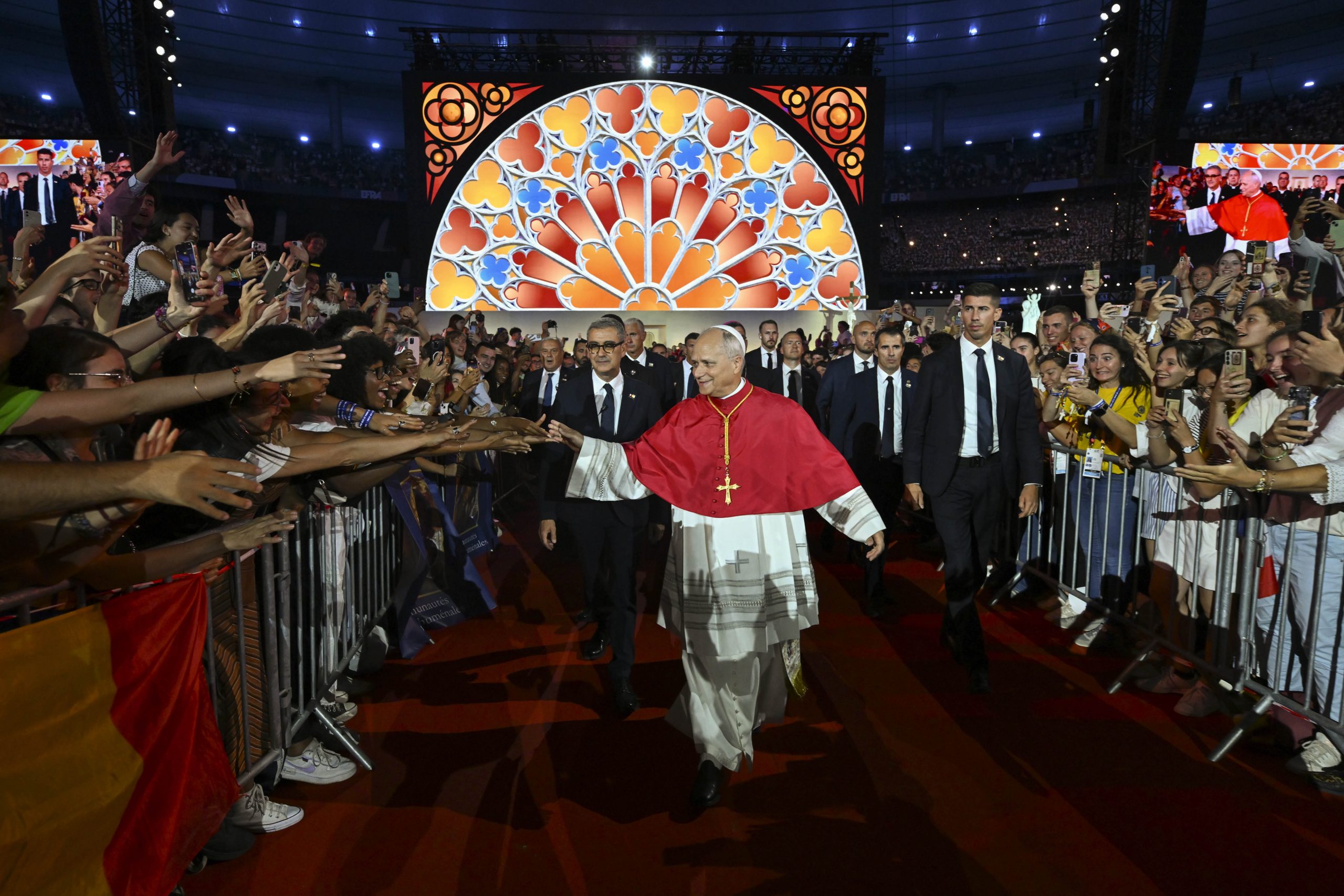
So why do popes make visits to mosques, courting controversy and criticism for making a point to go to holy sites of another religion? ‘We can live together in peace’Pope Leo XIV himself addressed criticism directed toward him on April 15 on board the papal plane after leaving Algiers bound for Cameroon. “I think the visit to the mosque was significant [and showed] that although we have different beliefs, we have different ways of worshipping, we have different ways of living, we can [still] live together in peace,” the Holy Father said. “I think that to promote that kind of image is something which the world needs to hear today,” he said, arguing that such visits show that “together we can continue to offer in our witness as we continue on this apostolic voyage.”Gabriel Said Reynolds, a theology professor at the University of Notre Dame who has written multiple works on the Quran and its relationship to Christianity, told EWTN News that interpreting papal visits to mosques should include an understanding of “the Churchʼs vision of God in the world.” “What is God’s relationship to the world? That’s been important to all of the recent popes,” he said.Reynolds pointed out that an Islamic mosque is “fundamentally different from a church.” “A Catholic church is a sort of temple in which God is present in the tabernacle — body, blood, soul, and divinity,” he said. “It’s a sacred space in the deepest sense of the word.”“What Muslims would say of a mosque is fundamentally different,” he said. “A mosque is for communal prayer, but the communal prayer that takes place in a mosque is no different than the ritual prayer that’s more often done at home.” He likened a mosque to a “gathering place” with just a few features that set it apart as a distinct site — such as a pulpit for occasional sermons and an alcove that denotes the direction of Mecca to which Muslims orient themselves during prayer. Reynolds said popes visit mosques in no small part as a “pastoral concern” for Christians living in majority-Muslim countries, such as Algeria. “Algerian society is thoroughly Islamic,” he said. “It’s not generally marked by notions of rights and responsibilities and citizenship in the same way the U.S. is. Cultivating positive relationships with Muslim leaders is absolutely essential for Christians.”Reynolds said the Churchʼs view about human dignity has “fundamental implications with its relationship toward non-Christians.” He pointed out, for instance, that the pope “could show up at an atheist convention and meet the people there and have dialogue with them.”“John 3:16 says God loves the world,” he said. “It’s not that God loves believers and doesn’t love the unbelievers. All people are children of God, according to Catholic teaching.”The declaration Nostra Aetate, meanwhile — issued by the Second Vatican Council in 1965 to address Catholicismʼs relationship with non-Christians — affirmed that the Church “regards [Muslims] with esteem.”The document points out that although Muslims “do not acknowledge Jesus as God,” they still “adore the one God” and “revere [Jesus] as a prophet” while giving honor to the Virgin Mother as well. The Second Vatican Council acknowledged that “in the course of centuries not a few quarrels and hostilities have arisen” between Christians and Muslims, but the document “urge[d] all to forget the past and to work sincerely for mutual understanding.”It further called on religious adherents to “preserve as well as to promote together for the benefit of all mankind social justice and moral welfare, as well as peace and freedom.”](https://unitedyam.com/wp-content/uploads/2026/04/ewtn-news-explains-why-does-the-pope-visit-mosques-on-papal-trips-catholic-for-more-than-a-quarter-century-popes-have-periodically-visited-islamic-mosques-as-part-of-official-voyages-and-papal-vis-scaled.jpg)
Why do popes make visits to Islamic mosques, courting controversy and criticism by taking part in events at holy sites of another religion?

![EWTN News explains: Why does the pope visit mosques on papal trips? #Catholic For more than a quarter-century, popes have periodically visited Islamic mosques as part of official voyages and papal visits. The tradition began with Pope John Paul II, who in 2001 became the first pope in history known to have entered a mosque when he visited the Great Mosque of Damascus in the capital of Syria. The subsequent Popes Benedict XVI, Francis, and Leo XIV have all paid visits to mosques to hold ecumenical dialogues and host diplomatic meetings. Yet the practice is not without some controversy. Indeed, Leo XIVʼs visit to the Great Mosque of Algiers on April 13 drew some backlash on social media by critics incredulous over the leader of the Catholic Church visiting a major Islamic holy site. (This was Leoʼs second visit to a mosque; he also visited the famed “Blue Mosque” in Istanbul in late 2025.)
Pope Leo XIV stands with Rector Mohamed Mamoun Al Qasimi at the Great Mosque in Algiers, Monday, April 13, 2026. | Credit: Vatican Media
So why do popes make visits to mosques, courting controversy and criticism for making a point to go to holy sites of another religion? ‘We can live together in peace’Pope Leo XIV himself addressed criticism directed toward him on April 15 on board the papal plane after leaving Algiers bound for Cameroon. “I think the visit to the mosque was significant [and showed] that although we have different beliefs, we have different ways of worshipping, we have different ways of living, we can [still] live together in peace,” the Holy Father said. “I think that to promote that kind of image is something which the world needs to hear today,” he said, arguing that such visits show that “together we can continue to offer in our witness as we continue on this apostolic voyage.”Gabriel Said Reynolds, a theology professor at the University of Notre Dame who has written multiple works on the Quran and its relationship to Christianity, told EWTN News that interpreting papal visits to mosques should include an understanding of “the Churchʼs vision of God in the world.” “What is God’s relationship to the world? That’s been important to all of the recent popes,” he said.Reynolds pointed out that an Islamic mosque is “fundamentally different from a church.” “A Catholic church is a sort of temple in which God is present in the tabernacle — body, blood, soul, and divinity,” he said. “It’s a sacred space in the deepest sense of the word.”“What Muslims would say of a mosque is fundamentally different,” he said. “A mosque is for communal prayer, but the communal prayer that takes place in a mosque is no different than the ritual prayer that’s more often done at home.” He likened a mosque to a “gathering place” with just a few features that set it apart as a distinct site — such as a pulpit for occasional sermons and an alcove that denotes the direction of Mecca to which Muslims orient themselves during prayer. Reynolds said popes visit mosques in no small part as a “pastoral concern” for Christians living in majority-Muslim countries, such as Algeria. “Algerian society is thoroughly Islamic,” he said. “It’s not generally marked by notions of rights and responsibilities and citizenship in the same way the U.S. is. Cultivating positive relationships with Muslim leaders is absolutely essential for Christians.”Reynolds said the Churchʼs view about human dignity has “fundamental implications with its relationship toward non-Christians.” He pointed out, for instance, that the pope “could show up at an atheist convention and meet the people there and have dialogue with them.”“John 3:16 says God loves the world,” he said. “It’s not that God loves believers and doesn’t love the unbelievers. All people are children of God, according to Catholic teaching.”The declaration Nostra Aetate, meanwhile — issued by the Second Vatican Council in 1965 to address Catholicismʼs relationship with non-Christians — affirmed that the Church “regards [Muslims] with esteem.”The document points out that although Muslims “do not acknowledge Jesus as God,” they still “adore the one God” and “revere [Jesus] as a prophet” while giving honor to the Virgin Mother as well. The Second Vatican Council acknowledged that “in the course of centuries not a few quarrels and hostilities have arisen” between Christians and Muslims, but the document “urge[d] all to forget the past and to work sincerely for mutual understanding.”It further called on religious adherents to “preserve as well as to promote together for the benefit of all mankind social justice and moral welfare, as well as peace and freedom.”](https://unitedyam.com/wp-content/uploads/2026/04/ewtn-news-explains-why-does-the-pope-visit-mosques-on-papal-trips-catholic-for-more-than-a-quarter-century-popes-have-periodically-visited-islamic-mosques-as-part-of-official-voyages-and-papal-vis-scaled.jpg)
Why do popes make visits to Islamic mosques, courting controversy and criticism by taking part in events at holy sites of another religion?


Bishop Samson Shukardin said government committees are often delayed so people forget, as protests continue over the marriage of 13-year-old Maria Shahbaz.


Christian leaders and Catholic clergy in the Muslim-majority South Asian nation are urging Prime Minister Tarique Rahman to add Easter Sunday to the government holiday calendar.


A Nigerian archbishop said African missionaries can evangelize a Europe uneasy with its Christian past.

![Pakistan Christian prisoners rebuild lives after church bombings #Catholic LAHORE, Pakistan — Every year during Lent, Sunil Masih remembers his elder brother as churches in Youhanabad — Lahore’s largest squatter settlement for poor Christians — mark the anniversary of the 2015 church bombings.The four Catholic brothers were among more than 150 Christians arrested by police days after twin suicide attacks on St. John’s Catholic Church and Christ Church on March 15, 2015, which killed at least 19 people and injured hundreds. The attacks were claimed by Jamaat-ul-Ahrar, an offshoot of Tehreek-e-Taliban Pakistan.The bombings sparked mob violence that mistakenly killed two Muslim men, who were later identified and detained through raids and video evidence.
Sunil Masih stands beside his vegetable cart in front of his family’s former
milk shop in Youhanabad, Lahore, Pakistan, on March 15, 2025. | Credit:
Kamran Chaudhry
Masih, now 28, said the trauma of prison changed him forever.“They hurled abuses at us, beat us with strips cut from vehicle tires, and in jail we were given old dried roti [flat bread],” he told EWTN News. “Water from the greasy toilet taps was served for drinking. Family meetings were allowed only after a month. It was a hellhole on earth.”He and his brother Sadaqat Perwaiz — popularly known as Monty — were released after six months in Central Jail Lahore. One brother, however, remained among 42 Christians and one Muslim charged in the lynching case.Devastation beyond prisonThe protracted court proceedings devastated the family’s four-decade-old milk business, saddled them with mounting debts, and forced the sale of their 680-square-foot home.Their worries deepened after two Christian inmates, Inderyas Masih, 36, and Usman Shaukat, 29, died in custody under suspicious circumstances during the trial. Police claimed tuberculosis and a heart attack, respectively, while families and the British Pakistani Christian Association reported bruises and unexplained injuries.
Pakistani police stand guard outside St. John’s Catholic Church in
Youhanabad, Lahore, on March 15, 2025. Posters of Servant of God Akash Bashir flank the entrance gate on the 10th anniversary of twin suicide bombings that struck the neighborhood. | Credit: Kamran Chaudhry
In January 2020, an anti-terrorism court acquitted the remaining 39 accused after blood money (Diyat) of 25 million rupees ($89,800) was paid to the victims’ families by Pastor Anwar Fazal, a prominent Christian televangelist.Under the Qisas and Diyat Ordinance 1990, introduced during Gen. Ziaul Haq’s Islamization process, courts calculate compensation based on the financial capacity of the convict and the victim’s heirs, with a minimum value linked to 30,630 grams of silver.Monty died of a heart attack in 2022, leaving behind two children aged 10 and 14. His faded poster still hangs in front of the family’s closed milk shop.“He was a stout man, known for his strong community ties and friendly nature in our neighborhood. Prison left him very lean and weakened by an infection that caused his legs to swell beneath the knees and bleed,” Masih said.Today, Sunil Masih sells vegetables from a wooden cart in front of the same shop, now leased to a real estate dealer. He hopes to marry once his new business stabilizes.‘The gift of a hero’On March 15, police guarded churches in Youhanabad, which houses more than 150,000 Christians, as the community observed the 11th bombing anniversary.At St. John’s, parishioners lit candles and placed flowers beneath a banner honoring Akash Bashir, the 20-year-old security volunteer who died preventing a suicide bomber from entering the church during that Sunday Mass.“Salute and gratitude to the martyrs of Youhanabad,” read the banner near the Marian grotto. In January 2022, the Vatican recognized Bashir as a servant of God, making him the first Pakistani Catholic on the path to canonization.
Father Akram Javed (fifth from right), parish priest of St. John’s Catholic Church, lights a memorial candle for Servant of God Akash Bashir at a commemoration in Youhanabad, Lahore, Pakistan, on March 15, 2025. |
Credit: Kamran Chaudhry
Father Akram Javed, parish priest of St. John’s, thanked police for security.“A group of 30 local volunteers carry on Akash’s mission, protecting the church and worshippers. The bombings were a terrible tragedy, but in that darkness, we received the gift of a hero,” he told EWTN News.‘The bombing was a national tragedy’Pentecostal politician Aslam Pervaiz Sahotra, who spent five years in prison, sees the anniversary as a moment of reflection for Pakistan’s 3.3 million Christians, many of whom continue to face discrimination, economic hardship, and lingering trauma.
A man prays outside a church in Youhanabad, Lahore, Pakistan, on March 15, 2025, during commemorations marking the anniversary of the twin suicide bombings. Banners honoring Akash Bashir are visible in the background. | Credit: Kamran Chaudhry
“The bombing was a national tragedy from which the authorities learnt nothing. We continue to suffer losses due to terrorism, with sporadic attacks targeting minority communities and security forces,” said the 65-year-old head of the Massiha Millat Party (Christian Nation Party).He alleged prison authorities tried to manipulate him, introducing Muslim prisoners to persuade him to stay passive.“Despite back pain from four displaced vertebrae, my time in prison strengthened my faith and resolve for activism. The trend of arresting Christians for alleged blasphemy to appease angry crowds will continue unless investigations are conducted on merit,” he added.
Pakistani bishops demand probe into death of Christian farmworker
The United States Commission on International Religious Freedom, in its 2025 annual report, said religious freedom in Pakistan continued to deteriorate, recommending it be designated a “country of particular concern,” citing blasphemy-related prosecutions, mob violence, and forced conversions targeting Christians and other minorities, and a growing climate of fear and impunity.](https://unitedyam.com/wp-content/uploads/2026/03/pakistan-christian-prisoners-rebuild-lives-after-church-bombings-catholic-lahore-pakistan-every-year-during-lent-sunil-masih-remembers-his-elder-brother-as-churches-in-youhanabad.jpg)
Eleven years after twin suicide bombings struck two Pakistan churches, survivors of mass arrests still bear the scars as a young martyr who died stopping the attack moves toward sainthood.


Now more than ever, the Christian minority in the Holy Land needs the support it receives through the annual Good Friday collection as ongoing violence in the Middle East has curtailed pilgrimages.


Catholic Indigenous leaders in Bangladesh say they will escalate protests if the government does not halt a forest development project they call a pretext for eviction.


As Ramadan draws to a close in the camps of Cox’s Bazar, Caritas Bangladesh is sharing the meaning of Lent with more than 1 million Rohingya Muslim refugees.


| Picture of the day |
|---|
|
|
Aerial view of 2023 Bishwa Ijtema in Bangladesh. With 5 million adherents, Bishwa Ijtema is the second-largest Muslim gathering in the world.
|