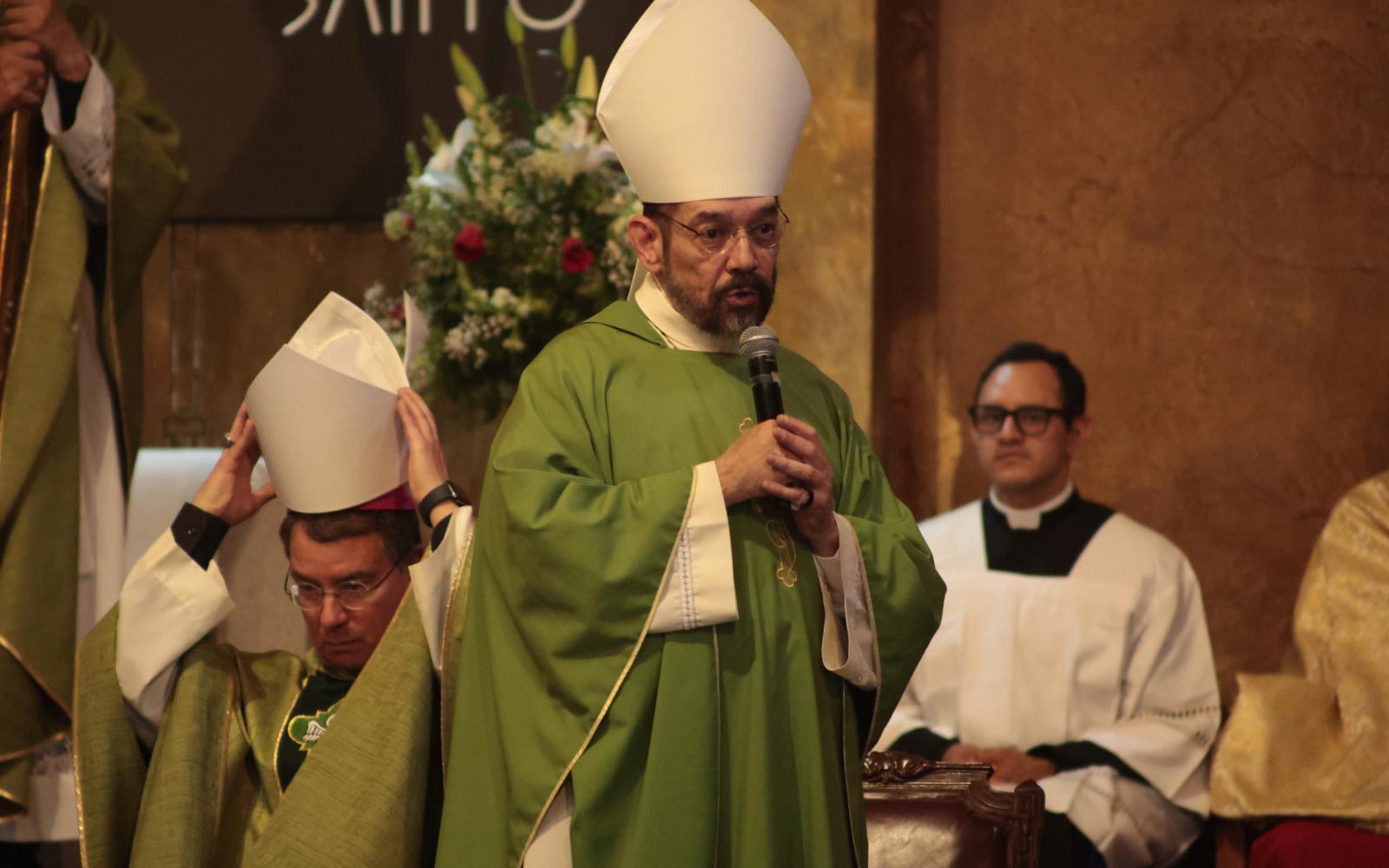
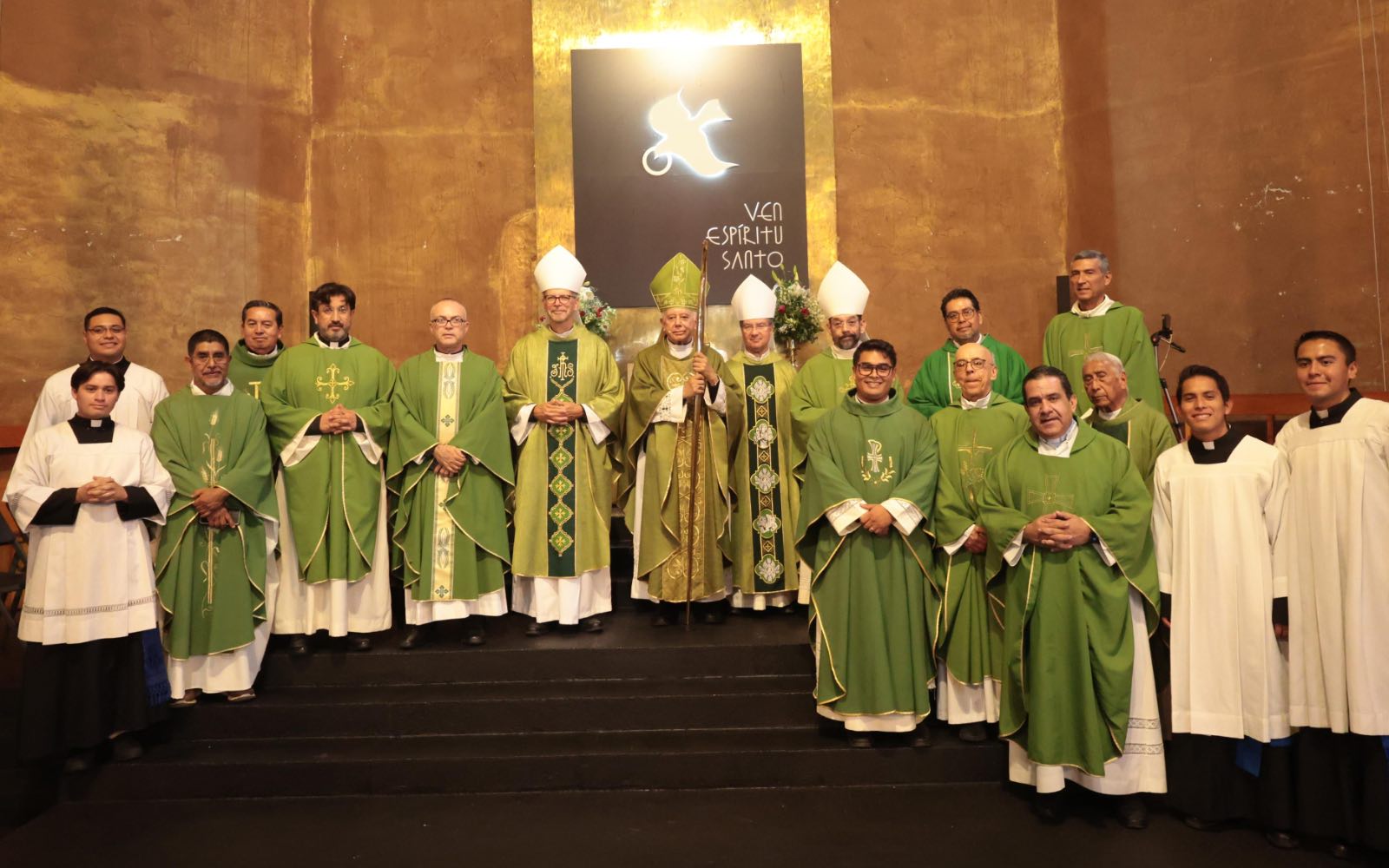
Read More Bishops from Mexico, U.S., Canada see urgent need to speak ‘with one voice’ #Catholic “It is increasingly urgent that the Catholic Church in the Americas speak with one voice,” stated Bishop Daniel Flores of Brownsville, Texas, vice president of the United States Conference of Catholic Bishops (USCCB), following the Mass celebrated Aug. 30 at the cathedral in Cuernavaca, Mexico, which marked the beginning of a meeting among Mexican, U.S., and Canadian bishops.Bishop Ramón Castro Castro of Cuernavaca, president of the Mexican Bishops’ Conference (CEM, by its Spanish acronym) was the main celebrant of the Mass. Concelebrating alongside various priests, along with Flores, were Bishop Oscar Cantú of San José, California, chairman of the USCCB Subcommittee on Hispanic/Latino Affairs; and Bishop Pierre Goudreault of Sainte-Anne-de-la-Pocatière, president of the Canadian Conference of Catholic Bishops. Bishop Daniel Flores of Brownsville, Texas, addresses the congregation at the conclusion of the Mass at Cuernavaca Cathedral on Aug. 30, 2026. | Credit: Photo courtesy of the Diocese of Cuernavaca In a brief message, Flores expressed gratitude for “Bishop Ramón’s inspiration in inviting us to this gathering to strengthen this ecclesial communion.”“In the times we are living through, it will become increasingly important — indeed, urgent — for the Catholic Church in the Americas to speak with one voice, defending the honor of Our Lord and the dignity of the human person — especially the poor and immigrants, who often have nowhere to lay their heads, just like the Lord Jesus himself,” he said.“We need to preach together and united as one Church, under the guidance of our Holy Father, Pope Leo, and in communion with all the bishops of the world,” he added.3 distinct countries ‘but one and the same faith’In his homily, Castro highlighted that this meeting of leaders from North American episcopal conferences is “the first of its kind in our history.”“We are three distinct countries. We are three Churches with different histories and realities, yet we share one and the same faith, one baptism, one Eucharist, and one mission,” the Mexican prelate affirmed.Regarding the role of bishops, Castro emphasized that “before being leaders, we are disciples,” and “before having responsibilities, we are men called by the Lord.”“Perhaps this can be the profound spirit of this gathering of the Church in North America: for all of us to place ourselves once again behind Jesus.” Bishop Ramón Castro Castro of Cuernavaca, Mexico, right, and Bishop Pierre Goudreault of Sainte-Anne-de-la-Pocatière, Canada, pray during the consecration at the Cuernavaca Cathedral on Aug. 30, 2026. | Credit: Photo courtesy of the Diocese of Cuernavaca ‘Enormous challenges’The president of the CEM emphasized that “our peoples face enormous challenges, particularly Mexico,” and pointed to issues such as “violence, demagoguery, corruption, loneliness, secularization, individualism, materialism, polarization, wounded families, and young people seeking reasons for hope.”He further noted that “perhaps one of the most common themes among the three of us as countries and conferences is migration.”“Over the coming days, we will have the opportunity to share our perspectives on these realities, not in a spirit of judgment or confrontation but rather out of the pastoral responsibility that falls to us as shepherds,” the bishop of Cuernavaca said. The faithful attend Mass at the Cuernavaca Cathedral on Aug. 30, 2026. | Credit: Photo courtesy of the Diocese of Cuernavaca “We want to better understand the lives of our people. To what end? To be able to serve them better,” he stated.Castro emphasized that “migration must not be reduced to statistics, public policies, or economic obligations,” because “behind every migrant there is a face, a story, a family, a hope, and, unfortunately, often many wounds.”“The Church must view these people as brothers and sisters whose dignity must be recognized and protected,” he said.The Mexican bishop also expressed his wish “that from Cuernavaca we might send a simple yet powerful sign to our churches, churches on pilgrimage in Canada, the United States, and Mexico.”This story was first published by ACI Prensa, the Spanish-language sister service of EWTN News. It has been translated and adapted by EWTN News English. unitedyam August 31, 2026September 1, 2026 The bishops discussed the pastoral challenges facing the Church in North America as a whole and concelebrated a Mass on Aug. 30 in the Cuernavaca, Mexico, cathedral. Read More
Read More U.S. bishops urge Supreme Court to require 12-person juries for criminal cases #Catholic The U.S. Conference of Catholic Bishops is urging the U.S. Supreme Court to require 12-person juries in criminal cases, with the bishops arguing against a Florida policy allowing smaller six-person juries in many cases. The case Kian v. Florida, which the Supreme Court agreed to hear in June, was brought after Florida chiropractor Hamed Kian was convicted of five felony counts for practicing without a license. Kian was found guilty by a six-person jury; the state of Florida only requires 12-person juries in capital cases. Several other states have similar rules. Kian sued the state arguing that the Sixth Amendment to the U.S. Constitution guarantees a right to a 12-person jury. He lost his appeal at the Fourth District Court of Appeal of Florida and subsequently appealed directly to the Supreme Court, which will hold arguments in the case in its upcoming term. In their amicus filing, the U.S. bishops argued that the term “jury” in the U.S. has historically referenced a body of 12 jurors; the bishops pointed to “Founding-era dictionaries” as well as “common-law history.” The bishops said they have a “strong interest” in the case, insofar as the Catholic Church over the centuries has played a “central role in shaping the legal culture from which the common-law jury emerged.”Among the historical examples of 12-person juries the bishops cited include the General Fundamentals of Plymouth, “the earliest codified legal system by English colonists in North America,” which guaranteed that “all trials” would be “tried by a jury of twelve good and lawful men.” The prelates disputed the Supreme Court’s 1970 ruling in the case Williams v. Florida, which held that the Sixth Amendment does not require 12 jurors in court cases. That ruling in part “discard[ed] the robust common-law history of the jury right,” while the high court in that decision “set far too high a bar for historical relevance,” they said.The bishops further cited the biblical commandment to “love your neighbor justly.” They pointed to the Catholic catechism’s mandate for public authorities to “dispense justice humanely by respecting the rights of everyone.” They urged the Supreme Court to “return to its previously long-held understanding that the Constitution entitles criminal defendants to a jury of twelve of their peers.”Numerous advocacy groups have also filed amicus briefs advocating the 12-juror standard, including the American Civil Liberties Union, the Innocence Project, several dozen current and former prosecutors, and the Florida Association of Criminal Defense Lawyers. unitedyam August 18, 2026August 19, 2026 The bishops argue that the term “jury” in the U.S. has historically referenced a body of 12 jurors. Read More