Paris

France legalizes euthanasia after forceful push through Parliament #Catholic The French National Assembly gave final approval on July 15 to a bill legalizing euthanasia and assisted suicide, making France one of the few European countries to legalize the practice along with Belgium, the Netherlands, Luxembourg, and Spain. The 291-241 vote came three years after President Emmanuel Macron, who had made it one of his key campaign promises, first opened the question to national debate.The vote ended an unusual parliamentary stalemate between the National Assembly and the Senate. Members of the National Assembly passed the bill three times over the course of 14 months — most recently on June 30 by a vote of 295 to 232 — and senators rejected it just as many times. On July 7, the Senate passed, by a narrow majority of 169 to 164, with 11 abstentions, a preliminary motion to outright reject the bill rather than debate it, and this motion itself called on the government to end the legislative process. Rather than heeding this call, Prime Minister Sébastien Lecornu invoked Article 45 of the Constitution, which allows the government to give the National Assembly the final say when repeated readings fail to produce an agreement between the two chambers. He then referred the bill back to the National Assembly for a fourth and final vote instead of a fourth reading in the Senate.The July 15 vote, however, did not close the matter. On July 14, Lecornu announced he would refer part of the text to the Constitutional Council, a step Senate President Gérard Larcher had also urged, citing in particular how the billʼs conscience clause would interact with health and social care facilities built around end-of-life accompaniment that exclude assisted dying. The council must rule within a month, or eight days if the government asks for an expedited review, meaning the law cannot be promulgated until that review is complete even though the Assembly has now adopted it.The end-of-life law covers both euthanasia, administered by a doctor or nurse, and assisted suicide, in which the patient self-administers a lethal substance, under five cumulative conditions: A person must be an adult, a stable resident of France, diagnosed with a serious and incurable condition, in an advanced or terminal phase of that condition, and suffering in a way current treatment cannot relieve, while remaining able to express a free and informed decision. Self-administration is supposed to be the default rule, with the law providing for intervention by a healthcare professional only when the patient is physically unable to act.A supporting measure aimed at expanding access to palliative care was adopted with much broader support, passing its first reading in the Senate by a vote of 307 to 17. To date, more than 20% of French departments still lack a palliative care unit, according to figures cited repeatedly by the Bishops’ Conference of France during the debate.The push to legalize assisted dying traces back to September 2022, when the National Consultative Ethics Committee reversed its earlier opposition to assisted dying and endorsed an “ethical” application of the practice. A citizens’ panel Macron had convened spent the following winter weighing the question and backed legalization.The French president unveiled the outline of a bill in March 2024, but the initiative stalled when he dissolved the Assembly in June the same year. Deputy Olivier Falorni, who had filed an earlier and unsuccessful end-of-life bill, revived it in 2025.Critics argue the newly adopted framework is among the most permissive of its kind in the world. Grégor Puppinck, a Catholic lawyer and director general of the European Centre for Law and Justice, has published a point-by-point analysis contending that the entire process rests on the judgment of a single physician, who may meet the patient for the first time on the day of the request and need not be the one already treating them.The two additional professionals that physician must consult are chosen by the same person, are not required to examine the patient in person, and may be consulted by videoconference. Puppinck noted the statute sets no minimum interval between the decision and the act itself beyond a two-day reflection window, relatives have no guaranteed right to be informed beforehand, and they cannot challenge the outcome in court. Doctors who object in conscience must still refer patients to a colleague willing to proceed, and private and religious institutions, including nursing homes, must accommodate mobile euthanasia teams under threat of administrative penalties. Oversight, in Puppinck’s account, comes only after death, based on a report filed by the same clinician who carried it out.The founders of the ethics collective Democracy, Ethics, and Solidarity, Laurent Frémont and Emmanuel Hirsch, wrote in Le Journal du Dimanche that the law’s eligibility criteria — primarily a “serious and incurable condition” causing “unbearable suffering,” are defined vaguely enough that a strict medical interpretation could make more than 1 million people eligible, including patients with chronic illnesses, psychiatric disorders, or advanced age, without requiring a prior written request, a peer review by medical colleagues, or a psychiatric evaluation.A 2025 study by the Fondation pour l’innovation politique estimated the measure could save the state around 1.4 billion euros (.6 billion) a year in health, eldercare, and pension spending, a projection critics have cited as evidence of the pressures vulnerable and elderly patients could face once the law takes effect.The French bishops’ conference called the text a threat to “the most fragile” among French citizens in a statement issued in May 2025 ahead of the Assembly’s first vote on the bill. The archbishop of Paris, Laurent Ulrich, has repeatedly urged lawmakers to reconsider their position, asserting that true solidarity is built through caring for others rather than through death. “More than assistance in dying, our society needs assistance in living,” he has repeatedly stated.In a video appeal to lawmakers released before the vote, Archbishop Vincent Jordy of Tours invoked François Rabelais’ centuries-old warning that “science without conscience is but the ruin of the soul.” What is underway, he said, is “an anthropological shift,” a new way of viewing life and its end that will gradually reshape the country, touching caregivers, families, people with disabilities, and the relationship between generations. He pointed to the Netherlands, where regulators had layered on safeguards for two decades and where health officials confirmed in June that a child under 12 had been euthanized for the first time, under a 2024 expansion of the law to children between the ages of 1 and 12. Making a law, Jordy said, is also opening doors toward things “one had perhaps not imagined” when it was written.

France legalizes euthanasia after forceful push through Parliament #Catholic The French National Assembly gave final approval on July 15 to a bill legalizing euthanasia and assisted suicide, making France one of the few European countries to legalize the practice along with Belgium, the Netherlands, Luxembourg, and Spain. The 291-241 vote came three years after President Emmanuel Macron, who had made it one of his key campaign promises, first opened the question to national debate.The vote ended an unusual parliamentary stalemate between the National Assembly and the Senate. Members of the National Assembly passed the bill three times over the course of 14 months — most recently on June 30 by a vote of 295 to 232 — and senators rejected it just as many times. On July 7, the Senate passed, by a narrow majority of 169 to 164, with 11 abstentions, a preliminary motion to outright reject the bill rather than debate it, and this motion itself called on the government to end the legislative process. Rather than heeding this call, Prime Minister Sébastien Lecornu invoked Article 45 of the Constitution, which allows the government to give the National Assembly the final say when repeated readings fail to produce an agreement between the two chambers. He then referred the bill back to the National Assembly for a fourth and final vote instead of a fourth reading in the Senate.The July 15 vote, however, did not close the matter. On July 14, Lecornu announced he would refer part of the text to the Constitutional Council, a step Senate President Gérard Larcher had also urged, citing in particular how the billʼs conscience clause would interact with health and social care facilities built around end-of-life accompaniment that exclude assisted dying. The council must rule within a month, or eight days if the government asks for an expedited review, meaning the law cannot be promulgated until that review is complete even though the Assembly has now adopted it.The end-of-life law covers both euthanasia, administered by a doctor or nurse, and assisted suicide, in which the patient self-administers a lethal substance, under five cumulative conditions: A person must be an adult, a stable resident of France, diagnosed with a serious and incurable condition, in an advanced or terminal phase of that condition, and suffering in a way current treatment cannot relieve, while remaining able to express a free and informed decision. Self-administration is supposed to be the default rule, with the law providing for intervention by a healthcare professional only when the patient is physically unable to act.A supporting measure aimed at expanding access to palliative care was adopted with much broader support, passing its first reading in the Senate by a vote of 307 to 17. To date, more than 20% of French departments still lack a palliative care unit, according to figures cited repeatedly by the Bishops’ Conference of France during the debate.The push to legalize assisted dying traces back to September 2022, when the National Consultative Ethics Committee reversed its earlier opposition to assisted dying and endorsed an “ethical” application of the practice. A citizens’ panel Macron had convened spent the following winter weighing the question and backed legalization.The French president unveiled the outline of a bill in March 2024, but the initiative stalled when he dissolved the Assembly in June the same year. Deputy Olivier Falorni, who had filed an earlier and unsuccessful end-of-life bill, revived it in 2025.Critics argue the newly adopted framework is among the most permissive of its kind in the world. Grégor Puppinck, a Catholic lawyer and director general of the European Centre for Law and Justice, has published a point-by-point analysis contending that the entire process rests on the judgment of a single physician, who may meet the patient for the first time on the day of the request and need not be the one already treating them.The two additional professionals that physician must consult are chosen by the same person, are not required to examine the patient in person, and may be consulted by videoconference. Puppinck noted the statute sets no minimum interval between the decision and the act itself beyond a two-day reflection window, relatives have no guaranteed right to be informed beforehand, and they cannot challenge the outcome in court. Doctors who object in conscience must still refer patients to a colleague willing to proceed, and private and religious institutions, including nursing homes, must accommodate mobile euthanasia teams under threat of administrative penalties. Oversight, in Puppinck’s account, comes only after death, based on a report filed by the same clinician who carried it out.The founders of the ethics collective Democracy, Ethics, and Solidarity, Laurent Frémont and Emmanuel Hirsch, wrote in Le Journal du Dimanche that the law’s eligibility criteria — primarily a “serious and incurable condition” causing “unbearable suffering,” are defined vaguely enough that a strict medical interpretation could make more than 1 million people eligible, including patients with chronic illnesses, psychiatric disorders, or advanced age, without requiring a prior written request, a peer review by medical colleagues, or a psychiatric evaluation.A 2025 study by the Fondation pour l’innovation politique estimated the measure could save the state around 1.4 billion euros ($1.6 billion) a year in health, eldercare, and pension spending, a projection critics have cited as evidence of the pressures vulnerable and elderly patients could face once the law takes effect.The French bishops’ conference called the text a threat to “the most fragile” among French citizens in a statement issued in May 2025 ahead of the Assembly’s first vote on the bill. The archbishop of Paris, Laurent Ulrich, has repeatedly urged lawmakers to reconsider their position, asserting that true solidarity is built through caring for others rather than through death. “More than assistance in dying, our society needs assistance in living,” he has repeatedly stated.In a video appeal to lawmakers released before the vote, Archbishop Vincent Jordy of Tours invoked François Rabelais’ centuries-old warning that “science without conscience is but the ruin of the soul.” What is underway, he said, is “an anthropological shift,” a new way of viewing life and its end that will gradually reshape the country, touching caregivers, families, people with disabilities, and the relationship between generations. He pointed to the Netherlands, where regulators had layered on safeguards for two decades and where health officials confirmed in June that a child under 12 had been euthanized for the first time, under a 2024 expansion of the law to children between the ages of 1 and 12. Making a law, Jordy said, is also opening doors toward things “one had perhaps not imagined” when it was written.

The vote, ending an unusual parliamentary stalemate between the National Assembly and the Senate, came three years after President Emmanuel Macron first opened the question to national debate.

Read More
Notre-Dame Cathedral enters final stage of restoration following 2019 fire #Catholic A symbol of Christian heritage and one of the finest examples of Gothic architecture, Notre-Dame Cathedral in Paris, attracts millions of tourists and pilgrims from around the world each year.The devastating fire that significantly damaged the iconic cathedral on April 15, 2019, led to an unprecedented wave of international solidarity to ensure its restoration.Although the cathedral reopened for worship in December 2024, restoration work is not yet complete. French authorities recently unveiled a final phase of work to be carried out from 2027 to 2033, which will require a new fundraising campaign aiming to raise 130 million euros (8.5 million).
 
 A view of the interior of the restored Notre Dame Cathedral. | Credit: Photo courtesy of Martín Muñoz Ledo
 
 The planned investment amounts to 150 million euros (1.3 million). Of that sum, nearly 20 million euros (.8 million) has already been secured, while the remainder is to come from donations from individuals, companies, and partner organizations, following the funding model used to rebuild the monument after the fire.“Our goal is to fully complete the cathedral’s restoration,” stated Philippe Jost, president of Rebâtir Notre-Dame de Paris (Rebuilding Notre Dame in Paris), in an interview with the French Catholic newspaper La Croix.The program consists of around a dozen projects aimed both at repairing damage done by the fire and at restoring elements of cultural heritage that were already in a fragile state of preservation prior to 2019.The western rose window: The central focusThe planned works feature the complete restoration of the great western rose window, one of the most iconic examples of European Gothic architecture. This historic 13th-century stained-glass window has not undergone a complete restoration since the work directed by Eugène Viollet-le-Duc in the 19th century.The plans also include the restoration of the north transept façades, various medieval sculptures, and other architectural elements showing signs of wear. Project leaders believe these works will be crucial for ensuring the cathedralʼs long-term preservation.A functioning cathedral, yet still under constructionThe reopening of Notre Dame in late 2024 allowed the resumption of the cathedralʼs ordinary liturgical life. Since then, thousands of the faithful and tourists have once again passed through its doors each day.However, the fire also made evident conservation issues that had accumulated over decades in a building with more than eight centuries of history. Consequently, the new phase of work aims not only to repair fire damage but also to address broader structural and heritage-related needs.The reopening ceremony, held in December 2024, was considered one of the most significant cultural and religious events in Europe in recent years.Furthermore, those responsible for the restoration hope to rekindle the spirit of solidarity that emerged following the 2019 tragedy. At that time, financial pledges totaling nearly 1 billion euros (.14 billion) were secured, funds that made the reconstruction possible and left resources for future conservation work.Debate persists over new stained-glass windowsThe unveiling of this final phase does not put an end to one of the most notable controversies surrounding Notre Dame: the proposal, backed by President Emmanuel Macron, to replace six 19th-century stained-glass windows created by Viollet-le-Duc with contemporary works by French artist Claire Tabouret.The project remains subject to a court ruling following challenges filed by various heritage preservation associations. Their representatives argue that the historic stained-glass windows sustained minimal damage during the fire and consider their replacement unjustified.The issue has divided restoration experts, public officials, and figures from the world of culture. While some advocate for the complete preservation of the cathedralʼs historic legacy, others view the proposal as an opportunity to incorporate a new artistic expression into one of Franceʼs most recognizable monuments.This story was first published by ACI Prensa, the Spanish-language sister service of EWTN News. It has been translated and adapted by EWTN News English.

Notre-Dame Cathedral enters final stage of restoration following 2019 fire #Catholic A symbol of Christian heritage and one of the finest examples of Gothic architecture, Notre-Dame Cathedral in Paris, attracts millions of tourists and pilgrims from around the world each year.The devastating fire that significantly damaged the iconic cathedral on April 15, 2019, led to an unprecedented wave of international solidarity to ensure its restoration.Although the cathedral reopened for worship in December 2024, restoration work is not yet complete. French authorities recently unveiled a final phase of work to be carried out from 2027 to 2033, which will require a new fundraising campaign aiming to raise 130 million euros ($148.5 million). A view of the interior of the restored Notre Dame Cathedral. | Credit: Photo courtesy of Martín Muñoz Ledo The planned investment amounts to 150 million euros ($171.3 million). Of that sum, nearly 20 million euros ($22.8 million) has already been secured, while the remainder is to come from donations from individuals, companies, and partner organizations, following the funding model used to rebuild the monument after the fire.“Our goal is to fully complete the cathedral’s restoration,” stated Philippe Jost, president of Rebâtir Notre-Dame de Paris (Rebuilding Notre Dame in Paris), in an interview with the French Catholic newspaper La Croix.The program consists of around a dozen projects aimed both at repairing damage done by the fire and at restoring elements of cultural heritage that were already in a fragile state of preservation prior to 2019.The western rose window: The central focusThe planned works feature the complete restoration of the great western rose window, one of the most iconic examples of European Gothic architecture. This historic 13th-century stained-glass window has not undergone a complete restoration since the work directed by Eugène Viollet-le-Duc in the 19th century.The plans also include the restoration of the north transept façades, various medieval sculptures, and other architectural elements showing signs of wear. Project leaders believe these works will be crucial for ensuring the cathedralʼs long-term preservation.A functioning cathedral, yet still under constructionThe reopening of Notre Dame in late 2024 allowed the resumption of the cathedralʼs ordinary liturgical life. Since then, thousands of the faithful and tourists have once again passed through its doors each day.However, the fire also made evident conservation issues that had accumulated over decades in a building with more than eight centuries of history. Consequently, the new phase of work aims not only to repair fire damage but also to address broader structural and heritage-related needs.The reopening ceremony, held in December 2024, was considered one of the most significant cultural and religious events in Europe in recent years.Furthermore, those responsible for the restoration hope to rekindle the spirit of solidarity that emerged following the 2019 tragedy. At that time, financial pledges totaling nearly 1 billion euros ($1.14 billion) were secured, funds that made the reconstruction possible and left resources for future conservation work.Debate persists over new stained-glass windowsThe unveiling of this final phase does not put an end to one of the most notable controversies surrounding Notre Dame: the proposal, backed by President Emmanuel Macron, to replace six 19th-century stained-glass windows created by Viollet-le-Duc with contemporary works by French artist Claire Tabouret.The project remains subject to a court ruling following challenges filed by various heritage preservation associations. Their representatives argue that the historic stained-glass windows sustained minimal damage during the fire and consider their replacement unjustified.The issue has divided restoration experts, public officials, and figures from the world of culture. While some advocate for the complete preservation of the cathedralʼs historic legacy, others view the proposal as an opportunity to incorporate a new artistic expression into one of Franceʼs most recognizable monuments.This story was first published by ACI Prensa, the Spanish-language sister service of EWTN News. It has been translated and adapted by EWTN News English.

The cathedral has reopened but restoration work remains to be done, including on the western rose window.

Read More
Cambodia’s Buddhist leaders honor Catholic bishop for decades of cooperation #Catholic Cambodia’s Buddhist leadership has conferred a high honorary title on the Catholic bishop of Phnom Penh, recognizing decades of cooperation between Buddhist and Christian communities in a country where the Catholic Church remains a small minority.Bishop Olivier Schmitthaeusler, apostolic vicar of Phnom Penh, received the title “Akka Mahāupāsakabuddhasāsanūpatthambhakr,” roughly translated as “Elder Great Lay Supporter and Upholder of the Buddha’s Dispensation,” during a ceremony on June 13, 2026, at Wat Botum Vatey in the Cambodian capital.
 
 Bishop Olivier Schmitthaeusler meets with Venerable Khim Sorn, third deputy supreme patriarch of Cambodiaʼs Mohanikaya Buddhist order, during a ceremony at Wat Botum Vatey in Phnom Penh on June 13, 2026. | Credit: Ly Sovanna/Catholic National Office for Social Communications in Cambodia
 
 The title was conferred by Supreme Patriarch Nun Nget of Cambodia’s Mohanikaya Buddhist order and presented at a ceremony presided over by Venerable Khim Sorn, the order’s third deputy supreme patriarch.The honor builds on a distinction Schmitthaeusler received in 2022, when Cambodia’s Buddhist leadership named him a “Maha Upasaka,” recognizing his support for Buddhist communities and his role in promoting dialogue and cooperation between Cambodia’s Buddhist majority and its small Catholic minority.At the time, Buddhist leaders cited joint development projects, educational initiatives, and efforts to strengthen social cohesion. The new title represents a higher level of recognition from the country’s Buddhist establishment.Speaking at the ceremony, Khim Sorn pointed to Cambodia’s constitutional framework, which recognizes Buddhism as the state religion while protecting religious freedom.He said the Constitution of the Kingdom of Cambodia clearly stipulates that Buddhism is the state religion, but “it also guarantees complete freedom of religious belief without coercion” and promotes religious harmony, peaceful coexistence, and mutual respect among the different religions.Buddhist leaders said the recognition reflected Schmitthaeusler’s long involvement in educational, humanitarian, and community-development initiatives carried out in cooperation with Buddhist institutions.For Schmitthaeusler, the award marked another chapter in a relationship that began more than two decades ago. “This is a profoundly meaningful event for me as a Catholic bishop,” he said.The French-born missionary of the Paris Foreign Missions Society traced that relationship to his years as a parish priest in Takeo province, where Catholics and Buddhists worked together on local development projects.Among them was the construction of a road linking a Catholic community and a nearby pagoda, an initiative he said helped lay the groundwork for deeper cooperation.Over the years, that collaboration expanded into education and social services. Schmitthaeusler noted that he supported the establishment of a primary school at Wat Ang Montrey, where students study Pali, Sanskrit, and other academic subjects.The prelate also highlighted joint humanitarian efforts during the COVID-19 pandemic and assistance provided to displaced families during recent tensions along the Cambodia-Thailand border.“Receiving the status of Akka Mahāupāsakabuddhasāsanūpatthambhakr today is a moment of profound recognition of how the Catholic Church and Buddhism walk hand-in-hand for the common good of our people and our country,” he said.
 
 Bishop Olivier Schmitthaeusler poses with community members outside Wat Botum Vatey in Phnom Penh on June 13, 2026, after receiving a high honorary title from Cambodiaʼs Buddhist leadership in recognition of his work promoting Buddhist-Christian cooperation. | Credit: Ly Sovanna/Catholic National Office for Social Communications in Cambodia
 
 Schmitthaeusler also cited recent dialogue initiatives involving Buddhist and Christian leaders from Cambodia and across Asia focused on peacebuilding and reconciliation.“We know that when Cambodia is full of peace, it radiates a positive influence to the rest of the world,” he said. “This is a powerful signal: when religions journey together, the world will witness true peace,” he added.A small Church rebuilt after the Khmer RougeTheravada Buddhism is practiced by the vast majority of Cambodia’s roughly 18 million people. The Catholic Church numbers about 20,000 faithful across one apostolic vicariate and two apostolic prefectures.The Catholic Church was nearly wiped out during the Khmer Rouge era, when religious communities were persecuted and most church buildings were destroyed.Since public religious life resumed in the early 1990s, the Catholic Church has gradually rebuilt through education, health care, social services, and pastoral ministry, becoming a small but visible presence in Cambodian society.

Cambodia’s Buddhist leaders honor Catholic bishop for decades of cooperation #Catholic Cambodia’s Buddhist leadership has conferred a high honorary title on the Catholic bishop of Phnom Penh, recognizing decades of cooperation between Buddhist and Christian communities in a country where the Catholic Church remains a small minority.Bishop Olivier Schmitthaeusler, apostolic vicar of Phnom Penh, received the title “Akka Mahāupāsakabuddhasāsanūpatthambhakr,” roughly translated as “Elder Great Lay Supporter and Upholder of the Buddha’s Dispensation,” during a ceremony on June 13, 2026, at Wat Botum Vatey in the Cambodian capital. Bishop Olivier Schmitthaeusler meets with Venerable Khim Sorn, third deputy supreme patriarch of Cambodiaʼs Mohanikaya Buddhist order, during a ceremony at Wat Botum Vatey in Phnom Penh on June 13, 2026. | Credit: Ly Sovanna/Catholic National Office for Social Communications in Cambodia The title was conferred by Supreme Patriarch Nun Nget of Cambodia’s Mohanikaya Buddhist order and presented at a ceremony presided over by Venerable Khim Sorn, the order’s third deputy supreme patriarch.The honor builds on a distinction Schmitthaeusler received in 2022, when Cambodia’s Buddhist leadership named him a “Maha Upasaka,” recognizing his support for Buddhist communities and his role in promoting dialogue and cooperation between Cambodia’s Buddhist majority and its small Catholic minority.At the time, Buddhist leaders cited joint development projects, educational initiatives, and efforts to strengthen social cohesion. The new title represents a higher level of recognition from the country’s Buddhist establishment.Speaking at the ceremony, Khim Sorn pointed to Cambodia’s constitutional framework, which recognizes Buddhism as the state religion while protecting religious freedom.He said the Constitution of the Kingdom of Cambodia clearly stipulates that Buddhism is the state religion, but “it also guarantees complete freedom of religious belief without coercion” and promotes religious harmony, peaceful coexistence, and mutual respect among the different religions.Buddhist leaders said the recognition reflected Schmitthaeusler’s long involvement in educational, humanitarian, and community-development initiatives carried out in cooperation with Buddhist institutions.For Schmitthaeusler, the award marked another chapter in a relationship that began more than two decades ago. “This is a profoundly meaningful event for me as a Catholic bishop,” he said.The French-born missionary of the Paris Foreign Missions Society traced that relationship to his years as a parish priest in Takeo province, where Catholics and Buddhists worked together on local development projects.Among them was the construction of a road linking a Catholic community and a nearby pagoda, an initiative he said helped lay the groundwork for deeper cooperation.Over the years, that collaboration expanded into education and social services. Schmitthaeusler noted that he supported the establishment of a primary school at Wat Ang Montrey, where students study Pali, Sanskrit, and other academic subjects.The prelate also highlighted joint humanitarian efforts during the COVID-19 pandemic and assistance provided to displaced families during recent tensions along the Cambodia-Thailand border.“Receiving the status of Akka Mahāupāsakabuddhasāsanūpatthambhakr today is a moment of profound recognition of how the Catholic Church and Buddhism walk hand-in-hand for the common good of our people and our country,” he said. Bishop Olivier Schmitthaeusler poses with community members outside Wat Botum Vatey in Phnom Penh on June 13, 2026, after receiving a high honorary title from Cambodiaʼs Buddhist leadership in recognition of his work promoting Buddhist-Christian cooperation. | Credit: Ly Sovanna/Catholic National Office for Social Communications in Cambodia Schmitthaeusler also cited recent dialogue initiatives involving Buddhist and Christian leaders from Cambodia and across Asia focused on peacebuilding and reconciliation.“We know that when Cambodia is full of peace, it radiates a positive influence to the rest of the world,” he said. “This is a powerful signal: when religions journey together, the world will witness true peace,” he added.A small Church rebuilt after the Khmer RougeTheravada Buddhism is practiced by the vast majority of Cambodia’s roughly 18 million people. The Catholic Church numbers about 20,000 faithful across one apostolic vicariate and two apostolic prefectures.The Catholic Church was nearly wiped out during the Khmer Rouge era, when religious communities were persecuted and most church buildings were destroyed.Since public religious life resumed in the early 1990s, the Catholic Church has gradually rebuilt through education, health care, social services, and pastoral ministry, becoming a small but visible presence in Cambodian society.

The recognition for Bishop Olivier Schmitthaeusler is a rare gesture from the Buddhist establishment of a country where Catholics number barely 20,000.

Read More
Ukraine advocate says cathedral bombing reflects broader campaign against Christianity #Catholic Russia’s “true goal” is “a war on Christianity in Ukraine,” Steven Moore, founder of the Ukraine Freedom Project, told “EWTN News Nightly” after the bombing of the 11th-century Dormition Cathedral of Kyiv Pechersk Lavra.“This is certainly deliberate,” Moore said, noting that Russia has destroyed 750 churches in Ukraine and killed as many as 80 pastors and priests.The Dormition Cathedral of the Kyiv Pechersk Lavra, part of a UNESCO World Heritage site, caught fire June 14 after Russia launched 70 missiles and 611 drones into several Ukrainian cities, which killed four people and injured 28 others, according to Ukrainian President Volodymyr Zelenskyy.Tweet“This is one of Russia’s most serious crimes against Christian culture to date,” Ukraine’s leader said about the damaged to the Eastern Orthodox cathedral, historically tied to the monastic life of the Lavra.‘Putin is not making mistakes’Russia’s Ministry of Defense issued a statement on June 15 claiming that the cathedral “was hit by a missile from an American Patriotic air defense system” and that “one possible reason for the malfunction of this system could be that Western countries had supplied the Kyiv regime with missiles that had expired.”“The Armed Forces of the Russian Federation do not plan or conduct strikes against civilian infrastructure facilities,” the Kremlin said.“The Kremlin is talking about it being an accident,” Moore said. “But there’s a lot of accidents — every week there’s an accidental church bombing.”“Putin is not making mistakes,” Moore said.“Putin is not going to stop this until someone makes him stop,” Moore said, describing efforts to bring the war to an end as “a lot of talk.”Combating Russian propaganda Moore is visiting Washington, D.C., from Kyiv and said he has plans to advocate on Capitol Hill and launch several films, including one on Ukrainian children who have been trafficked into Russia. Moore is set to meet with Sen. John Kennedy, R-Louisiana, on June 16.Moore told EWTN News in a separate interview that he plans to “focus primarily on Republicans because Republicans are in charge, and the Russians spend  billion annually on propaganda worldwide. Much of that goes into the conservative ecosphere.”“The Russians target these conservative believers with misinformation,” he said, citing online figures such as Candace Owens and Tucker Carlson. “So weʼre trying to push back on that, and weʼre pushing back on Capitol Hill.”The role of the international communityForeign leaders took to social media to condemn the strikes, including French Foreign Minister Jean-Noël Barrot, who said the strike on the Dormition Cathedral is the equivalent of bombing Notre-Dame in Paris.Tweet“The French are really good at talking,” Moore said. “But I have yet to see a Leclerc tank in Donbas,” he said, speaking of French-made battle tanks.“On an average day in April, the French bought enough petroleum products, liquid natural gas, primarily from Russia, to pay for about 220 Shahed drones every day,” he said about Iranian-made munitions, noting that Russia sends about 600 drones every time they attack Ukraine.“A lot of this is paid for by European purchases of Russian fossil fuel,” Moore said. “So, you know, while I always like to hear what the French have to say, I would like to see them stop fueling the Russian war machine. And I would like to see them do more, send more aid to Ukraine.”Ultimately, Moore called for the international community to cut off all financial ties with Russia. “Nothing else works because Putin only understands strength.”

Ukraine advocate says cathedral bombing reflects broader campaign against Christianity #Catholic Russia’s “true goal” is “a war on Christianity in Ukraine,” Steven Moore, founder of the Ukraine Freedom Project, told “EWTN News Nightly” after the bombing of the 11th-century Dormition Cathedral of Kyiv Pechersk Lavra.“This is certainly deliberate,” Moore said, noting that Russia has destroyed 750 churches in Ukraine and killed as many as 80 pastors and priests.The Dormition Cathedral of the Kyiv Pechersk Lavra, part of a UNESCO World Heritage site, caught fire June 14 after Russia launched 70 missiles and 611 drones into several Ukrainian cities, which killed four people and injured 28 others, according to Ukrainian President Volodymyr Zelenskyy.Tweet“This is one of Russia’s most serious crimes against Christian culture to date,” Ukraine’s leader said about the damaged to the Eastern Orthodox cathedral, historically tied to the monastic life of the Lavra.‘Putin is not making mistakes’Russia’s Ministry of Defense issued a statement on June 15 claiming that the cathedral “was hit by a missile from an American Patriotic air defense system” and that “one possible reason for the malfunction of this system could be that Western countries had supplied the Kyiv regime with missiles that had expired.”“The Armed Forces of the Russian Federation do not plan or conduct strikes against civilian infrastructure facilities,” the Kremlin said.“The Kremlin is talking about it being an accident,” Moore said. “But there’s a lot of accidents — every week there’s an accidental church bombing.”“Putin is not making mistakes,” Moore said.“Putin is not going to stop this until someone makes him stop,” Moore said, describing efforts to bring the war to an end as “a lot of talk.”Combating Russian propaganda Moore is visiting Washington, D.C., from Kyiv and said he has plans to advocate on Capitol Hill and launch several films, including one on Ukrainian children who have been trafficked into Russia. Moore is set to meet with Sen. John Kennedy, R-Louisiana, on June 16.Moore told EWTN News in a separate interview that he plans to “focus primarily on Republicans because Republicans are in charge, and the Russians spend $2 billion annually on propaganda worldwide. Much of that goes into the conservative ecosphere.”“The Russians target these conservative believers with misinformation,” he said, citing online figures such as Candace Owens and Tucker Carlson. “So weʼre trying to push back on that, and weʼre pushing back on Capitol Hill.”The role of the international communityForeign leaders took to social media to condemn the strikes, including French Foreign Minister Jean-Noël Barrot, who said the strike on the Dormition Cathedral is the equivalent of bombing Notre-Dame in Paris.Tweet“The French are really good at talking,” Moore said. “But I have yet to see a Leclerc tank in Donbas,” he said, speaking of French-made battle tanks.“On an average day in April, the French bought enough petroleum products, liquid natural gas, primarily from Russia, to pay for about 220 Shahed drones every day,” he said about Iranian-made munitions, noting that Russia sends about 600 drones every time they attack Ukraine.“A lot of this is paid for by European purchases of Russian fossil fuel,” Moore said. “So, you know, while I always like to hear what the French have to say, I would like to see them stop fueling the Russian war machine. And I would like to see them do more, send more aid to Ukraine.”Ultimately, Moore called for the international community to cut off all financial ties with Russia. “Nothing else works because Putin only understands strength.”

“This is certainly deliberate,” Ukraine Freedom Project Founder Steven Moore said of the attack on the historic 11th-century Dormition Cathedral of Kyiv Pechersk Lavra.

Read More
Picture of the day


Doll (musha-ningyo) featuring Takenouchi no Sukune, minister of Emperor Ōjin; end of the Edo period, 19th century, Japan. Ann and Gabriel Barbier-Mueller Museum, Dallas (Texas) ; the photograph was taken during an exhibition in the Musée des Arts Premiers in Paris
 #ImageOfTheDay
Picture of the day
Doll (musha-ningyo) featuring Takenouchi no Sukune, minister of Emperor Ōjin; end of the Edo period, 19th century, Japan. Ann and Gabriel Barbier-Mueller Museum, Dallas (Texas) ; the photograph was taken during an exhibition in the Musée des Arts Premiers in Paris
Read More
Picture of the day


Basilica, Xavier, Navarre, Spain. The basilica belongs to the ensemble of the Castle of Xavier, built in the 10th century, although the basilica was not built until end of the 19th and beginning of the 20th century. Of eclectic style, the interior has a unique neogothic nave built with grey stone and white marble. The stained glass is a work of painter Marcelino Santamaría from Burgos. The main altar is an artistic decorative work, carved in stone inlaid with mosaics, bronzes and enamels by the Biais house in Paris. The tabernacle is located on a high relief that represents San Francisco baptizing and preaching.
 #ImageOfTheDay
Picture of the day
Basilica, Xavier, Navarre, Spain. The basilica belongs to the ensemble of the Castle of Xavier, built in the 10th century, although the basilica was not built until end of the 19th and beginning of the 20th century. Of eclectic style, the interior has a unique neogothic nave built with grey stone and white marble. The stained glass is a work of painter Marcelino Santamaría from Burgos. The main altar is an artistic decorative work, carved in stone inlaid with mosaics, bronzes and enamels by the Biais house in Paris. The tabernacle is located on a high relief that represents San Francisco baptizing and preaching.
Read More
Picture of the day


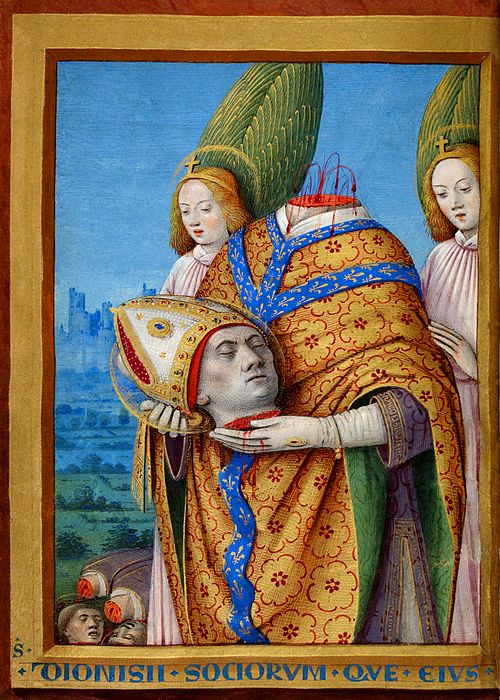
Illuminated manuscript of the Horae ad usum Parisiensem (Book of hours for Parisians), or “Book of Hours of Charles VIII” King of France (1468 – 1498). The folio shows Saint Denis, first bishop and patron of Paris, walking with his head in his hands after his execution. Today is the feast day of Saint Denis.
 #ImageOfTheDay
Picture of the day
Illuminated manuscript of the Horae ad usum Parisiensem (Book of hours for Parisians), or “Book of Hours of Charles VIII” King of France (1468 – 1498). The folio shows Saint Denis, first bishop and patron of Paris, walking with his head in his hands after his execution. Today is the feast day of Saint Denis.
Read More
Picture of the day


A cavalryman of the French Republican Guard during the Bastille Day military parade. This regiment is responsible for special security duties in Paris (including guarding important public buildings) and for providing guards of honour at official ceremonies.
 #ImageOfTheDay
Picture of the day
A cavalryman of the French Republican Guard during the Bastille Day military parade. This regiment is responsible for special security duties in Paris (including guarding important public buildings) and for providing guards of honour at official ceremonies.
Read More