
| Picture of the day |
|---|

|
|
Church of the Jesuit College, Ponta Delgada, São Miguel Island, Azores, Portugal
|

| Picture of the day |
|---|

|
|
Altar of the church of the Monastery of Jesus, Setúbal, Portugal. The monastery, founded in 1490, is one of the oldest buildings in Manueline style (Portuguese version of Gothic) and served as a monastery of Poor Clare nuns.
|



| Picture of the day |
|---|

|
|
This azulejo from the Igreja de São Bento (Ribeira Brava, Madeira, Portugal) depicts Our Lady of Fátima. Today is the feast of Our Lady of Fátima in the Catholic Church and the 110th anniversary of her first apparition to three shepherd children.
|
| Picture of the day |
|---|
,_canal_Fayal-Pico,_islas_Azores,_Portugal,_2020-07-27,_DD_14.jpg)
|
|
Blue shark (Prionace glauca), Faial-Pico Channel, Azores Islands, Portugal. The blue shark is a species of requiem shark, in the family Carcharhinidae, that inhabits deep waters (images taken though between 5 and 10 meter below water) averaging around 3.1 m (10 ft) and preferring cooler waters. They can live up to 20 years, can move very quickly and feed primarily on small fish and squid, although they can take larger prey.
|
| Picture of the day |
|---|
,_Parque_natural_de_la_Arr%C3%A1bida,_Portugal,_2020-07-21,_DD_62.jpg)
|
|
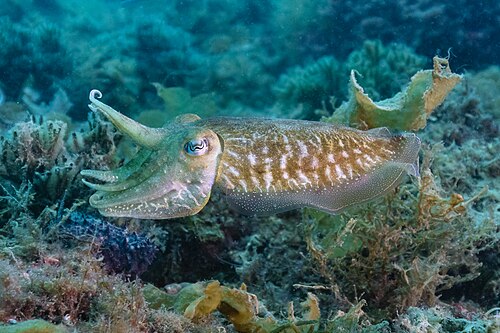
Common cuttlefish (Sepia officinalis), Arrábida National Park, Portugal. The common cuttlefish is one of the largest and best-known cuttlefish species. They are a migratory species that spend the summer and spring inshore for spawning and then move to depths of 100 to 200m during autumn and winter. They only have a lifespan of 1–2 years and have many predators including sharks, dolphins, seals, fish, and cephalopods which includes other cuttlefish. During the day, most cuttlefish can be found buried below the substrate and fairly inactive. At night however, they are actively searching for prey and can ambush them from under the substrate. Cuttlefish are carnivorous and eat a variety of organisms including crustaceans (crabs and shrimp), small fish, molluscs (clams and snails), and sometimes other cuttlefish.
|