Profile

Malta pro-life campaign challenges 6 parties on abortion, euthanasia #Catholic Maltese Prime Minister Robert Abela called a surprise general election for May 30, announcing the vote nine months before his Labour Partyʼs five-year term was scheduled to end. Citing geopolitical turmoil, particularly the war in Iran and volatile oil prices affecting Maltaʼs energy costs, Abela framed the early election as necessary to provide “stability” at a critical moment.The timing is politically advantageous. Abelaʼs Labour government holds a comfortable parliamentary majority, and opinion polls hint the party is on track to win a record fourth consecutive term.Yet the election has forced an uncomfortable conversation about abortion, a topic observers note that Maltese politicians often keep deliberately vague.A country deeply divided on abortionSince Maltaʼs constitution explicitly names Catholicism as the state religion, the nationʼs legal framework reflects that foundation by having a near-total prohibition on abortion. In line with Church teaching, treatment for ectopic pregnancies is permitted.Critics have often labeled the nation as having the most restrictive abortion laws in Europe and regularly called for more abortion rights. As external pressure for liberalization continues to mount, there is also deep internal division between younger, more urban voters who support some abortion access and a significant portion of the electorate that opposes it on moral or religious grounds.Some note that this tension has made abortion a political minefield. Rather than clearly stating whether they are “pro-life” or “pro-choice,” Maltese politicians allegedly employ careful ambiguity. They frame positions using broader language centered on “womenʼs health,” “medical emergencies,” “human rights,” or “legal clarity.” The use of such technical language allows them to address sensitive cases without explicitly endorsing wider abortion access.Pro-life advocates demand clarityAhead of the May 30 election, one of Maltaʼs largest and most prolific pro-life groups, the Life Network Foundation, issued a direct question to all political parties.It demanded that each of Maltaʼs six major political parties participating in the elections clearly state whether they will support changes to Maltese law that would introduce abortion and voluntary assisted euthanasia in the next legislature. The foundation asked for a simple yes-or-no answer.Notably, the Labour government has already broken ranks on one issue. On May 15, it pledged to hold a referendum on voluntary assisted euthanasia if reelected but remained silent on abortion.As of May 22, four of the six parties had responded to the Life Network Foundationʼs questionnaire. The foundation has pledged to publish all responses or publicly note which parties refused to answer.By asking for a direct answer on pro-life issues, it gives Maltaʼs political factions no room to avoid stating their values directly to voters on these key issues. It also allows for more accountability and transparency in the political arena ahead of elections.Pro-abortion encroachmentGiven Maltaʼs strong anti-abortion history and stance, there has been increased activity by pro-abortion organizations to slowly increase abortion rights in the country. Most notably, Women on Waves, a Dutch pro-abortion organization, announced in mid-April that it had installed approximately 15 abortion lock safes around Malta.Each safe contains one mifepristone pill and four misoprostol pills, collectively making up the chemical abortion pill regimen. Women interested in accessing abortion would email the organization, which would provide the location of the abortion safes and the code to unlock the safe.In response to this, the National Council of Women Malta called for legal action into the placement of these abortion pill safes. “Any initiative which appears to facilitate access to abortion pills in Malta raises serious concerns about respect for the law, public safety, the protection of vulnerable women, and the protection of unborn life,” the council stated, requesting authorities investigate the placement of these safes.Questions were also raised about the verification aspects of obtaining these abortion pills and what medical safeguards were in place to ensure they did not fall into the wrong hands. In response, Rebecca Gomperts, the founder of Women on Waves, noted that her organization was simply fulfilling an “unmet demand.”Women on Waves has operated in Malta since 2007. It gained notoriety and visibility in recent years through high-profile campaigns, including at the Malta Maritime Museum, featuring pro-abortion art. The organization has faced backlash in Spain and Poland from citizens and municipalities alike, but its Malta operation is particularly provocative given the countryʼs near-total prohibition on abortion.

Malta pro-life campaign challenges 6 parties on abortion, euthanasia #Catholic Maltese Prime Minister Robert Abela called a surprise general election for May 30, announcing the vote nine months before his Labour Partyʼs five-year term was scheduled to end. Citing geopolitical turmoil, particularly the war in Iran and volatile oil prices affecting Maltaʼs energy costs, Abela framed the early election as necessary to provide “stability” at a critical moment.The timing is politically advantageous. Abelaʼs Labour government holds a comfortable parliamentary majority, and opinion polls hint the party is on track to win a record fourth consecutive term.Yet the election has forced an uncomfortable conversation about abortion, a topic observers note that Maltese politicians often keep deliberately vague.A country deeply divided on abortionSince Maltaʼs constitution explicitly names Catholicism as the state religion, the nationʼs legal framework reflects that foundation by having a near-total prohibition on abortion. In line with Church teaching, treatment for ectopic pregnancies is permitted.Critics have often labeled the nation as having the most restrictive abortion laws in Europe and regularly called for more abortion rights. As external pressure for liberalization continues to mount, there is also deep internal division between younger, more urban voters who support some abortion access and a significant portion of the electorate that opposes it on moral or religious grounds.Some note that this tension has made abortion a political minefield. Rather than clearly stating whether they are “pro-life” or “pro-choice,” Maltese politicians allegedly employ careful ambiguity. They frame positions using broader language centered on “womenʼs health,” “medical emergencies,” “human rights,” or “legal clarity.” The use of such technical language allows them to address sensitive cases without explicitly endorsing wider abortion access.Pro-life advocates demand clarityAhead of the May 30 election, one of Maltaʼs largest and most prolific pro-life groups, the Life Network Foundation, issued a direct question to all political parties.It demanded that each of Maltaʼs six major political parties participating in the elections clearly state whether they will support changes to Maltese law that would introduce abortion and voluntary assisted euthanasia in the next legislature. The foundation asked for a simple yes-or-no answer.Notably, the Labour government has already broken ranks on one issue. On May 15, it pledged to hold a referendum on voluntary assisted euthanasia if reelected but remained silent on abortion.As of May 22, four of the six parties had responded to the Life Network Foundationʼs questionnaire. The foundation has pledged to publish all responses or publicly note which parties refused to answer.By asking for a direct answer on pro-life issues, it gives Maltaʼs political factions no room to avoid stating their values directly to voters on these key issues. It also allows for more accountability and transparency in the political arena ahead of elections.Pro-abortion encroachmentGiven Maltaʼs strong anti-abortion history and stance, there has been increased activity by pro-abortion organizations to slowly increase abortion rights in the country. Most notably, Women on Waves, a Dutch pro-abortion organization, announced in mid-April that it had installed approximately 15 abortion lock safes around Malta.Each safe contains one mifepristone pill and four misoprostol pills, collectively making up the chemical abortion pill regimen. Women interested in accessing abortion would email the organization, which would provide the location of the abortion safes and the code to unlock the safe.In response to this, the National Council of Women Malta called for legal action into the placement of these abortion pill safes. “Any initiative which appears to facilitate access to abortion pills in Malta raises serious concerns about respect for the law, public safety, the protection of vulnerable women, and the protection of unborn life,” the council stated, requesting authorities investigate the placement of these safes.Questions were also raised about the verification aspects of obtaining these abortion pills and what medical safeguards were in place to ensure they did not fall into the wrong hands. In response, Rebecca Gomperts, the founder of Women on Waves, noted that her organization was simply fulfilling an “unmet demand.”Women on Waves has operated in Malta since 2007. It gained notoriety and visibility in recent years through high-profile campaigns, including at the Malta Maritime Museum, featuring pro-abortion art. The organization has faced backlash in Spain and Poland from citizens and municipalities alike, but its Malta operation is particularly provocative given the countryʼs near-total prohibition on abortion.

A leading pro-life nongovernmental organization is asking Malta’s six political parties to declare publicly — yes or no — whether they would back abortion or euthanasia laws ahead of the May 30 vote.

Read More
U.S. bishops say violence ‘never the answer’ after shooting at White House press dinner #Catholic U.S. bishops said violence is never the answer after a shooter breached the hotel hosting the White House Correspondents’ Association dinner in Washington, D.C. and injured a Secret Service agent on April 25.Archbishop Paul Coakley, president of the U.S. Conference of Catholic Bishops, said in a statement, “We are grateful the lives of the President, those who protect him, and everyone in attendance last night were spared from serious harm. Let us all pray for our elected leaders and public officials that they may receive God’s blessings. Because human life is a precious gift, there is no room for violence of any kind in our society.”Attendees heard gunshots shortly after the White House Correspondents' Dinner began at the Washington Hilton hotel. President Donald Trump, first lady Melania Trump, Vice President JD Vance and several cabinet members were evacuated by federal agents.  Trump said in a press conference at the White House following the shooting that a lone suspect was taken into police custody and one federal agent was hospitalized after being hit in his bulletproof vest.Bishop David Bonnar of Youngstown, Ohio said the issue of gun violence requires attention.Bonnar said in a statement, “The United States is built on freedom and respect for all. There is no room for violence that endangers the life of any human being. Moreover, the issue of gun violence must be addressed. Violence is never the answer. We all must look deeper into the human heart to build each other up rather than tear each other down. We pray for peace in moments of disagreement and discord. As we celebrate our 250th birthday may we live as a nation under God with liberty and justice for all.”Bonnar also offered a prayer of protection.
 
 We all must look deeper into the human heart to build each other up rather than tear each other down.
 
 Bishop David BonnarDiocese of Youngstown, Ohio
 
 
 Since 2025, the United States has seen a marked escalation in political violence, including assassination attempts and lethal attacks linked to ideological extremism, threats against elected officials, and armed incidents surrounding political events. High‑profile political actor Charlie Kirk, a conservative commentator, was assassinated in Utah in September 2025. In Minnesota, Rep. Melissa Hortman, the top Democratic leader of the state House of Representatives, was assassinated in her home in June 2025, and her husband was killed in the same attack. Hortman, who had served as Minnesota House speaker, was a Roman Catholic catechist.Bishop Robert Barron of Winona-Rochester, Minnesota, posted on X on April 26, “Iʼm grateful that the President and his entourage are unhurt after this latest attack. May I raise my voice against the viciousness and tribalism that are so prevalent on the internet and that contribute mightily to the violence we see in our political culture. Can we please remember that it is possible to disagree with a politicianʼs ideas without demonizing and de-humanizing him? Jesus commanded us to love our enemies, and that includes our ideological opponents.”

U.S. bishops say violence ‘never the answer’ after shooting at White House press dinner #Catholic U.S. bishops said violence is never the answer after a shooter breached the hotel hosting the White House Correspondents’ Association dinner in Washington, D.C. and injured a Secret Service agent on April 25.Archbishop Paul Coakley, president of the U.S. Conference of Catholic Bishops, said in a statement, “We are grateful the lives of the President, those who protect him, and everyone in attendance last night were spared from serious harm. Let us all pray for our elected leaders and public officials that they may receive God’s blessings. Because human life is a precious gift, there is no room for violence of any kind in our society.”Attendees heard gunshots shortly after the White House Correspondents' Dinner began at the Washington Hilton hotel. President Donald Trump, first lady Melania Trump, Vice President JD Vance and several cabinet members were evacuated by federal agents.  Trump said in a press conference at the White House following the shooting that a lone suspect was taken into police custody and one federal agent was hospitalized after being hit in his bulletproof vest.Bishop David Bonnar of Youngstown, Ohio said the issue of gun violence requires attention.Bonnar said in a statement, “The United States is built on freedom and respect for all. There is no room for violence that endangers the life of any human being. Moreover, the issue of gun violence must be addressed. Violence is never the answer. We all must look deeper into the human heart to build each other up rather than tear each other down. We pray for peace in moments of disagreement and discord. As we celebrate our 250th birthday may we live as a nation under God with liberty and justice for all.”Bonnar also offered a prayer of protection. We all must look deeper into the human heart to build each other up rather than tear each other down. Bishop David BonnarDiocese of Youngstown, Ohio Since 2025, the United States has seen a marked escalation in political violence, including assassination attempts and lethal attacks linked to ideological extremism, threats against elected officials, and armed incidents surrounding political events. High‑profile political actor Charlie Kirk, a conservative commentator, was assassinated in Utah in September 2025. In Minnesota, Rep. Melissa Hortman, the top Democratic leader of the state House of Representatives, was assassinated in her home in June 2025, and her husband was killed in the same attack. Hortman, who had served as Minnesota House speaker, was a Roman Catholic catechist.Bishop Robert Barron of Winona-Rochester, Minnesota, posted on X on April 26, “Iʼm grateful that the President and his entourage are unhurt after this latest attack. May I raise my voice against the viciousness and tribalism that are so prevalent on the internet and that contribute mightily to the violence we see in our political culture. Can we please remember that it is possible to disagree with a politicianʼs ideas without demonizing and de-humanizing him? Jesus commanded us to love our enemies, and that includes our ideological opponents.”

Archbishop Paul Coakley, president of the U.S. Conference of Catholic Bishops, condemned violence, and Bishop David Bonnar of Youngstown, Ohio said the issue of gun violence must be addressed.

Read More

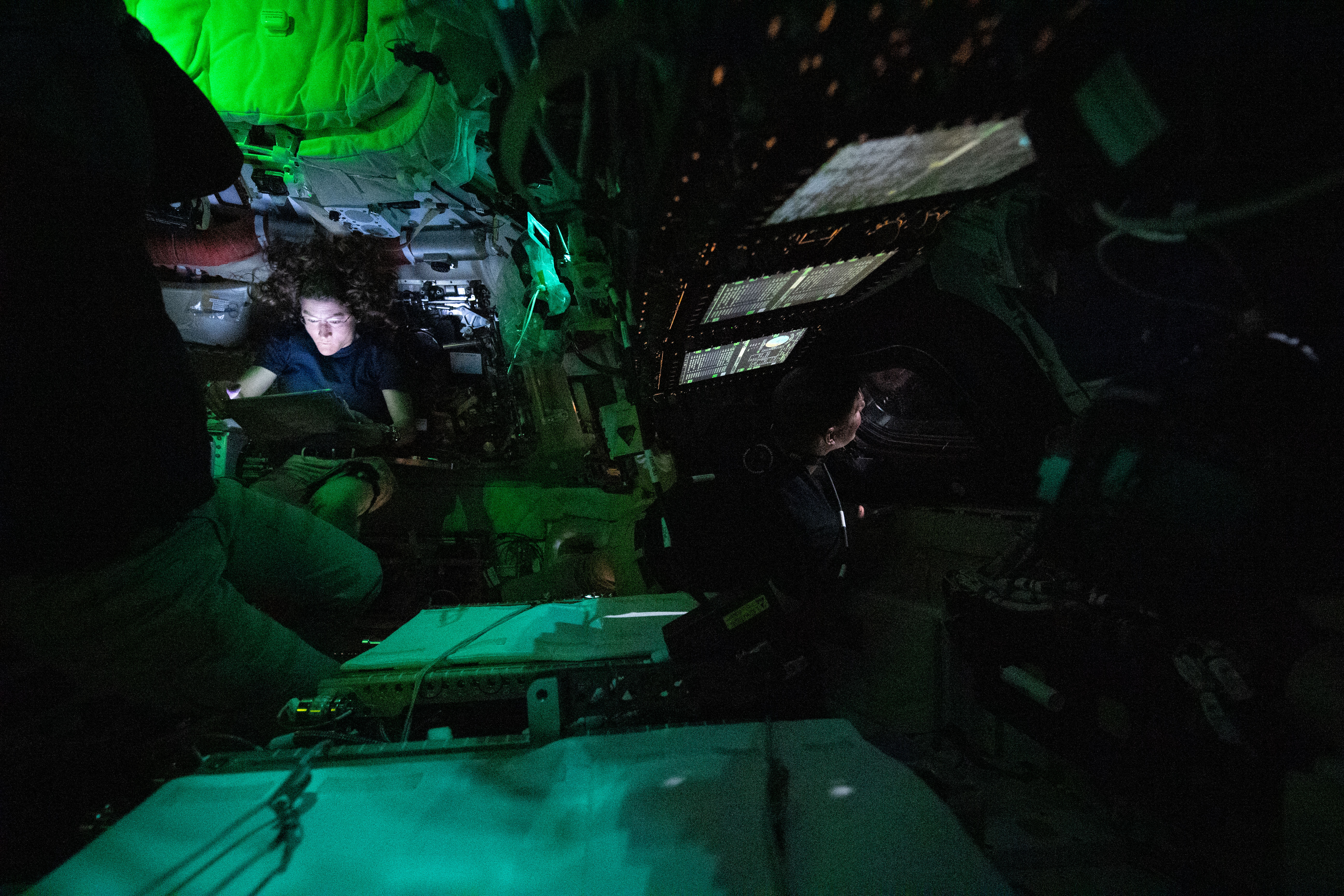
NASA astronaut Christina Koch is illuminated by a screen inside the darkened Orion spacecraft on the third day of the agency’s Artemis II mission. To the right of the image’s center, CSA (Canadian Space Agency) astronaut Jeremy Hansen is seen in profile peering out of one of Orion’s windows. Lights are turned off to avoid glare on the windows.

Read More