![Catholic moral theologians concerned by claims U.S., Iran struck civilian infrastructure #Catholic Iran and the United States have faced accusations of strikes on civilian infrastructure and have explicitly threatened attacks on civilian infrastructure going forward, prompting concerns from Catholic moral theologians.“I have deep concerns that the war will widen and the greatest impact will be on the civilian populations of Middle East nations,” Joseph Capizzi, director of Notre Dame’s McGrath Institute for Church Life, told EWTN News.Charles Camosy, a moral theologian at The Catholic University of America, told EWTN News that threats to civilian infrastructure are “absolutely not” consistent with moral conduct during war or Catholic just war doctrine.“The dignity of the human person — including a commitment to Christʼs command to love oneʼs enemies — must be paramount,” he said. “Not winning a war. Not gaining political advantage. … Catholics are not consequentialists.”A Pakistan‑mediated ceasefire that began April 8 ended on July 8. Last week, Iranian state media alleged that the U.S. struck a water desalination plant in the Hormozgan Province that supplies water to 30 villages, impacting thousands of people. U.S. officials confirmed military strikes in the province but have not confirmed a strike on the plant.The U.S. has confirmed strikes in southern Iran that destroyed port infrastructure. Pro-regime media in Iran in Iran reported commercial and fishing piers were among the targets, citing the Iranian Red Crescent Society. That report also alleged strikes on a wheat storage facility, roads, and bridges.U.S. Central Command denied strikes on the wheat facility but has not addressed every specific allegation. U.S. military officials have repeatedly said they only target Iran’s military capabilities.When reached for comment about the other specific allegations, a spokesperson for U.S. Central Command told EWTN News "we refer you to our published releases" and "we have nothing further to add."In response to these alleged attacks, Iran has repeatedly struck power plants and water facilities throughout Kuwait and Bahrain. Officials in Kuwait, which relies on water desalination plants for 90% of its drinking water, are urging people to conserve energy and water. Bahrain’s supply of drinking water is 100% reliant on water desalination plants.On July 22, Trump escalated threats to civilian infrastructure, saying he would strike “one bridge or power plant” for every ship Iran strikes. Iranian Foreign Minister Seyed Abbas Araghchi said in response that Iran’s doctrine is “an eye for an eye” and “those who contribute” to aggression “will also be considered as legitimate targets.”When a reporter asked Secretary of State Marco Rubio on July 23 whether he would rule out strikes on civilian infrastructure, he did not say. Rather, he pointed to Araghchi’s statement and said: “The president’s policy is a head for an eye — I mean, honestly, that’s what it’s going to be.”Just conduct in warThree Catholic moral theologians who provided comments to EWTN News — Capizzi; Camosy; and Taylor Patrick O’Neill, a theology professor at Thomas Aquinas College — all said it is not moral to intentionally target civilian populations in war.“The prohibition against targeting civilian infrastructure is absolute in moral and international law,” Capizzi said. “States are prohibited from targeting civilian infrastructure.”He urged caution about purported justifications for striking “dual use” infrastructure targets that may be used for both military and civilian purposes. He said “no party is allowed merely to claim targets are ‘dual use.’”“When there is doubt as to the dual or single use of a target, international [law] stipulates the presumption begins with single use, and therefore the target is inadmissible to be targeted, unless proven to the contrary,” Capizzi said.Camosy also said this is a moral absolute and there is no circumstance in which it is moral to target civilians. He said that “even in war, even when the stakes are highest,” Catholics do not adhere to the consequentialist moral philosophy of the ends justifying the means.The Catechism of the Catholic Church explains a person can never engage in intrinsically evil acts — such as targeting innocent people for harm — regardless of the reason because “the end does not justify the means.” Acts also require “good intention,” so while “good intention” is not sufficient and does not justify evil acts, bad intention — such as intending to harm innocent people — always “makes an act evil,” it explains.Camosy said: “Protection against the targeting of civilians is an absolute value in war. Catholics are called to be prepared to lose a war rather than violate exceptionless moral norms or commit intrinsically evil acts in this area.”Sometimes an act, in war or elsewhere, can also have several effects. St. Thomas Aquinas explains in the “Summa Theologica” that it can be proper to engage in an act that is morally neutral in and of itself but has both good and bad consequences, so long as only the good consequence is the one that is intended. This is the principle of “double effect.”The Catechism of the Catholic Church teaches that proportionality is required in war. The evil inflicted through war cannot be more severe than the evil one is aiming to defeat.“We need to ask if civilian harm is the intention and/or the mechanism of action in the military strike or [if] it is a merely foreseen side effect,” Camosy explained.“If the rationale for hitting the electric grid or desalination plant is that widespread darkness, spoiled food, rampant disease, failed hospitals, and more will generate political pressure on the Iranian regime, then the suffering of peaceful civilians becomes the causal pathway to the advantage sought,” he said. “This then becomes the object of the act itself and not a merely foreseen side effect.”Alternatively, Camosy added: “Attacking a generator dedicated to a command bunker, however, would likely not suffer the same kind of critique, however, even if one foresaw but did not intend that it would also have bad impacts on civilians.”Similarly, O’Neill said the moral analysis of striking a facility that results in civilian harm is about intention and proportionality. It is never moral to intend the suffering of innocents or target them.“You cannot intend or rely upon civilian death or fear to aid in your military effort,” O’Neill said. “In other words, the foreseen evil cannot itself be the means by which you attempt to achieve some good.”A specific bridge that is “dual use,” such as one used by civilians but also used “to transport tanks from factory to battlefield,” he said could possibly be justified under double effect. The moral analysis would have to consider intention and proportionality and “you must also try to minimize the negative.”“Will blowing up the bridge make civilian life uncomfortable or will it result in the loss of life, access to basic necessities, etc.? All of these things have to be taken into account just for double effect,” O’Neill said.“Under double effect, itʼs theoretically possible to strike a dual-use target,” he added. “But any strike on merely civilian infrastructure (or even [a target] with indirect ties to the war effort) would be intrinsically unjust.”“At that point, the attack would have more in common with an act of terrorism,” O’Neill said.‘Blessed are the peacemakers’St. Augustine, in a letter to the Roman general Boniface, emphasized that the intention of war must be to ultimately establish a just peace — not to simply to unleash destruction: “Peace should be the object of your desire; war should be waged only as a necessity, and waged only that God may by it deliver men from the necessity and preserve them in peace.”The fifth-century bishop and theologian cited the words of Jesus Christ in Matthew 5:9: “Blessed are the peacemakers, for they will be called children of God.”O’Neill explained that in the context of a just war, “the Christian always seeks war for the sake of peace and that of both his own people and the people of the enemy nation.”“To consider the civilians of an enemy nation as the enemy is already to lose the necessary distinction of combatant from innocent,” he said.Camosy noted that Trump, in his 2024 campaign, promised “to be deeply skeptical of war” and encouraged him to move back in that direction.“Trump himself was aggressively pursuing the Nobel Peace Prize on this basis,” he said. “It would be much better to go back to this way of thinking about war. Think about becoming a peacemaker again.”Trump told Axios on July 23 that he is “considering a massive attack, bigger than ever before” but did not say whether this includes the civilian infrastructure he has threatened. He said that Iranians want to negotiate, but “they havenʼt received enough pain yet.”](https://unitedyam.com/wp-content/uploads/2026/07/catholic-moral-theologians-concerned-by-claims-u-s-iran-struck-civilian-infrastructure-catholic-iran-and-the-united-states-have-faced-accusations-of-strikes-on-civilian-infrastructure-and-have-expl.jpg "Catholic moral theologians concerned by claims U.S., Iran struck civilian infrastructure #Catholic Iran and the United States have faced accusations of strikes on civilian infrastructure and have explicitly threatened attacks on civilian infrastructure going forward, prompting concerns from Catholic moral theologians.“I have deep concerns that the war will widen and the greatest impact will be on the civilian populations of Middle East nations,” Joseph Capizzi, director of Notre Dame’s McGrath Institute for Church Life, told EWTN News.Charles Camosy, a moral theologian at The Catholic University of America, told EWTN News that threats to civilian infrastructure are “absolutely not” consistent with moral conduct during war or Catholic just war doctrine.“The dignity of the human person — including a commitment to Christʼs command to love oneʼs enemies — must be paramount,” he said. “Not winning a war. Not gaining political advantage. … Catholics are not consequentialists.”A Pakistan‑mediated ceasefire that began April 8 ended on July 8. Last week, Iranian state media alleged that the U.S. struck a water desalination plant in the Hormozgan Province that supplies water to 30 villages, impacting thousands of people. U.S. officials confirmed military strikes in the province but have not confirmed a strike on the plant.The U.S. has confirmed strikes in southern Iran that destroyed port infrastructure. Pro-regime media in Iran in Iran reported commercial and fishing piers were among the targets, citing the Iranian Red Crescent Society. That report also alleged strikes on a wheat storage facility, roads, and bridges.U.S. Central Command denied strikes on the wheat facility but has not addressed every specific allegation. U.S. military officials have repeatedly said they only target Iran’s military capabilities.When reached for comment about the other specific allegations, a spokesperson for U.S. Central Command told EWTN News \"we refer you to our published releases\" and \"we have nothing further to add.\"In response to these alleged attacks, Iran has repeatedly struck power plants and water facilities throughout Kuwait and Bahrain. Officials in Kuwait, which relies on water desalination plants for 90% of its drinking water, are urging people to conserve energy and water. Bahrain’s supply of drinking water is 100% reliant on water desalination plants.On July 22, Trump escalated threats to civilian infrastructure, saying he would strike “one bridge or power plant” for every ship Iran strikes. Iranian Foreign Minister Seyed Abbas Araghchi said in response that Iran’s doctrine is “an eye for an eye” and “those who contribute” to aggression “will also be considered as legitimate targets.”When a reporter asked Secretary of State Marco Rubio on July 23 whether he would rule out strikes on civilian infrastructure, he did not say. Rather, he pointed to Araghchi’s statement and said: “The president’s policy is a head for an eye — I mean, honestly, that’s what it’s going to be.”Just conduct in warThree Catholic moral theologians who provided comments to EWTN News — Capizzi; Camosy; and Taylor Patrick O’Neill, a theology professor at Thomas Aquinas College — all said it is not moral to intentionally target civilian populations in war.“The prohibition against targeting civilian infrastructure is absolute in moral and international law,” Capizzi said. “States are prohibited from targeting civilian infrastructure.”He urged caution about purported justifications for striking “dual use” infrastructure targets that may be used for both military and civilian purposes. He said “no party is allowed merely to claim targets are ‘dual use.’”“When there is doubt as to the dual or single use of a target, international [law] stipulates the presumption begins with single use, and therefore the target is inadmissible to be targeted, unless proven to the contrary,” Capizzi said.Camosy also said this is a moral absolute and there is no circumstance in which it is moral to target civilians. He said that “even in war, even when the stakes are highest,” Catholics do not adhere to the consequentialist moral philosophy of the ends justifying the means.The Catechism of the Catholic Church explains a person can never engage in intrinsically evil acts — such as targeting innocent people for harm — regardless of the reason because “the end does not justify the means.” Acts also require “good intention,” so while “good intention” is not sufficient and does not justify evil acts, bad intention — such as intending to harm innocent people — always “makes an act evil,” it explains.Camosy said: “Protection against the targeting of civilians is an absolute value in war. Catholics are called to be prepared to lose a war rather than violate exceptionless moral norms or commit intrinsically evil acts in this area.”Sometimes an act, in war or elsewhere, can also have several effects. St. Thomas Aquinas explains in the “Summa Theologica” that it can be proper to engage in an act that is morally neutral in and of itself but has both good and bad consequences, so long as only the good consequence is the one that is intended. This is the principle of “double effect.”The Catechism of the Catholic Church teaches that proportionality is required in war. The evil inflicted through war cannot be more severe than the evil one is aiming to defeat.“We need to ask if civilian harm is the intention and/or the mechanism of action in the military strike or [if] it is a merely foreseen side effect,” Camosy explained.“If the rationale for hitting the electric grid or desalination plant is that widespread darkness, spoiled food, rampant disease, failed hospitals, and more will generate political pressure on the Iranian regime, then the suffering of peaceful civilians becomes the causal pathway to the advantage sought,” he said. “This then becomes the object of the act itself and not a merely foreseen side effect.”Alternatively, Camosy added: “Attacking a generator dedicated to a command bunker, however, would likely not suffer the same kind of critique, however, even if one foresaw but did not intend that it would also have bad impacts on civilians.”Similarly, O’Neill said the moral analysis of striking a facility that results in civilian harm is about intention and proportionality. It is never moral to intend the suffering of innocents or target them.“You cannot intend or rely upon civilian death or fear to aid in your military effort,” O’Neill said. “In other words, the foreseen evil cannot itself be the means by which you attempt to achieve some good.”A specific bridge that is “dual use,” such as one used by civilians but also used “to transport tanks from factory to battlefield,” he said could possibly be justified under double effect. The moral analysis would have to consider intention and proportionality and “you must also try to minimize the negative.”“Will blowing up the bridge make civilian life uncomfortable or will it result in the loss of life, access to basic necessities, etc.? All of these things have to be taken into account just for double effect,” O’Neill said.“Under double effect, itʼs theoretically possible to strike a dual-use target,” he added. “But any strike on merely civilian infrastructure (or even [a target] with indirect ties to the war effort) would be intrinsically unjust.”“At that point, the attack would have more in common with an act of terrorism,” O’Neill said.‘Blessed are the peacemakers’St. Augustine, in a letter to the Roman general Boniface, emphasized that the intention of war must be to ultimately establish a just peace — not to simply to unleash destruction: “Peace should be the object of your desire; war should be waged only as a necessity, and waged only that God may by it deliver men from the necessity and preserve them in peace.”The fifth-century bishop and theologian cited the words of Jesus Christ in Matthew 5:9: “Blessed are the peacemakers, for they will be called children of God.”O’Neill explained that in the context of a just war, “the Christian always seeks war for the sake of peace and that of both his own people and the people of the enemy nation.”“To consider the civilians of an enemy nation as the enemy is already to lose the necessary distinction of combatant from innocent,” he said.Camosy noted that Trump, in his 2024 campaign, promised “to be deeply skeptical of war” and encouraged him to move back in that direction.“Trump himself was aggressively pursuing the Nobel Peace Prize on this basis,” he said. “It would be much better to go back to this way of thinking about war. Think about becoming a peacemaker again.”Trump told Axios on July 23 that he is “considering a massive attack, bigger than ever before” but did not say whether this includes the civilian infrastructure he has threatened. He said that Iranians want to negotiate, but “they havenʼt received enough pain yet.”")

A battle over the Strait of Hormuz rekindled the war in the Middle East after a ceasefire ended. Intent to harm civilians, including attacks on civilian infrastructure, is immoral, theologians said.
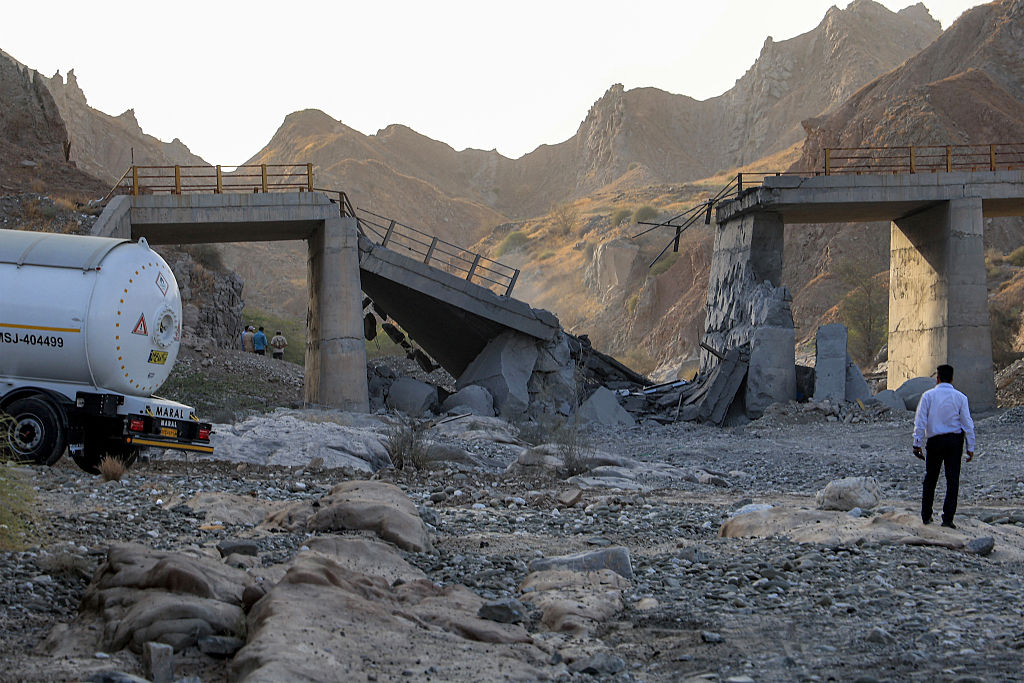
A battle over the Strait of Hormuz rekindled the war in the Middle East after a ceasefire ended. Intent to harm civilians, including attacks on civilian infrastructure, is immoral, theologians said.