A reading from the Book Proverbs
21:1-6, 10-13
Like a stream is the king’s heart in the hand of the LORD;
wherever it pleases him, he directs it.
All the ways of a man may be right in his own eyes,
but it is the LORD who proves hearts.
To do what is right and just
is more acceptable to the LORD than sacrifice.
Haughty eyes and a proud heart–
the tillage of the wicked is sin.
The plans of the diligent are sure of profit,
but all rash haste leads certainly to poverty.
Whoever makes a fortune by a lying tongue
is chasing a bubble over deadly snares.
The soul of the wicked man desires evil;
his neighbor finds no pity in his eyes.
When the arrogant man is punished, the simple are the wiser;
when the wise man is instructed, he gains knowledge.
The just man appraises the house of the wicked:
there is one who brings down the wicked to ruin.
He who shuts his ear to the cry of the poor
will himself also call and not be heard.
From the Gospel according to Luke
8:19-21
The mother of Jesus and his brothers came to him
but were unable to join him because of the crowd.
He was told, “Your mother and your brothers are standing outside
and they wish to see you.”
He said to them in reply, “My mother and my brothers
are those who hear the word of God and act on it.”
Jesus continued speaking with the people, and He loved the people and loved the crowd, so much so that He said, “These who follow me, that vast crowd, are my mother and my brothers; they are these”. And He explained: [They are] those who listen to the Word of God and put it into practice. These are the two conditions for following Jesus: listening to the Word of God and putting it into practice. This is Christian life, nothing more. Simple, simple. (…) Every time we do this – we open the Gospel and read a passage, and ask ourselves: “Is God speaking to me with this, is He saying something to me? And if He is saying something, what is He saying?” – this is listening to the Word of God, listening to it with our ears and listening to it with our hearts. Opening our hearts to the Word of God. Jesus’ enemies listened to His words, but they stayed close to Him to try and find a mistake, to trip Him up, and to undermine His authority. Yet they never asked themselves: “What is God saying to me in this Word?” And God does not speak merely to everyone: yes, He speaks to everyone, but He speaks to each one of us. The Gospel was written for each and every one of us. (…) The Lord sows His Word, always; He merely asks for an open heart to hear it and a willingness to put it into practice. Let us therefore make today’s prayer that of the Psalm: “Lead me in the path of thy commandments”, that is, the path of Your Word, so that, with your guidance, I may learn to put it into practice. (Pope Francis, Homily of 23 September 2014)
Read More




:max_bytes(150000):strip_icc():format(jpeg)/katahdin-woods-waters-national-monument-maine-DARKSKIESUS0920-ac19c3441375493885528875ce03127e.jpg)
![Catholic Church in U.S. to focus National Migration Week on migrant children – #Catholic – The situations faced by migrant and refugee children will be the focus of the U.S. Catholic Churchʼs 2026 National Migration Week, addressing the same concerns expressed by Pope Leo XIV in his message for this yearʼs World Day of Migrants and Refugees.National Migration Week will begin on Monday, Sept. 21, and conclude on Sunday, Sept. 27, the day the Catholic Church observes the 112th World Day of Migrants and Refugees.On its website, the United States Conference of Catholic Bishops (USCCB) announced that in solidarity with the pontiff, it will adopt the theme “Even One of These Little Ones,” the same theme chosen by Leo XIV for the global observance.In his message, Leo XIV explains that this theme “draws our attention to the minors directly involved in the experience of migration and flight, to the care owed to them, and to the Lord’s promise that “whoever receives one such child in my name receives me.’”The chairman of the USCCB Committee on Migration, Bishop Brendan Cahill, noted that the Catholic Church, “in this country and beyond has a long, inspiring history of caring for migrant and refugee children.”In the United States, this history spans “from the days of St. Frances Xavier Cabrini and her sisters sheltering many orphaned immigrant children when few others looked their way to today’s diocesan charities providing them and their families with vital support,” he noted.The Italian saint and her sisters arrived in New York in 1889, where they encountered a very harsh pastoral reality among European immigrants. Yet, despite the difficulties, the sisters managed to open an orphanage, a home for themselves, and a school for the children.Cahill expressed his gratitude to law enforcement officers, social workers, pastoral staff, and caregivers who look after the safety and well-being of migrant and refugee minors.However, he added, “[a]s we see protections for this population being undermined in various ways, including prolonged stays in detention and decreased access to legal representation, we urge governments and communities to ensure a high level of care rooted in their God-given human dignity.”“This requires promoting family unity and reunification whenever possible,” he said.Therefore, the USCCB invited the nation’s Catholics amid “heightened social tensions regarding immigration” to reflect “on how our faith is calling us to respond to this most vulnerable group.”Toward this end, the bishops’ conference is encouraging “dioceses, parishes, schools, and organizations nationwide to mark this observance with prayer, educational programs, pastoral outreach and support for migration-related ministries.”For its part, the USCCB’s Secretariat of Migration will host a webinar on Sept. 23 at 2 p.m. ET featuring “several expert panelists who will highlight some of the key implications of this yearʼs theme."“These experts will shed light on both the international and domestic dynamics facing children in the context of migration,” the bishops’ conference explained.Those interested in participating in the webinar may register at this link.This story was first published by ACI Prensa, the Spanish-language sister service of EWTN News. It has been translated and adapted by EWTN News English.](https://unitedyam.com/wp-content/uploads/2026/09/catholic-church-in-u-s-to-focus-national-migration-week-on-migrant-children-catholic-the-situations-faced-by-migrant-and-refugee-children-will-be-the-focus-of-the-u-s-catholic-churchcabcs-202-scaled.jpg "Catholic Church in U.S. to focus National Migration Week on migrant children – #Catholic – The situations faced by migrant and refugee children will be the focus of the U.S. Catholic Churchʼs 2026 National Migration Week, addressing the same concerns expressed by Pope Leo XIV in his message for this yearʼs World Day of Migrants and Refugees.National Migration Week will begin on Monday, Sept. 21, and conclude on Sunday, Sept. 27, the day the Catholic Church observes the 112th World Day of Migrants and Refugees.On its website, the United States Conference of Catholic Bishops (USCCB) announced that in solidarity with the pontiff, it will adopt the theme “Even One of These Little Ones,” the same theme chosen by Leo XIV for the global observance.In his message, Leo XIV explains that this theme “draws our attention to the minors directly involved in the experience of migration and flight, to the care owed to them, and to the Lord’s promise that “whoever receives one such child in my name receives me.’”The chairman of the USCCB Committee on Migration, Bishop Brendan Cahill, noted that the Catholic Church, “in this country and beyond has a long, inspiring history of caring for migrant and refugee children.”In the United States, this history spans “from the days of St. Frances Xavier Cabrini and her sisters sheltering many orphaned immigrant children when few others looked their way to today’s diocesan charities providing them and their families with vital support,” he noted.The Italian saint and her sisters arrived in New York in 1889, where they encountered a very harsh pastoral reality among European immigrants. Yet, despite the difficulties, the sisters managed to open an orphanage, a home for themselves, and a school for the children.Cahill expressed his gratitude to law enforcement officers, social workers, pastoral staff, and caregivers who look after the safety and well-being of migrant and refugee minors.However, he added, “[a]s we see protections for this population being undermined in various ways, including prolonged stays in detention and decreased access to legal representation, we urge governments and communities to ensure a high level of care rooted in their God-given human dignity.”“This requires promoting family unity and reunification whenever possible,” he said.Therefore, the USCCB invited the nation’s Catholics amid “heightened social tensions regarding immigration” to reflect “on how our faith is calling us to respond to this most vulnerable group.”Toward this end, the bishops’ conference is encouraging “dioceses, parishes, schools, and organizations nationwide to mark this observance with prayer, educational programs, pastoral outreach and support for migration-related ministries.”For its part, the USCCB’s Secretariat of Migration will host a webinar on Sept. 23 at 2 p.m. ET featuring “several expert panelists who will highlight some of the key implications of this yearʼs theme.\"“These experts will shed light on both the international and domestic dynamics facing children in the context of migration,” the bishops’ conference explained.Those interested in participating in the webinar may register at this link.This story was first published by ACI Prensa, the Spanish-language sister service of EWTN News. It has been translated and adapted by EWTN News English.")
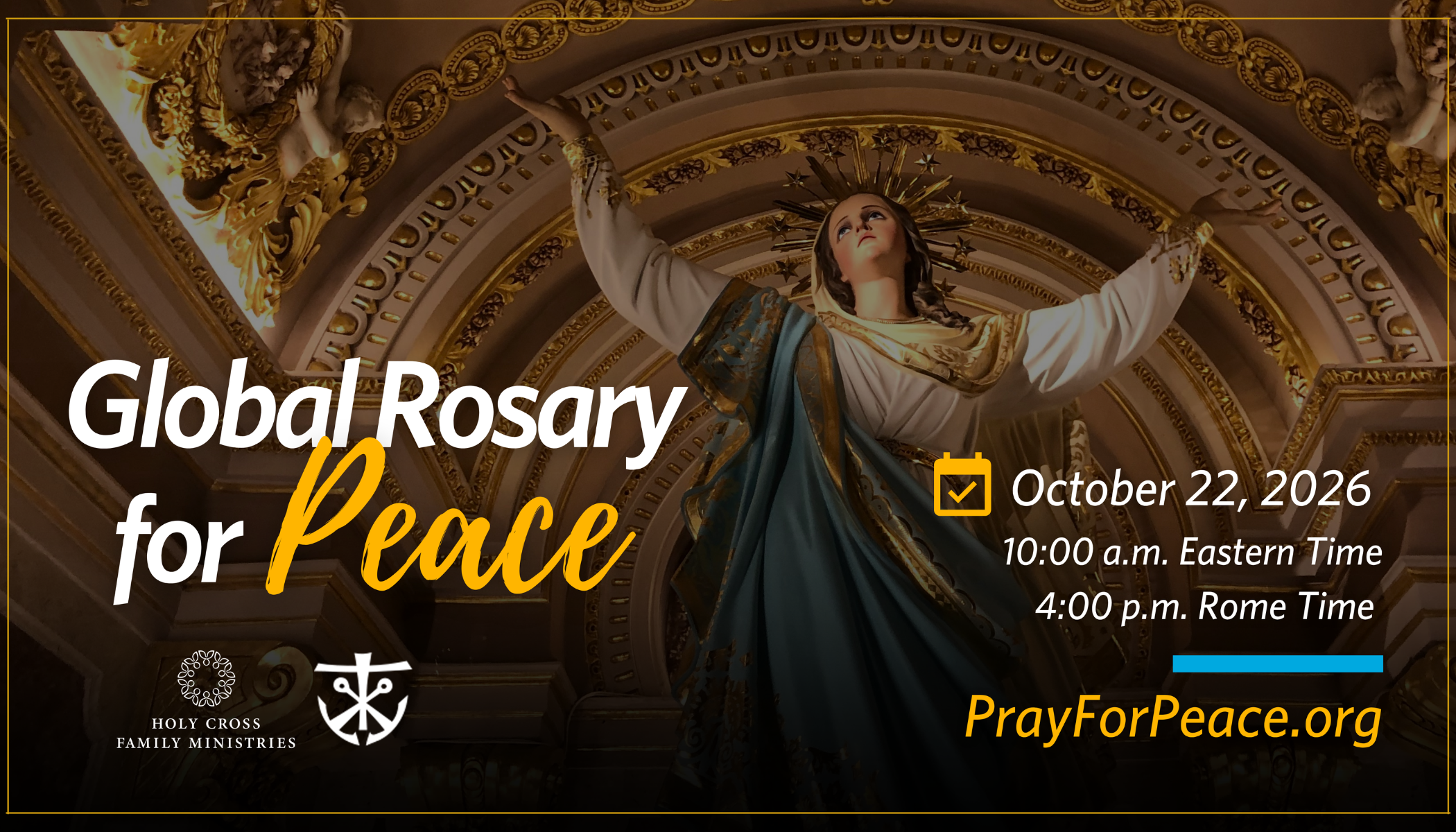
![Catholics worldwide invited to join Global Rosary for Peace – #Catholic – Catholics around the world are invited to join in prayer for the Global Rosary for Peace taking place on Oct. 22, the feast of St. John Paul II.The event is an international prayer initiative that aims to bring together families, parishes, schools, religious communities, and individuals from around the world in response to Pope Leo XIV’s call for the Church to pray the rosary for peace.The Global Rosary for Peace is organized by Holy Cross Family Ministries and is part of its efforts to strengthen family prayer and encourage the faithful to pray the rosary. The initiative received the pope’s blessing last year and over 67,000 people prayed the rosary live during the first global event.Father Fred Jenga, CSC, president of Holy Cross Family Ministries (HCFM), told EWTN News that the first Global Rosary for Peace was created due to several global crises taking place and the need for prayer.“There is always some kind of global crisis that is going on that really calls us to pray more,” he said. “Last year it was all the conflicts that were everywhere. Some of them have sort of died down a little bit but we still have more going on as well in this very year that we are in. So we are just picking up from where we left off. So that we invite people again to pray more.”Currently, over 95,000 people have signed up to take part in this year’s live, global rosary.HCFM was founded by Venerable Patrick Peyton, an Irish-born Catholic priest who was known as the “rosary priest” and for his famous phrase “a family that prays together stays together.”With this at the core of its ministry, HCFM desires to “bring God back into the life of families because we know when God is at the center of the families, especially through prayer, regular prayer, God changes the chemistry in those families because God is love, God is kindness,” Jenga explained.“God created our families. And they will be restless and weak and all over the place until they allow [God] to be the center,” he said.Jenga also spoke about the importance of praying the rosary specifically.“When we pray the rosary on a family level, the heart of the rosary is the mysteries of the rosary, and those mysteries speak to every human season that you can think about,” he shared. “We go through joy, we go through sorrow, we go through mission, we go through celebration or glory. So there you have a set of mysteries that you can pray with through any season that youʼre talking about.”The priest also pointed out that when we look at the saints, nearly all of them share two characteristics: a love for the Eucharist and a love for the rosary.“So, in their path to sanctity, these are the two rails that they ran on. And if we also desire the same kind of sanctity and strength in our families, right there is really a formula for us that we can be able to employ to help ourselves as a family and also to help ourselves as individuals,” Jenga said.He added: “We’re at a time of need in our world right now. There are too many conflicts that are going on and we need a favor for global peace, and the rosary is one of those prayers that weʼre turning to because even throughout history, every time there was a global crisis, the Church, even our Blessed Mother, if she appeared, she asked us to pray the rosary.”For those who participate in the Global Rosary for Peace, Jenga said he hopes they are “able to renew their belief in the power of prayer.”“Secondly, this can be a jumping-off point for them to get started, in smaller ways, praying in their own families and for the needs in their families, but also keep praying for our world at this time.”To take part and register for the Global Rosary of Peace visit https://hcfm.org/pray-for-peace/.](https://unitedyam.com/wp-content/uploads/2026/09/catholics-worldwide-invited-to-join-global-rosary-for-peace-catholic-catholics-around-the-world-are-invited-to-join-in-prayer-for-the-global-rosary-for-peace-taking-place-on-oct-22-the-feast-of.png "Catholics worldwide invited to join Global Rosary for Peace – #Catholic – Catholics around the world are invited to join in prayer for the Global Rosary for Peace taking place on Oct. 22, the feast of St. John Paul II.The event is an international prayer initiative that aims to bring together families, parishes, schools, religious communities, and individuals from around the world in response to Pope Leo XIV’s call for the Church to pray the rosary for peace.The Global Rosary for Peace is organized by Holy Cross Family Ministries and is part of its efforts to strengthen family prayer and encourage the faithful to pray the rosary. The initiative received the pope’s blessing last year and over 67,000 people prayed the rosary live during the first global event.Father Fred Jenga, CSC, president of Holy Cross Family Ministries (HCFM), told EWTN News that the first Global Rosary for Peace was created due to several global crises taking place and the need for prayer.“There is always some kind of global crisis that is going on that really calls us to pray more,” he said. “Last year it was all the conflicts that were everywhere. Some of them have sort of died down a little bit but we still have more going on as well in this very year that we are in. So we are just picking up from where we left off. So that we invite people again to pray more.”Currently, over 95,000 people have signed up to take part in this year’s live, global rosary.HCFM was founded by Venerable Patrick Peyton, an Irish-born Catholic priest who was known as the “rosary priest” and for his famous phrase “a family that prays together stays together.”With this at the core of its ministry, HCFM desires to “bring God back into the life of families because we know when God is at the center of the families, especially through prayer, regular prayer, God changes the chemistry in those families because God is love, God is kindness,” Jenga explained.“God created our families. And they will be restless and weak and all over the place until they allow [God] to be the center,” he said.Jenga also spoke about the importance of praying the rosary specifically.“When we pray the rosary on a family level, the heart of the rosary is the mysteries of the rosary, and those mysteries speak to every human season that you can think about,” he shared. “We go through joy, we go through sorrow, we go through mission, we go through celebration or glory. So there you have a set of mysteries that you can pray with through any season that youʼre talking about.”The priest also pointed out that when we look at the saints, nearly all of them share two characteristics: a love for the Eucharist and a love for the rosary.“So, in their path to sanctity, these are the two rails that they ran on. And if we also desire the same kind of sanctity and strength in our families, right there is really a formula for us that we can be able to employ to help ourselves as a family and also to help ourselves as individuals,” Jenga said.He added: “We’re at a time of need in our world right now. There are too many conflicts that are going on and we need a favor for global peace, and the rosary is one of those prayers that weʼre turning to because even throughout history, every time there was a global crisis, the Church, even our Blessed Mother, if she appeared, she asked us to pray the rosary.”For those who participate in the Global Rosary for Peace, Jenga said he hopes they are “able to renew their belief in the power of prayer.”“Secondly, this can be a jumping-off point for them to get started, in smaller ways, praying in their own families and for the needs in their families, but also keep praying for our world at this time.”To take part and register for the Global Rosary of Peace visit https://hcfm.org/pray-for-peace/.")
![EWTN News explains: What does a diocese do when a priest is accused of misconduct? – #Catholic – News headlines in recent years have periodically reported on Catholic priests accused of various types of misconduct, including financial crimes and sexual abuse, among other allegations. Much of the public will only be aware of the beginning and the end of such controversies — when a clergyman is accused of a misdeed and when he is ultimately either found guilty of it or cleared of any wrongdoing. But U.S. dioceses have complex and at times lengthy ways of addressing such allegations — processes that ensure both a full treatment of the alleged misconduct and the rights of priests to be presumed innocent until proven otherwise. ‘The smoke of truth’Monsignor William King, JCD, serves as an assistant professor of canon law at The Catholic University of America. His academic expertise includes the study of both canon and civil law as well as the study of “temporal goods” such as Church finance and corporate structure. King told EWTN News that bishops who receive allegations of wrongdoing against priests must first determine if there is sufficient credibility to the allegations, a principle he said in canon law is known as “fumus veritatis,” or “the smoke of truth.”“It’s not proof [of the allegations] in any way,” King said, “but if there’s sufficient suspicion that it might be truth, then the bishop would accept that allegation” and launch what is known as a “prior investigation” meant to gather facts. Amid the start of the process, King said, a bishop may or may not remove the priest from ministry if he “felt that it was necessary for any of several reasons.” After that he would appoint an investigator, who may or may not be a priest, to lead the inquiry. “That person is bound to secrecy so as to protect the reputation of the priest, and any of the accusers and witnesses,” King said. Such an investigator has “pretty broad powers” to ask questions of, and seek evidence from, those connected to the case. After that process, he or she would bring the results to the bishop.The prelate would likely then speak to his canon law experts. He may also talk with mental health experts and could potentially order the priest to submit to a psychological assessment. “That’s not uncommon, and depending on the nature of the allegations, it might be appropriate,” King said.After the fact-finding and consultation process, the bishop will decide whether or not to move forward with a criminal or penal process. In some cases, the ordinary may opt instead for a “penal remedy.““It could be a warning or rebuke, or a ‘penal precept’ — a formal document that prohibits the priest from undertaking certain actions or doing certain things,” King said. A precept, he said, can be used even in cases where no crime is committed, to ensure that the actions that led to the controversy are not repeated.If a penal process is instigated, the preferred method for most bishops is to convene a tribunal; in some cases, a prelate may opt for a less formal “administrative process.” Either option involves the calling of witnesses, testimony from both the accuser and the accused, and the collection of additional evidence. Tribunals are usually overseen by three judges, King said; they must be priests, and "they would typically be brought in from other dioceses.”Tribunals are meant to determine both whether a priest committed a crime, King said, as well as whether or not the crime itself is “fully imputable” to the priest. Sexual abuse allegations: Rome must be notifiedThe process is largely the same whether the allegations involve claims of administrative or professional misconduct or if they involve accusations of sexual abuse, King said. However, allegations against a priest of abuse of a minor are “reserved to the Holy See,” he said. In those cases, following the results of a preliminary investigation, a bishop is obligated to send a summary of the case, including the evidence, to the Dicastery for the Doctrine of the Faith, specifically its special disciplinary section. “[The dicastery] will review that and instruct the bishop as to what type of process should be followed — administrative or judicial,” King said.“When the bishop sends the initial dossier or file over, most of the time he will make a recommendation” as to which process should be followed, King said. A bishop in certain cases may recommend “no process, or another remedy or way of addressing the situation.”The dicastery “will take that into consideration. But ultimately, they make the determination, and the bishop is bound to follow their direction,” King said.The Vatican can approve or reject a diocese’s decision if the matter is reserved to Rome, King said. In all other cases, it is resolved domestically either via administrative process or tribunal.A priest, King said, can appeal a diocese’s decision to the Roman Rota if he wishes.](https://unitedyam.com/wp-content/uploads/2026/09/ewtn-news-explains-what-does-a-diocese-do-when-a-priest-is-accused-of-misconduct-catholic-news-headlines-in-recent-years-have-periodically-reported-on-catholic-priests-accused-of-various-types.jpg "EWTN News explains: What does a diocese do when a priest is accused of misconduct? – #Catholic – News headlines in recent years have periodically reported on Catholic priests accused of various types of misconduct, including financial crimes and sexual abuse, among other allegations. Much of the public will only be aware of the beginning and the end of such controversies — when a clergyman is accused of a misdeed and when he is ultimately either found guilty of it or cleared of any wrongdoing. But U.S. dioceses have complex and at times lengthy ways of addressing such allegations — processes that ensure both a full treatment of the alleged misconduct and the rights of priests to be presumed innocent until proven otherwise. ‘The smoke of truth’Monsignor William King, JCD, serves as an assistant professor of canon law at The Catholic University of America. His academic expertise includes the study of both canon and civil law as well as the study of “temporal goods” such as Church finance and corporate structure. King told EWTN News that bishops who receive allegations of wrongdoing against priests must first determine if there is sufficient credibility to the allegations, a principle he said in canon law is known as “fumus veritatis,” or “the smoke of truth.”“It’s not proof [of the allegations] in any way,” King said, “but if there’s sufficient suspicion that it might be truth, then the bishop would accept that allegation” and launch what is known as a “prior investigation” meant to gather facts. Amid the start of the process, King said, a bishop may or may not remove the priest from ministry if he “felt that it was necessary for any of several reasons.” After that he would appoint an investigator, who may or may not be a priest, to lead the inquiry. “That person is bound to secrecy so as to protect the reputation of the priest, and any of the accusers and witnesses,” King said. Such an investigator has “pretty broad powers” to ask questions of, and seek evidence from, those connected to the case. After that process, he or she would bring the results to the bishop.The prelate would likely then speak to his canon law experts. He may also talk with mental health experts and could potentially order the priest to submit to a psychological assessment. “That’s not uncommon, and depending on the nature of the allegations, it might be appropriate,” King said.After the fact-finding and consultation process, the bishop will decide whether or not to move forward with a criminal or penal process. In some cases, the ordinary may opt instead for a “penal remedy.““It could be a warning or rebuke, or a ‘penal precept’ — a formal document that prohibits the priest from undertaking certain actions or doing certain things,” King said. A precept, he said, can be used even in cases where no crime is committed, to ensure that the actions that led to the controversy are not repeated.If a penal process is instigated, the preferred method for most bishops is to convene a tribunal; in some cases, a prelate may opt for a less formal “administrative process.” Either option involves the calling of witnesses, testimony from both the accuser and the accused, and the collection of additional evidence. Tribunals are usually overseen by three judges, King said; they must be priests, and \"they would typically be brought in from other dioceses.”Tribunals are meant to determine both whether a priest committed a crime, King said, as well as whether or not the crime itself is “fully imputable” to the priest. Sexual abuse allegations: Rome must be notifiedThe process is largely the same whether the allegations involve claims of administrative or professional misconduct or if they involve accusations of sexual abuse, King said. However, allegations against a priest of abuse of a minor are “reserved to the Holy See,” he said. In those cases, following the results of a preliminary investigation, a bishop is obligated to send a summary of the case, including the evidence, to the Dicastery for the Doctrine of the Faith, specifically its special disciplinary section. “[The dicastery] will review that and instruct the bishop as to what type of process should be followed — administrative or judicial,” King said.“When the bishop sends the initial dossier or file over, most of the time he will make a recommendation” as to which process should be followed, King said. A bishop in certain cases may recommend “no process, or another remedy or way of addressing the situation.”The dicastery “will take that into consideration. But ultimately, they make the determination, and the bishop is bound to follow their direction,” King said.The Vatican can approve or reject a diocese’s decision if the matter is reserved to Rome, King said. In all other cases, it is resolved domestically either via administrative process or tribunal.A priest, King said, can appeal a diocese’s decision to the Roman Rota if he wishes.")