brother

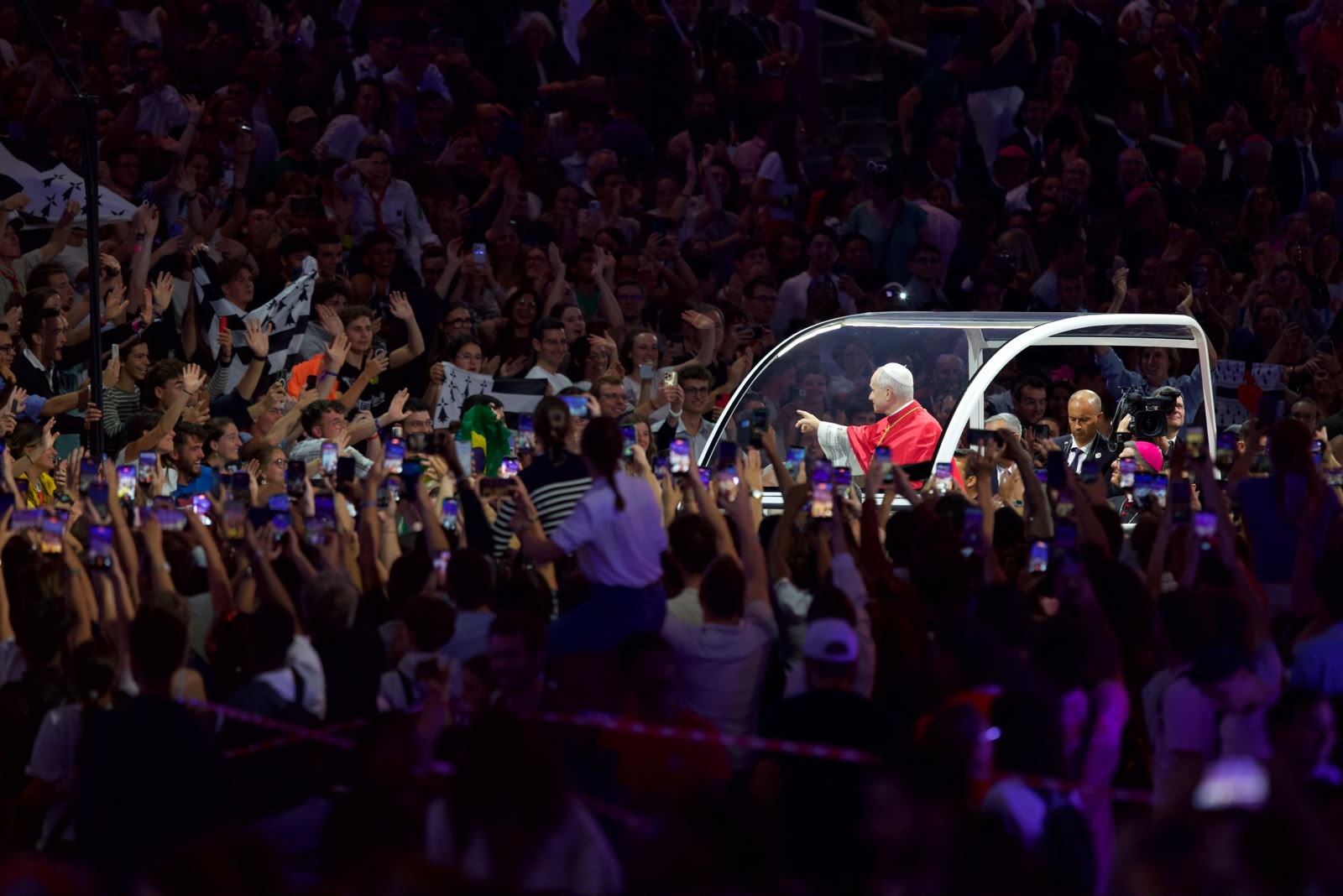
Pope Leo XIV says evil crumbles when the Gospel is lived out #Catholic VATICAN CITY — Pope Leo XIV said Sunday that when the Gospel is proclaimed and lived out, evil gives way before the power of the risen Christ.Speaking from the window of the Apostolic Palace for the June 14 Angelus in St. Peter’s Square, the pope reflected on the day’s Gospel from Matthew, saying it “brings us a great gift, for it draws all who hear it into Jesus’ gaze.”“It is a story that bears witness to the attentiveness of this gaze, as well as telling us what the Lord sees,” Pope Leo said, citing the passage in which Christ, “When he saw the crowds, he had compassion for them, because they were harassed and helpless.”“Having become our brother, the Son of God looks at the people, he looks at humanity: he sees the oppression that burdens and the violence that causes strength to fade,” the pope said.Christ, he continued, also sees the wounds of the contemporary world.“He sees the wounds of war and the emptiness of consumerism. He sees faces reduced to masks, families torn apart by evil, and young people misled by false ideals,” Pope Leo said. “Jesus sees and loves. He loves and suffers for and with us: his compassion expresses not only fraternal closeness, but his desire to redeem.”Before humanity’s wounds, the pope said, Christ remains near and sends “workers into the field of the world.”“What is their task?” he asked. “They must offer God’s comfort to those who suffer by bringing charity where there is misery, hope where there is affliction, faith where there is distrust.”The pope noted that the Gospel names the first 12 “workers,” the disciples made apostles, missionaries, and preachers.“The Good News that spans the centuries is the same, always young, fresh, and liberating: ‘The Kingdom of Heaven has come near!’” he said. “Yes, it is near because in Jesus Christ, God draws near to every man and woman, to every people and nation.”Pope Leo added that the Gospel is not merely announced but also lived.“When this Gospel is proclaimed and lived out, evil crumbles like a disease that passes away, like a night giving way to dawn, like death conquered by the risen One,” he said.The pope said the Church is called to continue the mission of the apostles, remembering Jesus’ words: “You received without payment; give without payment.”“Dear friends, the task of evangelization springs from God’s gift, which in Christ becomes forgiveness for the world, service to the least and the poor, and a commitment to justice,” he said.After the Angelus prayer, Pope Leo recalled his recent apostolic journey to Spain.“First of all, I express my gratitude to the Lord for the Apostolic Journey he has allowed me to undertake in Spain,” he said. “I also thank the Spanish people who have welcomed me with great enthusiasm and devotion.”“I am especially grateful to His Majesty the King; I affectionately thank the Bishops, all the communities I visited and the entire Church in Spain,” the pope added. “Que Dios bendiga siempre a España!”Pope Leo also remembered several newly beatified martyrs: the diocesan priests Václav Drbola and Jan Bula of Moravia, and Jan Šwierc and eight companions, Polish Salesian priests.“All were beatified as martyrs, as victims of the persecution by totalitarian regimes because of their fidelity to Christ,” he said.The pope also recalled that Nazareno Lanciotti, “a Roman missionary priest,” had been beatified Saturday in Mato Grosso, Brazil.“He too was a martyr, for he defended the poorest in the name of the Gospel,” Pope Leo said. “May the example and intercession of these courageous witnesses sustain the mission of priests and of the entire Church.”The pope concluded by expressing his closeness to the people of the Philippines, “struck a few days ago by a powerful earthquake.”“I pray for the deceased and their families, for the wounded and for all those suffering because of this disaster,” he said.This story was first published by ACI Stampa, the Italian-language sister service of EWTN News. It has been translated and adapted by EWTN News English.

Pope Leo XIV says evil crumbles when the Gospel is lived out #Catholic VATICAN CITY — Pope Leo XIV said Sunday that when the Gospel is proclaimed and lived out, evil gives way before the power of the risen Christ.Speaking from the window of the Apostolic Palace for the June 14 Angelus in St. Peter’s Square, the pope reflected on the day’s Gospel from Matthew, saying it “brings us a great gift, for it draws all who hear it into Jesus’ gaze.”“It is a story that bears witness to the attentiveness of this gaze, as well as telling us what the Lord sees,” Pope Leo said, citing the passage in which Christ, “When he saw the crowds, he had compassion for them, because they were harassed and helpless.”“Having become our brother, the Son of God looks at the people, he looks at humanity: he sees the oppression that burdens and the violence that causes strength to fade,” the pope said.Christ, he continued, also sees the wounds of the contemporary world.“He sees the wounds of war and the emptiness of consumerism. He sees faces reduced to masks, families torn apart by evil, and young people misled by false ideals,” Pope Leo said. “Jesus sees and loves. He loves and suffers for and with us: his compassion expresses not only fraternal closeness, but his desire to redeem.”Before humanity’s wounds, the pope said, Christ remains near and sends “workers into the field of the world.”“What is their task?” he asked. “They must offer God’s comfort to those who suffer by bringing charity where there is misery, hope where there is affliction, faith where there is distrust.”The pope noted that the Gospel names the first 12 “workers,” the disciples made apostles, missionaries, and preachers.“The Good News that spans the centuries is the same, always young, fresh, and liberating: ‘The Kingdom of Heaven has come near!’” he said. “Yes, it is near because in Jesus Christ, God draws near to every man and woman, to every people and nation.”Pope Leo added that the Gospel is not merely announced but also lived.“When this Gospel is proclaimed and lived out, evil crumbles like a disease that passes away, like a night giving way to dawn, like death conquered by the risen One,” he said.The pope said the Church is called to continue the mission of the apostles, remembering Jesus’ words: “You received without payment; give without payment.”“Dear friends, the task of evangelization springs from God’s gift, which in Christ becomes forgiveness for the world, service to the least and the poor, and a commitment to justice,” he said.After the Angelus prayer, Pope Leo recalled his recent apostolic journey to Spain.“First of all, I express my gratitude to the Lord for the Apostolic Journey he has allowed me to undertake in Spain,” he said. “I also thank the Spanish people who have welcomed me with great enthusiasm and devotion.”“I am especially grateful to His Majesty the King; I affectionately thank the Bishops, all the communities I visited and the entire Church in Spain,” the pope added. “Que Dios bendiga siempre a España!”Pope Leo also remembered several newly beatified martyrs: the diocesan priests Václav Drbola and Jan Bula of Moravia, and Jan Šwierc and eight companions, Polish Salesian priests.“All were beatified as martyrs, as victims of the persecution by totalitarian regimes because of their fidelity to Christ,” he said.The pope also recalled that Nazareno Lanciotti, “a Roman missionary priest,” had been beatified Saturday in Mato Grosso, Brazil.“He too was a martyr, for he defended the poorest in the name of the Gospel,” Pope Leo said. “May the example and intercession of these courageous witnesses sustain the mission of priests and of the entire Church.”The pope concluded by expressing his closeness to the people of the Philippines, “struck a few days ago by a powerful earthquake.”“I pray for the deceased and their families, for the wounded and for all those suffering because of this disaster,” he said.This story was first published by ACI Stampa, the Italian-language sister service of EWTN News. It has been translated and adapted by EWTN News English.

At the Angelus, the pontiff said Christ sees the wounds of war, broken families, and young people misled by false ideals.

Read More
Michigan diocese celebrates new priests after ordinations moved out of cathedral #Catholic ANN ARBOR, Michigan — Bishop Earl Boyea of Lansing, Michigan, ordained four men to the priesthood on June 6 at St. Thomas Aquinas Parish in East Lansing after the crowd was too big for St. Mary’s Cathedral, the mother church of the diocese. In the packed church, Boyea told the ordinands: “You have been spending years being with Jesus. He’s calling you as he called those 12 so many centuries ago. Today, as you are consecrated by the Church for a sacred ministry, consecrate yourselves to drink the cup which the Lord gives and take in the word which the Spirit is providing. Though weak vessels that we are, we will not let that prevent us from following the calling we have received.”Now 75 and due to retire from his duties in Lansing, Boyea has ordained 45 priests during his 18 years of leadership of the diocese in Michigan’s capital. The diocese, one of seven Latin-rite dioceses in Michigan, is currently sponsoring 29 seminarians, and last year’s ordination class was the largest in nearly 50 years.Fathers Joshua Bauer, Jacob Derry, Ryan Ferrigan, and Peter Randolph, ordained by Boyea, all attended Sacred Heart Major Seminary of the Detroit Archdiocese.
 
 Bishop Earl Boyea of Lansing, Michigan, washes the feet of one of the four men he ordained to the priesthood on June 6, 2026, at St. Thomas Aquinas Parish in East Lansing, Michigan. | Credit: Valerie Hendrickson
 
 Before their ordination, the men were interviewed on video, displaying the chalices they will use as priests.Ferrigan, 28, said his antique sacred vessel had been left behind at the now-shuttered St. Michael Parish church in Flint, Michigan, established more than 170 years ago. Inscribed on its base are the words of an anonymous donor: “In reparation from a friend of the Sacred Heart.”“You know, it’s a paradox because this chalice has a long history, and I don’t know who the priests are who used it in the past,” he said. “They offered the Holy Sacrifice using this vessel for over 100 years, and I get to continue faithfully offering the Mass and praying for the salvation of the world every day.”In his thanksgiving address to the congregation, Ferrigan said of his priesthood: “It’s all about the glory of God and the salvation of souls!”In an interview with EWTN News, the new priest said: “In being ordained, the palpable joy they could see in me was there because in ordination, I am seeing the purpose for which God created me coming to fruition. I have become what the Lord created me to be.”“The day of my ordination was the best day of my life. Lots of friends and family were there to support me. The Lord has blessed me and is very good to me. I’m still adjusting and realizing that I’m really a priest now and have the privilege of offering the Mass every day. This is my commission and what the Lord wants me to do for his praise and the salvation of the world. It is still sinking in,” he told EWTN News.
 
 From left to right: Fathers Peter Randolph, Ryan Ferrigan, Jacob Derry, and Joshua Bauer at their ordaination on June 6, 2026, in East Lansing, Michigan. | Credit: Valerie Hendrickson
 
 Ferrigan celebrated his first solo Mass that same day at St. Martha Parish in Okemos, near Lansing. He was able to distribute the Eucharist for the first time in both instances to his mother. He will serve at St. Thomas the Apostle Parish in Ann Arbor, which is close to the University of Michigan campus and known for its music and solemn liturgies.“I’m excited to be going there, and I expect to serve about three years at St. Thomas,” he said, adding: “I’m excited about learning to be a parish priest and diving into ministry. This is how the Lord wants me to feed his sheep.”Randolph, 27, reflected in the video about his journey to the altar, which has included profound loss. “The emphasis of this chalice upon the humanity of Christ and about receiving the chalice, and then living it out to the fullest extent, both in pain and suffering, and full self-abandonment and full self-emptying and glory, means a lot to me, because my [18-year-old] brother Xavier died less than a year ago. And the Lord has really promised me that he’s going to meet me in the place of my pain,” he said, adding: “He’s not going to leave me alone. But it’s going to come in my very broken humanity. In my humanity that is now broken in a particular way in grief.”
 
 Peter Randolph prepares for his ordination to the priesthood on June 6, 2026, in East Lansing, Michigan. | Credit: Valerie Hendrickson
 
 Randolph’s father and grandfather serve as deacons in the Lansing Diocese. At the July 2025 funeral for Xavier, hundreds of friends and parishioners of the close-knit Christ the King Parish in Ann Arbor were on hand to support the Randolph family with the same solidarity shown at Randolph’s ordination. He has been assigned to St. Patrick Parish in Brighton, Michigan, which is known for its healing services and charismatic liturgies.As Boyea consecrated Randolph, the newly ordained young man openly sobbed in the presence of his many friends and family members. “I want every day of my priesthood and every time that I offer Mass in this chalice, to be able to say, like, ‘Accipiam calicem,’ right, I accept the chalice,” Randolph vowed. Paraphrasing Matthew 26:42, Randolph said: “Father, I accept this chalice, and I will drink it to the dregs with your Son.”

Michigan diocese celebrates new priests after ordinations moved out of cathedral #Catholic ANN ARBOR, Michigan — Bishop Earl Boyea of Lansing, Michigan, ordained four men to the priesthood on June 6 at St. Thomas Aquinas Parish in East Lansing after the crowd was too big for St. Mary’s Cathedral, the mother church of the diocese. In the packed church, Boyea told the ordinands: “You have been spending years being with Jesus. He’s calling you as he called those 12 so many centuries ago. Today, as you are consecrated by the Church for a sacred ministry, consecrate yourselves to drink the cup which the Lord gives and take in the word which the Spirit is providing. Though weak vessels that we are, we will not let that prevent us from following the calling we have received.”Now 75 and due to retire from his duties in Lansing, Boyea has ordained 45 priests during his 18 years of leadership of the diocese in Michigan’s capital. The diocese, one of seven Latin-rite dioceses in Michigan, is currently sponsoring 29 seminarians, and last year’s ordination class was the largest in nearly 50 years.Fathers Joshua Bauer, Jacob Derry, Ryan Ferrigan, and Peter Randolph, ordained by Boyea, all attended Sacred Heart Major Seminary of the Detroit Archdiocese. Bishop Earl Boyea of Lansing, Michigan, washes the feet of one of the four men he ordained to the priesthood on June 6, 2026, at St. Thomas Aquinas Parish in East Lansing, Michigan. | Credit: Valerie Hendrickson Before their ordination, the men were interviewed on video, displaying the chalices they will use as priests.Ferrigan, 28, said his antique sacred vessel had been left behind at the now-shuttered St. Michael Parish church in Flint, Michigan, established more than 170 years ago. Inscribed on its base are the words of an anonymous donor: “In reparation from a friend of the Sacred Heart.”“You know, it’s a paradox because this chalice has a long history, and I don’t know who the priests are who used it in the past,” he said. “They offered the Holy Sacrifice using this vessel for over 100 years, and I get to continue faithfully offering the Mass and praying for the salvation of the world every day.”In his thanksgiving address to the congregation, Ferrigan said of his priesthood: “It’s all about the glory of God and the salvation of souls!”In an interview with EWTN News, the new priest said: “In being ordained, the palpable joy they could see in me was there because in ordination, I am seeing the purpose for which God created me coming to fruition. I have become what the Lord created me to be.”“The day of my ordination was the best day of my life. Lots of friends and family were there to support me. The Lord has blessed me and is very good to me. I’m still adjusting and realizing that I’m really a priest now and have the privilege of offering the Mass every day. This is my commission and what the Lord wants me to do for his praise and the salvation of the world. It is still sinking in,” he told EWTN News. From left to right: Fathers Peter Randolph, Ryan Ferrigan, Jacob Derry, and Joshua Bauer at their ordaination on June 6, 2026, in East Lansing, Michigan. | Credit: Valerie Hendrickson Ferrigan celebrated his first solo Mass that same day at St. Martha Parish in Okemos, near Lansing. He was able to distribute the Eucharist for the first time in both instances to his mother. He will serve at St. Thomas the Apostle Parish in Ann Arbor, which is close to the University of Michigan campus and known for its music and solemn liturgies.“I’m excited to be going there, and I expect to serve about three years at St. Thomas,” he said, adding: “I’m excited about learning to be a parish priest and diving into ministry. This is how the Lord wants me to feed his sheep.”Randolph, 27, reflected in the video about his journey to the altar, which has included profound loss. “The emphasis of this chalice upon the humanity of Christ and about receiving the chalice, and then living it out to the fullest extent, both in pain and suffering, and full self-abandonment and full self-emptying and glory, means a lot to me, because my [18-year-old] brother Xavier died less than a year ago. And the Lord has really promised me that he’s going to meet me in the place of my pain,” he said, adding: “He’s not going to leave me alone. But it’s going to come in my very broken humanity. In my humanity that is now broken in a particular way in grief.” Peter Randolph prepares for his ordination to the priesthood on June 6, 2026, in East Lansing, Michigan. | Credit: Valerie Hendrickson Randolph’s father and grandfather serve as deacons in the Lansing Diocese. At the July 2025 funeral for Xavier, hundreds of friends and parishioners of the close-knit Christ the King Parish in Ann Arbor were on hand to support the Randolph family with the same solidarity shown at Randolph’s ordination. He has been assigned to St. Patrick Parish in Brighton, Michigan, which is known for its healing services and charismatic liturgies.As Boyea consecrated Randolph, the newly ordained young man openly sobbed in the presence of his many friends and family members. “I want every day of my priesthood and every time that I offer Mass in this chalice, to be able to say, like, ‘Accipiam calicem,’ right, I accept the chalice,” Randolph vowed. Paraphrasing Matthew 26:42, Randolph said: “Father, I accept this chalice, and I will drink it to the dregs with your Son.”

Bishop Earl Boyea ordained four new priests at a local Lansing parish, urging them to “drink the cup which the Lord gives” as they begin their ministry.

Read More
Migrants in Tenerife tell Pope Leo XIV: We do not ask for privileges or compassion #Catholic TENERIFE, Canary Islands — “No one leaves their land, their family and their roots by choice when they can live in peace,” said Bousso Diouf, a woman from Senegal who spoke with the moral authority of someone who risked her life crossing the Atlantic in a wooden boat, knowing the journey could last a week or end adrift at sea.Diouf was among the migrants who greeted Pope Leo XIV at the Las Raíces reception center in Tenerife, where some 700 sub-Saharan African migrants — all adult men — are currently housed. The center is located in the humid Las Raíces area of Tenerife, a eucalyptus-filled area about 3,300 feet above sea level.The number is relatively low compared with the hardest years of the “cayuco” crisis, especially at the end of 2024, when the center received between 2,000 and 3,000 migrants amid overcrowding and widely reported tensions.Most of those currently housed at the center come from Senegal, Gambia, and Mali, and on average spend about three months there before being transferred to mainland Spain.They arrive exhausted after having spent up to 72 hours in police custody for identification and registration procedures.“We come from countries where poverty, violence, war, persecution, and lack of opportunity forced us to leave,” Diouf said.Las Raíces opened in 2021 in response to the 2020 crisis, when more than 23,000 migrants arrived on the coasts of the Canary Islands.Now those numbers have fallen sharply, and the situation is very different.“Our work is to offer them an initial welcome that is dignified, humane, and organized at an especially difficult moment, immediately after their arrival by sea,” Navarro Atiénzar, regional director of Accem, the NGO that manages the Las Raíces Reception Center for Refugees and Immigrants in Tenerife, told Pope Leo.The pope arrived in Tenerife early in the morning from Las Palmas and went to the large camp set up inside a former rural military barracks after six marathon days in Spain that had taken him to Barcelona and Madrid.He listened to those housed there as a father listens when a child opens his heart to recount a trauma.One young Nigerian man said that crossing the ocean to the Canary Islands means facing hunger, cold, desperation, and often death.“Many brothers and sisters lost their lives at sea, and others continue to suffer in silence, victims of mafias that take advantage of need and human suffering,” he said.He also made a plea for humanity: “May we not be seen only as migrants, numbers, or documents, but as people with stories, dreams, families, and hope.”“We do not ask for privileges. We do not ask for compassion. We ask for respect, humanity, and the opportunity to live with dignity,” he said.Among those present was also Aliu Ceesay, a 16-year-old Gambian who arrived in the Canary Islands just one month ago in an irregular boat after a difficult journey from his home country. Like many other migrant minors, his goal is to find work so he can help support his family.Amid an experience marked by uncertainty, Aliu has followed Pope Leo XIV with interest online. The teenager said he wanted to see him in person and was struck by the pope’s message.“I have been following him on the internet and wanted to see him. He is very kind, very good,” Aliu said. He also emphasized the pope’s inclusive spirit: “He does not care if we are black or white, Muslim or Christian. He wants to help us.”More than 54,000 people have passed through Las Raíces. Behind each one is a story, a difficult journey, and, above all, a hope.In his address, Pope Leo repeated the message he gave on the first day he set foot in Las Palmas: “God’s love knows no borders, makes no distinctions, is given to all and brings us together in unity.”“As I look at your faces and listen to your stories, I also think of your hearts — wounded by so many difficulties, yet also comforted by the love you have received from other open, generous and merciful hearts,” the pope said.“Christ’s heart suffered and was pierced out of love, and he was also comforted by compassionate people who eased his pain,” he added.Missionary saints and migrantsThe pope dedicated part of his address to missionary saints such as St. Brother Peter of St. Joseph de Betancur and St. José de Anchieta, who set out from the Canary Islands to proclaim the Gospel in the Americas, opening new missionary horizons.“They too were migrants who ventured into the unknown, carrying faith, hope and charity as their greatest possessions,” he said.The pope called for “responsibility” with an eye toward future generations, to whom, he said, “we wish to bequeath the heritage of a civilization of love.”“Migration will play an important role in this,” he said, because it “can become an opportunity for encounter and mutual enrichment among peoples.”“Dear brothers and sisters, in a sense, all of us are migrants, for we are all pilgrims on our way to our heavenly homeland,” he said. “Let us help make this journey more humane for everyone by contributing in whatever way we can.”The pope said the name of the center, Las Raíces — “the roots” — had caught his attention. He recalled that Pope Francis, “who so longed to be with you,” often used the image of roots “to emphasize the importance of remembering our origins, staying united and trusting in the Lord.”“May this image of roots also help you to be firmly rooted in the Lord, so that no storm may drive you away from his presence, which strengthens and gives life,” Pope Leo said.At the end of his address, the pope told those gathered: “Dear friends, I carry you in my heart and will remember you in my prayers. May God bless you, your families and all who do good to you. And may the Blessed Virgin Mary, Consolation of Migrants, always accompany and assist you with her maternal protection.”During the meeting, when the pope announced that he would speak in French and English, many migrants responded with loud applause.This story was first published by ACI Prensa, the Spanish-language sister service of EWTN News. It has been translated and adapted by EWTN News English.

Migrants in Tenerife tell Pope Leo XIV: We do not ask for privileges or compassion #Catholic TENERIFE, Canary Islands — “No one leaves their land, their family and their roots by choice when they can live in peace,” said Bousso Diouf, a woman from Senegal who spoke with the moral authority of someone who risked her life crossing the Atlantic in a wooden boat, knowing the journey could last a week or end adrift at sea.Diouf was among the migrants who greeted Pope Leo XIV at the Las Raíces reception center in Tenerife, where some 700 sub-Saharan African migrants — all adult men — are currently housed. The center is located in the humid Las Raíces area of Tenerife, a eucalyptus-filled area about 3,300 feet above sea level.The number is relatively low compared with the hardest years of the “cayuco” crisis, especially at the end of 2024, when the center received between 2,000 and 3,000 migrants amid overcrowding and widely reported tensions.Most of those currently housed at the center come from Senegal, Gambia, and Mali, and on average spend about three months there before being transferred to mainland Spain.They arrive exhausted after having spent up to 72 hours in police custody for identification and registration procedures.“We come from countries where poverty, violence, war, persecution, and lack of opportunity forced us to leave,” Diouf said.Las Raíces opened in 2021 in response to the 2020 crisis, when more than 23,000 migrants arrived on the coasts of the Canary Islands.Now those numbers have fallen sharply, and the situation is very different.“Our work is to offer them an initial welcome that is dignified, humane, and organized at an especially difficult moment, immediately after their arrival by sea,” Navarro Atiénzar, regional director of Accem, the NGO that manages the Las Raíces Reception Center for Refugees and Immigrants in Tenerife, told Pope Leo.The pope arrived in Tenerife early in the morning from Las Palmas and went to the large camp set up inside a former rural military barracks after six marathon days in Spain that had taken him to Barcelona and Madrid.He listened to those housed there as a father listens when a child opens his heart to recount a trauma.One young Nigerian man said that crossing the ocean to the Canary Islands means facing hunger, cold, desperation, and often death.“Many brothers and sisters lost their lives at sea, and others continue to suffer in silence, victims of mafias that take advantage of need and human suffering,” he said.He also made a plea for humanity: “May we not be seen only as migrants, numbers, or documents, but as people with stories, dreams, families, and hope.”“We do not ask for privileges. We do not ask for compassion. We ask for respect, humanity, and the opportunity to live with dignity,” he said.Among those present was also Aliu Ceesay, a 16-year-old Gambian who arrived in the Canary Islands just one month ago in an irregular boat after a difficult journey from his home country. Like many other migrant minors, his goal is to find work so he can help support his family.Amid an experience marked by uncertainty, Aliu has followed Pope Leo XIV with interest online. The teenager said he wanted to see him in person and was struck by the pope’s message.“I have been following him on the internet and wanted to see him. He is very kind, very good,” Aliu said. He also emphasized the pope’s inclusive spirit: “He does not care if we are black or white, Muslim or Christian. He wants to help us.”More than 54,000 people have passed through Las Raíces. Behind each one is a story, a difficult journey, and, above all, a hope.In his address, Pope Leo repeated the message he gave on the first day he set foot in Las Palmas: “God’s love knows no borders, makes no distinctions, is given to all and brings us together in unity.”“As I look at your faces and listen to your stories, I also think of your hearts — wounded by so many difficulties, yet also comforted by the love you have received from other open, generous and merciful hearts,” the pope said.“Christ’s heart suffered and was pierced out of love, and he was also comforted by compassionate people who eased his pain,” he added.Missionary saints and migrantsThe pope dedicated part of his address to missionary saints such as St. Brother Peter of St. Joseph de Betancur and St. José de Anchieta, who set out from the Canary Islands to proclaim the Gospel in the Americas, opening new missionary horizons.“They too were migrants who ventured into the unknown, carrying faith, hope and charity as their greatest possessions,” he said.The pope called for “responsibility” with an eye toward future generations, to whom, he said, “we wish to bequeath the heritage of a civilization of love.”“Migration will play an important role in this,” he said, because it “can become an opportunity for encounter and mutual enrichment among peoples.”“Dear brothers and sisters, in a sense, all of us are migrants, for we are all pilgrims on our way to our heavenly homeland,” he said. “Let us help make this journey more humane for everyone by contributing in whatever way we can.”The pope said the name of the center, Las Raíces — “the roots” — had caught his attention. He recalled that Pope Francis, “who so longed to be with you,” often used the image of roots “to emphasize the importance of remembering our origins, staying united and trusting in the Lord.”“May this image of roots also help you to be firmly rooted in the Lord, so that no storm may drive you away from his presence, which strengthens and gives life,” Pope Leo said.At the end of his address, the pope told those gathered: “Dear friends, I carry you in my heart and will remember you in my prayers. May God bless you, your families and all who do good to you. And may the Blessed Virgin Mary, Consolation of Migrants, always accompany and assist you with her maternal protection.”During the meeting, when the pope announced that he would speak in French and English, many migrants responded with loud applause.This story was first published by ACI Prensa, the Spanish-language sister service of EWTN News. It has been translated and adapted by EWTN News English.

At Las Raíces reception center in Spain’s Canary Islands, the pope heard testimonies from migrants who risked their lives crossing the Atlantic and urged a more humane response rooted in dignity.

Read More
Pope Leo XIV in Madrid: Corpus Christi must not become museum of the past #Catholic Madrid, Spain, June 7, 2026 — Pope Leo XIV on Sunday called on Spain to renew its historic Eucharistic faith, warning that the country’s centuries-old religious traditions must not become “a museum of the past to be visited” but remain “a school of faith from which to draw even today.”The pope made the appeal while presiding over Mass, a procession, and Eucharistic blessing for the solemnity of Corpus Christi in Madrid’s Plaza de Cibeles, one of the Spanish capital’s most emblematic sites.“As I begin my visit to Spain, it is with a heart filled with joy that I preside over this celebration on the Solemnity of Corpus Christi,” the pope said in his homily.Corpus Christi has deep roots in Spain and throughout the Catholic world. The feast originated after the efforts of St. Juliana of Cornillon, a Belgian religious sister who promoted a liturgical celebration dedicated to the Blessed Sacrament. Pope Urban IV confirmed the feast for the universal Church in 1264, and within decades it had reached the Iberian Peninsula. King Alfonso X, known as “the Wise,” took part in a Corpus Christi celebration in Toledo in 1280.Over the centuries, the tradition became firmly established in Spain, making the country one of the great centers of Eucharistic devotion. During the period of the Council of Trent, when the real presence of Christ in the Eucharist was contested in parts of Europe, Spanish popular piety continued to exalt it through processions, music, art, and public expressions of faith.In Madrid, Pope Leo said Corpus Christi is “more than just another celebration on the liturgical calendar.”“It is a way of returning to the heart of the faith to renew our love and fidelity to God,” he said.“The solemn processions held on this day have for centuries shaped the piety, art, music, architecture and life of the Spanish people,” the pope continued. “Even today, they still express and manifest the spiritual sentiments of this country through the beauty and elegance of the floral carpets, the altars erected in the streets, the carefully crafted monstrances and stands, the hymns and the liturgical vestments.”The setting itself added a striking backdrop to the celebration. Plaza de Cibeles, crowned by the statue of the Roman goddess in a chariot drawn by lions, is known internationally as the place where Real Madrid celebrates its titles. On Sunday, however, the square’s focus was Christ in the Eucharist.One participant joked that with Pope Leo XIV in Madrid, the Spanish capital had three lions.The pope said the Corpus Christi procession is not “an exhibition, a remnant of folklore or a simple display of beauty.”“It is a profession of faith in the presence of the risen Lord, who is alive and continues to walk among us, who becomes bread to satiate our hunger for life, and visits the recesses of our hearts and history, even those shrouded in darkness,” he said.The procession route, about 600 meters along Calle de Alcalá, one of Madrid’s central thoroughfares, was adorned with 16 floral carpets — eight on each side — made with more than 30,000 carnations. Numerous faithful joined the pope, including many boys and girls who had recently received their first Communion.Pope Leo said the procession reveals that Christ “is not confined to the church, but comes out to meet us.”“Jesus travels the streets, crosses the squares and visits our neighborhoods, dwelling in the settings of our daily lives,” he said. “He is a God who is close to us, who walks with his people, the Lord of history.”The pope also connected Corpus Christi with charity, noting that the Church in Spain has long associated the solemnity with the Day for Charity.“The Christ who processes through the streets in the monstrance is the same one who identifies with the poor, the downtrodden, those who are alone and forsaken,” he said.“It is not merely a matter of bringing out the monstrance,” Pope Leo emphasized, “but of allowing ourselves to be brought out of our selfishness and indifference, of a comfortable, private faith, so as to respond to his invitation to conversion, to change our perspective, and to welcome his presence which transforms us and makes us builders of a new world.”The pope said the historical memory of Spain’s Corpus Christi processions “is not confined to wistful nostalgia.”“Instead, it stands as an invitation in the present moment, in our daily lives, in our relationships, in society, and in the building of the future,” he said.That, he added, is the task facing Spain today and tomorrow: “to ensure that the religiosity which has shaped and defined this country for centuries is not a museum of the past to be visited, but a school of faith from which to draw even today.”The pope described that school of faith as one that “teaches us to kneel before God and before our neighbor, because no one can kneel before the Lord and despise their brother.”It is also, he said, “a school that teaches us of the gratitude of love that becomes a gift, so that it may flow among us and break the chains of all selfishness.”From the Eucharist, he continued, Catholics learn “that God is a real presence and that we too are called to be present in the realities and challenges of society, not shying away, but personally committing ourselves to the building of the common good.”Pope Leo also recalled St. Manuel González García, the Spanish bishop known as “the bishop of the abandoned tabernacle.”“His life reminds us that the Eucharist should be honored not only during great celebrations or on special occasions, but also through the silent fidelity of those who accompany the Lord with a humble and quiet friendship that is nourished day by day,” the pope said.The pope also cited St. John of the Cross, recalling that while imprisoned in harsh conditions in Toledo around the time of Corpus Christi in 1578, the Spanish mystic recognized the hidden presence of the Lord even in darkness.“The Eucharistic Jesus is ‘that eternal spring that is hidden’ — a spring that flows and quenches thirst, yet without blinding, without imposing itself through outward power, without presenting itself in a spectacular way,” the pope said.Pope Leo closed by urging the faithful to return to Christ in the Eucharist with “sincere love.”“Let us open ourselves to the encounter with him, let us allow him to quench the thirst of our hearts, so that we may then go forth into the paths of life and history, bringing to the people this stream of fresh water, a stream of love, peace, justice and joy,” he said.“Let us drink anew from this Eucharistic spring, which does not enclose us in private devotion, but sends us out to refresh our brothers and sisters, our families, the poor, the suffering, and those who have lost hope,” the pope said. “Eucharistic grace transforms us and makes us protagonists of the transformation of history, a sign of hope for those we meet.”“May the Lord Jesus, present in the Eucharist, transform you into bread that is broken, given, and offered,” he concluded, “so that a life of fullness may spring forth for you, for your families, and for your country.”This story was first published by ACI Prensa, the Spanish-language sister service of EWTN News. It has been translated and adapted by EWTN News English.

Pope Leo XIV in Madrid: Corpus Christi must not become museum of the past #Catholic Madrid, Spain, June 7, 2026 — Pope Leo XIV on Sunday called on Spain to renew its historic Eucharistic faith, warning that the country’s centuries-old religious traditions must not become “a museum of the past to be visited” but remain “a school of faith from which to draw even today.”The pope made the appeal while presiding over Mass, a procession, and Eucharistic blessing for the solemnity of Corpus Christi in Madrid’s Plaza de Cibeles, one of the Spanish capital’s most emblematic sites.“As I begin my visit to Spain, it is with a heart filled with joy that I preside over this celebration on the Solemnity of Corpus Christi,” the pope said in his homily.Corpus Christi has deep roots in Spain and throughout the Catholic world. The feast originated after the efforts of St. Juliana of Cornillon, a Belgian religious sister who promoted a liturgical celebration dedicated to the Blessed Sacrament. Pope Urban IV confirmed the feast for the universal Church in 1264, and within decades it had reached the Iberian Peninsula. King Alfonso X, known as “the Wise,” took part in a Corpus Christi celebration in Toledo in 1280.Over the centuries, the tradition became firmly established in Spain, making the country one of the great centers of Eucharistic devotion. During the period of the Council of Trent, when the real presence of Christ in the Eucharist was contested in parts of Europe, Spanish popular piety continued to exalt it through processions, music, art, and public expressions of faith.In Madrid, Pope Leo said Corpus Christi is “more than just another celebration on the liturgical calendar.”“It is a way of returning to the heart of the faith to renew our love and fidelity to God,” he said.“The solemn processions held on this day have for centuries shaped the piety, art, music, architecture and life of the Spanish people,” the pope continued. “Even today, they still express and manifest the spiritual sentiments of this country through the beauty and elegance of the floral carpets, the altars erected in the streets, the carefully crafted monstrances and stands, the hymns and the liturgical vestments.”The setting itself added a striking backdrop to the celebration. Plaza de Cibeles, crowned by the statue of the Roman goddess in a chariot drawn by lions, is known internationally as the place where Real Madrid celebrates its titles. On Sunday, however, the square’s focus was Christ in the Eucharist.One participant joked that with Pope Leo XIV in Madrid, the Spanish capital had three lions.The pope said the Corpus Christi procession is not “an exhibition, a remnant of folklore or a simple display of beauty.”“It is a profession of faith in the presence of the risen Lord, who is alive and continues to walk among us, who becomes bread to satiate our hunger for life, and visits the recesses of our hearts and history, even those shrouded in darkness,” he said.The procession route, about 600 meters along Calle de Alcalá, one of Madrid’s central thoroughfares, was adorned with 16 floral carpets — eight on each side — made with more than 30,000 carnations. Numerous faithful joined the pope, including many boys and girls who had recently received their first Communion.Pope Leo said the procession reveals that Christ “is not confined to the church, but comes out to meet us.”“Jesus travels the streets, crosses the squares and visits our neighborhoods, dwelling in the settings of our daily lives,” he said. “He is a God who is close to us, who walks with his people, the Lord of history.”The pope also connected Corpus Christi with charity, noting that the Church in Spain has long associated the solemnity with the Day for Charity.“The Christ who processes through the streets in the monstrance is the same one who identifies with the poor, the downtrodden, those who are alone and forsaken,” he said.“It is not merely a matter of bringing out the monstrance,” Pope Leo emphasized, “but of allowing ourselves to be brought out of our selfishness and indifference, of a comfortable, private faith, so as to respond to his invitation to conversion, to change our perspective, and to welcome his presence which transforms us and makes us builders of a new world.”The pope said the historical memory of Spain’s Corpus Christi processions “is not confined to wistful nostalgia.”“Instead, it stands as an invitation in the present moment, in our daily lives, in our relationships, in society, and in the building of the future,” he said.That, he added, is the task facing Spain today and tomorrow: “to ensure that the religiosity which has shaped and defined this country for centuries is not a museum of the past to be visited, but a school of faith from which to draw even today.”The pope described that school of faith as one that “teaches us to kneel before God and before our neighbor, because no one can kneel before the Lord and despise their brother.”It is also, he said, “a school that teaches us of the gratitude of love that becomes a gift, so that it may flow among us and break the chains of all selfishness.”From the Eucharist, he continued, Catholics learn “that God is a real presence and that we too are called to be present in the realities and challenges of society, not shying away, but personally committing ourselves to the building of the common good.”Pope Leo also recalled St. Manuel González García, the Spanish bishop known as “the bishop of the abandoned tabernacle.”“His life reminds us that the Eucharist should be honored not only during great celebrations or on special occasions, but also through the silent fidelity of those who accompany the Lord with a humble and quiet friendship that is nourished day by day,” the pope said.The pope also cited St. John of the Cross, recalling that while imprisoned in harsh conditions in Toledo around the time of Corpus Christi in 1578, the Spanish mystic recognized the hidden presence of the Lord even in darkness.“The Eucharistic Jesus is ‘that eternal spring that is hidden’ — a spring that flows and quenches thirst, yet without blinding, without imposing itself through outward power, without presenting itself in a spectacular way,” the pope said.Pope Leo closed by urging the faithful to return to Christ in the Eucharist with “sincere love.”“Let us open ourselves to the encounter with him, let us allow him to quench the thirst of our hearts, so that we may then go forth into the paths of life and history, bringing to the people this stream of fresh water, a stream of love, peace, justice and joy,” he said.“Let us drink anew from this Eucharistic spring, which does not enclose us in private devotion, but sends us out to refresh our brothers and sisters, our families, the poor, the suffering, and those who have lost hope,” the pope said. “Eucharistic grace transforms us and makes us protagonists of the transformation of history, a sign of hope for those we meet.”“May the Lord Jesus, present in the Eucharist, transform you into bread that is broken, given, and offered,” he concluded, “so that a life of fullness may spring forth for you, for your families, and for your country.”This story was first published by ACI Prensa, the Spanish-language sister service of EWTN News. It has been translated and adapted by EWTN News English.

At Mass in Madrid’s Plaza de Cibeles, the pope called Spain’s centuries-old Eucharistic devotion “a school of faith” for the present and future.

Read More
From seminarian in Nicaragua to priest in Miami: ‘I carry my people and my homeland in my heart’ #Catholic As a seminarian, Cristhian David Mendieta Hernández had to flee Nicaragua, persecuted by the very dictatorship that had recently exiled his bishop. The regime of President Daniel Ortega and his wife and vice president, Rosario Murillo, ramped up its persecution of the Catholic Church in 2018.After the dictatorship exiled Silvio Báez, the auxiliary bishop of Managua, from Nicaragua in April 2019, Mendieta, who as a seminarian often accompanied the bishop, was forced to flee the country as well, traveling first to Guatemala and then to Costa Rica. His journey concluded in Miami in January 2022, where, with the assistance of Báez and Father Marco Somarriba, pastor of St. Agatha Parish in Miami, he was able to continue his priestly formation.On May 9 at St. Mary’s Cathedral, he knelt before Archbishop Thomas Wenski and received the priestly ordination that the Nicaraguan dictatorship had attempted to deny him.“I carry my people and my homeland in my heart, and I will offer my first Mass for them,” the newly ordained Nicaraguan priest, who will serve as parochial vicar at St. Thomas the Apostle in Miami, told ACI Prensa, the Spanish-language sister service of EWTN News, on May 10.“This priesthood is a blessing for me, for my family, for the Church, and for the people of Nicaragua,” added Mendieta, who was born in La Concepción township in the Masaya district of Nicaragua. He celebrated his first Mass on May 10 at St. Agatha, accompanied by Báez and other Nicaraguan priests who attended the ordination.“I am grateful to the Archdiocese of Miami for welcoming me and giving me the opportunity to serve the people of God. Here we have a broader perspective that our ministry is for all of God’s people and that our people, especially those from Latin America, share the same aspirations for freedom, peace, and stability,” he emphasized. Father Edwing Román, parochial vicar at St. Agatha, told ACI Prensa that “it’s a source of great joy to have Father Cristhian as another brother in the priesthood. He is a young man of many virtues and a dedicated scholar.”“I admire his piety and humility as well as his ease in forming friendships with the faithful. May God bless him abundantly, and may he be a shepherd modeled after Jesus Christ, the eternal high priest,” Román said.In a video posted by the Archdiocese of Miami on May 6, Mendieta recalled that when he was 6 years old and attending a concert, he announced that he was thinking of becoming a priest, which surprised his family.Years later, while involved in his parishʼs youth ministry, the example of his hardworking parish priest, Father José Antonio, who strove to reach every community, no matter how remote, encouraged him to pursue his vocation and change his plans to become a doctor.The young priest also shared that he enjoys classical music and Frank Sinatra, and that when he is driving, he entertains himself by listening to the British band Queen.Along with Mendieta, the following men were ordained: Adam Cahill, Henry Cárdenas Afanador, Tomasz Kaziel, Arístides Lima, Carlos Luzardo, Saint-Clos Papouloute, Pietro Pironato, and Michele Sega.In his homily, Wenski highlighted the diverse origins of the new priests — Nicaragua, Italy, Poland, Haiti, Venezuela, Colombia, etc. — and noted that “in an increasingly secularized world, where many have lost the sense of the transcendent, the priest is an enigma, a symbol of great contradiction.”"Nowadays, many view religious faith with hostility or at best, with indifference. In such a world, the Church will always appear out of step and irrelevant. Often, such a Church will be viewed if not with contempt and mockery, with total incomprehension. As Jesus said: ‘If the world hates you, know that it hated me first,’” the archbishop said.“Face the challenges of your ministry without anxiety or mediocrity, and do not allow yourselves to be intimidated or influenced by those who make power, wealth, or pleasure the primary criteria of their lives,” he exhorted.After encouraging the new priests to lay down their lives for their faithful, Wenski urged them to be “generous with their time and available to hear the confessions of the faithful.”This story was first published by ACI Prensa, the Spanish-language sister service of EWTN News. It has been translated and adapted by EWTN News English.

From seminarian in Nicaragua to priest in Miami: ‘I carry my people and my homeland in my heart’ #Catholic As a seminarian, Cristhian David Mendieta Hernández had to flee Nicaragua, persecuted by the very dictatorship that had recently exiled his bishop. The regime of President Daniel Ortega and his wife and vice president, Rosario Murillo, ramped up its persecution of the Catholic Church in 2018.After the dictatorship exiled Silvio Báez, the auxiliary bishop of Managua, from Nicaragua in April 2019, Mendieta, who as a seminarian often accompanied the bishop, was forced to flee the country as well, traveling first to Guatemala and then to Costa Rica. His journey concluded in Miami in January 2022, where, with the assistance of Báez and Father Marco Somarriba, pastor of St. Agatha Parish in Miami, he was able to continue his priestly formation.On May 9 at St. Mary’s Cathedral, he knelt before Archbishop Thomas Wenski and received the priestly ordination that the Nicaraguan dictatorship had attempted to deny him.“I carry my people and my homeland in my heart, and I will offer my first Mass for them,” the newly ordained Nicaraguan priest, who will serve as parochial vicar at St. Thomas the Apostle in Miami, told ACI Prensa, the Spanish-language sister service of EWTN News, on May 10.“This priesthood is a blessing for me, for my family, for the Church, and for the people of Nicaragua,” added Mendieta, who was born in La Concepción township in the Masaya district of Nicaragua. He celebrated his first Mass on May 10 at St. Agatha, accompanied by Báez and other Nicaraguan priests who attended the ordination.“I am grateful to the Archdiocese of Miami for welcoming me and giving me the opportunity to serve the people of God. Here we have a broader perspective that our ministry is for all of God’s people and that our people, especially those from Latin America, share the same aspirations for freedom, peace, and stability,” he emphasized. Father Edwing Román, parochial vicar at St. Agatha, told ACI Prensa that “it’s a source of great joy to have Father Cristhian as another brother in the priesthood. He is a young man of many virtues and a dedicated scholar.”“I admire his piety and humility as well as his ease in forming friendships with the faithful. May God bless him abundantly, and may he be a shepherd modeled after Jesus Christ, the eternal high priest,” Román said.In a video posted by the Archdiocese of Miami on May 6, Mendieta recalled that when he was 6 years old and attending a concert, he announced that he was thinking of becoming a priest, which surprised his family.Years later, while involved in his parishʼs youth ministry, the example of his hardworking parish priest, Father José Antonio, who strove to reach every community, no matter how remote, encouraged him to pursue his vocation and change his plans to become a doctor.The young priest also shared that he enjoys classical music and Frank Sinatra, and that when he is driving, he entertains himself by listening to the British band Queen.Along with Mendieta, the following men were ordained: Adam Cahill, Henry Cárdenas Afanador, Tomasz Kaziel, Arístides Lima, Carlos Luzardo, Saint-Clos Papouloute, Pietro Pironato, and Michele Sega.In his homily, Wenski highlighted the diverse origins of the new priests — Nicaragua, Italy, Poland, Haiti, Venezuela, Colombia, etc. — and noted that “in an increasingly secularized world, where many have lost the sense of the transcendent, the priest is an enigma, a symbol of great contradiction.”"Nowadays, many view religious faith with hostility or at best, with indifference. In such a world, the Church will always appear out of step and irrelevant. Often, such a Church will be viewed if not with contempt and mockery, with total incomprehension. As Jesus said: ‘If the world hates you, know that it hated me first,’” the archbishop said.“Face the challenges of your ministry without anxiety or mediocrity, and do not allow yourselves to be intimidated or influenced by those who make power, wealth, or pleasure the primary criteria of their lives,” he exhorted.After encouraging the new priests to lay down their lives for their faithful, Wenski urged them to be “generous with their time and available to hear the confessions of the faithful.”This story was first published by ACI Prensa, the Spanish-language sister service of EWTN News. It has been translated and adapted by EWTN News English.

The Ortega regime’s repression of the Catholic Church could not silence God’s call to Cristhian Mendieta. Having fled Nicaragua as a seminarian, the young man was ordained to the priesthood in Miami.

Read More
Chicago priest removed after ‘inappropriate conversations’ with children, women #Catholic A priest in the Archdiocese of Chicago has been barred from ministry there after allegations he engaged in “inappropriate conversations” with both children and adults. Father Jose Molina, a priest of the Institute of the Incarnate Word, was accused of engaging in “improper and inappropriate conversations and communications with minors and adult women,” Chicago archbishop Cardinal Blase Cupich said in a May 9 letter. Cupich, in the letter addressed to parishioners at St. Francis of Assisi Parish on Chicagoʼs Near West Side, said he had sent Molina back to the provincial house of the Institute of the Incarnate Word and had removed Molinaʼs faculties to minister in the archdiocese. The letter also said the archdiocese has “reported the allegations to civil authorities,” while Molinaʼs accusers were “offered the services of the archdiocese’s Office of Assistance Ministry.”The archbishopʼs letter did not offer any further details about the allegations against Molina and indicated the investigation was ongoing.Priest in New Mexico also removed from ministryA priest in New Mexico was also recently removed from ministry amid allegations of the theft of diocesan records. In a May 8 letter to parishioners at the Basilica of San Albino, Las Cruces Bishop Peter Baldacchino said Father Chris Williams had been “relieved of all his duties” in the diocese and suspended as pastor of the basilica amid a controversy involving the reported theft of tens of thousands of diocesan files. The bishop said a civil discovery process revealed that Williams and “certain employees” of the basilica allegedly conspired to steal “over 60,000 private diocesan records,” specifically financial records. The diocese has referred the theft to law enforcement, he said. The alleged robbery “exposed the diocese and all parishes to a significant risk of misappropriation and theft,” the bishop said. Williams' brother, Father Michael Williams, would serve as the temporary pastor of the basilica, Baldacchino said, noting he was unable to share further details due to the ongoing investigation.

Chicago priest removed after ‘inappropriate conversations’ with children, women #Catholic A priest in the Archdiocese of Chicago has been barred from ministry there after allegations he engaged in “inappropriate conversations” with both children and adults. Father Jose Molina, a priest of the Institute of the Incarnate Word, was accused of engaging in “improper and inappropriate conversations and communications with minors and adult women,” Chicago archbishop Cardinal Blase Cupich said in a May 9 letter. Cupich, in the letter addressed to parishioners at St. Francis of Assisi Parish on Chicagoʼs Near West Side, said he had sent Molina back to the provincial house of the Institute of the Incarnate Word and had removed Molinaʼs faculties to minister in the archdiocese. The letter also said the archdiocese has “reported the allegations to civil authorities,” while Molinaʼs accusers were “offered the services of the archdiocese’s Office of Assistance Ministry.”The archbishopʼs letter did not offer any further details about the allegations against Molina and indicated the investigation was ongoing.Priest in New Mexico also removed from ministryA priest in New Mexico was also recently removed from ministry amid allegations of the theft of diocesan records. In a May 8 letter to parishioners at the Basilica of San Albino, Las Cruces Bishop Peter Baldacchino said Father Chris Williams had been “relieved of all his duties” in the diocese and suspended as pastor of the basilica amid a controversy involving the reported theft of tens of thousands of diocesan files. The bishop said a civil discovery process revealed that Williams and “certain employees” of the basilica allegedly conspired to steal “over 60,000 private diocesan records,” specifically financial records. The diocese has referred the theft to law enforcement, he said. The alleged robbery “exposed the diocese and all parishes to a significant risk of misappropriation and theft,” the bishop said. Williams' brother, Father Michael Williams, would serve as the temporary pastor of the basilica, Baldacchino said, noting he was unable to share further details due to the ongoing investigation.

Cardinal Blase Cupich said Father Jose Molina was accused of “improper communications” and was barred from ministering in Chicago.

Read More
Bethsaida excavation turning ‘Bible stories into Bible realities’ #Catholic WASHINGTON — The academic director of one of the most celebrated current archaeological digs in Israel was in Washington, D.C., this week to provide an update on the ongoing excavation of Bethsaida, the town that the Gospel of John (1:44) records as the home of the apostles Peter, his brother Andrew, and Philip and where Jesus performed various miracles.In a May 5 presentation at the Catholic Information Center, Steven Notley, the academic director of the El Araj Excavation Project, said the excavation of the last town of apostolic times to be discovered, which began in 2016 and has been ongoing since then, has essentially confirmed that the site, known as El Araj, is indeed the location of the Galilean seaside town of Bethsaida, which is referenced several times in the New Testament.Notley, who is also executive director of the Center for the Study of Ancient Judaism and Christian Origins, lived in Jerusalem with his wife and four children for 16 years and has been leading groups of students and laypeople to Israel and the eastern Mediterranean region for over 35 years.Melissa Overmyer, a Catholic evangelist who has participated in the dig at Bethsaida, shared her own testimony at the event, saying being a part of such experiences in the Holy Land turns “Bible stories into Bible realities.” Notley said excavations at the site in 2018 uncovered the remains of a Byzantine-era basilica and a first-century house located directly under its apse in 2023. These remains, he said, match the historic account of Willibald, an eighth-century bishop of Eichstätt in Bavaria, Germany, who traveled to the Holy Land in 725 A.D. and wrote about a church in Bethsaida that was built over the home of Sts. Peter and Andrew.Among the discoveries made at this basilica is a mosaic, uncovered in 2022, with the inscription “Chief of the apostles and keeper of the keys of heaven, intercede for him and his children George and Theophano."Last year, the site also endured a wildfire, the results of which Notley said have subsequently allowed the team to uncover evidence of columns and other structures previously overlooked due to dense underbrush.Notley told EWTN News that the archaeological team was able to identify a structure underneath the apse of the basilica by identifying pottery they discovered there as first-century pottery. The team also found first-century fishing weights.“So, we have a first-century house wall under the apse. It doesnʼt have a plaque on it that says ‘Peter slept here,’ but from a perspective of archaeology, it doesnʼt get much better than that,” Notley said.Notley said he welcomes volunteers to participate in the ongoing dig, which he said is entirely privately funded. Information about how to volunteer may be found on the excavation’s website.

Bethsaida excavation turning ‘Bible stories into Bible realities’ #Catholic WASHINGTON — The academic director of one of the most celebrated current archaeological digs in Israel was in Washington, D.C., this week to provide an update on the ongoing excavation of Bethsaida, the town that the Gospel of John (1:44) records as the home of the apostles Peter, his brother Andrew, and Philip and where Jesus performed various miracles.In a May 5 presentation at the Catholic Information Center, Steven Notley, the academic director of the El Araj Excavation Project, said the excavation of the last town of apostolic times to be discovered, which began in 2016 and has been ongoing since then, has essentially confirmed that the site, known as El Araj, is indeed the location of the Galilean seaside town of Bethsaida, which is referenced several times in the New Testament.Notley, who is also executive director of the Center for the Study of Ancient Judaism and Christian Origins, lived in Jerusalem with his wife and four children for 16 years and has been leading groups of students and laypeople to Israel and the eastern Mediterranean region for over 35 years.Melissa Overmyer, a Catholic evangelist who has participated in the dig at Bethsaida, shared her own testimony at the event, saying being a part of such experiences in the Holy Land turns “Bible stories into Bible realities.” Notley said excavations at the site in 2018 uncovered the remains of a Byzantine-era basilica and a first-century house located directly under its apse in 2023. These remains, he said, match the historic account of Willibald, an eighth-century bishop of Eichstätt in Bavaria, Germany, who traveled to the Holy Land in 725 A.D. and wrote about a church in Bethsaida that was built over the home of Sts. Peter and Andrew.Among the discoveries made at this basilica is a mosaic, uncovered in 2022, with the inscription “Chief of the apostles and keeper of the keys of heaven, intercede for him and his children George and Theophano."Last year, the site also endured a wildfire, the results of which Notley said have subsequently allowed the team to uncover evidence of columns and other structures previously overlooked due to dense underbrush.Notley told EWTN News that the archaeological team was able to identify a structure underneath the apse of the basilica by identifying pottery they discovered there as first-century pottery. The team also found first-century fishing weights.“So, we have a first-century house wall under the apse. It doesnʼt have a plaque on it that says ‘Peter slept here,’ but from a perspective of archaeology, it doesnʼt get much better than that,” Notley said.Notley said he welcomes volunteers to participate in the ongoing dig, which he said is entirely privately funded. Information about how to volunteer may be found on the excavation’s website.

Recent excavations at the site match the account of an eighth-century Bavarian bishop who wrote about a church in Bethsaida that was built over the home of Sts. Peter and Andrew.

Read More