

1/20
Keynote speakers at “The Beauty of Truth: Navigating Society Today as a Catholic Woman” conference, held Jan. 9-10, 2026, in Houston (left to right): Erika Bachiochi, Mary Eberstadt, Angela Franks, Pia de Solenni, and Leah Sargeant. | Credit: Photo courtesy of the University of St. Thomas
Read More

Jan 23, 2026 / 10:34 am (CNA).
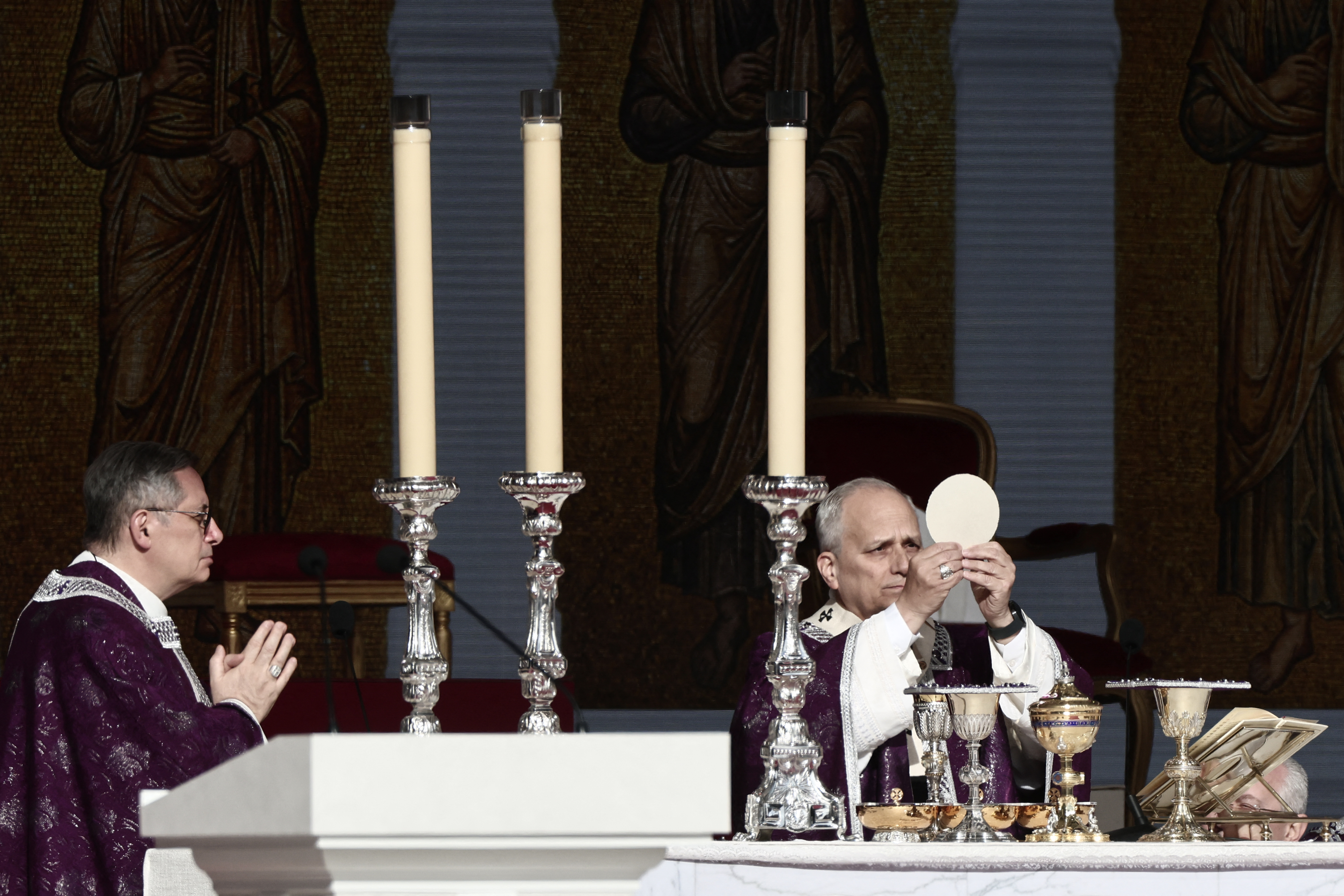
Cardinal Seán P. O’Malley said life is a “precious gift from a loving God” ahead of the 2026 annual March for Life.
O’Malley, archbishop emeritus of Boston, celebrated Mass on Jan. 23 before the March for Life, concluding the annual National Prayer Vigil for Life at the Basilica of the National Shrine of the Immaculate Conception in Washington, D.C.
“I know that many of you are tired and have made many sacrifices to be here,” O’Malley said. “I assure you, you could not be doing anything more important than being here today. And your presence is not by accident. The Lord in his providence has brought all of us here today.”
The Mass featured prayers for the pro-life movement and provided a moment to strengthen commitment to defending human life ahead of the march.
“Abortion is the greatest moral crisis faced by our country and by our world. It’s a matter of life and death in a very grand scale," O’Malley said. “It’s been a joy and a privilege for me to be at every March for Life here in Washington for the past 53 years.”
“It’s such a joy to be with you here today in this March for Life. This is a pilgrimage for life, and it begins with prayer, here in Mary’s shrine. I thank God for all of you,” he said.
O’Malley spoke about the 2026 March for Life theme: “Life Is a Gift.”
“What a powerful theme,” O’Malley said. “Sadly, life is not always seen as a gift. For some, it seems a burden or a curse.”
The cardinal detailed a recent poll that found “for the very first time in the history of our nation, the majority of Americans say they do not want to have children.” O’Malley called it “an alarming statistic.”
“Life is a gift, a gift given by a loving God,” he said. “Life is beautiful, especially when it is received with gratitude and love.”
We must “love as God loves,” O’Malley said. “We must love first, forgive first, give first. That’s why we’re here in this Mass for life.”
“We’re here because life is a gift. God has given us this precious gift. We must be grateful and express our gratitude by proclaiming the gospel of life,” he said.
O’Malley, who has been active in the pro-life movement for decades, said the opposition once believed the pro-life advocates would “die off,” but “we’re still here, proclaiming the gospel of life.”
“Our mission is not a political crusade. It’s a response to God’s command to love and to care for each other. And God bless us, the crowd is getting younger and younger. You are beautiful,” he said.
To end abortion, “our task is not to judge others but to bring healing,” O’Malley said. We must be “gentle” like Jesus was with “the Samaritan woman, the poor, the tax collector, the adulterous woman, the good thief,” he said.
“Our task is to build a society that takes care of everybody, where every person counts, where every life is important. Political polarization, racism, economic injustice will only continue to fuel abortion in a post-Roe v. Wade world,” O’Malley said.
“Our world is wracked by divisions and violence. Pope Leo is inviting us to be messengers of unity and of peace. But we do not want to get in the way of the message,” O’Malley said.
“Together, we can protect and nurture that gift of life. We must look for opportunities to be apostles of life, building a civilization of love and ethic of care,” he said.
“The antidote to abortion is love. Love manifests in community, compassion, and solidarity. Life is a gift. Every person is a gift. Every person counts. All are important. Our mission is to work so that no child be left behind. Every baby will be welcomed, loved, cared for, nurtured, and protected,” he said.
“Thank God for the gift of life. Thank God for love. Thank God for you,” O’Malley concluded.
EWTN News’ coverage of the 2026 March for Life can be found here.
If you’re attending the March for Life, don’t forget to use #ewtnprolife on all your posts across X, TikTok, Instagram, and Facebook!
Want to relive interviews and special moments from the march? Visit ewtnnews.com/watch and subscribe to youtube.com/@EWTNNews for full coverage.
Read More

Jan 23, 2026 / 09:34 am (CNA).
Young Catholics who traveled from across the country for the March for Life started their day singing and praying with the Sisters of Life early Friday morning.
Life Fest 2026 participants gathered at the Gaylord National Resort and Convention Center in Oxon Hill, Maryland, to get energized, sing songs, and receive the sacraments before heading to the National Mall for the March for Life 2026.

The event, organized by the Sisters of Life and Knights of Columbus, began at 6 a.m. with music, pro-life testimonies, and chances to go to confession and venerate the relics of numerous saints. Several nuns played music as a part of the All the Living Band alongside Father Isaiah Marie Hofmann, CFR, while participants in the crowd sang along and clapped.
The crowd included everyone from young children to elderly people, Sisters of Life, Dominican brothers and priests, and the Knights of Columbus, who sponsored the event.
Students from Lansing Catholic High School in Lansing, Michigan, waited in a line to venerate relics of St. Carlos Acutis and St. John Paul II.

The event featured pro-life testimony from women and families who experienced crisis pregnancies and chose life, including the Schachle family, whose son Michael McGivny Schachle, who helped make his namesake a “blessed” through the miracle of his birth.
Schachle’s parents, Michelle and Daniel, gave their testimony while he stood alongside them on stage.
If you’re attending the March for Life, don’t forget to use #ewtnprolife on all your posts across X, TikTok, Instagram, and Facebook!
Want to relive interviews and special moments from the march? Visit ewtnnews.com/watch and subscribe to youtube.com/@EWTNNews for full coverage.
Read More

Jan 22, 2026 / 12:00 pm (CNA).
Catholic figures gathered in Los Angeles on Jan. 16 for the premiere of “Seeking Beauty,” the first original series from EWTN Studios airing exclusively on the network’s brand-new streaming platform, EWTN+.
Here are five things to know about the new series and its host, actor David Henrie.
“Seeking Beauty” is a first-of-its-kind adventure documentary series that explores culture, architecture, food, art, and music, and aims to point viewers to the beautiful — and ultimately to the divine.
The series follows Henrie’s journey into the heart of Italy to explore what makes Italian culture one of the most beautiful in the world. It not only looks at the physical beauty of the country but also its spiritual richness.
“Seeking Beauty” is available to watch exclusively on EWTN+, a free digital streaming platform that offers faith-based content. EWTN+ is available on RokuTV, GoogleTV, AppleTV, AmazonFireTV, and on EWTN.com.
The first season of “Seeking Beauty” takes place in several cities across Italy including Vatican City, Rome, Milan, Florence, and Venice.
Henrie is best known for his breakout role as Justin Russo on Disney Channel’s “Wizards of Waverly Place.” He grew up in a Catholic household with Italian heritage; however, Henrie’s early adult years were marked by what he has described as a relativistic and agnostic period. He has also spoken about how the successes of early fame left him feeling unfulfilled and searching for deeper meaning.
Henrie’s return to the Catholic faith was a profound personal transformation that he says began around age 21 or 22.
A significant influence came while working on the movie “Little Boy,” where conversations with Catholic cast members Kevin James and Eduardo Verástegui, as well as a visit to St. Michael Abbey in Orange County, California — including his first confession since childhood — played a pivotal role in rediscovering his faith.
Since then, Henrie has embraced his faith publicly and personally, integrating his beliefs into his family life, creative projects, and charity work, including serving as a brand ambassador for Cross Catholic Outreach and participating in mission trips that reflect his commitment to living out his faith. He is married and has three children.
Yes! The second season of the series was filmed in Spain and is scheduled to premiere this fall.
Read More

Jan 21, 2026 / 15:49 pm (CNA).
A federal health spending bill would impose a long-enforced ban on using taxpayer funds for elective abortion, known as the Hyde Amendment.
The U.S. House is set to consider the bill this week, which would fund the departments of Labor, Education, and Health and Human Services. Lawmakers would need to pass spending bills in both chambers and send them to the White House by Jan. 30 or the government could face another partial shutdown.
Republican President Donald Trump had asked his party to be “flexible” in its approach to the provision in a separate funding bill. According to a Jan. 19 news release from the Republican-led House Appropriations Committee, the Labor-HHS-Education spending bill includes the provision “protecting the lives of unborn children” known as the Hyde Amendment.
The Hyde Amendment, which is not permanent law, was first included as a rider in federal spending bills in 1976. It was included consistently since then although some recent legislation and budget proposals have sometimes excluded it. The provision would ban federal funds for abortion except when the unborn child is conceived through rape or incest or if the life of the mother is at risk.
Katie Glenn Daniel, director of legal affairs and policy counsel for Susan B. Anthony Pro-Life America, said the amendment is “a long-standing federal policy that’s been included for the last five decades and is popular with the American people.”
“Americans don’t want to pay for abortion on demand,” she said.
Many Democratic lawmakers have sought to eliminate the rider in recent years, saying it disproportionately limits abortion access for low-income women. Former President Joe Biden reversed his longtime support of the Hyde Amendment in the lead-up to the 2020 election and refused to include it in his spending proposals, saying: “If I believe health care is a right, as I do, I can no longer support an amendment that makes that right dependent on someone’s zip code.” But Republicans successfully negotiated the rider’s inclusion into spending bills.
In January 2025, Trump issued an executive order directing the government to enforce the Hyde Amendment. A year later, Trump urged Republicans to be “a little flexible on Hyde” when lawmakers were negotiating the extension of health care subsidies related to the Affordable Care Act. A White House spokesperson also said the president would work with Congress to ensure the strongest possible pro-life protections.
The House eventually passed the extension without the Hyde Amendment after 17 Republicans joined Democrats to support the bill. The Senate has not yet advanced the measure, where the question of whether to include the Hyde Amendment has been a point of contention between Republicans and Democrats.
In mid-January, Trump announced a plan to change how health care subsidies are disbursed. There was no mention of the Hyde Amendment in the White House’s 827-word memo.
The United States Conference of Catholic Bishops has consistently lobbied for the inclusion of the Hyde Amendment in spending bills. On Jan. 14, the bishops sent a letter to Congress “to stress in the strongest possible terms that Hyde is essential for health care policy that protects human dignity.”
“Authentic health care and the protection of human life go hand in hand,” the letter said. “There can be no compromise on these two combined values.”
Read More

Jan 21, 2026 / 06:00 am (CNA).
With tens of thousands of pro-life Americans gathering for the 53rd annual March for Life in Washington, D.C., on Friday, Jan. 23, EWTN will provide live coverage of the event.
The yearly national pro-life event marks the anniversary of Roe v. Wade, drawing together thousands to protest abortion and advocate for life. This year’s theme is “Life Is a Gift,” which the March for Life official website says emphasizes the “unshakeable conviction that life is very good and worthy of protection, no matter the circumstances.”
5 p.m. ET: EWTN’s National March for Life coverage kicks off before the march with a night of prayer at the Basilica of the National Shrine of the Immaculate Conception. The National Prayer Vigil for Life is held annually on the eve of the March for Life, bringing thousands of pilgrims across the nation together to pray for an end to abortion.
At 5 p.m. ET, EWTN will stream the opening Mass followed by the Holy Hour of the National Prayer Vigil for Life at 7 p.m. as pro-lifers pray and prepare for the upcoming march.
8 a.m. ET: The all-night prayer vigil will conclude with the closing Mass of the National Prayer Vigil for Life at the shrine, televised live by EWTN.
9:30 p.m. to 4:30 p.m. ET: EWTN will air coverage of the March for Life, featuring a keynote by Sarah Hurm, a single mom of four who went through a chemical abortion reversal to save the life of her child.
Other speakers include Speaker of the House Mike Johnson, R-Louisiana; Rep. Chris Smith, R-New Jersey; and March for Life President Jennie Bradley Lichter. The march will also feature pro-life entrepreneurs including Shawnte Mallory, founder of Labir Love And Care, and Debbie Biskey, CEO of Options for Her, as well as student activist Elizabeth Pillsbury Oliver, a convert to Catholicism who heads Georgetown University’s Right to Life group.
Rev. Irinej Dobrijevic, a Serbian Orthodox bishop of the Diocese of Eastern America, and Cissie Graham Lynch, spokesperson for the Billy Graham Evangelistic Association, will also speak at the event.
In addition, the Christian band Sanctus Real will perform at the rally and the Friends of Club 21 choir — a chorus of young adults with Down syndrome — will perform the national anthem.
4 p.m. ET: EWTN will broadcast the second annual Life Fest Mass, sponsored by the Sisters of Life and the Knights of Columbus as part of the Life Fest Rally. The Life Fest Rally begins the evening before the march with live music from Matt Maher and other Christian bands.
2:30 p.m. ET: The 21st annual Walk for Life West Coast will begin with a rally followed by the walk. EWTN will livestream coverage of the walk.
5 p.m. ET: EWTN will televise highlights from One Life (Una Vida), a one-day event centered on witnessing human dignity with a focus on the pro-life issues as well as other issues such as human trafficking and homelessness. The coverage will be hosted by Astrid Bennett and Patricia Sandoval, along with EWTN producers, during the march.
8 p.m. ET: EWTN will televise a pro-life Mass from Los Angeles, concluding the weekend’s pro-life coverage.
Read More![Pro-life movement has mixed reaction after Trump’s first year of second term #Catholic
Participants in a pro-life rally hold signs in front of the Lincoln Memorial in Washington, D.C., on June 24, 2023, at a rally marking the first anniversary of the Supreme Court's Dobbs decision that overturned Roe v. Wade. | Credit: Joseph Portolano/EWTN News
Jan 20, 2026 / 14:37 pm (CNA).
Members of the pro-life movement have mixed thoughts on the first year of President Donald Trump’s second term, noting many wins early into his presidency but a number of shortfalls as time has gone by.Some wins include defunding Planned Parenthood, walking back some of President Joe Biden’s initiatives, and removing foreign aid funding for organizations that promote abortion. However, a lack of action on chemical abortions and weakened rhetoric surrounding taxpayer-funded abortions are causing concern.A notable pro-life win was included in the tax overhaul bill signed by Trump in July, which cut off all Medicaid reimbursements for organizations that provide a large number of abortions, such as Planned Parenthood.Amid funding cuts, nearly 70 Planned Parenthood affiliates shut down. The administration also initially cut off Title X family planning grants from the abortion giant, but those have resumed.The president pardoned pro-life protesters convicted of violating the Freedom of Access to Clinic Entrances (FACE) Act and blocked foreign aid from supporting organizations that promote abortion. He rescinded several policies from the Biden administration, including one that paid Pentagon workers to travel for abortions. He also established strong conscience protections for pro-life doctors.“Right out the gate, we saw some progress on the pro-life issue,” Kelsey Pritchard, a spokesperson for Susan B. Anthony Pro-Life America (SBA), told EWTN.Yet, she cautioned: “We have also not seen progress in the one area that matters the most — and that’s on abortion drugs.”Health Secretary Robert F. Kennedy Jr. launched a study into the safety of the abortion pill mifepristone in September 2025, but so far no action has been taken to curtail the drug. Rather, the Food and Drug Administration (FDA) went in the opposite direction, approving a generic version of mifepristone later that same month.Pritchard said that move was “the opposite of what they should have done,” and referred to the generic mifepristone as “a new kill pill to increase the number of abortions that are done in this country.”She said Kennedy’s promised study has “absolutely been moving too slow” and added that there is no confirmation it even began or is taking place. SBA called for FDA Commissioner Marty Makary to be fired following allegations he was “slow-walking the report for political reasons,” she said.Trump has said abortion should be regulated by the states, but Pritchard warned “those [pro-life] laws can’t be in effect at all, really, when mail-order abortion happens with the abortion drugs.”“They’re allowing [California Gov.] Gavin Newsom and [New York Gov.] Kathy Hochul and their blue state friends to completely nullify the pro-life laws in states like Texas and Florida,” she said.Joseph Meaney, a senior ethicist at the National Catholic Bioethics Center, similarly said “the delay in the promised review of the rushed process in which mifepristone was approved as an abortion drug by the FDA has frustrated pro-lifers.”“When the FDA approved a second generic version of mifepristone, … it highlighted the lack of progress in fighting the leading means of doing abortions in the [United States],” he said.Trump also began to waver on taxpayer-funded abortions early in 2026, asking Republicans to be “flexible” on the Hyde Amendment amid negotiations on extending health care subsidies for the Affordable Care Act. Trump later unveiled “The Great Healthcare Plan” and said the White House intends to negotiate with Congress to ensure pro-life protections.Pritchard called taxpayer-funded abortion “a very basic red line” and said it’s “concerning to see Republicans back away from something so basic.”She warned Republicans to not take pro-life voters for granted in the upcoming midterms, saying “you’ll lose the elections and we won’t have the majority of Congress” without pro-life voters.“You must remain the pro-life party or you will lose the midterms if you decide to bow to the pro-death Democrat agenda,” Pritchard said.Meaney said there is “a widespread feeling that the second Trump administration has seemed to deprioritize issues important to the pro-life community,” adding he has “seen calls for pro-life groups to ‘flex their muscles’ and show that they cannot be taken for granted.”However, he said the shortfalls “should not obscure the fact that the Trump administration has rolled back the Biden-era pro-abortion measures internationally and domestically.”“It even achieved a temporary defunding of Planned Parenthood domestically in legislation,” he said. “The federal government no longer funds research on fetal tissues and defends the conscience rights of health care professionals and others robustly.”Trump also signed an executive order that directed departments and agencies to boost access to and reduce the cost of in vitro fertilization (IVF). The Catholic Church opposes IVF, which results in the destruction of human embryos, ending human lives.](https://unitedyam.com/wp-content/uploads/2026/01/pro-life-movement-has-mixed-reaction-after-trumps-first-year-of-second-term-catholic-participants-in-a-pro-life-rally-hold-signs-in-front-of-the-lincoln-memorial-in-washington-d-c-on-scaled.jpg)

Jan 20, 2026 / 14:37 pm (CNA).
Members of the pro-life movement have mixed thoughts on the first year of President Donald Trump’s second term, noting many wins early into his presidency but a number of shortfalls as time has gone by.
Some wins include defunding Planned Parenthood, walking back some of President Joe Biden’s initiatives, and removing foreign aid funding for organizations that promote abortion. However, a lack of action on chemical abortions and weakened rhetoric surrounding taxpayer-funded abortions are causing concern.
A notable pro-life win was included in the tax overhaul bill signed by Trump in July, which cut off all Medicaid reimbursements for organizations that provide a large number of abortions, such as Planned Parenthood.
Amid funding cuts, nearly 70 Planned Parenthood affiliates shut down. The administration also initially cut off Title X family planning grants from the abortion giant, but those have resumed.
The president pardoned pro-life protesters convicted of violating the Freedom of Access to Clinic Entrances (FACE) Act and blocked foreign aid from supporting organizations that promote abortion. He rescinded several policies from the Biden administration, including one that paid Pentagon workers to travel for abortions. He also established strong conscience protections for pro-life doctors.
“Right out the gate, we saw some progress on the pro-life issue,” Kelsey Pritchard, a spokesperson for Susan B. Anthony Pro-Life America (SBA), told EWTN.
Yet, she cautioned: “We have also not seen progress in the one area that matters the most — and that’s on abortion drugs.”
Health Secretary Robert F. Kennedy Jr. launched a study into the safety of the abortion pill mifepristone in September 2025, but so far no action has been taken to curtail the drug. Rather, the Food and Drug Administration (FDA) went in the opposite direction, approving a generic version of mifepristone later that same month.
Pritchard said that move was “the opposite of what they should have done,” and referred to the generic mifepristone as “a new kill pill to increase the number of abortions that are done in this country.”
She said Kennedy’s promised study has “absolutely been moving too slow” and added that there is no confirmation it even began or is taking place. SBA called for FDA Commissioner Marty Makary to be fired following allegations he was “slow-walking the report for political reasons,” she said.
Trump has said abortion should be regulated by the states, but Pritchard warned “those [pro-life] laws can’t be in effect at all, really, when mail-order abortion happens with the abortion drugs.”
“They’re allowing [California Gov.] Gavin Newsom and [New York Gov.] Kathy Hochul and their blue state friends to completely nullify the pro-life laws in states like Texas and Florida,” she said.
Joseph Meaney, a senior ethicist at the National Catholic Bioethics Center, similarly said “the delay in the promised review of the rushed process in which mifepristone was approved as an abortion drug by the FDA has frustrated pro-lifers.”
“When the FDA approved a second generic version of mifepristone, … it highlighted the lack of progress in fighting the leading means of doing abortions in the [United States],” he said.
Trump also began to waver on taxpayer-funded abortions early in 2026, asking Republicans to be “flexible” on the Hyde Amendment amid negotiations on extending health care subsidies for the Affordable Care Act. Trump later unveiled “The Great Healthcare Plan” and said the White House intends to negotiate with Congress to ensure pro-life protections.
Pritchard called taxpayer-funded abortion “a very basic red line” and said it’s “concerning to see Republicans back away from something so basic.”
She warned Republicans to not take pro-life voters for granted in the upcoming midterms, saying “you’ll lose the elections and we won’t have the majority of Congress” without pro-life voters.
“You must remain the pro-life party or you will lose the midterms if you decide to bow to the pro-death Democrat agenda,” Pritchard said.
Meaney said there is “a widespread feeling that the second Trump administration has seemed to deprioritize issues important to the pro-life community,” adding he has “seen calls for pro-life groups to ‘flex their muscles’ and show that they cannot be taken for granted.”
However, he said the shortfalls “should not obscure the fact that the Trump administration has rolled back the Biden-era pro-abortion measures internationally and domestically.”
“It even achieved a temporary defunding of Planned Parenthood domestically in legislation,” he said. “The federal government no longer funds research on fetal tissues and defends the conscience rights of health care professionals and others robustly.”
Trump also signed an executive order that directed departments and agencies to boost access to and reduce the cost of in vitro fertilization (IVF). The Catholic Church opposes IVF, which results in the destruction of human embryos, ending human lives.
Read More![Catholics express mixed views on first year of Trump’s second term #Catholic
With Speaker of the House Mike Johnson by his side, President Donald Trump speaks to the press following a House Republican meeting at the U.S. Capitol on May 20, 2025, in Washington, D.C. | Credit: Tasos Katopodis/Getty Images
Jan 20, 2026 / 12:21 pm (CNA).
Catholics are offering mixed reactions to the first year of President Donald Trump’s second term, which included domestic policy actions that align with U.S. bishops on gender-related issues, and also tensions over immigration, expansion of the death penalty, and reduced funding for organizations that provide food and basic support to people in need.Trump secured his electoral victory in 2024 with the help of Catholics, who supported him by a double-digit margin, according to exit polls. A Pew Research Center report found that nearly a quarter of Trump’s voters in 2024 were Catholic.Throughout his first year, Trump — who calls himself a nondenominational Christian — has invoked Christianity and created a White House Faith Office. He created a Religious Liberty Commission by executive order in May 2025 and became the first president to issue a proclamation honoring the Catholic feast of the Immaculate Conception in December.Last year, the president also launched the “America Prays” initiative, which encouraged people to dedicate one hour of prayer for the United States and its people in preparation for the 250th anniversary of the Declaration of Independence on July 4, 2026.Immigration, poverty, and NGOsJohn White, professor of politics at The Catholic University of America, said the first year of Trump’s second term “challenged Catholics on many levels.”“The brutality of ICE has caused the U.S. Conference of Catholic Bishops to issue an extraordinary statement at the prompting of Pope Leo XIV,” White said, referring to the Immigration and Customs Enforcement agency. The U.S. Conference of Catholic Bishops (USCCB) issued a special message in November opposing indiscriminate mass deportations, calling for humane treatment, urging meaningful reform, and affirming the compatibility of national security with human dignity.The Trump administration, with JD Vance, the second Catholic vice president in U.S. history, cut billions of dollars in funding to nongovernmental organizations (NGOs), which financially damaged several Catholic nonprofits that had received funding. Trump also signed into law historic cuts to the Supplemental Nutrition Assistance Program.“The cuts to NGO funding, SNAP, and Medicaid benefits, alongside the huge increases in health care costs, have hurt the poor and middle class at home and around the world,” he said. “Instead of being the good Samaritan, Trump has challenged our Catholic values and narrowed our vision of who we are and what we believe. JD Vance’s interpretation of ‘Ordo Amoris’ of a hierarchy to those whom we love rather than a universal love is a case in point and has been repudiated by Pope Francis and Pope Leo XIV,” he said.The cuts aligned federal policy with the administration’s agenda, which included strict immigration enforcement, mass deportations of immigrants who are in the country illegally, and less foreign aid support.Catholic Charities USA was previously receiving more than $100 million annually for migrant services, and the Trump administration cut off those funds. In response, the organization scaled back its services.Since Trump took office, the administration said it has deported more than 600,000 people.Karen Sullivan, director of advocacy for the Catholic Legal Immigration Network (CLINIC), which provides legal services to migrants, said she is “very concerned about the way that immigration enforcement has been carried out,” adding her organization is “very concerned that human dignity of all persons [needs to] be respected.”Sullivan said the administration is “enabling their officers to use excessive force as they are taking people into custody” and “denying access to oversight at their detention centers.” She also expressed concern about the administration increasing fees for asylum applications and giving agents more leeway to conduct immigration enforcement at sensitive locations, such as churches, schools, and hospitals.She said the large number of deportations and the increase in expedited removals has “been a strain” on organizations that seek to provide legal help to migrants.CLINIC receives inquiries from people who are facing deportation and also those who fear they may be deported. She said: “The worry and the fear among those people [who may face deportation] makes them seek out assistance and advice even more often.”“The pace of the changes that have been happening in the past year have been very difficult to manage,” she said. “We are having to respond very quickly to changes."Executive actions on genderSusan Hanssen, a history professor at the University of Dallas (a Catholic institution), viewed the first year of Trump’s second term in mostly successful terms.“As Catholics we know that the law educates, and during Trump’s first year in office we witnessed an actual shift in public opinion on the LGBT/transgender ideology due to his asserting the scientific and natural common sense that there are only male and female,” Hanssen said.Trump took executive action to prohibit what he called the “chemical and surgical mutilation” of children, such as hormone therapy and surgical transition. He signed a policy restricting participation of transgender athletes in women’s sports. He legally recognized only two genders, determined by biology: male and female.“His strong executive action on this essential point — domestically in making the executive branch remove its trans-affirming language, the executive department of education stop subverting parental rights over their children, and women’s rights in sports, and (importantly) putting an end to USAID’s [U.S. Agency for International Development] pushing this gender agenda on the countries who need our economic assistance,” she said.“This has led to a genuine public shift, with fewer independent corporations choosing to enforce June as LGBT Pride month on their customer base, fewer DEI programs pushing the gender agenda on hiring, and a shift (especially among young men) towards disapproval of gender transitioning children and even towards disapproval of the legalization of so-called same sex ‘marriage,’” she added. “We will need to see how these executive branch victories will affect judicial and legislative action moving forward.”Father Tadeusz Pacholczyk, senior ethicist at the National Catholic Bioethics Center, had a similar view of some of the social changes.“The current administration has focused significant energy on the important task of ‘putting folks on notice,’ so it’s hard to deny, for example, that the misguided medico-pharmaceutical industry that has profited handsomely from exploiting vulnerable youth and other gender dysphoric individuals can no longer miss the loud indicators that these practices will not be able to continue unabated,” he said.Death penaltyTrump signaled a renewed and more aggressive federal capital-punishment policy in 2025, in opposition to the Catechism of the Catholic Church, which teaches that the death penalty is “inadmissible.”Trump signed an executive order on his first day in office directing the Justice Department to actively pursue the federal death penalty for serious crimes. He also directed federal prosecutors to seek death sentences in Washington, D.C., homicide cases. His administration lifted a moratorium on executions, reversing a pause in federal executions and following President Joe Biden’s commutations of federal death sentences.Archbishop Timothy P. Broglio, then-president of the USCCB, in a Jan. 22, 2025, statement called Trump’s support for expanding the federal death penalty “deeply troubling.” Newly elected USCCB president Archbishop Paul Coakley likewise called for the abolition of the death penalty.](https://unitedyam.com/wp-content/uploads/2026/01/catholics-express-mixed-views-on-first-year-of-trumps-second-term-catholic-with-speaker-of-the-house-mike-johnson-by-his-side-president-donald-trump-speaks-to-the-press-following-a-hous.jpg)

Jan 20, 2026 / 12:21 pm (CNA).
Catholics are offering mixed reactions to the first year of President Donald Trump’s second term, which included domestic policy actions that align with U.S. bishops on gender-related issues, and also tensions over immigration, expansion of the death penalty, and reduced funding for organizations that provide food and basic support to people in need.
Trump secured his electoral victory in 2024 with the help of Catholics, who supported him by a double-digit margin, according to exit polls. A Pew Research Center report found that nearly a quarter of Trump’s voters in 2024 were Catholic.
Throughout his first year, Trump — who calls himself a nondenominational Christian — has invoked Christianity and created a White House Faith Office. He created a Religious Liberty Commission by executive order in May 2025 and became the first president to issue a proclamation honoring the Catholic feast of the Immaculate Conception in December.
Last year, the president also launched the “America Prays” initiative, which encouraged people to dedicate one hour of prayer for the United States and its people in preparation for the 250th anniversary of the Declaration of Independence on July 4, 2026.
John White, professor of politics at The Catholic University of America, said the first year of Trump’s second term “challenged Catholics on many levels.”
“The brutality of ICE has caused the U.S. Conference of Catholic Bishops to issue an extraordinary statement at the prompting of Pope Leo XIV,” White said, referring to the Immigration and Customs Enforcement agency. The U.S. Conference of Catholic Bishops (USCCB) issued a special message in November opposing indiscriminate mass deportations, calling for humane treatment, urging meaningful reform, and affirming the compatibility of national security with human dignity.
The Trump administration, with JD Vance, the second Catholic vice president in U.S. history, cut billions of dollars in funding to nongovernmental organizations (NGOs), which financially damaged several Catholic nonprofits that had received funding. Trump also signed into law historic cuts to the Supplemental Nutrition Assistance Program.
“The cuts to NGO funding, SNAP, and Medicaid benefits, alongside the huge increases in health care costs, have hurt the poor and middle class at home and around the world,” he said. “Instead of being the good Samaritan, Trump has challenged our Catholic values and narrowed our vision of who we are and what we believe. JD Vance’s interpretation of ‘Ordo Amoris’ of a hierarchy to those whom we love rather than a universal love is a case in point and has been repudiated by Pope Francis and Pope Leo XIV,” he said.
The cuts aligned federal policy with the administration’s agenda, which included strict immigration enforcement, mass deportations of immigrants who are in the country illegally, and less foreign aid support.
Catholic Charities USA was previously receiving more than $100 million annually for migrant services, and the Trump administration cut off those funds. In response, the organization scaled back its services.
Since Trump took office, the administration said it has deported more than 600,000 people.
Karen Sullivan, director of advocacy for the Catholic Legal Immigration Network (CLINIC), which provides legal services to migrants, said she is “very concerned about the way that immigration enforcement has been carried out,” adding her organization is “very concerned that human dignity of all persons [needs to] be respected.”
Sullivan said the administration is “enabling their officers to use excessive force as they are taking people into custody” and “denying access to oversight at their detention centers.” She also expressed concern about the administration increasing fees for asylum applications and giving agents more leeway to conduct immigration enforcement at sensitive locations, such as churches, schools, and hospitals.
She said the large number of deportations and the increase in expedited removals has “been a strain” on organizations that seek to provide legal help to migrants.
CLINIC receives inquiries from people who are facing deportation and also those who fear they may be deported. She said: “The worry and the fear among those people [who may face deportation] makes them seek out assistance and advice even more often.”
“The pace of the changes that have been happening in the past year have been very difficult to manage,” she said. “We are having to respond very quickly to changes."
Susan Hanssen, a history professor at the University of Dallas (a Catholic institution), viewed the first year of Trump’s second term in mostly successful terms.
“As Catholics we know that the law educates, and during Trump’s first year in office we witnessed an actual shift in public opinion on the LGBT/transgender ideology due to his asserting the scientific and natural common sense that there are only male and female,” Hanssen said.
Trump took executive action to prohibit what he called the “chemical and surgical mutilation” of children, such as hormone therapy and surgical transition. He signed a policy restricting participation of transgender athletes in women’s sports. He legally recognized only two genders, determined by biology: male and female.
“His strong executive action on this essential point — domestically in making the executive branch remove its trans-affirming language, the executive department of education stop subverting parental rights over their children, and women’s rights in sports, and (importantly) putting an end to USAID’s [U.S. Agency for International Development] pushing this gender agenda on the countries who need our economic assistance,” she said.
“This has led to a genuine public shift, with fewer independent corporations choosing to enforce June as LGBT Pride month on their customer base, fewer DEI programs pushing the gender agenda on hiring, and a shift (especially among young men) towards disapproval of gender transitioning children and even towards disapproval of the legalization of so-called same sex ‘marriage,’” she added. “We will need to see how these executive branch victories will affect judicial and legislative action moving forward.”
Father Tadeusz Pacholczyk, senior ethicist at the National Catholic Bioethics Center, had a similar view of some of the social changes.
“The current administration has focused significant energy on the important task of ‘putting folks on notice,’ so it’s hard to deny, for example, that the misguided medico-pharmaceutical industry that has profited handsomely from exploiting vulnerable youth and other gender dysphoric individuals can no longer miss the loud indicators that these practices will not be able to continue unabated,” he said.
Trump signaled a renewed and more aggressive federal capital-punishment policy in 2025, in opposition to the Catechism of the Catholic Church, which teaches that the death penalty is “inadmissible.”
Trump signed an executive order on his first day in office directing the Justice Department to actively pursue the federal death penalty for serious crimes. He also directed federal prosecutors to seek death sentences in Washington, D.C., homicide cases. His administration lifted a moratorium on executions, reversing a pause in federal executions and following President Joe Biden’s commutations of federal death sentences.
Archbishop Timothy P. Broglio, then-president of the USCCB, in a Jan. 22, 2025, statement called Trump’s support for expanding the federal death penalty “deeply troubling.” Newly elected USCCB president Archbishop Paul Coakley likewise called for the abolition of the death penalty.
Read More

Jan 18, 2026 / 10:26 am (CNA).
This past week, nearly a quarter of U.S. states sued the federal government for defining biological sex as binary, the U.S. Supreme Court heard arguments for and against legally allowing males to compete against females in sports, and a Vatican official called surrogacy a “new form of colonialism” that commodifies women and their children.
These are just the latest legal and cultural effects of a “mass cultural confusion” surrounding the meaning and purpose of the human body, and particularly women’s bodies, according to Leah Jacobson, program coordinator of the Catholic Women’s and Gender Studies Program at the University of St. Thomas in Houston.
On Jan. 9–10, the program sponsored a symposium titled “The Beauty of Truth: Navigating Society Today as a Catholic Woman,” which brought together a group of Catholic women who have used their gifts of intellect and faith to serve as what Jacobson calls an “antidote” to the “chaos and confusion” of the cultural moment.
The speakers presented on a wide range of topics concerned with the beauty, truth, and necessity of the Church’s teachings on human sexuality, while also acknowledging how difficult living according to those teachings can sometimes be.
In one of the first talks, writer Mary Eberstadt argued that the question “Who am I?” became harder to answer due to the widespread use of the birth control pill, which has led to huge increases in abortion, divorce, fatherlessness, single parenthood, and childlessness.
“Each of these acts is an act of human subtraction,” Eberstadt said. “I’m not trying to make a point about morality, but arithmetic.”
“The number of people we can call our own” became smaller, she said.
While she acknowledged that not everyone has been affected equally, “members of our species share a collective environment. Just as toxic waste affects everyone," she said, the reduction in the number of human connections “amounts to a massive disturbance to the human ecosystem,” leading to a crisis of human identity.
This reduction in the number of people in an individual's life, she argued, resulted in widespread confusion over gender identity and the meaning and purpose of the body.
Eberstadt also attributed the decline in religiosity to the smaller number of human connections modern people have.
“The sexual revolution subtracted the number of role models,” she said. “Many children have no siblings, no cousins, no aunts or uncles, no father; yet that is how humans conduct social learning.”
“Without children, adults are less likely to go to church,” she said. “Without birth, we lose knowledge of the transcendent. Without an earthly father, it is hard to grasp the paradigm of a heavenly father.”
“Living without God is not liberating people,” she continued. “It’s tearing some individuals apart, making people miserable and lonely.”
When the sexual revolution made sex "recreational and not procreative, what it produced above all is a love deficit,” Eberstadt said.
At the same time, secularization produced “troubled, disconnected souls drifting through society without gravity, shattering the ability to answer ‘Who am I?’”
“The Church is the answer to the love deficit because Church teachings about who we are and what we’re here for are true,” she said.
She concluded with a final note on hope, saying “it is easy to feel embattled, but we must never lose sight of the faces of the sexual revolution’s victims,” she said, “who are sending up primal screams for a world more ordered than many of today’s people now know; more ordered to mercy, to community and redemption.”
Erika Bachiochi, a legal scholar and fellow at the Ethics and Public Policy Center who has taught a class for the graduate program, shared her experience as a mother of seven who tried to live according to the Church’s “difficult” teachings.
As her children began to arrive at “a breakneck pace” and each pregnancy was “a bit of a crucible,” Bachiochi said being a mother was “very hard” for her, partly due to wounds from her youth (among other troubles, her own mother had been married and divorced three times), and partly because of a lack of community.
Echoing Eberstadt’s “arithmetic” problem, Bachiochi described having very few examples of Catholic family life and a very small support system.
Bachiochi said she believes God heals us from our wounds through our “particular vocations,” however.
Of motherhood, she said: “I think God really healed me through being faithful to teachings that I found quite hard, but truly beautiful. I was intellectually convinced by them and found them spiritually beautiful, but found them to be very, very hard to live.”
“Motherhood has served to heal me profoundly," she said, encouraging young mothers to have faith that though it might be difficult now, there is an “amazing future” awaiting them.
“It’s really an incredible gift that Church has given me … the gift of obedience,” she said.
She also said by God’s grace, she was given an “excellent husband” and has found that “just as the Church promises, that leaning into motherhood, into the little things, the daily needs, the constant requests for my attention, has truly been a school of virtue.”
The Catholic Women’s and Gender Studies Program is a new part of the Nesti Center for Faith and Culture at the University of St. Thomas, a recognized Catholic cultural center of the Vatican’s Dicastery for Culture and Education.
Read More

Jan 18, 2026 / 08:00 am (CNA).
The Virginia Catholic bishops on Friday spoke out against an abortion amendment that would remove state protections for unborn children, calling the measure “extreme.”
The Virginia General Assembly passed a proposed amendment that would add a fundamental right to abortion to Virginia’s constitution, if voters approve it this November.
The proposed abortion amendment would establish a “fundamental right to reproductive freedom, including the ability to make and carry out decisions relating to one’s own prenatal care, childbirth, postpartum care, contraception, abortion care, miscarriage management, and fertility care.”
Bishops Michael Burbidge of Arlington and Barry Knestout of Richmond called the move “shocking to the conscience,” noting that lawmakers quickly moved the proposed amendment through both chambers in the early days of its 60-day session.
“The extreme abortion amendment, which will proceed to a referendum for voters to decide later this year, would go far beyond even what Roe v. Wade previously allowed,” the bishops said in the Jan. 16 statement. “It would enshrine virtually unlimited abortion at any stage of pregnancy, with no age restriction.”
The bishops cautioned that the amendment would “severely jeopardize Virginia’s parental consent law, health and safety standards for women, conscience protections for health care providers, and restrictions on taxpayer-funded abortions.”
“Most tragically of all, the extreme abortion amendment provides no protections whatsoever for preborn children,” the bishops continued.
“Most importantly, human life is sacred,” the bishops said. “The lives of vulnerable mothers and their preborn children must always be welcomed, cared for, and protected.”
“Parental rights and the health and well-being of minors must be defended,” the bishops said. “So too must religious liberty. No one should ever be forced to pay for or participate in an abortion. Health and safety should be enhanced, not diminished.”
In addition, the bishops urged Virginia voters to oppose a measure that would repeal a 2006 provision defining marriage as between one man and one woman. The bishops also expressed support for a measure that would restore voting rights to those who have completed prison sentences.
“We will be deeply engaged in the work of helping to educate voters on these proposed amendments and will fight the extreme abortion amendment with maximum determination,” the bishops concluded.
The joint statement followed a statement by Burbidge, who on Jan. 15 urged Catholics to “to pray, fast, and advocate for the cause of life” amid the “looming threat” of the abortion amendment.
“Prayer opens our hearts to God’s wisdom and strengthens us to act with courage and charity,” Burbidge wrote. “Fasting makes reparation for sin and reminds us that true freedom is found not in self-indulgence but in self-gift. Advocacy allows us to bring our convictions into the public square with respect, clarity, and perseverance.”
“Our response as Catholics — and as citizens committed to justice — must be rooted in faith, truth, and love,” he continued.
Burbidge also reminded Catholics of the mercy of the Church.
“It is essential to reaffirm a truth that lies at the very center of the Church’s pro-life mission: The Church is a loving mother,” Burbidge continued. “To any man or woman who carries the pain, regret, or sorrow of participation in abortion, know this clearly — you are not alone, and God awaits you with love and mercy. The Church desires to walk with you on a journey of healing and hope.”
“May we together pray fervently, act courageously, and serve generously,” Burbidge said. “May our witness help build a culture in Virginia — and beyond — that recognizes every human life as sacred, every person as beloved, and every moment as an opportunity to choose life.”
Read More

Jan 18, 2026 / 06:00 am (CNA).
Amy Ford was 19 years old when she found herself with an unplanned pregnancy. Scared and thinking her life and dreams were over, she attempted to get an abortion but was unable to go through with it.
Ford and the baby’s father turned to their church for support and received none. The experience led her to create Embrace Grace, a nonprofit that provides support and community through local churches for pregnant mothers in need.
Ford told EWTN News that she thought “my life was over, my dreams were over, that my parents were going to hate me.” She said she thought she would end up homeless.
“The father of the baby felt the same way and we just thought we could have an abortion and maybe that’s a quick fix and we’ll just deal with the consequences of a broken heart later. And even though we grew up knowing abortion was wrong, we just kind of went into this mode of trying not to feel anything,” Ford recalled.
So, she went to an abortion clinic. As the nurses explained what they were going to do during the procedure, Ford began to hyperventilate and passed out. She was told she was “too emotionally distraught” to make a decision and that she could go back to the abortion clinic another day.
As she walked into the waiting room, she told the baby’s father that she was still pregnant. At that moment, the two decided they would keep the child. The high school sweethearts knew they wanted to get married one day; they just didn’t expect to have a child before marriage.
The two went to an evangelical pastor whom they knew personally to ask him if he could marry them.
“He said, ‘No, I’m sorry, because you sinned I will not bless this marriage,’” Ford shared.
The couple found another pastor to marry them and got married when Ford was 16 weeks pregnant. They tried going back to their church after that but it was “the elephant in the room” — others changed how they interacted with them and they decided to stop attending church for a period of time.
Ford and her husband welcomed their son — who is now 27 years old and also works in the pro-life movement — and have been married for 27 years, welcoming three more children after their firstborn.

Looking back at her experience, Ford felt called to help women who found themselves in these situations, not sure where to go, and weren’t aware of the resources available to them. So she started a small group at her church for women who were experiencing an unexpected pregnancy.
Ford admitted that back then she didn’t know what a pregnancy center was or what the pro-life movement was.
“If someone would have said, ‘I work in the pro-life movement,’ I would have assumed that meant picketing because that’s the only thing the media shows,” she admitted. “I didn’t know what a pregnancy center was even when I started Embrace Grace, the group. I didn’t know anything about it. So, I never thought, ‘I’m starting a pro-life group.’ That wasn’t even on my mind. I just wanted to start a small group for women that have unexpected pregnancies.”
In 2008 Ford hosted her first group, which was made up of three women who met at a local church in the Dallas-Forth Worth area. After meeting for 12 weeks as a group, “they didn’t even seem like the same person by the end of it,” Ford recalled.
“They had completely transformed. They were empowered as women to be the moms that God created them to be.”
After the first group, Ford held another Embrace Grace session, and another and another. With each passing session, more and more young women were attending and slowly more and more churches were getting involved.
Today, Embrace Grace is in over 1,200 churches across the country — mostly in evangelical, Baptist, and Catholic churches.
A woman who joins an Embrace Grace group goes through a 12-week curriculum that aims to help her experience healing and remind her of who God made her to be as a daughter of God and a mother. Additionally, the church hosting the group throws each woman a baby shower.

Embrace Grace also has two other programs: Embrace Life and Embrace Legacy.
Embrace Life is a 20-week program that teaches the women more practical skills in terms of parenting, the newborn phase and postpartum, how to manage finances, and more. Embrace Legacy is a 12-week program aimed at new or single fathers.
Ford hopes that Embrace Grace serves as a tool of “courage and the bridge to get them actually going to church and raising their kids in the church and being a part of a spiritual family.”
The nondenominational nonprofit also works in partnership with local pregnancy centers that are within a 30-mile radius of a church that hosts an Embrace Grace group by giving them what they call “Love Boxes” to give women who find out they are pregnant and are seeking support. The Love Box contains a onesie with the words “Best Gift Ever,” a book called “A Bump in Life” — which contains 20 testimonies from women who chose life — a journal, a handwritten letter encouraging a new mother, and an invitation to join the local Embrace Grace group.

“Because most pregnancy centers have sonogram machines, that means they’re medical, which means they have HIPAA laws that they have to abide by. So, they can’t just give the church the girl’s name,” Ford explained. “So these Love Boxes are kind of a way, another touch, for the mom to find out more … and that there’s a church that wants to walk alongside you.”
Embrace Grace recently reached a milestone by giving out 150,000 Love Boxes since its launch in 2018.
Looking ahead, Ford’s goal is to be in 23,400 churches. If that number sounds specific, that’s because it is. By using different tools, Ford and her team concluded that if they want every woman who finds herself in an unplanned pregnancy to be able to turn to a church for support, Embrace Grace needs to be in “23,400 churches strategically placed around the United States … so that no mom would ever have to walk alone.”
“We are just putting it out there, trying to partner with as many churches as possible, so that we can make that happen,” she said. “That is our big dream. That that’s what the world would look like — that no mom would have to walk alone and that she would have a church to turn to in her local area.”
“I believe in leading Embrace Grace, we have front-row seats to miracles.”
Read More

Jan 17, 2026 / 11:00 am (CNA).
Father Travis Moger has been a Catholic priest for just nine months, and his journey to ordination was a unique one. A former Baptist pastor and Navy chaplain, he was ordained in May 2025 in the Diocese of Wheeling-Charleston, West Virginia, seven years after he, his wife, and his son entered the Catholic Church.
“I didn’t come into the Church in order to be a priest; God used prayer to draw me to the Catholic Church,” Moger told EWTN News reporter Julia Convery.
During a military campaign as a Navy chaplain, Moger; his wife, Amelia; and his son, Mark, all separately began to feel the call toward Catholicism. While Moger was away, his wife had begun attending RCIA (Rite of Christian Initiation of Adults, which is now called OCIA — the Order of Christian Initiation of Adults).
Father Thomas Falkenthal, Moger’s former Navy chaplain supervisor, witnessed the seeds being planted in Moger’s heart.
“He was connecting with the liturgy. The Catholic Mass was certainly far from his tradition. I could tell it was touching him,” Falkenthal shared with Convery.
“He didn’t realize it, but all the way back home in the United States his wife, Amelia, was going to RCIA and preparing to join the Catholic Church. So when he came home from that deployment, they both had something to share with each other. Now I think that’s an amazing movement of the Spirit to keep that couple so close," Falkenthal said.
“It was definitely a God thing definitely to draw her towards the Catholic Church,” Moger added.
After a five-year journey of study and conversion, Moger, his wife, and his son were received into the Catholic Church on Easter Sunday 2018.
“I entered the Church not knowing if there would be a path to the priesthood for me,” Moger shared.
Bishop Mark Brennan of the Diocese of Wheeling-Charleston explained that Pope Francis eventually granted Moger a dispensation from the usual requirement of celibacy for the Catholic priesthood, allowing him to be ordained a priest.
The bishop also pointed out that he believes having a desire for a family is a trait that makes a good priest.
“When I was a vocations director, I always looked for would this man make a good husband and father? If he would, then he’d probably make a good priest,” Brennan said.
Moger also highlighted this trait as one that allows him to have a unique perspective into his now-spiritual fatherhood.
“There’s something about being able to bring a child into the world and then nurture them and you’re fully invested in another person. And I think that experience does inform the way you look at spiritual fatherhood and the way you look at God’s fatherhood,” Moger said.
Moger’s son, Mark, told EWTN News that his father’s newly found spiritual fatherhood has brought a “deeper spirituality” into their family.
Maddy Cordle, Moger’s daughter, added: “I’ve had the privilege of watching his conversion from the beginning — same with my mom and my brother —and I just got to watch how it brought them so much closer to each other in their marriage, together as a family, but also really, really strengthened their relationship with God.”
“To him there’s nothing more important than the impoverished and the cast aside. That’s his charism and you’ll see it throughout his ministry,” Mark added.
Despite his unconventional journey to the priesthood, Moger sees it as the result of saying “yes” to God.
“God honors it when we start moving in the direction that he’s leading us, trusting that he’s going to work it out,” he said.
Read More![U.S. bishops say multimillion-dollar Eucharistic revival bore spiritual fruit #Catholic
Scene from the 2024 National Eucharistic Congress in Indianapolis. | Credit: “EWTN News in Depth”/Screenshot
Jan 17, 2026 / 09:00 am (CNA).
Catholic clergy and lay people reported a stronger devotion to the Eucharist after the National Eucharistic Revival.This week, the United States Conference of Catholic Bishops (USCCB) released the report for the National Eucharistic Revival Impact Study. Done in collaboration with the National Eucharistic Congress corporation and Vinea Research, the study surveyed nearly 2,500 lay Catholics, clergy, and Church staff during the summer and fall of 2025.The online survey asked questions about revival promotion, participation, and impact one year after the initial National Eucharistic Pilgrimage and Congress. The price tag of the Eucharistic congress was more than $10 million, organizers said.“Never in my tenure of working for the Church have I seen such deep impact,” said Jason Shanks, president of the National Eucharistic Congress, in a press release. “The fruits of the National Eucharistic Revival are real, lasting, and will continue to shape the life of the American Church for years to come.”The revival, sponsored by the USCCB, launched in June 2022 with the mission to “renew the Church by enkindling a living relationship with the Lord Jesus Christ in the holy Eucharist.”The three-year initiative, which concluded in 2025, included the 10th National Eucharistic Congress and the National Eucharistic Pilgrimage in 2024 and 2025.In a Jan. 16 interview on “EWTN News In Depth,” Bishop Andrew Cozzens, chair of the National Eucharistic Congress, said he was “extremely heartened” by the results of the study.“I had a sense that the revival had a big impact on people and especially on our Church,” he said. “But it was great to see that confirmed by the data and to see some of the actual statistics.”Impact on clergy membersOf 249 clergy members of priests and deacons surveyed, 49% reported feeling “more encouraged’ since the revival began. Specifically, 38% said they feel “somewhat more encouraged” and 11% said they feel “significantly more encouraged.”Nearly half, 48%, said they feel “more comfortable encouraging others to share their faith.”The research found the revival “refocused clergy on the Eucharist,” with the majority reporting changes to their pastoral approach since 2021. The report found that 70% of clergy reported a stronger “focus on the Eucharist in teaching [and] ministry,” and 69% said they have a stronger “emphasis on evangelization and outreach.”Clergy also reported personal advancements with their relationship with the Eucharist. More than half (51%) said their “time spent in personal adoration” is stronger now than it was in 2021. “I was so grateful when I saw that priests found it encouraging. They were encouraged by this opportunity to focus on the Eucharist,” Cozzens said. “I know so much more preaching and encouragement about Eucharistic devotion happened in our parishes during this time.”“If our priests are encouraged and they’re drawing closer to Jesus in the Eucharist, that’s going to help our people so much, and it’s going to help our Church so much,” he said.Impact on lay CatholicsAmong 1,758 of the lay Catholics surveyed, 874 were labeled as “national participants” who attended the National Eucharistic Pilgrimage, National Eucharistic Congress, or both. “We wanted Catholics to come together and to experience more deeply a profound love for Jesus in the Eucharist, and then from that, to be sent out on mission,” Cozzens said. The study “showed that anyone who attended one of our National Eucharistic Pilgrimages or National Eucharistic Congress said they were 50% more likely to do outreach, to share their faith, to do some act of service.”“I think the thing that most stood out to me is that we accomplished our goal,” he said. “Our goal was really to bring about a missionary conversion of Catholics.”Another 425 of lay Catholics were “local participants” who took part in local processions, small groups, and revival-specific Holy Hours. Most (83%) of the laypeople surveyed who participated at the national or local level said their “overall level of faith” is stronger now than it was in 2021.The other 459 laypeople surveyed were “nonparticipating contacts” who did not participate in any revival activities. Most came from the USCCB’s newsletter distribution list and they were aware of the revival but not involved. Even though they did not directly participate, 79% reported their “overall level of faith” was stronger following the revival.When asked to compare their faith practices with those in 2021, lay Catholics overwhelmingly reported praying more, attending adoration more frequently, and going to confession more often.The research took a deeper look at how lay Catholics’ faith evolved, examining the changes in the level of “importance” of faith-related activities over the last three years. The greatest growth in importance was observed in volunteering and spending time in Eucharistic adoration.In 2021, 57% of lay national participants reported “spending quiet time in Eucharistic adoration” was “very important” or “extremely important” to them. Following the revival, the number had jumped to 76%. There was also an increase for local participants with a rise from 65% to 82%. Among those who did not directly participate, there was the largest increase from 49% to 69%.Continuing to spread the ‘fire’The bishops have confirmed that the country’s second National Eucharistic Congress of the 21st century will take place in 2029.“As we continue to strengthen the core of our faith and those people who are committed, and they begin to draw closer to Jesus from Eucharist, what the study showed is that they get on fire, and then they start to spread that fire,” he said.“It’s the way Jesus worked himself. Jesus certainly did preach to crowds, but most of the time he spent with his 12 apostles and with those people who were with him. Because if he could convert and strengthen them, then they could go out and convert the world,” he said.“I think that’s really the goal of the whole Eucharistic movement that we have now is strengthening those people so that they can become the witnesses that we’re called to be,” he said.](https://unitedyam.com/wp-content/uploads/2026/01/u-s-bishops-say-multimillion-dollar-eucharistic-revival-bore-spiritual-fruit-catholic-scene-from-the-2024-national-eucharistic-congress-in-indianapolis-credit-ewtn-news-in-depth.jpg)

Jan 17, 2026 / 09:00 am (CNA).
Catholic clergy and lay people reported a stronger devotion to the Eucharist after the National Eucharistic Revival.
This week, the United States Conference of Catholic Bishops (USCCB) released the report for the National Eucharistic Revival Impact Study. Done in collaboration with the National Eucharistic Congress corporation and Vinea Research, the study surveyed nearly 2,500 lay Catholics, clergy, and Church staff during the summer and fall of 2025.
The online survey asked questions about revival promotion, participation, and impact one year after the initial National Eucharistic Pilgrimage and Congress. The price tag of the Eucharistic congress was more than $10 million, organizers said.
“Never in my tenure of working for the Church have I seen such deep impact,” said Jason Shanks, president of the National Eucharistic Congress, in a press release. “The fruits of the National Eucharistic Revival are real, lasting, and will continue to shape the life of the American Church for years to come.”
The revival, sponsored by the USCCB, launched in June 2022 with the mission to “renew the Church by enkindling a living relationship with the Lord Jesus Christ in the holy Eucharist.”
The three-year initiative, which concluded in 2025, included the 10th National Eucharistic Congress and the National Eucharistic Pilgrimage in 2024 and 2025.
In a Jan. 16 interview on “EWTN News In Depth,” Bishop Andrew Cozzens, chair of the National Eucharistic Congress, said he was “extremely heartened” by the results of the study.
“I had a sense that the revival had a big impact on people and especially on our Church,” he said. “But it was great to see that confirmed by the data and to see some of the actual statistics.”
Of 249 clergy members of priests and deacons surveyed, 49% reported feeling “more encouraged’ since the revival began. Specifically, 38% said they feel “somewhat more encouraged” and 11% said they feel “significantly more encouraged.”
Nearly half, 48%, said they feel “more comfortable encouraging others to share their faith.”
The research found the revival “refocused clergy on the Eucharist,” with the majority reporting changes to their pastoral approach since 2021. The report found that 70% of clergy reported a stronger “focus on the Eucharist in teaching [and] ministry,” and 69% said they have a stronger “emphasis on evangelization and outreach.”
Clergy also reported personal advancements with their relationship with the Eucharist. More than half (51%) said their “time spent in personal adoration” is stronger now than it was in 2021.
“I was so grateful when I saw that priests found it encouraging. They were encouraged by this opportunity to focus on the Eucharist,” Cozzens said. “I know so much more preaching and encouragement about Eucharistic devotion happened in our parishes during this time.”
“If our priests are encouraged and they’re drawing closer to Jesus in the Eucharist, that’s going to help our people so much, and it’s going to help our Church so much,” he said.
Among 1,758 of the lay Catholics surveyed, 874 were labeled as “national participants” who attended the National Eucharistic Pilgrimage, National Eucharistic Congress, or both.
“We wanted Catholics to come together and to experience more deeply a profound love for Jesus in the Eucharist, and then from that, to be sent out on mission,” Cozzens said. The study “showed that anyone who attended one of our National Eucharistic Pilgrimages or National Eucharistic Congress said they were 50% more likely to do outreach, to share their faith, to do some act of service.”
“I think the thing that most stood out to me is that we accomplished our goal,” he said. “Our goal was really to bring about a missionary conversion of Catholics.”
Another 425 of lay Catholics were “local participants” who took part in local processions, small groups, and revival-specific Holy Hours. Most (83%) of the laypeople surveyed who participated at the national or local level said their “overall level of faith” is stronger now than it was in 2021.
The other 459 laypeople surveyed were “nonparticipating contacts” who did not participate in any revival activities. Most came from the USCCB’s newsletter distribution list and they were aware of the revival but not involved. Even though they did not directly participate, 79% reported their “overall level of faith” was stronger following the revival.
When asked to compare their faith practices with those in 2021, lay Catholics overwhelmingly reported praying more, attending adoration more frequently, and going to confession more often.
The research took a deeper look at how lay Catholics’ faith evolved, examining the changes in the level of “importance” of faith-related activities over the last three years. The greatest growth in importance was observed in volunteering and spending time in Eucharistic adoration.
In 2021, 57% of lay national participants reported “spending quiet time in Eucharistic adoration” was “very important” or “extremely important” to them. Following the revival, the number had jumped to 76%. There was also an increase for local participants with a rise from 65% to 82%. Among those who did not directly participate, there was the largest increase from 49% to 69%.
The bishops have confirmed that the country’s second National Eucharistic Congress of the 21st century will take place in 2029.
“As we continue to strengthen the core of our faith and those people who are committed, and they begin to draw closer to Jesus from Eucharist, what the study showed is that they get on fire, and then they start to spread that fire,” he said.
“It’s the way Jesus worked himself. Jesus certainly did preach to crowds, but most of the time he spent with his 12 apostles and with those people who were with him. Because if he could convert and strengthen them, then they could go out and convert the world,” he said.
“I think that’s really the goal of the whole Eucharistic movement that we have now is strengthening those people so that they can become the witnesses that we’re called to be,” he said.
Read More![CUA professor launches AI marketplace in line with Catholic social teaching #Catholic
Credit: David Gyung/Shutterstock
Jan 17, 2026 / 06:00 am (CNA).
An artificial intelligence (AI) marketplace launched by a business professor at The Catholic University of America seeks to offer products and services in a venue consistent with the social teachings of the Catholic Church — it is called Almma AI.Lucas Wall, who teaches finance at the university and has led several entrepreneurial ventures, began building Almma AI in mid-2023. The marketplace facilitates transactions for AI-related products, allowing people to upload their creations to be purchased or, in some cases, used for no charge.The types of products that can be offered on the marketplace include Large Language Models (LLMs) — similar to ChatGPT and Grok — along with AI prompts, personas, assistants, agents, and plugins.Although other marketplaces exist, Wall told EWTN News that Almma AI is designed to ensure the average person can “benefit from this new revolution that is coming” by selling or purchasing products in the marketplace.“With most technological revolutions and changes, there are only a handful of people who make fortunes,” Wall said.Almma’s mission statement is “AI profits for all,” and Wall said it is meant to “help people monetize their knowledge.” He said the marketplace can “build bridges across cultures” because people anywhere can access it, and “allows people to make solutions for their neighbors or for their parishes.”Almma does not exclusively offer Catholic-related products, but it does block the sale of anything that is immoral or could provoke sin, which Wall said was another major contrast with other AI marketplaces.“I want to be part of the group of people who help innovation meet morality,” he said.Among the examples of problems within larger AI companies, he noted, are the development of artificial romantic chatbots and the creation of erotica and artificial pornographic images and videos. He also expressed concern about AI consultation in end-of-life care.“I refuse to believe we don’t have enough imagination as a Catholic community and the courage to build something better,” Wall said.AI and Catholic social teachingWall said the development of Almma AI was “responding to the call of Pope Francis that he very clearly outlined in [the 2025 doctrinal note] Antiqua et Nova” and also took inspiration from Pope Leo XIII’s 1891 encyclical Rerum Novarum.In Antiqua et Nova, the Vatican holds that the development of AI should spur us to “a renewed appreciation of all that is human.” It teaches that AI should be used to serve the common good, promote human development, and not simply be used for individual or corporate gain.That note builds on the framework provided in Rerum Novarum, which expressed Catholic social teaching in the wake of the industrial revolution. At the time, Pope Leo XIII emphasized a need to seek the common good and safeguard the dignity of work when many laborers faced poor working conditions.“Wages ought not to be insufficient to support a frugal and well-behaved wage-earner,” Leo XIII writes. “... If a workman’s wages be sufficient to enable him comfortably to support himself, his wife, and his children, he will find it easy, if he be a sensible man, to practice thrift, and he will not fail, by cutting down expenses, to put by some little savings and thus secure a modest source of income.”Wall said Almma AI follows those guidelines by “trying to help people earn a decent living and keeping their dignity.” He added: “If you want to monetize a skill, we have the tools for you.”When the current pontiff Leo XIV chose the name “Leo,” he said he did so to honor Leo XIII, who “addressed the social question in the context of the first great industrial revolution.” He chose the name, in part, because AI developments pose “new challenges for the defense of human dignity, justice, and labor,” Leo XIV explained.Leo XIV has spoken at length about AI. This includes warnings about anti-human ideologies, the threat to human connections and interactions, and concern about the displacement of workers. However, he has also highlighted the potential benefits of AI if used to advance humanity and uphold the dignity of the human person.Wall welcomed continued guidance from the Vatican, saying the Church has “moral foundations … beyond what anyone in secular society can point at.” He expressed hope that Leo XIV will author a document similar to Rerum Novarum that addresses the changes AI is bringing about to the global economy“I pray daily for it,” Wall said.](https://unitedyam.com/wp-content/uploads/2026/01/cua-professor-launches-ai-marketplace-in-line-with-catholic-social-teaching-catholic-credit-david-gyung-shutterstockjan-17-2026-0600-am-cna-an-artificial-intelligence-ai-marketplace-l.jpg)

Jan 17, 2026 / 06:00 am (CNA).
An artificial intelligence (AI) marketplace launched by a business professor at The Catholic University of America seeks to offer products and services in a venue consistent with the social teachings of the Catholic Church — it is called Almma AI.
Lucas Wall, who teaches finance at the university and has led several entrepreneurial ventures, began building Almma AI in mid-2023. The marketplace facilitates transactions for AI-related products, allowing people to upload their creations to be purchased or, in some cases, used for no charge.
The types of products that can be offered on the marketplace include Large Language Models (LLMs) — similar to ChatGPT and Grok — along with AI prompts, personas, assistants, agents, and plugins.
Although other marketplaces exist, Wall told EWTN News that Almma AI is designed to ensure the average person can “benefit from this new revolution that is coming” by selling or purchasing products in the marketplace.
“With most technological revolutions and changes, there are only a handful of people who make fortunes,” Wall said.
Almma’s mission statement is “AI profits for all,” and Wall said it is meant to “help people monetize their knowledge.” He said the marketplace can “build bridges across cultures” because people anywhere can access it, and “allows people to make solutions for their neighbors or for their parishes.”
Almma does not exclusively offer Catholic-related products, but it does block the sale of anything that is immoral or could provoke sin, which Wall said was another major contrast with other AI marketplaces.
“I want to be part of the group of people who help innovation meet morality,” he said.
Among the examples of problems within larger AI companies, he noted, are the development of artificial romantic chatbots and the creation of erotica and artificial pornographic images and videos. He also expressed concern about AI consultation in end-of-life care.
“I refuse to believe we don’t have enough imagination as a Catholic community and the courage to build something better,” Wall said.
Wall said the development of Almma AI was “responding to the call of Pope Francis that he very clearly outlined in [the 2025 doctrinal note] Antiqua et Nova” and also took inspiration from Pope Leo XIII’s 1891 encyclical Rerum Novarum.
In Antiqua et Nova, the Vatican holds that the development of AI should spur us to “a renewed appreciation of all that is human.” It teaches that AI should be used to serve the common good, promote human development, and not simply be used for individual or corporate gain.
That note builds on the framework provided in Rerum Novarum, which expressed Catholic social teaching in the wake of the industrial revolution. At the time, Pope Leo XIII emphasized a need to seek the common good and safeguard the dignity of work when many laborers faced poor working conditions.
“Wages ought not to be insufficient to support a frugal and well-behaved wage-earner,” Leo XIII writes. “… If a workman’s wages be sufficient to enable him comfortably to support himself, his wife, and his children, he will find it easy, if he be a sensible man, to practice thrift, and he will not fail, by cutting down expenses, to put by some little savings and thus secure a modest source of income.”
Wall said Almma AI follows those guidelines by “trying to help people earn a decent living and keeping their dignity.” He added: “If you want to monetize a skill, we have the tools for you.”
When the current pontiff Leo XIV chose the name “Leo,” he said he did so to honor Leo XIII, who “addressed the social question in the context of the first great industrial revolution.” He chose the name, in part, because AI developments pose “new challenges for the defense of human dignity, justice, and labor,” Leo XIV explained.
Leo XIV has spoken at length about AI. This includes warnings about anti-human ideologies, the threat to human connections and interactions, and concern about the displacement of workers. However, he has also highlighted the potential benefits of AI if used to advance humanity and uphold the dignity of the human person.
Wall welcomed continued guidance from the Vatican, saying the Church has “moral foundations … beyond what anyone in secular society can point at.” He expressed hope that Leo XIV will author a document similar to Rerum Novarum that addresses the changes AI is bringing about to the global economy
“I pray daily for it,” Wall said.
Read More

Jan 16, 2026 / 16:40 pm (CNA).
Vice President JD Vance is scheduled to speak at the 2026 March for Life Rally in Washington, D.C., on Jan. 23.
Vance, who is the nation’s second Catholic vice president, will join Republican House Speaker Mike Johnson and Rep. Chris Smith, R-New Jersey, among other speakers at the 53rd annual pro-life event, organizers said.
“Vice President Vance is grateful to the tens of thousands of Americans who travel to the National Mall each year to speak out in support of life and looks forward to joining them for the second consecutive year,” a spokesperson for the vice president told EWTN News.
Vance will be attending and speaking at the event for the second time as vice president. He spoke at the March for Life in 2025 where he delivered his first public remarks in the leadership position.
Addressing the crowd at the 2025 march, Vance said becoming a father helped to solidify his convictions that “an unborn life is worthy of protection.”
“You remind us that the March for Life is not a single event that takes place on a frigid January day,” he said to the crowd. “The March for Life is the work of the pro-life movement every day from this point forward,” he said.
“We will be back next year,” he said.
While President Donald Trump will not be attending the 2026 March for Life in person, he told EWTN News’ White House correspondent Owen Jensen on Jan. 16 he will address the crowd through a “beautiful” prerecorded message.
“And they’re going to play it,” he said. “And those are great people. I want to tell you they’re great people,” Trump said about attendees.
While the president will deliver the virtual message, the Trump administration is receiving backlash from pro-life activists following his claim that Republicans need to be “ flexible” with the Hyde Amendment and the reinstatement of funds to Planned Parenthood.
When asked about the Hyde Amendment, Trump said “you’re going to hear about it” in the message.
Vance is set to deliver his remarks at the pre-march rally at 11 a.m. on Jan. 23. The March for Life is scheduled to begin after the rally.
Read More

Jan 15, 2026 / 06:00 am (CNA).
The attorney general of Ohio is moving to shut down a nursing home after a congregation of Catholic nuns sold it, amid reports that the facility’s “shockingly poor care” is placing elderly residents in “clear and present danger.”
House of Loreto, a nursing facility formerly run by the sisters of the Congregation of the Divine Spirit, has allegedly committed “widespread care failures,” Attorney General Dave Yost’s office said in a Jan. 13 press release.
The sisters were involved with the home from 1957, when then-Youngstown Bishop Emmet Walsh asked for the religious to run the facility. The current facility opened in 1963.
The Youngstown Diocese said in March 2025 that the home had been acquired by Hari Group LLC, a company based out of Ohio. In its press release announcing the sale the diocese did not note any troubles experienced by House of Loreto at the time. A diocesan spokesman said on Jan. 15 that the home was no longer under Catholic control after the sale.
In a court order request filed on Jan. 12, Yost’s office said that state inspectors have observed a “rapid deterioration of care” at the facility, with the filing claiming that “shockingly poor care” was putting residents in “real and present danger.”
Among the problems alleged by inspectors include the lack of a director of nursing, leaving the facility “spinning out of control” with repeated resident falls, improper medicine administration, denial of pain medication, and other alleged mismanagement issues.
The facility is “so dysfunctional” that the government “lacks any confidence that the current leadership … will be able to right the ship,” the court filing says.
The attorney general’s office said it is trying to get the facility shut down and “relocate residents to safer facilities.”
In a statement to EWTN News, the Youngstown Diocese said it was “deeply saddened” at the imminent closure of the facility.
Youngstown Bishop David Bonnar in the statement said the sisters “poured their lives into creating a home where the elderly were cherished and protected.”
“Their ministry at the House of Loreto was a profound witness to the Gospel,” the prelate said. “It is painful to see their legacy overshadowed by the serious concerns that have emerged under the new ownership.”
The facility said it takes its name from the Holy House of Loreto in Italy, said to be the home at which the Annunciation occurred and the Word was made flesh.
The nursing home said it seeks to foster “an environment where seniors can experience the same love and respect they would find in their own homes —truly standing on the threshold of heaven as they navigate life’s later chapters.”
Correction: This story originally identified the House of Loreto as a "Catholic-run" facility based on information from the facility's website. The home is actually no longer under Catholic ownership. This story was updated on Thursday, Jan. 15, 2026 at 9:30 a.m. ET.
Read More

Jan 14, 2026 / 16:19 pm (CNA).
House Republican lawmakers unveiled a framework that outlines their budget priorities for the upcoming fiscal year, which includes permanently defunding large abortion providers such as Planned Parenthood.
The Republican Study Committee, which is the largest Republican-aligned caucus in the House, published the framework on Jan. 13. The document is a starting point for crafting the budget but does not include any of the specific language that will ultimately be included in the bill.
According to the framework, House Republican leaders intend to “extend and make permanent” the temporary freeze on federal funds for abortion providers, which was included in the tax overhaul that President Donald Trump signed into law last July.
That bill included a one-year freeze on Medicaid reimbursements for organizations that provide abortions on a large scale. Although existing law had already blocked direct taxpayer funds for elective abortions, the change in law expanded the ban to include non-abortive services that are offered by organizations that perform abortions on a large scale.
If that provision is not extended or made permanent in the next fiscal year, Planned Parenthood would again be eligible for Medicaid reimbursements for its non-abortive services.
Many Republicans had initially hoped to implement a more long-term freeze on reimbursements for Planned Parenthood in last year’s bill, but that effort failed. The original House proposal last year planned a 10-year freeze, but it was reduced to only one year following negotiations and compromise.
A spokesperson for National Right to Life said the organization is “excited” by the framework, adding that “this proposal would benefit countless American families while also protecting unborn Americans by extending the current defunding of major abortion providers.”
“Taxpayer dollars should not be used to subsidize abortion providers, and we are encouraged to see this principle reflected in the reconciliation framework,” the spokesperson said.
The ongoing one-year freeze already had a major impact on Planned Parenthood. Nearly 70 Planned Parenthood facilities closed last year, caused in part by the revenue stemming from those provisions in the tax overhaul.
Republicans hold a narrow five-seat majority in the House and a six-seat majority in the Senate, which means a small number of Republicans defecting could ultimately sink certain provisions.
The framework for the budget proposal also suggests an extension on the long-standing ban on direct federal funding for elective abortions, which has been included in federal budgets since 1976.
It also extends a ban on funds for “gender transition/mutilation procedures,” which was included in the tax overhaul.
According to the framework, both of these rules would apply to Medicaid reimbursements and tax credits provided through the Affordable Care Act, also known as Obamacare. According to the Republican Study Committee, the rules would save taxpayers about $2.9 billion in federal spending costs.
The framework for the budget priorities comes about one week after President Donald Trump asked Republicans to be “flexible” on language related to taxpayer-funded abortion in relation to negotiations surrounding extensions to health care subsidies in the Affordable Care Act.
Trump’s comments prompted criticism from some pro-life leaders, including Marjorie Dannenfelser, the president of Susan B. Anthony Pro-Life America.
In an Oval Office press conference Jan. 14, Trump and Health and Human Services Secretary Robert F. Kennedy Jr. said they didn’t know anything about HHS funds being released to Planned Parenthood in December.
Read More![Homeland Security Department says rule will address religious worker visa backlog #Catholic
Credit: Lisa F. Young/Shutterstock
Jan 14, 2026 / 10:25 am (CNA).
The Department of Homeland Security (DHS) said it is addressing a religious worker visa backlog with rules that will reduce wait times and disruptions in ministry for faith-based communities.“Under the leadership of Secretary [Kristi] Noem, DHS is committed to protecting and preserving freedom and expression of religion. We are taking the necessary steps to ensure religious organizations can continue delivering the services that Americans depend on,” a DHS spokesperson said in a press release Wednesday. “Pastors, priests, nuns, and rabbis are essential to the social and moral fabric of this country. We remain committed to finding ways to support and empower these organizations in their critical work.”Under the rule expected to be issued Jan. 14, religious workers in the country on R-1 visas would no longer be required to reside outside of the U.S. for a full year if they reach their statutory five-year maximum period of stay before completing their green card applications. “While R-1 religious workers are still required to depart the U.S., the rule establishes that there is no longer a minimum period of time they must reside and be physically present outside the U.S. before they seek readmission in R-1 status,” DHS said.DHS acknowledged the significant demand for visas within the EB-4 category “has exceeded the supply for many years,” citing 2023 changes implemented by President Joe Biden’s State Department. “By eliminating the one-year foreign residency requirement, USCIS [U.S. Citizenship and Immigration Services] is reducing the time religious organizations are left without their trusted clergy and non-ministerial religious workers,” according to a DHS statement.The rule, expected to be issued at 11 a.m. Jan. 14, is effective immediately, DHS said.Secretary of State Marco Rubio said in a press conference in December 2025 that the government would reveal its plan “early next month” for religious worker visas that would avoid giving preference to one denomination over another. Rubio noted that the plan would not favor one religion over another and that there would be “country-specific requirements depending on the country they’re coming from.” “I think we’re going to get to a good place,” Rubio said at the time. “We don’t have it ready yet. All this takes time to put together, but we’re moving quickly. I think we’ll have something positive about that at some point next month, hopefully in the early part of next month.”Visas for religious workers allow foreign nationals to work for a U.S. religious organization, through the temporary R-1 visa or a Green Card EB-4 visa, which requires at least two years of membership in the same denomination and a job offer from a qualifying nonprofit religious group.Rubio had also said in August the administration was working to create a “standalone process” for religious workers, separate from other competing applicants to the employment-based fourth preference (EB-4) category of visas that became severely backlogged after an unprecedented influx in unaccompanied minor applicants — most of which the USCIS has since alleged were fraudulent — who were added to the already-tight category under the Biden administration.In November 2025, a Catholic diocese in New Jersey dropped a lawsuit filed against the Biden administration’s State Department, Department of Homeland Security, and USCIS, citing knowledge of a solution with national implications.Since the issue of the backlogged visas started, multiple U.S. dioceses have called for a solution. Priests in the Archdiocese of Boston who are in the U.S. on visas were urged to avoid international travel amid the Trump administration’s immigration policies and deportations.Priests and other Church leaders have expressed fear of having to leave their ministries and return to their home countries, then endure lengthy wait times before coming back. Church officials have warned that a continuing backlog could lead to significant priest shortages in the United States.“We are grateful for the administration’s attention to this important issue for the Church and value the opportunity for ongoing dialogue to address these challenges so the faithful can have access to the sacraments and other essential ministries,” a spokesperson for the USCCB told CNA.](https://unitedyam.com/wp-content/uploads/2026/01/homeland-security-department-says-rule-will-address-religious-worker-visa-backlog-catholic-credit-lisa-f-young-shutterstockjan-14-2026-1025-am-cna-the-department-of-homeland-security.jpg)

Jan 14, 2026 / 10:25 am (CNA).
The Department of Homeland Security (DHS) said it is addressing a religious worker visa backlog with rules that will reduce wait times and disruptions in ministry for faith-based communities.
“Under the leadership of Secretary [Kristi] Noem, DHS is committed to protecting and preserving freedom and expression of religion. We are taking the necessary steps to ensure religious organizations can continue delivering the services that Americans depend on,” a DHS spokesperson said in a press release Wednesday. “Pastors, priests, nuns, and rabbis are essential to the social and moral fabric of this country. We remain committed to finding ways to support and empower these organizations in their critical work.”
Under the rule expected to be issued Jan. 14, religious workers in the country on R-1 visas would no longer be required to reside outside of the U.S. for a full year if they reach their statutory five-year maximum period of stay before completing their green card applications.
“While R-1 religious workers are still required to depart the U.S., the rule establishes that there is no longer a minimum period of time they must reside and be physically present outside the U.S. before they seek readmission in R-1 status,” DHS said.
DHS acknowledged the significant demand for visas within the EB-4 category “has exceeded the supply for many years,” citing 2023 changes implemented by President Joe Biden’s State Department. “By eliminating the one-year foreign residency requirement, USCIS [U.S. Citizenship and Immigration Services] is reducing the time religious organizations are left without their trusted clergy and non-ministerial religious workers,” according to a DHS statement.
The rule, expected to be issued at 11 a.m. Jan. 14, is effective immediately, DHS said.
Secretary of State Marco Rubio said in a press conference in December 2025 that the government would reveal its plan “early next month” for religious worker visas that would avoid giving preference to one denomination over another. Rubio noted that the plan would not favor one religion over another and that there would be “country-specific requirements depending on the country they’re coming from.”
“I think we’re going to get to a good place,” Rubio said at the time. “We don’t have it ready yet. All this takes time to put together, but we’re moving quickly. I think we’ll have something positive about that at some point next month, hopefully in the early part of next month.”
Visas for religious workers allow foreign nationals to work for a U.S. religious organization, through the temporary R-1 visa or a Green Card EB-4 visa, which requires at least two years of membership in the same denomination and a job offer from a qualifying nonprofit religious group.
Rubio had also said in August the administration was working to create a “standalone process” for religious workers, separate from other competing applicants to the employment-based fourth preference (EB-4) category of visas that became severely backlogged after an unprecedented influx in unaccompanied minor applicants — most of which the USCIS has since alleged were fraudulent — who were added to the already-tight category under the Biden administration.
In November 2025, a Catholic diocese in New Jersey dropped a lawsuit filed against the Biden administration’s State Department, Department of Homeland Security, and USCIS, citing knowledge of a solution with national implications.
Since the issue of the backlogged visas started, multiple U.S. dioceses have called for a solution. Priests in the Archdiocese of Boston who are in the U.S. on visas were urged to avoid international travel amid the Trump administration’s immigration policies and deportations.
Priests and other Church leaders have expressed fear of having to leave their ministries and return to their home countries, then endure lengthy wait times before coming back. Church officials have warned that a continuing backlog could lead to significant priest shortages in the United States.
“We are grateful for the administration’s attention to this important issue for the Church and value the opportunity for ongoing dialogue to address these challenges so the faithful can have access to the sacraments and other essential ministries,” a spokesperson for the USCCB told CNA.
Read More

Jan 13, 2026 / 15:36 pm (CNA).
Scott Adams, the creator of the long-running “Dilbert” comic strip whose art satirized the typical American workplace, died on Jan. 13 at 68 years old after a battle with cancer.
Adams, who became known later in his career for espousing conservative and at times controversial political views, revealed in May 2025 that he was suffering from prostate cancer. The disease spread in the coming months, with Adams passing away after a short stay in hospice.
On Jan. 13, shortly after his death, Adams’ X account posted a “final message” from the renowned cartoonist in which he recalled that many of his Christian friends had urged him to convert to Christianity.
A Final Message From Scott Adams pic.twitter.com/QKX6b0MFZA
— Scott Adams (@ScottAdamsSays) January 13, 2026
“I accept Jesus Christ as my lord and savior, and I look forward to spending an eternity with him,” Adams declared in the message, adding that he hoped he was “still qualified for entry” into heaven upon his death.
“I had an amazing life. I gave it everything I had,” he wrote in the statement. “If you got any benefits from my work, I’m asking you to pay it forward as best you can. That is the legacy I want.”
Adams had previously announced his intent to convert on Jan. 1, admitting that “any skepticism I have about reality would certainly be instantly answered if I wake up in heaven.”
Born June 8, 1957, in Windham, New York, Adams began drawing from a young age. His work at the Pacific Bell Telephone Company in the 1980s and 1990s inspired many of the humorous office stereotypes portrayed in “Dilbert.”
A send-up of many of the tropes that continue to define U.S. office work, “Dilbert” became wildly popular into the 2000s and eventually included a brief television series.
Later in his career he launched the video talk series “Real Coffee With Scott Adams,” which he continued until just several days before his death.
In his final message released after his death, Adams told his fans: “Be useful.”
“And please know,” he added, “I loved you all to the end.”
Read More

Jan 13, 2026 / 10:41 am (CNA).
CHICAGO — A Catholic nonprofit that helps parishes and schools provide faith formation and catechesis for people with disabilities was selected to win the 2026 award for service to Catholic studies from the American Catholic Historical Association (ACHA).
The National Catholic Partnership on Disability (NCPD) was presented the award during a panel discussion about the historical and modern interactions between the Church and Catholics with disabilities at the annual ACHA meeting in Chicago on Jan. 8.
During the discussion, panelists highlighted the ongoing efforts to make Catholic parish and school life more welcoming to members of the faithful who have disabilities and also spoke about persistent struggles to ensure that inclusivity is comprehensive throughout the Church.
“Though this recognition of our mission and ministry was very unexpected, it is both energizing and affirming,” Charleen Katra, executive director of NCPD, told CNA in a statement.
Katra said the award helps bring attention to the NCPD’s efforts to ensure Catholics with disabilities receive access to their baptismal rights: “To be educated in the faith; to live a sacramental life; and to respond to God’s call.”
“Persons with disabilities have unique gifts that bless the Church,” she said. “Thank you for blessing NCPD with this honor. We gratefully accept it on behalf of Catholics living with disabilities, and their families, who seek meaningful participation in the Church!”
Mary Dunn, outgoing ACHA president, said NCPD was selected because of its efforts to “promote real belonging” for those with disabilities and said “the lines between history and practice are always thin.”
Katra, who has a background in special education, said in the panel discussion that she first became involved in special religious education when she tutored a child with an intellectual disability named Brandon, who needed catechesis to prepare for the sacraments.
She said there are “a lot of different ways” to learn about God. Brandon needed multisensory learning that included a lot of visuals, which was not a learning experience offered at the parish at that time. In her current role, she helps provide training and resources to parishes to make sure Catholics with disabilities have access to a learning experience that fits their needs.
Although many parishes have incorporated these options into their catechesis, Katra said she still hears from families whose needs are not met by the Church. In some cases, she warned, families will leave the Catholic Church altogether if those needs are not met: “The Church can’t not look at this.”
“What happens?” she said. “They go somewhere else that will meet their needs or their loved one’s needs.”
“No one should not feel at home in the house of the Lord,” she added.
University of Southern Mississippi English professor Leah Parker, who has expertise in disability studies related to literature, said 15% of children in American public schools receive some form of special education, which highlights the need for greater inclusion.
“We’re all made in the image of God,” she said. “… I need my brothers and sisters with disabilities. We are incomplete without each other.”
The ACHA gave out two other awards during its 2026 annual meeting.
The Excellence in Teaching award was presented to Harvard ecclesiastical history professor Kevin Madigan. The Lifetime of Distinguished Scholarship Award was given to Yale history and religious studies professor Carlos Eire.
Read More

Jan 12, 2026 / 06:00 am (CNA).
Catholic medical professionals and ethicists had mixed reactions to the Centers for Disease Control and Prevention’s (CDC) announcement last week that it has revised the recommended childhood and adolescent vaccine schedule.
In a press release on Jan. 5, the CDC announced a revised recommended childhood immunization schedule, which reduces the number of universally recommended vaccines from 18 to 11. It retains routine recommendations for all children against measles, mumps, rubella, polio, pertussis, tetanus, diphtheria, Haemophilus influenzae type b, pneumococcal disease, human papillomavirus (HPV), and varicella (chickenpox).
Vaccines for rotavirus, influenza, COVID-19, hepatitis A, hepatitis B, meningococcal disease, and RSV now shift to recommendations for high-risk groups or after “shared clinical decision-making” between providers and families.
According to a Department of Health and Human Services (HHS) memo, the CDC “applies shared clinical decision-making recommendations when evidence indicates that individuals may benefit from vaccination based on an analysis of the individual’s characteristics, values, and preferences, the provider’s medical judgment, and the characteristics of the vaccine being considered.”
Insurance companies must continue to cover all vaccines.
The changes come after President Donald Trump directed the heads of the CDC and HHS in December 2025 to “review best practices from peer, developed nations regarding childhood vaccination recommendations and the scientific evidence underlying those practices” and to make changes accordingly.
After reviewing the vaccination practices of 20 peer nations, a scientific assessment found that “the U.S. is a global outlier among developed nations in both the number of diseases addressed in its routine childhood vaccination schedule and the total number of recommended doses but does not have higher vaccination rates than such countries.”
“Science demands continuous evaluation,” Dr. Jay Bhattacharya, director of the National Institutes of Health (NIH), said in the CDC press release. “This decision commits NIH, CDC, and the Food and Drug Administration (FDA) to gold standard science, greater transparency, and ongoing reassessment as new data emerge.”
Dr. Tim Millea, chair of the health care policy committee at the Catholic Medical Association (CMA), welcomed the changes, telling CNA that he thought the CDC approached the revisions “in a very logical way.”
“There has been a huge drop in trust surrounding vaccines since the COVID-19 pandemic,” Millea said. “The suggestions during COVID that the science was ‘settled’ rubbed a lot of us the wrong way.”
“The loudest critics of these new recommendations say this is ideology over science,” he said. “Science is a process, not an end. If we need more evidence, let’s get it,” he said, pointing out Bhattacharya’s call for “gold standard” science and “ongoing reassessment.”
Millea, a retired orthopedic surgeon, said he has confidence that Bhattacharya and Dr. Marty Makary, head of the FDA, are “not going to let ideology get ahead of science.”
The president of the National Catholic Bioethics Center (NCBC), John Di Camillo, told CNA in a statement regarding the updated immunization recommendations: “The people look to public health authorities precisely for this kind of guidance, which is responsive to continually evolving research, ongoing discussions among professionals in the medical field, and ethical principles that promote the common good, respect the dignity of the human person, and limit the interference of financial and ideological conflicts.”
Millea acknowledged that critics of the CDC’s revised recommendations say comparing the U.S. vaccine schedule to that of much smaller, more homogeneous nations such as Denmark is like “comparing apples to oranges.”
However, he pointed out that the CDC’s revised schedule is simply a recommendation, and each of the 50 U.S. states is free to do what it deems best. “It’s like 50 laboratories. Let’s see what works the best.”
Invoking the Catholic principle of subsidiarity, Millea said “let those closest to the children who are getting the vaccinations make the decisions.”
“One of the positive aspects of the pandemic is that now we can take a step back and we’re questioning, not because something may be wrong, but maybe because it could be improved upon,” Millea said.
John F. Brehany, executive vice president and director of Institutional Relations at the NCBC, told CNA that “the new schedule appears to have been designed with good intent; that is, … to have gained public trust in the absence of mandates and to have contributed to population health outcomes that meet or exceed those of the U.S.”
“The new schedule does not take a ‘one size fits all’ approach but rather structures recommendations based on the nature of the diseases, vaccines in question, and characteristics of the children or patients who may receive them,” he continued. “This approach appears to be well-founded and to provide a sound foundation for respecting the dignity and rights of every unique human person.”
Dr. Gwyneth Spaeder, a Catholic pediatrician in North Carolina, did not welcome the changes to the immunization schedule.
While she acknowledged that the damage to trust in institutions was substantial after the COVID-19 pandemic, she thinks the issues surrounding the COVID-19 vaccine’s safety and efficacy “cannot be compared” with the decades of studies demonstrating the safety of common children’s immunizations.
“It is not the same moral calculus,” she said.
She does not believe revising the immunization schedule this way will restore trust in institutions, which she said might take “years or even generations” to rebuild.
This method will “sow more confusion,” Spaeder said. “Instead of trying to rebuild trust in transparent, evidence-based practices, we have created a situation where everyone is told different things … For this child, we think this schedule is the best, for that child, there’s a different one. That’s not how public health works.”
She also said that comparing the homogeneous, relatively tiny population of 6 million in Denmark to that of the diverse population of 340 million in the U.S. is “a false comparison.”
“Their children are at less risk from falling through the cracks and contracting these diseases we try to vaccinate against,” she said, noting the protective public health effects of Denmark’s universal health care and generous parental leave policies.
“The children who will be most harmed in the U.S. are the underserved,” Spaeder said. “That’s being lost in this conversation. We can have a lot of high-level political arguments, but I am most concerned about my patients from single-parent homes who attend day care from young ages, or who are born to mothers who don’t have adequate prenatal care.”
“They will lose out the most from not being protected from these diseases.”
Read More

Jan 11, 2026 / 06:00 am (CNA).
Soon after the election of Pope Leo XIV, Cardinal Luis Antonio Tagle shared in a press conference that moments before then-Cardinal Robert Prevost was chosen to be pontiff, Tagle noticed the emotion by the soon-to-be-pope as it was becoming more clear he would be elected, so he reached into his pocket and offered Prevost a piece of candy.
It was this simple moment that inspired Lauren Winter, founder of the Catholic company Brick House in the City, to start the Adopt a Bishop initiative.
“It really reminded me that these are all human beings who made the choice one day to accept a very serious ‘yes,’” Winter told CNA in an interview.
The Adopt a Bishop initiative, which has been launched in collaboration with The Dorothea Project, invites the faithful to adopt a bishop for the year and pray for that bishop throughout the year.
“I think our bishops carry an enormous and often invisible spiritual weight,” she said. “They carry a responsibility that most of us never see — it’s pastoral and spiritual and it’s deeply personal and they’re holding entire dioceses in their prayer. And I think that kind of weight requires spiritual support.”
This is the first year of the initiative and over 1,000 people have already signed up to adopt a bishop in prayer. When an individual signs up on the website that person is randomly assigned a bishop from anywhere in the world.
Winter explained that she decided to use a random generator in order to “remove preference.”
“I didn’t want anyone to choose a bishop that they already knew and admired and I wanted to leave that room for the Holy Spirit,” she said. “And it may be a bishop you are already familiar with. It may be a bishop that is someone that you have disagreed with. But the call to prayer is still there and I think receiving a bishop instead of choosing one, that felt more like a posture of reception, which I feel like it’s more aligned with how grace works in the Church — just leaving the room there for the Spirit to work.”
The Catholic business owner highlighted the importance spiritual adoption plays in the Church in that it reminds us that “we are also being prayed for, it strengthens the bonds within the Church, and then I feel like it helps us to live more intentionally as one body of Christ.”
Winter said she hopes that through this initiative “people feel more connected to their bishop, to the Church, to the quiet work of prayer, and how a small faithful commitment can really shape our faith.”
“I imagine many people when they meet a bishop, they ask the good bishop to pray for them and I think it’s really beautiful that we can return that — the reciprocity of prayer. I think they need our prayers too.”
Read More

Jan 10, 2026 / 10:12 am (CNA).
Assessing the impact of the Catholic Church's first American pope was front and center at the 106th annual meeting of the American Catholic Historical Association (ACHA), which met in Pope Leo XIV's hometown of Chicago from Jan. 8-11.
During a panel on the subject, Catholic scholars noted some of the historic caricatures of what an American papacy would be like and compared that to the first eight months of Leo's actual papacy.

At the outset of the panel, University of Notre Dame history professor Kathleen Sprows Cummings referenced the 1894 Puck magazine cartoon titled “ The American Pope,” which depicts the first apostolic delegate to the United States, Cardinal Francesco Satolli, sitting atop a church labeled the “American headquarters” and casting a shadow of then Pope Leo XIII over the entire country.
Sprows Cummings noted the cartoon illustrates “fears about papal intervention in the United States” at a time when the country was receiving waves of Catholic immigrants from countries such as Ireland and Italy.
As Catholics became more settled in American society in the subsequent decades, she said some of those prejudices began to lessen and pointed to the 1918 election of Catholic Democrat Al Smith as New York’s governor. By this point, Catholics had become “much more confident about their place in American culture.”
During the same early 20th century period, the United States also began to rise as a superpower. Sprows Cummings noted that predominant concerns about an American pope shifted to Vatican concerns over the “Americanization of the Catholic Church.”
America magazine's Vatican correspondent, Colleen Dulle, said some of those concerns were evidently mitigated in the person of then Cardinal Robert Prevost, whose service to the Church included many years as a missionary and bishop in Peru as well as in Rome as the head of a global religious order, the Augustinians.
Sprows Cummings said the College of Cardinals clearly saw in Cardinal Prevost the "pastoral presence, administrative savvy and global vision" that the Church needed at this time and that he was “not elected in some flex of American power.”
Miguel Diaz, the John Courtney Murray, S.J. Chair in Public Service at Loyola University Chicago, noted that some of Leo’s actions have actually amounted to the opposite of flexing American power, such as his focus on the dignity of migrants, which he contrasted to the policies of the Trump administration.

Diaz, who served as U.S. ambassador to the Holy See under former President Barack Obama, said Leo is “a different symbol, from America first to America cares.”
He emphasized that having an American pope is significant amid the country’s political debates because “he can say things and he will be listened to.”
The panelists also discussed what Leo’s papacy may look like moving forward, with Dulle noting that only this year are there clear signs of him charting his own programmatic course, as the events and itinerary of the 2025 Jubilee were primarily developed for Pope Francis.
Up until now, she said, he has been mostly “continuing the Francis initiatives in a different style.”
She noted Pope Leo's management of this week's consistory — a meeting between the pope and the College of Cardinals — where the pontiff gave them four topics to choose from, which were all in line with Francis’s priorities: synodality, evangelization, reform of the curia, and the liturgy. The cardinals chose synodality and evangelization.
Dulle said Leo is seen as "a consensus builder” who aims to build consensus around the Church's priorities. She noted Pope Leo's announcement this week of a regular schedule of consistories, with the next one set for this June. This approach is emerging as a "hallmark of how he governs the Church" Dulle said.
Brian Flanagan, the John Cardinal Cody Chair of Catholic Theology at Loyola University Chicago, also emphasized Leo’s strong appeal to the cardinals and bishops in efforts to reach consensus, in keeping with the Pope's role as a preserver of unity.
Flanagan said he sees Leo exercising the papacy as not so much "at the top of the pyramid, but as at the center of conversation.” He said this is likely influenced by Leo's past as leader of a religious order — the Order of Saint Augustine — rather than a diocese because the orders are “global, diverse, and somewhat fractious.”
“You can’t govern a global religious community without getting people on board,” he said.
Read More

Jan 10, 2026 / 06:00 am (CNA).
Catholics in the U.S. were witness to a rare Church decision in 2023 when Pope Francis elevated the Diocese of Las Vegas to a metropolitan archdiocese. Las Vegas had previously been a suffragan diocese of San Francisco, having been created by Pope John Paul II in 1995.
A suffragan diocese operates within an ecclesiastical province subordinate to a larger archdiocese and is led by a suffragan bishop who has the authority to lead his own diocese but works under the metropolitan archbishop.
In September 2025, Pope Leo XIV created a new Catholic diocese in northern China; though it goes by the same name as one established decades ago by Beijing without Vatican approval — a product of ongoing tensions between China and the Holy See — the move demonstrated the Holy See’s authority in creating local Church jurisdictions.
Outside of one’s own parish, a diocese or archdiocese is arguably the average Catholic’s most common point of interaction with the Church. These jurisdictions manage local Church life and administration, with bishops and archbishops offering both spiritual and temporal guidance and authority to Catholics under their care.
But how does the Catholic Church decide what becomes a diocese or an archdiocese? What are the roots of this ancient practice, and how does it function today?
Monsignor William King, JCD, KCHS, an assistant professor at the school of canon law at The Catholic University of America, told CNA that the right to erect (or suppress) a diocese “belongs exclusively to the successor of Peter, the bishop of Rome,” that is, the pope.
“Historically, secular rulers have intruded into the process and the autonomy of the Church in this action has been hard-won,” he said, pointing out that “even today in certain parts of the world, secular or civil rulers wish to have input into matters such as this.”
The pope never makes decisions regarding dioceses and archdioceses “without considerable study and consultation,” King said.
The history of diocesan administration stretches back to the earliest years of the Church, he said. In those days a diocese consisted of “a city larger than the surrounding cities and towns,” often a place of commerce or a center of government.
Throughout the centuries, including after the imperial legalization of the Church by Constantine, Church leaders refined the diocesan structure of “pastoral ministry and governance” in order to facilitate “communication and decision-making” throughout Christendom.
“This became increasingly important as the Church grew and encountered different systems of law, philosophy, and religious practice,” King said. Roman models of government structure proved useful and sufficient for Church governance; King noted that the Church structure even today more closely resembles a government than a corporation.
The process by determining which jurisdictions counted as archdioceses likely arose in earlier centuries organically, King said, with Church leaders identifying major centers of “culture, education, commerce, government, and transportation” as particularly significant jurisdictions.
The procedure for elevating a diocese to an archdiocese, meanwhile — as Pope Francis did to Las Vegas in 2023 — requires “significant study, discussion, and decision-making,” King said.
The Holy See conducts such reviews in part through a diocese’s “quinquennial report,” a detailed rundown of the diocese’s activities and administration. Such a report may indicate to the Holy See that a particular region is growing and could benefit from elevation to an archdiocese.
Local suffragan bishops will participate in discussions to that effect, King said, and the Roman Curia will work with bishops’ conferences as well as the local apostolic nuncio.
“The ultimate decision is that of the Roman pontiff, the bishop of Rome,” King said, “but is always done with his awareness of the conversations and consultations already conducted at every level.”
The priest pointed out that not every local jurisdiction of the Church is a diocese or archdiocese. At times, he said, the pope may establish a less common ecclesiastical administration “for a variety of reasons that relate to culture, legal acceptance or opposition, small numbers, and the like.”
Such jurisdictions include apostolic prefectures, apostolic vicariates, ordinariates, and other designations. Such areas may be governed by a bishop or a priest named by the pope, King said.
Read More![Michael Reagan, Catholic son of U.S. President Ronald Reagan, dies at 80 #Catholic
Republican strategist Michael Reagan speaks at a get-out-the-vote rally for U.S. Republican Senate candidate Sharron Angle featuring U.S. Sen. John McCain at the Orleans, Friday, Oct. 29, 2010, in Las Vegas. | Credit: Ethan Miller/Getty Images
Jan 7, 2026 / 10:07 am (CNA).
Michael Reagan, the adopted son of former U.S. President Ronald Reagan and a longtime conservative activist who spoke publicly about his Catholic faith, died on Jan. 4 at 80 years old.Reagan’s family announced his death on Jan. 6 via Young America’s Foundation, which operates out of the “Reagan Ranch” near Santa Barbara, California. The announcement said Reagan died in Los Angeles “surrounded by his entire family.”“Michael was and will always remain a beloved husband, father, and grandpa,” the statement said, with the family expressing grief over “the loss of a man who meant so much to all who knew and loved him.”He is survived by his wife, Colleen, his son Cameron and his daughter Ashley. Born March 18, 1945, Reagan was adopted by Ronald Reagan and his then-wife Jane Wyman shortly thereafter. He was known throughout the 2000s as the host of “The Michael Reagan Show,” a nationwide radio program. Reagan was a Catholic through Wyman, a legendary movie star who herself was a third order Dominican. In a 2024 interview with EWTN News’ ChurchPOP, he pointed out that “a lot of people don’t know” of Wyman’s Catholic background. Joking when comparing his father’s Protestant beliefs with his mother’s Catholic faith, Reagan said: “When you get [to heaven], if you see my dad, look three floors above him [to see my mother].”Reagan told ChurchPOP Editor Jacqueline Burkepile that a large part of his family is Catholic. “My whole family is [Catholic],” he said. “My wife, Colleen, converted to Catholicism a few years ago. My son Cameron, his wife, Susanna, my daughter Ashley [are all Catholic].” His grandchildren have been baptized in the Church as well, he said.“So we got everybody on the planet,” he joked. In a Jan. 6 reflection, Reagan Ranch Director Andrew Coffin said Reagan “worked alongside Young America’s Foundation to share his father’s legacy and ideas with new generations.”In a separate statement, Young America’s Foundation President Scott Walker said that Reagan “was such a wonderful inspiration to so many of us.” Walker said that though Reagan had been optimistic about overcoming his recent health challenges, “unfortunately for all of us, the Good Lord decided to call him home sooner.” “That said, he and I also discussed his faith and devotion to Jesus,” Walker said. “That should give us all comfort during this difficult time as he is with the Lord.”](https://unitedyam.com/wp-content/uploads/2026/01/michael-reagan-catholic-son-of-u-s-president-ronald-reagan-dies-at-80-catholic-republican-strategist-michael-reagan-speaks-at-a-get-out-the-vote-rally-for-u-s-republican-senate-candidate-shar-scaled.jpg)

Jan 7, 2026 / 10:07 am (CNA).
Michael Reagan, the adopted son of former U.S. President Ronald Reagan and a longtime conservative activist who spoke publicly about his Catholic faith, died on Jan. 4 at 80 years old.
Reagan’s family announced his death on Jan. 6 via Young America’s Foundation, which operates out of the “Reagan Ranch” near Santa Barbara, California. The announcement said Reagan died in Los Angeles “surrounded by his entire family.”
“Michael was and will always remain a beloved husband, father, and grandpa,” the statement said, with the family expressing grief over “the loss of a man who meant so much to all who knew and loved him.”
He is survived by his wife, Colleen, his son Cameron and his daughter Ashley.
Born March 18, 1945, Reagan was adopted by Ronald Reagan and his then-wife Jane Wyman shortly thereafter. He was known throughout the 2000s as the host of “The Michael Reagan Show,” a nationwide radio program.
Reagan was a Catholic through Wyman, a legendary movie star who herself was a third order Dominican. In a 2024 interview with EWTN News’ ChurchPOP, he pointed out that “a lot of people don’t know” of Wyman’s Catholic background.
Joking when comparing his father’s Protestant beliefs with his mother’s Catholic faith, Reagan said: “When you get [to heaven], if you see my dad, look three floors above him [to see my mother].”
Reagan told ChurchPOP Editor Jacqueline Burkepile that a large part of his family is Catholic.
“My whole family is [Catholic],” he said. “My wife, Colleen, converted to Catholicism a few years ago. My son Cameron, his wife, Susanna, my daughter Ashley [are all Catholic].” His grandchildren have been baptized in the Church as well, he said.
“So we got everybody on the planet,” he joked.
In a Jan. 6 reflection, Reagan Ranch Director Andrew Coffin said Reagan “worked alongside Young America’s Foundation to share his father’s legacy and ideas with new generations.”
In a separate statement, Young America’s Foundation President Scott Walker said that Reagan “was such a wonderful inspiration to so many of us.”
Walker said that though Reagan had been optimistic about overcoming his recent health challenges, “unfortunately for all of us, the Good Lord decided to call him home sooner.”
“That said, he and I also discussed his faith and devotion to Jesus,” Walker said. “That should give us all comfort during this difficult time as he is with the Lord.”
Read More

Jan 7, 2026 / 06:00 am (CNA).
Hundreds of young women filled a ballroom on Jan. 4 at the 2026 SEEK Conference in Denver to hear Sister Virginia Joy Cotter, SV, discuss how to follow God’s call and determine one’s vocation.
“When we think about vocation, it’s ultimately a call to love and be loved,” Sister Virginia Joy said during her talk, titled “The Adventure of the Yes: Following God’s Call.”
“Growing up, or even now, you’re probably asked, ‘What are you going to do when you grow up? What’s your major? What do you want to do with your life?’” she said. “I would guess no one has probably asked you, ‘What are you going to do with your love? How do you plan to make a gift of yourself?’ But these are the questions that sit behind a vocation.”
“For some, the word vocation might be completely foreign to you. For others, maybe it provokes a stream of emotions from wonder to anticipation to anxiety. Whatever it means to you, it’s good to take stock of where it sits with you right now and open your heart to whatever God wants to give you this morning.”
Sister Virginia Joy shared that “ultimately, our vocation is not a problem to be fixed or a riddle to be solved … Vocation is deeply relational, personal, and distinct. It comes from the Latin ‘vocare,’ meaning to call, to name, to summon. There’s one who calls and there’s one who responds. It’s a relationship between each individual and God.”
Here are seven ways a person can discern his or her vocation based on Sister Virginia Joy’s talk:
Sister Virginia Joy shared that the questions behind one’s vocation are fundamentally about “what are you going to do with your love” and how you are called to “make a gift of yourself,” not merely what career or role you will have.
She emphasized that the prerequisite for hearing God’s call is first receiving his love, since vocation flows from a relationship.
“When I think about a vocational call, I think of two things: First, God is the one who calls, and it is always a call of love. Second, we are the ones to respond to that call and to love in return. So first, the prerequisite to hearing God’s call is receiving his love,” Sister Virginia Joy said.
God makes himself known in prayer, especially when a person speaks from the heart — expressing longing, confusion, loneliness, or desire for meaning.
Sister Virginia Joy highlighted that “God is looking for a place to break in and make himself known. I trust you’ve experienced it here at SEEK. It’s real. He’s real. And he is in pursuit of your heart. He knows you and he desires that you come to know him. This happens in prayer.”
“But prayer can be challenging because we’re used to instant gratification. We want to see results. And yet relationships, they’re not about results,” she added. “Relationships take time, patience, and trust. Sometimes I think we settle or we allow ourselves to get distracted because real love means facing our weakness and searching for the Lord in times of loneliness, doubt, and even pain.”

Sister Virginia Joy emphasized that living in grace and regularly receiving the sacraments helps ensure that a person does not miss God’s call and gains the strength to respond in his time.
She shared with those gathered that she has always found herself making life decisions after “a good confession — decisions to move across the country, decisions to become a missionary, decisions to accept a particular job or begin or end a dating relationship.”
“I know there can be a lot of fear about somehow missing what God is calling me to,” Sister Virginia Joy said. “And I just want to crush that fear because the truth is if you’re staying close to the sacraments, if you’re living in grace, you will not miss what God is calling you to. And because of the grace of the sacraments, you will have the strength to respond in God’s time.”
Sister Virginia Joy stressed that holiness and vocation are lived now, through everyday acts of love, even before one enters marriage, religious life, or another permanent state.
She asked those gathered: “Where are we called to love?”
“It’s not a complicated question. All the love happens right where God has you — with family, friends, roommates. We are each given so many opportunities to love every day. You might not be in your definitive vocation right now or five years from now, but your call to love is now. Your call to make a gift of yourself is now,” she said.
Especially for women, discerning vocation involves recognizing the “uniquely feminine” capacity for receptivity, generosity, spiritual maternity, and leading others to God, Sister Virginia Joy explained.
“As women, we possess a unique capacity for love … Written into our very makeup by design, we as women have space for another, room for another. And the physical capacity — we’ve heard this over the days — the physical capacity to receive and carry life sheds a much deeper reality within the heart of each woman,” she said. “Our bodies and souls are intimately connected and together they tell us something — that our love is receptive, sensitive, generous, maternal.”
A key sign of vocation is interior freedom and unity of heart, where fear gives way to peace and clarity about where, as Sister Virginia Joy said, one is called “to make a gift of oneself in a total way.”
She shared that while discerning her own vocation her heart was divided — seeing the beauty in both married life and religious life. It wasn’t until she asked in prayer, “What do you want, Lord?” while on retreat with the Sisters of Life that she heard him say, “You. You. All of you for myself.”
“And in an instant, my heart was undivided,” she recalled. “I knew where I was being called to give my love and my life, and I felt more free than I ever had.”
“Your love story is going to be perfectly unique to you,” Sister Virginia Joy added. “God has been preparing something far beyond your expectations and he desires your freedom to respond with an undivided heart. Whether it be marriage, religious life, lay life, there is no doubt he wants you and your unique love. God loves you.”
Read More![Trump urges Republican ‘flexibility’ on taxpayer-funded abortions #Catholic
President Donald Trump talks to Republicans about their stance on the Hyde Amendment on Jan. 6, 2026. | Credit: Mandel NGAN/AFP via Getty Images
Jan 6, 2026 / 18:10 pm (CNA).
President Donald Trump is asking congressional Republicans to be more flexible on taxpayer funding for abortions as lawmakers continue to negotiate an extension to health care subsidies related to the Affordable Care Act, also known as Obamacare.Some federal subsidies that lowered premiums for those enrolled in the Affordable Care Act expired in December. The Kaiser Family Foundation estimates that the average increase to premiums for people who lost the subsidies will be about 114%, from $888 in 2025 to $1,904 in 2026. The exact costs will be different, depending on specific plans.Trump has encouraged his party to work on extending those subsidies and is asking them to be “flexible” on a provision that could affect tax-funded abortion. Democrats have proposed ending the restrictions of the Hyde Amendment, which bans direct federal funding for abortions in most cases.“Let the money go directly to the people,” Trump said at the House Republican Conference retreat at the John F. Kennedy Center for the Performing Arts on Jan. 6.“Now you have to be a little flexible on Hyde,” the president said. “You know that you got to be a little flexible. You got to work something [out]. You got to use ingenuity. You got to work. We’re all big fans of everything, but you got to be flexible. You have to have flexibility.”The Hyde Amendment began as a bipartisan provision in funding bills that prohibited the use of federal funds for more than 45 years. Lawmakers have reauthorized the prohibition every year since it was first introduced in 1976.A study from the Charlotte Lozier Institute estimates that the Hyde Amendment has saved more than 2.6 million lives. According to a poll conducted by the Marist Institute for Public Opinion, which was commissioned by the Knights of Columbus, nearly 6 in 10 Americans oppose tax funding for abortions.However, in recent years, many Democratic politicians have tried to keep the rule out of spending bills. Former President Joe Biden abandoned the Hyde Amendment in budget proposals, but it was ultimately included in the final compromise versions that became law.Marjorie Dannenfelser, president of Susan B. Anthony Pro-Life America, criticized Trump for urging flexibility on the provision, calling its support “an unshakeable bedrock principle and a minimum standard in the Republican Party.”Dannenfelser said Republicans “are sure to lose this November” if they abandon Hyde: “The voters sent a [Republican] trifecta to Washington and they expect it to govern like one.”“Giving in to Democrat demands that our tax dollars are used to fund plans that cover abortion on demand until birth would be a massive betrayal,” she said.Dannenfelser also noted that, before these comments, Trump has consistently supported the Hyde Amendment. The president issued an executive order in January on enforcing the Hyde Amendment that accused Biden’s administration of disregarding this “commonsense policy.”“For nearly five decades, the Congress has annually enacted the Hyde Amendment and similar laws that prevent federal funding of elective abortion, reflecting a long-standing consensus that American taxpayers should not be forced to pay for that practice,” the executive order reads.“It is the policy of the United States, consistent with the Hyde Amendment, to end the forced use of federal taxpayer dollars to fund or promote elective abortion,” it adds.](https://unitedyam.com/wp-content/uploads/2026/01/trump-urges-republican-flexibility-on-taxpayer-funded-abortions-catholic-president-donald-trump-talks-to-republicans-about-their-stance-on-the-hyde-amendment-on-jan-6-2026.jpg)

Jan 6, 2026 / 18:10 pm (CNA).
President Donald Trump is asking congressional Republicans to be more flexible on taxpayer funding for abortions as lawmakers continue to negotiate an extension to health care subsidies related to the Affordable Care Act, also known as Obamacare.
Some federal subsidies that lowered premiums for those enrolled in the Affordable Care Act expired in December.
The Kaiser Family Foundation estimates that the average increase to premiums for people who lost the subsidies will be about 114%, from $888 in 2025 to $1,904 in 2026. The exact costs will be different, depending on specific plans.
Trump has encouraged his party to work on extending those subsidies and is asking them to be “flexible” on a provision that could affect tax-funded abortion. Democrats have proposed ending the restrictions of the Hyde Amendment, which bans direct federal funding for abortions in most cases.
“Let the money go directly to the people,” Trump said at the House Republican Conference retreat at the John F. Kennedy Center for the Performing Arts on Jan. 6.
“Now you have to be a little flexible on Hyde,” the president said. “You know that you got to be a little flexible. You got to work something [out]. You got to use ingenuity. You got to work. We’re all big fans of everything, but you got to be flexible. You have to have flexibility.”
The Hyde Amendment began as a bipartisan provision in funding bills that prohibited the use of federal funds for more than 45 years. Lawmakers have reauthorized the prohibition every year since it was first introduced in 1976.
A study from the Charlotte Lozier Institute estimates that the Hyde Amendment has saved more than 2.6 million lives. According to a poll conducted by the Marist Institute for Public Opinion, which was commissioned by the Knights of Columbus, nearly 6 in 10 Americans oppose tax funding for abortions.
However, in recent years, many Democratic politicians have tried to keep the rule out of spending bills. Former President Joe Biden abandoned the Hyde Amendment in budget proposals, but it was ultimately included in the final compromise versions that became law.
Marjorie Dannenfelser, president of Susan B. Anthony Pro-Life America, criticized Trump for urging flexibility on the provision, calling its support “an unshakeable bedrock principle and a minimum standard in the Republican Party.”
Dannenfelser said Republicans “are sure to lose this November” if they abandon Hyde: “The voters sent a [Republican] trifecta to Washington and they expect it to govern like one.”
“Giving in to Democrat demands that our tax dollars are used to fund plans that cover abortion on demand until birth would be a massive betrayal,” she said.
Dannenfelser also noted that, before these comments, Trump has consistently supported the Hyde Amendment. The president issued an executive order in January on enforcing the Hyde Amendment that accused Biden’s administration of disregarding this “commonsense policy.”
“For nearly five decades, the Congress has annually enacted the Hyde Amendment and similar laws that prevent federal funding of elective abortion, reflecting a long-standing consensus that American taxpayers should not be forced to pay for that practice,” the executive order reads.
“It is the policy of the United States, consistent with the Hyde Amendment, to end the forced use of federal taxpayer dollars to fund or promote elective abortion,” it adds.
Read More

Jan 6, 2026 / 14:00 pm (CNA).
The United States bishops have invited Catholics to pray an annual Respect Life novena for the protection of the unborn.
The Committee on Pro-Life Activities of the U.S. Conference of Catholic Bishops (USCCB) is sponsoring the “9 Days for Life” prayer that will begin on Friday, Jan. 16, and end on Jan. 24. The novena is to be prayed in observance of the annual Day of Prayer for the Legal Protection of Unborn Children on Jan. 22.
The 2026 “9 Days for Life” marks the 14th time the novena has taken place. Since it began, the prayer has reached hundreds of thousands of people in over 100 countries spanning six continents, according to the USCCB.
The overarching intention of the novena is to end abortion, and it also offers prayers for mothers and fathers, those suffering from participation in abortions, civic leaders, and pro-life activists.
Those who sign up to participate can access a resource kit with information in both English and Spanish. Participants will be offered daily prayer intentions accompanied by short reflections and suggested actions to help build a culture of life.
There are also resources available to help leaders guide the novena at parishes, schools, and ministries.
The USCCB first started sponsoring the novena in 2013 to commemorate the 40th anniversary of the Roe v. Wade Supreme Court decision on Jan. 22, 1973. Following the legalization of abortion, “millions of children have lost their lives, and millions of women and families have been wounded by abortion,” the USCCB said.
While the Supreme Court overturned Roe. v Wade in 2022, continuing efforts are still “needed to protect children and their mothers from the tragedy of abortion,” the bishops said.
The General Instruction of the Roman Missal (GIRM), designated Jan. 22 as “a particular day of prayer and penance.” In all the dioceses of the U.S., the day “shall be observed as a particular day of prayer for the full restoration of the legal guarantee of the right to life and of penance for violations to the dignity of the human person committed through acts of abortion,” according to the GIRM.
On the Day of Prayer for the Legal Protection of Unborn Children, the bishops suggest the faithful observe the day by attending Mass, abstaining from meat, praying the Divine Mercy Chaplet, fasting, praying a decade of the rosary, or offering a prayer for life to Jesus in the Blessed Sacrament.
Read More![Arthur Brooks at SEEK26: ‘Your job isn’t to win arguments, it’s to win a soul’ #Catholic
Arthur Brooks gives a keynote address at SEEK 2026 on Jan. 4, 2026, in Columbus, Ohio. | Credit: Madalaine Elhabbal/CNA
Jan 6, 2026 / 12:29 pm (CNA).
New York Times bestselling author and Harvard professor Arthur Brooks encouraged attendees at SEEK 2026 to resist the temptation as missionaries to “fight fire with fire.”In his Jan. 4 keynote speech in Columbus, Ohio, Brooks said the world “is not just a cold world” but “a world that attacks you.” In this context, he said, it can be challenging not to fight back.However, he said, “your job isn’t to win arguments, it’s to win a soul.”Brooks teaches at the Harvard Kennedy School and Harvard Business School and has written multiple books on finding happiness and meaning in life, including “From Strength to Strength” and “Build the Life You Want,” which he coauthored with Oprah Winfrey. He also writes a column for The Free Press.Some 26,000 attendees have gathered through Jan. 5 in Columbus, Denver, and Fort Worth, Texas, for the SEEK 2026 conference organized by FOCUS.“The spirit of the missionary will take you into the heart of a culture war,” Brooks said. “And in that culture war, you won’t win with violence … as you can win with love.” Brooks recounted his experience giving a talk in Manchester, New Hampshire, in 2014 for an audience he said was “a very ideologically oriented group.”According to Brooks, he was the only speaker out of the 15 present who was not a presidential candidate. He said that during his address, he told his audience: “You’ve been hearing from political candidates who want your vote. And what they’re telling you is that you’re right and the people who disagree with you are stupid people and hate America, but I want you to remember something. Those people, they’re your neighbors, and they’re your family … It’s not that they hate America, it’s that they disagree with you.”When acting as a missionary, he said, the goal is to persuade people. “If you want to persuade them, you can’t do that with hatred, because nobody has ever been insulted into agreement,” Brooks said.‘Entering mission territory’Brooks concluded by telling about a retreat center that he and his wife, Ester, visit when they give marriage preparation. Inside the chapel of the retreat center, he said, there is a sign over the door to exit the chapel that reads: “You are now entering mission territory.”“So as you leave this beautiful, beautiful gathering tomorrow, the signs on the door of your hotel or this conference facility, any place that you find yourself as you leave this city, and effectively for the last time tomorrow, is that you’re entering mission territory,” Brooks said. “Let’s set the world on fire together.”Katie Tangeman, a sophomore at Northwest Missouri State University, said she came away from Brooks’ talk motivated to “just take a step back whenever I’m feeling frustrated or annoyed with somebody, or if they’re attacking me, to just see them as a beloved son or daughter of God and approach them with love instead of the contempt and hate that [Brooks] was talking about.”“Because that’s not being a good Christian,” she added.“I want to say the biggest thing I took away from Arthur Brooks’ talk tonight, his keynote speech, [is] that you can change the trajectory of how a conversation goes by battling it with kindness in a way,” said Andrew Stuart, an agricultural business major, also at Northwest Missouri State.](https://unitedyam.com/wp-content/uploads/2026/01/arthur-brooks-at-seek26-your-job-isnt-to-win-arguments-its-to-win-a-soul-catholic-arthur-brooks-gives-a-keynote-address-at-seek-2026-on-jan-4-2026-in-colu.jpg)

Jan 6, 2026 / 12:29 pm (CNA).
New York Times bestselling author and Harvard professor Arthur Brooks encouraged attendees at SEEK 2026 to resist the temptation as missionaries to “fight fire with fire.”
In his Jan. 4 keynote speech in Columbus, Ohio, Brooks said the world “is not just a cold world” but “a world that attacks you.” In this context, he said, it can be challenging not to fight back.
However, he said, “your job isn’t to win arguments, it’s to win a soul.”
Brooks teaches at the Harvard Kennedy School and Harvard Business School and has written multiple books on finding happiness and meaning in life, including “From Strength to Strength” and “Build the Life You Want,” which he coauthored with Oprah Winfrey. He also writes a column for The Free Press.
Some 26,000 attendees have gathered through Jan. 5 in Columbus, Denver, and Fort Worth, Texas, for the SEEK 2026 conference organized by FOCUS.
“The spirit of the missionary will take you into the heart of a culture war,” Brooks said. “And in that culture war, you won’t win with violence … as you can win with love.” Brooks recounted his experience giving a talk in Manchester, New Hampshire, in 2014 for an audience he said was “a very ideologically oriented group.”
According to Brooks, he was the only speaker out of the 15 present who was not a presidential candidate. He said that during his address, he told his audience: “You’ve been hearing from political candidates who want your vote. And what they’re telling you is that you’re right and the people who disagree with you are stupid people and hate America, but I want you to remember something. Those people, they’re your neighbors, and they’re your family … It’s not that they hate America, it’s that they disagree with you.”
When acting as a missionary, he said, the goal is to persuade people. “If you want to persuade them, you can’t do that with hatred, because nobody has ever been insulted into agreement,” Brooks said.
Brooks concluded by telling about a retreat center that he and his wife, Ester, visit when they give marriage preparation. Inside the chapel of the retreat center, he said, there is a sign over the door to exit the chapel that reads: “You are now entering mission territory.”
“So as you leave this beautiful, beautiful gathering tomorrow, the signs on the door of your hotel or this conference facility, any place that you find yourself as you leave this city, and effectively for the last time tomorrow, is that you’re entering mission territory,” Brooks said. “Let’s set the world on fire together.”
Katie Tangeman, a sophomore at Northwest Missouri State University, said she came away from Brooks’ talk motivated to “just take a step back whenever I’m feeling frustrated or annoyed with somebody, or if they’re attacking me, to just see them as a beloved son or daughter of God and approach them with love instead of the contempt and hate that [Brooks] was talking about.”
“Because that’s not being a good Christian,” she added.
“I want to say the biggest thing I took away from Arthur Brooks’ talk tonight, his keynote speech, [is] that you can change the trajectory of how a conversation goes by battling it with kindness in a way,” said Andrew Stuart, an agricultural business major, also at Northwest Missouri State.
Read More![‘As men, you’re called to act!’ speaker says to a packed room of young men at SEEK 2026 #Catholic
John Bishop, founder of Forge, speaks to hundreds of young men at the SEEK 2026 conference in the Diocese of Fort Worth, Texas, on Jan. 2, 2026. | Credit: Amira Abuzeid/CNA
Jan 6, 2026 / 07:00 am (CNA).
Hundreds of young men at the SEEK 2026 conference in the Fort Worth, Texas, Diocese this weekend filled a cavernous room to learn about what it means to be a man formed by “Jesus Christ and his Church.”John Bishop, founder and executive director of Forge, an organization that supports the family with an emphasis on masculinity, told the young men that “you are much more than your animalistic desires. Live something higher for someone higher.”In his talk titled “God Made Men,” Bishop spoke about how when Adam, the first man, “opened his eyes, he had never seen a woman before. She was completely naked.”“It was a great day for Adam,” Bishop said to waves of laughter. “Adam was the Elon Musk of the garden.”Taking a more serious tone, Bishop asked: “How would Adam see Eve? In his theology of the body, Pope John Paul II said Eve’s body was a manifestation of her soul. Eve had a perfect body, but when Adam saw her naked body, he didn’t lust over her.”“He realized who she was and who he was: made to make a gift of himself to her,” he said.Bishop then turned to what happened next: “What did Adam do as the snake came into the garden?” he asked.“Nothing! The most common, toxic, nauseating sin that runs rampant throughout men in the world is that we don’t do a damn thing.”“When we see our brothers walking into sin, we twiddle our thumbs. When we see our daughters walking out wearing next to nothing, we say nothing. When we’re grandfathers seeing the culture going in a bad way, we watch football,” he said.‘The image of God lives in a man fully alive’“You’re called to act!” Bishop admonished the group. “You might be filled with doubt … but it might be time for you to take the first step.”“The image of God lives in a man fully alive … Study after study shows that when a good man acts and doesn’t hold anything back, when he follows Christ with all [he is], … when he gives himself over [to Christ], the effect of that one man’s life multiplies beyond anything that we can understand,” he said.Hundreds of young men listen to John Bishop’s talk on masculinity on Jan. 2, 2026, at the SEEK conference in Grapevine, Texas. | Credit: Amira Abuzeid/CNAPatricio Parra, a sophomore at Texas A&M University, told CNA that he enjoyed Bishop’s talk because he and his friends have noticed how “society says it’s toxic to be masculine.”Parra said a New York Times journalist asked him and his friends after the talk why his generation of men was so invested in the faith.“There’s a striving for men to want to be men again,” he told her. “As a society, we see male role models on YouTube, but they are deformed. Recently, there aren’t a lot of good masculine models to follow.”Parra said what stood out to him the most after Bishop’s talk was the idea that Adam saw Eve’s physical beauty as the same as her internal beauty and recognized her dignity.“We have to strive to be as masculine as that,” Parra said.He said he took to heart three pieces of advice Bishop gave the men in the audience.First: “There’s no glory without the cross, no sainthood without suffering; so suffer a little bit. Make your body go through hard things,” Parra recalled. “Everything we suffer now will bring fruit for others, including our children someday, who will want to emulate us.”Next, Parra said Bishop advised that young men invest in solid, masculine friendships where they encourage one another toward sainthood.Last, Bishop told his listeners to be like St. Joseph, who, after Adam, was “one of the most manly men in Scripture.”“Joseph never said a word. We just know what he did,” Parra said. “We should do the same: just be quiet and act.”Parra demonstrated a hand motion he and his other friends from Texas A&M invented to go with the words “Zip it and act!” He made a zipper motion across his mouth and then the letter “A” with his fingers.“Don’t just talk about asking a girl out; do it!” he said enthusiastically. “Don’t just think about seminary; go do it!”](https://unitedyam.com/wp-content/uploads/2026/01/as-men-youre-called-to-act-speaker-says-to-a-packed-room-of-young-men-at-seek-2026-catholic-john-bishop-founder-of-forge-speaks-to-hundreds-of-young-men-at-the-seek.jpg)

Jan 6, 2026 / 07:00 am (CNA).
Hundreds of young men at the SEEK 2026 conference in the Fort Worth, Texas, Diocese this weekend filled a cavernous room to learn about what it means to be a man formed by “Jesus Christ and his Church.”
John Bishop, founder and executive director of Forge, an organization that supports the family with an emphasis on masculinity, told the young men that “you are much more than your animalistic desires. Live something higher for someone higher.”
In his talk titled “God Made Men,” Bishop spoke about how when Adam, the first man, “opened his eyes, he had never seen a woman before. She was completely naked.”
“It was a great day for Adam,” Bishop said to waves of laughter. “Adam was the Elon Musk of the garden.”
Taking a more serious tone, Bishop asked: “How would Adam see Eve? In his theology of the body, Pope John Paul II said Eve’s body was a manifestation of her soul. Eve had a perfect body, but when Adam saw her naked body, he didn’t lust over her.”
“He realized who she was and who he was: made to make a gift of himself to her,” he said.
Bishop then turned to what happened next: “What did Adam do as the snake came into the garden?” he asked.
“Nothing! The most common, toxic, nauseating sin that runs rampant throughout men in the world is that we don’t do a damn thing.”
“When we see our brothers walking into sin, we twiddle our thumbs. When we see our daughters walking out wearing next to nothing, we say nothing. When we’re grandfathers seeing the culture going in a bad way, we watch football,” he said.
“You’re called to act!” Bishop admonished the group. “You might be filled with doubt … but it might be time for you to take the first step.”
“The image of God lives in a man fully alive … Study after study shows that when a good man acts and doesn’t hold anything back, when he follows Christ with all [he is], … when he gives himself over [to Christ], the effect of that one man’s life multiplies beyond anything that we can understand,” he said.

Patricio Parra, a sophomore at Texas A&M University, told CNA that he enjoyed Bishop’s talk because he and his friends have noticed how “society says it’s toxic to be masculine.”
Parra said a New York Times journalist asked him and his friends after the talk why his generation of men was so invested in the faith.
“There’s a striving for men to want to be men again,” he told her. “As a society, we see male role models on YouTube, but they are deformed. Recently, there aren’t a lot of good masculine models to follow.”
Parra said what stood out to him the most after Bishop’s talk was the idea that Adam saw Eve’s physical beauty as the same as her internal beauty and recognized her dignity.
“We have to strive to be as masculine as that,” Parra said.
He said he took to heart three pieces of advice Bishop gave the men in the audience.
First: “There’s no glory without the cross, no sainthood without suffering; so suffer a little bit. Make your body go through hard things,” Parra recalled. “Everything we suffer now will bring fruit for others, including our children someday, who will want to emulate us.”
Next, Parra said Bishop advised that young men invest in solid, masculine friendships where they encourage one another toward sainthood.
Last, Bishop told his listeners to be like St. Joseph, who, after Adam, was “one of the most manly men in Scripture.”
“Joseph never said a word. We just know what he did,” Parra said. “We should do the same: just be quiet and act.”
Parra demonstrated a hand motion he and his other friends from Texas A&M invented to go with the words “Zip it and act!” He made a zipper motion across his mouth and then the letter “A” with his fingers.
“Don’t just talk about asking a girl out; do it!” he said enthusiastically. “Don’t just think about seminary; go do it!”
Read More

Jan 5, 2026 / 18:52 pm (CNA).
Twenty years ago, Lauri Hauser, a Catholic mom of two and high school math teacher from Madison, Wisconsin, started a chant with her children — something simple and fun that would keep God and their faith at the forefront of their minds.
“I would chant ‘IC’ and they would respond, ‘2KG,’” Hauser told CNA in an interview.
“IC2KG,” which stands for “I choose to know God,” would be chanted around the Hauser household as chores would be done, while the kids played, and after flag football games in the backyard.
Fast forward 20 years and the family chant is now being shared with children in Catholic schools and, most recently, at the SEEK 2026 conference in Denver, which took place Jan. 1–5.
Hauser explained that it was her youngest son, Joe, who inspired his mother to start her IC2KG ministry. While in college, Joe was a part of an Athletes in Action group and asked his mom if she could make IC2KG shirts for the young men in the group.
“I said, ‘No. We don’t do T-shirts and this is just kind of a family thing and I’m kind of private with my faith,’” she recalled.
After breaking his arm before his senior year of college, Joe took it upon himself to create a T-shirt design with the “IC2KG” phrase printed on the front. One hundred shirts were made and they were a huge hit among the athletes. It was after this that Hauser thought this could become a ministry.
Despite attending a Catholic grade school and college, Hauser never felt completely comfortable sharing her faith publicly. After the success of the T-shirts, she began to think that “maybe these are the words, or the saying, that somebody needs to be bold and be brave and stand up and be strong and be courageous to share our faith.”
“I thought maybe this could be something that kids could catch on to or kids could keep in their heart — I choose to know God. We need to make that choice every day that we get up,” she added.
Using her background in education, Hauser created a program that she now takes to Catholic schools in Wisconsin and neighboring states, as well as through Zoom, in order to speak with schools that are further away.
The program aims to teach kids how to know, love, serve, and share God with others. Some of the elements of the program include testimonies from older kids to young children, teaching kids the IC2KG chant, pairing younger kids with an older IC2KG buddy, and playing games such as IC2KG bingo. Many elements of the program vary from school to school.
The program also includes a powerful demonstration where a child is asked to stand on a ball. The other kids observe and then share what they see, such as the child on the ball is wobbly, unsure of himself, or is shaky. That child then goes and stands on a prop Bible.
“Then the kids will observe and say, ‘Oh yeah, when you’re standing on the Bible, you are steadfast, you’re strong, you’re solid. This is the foundation,’” Hauser said.
Hauser has also designed more apparel with the IC2KG message. Her website includes T-shirts, hats, stickers, and wristbands with the hope that people will join her movement to inspire the faithful everywhere to know, love, serve, and share God with others.
During the SEEK 2026 conference, Hauser greeted college students from all over the country at the IC2KG booth. She called her first experience at SEEK “beautiful” and that her heart was “booming.”

“The response has been amazing. They’re all excited,” she added. “I’ve had conversations with kids and they’re like, ‘Yeah, I'm not really great at sharing.’ I said, ‘You know, neither am I, but it’s kind of time to take the duct tape off the word share — just take it off like a Band-Aid and let’s just do it because now is the time … It’s just going to be a more beautiful world if we all share our faith.’”
She said that as she folds each piece of clothing, she recites a prayer over it: “Bless the person who wears this shirt and help them spread your message.”
Hauser said she hopes her ministry will “help people to just take that little step forward” and act as a “little life raft to help us go to the public square and share our faith.”
Read More

Jan 5, 2026 / 18:32 pm (CNA).
The Archdiocese of New Orleans released a letter written to child sexual abuse claimants apologizing for the “inexcusable harm” they suffered.
“On behalf of the clergy, religious, and laity of the Archdiocese of New Orleans,” Archbishop Gregory Aymond of New Orleans expressed in the Dec. 26, 2025, letter his “profound regret over the tragic and inexcusable harm” child abuse survivors suffered.
The letter was made public on Jan. 4 and emphasized that the Archdiocese of New Orleans “takes responsibility for the abuse.” Aymond said the archdiocese “pledges to keep children and all vulnerable people safe in our ministry.”
“I sincerely apologize to you for the trauma caused to you and to those close to you as a survivor of sexual abuse perpetrated by a member of the clergy, a religious sister or brother, or a lay employee or volunteer working within the Catholic Church,” Aymond said.
“I am ashamed that you or anyone should have been sexually abused by someone working within the Catholic Church. Sexual abuse is an inexcusable evil, and I am ashamed that you or anyone should have been sexually abused by someone working within the Catholic Church.”
“Please know that you are not to blame for the abuse perpetrated on you,” Aymond said. “You were and are completely innocent and did nothing to deserve the pain you have suffered because of the hideous crime of sexual abuse of a minor.”
The public release of the letter is a part of an “extensive media outreach” to express the Archdiocese of New Orleans’ “commitment to the nonmonetary provisions laid out in its Chapter 11 settlement plan,” according to the Clarion Herald, the official newspaper of the archdiocese.
The letter follows the October 2025 approval for a $230 million bankruptcy settlement to pay out over 650 victims after five years of litigation.
The Chapter 11 case filed in 2020 highlights a number of procedures in its nonmonetary provisions “to foster child protection and prevent child sexual abuse.” Within its “recognition” section, the document calls for individual apology letters and a public apology letter.
“It is my fervent hope that as we bring these Chapter 11 proceedings to a close, you will achieve some sense of peace, justice, and healing,” Aymond wrote in the letter. “I hold you and all survivors of abuse in prayer daily and encourage all to join me in prayer for you.”
The letter will be shared through multiple media outlets over the upcoming days and weeks.
Read More

Jan 5, 2026 / 17:32 pm (CNA).
Bishop Robert Barron, founder of the Word on Fire ministry, criticized New York City Mayor Zohran Mamdani for promising constituents “the warmth of collectivism” in his Jan. 1 inaugural address.
Mamdani, who defeated two candidates with nearly 51% of the vote in the November election, won on a democratic socialist platform. His plans include free buses, city-owned grocery stores, no-cost child care, raising the minimum wage to $30 per hour, and freezing the rent for people in rent-stabilized apartments.
“We will replace the frigidity of rugged individualism with the warmth of collectivism,” Mamdani said in his inaugural address.
“If our campaign demonstrated that the people of New York yearn for solidarity, then let this government foster it,” he said. “Because no matter what you eat, what language you speak, how you pray, or where you come from — the words that most define us are the two we all share: New Yorkers.”
Barron, bishop of the Diocese of Winona-Rochester, Minnesota, said in a post on X that this line “took my breath away.”
“Collectivism in its various forms is responsible for the deaths of at least 100 million people in the last century,” Barron said.
“Socialist and communist forms of government around the world today — Venezuela, Cuba, North Korea, etc. — are disastrous,” he added. “Catholic social teaching has consistently condemned socialism and has embraced the market economy, which people like Mayor Mamdani caricature as ‘rugged individualism.’ In fact, it is the economic system that is based upon the rights, freedom, and dignity of the human person.”
“For God’s sake, spare me the ‘warmth of collectivism,’” Barron concluded.
Both socialism and communism have been condemned by many popes, first by Pope Pius IX in his 1849 encyclical Nostis et Nobiscum, just one year after Karl Marx published “ The Communist Manifesto.”
The foundation of Catholic social teaching rests on Pope Leo XIII’s 1891 encyclical Rerum Novarum.
In the encyclical, Leo denounced socialism and communism, and also condemned poor labor conditions for the working class and employers “who use human beings as mere instruments for moneymaking.”
“Each needs the other: Capital cannot do without labor, nor labor without capital,” the 19th century pontiff wrote. “Mutual agreement results in the beauty of good order, while perpetual conflict necessarily produces confusion and savage barbarity.”
Pope Pius XI, in his 1931 encyclical Quadragesimo Anno, wrote of the importance of private property, that man must be able to “fully cultivate and develop all his faculties unto the praise and glory of his Creator; and that by faithfully fulfilling the duties of his craft or other calling he may obtain for himself temporal and at the same time eternal happiness.”
Socialism, he said, is “wholly ignoring and indifferent to this sublime end of both man and society, affirms that human association has been instituted for the sake of material advantage alone.”
“Religious socialism, Christian socialism, are contradictory terms; no one can be at the same time a good Catholic and a true socialist,” Pius XI wrote.
Pope Benedict XVI differentiated socialism and democratic socialism. In 2006, he wrote: “In many respects, democratic socialism was and is close to Catholic social doctrine and has in any case made a remarkable contribution to the formation of a social consciousness.”
Though, in his 2005 encyclical Deus Caritas Est, Benedict XVI wrote that government should not control everything but that society needs a state that, “in accordance with the principle of subsidiarity, generously acknowledges and supports initiatives arising from the different social forces and combines spontaneity with closeness to those in need.”
Pope Francis has criticized Marxist ideology but also “radical individualism,” which he said in his 2020 encyclical Fratelli Tutti “makes us believe that everything consists in giving free rein to our own ambitions, as if by pursuing ever greater ambitions and creating safety nets we would somehow be serving the common good.”
In 2024, Francis encouraged cooperation and dialogue between Marxists and Christians.
The Catechism of the Catholic Church teaches: “The Church has rejected the totalitarian and atheistic ideologies associated in modem times with ‘communism’ or ‘socialism.’ She has likewise refused to accept, in the practice of ‘capitalism,’ individualism and the absolute primacy of the law of the marketplace over human labor.”
Read More![Catholic singles seek faithful connections at huge SEEK 2026 speed dating event #Catholic
Young Catholics gather for a possibly record-breaking large speed dating event in Columbus, Ohio, on Jan. 4, 2026. | Credit: Gigi Duncan/EWTN News / null
Jan 5, 2026 / 16:41 pm (CNA).
“Do you believe in miracles, or should we start with coffee?”Young Catholics gathered for a possibly record-breaking large speed dating event in Columbus, Ohio, on Jan. 4. About 2,500 students participated in speed dating at SEEK 2026, reflecting both a thirst for genuine connection and a willingness to step outside of comfort zones in pursuit of meaningful relationships. At a time when dating culture often seems dominated by casual hookups, social media pressures, and uncertainty, SEEK 2026 participants explored a wide range of topics, from personal faith to vocational discernment. The event broke the world record for the largest speed dating event based on earlier entries in Guinness World Records.About 26,000 people attended the SEEK 2026 conference held simultaneously in Columbus, Denver, and Fort Worth, Texas, organized by FOCUS, a Catholic group that sends missionaries to college campuses and parishes.In Columbus, which drew about 16,000 attendees, Emily Wilson, a Catholic author and YouTuber, offered students a framework for approaching dating with clarity and purpose ahead of the speed dating event on Jan. 4. 6 principles for intentional Catholic dating Wilson emphasized six key points for navigating dating with freedom, dignity, and an ultimate focus on God.1. Go on one date — and let others do the same.“Dating is the process of discernment,” Wilson said. “You do not need to know if you’re going to marry someone before saying yes to a second date. Jesus wants you to be calm.” The idea is simple: Allow yourself and others to explore relationships without pressure, gossip, or unrealistic expectations. 2. Use the word “date” and be clear and intentional.Clarity matters, especially in an age where sending a “WYD” (what are you doing?) text has become common. “If you want to stand out, be clear. Use the word ‘date,’” Wilson told the audience. “Call her. Say, ‘I’d love to take you on a date.’ Yes, it’s a risk, but many marriages begin with that courage.”3. If God calls you to marriage, college is not the only place to meet your spouse.Wilson encouraged young people to resist the “ring by spring” pressures. “Focus on becoming the most beautiful version of yourself — the person God is calling you to be right now,” she said. God’s timing, she emphasized, is unique for everyone.4. Let go of the idea that your future spouse will perfectly match your type.While attraction is important, deeper qualities matter most. “When life gets hard,” Wilson noted, one will not be so fixated on physical appearance but rather be thanking God that their spouse is so “selfless, giving, kind, loving, virtuous, and holy.”5. Guard your heart.“Peace in dating comes from making hard choices to protect your heart,” she said, quoting Philippians 4:7: “The peace of God, which surpasses all understanding, will guard your hearts and minds in Christ Jesus.” Making intentional decisions is a form of self-respect, not aggression.6. Do not apologize for your standards.Wilson urged students to stand firm in their faith and virtues: “Say it with confidence. ‘I’m looking for a virtuous Catholic who loves the Eucharist, desires the sacraments, and wants a faithful marriage.’ There is nothing to apologize for.”Breaking records, building connectionsThe “Catholic Speed Dating Event with Candid” drew lines stretching across several exhibit halls down the Greater Columbus Convention Center. Students repeatedly noted that such spaces provide rare, faith-aligned opportunities to meet new people without immediate expectation.Participants described the speed dating event as both countercultural and reassuring — a response to frustrations many feel with modern dating. For Clemson University student Jonathan Brinker, the shared Catholic identity immediately changed the tone of conversations. “It was nice to meet people who have similar values,” he said. “That makes the conversation deeper and more meaningful.”That sense of ease stood out for Shippensburg University student Joseph Striggle as well. “Events like this help you realize dating isn’t as intimidating as it’s made out to be,” he said. “It’s just having a normal conversation with another person.”His classmate, Tom Gehman, said the event addressed deeper concerns about today’s dating culture. “A lot of people don’t share the same worldview or end goals, especially when it comes to faith and relationships,” he noted. “People want reassurance that there are other people who share their values.” Expressing a strong dislike of social media, Gehman added that he desires “to meet someone face-to-face and ask them out directly,” calling the event “good practice” for doing so.Students from Western Kentucky University echoed this sentiment as well as an emphasis on lowering pressure while remaining intentional. “Going on a first date doesn’t mean you have to marry that person,” Mary Pikar said. “It’s just about getting to know each other.” Karley Solorzano added that high expectations can sometimes lead to inaction. “We overthink dating, especially as Catholics,” she said. “Events like this can give us a way to take chances and trust that God can surprise us.”For some students, simply being surrounded by others who take faith seriously was encouraging. Seton Hall University student Emily Castillo said observing faithful behavior — even in her male friendships — gave her hope. “Seeing that makes me think what it could be like with someone who genuinely loves and cares for me,” she said. Maria Notario added: “A shared faith allows relationships to go deeper than surface-level connections. Everyone [at the event] is single and Catholic; there’s at least some foundation there.”Short conversations also proved meaningful. Kylee Jackels from Winona State University said having a designated space to meet people — even for a few minutes at a time — mattered. “It’s valuable to have a low-pressure environment where people can actually talk,” she said. “There aren’t many single Christians where I’m from,” Lindsay Moen added. “It was nice to be in this space with similar people without crazy expectations.” The two students did see immediate results, however, as their friend was asked out on a date while waiting in line for the event to begin.Others said the event helped them step outside their comfort zones. Anna Whittenburg of Bowling Green State University referenced Emily Wilson’s earlier point of maintaining standards, sharing that this was something she kept in mind before going into the speed dating event. “Hearing that reaffirmed by someone like Emily Wilson made a difference. I don’t have to apologize for wanting a good, healthy Catholic relationship,” she said. Her twin sister, Elaina, added that the experience was practical as well as affirming: “It was a good way to practice talking to new people.”For University of Alabama student Jay Zito, this event challenged initial hesitation. “We were kind of dragged into it by a friend,” he admitted. “But I’m glad we were. In an age where men can be fearful of approaching women for several reasons, this space gave people permission to try and make meaningful connections.” His friend Landon McClellan added that the in-person nature of the event was crucial. “Hookup culture is everywhere today, and things like social media, filters, and AI mess with expectations and confidence,” he said. “Dating doesn’t have to be scary; it can be a really good thing that will lead to sacramental marriages.”Candid Dating, a platform co-founded by Taylor O’Brien, led the speed dating event. Candid hosts weekly virtual speed dating for Catholic singles, and SEEK provided a chance to create real connections in person. “Success can look different for everyone. For some, it’s gaining experience and confidence in talking to others — men or women,” O’Brien said. “For others, it might be building the courage to ask for someone’s number or feeling secure and confident present themselves as a whole person.”She added that another goal for some could be marriage, reflecting the previous year’s several couples who have since become engaged. Hope for the futureWilson said the weekend confirmed what she has seen in her work with Catholic singles: a deep desire for holy, intentional relationships. “There has been a real breakdown in communication, and a lot of fear has crept in,” she said. That fear, she described, is not from the Lord but rather the enemy who “wants us stuck in panic or overwhelm” so that we don’t “step into what the Lord desires for us.”Drawing on her experience with Sacred Spark, a Catholic dating platform she co-founded, Wilson expressed optimism. “We now have tens of thousands of Catholic singles on the app who are intentionally seeking meaningful relationships, even if it starts digitally — just making that initial connection.”She added that in the coming years, “we’re going to see a revival of beautiful sacramental marriages, with Catholic singles who are intentional, communicative, open, honest, and clear.”“After things have become as complicated as they have, there’s really nowhere to go but up,” she said. “For these young Catholics desiring relationships, I really stand on hope.”](https://unitedyam.com/wp-content/uploads/2026/01/catholic-singles-seek-faithful-connections-at-huge-seek-2026-speed-dating-event-catholic-young-catholics-gather-for-a-possibly-record-breaking-large-speed-dating-event-in-columbus-ohio-on-jan-scaled.jpg)

Jan 5, 2026 / 16:41 pm (CNA).
“Do you believe in miracles, or should we start with coffee?”
Young Catholics gathered for a possibly record-breaking large speed dating event in Columbus, Ohio, on Jan. 4.
About 2,500 students participated in speed dating at SEEK 2026, reflecting both a thirst for genuine connection and a willingness to step outside of comfort zones in pursuit of meaningful relationships. At a time when dating culture often seems dominated by casual hookups, social media pressures, and uncertainty, SEEK 2026 participants explored a wide range of topics, from personal faith to vocational discernment.
The event broke the world record for the largest speed dating event based on earlier entries in Guinness World Records.
About 26,000 people attended the SEEK 2026 conference held simultaneously in Columbus, Denver, and Fort Worth, Texas, organized by FOCUS, a Catholic group that sends missionaries to college campuses and parishes.
In Columbus, which drew about 16,000 attendees, Emily Wilson, a Catholic author and YouTuber, offered students a framework for approaching dating with clarity and purpose ahead of the speed dating event on Jan. 4.
Wilson emphasized six key points for navigating dating with freedom, dignity, and an ultimate focus on God.
1. Go on one date — and let others do the same.
“Dating is the process of discernment,” Wilson said. “You do not need to know if you’re going to marry someone before saying yes to a second date. Jesus wants you to be calm.” The idea is simple: Allow yourself and others to explore relationships without pressure, gossip, or unrealistic expectations.
2. Use the word “date” and be clear and intentional.
Clarity matters, especially in an age where sending a “WYD” (what are you doing?) text has become common. “If you want to stand out, be clear. Use the word ‘date,’” Wilson told the audience. “Call her. Say, ‘I’d love to take you on a date.’ Yes, it’s a risk, but many marriages begin with that courage.”
3. If God calls you to marriage, college is not the only place to meet your spouse.
Wilson encouraged young people to resist the “ring by spring” pressures. “Focus on becoming the most beautiful version of yourself — the person God is calling you to be right now,” she said. God’s timing, she emphasized, is unique for everyone.
4. Let go of the idea that your future spouse will perfectly match your type.
While attraction is important, deeper qualities matter most. “When life gets hard,” Wilson noted, one will not be so fixated on physical appearance but rather be thanking God that their spouse is so “selfless, giving, kind, loving, virtuous, and holy.”
5. Guard your heart.
“Peace in dating comes from making hard choices to protect your heart,” she said, quoting Philippians 4:7: “The peace of God, which surpasses all understanding, will guard your hearts and minds in Christ Jesus.” Making intentional decisions is a form of self-respect, not aggression.
6. Do not apologize for your standards.
Wilson urged students to stand firm in their faith and virtues: “Say it with confidence. ‘I’m looking for a virtuous Catholic who loves the Eucharist, desires the sacraments, and wants a faithful marriage.’ There is nothing to apologize for.”
The “Catholic Speed Dating Event with Candid” drew lines stretching across several exhibit halls down the Greater Columbus Convention Center. Students repeatedly noted that such spaces provide rare, faith-aligned opportunities to meet new people without immediate expectation.
Participants described the speed dating event as both countercultural and reassuring — a response to frustrations many feel with modern dating. For Clemson University student Jonathan Brinker, the shared Catholic identity immediately changed the tone of conversations. “It was nice to meet people who have similar values,” he said. “That makes the conversation deeper and more meaningful.”
That sense of ease stood out for Shippensburg University student Joseph Striggle as well. “Events like this help you realize dating isn’t as intimidating as it’s made out to be,” he said. “It’s just having a normal conversation with another person.”
His classmate, Tom Gehman, said the event addressed deeper concerns about today’s dating culture. “A lot of people don’t share the same worldview or end goals, especially when it comes to faith and relationships,” he noted. “People want reassurance that there are other people who share their values.”
Expressing a strong dislike of social media, Gehman added that he desires “to meet someone face-to-face and ask them out directly,” calling the event “good practice” for doing so.
Students from Western Kentucky University echoed this sentiment as well as an emphasis on lowering pressure while remaining intentional. “Going on a first date doesn’t mean you have to marry that person,” Mary Pikar said. “It’s just about getting to know each other.”
Karley Solorzano added that high expectations can sometimes lead to inaction. “We overthink dating, especially as Catholics,” she said. “Events like this can give us a way to take chances and trust that God can surprise us.”
For some students, simply being surrounded by others who take faith seriously was encouraging. Seton Hall University student Emily Castillo said observing faithful behavior — even in her male friendships — gave her hope. “Seeing that makes me think what it could be like with someone who genuinely loves and cares for me,” she said.
Maria Notario added: “A shared faith allows relationships to go deeper than surface-level connections. Everyone [at the event] is single and Catholic; there’s at least some foundation there.”
Short conversations also proved meaningful. Kylee Jackels from Winona State University said having a designated space to meet people — even for a few minutes at a time — mattered. “It’s valuable to have a low-pressure environment where people can actually talk,” she said.
“There aren’t many single Christians where I’m from,” Lindsay Moen added. “It was nice to be in this space with similar people without crazy expectations.” The two students did see immediate results, however, as their friend was asked out on a date while waiting in line for the event to begin.
Others said the event helped them step outside their comfort zones. Anna Whittenburg of Bowling Green State University referenced Emily Wilson’s earlier point of maintaining standards, sharing that this was something she kept in mind before going into the speed dating event.
“Hearing that reaffirmed by someone like Emily Wilson made a difference. I don’t have to apologize for wanting a good, healthy Catholic relationship,” she said. Her twin sister, Elaina, added that the experience was practical as well as affirming: “It was a good way to practice talking to new people.”
For University of Alabama student Jay Zito, this event challenged initial hesitation. “We were kind of dragged into it by a friend,” he admitted. “But I’m glad we were. In an age where men can be fearful of approaching women for several reasons, this space gave people permission to try and make meaningful connections.”
His friend Landon McClellan added that the in-person nature of the event was crucial. “Hookup culture is everywhere today, and things like social media, filters, and AI mess with expectations and confidence,” he said. “Dating doesn’t have to be scary; it can be a really good thing that will lead to sacramental marriages.”
Candid Dating, a platform co-founded by Taylor O’Brien, led the speed dating event. Candid hosts weekly virtual speed dating for Catholic singles, and SEEK provided a chance to create real connections in person.
“Success can look different for everyone. For some, it’s gaining experience and confidence in talking to others — men or women,” O’Brien said. “For others, it might be building the courage to ask for someone’s number or feeling secure and confident present themselves as a whole person.”
She added that another goal for some could be marriage, reflecting the previous year’s several couples who have since become engaged.
Wilson said the weekend confirmed what she has seen in her work with Catholic singles: a deep desire for holy, intentional relationships.
“There has been a real breakdown in communication, and a lot of fear has crept in,” she said. That fear, she described, is not from the Lord but rather the enemy who “wants us stuck in panic or overwhelm” so that we don’t “step into what the Lord desires for us.”
Drawing on her experience with Sacred Spark, a Catholic dating platform she co-founded, Wilson expressed optimism. “We now have tens of thousands of Catholic singles on the app who are intentionally seeking meaningful relationships, even if it starts digitally — just making that initial connection.”
She added that in the coming years, “we’re going to see a revival of beautiful sacramental marriages, with Catholic singles who are intentional, communicative, open, honest, and clear.”
“After things have become as complicated as they have, there’s really nowhere to go but up,” she said. “For these young Catholics desiring relationships, I really stand on hope.”
Read More
Jan 5, 2026 / 04:00 am (CNA).
Every Jan. 5 the Church celebrates the feast of St. John Neumann, Redemptorist missionary, fourth bishop of the city of Philadelphia, and organizer of the first Catholic education network in the U.S.
John Nepomucene Neumann was born in Bohemia, now the Czech Republic, in 1811. He attended school in Budweis and years later, in 1831, entered the seminary in that same city.
Upon completing his preparation for the priesthood, he presented himself to his diocese but suffered an unexpected setback. The local bishop had fallen ill and priestly ordinations in his diocese were suspended until further notice.
Neumann, eager to serve the Lord, wrote letters to the bishops of the neighboring dioceses, but none of them wanted to accept him. Despite the obstacles, the saint was not discouraged.
To earn his living, he went to work in a factory where he met a few Americans from whom he learned some English. Later, he contacted some bishops in the United States. Neumann had a missionary soul and was ready to move to America.
The archbishop of New York agreed to receive and ordain Neumann, so he left his family and friends to embark on the adventure of proclaiming the Lord in a distant land. After being ordained in the U.S., Neumann joined 36 other priests who were to assist the almost 200,000 Catholics living in the U.S. at the time.
The newly ordained was entrusted with the administration of a parish. The first pastoral difficulty he faced was the vast territory entrusted to him: His parish stretched from Ontario, Canada, to Pennsylvania.
Given the immense need, Neumann spent most of his time visiting villages and towns. He had to cross inhospitable territories, walk long distances in extreme cold and sweltering heat, and trek high mountains and majestic landscapes — all in order to watch over his flock and to assist those in need.
These were long years of providing catechesis, administering the sacraments, and celebrating the Eucharist. It was common to see Neumann preach both in churches and in abandoned huts. He even preached outside taverns, refuges for impenitent souls.
Neumann often had to celebrate Mass in dining rooms and kitchens.
With time and continued difficulties, the missionary priest discovered the need for the support of a religious community. He knew the Redemptorists well so he applied to join the Congregation of the Most Holy Redeemer. When the time came, he took his vows at the congregation’s house in Baltimore in 1842.
Neumann was noted for his piety and kindness as well as his versatility in understanding and accompanying his parishioners, most of whom were European immigrants. Neumann knew up to six languages, so it was not difficult for him to communicate with Catholics who did not speak English well.
In 1847, he was appointed visitator of the Redemptorists in the United States. At the end of his service, the Redemptorists were ready to form an autonomous “province or religious province,” which became a reality in 1850.
Neumann was then ordained bishop of Philadelphia, and from that city he organized the diocesan system of Catholic schools, becoming a great promoter of religious education in the country. He also founded the congregation of the Sisters of the Third Order of St. Francis, dedicated to teaching in schools, and was the promoter of the construction of more than 80 churches throughout the country.
Neumann was a simple man, short in stature and reportedly good-natured. Although he never had robust health, he carried out great pastoral and literary activity. He wrote many articles in magazines and newspapers, and published two catechisms and a history of the Bible for schoolchildren.
Once, in one of his articles, he wrote: “I have never regretted having dedicated myself to the mission in America.”
On Jan. 5, 1860, when he was just 48 years old, he suddenly collapsed in the street and went home to the Lord. He was beatified in 1963 and canonized in 1977 by Pope Paul VI.
This story was first published by ACI Prensa, CNA’s Spanish-language news partner. It has been translated and adapted by CNA.
Read More
Jan 4, 2026 / 04:00 am (CNA).
Have you ever walked past a door and seen what appears to be random letters and numbers written at the top? These letters and numbers actually have a great significance.
Traditionally on the feast of Epiphany, Catholics bless their homes by writing the letters C, M, and B and the numbers of the year on either side — so this year it would look like “20+C+M+B+26.”
The letters stand for the traditional names of the three Magi: Caspar, Melchior, and Balthasar. They also represent the Latin blessing “Christus mansionem benedicat,” which means “May Christ bless this house.”
Many Catholic parishes will give their parishioners a piece of chalk, a small bottle of holy water, and the words for the house blessing so that each family can bless its home.
Epiphany, which is also known as “Little Christmas,” is the feast that celebrates the arrival of the three Magi who came to worship the child Jesus shortly after his birth. It is traditionally celebrated on Jan. 6. However, the Church in the United States celebrates it on the Sunday between Jan. 2 and Jan. 8. Many around the world celebrate this feast with as much pomp and circumstance as Christmas, including the exchanging of gifts.
The blessing, which is popular in Poland and other Slavic countries, has spread around the world and become increasingly popular in the United States.
Begin by having all family members gather outside the front door. All make the sign of the cross. One person will then read this prayer:
Leader: Peace be to this house.
All: And to all who dwell herein.
Leader: From the east came the Magi to Bethlehem to adore the Lord; and opening their treasures they offered precious gifts: gold for the great King, incense for the true God, and myrrh in symbol of his burial.
(Enter your home and read the Magnificat, the hymn of praise sung by the Blessed Virgin Mary in Luke’s Gospel after being greeted by Elizabeth. During this, sprinkle the area you are in with holy water. After that is complete, pray:)
All: From the east came the Magi to Bethlehem to adore the Lord; and opening their treasures they offered precious gifts: gold for the great King, incense for the true God, and myrrh in symbol of his burial.
Leader: Our Father, who art in heaven, hallowed be thy name. Thy kingdom come, thy will be done on earth as it is in heaven. Give us this day our daily bread, and forgive us our trespasses as we forgive those who trespass against us. And lead us not into temptation,
All: But deliver us from evil.
Leader: All they from Saba shall come
All: Bringing gold and frankincense.
Leader: O Lord, hear my prayer.
All: And let my cry come unto thee.
Leader: Let us pray. O God, who by the guidance of a star didst on this day manifest thine only-begotten Son to the Gentiles, mercifully grant that we who know thee by faith may also attain the vision of thy glorious majesty. Through Christ, Our Lord.
All: Amen.
Leader: Be enlightened, be enlightened, O Jerusalem, for thy light is come, and the glory of the Lord is risen upon thee — Jesus Christ born of the Virgin Mary.
All: And the Gentiles shall walk in thy light and kings in the splendor of thy rising, and the glory of the Lord has risen upon thee.
Leader: Let us pray. Bless, O Lord God almighty, this home, that in it there may be health, purity, the strength of victory, humility, goodness, and mercy, the fulfillment of thy law, the thanksgiving to God the Father and to the Son and to the Holy Spirit. And may this blessing remain upon this home and upon all who dwell herein. Through Christ, Our Lord.
All: Amen.
After the prayers are recited, walk throughout your home sprinkling each room with holy water. Then write the initials of the Magi connected with crosses at the top of your front door. Then the numbers of the year. The numbers will be split so that they are on each side of the initials. You will write:
20 + C + M + B + 26
This is a special tradition at the beginning of each year, a way to invite God into your home and place your family under his protection.
This story was first published Jan. 6, 2022, and was updated Jan. 2, 2026.
Read More![At SEEK 2026, young Catholics urged to use technology intentionally, as a tool #Catholic
Andrew Laubacher, executive director of Humanality, ahead of his talk at SEEK 2026 in Denver, Colorado on Jan. 2, 2026. Credit: Francesca Fenton/EWTN News
Jan 3, 2026 / 17:56 pm (CNA).
In 2018, Andrew Laubacher, a touring Catholic musician at the time, decided to quit social media completely. Despite his recording label telling him that he was making a terrible decision, he was exhausted from the impact it was having on his life and felt God calling him to make this change.Fast-forward to today and Laubacher is now the executive director of Humanality, a nonprofit organization that “exists to help people discover freedom through an intentional relationship with technology” and offers individuals help to break their digital addiction through a 12-week digital detox program.Speaking to hundreds of young Catholics at SEEK 2026 in Denver, Colorado, on Jan. 2, he explained how social media can become addictive and have negative effects on the human person – including depression, anxiety, and body image issues – and offered tips on how individuals can use technology practically and intentionally.Laubacher began by highlighting data from the U.S. Centers for Disease Control and Prevention (CDC), which showed that the average U.S. life expectancy decreased for the first time between 2017 and 2019 and that “Americans are 10 times more likely to have a depressive illness than they were 60 years ago."Citing the federal data as well as research in Jonathan Haidt’s 2024 book “The Anxious Generation,” Laubacher explained that in 2010 a new feature was introduced on smartphones which led to “drastic increases in anxiety and depression.”What was this feature? The front-facing camera.“When that front-facing camera came out, all of a sudden our lives became self-defining,” he argued.Laubacher shared how he saw this play out in his own life – constantly comparing himself and his life to others, experiencing lust, feeling lonely, and wasting his time mindlessly scrolling through his feeds.“These technologies affected me in many different ways,” he said, “And when I made that leap [off social media] everything got better. My friendships got better, my purity, my productivity, my prayer got better. Everything started to improve.”“So you guys, the way that you've grown up with these technologies has literally changed everything… It's changed the way you think. It's changed the way you behave. It's changed the way you relate to one another. It's changed the way you sleep. It's changed the way you perceive reality,” Laubacher told those gathered. “You have to understand algorithms are literally shaping your perception of what is true. And if you are living your life scrolling and getting stuck into these platforms like me you're not necessarily as you want to be.”Laubacher said that the average 18-year-old in 2025 is on pace to have a 90-year life span. He then broke this down into how many months one might spend doing different activities such as eating, sleeping, going to school or work, and driving. Over the course of one's life, the average person is left with “334 months of free time – this is where you fall in love. This is where you create music, this is where you write that book, this is where you go on the trip with your loved ones. This is where you discover your vocation,” Laubacher said.“Right now, of those 334 months, 93% of that time is going to be spent on the screen,” he said. “At the end of your lives, you in this crowd will have looked at the screen for 27 years of your life." "And friends, my mission is to help you get that time back into your life. So you can invest that time and attention into the things that matter most.”Offering those gathered practical tools to gain more freedom from digital media, Laubacher highlighted three of the 11 ways Humanality’s digital detox program aims to help individuals gain a more human way to be – be light, be giving, and be present.“Be light” focuses on individuals stopping the nighttime scrolling and beginning to acknowledge the difference between daytime and nighttime. Laubacher explained that people spend 90% of their time indoors versus 100 years ago when people spent 90% of their time outdoors. Additionally, when people scroll on their phones at nighttime, the light from the screen tells the brain it’s daytime.“So, our separation from light in the daytime — and you scrolling yourself to sleep in the nighttime — is a huge reason for our mental health slash sleep disorder slash fatigue and exhaustion,” he said.“Be giving” turns the self-centered nature of social media to one where you “start to think outside of yourself,” which leads a person to be “more happy and more healthy when you live a life that is giving,” Laubacher explained.The last way Laubacher highlighted was “be present,” which aims to simply teach people how to be present with themselves, with others, and with God.
“Friends, I want to tell you right now, the scariest, best, most amazing adventure in your life is going to be learning to love God, your neighbor, and yourself,” Laubacher said. “And if I'm honest, I can love people pretty easily, but it's really hard for me to love myself most of the time. And I found that my technologies were not allowing me to get to know the person that God has created me to be.”“These three ways – there's a lot more – but these three ways I think if you start to implement in your day today you'll start to use technology as a tool and get out of these addictions.”](https://unitedyam.com/wp-content/uploads/2026/01/at-seek-2026-young-catholics-urged-to-use-technology-intentionally-as-a-tool-catholic-andrew-laubacher-executive-director-of-humanality-ahead-of-his-talk-at-seek-2026-in-denver-colorado-on-j.png)

Jan 3, 2026 / 17:56 pm (CNA).
In 2018, Andrew Laubacher, a touring Catholic musician at the time, decided to quit social media completely. Despite his recording label telling him that he was making a terrible decision, he was exhausted from the impact it was having on his life and felt God calling him to make this change.
Fast-forward to today and Laubacher is now the executive director of Humanality, a nonprofit organization that “exists to help people discover freedom through an intentional relationship with technology” and offers individuals help to break their digital addiction through a 12-week digital detox program.
Speaking to hundreds of young Catholics at SEEK 2026 in Denver, Colorado, on Jan. 2, he explained how social media can become addictive and have negative effects on the human person – including depression, anxiety, and body image issues – and offered tips on how individuals can use technology practically and intentionally.
Laubacher began by highlighting data from the U.S. Centers for Disease Control and Prevention (CDC), which showed that the average U.S. life expectancy decreased for the first time between 2017 and 2019 and that “Americans are 10 times more likely to have a depressive illness than they were 60 years ago."
Citing the federal data as well as research in Jonathan Haidt’s 2024 book “The Anxious Generation,” Laubacher explained that in 2010 a new feature was introduced on smartphones which led to “drastic increases in anxiety and depression.”
What was this feature? The front-facing camera.
“When that front-facing camera came out, all of a sudden our lives became self-defining,” he argued.
Laubacher shared how he saw this play out in his own life – constantly comparing himself and his life to others, experiencing lust, feeling lonely, and wasting his time mindlessly scrolling through his feeds.
“These technologies affected me in many different ways,” he said, “And when I made that leap [off social media] everything got better. My friendships got better, my purity, my productivity, my prayer got better. Everything started to improve.”
“So you guys, the way that you've grown up with these technologies has literally changed everything… It's changed the way you think. It's changed the way you behave. It's changed the way you relate to one another. It's changed the way you sleep. It's changed the way you perceive reality,” Laubacher told those gathered.
“You have to understand algorithms are literally shaping your perception of what is true. And if you are living your life scrolling and getting stuck into these platforms like me you're not necessarily as you want to be.”
Laubacher said that the average 18-year-old in 2025 is on pace to have a 90-year life span. He then broke this down into how many months one might spend doing different activities such as eating, sleeping, going to school or work, and driving.
Over the course of one's life, the average person is left with “334 months of free time – this is where you fall in love. This is where you create music, this is where you write that book, this is where you go on the trip with your loved ones. This is where you discover your vocation,” Laubacher said.
“Right now, of those 334 months, 93% of that time is going to be spent on the screen,” he said. “At the end of your lives, you in this crowd will have looked at the screen for 27 years of your life."
"And friends, my mission is to help you get that time back into your life. So you can invest that time and attention into the things that matter most.”
Offering those gathered practical tools to gain more freedom from digital media, Laubacher highlighted three of the 11 ways Humanality’s digital detox program aims to help individuals gain a more human way to be – be light, be giving, and be present.
“Be light” focuses on individuals stopping the nighttime scrolling and beginning to acknowledge the difference between daytime and nighttime. Laubacher explained that people spend 90% of their time indoors versus 100 years ago when people spent 90% of their time outdoors.
Additionally, when people scroll on their phones at nighttime, the light from the screen tells the brain it’s daytime.
“So, our separation from light in the daytime — and you scrolling yourself to sleep in the nighttime — is a huge reason for our mental health slash sleep disorder slash fatigue and exhaustion,” he said.
“Be giving” turns the self-centered nature of social media to one where you “start to think outside of yourself,” which leads a person to be “more happy and more healthy when you live a life that is giving,” Laubacher explained.
The last way Laubacher highlighted was “be present,” which aims to simply teach people how to be present with themselves, with others, and with God.
“Friends, I want to tell you right now, the scariest, best, most amazing adventure in your life is going to be learning to love God, your neighbor, and yourself,” Laubacher said.
“And if I'm honest, I can love people pretty easily, but it's really hard for me to love myself most of the time. And I found that my technologies were not allowing me to get to know the person that God has created me to be.”
“These three ways – there's a lot more – but these three ways I think if you start to implement in your day today you'll start to use technology as a tool and get out of these addictions.”
Read More![FOCUS expands reach into parishes, hoping to revitalize local Church #Catholic
Left to right: Curtis Martin, founder of FOCUS, and his son, Brock Martin, vice president of parish outreach at FOCUS, sit down for an interview with CNA on Dec. 10, 2025. | Credit: Francesca Fenton/EWTN News
Jan 3, 2026 / 08:00 am (CNA).
For nearly 30 years, FOCUS has been known for its missionary work on college campuses. Earlier this year, the ministry began to expand its reach with a new branch — FOCUS Parish.FOCUS Parish brings FOCUS missionaries into Catholic parishes to help revitalize the parish itself and the parishioners, and to form missionary disciples — laypeople who effectively spread the Gospel message in the local community and diocese.Founder of FOCUS Curtis Martin and his son, Brock Martin, vice president of parish outreach at FOCUS, both agree that FOCUS Parish is a response to the need of sending missionaries to “where the people are.”“If we’re trying to bring the Gospel to every man, woman, and child on the face of the earth, the vast majority of people don’t currently live on U.S. college campuses,” Brock told CNA in an interview. “The Catholic Church has amazingly already done this work — every inch of the globe is already mapped out into a parish structure. So, FOCUS’ move into parishes is really a response to the fact that we want to take this mission seriously. We need to send missionaries to where the people are.”Curtis added: “Everybody lives in a parish, as Brock said, and evangelization takes root when there’s real transformation. It’s going to take place in families and in parishes. That’s where Catholics live. And so we want to be with them to share the Gospel of Jesus Christ with them in the midst, as Brock said, in the midst of friendship.”Parishes who take part in FOCUS’ new ministry will receive two full-time missionaries who become part of the parish’s leadership team, help advise and lead parish ministries, and work to create small communities where the Gospel message is shared and spread to all parishioners.“These missionaries are imbedding into the parish culture,” Brock said.FOCUS Parish is currently in 25 parishes and plans to expand to an additional 25 parishes in 2026.When speaking to the fact that FOCUS Parish has become the fastest-growing part of the apostolate, Brock credited the current “landscape of the parish in the United States.”“Right now there’s about 16,000 parishes [in the U.S.],” Brock said. “I think the number of parishes who are waking up, the number of pastors who recognize that business as usual is not working, we have to, with new ardor and new methodologies, try to figure out how to live the new evangelization. I just think there’s a unique moment where as pastors and finance councils become aware of the opportunity, we’re seeing more and more people start to raise their hand at a faster rate.”Curtis highlighted the retention rate of FOCUS Parish missionaries leading to the success of the ministry.“We’re seeing greater longevity with our missionaries because they’re not walking with 18- to 22-year-olds, they’re walking with people who are of their same age, maybe older, maybe younger,” he explained. “The retention rate for FOCUS missionaries in Parish last year was 100%. Nobody left. By way of comparison, probably 25% of the missionaries left on campus; that’s part of our cycle. And so to be able to recognize, we can grow because of the longevity.”With the growth to 25 more parishes in the new year, FOCUS is looking to hire an additional 50 to 55 missionaries — considering both moving campus missionaries to parishes and hiring individuals who have never been FOCUS missionaries.As for his hopes for the future, Brock said: “My deepest hope in FOCUS Parish is that this would be a simple and repeatable gift that we can offer to the Church.”Curtis said: “My hope for FOCUS in the parish is actually hope. I think a lot of leaders in the Church are good people but they’re discouraged and they’re kind of managing a slow decline. And that’s not the way Christianity works. Christianity has grown in every generation since the time of Christ. We’re living in a very abnormal time, at least in the West. It’s shrinking. That’s not the way it should be.”He added: “There’s a resurgence of faith — articles are being written about this all over the world — FOCUS is just participating in a little way. Millions of people awakening to Christ. We need to welcome them and to be able to recognize the Church ought to be growing. This can work. And when you have hope you start to make decisions based upon that and all of a sudden you see the Church should be a place of growth.”](https://unitedyam.com/wp-content/uploads/2026/01/focus-expands-reach-into-parishes-hoping-to-revitalize-local-church-catholic-left-to-right-curtis-martin-founder-of-focus-and-his-son-brock-martin-vice-president-of-parish-outreach-at-focus.png)

Jan 3, 2026 / 08:00 am (CNA).
For nearly 30 years, FOCUS has been known for its missionary work on college campuses. Earlier this year, the ministry began to expand its reach with a new branch — FOCUS Parish.
FOCUS Parish brings FOCUS missionaries into Catholic parishes to help revitalize the parish itself and the parishioners, and to form missionary disciples — laypeople who effectively spread the Gospel message in the local community and diocese.
Founder of FOCUS Curtis Martin and his son, Brock Martin, vice president of parish outreach at FOCUS, both agree that FOCUS Parish is a response to the need of sending missionaries to “where the people are.”
“If we’re trying to bring the Gospel to every man, woman, and child on the face of the earth, the vast majority of people don’t currently live on U.S. college campuses,” Brock told CNA in an interview. “The Catholic Church has amazingly already done this work — every inch of the globe is already mapped out into a parish structure. So, FOCUS’ move into parishes is really a response to the fact that we want to take this mission seriously. We need to send missionaries to where the people are.”
Curtis added: “Everybody lives in a parish, as Brock said, and evangelization takes root when there’s real transformation. It’s going to take place in families and in parishes. That’s where Catholics live. And so we want to be with them to share the Gospel of Jesus Christ with them in the midst, as Brock said, in the midst of friendship.”
Parishes who take part in FOCUS’ new ministry will receive two full-time missionaries who become part of the parish’s leadership team, help advise and lead parish ministries, and work to create small communities where the Gospel message is shared and spread to all parishioners.
“These missionaries are imbedding into the parish culture,” Brock said.
FOCUS Parish is currently in 25 parishes and plans to expand to an additional 25 parishes in 2026.
When speaking to the fact that FOCUS Parish has become the fastest-growing part of the apostolate, Brock credited the current “landscape of the parish in the United States.”
“Right now there’s about 16,000 parishes [in the U.S.],” Brock said. “I think the number of parishes who are waking up, the number of pastors who recognize that business as usual is not working, we have to, with new ardor and new methodologies, try to figure out how to live the new evangelization. I just think there’s a unique moment where as pastors and finance councils become aware of the opportunity, we’re seeing more and more people start to raise their hand at a faster rate.”
Curtis highlighted the retention rate of FOCUS Parish missionaries leading to the success of the ministry.
“We’re seeing greater longevity with our missionaries because they’re not walking with 18- to 22-year-olds, they’re walking with people who are of their same age, maybe older, maybe younger,” he explained. “The retention rate for FOCUS missionaries in Parish last year was 100%. Nobody left. By way of comparison, probably 25% of the missionaries left on campus; that’s part of our cycle. And so to be able to recognize, we can grow because of the longevity.”
With the growth to 25 more parishes in the new year, FOCUS is looking to hire an additional 50 to 55 missionaries — considering both moving campus missionaries to parishes and hiring individuals who have never been FOCUS missionaries.
As for his hopes for the future, Brock said: “My deepest hope in FOCUS Parish is that this would be a simple and repeatable gift that we can offer to the Church.”
Curtis said: “My hope for FOCUS in the parish is actually hope. I think a lot of leaders in the Church are good people but they’re discouraged and they’re kind of managing a slow decline. And that’s not the way Christianity works. Christianity has grown in every generation since the time of Christ. We’re living in a very abnormal time, at least in the West. It’s shrinking. That’s not the way it should be.”
He added: “There’s a resurgence of faith — articles are being written about this all over the world — FOCUS is just participating in a little way. Millions of people awakening to Christ. We need to welcome them and to be able to recognize the Church ought to be growing. This can work. And when you have hope you start to make decisions based upon that and all of a sudden you see the Church should be a place of growth.”
Read More

CNA Staff, Jan 3, 2026 / 06:00 am (CNA).
In response to Maryland’s growing health care crisis, Mount St. Mary’s University is launching a physician assistant program later this month.
The private Catholic liberal arts university, located in Emmitsburg, Maryland, is partnering with the Daughters of Charity — the religious order founded by St. Elizabeth Ann Seton — to bring more students into the field of health care.

Amid a staffing shortage, Maryland has had the longest emergency room wait times in the nation for nine years, averaging more than four hours. The number of serious medical mistakes that have resulted in death or severe disability for patients has risen each year in Maryland for the past four years, according to a report published in September 2025.
A recent projection found that Maryland needs to increase the number of primary physicians by 23% by 2030 to cover the gap in primary care providers.
The Maryland Department of Health has cited staffing shortages — among several causes of rising medical errors — as something that Mount St. Mary’s program hopes to mitigate.

The program — part of the college’s recent move into the health care arena — will welcome its inaugural class of 43 students on Jan. 20.
The school’s new program includes resources for students to prevent burnout through its Center for Clinician Well-Being.
CNA spoke with physician assistant program director Mary Jackson about the new program.

CNA: What inspired the launch of the new physician assistant program?
Mary Jackson: The Mount made a very intentional decision to enter the health care education arena as another way to live out our mission. As a Catholic university, Mount St. Mary’s graduates ethical leaders who are inspired by a passion for learning and who lead lives of significance in service to God and others.
Preparing future health care clinicians is a natural extension of this mission, one that allows our students to serve individuals, families, and communities at moments of greatest vulnerability.
We chose to launch a physician assistant program because the PA profession consistently ranks among the top careers nationally, with strong student interest and growing workforce demand.
With a growing health care shortage in Maryland, how do you hope this program will address this crisis?
Maryland, like much of the country, is experiencing a significant health care workforce shortage, marked by long wait times, limited access in rural and underserved areas, and an aging population with increasing medical needs.
Physician assistants play a vital role in expanding access to high-quality care. By educating future PAs who are clinically excellent, compassionate, and mission-driven, our program aims to strengthen Maryland’s health care workforce and ensure that more patients receive timely, patient-centered care.

How does your mission as a Catholic university drive the physician assistant program?
Our Catholic identity shapes every aspect of the physician assistant program. The Mount’s commitment to service, compassion, equity, and well-being calls us to prepare clinicians who go beyond transactional medicine.
We aim to form PAs who care deeply for all patients, especially those who are underserved, while also tending to their own well-being so they can flourish long term in their calling to health care.
How did Mount St. Mary’s work with the Daughters of Charity to build this program?
The Daughters of Charity have been extraordinary partners in bringing this vision to life. Their legacy of caring for the poor and vulnerable has inspired the program’s mission and helped us ground our work in the values of humility and loving service.
The Daughters have generously provided both tangible and in-kind support, enabling our inspiring facility, helping fund our Care for America scholarships, and working with us as thought leaders in this work.
Read More![SEEK 2026: Bishop Olson of Fort Worth speaks about what he’s praying for, other issues #Catholic
Bishop Michael Olson of Fort Worth, Texas, speaks to CNA during the SEEK 2026 conference on Jan. 2, 2026. | Credit: Amira Abuzeid/CNA
Jan 2, 2026 / 20:00 pm (CNA).
Bishop Michael Olson, whose diocese of Fort Worth, Texas, is hosting the SEEK 2026 conference, said he is praying for unity in Christ.Olson said he has observed that young people attending the conference have “a real openness to God’s call. They very much want to make a difference for Christ” with their lives.“There’s a sense of communion that the Church has that postmodern reality undercuts. Young people, however, want to be disciples of the Lord. They want to belong, but they want to belong in the way he calls them to belong.”Regarding what is moving him spiritually right now, he said in an interview that “the heart of my prayer is the prayer of Jesus: That all may be one, as he and the father are one.”He said he is praying that “we all find communion and unity in Christ, as his Church, which is his intention.”“With all differences that we’re tempted to be divided over, especially in the sacraments and the liturgy,” he said he prays to help foster a sense of communion among people within the Church.ImmigrationAbout immigration, a prominent issue in Texas, Olson said that along with the majority of the U.S. bishops, he affirms the rule of law and the integrity of borders, “because without that, there is no sense of peace; there’s chaos and lawlessness and the most vulnerable suffer.”He said we all have to stop “defining ourselves by partisan ideologies, which feels like the dominant ‘religion’ in the U.S., for Catholics and non-Catholics alike.”“We have a responsibility to lend comfort [to immigrants] and to provide security. As an international issue and as a nation, we must help other nations to ensure their borders,” he continued.“Some of the challenges for the leadership of other nations are gangs. The most vulnerable are paying the price, terrified by the tyranny of the gangs,” he said.“We have to look at ourselves and say, how have we promoted [those challenges] in areas of foreign policy? We’re reaping what we’ve sown,” Olson said.“What we faced before with abortion and the death penalty, we now face with immigration: The dignity of the human person must be focused on, as well as the primacy of family life as the basis of society,” he said.Parish and school securityAsked about how security at parishes and Catholic schools is handled in his diocese following recent violence at Catholic schools, he said for the past seven years, the diocese has employed the Guardian ministry, which involves fully vetted, trained, and armed parishioners in partnership with the police.Those in the ministry are “proactive in cultivating a spirit and practice of deescalation, in the spirit of discipleship with Christ, in order to protect the vulnerable and weak.”Olson said at the rest of the SEEK conference he plans to spend time with the young people, giving a talk to the seminarians on prayer and St. Thérèse of Lisieux.](https://unitedyam.com/wp-content/uploads/2026/01/seek-2026-bishop-olson-of-fort-worth-speaks-about-what-hes-praying-for-other-issues-catholic-bishop-michael-olson-of-fort-worth-texas-speaks-to-cna-during-the-seek-2026-conference-on.jpg)

Jan 2, 2026 / 20:00 pm (CNA).
Bishop Michael Olson, whose diocese of Fort Worth, Texas, is hosting the SEEK 2026 conference, said he is praying for unity in Christ.
Olson said he has observed that young people attending the conference have “a real openness to God’s call. They very much want to make a difference for Christ” with their lives.
“There’s a sense of communion that the Church has that postmodern reality undercuts. Young people, however, want to be disciples of the Lord. They want to belong, but they want to belong in the way he calls them to belong.”
Regarding what is moving him spiritually right now, he said in an interview that “the heart of my prayer is the prayer of Jesus: That all may be one, as he and the father are one.”
He said he is praying that “we all find communion and unity in Christ, as his Church, which is his intention.”
“With all differences that we’re tempted to be divided over, especially in the sacraments and the liturgy,” he said he prays to help foster a sense of communion among people within the Church.
About immigration, a prominent issue in Texas, Olson said that along with the majority of the U.S. bishops, he affirms the rule of law and the integrity of borders, “because without that, there is no sense of peace; there’s chaos and lawlessness and the most vulnerable suffer.”
He said we all have to stop “defining ourselves by partisan ideologies, which feels like the dominant ‘religion’ in the U.S., for Catholics and non-Catholics alike.”
“We have a responsibility to lend comfort [to immigrants] and to provide security. As an international issue and as a nation, we must help other nations to ensure their borders,” he continued.
“Some of the challenges for the leadership of other nations are gangs. The most vulnerable are paying the price, terrified by the tyranny of the gangs,” he said.
“We have to look at ourselves and say, how have we promoted [those challenges] in areas of foreign policy? We’re reaping what we’ve sown,” Olson said.
“What we faced before with abortion and the death penalty, we now face with immigration: The dignity of the human person must be focused on, as well as the primacy of family life as the basis of society,” he said.
Asked about how security at parishes and Catholic schools is handled in his diocese following recent violence at Catholic schools, he said for the past seven years, the diocese has employed the Guardian ministry, which involves fully vetted, trained, and armed parishioners in partnership with the police.
Those in the ministry are “proactive in cultivating a spirit and practice of deescalation, in the spirit of discipleship with Christ, in order to protect the vulnerable and weak.”
Olson said at the rest of the SEEK conference he plans to spend time with the young people, giving a talk to the seminarians on prayer and St. Thérèse of Lisieux.
Read More![Food assistance, housing top Catholic Charities’ policy wish list in 2026 #Catholic
Credit: Jonathan Weiss/Shutterstock
Jan 2, 2026 / 07:00 am (CNA).
Many people who receive assistance through anti-poverty programs faced disruptions in 2025, and Catholic Charities’ wish list for 2026 includes government support for food assistance and housing.The largest disruption came in October when food stamps received through the Supplemental Nutrition Assistance Program (SNAP) were delayed amid the government shutdown. Funding for rental and heating assistance were also disrupted.Confusion about how to implement a memo in January from the Office of Management and Budget calling for a grant freeze also caused delays in funding related to health care, housing affordability, and food assistance.Luz Tavarez, vice president of government relations at Catholic Charities USA, said “people get nervous and scared” amid disruptions.Many Catholic Charities affiliates saw an influx in clients, especially during the shutdown, but Tavarez said there are “very poor people who rely on SNAP subsidies for their meals” and who “can’t get to a Catholic Charities [affiliate] or other food pantry for assistance” when it happens.Long-term eligibility and funding changes to SNAP were also approved in the tax overhaul signed into law in July. Previous rules only included a work requirement up to age 54, but the law extended those requirements up to age 64. It added stricter and more frequent checks for verifying the work requirements.It also shifted some funding responsibilities away from the federal government and to the states.Tavarez expressed concern about some of the SNAP changes as well, saying the government should end “burdensome requirements for individuals and states.”Under the new law, there are stricter rules for verifying a person’s immigration status for benefits. It also limited which noncitizens could receive SNAP benefits, which excluded some refugees and people granted asylum. Tavarez expressed concern about such SNAP changes, encouraging the government to permit “humanitarian-based noncitizens” to receive those benefits.Overall the 2025 tax law gave the biggest boost to the richest families while poorer families might get a little less help than before, according to the Congressional Budget Office.The bill added a work requirement for Medicaid recipients, and this will not take effect until 2027. Under the previous law, there was no work requirement for this benefit. It also shifts some Medicaid funding requirements onto the states.Tavarez said Catholic Charities has “concerns with how [work requirements are] implemented” moving forward but does not oppose the idea outright: “There’s dignity in work so the Church isn’t necessarily opposed to people working as long as there’s some opportunities for people to do other things and other issues are taken into consideration.”She also expressed concerns about funding shifts: “We know that not every state views things like SNAP and Medicaid as a good thing. We don’t know how states are going to balance their budget and prioritize these programs.”2026 wish listLooking forward to 2026, Tavarez said Catholic Charities hopes the government will restore full funding to the Temporary Emergency Food Assistance Program for food banks and bulk food distribution programs and ensure that funding is protected for school meals and the Special Supplemental Nutrition Program for Women, Infants, and Children.The Department of Housing and Urban Development (HUD) made policy changes in November that would focus its homelessness funding on “transitional” housing instead of “permanent” housing. This move is facing legal challenges.President Donald Trump’s administration initially sought to cut federal housing assistance and shift much of those costs to states, but this was ultimately not included in the final version of the 2025 tax law.In December, Trump promised an “aggressive” housing reform plan that focuses on reducing costs. At this time, the specifics of that proposal have not been announced. The increased cost to buy a new home has outpaced the growth in wages for decades.Tavarez said Catholic Charities is focused on housing affordability in 2026 and that the solution must be multifaceted. This includes “building and developing affordable housing,” “a tax credit for developers,” “more affordable housing units,” and subsidies and Section 8 vouchers for low-income Americans, she said.“We recognize that there’s a real crisis — I think everybody does in a bipartisan way — but there needs to be a real bipartisan approach and it’s going to require money,” Tavarez said.Tax credits and economic trendsSome changes to the tax code included in the 2025 tax law are geared toward helping low-income Americans.Specifically, the law reduced taxes taken from tips and overtime work. It also increased the child tax credit from $2,000 to $2,200 and tied the credit to inflation, meaning that it will increase each year based on the rate of inflation.Tavarez characterized the changes to the child tax credit as a “win” and hopes it can be expanded further.The economy has been a mixed bag, with November unemployment numbers showing a 4.6% rate. In November of last year, it was slightly lower at 4.2%.Inflation has gone down a little, with the annual rate being around 2.7%. In 2024, it was around 2.9%. The average wage for workers also outpaced inflation, with hourly wages increasing by 3.5%, which shows a modest inflation-adjusted increase of 0.8%.](https://unitedyam.com/wp-content/uploads/2026/01/food-assistance-housing-top-catholic-charities-policy-wish-list-in-2026-catholic-credit-jonathan-weiss-shutterstockjan-2-2026-0700-am-cna-many-people-who-receive-assistance-th-1.jpg)

Jan 2, 2026 / 07:00 am (CNA).
Many people who receive assistance through anti-poverty programs faced disruptions in 2025, and Catholic Charities’ wish list for 2026 includes government support for food assistance and housing.
The largest disruption came in October when food stamps received through the Supplemental Nutrition Assistance Program (SNAP) were delayed amid the government shutdown. Funding for rental and heating assistance were also disrupted.
Confusion about how to implement a memo in January from the Office of Management and Budget calling for a grant freeze also caused delays in funding related to health care, housing affordability, and food assistance.
Luz Tavarez, vice president of government relations at Catholic Charities USA, said “people get nervous and scared” amid disruptions.
Many Catholic Charities affiliates saw an influx in clients, especially during the shutdown, but Tavarez said there are “very poor people who rely on SNAP subsidies for their meals” and who “can’t get to a Catholic Charities [affiliate] or other food pantry for assistance” when it happens.
Long-term eligibility and funding changes to SNAP were also approved in the tax overhaul signed into law in July. Previous rules only included a work requirement up to age 54, but the law extended those requirements up to age 64. It added stricter and more frequent checks for verifying the work requirements.
It also shifted some funding responsibilities away from the federal government and to the states.
Tavarez expressed concern about some of the SNAP changes as well, saying the government should end “burdensome requirements for individuals and states.”
Under the new law, there are stricter rules for verifying a person’s immigration status for benefits. It also limited which noncitizens could receive SNAP benefits, which excluded some refugees and people granted asylum.
Tavarez expressed concern about such SNAP changes, encouraging the government to permit “humanitarian-based noncitizens” to receive those benefits.
Overall the 2025 tax law gave the biggest boost to the richest families while poorer families might get a little less help than before, according to the Congressional Budget Office.
The bill added a work requirement for Medicaid recipients, and this will not take effect until 2027. Under the previous law, there was no work requirement for this benefit. It also shifts some Medicaid funding requirements onto the states.
Tavarez said Catholic Charities has “concerns with how [work requirements are] implemented” moving forward but does not oppose the idea outright: “There’s dignity in work so the Church isn’t necessarily opposed to people working as long as there’s some opportunities for people to do other things and other issues are taken into consideration.”
She also expressed concerns about funding shifts: “We know that not every state views things like SNAP and Medicaid as a good thing. We don’t know how states are going to balance their budget and prioritize these programs.”
Looking forward to 2026, Tavarez said Catholic Charities hopes the government will restore full funding to the Temporary Emergency Food Assistance Program for food banks and bulk food distribution programs and ensure that funding is protected for school meals and the Special Supplemental Nutrition Program for Women, Infants, and Children.
The Department of Housing and Urban Development (HUD) made policy changes in November that would focus its homelessness funding on “transitional” housing instead of “permanent” housing. This move is facing legal challenges.
President Donald Trump’s administration initially sought to cut federal housing assistance and shift much of those costs to states, but this was ultimately not included in the final version of the 2025 tax law.
In December, Trump promised an “aggressive” housing reform plan that focuses on reducing costs. At this time, the specifics of that proposal have not been announced. The increased cost to buy a new home has outpaced the growth in wages for decades.
Tavarez said Catholic Charities is focused on housing affordability in 2026 and that the solution must be multifaceted. This includes “building and developing affordable housing,” “a tax credit for developers,” “more affordable housing units,” and subsidies and Section 8 vouchers for low-income Americans, she said.
“We recognize that there’s a real crisis — I think everybody does in a bipartisan way — but there needs to be a real bipartisan approach and it’s going to require money,” Tavarez said.
Some changes to the tax code included in the 2025 tax law are geared toward helping low-income Americans.
Specifically, the law reduced taxes taken from tips and overtime work. It also increased the child tax credit from $2,000 to $2,200 and tied the credit to inflation, meaning that it will increase each year based on the rate of inflation.
Tavarez characterized the changes to the child tax credit as a “win” and hopes it can be expanded further.
The economy has been a mixed bag, with November unemployment numbers showing a 4.6% rate. In November of last year, it was slightly lower at 4.2%.
Inflation has gone down a little, with the annual rate being around 2.7%. In 2024, it was around 2.9%. The average wage for workers also outpaced inflation, with hourly wages increasing by 3.5%, which shows a modest inflation-adjusted increase of 0.8%.
Read More![Food assistance, housing top Catholic Charities’ policy wish list in 2026 #Catholic
Credit: Jonathan Weiss/Shutterstock
Jan 2, 2026 / 07:00 am (CNA).
Many people who receive assistance through anti-poverty programs faced disruptions in 2025, and Catholic Charities’ wish list for 2026 includes government support for food assistance and housing.The largest disruption came in October when food stamps received through the Supplemental Nutrition Assistance Program (SNAP) were delayed amid the government shutdown. Funding for rental and heating assistance were also disrupted.Confusion about how to implement a memo in January from the Office of Management and Budget calling for a grant freeze also caused delays in funding related to health care, housing affordability, and food assistance.Luz Tavarez, vice president of government relations at Catholic Charities USA, said “people get nervous and scared” amid disruptions.Many Catholic Charities affiliates saw an influx in clients, especially during the shutdown, but Tavarez said there are “very poor people who rely on SNAP subsidies for their meals” and who “can’t get to a Catholic Charities [affiliate] or other food pantry for assistance” when it happens.Long-term eligibility and funding changes to SNAP were also approved in the tax overhaul signed into law in July. Previous rules only included a work requirement up to age 54, but the law extended those requirements up to age 64. It added stricter and more frequent checks for verifying the work requirements.It also shifted some funding responsibilities away from the federal government and to the states.Tavarez expressed concern about some of the SNAP changes as well, saying the government should end “burdensome requirements for individuals and states.”Under the new law, there are stricter rules for verifying a person’s immigration status for benefits. It also limited which noncitizens could receive SNAP benefits, which excluded some refugees and people granted asylum. Tavarez expressed concern about such SNAP changes, encouraging the government to permit “humanitarian-based noncitizens” to receive those benefits.Overall the 2025 tax law gave the biggest boost to the richest families while poorer families might get a little less help than before, according to the Congressional Budget Office.The bill added a work requirement for Medicaid recipients, and this will not take effect until 2027. Under the previous law, there was no work requirement for this benefit. It also shifts some Medicaid funding requirements onto the states.Tavarez said Catholic Charities has “concerns with how [work requirements are] implemented” moving forward but does not oppose the idea outright: “There’s dignity in work so the Church isn’t necessarily opposed to people working as long as there’s some opportunities for people to do other things and other issues are taken into consideration.”She also expressed concerns about funding shifts: “We know that not every state views things like SNAP and Medicaid as a good thing. We don’t know how states are going to balance their budget and prioritize these programs.”2026 wish listLooking forward to 2026, Tavarez said Catholic Charities hopes the government will restore full funding to the Temporary Emergency Food Assistance Program for food banks and bulk food distribution programs and ensure that funding is protected for school meals and the Special Supplemental Nutrition Program for Women, Infants, and Children.The Department of Housing and Urban Development (HUD) made policy changes in November that would focus its homelessness funding on “transitional” housing instead of “permanent” housing. This move is facing legal challenges.President Donald Trump’s administration initially sought to cut federal housing assistance and shift much of those costs to states, but this was ultimately not included in the final version of the 2025 tax law.In December, Trump promised an “aggressive” housing reform plan that focuses on reducing costs. At this time, the specifics of that proposal have not been announced. The increased cost to buy a new home has outpaced the growth in wages for decades.Tavarez said Catholic Charities is focused on housing affordability in 2026 and that the solution must be multifaceted. This includes “building and developing affordable housing,” “a tax credit for developers,” “more affordable housing units,” and subsidies and Section 8 vouchers for low-income Americans, she said.“We recognize that there’s a real crisis — I think everybody does in a bipartisan way — but there needs to be a real bipartisan approach and it’s going to require money,” Tavarez said.Tax credits and economic trendsSome changes to the tax code included in the 2025 tax law are geared toward helping low-income Americans.Specifically, the law reduced taxes taken from tips and overtime work. It also increased the child tax credit from $2,000 to $2,200 and tied the credit to inflation, meaning that it will increase each year based on the rate of inflation.Tavarez characterized the changes to the child tax credit as a “win” and hopes it can be expanded further.The economy has been a mixed bag, with November unemployment numbers showing a 4.6% rate. In November of last year, it was slightly lower at 4.2%.Inflation has gone down a little, with the annual rate being around 2.7%. In 2024, it was around 2.9%. The average wage for workers also outpaced inflation, with hourly wages increasing by 3.5%, which shows a modest inflation-adjusted increase of 0.8%.](https://unitedyam.com/wp-content/uploads/2026/01/food-assistance-housing-top-catholic-charities-policy-wish-list-in-2026-catholic-credit-jonathan-weiss-shutterstockjan-2-2026-0700-am-cna-many-people-who-receive-assistance-th.jpg)

Jan 2, 2026 / 07:00 am (CNA).
Many people who receive assistance through anti-poverty programs faced disruptions in 2025, and Catholic Charities’ wish list for 2026 includes government support for food assistance and housing.
The largest disruption came in October when food stamps received through the Supplemental Nutrition Assistance Program (SNAP) were delayed amid the government shutdown. Funding for rental and heating assistance were also disrupted.
Confusion about how to implement a memo in January from the Office of Management and Budget calling for a grant freeze also caused delays in funding related to health care, housing affordability, and food assistance.
Luz Tavarez, vice president of government relations at Catholic Charities USA, said “people get nervous and scared” amid disruptions.
Many Catholic Charities affiliates saw an influx in clients, especially during the shutdown, but Tavarez said there are “very poor people who rely on SNAP subsidies for their meals” and who “can’t get to a Catholic Charities [affiliate] or other food pantry for assistance” when it happens.
Long-term eligibility and funding changes to SNAP were also approved in the tax overhaul signed into law in July. Previous rules only included a work requirement up to age 54, but the law extended those requirements up to age 64. It added stricter and more frequent checks for verifying the work requirements.
It also shifted some funding responsibilities away from the federal government and to the states.
Tavarez expressed concern about some of the SNAP changes as well, saying the government should end “burdensome requirements for individuals and states.”
Under the new law, there are stricter rules for verifying a person’s immigration status for benefits. It also limited which noncitizens could receive SNAP benefits, which excluded some refugees and people granted asylum.
Tavarez expressed concern about such SNAP changes, encouraging the government to permit “humanitarian-based noncitizens” to receive those benefits.
Overall the 2025 tax law gave the biggest boost to the richest families while poorer families might get a little less help than before, according to the Congressional Budget Office.
The bill added a work requirement for Medicaid recipients, and this will not take effect until 2027. Under the previous law, there was no work requirement for this benefit. It also shifts some Medicaid funding requirements onto the states.
Tavarez said Catholic Charities has “concerns with how [work requirements are] implemented” moving forward but does not oppose the idea outright: “There’s dignity in work so the Church isn’t necessarily opposed to people working as long as there’s some opportunities for people to do other things and other issues are taken into consideration.”
She also expressed concerns about funding shifts: “We know that not every state views things like SNAP and Medicaid as a good thing. We don’t know how states are going to balance their budget and prioritize these programs.”
Looking forward to 2026, Tavarez said Catholic Charities hopes the government will restore full funding to the Temporary Emergency Food Assistance Program for food banks and bulk food distribution programs and ensure that funding is protected for school meals and the Special Supplemental Nutrition Program for Women, Infants, and Children.
The Department of Housing and Urban Development (HUD) made policy changes in November that would focus its homelessness funding on “transitional” housing instead of “permanent” housing. This move is facing legal challenges.
President Donald Trump’s administration initially sought to cut federal housing assistance and shift much of those costs to states, but this was ultimately not included in the final version of the 2025 tax law.
In December, Trump promised an “aggressive” housing reform plan that focuses on reducing costs. At this time, the specifics of that proposal have not been announced. The increased cost to buy a new home has outpaced the growth in wages for decades.
Tavarez said Catholic Charities is focused on housing affordability in 2026 and that the solution must be multifaceted. This includes “building and developing affordable housing,” “a tax credit for developers,” “more affordable housing units,” and subsidies and Section 8 vouchers for low-income Americans, she said.
“We recognize that there’s a real crisis — I think everybody does in a bipartisan way — but there needs to be a real bipartisan approach and it’s going to require money,” Tavarez said.
Some changes to the tax code included in the 2025 tax law are geared toward helping low-income Americans.
Specifically, the law reduced taxes taken from tips and overtime work. It also increased the child tax credit from $2,000 to $2,200 and tied the credit to inflation, meaning that it will increase each year based on the rate of inflation.
Tavarez characterized the changes to the child tax credit as a “win” and hopes it can be expanded further.
The economy has been a mixed bag, with November unemployment numbers showing a 4.6% rate. In November of last year, it was slightly lower at 4.2%.
Inflation has gone down a little, with the annual rate being around 2.7%. In 2024, it was around 2.9%. The average wage for workers also outpaced inflation, with hourly wages increasing by 3.5%, which shows a modest inflation-adjusted increase of 0.8%.
Read More

Jan 1, 2026 / 16:24 pm (CNA).
Micah Kim, the 5-year-old son of popular Catholic speaker Paul Kim, has passed away, Kim announced in a tearful social media post Thursday afternoon.
Micah died on Wednesday, Dec. 31, 2025, after more than a week on life support following a rare medical emergency brought on by a severe case of the flu.
“Micah Joseph is beginning the new year basking in the never-ending glory, love, and peace of God,” Kim wrote in the post, which was accompanied by a two-part video. “Micah has been very busy already, as I see the Lord using him and sending him on missions to bring millions of people closer to God.”
Kim asked for privacy for his family as they grieve but said he felt he had to provide an update to the millions of people praying for Micah and his family throughout the ordeal. He shared that over the last week and a half, his social media account has been viewed more than 50 million times by people from all over the world offering prayers for the situation.
Micah was rushed to the hospital a week and a half ago after experiencing severe internal bleeding and other complications. Kim, a devoted husband and father of six known for his engaging talks on faith and family at Catholic conferences, first alerted followers via social media on Dec. 22: “My son Micah is having a medical emergency right now and headed to the hospital in an ambulance.”
By Dec. 24, Micah underwent emergency chest surgery to address the bleeding, which successfully stabilized his heart function. Kim shared on social media that after the surgery, his son’s heart began beating independently and his vital signs remained steady.
Doctors gradually reduced life support, with Micah’s lungs showing slow improvement on a ventilator. However, a subsequent MRI revealed severe brain damage, leading physicians to conclude there is “no medical possibility” of recovery.
“I couldn’t be a prouder father,” Kim said in his Jan. 1 post. “This reality gives me great joy and hope in the midst of sorrow. Our hearts are broken; but we trust in the Lord. Please pray for my family and me as we learn how to live by faith and not by sight.”
Cardinals, bishops, priests, deacons, and laypeople — including many well-known Catholic media personalities — had messaged Kim and told him they were praying for his son, he said. Kim had prayed the Divine Mercy Chaplet live with followers during the ordeal, and the family had asked for a miracle through the intercession of Venerable Fulton Sheen.
In addition to an outpouring of prayer for Micah, a GoFundMe campaign was begun to support the family amid mounting medical costs.
“Thank you for all the love, prayers, and compassion that a countless number of you have showed us,” Kim wrote. “May God truly bless you. Your prayers for Micah were answered, but in a different way than what we had all hoped for. God healed and welcomed him into eternal life. He is where we all want to be.”
Amira Abuzeid contributed to this story.
Read More

Dec 31, 2025 / 08:00 am (CNA).
2025 was filled with impactful moments — from the death of Pope Francis to the election of the first American-born pope, Leo XIV, to hundreds of thousands of young people who gathered in Rome for the Jubilee of Youth to the canonization of the Church’s first millennial saint.
Here are some of the top Catholic moments of 2025:
The new year began with Catholics around the world uniting in prayer for Pope Francis’ health as he entered the hospital on Feb. 14. He was admitted to Gemelli Hospital in Rome due to a respiratory infection that progressed to bilateral pneumonia, requiring a prolonged hospitalization that lasted almost six weeks.
On March 23, Pope Francis was discharged from the hospital and gave a blessing from the hospital window to the faithful who were gathered.
Soon after, on March 29, the late pontiff was readmitted to the hospital with difficulty breathing. On April 21, the day after Easter, Pope Francis passed away at the age of 88 from a stroke, coma, and irreversible cardiovascular collapse, according to the death certificate published just over 12 hours after Francis’ death.
More than 400,000 people filled St. Peter’s Square for the funeral of Pope Francis on April 26 as the world said goodbye to the first Latin American pope, who led the Catholic Church for 12 years.
On May 7, 133 cardinal electors gathered in the Sistine Chapel for the start of the conclave. After four ballots, Cardinal Robert Prevost was elected on May 8 as the 267th pope of the Catholic Church and took the name Pope Leo XIV. A Chicago native, he became the first American pope in Church history.
Thousands gathered in St. Peter’s Square erupted in cheers as the bells of the basilica began to toll, confirming the election of a new pontiff. The crowds gathered as word spread throughout Rome that a new pope had been chosen.
One of Pope Leo’s first major events was the Jubilee of Youth, which was held in Rome from July 28 to Aug. 3. Roughly 1 million young adults from around the world filled the streets of Rome as each day was filled with different opportunities and events for the young people to experience the richness of the Catholic faith.
On Aug. 2, Pope Leo XIV was greeted by the largest crowd he had addressed during his pontificate thus far for the evening vigil at Tor Vergata, an outdoor venue 10 miles east of Rome. An estimated 1 million people were in attendance. The Holy Father arrived by helicopter and then drove through the grounds on the popemobile, waving to the cheering young people before the prayer service began.

The Catholic community was shaken when a school shooting took place on Aug. 27 at Annunciation Catholic Church in Minneapolis. Two children were killed and 20 were injured. The shooter was identified as Robin Westman — who was born “Robert” and identified as a transgender woman — who died by suicide shortly after shooting through the windows of the church during a weekday school Mass.
The Holy Father sent his condolences and offered prayers for the victims. He described the event as an “extremely difficult” and “terrible” tragedy.

On Sept. 7, two of the Church’s most beloved blesseds became saints: Carlo Acutis and Pier Giorgio Frassati. The canonizations of the two men, promulgated before an estimated 70,000 people in St. Peter’s Square, were the first of Leo XIV’s pontificate.
During his homily, the pope said: “Today we look to St. Pier Giorgio Frassati and St. Carlo Acutis: a young man from the early 20th century and a teenager from our own day, both in love with Jesus and ready to give everything for him.”
“Dear friends, Sts. Pier Giorgio Frassati and Carlo Acutis are an invitation to all of us, especially young people, not to squander our lives but to direct them upwards and make them masterpieces,” he added.
The Catholic Church gained a new doctor of the Church on Nov. 1 , when Pope Leo XIV declared St. John Henry Newman a doctor of the Church, recognizing the English cardinal and theologian — one of the most influential converts from Anglicanism — as a towering figure of faith and intellect in modern Catholicism.
“Newman’s impressive spiritual and cultural stature will surely serve as an inspiration to new generations whose hearts thirst for the infinite and who, through research and knowledge, are willing to undertake that journey which, as the ancients said, takes us ‘per aspera ad astra,’ through difficulties to the stars,” the pope said in his homily.

On Nov. 21, Pope Leo took part in his first digital encounter with American youth during the National Catholic Youth Conference, which took place Nov. 20–22 in Indianapolis.
The conference featured Catholic speakers, daily Mass and adoration, music and worship, breakout groups and workshops, and interactive exhibits with games, vendors, meetups, and live radio shows.
The main attraction of the conference was the hourlong live, virtual dialogue the pope had with those in attendance. Five young people were chosen to ask the Holy Father questions, which ranged from prayer to technology to friendships and the future of the Church. Pope Leo gave those gathered invaluable advice regarding the several different topics discussed.
Pope Leo visited Turkey and Lebanon during his first papal trip from Nov. 27–Dec. 2. The wide-ranging international visit included historic ecumenical encounters, deeply symbolic gestures of prayer, and pastoral visits to Christian communities under pressure. The Holy Father highlighted the importance of unity, peace, and fraternity, and brought encouragement to a region marked by ancient faith and present suffering.


Dec 31, 2025 / 06:00 am (CNA).
The past year has seen several notable Catholics pass away — from public officials to the vicar of Christ himself.
Here’s a rundown of some prominent Catholics around the world who left us in 2025:
The Holy Father, Pope Francis, passed away at 7:35 a.m. on Easter Monday, April 21, at his residence in the Vatican’s Casa Santa Marta. The 88-year-old pontiff led the Catholic Church for a little more than 12 years.
The first Latin American pope in history as well as the first Jesuit pope, Francis led the Church through significant canonical and catechetical reforms, urging the faithful to reach out and minister to those on the margins of society while preaching the mercy of God.
Upon his death he left the legacy of what Cardinal Kevin Farrell said was a life “dedicated to the service of God and his Church,” one that urged the faithful to “live the values of the Gospel with fidelity, courage, and universal love, especially for the poorest and most marginalized.”
Pope Francis was succeeded in the chair of St. Peter by Pope Leo XIV on May 8.
Mabel Landry Staton, a trailblazing athlete who briefly set an Olympic record at the 1952 Summer Olympics, died on Feb. 20 at age 92.
Representing the United States at the Olympic games in Helsinki in 1952, Staton — known as “Dolly” after a nickname from her father — set a record in the long jump category at 19 feet 3.25 inches. Though the record only lasted for several minutes before New Zealand athlete Yvette Williams bested it, Staton would go on to win medals in the 1955 Pan American Games.
The Philadelphia Inquirer reported that Staton served as a Eucharistic minister at St. Thomas More Church in Cherry Hill, New Jersey, as well as on the board of the Black Catholic Ministry of the Diocese of Camden.
According to the Inquirer, Staton “could still outsprint some of the local high school boys in her 70s.”
Alasdair MacIntyre, a towering figure in moral philosophy and a Catholic convert credited with reviving the discipline of virtue ethics, died on May 21 at age 96.
His seminal 1981 work “After Virtue” reshaped contemporary moral and political philosophy, emphasizing virtue over utilitarian or deontological frameworks.
Known by many as “the most important” modern Catholic philosopher, MacIntyre’s intellectual and spiritual journey spanned atheism, Marxism, Anglicanism, and ultimately Roman Catholicism.
James Hitchcock — a noted historian of the Catholic Church, popular author, and longtime college professor — died on July 14 at age 87.
Hitchcock was remembered by friends and colleagues as a man of prophetic insight who defended Church teaching and helped to make the Catholic intellectual tradition accessible for his students and readers.
Hitchcock taught history at Saint Louis University from the late 1960s until 2013. Some of the most popular of the dozen books he wrote include his one-volume “History of the Catholic Church: From the Apostolic Age to the Third Millennium,” published in 2012 by Ignatius Press.
Frank Caprio, who served as a Providence, Rhode Island, municipal court judge for nearly 40 years and came to be known as “America’s nicest judge,” passed away on Aug. 20 from pancreatic cancer.
Caprio gained worldwide fame for a lenient judicial style that blended justice, extreme empathy, and mercy when his courtroom was televised in a program called “Caught in Providence.”
The program began in 1999 and went viral in 2017, achieving hundreds of millions of views since then. The show was nominated for a Daytime Emmy Award in 2021 and has a YouTube channel with nearly 3 million subscribers.
Caprio told EWTN News in February that he always kept in mind something his father, a hardworking Italian immigrant with a fifth-grade education, had impressed upon him: “What might seem like a small fine to some was something that many couldn’t afford.”
“Your case is dismissed” became Caprio’s signature phrase.
Thomas A. Nelson, the founder of TAN Books — a Catholic publishing house known for its books promoting traditional Catholicism in the post-Vatican II era — died Aug. 16 at age 88.
Nelson, who had previously worked as a teacher, founded TAN Books and Publishers Inc. in Rockford, Illinois, in 1967 and an accompanying printing plant in 1978. In addition to being Nelson’s initials, TAN is an acronym for the Latin phrase “Tuum Adoramus Nomen” (“Let Us Adore Thy Name”).
Under Nelson’s ownership, TAN became known for publishing orthodox Catholic books, including reprints of classic Catholic works on theology, Scripture, traditional devotions, the Traditional Latin Mass, and the lives of the saints as well as new titles on these subjects by contemporary authors.
The Duchess of Kent, who became the first senior British royal to be received into the Catholic Church since the 17th century, died on Sept. 4 at the age of 92.
Renowned for her natural charm, compassion for the sick and downtrodden, and commitment to serving others, the duchess was a much-loved and hardworking British royal whose popularity was enhanced by her own personal suffering and self-effacing nature.
She was received into the Church in January 1994 by Cardinal Basil Hume. Up until then, no senior royal had publicly been received into the Church since 1685.
Katharine spoke favorably of the Church’s moral precepts. “I do love guidelines and the Catholic Church offers you guidelines,” she once told the BBC. “I have always wanted that in my life. I like to know what’s expected of me.”
Sister Jean Dolores Schmidt, the beloved Catholic nun who became known across the country at the age of 98 as the chaplain of the Loyola University Chicago men’s basketball team, died Oct. 9 at the age of 106.
Sister Jean was born Dolores Bertha Schmidt on Aug. 21, 1919, to Joseph and Bertha Schmidt. She was raised in a devout Catholic home in San Francisco’s Castro District.
In 1937, she joined the Sisters of Charity of the Blessed Virgin Mary and took the name Sister Jean Dolores. In 1991, she joined the staff at Loyola Chicago and three years later became part of the basketball team, first as an academic adviser before transitioning to chaplain.
Sister Jean led the team in prayer before each game — praying for her players to be safe, for the referees to be fair, and for God’s assistance during the game.
She also admitted to praying for the opposing team, though “not as hard.”
Sister Mary Michael of the Eucharistic Heart of Jesus, PCPA, died on Nov. 10 at age 94 after roughly three-quarters of a century of religious life.
Sister Mary Michael was the last of the original five nuns who, along with EWTN foundress Mother Angelica, began the Our Lady of the Angels Monastery in Irondale, Alabama.
Born Evelyn Shinosky on Feb. 25, 1931, to Joseph and Helen Shinosky, she entered Sancta Clara Monastery in Canton, Ohio, on Aug. 15, 1951, and received the habit and her new name the following May.
Her passing marked the end of an era at EWTN and at the monastery — one that saw both the launch of the global Catholic network and the expansion of the religious community to include the Shrine of the Most Blessed Sacrament of Our Lady of the Angels Monastery.
Paul Badde, author of many well-known books such as “Benedict Up Close,” “The Face of God,” and “The True Icon,” died on Nov. 10 at the age of 77 after a long illness. Badde was also a veteran contributor to EWTN and CNA Deutsch, CNA’s German-language news partner.
Born in Schaag, Germany — a small village on the Lower Rhine — he studied philosophy and sociology in Freiburg as well as art history, history, and political science in Frankfurt. Before embarking on a journalistic career, Badde worked as a teacher for several years.
A founding editor of Vatican Magazine, Paul and his wife, Ellen, had five children.
Longtime immigrant rights advocate Sister JoAnn Persch died on Nov. 14 at age 91.
Two weeks before her death, Persch attempted to bring Communion to detainees at the Broadview, Illinois, Immigration and Customs Enforcement (ICE) facility where for decades the Sisters of Mercy ministered to migrants and refugees. Officials denied her entry.
Persch and Sister Pat Murphy were founding members of the Su Casa Catholic Worker House in Chicago, serving refugees from Central America who were survivors of war, torture, and political persecution.
May the souls of the faithful departed, through the mercy of God, rest in peace.
Read More

Dec 30, 2025 / 07:00 am (CNA).
Abortion policy at the federal and state levels has continued to shift in the United States three and a half years since the Supreme Court overturned Roe v. Wade in its June 2022 Dobbs v. Jackson Women’s Health Organization decision.
At the federal level, President Donald Trump’s administration and congressional Republicans made strides to pull back funding for organizations that advocate for abortion access and to reinstate conscience protections. Yet the administration also approved a generic abortion pill and failed to further regulate chemical abortion drugs.
Some states adopted new restrictions on abortion, but others expanded policies to increase abortion access. In most states, changes to abortion policy were minimal, as many states already set their post-Dobbs abortion policies in the previous years.
Abortion policy at the federal level shifted shortly after Trump took office, with the administration reinstating many policies from Trump’s first term that had been abandoned for four years under President Joe Biden’s administration.
Trump reinstated the Mexico City Policy during his first week in office, which requires foreign organizations to certify they will not perform, promote, or actively advocate for abortion to receive U.S. government funding. In June, the Centers for Medicare and Medicaid Services rescinded Biden-era guidelines that had required emergency rooms to perform abortions when a pregnant woman had a life-threatening emergency (like severe bleeding, ectopic pregnancy, or risk of organ failure) to stabilize her condition — even in states where abortion is otherwise banned.
Other changes within federal departments and agencies included rescinding a Department of Defense policy that provided paid leave and travel expenses for abortion and a proposed rule change to end abortion at Veterans Affairs facilities.
The Department of Health and Human Services has also withheld Title X family planning funds from Planned Parenthood. Trump also signed a government spending bill that withheld Medicaid reimbursements from Planned Parenthood. Federal tax money was not spent directly on abortion before those changes, but abortion providers did receive funds for other purposes.
Nearly 70 Planned Parenthood abortion clinics shut down in 2025 amid funding cuts.
Those closures came as the administration advanced changes affecting abortion medication. Although the administration announced it would review the abortion pill, the Food and Drug Administration approved a new generic version of the drug mifepristone. Bloomberg Law reported the review has been delayed, although officials deny it.
The state-level results in 2025 have also been mixed, with a few states adding pro-life laws and others expanding access to abortion.
In Texas, where nearly all abortions are illegal, lawmakers passed a bill that allows families to sue companies that manufacture or distribute chemical abortion pills. This comes as state laws related to chemical abortions often conflict, with states like New York enforcing “shield laws” that order courts to not cooperate with out-of-state lawsuits or criminal charges against abortionists within their states.
Lawmakers in Wyoming passed a law overriding a veto from the governor that requires women to receive an ultrasound before they can obtain an abortion. However, the law was blocked by a court and is not in effect.
There were two pro-life legal wins for states in 2025 as well.
In November, the North Dakota Supreme Court ruled in favor of the state’s near-total abortion ban after it was temporarily blocked by a lower court. Under the law, unborn life is protected at every stage in pregnancy in most cases, but it remains legal in the first six weeks in cases of rape and incest and for the duration of pregnancy when the mother is at risk of death or serious physical harm.
The U.S. Supreme Court ruled in June that a South Carolina policy to withhold Medicaid funding for Planned Parenthood could stay in place. This ruling also opened the door for other states to adopt similar policies moving forward.
In at least 10 states, lawmakers enacted bills to provide more funding for pro-life pregnancy centers, which offer life-affirming alternatives to abortion for pregnant women.
Alternatively, a handful of states in 2025 expanded their shield laws, which prevent courts from complying with out-of-state criminal or civil cases against abortionists. This includes new laws in California, Vermont, Massachusetts, and New York. Several states expanded these laws by allowing pharmacies to provide chemical abortion pills without listing the name of the doctor who prescribed them to prevent out-of-state legal action.
About a dozen states expanded funding for abortion providers, such as California directing $140 million to Planned Parenthood to counteract federal defunding efforts. Maryland established a new program called the Public Health Abortion Grant Program, which offers abortion coverage through Affordable Care Act funds.
New laws in Colorado and Washington require emergency rooms to provide abortions when the procedure is deemed “necessary.” A law adopted in Illinois requires public college campuses to provide the abortion pill at their pharmacies.
Connecticut removed its parental notification policy regarding abortion, which means that minors are allowed to obtain abortions without the consent of their parents.
As of December, 13 states prohibit most abortions, four states ban abortions after six weeks’ gestation, two have bans after 12 weeks, and one has a ban after 18 weeks. The other 30 states and the District of Columbia permit abortion up to the 22nd week or later. Nine of those states allow elective abortion through nine months until the moment of birth.
Read More

Dec 29, 2025 / 17:51 pm (CNA).
Paul Kim, a highly popular Catholic youth and young adult speaker, continues to share updates on his 5-year-old son, Micah, who remains on life support following a sudden medical emergency just days before Christmas.
Entering his ninth day in the hospital, Micah’s condition has sparked an outpouring of prayers across the globe, with the family invoking the intercession of Venerable Fulton Sheen for a miracle amid grim medical prognoses.
The ordeal began when Micah was rushed to the hospital last week after experiencing severe internal bleeding and other complications. Kim, a devoted husband and father of six known for his engaging talks on faith and family at Catholic conferences, first alerted followers via social media on Dec. 22: “My son Micah is having a medical emergency right now and headed to the hospital in an ambulance.”
By Dec. 24, Micah underwent emergency chest surgery to address the bleeding, which successfully stabilized his heart function. Kim shared on social media that after the surgery, his son’s heart began beating independently and his vital signs remained steady.
Doctors gradually reduced life support, with Micah’s lungs showing slow improvement on a ventilator. However, a subsequent MRI revealed severe brain damage, leading physicians to conclude there is “no medical possibility” of recovery.
“Micah is fighting for his life,” Kim said in a Dec. 29 update on Instagram. “We’re waiting on the Lord, and we don’t give up trust.”
Micah received the sacrament of anointing of the sick on Dec. 23 at 3 p.m., “when divine mercy redeemed us all,” and Kim invited all Catholics to join with his family in praying the Divine Mercy Chaplet, humbly requesting a miracle “through the intercession of Archbishop Fulton Sheen.”
In addition to an outpouring of prayer for Micah, a GoFundMe campaign was begun to support the family amid mounting medical costs.
“Praying that all is stable and the parents are resting,” one supporter posted on social media platform X, echoing widespread sentiment.
As of Dec. 29, Micah’s kidney function remains a concern, but the family is holding fast to hope. “Please keep praying! God has the ultimate say. He is the Divine Physician,” Kim noted on Instagram.
Read More![Jonathan Roumie tells Father Mike Schmitz: ‘Everything in my life has prepared me for this role’ #Catholic
Actor Jonathan Roumie, known for his role as Jesus in “The Chosen,” and Father Mike Schmitz, known for the “Bible in a Year” podcast, sit down for an in-depth interview. Credit: Ascension Presents
Dec 29, 2025 / 17:21 pm (CNA).
In a new sit-down interview with Father Mike Schmitz, who is best known for the “Bible in a Year” podcast and YouTube videos on Ascension Presents, actor Jonathan Roumie spoke in depth about his role portraying Jesus in the hit series “The Chosen.”“Everything in my life has prepared me for this role,” Roumie told Schmitz in the 43-minute-long interview, which aired Dec. 28 on the Ascension Presents YouTube channel.Looking back at his childhood, Roumie recalled a couple of moments and experiences that deeply impacted him and his own portrayal of Jesus. He said at 12 years old he reenacted Christ’s passion and crucifixion in his backyard after watching Robert Powell’s portrayal of Jesus in “Jesus of Nazareth.”“I had 2-by-8 planks that I found and I hammered them together and I hammered the nails where the hands would go and I painted the blood and the same thing with the feet,” he recalled. “And then I grabbed like a bush, a piece of a branch of a bush, and made my own crown of thorns and I painted blood on it and everything and I processed around to the side of my garage.”Roumie also opened up about his experience being bullied as a child and how it led him to offer up his past trauma to God as he was reenacting the Crucifixion during filming of Season 6 of “The Chosen,” which focuses on Jesus’ passion and crucifixion.“I was bullied as a kid a lot and I had to kind of look at what Jesus went through as a righteous man and a peaceful man and meek and humble and see just the level of devastation and terrorized bullying that he received to the point of death,” he said. “So for me, I think, and I’ll go back and look at all those experiences I had as a kid, which might have been part of the reason that led me to reenact the Passion, as something that I could relate to and I think all of that prepared me for this role.”He added: “I understand it now a bit more, at least I think, in my own sort of human ignorance and pride… Of course I don’t know exactly what all of this is about but it feels authentic. Like, ‘Well, I went through that as a kid and my compassion increased and my empathy increased and now I’m playing the most compassionate, empathetic human being that was God in the universe for all time.’ So I can lend that experience in his suffering and in his empathy even in wanting to forgive his enemies, which I had to do.”“I was beaten pretty bad. So, I had to offer up all of my past trauma to him as I was recreating it, knowing that that was part of my own personal sacrifice — was my own offering for him on behalf of what he suffered for humanity.”The actor shared that before beginning the filming of Season 6, he asked God in prayer that “if it were his will to allow me a fraction of a fraction of what he went through.”Before traveling to Matera, Italy — the location where the Crucifixion was filmed — Roumie injured his right shoulder after falling while filming a scene. An X-ray and MRI showed that he had separated a bit of his AC joint from the clavicle, causing sharp pain.“It was the right shoulder, so the shoulder that was carrying the beam [of the cross] on and it was extremely painful,” Roumie said. “And that was just one of many things.”Roumie added that while filming the Crucifixion “certain adjustments” also had to be made due to pain being felt by the metal and real nails being used during filming.“He [God] gave me exactly what I asked for — just a glimpse, just a glimpse,” he said. “And I think the thing that I got was that I got to enter into it in a way that I had never entered into it before.”Schmitz asked Roumie how his experience portraying Jesus’ passion and crucifixion has impacted the way he attends or prays at Mass. Roumie shared that in the past year he began to feel “convicted to give more reverence to Christ in the Eucharist.”“I started receiving on my knees and on the tongue, which I hadn’t before,” he said, adding that it was slightly “disorienting at first.”He recalled an experience at Mass where he kneeled to receive the Eucharist but the priest asked him to stand up. He hesitated but rose and continued on with the Mass. Afterward, he asked his spiritual director if that was permissible, to which he responded that a priest “shouldn’t do that but it happens.”After this experience, Roumie shared that he “doubled down on it and now I’m prepared to just wait as long as I need to until somebody concedes because I’m not going anywhere.”Returning to his time portraying Jesus in the series, Schmitz told Roumie that “the show is called ‘The Chosen’ in the sense that it’s also about those who were chosen, but you were chosen and there’s something in that that has changed you. You being chosen to not only portray Jesus, but to be his disciple, an imitator of him, as St. Paul says, and that’s changed you.”“That’s something I’m trying to wrap my head around and identify with,” Roumie responded. “It wasn’t somebody else. He picked me. And I, of course, said yes, because I needed the work initially. I didn’t know what it was going to do to me internally.”Once the final season of “The Chosen” airs, it will have been a span of 10 years that Roumie will have been portraying Jesus. He said that this experience is something that might take “the rest of my life to unpack.”There was an error serializing the imagefile_get_contents(https://iframe.ly/api/iframely/oembed?url=https%3A%2F%2Fwww.youtube.com%2Fwatch%3Fv%3DtLHZ1qYhph0&api_key=): Failed to open stream: HTTP request failed! HTTP/1.1 404 Not Found
“So, I have to give myself a little bit of grace, but it’s something that I think I will always live with. And in fact, I don’t know that I want to let it go because it keeps me connected to him, especially when the show ends.”](https://unitedyam.com/wp-content/uploads/2025/12/jonathan-roumie-tells-father-mike-schmitz-everything-in-my-life-has-prepared-me-for-this-role-catholic-actor-jonathan-roumie-known-for-his-role-as-jesus-in-the-chosen.png)

Dec 29, 2025 / 17:21 pm (CNA).
In a new sit-down interview with Father Mike Schmitz, who is best known for the “Bible in a Year” podcast and YouTube videos on Ascension Presents, actor Jonathan Roumie spoke in depth about his role portraying Jesus in the hit series “The Chosen.”
“Everything in my life has prepared me for this role,” Roumie told Schmitz in the 43-minute-long interview, which aired Dec. 28 on the Ascension Presents YouTube channel.
Looking back at his childhood, Roumie recalled a couple of moments and experiences that deeply impacted him and his own portrayal of Jesus. He said at 12 years old he reenacted Christ’s passion and crucifixion in his backyard after watching Robert Powell’s portrayal of Jesus in “Jesus of Nazareth.”
“I had 2-by-8 planks that I found and I hammered them together and I hammered the nails where the hands would go and I painted the blood and the same thing with the feet,” he recalled. “And then I grabbed like a bush, a piece of a branch of a bush, and made my own crown of thorns and I painted blood on it and everything and I processed around to the side of my garage.”
Roumie also opened up about his experience being bullied as a child and how it led him to offer up his past trauma to God as he was reenacting the Crucifixion during filming of Season 6 of “The Chosen,” which focuses on Jesus’ passion and crucifixion.
“I was bullied as a kid a lot and I had to kind of look at what Jesus went through as a righteous man and a peaceful man and meek and humble and see just the level of devastation and terrorized bullying that he received to the point of death,” he said.
“So for me, I think, and I’ll go back and look at all those experiences I had as a kid, which might have been part of the reason that led me to reenact the Passion, as something that I could relate to and I think all of that prepared me for this role.”
He added: “I understand it now a bit more, at least I think, in my own sort of human ignorance and pride… Of course I don’t know exactly what all of this is about but it feels authentic. Like, ‘Well, I went through that as a kid and my compassion increased and my empathy increased and now I’m playing the most compassionate, empathetic human being that was God in the universe for all time.’ So I can lend that experience in his suffering and in his empathy even in wanting to forgive his enemies, which I had to do.”
“I was beaten pretty bad. So, I had to offer up all of my past trauma to him as I was recreating it, knowing that that was part of my own personal sacrifice — was my own offering for him on behalf of what he suffered for humanity.”
The actor shared that before beginning the filming of Season 6, he asked God in prayer that “if it were his will to allow me a fraction of a fraction of what he went through.”
Before traveling to Matera, Italy — the location where the Crucifixion was filmed — Roumie injured his right shoulder after falling while filming a scene. An X-ray and MRI showed that he had separated a bit of his AC joint from the clavicle, causing sharp pain.
“It was the right shoulder, so the shoulder that was carrying the beam [of the cross] on and it was extremely painful,” Roumie said. “And that was just one of many things.”
Roumie added that while filming the Crucifixion “certain adjustments” also had to be made due to pain being felt by the metal and real nails being used during filming.
“He [God] gave me exactly what I asked for — just a glimpse, just a glimpse,” he said. “And I think the thing that I got was that I got to enter into it in a way that I had never entered into it before.”
Schmitz asked Roumie how his experience portraying Jesus’ passion and crucifixion has impacted the way he attends or prays at Mass. Roumie shared that in the past year he began to feel “convicted to give more reverence to Christ in the Eucharist.”
“I started receiving on my knees and on the tongue, which I hadn’t before,” he said, adding that it was slightly “disorienting at first.”
He recalled an experience at Mass where he kneeled to receive the Eucharist but the priest asked him to stand up. He hesitated but rose and continued on with the Mass. Afterward, he asked his spiritual director if that was permissible, to which he responded that a priest “shouldn’t do that but it happens.”
After this experience, Roumie shared that he “doubled down on it and now I’m prepared to just wait as long as I need to until somebody concedes because I’m not going anywhere.”
Returning to his time portraying Jesus in the series, Schmitz told Roumie that “the show is called ‘The Chosen’ in the sense that it’s also about those who were chosen, but you were chosen and there’s something in that that has changed you. You being chosen to not only portray Jesus, but to be his disciple, an imitator of him, as St. Paul says, and that’s changed you.”
“That’s something I’m trying to wrap my head around and identify with,” Roumie responded. “It wasn’t somebody else. He picked me. And I, of course, said yes, because I needed the work initially. I didn’t know what it was going to do to me internally.”
Once the final season of “The Chosen” airs, it will have been a span of 10 years that Roumie will have been portraying Jesus. He said that this experience is something that might take “the rest of my life to unpack.”
There was an error serializing the image
file_get_contents(https://iframe.ly/api/iframely/oembed?url=https%3A%2F%2Fwww.youtube.com%2Fwatch%3Fv%3DtLHZ1qYhph0&api_key=): Failed to open stream: HTTP request failed! HTTP/1.1 404 Not Found
“So, I have to give myself a little bit of grace, but it’s something that I think I will always live with. And in fact, I don’t know that I want to let it go because it keeps me connected to him, especially when the show ends.”
Read More![Bishop of Columbus grants Mass dispensation to immigrants who fear deportation #Catholic
Bishop Earl Fernandes of Columbus, Ohio, carries the Blessed Sacrament during a procession at Pickaway Correctional Institution on June 28, 2024, at one of the stops on the Seton Route of the National Eucharistic Pilgrimage. Credit: Catholic Times/Ken Snow
Dec 29, 2025 / 14:18 pm (CNA).
The bishop of the Diocese of Columbus, Ohio, has granted a dispensation from Mass for parishioners who fear deportation by immigration enforcement officers, who have increased activity in the area since mid-December.Bishop Earl Fernandes announced in a letter and video last week that those who fear immigration enforcement action are free from the obligation to attend Sunday Mass until Jan. 11, 2026. The bishop said the dispensation was precipitated by increased immigration enforcement activity in Ohio stemming from Operation Buckeye, a U.S. Immigration and Customs Enforcement (ICE) initiative launched Dec. 16 that is allegedly targeting “the worst of the worst criminal illegal aliens in Columbus and throughout Ohio.”Fernandes told EWTN News on Monday that after he began receiving messages from pastors throughout his diocese informing him that Hispanic parishioners were afraid to attend Mass due to the increased enforcement by ICE officers, he asked diocesan personnel in the Office of Catholic Social Doctrine and the Hispanic ministry office to help him get a clearer picture of “what is happening on the ground.”“They told me there were ICE trucks in front of parishes; even in front of schools,” Fernandes said. “All of a sudden, there were half or fewer attendees at the Posadas [traditional pre-Christmas] celebrations.”He said he decided to issue the dispensation “even though I did not want to” because “people need Mass and the sacraments more than ever” and he wanted families to be together without fear for Christmas.During a Mass he celebrated on Saturday, Dec. 20, Fernandes told EWTN News the pastor of the church remained at the front door and saw an ICE truck nearby. Because of this, the Posada [traditional pre-Christmas] procession was moved from outdoors to a hallway inside the building because “the people were too afraid to go outside.”The procession took place inside the building. “We had a meal, there was a piñata and some celebrations,” Fernandes said. “But it was clear there were a lot of people who weren’t there.”The bishop said he began receiving calls from pastors more than two hours from Columbus who were reporting ICE’s presence.Sharp drops in Mass attendance“The atmosphere of fear was keeping people away,” he said. One pastor reported that only one-third of his congregation attended weekend Mass. Another said only one-quarter were present, Fernandes said.Of the increased enforcement against immigrants, Fernandes reflected: “It’s easy to say immigrants should have come to our country legally. But what if your parents came here illegally and you are a U.S. citizen? … What if one spouse is documented and the other is not. What’s in the best interest of their children and society at large?”Of the Mexican population in Columbus, Fernandes said that “many are the grandchildren of the Cristeros,” resistors to the Mexican government’s attempts in the 1920s to suppress Catholicism in the country.He said a large group of Hispanics came to the midnight Mass on Christmas at the cathedral because they did not think ICE would be there. “I think they felt safe at the cathedral.”Fernandes said the Diocese of Columbus also has large numbers of Catholic African migrants who have “tons of children” and make up “young communities full of life and full of faith.”Fernandes said he talked to the pastor of a multiethnic parish made up of Nigerians, Filipinos, and others, and “they’re afraid too.”He is concerned for the Haitian community as well, whose temporary protected status (TPS) is set to expire on Feb. 3, 2026.He said the Mass dispensation expires on Jan. 11, the end of the Christmas season, at which time he will reevaluate the situation.](https://unitedyam.com/wp-content/uploads/2026/01/bishop-of-columbus-grants-mass-dispensation-to-immigrants-who-fear-deportation-catholic-bishop-earl-fernandes-of-columbus-ohio-carries-the-blessed-sacrament-during-a-procession-at-pickaway-corr-scaled.jpg)

Dec 29, 2025 / 14:18 pm (CNA).
The bishop of the Diocese of Columbus, Ohio, has granted a dispensation from Mass for parishioners who fear deportation by immigration enforcement officers, who have increased activity in the area since mid-December.
Bishop Earl Fernandes announced in a letter and video last week that those who fear immigration enforcement action are free from the obligation to attend Sunday Mass until Jan. 11, 2026. The bishop said the dispensation was precipitated by increased immigration enforcement activity in Ohio stemming from Operation Buckeye, a U.S. Immigration and Customs Enforcement (ICE) initiative launched Dec. 16 that is allegedly targeting “the worst of the worst criminal illegal aliens in Columbus and throughout Ohio.”
Fernandes told EWTN News on Monday that after he began receiving messages from pastors throughout his diocese informing him that Hispanic parishioners were afraid to attend Mass due to the increased enforcement by ICE officers, he asked diocesan personnel in the Office of Catholic Social Doctrine and the Hispanic ministry office to help him get a clearer picture of “what is happening on the ground.”
“They told me there were ICE trucks in front of parishes; even in front of schools,” Fernandes said. “All of a sudden, there were half or fewer attendees at the Posadas [traditional pre-Christmas] celebrations.”
He said he decided to issue the dispensation “even though I did not want to” because “people need Mass and the sacraments more than ever” and he wanted families to be together without fear for Christmas.
During a Mass he celebrated on Saturday, Dec. 20, Fernandes told EWTN News the pastor of the church remained at the front door and saw an ICE truck nearby. Because of this, the Posada [traditional pre-Christmas] procession was moved from outdoors to a hallway inside the building because “the people were too afraid to go outside.”
The procession took place inside the building. “We had a meal, there was a piñata and some celebrations,” Fernandes said. “But it was clear there were a lot of people who weren’t there.”
The bishop said he began receiving calls from pastors more than two hours from Columbus who were reporting ICE’s presence.
“The atmosphere of fear was keeping people away,” he said. One pastor reported that only one-third of his congregation attended weekend Mass. Another said only one-quarter were present, Fernandes said.
Of the increased enforcement against immigrants, Fernandes reflected: “It’s easy to say immigrants should have come to our country legally. But what if your parents came here illegally and you are a U.S. citizen? … What if one spouse is documented and the other is not. What’s in the best interest of their children and society at large?”
Of the Mexican population in Columbus, Fernandes said that “many are the grandchildren of the Cristeros,” resistors to the Mexican government’s attempts in the 1920s to suppress Catholicism in the country.
He said a large group of Hispanics came to the midnight Mass on Christmas at the cathedral because they did not think ICE would be there. “I think they felt safe at the cathedral.”
Fernandes said the Diocese of Columbus also has large numbers of Catholic African migrants who have “tons of children” and make up “young communities full of life and full of faith.”
Fernandes said he talked to the pastor of a multiethnic parish made up of Nigerians, Filipinos, and others, and “they’re afraid too.”
He is concerned for the Haitian community as well, whose temporary protected status (TPS) is set to expire on Feb. 3, 2026.
He said the Mass dispensation expires on Jan. 11, the end of the Christmas season, at which time he will reevaluate the situation.
Read More