
| Picture of the day |
|---|
,_mar_Rojo,_Egipto,_2023-04-15,_DD_36.jpg)
|
|
Red Sea bannerfish (Heniochus intermedius), Red Sea, Egypt. The Red Sea bannerfish attains as maximum total length of 18 centimetres (7.1 in) and is native to the western Indian Ocean where it is found in the Red Sea and the Gulf of Aden. It’s associated with coral reefs where it is most frequently recorded as a solitary fish or in pairs, although large schools have been recorded. The juveniles form large schools, particularly in areas of deep reef where there is a low density of corals. They feed on both zooplankton and benthic invertebrates but the extent to which they feed on live coral has still to be determined. It is an oviparous species which forms monogamous pairs for spawning. It’s collected for the aquarium trade but its collection is of a limited scale and is not believed to be a threat to the species population.
|

Vietnamese youth drawn to the TLM, Holy Land priests highlight plight of Christian community, Philippine dioceses call for end of mining agreement, and more in this week’s world news roundup.

| Picture of the day |
|---|
,_parque_nacional_Ras_Muhammad,_Egipto,_2022-03-26,_DD_155.jpg)
|
|
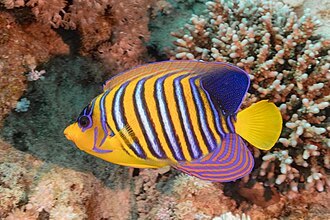
Royal angelfish (Pygoplites diacanthus), Ras Muhammad National Park, Red Sea, Egypt. The body of the royal angelfish is moderately elongate, is very compressed and can reach a length of up to 25 centimetres (9.8 in) It’s widely distributed throughout the Indo-Pacific and can be found in the Red Sea and Indian Ocean around East Africa and the Maldives, stretching to the Tuamoto Islands, New Caledonia, and Great Barrier Reef. The royal angelfish occurs at depths ranging from 0 to 80m (0 to 262 ft), in coral rich areas of lagoons, reefs, and are also often found in the vicinity of caves. It is a carnivorous species that feeds on sponges and tunicates located throughout reefs and underwater caves. They are a non-migratory species that can be found solitary, in pairs, or groups.
|
| Picture of the day |
|---|
,_parque_nacional_Ras_Muhammad,_Egipto,_2022-03-26,_DD_138.jpg)
|
|
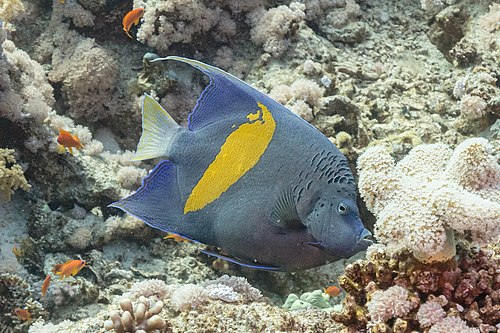
Yellowbar angelfish (Pomacanthus maculosus), Ras Muhammad National Park, Red Sea, Egypt. This marine angelfish is distributed throughout the Persian Gulf, the northwestern Indian Ocean, and the Red Sea south to 19°S. In 2009 it was recorded off the coast of Lebanon in the eastern Mediterranean, probably as a result of Lessepsian migration from the Red Sea through the Suez Canal. Pomacanthus maculosus is found at depths of between 4 and 50 metres (13 and 164 ft). It is a solitary species that lives in sheltered areas, often where there is a mixture of coral and silt. Their diet is dominated by sea sponges and tunicates, although other invertebrates will be eaten opportunistically. The females attain sexual maturity when the reach around 5.5 years of age and a total length of 21.6 centimetres (8.5 in). The maximum longevity is thought to be 36 years old. They are protogynous hermaphrodites and the older females can change sex to become males when there is a shortage of males. The larvae are planktonic. The yellowbar angelfish is occasionally collected for the aquarium trade and in some parts of the Persian Gulf it has been recorded in fish markets.
|

Coral reefs, intricate underwater structures built by tiny coral polyps, are among the most diverse and vibrant ecosystems on the planet. These remarkable formations, often referred to as the “rainforests of the sea,” provide a home to a dazzling array of marine life,
Read More