French

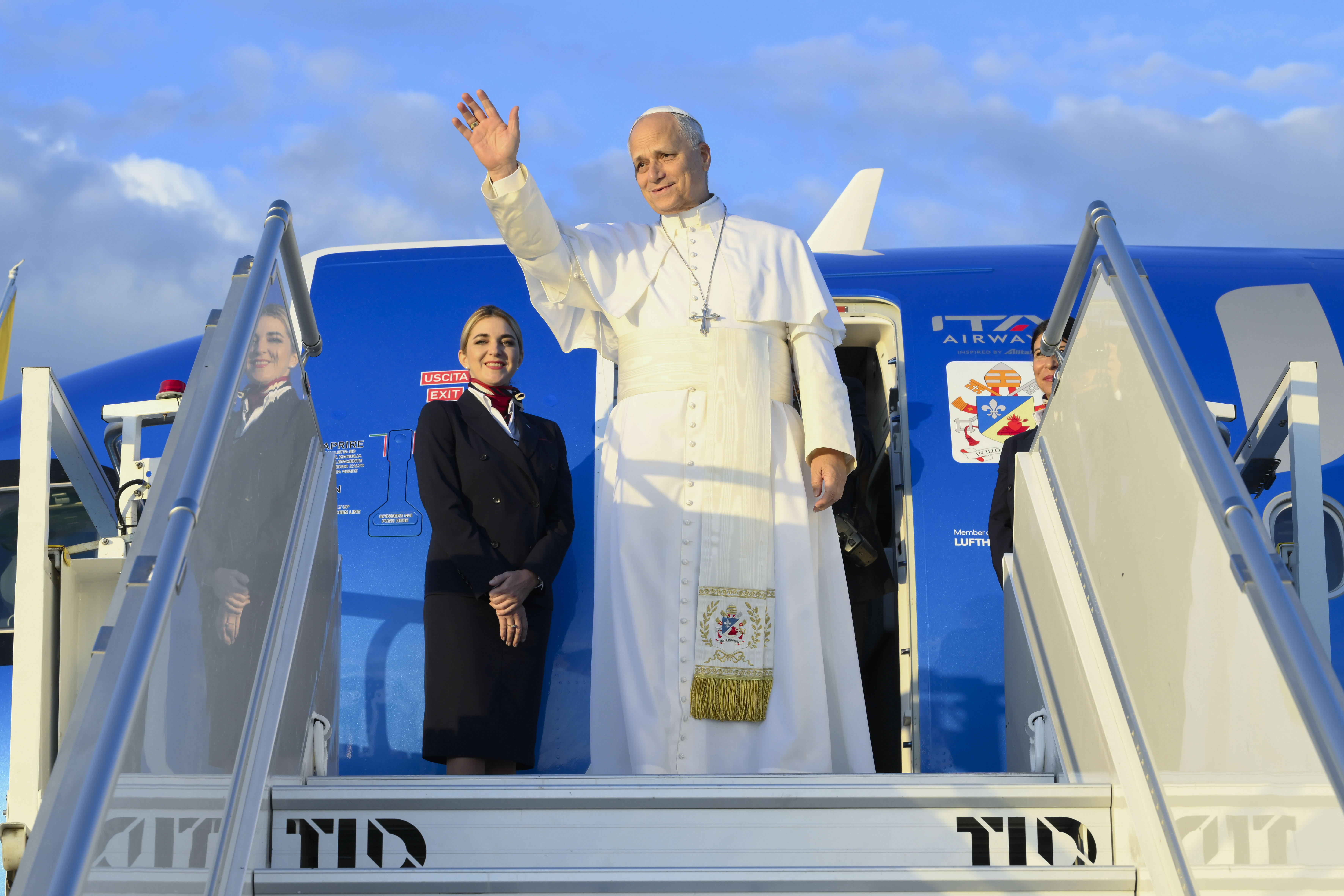
Pope Leo XIV says debate with Trump is ‘not in my interest at all’ #Catholic ABOARD THE PAPAL PLANE — Pope Leo XIV arrived in Angola after a two-and-a-half-hour flight from Cameroon on April 18, using the short journey to reject suggestions that his recent remarks about war were aimed at U.S. President Donald Trump while reflecting on the pastoral focus of his African trip.In a brief in-flight press conference with journalists, the pope addressed the interpretation of some of his recent speeches as a response to criticism from Trump, who had accused him of weakness in foreign policy.“[T]hereʼs been a certain narrative that has not been accurate in all of its aspects, but because of the political situation created when on the first day of the trip, the President of the United States made some comments about myself,” the pope said.“Much of what has been written since then has been more commentary on commentary, trying to interpret what has been said.”He pointed in particular to his address at the April 16 prayer meeting for peace in Cameroon.“Just one little example, the talk that I gave at the prayer meeting for peace a couple days ago was prepared two weeks ago, well before the president ever commented on myself and on the message of peace that I am promoting,” he said.“And yet, as it happens, it was looked at as if I was trying to debate again the president, which is not in my interest at all.”Leo XIV said he intends instead to continue proclaiming the Gospel and promoting peace.“So we go on the journey, we continue proclaiming the Gospel message,” he said.He added that the liturgies during the trip have highlighted what it means to follow Christ, promote fraternity, and seek justice and peace.The pope also said the broader African journey has been shaped by themes that emerged at the start of the trip in Algeria, especially the figure of St. Augustine.“I was personally very pleased, as you know, we began the trip in Algeria with the theme of Saint Augustine, and yesterday at the Catholic University, we had the blessing of that beautiful monument that they had prepared with a map of Africa and Saint Augustine at the center,” he said.“And so in one sense, it expresses part of what this trip is about.”Leo XIV emphasized that his primary purpose in Africa is to accompany Catholics.“And I primarily come to Africa as pastor, as the head of the Catholic Church, to be with, to celebrate with, to encourage and accompany all of the Catholics throughout Africa.”He also referred to a meeting with imams in Cameroon, describing it in general terms as part of the Church’s continuing commitment to interreligious dialogue, understanding, and peace-building.He concluded his main remarks by thanking journalists for their work and expressing hope that God would continue to bless the journey.Responding later to a French journalist, Leo XIV expressed gratitude for the reception he received in Cameroon.“I would just like to thank everyone in Cameroon for the wonderful welcome, the great enthusiasm, the joy of the people,” he said.“It was absolutely fantastic, the experience … how wonderful it is to experience what it means to be a follower of Jesus Christ and to celebrate our faith together.”The pope’s flight took him from Yaoundé to Luanda, crossing over Cameroon, Equatorial Guinea, Gabon, the Democratic Republic of Congo, and Angola. Angola is the third and penultimate stop of his African journey.The Catholic Church has longstanding ties with Angola. Formal relations date back centuries, including the 1608 appointment of Antonio Manuel Nyunda as the first ambassador to Rome from the then-Kingdom of Kongo. More recently, in 2019, the Holy See and Angola signed an agreement recognizing the legal personality of the Catholic Church and defining its property rights.This story was first published by ACI Stampa, the Italian-language sister service of EWTN News. It has been translated and adapted by EWTN News English.

Pope Leo XIV says debate with Trump is ‘not in my interest at all’ #Catholic ABOARD THE PAPAL PLANE — Pope Leo XIV arrived in Angola after a two-and-a-half-hour flight from Cameroon on April 18, using the short journey to reject suggestions that his recent remarks about war were aimed at U.S. President Donald Trump while reflecting on the pastoral focus of his African trip.In a brief in-flight press conference with journalists, the pope addressed the interpretation of some of his recent speeches as a response to criticism from Trump, who had accused him of weakness in foreign policy.“[T]hereʼs been a certain narrative that has not been accurate in all of its aspects, but because of the political situation created when on the first day of the trip, the President of the United States made some comments about myself,” the pope said.“Much of what has been written since then has been more commentary on commentary, trying to interpret what has been said.”He pointed in particular to his address at the April 16 prayer meeting for peace in Cameroon.“Just one little example, the talk that I gave at the prayer meeting for peace a couple days ago was prepared two weeks ago, well before the president ever commented on myself and on the message of peace that I am promoting,” he said.“And yet, as it happens, it was looked at as if I was trying to debate again the president, which is not in my interest at all.”Leo XIV said he intends instead to continue proclaiming the Gospel and promoting peace.“So we go on the journey, we continue proclaiming the Gospel message,” he said.He added that the liturgies during the trip have highlighted what it means to follow Christ, promote fraternity, and seek justice and peace.The pope also said the broader African journey has been shaped by themes that emerged at the start of the trip in Algeria, especially the figure of St. Augustine.“I was personally very pleased, as you know, we began the trip in Algeria with the theme of Saint Augustine, and yesterday at the Catholic University, we had the blessing of that beautiful monument that they had prepared with a map of Africa and Saint Augustine at the center,” he said.“And so in one sense, it expresses part of what this trip is about.”Leo XIV emphasized that his primary purpose in Africa is to accompany Catholics.“And I primarily come to Africa as pastor, as the head of the Catholic Church, to be with, to celebrate with, to encourage and accompany all of the Catholics throughout Africa.”He also referred to a meeting with imams in Cameroon, describing it in general terms as part of the Church’s continuing commitment to interreligious dialogue, understanding, and peace-building.He concluded his main remarks by thanking journalists for their work and expressing hope that God would continue to bless the journey.Responding later to a French journalist, Leo XIV expressed gratitude for the reception he received in Cameroon.“I would just like to thank everyone in Cameroon for the wonderful welcome, the great enthusiasm, the joy of the people,” he said.“It was absolutely fantastic, the experience … how wonderful it is to experience what it means to be a follower of Jesus Christ and to celebrate our faith together.”The pope’s flight took him from Yaoundé to Luanda, crossing over Cameroon, Equatorial Guinea, Gabon, the Democratic Republic of Congo, and Angola. Angola is the third and penultimate stop of his African journey.The Catholic Church has longstanding ties with Angola. Formal relations date back centuries, including the 1608 appointment of Antonio Manuel Nyunda as the first ambassador to Rome from the then-Kingdom of Kongo. More recently, in 2019, the Holy See and Angola signed an agreement recognizing the legal personality of the Catholic Church and defining its property rights.This story was first published by ACI Stampa, the Italian-language sister service of EWTN News. It has been translated and adapted by EWTN News English.

En route from Cameroon to Angola, the pope said his mission in Africa is pastoral and rejected suggestions that his recent remarks were aimed at President Donald Trump.

Read More
Pope Leo XIV in Algeria: ‘I am here among you as a pilgrim of peace’ #Catholic ALGIERS, Algeria — Pope Leo XIV on Monday presented himself to Algeria’s diplomatic corps and civil society as “a pilgrim of peace,” urging a more just international order, warning against exclusion and inequality, and praising those who refuse to be “blinded by power or wealth.”Peace remained the central theme of the pope’s first day in Algeria, following his earlier stop at the Martyrs’ Memorial, where he delivered an appeal for peace and reconciliation.Speaking in French at the Djamaa el Djazair Conference Center, Leo recalled his previous visits to Algeria in 2001 and 2013 to Annaba, the ancient see of St. Augustine, whose spiritual legacy has long shaped the Augustinian order to which the pope belongs.“I am here among you as a pilgrim of peace, eager to meet the noble Algerian people,” the pope said. “We are brothers and sisters, for we have the same Father in heaven.”Leo said the “profound religious sense of the Algerian people” fosters “a culture of encounter and reconciliation,” adding that his visit also seeks to be a sign of that spirit.“In a world full of conflicts and misunderstandings, let us meet and strive for mutual understanding, recognizing that we are one family!” he said. “Today, the simplicity of this awareness is the key to opening many doors that are closed.”Addressing an audience of about 1,400 people from civil society and the diplomatic corps, the pope praised the resilience of the Algerian people, saying they had never been defeated by their trials because of their spirit of solidarity, hospitality, and community.“They are the truly strong ones, to whom the future belongs: those who do not allow themselves to be blinded by power or wealth, and those who refuse to sacrifice the dignity of their fellow citizens for the sake of personal or collective gain,” he said.Leo also highlighted the Algerian understanding of hospitality and almsgiving, reflected in the word “sadaka,” which he noted can also mean justice.“The one who accumulates wealth and remains indifferent to others is unjust,” the pope said, calling this vision of justice both “simple and radical” because it recognizes the image of God in others. “Indeed, a religion without mercy and a society without solidarity are a scandal in God’s eyes.”At the same time, he warned that many societies that consider themselves advanced are falling ever deeper into inequality and exclusion, while “people and organizations that dominate others destroy the world.” He said Africa knows this reality well and suggested that Algeria’s historical experience gives it a critical perspective on global power balances.“If you are able to engage in dialogue regarding the concerns of all and show solidarity with the sufferings of so many countries near and far, then you will be able to contribute to both envisioning and bringing about greater justice among peoples,” Leo said.He added that this task is especially urgent “in the face of continuous violations of international law and neocolonial tendencies.”Drawing on the teaching of Benedict XVI and Pope Francis, Leo called on Algeria’s authorities not to fear a broader social participation by those on the margins.“I therefore urge those of you who hold positions of authority in this country not to fear this outlook but to promote a vibrant, dynamic, and free civil society, in which young people in particular are recognized as capable of helping to broaden the horizon of hope for all,” he said.“The true strength of a nation lies in the cooperation of everyone in pursuing the common good,” he continued. “Authorities are called not to dominate but to serve the people and foster their development.”The pope also pointed to Algeria’s unique role as “a bridge between North and South, and between East and West,” describing the Mediterranean and the Sahara as geographical and spiritual crossroads rich with human and cultural meaning.“Woe to us if we turn them into graveyards where hope also dies!” he said. “Let us multiply oases of peace; let us denounce and remove the causes of despair; and let us oppose those who profit from the misfortune of others!”“For illicit are the gains of those who exploit human life, whose dignity is inviolable,” he added.Leo then broadened his reflection to the place of religion in modern society, noting that Algeria, like much of the world, experiences tensions between religious sensibility and modern life. He warned against both fundamentalism and secularization when they distort the true sense of God and human dignity.“Religious symbols and words can become, on the one hand, blasphemous languages of violence and oppression, or on the other, empty signs in the immense marketplace of consumption that does not satisfy us,” he said.Still, the pope insisted that such polarization should not lead to despair.“We must educate people in critical thinking and freedom, in listening and dialogue, and in the trust that leads us to recognize in those who are different fellow travelers and not threats,” he said. “We must work toward the healing of memory and reconciliation among former adversaries.”In his introduction, Algerian President Abdelmadjid Tebboune called Leo’s presence the first visit of a pope to Algeria and said it gave the occasion “a unique resonance.” He invoked both St. Augustine and Emir Abdelkader as enduring models at a time of accelerating change and weakening moral values.Tebboune also praised the pope’s moral authority and his support for social justice while reaffirming Algeria’s commitment to working with the Holy Father to promote dialogue, coexistence, and cooperation over division and conflict.This story was first published by ACI Stampa, the Italian-language sister service of EWTN News. It has been translated and adapted by EWTN News English.

Pope Leo XIV in Algeria: ‘I am here among you as a pilgrim of peace’ #Catholic ALGIERS, Algeria — Pope Leo XIV on Monday presented himself to Algeria’s diplomatic corps and civil society as “a pilgrim of peace,” urging a more just international order, warning against exclusion and inequality, and praising those who refuse to be “blinded by power or wealth.”Peace remained the central theme of the pope’s first day in Algeria, following his earlier stop at the Martyrs’ Memorial, where he delivered an appeal for peace and reconciliation.Speaking in French at the Djamaa el Djazair Conference Center, Leo recalled his previous visits to Algeria in 2001 and 2013 to Annaba, the ancient see of St. Augustine, whose spiritual legacy has long shaped the Augustinian order to which the pope belongs.“I am here among you as a pilgrim of peace, eager to meet the noble Algerian people,” the pope said. “We are brothers and sisters, for we have the same Father in heaven.”Leo said the “profound religious sense of the Algerian people” fosters “a culture of encounter and reconciliation,” adding that his visit also seeks to be a sign of that spirit.“In a world full of conflicts and misunderstandings, let us meet and strive for mutual understanding, recognizing that we are one family!” he said. “Today, the simplicity of this awareness is the key to opening many doors that are closed.”Addressing an audience of about 1,400 people from civil society and the diplomatic corps, the pope praised the resilience of the Algerian people, saying they had never been defeated by their trials because of their spirit of solidarity, hospitality, and community.“They are the truly strong ones, to whom the future belongs: those who do not allow themselves to be blinded by power or wealth, and those who refuse to sacrifice the dignity of their fellow citizens for the sake of personal or collective gain,” he said.Leo also highlighted the Algerian understanding of hospitality and almsgiving, reflected in the word “sadaka,” which he noted can also mean justice.“The one who accumulates wealth and remains indifferent to others is unjust,” the pope said, calling this vision of justice both “simple and radical” because it recognizes the image of God in others. “Indeed, a religion without mercy and a society without solidarity are a scandal in God’s eyes.”At the same time, he warned that many societies that consider themselves advanced are falling ever deeper into inequality and exclusion, while “people and organizations that dominate others destroy the world.” He said Africa knows this reality well and suggested that Algeria’s historical experience gives it a critical perspective on global power balances.“If you are able to engage in dialogue regarding the concerns of all and show solidarity with the sufferings of so many countries near and far, then you will be able to contribute to both envisioning and bringing about greater justice among peoples,” Leo said.He added that this task is especially urgent “in the face of continuous violations of international law and neocolonial tendencies.”Drawing on the teaching of Benedict XVI and Pope Francis, Leo called on Algeria’s authorities not to fear a broader social participation by those on the margins.“I therefore urge those of you who hold positions of authority in this country not to fear this outlook but to promote a vibrant, dynamic, and free civil society, in which young people in particular are recognized as capable of helping to broaden the horizon of hope for all,” he said.“The true strength of a nation lies in the cooperation of everyone in pursuing the common good,” he continued. “Authorities are called not to dominate but to serve the people and foster their development.”The pope also pointed to Algeria’s unique role as “a bridge between North and South, and between East and West,” describing the Mediterranean and the Sahara as geographical and spiritual crossroads rich with human and cultural meaning.“Woe to us if we turn them into graveyards where hope also dies!” he said. “Let us multiply oases of peace; let us denounce and remove the causes of despair; and let us oppose those who profit from the misfortune of others!”“For illicit are the gains of those who exploit human life, whose dignity is inviolable,” he added.Leo then broadened his reflection to the place of religion in modern society, noting that Algeria, like much of the world, experiences tensions between religious sensibility and modern life. He warned against both fundamentalism and secularization when they distort the true sense of God and human dignity.“Religious symbols and words can become, on the one hand, blasphemous languages of violence and oppression, or on the other, empty signs in the immense marketplace of consumption that does not satisfy us,” he said.Still, the pope insisted that such polarization should not lead to despair.“We must educate people in critical thinking and freedom, in listening and dialogue, and in the trust that leads us to recognize in those who are different fellow travelers and not threats,” he said. “We must work toward the healing of memory and reconciliation among former adversaries.”In his introduction, Algerian President Abdelmadjid Tebboune called Leo’s presence the first visit of a pope to Algeria and said it gave the occasion “a unique resonance.” He invoked both St. Augustine and Emir Abdelkader as enduring models at a time of accelerating change and weakening moral values.Tebboune also praised the pope’s moral authority and his support for social justice while reaffirming Algeria’s commitment to working with the Holy Father to promote dialogue, coexistence, and cooperation over division and conflict.This story was first published by ACI Stampa, the Italian-language sister service of EWTN News. It has been translated and adapted by EWTN News English.

The pontiff called for a world order that does not exclude the vulnerable and urged leaders to serve the common good.

Read More
Vatican aid convoy in Lebanon caught in crossfire as Church relief effort is forced back #Catholic A Vatican humanitarian convoy carrying the apostolic nuncio to Lebanon, Archbishop Paolo Borgia, was forced to turn back Tuesday, April 7, after becoming trapped in heavy crossfire between Israeli forces and Hezbollah fighters in southern Lebanon.“The fighting between Hezbollah and Israel was intense. We waited a long time three kilometers from the village while hearing gunfire and explosions, but we could not continue and had to suspend the mission,” Monsignor Hugues de Woillemont, general director of l’Oeuvre d’Orient, told ACI Prensa, the Spanish-language sister service of EWTN News.De Woillemont traveled to Lebanon as a representative of the French Catholic aid organization and of the Church in France “to celebrate Easter, to show support and friendship, and also to thank Christians for their witness.”Although the convoy was under the protection of soldiers from the U.N. peacekeeping mission in Lebanon, UNIFIL, he said “security conditions were not sufficient for us to carry out our visit or deliver the aid, which was a great disappointment for the Christians we wanted to visit.”The aid was headed to Debel, a village just over a mile from the southern border with Israel in the Maronite Diocese of Tyre, where nearly 10,000 Christians live in about 20 parishes.Residents there remain under an evacuation order issued by the Israeli army, but many Lebanese Christians have chosen to stay in their homes.“That is why we wanted to bring a truck of humanitarian aid and, above all, to show our friendship and closeness to the Christians there,” De Woillemont said.The region south of the Litani River makes up about 15% of Lebanese territory. Christian communities there are trying to remain in their villages despite the threat of Israeli annexation, and their situation reflects the long-standing vulnerability of Lebanon’s Maronite Christians, who often bear some of the conflict’s heaviest consequences.L’Oeuvre d’Orient has distributed tons of humanitarian aid throughout Lebanon, but De Woillemont said the group, like other humanitarian and religious organizations, is reaching its limits.“The situation is untenable,” he said.The convoy he joined was the seventh sent to villages in southern Lebanon.“We are determined to return as soon as conditions allow,” he said, while praising the courage and resilience of Christians in the land once walked by Christ.On Wednesday, De Woillemont was able to visit three other villages with Maronite Patriarch Cardinal Bechara Boutros al-Rai, where they delivered 30 tons of humanitarian assistance — mainly food and hygiene kits — without incident.“We were able to show our support and admiration for those who remain in their homes,” he said.“For us it was a moment to measure up close the restrictions and dangers they — the living stones — experience every day,” he added after spending another night listening to the sound of detonations.He said that in recent hours, the fall of about 100 Israeli projectiles in just 10 minutes overwhelmed hospitals and makeshift shelters.“Recent Israeli bombings have affected more than 100 cities, causing more than 100 deaths and 800 injuries, including in Beirut. The situation is terrible and requires urgent help,” De Woillemont said, lamenting that the ceasefire with Iran does not apply to Lebanon.Lebanon is also facing a severe humanitarian crisis, with 1.2 million internally displaced persons — about 20% of the country’s population of 5.5 million.This story was first published by ACI Prensa, the Spanish-language sister service of EWTN News. It has been translated and adapted by EWTN News English.

Vatican aid convoy in Lebanon caught in crossfire as Church relief effort is forced back #Catholic A Vatican humanitarian convoy carrying the apostolic nuncio to Lebanon, Archbishop Paolo Borgia, was forced to turn back Tuesday, April 7, after becoming trapped in heavy crossfire between Israeli forces and Hezbollah fighters in southern Lebanon.“The fighting between Hezbollah and Israel was intense. We waited a long time three kilometers from the village while hearing gunfire and explosions, but we could not continue and had to suspend the mission,” Monsignor Hugues de Woillemont, general director of l’Oeuvre d’Orient, told ACI Prensa, the Spanish-language sister service of EWTN News.De Woillemont traveled to Lebanon as a representative of the French Catholic aid organization and of the Church in France “to celebrate Easter, to show support and friendship, and also to thank Christians for their witness.”Although the convoy was under the protection of soldiers from the U.N. peacekeeping mission in Lebanon, UNIFIL, he said “security conditions were not sufficient for us to carry out our visit or deliver the aid, which was a great disappointment for the Christians we wanted to visit.”The aid was headed to Debel, a village just over a mile from the southern border with Israel in the Maronite Diocese of Tyre, where nearly 10,000 Christians live in about 20 parishes.Residents there remain under an evacuation order issued by the Israeli army, but many Lebanese Christians have chosen to stay in their homes.“That is why we wanted to bring a truck of humanitarian aid and, above all, to show our friendship and closeness to the Christians there,” De Woillemont said.The region south of the Litani River makes up about 15% of Lebanese territory. Christian communities there are trying to remain in their villages despite the threat of Israeli annexation, and their situation reflects the long-standing vulnerability of Lebanon’s Maronite Christians, who often bear some of the conflict’s heaviest consequences.L’Oeuvre d’Orient has distributed tons of humanitarian aid throughout Lebanon, but De Woillemont said the group, like other humanitarian and religious organizations, is reaching its limits.“The situation is untenable,” he said.The convoy he joined was the seventh sent to villages in southern Lebanon.“We are determined to return as soon as conditions allow,” he said, while praising the courage and resilience of Christians in the land once walked by Christ.On Wednesday, De Woillemont was able to visit three other villages with Maronite Patriarch Cardinal Bechara Boutros al-Rai, where they delivered 30 tons of humanitarian assistance — mainly food and hygiene kits — without incident.“We were able to show our support and admiration for those who remain in their homes,” he said.“For us it was a moment to measure up close the restrictions and dangers they — the living stones — experience every day,” he added after spending another night listening to the sound of detonations.He said that in recent hours, the fall of about 100 Israeli projectiles in just 10 minutes overwhelmed hospitals and makeshift shelters.“Recent Israeli bombings have affected more than 100 cities, causing more than 100 deaths and 800 injuries, including in Beirut. The situation is terrible and requires urgent help,” De Woillemont said, lamenting that the ceasefire with Iran does not apply to Lebanon.Lebanon is also facing a severe humanitarian crisis, with 1.2 million internally displaced persons — about 20% of the country’s population of 5.5 million.This story was first published by ACI Prensa, the Spanish-language sister service of EWTN News. It has been translated and adapted by EWTN News English.

A French Catholic aid leader said conditions in southern Lebanon have become untenable.

Read More
New record in France: More than 20,000 adults and teens baptized at Easter #Catholic This Easter, France recorded more than 20,000 adult and adolescent baptisms, a 20% increase compared with the previous year. A new report published by the French Bishops’ Conference presents the latest statistical data from Easter 2026, during which approximately 8,200 adolescents and 13,200 adults embraced the Catholic faith.The report indicates that the majority of converts are young adults between the ages of 18 and 25, closely followed by the 26-to-40 age group. Women constitute the largest segment, accounting for approximately 62% of the total.In general, the new catechumens have no prior religious tradition, driven primarily by difficult life experiences, a profound search for meaning, or spiritual encounters that left a lasting mark on their lives, according to the report.The ecclesiastical provinces with the highest number of baptisms were Paris, with 3,184, followed by Marseille with 1,437 and Lyon with 1,200. The report highlights a notable increase in the military diocese, headquartered in the French capital, particularly during the military pilgrimage to Lourdes.The ‘magnitude of the thirst for God’Olivier de Germay, archbishop of Lyon and the official responsible for the catechumenate in the country, reflected on this new reality, one that “never ceases to surprise and challenge us.”Although society has long been aware of the world’s failure to provide answers to “the deep aspirations of the human being,” the French prelate expressed his surprise at the “rapidity and magnitude of the thirst for God manifesting itself today.”This phenomenon opens up a new horizon and presents a “major challenge” for the Church, he said, which must offer appropriate guidance for initiation into the Christian life.For De Germay, the situation also calls upon the “seasoned veterans of the Christian life,” who are invited “to once again become aware of how God can break into [a person’s life] and transform it.”Among some new initiatives to address the increasing numbers, the regional council launched by the eight dioceses of the Île-de-France region stands out. Titled “Catechumens and Neophytes: New Perspectives for the Life of Our Church in Our Dioceses,” the council will run until May 2027. After gathering feedback from Catholics, including the newly baptized, the council aims to develop an appropriate response to the growing number of converts and to establish common guidelines at the provincial level.The provincial council is encouraging the other dioceses outside the Île-de-France region to launch other initiatives focused on specific proposals to increase the participation of the newly baptized in the liturgy.This story was first published by ACI Prensa, the Spanish-language sister service of EWTN News. It has been translated and adapted by EWTN News English.

New record in France: More than 20,000 adults and teens baptized at Easter #Catholic This Easter, France recorded more than 20,000 adult and adolescent baptisms, a 20% increase compared with the previous year. A new report published by the French Bishops’ Conference presents the latest statistical data from Easter 2026, during which approximately 8,200 adolescents and 13,200 adults embraced the Catholic faith.The report indicates that the majority of converts are young adults between the ages of 18 and 25, closely followed by the 26-to-40 age group. Women constitute the largest segment, accounting for approximately 62% of the total.In general, the new catechumens have no prior religious tradition, driven primarily by difficult life experiences, a profound search for meaning, or spiritual encounters that left a lasting mark on their lives, according to the report.The ecclesiastical provinces with the highest number of baptisms were Paris, with 3,184, followed by Marseille with 1,437 and Lyon with 1,200. The report highlights a notable increase in the military diocese, headquartered in the French capital, particularly during the military pilgrimage to Lourdes.The ‘magnitude of the thirst for God’Olivier de Germay, archbishop of Lyon and the official responsible for the catechumenate in the country, reflected on this new reality, one that “never ceases to surprise and challenge us.”Although society has long been aware of the world’s failure to provide answers to “the deep aspirations of the human being,” the French prelate expressed his surprise at the “rapidity and magnitude of the thirst for God manifesting itself today.”This phenomenon opens up a new horizon and presents a “major challenge” for the Church, he said, which must offer appropriate guidance for initiation into the Christian life.For De Germay, the situation also calls upon the “seasoned veterans of the Christian life,” who are invited “to once again become aware of how God can break into [a person’s life] and transform it.”Among some new initiatives to address the increasing numbers, the regional council launched by the eight dioceses of the Île-de-France region stands out. Titled “Catechumens and Neophytes: New Perspectives for the Life of Our Church in Our Dioceses,” the council will run until May 2027. After gathering feedback from Catholics, including the newly baptized, the council aims to develop an appropriate response to the growing number of converts and to establish common guidelines at the provincial level.The provincial council is encouraging the other dioceses outside the Île-de-France region to launch other initiatives focused on specific proposals to increase the participation of the newly baptized in the liturgy.This story was first published by ACI Prensa, the Spanish-language sister service of EWTN News. It has been translated and adapted by EWTN News English.

The surge in baptisms of young persons continues in France in 2026, a 20% increase over the already previous record-high number in 2025. The influx represents a major challenge for the French Church.

Read More
French priest Henri Caffarel, founder of Teams of Our Lady, declared venerable by Pope Leo XIV #Catholic Father Henri Caffarel, a French priest whose apostolate centered on accompanying and guiding married couples on the path to holiness, is one step closer to being canonized.On March 23, Pope Leo XIV recognized the heroic virtues of the newly declared venerable, who maintained that couples are made for happiness and that marriage is a path toward it.With this deep conviction, and conscious of the challenges faced by couples, Caffarel, who was born in Lyon, France, in 1903, founded the movement for marital spirituality known as “Teams of Our Lady” in Paris in 1939.The beginning of a living legacySpaniards Alberto Pérez Bueno and Mercedes Gómez-Ferrer Lozano, the couple in charge of the Teams of Our Lady internationally, have been married for 35 years and have three children. In an interview with ACI Prensa, the Spanish-language sister service of EWTN News, they said the ministry started “with four couples who approached Father Caffarel to ask him how they could live out their faith as a couple.”“He didn’t have an answer at that moment, so he proposed that they embark on a journey of discovery together rooted in the sacrament of holy orders and the sacrament of matrimony. And that‘s how it all began,” Alberto explained.Following World War II, the movement, which is primarily lay-led, grew rapidly; today, it is present in 92 countries and is comprised of more than 15,000 teams.
 
 Father Henri Caffarel. | Credit: Photo courtesy of Alberto Pérez Bueno
 
 Marital communication and prayerMercedes emphasized that from the very beginning, Caffarel saw the need to foster the essentials of marital communication and prayer, convinced that by sharing their problems with one another, many couples could avoid estrangement that sometimes occurs in marriage.The priest, Alberto recalled, said that “the sacrament of matrimony is an image of God” and “probably the most perfect one there is.” The priest said married couples are called to holiness through a life of “work, personal growth, love, patience, and building a life together.”“It‘s not an overnight process but rather a journey undertaken over the course of a lifetime. Father Caffarel invited couples to embark on this path and to attain holiness through their work and their life together,” Alberto emphasized.Mercedes said the priest thought of marriage as a sign “that reflects the love of God” because the relationship of communion that exists between spouses is analogous to the relationship existing among the three Divine Persons: Christ, the Father, and the Holy Spirit.In the priest’s view, the image of marriage allowed for a clearer expression of the idea of ​​a God who is love “and who communicates and expands within his own nature.” From this perspective, “holiness ceases to be understood as a matter of individual effort or moral perfection and is situated instead within the dynamic of love that transforms and animates life,” Mercedes explained.A continuous path of spiritual growthThe organization of the Teams of Our Lady is based on a specific methodology “that goes beyond monthly meetings,” encompassing prayer, dialogue, and personal commitment. Each team consists of five or six married couples, fostering “listening to the word, personal prayer, prayer as a couple and family prayer, and a profound dialogue in the presence of the Lord that we also have every month,” Mercedes explained.Ultimately, it is a matter of “having a rule of life, a set of elements through which you strive to improve your Christian life,” she said. There is also a yearly retreat and a specific study theme each month.Alberto emphasized that the Teams of Our Lady are, in a sense, “precursors of the synodality” promoted by Pope Francis. “It’s a movement that is very nonclerical — though, it must be said, the accompaniment of married couples by priests is essential.”He also noted that “married couples place their time, their skills, their charisms, and their gifts at the service of others in order to build community.” Mercedes, who had the opportunity to meet the now-venerable, recalled that in 1973 he stepped aside after founding the teams, convinced that “if it was a work of the Holy Spirit and possessed a charism for the Church, there was no need for him to stay on.”Leaving the ministry in the laity’s hands, he retired to a house of prayer on the outskirts of Paris, where he began his other “great work”: teaching people how to pray. Mercedes noted that “one of the things he desired most was to teach people how to draw closer to Christ and to serve as an intermediary so that every person could have a personal encounter with God.”
 
 Alberto Pérez Bueno and Mercedes Gómez-Ferrer Lozano, international organizers of Teams of Our Lady. | Credit: Photo courtesy of Alberto Pérez Bueno
 
 The challenges facing married couples todayAlberto and Mercedes explained how married couples today confront new challenges stemming from the pace of life, particularly the “massive entry of women into the workforce,” which has brought different challenges, such as “finding time to be together and talk.”They highlighted Caffarel’s enduring counsel: “Seek out these moments; don’t let them slip away,” for life “sweeps us along like a fast-moving river.They also highlighted the movement’s impact in countries such as Lithuania, with a past marked by communist repression, or in African nations where the teams foster equality, participation, and changes such as abandoning polygamy. This is also true in Europe, where the Teams of Our Lady help strengthen families within increasingly secularized societies.Both highlight the universal impact of the movement: Couples from diverse cultures agree on the benefits received, particularly the “opportunity to pray together” and the realization of “how difficult it would have been without the presence of Christ in their married life.” Ultimately, this is a way of life that responds to a profound desire: Even as sacramental marriages decline, “there is no diminishing of people’s desire to live as a couple.”Mercedes also warned of a growing way of dealing with problems: “At the slightest setback, people are right off tempted to give up,” and the couple is not taught how to “persevere and forgive.” Added to this is “a great fear of commitment” and a tendency to avoid lasting bonds or communities despite the fact that, deep down, people “want to be happy and want to stay together.”For this reason, she emphasized the importance of mutual support and community life: “It‘s fundamental to allow oneself to be helped,” since in her view navigating married life in isolation “is extremely complex.”The teams offer precisely the necessary tools and support: a setting where married couples share their problems and solutions. Drawing upon their own experiences, they particularly encourage young couples to embark on this path of holiness.Both expressed their joy that Caffarel has been declared venerable, a long-awaited recognition following nearly 20 years of going through the beatification process, which continues, awaiting a miracle wrought through his intercession.This story was first published by ACI Prensa, the Spanish-language sister service of EWTN News. It has been translated and adapted by EWTN News English.

French priest Henri Caffarel, founder of Teams of Our Lady, declared venerable by Pope Leo XIV #Catholic Father Henri Caffarel, a French priest whose apostolate centered on accompanying and guiding married couples on the path to holiness, is one step closer to being canonized.On March 23, Pope Leo XIV recognized the heroic virtues of the newly declared venerable, who maintained that couples are made for happiness and that marriage is a path toward it.With this deep conviction, and conscious of the challenges faced by couples, Caffarel, who was born in Lyon, France, in 1903, founded the movement for marital spirituality known as “Teams of Our Lady” in Paris in 1939.The beginning of a living legacySpaniards Alberto Pérez Bueno and Mercedes Gómez-Ferrer Lozano, the couple in charge of the Teams of Our Lady internationally, have been married for 35 years and have three children. In an interview with ACI Prensa, the Spanish-language sister service of EWTN News, they said the ministry started “with four couples who approached Father Caffarel to ask him how they could live out their faith as a couple.”“He didn’t have an answer at that moment, so he proposed that they embark on a journey of discovery together rooted in the sacrament of holy orders and the sacrament of matrimony. And that‘s how it all began,” Alberto explained.Following World War II, the movement, which is primarily lay-led, grew rapidly; today, it is present in 92 countries and is comprised of more than 15,000 teams. Father Henri Caffarel. | Credit: Photo courtesy of Alberto Pérez Bueno Marital communication and prayerMercedes emphasized that from the very beginning, Caffarel saw the need to foster the essentials of marital communication and prayer, convinced that by sharing their problems with one another, many couples could avoid estrangement that sometimes occurs in marriage.The priest, Alberto recalled, said that “the sacrament of matrimony is an image of God” and “probably the most perfect one there is.” The priest said married couples are called to holiness through a life of “work, personal growth, love, patience, and building a life together.”“It‘s not an overnight process but rather a journey undertaken over the course of a lifetime. Father Caffarel invited couples to embark on this path and to attain holiness through their work and their life together,” Alberto emphasized.Mercedes said the priest thought of marriage as a sign “that reflects the love of God” because the relationship of communion that exists between spouses is analogous to the relationship existing among the three Divine Persons: Christ, the Father, and the Holy Spirit.In the priest’s view, the image of marriage allowed for a clearer expression of the idea of ​​a God who is love “and who communicates and expands within his own nature.” From this perspective, “holiness ceases to be understood as a matter of individual effort or moral perfection and is situated instead within the dynamic of love that transforms and animates life,” Mercedes explained.A continuous path of spiritual growthThe organization of the Teams of Our Lady is based on a specific methodology “that goes beyond monthly meetings,” encompassing prayer, dialogue, and personal commitment. Each team consists of five or six married couples, fostering “listening to the word, personal prayer, prayer as a couple and family prayer, and a profound dialogue in the presence of the Lord that we also have every month,” Mercedes explained.Ultimately, it is a matter of “having a rule of life, a set of elements through which you strive to improve your Christian life,” she said. There is also a yearly retreat and a specific study theme each month.Alberto emphasized that the Teams of Our Lady are, in a sense, “precursors of the synodality” promoted by Pope Francis. “It’s a movement that is very nonclerical — though, it must be said, the accompaniment of married couples by priests is essential.”He also noted that “married couples place their time, their skills, their charisms, and their gifts at the service of others in order to build community.” Mercedes, who had the opportunity to meet the now-venerable, recalled that in 1973 he stepped aside after founding the teams, convinced that “if it was a work of the Holy Spirit and possessed a charism for the Church, there was no need for him to stay on.”Leaving the ministry in the laity’s hands, he retired to a house of prayer on the outskirts of Paris, where he began his other “great work”: teaching people how to pray. Mercedes noted that “one of the things he desired most was to teach people how to draw closer to Christ and to serve as an intermediary so that every person could have a personal encounter with God.” Alberto Pérez Bueno and Mercedes Gómez-Ferrer Lozano, international organizers of Teams of Our Lady. | Credit: Photo courtesy of Alberto Pérez Bueno The challenges facing married couples todayAlberto and Mercedes explained how married couples today confront new challenges stemming from the pace of life, particularly the “massive entry of women into the workforce,” which has brought different challenges, such as “finding time to be together and talk.”They highlighted Caffarel’s enduring counsel: “Seek out these moments; don’t let them slip away,” for life “sweeps us along like a fast-moving river.They also highlighted the movement’s impact in countries such as Lithuania, with a past marked by communist repression, or in African nations where the teams foster equality, participation, and changes such as abandoning polygamy. This is also true in Europe, where the Teams of Our Lady help strengthen families within increasingly secularized societies.Both highlight the universal impact of the movement: Couples from diverse cultures agree on the benefits received, particularly the “opportunity to pray together” and the realization of “how difficult it would have been without the presence of Christ in their married life.” Ultimately, this is a way of life that responds to a profound desire: Even as sacramental marriages decline, “there is no diminishing of people’s desire to live as a couple.”Mercedes also warned of a growing way of dealing with problems: “At the slightest setback, people are right off tempted to give up,” and the couple is not taught how to “persevere and forgive.” Added to this is “a great fear of commitment” and a tendency to avoid lasting bonds or communities despite the fact that, deep down, people “want to be happy and want to stay together.”For this reason, she emphasized the importance of mutual support and community life: “It‘s fundamental to allow oneself to be helped,” since in her view navigating married life in isolation “is extremely complex.”The teams offer precisely the necessary tools and support: a setting where married couples share their problems and solutions. Drawing upon their own experiences, they particularly encourage young couples to embark on this path of holiness.Both expressed their joy that Caffarel has been declared venerable, a long-awaited recognition following nearly 20 years of going through the beatification process, which continues, awaiting a miracle wrought through his intercession.This story was first published by ACI Prensa, the Spanish-language sister service of EWTN News. It has been translated and adapted by EWTN News English.

A married couple that leads the Teams of Our Lady, founded by newly-declared Venerable Father Henri Caffarel, explains how this lay apostolate helps couples grow together in holiness.

Read More
Hundreds of adults to be baptized in Paris at Easter as part of national surge #Catholic The Catholic revival that Paris has been experiencing over the past five years continues unabated, even amid the city’s long-running status as a symbol of European secularization.On the night of the Easter Vigil, April 4, more than 700 adults across the French capital will be received into the Catholic Church as part of a sudden nationwide surge.Across France, more than 13,000 adults will be baptized this Easter, according to data released by the French Bishops’ Conference — an increase of 28% compared with 2025.The “boom” in adult baptisms in France is a relatively recent phenomenon. It has intensified over the past decade, with a marked acceleration following the COVID-19 pandemic, reaching record levels since 2024.Within this national picture, Paris stands out as a beating heart of such renewal. According to figures provided by the archdiocese, 788 adult catechumens will be baptized in the city during the Easter Vigil, a 17% increase from the previous year.These baptisms will take place across 94 parishes and several communities, mobilizing more than 1,000 accompanying members, mostly laypeople. The age distribution is characterized by a predominance of younger people, with nearly one-third under the age of 25, about half between the ages of 26 and 40, and 1 in 5 over the age of 40, with candidates ranging in age from 18 to 73.Women remain the majority among catechumens, accounting for 58% in Paris, a proportion consistent with national patterns.The list of Parisian parishes with particularly high numbers of catechumens reveals a landscape that cuts across ecclesial sensibilities and social geographies. Parishes where the Traditional Latin Mass is regularly celebrated such as Saint-Roch in the 1st arrondissement or Saint-Eugène Sainte-Cécile (9th) stand alongside parishes in more working-class or mixed neighborhoods, including Notre-Dame de Clignancourt (18th), Notre-Dame de la Gare (13th), or Saint-Ambroise (11th). Many of these communities, often led by young and dynamic clergy, have become vibrant centers of parish life.Robin, a 30-year-old catechumen preparing to be baptized at Saint-Ambroise this Saturday, embodies this trend. Raised in a nonbelieving family with no religious background, he began his spiritual journey through a gradual process of questioning the purpose of life. “In a world where everything moves so fast, where we lose sight of what matters, the Church has done me a world of good,” he told EWTN News. “It has helped me put the ‘why’ back at the center of everything.”His path has been shaped by a growing desire for silence and contemplation as well as a yearning for beauty. “I would go to churches to find a moment of calm, where time would stop,” he explained. “I was looking for a place where you can listen to yourself and reflect on what you want to do with your life.” “What moves me deeply,” he added, “is the beauty that surrounds my church — its architecture, its music… that’s where I feel something powerful.”Like many catechumens, Robin described an experience of welcome that proved decisive. At an early stage in his journey, he met a young parish priest who, despite a busy schedule, took the time to speak with him. “We talked for an hour. It was incredibly reassuring,” he recalled. He was then introduced to a group of parishioners who accompanied him throughout his catechumenate, forming what he describes as a “deep bond of humanity.”This communal dimension appears to be a key factor in the current surge. While the French model of catechumenate has traditionally been more individual, the growing number of candidates is prompting parishes to rethink their approach, often favoring group dynamics that foster a sense of belonging from the outset.Many catechumens come from families with little or no Christian background, reflecting a broader shift from cultural Catholicism toward a more deliberate, conviction-based faith. On a national level, the number of catechumens identifying as having no religious tradition now represent a proportion comparable with those from Christian backgrounds.The scale of the phenomenon is now prompting serious reflection among French Church leaders. In response to the steady increase in adult baptisms, the eight dioceses of the Île-de-France region, together with the Diocese for the Armed Forces, have convened a provincial council set to open on May 31 at Notre-Dame Cathedral.Under the theme “Catechumens and Neophytes: New Perspectives for the Life of Our Church,” the council will seek to discern how local structures and pastoral practices should adapt to this unexpected growth.

Hundreds of adults to be baptized in Paris at Easter as part of national surge #Catholic The Catholic revival that Paris has been experiencing over the past five years continues unabated, even amid the city’s long-running status as a symbol of European secularization.On the night of the Easter Vigil, April 4, more than 700 adults across the French capital will be received into the Catholic Church as part of a sudden nationwide surge.Across France, more than 13,000 adults will be baptized this Easter, according to data released by the French Bishops’ Conference — an increase of 28% compared with 2025.The “boom” in adult baptisms in France is a relatively recent phenomenon. It has intensified over the past decade, with a marked acceleration following the COVID-19 pandemic, reaching record levels since 2024.Within this national picture, Paris stands out as a beating heart of such renewal. According to figures provided by the archdiocese, 788 adult catechumens will be baptized in the city during the Easter Vigil, a 17% increase from the previous year.These baptisms will take place across 94 parishes and several communities, mobilizing more than 1,000 accompanying members, mostly laypeople. The age distribution is characterized by a predominance of younger people, with nearly one-third under the age of 25, about half between the ages of 26 and 40, and 1 in 5 over the age of 40, with candidates ranging in age from 18 to 73.Women remain the majority among catechumens, accounting for 58% in Paris, a proportion consistent with national patterns.The list of Parisian parishes with particularly high numbers of catechumens reveals a landscape that cuts across ecclesial sensibilities and social geographies. Parishes where the Traditional Latin Mass is regularly celebrated such as Saint-Roch in the 1st arrondissement or Saint-Eugène Sainte-Cécile (9th) stand alongside parishes in more working-class or mixed neighborhoods, including Notre-Dame de Clignancourt (18th), Notre-Dame de la Gare (13th), or Saint-Ambroise (11th). Many of these communities, often led by young and dynamic clergy, have become vibrant centers of parish life.Robin, a 30-year-old catechumen preparing to be baptized at Saint-Ambroise this Saturday, embodies this trend. Raised in a nonbelieving family with no religious background, he began his spiritual journey through a gradual process of questioning the purpose of life. “In a world where everything moves so fast, where we lose sight of what matters, the Church has done me a world of good,” he told EWTN News. “It has helped me put the ‘why’ back at the center of everything.”His path has been shaped by a growing desire for silence and contemplation as well as a yearning for beauty. “I would go to churches to find a moment of calm, where time would stop,” he explained. “I was looking for a place where you can listen to yourself and reflect on what you want to do with your life.” “What moves me deeply,” he added, “is the beauty that surrounds my church — its architecture, its music… that’s where I feel something powerful.”Like many catechumens, Robin described an experience of welcome that proved decisive. At an early stage in his journey, he met a young parish priest who, despite a busy schedule, took the time to speak with him. “We talked for an hour. It was incredibly reassuring,” he recalled. He was then introduced to a group of parishioners who accompanied him throughout his catechumenate, forming what he describes as a “deep bond of humanity.”This communal dimension appears to be a key factor in the current surge. While the French model of catechumenate has traditionally been more individual, the growing number of candidates is prompting parishes to rethink their approach, often favoring group dynamics that foster a sense of belonging from the outset.Many catechumens come from families with little or no Christian background, reflecting a broader shift from cultural Catholicism toward a more deliberate, conviction-based faith. On a national level, the number of catechumens identifying as having no religious tradition now represent a proportion comparable with those from Christian backgrounds.The scale of the phenomenon is now prompting serious reflection among French Church leaders. In response to the steady increase in adult baptisms, the eight dioceses of the Île-de-France region, together with the Diocese for the Armed Forces, have convened a provincial council set to open on May 31 at Notre-Dame Cathedral.Under the theme “Catechumens and Neophytes: New Perspectives for the Life of Our Church,” the council will seek to discern how local structures and pastoral practices should adapt to this unexpected growth.

Across France, more than 13,000 adults will be baptized this Easter, according to data released by the French Bishops’ Conference — an increase of 28% compared with 2025. 

Read More
Picture of the day


A cavalryman of the French Republican Guard during the Bastille Day military parade. This regiment is responsible for special security duties in Paris (including guarding important public buildings) and for providing guards of honour at official ceremonies.
 #ImageOfTheDay
Picture of the day
A cavalryman of the French Republican Guard during the Bastille Day military parade. This regiment is responsible for special security duties in Paris (including guarding important public buildings) and for providing guards of honour at official ceremonies.
Read More