Gas

Ukraine advocate says cathedral bombing reflects broader campaign against Christianity #Catholic Russia’s “true goal” is “a war on Christianity in Ukraine,” Steven Moore, founder of the Ukraine Freedom Project, told “EWTN News Nightly” after the bombing of the 11th-century Dormition Cathedral of Kyiv Pechersk Lavra.“This is certainly deliberate,” Moore said, noting that Russia has destroyed 750 churches in Ukraine and killed as many as 80 pastors and priests.The Dormition Cathedral of the Kyiv Pechersk Lavra, part of a UNESCO World Heritage site, caught fire June 14 after Russia launched 70 missiles and 611 drones into several Ukrainian cities, which killed four people and injured 28 others, according to Ukrainian President Volodymyr Zelenskyy.Tweet“This is one of Russia’s most serious crimes against Christian culture to date,” Ukraine’s leader said about the damaged to the Eastern Orthodox cathedral, historically tied to the monastic life of the Lavra.‘Putin is not making mistakes’Russia’s Ministry of Defense issued a statement on June 15 claiming that the cathedral “was hit by a missile from an American Patriotic air defense system” and that “one possible reason for the malfunction of this system could be that Western countries had supplied the Kyiv regime with missiles that had expired.”“The Armed Forces of the Russian Federation do not plan or conduct strikes against civilian infrastructure facilities,” the Kremlin said.“The Kremlin is talking about it being an accident,” Moore said. “But there’s a lot of accidents — every week there’s an accidental church bombing.”“Putin is not making mistakes,” Moore said.“Putin is not going to stop this until someone makes him stop,” Moore said, describing efforts to bring the war to an end as “a lot of talk.”Combating Russian propaganda Moore is visiting Washington, D.C., from Kyiv and said he has plans to advocate on Capitol Hill and launch several films, including one on Ukrainian children who have been trafficked into Russia. Moore is set to meet with Sen. John Kennedy, R-Louisiana, on June 16.Moore told EWTN News in a separate interview that he plans to “focus primarily on Republicans because Republicans are in charge, and the Russians spend  billion annually on propaganda worldwide. Much of that goes into the conservative ecosphere.”“The Russians target these conservative believers with misinformation,” he said, citing online figures such as Candace Owens and Tucker Carlson. “So weʼre trying to push back on that, and weʼre pushing back on Capitol Hill.”The role of the international communityForeign leaders took to social media to condemn the strikes, including French Foreign Minister Jean-Noël Barrot, who said the strike on the Dormition Cathedral is the equivalent of bombing Notre-Dame in Paris.Tweet“The French are really good at talking,” Moore said. “But I have yet to see a Leclerc tank in Donbas,” he said, speaking of French-made battle tanks.“On an average day in April, the French bought enough petroleum products, liquid natural gas, primarily from Russia, to pay for about 220 Shahed drones every day,” he said about Iranian-made munitions, noting that Russia sends about 600 drones every time they attack Ukraine.“A lot of this is paid for by European purchases of Russian fossil fuel,” Moore said. “So, you know, while I always like to hear what the French have to say, I would like to see them stop fueling the Russian war machine. And I would like to see them do more, send more aid to Ukraine.”Ultimately, Moore called for the international community to cut off all financial ties with Russia. “Nothing else works because Putin only understands strength.”

Ukraine advocate says cathedral bombing reflects broader campaign against Christianity #Catholic Russia’s “true goal” is “a war on Christianity in Ukraine,” Steven Moore, founder of the Ukraine Freedom Project, told “EWTN News Nightly” after the bombing of the 11th-century Dormition Cathedral of Kyiv Pechersk Lavra.“This is certainly deliberate,” Moore said, noting that Russia has destroyed 750 churches in Ukraine and killed as many as 80 pastors and priests.The Dormition Cathedral of the Kyiv Pechersk Lavra, part of a UNESCO World Heritage site, caught fire June 14 after Russia launched 70 missiles and 611 drones into several Ukrainian cities, which killed four people and injured 28 others, according to Ukrainian President Volodymyr Zelenskyy.Tweet“This is one of Russia’s most serious crimes against Christian culture to date,” Ukraine’s leader said about the damaged to the Eastern Orthodox cathedral, historically tied to the monastic life of the Lavra.‘Putin is not making mistakes’Russia’s Ministry of Defense issued a statement on June 15 claiming that the cathedral “was hit by a missile from an American Patriotic air defense system” and that “one possible reason for the malfunction of this system could be that Western countries had supplied the Kyiv regime with missiles that had expired.”“The Armed Forces of the Russian Federation do not plan or conduct strikes against civilian infrastructure facilities,” the Kremlin said.“The Kremlin is talking about it being an accident,” Moore said. “But there’s a lot of accidents — every week there’s an accidental church bombing.”“Putin is not making mistakes,” Moore said.“Putin is not going to stop this until someone makes him stop,” Moore said, describing efforts to bring the war to an end as “a lot of talk.”Combating Russian propaganda Moore is visiting Washington, D.C., from Kyiv and said he has plans to advocate on Capitol Hill and launch several films, including one on Ukrainian children who have been trafficked into Russia. Moore is set to meet with Sen. John Kennedy, R-Louisiana, on June 16.Moore told EWTN News in a separate interview that he plans to “focus primarily on Republicans because Republicans are in charge, and the Russians spend $2 billion annually on propaganda worldwide. Much of that goes into the conservative ecosphere.”“The Russians target these conservative believers with misinformation,” he said, citing online figures such as Candace Owens and Tucker Carlson. “So weʼre trying to push back on that, and weʼre pushing back on Capitol Hill.”The role of the international communityForeign leaders took to social media to condemn the strikes, including French Foreign Minister Jean-Noël Barrot, who said the strike on the Dormition Cathedral is the equivalent of bombing Notre-Dame in Paris.Tweet“The French are really good at talking,” Moore said. “But I have yet to see a Leclerc tank in Donbas,” he said, speaking of French-made battle tanks.“On an average day in April, the French bought enough petroleum products, liquid natural gas, primarily from Russia, to pay for about 220 Shahed drones every day,” he said about Iranian-made munitions, noting that Russia sends about 600 drones every time they attack Ukraine.“A lot of this is paid for by European purchases of Russian fossil fuel,” Moore said. “So, you know, while I always like to hear what the French have to say, I would like to see them stop fueling the Russian war machine. And I would like to see them do more, send more aid to Ukraine.”Ultimately, Moore called for the international community to cut off all financial ties with Russia. “Nothing else works because Putin only understands strength.”

“This is certainly deliberate,” Ukraine Freedom Project Founder Steven Moore said of the attack on the historic 11th-century Dormition Cathedral of Kyiv Pechersk Lavra.

Read More
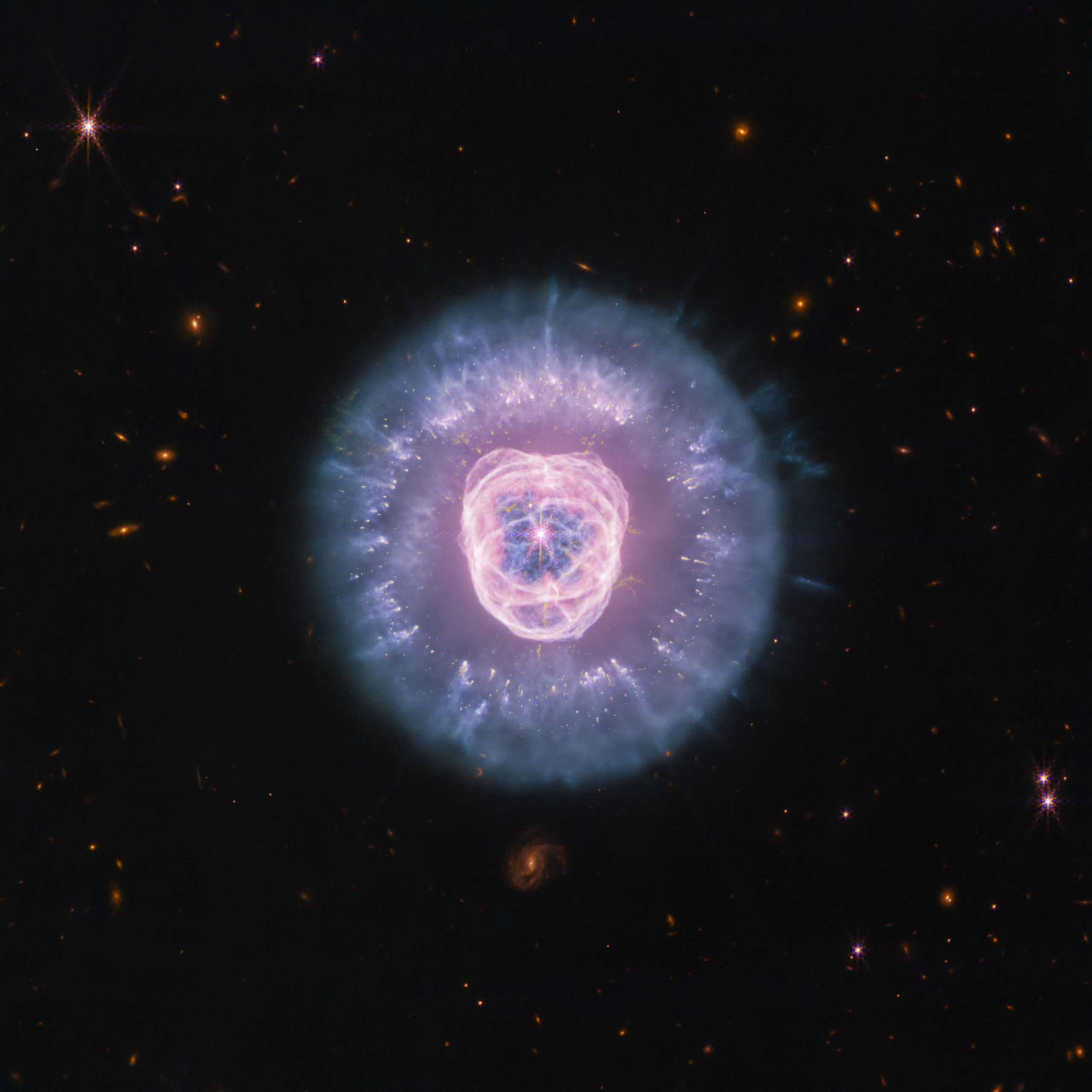
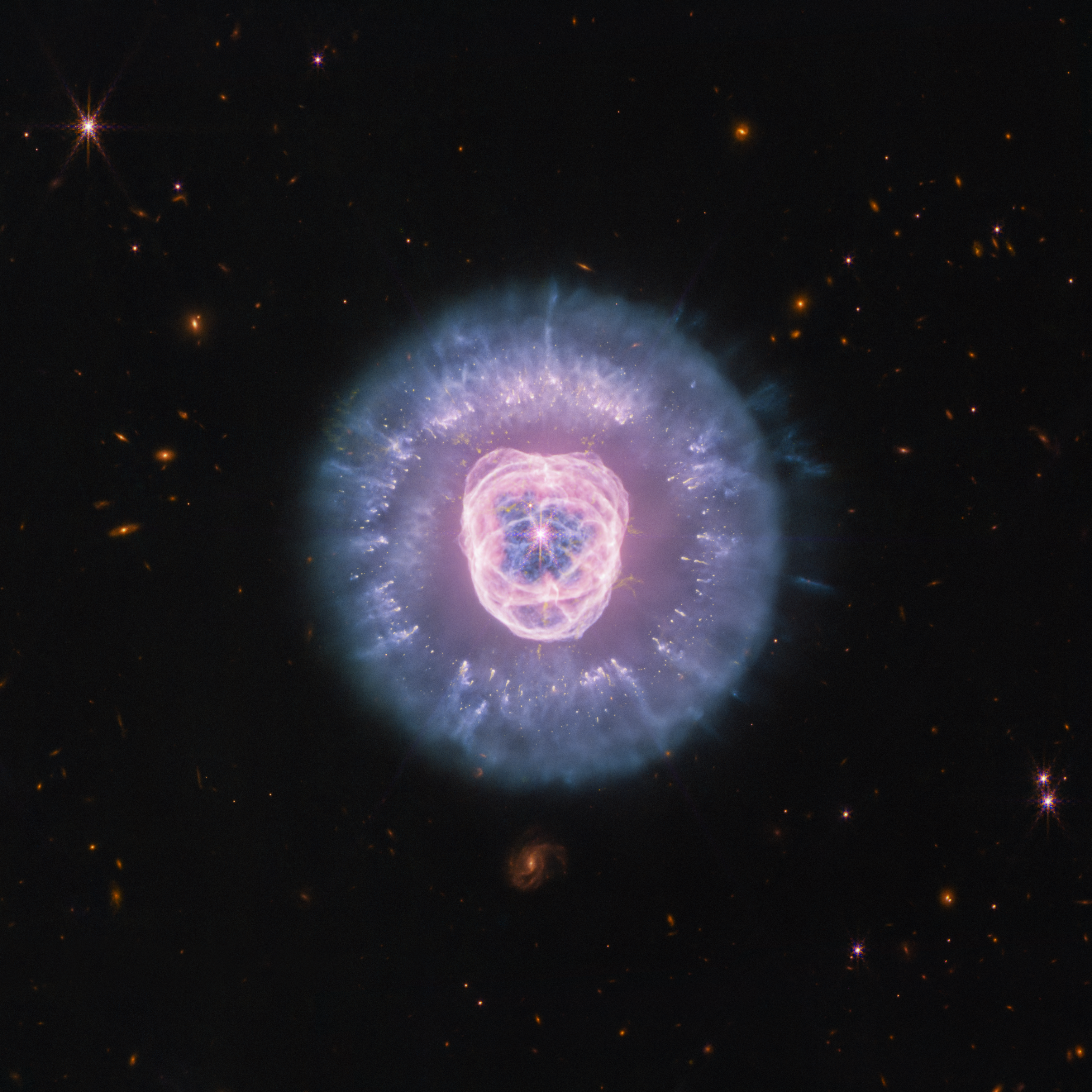
Telescopes Team Up for New View of Cat’s Eye Nebula – In Euclid’s wide, near-infrared, and visible light view, the arcs and filaments of the nebula’s bright central region are situated within a halo of colorful fragments of gas zooming away from the star. This ring was ejected from the star at an earlier stage, before the main nebula at the center formed. Hubble captures the very core of the billowing gas with high-resolution visible-light images, adding extra detail in the center of this image. The whole nebula stands out against a backdrop teeming with distant galaxies, demonstrating how local astrophysical beauty and the farthest reaches of the cosmos can be seen together in modern astronomical surveys. Together, these missions provide a rich and complementary view of NGC 6543 — revealing the delicate interplay between stellar end-of-life processes and the vast cosmic tapestry beyond.

In Euclid’s wide, near-infrared, and visible light view, the arcs and filaments of the nebula’s bright central region are situated within a halo of colorful fragments of gas zooming away from the star. This ring was ejected from the star at an earlier stage, before the main nebula at the center formed. Hubble captures the very core of the billowing gas with high-resolution visible-light images, adding extra detail in the center of this image. The whole nebula stands out against a backdrop teeming with distant galaxies, demonstrating how local astrophysical beauty and the farthest reaches of the cosmos can be seen together in modern astronomical surveys. Together, these missions provide a rich and complementary view of NGC 6543 — revealing the delicate interplay between stellar end-of-life processes and the vast cosmic tapestry beyond.

Read More
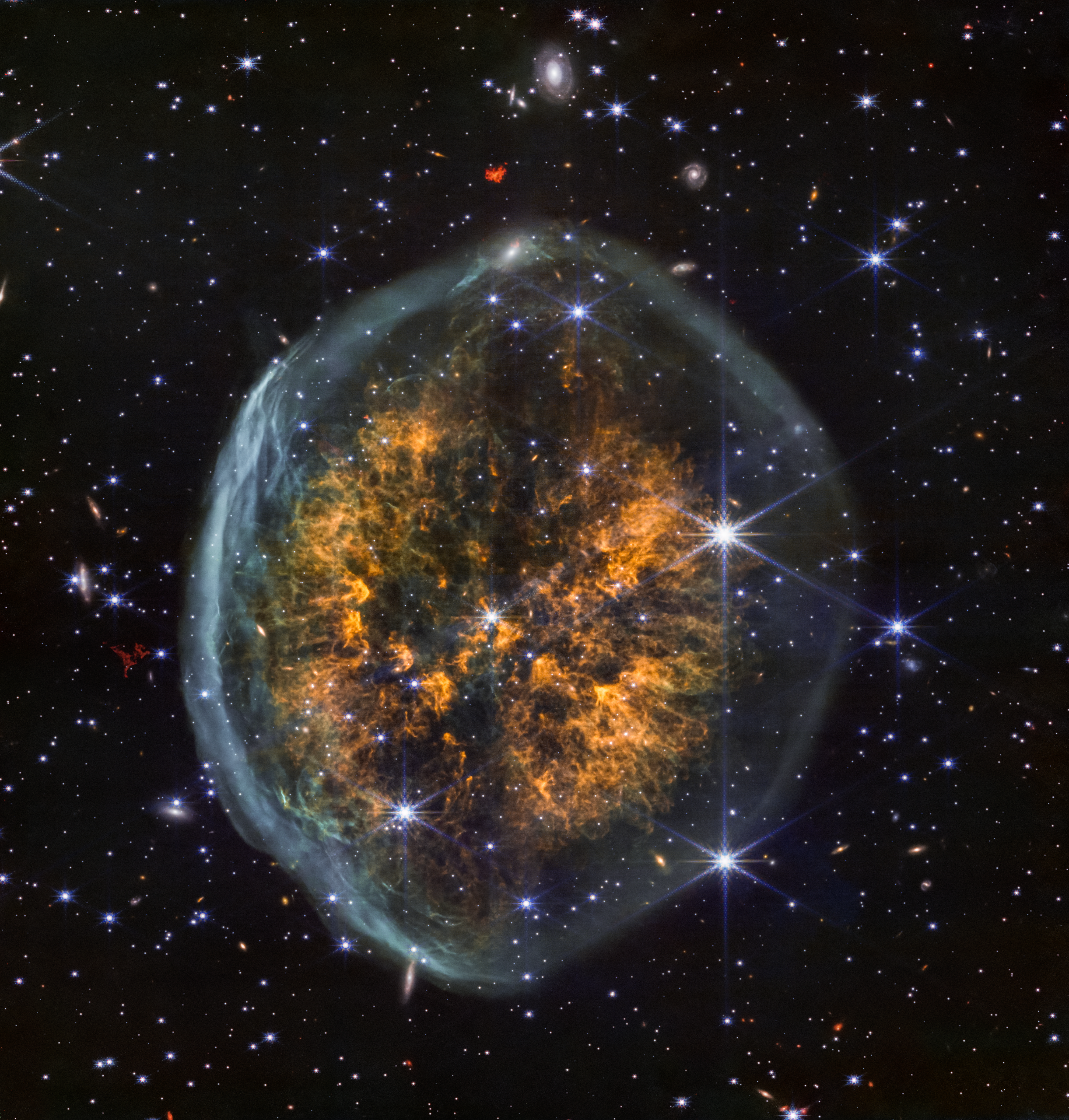
Webb Studies Cranium Nebula – A brain-new image from Webb! What looks like a brain (complete with what appear as left and right hemispheres) is actually a dying star blowing off a shell of gas, and within that shell, a cloud of various gases.

A brain-new image from Webb! What looks like a brain (complete with what appear as left and right hemispheres) is actually a dying star blowing off a shell of gas, and within that shell, a cloud of various gases.

Read More
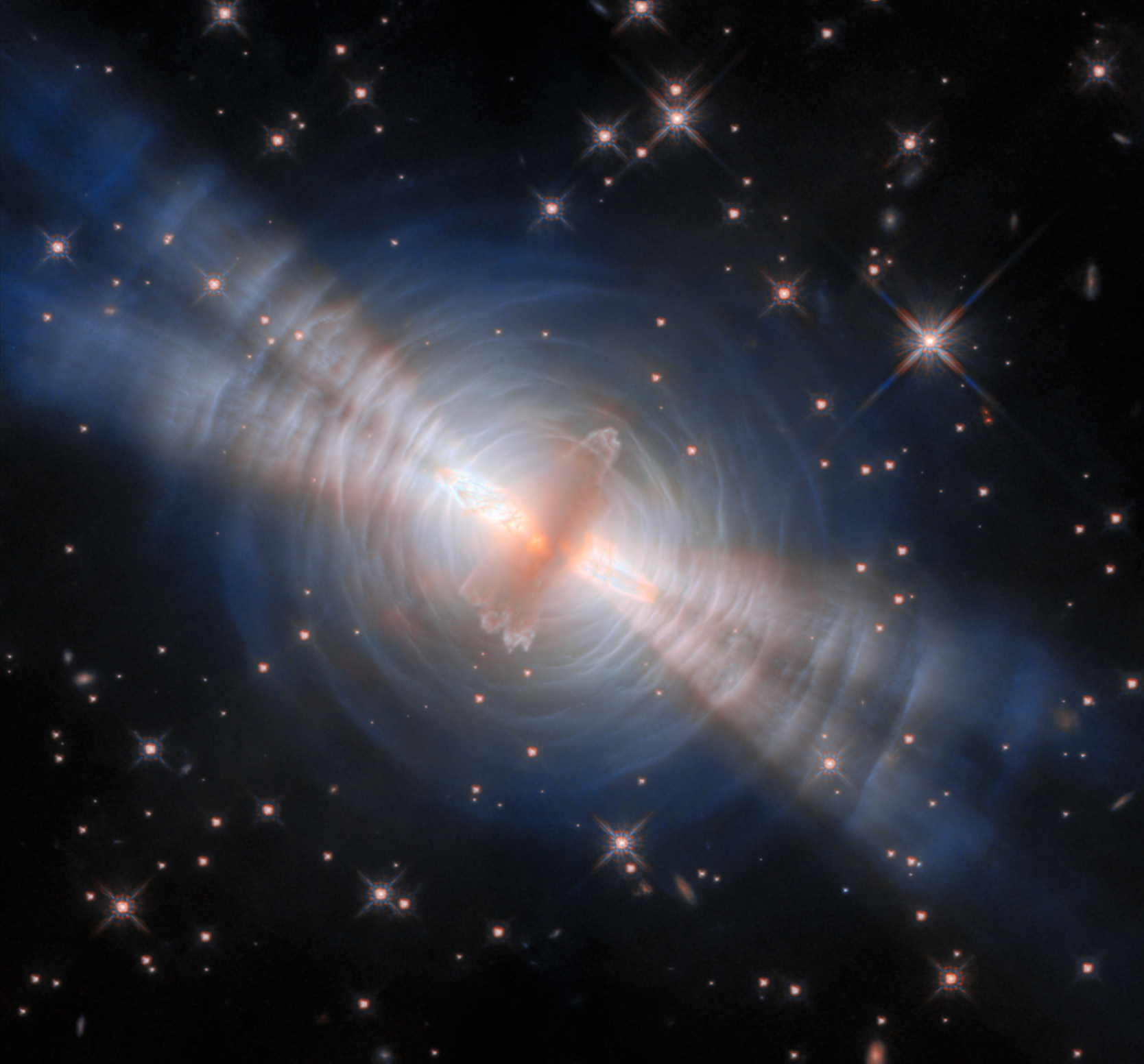
Shimmering Light in Egg Nebula – NASA’s Hubble Space Telescope reveals the clearest view yet of the Egg Nebula. This structure of gas and dust was created by a dying, Sun-like star. These newest observations were taken with Hubble’s Wide Field Camera 3.

NASA’s Hubble Space Telescope reveals the clearest view yet of the Egg Nebula. This structure of gas and dust was created by a dying, Sun-like star. These newest observations were taken with Hubble’s Wide Field Camera 3.

Read More
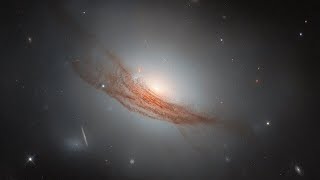
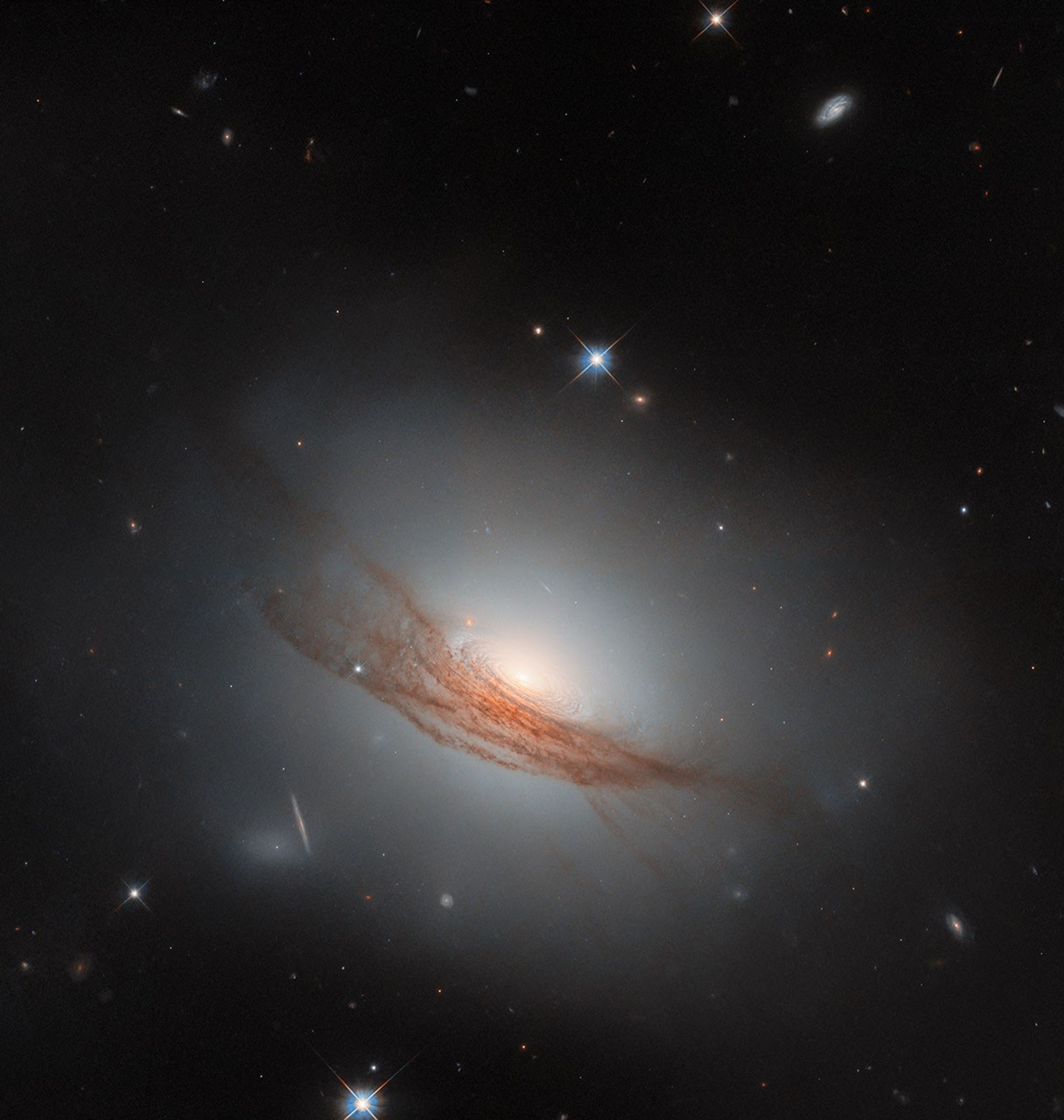
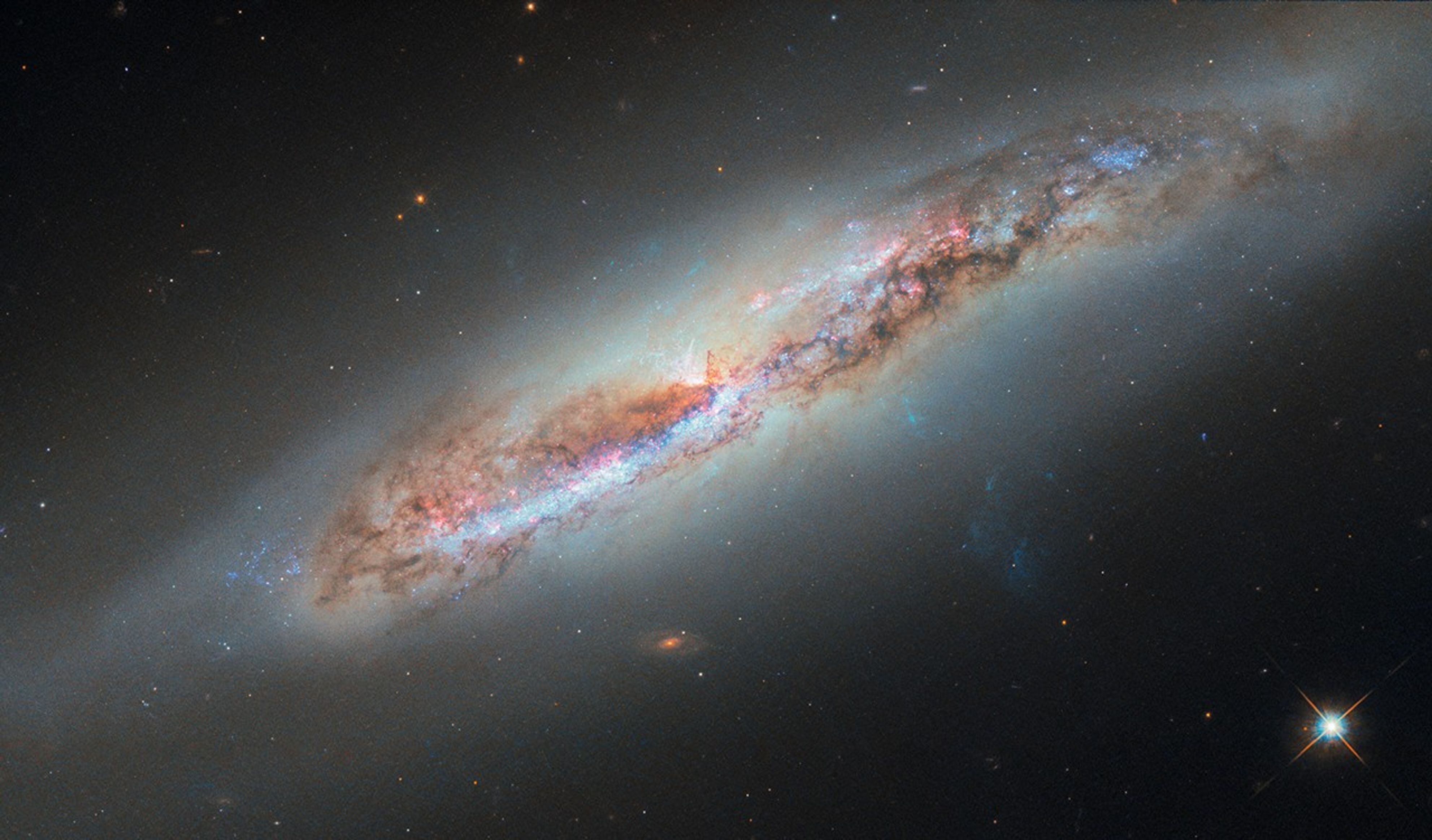
Hubble Spots Lens-Shaped Galaxy – This NASA/ESA Hubble Space Telescope image of NGC 7722, a lenticular galaxy located about 187 million light-years away, features concentric rings of dust and gas that appear to swirl around its bright nucleus.

This NASA/ESA Hubble Space Telescope image of NGC 7722, a lenticular galaxy located about 187 million light-years away, features concentric rings of dust and gas that appear to swirl around its bright nucleus.

Read More
Picture of the day


“Selection” of Hungarian Jews on the ramp at Auschwitz-II-Birkenau in German-occupied Poland, May/June 1944, during the final phase of the Holocaust. Jews were sent either to forced labor or the gas chambers. 81 years ago today, on January 27, 1945, Auschwitz was liberated by the Red Army. Today is also International Holocaust Remembrance Day.
 #ImageOfTheDay
Picture of the day
“Selection” of Hungarian Jews on the ramp at Auschwitz-II-Birkenau in German-occupied Poland, May/June 1944, during the final phase of the Holocaust. Jews were sent either to forced labor or the gas chambers. 81 years ago today, on January 27, 1945, Auschwitz was liberated by the Red Army. Today is also International Holocaust Remembrance Day.
Read More
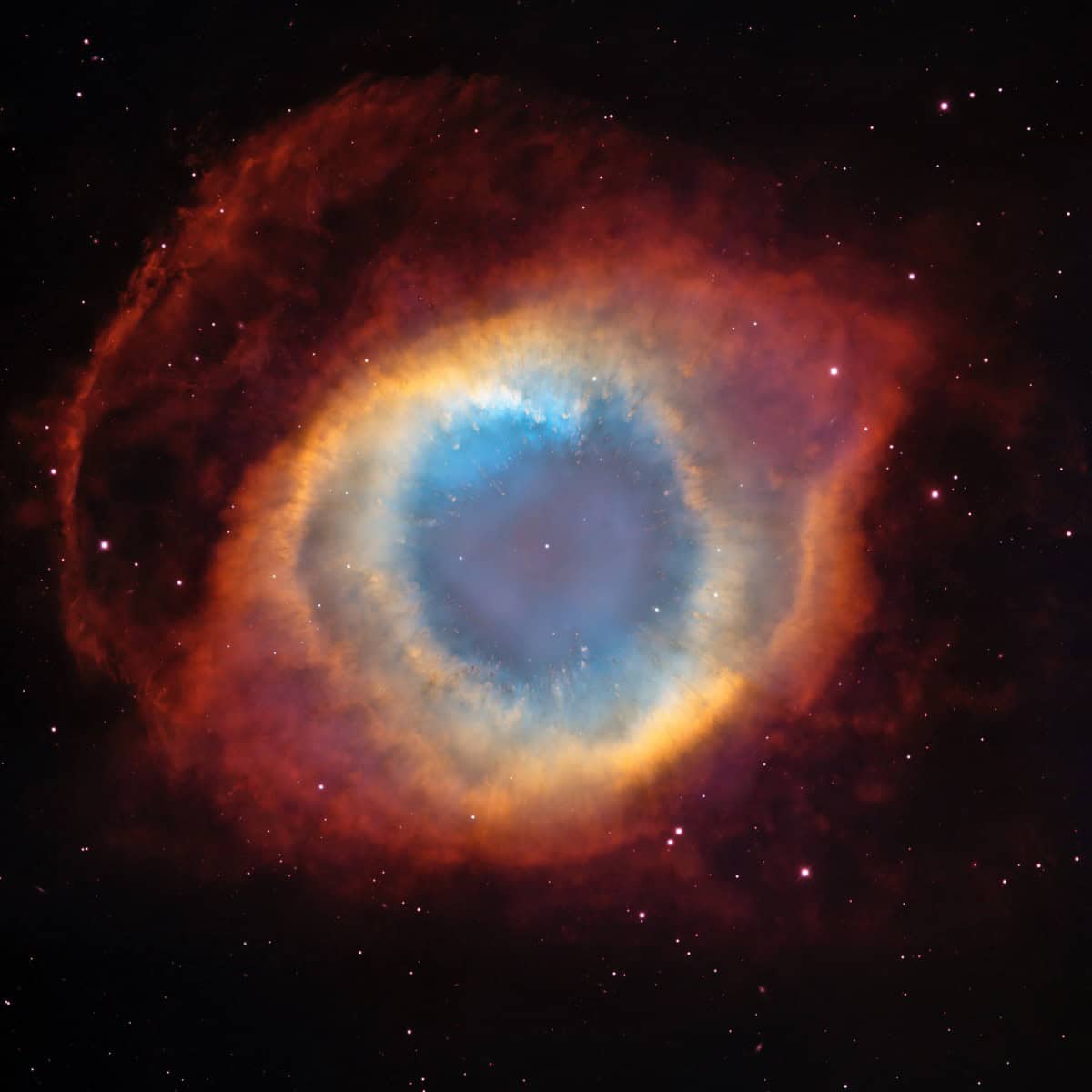
Webb Zooms into Helix Nebula – A new image from NASA’s James Webb Space Telescope of a portion of the Helix Nebula highlights comet-like knots, fierce stellar winds, and layers of gas shed off by a dying star interacting with its surrounding environment. Webb’s image also shows the stark transition between the hottest gas to the coolest gas as the shell expands out from the central white dwarf.

A new image from NASA’s James Webb Space Telescope of a portion of the Helix Nebula highlights comet-like knots, fierce stellar winds, and layers of gas shed off by a dying star interacting with its surrounding environment. Webb’s image also shows the stark transition between the hottest gas to the coolest gas as the shell expands out from the central white dwarf.

Read More
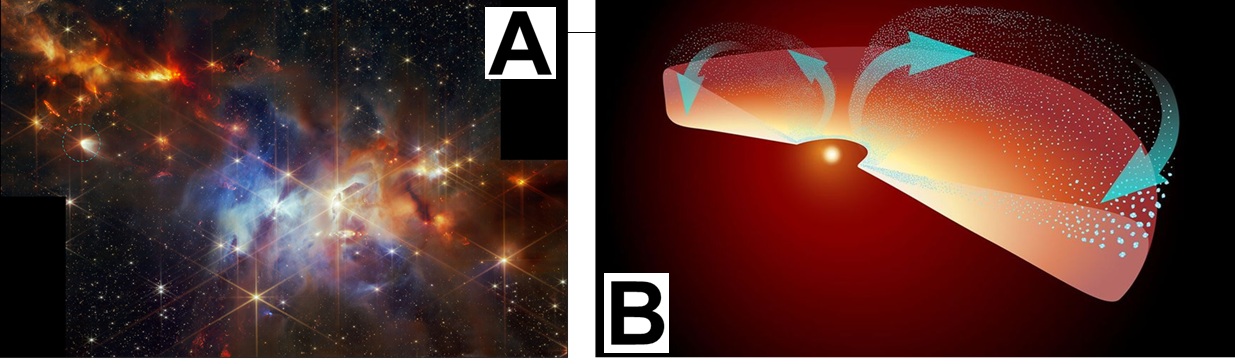
NASA’s James Webb Space Telescope Finds Crystal-Spewing Protostar – NASA’s James Webb Space Telescope’s 2024 NIRCam image shows protostar EC 53 circled. Researchers using new data from Webb’s MIRI proved that crystalline silicates form in the hottest part of the disk of gas and dust surrounding the star — and may be shot to the system’s edges.

NASA’s James Webb Space Telescope’s 2024 NIRCam image shows protostar EC 53 circled. Researchers using new data from Webb’s MIRI proved that crystalline silicates form in the hottest part of the disk of gas and dust surrounding the star — and may be shot to the system’s edges.

Read More
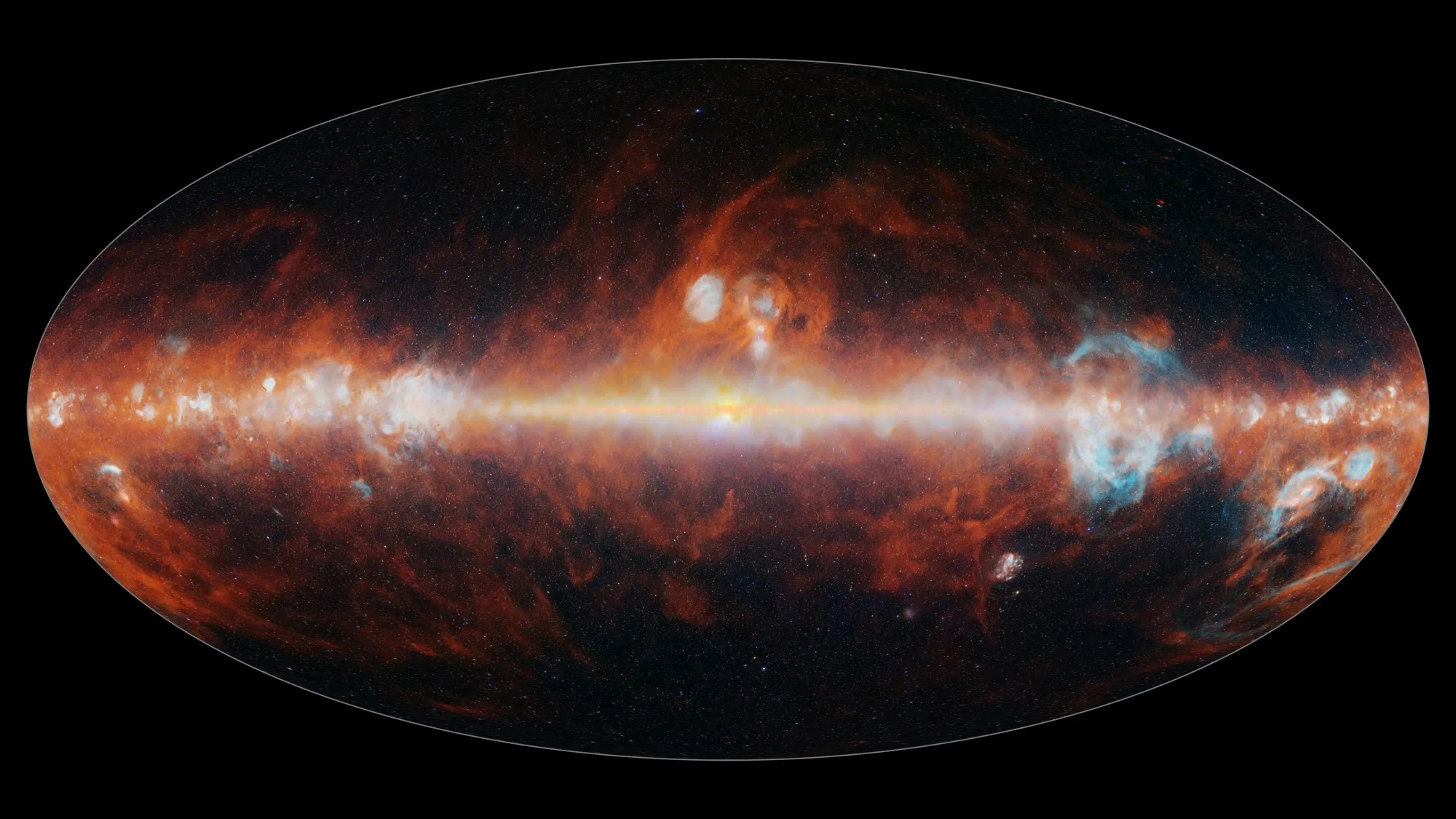
First Sky Map from NASA’s SPHEREx Observatory – NASA’s SPHEREx Observatory has mapped the entire sky in 102 infrared colors, as seen here in this image released on Dec. 18, 2025. This image features a selection of colors emitted primarily by stars (blue, green, and white), hot hydrogen gas (blue), and cosmic dust (red).

NASA’s SPHEREx Observatory has mapped the entire sky in 102 infrared colors, as seen here in this image released on Dec. 18, 2025. This image features a selection of colors emitted primarily by stars (blue, green, and white), hot hydrogen gas (blue), and cosmic dust (red).

Read More
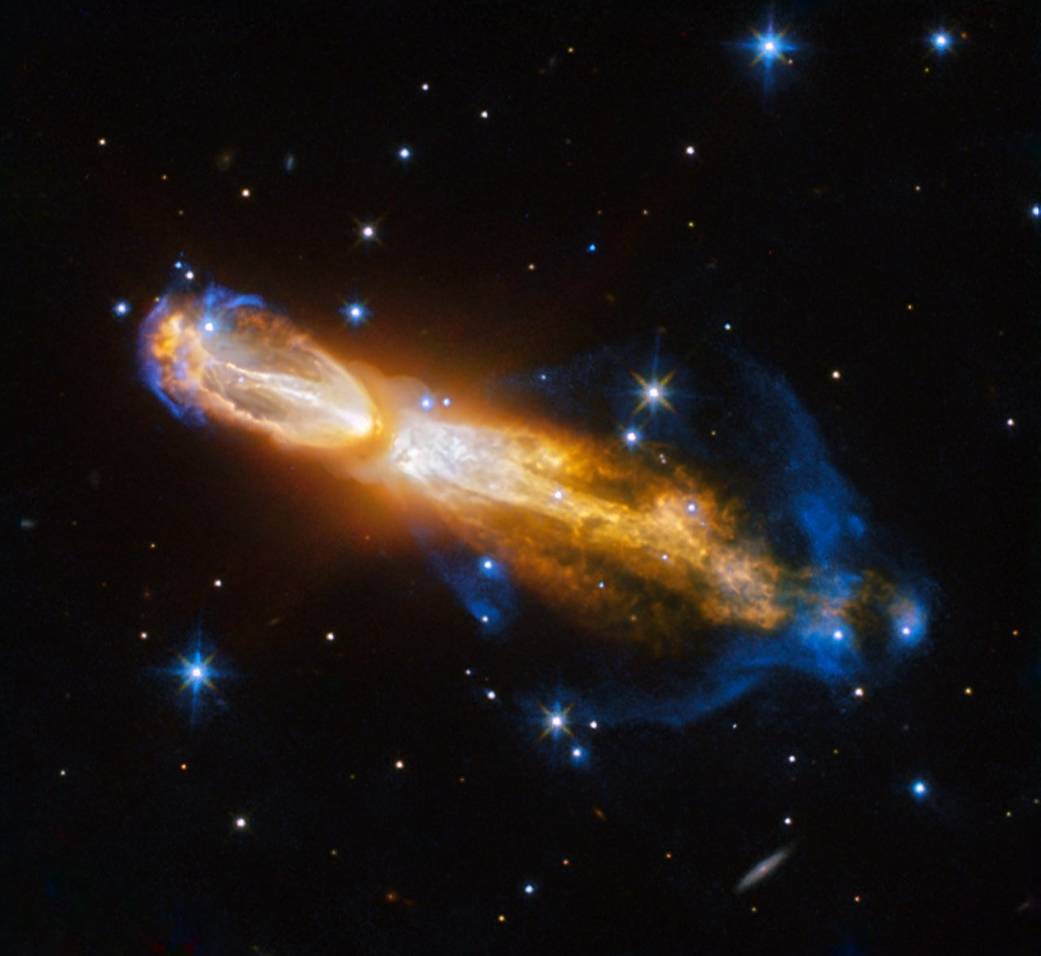
The Calabash clash – The Calabash Nebula, pictured here — which has the technical name OH 231.8+04.2 — is a spectacular example of the death of a low-mass star like the Sun. This image taken by the NASA/ESA Hubble Space Telescope shows the star going through a rapid transformation from a red giant to a planetary nebula, during which it blows its outer layers of gas and dust out into the surrounding space. The recently ejected material is spat out in opposite directions with immense speed — the gas shown in yellow is moving close to a million kilometres an hour. Astronomers rarely capture a star in this phase of its evolution because it occurs within the blink of an eye — in astronomical terms. Over the next thousand years the nebula is expected to evolve into a fully fledged planetary nebula. The nebula is also known as the Rotten Egg Nebula because it contains a lot of sulphur, an element that, when combined with other elements, smells like a rotten egg — but luckily, it resides over 5000 light-years away in the constellation of Puppis (The Poop deck).

The Calabash Nebula, pictured here — which has the technical name OH 231.8+04.2 — is a spectacular example of the death of a low-mass star like the Sun. This image taken by the NASA/ESA Hubble Space Telescope shows the star going through a rapid transformation from a red giant to a planetary nebula, during which it blows its outer layers of gas and dust out into the surrounding space. The recently ejected material is spat out in opposite directions with immense speed — the gas shown in yellow is moving close to a million kilometres an hour. Astronomers rarely capture a star in this phase of its evolution because it occurs within the blink of an eye — in astronomical terms. Over the next thousand years the nebula is expected to evolve into a fully fledged planetary nebula. The nebula is also known as the Rotten Egg Nebula because it contains a lot of sulphur, an element that, when combined with other elements, smells like a rotten egg — but luckily, it resides over 5000 light-years away in the constellation of Puppis (The Poop deck).

Read More
Picture of the day


A close-in image of a protoplanetary disc HH 30 around a newly formed star produced by NASA/ESA/CSA James Webb Space Telescope. It is surrounded by jets and a disc wind, and is located in the dark cloud LDN 1551 in the Taurus Molecular Cloud. Herbig-Haro objects are small nebulae found in star formation regions, marking the locations where gas outflowing from young stars is heated into luminescence by shockwaves. HH 30 is an example of where this outflowing gas takes the form of a narrow jet. The source star is located on one end of the jet, hidden behind an edge-on protoplanetary disc that the star is illuminating.
 #ImageOfTheDay
Picture of the day
A close-in image of a protoplanetary disc HH 30 around a newly formed star produced by NASA/ESA/CSA James Webb Space Telescope. It is surrounded by jets and a disc wind, and is located in the dark cloud LDN 1551 in the Taurus Molecular Cloud. Herbig-Haro objects are small nebulae found in star formation regions, marking the locations where gas outflowing from young stars is heated into luminescence by shockwaves. HH 30 is an example of where this outflowing gas takes the form of a narrow jet. The source star is located on one end of the jet, hidden behind an edge-on protoplanetary disc that the star is illuminating.
Read More