Indigenous Peoples

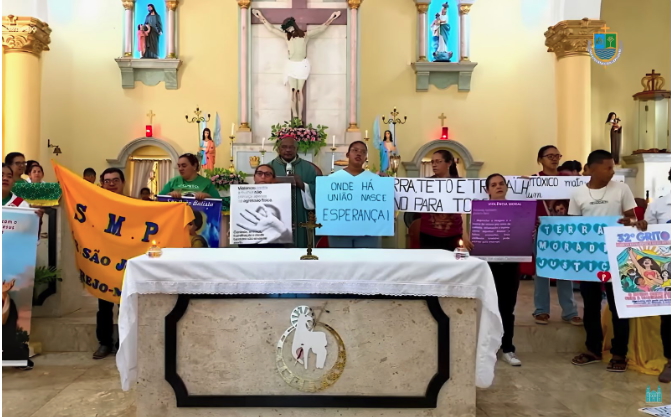
Controversial ‘Creed of the Ecclesial Base Communities’ included at Mass in Brazil #Catholic On Sept. 7, Bishop José Valdeci Santos Mendes of Brejo, Maranhão, Brazil, celebrated Mass as part of a national Cry of the Excluded event. During the Mass, the "Creed of the Ecclesial Base Communities” (known as CEBs, by their synonym in Portuguese) was read. This creed, developed in 2016, professes belief in “a God/Goddess present in the diverse experiences of the communities: a God who is close, a liberating and revolutionary God, a God who is a member of the CEBs, who works and struggles just as Jesus of Nazareth did.”Following the distribution of the Eucharist but before the final blessing, the bishop — who chairs the Episcopal Commission for Social-Transformative Action of the National Conference of Bishops of Brazil (CEPAST-CNBB, by its Portuguese acronym) — introduced the referenced creed. He called it a “supplication from the youth of Latin America, who stand before God asking him to come to meet us,” and entrusted the creed’s recitation to two young men.“We do not believe in a static, patriarchal, clerical, and hierarchical Church,” stated the text read by the young men at the Cathedral of Our Lady of the Conception. “We believe in an inclusive, intergenerational community with a voice of its own. We believe in this Church that struggles, ‘casting its lot with the poor of the earth’ in the face of a dominant capitalist system.”“We believe we are daughters and sons of a ‘Great Homeland’ free from racism and free from rules governing love — embracing all sexual diversity, women, youth, Indigenous peoples, Black people, minorities, and all those at the bottom of the social order.”The Creed of the Ecclesial Base Communities is part of a suggested liturgy outline for Masses, worship services, and public gatherings marking the 32nd Cry of the Excluded — a mobilization bringing together pastoral groups, Catholic organizations, and social movements, held annually on Brazil’s Independence Day. CEPAST has called upon dioceses, pastoral groups, and grassroots movements to strengthen this mobilization within their respective jurisdictions this year.In a message released in June regarding the 2026 elections, the CNBB (National Conference of Bishops of Brazil) stated that “the Catholic Church does not endorse candidates or political parties” but affirmed that the Church, “driven by the Gospel and the mission to proclaim it, promotes life and human dignity, and serves the building of the common good.”Elections, the CEB Creed, and prayersDuring the penitential rite, Mass participants asked for forgiveness for “times when we did not take the country’s destiny seriously during elections” and for failing to speak out against “candidacies backed by economic power that will harm the people and potentially even impose authoritarian regimes.”The other parts of the penitential rite address wars, people living on the streets, real estate speculation, housing movements, violence against women, and femicide.During the Prayers of the Faithful, an intention regarding the elections was also included: “For this election season, that we may have the discernment not to vote for anyone who seeks to jeopardize Brazil’s sovereignty or harbors plans for a coup. May we not vote for politicians and parties that wish to turn the public good into an object of profit. Sovereignty is not negotiable.” The assembly’s response was: “Deliver us, Lord, from all those who use politics to betray the Brazilian people!”CEPAST states it did not draft the liturgy guideCEPAST’s communications office told ACI Digital, the Portuguese-language sister service of EWTN News, that the CNBB commission did not participate in drafting the document. “The ‘Cry of the Excluded’ is a coalition formed by various organizations, and CEPAST did not participate in drafting the liturgy guide,” said Juce Rocha of the commission’s communications team.The National Coordination of the Cry of the Excluded includes among its participants Catholic pastoral groups, organizations, and social movements such as the Pastoral Land Commission (CPT), Caritas Brazil, the Workers' Pastoral, the Migrants' Pastoral Service, Base Ecclesial Communities (CEBs), the Landless Rural Workers' Movement (MST), the Movement of People Affected by Dams (MAB), the Central of Popular Movements (CMP), and the National Confederation of Education Workers (CNTE).The national map for this year’s “Cry” documented activities in all regions of the country. In Cachoeiro de Itapemirim, Espírito Santo, a march brought together the faithful, pastoral groups, and representatives of social movements, concluding at St. Peterʼs Cathedral, where Bishop Luiz Fernando Lisboa participated in the mobilization. In Santos, São Paulo, the “Cry” was part of the dioceseʼs official agenda and was attended by Bishop Joaquim Giovani Mol Guimarães.
 
 In Cachoeiro de Itapemirim, Brazil, a march brought together the faithful, pastoral groups, and representatives of social movements, concluding at St. Peter’s Cathedral. | Credit: Diocese of Cachoeiro de Itapemirim
 
 The same order of service was not followed at all Masses linked to the Cry. At the National Shrine of Aparecida in São Paulo, for instance, the Sept. 7 Mass was celebrated within the context of both the 39th Workers' Pilgrimage and the 32nd Cry of the Excluded. The Mass was celebrated by the archbishop of Aparecida, Mário Antonio da Silva; among the concelebrants was the bishop of the Prelature of Marajó, Pará, José Ionilton Lisboa de Oliveira, president of the Pastoral Land Commission.The Cry was mentioned during the Mass and the homily, but the program used in Brejo was not adopted for the celebration.The Cry of the Excluded first emerged during the evaluation of the second Brazilian Social Week — promoted by the CNBB in 1993 and 1994 — as a way to continue the reflections from that process. The initiative was also inspired by the 1995 Fraternity Campaign, which featured the theme “Fraternity and the Excluded” and the motto “Was it you, Lord?”The first edition took place on Sept. 7, 1995, in 170 locations. In 1996, the CNBB adopted the Cry during its general assembly as part of the Toward the New Millennium Project.Today, the mobilization is led by a National Coordination body comprising the CNBB’s Commission 8, Catholic pastoral groups and organizations, and various social movements and entities — including the CPT, Cáritas Brasileira, the Workers‘ Pastoral, the Migrants’ Pastoral Service, CEBs, the MST, MAB, CMP, and CNTE.According to the event’s organizers, the choice of Sept. 7 is intended to provide a “counterpoint” to the official Independence Day commemoration. The date has also been identified by the event’s organizers as a moment for “political awareness” and the struggle for a “new national and global order.”While the movement’s longtime theme is “Life Comes First!”, the slogan for 2026 is: “In defense of the land, peace, and housing, we raise our voices: Women alive and sovereignty!” National demands include ending the “6×1” (six days of work and one day off) work schedule, ensuring dignified housing, agrarian reform, quality public education, and the defense of the SUS (Unified Health System), as well as combating femicide, racism, and what is termed as “LGBTphobia.”The event’s website states that the choice of Sept. 7 seeks to offer a “counterpoint to the official history of Brazilʼs independence. Contrasting with the civic and military parades that have traditionally marked the day, it calls upon the people — especially the poor and the excluded — to step down from the grandstands, leave passive patriotism behind, and occupy public squares and streets in defense of their rights.”This story was first published by ACI Digital, the Portuguese-language sister service of EWTN News. It has been translated and adapted by EWTN News English.

Controversial ‘Creed of the Ecclesial Base Communities’ included at Mass in Brazil #Catholic On Sept. 7, Bishop José Valdeci Santos Mendes of Brejo, Maranhão, Brazil, celebrated Mass as part of a national Cry of the Excluded event. During the Mass, the "Creed of the Ecclesial Base Communities” (known as CEBs, by their synonym in Portuguese) was read. This creed, developed in 2016, professes belief in “a God/Goddess present in the diverse experiences of the communities: a God who is close, a liberating and revolutionary God, a God who is a member of the CEBs, who works and struggles just as Jesus of Nazareth did.”Following the distribution of the Eucharist but before the final blessing, the bishop — who chairs the Episcopal Commission for Social-Transformative Action of the National Conference of Bishops of Brazil (CEPAST-CNBB, by its Portuguese acronym) — introduced the referenced creed. He called it a “supplication from the youth of Latin America, who stand before God asking him to come to meet us,” and entrusted the creed’s recitation to two young men.“We do not believe in a static, patriarchal, clerical, and hierarchical Church,” stated the text read by the young men at the Cathedral of Our Lady of the Conception. “We believe in an inclusive, intergenerational community with a voice of its own. We believe in this Church that struggles, ‘casting its lot with the poor of the earth’ in the face of a dominant capitalist system.”“We believe we are daughters and sons of a ‘Great Homeland’ free from racism and free from rules governing love — embracing all sexual diversity, women, youth, Indigenous peoples, Black people, minorities, and all those at the bottom of the social order.”The Creed of the Ecclesial Base Communities is part of a suggested liturgy outline for Masses, worship services, and public gatherings marking the 32nd Cry of the Excluded — a mobilization bringing together pastoral groups, Catholic organizations, and social movements, held annually on Brazil’s Independence Day. CEPAST has called upon dioceses, pastoral groups, and grassroots movements to strengthen this mobilization within their respective jurisdictions this year.In a message released in June regarding the 2026 elections, the CNBB (National Conference of Bishops of Brazil) stated that “the Catholic Church does not endorse candidates or political parties” but affirmed that the Church, “driven by the Gospel and the mission to proclaim it, promotes life and human dignity, and serves the building of the common good.”Elections, the CEB Creed, and prayersDuring the penitential rite, Mass participants asked for forgiveness for “times when we did not take the country’s destiny seriously during elections” and for failing to speak out against “candidacies backed by economic power that will harm the people and potentially even impose authoritarian regimes.”The other parts of the penitential rite address wars, people living on the streets, real estate speculation, housing movements, violence against women, and femicide.During the Prayers of the Faithful, an intention regarding the elections was also included: “For this election season, that we may have the discernment not to vote for anyone who seeks to jeopardize Brazil’s sovereignty or harbors plans for a coup. May we not vote for politicians and parties that wish to turn the public good into an object of profit. Sovereignty is not negotiable.” The assembly’s response was: “Deliver us, Lord, from all those who use politics to betray the Brazilian people!”CEPAST states it did not draft the liturgy guideCEPAST’s communications office told ACI Digital, the Portuguese-language sister service of EWTN News, that the CNBB commission did not participate in drafting the document. “The ‘Cry of the Excluded’ is a coalition formed by various organizations, and CEPAST did not participate in drafting the liturgy guide,” said Juce Rocha of the commission’s communications team.The National Coordination of the Cry of the Excluded includes among its participants Catholic pastoral groups, organizations, and social movements such as the Pastoral Land Commission (CPT), Caritas Brazil, the Workers' Pastoral, the Migrants' Pastoral Service, Base Ecclesial Communities (CEBs), the Landless Rural Workers' Movement (MST), the Movement of People Affected by Dams (MAB), the Central of Popular Movements (CMP), and the National Confederation of Education Workers (CNTE).The national map for this year’s “Cry” documented activities in all regions of the country. In Cachoeiro de Itapemirim, Espírito Santo, a march brought together the faithful, pastoral groups, and representatives of social movements, concluding at St. Peterʼs Cathedral, where Bishop Luiz Fernando Lisboa participated in the mobilization. In Santos, São Paulo, the “Cry” was part of the dioceseʼs official agenda and was attended by Bishop Joaquim Giovani Mol Guimarães. In Cachoeiro de Itapemirim, Brazil, a march brought together the faithful, pastoral groups, and representatives of social movements, concluding at St. Peter’s Cathedral. | Credit: Diocese of Cachoeiro de Itapemirim The same order of service was not followed at all Masses linked to the Cry. At the National Shrine of Aparecida in São Paulo, for instance, the Sept. 7 Mass was celebrated within the context of both the 39th Workers' Pilgrimage and the 32nd Cry of the Excluded. The Mass was celebrated by the archbishop of Aparecida, Mário Antonio da Silva; among the concelebrants was the bishop of the Prelature of Marajó, Pará, José Ionilton Lisboa de Oliveira, president of the Pastoral Land Commission.The Cry was mentioned during the Mass and the homily, but the program used in Brejo was not adopted for the celebration.The Cry of the Excluded first emerged during the evaluation of the second Brazilian Social Week — promoted by the CNBB in 1993 and 1994 — as a way to continue the reflections from that process. The initiative was also inspired by the 1995 Fraternity Campaign, which featured the theme “Fraternity and the Excluded” and the motto “Was it you, Lord?”The first edition took place on Sept. 7, 1995, in 170 locations. In 1996, the CNBB adopted the Cry during its general assembly as part of the Toward the New Millennium Project.Today, the mobilization is led by a National Coordination body comprising the CNBB’s Commission 8, Catholic pastoral groups and organizations, and various social movements and entities — including the CPT, Cáritas Brasileira, the Workers‘ Pastoral, the Migrants’ Pastoral Service, CEBs, the MST, MAB, CMP, and CNTE.According to the event’s organizers, the choice of Sept. 7 is intended to provide a “counterpoint” to the official Independence Day commemoration. The date has also been identified by the event’s organizers as a moment for “political awareness” and the struggle for a “new national and global order.”While the movement’s longtime theme is “Life Comes First!”, the slogan for 2026 is: “In defense of the land, peace, and housing, we raise our voices: Women alive and sovereignty!” National demands include ending the “6×1” (six days of work and one day off) work schedule, ensuring dignified housing, agrarian reform, quality public education, and the defense of the SUS (Unified Health System), as well as combating femicide, racism, and what is termed as “LGBTphobia.”The event’s website states that the choice of Sept. 7 seeks to offer a “counterpoint to the official history of Brazilʼs independence. Contrasting with the civic and military parades that have traditionally marked the day, it calls upon the people — especially the poor and the excluded — to step down from the grandstands, leave passive patriotism behind, and occupy public squares and streets in defense of their rights.”This story was first published by ACI Digital, the Portuguese-language sister service of EWTN News. It has been translated and adapted by EWTN News English.

This past Sept. 7, the “Creed of the Ecclesial Base Communities” was included as part of a Mass marking Brazil’s annual “Cry of the Excluded” event.
Read More
Catholic leaders urge protection for Christian village attacked in Bangladesh #Catholic The Catholic Church and Indigenous Christian leaders in Bangladesh have called on the authorities to protect families terrified by an attack on a Christian village and to bring those responsible to justice.On Aug. 12, houses in the village of Gazarikura, a community in the Diocese of Mymensingh in the north of the Muslim-majority country, were attacked, looted, and vandalized. Local Indigenous Garo people said the stolen property included cash, cows, goats, and other valuables.The Indigenous families said the attack and looting were carried out by people from a neighboring Muslim village after the body of a Muslim man was found in their village.Father Simon Hacha, vicar general of the Diocese of Mymensingh, visited the village together with other priests, sisters, Garo Indigenous leaders, and local leaders.“We never want unrest; we are for peace,” Hacha, who is himself a Garo, told EWTN News.“We pray for the soul of the deceased person around whom this problem has arisen and we offer our condolences to his family,” he said.He urged police not to harass those who are not guilty and to identify the culprits and take appropriate action.“I hope that the administration will provide security to the Garo Indigenous of this village and that the villagers will maintain good relations with each other so that peace can prevail in the future,” Hacha added.Losses and arrestsVillage leaders told EWTN News that six houses in Gazarikura were vandalized and that the furniture of one house was burned. The attackers took away seven cows, 10 goats, a motorcycle, cash, and expensive furniture. The incident spread panic among local residents.Father Lawrence Ribeiro, the parish priest of Mariamnagar, told EWTN News by telephone during a visit to the village on Aug. 14 that 11 houses had been looted and that televisions, refrigerators, cows, and goats had been taken away. The families do not have enough food, he said. “So, we brought food, soap, and other items for these families.”Ribeiro said the families had been calculated to have suffered losses of about 4 million taka (about ,000). “We are preparing to file a case of looting for this,” he said.The body of a rice trader, Billal Hossain, 40, was recovered by police. Nineteen people, including men and women from the Garo community, were arrested on suspicion of involvement in the case. Police later released 14 of them.According to police sources, Hossain, a resident of the Jarultala area of the upazila, or subdistrict, went missing on Aug. 4. On the afternoon of Aug. 12, local farmers working in a field smelled a foul odor near a canal, searched the surroundings, and found the body buried in the ground. Police went to the spot and recovered it after being informed.An organization of Garo Indigenous students said in a statement: "We want to say very clearly that the responsibility for the crime of an individual can never be imposed on an entire ethnic group, community, or population.”“If someone is involved in any crime, his involvement will be determined through an impartial and fair investigation. If the crime is proven, he will be tried according to the prevailing law. But suspecting, harassing, or victimizing another innocent person on the basis of an individualʼs identity, ethnic identity, or community identity is against justice,” the student organization said.S.M. Noor Mohammad, officer in charge of the Jhenaigati police station, said the atmosphere in the village is now calm and that police have been deployed.“The police are investigating the incident and are continuing their efforts to identify the criminals involved in the incident,” Mohammad said.On Aug. 9, Indigenous people had rallied for their rights and to protest atrocities against them on the occasion of the International Day of the Worldʼs Indigenous Peoples.

Catholic leaders urge protection for Christian village attacked in Bangladesh #Catholic The Catholic Church and Indigenous Christian leaders in Bangladesh have called on the authorities to protect families terrified by an attack on a Christian village and to bring those responsible to justice.On Aug. 12, houses in the village of Gazarikura, a community in the Diocese of Mymensingh in the north of the Muslim-majority country, were attacked, looted, and vandalized. Local Indigenous Garo people said the stolen property included cash, cows, goats, and other valuables.The Indigenous families said the attack and looting were carried out by people from a neighboring Muslim village after the body of a Muslim man was found in their village.Father Simon Hacha, vicar general of the Diocese of Mymensingh, visited the village together with other priests, sisters, Garo Indigenous leaders, and local leaders.“We never want unrest; we are for peace,” Hacha, who is himself a Garo, told EWTN News.“We pray for the soul of the deceased person around whom this problem has arisen and we offer our condolences to his family,” he said.He urged police not to harass those who are not guilty and to identify the culprits and take appropriate action.“I hope that the administration will provide security to the Garo Indigenous of this village and that the villagers will maintain good relations with each other so that peace can prevail in the future,” Hacha added.Losses and arrestsVillage leaders told EWTN News that six houses in Gazarikura were vandalized and that the furniture of one house was burned. The attackers took away seven cows, 10 goats, a motorcycle, cash, and expensive furniture. The incident spread panic among local residents.Father Lawrence Ribeiro, the parish priest of Mariamnagar, told EWTN News by telephone during a visit to the village on Aug. 14 that 11 houses had been looted and that televisions, refrigerators, cows, and goats had been taken away. The families do not have enough food, he said. “So, we brought food, soap, and other items for these families.”Ribeiro said the families had been calculated to have suffered losses of about 4 million taka (about $32,000). “We are preparing to file a case of looting for this,” he said.The body of a rice trader, Billal Hossain, 40, was recovered by police. Nineteen people, including men and women from the Garo community, were arrested on suspicion of involvement in the case. Police later released 14 of them.According to police sources, Hossain, a resident of the Jarultala area of the upazila, or subdistrict, went missing on Aug. 4. On the afternoon of Aug. 12, local farmers working in a field smelled a foul odor near a canal, searched the surroundings, and found the body buried in the ground. Police went to the spot and recovered it after being informed.An organization of Garo Indigenous students said in a statement: "We want to say very clearly that the responsibility for the crime of an individual can never be imposed on an entire ethnic group, community, or population.”“If someone is involved in any crime, his involvement will be determined through an impartial and fair investigation. If the crime is proven, he will be tried according to the prevailing law. But suspecting, harassing, or victimizing another innocent person on the basis of an individualʼs identity, ethnic identity, or community identity is against justice,” the student organization said.S.M. Noor Mohammad, officer in charge of the Jhenaigati police station, said the atmosphere in the village is now calm and that police have been deployed.“The police are investigating the incident and are continuing their efforts to identify the criminals involved in the incident,” Mohammad said.On Aug. 9, Indigenous people had rallied for their rights and to protest atrocities against them on the occasion of the International Day of the Worldʼs Indigenous Peoples.

Several homes were looted and vandalized in a mainly Catholic village after the body of a Muslim man was found nearby, and 19 Indigenous villagers were arrested.

Read More