
| Picture of the day |
|---|

|
|
Orange-lined triggerfish (Balistapus undulatus), Red Sea, Egypt. This demersal triggerfish has a maximum body size of about 30 centimetres (12 in) and is found across the Indo-western Pacific East Africa, Red Sea and Japan, typically in coral reefs ecosystems, coral lagoons, and external reef slopes within this area. Within coral reefs, the orange-lined triggerfish are more versatile than other triggerfish species and can be found at depths up to 50 metres (160 ft), although studies have found that they prefer depths of 2 to 8 metres (6 ft 7 in to 26 ft 3 in). It’s an omnivorous feeder that can, because of its strong and heavy teeth, tackle a variety of benthic prey like cnidarians, molluscs, ctenophores, crustaceans, other fish, algae, and echinoderms. This species in particular, given its broad diet and distribution, is a crucial component in coral reef ecosystems through top-down control and especially through consumption of sea-urchin.
|
| Picture of the day |
|---|

|
|
Brown booby (Sula leucogaster plotus) male in flight over Michaelmas Cay, Great Barrier Reef, Queensland, Australia.
|
| Picture of the day |
|---|

|
|
Red Sea bannerfish (Heniochus intermedius), Red Sea, Egypt. The Red Sea bannerfish attains as maximum total length of 18 centimetres (7.1 in) and is native to the western Indian Ocean where it is found in the Red Sea and the Gulf of Aden. It’s associated with coral reefs where it is most frequently recorded as a solitary fish or in pairs, although large schools have been recorded. The juveniles form large schools, particularly in areas of deep reef where there is a low density of corals. They feed on both zooplankton and benthic invertebrates but the extent to which they feed on live coral has still to be determined. It is an oviparous species which forms monogamous pairs for spawning. It’s collected for the aquarium trade but its collection is of a limited scale and is not believed to be a threat to the species population.
|
| Picture of the day |
|---|

|
|
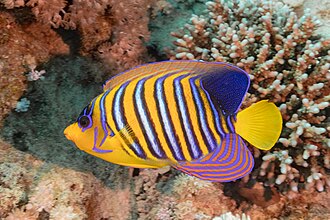
Royal angelfish (Pygoplites diacanthus), Ras Muhammad National Park, Red Sea, Egypt. The body of the royal angelfish is moderately elongate, is very compressed and can reach a length of up to 25 centimetres (9.8 in) It’s widely distributed throughout the Indo-Pacific and can be found in the Red Sea and Indian Ocean around East Africa and the Maldives, stretching to the Tuamoto Islands, New Caledonia, and Great Barrier Reef. The royal angelfish occurs at depths ranging from 0 to 80m (0 to 262 ft), in coral rich areas of lagoons, reefs, and are also often found in the vicinity of caves. It is a carnivorous species that feeds on sponges and tunicates located throughout reefs and underwater caves. They are a non-migratory species that can be found solitary, in pairs, or groups.
|

#AIPrompt – Image of a Fancy Coral Reefs: Underwater structures built by coral polyps. using Bold Color , With Emotion Aggressive, in the Style of Cubism
Read More