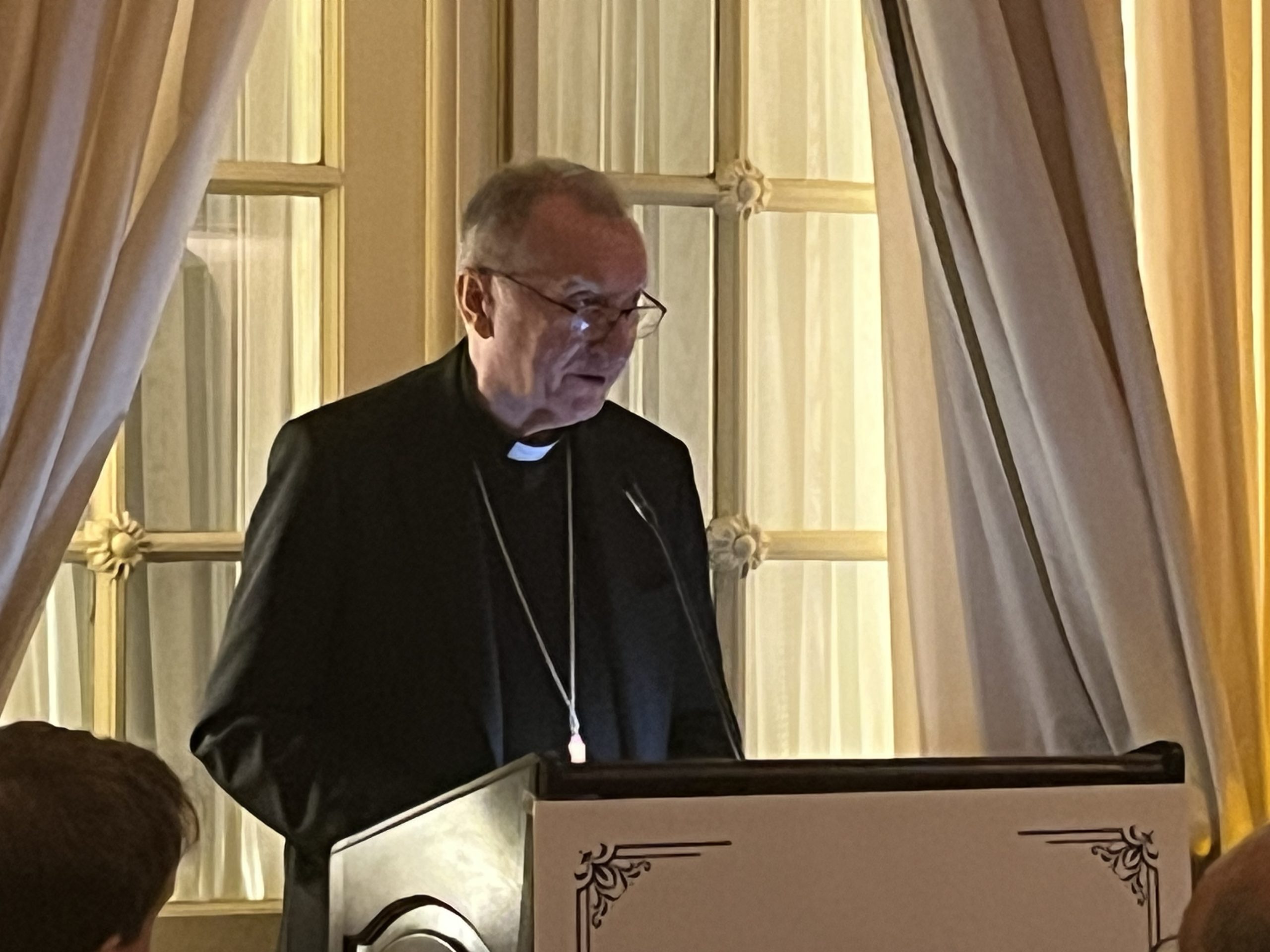

“In a world connected online and disconnected offline, be people of presence,” Cardinal Pietro Parolin said. “In a world asking whether we can remain human, answer with the witness of your lives.”
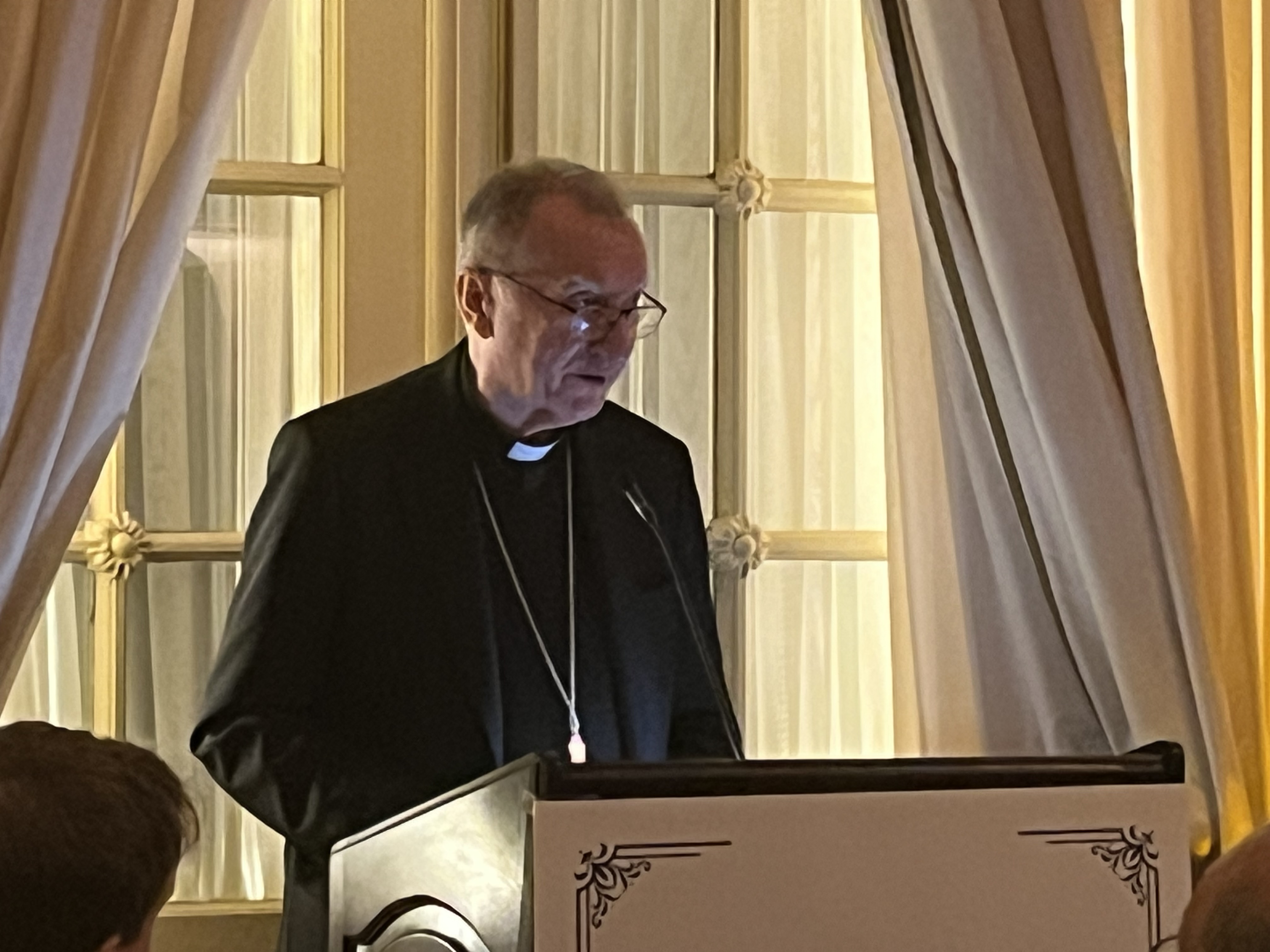
“In a world connected online and disconnected offline, be people of presence,” Cardinal Pietro Parolin said. “In a world asking whether we can remain human, answer with the witness of your lives.”
![Apostolic nuncio calls for ‘moral voice’ in AI development #Catholic Archbishop Gabriele Giordano Caccia, apostolic nuncio to the United States, discussed the need for a “moral voice” in artificial intelligence (AI) development during a panel discussion hosted by Georgetown University on Sept. 9.The panel, titled “AI, Catholic Social Teaching, and Pope Leoʼs Invitation to Dialogue with the World,” examined Pope Leo XIV’s encyclical Magnifica Humanitas and its call for a shared human effort to develop technology that serves the common good rather than harms it.Speakers noted that the Holy Father’s encyclical stopped short of prescribing specific policy ideas for addressing the moral and ethical concerns, but the nuncio said “there is the perception that we need a moral voice” on the subject.“A moral voice is what?” he said. “Not everything which is possible to be done should be done. Not everything that technology offers should be taken. This is a moral choice.”Caccia stressed that decisions affecting human lives should not be handed over to AI, citing distinctions between AI algorithms and the human conscience, as the Holy Father discussed in Magnifica Humanitas.Leo drew a distinction between artificial intelligence and human intelligence in the encyclical, focusing on how each approaches moral questions. The pope wrote that he rejected ideas of “artificial moral agents” and the notion that a machine can “distinguish between right and wrong with greater consistency than a human being.”“Moral judgment cannot be reduced to calculation, for it involves conscience, personal responsibility and the recognition of the other as a person,” Leo wrote. “Therefore, it is not permissible to entrust lethal or otherwise irreversible decisions to artificial systems.”Caccia said during the panel discussion that, as a society, “we have to keep the value of the human relationship.”“The problem is that [if] life and death is decided by a machine, not by the human being, who is accountable?” he said. “So these are very important, important questions. But I am confident, as I said, that together we can face this situation and find a way.”The nuncio said he has similar concerns about the use of AI in other types of decision-making that impacts humans.“I hear very troubling accounts of algorithms that can block access to healthcare, employment, and security on the basis of data tainted by prejudice and injustice,” he said. “And Iʼve heard the silence of those who have no voice. When decisions are made, decisions [are] likely to generate new forms of exclusion and suffering.”Quoting the encyclical, Caccia affirmed the pope’s call that AI “needs to be disarmed.”
Archbishop Gabriele Caccia, the Holy See’s permanent observer to the United Nations in New York, speaks on Aug. 29, 2025, the International Day Against Nuclear Tests. | Credit: Holy See Mission to the United Nations
“The word is strong, I know, but deliberately chosen because this moment needs words capable of attracting attention, awakening consciences, and indicating paths forward for humanity,” he said. “This is more or less a framework in which we can go on with the conversation.”Speaking to EWTN News after the panel, Caccia said the pope’s call to address moral concerns of AI is not just a call to Church leadership but to every Catholic.“There is, of course, the voice of the bishops,” he said. “But there is also the voice of Catholic people who are in the business or are engineers who are in the economy, who are in the field. So itʼs not just for those who have pastoral responsibility, but for the bigger community.”Pope’s impact on AI discussionSeveral panelists discussed the importance of Magnifica Humanitas in providing a type of moral guidance on AI development that focuses on the common good of humanity.Jasmine Sun, a journalist who writes about AI and Silicon Valley, said she “was actually surprised by how much folks I knew in Silicon Valley, in the AI industry did pay attention to Magnifica Humanitas.”“It was a lot more engagement, I think, than I expected,” she said. “And once again, I think itʼs because there is this sense that the profit motive that has driven Silicon Valley, that continues to drive Silicon Valley, is not enough.”Molly Kinder, CEO of the Breakwater Initiative, said the Church provides “wisdom and moral leadership” and believes its broad focus on humanity is why people listened.“Iʼm struck that in the opening pages of the Bible, there is a discussion of Adam and Eve being put on Earth to till the land as our fundamental reason for existing,” she said. “And it feels to me sometimes when Iʼm in Silicon Valley … they almost talk about almost a new Garden of Eden that AI is going to bring about, that maybe our purpose is not to work, or maybe itʼs leisure or a check and a hobby.”Caccia too said he was “positively surprised” by the reaction to the encyclical, saying “it seems that there was a need to do something about this.”“It didnʼt pretend to have the answers,” he said, “but he put questions, common questions that we have to tackle together to decide where we want to go.”](https://unitedyam.com/wp-content/uploads/2026/09/apostolic-nuncio-calls-for-moral-voice-in-ai-development-catholic-archbishop-gabriele-giordano-caccia-apostolic-nuncio-to-the-united-states-discussed-the-need-for-a-moral.jpg "Apostolic nuncio calls for ‘moral voice’ in AI development #Catholic Archbishop Gabriele Giordano Caccia, apostolic nuncio to the United States, discussed the need for a “moral voice” in artificial intelligence (AI) development during a panel discussion hosted by Georgetown University on Sept. 9.The panel, titled “AI, Catholic Social Teaching, and Pope Leoʼs Invitation to Dialogue with the World,” examined Pope Leo XIV’s encyclical Magnifica Humanitas and its call for a shared human effort to develop technology that serves the common good rather than harms it.Speakers noted that the Holy Father’s encyclical stopped short of prescribing specific policy ideas for addressing the moral and ethical concerns, but the nuncio said “there is the perception that we need a moral voice” on the subject.“A moral voice is what?” he said. “Not everything which is possible to be done should be done. Not everything that technology offers should be taken. This is a moral choice.”Caccia stressed that decisions affecting human lives should not be handed over to AI, citing distinctions between AI algorithms and the human conscience, as the Holy Father discussed in Magnifica Humanitas.Leo drew a distinction between artificial intelligence and human intelligence in the encyclical, focusing on how each approaches moral questions. The pope wrote that he rejected ideas of “artificial moral agents” and the notion that a machine can “distinguish between right and wrong with greater consistency than a human being.”“Moral judgment cannot be reduced to calculation, for it involves conscience, personal responsibility and the recognition of the other as a person,” Leo wrote. “Therefore, it is not permissible to entrust lethal or otherwise irreversible decisions to artificial systems.”Caccia said during the panel discussion that, as a society, “we have to keep the value of the human relationship.”“The problem is that [if] life and death is decided by a machine, not by the human being, who is accountable?” he said. “So these are very important, important questions. But I am confident, as I said, that together we can face this situation and find a way.”The nuncio said he has similar concerns about the use of AI in other types of decision-making that impacts humans.“I hear very troubling accounts of algorithms that can block access to healthcare, employment, and security on the basis of data tainted by prejudice and injustice,” he said. “And Iʼve heard the silence of those who have no voice. When decisions are made, decisions [are] likely to generate new forms of exclusion and suffering.”Quoting the encyclical, Caccia affirmed the pope’s call that AI “needs to be disarmed.”
Archbishop Gabriele Caccia, the Holy See’s permanent observer to the United Nations in New York, speaks on Aug. 29, 2025, the International Day Against Nuclear Tests. | Credit: Holy See Mission to the United Nations
“The word is strong, I know, but deliberately chosen because this moment needs words capable of attracting attention, awakening consciences, and indicating paths forward for humanity,” he said. “This is more or less a framework in which we can go on with the conversation.”Speaking to EWTN News after the panel, Caccia said the pope’s call to address moral concerns of AI is not just a call to Church leadership but to every Catholic.“There is, of course, the voice of the bishops,” he said. “But there is also the voice of Catholic people who are in the business or are engineers who are in the economy, who are in the field. So itʼs not just for those who have pastoral responsibility, but for the bigger community.”Pope’s impact on AI discussionSeveral panelists discussed the importance of Magnifica Humanitas in providing a type of moral guidance on AI development that focuses on the common good of humanity.Jasmine Sun, a journalist who writes about AI and Silicon Valley, said she “was actually surprised by how much folks I knew in Silicon Valley, in the AI industry did pay attention to Magnifica Humanitas.”“It was a lot more engagement, I think, than I expected,” she said. “And once again, I think itʼs because there is this sense that the profit motive that has driven Silicon Valley, that continues to drive Silicon Valley, is not enough.”Molly Kinder, CEO of the Breakwater Initiative, said the Church provides “wisdom and moral leadership” and believes its broad focus on humanity is why people listened.“Iʼm struck that in the opening pages of the Bible, there is a discussion of Adam and Eve being put on Earth to till the land as our fundamental reason for existing,” she said. “And it feels to me sometimes when Iʼm in Silicon Valley … they almost talk about almost a new Garden of Eden that AI is going to bring about, that maybe our purpose is not to work, or maybe itʼs leisure or a check and a hobby.”Caccia too said he was “positively surprised” by the reaction to the encyclical, saying “it seems that there was a need to do something about this.”“It didnʼt pretend to have the answers,” he said, “but he put questions, common questions that we have to tackle together to decide where we want to go.”")
Speakers at a Georgetown University event said Magnifica Humanitas offers moral guidance without policy steps, and the nuncio noted rising concern that debates over AI need a moral voice.

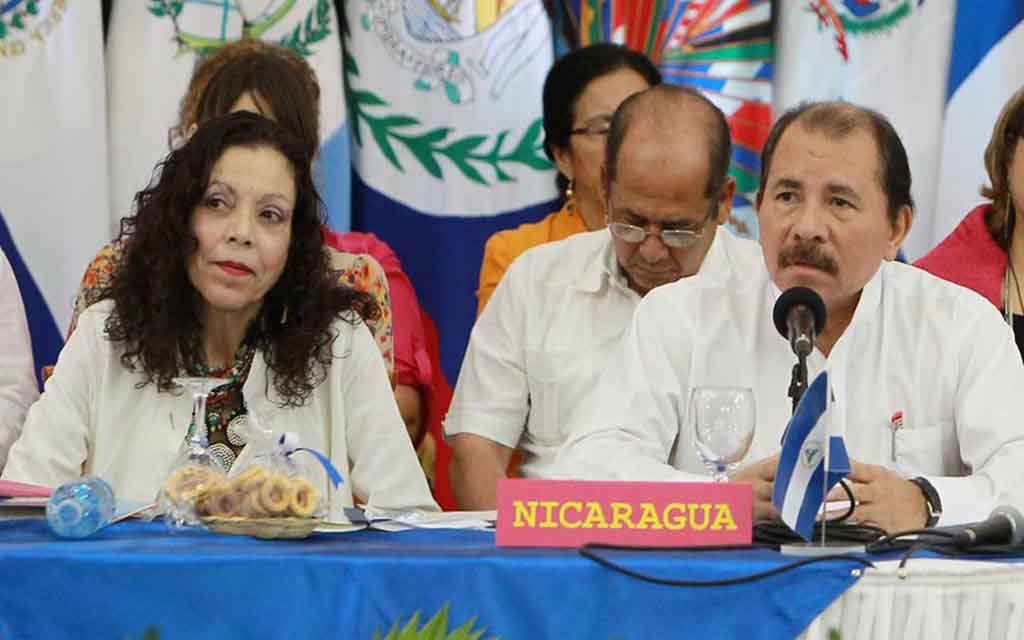
![Human rights group calls Nicaragua’s constitutional reforms a ‘usurpation of power’ #Catholic Nicaragua’s National Assembly, controlled by the dictatorship of President Daniel Ortega and his wife and co-president, Rosario Murillo, “unanimously” approved a constitutional reform barring “traitors to the homeland” (the term the regime uses for its political opposition) from participating in elections. The measure has sparked widespread domestic and international condemnation.The reform was “unanimously approved in general terms,” Assembly President Gustavo Porras stated on Sept. 1 during a special session held in the city of León, according to the Nicaraguan newspaper La Prensa.The reform amends the constitution, which extends the presidential term, as well as those of other high-ranking officials, from six to seven years, with the possibility of renewal.Ortega has governed Nicaragua for about 30 years: since 2007, and previously, from 1979 to 1990. On July 19, he stated that there would be no further elections in Nicaragua, and on July 31, he proposed the reform — set to take effect in 2027 — that excludes “coup plotters” and “terrorists,”, terms he uses to refer to the political opposition, from participating in elections.Reforms are a ‘formalization of the usurpation of power’Ruta del Cambio (Pathway for Change), an organization which defends human rights and the rule of law, declared in a Sept. 2 statement that it “categorically rejects and and gives no legal recognition to the partial reform to the Political Constitution [of the Republic of Nicaragua] approved during the first legislative session on Sept. 1, 2026, by a National Assembly stripped of all independence and reduced to a mere rubber stamp for the will of Daniel Ortega and Rosario Murillo.”Ruta del Cambio counts among its leaders Félix Maradiaga, a former presidential candidate and former political prisoner now living in exile.“What has been approved is not a constitutional reform. It is the formalization of the usurpation of power through a text drafted in secret, approved without opposition, and voted for with unanimous obedience by those who owe their positions, privileges, and impunity to the couple that has hijacked the state,” Ruta del Cambio charged.“Daniel Ortega and Rosario Murillo have turned the constitution into a family’s title deed. They have transformed the state into personal property, the law into an instrument of vengeance, and the republic’s [law enforcement apparatus] into tools of terror against the very people they swore to serve,” the organization emphasized.Ruta del Cambio called for “rejecting the legal validity of this reform and of any act, mandate, extension, or appointment derived from it, and formally declaring it without force under international law.”Elections ‘without legitimacy’“What we are seeing in Nicaragua right now is a reform attempting to hold elections without competition, without legitimacy, and without any possibility of change. In other words, Ortega controls the judges and the playing field, and seeks to firmly establish his authoritarian model without any competition,” stated Arturo Mcfields Yescas, Nicaragua’s former ambassador to the Organization of American States (OAS), in a Sept. 3 interview with EWTN Noticias, the Spanish-language edition of EWTN News.“This further undermines not only civil and political freedoms but also another fundamental freedom: religious freedom,” he pointed out.McFields explained that when the regime speaks of “traitors to the homeland,” it is referring to those who dissent from its rule. “People who questioned Ortega’s authority immediately became traitors to the homeland,” as did those who “simply thought differently” or called for “international mediation.”“This means,” he charged, “that anyone who does not applaud Ortega becomes a traitor to the homeland.”U.S. reactionOn Wednesday, U.S. Secretary of State Marco Rubio stated on X that “the Murillo-Ortega’s National Assembly gutted what remained of Nicaragua’s democracy in the second constitutional rewrite in two years. The U.S. will implement measures at the next @OAS_official [meeting of foreign ministers] to ensure that our hemisphere stops business as usual with this dictatorship.”Regarding the United States’ call for countries to sever diplomatic and commercial ties with Nicaragua, McFields called it “an extraordinary start.” “For the first time, Ortega is facing pressure of this nature. For the first time, the OAS has approved a resolution on Nicaragua almost unanimously,” by convening a meeting of foreign ministers to address the situation, McFields said.Likewise, neighboring Costa Rica expressed its “deep concern regarding the ongoing deterioration of democracy in Nicaragua, exacerbated by the recent constitutional reform that further limits political and electoral participation,” and stated that it “will support a firm and coordinated response” with the OAS.The government of Peru, led by President Keiko Fujimori, also rejected the approval of the constitutional reform. In a Sept. 2 statement, it declared that it “will stand with the Nicaraguan people, their political prisoners, their exiles, and all those who are currently persecuted for dreaming of free elections.”Persecution of the Catholic Church in NicaraguaMcFields questioned the stance of countries like Brazil and Mexico, which did not support the resolution against Nicaragua, stating that “it’s surprising, painful, and something that ought to change. There should be empathy for the suffering of the Nicaraguan people, for persecuted politicians, for priests who have been imprisoned, exiled, or banished, and for the churches that have, at times, been burned down. It is truly grotesque, yet ideology seems to be prevailing over democracy.”Since 2018, the Ortega-Murillo dictatorship has waged a fierce campaign of persecution against the Catholic Church in Nicaragua. Its latest known victim is the bishop emeritus of Estelí, Abelardo Mata (80), who suffers from diabetes, a heart condition, and vision problems. His condition remains uncertain, despite the regime’s claim that he is at home. In mid-August, the regime released a video of an interview with the prelate, who recently celebrated his 50th anniversary as a priest, without specifying when the footage was recorded.This story was first published by ACI Prensa, the Spanish-language sister service of EWTN News. It has been translated and adapted by EWTN News English.](https://unitedyam.com/wp-content/uploads/2026/09/human-rights-group-calls-nicaraguas-constitutional-reforms-a-usurpation-of-power-catholic-nicaraguas-national-assembly-controlled-by-the-dictatorship-of-president.jpg "Human rights group calls Nicaragua’s constitutional reforms a ‘usurpation of power’ #Catholic Nicaragua’s National Assembly, controlled by the dictatorship of President Daniel Ortega and his wife and co-president, Rosario Murillo, “unanimously” approved a constitutional reform barring “traitors to the homeland” (the term the regime uses for its political opposition) from participating in elections. The measure has sparked widespread domestic and international condemnation.The reform was “unanimously approved in general terms,” Assembly President Gustavo Porras stated on Sept. 1 during a special session held in the city of León, according to the Nicaraguan newspaper La Prensa.The reform amends the constitution, which extends the presidential term, as well as those of other high-ranking officials, from six to seven years, with the possibility of renewal.Ortega has governed Nicaragua for about 30 years: since 2007, and previously, from 1979 to 1990. On July 19, he stated that there would be no further elections in Nicaragua, and on July 31, he proposed the reform — set to take effect in 2027 — that excludes “coup plotters” and “terrorists,”, terms he uses to refer to the political opposition, from participating in elections.Reforms are a ‘formalization of the usurpation of power’Ruta del Cambio (Pathway for Change), an organization which defends human rights and the rule of law, declared in a Sept. 2 statement that it “categorically rejects and and gives no legal recognition to the partial reform to the Political Constitution [of the Republic of Nicaragua] approved during the first legislative session on Sept. 1, 2026, by a National Assembly stripped of all independence and reduced to a mere rubber stamp for the will of Daniel Ortega and Rosario Murillo.”Ruta del Cambio counts among its leaders Félix Maradiaga, a former presidential candidate and former political prisoner now living in exile.“What has been approved is not a constitutional reform. It is the formalization of the usurpation of power through a text drafted in secret, approved without opposition, and voted for with unanimous obedience by those who owe their positions, privileges, and impunity to the couple that has hijacked the state,” Ruta del Cambio charged.“Daniel Ortega and Rosario Murillo have turned the constitution into a family’s title deed. They have transformed the state into personal property, the law into an instrument of vengeance, and the republic’s [law enforcement apparatus] into tools of terror against the very people they swore to serve,” the organization emphasized.Ruta del Cambio called for “rejecting the legal validity of this reform and of any act, mandate, extension, or appointment derived from it, and formally declaring it without force under international law.”Elections ‘without legitimacy’“What we are seeing in Nicaragua right now is a reform attempting to hold elections without competition, without legitimacy, and without any possibility of change. In other words, Ortega controls the judges and the playing field, and seeks to firmly establish his authoritarian model without any competition,” stated Arturo Mcfields Yescas, Nicaragua’s former ambassador to the Organization of American States (OAS), in a Sept. 3 interview with EWTN Noticias, the Spanish-language edition of EWTN News.“This further undermines not only civil and political freedoms but also another fundamental freedom: religious freedom,” he pointed out.McFields explained that when the regime speaks of “traitors to the homeland,” it is referring to those who dissent from its rule. “People who questioned Ortega’s authority immediately became traitors to the homeland,” as did those who “simply thought differently” or called for “international mediation.”“This means,” he charged, “that anyone who does not applaud Ortega becomes a traitor to the homeland.”U.S. reactionOn Wednesday, U.S. Secretary of State Marco Rubio stated on X that “the Murillo-Ortega’s National Assembly gutted what remained of Nicaragua’s democracy in the second constitutional rewrite in two years. The U.S. will implement measures at the next @OAS_official [meeting of foreign ministers] to ensure that our hemisphere stops business as usual with this dictatorship.”Regarding the United States’ call for countries to sever diplomatic and commercial ties with Nicaragua, McFields called it “an extraordinary start.” “For the first time, Ortega is facing pressure of this nature. For the first time, the OAS has approved a resolution on Nicaragua almost unanimously,” by convening a meeting of foreign ministers to address the situation, McFields said.Likewise, neighboring Costa Rica expressed its “deep concern regarding the ongoing deterioration of democracy in Nicaragua, exacerbated by the recent constitutional reform that further limits political and electoral participation,” and stated that it “will support a firm and coordinated response” with the OAS.The government of Peru, led by President Keiko Fujimori, also rejected the approval of the constitutional reform. In a Sept. 2 statement, it declared that it “will stand with the Nicaraguan people, their political prisoners, their exiles, and all those who are currently persecuted for dreaming of free elections.”Persecution of the Catholic Church in NicaraguaMcFields questioned the stance of countries like Brazil and Mexico, which did not support the resolution against Nicaragua, stating that “it’s surprising, painful, and something that ought to change. There should be empathy for the suffering of the Nicaraguan people, for persecuted politicians, for priests who have been imprisoned, exiled, or banished, and for the churches that have, at times, been burned down. It is truly grotesque, yet ideology seems to be prevailing over democracy.”Since 2018, the Ortega-Murillo dictatorship has waged a fierce campaign of persecution against the Catholic Church in Nicaragua. Its latest known victim is the bishop emeritus of Estelí, Abelardo Mata (80), who suffers from diabetes, a heart condition, and vision problems. His condition remains uncertain, despite the regime’s claim that he is at home. In mid-August, the regime released a video of an interview with the prelate, who recently celebrated his 50th anniversary as a priest, without specifying when the footage was recorded.This story was first published by ACI Prensa, the Spanish-language sister service of EWTN News. It has been translated and adapted by EWTN News English.")
The Ortega-Murilla regime has approved reforms that bar the opposition from participating in elections, drawing strong opposition from exiled leaders, the United States, Costa Rica and Peru.