Curia

Pope Leo unveils his encyclical: AI has ‘even greater consequences’ than Industrial Revolution #Catholic VATICAN CITY — Pope Leo XIV on Monday personally attended the presentation of his first encyclical, Magnifica Humanitas, in an uncustomary gesture. Upon his arrival at the event, held in the Vaticanʼs Synod Hall, he was greeted with sustained applause from an audience made up of members of the Roman Curia, representatives of academia, and the diplomatic corps.Among the speakers was Canadian Christopher Olah, co-founder of Anthropic, one of the leading artificial intelligence (AI) companies. The firm has recently had tensions with the administration of U.S. President Donald Trump after prohibiting the U.S. Department of Defense from using its software for military purposes.Some observers had raised concerns about including a representative of a major tech company like Anthropic in an event of this kind. The Holy Father himself dispelled any hesitation by thanking Olah for his presence: “What a great sign of hope it is that with our differences we can listen to one another,” he said in his remarks.“This interchange clearly bespeaks the gravity of the moment, as well as confidence that together we can discern the major questions of our time, and so the future of humanity,” he added.In his remarks prior to the pope’s address, Olah echoed the same idea: "That is why, if we want this technology to go well, it is enormously important that there be people outside those incentives — people who care about things going well and insist on safety, who are paying close attention, who are willing to say hard things, who are willing to be our earnest, thoughtful, critics. It is through dialogue and mutual effort, through the push and pull, that humanity will achieve great things. That is what I see in Magnifica Humanitas, and it is why I am grateful to His Holiness and the Church for taking up this work of discernment.”
 
 Christopher Olah, co-founder of AI company Anthropic, says he is grateful to Pope Leo XIV and the Church for “taking up this work of discernment” on artificial intelligence, during his address at the presentation of the encyclical Magnifica Humanitas on May 25, 2026, in the Synod Hall of the Vatican. | Credit: Daniel Ibáñez/EWTN News/Vatican Pool
 
 Olah, who is not a believer, also issued a call to various sectors — religious communities, civil society, academics, and governments — to follow the pope’s example with this document: “to take this seriously, to look closely, and to push events in a better direction. We need informed critics who will tell the labs when we are failing. We need moral voices that the incentives cannot bend.”It is no coincidence that Leo XIV signed his first encyclical on May 15, the same date on which his predecessor Leo XIII promulgated Rerum Novarum (“On New Things”) in 1891 in response to the dehumanization brought about by the Industrial Revolution. As the pope explained, the world today faces a transformation of perhaps even greater scope.“Today we find ourselves facing a transformation of similar magnitude, with perhaps even greater consequences. Artificial intelligence already touches many areas of our lives and affects decisions that shape human coexistence,” he said.The pope expressed particular concern about the impact of new technologies on the conduct of war, which, he warned, is changing dramatically.“Like the earlier Leo, I feel entrusted to look upon another huge transformation with eyes of faith, with lucidity of reason, with openness to mystery, and with cries of the poor and the earth resounding in my heart,” he said.The Holy Father also described the method behind the drafting of this magisterial document, which began in July 2025 at the papal residence in Castel Gandolfo. In it, he seeks to reaffirm what makes us human in a society shaped by technology.He emphasized that Magnifica Humanitas was born from listening: “I have listened to scientists and engineers who work with sincere enthusiasm on technologies capable of alleviating immense suffering, to political leaders and public officials who have perseveringly sought just rules, to parents and teachers who are deeply concerned for the future of younger generations,” he said, without naming individuals.At the same time, he acknowledged hearing “Other very troubling voices have also reached me about increasingly autonomous weapons systems practically beyond any human reach to govern them effectively.”“I hear very troubling accounts of algorithms that can block access to healthcare, employment, and security on the basis of data tainted by prejudice and injustice. And Iʼve heard the silence of those who have no voice when decisions are made — decisions likely to generate new forms of exclusion and suffering,” he lamented.In line with the document — which states that artificial intelligence is not morally neutral — the pope called for AI to be “disarmed.”“The word is strong, I know, but deliberately chosen because this moment needs words capable of attracting attention, awakening consciences, and indicating paths forward for humanity,” he warned.“The Church has long been working for nuclear disarmament, aware that every great technical power can affect peopleʼs lives, and so must be accompanied by adequate moral discernment and public control. Nuclear disarmament remains a service to peace and the dignity of the human family,” he added.Also speaking at the presentation were three cardinals of the Roman Curia: Secretary of State Pietro Parolin; Cardinal Víctor Manuel Fernández, prefect of the Dicastery for the Doctrine of the Faith; and Cardinal Michael Czerny, SJ, prefect of the Dicastery for Promoting Integral Human Development.Two theologians also took the floor: Anna Rowlands, a specialist in Catholic social teaching and migration ethics at Durham University, and Leocadie Lushombo, an expert in political theology and Catholic social thought at the Jesuit School of Theology of Santa Clara University in California.This story was originally published by ACI Prensa, EWTN News' Spanish-language news service. It has been translated and adapted by EWTN News English.

Pope Leo unveils his encyclical: AI has ‘even greater consequences’ than Industrial Revolution #Catholic VATICAN CITY — Pope Leo XIV on Monday personally attended the presentation of his first encyclical, Magnifica Humanitas, in an uncustomary gesture. Upon his arrival at the event, held in the Vaticanʼs Synod Hall, he was greeted with sustained applause from an audience made up of members of the Roman Curia, representatives of academia, and the diplomatic corps.Among the speakers was Canadian Christopher Olah, co-founder of Anthropic, one of the leading artificial intelligence (AI) companies. The firm has recently had tensions with the administration of U.S. President Donald Trump after prohibiting the U.S. Department of Defense from using its software for military purposes.Some observers had raised concerns about including a representative of a major tech company like Anthropic in an event of this kind. The Holy Father himself dispelled any hesitation by thanking Olah for his presence: “What a great sign of hope it is that with our differences we can listen to one another,” he said in his remarks.“This interchange clearly bespeaks the gravity of the moment, as well as confidence that together we can discern the major questions of our time, and so the future of humanity,” he added.In his remarks prior to the pope’s address, Olah echoed the same idea: "That is why, if we want this technology to go well, it is enormously important that there be people outside those incentives — people who care about things going well and insist on safety, who are paying close attention, who are willing to say hard things, who are willing to be our earnest, thoughtful, critics. It is through dialogue and mutual effort, through the push and pull, that humanity will achieve great things. That is what I see in Magnifica Humanitas, and it is why I am grateful to His Holiness and the Church for taking up this work of discernment.” Christopher Olah, co-founder of AI company Anthropic, says he is grateful to Pope Leo XIV and the Church for “taking up this work of discernment” on artificial intelligence, during his address at the presentation of the encyclical Magnifica Humanitas on May 25, 2026, in the Synod Hall of the Vatican. | Credit: Daniel Ibáñez/EWTN News/Vatican Pool Olah, who is not a believer, also issued a call to various sectors — religious communities, civil society, academics, and governments — to follow the pope’s example with this document: “to take this seriously, to look closely, and to push events in a better direction. We need informed critics who will tell the labs when we are failing. We need moral voices that the incentives cannot bend.”It is no coincidence that Leo XIV signed his first encyclical on May 15, the same date on which his predecessor Leo XIII promulgated Rerum Novarum (“On New Things”) in 1891 in response to the dehumanization brought about by the Industrial Revolution. As the pope explained, the world today faces a transformation of perhaps even greater scope.“Today we find ourselves facing a transformation of similar magnitude, with perhaps even greater consequences. Artificial intelligence already touches many areas of our lives and affects decisions that shape human coexistence,” he said.The pope expressed particular concern about the impact of new technologies on the conduct of war, which, he warned, is changing dramatically.“Like the earlier Leo, I feel entrusted to look upon another huge transformation with eyes of faith, with lucidity of reason, with openness to mystery, and with cries of the poor and the earth resounding in my heart,” he said.The Holy Father also described the method behind the drafting of this magisterial document, which began in July 2025 at the papal residence in Castel Gandolfo. In it, he seeks to reaffirm what makes us human in a society shaped by technology.He emphasized that Magnifica Humanitas was born from listening: “I have listened to scientists and engineers who work with sincere enthusiasm on technologies capable of alleviating immense suffering, to political leaders and public officials who have perseveringly sought just rules, to parents and teachers who are deeply concerned for the future of younger generations,” he said, without naming individuals.At the same time, he acknowledged hearing “Other very troubling voices have also reached me about increasingly autonomous weapons systems practically beyond any human reach to govern them effectively.”“I hear very troubling accounts of algorithms that can block access to healthcare, employment, and security on the basis of data tainted by prejudice and injustice. And Iʼve heard the silence of those who have no voice when decisions are made — decisions likely to generate new forms of exclusion and suffering,” he lamented.In line with the document — which states that artificial intelligence is not morally neutral — the pope called for AI to be “disarmed.”“The word is strong, I know, but deliberately chosen because this moment needs words capable of attracting attention, awakening consciences, and indicating paths forward for humanity,” he warned.“The Church has long been working for nuclear disarmament, aware that every great technical power can affect peopleʼs lives, and so must be accompanied by adequate moral discernment and public control. Nuclear disarmament remains a service to peace and the dignity of the human family,” he added.Also speaking at the presentation were three cardinals of the Roman Curia: Secretary of State Pietro Parolin; Cardinal Víctor Manuel Fernández, prefect of the Dicastery for the Doctrine of the Faith; and Cardinal Michael Czerny, SJ, prefect of the Dicastery for Promoting Integral Human Development.Two theologians also took the floor: Anna Rowlands, a specialist in Catholic social teaching and migration ethics at Durham University, and Leocadie Lushombo, an expert in political theology and Catholic social thought at the Jesuit School of Theology of Santa Clara University in California.This story was originally published by ACI Prensa, EWTN News' Spanish-language news service. It has been translated and adapted by EWTN News English.

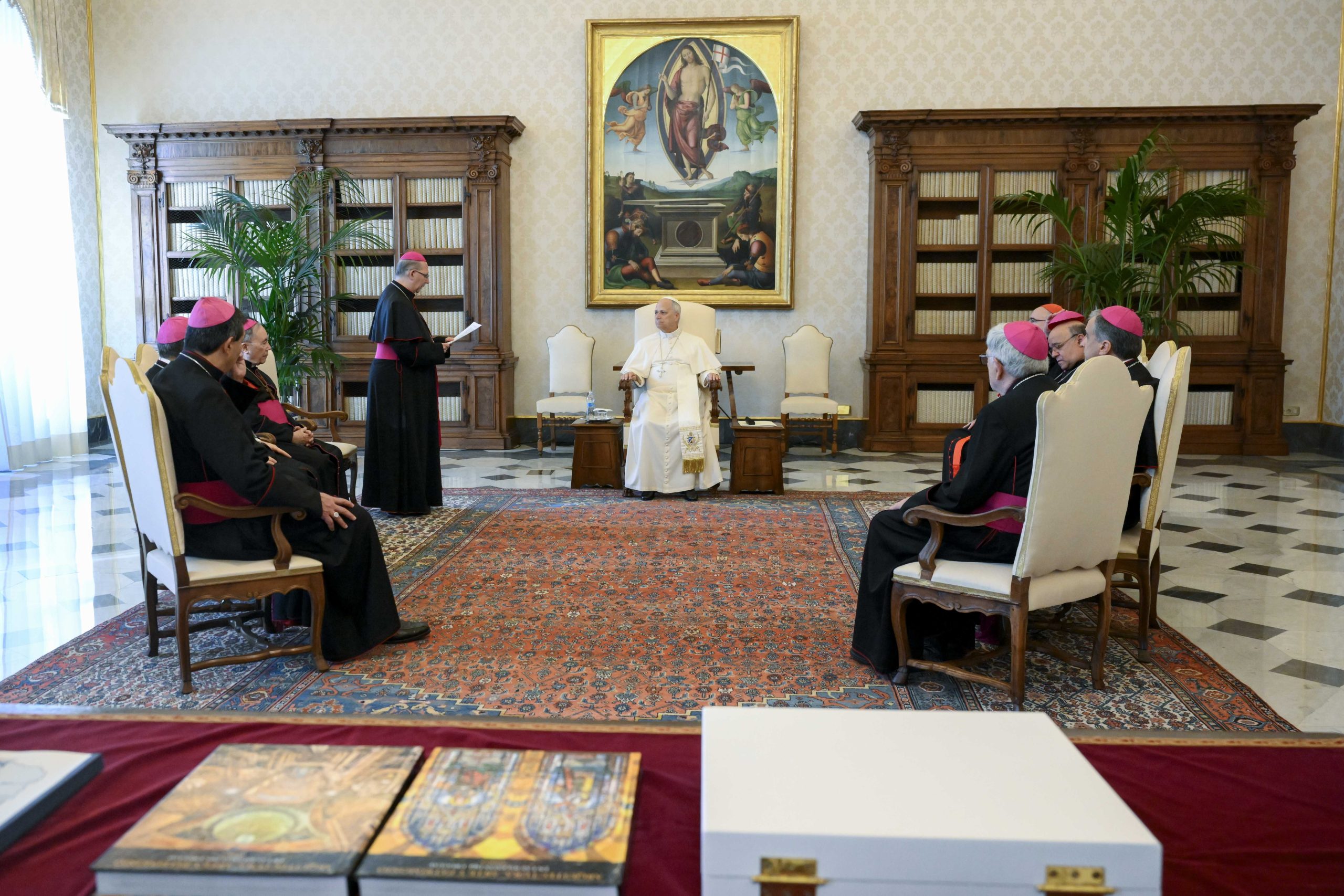
The pope thanked Anthropic co-founder Christopher Olah for his presence at the presentation: “What a great sign of hope it is that with our differences we can listen to one another.”

Read More
Fidelity, enthusiasm, and faith: Pope Leo XIV welcomes Swiss Guard recruits #Catholic Recruits of the Pontifical Swiss Guard took their oath of allegiance to Pope Leo XIV, solemnly pledging to serve and protect him.The ceremony took place May 6 in the Paul VI Audience Hall at the Vatican in the presence of the pontiff, members of the Holy See Diplomatic Corps, and the family and friends of the 28 recruits.At the high point of the ceremony, in a gesture laden with tradition, each recruit held the banner of the Pontifical Swiss Guard with his left hand, raised three fingers with his right, and recited the oath swearing to protect the pope, even at the cost of his life. 
 
 Each recruit holds the banner of the Pontifical Swiss Guard with his left hand, raises three fingers with his right, and recites the oath swearing to protect the pope, even at the cost of his life, on May 6, 2026. | Credit: Vatican Media
 
 This gesture, more than just an oath of allegiance, also commemorates the 147 Swiss Guards who died defending Pope Clement VII during the Sack of Rome on May 6, 1527.In his address after the ceremony, Leo thanked the recruits, describing their future service as a “commitment of fidelity, inspired by youthful enthusiasm and grounded in faith in God and love for the Church.”On Thursday, the pope held a private audience with the new Swiss Guards and their families. Leo took this occasion to remind them of the beauty of their calling and described them as servants of Christ, called not only to serve the Holy See but also those most in need.
 
 Pope Leo XIV welcomes the Swiss Guard in a ceremony for recruits on May 6, 2026. | Credit: Vatican Media
 
 “More than soldiers, you are servants who, in the image of Christ, go out to meet those who need your help: not only members of the Curia or officials visiting the Vatican but also pilgrims and tourists,” the pope said. “Always remember these words of Jesus: ‘Whatever you did for one of the least of these, my brothers, you did for me’ (Mt 25:40).”
 
 Pope Leo XIV welcomes the Swiss Guard in a ceremony for recruits on May 6, 2026. | Credit: Vatican Media

Fidelity, enthusiasm, and faith: Pope Leo XIV welcomes Swiss Guard recruits #Catholic Recruits of the Pontifical Swiss Guard took their oath of allegiance to Pope Leo XIV, solemnly pledging to serve and protect him.The ceremony took place May 6 in the Paul VI Audience Hall at the Vatican in the presence of the pontiff, members of the Holy See Diplomatic Corps, and the family and friends of the 28 recruits.At the high point of the ceremony, in a gesture laden with tradition, each recruit held the banner of the Pontifical Swiss Guard with his left hand, raised three fingers with his right, and recited the oath swearing to protect the pope, even at the cost of his life. Each recruit holds the banner of the Pontifical Swiss Guard with his left hand, raises three fingers with his right, and recites the oath swearing to protect the pope, even at the cost of his life, on May 6, 2026. | Credit: Vatican Media This gesture, more than just an oath of allegiance, also commemorates the 147 Swiss Guards who died defending Pope Clement VII during the Sack of Rome on May 6, 1527.In his address after the ceremony, Leo thanked the recruits, describing their future service as a “commitment of fidelity, inspired by youthful enthusiasm and grounded in faith in God and love for the Church.”On Thursday, the pope held a private audience with the new Swiss Guards and their families. Leo took this occasion to remind them of the beauty of their calling and described them as servants of Christ, called not only to serve the Holy See but also those most in need. Pope Leo XIV welcomes the Swiss Guard in a ceremony for recruits on May 6, 2026. | Credit: Vatican Media “More than soldiers, you are servants who, in the image of Christ, go out to meet those who need your help: not only members of the Curia or officials visiting the Vatican but also pilgrims and tourists,” the pope said. “Always remember these words of Jesus: ‘Whatever you did for one of the least of these, my brothers, you did for me’ (Mt 25:40).” Pope Leo XIV welcomes the Swiss Guard in a ceremony for recruits on May 6, 2026. | Credit: Vatican Media

Twenty-eight Swiss Guards were sworn in Wednesday at the Vatican.

Read More
Vatican prepares Pope Leo XIV summit on marriage crisis #Catholic Pope Leo XIV is aware that among the vocations to which men and women are called by God, marriage is one of the “noblest and highest.”He said as much last October, on the 10th anniversary of the canonization of Sts. Louis and Zélie Martin, the parents of St. Thérèse of the Child Jesus. Now, the pope has set in motion a process to address both marital crises and the growing fear among young people of getting married and forming a family.Leo XIV has called the presidents of the world’s bishops’ conferences to Rome this October to seek a response to an issue he considers crucial not only for the Church but also for society.In preparation for the high-level meeting, the Vatican organized a study day Tuesday titled “The Sacrament of Marriage, Faith, and Munus Docendi” at the Casina Pio IV.The initiative, hosted by the Dicastery for the Laity, the Family, and Life, brought together about 75 participants by invitation, including representatives of various dicasteries of the Roman Curia as well as rectors, lecturers, and others involved in the formation of future pastors.According to the dicastery, the study day was devoted to the formation of priests in accompanying “young people, engaged couples, and married couples in faith.”How can the Church form pastors capable of accompanying young people, engaged couples, and spouses so that they live Christian marriage as an authentic experience of faith in a cultural context marked by secularization? Several speakers addressed that question, including Father Andrea Bozzolo, rector of the Pontifical Salesian University.Speaking with ACI Prensa, the Spanish-language sister service of EWTN News, the Italian priest — who has taught theology of marriage at the Pontifical John Paul II Institute for Studies on Marriage and Family — emphasized the urgent need to form priests who are prepared to accompany young people and help them live Christian marriage as a true event of faith rather than as a mere “formality or social rite.”According to Bozzolo, in large sectors of contemporary society, marriage is no longer perceived as a decisive moment in the formation of a family.“For many couples, marriage today seems to be a less decisive step in the emergence of the family covenant,” he said.In that context, he added, cohabitation before marriage has become widespread as a kind of trial stage. For many young people, the strength of that relationship, tested in daily life, “has become the condition for eventually considering access to marriage,” he said.Bozzolo explained that this mentality fuels the now widespread phenomenon of couples living together before going to the altar.Unlike in past decades, when de facto unions were presented as an ideological alternative to marriage, today “they are often understood as a preparatory path,” he said.In what he described as a “liquid society,” cohabitation frequently functions as a first family experience, open to being consolidated over time into a more stable relationship.“Cohabitation in most cases does not seek to exclude the marriage covenant but rather to verify its viability,” he said, noting that the increase in separations also reflects this way of understanding the bond.Not blaming, but not trivializingIn response to this reality, Bozzolo said the Church should “not blame” young people who ask to marry after living together, but it also should not “trivialize” premarital cohabitation, because “it is not the correct way” to arrive at the altar.He also called on the Church to break with stereotypes that present love as if it were “a simple feeling.”“Love has ontological value — and not merely psychological value — and that is why marriage is a privileged vehicle for the biblical revelation of the face of God,” he said.Bozzolo insisted on the need for priestly formation that helps future priests rediscover the decisive value of marriage as a public and sacramental act.“The public and religious expression of consent,” he said, is no longer usually perceived today as something that substantially affects the stability of the bond — a reality he described as “a pastoral challenge of the first order.”Marriage is not a simple social procedureFor that reason, he said, it is essential for the Church to prepare priests who can accompany young people along a journey of faith that presents Christian marriage not as a “simple social procedure.”The goal, Bozzolo explained, is to help priests accompany married couples so that they learn to “recognize the presence and action of God in the concrete history of their bond.”Such accompaniment, he said, requires a “formative approach” capable of bringing together biblical wisdom, theological understanding, an awareness of contemporary cultural trends, and attentive listening to the real experiences of families.One current problem among couples, he said, is the tendency to absolutize the relationship and place expectations on the spousal bond that the other person cannot sustain alone.“We cannot place the entire responsibility for our happiness on our spouse, because he or she will disappoint us. For that, we have Jesus, the true messiah,” Bozzolo said.Only from a well-grounded faith, he emphasized, is it possible to live marriage in a healthy, realistic way that is open to gratuitousness, without making the other person the ultimate source of meaning.For that reason, and in direct relation to the formation of future priests, Bozzolo highlighted the need to create formation paths in seminaries that integrate these dimensions and prepare pastors for authentic marriage ministry, rooted in life and not reduced to theoretical frameworks.The last time a pope called together all the presidents of the world’s bishops’ conferences was in February 2019, when Pope Francis gathered them to address the wound of sexual abuse in the Church. That meeting marked a shift in the global perception of the problem and made it possible to outline a long-term strategy.This story was first published by ACI Prensa, the Spanish-language sister service of EWTN News. It has been translated and adapted by EWTN News English.

Vatican prepares Pope Leo XIV summit on marriage crisis #Catholic Pope Leo XIV is aware that among the vocations to which men and women are called by God, marriage is one of the “noblest and highest.”He said as much last October, on the 10th anniversary of the canonization of Sts. Louis and Zélie Martin, the parents of St. Thérèse of the Child Jesus. Now, the pope has set in motion a process to address both marital crises and the growing fear among young people of getting married and forming a family.Leo XIV has called the presidents of the world’s bishops’ conferences to Rome this October to seek a response to an issue he considers crucial not only for the Church but also for society.In preparation for the high-level meeting, the Vatican organized a study day Tuesday titled “The Sacrament of Marriage, Faith, and Munus Docendi” at the Casina Pio IV.The initiative, hosted by the Dicastery for the Laity, the Family, and Life, brought together about 75 participants by invitation, including representatives of various dicasteries of the Roman Curia as well as rectors, lecturers, and others involved in the formation of future pastors.According to the dicastery, the study day was devoted to the formation of priests in accompanying “young people, engaged couples, and married couples in faith.”How can the Church form pastors capable of accompanying young people, engaged couples, and spouses so that they live Christian marriage as an authentic experience of faith in a cultural context marked by secularization? Several speakers addressed that question, including Father Andrea Bozzolo, rector of the Pontifical Salesian University.Speaking with ACI Prensa, the Spanish-language sister service of EWTN News, the Italian priest — who has taught theology of marriage at the Pontifical John Paul II Institute for Studies on Marriage and Family — emphasized the urgent need to form priests who are prepared to accompany young people and help them live Christian marriage as a true event of faith rather than as a mere “formality or social rite.”According to Bozzolo, in large sectors of contemporary society, marriage is no longer perceived as a decisive moment in the formation of a family.“For many couples, marriage today seems to be a less decisive step in the emergence of the family covenant,” he said.In that context, he added, cohabitation before marriage has become widespread as a kind of trial stage. For many young people, the strength of that relationship, tested in daily life, “has become the condition for eventually considering access to marriage,” he said.Bozzolo explained that this mentality fuels the now widespread phenomenon of couples living together before going to the altar.Unlike in past decades, when de facto unions were presented as an ideological alternative to marriage, today “they are often understood as a preparatory path,” he said.In what he described as a “liquid society,” cohabitation frequently functions as a first family experience, open to being consolidated over time into a more stable relationship.“Cohabitation in most cases does not seek to exclude the marriage covenant but rather to verify its viability,” he said, noting that the increase in separations also reflects this way of understanding the bond.Not blaming, but not trivializingIn response to this reality, Bozzolo said the Church should “not blame” young people who ask to marry after living together, but it also should not “trivialize” premarital cohabitation, because “it is not the correct way” to arrive at the altar.He also called on the Church to break with stereotypes that present love as if it were “a simple feeling.”“Love has ontological value — and not merely psychological value — and that is why marriage is a privileged vehicle for the biblical revelation of the face of God,” he said.Bozzolo insisted on the need for priestly formation that helps future priests rediscover the decisive value of marriage as a public and sacramental act.“The public and religious expression of consent,” he said, is no longer usually perceived today as something that substantially affects the stability of the bond — a reality he described as “a pastoral challenge of the first order.”Marriage is not a simple social procedureFor that reason, he said, it is essential for the Church to prepare priests who can accompany young people along a journey of faith that presents Christian marriage not as a “simple social procedure.”The goal, Bozzolo explained, is to help priests accompany married couples so that they learn to “recognize the presence and action of God in the concrete history of their bond.”Such accompaniment, he said, requires a “formative approach” capable of bringing together biblical wisdom, theological understanding, an awareness of contemporary cultural trends, and attentive listening to the real experiences of families.One current problem among couples, he said, is the tendency to absolutize the relationship and place expectations on the spousal bond that the other person cannot sustain alone.“We cannot place the entire responsibility for our happiness on our spouse, because he or she will disappoint us. For that, we have Jesus, the true messiah,” Bozzolo said.Only from a well-grounded faith, he emphasized, is it possible to live marriage in a healthy, realistic way that is open to gratuitousness, without making the other person the ultimate source of meaning.For that reason, and in direct relation to the formation of future priests, Bozzolo highlighted the need to create formation paths in seminaries that integrate these dimensions and prepare pastors for authentic marriage ministry, rooted in life and not reduced to theoretical frameworks.The last time a pope called together all the presidents of the world’s bishops’ conferences was in February 2019, when Pope Francis gathered them to address the wound of sexual abuse in the Church. That meeting marked a shift in the global perception of the problem and made it possible to outline a long-term strategy.This story was first published by ACI Prensa, the Spanish-language sister service of EWTN News. It has been translated and adapted by EWTN News English.

The October meeting in Rome will bring together presidents of bishops’ conferences from around the world to seek a response to what the pope considers a crucial issue for the Church and society.

Read More