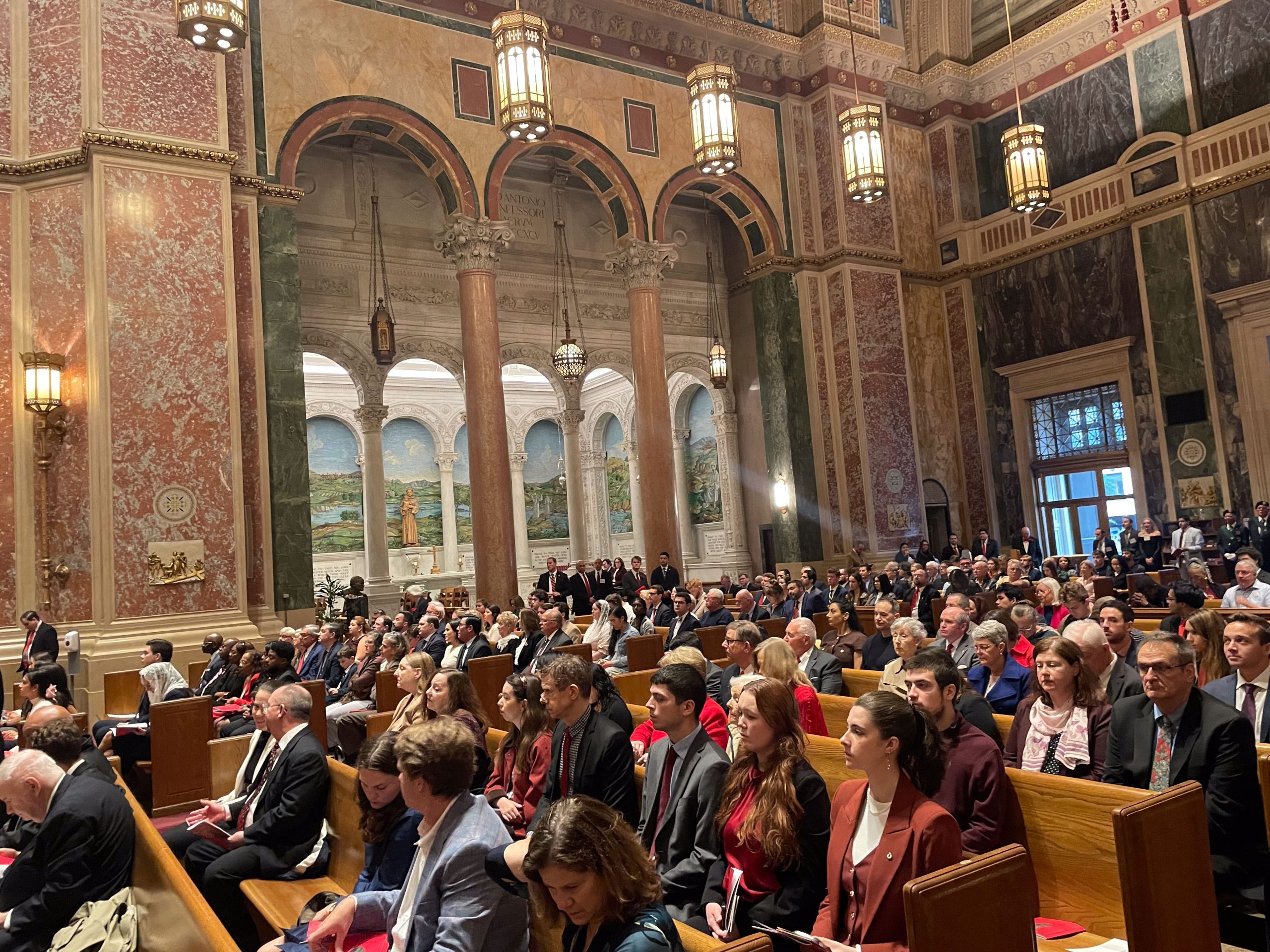
Holy Spirit

Pope Leo XIV urges Angola to ‘remove the obstacles to integral human development’ #Catholic LUANDA, Angola — Pope Leo XIV on April 18 called on Angola’s leaders and people to “remove the obstacles to integral human development,” urging them to choose the path of the common good, resist exploitative interests, and preserve the hope and joy that, he said, remain among Africa’s greatest treasures.The pope spoke at the presidential palace in Luanda during his meeting with authorities, civil society, and the diplomatic corps, the first public event of the Angola leg of his broader trip to Africa.Arriving in Luanda earlier in the day, Leo traveled by popemobile through jubilant crowds lining the route to the palace. He also held a private meeting with Angolan President João Lourenço before delivering his address.At the outset of his speech, the pope expressed solidarity with those affected by recent flooding in the country.“Before continuing, I would like to offer the assurance of my prayers for the victims of the heavy rains and floods that have struck the province of Benguela, and to express my closeness to the families who have lost their homes,” he said. “I also know that you, the people of Angola, are united in a great chain of solidarity with those affected.”His remarks came against the backdrop of mounting social strains in Angola, including protests last year over fuel price increases, repeated criticism by the country’s bishops over entrenched corruption, and deadly flooding in early April.Leo framed his address around themes that have marked earlier stops on his Africa trip, including peace, reconciliation, the common good, and criticism of those who exploit the continent for personal gain.Speaking in Portuguese, the pope praised the Angolan people for possessing “treasures that cannot be bought or taken away.”“In particular, there dwells within you a joy that not even the most adverse circumstances have been able to extinguish,” he said. This joy, he added, “is no stranger to sorrow, indignation, disappointment and defeat,” yet continues to be reborn in those who have resisted “the seductions of wealth.”The pope sharply criticized patterns of exploitation directed at Africa.“You know well that all too often people have looked — and continue to look — to your lands in order to give, or, more commonly, in order to take,” he said. “It is necessary to break this cycle of interests, which reduces reality, and even life itself, to mere commodities.”Leo described Africa’s joy and hope as “virtues that I would not hesitate to call ‘political,’” because “her young people and her poor continue to dream and to hope.” He said they “are not content with what already exists; they strive to rise above, to prepare themselves for great responsibilities, and to take an active part in shaping their own future.”He also emphasized that authentic social transformation cannot be imposed ideologically.“Indeed, the wisdom of a people cannot be stifled by any ideology, and the longing for the infinite that dwells in the human heart is a principle of social transformation far deeper than any political or cultural program,” he said.The pope said he had come to “listen to and encourage all those who have already chosen the paths of goodness, justice, peace, tolerance and reconciliation,” while also praying “for the conversion of those who choose contrary paths and hinder its harmonious and fraternal development.”Turning to Angola’s natural wealth, Leo warned against what he called a destructive extractive logic.“How much suffering, how many deaths, how many social and environmental disasters are brought about by this logic of extractivism!” he said. At every level, he added, it supports “a model of development that discriminates and excludes, while still presuming to impose itself as the only viable option.”He said Africa “urgently needs to overcome situations and dynamics of conflict and enmity that tear apart the social and political fabric of many countries, fostering poverty and exclusion.”Only encounter allows life to flourish, the pope said, and dialogue must come first, even when disagreements emerge.“Angola can experience great growth if, first of all, those who hold authority in the country believe in the manifold nature of its riches,” he said. “Do not be afraid of disagreement; do not suppress the ideas of the young or the dreams of the elderly; and know how to manage conflicts by transforming them into paths of renewal. Place the common good before every particular interest, never confusing your own part with the whole. History will then vindicate you, even if in the near term some may oppose you.”Leo then returned to the themes of joy and hope, describing them not as merely private sentiments but as forces with public and political consequences.“Despots and tyrants of both body and spirit seek to render souls passive and passions gloomy; they prefer a populace prone to inertia, docile and subservient to power,” he said.Sadness, he argued, leaves people vulnerable to fear, fanaticism, manipulation, and isolation from public life. By contrast, “true joy frees us from such alienation,” he said, calling joy “a gift of the Holy Spirit.”“Joy intensifies life and leads to the creation of community,” the pope said. “Joy knows how to carve paths even in the darkest zones of stagnation and hardship.”He concluded with an appeal for moral and social renewal.“Let us therefore examine our own hearts, dear friends, because without joy there is no renewal; without interiority there is no liberation; without encounter there is no politics; without the other there is no justice.”Leo said the Catholic Church wants to help Angola become “a project of hope” by fostering a just model of coexistence, especially in poor urban neighborhoods and remote rural areas.“Let us remove the obstacles to integral human development, working and hoping together alongside those whom the world has discarded but whom God has chosen,” he said.This story was first published by ACI Stampa, the Italian-language sister service of EWTN News. It has been translated and adapted by EWTN News English.

Pope Leo XIV urges Angola to ‘remove the obstacles to integral human development’ #Catholic LUANDA, Angola — Pope Leo XIV on April 18 called on Angola’s leaders and people to “remove the obstacles to integral human development,” urging them to choose the path of the common good, resist exploitative interests, and preserve the hope and joy that, he said, remain among Africa’s greatest treasures.The pope spoke at the presidential palace in Luanda during his meeting with authorities, civil society, and the diplomatic corps, the first public event of the Angola leg of his broader trip to Africa.Arriving in Luanda earlier in the day, Leo traveled by popemobile through jubilant crowds lining the route to the palace. He also held a private meeting with Angolan President João Lourenço before delivering his address.At the outset of his speech, the pope expressed solidarity with those affected by recent flooding in the country.“Before continuing, I would like to offer the assurance of my prayers for the victims of the heavy rains and floods that have struck the province of Benguela, and to express my closeness to the families who have lost their homes,” he said. “I also know that you, the people of Angola, are united in a great chain of solidarity with those affected.”His remarks came against the backdrop of mounting social strains in Angola, including protests last year over fuel price increases, repeated criticism by the country’s bishops over entrenched corruption, and deadly flooding in early April.Leo framed his address around themes that have marked earlier stops on his Africa trip, including peace, reconciliation, the common good, and criticism of those who exploit the continent for personal gain.Speaking in Portuguese, the pope praised the Angolan people for possessing “treasures that cannot be bought or taken away.”“In particular, there dwells within you a joy that not even the most adverse circumstances have been able to extinguish,” he said. This joy, he added, “is no stranger to sorrow, indignation, disappointment and defeat,” yet continues to be reborn in those who have resisted “the seductions of wealth.”The pope sharply criticized patterns of exploitation directed at Africa.“You know well that all too often people have looked — and continue to look — to your lands in order to give, or, more commonly, in order to take,” he said. “It is necessary to break this cycle of interests, which reduces reality, and even life itself, to mere commodities.”Leo described Africa’s joy and hope as “virtues that I would not hesitate to call ‘political,’” because “her young people and her poor continue to dream and to hope.” He said they “are not content with what already exists; they strive to rise above, to prepare themselves for great responsibilities, and to take an active part in shaping their own future.”He also emphasized that authentic social transformation cannot be imposed ideologically.“Indeed, the wisdom of a people cannot be stifled by any ideology, and the longing for the infinite that dwells in the human heart is a principle of social transformation far deeper than any political or cultural program,” he said.The pope said he had come to “listen to and encourage all those who have already chosen the paths of goodness, justice, peace, tolerance and reconciliation,” while also praying “for the conversion of those who choose contrary paths and hinder its harmonious and fraternal development.”Turning to Angola’s natural wealth, Leo warned against what he called a destructive extractive logic.“How much suffering, how many deaths, how many social and environmental disasters are brought about by this logic of extractivism!” he said. At every level, he added, it supports “a model of development that discriminates and excludes, while still presuming to impose itself as the only viable option.”He said Africa “urgently needs to overcome situations and dynamics of conflict and enmity that tear apart the social and political fabric of many countries, fostering poverty and exclusion.”Only encounter allows life to flourish, the pope said, and dialogue must come first, even when disagreements emerge.“Angola can experience great growth if, first of all, those who hold authority in the country believe in the manifold nature of its riches,” he said. “Do not be afraid of disagreement; do not suppress the ideas of the young or the dreams of the elderly; and know how to manage conflicts by transforming them into paths of renewal. Place the common good before every particular interest, never confusing your own part with the whole. History will then vindicate you, even if in the near term some may oppose you.”Leo then returned to the themes of joy and hope, describing them not as merely private sentiments but as forces with public and political consequences.“Despots and tyrants of both body and spirit seek to render souls passive and passions gloomy; they prefer a populace prone to inertia, docile and subservient to power,” he said.Sadness, he argued, leaves people vulnerable to fear, fanaticism, manipulation, and isolation from public life. By contrast, “true joy frees us from such alienation,” he said, calling joy “a gift of the Holy Spirit.”“Joy intensifies life and leads to the creation of community,” the pope said. “Joy knows how to carve paths even in the darkest zones of stagnation and hardship.”He concluded with an appeal for moral and social renewal.“Let us therefore examine our own hearts, dear friends, because without joy there is no renewal; without interiority there is no liberation; without encounter there is no politics; without the other there is no justice.”Leo said the Catholic Church wants to help Angola become “a project of hope” by fostering a just model of coexistence, especially in poor urban neighborhoods and remote rural areas.“Let us remove the obstacles to integral human development, working and hoping together alongside those whom the world has discarded but whom God has chosen,” he said.This story was first published by ACI Stampa, the Italian-language sister service of EWTN News. It has been translated and adapted by EWTN News English.

The pontiff urged the country to reject exploitative models of development and place the common good above particular interests.

Read More
French priest Henri Caffarel, founder of Teams of Our Lady, declared venerable by Pope Leo XIV #Catholic Father Henri Caffarel, a French priest whose apostolate centered on accompanying and guiding married couples on the path to holiness, is one step closer to being canonized.On March 23, Pope Leo XIV recognized the heroic virtues of the newly declared venerable, who maintained that couples are made for happiness and that marriage is a path toward it.With this deep conviction, and conscious of the challenges faced by couples, Caffarel, who was born in Lyon, France, in 1903, founded the movement for marital spirituality known as “Teams of Our Lady” in Paris in 1939.The beginning of a living legacySpaniards Alberto Pérez Bueno and Mercedes Gómez-Ferrer Lozano, the couple in charge of the Teams of Our Lady internationally, have been married for 35 years and have three children. In an interview with ACI Prensa, the Spanish-language sister service of EWTN News, they said the ministry started “with four couples who approached Father Caffarel to ask him how they could live out their faith as a couple.”“He didn’t have an answer at that moment, so he proposed that they embark on a journey of discovery together rooted in the sacrament of holy orders and the sacrament of matrimony. And that‘s how it all began,” Alberto explained.Following World War II, the movement, which is primarily lay-led, grew rapidly; today, it is present in 92 countries and is comprised of more than 15,000 teams.
 
 Father Henri Caffarel. | Credit: Photo courtesy of Alberto Pérez Bueno
 
 Marital communication and prayerMercedes emphasized that from the very beginning, Caffarel saw the need to foster the essentials of marital communication and prayer, convinced that by sharing their problems with one another, many couples could avoid estrangement that sometimes occurs in marriage.The priest, Alberto recalled, said that “the sacrament of matrimony is an image of God” and “probably the most perfect one there is.” The priest said married couples are called to holiness through a life of “work, personal growth, love, patience, and building a life together.”“It‘s not an overnight process but rather a journey undertaken over the course of a lifetime. Father Caffarel invited couples to embark on this path and to attain holiness through their work and their life together,” Alberto emphasized.Mercedes said the priest thought of marriage as a sign “that reflects the love of God” because the relationship of communion that exists between spouses is analogous to the relationship existing among the three Divine Persons: Christ, the Father, and the Holy Spirit.In the priest’s view, the image of marriage allowed for a clearer expression of the idea of ​​a God who is love “and who communicates and expands within his own nature.” From this perspective, “holiness ceases to be understood as a matter of individual effort or moral perfection and is situated instead within the dynamic of love that transforms and animates life,” Mercedes explained.A continuous path of spiritual growthThe organization of the Teams of Our Lady is based on a specific methodology “that goes beyond monthly meetings,” encompassing prayer, dialogue, and personal commitment. Each team consists of five or six married couples, fostering “listening to the word, personal prayer, prayer as a couple and family prayer, and a profound dialogue in the presence of the Lord that we also have every month,” Mercedes explained.Ultimately, it is a matter of “having a rule of life, a set of elements through which you strive to improve your Christian life,” she said. There is also a yearly retreat and a specific study theme each month.Alberto emphasized that the Teams of Our Lady are, in a sense, “precursors of the synodality” promoted by Pope Francis. “It’s a movement that is very nonclerical — though, it must be said, the accompaniment of married couples by priests is essential.”He also noted that “married couples place their time, their skills, their charisms, and their gifts at the service of others in order to build community.” Mercedes, who had the opportunity to meet the now-venerable, recalled that in 1973 he stepped aside after founding the teams, convinced that “if it was a work of the Holy Spirit and possessed a charism for the Church, there was no need for him to stay on.”Leaving the ministry in the laity’s hands, he retired to a house of prayer on the outskirts of Paris, where he began his other “great work”: teaching people how to pray. Mercedes noted that “one of the things he desired most was to teach people how to draw closer to Christ and to serve as an intermediary so that every person could have a personal encounter with God.”
 
 Alberto Pérez Bueno and Mercedes Gómez-Ferrer Lozano, international organizers of Teams of Our Lady. | Credit: Photo courtesy of Alberto Pérez Bueno
 
 The challenges facing married couples todayAlberto and Mercedes explained how married couples today confront new challenges stemming from the pace of life, particularly the “massive entry of women into the workforce,” which has brought different challenges, such as “finding time to be together and talk.”They highlighted Caffarel’s enduring counsel: “Seek out these moments; don’t let them slip away,” for life “sweeps us along like a fast-moving river.They also highlighted the movement’s impact in countries such as Lithuania, with a past marked by communist repression, or in African nations where the teams foster equality, participation, and changes such as abandoning polygamy. This is also true in Europe, where the Teams of Our Lady help strengthen families within increasingly secularized societies.Both highlight the universal impact of the movement: Couples from diverse cultures agree on the benefits received, particularly the “opportunity to pray together” and the realization of “how difficult it would have been without the presence of Christ in their married life.” Ultimately, this is a way of life that responds to a profound desire: Even as sacramental marriages decline, “there is no diminishing of people’s desire to live as a couple.”Mercedes also warned of a growing way of dealing with problems: “At the slightest setback, people are right off tempted to give up,” and the couple is not taught how to “persevere and forgive.” Added to this is “a great fear of commitment” and a tendency to avoid lasting bonds or communities despite the fact that, deep down, people “want to be happy and want to stay together.”For this reason, she emphasized the importance of mutual support and community life: “It‘s fundamental to allow oneself to be helped,” since in her view navigating married life in isolation “is extremely complex.”The teams offer precisely the necessary tools and support: a setting where married couples share their problems and solutions. Drawing upon their own experiences, they particularly encourage young couples to embark on this path of holiness.Both expressed their joy that Caffarel has been declared venerable, a long-awaited recognition following nearly 20 years of going through the beatification process, which continues, awaiting a miracle wrought through his intercession.This story was first published by ACI Prensa, the Spanish-language sister service of EWTN News. It has been translated and adapted by EWTN News English.

French priest Henri Caffarel, founder of Teams of Our Lady, declared venerable by Pope Leo XIV #Catholic Father Henri Caffarel, a French priest whose apostolate centered on accompanying and guiding married couples on the path to holiness, is one step closer to being canonized.On March 23, Pope Leo XIV recognized the heroic virtues of the newly declared venerable, who maintained that couples are made for happiness and that marriage is a path toward it.With this deep conviction, and conscious of the challenges faced by couples, Caffarel, who was born in Lyon, France, in 1903, founded the movement for marital spirituality known as “Teams of Our Lady” in Paris in 1939.The beginning of a living legacySpaniards Alberto Pérez Bueno and Mercedes Gómez-Ferrer Lozano, the couple in charge of the Teams of Our Lady internationally, have been married for 35 years and have three children. In an interview with ACI Prensa, the Spanish-language sister service of EWTN News, they said the ministry started “with four couples who approached Father Caffarel to ask him how they could live out their faith as a couple.”“He didn’t have an answer at that moment, so he proposed that they embark on a journey of discovery together rooted in the sacrament of holy orders and the sacrament of matrimony. And that‘s how it all began,” Alberto explained.Following World War II, the movement, which is primarily lay-led, grew rapidly; today, it is present in 92 countries and is comprised of more than 15,000 teams. Father Henri Caffarel. | Credit: Photo courtesy of Alberto Pérez Bueno Marital communication and prayerMercedes emphasized that from the very beginning, Caffarel saw the need to foster the essentials of marital communication and prayer, convinced that by sharing their problems with one another, many couples could avoid estrangement that sometimes occurs in marriage.The priest, Alberto recalled, said that “the sacrament of matrimony is an image of God” and “probably the most perfect one there is.” The priest said married couples are called to holiness through a life of “work, personal growth, love, patience, and building a life together.”“It‘s not an overnight process but rather a journey undertaken over the course of a lifetime. Father Caffarel invited couples to embark on this path and to attain holiness through their work and their life together,” Alberto emphasized.Mercedes said the priest thought of marriage as a sign “that reflects the love of God” because the relationship of communion that exists between spouses is analogous to the relationship existing among the three Divine Persons: Christ, the Father, and the Holy Spirit.In the priest’s view, the image of marriage allowed for a clearer expression of the idea of ​​a God who is love “and who communicates and expands within his own nature.” From this perspective, “holiness ceases to be understood as a matter of individual effort or moral perfection and is situated instead within the dynamic of love that transforms and animates life,” Mercedes explained.A continuous path of spiritual growthThe organization of the Teams of Our Lady is based on a specific methodology “that goes beyond monthly meetings,” encompassing prayer, dialogue, and personal commitment. Each team consists of five or six married couples, fostering “listening to the word, personal prayer, prayer as a couple and family prayer, and a profound dialogue in the presence of the Lord that we also have every month,” Mercedes explained.Ultimately, it is a matter of “having a rule of life, a set of elements through which you strive to improve your Christian life,” she said. There is also a yearly retreat and a specific study theme each month.Alberto emphasized that the Teams of Our Lady are, in a sense, “precursors of the synodality” promoted by Pope Francis. “It’s a movement that is very nonclerical — though, it must be said, the accompaniment of married couples by priests is essential.”He also noted that “married couples place their time, their skills, their charisms, and their gifts at the service of others in order to build community.” Mercedes, who had the opportunity to meet the now-venerable, recalled that in 1973 he stepped aside after founding the teams, convinced that “if it was a work of the Holy Spirit and possessed a charism for the Church, there was no need for him to stay on.”Leaving the ministry in the laity’s hands, he retired to a house of prayer on the outskirts of Paris, where he began his other “great work”: teaching people how to pray. Mercedes noted that “one of the things he desired most was to teach people how to draw closer to Christ and to serve as an intermediary so that every person could have a personal encounter with God.” Alberto Pérez Bueno and Mercedes Gómez-Ferrer Lozano, international organizers of Teams of Our Lady. | Credit: Photo courtesy of Alberto Pérez Bueno The challenges facing married couples todayAlberto and Mercedes explained how married couples today confront new challenges stemming from the pace of life, particularly the “massive entry of women into the workforce,” which has brought different challenges, such as “finding time to be together and talk.”They highlighted Caffarel’s enduring counsel: “Seek out these moments; don’t let them slip away,” for life “sweeps us along like a fast-moving river.They also highlighted the movement’s impact in countries such as Lithuania, with a past marked by communist repression, or in African nations where the teams foster equality, participation, and changes such as abandoning polygamy. This is also true in Europe, where the Teams of Our Lady help strengthen families within increasingly secularized societies.Both highlight the universal impact of the movement: Couples from diverse cultures agree on the benefits received, particularly the “opportunity to pray together” and the realization of “how difficult it would have been without the presence of Christ in their married life.” Ultimately, this is a way of life that responds to a profound desire: Even as sacramental marriages decline, “there is no diminishing of people’s desire to live as a couple.”Mercedes also warned of a growing way of dealing with problems: “At the slightest setback, people are right off tempted to give up,” and the couple is not taught how to “persevere and forgive.” Added to this is “a great fear of commitment” and a tendency to avoid lasting bonds or communities despite the fact that, deep down, people “want to be happy and want to stay together.”For this reason, she emphasized the importance of mutual support and community life: “It‘s fundamental to allow oneself to be helped,” since in her view navigating married life in isolation “is extremely complex.”The teams offer precisely the necessary tools and support: a setting where married couples share their problems and solutions. Drawing upon their own experiences, they particularly encourage young couples to embark on this path of holiness.Both expressed their joy that Caffarel has been declared venerable, a long-awaited recognition following nearly 20 years of going through the beatification process, which continues, awaiting a miracle wrought through his intercession.This story was first published by ACI Prensa, the Spanish-language sister service of EWTN News. It has been translated and adapted by EWTN News English.

A married couple that leads the Teams of Our Lady, founded by newly-declared Venerable Father Henri Caffarel, explains how this lay apostolate helps couples grow together in holiness.

Read More
Adult conversions soar in dioceses across U.S. #Catholic Many U.S. dioceses are expecting heavy increases in people joining the Catholic Church at Easter 2026, including some with record highs, a survey by the National Catholic Register, the sister partner of EWTN News, found.“Something’s happening,” said John Helsey, director of communications for the Archdiocese of Oklahoma City, which is expecting a 57% increase in unbaptized people becoming Catholics at Easter — from 635 in 2025 to nearly 1,000 in 2026.In most places, this year’s increases aren’t a one-off but follow significant increases in recent years.One example is the Archdiocese of Newark, New Jersey, which had record highs attending liturgies several weeks ago that were meant to welcome would-be converts who have been preparing to enter the Church in recent months and to formalize their status.Newark is expecting a 30% jump in converts in 2026 (at 1,701) over 2025 (at 1,305). The 2026 figure is 60% higher than the 1,064 converts in 2019, the year before the COVID-19 pandemic.In the Archdiocese of Mobile, Alabama, the number of converts in 2025 (447) was the highest since at least 2014, and the number in 2026 (603) is 35% higher than in 2025.The Register recently contacted all 175 Latin-rite territorial dioceses in the United States, seeking numbers of people planning to join the Catholic Church at Easter 2026.Seventy-one, or 40% of U.S. dioceses, responded. In some cases, the Register used published sources to supplement the data it used in its analysis. In all cases, the Register attempted to make apples-to-apples comparisons, with the caveat that 2026 numbers aren’t set yet.Just five of the 71 dioceses expected a drop in converts this year, most of them slight. The remaining 66 are expecting increases — in many cases, significant ones.This year’s expected increases in converts in the United States include regions where the Church has been growing rapidly in recent decades, such as Florida, where the Diocese of St. Petersburg is expecting an 84% jump, and Texas, where the Diocese of Austin is expecting a 53% jump.But it also includes highly secularized New England, where the Archdiocese of Boston has 55% more catechumens (unbaptized) this year than last year. The Diocese of Manchester, New Hampshire, reported a 54% increase (including already-baptized and unbaptized); the Diocese of Providence has 76% more converts; and the Diocese of Norwich, Connecticut, is recording a 112% spike.In Pennsylvania, the dioceses of Harrisburg (77%) and Altoona-Johnstown (84%) are seeing big increases. Across the country, the Diocese of Pueblo, Colorado, is expecting a 105% increase.In the Archdiocese of Philadelphia, which is expecting a 60% increase in converts in 2026 over last year, a priest who oversees conversion programs said people seeking to join the Catholic Church tend to come to Mass and have an active prayer life before they ever attend formal sessions with catechists and that they tend to accept Church teachings earlier in the process than their predecessors did.“I have noticed over the last several years that there is a greater commitment to conversion, a greater commitment to the Church, when they arrive,” said Father Dennis Gill, director of the Office for Divine Worship for the Archdiocese of Philadelphia and rector of the Cathedral Basilica of Sts. Peter and Paul.Other factorsAs for why it’s happening, diocesan officials offered various theories.Immigration, particularly from the surge during the Biden administration, is a factor in some places. Some suggest the election in May 2025 of Pope Leo XIV, the first American pope, who describes Church teachings with a native accent unfiltered by translation, might also be a draw for some non-Catholics. Some diocesan officials shared a new emphasis on outreach to non-Catholics.Bishop Frank Dewane, who leads the Diocese of Venice, Florida, which is expecting a 94% increase in converts, noted that some places outside the United States are also seeing big increases this year, including England and France.He told the Register the Church is enjoying what he called “a golden age of Catholic resources,” including podcasts and other online sources that get information about the Church to people who would ordinarily never set foot in it and yet come to find Catholicism unexpectedly attractive.“Our modern culture has not borne good fruits, and I think people see that. They recognize that. They know that,” Dewane said.But ultimately, he and other Church officials the Register spoke with attributed the bountiful harvest to God.“It’s the Holy Spirit,” Dewane emphasized. “Yes, we follow promptings, also. But I think it’s the work of the Holy Spirit right now in society and in the Church.”This story was first published by the National Catholic Register, the sister partner of EWTN News, and has been adapted by EWTN News.

Adult conversions soar in dioceses across U.S. #Catholic Many U.S. dioceses are expecting heavy increases in people joining the Catholic Church at Easter 2026, including some with record highs, a survey by the National Catholic Register, the sister partner of EWTN News, found.“Something’s happening,” said John Helsey, director of communications for the Archdiocese of Oklahoma City, which is expecting a 57% increase in unbaptized people becoming Catholics at Easter — from 635 in 2025 to nearly 1,000 in 2026.In most places, this year’s increases aren’t a one-off but follow significant increases in recent years.One example is the Archdiocese of Newark, New Jersey, which had record highs attending liturgies several weeks ago that were meant to welcome would-be converts who have been preparing to enter the Church in recent months and to formalize their status.Newark is expecting a 30% jump in converts in 2026 (at 1,701) over 2025 (at 1,305). The 2026 figure is 60% higher than the 1,064 converts in 2019, the year before the COVID-19 pandemic.In the Archdiocese of Mobile, Alabama, the number of converts in 2025 (447) was the highest since at least 2014, and the number in 2026 (603) is 35% higher than in 2025.The Register recently contacted all 175 Latin-rite territorial dioceses in the United States, seeking numbers of people planning to join the Catholic Church at Easter 2026.Seventy-one, or 40% of U.S. dioceses, responded. In some cases, the Register used published sources to supplement the data it used in its analysis. In all cases, the Register attempted to make apples-to-apples comparisons, with the caveat that 2026 numbers aren’t set yet.Just five of the 71 dioceses expected a drop in converts this year, most of them slight. The remaining 66 are expecting increases — in many cases, significant ones.This year’s expected increases in converts in the United States include regions where the Church has been growing rapidly in recent decades, such as Florida, where the Diocese of St. Petersburg is expecting an 84% jump, and Texas, where the Diocese of Austin is expecting a 53% jump.But it also includes highly secularized New England, where the Archdiocese of Boston has 55% more catechumens (unbaptized) this year than last year. The Diocese of Manchester, New Hampshire, reported a 54% increase (including already-baptized and unbaptized); the Diocese of Providence has 76% more converts; and the Diocese of Norwich, Connecticut, is recording a 112% spike.In Pennsylvania, the dioceses of Harrisburg (77%) and Altoona-Johnstown (84%) are seeing big increases. Across the country, the Diocese of Pueblo, Colorado, is expecting a 105% increase.In the Archdiocese of Philadelphia, which is expecting a 60% increase in converts in 2026 over last year, a priest who oversees conversion programs said people seeking to join the Catholic Church tend to come to Mass and have an active prayer life before they ever attend formal sessions with catechists and that they tend to accept Church teachings earlier in the process than their predecessors did.“I have noticed over the last several years that there is a greater commitment to conversion, a greater commitment to the Church, when they arrive,” said Father Dennis Gill, director of the Office for Divine Worship for the Archdiocese of Philadelphia and rector of the Cathedral Basilica of Sts. Peter and Paul.Other factorsAs for why it’s happening, diocesan officials offered various theories.Immigration, particularly from the surge during the Biden administration, is a factor in some places. Some suggest the election in May 2025 of Pope Leo XIV, the first American pope, who describes Church teachings with a native accent unfiltered by translation, might also be a draw for some non-Catholics. Some diocesan officials shared a new emphasis on outreach to non-Catholics.Bishop Frank Dewane, who leads the Diocese of Venice, Florida, which is expecting a 94% increase in converts, noted that some places outside the United States are also seeing big increases this year, including England and France.He told the Register the Church is enjoying what he called “a golden age of Catholic resources,” including podcasts and other online sources that get information about the Church to people who would ordinarily never set foot in it and yet come to find Catholicism unexpectedly attractive.“Our modern culture has not borne good fruits, and I think people see that. They recognize that. They know that,” Dewane said.But ultimately, he and other Church officials the Register spoke with attributed the bountiful harvest to God.“It’s the Holy Spirit,” Dewane emphasized. “Yes, we follow promptings, also. But I think it’s the work of the Holy Spirit right now in society and in the Church.”This story was first published by the National Catholic Register, the sister partner of EWTN News, and has been adapted by EWTN News.

The National Catholic Register contacted all 175 Latin-rite territorial dioceses in the United States, seeking numbers of people planning to join the Catholic Church at Easter 2026.

Read More
Bangladesh gets ninth diocese as Pope Leo XIV appoints first bishop #Catholic DHAKA — Pope Leo XIV has erected a new diocese in northern Bangladesh, naming a veteran seminary rector as its first bishop in what local Catholics are calling an Easter gift to the region’s predominantly Indigenous faithful.The Diocese of Joypurhat was established March 25, carved out of territories belonging to the dioceses of Rajshahi and Dinajpur and made a suffragan of the Archdiocese of Dhaka. The announcement was made by Archbishop Kevin Randall, apostolic nuncio to Bangladesh.Father Paul Gomes, 63, a priest of the Diocese of Rajshahi and rector of the Holy Spirit Major Seminary in Banani, Dhaka, has been appointed the diocese’s first bishop.Gomes was born in the Diocese of Rajshahi on Sept. 3, 1962. He studied philosophy and theology at the Holy Spirit Major Seminary and earned a bachelor of arts degree from Notre Dame College in Dhaka. He later completed a master’s degree and licentiate in dogmatic theology at the University of Santo Tomas in Manila, Philippines. He was ordained a priest on Dec. 29, 1992, and has served in pastoral and academic roles across the Rajshahi Diocese ever since, including as vicar general and rector of the Good Shepherd Cathedral in Rajshahi before returning to seminary leadership.Speaking to Radio Veritas after the announcement, Gomes said he would work to strengthen the faith, education, moral and social values, and overall development of the faithful in the new diocese.“There is no infrastructure here except for the parishes. I have to build a new bishop’s house and other infrastructure, and I hope to complete it with everyone’s cooperation,” Gomes said.‘An Easter gift from Pope Leo XIV’The new Joypurhat Diocese has 10 parishes and two quasi-parishes, serving approximately 23,000 Catholics, the majority of whom belong to Indigenous communities.“I think the new bishop and the diocese are an Easter gift from Pope Leo XIV to us. I hope the new bishop will carry out his pastoral work properly with our laypeople,” said Hilarius Mardy, a father of two.Mardy told EWTN News that lay Catholics would provide every kind of support within their means to the new bishop, but he added that the development of the diocese would require cooperation from Catholics across Bangladesh, not only within the new diocese.Questions over Indigenous representationWith the erection of Joypurhat, Bangladesh now has nine Catholic dioceses. Less than 1% of Bangladesh’s approximately 180 million people are Christian; the country’s roughly 400,000 Catholics include a large proportion from Indigenous communities.However, the appointment has prompted some differences of opinion. A 55-year-old Catholic who asked not to be named said an Indigenous bishop would have encouraged more Indigenous people to enter religious life.“I think the bishop who has been appointed is qualified, but was there no qualified Indigenous priest? If not, then it is a failure of the Church,” the Catholic said.Although Gomes has been formally appointed, his episcopal consecration is scheduled for June 5 in Joypurhat, Chancellor Father Premu T. Rozario of the Diocese of Rajshahi told EWTN News. Since no bishop’s house yet exists, the installation will take place at a local parish church near the city of Joypurhat.

Bangladesh gets ninth diocese as Pope Leo XIV appoints first bishop #Catholic DHAKA — Pope Leo XIV has erected a new diocese in northern Bangladesh, naming a veteran seminary rector as its first bishop in what local Catholics are calling an Easter gift to the region’s predominantly Indigenous faithful.The Diocese of Joypurhat was established March 25, carved out of territories belonging to the dioceses of Rajshahi and Dinajpur and made a suffragan of the Archdiocese of Dhaka. The announcement was made by Archbishop Kevin Randall, apostolic nuncio to Bangladesh.Father Paul Gomes, 63, a priest of the Diocese of Rajshahi and rector of the Holy Spirit Major Seminary in Banani, Dhaka, has been appointed the diocese’s first bishop.Gomes was born in the Diocese of Rajshahi on Sept. 3, 1962. He studied philosophy and theology at the Holy Spirit Major Seminary and earned a bachelor of arts degree from Notre Dame College in Dhaka. He later completed a master’s degree and licentiate in dogmatic theology at the University of Santo Tomas in Manila, Philippines. He was ordained a priest on Dec. 29, 1992, and has served in pastoral and academic roles across the Rajshahi Diocese ever since, including as vicar general and rector of the Good Shepherd Cathedral in Rajshahi before returning to seminary leadership.Speaking to Radio Veritas after the announcement, Gomes said he would work to strengthen the faith, education, moral and social values, and overall development of the faithful in the new diocese.“There is no infrastructure here except for the parishes. I have to build a new bishop’s house and other infrastructure, and I hope to complete it with everyone’s cooperation,” Gomes said.‘An Easter gift from Pope Leo XIV’The new Joypurhat Diocese has 10 parishes and two quasi-parishes, serving approximately 23,000 Catholics, the majority of whom belong to Indigenous communities.“I think the new bishop and the diocese are an Easter gift from Pope Leo XIV to us. I hope the new bishop will carry out his pastoral work properly with our laypeople,” said Hilarius Mardy, a father of two.Mardy told EWTN News that lay Catholics would provide every kind of support within their means to the new bishop, but he added that the development of the diocese would require cooperation from Catholics across Bangladesh, not only within the new diocese.Questions over Indigenous representationWith the erection of Joypurhat, Bangladesh now has nine Catholic dioceses. Less than 1% of Bangladesh’s approximately 180 million people are Christian; the country’s roughly 400,000 Catholics include a large proportion from Indigenous communities.However, the appointment has prompted some differences of opinion. A 55-year-old Catholic who asked not to be named said an Indigenous bishop would have encouraged more Indigenous people to enter religious life.“I think the bishop who has been appointed is qualified, but was there no qualified Indigenous priest? If not, then it is a failure of the Church,” the Catholic said.Although Gomes has been formally appointed, his episcopal consecration is scheduled for June 5 in Joypurhat, Chancellor Father Premu T. Rozario of the Diocese of Rajshahi told EWTN News. Since no bishop’s house yet exists, the installation will take place at a local parish church near the city of Joypurhat.

Pope Leo XIV erected the Diocese of Joypurhat on March 25, appointing Father Paul Gomes as first bishop of a region whose Catholics are largely Indigenous.

Read More
Pope decries war’s toll #Catholic Pope Leo XIV on Sunday voiced dismay over ongoing conflicts around the world, saying the suffering of innocent victims “hurts all of humanity” and urging an end to hostilities grounded in dialogue and respect for human dignity.“We cannot remain silent in the face of the suffering of so many defenseless people who are victims of these conflicts. What hurts them hurts all of humanity,” the pope said after praying the Angelus on March 22.“The death and pain caused by these wars is a scandal for the entire human family and a cry that rises to God,” he continued. “I strongly renew my appeal to persevere in prayer, so that hostilities may cease and paths to peace may finally open up, based on sincere dialogue and respect for the dignity of every human person.”Earlier, in his reflection before the Angelus, the pope focused on the Gospel account of the raising of Lazarus, describing it as a sign of Christ’s victory over death and the promise of eternal life received through baptism.“The account of the resurrection of Lazarus, then, invites us to listen to this profound need and, with the power of the Holy Spirit, to free our hearts from habits, conditioning, and ways of thinking which, like boulders, shut us away in the tomb of selfishness, materialism, violence, and superficiality,” he said.“In these places there is no life but only confusion, dissatisfaction, and loneliness.”Quoting Jesus’ command in the Gospel — “Come out!” — the pope said Christ calls believers to emerge from such “cramped spaces,” renewed by his grace, and to “walk in the light of love, as new women and men, capable of hoping and loving, without calculation and without measure, according to the model of his infinite charity.”He also warned that the world seems “to constantly search for novelty and change, even at the cost of sacrificing important things — time, energy, values, affections,” as though “fame, material goods, entertainment, and fleeting relationships could fill our hearts or make us immortal.”“It is a symptom of a longing for the infinite that each of us carries within us, a need that cannot be satisfied by passing things,” he said. “Nothing finite can quench our inner thirst, for we are made for God, and we find no peace until we rest in him.”The pope concluded by entrusting the faithful to the Virgin Mary, praying that the experience of encountering the risen Christ may be renewed in them each day.This story was first published by ACI Stampa, the Italian-language sister service of EWTN News. It has been translated and adapted by EWTN News English.

Pope decries war’s toll #Catholic Pope Leo XIV on Sunday voiced dismay over ongoing conflicts around the world, saying the suffering of innocent victims “hurts all of humanity” and urging an end to hostilities grounded in dialogue and respect for human dignity.“We cannot remain silent in the face of the suffering of so many defenseless people who are victims of these conflicts. What hurts them hurts all of humanity,” the pope said after praying the Angelus on March 22.“The death and pain caused by these wars is a scandal for the entire human family and a cry that rises to God,” he continued. “I strongly renew my appeal to persevere in prayer, so that hostilities may cease and paths to peace may finally open up, based on sincere dialogue and respect for the dignity of every human person.”Earlier, in his reflection before the Angelus, the pope focused on the Gospel account of the raising of Lazarus, describing it as a sign of Christ’s victory over death and the promise of eternal life received through baptism.“The account of the resurrection of Lazarus, then, invites us to listen to this profound need and, with the power of the Holy Spirit, to free our hearts from habits, conditioning, and ways of thinking which, like boulders, shut us away in the tomb of selfishness, materialism, violence, and superficiality,” he said.“In these places there is no life but only confusion, dissatisfaction, and loneliness.”Quoting Jesus’ command in the Gospel — “Come out!” — the pope said Christ calls believers to emerge from such “cramped spaces,” renewed by his grace, and to “walk in the light of love, as new women and men, capable of hoping and loving, without calculation and without measure, according to the model of his infinite charity.”He also warned that the world seems “to constantly search for novelty and change, even at the cost of sacrificing important things — time, energy, values, affections,” as though “fame, material goods, entertainment, and fleeting relationships could fill our hearts or make us immortal.”“It is a symptom of a longing for the infinite that each of us carries within us, a need that cannot be satisfied by passing things,” he said. “Nothing finite can quench our inner thirst, for we are made for God, and we find no peace until we rest in him.”The pope concluded by entrusting the faithful to the Virgin Mary, praying that the experience of encountering the risen Christ may be renewed in them each day.This story was first published by ACI Stampa, the Italian-language sister service of EWTN News. It has been translated and adapted by EWTN News English.

Pope Leo XIV says suffering of innocent victims “hurts all of humanity” as he calls for end to hostilities and renewed paths to peace.

Read More
‘God wants to cover us in robes of grace,’ Catholic fashion writer says #Catholic According to Catholic author Mary Harper, the way we dress can be a way to express faith, human dignity, and personal identity.Harper, author of “The Liturgical Style Guide,” in which she explores how faith should influence how we dress, noted that the Bible shows the symbolic importance of clothing: “It’s actually pretty amazing how, throughout both the Old Testament and the New … clothing is mentioned over 100 times... The majority of times, it’s meant to be a sign of God’s mercy and providence.”This symbolism appears from the very beginning of the Bible, she said in a recent interview posted by the Archdiocese of Miami.
 
 Mary Harper, author of “The Liturgical Style Guide,” explores how faith can influence even everyday dress. | Credit: Archdiocese of Miami
 
 After original sin, Adam and Eve tried to cover themselves by sewing together fig leaves, which Harper called “flimsy.”“What does God do? He literally slaughters an animal, the first sacrifice in Scripture. He covers them in leather garments because he wants them to have something that’s worthy, something that’s good, something that’s actually going to protect them and be lasting,” she explained.According to Harper, this biblical image helps us understand human dignity. “God wants to cover us in robes of grace,” she said, also recalling the parable of the prodigal son, when the father “puts a robe on him and a ring on him, as a reminder of his goodness and his dignity and his identity.”That’s why even something as ordinary as getting dressed every day can have a spiritual dimension. “Even through something that we do every day — getting dressed for the day — the Lord is speaking his providence over you. He desires to lavish you in grace. Even getting dressed in the morning is a way to remember putting on Christ, putting on your baptismal garment again, remembering who you are and who you’re called to be in Christ,” she pointed out.Harper grew up Catholic in New Orleans. She earned her master’s and bachelor’s degrees in theology from Ave Maria University and is the founder of LiturgicalStyle.com, a project dedicated to reflecting on the theological significance of clothing based on the Bible, the stories of the saints, and the liturgical calendar.She also writes for litanynyc.com a Catholic made-to-measure clothing company that seeks to apply the Church’s social teaching in its production process.Clothing as a form of Christian witness“Whether I intend it or not, my clothing is going to communicate something. You wear a school uniform, it tells you what school you go to; priests put on vestments that tell you about the liturgical season. Well, there’s great power in that,” she said.From that perspective, she added, clothing can become a form of Christian witness. “I have the capacity to communicate the Gospel through my very garments, through intentionality, creativity, and beauty.”The author also cautioned that the Christian view of modesty avoids two extremes: absolute individualism and fear of the body.“One extreme is, I can wear whatever I want, I don’t care what anyone else thinks about it. At the same time, we don’t want to get to the point of, ‘I don’t know how to dress myself well, and I’m so scared of doing the wrong thing … [and] nothing can show because my body is bad,’” she explained.“The Church has never said that,” Harper added, noting that Christian teaching on the goodness of the human body is developed in depth in St. John Paul II’s theology of the body.More than strict rules, she argued, the key lies in discerning: “What is it that I want to communicate through what I’m wearing?” Harper also explained that modesty involves considering the context and the activity.“It is my responsibility to wear something that makes sense for the activity at hand, for the environment that I’m in, and that allows me to be fully present. That’s a service to everyone around me and to myself,” she stated, citing as an example the impracticality of wearing flip flops to hike in the Rocky Mountains.Drawing inspiration from the saintsHarper also proposed a creative idea for living out one’s faith in everyday life: finding inspiration in the saints when choosing what to wear.This does not mean, she clarified, that we imitate them literally. “I’m not telling you to go around wearing a Carmelite habit,” she joked.Rather, she suggested small symbolic gestures: “If you have Western boots, you can say you’re wearing them in honor of St. Teresa of the Andes,” who loved horseback riding. Or “when you wear jeans, you can think of her, because she just loved to be this great adventurer and going into the mountains” and “I’m going to ask her to pray for me."Creativity and freedom in the Christian lifeFor Harper, the relationship between faith and clothing should not become a source of scrupulosity or pressure.“Sometimes we can get so caught up saying, ‘If I’m a ‘real Catholic,’ then I’m going to dress in this particular way.’ I think it’s really easy to get kind of scrupulous when it comes to clothing,” she reflected.Instead, she recommended bringing the matter to prayer and discernment with trusted individuals. “If you have any concern about, ‘Am I dressing in a way that is good?’, talk to someone who knows your heart,” she advised.Finally, Harper encouraged living out Christian creativity in these everyday details as well: “The Holy Spirit is creative."“When you get dressed for the day, if you just say, ‘Come, Holy Spirit,’ he’s going to show up. It’s going to be awesome and joyful, and it’ll be more fun.”This story was first published by ACI Prensa, the Spanish-language sister service of EWTN News. It has been translated and adapted by EWTN News English.

‘God wants to cover us in robes of grace,’ Catholic fashion writer says #Catholic According to Catholic author Mary Harper, the way we dress can be a way to express faith, human dignity, and personal identity.Harper, author of “The Liturgical Style Guide,” in which she explores how faith should influence how we dress, noted that the Bible shows the symbolic importance of clothing: “It’s actually pretty amazing how, throughout both the Old Testament and the New … clothing is mentioned over 100 times… The majority of times, it’s meant to be a sign of God’s mercy and providence.”This symbolism appears from the very beginning of the Bible, she said in a recent interview posted by the Archdiocese of Miami. Mary Harper, author of “The Liturgical Style Guide,” explores how faith can influence even everyday dress. | Credit: Archdiocese of Miami After original sin, Adam and Eve tried to cover themselves by sewing together fig leaves, which Harper called “flimsy.”“What does God do? He literally slaughters an animal, the first sacrifice in Scripture. He covers them in leather garments because he wants them to have something that’s worthy, something that’s good, something that’s actually going to protect them and be lasting,” she explained.According to Harper, this biblical image helps us understand human dignity. “God wants to cover us in robes of grace,” she said, also recalling the parable of the prodigal son, when the father “puts a robe on him and a ring on him, as a reminder of his goodness and his dignity and his identity.”That’s why even something as ordinary as getting dressed every day can have a spiritual dimension. “Even through something that we do every day — getting dressed for the day — the Lord is speaking his providence over you. He desires to lavish you in grace. Even getting dressed in the morning is a way to remember putting on Christ, putting on your baptismal garment again, remembering who you are and who you’re called to be in Christ,” she pointed out.Harper grew up Catholic in New Orleans. She earned her master’s and bachelor’s degrees in theology from Ave Maria University and is the founder of LiturgicalStyle.com, a project dedicated to reflecting on the theological significance of clothing based on the Bible, the stories of the saints, and the liturgical calendar.She also writes for litanynyc.com a Catholic made-to-measure clothing company that seeks to apply the Church’s social teaching in its production process.Clothing as a form of Christian witness“Whether I intend it or not, my clothing is going to communicate something. You wear a school uniform, it tells you what school you go to; priests put on vestments that tell you about the liturgical season. Well, there’s great power in that,” she said.From that perspective, she added, clothing can become a form of Christian witness. “I have the capacity to communicate the Gospel through my very garments, through intentionality, creativity, and beauty.”The author also cautioned that the Christian view of modesty avoids two extremes: absolute individualism and fear of the body.“One extreme is, I can wear whatever I want, I don’t care what anyone else thinks about it. At the same time, we don’t want to get to the point of, ‘I don’t know how to dress myself well, and I’m so scared of doing the wrong thing … [and] nothing can show because my body is bad,’” she explained.“The Church has never said that,” Harper added, noting that Christian teaching on the goodness of the human body is developed in depth in St. John Paul II’s theology of the body.More than strict rules, she argued, the key lies in discerning: “What is it that I want to communicate through what I’m wearing?” Harper also explained that modesty involves considering the context and the activity.“It is my responsibility to wear something that makes sense for the activity at hand, for the environment that I’m in, and that allows me to be fully present. That’s a service to everyone around me and to myself,” she stated, citing as an example the impracticality of wearing flip flops to hike in the Rocky Mountains.Drawing inspiration from the saintsHarper also proposed a creative idea for living out one’s faith in everyday life: finding inspiration in the saints when choosing what to wear.This does not mean, she clarified, that we imitate them literally. “I’m not telling you to go around wearing a Carmelite habit,” she joked.Rather, she suggested small symbolic gestures: “If you have Western boots, you can say you’re wearing them in honor of St. Teresa of the Andes,” who loved horseback riding. Or “when you wear jeans, you can think of her, because she just loved to be this great adventurer and going into the mountains” and “I’m going to ask her to pray for me."Creativity and freedom in the Christian lifeFor Harper, the relationship between faith and clothing should not become a source of scrupulosity or pressure.“Sometimes we can get so caught up saying, ‘If I’m a ‘real Catholic,’ then I’m going to dress in this particular way.’ I think it’s really easy to get kind of scrupulous when it comes to clothing,” she reflected.Instead, she recommended bringing the matter to prayer and discernment with trusted individuals. “If you have any concern about, ‘Am I dressing in a way that is good?’, talk to someone who knows your heart,” she advised.Finally, Harper encouraged living out Christian creativity in these everyday details as well: “The Holy Spirit is creative."“When you get dressed for the day, if you just say, ‘Come, Holy Spirit,’ he’s going to show up. It’s going to be awesome and joyful, and it’ll be more fun.”This story was first published by ACI Prensa, the Spanish-language sister service of EWTN News. It has been translated and adapted by EWTN News English.

Mary Harper explains the positive dimension of choosing what to wear and what it can express, urging Catholics to invite the Holy Spirit into their fashion choices.

Read More
Michigan teen starts Catholic online newspaper for other teens #Catholic Luis Nava, a high school freshman at the International Academy in Michigan, takes to heart that he wants to be ready to answer any questions from his peers but also to better understand his Catholic faith. He began an online newspaper called The Catholic Michigander, where he tackles some of those questions and more.Nava is a parishioner at St. Joseph Parish in Lake Orion, Michigan, and spent his first few years attending school there. He recently spoke to students at the Catholic school about a project he started to help spread the Catholic faith among teens and to help young people understand what the faith is all about.“A lot of the times, if I’m facing questions from classmates that don’t have the same beliefs as me, I want to know exactly what I believe and exactly why I believe it,” Nava said.Learning about his faith became more of a quest after Nava attended a pro-life conference in 2024 at his parish. While he was there, Nava picked up a quote from William Wilberforce that he says inspired him to fulfill what he believes is his calling: “Let it not be said that I was silent when they needed me,” he said. The saying is posted above his desk. “I see it every day.”Nava, who plans to study neuroscience, said he has always been passionate about writing and hoped to start a newspaper one day. After the conference, he felt the prompting of the Holy Spirit guiding him, and he got to work on a website.“It all came from a project that I had when I was in middle school,” he said. “I was on the newspaper for my middle school in sixth grade, and then in seventh grade I took over as the editor.”Nava takes ideas for content for the newspaper from his daily experiences and conversations with classmates. He also invites others to write with him.The newspaper contains a wide variety of articles on different topics, from infertility and natural family planning to life issues and the real presence of Christ in the Eucharist. Nava said he writes “if a particular issue sparks my interest.” Father Jim Kean advises Nava on Catholic theology to ensure that all of the content adheres to Catholic teaching.“There was a report that a huge amount of Catholics don’t know that Christ is really present in the Eucharist, so I thought topics like those would be good to address,” Nava said.Each month, Nava writes and edits the copy and posts it to the website, featuring not only his writing but also that of some of his peers.
 
 A middle school student at St. Joseph School in Lake Orion, Michigan, reviews an article in Luis Nava’s online newspaper, The Catholic Michigander. | Credit: Photo courtesy of Luis Nava/Detroit Catholic
 
 “A couple of them are parishioners here at St. Joseph Parish, but they were public school students,” said Doris Fornasiero, principal at St. Joseph School. “I think that’s also a remarkable piece, that he’s reaching and pulling in students from all over the public school, private school, but students who are passionate about their faith.”Nava doesn’t just write about his faith, but he brings it to life, said Lindy Cubba, a middle school religion teacher at St. Joseph.“As teachers and educators, listening to him, it was remarkable because he had captured this passion for faith and yet this way to inspire and nurture beliefs that people already have and bring them into the open,” Cubba said.In addition to his work with the newspaper, Nava is also active in the youth group and as an athlete, where he encourages others to live their lives of faith. Recently he spoke to St. Joseph students about his project.“He’s just an incredibly positive, strong influence in the right way,” Fornasiero said. “He inspired the kids and encouraged them to speak out, that they didn’t have to keep their beliefs and their feelings about their faith to themselves. He was giving them a safe place to voice their beliefs.”Nava said he is grateful to the Holy Spirit, as well as mentors such as Fornasiero and Cubba, and said he wants to encourage other students to be courageous enough to do what they dream.“Well, I try to be a model to imitate, but I mean it’s a work in progress,” he said.“Like with everything, we’re all called to be saints, so I’m trying to walk down that road, as I’m sure everybody is,” Nava said. “I hope this can inspire other people to maybe take action and realize they can do anything. Hopefully, we can get all of the youth of today to really grow in their love for God.”Nava believes his newspaper project and his interest in neuroscience are related.“It’s really perfect, because neuroscience and religion and spirituality go hand in hand so well together,” Nava said. “We need God at the center of our lives if we want to have good mental health. I thought that would integrate very well with the writing and with religion.”With three more years of high school ahead of him, Nava said he hopes he can continue the newspaper for several more years.“I’m not sure how it’s going to evolve,” he said, “but I hope that we can continue to put out articles that teenagers can see and be inspired by.”This story was first published by the Detroit Catholic and is reprinted here with permission.

Michigan teen starts Catholic online newspaper for other teens #Catholic Luis Nava, a high school freshman at the International Academy in Michigan, takes to heart that he wants to be ready to answer any questions from his peers but also to better understand his Catholic faith. He began an online newspaper called The Catholic Michigander, where he tackles some of those questions and more.Nava is a parishioner at St. Joseph Parish in Lake Orion, Michigan, and spent his first few years attending school there. He recently spoke to students at the Catholic school about a project he started to help spread the Catholic faith among teens and to help young people understand what the faith is all about.“A lot of the times, if I’m facing questions from classmates that don’t have the same beliefs as me, I want to know exactly what I believe and exactly why I believe it,” Nava said.Learning about his faith became more of a quest after Nava attended a pro-life conference in 2024 at his parish. While he was there, Nava picked up a quote from William Wilberforce that he says inspired him to fulfill what he believes is his calling: “Let it not be said that I was silent when they needed me,” he said. The saying is posted above his desk. “I see it every day.”Nava, who plans to study neuroscience, said he has always been passionate about writing and hoped to start a newspaper one day. After the conference, he felt the prompting of the Holy Spirit guiding him, and he got to work on a website.“It all came from a project that I had when I was in middle school,” he said. “I was on the newspaper for my middle school in sixth grade, and then in seventh grade I took over as the editor.”Nava takes ideas for content for the newspaper from his daily experiences and conversations with classmates. He also invites others to write with him.The newspaper contains a wide variety of articles on different topics, from infertility and natural family planning to life issues and the real presence of Christ in the Eucharist. Nava said he writes “if a particular issue sparks my interest.” Father Jim Kean advises Nava on Catholic theology to ensure that all of the content adheres to Catholic teaching.“There was a report that a huge amount of Catholics don’t know that Christ is really present in the Eucharist, so I thought topics like those would be good to address,” Nava said.Each month, Nava writes and edits the copy and posts it to the website, featuring not only his writing but also that of some of his peers. A middle school student at St. Joseph School in Lake Orion, Michigan, reviews an article in Luis Nava’s online newspaper, The Catholic Michigander. | Credit: Photo courtesy of Luis Nava/Detroit Catholic “A couple of them are parishioners here at St. Joseph Parish, but they were public school students,” said Doris Fornasiero, principal at St. Joseph School. “I think that’s also a remarkable piece, that he’s reaching and pulling in students from all over the public school, private school, but students who are passionate about their faith.”Nava doesn’t just write about his faith, but he brings it to life, said Lindy Cubba, a middle school religion teacher at St. Joseph.“As teachers and educators, listening to him, it was remarkable because he had captured this passion for faith and yet this way to inspire and nurture beliefs that people already have and bring them into the open,” Cubba said.In addition to his work with the newspaper, Nava is also active in the youth group and as an athlete, where he encourages others to live their lives of faith. Recently he spoke to St. Joseph students about his project.“He’s just an incredibly positive, strong influence in the right way,” Fornasiero said. “He inspired the kids and encouraged them to speak out, that they didn’t have to keep their beliefs and their feelings about their faith to themselves. He was giving them a safe place to voice their beliefs.”Nava said he is grateful to the Holy Spirit, as well as mentors such as Fornasiero and Cubba, and said he wants to encourage other students to be courageous enough to do what they dream.“Well, I try to be a model to imitate, but I mean it’s a work in progress,” he said.“Like with everything, we’re all called to be saints, so I’m trying to walk down that road, as I’m sure everybody is,” Nava said. “I hope this can inspire other people to maybe take action and realize they can do anything. Hopefully, we can get all of the youth of today to really grow in their love for God.”Nava believes his newspaper project and his interest in neuroscience are related.“It’s really perfect, because neuroscience and religion and spirituality go hand in hand so well together,” Nava said. “We need God at the center of our lives if we want to have good mental health. I thought that would integrate very well with the writing and with religion.”With three more years of high school ahead of him, Nava said he hopes he can continue the newspaper for several more years.“I’m not sure how it’s going to evolve,” he said, “but I hope that we can continue to put out articles that teenagers can see and be inspired by.”This story was first published by the Detroit Catholic and is reprinted here with permission.

Luis Nava, a high school freshman in Lake Orion, Michigan, felt inspired to help peers find their voice and live their Catholic faith.

Read More
Picture of the day


This stained glass window located in the Basilica of St. James and St. Agnes, a church in Nysa, Poland, depicts angels adoring the sacred host and wine during an epiclesis to the Holy Spirit, represented as a dove. Today is the Feast of Corpus Christi, which is observed as a religious celebration in much of Western Christianity and as a public holiday in various nations.
 #ImageOfTheDay
Picture of the day
This stained glass window located in the Basilica of St. James and St. Agnes, a church in Nysa, Poland, depicts angels adoring the sacred host and wine during an epiclesis to the Holy Spirit, represented as a dove. Today is the Feast of Corpus Christi, which is observed as a religious celebration in much of Western Christianity and as a public holiday in various nations.
Read More