Mercy

Pope Leo XIV tells new priests: ‘You are a channel, not a filter’ #Catholic VATICAN CITY, April 26, 2026 — Pope Leo XIV ordained 10 new priests in St. Peter’s Basilica on Sunday, urging them to keep the doors of the Church open and to remember that their mission is to welcome, not to exclude.“Today more than ever, especially when statistics seem to indicate a divide between people and the Church, keep the door open! Let people in, and be prepared to go out,” the pope said in his homily for the Mass on the Fourth Sunday of Easter, also known as Good Shepherd Sunday.“This is another secret for your life: you are a channel, not a filter,” he told the ordinands.Eight of the new priests were ordained for the Diocese of Rome, of which the pope is bishop: Guglielmo Lapenna, Giorgio Larosa, Jos Emanuele Nleme Sabate, Giovanni Emanuele Nunziante Salazar, Antonino Ordine, Yordan Camilo Ramos Medina, Daniele Riscica, and Cristian Sguazzino.The pope also ordained Armando Roa Núñez, born in Mexico and incardinated in the Diocese of Miao in India, and Selwyn Pinto Loyce, born in Saudi Arabia and incardinated in the Institute of Christ the Redeemer, Idente Missionaries.Reflecting on the Gospel in which Jesus says, “I am the gate,” Leo told the new priests to see themselves as servants of a suffering humanity that awaits abundant life.“Never hide this holy door. Do not block it; do not be an obstacle to those who wish to enter,” he said. Quoting Jesus’ rebuke in Luke’s Gospel, he added: “You did not enter yourselves, and you hindered those who were entering.”The pope said priestly ministry should be marked by communion and openness. “You belong to everyone and are for everyone!” he said. “Let this be the fundamental purpose of your mission: to keep the threshold open and direct others to it, without using too many words.”Leo also urged the ordinands not to reduce Christian life to parish structures or ecclesial groups.“The Church’s doors are open, but not to cut us off from life: life does not end in a parish, in an association, in a movement, in a group,” he said. “Whoever is saved can ‘go out and find pasture.’”“Dear brothers, go out and discover culture, people and life!” the pope continued. “Marvel at the things that God makes grow without our having sown them.”The pope also spoke about celibacy, comparing it to the love of spouses.“Certainly, like the love of spouses, the love that inspires celibacy for the Kingdom of God must also be guarded and constantly renewed, for every true affection matures and becomes fruitful over time,” he said.He told the new priests that the deeper their bond with Christ, “the more radical” their belonging to humanity becomes, adding that they are called to be “not only good priests but also honest, helpful citizens, builders of peace and social friendship.”The pope warned against fear and the search for scapegoats, saying that the need for security today can make people aggressive and cause communities to close in on themselves.“May your security not lie in the role you hold, but in the life, death and resurrection of Jesus as well as in your participation, along with your people, in the story of salvation,” he said.The communities to which the priests will be sent, he said, are already places where the risen Christ is present.“These communities will also help you to become saints!” Leo said. “For your part, help them to walk together, following Jesus, the Good Shepherd, so that they may become places — gardens — of life that rise anew and share themselves with others.”He added: “Facilitating encounters, helping to bring together those who would otherwise never meet, and conciliating division is one and the same as celebrating the Eucharist and Reconciliation. Coming together always means planting the Church anew.”Later on Sunday, before leading the Regina Caeli from the window of the Apostolic Palace, Pope Leo returned to the image of Jesus as the Good Shepherd and the gate of the sheepfold.“Jesus does not come as a thief to take away our life and our freedom, but to lead us along the paths of righteousness,” he said. “He does not come to ensnare or deceive our conscience, but to illuminate it with the light of his wisdom. He does not come to taint our earthly joys, but to open them to a fuller and more lasting happiness.”“Those who entrust themselves to him have nothing to fear,” the pope said, “for he does not deprive us of life, but comes to give it to us in abundance.”Leo urged the faithful to be vigilant about who or what enters “the gate” of their hearts.“‘Thieves’ can take many forms,” he said, citing those who “suppress our freedom or fail to respect our dignity,” as well as “beliefs and biases,” “mistaken ideas,” and “superficial and consumeristic lifestyles” that leave people empty inside.He also pointed to those who harm humanity by “pillaging the earth’s resources, waging blood-thirsty wars, or fueling evil in any form,” saying they “do nothing but rob each of us of the possibility of a future marked by peace and serenity.”The pope invited the faithful to examine their consciences: “Who do we want to guide us in life? Which ‘thieves’ have tried to break into our fold? Have they succeeded, or have we managed to ward them off?”After the Regina Caeli, Leo recalled the 40th anniversary of the Chernobyl nuclear disaster, calling it a warning about the risks of powerful technologies.“Let us entrust those who died and all who still suffer from the aftermath of the disaster to God’s mercy,” he said. “I hope that discernment and responsibility will always prevail at every level of decision-making so that all use of atomic energy may be placed at the service of life and peace.”The pope also offered a special greeting to the relatives and friends of the new priests of the Diocese of Rome.“Please continue to accompany these young ministers of the Gospel with your prayers,” he said.This story was first published in two parts by ACI Prensa, EWTN News’ Spanish-language news partner. It has been translated and adapted by EWTN News English.

Pope Leo XIV tells new priests: ‘You are a channel, not a filter’ #Catholic VATICAN CITY, April 26, 2026 — Pope Leo XIV ordained 10 new priests in St. Peter’s Basilica on Sunday, urging them to keep the doors of the Church open and to remember that their mission is to welcome, not to exclude.“Today more than ever, especially when statistics seem to indicate a divide between people and the Church, keep the door open! Let people in, and be prepared to go out,” the pope said in his homily for the Mass on the Fourth Sunday of Easter, also known as Good Shepherd Sunday.“This is another secret for your life: you are a channel, not a filter,” he told the ordinands.Eight of the new priests were ordained for the Diocese of Rome, of which the pope is bishop: Guglielmo Lapenna, Giorgio Larosa, Jos Emanuele Nleme Sabate, Giovanni Emanuele Nunziante Salazar, Antonino Ordine, Yordan Camilo Ramos Medina, Daniele Riscica, and Cristian Sguazzino.The pope also ordained Armando Roa Núñez, born in Mexico and incardinated in the Diocese of Miao in India, and Selwyn Pinto Loyce, born in Saudi Arabia and incardinated in the Institute of Christ the Redeemer, Idente Missionaries.Reflecting on the Gospel in which Jesus says, “I am the gate,” Leo told the new priests to see themselves as servants of a suffering humanity that awaits abundant life.“Never hide this holy door. Do not block it; do not be an obstacle to those who wish to enter,” he said. Quoting Jesus’ rebuke in Luke’s Gospel, he added: “You did not enter yourselves, and you hindered those who were entering.”The pope said priestly ministry should be marked by communion and openness. “You belong to everyone and are for everyone!” he said. “Let this be the fundamental purpose of your mission: to keep the threshold open and direct others to it, without using too many words.”Leo also urged the ordinands not to reduce Christian life to parish structures or ecclesial groups.“The Church’s doors are open, but not to cut us off from life: life does not end in a parish, in an association, in a movement, in a group,” he said. “Whoever is saved can ‘go out and find pasture.’”“Dear brothers, go out and discover culture, people and life!” the pope continued. “Marvel at the things that God makes grow without our having sown them.”The pope also spoke about celibacy, comparing it to the love of spouses.“Certainly, like the love of spouses, the love that inspires celibacy for the Kingdom of God must also be guarded and constantly renewed, for every true affection matures and becomes fruitful over time,” he said.He told the new priests that the deeper their bond with Christ, “the more radical” their belonging to humanity becomes, adding that they are called to be “not only good priests but also honest, helpful citizens, builders of peace and social friendship.”The pope warned against fear and the search for scapegoats, saying that the need for security today can make people aggressive and cause communities to close in on themselves.“May your security not lie in the role you hold, but in the life, death and resurrection of Jesus as well as in your participation, along with your people, in the story of salvation,” he said.The communities to which the priests will be sent, he said, are already places where the risen Christ is present.“These communities will also help you to become saints!” Leo said. “For your part, help them to walk together, following Jesus, the Good Shepherd, so that they may become places — gardens — of life that rise anew and share themselves with others.”He added: “Facilitating encounters, helping to bring together those who would otherwise never meet, and conciliating division is one and the same as celebrating the Eucharist and Reconciliation. Coming together always means planting the Church anew.”Later on Sunday, before leading the Regina Caeli from the window of the Apostolic Palace, Pope Leo returned to the image of Jesus as the Good Shepherd and the gate of the sheepfold.“Jesus does not come as a thief to take away our life and our freedom, but to lead us along the paths of righteousness,” he said. “He does not come to ensnare or deceive our conscience, but to illuminate it with the light of his wisdom. He does not come to taint our earthly joys, but to open them to a fuller and more lasting happiness.”“Those who entrust themselves to him have nothing to fear,” the pope said, “for he does not deprive us of life, but comes to give it to us in abundance.”Leo urged the faithful to be vigilant about who or what enters “the gate” of their hearts.“‘Thieves’ can take many forms,” he said, citing those who “suppress our freedom or fail to respect our dignity,” as well as “beliefs and biases,” “mistaken ideas,” and “superficial and consumeristic lifestyles” that leave people empty inside.He also pointed to those who harm humanity by “pillaging the earth’s resources, waging blood-thirsty wars, or fueling evil in any form,” saying they “do nothing but rob each of us of the possibility of a future marked by peace and serenity.”The pope invited the faithful to examine their consciences: “Who do we want to guide us in life? Which ‘thieves’ have tried to break into our fold? Have they succeeded, or have we managed to ward them off?”After the Regina Caeli, Leo recalled the 40th anniversary of the Chernobyl nuclear disaster, calling it a warning about the risks of powerful technologies.“Let us entrust those who died and all who still suffer from the aftermath of the disaster to God’s mercy,” he said. “I hope that discernment and responsibility will always prevail at every level of decision-making so that all use of atomic energy may be placed at the service of life and peace.”The pope also offered a special greeting to the relatives and friends of the new priests of the Diocese of Rome.“Please continue to accompany these young ministers of the Gospel with your prayers,” he said.This story was first published in two parts by ACI Prensa, EWTN News’ Spanish-language news partner. It has been translated and adapted by EWTN News English.

The pope ordained 10 men to the priesthood on Good Shepherd Sunday and later warned at the Regina Caeli against the “thieves” that rob people of freedom, dignity, and peace.

Read More
Cardinals in Rome remember Pope Francis as missionary to all 1 year after death #Catholic Rome remembered Pope Francis' legacy one year after his death with a Mass on Tuesday at the Basilica of St. Mary Major, where the late pontiff is buried.The same day, while en route to Equatorial Guinea to wrap up his trip to Africa, Pope Leo XIV remembered Pope Francis on the first anniversary of his death, highlighting his predecessorʼs “solidarity with the poorest, the most vulnerable, the sick, children, and the elderly.”
 
 Cardinal Rolandas Makrickas, archpriest of the Basilica of St. Mary Major, sprinkles holy water on the tomb of Pope Francis at the aforementioned basilica in Rome on April 21, 2026. | Credit: Daniel Ibanez/EWTN News
 
 Cardinal Giovanni Battista Re, dean of the College of Cardinals, celebrated the Mass with other cardinals and clergy resident in Rome. He read Leoʼs message at the Mass, in which the pope recalled Francis' missionary zeal.“He was also a missionary, proclaiming the Gospel of mercy ‘to everyone, everyone, everyone,’” Leo wrote. “In harmony with his predecessors, he took up the legacy of the Second Vatican Council and urged the Church to be open to mission, a guardian of the world’s hope, passionate about proclaiming that Gospel which is capable of giving every life fulfillment and happiness.”
 
 Cardinal Giovanni Battista Re, dean of the College of Cardinals, preaches at Mass for the first anniversary of the death of Pope Francis at the Basilica of St. Mary Major in Rome on April 21, 2026. | Credit: Daniel Ibanez/EWTN News
 
 Re described Leoʼs message as an invitation to preserve the legacy of Pope Francis, rooted in his “exhortation to build bridges and not walls.”“The heart of this message seems to me a vibrant invitation to preserve the spiritual legacy of the late Pope Francis. A legacy summarized, as we have heard, through several of his key phrases: ‘the joy of the Gospel,’ ‘the mercy of God,’ ‘the smell of the sheep,’” Re said.
 
 A special plaque commemorating the visits of Pope Francis to the Marian icon “Salus Populi Romani” is displayed at the Basilica of St. Mary Major in Rome on April 21, 2026. | Credit: Daniel Ibanez/EWTN News
 
 Before the Mass, a special plaque was blessed and unveiled to commemorate Francis' many visits to the Basilica of St. Mary Major. During his life, Francis frequently visited the basilica to venerate the Marian icon “Salus Populi Romani” and expressed his wish to be buried in the church near the icon.The Mass was also attended by several ambassadors accredited to the Holy See, including Irish Ambassador Frances Collins and U.S. Ambassador Brian Burch.After the Mass, all the cardinals processed to Francis' tomb for the final prayer, delivered by Cardinal Rolandas Makrickas, archpriest of the basilica. Commending the late pontiff to the mercy of God, Makrickas recalled that “hope does not disappoint,” a tribute to the papal bull with which Francis inaugurated the Jubilee Year 2025, which drew over 20 million people to St. Mary Major and his tomb.

Cardinals in Rome remember Pope Francis as missionary to all 1 year after death #Catholic Rome remembered Pope Francis' legacy one year after his death with a Mass on Tuesday at the Basilica of St. Mary Major, where the late pontiff is buried.The same day, while en route to Equatorial Guinea to wrap up his trip to Africa, Pope Leo XIV remembered Pope Francis on the first anniversary of his death, highlighting his predecessorʼs “solidarity with the poorest, the most vulnerable, the sick, children, and the elderly.” Cardinal Rolandas Makrickas, archpriest of the Basilica of St. Mary Major, sprinkles holy water on the tomb of Pope Francis at the aforementioned basilica in Rome on April 21, 2026. | Credit: Daniel Ibanez/EWTN News Cardinal Giovanni Battista Re, dean of the College of Cardinals, celebrated the Mass with other cardinals and clergy resident in Rome. He read Leoʼs message at the Mass, in which the pope recalled Francis' missionary zeal.“He was also a missionary, proclaiming the Gospel of mercy ‘to everyone, everyone, everyone,’” Leo wrote. “In harmony with his predecessors, he took up the legacy of the Second Vatican Council and urged the Church to be open to mission, a guardian of the world’s hope, passionate about proclaiming that Gospel which is capable of giving every life fulfillment and happiness.” Cardinal Giovanni Battista Re, dean of the College of Cardinals, preaches at Mass for the first anniversary of the death of Pope Francis at the Basilica of St. Mary Major in Rome on April 21, 2026. | Credit: Daniel Ibanez/EWTN News Re described Leoʼs message as an invitation to preserve the legacy of Pope Francis, rooted in his “exhortation to build bridges and not walls.”“The heart of this message seems to me a vibrant invitation to preserve the spiritual legacy of the late Pope Francis. A legacy summarized, as we have heard, through several of his key phrases: ‘the joy of the Gospel,’ ‘the mercy of God,’ ‘the smell of the sheep,’” Re said. A special plaque commemorating the visits of Pope Francis to the Marian icon “Salus Populi Romani” is displayed at the Basilica of St. Mary Major in Rome on April 21, 2026. | Credit: Daniel Ibanez/EWTN News Before the Mass, a special plaque was blessed and unveiled to commemorate Francis' many visits to the Basilica of St. Mary Major. During his life, Francis frequently visited the basilica to venerate the Marian icon “Salus Populi Romani” and expressed his wish to be buried in the church near the icon.The Mass was also attended by several ambassadors accredited to the Holy See, including Irish Ambassador Frances Collins and U.S. Ambassador Brian Burch.After the Mass, all the cardinals processed to Francis' tomb for the final prayer, delivered by Cardinal Rolandas Makrickas, archpriest of the basilica. Commending the late pontiff to the mercy of God, Makrickas recalled that “hope does not disappoint,” a tribute to the papal bull with which Francis inaugurated the Jubilee Year 2025, which drew over 20 million people to St. Mary Major and his tomb.

Pope Leo XIV, who is traveling in Africa, sent a message to be read at the Mass commemorating the first anniversary of Pope Francis’ death.

Read More
Pope Leo XIV in Algeria: Where there is conflict the Church brings reconciliation #Catholic ANNABA, Algeria — Pope Leo XIV concluded his visit to the land of St. Augustine by celebrating Mass at the Basilica of St. Augustine in Annaba, where he said the Church is continually reborn when it brings hope to the despairing, dignity to the poor, and reconciliation where there is conflict.The basilica, dedicated to the bishop of ancient Hippo, was built between 1881 and 1907 at the initiative of Algiers Archbishop Charles-Martial-Allemand Lavigerie and was elevated to the rank of minor basilica on April 24, 1914, by Pope Pius X. Restoration work was completed in 2013, with support that included a personal donation from Pope Benedict XVI.In his homily, the pope reflected on the Gospel account of Jesus’ nighttime encounter with Nicodemus, presenting it as a summons to renewal for the whole Church and especially for Algeria’s Christian community.“Today we listen to the Gospel, the good news for all time, in this basilica in Annaba dedicated to St. Augustine, bishop of the ancient city of Hippo,” the pope said. “Over the centuries, the names of the places that welcome us have changed, but the saints continue to serve as our patrons and faithful witnesses of a connection to the land that comes from heaven.”Leo said Jesus’ words to Nicodemus — “You must be born from above” — are not a burden but an invitation to freedom and new life in God.“Such is the invitation for every man and woman who seeks salvation!” he said. “Jesus’ invitation gives rise to the mission of the whole Church, and consequently to the Christian community in Algeria: to be born again from above, that is, from God. In this perspective, faith overcomes earthly hardships and the Lord’s grace makes the desert blossom.”The pope acknowledged that Christ’s command can sound impossible at first but said it reveals God’s power to renew human life.“On the contrary, the obligation expressed by Jesus is a gift of freedom for us, because it reveals an unexpected possibility: We can be born anew from above thanks to God,” Leo said. “We should do so, then, according to his loving will, which desires to renew humanity by calling us to a communion of life that begins with faith. While Christ invites us to renew our lives completely, he also gives us the strength to do so.”He then asked whether life can truly begin again and answered with hope rooted in the cross and Resurrection.“Yes! The Lord’s response, so full of love, fills our hearts with hope,” the pope said. “No matter how weighed down we are by pain or sin: The crucified One carries all these burdens with us and for us. No matter how discouraged we are by our own weaknesses: It is precisely then that God manifests his strength, the God who has raised Christ from the dead in order to give life to the world.”“Each one of us can experience the freedom of new life that comes from faith in the Redeemer,” he added. “Once again, St. Augustine offers us an example of this: We revere him for his conversion even more than for his wisdom.”Turning to the Acts of the Apostles, Leo said the life of the early Church remains the model for genuine ecclesial reform.“Even today, we must embrace this apostolic rule and put it into practice, meditating on it as an authentic criterion for ecclesial reform: a reform that must begin in the heart, if it is to be genuine, and must encompass everyone if it is to be effective,” he said.The pope said the first Christian community was not founded on a merely human agreement but on communion in Christ.“The early Church, therefore, was not based on a social contract but rather on the harmony of faith, affections, ideas, and life decisions centered on the love of God who became man to save all the peoples of the earth,” he said.That unity, he said, must bear fruit in charity, especially amid poverty and oppression.“Therefore, in the face of poverty and oppression, the guiding principle above all for Christians is charity: Let us do to those around us, as we would have them do to us,” Leo said. “Inspired by this law, inscribed in our hearts by God, the Church is continually reborn, for where there is despair she kindles hope, where there is misery she brings dignity, and where there is conflict she brings reconciliation.”Addressing bishops and priests, the pope said pastors are called above all to bear witness to God without fear or compromise.“The primary task of pastors as ministers of the Gospel is therefore to bear witness to God before the world with one heart and one soul, not permitting our concerns to lead us astray through fear, nor trends to undermine us through compromise,” he said.“Together with you, brothers in the episcopate and the priesthood, let us constantly renew this mission for the sake of those entrusted to us, so that through her service, the whole Church may be a message of new life for those we encounter,” he added.In his closing appeal, Leo addressed Algeria’s Christians directly, praising their fidelity and urging them to continue witnessing to the Gospel in ordinary life.“Dearest Christians of Algeria, you remain a humble and faithful sign of Christ’s love in this land,” he said. “Bear witness to the Gospel through simple gestures, genuine relationships, and a dialogue lived out day by day: In this way, you bring flavor and light to the places where you live.”He also praised their perseverance through hardship and invoked the example of the martyrs and of St. Augustine.“Your history is one of generous hospitality and resilience in times of trial,” the pope said. “Here the martyrs prayed; here St. Augustine loved his flock, fervently seeking the truth and serving Christ with ardent faith. Be heirs to this tradition, bearing witness through fraternal charity to the freedom of those born from above as a hope of salvation for the world.”Several cardinals concelebrated the Mass with the pope, including Cardinal Jean-Paul Vesco, archbishop of Algiers; Cardinal Cristóbal López Romero, archbishop of Rabat; and curial cardinals Pietro Parolin, George Koovakad, Luis Antonio Tagle, Peter Turkson, and Robert Sarah. Also among the concelebrants were Archbishop Paul Gallagher and Father Joseph Farrell, prior general of the Augustinians.Before the Mass, the pope visited the Augustinian community house and later had lunch with his confreres.At the end of the celebration, Bishop Michel Jean-Paul Guillaud of Constantine offered words of thanks to the pope.“Holy Father, your visit to this place, a source of your Augustinian roots, was brief, but it was an encouragement for us,” Guillaud said. “First of all, it strengthened our Christian community in its faith and in its trust in the goodwill and respect of the Algerian people. We could not have welcomed you without the support and active collaboration of the authorities and the joyful hospitality of our Algerian brothers and sisters.”The exchange of gifts followed: The pope received a ceramic work made by an Algerian artist, and he in turn gave a chalice.Leo then offered brief words of thanks of his own.“This journey has been for me a particular gift of God’s providence, a gift that the Lord has wished to make to the whole Church,” the pope said. “And it seems to me that I can sum it up this way: God is love; he is the Father of all men and women. Let us return to God with humility…”He continued: “We acknowledge that the current situation of the world is caught in a negative spiral that ultimately depends on our pride. We need him, we need his mercy, because only in him is the peace of the human heart found, and with him we will all be able to live together.”This story was first published by ACI Stampa, the Italian-language sister service of EWTN News. It has been translated and adapted by EWTN News English.

Pope Leo XIV in Algeria: Where there is conflict the Church brings reconciliation #Catholic ANNABA, Algeria — Pope Leo XIV concluded his visit to the land of St. Augustine by celebrating Mass at the Basilica of St. Augustine in Annaba, where he said the Church is continually reborn when it brings hope to the despairing, dignity to the poor, and reconciliation where there is conflict.The basilica, dedicated to the bishop of ancient Hippo, was built between 1881 and 1907 at the initiative of Algiers Archbishop Charles-Martial-Allemand Lavigerie and was elevated to the rank of minor basilica on April 24, 1914, by Pope Pius X. Restoration work was completed in 2013, with support that included a personal donation from Pope Benedict XVI.In his homily, the pope reflected on the Gospel account of Jesus’ nighttime encounter with Nicodemus, presenting it as a summons to renewal for the whole Church and especially for Algeria’s Christian community.“Today we listen to the Gospel, the good news for all time, in this basilica in Annaba dedicated to St. Augustine, bishop of the ancient city of Hippo,” the pope said. “Over the centuries, the names of the places that welcome us have changed, but the saints continue to serve as our patrons and faithful witnesses of a connection to the land that comes from heaven.”Leo said Jesus’ words to Nicodemus — “You must be born from above” — are not a burden but an invitation to freedom and new life in God.“Such is the invitation for every man and woman who seeks salvation!” he said. “Jesus’ invitation gives rise to the mission of the whole Church, and consequently to the Christian community in Algeria: to be born again from above, that is, from God. In this perspective, faith overcomes earthly hardships and the Lord’s grace makes the desert blossom.”The pope acknowledged that Christ’s command can sound impossible at first but said it reveals God’s power to renew human life.“On the contrary, the obligation expressed by Jesus is a gift of freedom for us, because it reveals an unexpected possibility: We can be born anew from above thanks to God,” Leo said. “We should do so, then, according to his loving will, which desires to renew humanity by calling us to a communion of life that begins with faith. While Christ invites us to renew our lives completely, he also gives us the strength to do so.”He then asked whether life can truly begin again and answered with hope rooted in the cross and Resurrection.“Yes! The Lord’s response, so full of love, fills our hearts with hope,” the pope said. “No matter how weighed down we are by pain or sin: The crucified One carries all these burdens with us and for us. No matter how discouraged we are by our own weaknesses: It is precisely then that God manifests his strength, the God who has raised Christ from the dead in order to give life to the world.”“Each one of us can experience the freedom of new life that comes from faith in the Redeemer,” he added. “Once again, St. Augustine offers us an example of this: We revere him for his conversion even more than for his wisdom.”Turning to the Acts of the Apostles, Leo said the life of the early Church remains the model for genuine ecclesial reform.“Even today, we must embrace this apostolic rule and put it into practice, meditating on it as an authentic criterion for ecclesial reform: a reform that must begin in the heart, if it is to be genuine, and must encompass everyone if it is to be effective,” he said.The pope said the first Christian community was not founded on a merely human agreement but on communion in Christ.“The early Church, therefore, was not based on a social contract but rather on the harmony of faith, affections, ideas, and life decisions centered on the love of God who became man to save all the peoples of the earth,” he said.That unity, he said, must bear fruit in charity, especially amid poverty and oppression.“Therefore, in the face of poverty and oppression, the guiding principle above all for Christians is charity: Let us do to those around us, as we would have them do to us,” Leo said. “Inspired by this law, inscribed in our hearts by God, the Church is continually reborn, for where there is despair she kindles hope, where there is misery she brings dignity, and where there is conflict she brings reconciliation.”Addressing bishops and priests, the pope said pastors are called above all to bear witness to God without fear or compromise.“The primary task of pastors as ministers of the Gospel is therefore to bear witness to God before the world with one heart and one soul, not permitting our concerns to lead us astray through fear, nor trends to undermine us through compromise,” he said.“Together with you, brothers in the episcopate and the priesthood, let us constantly renew this mission for the sake of those entrusted to us, so that through her service, the whole Church may be a message of new life for those we encounter,” he added.In his closing appeal, Leo addressed Algeria’s Christians directly, praising their fidelity and urging them to continue witnessing to the Gospel in ordinary life.“Dearest Christians of Algeria, you remain a humble and faithful sign of Christ’s love in this land,” he said. “Bear witness to the Gospel through simple gestures, genuine relationships, and a dialogue lived out day by day: In this way, you bring flavor and light to the places where you live.”He also praised their perseverance through hardship and invoked the example of the martyrs and of St. Augustine.“Your history is one of generous hospitality and resilience in times of trial,” the pope said. “Here the martyrs prayed; here St. Augustine loved his flock, fervently seeking the truth and serving Christ with ardent faith. Be heirs to this tradition, bearing witness through fraternal charity to the freedom of those born from above as a hope of salvation for the world.”Several cardinals concelebrated the Mass with the pope, including Cardinal Jean-Paul Vesco, archbishop of Algiers; Cardinal Cristóbal López Romero, archbishop of Rabat; and curial cardinals Pietro Parolin, George Koovakad, Luis Antonio Tagle, Peter Turkson, and Robert Sarah. Also among the concelebrants were Archbishop Paul Gallagher and Father Joseph Farrell, prior general of the Augustinians.Before the Mass, the pope visited the Augustinian community house and later had lunch with his confreres.At the end of the celebration, Bishop Michel Jean-Paul Guillaud of Constantine offered words of thanks to the pope.“Holy Father, your visit to this place, a source of your Augustinian roots, was brief, but it was an encouragement for us,” Guillaud said. “First of all, it strengthened our Christian community in its faith and in its trust in the goodwill and respect of the Algerian people. We could not have welcomed you without the support and active collaboration of the authorities and the joyful hospitality of our Algerian brothers and sisters.”The exchange of gifts followed: The pope received a ceramic work made by an Algerian artist, and he in turn gave a chalice.Leo then offered brief words of thanks of his own.“This journey has been for me a particular gift of God’s providence, a gift that the Lord has wished to make to the whole Church,” the pope said. “And it seems to me that I can sum it up this way: God is love; he is the Father of all men and women. Let us return to God with humility…”He continued: “We acknowledge that the current situation of the world is caught in a negative spiral that ultimately depends on our pride. We need him, we need his mercy, because only in him is the peace of the human heart found, and with him we will all be able to live together.”This story was first published by ACI Stampa, the Italian-language sister service of EWTN News. It has been translated and adapted by EWTN News English.

At the Basilica of St. Augustine, the pontiff urged Christians to bear witness through “simple gestures, genuine relationships and a dialogue lived out day by day.”

Read More
Pope Leo XIV in Algeria: ‘I am here among you as a pilgrim of peace’ #Catholic ALGIERS, Algeria — Pope Leo XIV on Monday presented himself to Algeria’s diplomatic corps and civil society as “a pilgrim of peace,” urging a more just international order, warning against exclusion and inequality, and praising those who refuse to be “blinded by power or wealth.”Peace remained the central theme of the pope’s first day in Algeria, following his earlier stop at the Martyrs’ Memorial, where he delivered an appeal for peace and reconciliation.Speaking in French at the Djamaa el Djazair Conference Center, Leo recalled his previous visits to Algeria in 2001 and 2013 to Annaba, the ancient see of St. Augustine, whose spiritual legacy has long shaped the Augustinian order to which the pope belongs.“I am here among you as a pilgrim of peace, eager to meet the noble Algerian people,” the pope said. “We are brothers and sisters, for we have the same Father in heaven.”Leo said the “profound religious sense of the Algerian people” fosters “a culture of encounter and reconciliation,” adding that his visit also seeks to be a sign of that spirit.“In a world full of conflicts and misunderstandings, let us meet and strive for mutual understanding, recognizing that we are one family!” he said. “Today, the simplicity of this awareness is the key to opening many doors that are closed.”Addressing an audience of about 1,400 people from civil society and the diplomatic corps, the pope praised the resilience of the Algerian people, saying they had never been defeated by their trials because of their spirit of solidarity, hospitality, and community.“They are the truly strong ones, to whom the future belongs: those who do not allow themselves to be blinded by power or wealth, and those who refuse to sacrifice the dignity of their fellow citizens for the sake of personal or collective gain,” he said.Leo also highlighted the Algerian understanding of hospitality and almsgiving, reflected in the word “sadaka,” which he noted can also mean justice.“The one who accumulates wealth and remains indifferent to others is unjust,” the pope said, calling this vision of justice both “simple and radical” because it recognizes the image of God in others. “Indeed, a religion without mercy and a society without solidarity are a scandal in God’s eyes.”At the same time, he warned that many societies that consider themselves advanced are falling ever deeper into inequality and exclusion, while “people and organizations that dominate others destroy the world.” He said Africa knows this reality well and suggested that Algeria’s historical experience gives it a critical perspective on global power balances.“If you are able to engage in dialogue regarding the concerns of all and show solidarity with the sufferings of so many countries near and far, then you will be able to contribute to both envisioning and bringing about greater justice among peoples,” Leo said.He added that this task is especially urgent “in the face of continuous violations of international law and neocolonial tendencies.”Drawing on the teaching of Benedict XVI and Pope Francis, Leo called on Algeria’s authorities not to fear a broader social participation by those on the margins.“I therefore urge those of you who hold positions of authority in this country not to fear this outlook but to promote a vibrant, dynamic, and free civil society, in which young people in particular are recognized as capable of helping to broaden the horizon of hope for all,” he said.“The true strength of a nation lies in the cooperation of everyone in pursuing the common good,” he continued. “Authorities are called not to dominate but to serve the people and foster their development.”The pope also pointed to Algeria’s unique role as “a bridge between North and South, and between East and West,” describing the Mediterranean and the Sahara as geographical and spiritual crossroads rich with human and cultural meaning.“Woe to us if we turn them into graveyards where hope also dies!” he said. “Let us multiply oases of peace; let us denounce and remove the causes of despair; and let us oppose those who profit from the misfortune of others!”“For illicit are the gains of those who exploit human life, whose dignity is inviolable,” he added.Leo then broadened his reflection to the place of religion in modern society, noting that Algeria, like much of the world, experiences tensions between religious sensibility and modern life. He warned against both fundamentalism and secularization when they distort the true sense of God and human dignity.“Religious symbols and words can become, on the one hand, blasphemous languages of violence and oppression, or on the other, empty signs in the immense marketplace of consumption that does not satisfy us,” he said.Still, the pope insisted that such polarization should not lead to despair.“We must educate people in critical thinking and freedom, in listening and dialogue, and in the trust that leads us to recognize in those who are different fellow travelers and not threats,” he said. “We must work toward the healing of memory and reconciliation among former adversaries.”In his introduction, Algerian President Abdelmadjid Tebboune called Leo’s presence the first visit of a pope to Algeria and said it gave the occasion “a unique resonance.” He invoked both St. Augustine and Emir Abdelkader as enduring models at a time of accelerating change and weakening moral values.Tebboune also praised the pope’s moral authority and his support for social justice while reaffirming Algeria’s commitment to working with the Holy Father to promote dialogue, coexistence, and cooperation over division and conflict.This story was first published by ACI Stampa, the Italian-language sister service of EWTN News. It has been translated and adapted by EWTN News English.

Pope Leo XIV in Algeria: ‘I am here among you as a pilgrim of peace’ #Catholic ALGIERS, Algeria — Pope Leo XIV on Monday presented himself to Algeria’s diplomatic corps and civil society as “a pilgrim of peace,” urging a more just international order, warning against exclusion and inequality, and praising those who refuse to be “blinded by power or wealth.”Peace remained the central theme of the pope’s first day in Algeria, following his earlier stop at the Martyrs’ Memorial, where he delivered an appeal for peace and reconciliation.Speaking in French at the Djamaa el Djazair Conference Center, Leo recalled his previous visits to Algeria in 2001 and 2013 to Annaba, the ancient see of St. Augustine, whose spiritual legacy has long shaped the Augustinian order to which the pope belongs.“I am here among you as a pilgrim of peace, eager to meet the noble Algerian people,” the pope said. “We are brothers and sisters, for we have the same Father in heaven.”Leo said the “profound religious sense of the Algerian people” fosters “a culture of encounter and reconciliation,” adding that his visit also seeks to be a sign of that spirit.“In a world full of conflicts and misunderstandings, let us meet and strive for mutual understanding, recognizing that we are one family!” he said. “Today, the simplicity of this awareness is the key to opening many doors that are closed.”Addressing an audience of about 1,400 people from civil society and the diplomatic corps, the pope praised the resilience of the Algerian people, saying they had never been defeated by their trials because of their spirit of solidarity, hospitality, and community.“They are the truly strong ones, to whom the future belongs: those who do not allow themselves to be blinded by power or wealth, and those who refuse to sacrifice the dignity of their fellow citizens for the sake of personal or collective gain,” he said.Leo also highlighted the Algerian understanding of hospitality and almsgiving, reflected in the word “sadaka,” which he noted can also mean justice.“The one who accumulates wealth and remains indifferent to others is unjust,” the pope said, calling this vision of justice both “simple and radical” because it recognizes the image of God in others. “Indeed, a religion without mercy and a society without solidarity are a scandal in God’s eyes.”At the same time, he warned that many societies that consider themselves advanced are falling ever deeper into inequality and exclusion, while “people and organizations that dominate others destroy the world.” He said Africa knows this reality well and suggested that Algeria’s historical experience gives it a critical perspective on global power balances.“If you are able to engage in dialogue regarding the concerns of all and show solidarity with the sufferings of so many countries near and far, then you will be able to contribute to both envisioning and bringing about greater justice among peoples,” Leo said.He added that this task is especially urgent “in the face of continuous violations of international law and neocolonial tendencies.”Drawing on the teaching of Benedict XVI and Pope Francis, Leo called on Algeria’s authorities not to fear a broader social participation by those on the margins.“I therefore urge those of you who hold positions of authority in this country not to fear this outlook but to promote a vibrant, dynamic, and free civil society, in which young people in particular are recognized as capable of helping to broaden the horizon of hope for all,” he said.“The true strength of a nation lies in the cooperation of everyone in pursuing the common good,” he continued. “Authorities are called not to dominate but to serve the people and foster their development.”The pope also pointed to Algeria’s unique role as “a bridge between North and South, and between East and West,” describing the Mediterranean and the Sahara as geographical and spiritual crossroads rich with human and cultural meaning.“Woe to us if we turn them into graveyards where hope also dies!” he said. “Let us multiply oases of peace; let us denounce and remove the causes of despair; and let us oppose those who profit from the misfortune of others!”“For illicit are the gains of those who exploit human life, whose dignity is inviolable,” he added.Leo then broadened his reflection to the place of religion in modern society, noting that Algeria, like much of the world, experiences tensions between religious sensibility and modern life. He warned against both fundamentalism and secularization when they distort the true sense of God and human dignity.“Religious symbols and words can become, on the one hand, blasphemous languages of violence and oppression, or on the other, empty signs in the immense marketplace of consumption that does not satisfy us,” he said.Still, the pope insisted that such polarization should not lead to despair.“We must educate people in critical thinking and freedom, in listening and dialogue, and in the trust that leads us to recognize in those who are different fellow travelers and not threats,” he said. “We must work toward the healing of memory and reconciliation among former adversaries.”In his introduction, Algerian President Abdelmadjid Tebboune called Leo’s presence the first visit of a pope to Algeria and said it gave the occasion “a unique resonance.” He invoked both St. Augustine and Emir Abdelkader as enduring models at a time of accelerating change and weakening moral values.Tebboune also praised the pope’s moral authority and his support for social justice while reaffirming Algeria’s commitment to working with the Holy Father to promote dialogue, coexistence, and cooperation over division and conflict.This story was first published by ACI Stampa, the Italian-language sister service of EWTN News. It has been translated and adapted by EWTN News English.

The pontiff called for a world order that does not exclude the vulnerable and urged leaders to serve the common good.

Read More
Pope Leo XIV: Eucharist is ‘indispensable for Christian life’ #Catholic “The Sunday Eucharist is indispensable for Christian life,” said Pope Leo XIV before reciting the Marian prayer of the Regina Caeli on April 12 in St. Peterʼs Square. Speaking to crowds gathered in the square, the pope noted his upcoming departure for Africa, where “some martyrs of the early African Church, the Martyrs of Abitene, have left us a beautiful testimony in this regard." "Faced with the offer to save their lives on the condition that they renounce celebrating the Eucharist, they replied that they could not live without celebrating the Lord’s Day. It is there that our faith is nourished and grows,” the Holy Father said. “Because it is through the Eucharist that even our hands become ‘hands of the Risen One,’ witnesses of his presence, of his mercy, and of his peace, in the signs of work, of sacrifices, of illness, and of the passing of the years, which are often engraved upon them — just as in the tenderness of a caress, a handshake, or a gesture of charity," he said. In his commentary on the April 12 Gospel for the second Sunday of Easter — dedicated by Pope John Paul II to Divine Mercy — the pope spoke about the faithfulʼs encounter with Jesus: “Where can we find him? How can we recognize him? How can we believe?”“Certainly, it is not always easy to believe. It was not easy for Thomas, and it is not easy for us either. Faith needs to be nourished and supported. For this reason, on the ‘eighth day,’ that is, every Sunday, the Church invites us to do as the first disciples did: to gather together and celebrate the Eucharist as one," he said.The pope concluded: “In a world that is in such great need of peace, this commits us more than ever to be assiduous and faithful in our Eucharistic encounter with the Risen Lord, so that we may depart from it as witnesses of charity and bearers of reconciliation." “May the Virgin Mary help us to do this — she who is blessed because she was the first to believe without seeing,” he said. After the prayer, Pope Leo XIV returned to the theme of peace. Recalling the Easter celebration of the Orthodox Churches, he said: “I accompany those communities with even more intense prayer for all those who suffer because of the war, in particular for the dear people of Ukraine.”“May the light of Christ bring comfort to afflicted hearts and strengthen the hope of peace. May the attention of the international community toward the drama of this war not diminish. I am also more than ever close to the beloved people of Lebanon in these days of sorrow, fear, and invincible hope in God.”“The principle of humanity, inscribed in the conscience of every person and recognized in international law, entails the moral obligation to protect the civilian population from the atrocious effects of war. I appeal to the conflicting parties to cease fire and to urgently seek a peaceful solution," he said. Next Wednesday marks three years since the beginning of the bloody conflict in Sudan. “How much the Sudanese people are suffering — innocent victims of this inhuman tragedy!“ the pope said. ”I renew my heartfelt appeal to the warring parties to silence the weapons and to begin, without preconditions, a sincere dialogue aimed at ending as soon as possible this fratricidal war.”The pope then greeted everyone: “I extend a warm welcome to all of you, Romans and pilgrims, especially to the faithful who have celebrated Divine Mercy Sunday at the Shrine of Santo Spirito in Sassia.”This story was first published by ACI Stampa, the Italian-language sister service of EWTN News. It has been translated and adapted by EWTN News English.

Pope Leo XIV: Eucharist is ‘indispensable for Christian life’ #Catholic “The Sunday Eucharist is indispensable for Christian life,” said Pope Leo XIV before reciting the Marian prayer of the Regina Caeli on April 12 in St. Peterʼs Square. Speaking to crowds gathered in the square, the pope noted his upcoming departure for Africa, where “some martyrs of the early African Church, the Martyrs of Abitene, have left us a beautiful testimony in this regard." "Faced with the offer to save their lives on the condition that they renounce celebrating the Eucharist, they replied that they could not live without celebrating the Lord’s Day. It is there that our faith is nourished and grows,” the Holy Father said. “Because it is through the Eucharist that even our hands become ‘hands of the Risen One,’ witnesses of his presence, of his mercy, and of his peace, in the signs of work, of sacrifices, of illness, and of the passing of the years, which are often engraved upon them — just as in the tenderness of a caress, a handshake, or a gesture of charity," he said. In his commentary on the April 12 Gospel for the second Sunday of Easter — dedicated by Pope John Paul II to Divine Mercy — the pope spoke about the faithfulʼs encounter with Jesus: “Where can we find him? How can we recognize him? How can we believe?”“Certainly, it is not always easy to believe. It was not easy for Thomas, and it is not easy for us either. Faith needs to be nourished and supported. For this reason, on the ‘eighth day,’ that is, every Sunday, the Church invites us to do as the first disciples did: to gather together and celebrate the Eucharist as one," he said.The pope concluded: “In a world that is in such great need of peace, this commits us more than ever to be assiduous and faithful in our Eucharistic encounter with the Risen Lord, so that we may depart from it as witnesses of charity and bearers of reconciliation." “May the Virgin Mary help us to do this — she who is blessed because she was the first to believe without seeing,” he said. After the prayer, Pope Leo XIV returned to the theme of peace. Recalling the Easter celebration of the Orthodox Churches, he said: “I accompany those communities with even more intense prayer for all those who suffer because of the war, in particular for the dear people of Ukraine.”“May the light of Christ bring comfort to afflicted hearts and strengthen the hope of peace. May the attention of the international community toward the drama of this war not diminish. I am also more than ever close to the beloved people of Lebanon in these days of sorrow, fear, and invincible hope in God.”“The principle of humanity, inscribed in the conscience of every person and recognized in international law, entails the moral obligation to protect the civilian population from the atrocious effects of war. I appeal to the conflicting parties to cease fire and to urgently seek a peaceful solution," he said. Next Wednesday marks three years since the beginning of the bloody conflict in Sudan. “How much the Sudanese people are suffering — innocent victims of this inhuman tragedy!“ the pope said. ”I renew my heartfelt appeal to the warring parties to silence the weapons and to begin, without preconditions, a sincere dialogue aimed at ending as soon as possible this fratricidal war.”The pope then greeted everyone: “I extend a warm welcome to all of you, Romans and pilgrims, especially to the faithful who have celebrated Divine Mercy Sunday at the Shrine of Santo Spirito in Sassia.”This story was first published by ACI Stampa, the Italian-language sister service of EWTN News. It has been translated and adapted by EWTN News English.

“It is through the Eucharist that even our hands become ‘hands of the Risen One’,” the pope said.

Read More
Pope Leo XIV says God ‘does not listen’ to prayers of those who wage war #Catholic Pope Leo XIV on Palm Sunday sharply condemned war and the use of religion to justify violence, saying during Mass in St. Peter’s Square that God “does not listen to the prayers of those who wage war.”At the start of Holy Week, the pope tied the Church’s contemplation of Christ’s Passion to the suffering of people caught in today’s conflicts, especially Christians in the Middle East.In his Palm Sunday homily, Leo repeatedly presented Christ as the “King of Peace,” contrasting Jesus’ meekness with the violence surrounding him as he entered into his Passion.“We turn our gaze to Jesus, who reveals himself as King of Peace, even as war looms abounds him,” the pope said. “He remains steadfast in meekness, while others are stirring up violence.”Leo said Christ “did not arm himself, or defend himself, or fight any war” but instead “revealed the gentle face of God, who always rejects violence.”“Rather than saving himself, he allowed himself to be nailed to the cross, embracing every cross borne in every time and place throughout human history,” the pope said.The pope then issued one of the strongest lines of his homily, rejecting any attempt to invoke God in support of armed conflict.“Brothers and sisters, this is our God: Jesus, King of Peace, who rejects war, whom no one can use to justify war,” Leo said. “He does not listen to the prayers of those who wage war, but rejects them, saying: ‘Even though you make many prayers, I will not listen: your hands are full of blood.’”The Palm Sunday liturgy, which opened Holy Week, began with the traditional procession in St. Peter’s Square with cardinals, bishops, priests, religious, and thousands of faithful carrying palms and olive branches.In his homily, Leo reflected on Jesus’ entry into Jerusalem on a donkey rather than a war horse, saying the moment fulfilled the prophecy of a king who would “command peace to the nations.”Recalling the Gospel account of Peter drawing a sword to defend Jesus, Leo cited Christ’s rebuke: “Put your sword back into its place, for all who take the sword will perish by the sword.”The pope said that in the crucified Christ “we can see a crucified humanity.”“In his wounds, we see the hurts of so many women and men today,” he said. “Above all, we hear the painful groans of all those who are oppressed by violence and are victims of war.”“Christ, King of Peace, cries out again from his cross: God is love! Have mercy! Lay down your weapons! Remember that you are brothers and sisters!”Following the Mass, Leo returned to the theme of war during the Angelus, praying in particular for Christians in the Middle East who have been prevented in some places from fully taking part in Holy Week rites.“At the beginning of Holy Week, our prayers are more than ever with the Christians of the Middle East, who are suffering the consequences of a brutal conflict and, in many cases, are unable to observe fully the liturgies of these holy days,” he said.“Just as the Church contemplates the mystery of the Lord’s Passion, we cannot forget those who today are truly sharing in his suffering. Their ordeal challenges all our consciences.”The pope added: “Let us raise our prayer to the Prince of Peace that he may sustain the peoples wounded by war and open concrete paths to reconciliation and peace.”Leo also remembered “the maritime workers who have fallen victim to the conflict,” adding: “I pray for the deceased, the wounded and their families. Land, sky and sea were all created for life and peace!”He further called attention to migrants who died in the Mediterranean, saying: “Let us also pray for all the migrants who have died at sea, especially those who lost their lives in recent days off the coast of Crete.”Near the end of his homily, the pope entrusted his plea for peace to the intercession of Mary, quoting the Servant of God Bishop Tonino Bello and praying that “the tears of all the victims of violence and pain will soon be dried up.”He concluded the Angelus by asking the Virgin Mary to accompany the faithful through the days ahead.“May she guide us during these holy days, so that we may follow Jesus, our Savior, with faith and love,” he said.This story was first published in two parts by ACI Prensa, EWTN News’ Spanish-language news partner. It has been translated and adapted by EWTN News English.

Pope Leo XIV says God ‘does not listen’ to prayers of those who wage war #Catholic Pope Leo XIV on Palm Sunday sharply condemned war and the use of religion to justify violence, saying during Mass in St. Peter’s Square that God “does not listen to the prayers of those who wage war.”At the start of Holy Week, the pope tied the Church’s contemplation of Christ’s Passion to the suffering of people caught in today’s conflicts, especially Christians in the Middle East.In his Palm Sunday homily, Leo repeatedly presented Christ as the “King of Peace,” contrasting Jesus’ meekness with the violence surrounding him as he entered into his Passion.“We turn our gaze to Jesus, who reveals himself as King of Peace, even as war looms abounds him,” the pope said. “He remains steadfast in meekness, while others are stirring up violence.”Leo said Christ “did not arm himself, or defend himself, or fight any war” but instead “revealed the gentle face of God, who always rejects violence.”“Rather than saving himself, he allowed himself to be nailed to the cross, embracing every cross borne in every time and place throughout human history,” the pope said.The pope then issued one of the strongest lines of his homily, rejecting any attempt to invoke God in support of armed conflict.“Brothers and sisters, this is our God: Jesus, King of Peace, who rejects war, whom no one can use to justify war,” Leo said. “He does not listen to the prayers of those who wage war, but rejects them, saying: ‘Even though you make many prayers, I will not listen: your hands are full of blood.’”The Palm Sunday liturgy, which opened Holy Week, began with the traditional procession in St. Peter’s Square with cardinals, bishops, priests, religious, and thousands of faithful carrying palms and olive branches.In his homily, Leo reflected on Jesus’ entry into Jerusalem on a donkey rather than a war horse, saying the moment fulfilled the prophecy of a king who would “command peace to the nations.”Recalling the Gospel account of Peter drawing a sword to defend Jesus, Leo cited Christ’s rebuke: “Put your sword back into its place, for all who take the sword will perish by the sword.”The pope said that in the crucified Christ “we can see a crucified humanity.”“In his wounds, we see the hurts of so many women and men today,” he said. “Above all, we hear the painful groans of all those who are oppressed by violence and are victims of war.”“Christ, King of Peace, cries out again from his cross: God is love! Have mercy! Lay down your weapons! Remember that you are brothers and sisters!”Following the Mass, Leo returned to the theme of war during the Angelus, praying in particular for Christians in the Middle East who have been prevented in some places from fully taking part in Holy Week rites.“At the beginning of Holy Week, our prayers are more than ever with the Christians of the Middle East, who are suffering the consequences of a brutal conflict and, in many cases, are unable to observe fully the liturgies of these holy days,” he said.“Just as the Church contemplates the mystery of the Lord’s Passion, we cannot forget those who today are truly sharing in his suffering. Their ordeal challenges all our consciences.”The pope added: “Let us raise our prayer to the Prince of Peace that he may sustain the peoples wounded by war and open concrete paths to reconciliation and peace.”Leo also remembered “the maritime workers who have fallen victim to the conflict,” adding: “I pray for the deceased, the wounded and their families. Land, sky and sea were all created for life and peace!”He further called attention to migrants who died in the Mediterranean, saying: “Let us also pray for all the migrants who have died at sea, especially those who lost their lives in recent days off the coast of Crete.”Near the end of his homily, the pope entrusted his plea for peace to the intercession of Mary, quoting the Servant of God Bishop Tonino Bello and praying that “the tears of all the victims of violence and pain will soon be dried up.”He concluded the Angelus by asking the Virgin Mary to accompany the faithful through the days ahead.“May she guide us during these holy days, so that we may follow Jesus, our Savior, with faith and love,” he said.This story was first published in two parts by ACI Prensa, EWTN News’ Spanish-language news partner. It has been translated and adapted by EWTN News English.

At Palm Sunday Mass and the Angelus following it, the pope prayed for Middle East Christians, victims of war, and migrants who died at sea off Crete.

Read More
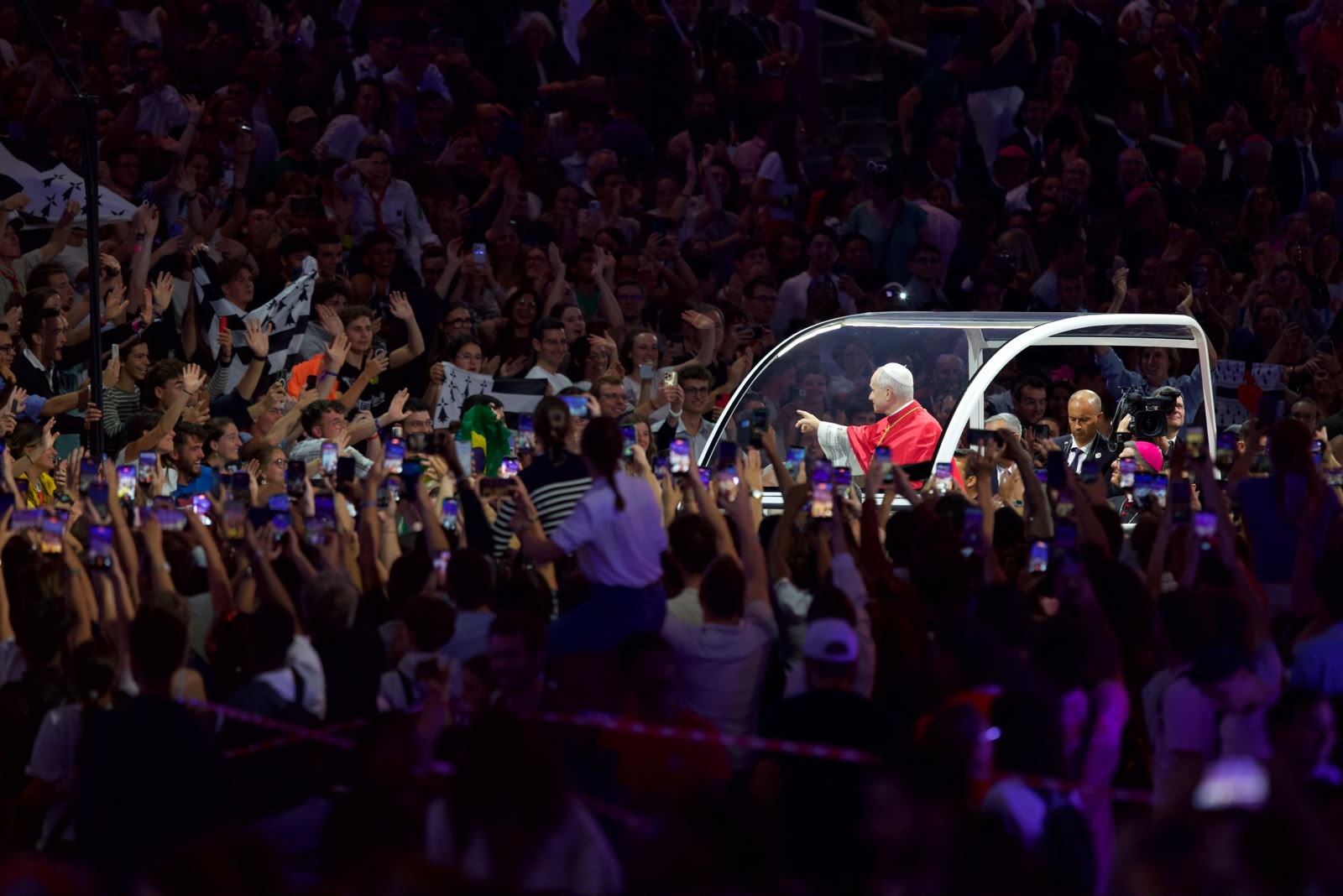
Pope Leo XIV at Monaco stadium Mass: Wars are ‘the result of the idolatry of power and money’ #Catholic Pope Leo XIV on March 28 condemned all military conflicts, which he argued are the result of the “idolatry of power and money” and which “bloody” Godʼs gift of grace to men.Godʼs grace “illuminates our present, because the wars that bloody it are the result of the idolatry of power and money,” said Leo in the homily he delivered during the Mass at the Louis II Stadium in Monaco.Four months after his first apostolic trip to Turkey and Lebanon, the pontiff ended his lightning visit to the Principality of Monaco with the Mass in the stadium dedicated to Prince Louis II, who reigned between 1922 and 1949.The stadium has a capacity for more than 18,000 spectators, which makes it a prominent place for sporting and entertainment events, in addition to being an ideal place for the papal Mass.Upon his arrival, Leo toured the venue in a golf cart, from which he greeted and blessed the cheering faithful who were waiting for him while waving flags of the Vatican City and of Monaco.The logic of power versus innocenceIn his homily, the pope highlighted the biblical account in which the members of the Sanhedrin decide to kill Jesus. From this passage, he explained that the face of God is revealed alongside those who, moved by power interests, are willing to eliminate the innocent.As he pointed out, Caiphas' verdict is born from a political calculation based on fear: “Forgetting Godʼs promise to his people, they want to kill the innocent, because behind their fear is the attachment to power.”“Isnʼt that what happens today?” the pope asked. “Even today, how many calculations are made in the world to kill innocent people; how many false reasons are used to get them out of the way!”Not getting used to warThe pontiff called for the purification of the “idolatry” that feeds wars and turns men into slaves of other men, while urging the faithful to not get used to violence.“Every truncated life is a wound to the body of Christ. Letʼs not get used to the rumble of weapons or the images of war!” he exclaimed.In this sense, he stressed that peace cannot be reduced to a balance of power: “It is not a mere balance of forces, but the work of purified hearts, of those who see in the other a brother to take care of, not an enemy to bring down.”Mercy, response to evilFaced with the persistence of evil, the pope recalled that Godʼs justice acts as a source of hope and renewal: “The Lord frees from pain by infusing hope, he converts the hardness of the heart by transforming power into service, precisely while manifesting the true name of his omnipotence: mercy.”In this way, he assured that it is “mercy that saves the world” because it takes charge of all human existence, “in each of its weaknesses, from the moment it is conceived in the womb until it ages,” he added.A message on the eve of EasterThe popeʼs visit to Monaco, just eight hours long, was made at the invitation of Albert II of Monaco. It took place on the eve of Holy Week, a context to which the pope referred during his homily. “The Lord changes the history of the world by calling us from idolatry to true faith, from death to life,” he said.In this context, he also evoked the prophet Jeremiah: “In the face of the numerous injustices that destroy the peoples and the war that plagues the nations, the voice of the prophet Jeremiah is constantly raised: I will change their mourning into joy, I will make them happy and I will console them with their affliction” (Jer 31,13).The joy that is born of charityFinally, the pontiff called the faithful to be witnesses of hope, making “many happy with their faith” and sharing a joy that is not acquired as a prize, but is born of charity.“The source of this joy is the love of God: love for the nascent and fragile life, which must always be welcomed and cared for; love for young and old life, which must be encouraged in the trials of each stage; love for healthy and sick life, sometimes alone, always in need of being accompanied with care,” he concluded.At the end of the celebration, the Archbishop of Monaco, Monsignor Dominique-Marie David, thanked Pope Leo XIV for his visit, emphasizing that God is “the source of all good” and that the pontiff, as the successor of Peter, has come to remind the local Church of this.In this sense, he stressed that the pope has encouraged the faithful to face “fearlessly” the current challenges, aware that they have “a treasure capable of sustaining hope, ours and that of the world.”On the eve of Holy Week, David said that the popeʼs visit has served to “confirm the faith of his brothers,” reinforcing the commitment of the Christian community.Pope Leo XIV gave the Archdiocese of Monaco a contemporary sculpture by St. Francis of Assisi. The work represents the Italian saint, one of the most beloved figures of the Christian tradition and universally recognized as a messenger of peace, fraternity and reconciliation.Francis in the sculpture appears dressed in the simple Franciscan habit, a symbol of evangelical poverty and inner freedom, girded by the characteristic cord with three knots.In the sculpture the saint holds a white dove in his left hand, while the right hand opens in a gesture of welcome and donation.This story was first published by ACI Prensa, the Spanish-language sister service of EWTN News. It has been translated and adapted by EWTN News English.

Pope Leo XIV at Monaco stadium Mass: Wars are ‘the result of the idolatry of power and money’ #Catholic Pope Leo XIV on March 28 condemned all military conflicts, which he argued are the result of the “idolatry of power and money” and which “bloody” Godʼs gift of grace to men.Godʼs grace “illuminates our present, because the wars that bloody it are the result of the idolatry of power and money,” said Leo in the homily he delivered during the Mass at the Louis II Stadium in Monaco.Four months after his first apostolic trip to Turkey and Lebanon, the pontiff ended his lightning visit to the Principality of Monaco with the Mass in the stadium dedicated to Prince Louis II, who reigned between 1922 and 1949.The stadium has a capacity for more than 18,000 spectators, which makes it a prominent place for sporting and entertainment events, in addition to being an ideal place for the papal Mass.Upon his arrival, Leo toured the venue in a golf cart, from which he greeted and blessed the cheering faithful who were waiting for him while waving flags of the Vatican City and of Monaco.The logic of power versus innocenceIn his homily, the pope highlighted the biblical account in which the members of the Sanhedrin decide to kill Jesus. From this passage, he explained that the face of God is revealed alongside those who, moved by power interests, are willing to eliminate the innocent.As he pointed out, Caiphas' verdict is born from a political calculation based on fear: “Forgetting Godʼs promise to his people, they want to kill the innocent, because behind their fear is the attachment to power.”“Isnʼt that what happens today?” the pope asked. “Even today, how many calculations are made in the world to kill innocent people; how many false reasons are used to get them out of the way!”Not getting used to warThe pontiff called for the purification of the “idolatry” that feeds wars and turns men into slaves of other men, while urging the faithful to not get used to violence.“Every truncated life is a wound to the body of Christ. Letʼs not get used to the rumble of weapons or the images of war!” he exclaimed.In this sense, he stressed that peace cannot be reduced to a balance of power: “It is not a mere balance of forces, but the work of purified hearts, of those who see in the other a brother to take care of, not an enemy to bring down.”Mercy, response to evilFaced with the persistence of evil, the pope recalled that Godʼs justice acts as a source of hope and renewal: “The Lord frees from pain by infusing hope, he converts the hardness of the heart by transforming power into service, precisely while manifesting the true name of his omnipotence: mercy.”In this way, he assured that it is “mercy that saves the world” because it takes charge of all human existence, “in each of its weaknesses, from the moment it is conceived in the womb until it ages,” he added.A message on the eve of EasterThe popeʼs visit to Monaco, just eight hours long, was made at the invitation of Albert II of Monaco. It took place on the eve of Holy Week, a context to which the pope referred during his homily. “The Lord changes the history of the world by calling us from idolatry to true faith, from death to life,” he said.In this context, he also evoked the prophet Jeremiah: “In the face of the numerous injustices that destroy the peoples and the war that plagues the nations, the voice of the prophet Jeremiah is constantly raised: I will change their mourning into joy, I will make them happy and I will console them with their affliction” (Jer 31,13).The joy that is born of charityFinally, the pontiff called the faithful to be witnesses of hope, making “many happy with their faith” and sharing a joy that is not acquired as a prize, but is born of charity.“The source of this joy is the love of God: love for the nascent and fragile life, which must always be welcomed and cared for; love for young and old life, which must be encouraged in the trials of each stage; love for healthy and sick life, sometimes alone, always in need of being accompanied with care,” he concluded.At the end of the celebration, the Archbishop of Monaco, Monsignor Dominique-Marie David, thanked Pope Leo XIV for his visit, emphasizing that God is “the source of all good” and that the pontiff, as the successor of Peter, has come to remind the local Church of this.In this sense, he stressed that the pope has encouraged the faithful to face “fearlessly” the current challenges, aware that they have “a treasure capable of sustaining hope, ours and that of the world.”On the eve of Holy Week, David said that the popeʼs visit has served to “confirm the faith of his brothers,” reinforcing the commitment of the Christian community.Pope Leo XIV gave the Archdiocese of Monaco a contemporary sculpture by St. Francis of Assisi. The work represents the Italian saint, one of the most beloved figures of the Christian tradition and universally recognized as a messenger of peace, fraternity and reconciliation.Francis in the sculpture appears dressed in the simple Franciscan habit, a symbol of evangelical poverty and inner freedom, girded by the characteristic cord with three knots.In the sculpture the saint holds a white dove in his left hand, while the right hand opens in a gesture of welcome and donation.This story was first published by ACI Prensa, the Spanish-language sister service of EWTN News. It has been translated and adapted by EWTN News English.

The Holy Father during his homily at Monaco’s Louis II Stadium urged the faithful to “not get used to the rumble of weapons or the images of war.”

Read More
War forces Latin Patriarchate of Jerusalem to cancel Palm Sunday procession #Catholic Amid the continuing war and restrictions on access to the holy sites, the Latin Patriarchate of Jerusalem has canceled the traditional Palm Sunday procession from the Mount of Olives to Jerusalem, announcing “exceptional measures” regarding this year’s Holy Week and Easter celebrations.The Palm Sunday procession will instead be replaced by a time of prayer for the city in a location yet to be announced.The patriarchate also announced the postponement of the chrism Mass until circumstances allow — most likely during the Easter season after necessary ecclesiastical approvals are obtained.At the same time, it affirmed that the churches of the diocese will remain open and that priests and pastors will work, within the limits of what is possible, to ensure the participation of the faithful in prayers and liturgical celebrations.The patriarchate explained that this year it has not been possible to hold the traditional Lenten pilgrimage in Jerusalem, with its celebrations at the Church of the Holy Sepulchre and the sites associated with Christ’s passion. It noted that, although the faithful have been able to prepare individually, they have felt the absence of the communal journey toward Easter, which is an essential element of the Church’s spiritual life.Continuing restrictionsThe patriarchate said the security conditions linked to the conflict do not suggest any improvement in the near future. It stressed that, in coordination with the other Churches and the relevant authorities, it is continuing to assess possible ways to hold the celebrations within the available framework.Decisions, it said, will be made on a day-by-day basis according to developments on the ground. According to the statement, it has become clear that it will not be possible to organize normal celebrations open to all the faithful, prompting the patriarchate to adopt a set of organizational measures.The patriarchate said this reality constitutes “another wound added to the many wounds caused by the conflict.” The pain, it said, is not limited to the consequences of war but also includes the inability to celebrate Easter together “in a fitting way.” Yet it stressed the need not to surrender to despair and called for perseverance in prayer.In this context, the patriarchate called on the faithful to unite in prayer on Saturday, March 28, by reciting the rosary for peace and reassurance, especially for those suffering because of the conflict. It concluded by affirming that Easter remains, despite every circumstance, a sign of hope, recalling that “no darkness, not even the darkness of war, can have the last word” and that the empty tomb remains a witness to the victory of life over hatred and mercy over sin.This story was first published by ACI MENA, the Arabic-language sister service of EWTN News. It has been translated and adapted by EWTN News English.

War forces Latin Patriarchate of Jerusalem to cancel Palm Sunday procession #Catholic Amid the continuing war and restrictions on access to the holy sites, the Latin Patriarchate of Jerusalem has canceled the traditional Palm Sunday procession from the Mount of Olives to Jerusalem, announcing “exceptional measures” regarding this year’s Holy Week and Easter celebrations.The Palm Sunday procession will instead be replaced by a time of prayer for the city in a location yet to be announced.The patriarchate also announced the postponement of the chrism Mass until circumstances allow — most likely during the Easter season after necessary ecclesiastical approvals are obtained.At the same time, it affirmed that the churches of the diocese will remain open and that priests and pastors will work, within the limits of what is possible, to ensure the participation of the faithful in prayers and liturgical celebrations.The patriarchate explained that this year it has not been possible to hold the traditional Lenten pilgrimage in Jerusalem, with its celebrations at the Church of the Holy Sepulchre and the sites associated with Christ’s passion. It noted that, although the faithful have been able to prepare individually, they have felt the absence of the communal journey toward Easter, which is an essential element of the Church’s spiritual life.Continuing restrictionsThe patriarchate said the security conditions linked to the conflict do not suggest any improvement in the near future. It stressed that, in coordination with the other Churches and the relevant authorities, it is continuing to assess possible ways to hold the celebrations within the available framework.Decisions, it said, will be made on a day-by-day basis according to developments on the ground. According to the statement, it has become clear that it will not be possible to organize normal celebrations open to all the faithful, prompting the patriarchate to adopt a set of organizational measures.The patriarchate said this reality constitutes “another wound added to the many wounds caused by the conflict.” The pain, it said, is not limited to the consequences of war but also includes the inability to celebrate Easter together “in a fitting way.” Yet it stressed the need not to surrender to despair and called for perseverance in prayer.In this context, the patriarchate called on the faithful to unite in prayer on Saturday, March 28, by reciting the rosary for peace and reassurance, especially for those suffering because of the conflict. It concluded by affirming that Easter remains, despite every circumstance, a sign of hope, recalling that “no darkness, not even the darkness of war, can have the last word” and that the empty tomb remains a witness to the victory of life over hatred and mercy over sin.This story was first published by ACI MENA, the Arabic-language sister service of EWTN News. It has been translated and adapted by EWTN News English.

Holy Week observances and events in the Holy Land have been canceled or significantly revised in the face of closures in Jerusalem due to the war with Iran.

Read More