sisters

Christ is not ‘a guru or a good luck charm,’ pope says at Mass in Angola #Catholic SAURIMO, Angola — Pope Leo XIV warned at Mass in Saurimo, Angola, on Monday of making God into an idol that is sought only when advantageous — “when genuine faith is replaced with superstitious practices.”“There are erroneous motives for seeking Christ, particularly when he is considered to be a guru or a good luck charm,” the pope said on April 20, referring to how the crowds in the Gospel reading reacted after Jesus performed the miracle of the loaves and the fishes.“They were not seeking a teacher whom they love but a leader to applaud for their own advantage,” he said.Joyful faith in Saurimo
 
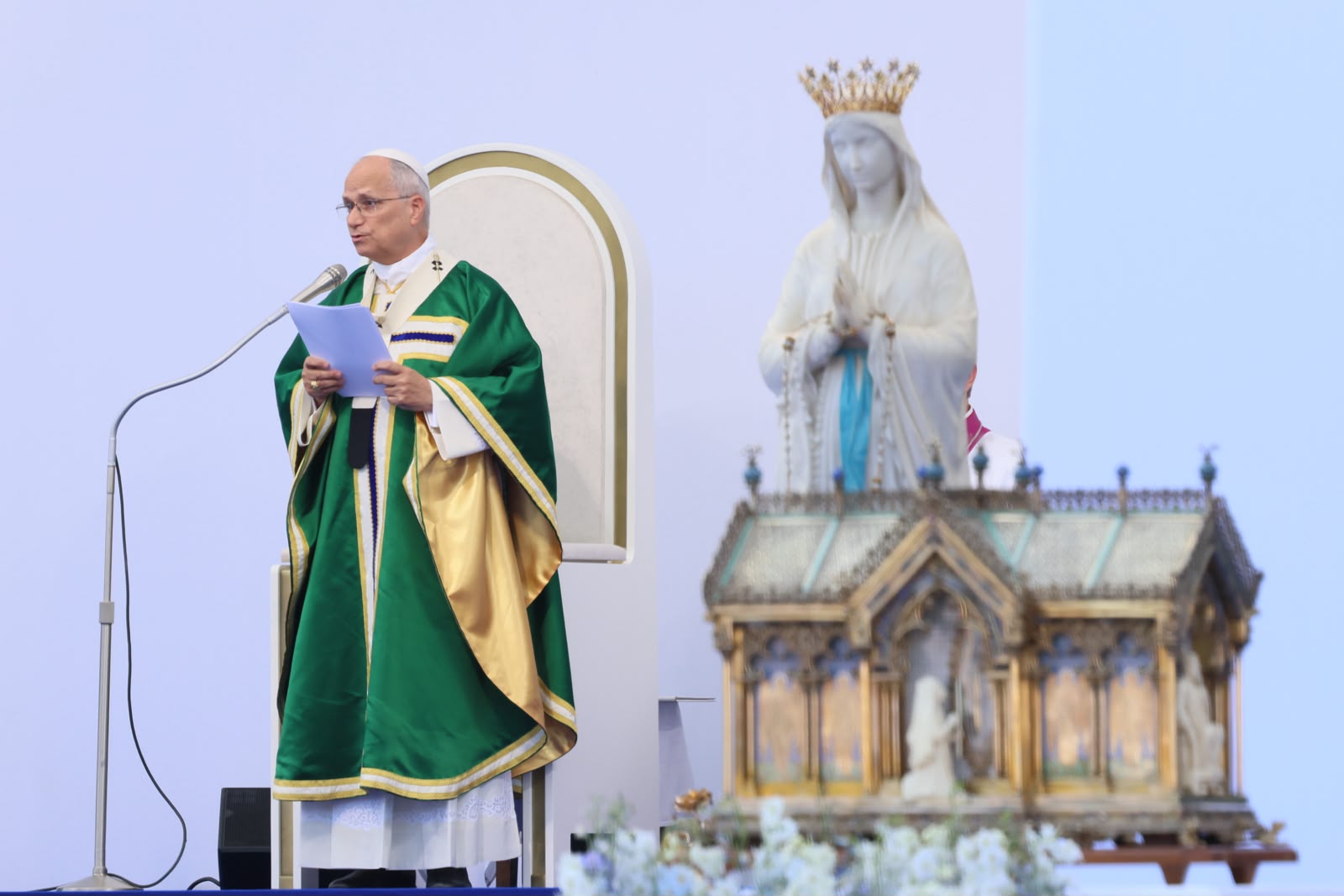
 Pope Leo XIV celebrates Mass in Saurimo, Angola, on April 20, 2026. | Credit: Vatican Media
 
 From the start of his arrival in Sub-Saharan Africa — first in Cameroon and then in Angola — Pope Leo has been welcomed by the warmth of the faithful. In Saurimo, a city in northeastern Angola, the atmosphere greeting the pope on Monday was marked by joyful faith. Everyone welcomed the successor of Peter with songs, dances, and applause.Despite the intense heat, upon reaching the esplanade before Mass, Leo XIV greeted the roughly 60,000 faithful of all ages — who had come from across the region and neighboring dioceses — by making a circuit in the popemobile.“This is the first time a pope has gone beyond Angola’s coastal belt and come — using Pope Francis’ language — to the peripheries,“ the director of the communications office of the Archdiocese of Saurimo said. ”This is a region rich in diamonds, but there is also great poverty, and he comes here to show our reality. For us, having the Holy Father in our region is a great joy.”“This is a unique and unforgettable moment in my life and in the lives of the many pilgrims here today,” Filomena Vunda, who works in the pastoral secretariat of the Archdiocese of Malanje, told ACI Africa, the sister service of EWTN News in Africa, at the Mass.Vunda encouraged non-Catholics in Angola to “keep in mind our African word ‘Ubuntu’: The happiness of others depends on me; my happiness depends solely on the happiness of others.”Ubuntu is an African philosophy about human interconnectedness. It can be translated as “I am because we are.”‘Disciples of Christ’In his homily at Mass, concelebrated by Angolan bishops, Pope Leo said: “In every part of the world, the Church lives as a people who walk as disciples of Christ, our brother and redeemer.”"He, the Risen One, illumines for us the path to the Father and with the strength of the Spirit he sanctifies us so that we may transform our way of life in conformity with his love," the pope said. "This is the good news, the Gospel that courses through our veins like blood, sustaining us on the journey. A journey that has brought me here with you today!”
 
 Pope Leo XIV celebrates Mass in Saurimo, Angola, on April 20, 2026. | Credit: Vatican Media
 
 Commenting on the Gospel of the day, Leo reflected: “Indeed, when the Son of God became man, he performed striking miracles in order to manifest the will of the Father: He made light shine in the darkness by giving sight to the blind, he gave a voice to the oppressed by loosening the tongues of the mute, he slaked our thirst for justice by multiplying bread for the poor and weak. Anyone who heard about these works set out in search of Jesus. At the same time, the Lord looks into our heart and asks us whether we seek him out of gratitude or for our own self-interest, with calculation or with love.”“The Lord himself says,” the pope continued, “‘you are looking for me, not because you saw signs, but because you ate your fill of the loaves’ (Jn 6:26). His words reveal the designs of those who do not want to encounter a person but want to consume things. The crowd sees Jesus as means to an end, a provider of services. If he had not given them something to eat, his actions and teachings would not have interested them.”“This happens,” Leo XIV explained, “when genuine faith is replaced with superstitious practices, in which God becomes an idol that is sought only when it is advantageous to us and only for as long as it is. Even the most beautiful gifts of the Lord, which are always for the care of his people, become a pretext, a prize or a bargaining chip, and are misinterpreted by those who receive them.”“How different is Jesus’ attitude toward us,” the pontiff continued. “Yet, he does not reject this insincere search, but encourages its conversion ... Christ calls us to freedom: He does not want servants or clients, rather he seeks brothers and sisters to whom he can totally dedicate himself.”“Therefore,” Leo XIV said, “the admonition that the Lord directs to the crowd is transformed into an invitation: ‘Do not work for the food that perishes, but for the food that endures for eternal life’ (Jn 6:27)."“His gift sheds light on our current situation,” the pope went on. “We can see today how the hope of many people is frustrated by violence, exploited by the powerful, and defrauded by the rich. Consequently, when injustice corrupts hearts, the bread of all becomes the possession of a few."“In the face of these evils, Christ hears the cry of the people and renews our history by lifting us up from every fall, comforting us in every suffering, and encouraging us in our mission," he said. 
 
 Crowds of people brave the heat and sun to attend Mass with Pope Leo XIV in Saurimo, Angola, on April 20, 2026. | Credit: Raúl Kangombe Sapiti/ACI Africa
 
 “All this,” the pope exhorted, “means that, in light of our discipleship, the ecclesial journey is a ‘synod of resurrection and hope,’ as St. John Paul II affirmed in his apostolic exhortation Ecclesia in Africa. Let us proceed in this wise direction! Christ himself guides and strengthens our journey, a journey that we want to learn to live more and more as it should be, that is, in a synodal manner.”The pope concluded by recalling the importance of the martyrs and saints, whose witness “encourages us and pushes us onto a path of hope, reconciliation, and peace, along which the gift of God becomes the responsibility of the head of the household, in the Christian community, in civil society.”"The vitality of the vocations that you experience [in Angola]," he said, "is a sign that you are responding to the Lord’s gift, which is always abundant for those who welcome it with pure hearts.”ACI Africa reporter Raúl Kangombe Sapiti contributed to this report.This story was first published by ACI Stampa, the Italian-language sister service of EWTN News. It has been translated and adapted by EWTN News English.

Christ is not ‘a guru or a good luck charm,’ pope says at Mass in Angola #Catholic SAURIMO, Angola — Pope Leo XIV warned at Mass in Saurimo, Angola, on Monday of making God into an idol that is sought only when advantageous — “when genuine faith is replaced with superstitious practices.”“There are erroneous motives for seeking Christ, particularly when he is considered to be a guru or a good luck charm,” the pope said on April 20, referring to how the crowds in the Gospel reading reacted after Jesus performed the miracle of the loaves and the fishes.“They were not seeking a teacher whom they love but a leader to applaud for their own advantage,” he said.Joyful faith in Saurimo Pope Leo XIV celebrates Mass in Saurimo, Angola, on April 20, 2026. | Credit: Vatican Media From the start of his arrival in Sub-Saharan Africa — first in Cameroon and then in Angola — Pope Leo has been welcomed by the warmth of the faithful. In Saurimo, a city in northeastern Angola, the atmosphere greeting the pope on Monday was marked by joyful faith. Everyone welcomed the successor of Peter with songs, dances, and applause.Despite the intense heat, upon reaching the esplanade before Mass, Leo XIV greeted the roughly 60,000 faithful of all ages — who had come from across the region and neighboring dioceses — by making a circuit in the popemobile.“This is the first time a pope has gone beyond Angola’s coastal belt and come — using Pope Francis’ language — to the peripheries,“ the director of the communications office of the Archdiocese of Saurimo said. ”This is a region rich in diamonds, but there is also great poverty, and he comes here to show our reality. For us, having the Holy Father in our region is a great joy.”“This is a unique and unforgettable moment in my life and in the lives of the many pilgrims here today,” Filomena Vunda, who works in the pastoral secretariat of the Archdiocese of Malanje, told ACI Africa, the sister service of EWTN News in Africa, at the Mass.Vunda encouraged non-Catholics in Angola to “keep in mind our African word ‘Ubuntu’: The happiness of others depends on me; my happiness depends solely on the happiness of others.”Ubuntu is an African philosophy about human interconnectedness. It can be translated as “I am because we are.”‘Disciples of Christ’In his homily at Mass, concelebrated by Angolan bishops, Pope Leo said: “In every part of the world, the Church lives as a people who walk as disciples of Christ, our brother and redeemer.”"He, the Risen One, illumines for us the path to the Father and with the strength of the Spirit he sanctifies us so that we may transform our way of life in conformity with his love," the pope said. "This is the good news, the Gospel that courses through our veins like blood, sustaining us on the journey. A journey that has brought me here with you today!” Pope Leo XIV celebrates Mass in Saurimo, Angola, on April 20, 2026. | Credit: Vatican Media Commenting on the Gospel of the day, Leo reflected: “Indeed, when the Son of God became man, he performed striking miracles in order to manifest the will of the Father: He made light shine in the darkness by giving sight to the blind, he gave a voice to the oppressed by loosening the tongues of the mute, he slaked our thirst for justice by multiplying bread for the poor and weak. Anyone who heard about these works set out in search of Jesus. At the same time, the Lord looks into our heart and asks us whether we seek him out of gratitude or for our own self-interest, with calculation or with love.”“The Lord himself says,” the pope continued, “‘you are looking for me, not because you saw signs, but because you ate your fill of the loaves’ (Jn 6:26). His words reveal the designs of those who do not want to encounter a person but want to consume things. The crowd sees Jesus as means to an end, a provider of services. If he had not given them something to eat, his actions and teachings would not have interested them.”“This happens,” Leo XIV explained, “when genuine faith is replaced with superstitious practices, in which God becomes an idol that is sought only when it is advantageous to us and only for as long as it is. Even the most beautiful gifts of the Lord, which are always for the care of his people, become a pretext, a prize or a bargaining chip, and are misinterpreted by those who receive them.”“How different is Jesus’ attitude toward us,” the pontiff continued. “Yet, he does not reject this insincere search, but encourages its conversion … Christ calls us to freedom: He does not want servants or clients, rather he seeks brothers and sisters to whom he can totally dedicate himself.”“Therefore,” Leo XIV said, “the admonition that the Lord directs to the crowd is transformed into an invitation: ‘Do not work for the food that perishes, but for the food that endures for eternal life’ (Jn 6:27)."“His gift sheds light on our current situation,” the pope went on. “We can see today how the hope of many people is frustrated by violence, exploited by the powerful, and defrauded by the rich. Consequently, when injustice corrupts hearts, the bread of all becomes the possession of a few."“In the face of these evils, Christ hears the cry of the people and renews our history by lifting us up from every fall, comforting us in every suffering, and encouraging us in our mission," he said. Crowds of people brave the heat and sun to attend Mass with Pope Leo XIV in Saurimo, Angola, on April 20, 2026. | Credit: Raúl Kangombe Sapiti/ACI Africa “All this,” the pope exhorted, “means that, in light of our discipleship, the ecclesial journey is a ‘synod of resurrection and hope,’ as St. John Paul II affirmed in his apostolic exhortation Ecclesia in Africa. Let us proceed in this wise direction! Christ himself guides and strengthens our journey, a journey that we want to learn to live more and more as it should be, that is, in a synodal manner.”The pope concluded by recalling the importance of the martyrs and saints, whose witness “encourages us and pushes us onto a path of hope, reconciliation, and peace, along which the gift of God becomes the responsibility of the head of the household, in the Christian community, in civil society.”"The vitality of the vocations that you experience [in Angola]," he said, "is a sign that you are responding to the Lord’s gift, which is always abundant for those who welcome it with pure hearts.”ACI Africa reporter Raúl Kangombe Sapiti contributed to this report.This story was first published by ACI Stampa, the Italian-language sister service of EWTN News. It has been translated and adapted by EWTN News English.

After praying at the Cathedral of Our Lady of the Assumption in Saurimo, Pope Leo XIV proceeded to the site of the Mass, attended by an estimated 60,000 people.

Read More
National Infertility Awareness Week: 4 Catholic ministries walking with couples #Catholic According to the World Health Organization, about 1 in 6 people globally experience infertility in their lifetime. In the United States, 1 in 8 couples deal with infertility.This year, National Infertility Awareness Week (NIAW) runs from April 19–25. Established in 1989 by RESOLVE: The National Infertility Association, NIAW is an annual initiative held each April that raises public awareness, promotes policy change — especially regarding insurance coverage — and fosters open conversations to support those struggling to build their families.RESOLVE: The National Infertility Association was founded in 1974 as a nonprofit dedicated to supporting individuals and couples facing infertility through education, advocacy, and community support.The Catholic Church offers couples struggling with infertility a wide range of resources that aim to address the root of the issue in a holistic manner and in a way that aligns with Church teaching.Here are four Catholic ministries that work with couples carrying the cross of infertility:Springs in the DesertSprings in the Desert is a Catholic infertility ministry founded in 2019 by Kimberly Henkel and Ann Koshute after they recognized how isolating infertility can be and how little pastoral support existed within the Church. The ministry exists to accompany women and couples spiritually and emotionally, helping them encounter God’s love and discover a broader understanding of fruitfulness beyond biological parenthood. Rooted deeply in Catholic teaching on marriage, human dignity, and reproductive ethics, it also works to educate clergy and lay leaders about the unique grief and needs associated with infertility.The ministry offers a wide range of resources, including retreats, small groups, blog reflections, a podcast, and virtual and in-person events designed to foster community and healing.For this year’s National Infertility Awareness Week, Springs in the Desert has partnered with Ascension to launch two free spiritual resources designed specifically for couples experiencing this hardship. They are a 15-part “Scripture and Saints” audio series featuring biblical figures such as Sarah and Abraham, Ruth and Naomi, Hannah and Elkanah, St. Joseph, Elizabeth and Zechariah, the woman with the hemorrhage, and St. Paul who connect the listener to the lived experience of infertility, and a novena inviting couples to pray with titles of Our Lady such as Our Lady of Sorrows and Queen of Families in order to invoke the Blessed Mother during times of grief and loss.Both resources will be available beginning April 19 in the Ascension app.The Fruitful HollowThe Fruitful Hollow is an online Catholic infertility ministry founded in 2021 by Lauren Allen after her own experience of infertility inspired her to create a space rooted in Church teaching and authentic support. The ministry focuses on helping women and couples live out their vocation with purpose during infertility, emphasizing that fruitfulness is not limited to having children but can be lived out in many spiritual and relational ways. It aims to address the lack of conversation and resources within Catholic circles and to guide people toward holiness in the midst of suffering.
 
 Lauren Allen, the founder of the Catholic infertility ministry the Fruitful Hollow, with her husband. | Credit: Photo courtesy of Lauren Allen
 
 The ministry provides weekly blog reflections, a mentorship program titled “Sisters of Hannah,” and a wide range of downloadable resources that address grief, medical decisions, marriage, and spiritual growth. It also offers tools for prayer, education on ethical fertility treatments, and even a memorial space for those who have experienced loss.Lily of the ValleyLily of the Valley is a Catholic lay ministry founded in 2022 to support families facing infertility, pregnancy loss, and difficult prenatal or postnatal diagnoses. Rooted in Catholic teaching and devotion — especially to St. Gianna Molla — the ministry’s mission is to accompany those carrying the cross of early-life suffering with prayer, compassion, and spiritual solidarity.The ministry’s work focuses on providing both spiritual and community-based support, particularly through tangible and relational resources. One of its most distinctive offerings is personalized prayer care packages, which include sacramentals, prayer cards, and handwritten notes designed to bring comfort and encourage prayer during difficult times.In addition, Lily of the Valley offers online support groups, curated spiritual resources, and opportunities for prayer accompaniment, helping women and families feel less alone and more supported within a faith-filled community as they navigate infertility and related struggles.Elizabeth MinistryA parish-based Catholic outreach founded in 1991 in Wisconsin, Elizabeth Ministry is designed to support women and families during critical reproductive and family life experiences, including infertility, miscarriage, pregnancy, and adoption. The ministry is inspired by the Visitation of Mary to Elizabeth, emphasizing accompaniment, presence, and shared faith. Its mission is to affirm the dignity of life and provide emotional, spiritual, and practical care to women navigating difficult or unexpected journeys.The ministry operates primarily through local parish chapters, offering one-on-one mentoring, meal support, prayer networks, and companionship for women experiencing infertility or loss. It also provides training materials, spiritual reflections, and structured programs to help parishes build supportive communities.Elizabeth Ministry’s work is especially valuable for women seeking in-person, relational support within their local Catholic community rather than solely online resources.Several parishes and dioceses have their own programs for couples struggling with infertility. For example, the Archdiocese of Denver and the Diocese of Des Moines, Iowa, have a program called Behold Your Child, which offers spiritual and emotional support for those experiencing infertility and hosts memorial Masses for those who have lost a child due to miscarriage, stillbirth, or infant loss.

National Infertility Awareness Week: 4 Catholic ministries walking with couples #Catholic According to the World Health Organization, about 1 in 6 people globally experience infertility in their lifetime. In the United States, 1 in 8 couples deal with infertility.This year, National Infertility Awareness Week (NIAW) runs from April 19–25. Established in 1989 by RESOLVE: The National Infertility Association, NIAW is an annual initiative held each April that raises public awareness, promotes policy change — especially regarding insurance coverage — and fosters open conversations to support those struggling to build their families.RESOLVE: The National Infertility Association was founded in 1974 as a nonprofit dedicated to supporting individuals and couples facing infertility through education, advocacy, and community support.The Catholic Church offers couples struggling with infertility a wide range of resources that aim to address the root of the issue in a holistic manner and in a way that aligns with Church teaching.Here are four Catholic ministries that work with couples carrying the cross of infertility:Springs in the DesertSprings in the Desert is a Catholic infertility ministry founded in 2019 by Kimberly Henkel and Ann Koshute after they recognized how isolating infertility can be and how little pastoral support existed within the Church. The ministry exists to accompany women and couples spiritually and emotionally, helping them encounter God’s love and discover a broader understanding of fruitfulness beyond biological parenthood. Rooted deeply in Catholic teaching on marriage, human dignity, and reproductive ethics, it also works to educate clergy and lay leaders about the unique grief and needs associated with infertility.The ministry offers a wide range of resources, including retreats, small groups, blog reflections, a podcast, and virtual and in-person events designed to foster community and healing.For this year’s National Infertility Awareness Week, Springs in the Desert has partnered with Ascension to launch two free spiritual resources designed specifically for couples experiencing this hardship. They are a 15-part “Scripture and Saints” audio series featuring biblical figures such as Sarah and Abraham, Ruth and Naomi, Hannah and Elkanah, St. Joseph, Elizabeth and Zechariah, the woman with the hemorrhage, and St. Paul who connect the listener to the lived experience of infertility, and a novena inviting couples to pray with titles of Our Lady such as Our Lady of Sorrows and Queen of Families in order to invoke the Blessed Mother during times of grief and loss.Both resources will be available beginning April 19 in the Ascension app.The Fruitful HollowThe Fruitful Hollow is an online Catholic infertility ministry founded in 2021 by Lauren Allen after her own experience of infertility inspired her to create a space rooted in Church teaching and authentic support. The ministry focuses on helping women and couples live out their vocation with purpose during infertility, emphasizing that fruitfulness is not limited to having children but can be lived out in many spiritual and relational ways. It aims to address the lack of conversation and resources within Catholic circles and to guide people toward holiness in the midst of suffering. Lauren Allen, the founder of the Catholic infertility ministry the Fruitful Hollow, with her husband. | Credit: Photo courtesy of Lauren Allen The ministry provides weekly blog reflections, a mentorship program titled “Sisters of Hannah,” and a wide range of downloadable resources that address grief, medical decisions, marriage, and spiritual growth. It also offers tools for prayer, education on ethical fertility treatments, and even a memorial space for those who have experienced loss.Lily of the ValleyLily of the Valley is a Catholic lay ministry founded in 2022 to support families facing infertility, pregnancy loss, and difficult prenatal or postnatal diagnoses. Rooted in Catholic teaching and devotion — especially to St. Gianna Molla — the ministry’s mission is to accompany those carrying the cross of early-life suffering with prayer, compassion, and spiritual solidarity.The ministry’s work focuses on providing both spiritual and community-based support, particularly through tangible and relational resources. One of its most distinctive offerings is personalized prayer care packages, which include sacramentals, prayer cards, and handwritten notes designed to bring comfort and encourage prayer during difficult times.In addition, Lily of the Valley offers online support groups, curated spiritual resources, and opportunities for prayer accompaniment, helping women and families feel less alone and more supported within a faith-filled community as they navigate infertility and related struggles.Elizabeth MinistryA parish-based Catholic outreach founded in 1991 in Wisconsin, Elizabeth Ministry is designed to support women and families during critical reproductive and family life experiences, including infertility, miscarriage, pregnancy, and adoption. The ministry is inspired by the Visitation of Mary to Elizabeth, emphasizing accompaniment, presence, and shared faith. Its mission is to affirm the dignity of life and provide emotional, spiritual, and practical care to women navigating difficult or unexpected journeys.The ministry operates primarily through local parish chapters, offering one-on-one mentoring, meal support, prayer networks, and companionship for women experiencing infertility or loss. It also provides training materials, spiritual reflections, and structured programs to help parishes build supportive communities.Elizabeth Ministry’s work is especially valuable for women seeking in-person, relational support within their local Catholic community rather than solely online resources.Several parishes and dioceses have their own programs for couples struggling with infertility. For example, the Archdiocese of Denver and the Diocese of Des Moines, Iowa, have a program called Behold Your Child, which offers spiritual and emotional support for those experiencing infertility and hosts memorial Masses for those who have lost a child due to miscarriage, stillbirth, or infant loss.

In honor of National Infertility Awareness Week, here are four Catholic ministries helping couples carry the cross of infertility.

Read More
Pope Leo XIV in Algeria: Where there is conflict the Church brings reconciliation #Catholic ANNABA, Algeria — Pope Leo XIV concluded his visit to the land of St. Augustine by celebrating Mass at the Basilica of St. Augustine in Annaba, where he said the Church is continually reborn when it brings hope to the despairing, dignity to the poor, and reconciliation where there is conflict.The basilica, dedicated to the bishop of ancient Hippo, was built between 1881 and 1907 at the initiative of Algiers Archbishop Charles-Martial-Allemand Lavigerie and was elevated to the rank of minor basilica on April 24, 1914, by Pope Pius X. Restoration work was completed in 2013, with support that included a personal donation from Pope Benedict XVI.In his homily, the pope reflected on the Gospel account of Jesus’ nighttime encounter with Nicodemus, presenting it as a summons to renewal for the whole Church and especially for Algeria’s Christian community.“Today we listen to the Gospel, the good news for all time, in this basilica in Annaba dedicated to St. Augustine, bishop of the ancient city of Hippo,” the pope said. “Over the centuries, the names of the places that welcome us have changed, but the saints continue to serve as our patrons and faithful witnesses of a connection to the land that comes from heaven.”Leo said Jesus’ words to Nicodemus — “You must be born from above” — are not a burden but an invitation to freedom and new life in God.“Such is the invitation for every man and woman who seeks salvation!” he said. “Jesus’ invitation gives rise to the mission of the whole Church, and consequently to the Christian community in Algeria: to be born again from above, that is, from God. In this perspective, faith overcomes earthly hardships and the Lord’s grace makes the desert blossom.”The pope acknowledged that Christ’s command can sound impossible at first but said it reveals God’s power to renew human life.“On the contrary, the obligation expressed by Jesus is a gift of freedom for us, because it reveals an unexpected possibility: We can be born anew from above thanks to God,” Leo said. “We should do so, then, according to his loving will, which desires to renew humanity by calling us to a communion of life that begins with faith. While Christ invites us to renew our lives completely, he also gives us the strength to do so.”He then asked whether life can truly begin again and answered with hope rooted in the cross and Resurrection.“Yes! The Lord’s response, so full of love, fills our hearts with hope,” the pope said. “No matter how weighed down we are by pain or sin: The crucified One carries all these burdens with us and for us. No matter how discouraged we are by our own weaknesses: It is precisely then that God manifests his strength, the God who has raised Christ from the dead in order to give life to the world.”“Each one of us can experience the freedom of new life that comes from faith in the Redeemer,” he added. “Once again, St. Augustine offers us an example of this: We revere him for his conversion even more than for his wisdom.”Turning to the Acts of the Apostles, Leo said the life of the early Church remains the model for genuine ecclesial reform.“Even today, we must embrace this apostolic rule and put it into practice, meditating on it as an authentic criterion for ecclesial reform: a reform that must begin in the heart, if it is to be genuine, and must encompass everyone if it is to be effective,” he said.The pope said the first Christian community was not founded on a merely human agreement but on communion in Christ.“The early Church, therefore, was not based on a social contract but rather on the harmony of faith, affections, ideas, and life decisions centered on the love of God who became man to save all the peoples of the earth,” he said.That unity, he said, must bear fruit in charity, especially amid poverty and oppression.“Therefore, in the face of poverty and oppression, the guiding principle above all for Christians is charity: Let us do to those around us, as we would have them do to us,” Leo said. “Inspired by this law, inscribed in our hearts by God, the Church is continually reborn, for where there is despair she kindles hope, where there is misery she brings dignity, and where there is conflict she brings reconciliation.”Addressing bishops and priests, the pope said pastors are called above all to bear witness to God without fear or compromise.“The primary task of pastors as ministers of the Gospel is therefore to bear witness to God before the world with one heart and one soul, not permitting our concerns to lead us astray through fear, nor trends to undermine us through compromise,” he said.“Together with you, brothers in the episcopate and the priesthood, let us constantly renew this mission for the sake of those entrusted to us, so that through her service, the whole Church may be a message of new life for those we encounter,” he added.In his closing appeal, Leo addressed Algeria’s Christians directly, praising their fidelity and urging them to continue witnessing to the Gospel in ordinary life.“Dearest Christians of Algeria, you remain a humble and faithful sign of Christ’s love in this land,” he said. “Bear witness to the Gospel through simple gestures, genuine relationships, and a dialogue lived out day by day: In this way, you bring flavor and light to the places where you live.”He also praised their perseverance through hardship and invoked the example of the martyrs and of St. Augustine.“Your history is one of generous hospitality and resilience in times of trial,” the pope said. “Here the martyrs prayed; here St. Augustine loved his flock, fervently seeking the truth and serving Christ with ardent faith. Be heirs to this tradition, bearing witness through fraternal charity to the freedom of those born from above as a hope of salvation for the world.”Several cardinals concelebrated the Mass with the pope, including Cardinal Jean-Paul Vesco, archbishop of Algiers; Cardinal Cristóbal López Romero, archbishop of Rabat; and curial cardinals Pietro Parolin, George Koovakad, Luis Antonio Tagle, Peter Turkson, and Robert Sarah. Also among the concelebrants were Archbishop Paul Gallagher and Father Joseph Farrell, prior general of the Augustinians.Before the Mass, the pope visited the Augustinian community house and later had lunch with his confreres.At the end of the celebration, Bishop Michel Jean-Paul Guillaud of Constantine offered words of thanks to the pope.“Holy Father, your visit to this place, a source of your Augustinian roots, was brief, but it was an encouragement for us,” Guillaud said. “First of all, it strengthened our Christian community in its faith and in its trust in the goodwill and respect of the Algerian people. We could not have welcomed you without the support and active collaboration of the authorities and the joyful hospitality of our Algerian brothers and sisters.”The exchange of gifts followed: The pope received a ceramic work made by an Algerian artist, and he in turn gave a chalice.Leo then offered brief words of thanks of his own.“This journey has been for me a particular gift of God’s providence, a gift that the Lord has wished to make to the whole Church,” the pope said. “And it seems to me that I can sum it up this way: God is love; he is the Father of all men and women. Let us return to God with humility…”He continued: “We acknowledge that the current situation of the world is caught in a negative spiral that ultimately depends on our pride. We need him, we need his mercy, because only in him is the peace of the human heart found, and with him we will all be able to live together.”This story was first published by ACI Stampa, the Italian-language sister service of EWTN News. It has been translated and adapted by EWTN News English.

Pope Leo XIV in Algeria: Where there is conflict the Church brings reconciliation #Catholic ANNABA, Algeria — Pope Leo XIV concluded his visit to the land of St. Augustine by celebrating Mass at the Basilica of St. Augustine in Annaba, where he said the Church is continually reborn when it brings hope to the despairing, dignity to the poor, and reconciliation where there is conflict.The basilica, dedicated to the bishop of ancient Hippo, was built between 1881 and 1907 at the initiative of Algiers Archbishop Charles-Martial-Allemand Lavigerie and was elevated to the rank of minor basilica on April 24, 1914, by Pope Pius X. Restoration work was completed in 2013, with support that included a personal donation from Pope Benedict XVI.In his homily, the pope reflected on the Gospel account of Jesus’ nighttime encounter with Nicodemus, presenting it as a summons to renewal for the whole Church and especially for Algeria’s Christian community.“Today we listen to the Gospel, the good news for all time, in this basilica in Annaba dedicated to St. Augustine, bishop of the ancient city of Hippo,” the pope said. “Over the centuries, the names of the places that welcome us have changed, but the saints continue to serve as our patrons and faithful witnesses of a connection to the land that comes from heaven.”Leo said Jesus’ words to Nicodemus — “You must be born from above” — are not a burden but an invitation to freedom and new life in God.“Such is the invitation for every man and woman who seeks salvation!” he said. “Jesus’ invitation gives rise to the mission of the whole Church, and consequently to the Christian community in Algeria: to be born again from above, that is, from God. In this perspective, faith overcomes earthly hardships and the Lord’s grace makes the desert blossom.”The pope acknowledged that Christ’s command can sound impossible at first but said it reveals God’s power to renew human life.“On the contrary, the obligation expressed by Jesus is a gift of freedom for us, because it reveals an unexpected possibility: We can be born anew from above thanks to God,” Leo said. “We should do so, then, according to his loving will, which desires to renew humanity by calling us to a communion of life that begins with faith. While Christ invites us to renew our lives completely, he also gives us the strength to do so.”He then asked whether life can truly begin again and answered with hope rooted in the cross and Resurrection.“Yes! The Lord’s response, so full of love, fills our hearts with hope,” the pope said. “No matter how weighed down we are by pain or sin: The crucified One carries all these burdens with us and for us. No matter how discouraged we are by our own weaknesses: It is precisely then that God manifests his strength, the God who has raised Christ from the dead in order to give life to the world.”“Each one of us can experience the freedom of new life that comes from faith in the Redeemer,” he added. “Once again, St. Augustine offers us an example of this: We revere him for his conversion even more than for his wisdom.”Turning to the Acts of the Apostles, Leo said the life of the early Church remains the model for genuine ecclesial reform.“Even today, we must embrace this apostolic rule and put it into practice, meditating on it as an authentic criterion for ecclesial reform: a reform that must begin in the heart, if it is to be genuine, and must encompass everyone if it is to be effective,” he said.The pope said the first Christian community was not founded on a merely human agreement but on communion in Christ.“The early Church, therefore, was not based on a social contract but rather on the harmony of faith, affections, ideas, and life decisions centered on the love of God who became man to save all the peoples of the earth,” he said.That unity, he said, must bear fruit in charity, especially amid poverty and oppression.“Therefore, in the face of poverty and oppression, the guiding principle above all for Christians is charity: Let us do to those around us, as we would have them do to us,” Leo said. “Inspired by this law, inscribed in our hearts by God, the Church is continually reborn, for where there is despair she kindles hope, where there is misery she brings dignity, and where there is conflict she brings reconciliation.”Addressing bishops and priests, the pope said pastors are called above all to bear witness to God without fear or compromise.“The primary task of pastors as ministers of the Gospel is therefore to bear witness to God before the world with one heart and one soul, not permitting our concerns to lead us astray through fear, nor trends to undermine us through compromise,” he said.“Together with you, brothers in the episcopate and the priesthood, let us constantly renew this mission for the sake of those entrusted to us, so that through her service, the whole Church may be a message of new life for those we encounter,” he added.In his closing appeal, Leo addressed Algeria’s Christians directly, praising their fidelity and urging them to continue witnessing to the Gospel in ordinary life.“Dearest Christians of Algeria, you remain a humble and faithful sign of Christ’s love in this land,” he said. “Bear witness to the Gospel through simple gestures, genuine relationships, and a dialogue lived out day by day: In this way, you bring flavor and light to the places where you live.”He also praised their perseverance through hardship and invoked the example of the martyrs and of St. Augustine.“Your history is one of generous hospitality and resilience in times of trial,” the pope said. “Here the martyrs prayed; here St. Augustine loved his flock, fervently seeking the truth and serving Christ with ardent faith. Be heirs to this tradition, bearing witness through fraternal charity to the freedom of those born from above as a hope of salvation for the world.”Several cardinals concelebrated the Mass with the pope, including Cardinal Jean-Paul Vesco, archbishop of Algiers; Cardinal Cristóbal López Romero, archbishop of Rabat; and curial cardinals Pietro Parolin, George Koovakad, Luis Antonio Tagle, Peter Turkson, and Robert Sarah. Also among the concelebrants were Archbishop Paul Gallagher and Father Joseph Farrell, prior general of the Augustinians.Before the Mass, the pope visited the Augustinian community house and later had lunch with his confreres.At the end of the celebration, Bishop Michel Jean-Paul Guillaud of Constantine offered words of thanks to the pope.“Holy Father, your visit to this place, a source of your Augustinian roots, was brief, but it was an encouragement for us,” Guillaud said. “First of all, it strengthened our Christian community in its faith and in its trust in the goodwill and respect of the Algerian people. We could not have welcomed you without the support and active collaboration of the authorities and the joyful hospitality of our Algerian brothers and sisters.”The exchange of gifts followed: The pope received a ceramic work made by an Algerian artist, and he in turn gave a chalice.Leo then offered brief words of thanks of his own.“This journey has been for me a particular gift of God’s providence, a gift that the Lord has wished to make to the whole Church,” the pope said. “And it seems to me that I can sum it up this way: God is love; he is the Father of all men and women. Let us return to God with humility…”He continued: “We acknowledge that the current situation of the world is caught in a negative spiral that ultimately depends on our pride. We need him, we need his mercy, because only in him is the peace of the human heart found, and with him we will all be able to live together.”This story was first published by ACI Stampa, the Italian-language sister service of EWTN News. It has been translated and adapted by EWTN News English.

At the Basilica of St. Augustine, the pontiff urged Christians to bear witness through “simple gestures, genuine relationships and a dialogue lived out day by day.”

Read More
Pope Leo XIV in Algeria: ‘I am here among you as a pilgrim of peace’ #Catholic ALGIERS, Algeria — Pope Leo XIV on Monday presented himself to Algeria’s diplomatic corps and civil society as “a pilgrim of peace,” urging a more just international order, warning against exclusion and inequality, and praising those who refuse to be “blinded by power or wealth.”Peace remained the central theme of the pope’s first day in Algeria, following his earlier stop at the Martyrs’ Memorial, where he delivered an appeal for peace and reconciliation.Speaking in French at the Djamaa el Djazair Conference Center, Leo recalled his previous visits to Algeria in 2001 and 2013 to Annaba, the ancient see of St. Augustine, whose spiritual legacy has long shaped the Augustinian order to which the pope belongs.“I am here among you as a pilgrim of peace, eager to meet the noble Algerian people,” the pope said. “We are brothers and sisters, for we have the same Father in heaven.”Leo said the “profound religious sense of the Algerian people” fosters “a culture of encounter and reconciliation,” adding that his visit also seeks to be a sign of that spirit.“In a world full of conflicts and misunderstandings, let us meet and strive for mutual understanding, recognizing that we are one family!” he said. “Today, the simplicity of this awareness is the key to opening many doors that are closed.”Addressing an audience of about 1,400 people from civil society and the diplomatic corps, the pope praised the resilience of the Algerian people, saying they had never been defeated by their trials because of their spirit of solidarity, hospitality, and community.“They are the truly strong ones, to whom the future belongs: those who do not allow themselves to be blinded by power or wealth, and those who refuse to sacrifice the dignity of their fellow citizens for the sake of personal or collective gain,” he said.Leo also highlighted the Algerian understanding of hospitality and almsgiving, reflected in the word “sadaka,” which he noted can also mean justice.“The one who accumulates wealth and remains indifferent to others is unjust,” the pope said, calling this vision of justice both “simple and radical” because it recognizes the image of God in others. “Indeed, a religion without mercy and a society without solidarity are a scandal in God’s eyes.”At the same time, he warned that many societies that consider themselves advanced are falling ever deeper into inequality and exclusion, while “people and organizations that dominate others destroy the world.” He said Africa knows this reality well and suggested that Algeria’s historical experience gives it a critical perspective on global power balances.“If you are able to engage in dialogue regarding the concerns of all and show solidarity with the sufferings of so many countries near and far, then you will be able to contribute to both envisioning and bringing about greater justice among peoples,” Leo said.He added that this task is especially urgent “in the face of continuous violations of international law and neocolonial tendencies.”Drawing on the teaching of Benedict XVI and Pope Francis, Leo called on Algeria’s authorities not to fear a broader social participation by those on the margins.“I therefore urge those of you who hold positions of authority in this country not to fear this outlook but to promote a vibrant, dynamic, and free civil society, in which young people in particular are recognized as capable of helping to broaden the horizon of hope for all,” he said.“The true strength of a nation lies in the cooperation of everyone in pursuing the common good,” he continued. “Authorities are called not to dominate but to serve the people and foster their development.”The pope also pointed to Algeria’s unique role as “a bridge between North and South, and between East and West,” describing the Mediterranean and the Sahara as geographical and spiritual crossroads rich with human and cultural meaning.“Woe to us if we turn them into graveyards where hope also dies!” he said. “Let us multiply oases of peace; let us denounce and remove the causes of despair; and let us oppose those who profit from the misfortune of others!”“For illicit are the gains of those who exploit human life, whose dignity is inviolable,” he added.Leo then broadened his reflection to the place of religion in modern society, noting that Algeria, like much of the world, experiences tensions between religious sensibility and modern life. He warned against both fundamentalism and secularization when they distort the true sense of God and human dignity.“Religious symbols and words can become, on the one hand, blasphemous languages of violence and oppression, or on the other, empty signs in the immense marketplace of consumption that does not satisfy us,” he said.Still, the pope insisted that such polarization should not lead to despair.“We must educate people in critical thinking and freedom, in listening and dialogue, and in the trust that leads us to recognize in those who are different fellow travelers and not threats,” he said. “We must work toward the healing of memory and reconciliation among former adversaries.”In his introduction, Algerian President Abdelmadjid Tebboune called Leo’s presence the first visit of a pope to Algeria and said it gave the occasion “a unique resonance.” He invoked both St. Augustine and Emir Abdelkader as enduring models at a time of accelerating change and weakening moral values.Tebboune also praised the pope’s moral authority and his support for social justice while reaffirming Algeria’s commitment to working with the Holy Father to promote dialogue, coexistence, and cooperation over division and conflict.This story was first published by ACI Stampa, the Italian-language sister service of EWTN News. It has been translated and adapted by EWTN News English.

Pope Leo XIV in Algeria: ‘I am here among you as a pilgrim of peace’ #Catholic ALGIERS, Algeria — Pope Leo XIV on Monday presented himself to Algeria’s diplomatic corps and civil society as “a pilgrim of peace,” urging a more just international order, warning against exclusion and inequality, and praising those who refuse to be “blinded by power or wealth.”Peace remained the central theme of the pope’s first day in Algeria, following his earlier stop at the Martyrs’ Memorial, where he delivered an appeal for peace and reconciliation.Speaking in French at the Djamaa el Djazair Conference Center, Leo recalled his previous visits to Algeria in 2001 and 2013 to Annaba, the ancient see of St. Augustine, whose spiritual legacy has long shaped the Augustinian order to which the pope belongs.“I am here among you as a pilgrim of peace, eager to meet the noble Algerian people,” the pope said. “We are brothers and sisters, for we have the same Father in heaven.”Leo said the “profound religious sense of the Algerian people” fosters “a culture of encounter and reconciliation,” adding that his visit also seeks to be a sign of that spirit.“In a world full of conflicts and misunderstandings, let us meet and strive for mutual understanding, recognizing that we are one family!” he said. “Today, the simplicity of this awareness is the key to opening many doors that are closed.”Addressing an audience of about 1,400 people from civil society and the diplomatic corps, the pope praised the resilience of the Algerian people, saying they had never been defeated by their trials because of their spirit of solidarity, hospitality, and community.“They are the truly strong ones, to whom the future belongs: those who do not allow themselves to be blinded by power or wealth, and those who refuse to sacrifice the dignity of their fellow citizens for the sake of personal or collective gain,” he said.Leo also highlighted the Algerian understanding of hospitality and almsgiving, reflected in the word “sadaka,” which he noted can also mean justice.“The one who accumulates wealth and remains indifferent to others is unjust,” the pope said, calling this vision of justice both “simple and radical” because it recognizes the image of God in others. “Indeed, a religion without mercy and a society without solidarity are a scandal in God’s eyes.”At the same time, he warned that many societies that consider themselves advanced are falling ever deeper into inequality and exclusion, while “people and organizations that dominate others destroy the world.” He said Africa knows this reality well and suggested that Algeria’s historical experience gives it a critical perspective on global power balances.“If you are able to engage in dialogue regarding the concerns of all and show solidarity with the sufferings of so many countries near and far, then you will be able to contribute to both envisioning and bringing about greater justice among peoples,” Leo said.He added that this task is especially urgent “in the face of continuous violations of international law and neocolonial tendencies.”Drawing on the teaching of Benedict XVI and Pope Francis, Leo called on Algeria’s authorities not to fear a broader social participation by those on the margins.“I therefore urge those of you who hold positions of authority in this country not to fear this outlook but to promote a vibrant, dynamic, and free civil society, in which young people in particular are recognized as capable of helping to broaden the horizon of hope for all,” he said.“The true strength of a nation lies in the cooperation of everyone in pursuing the common good,” he continued. “Authorities are called not to dominate but to serve the people and foster their development.”The pope also pointed to Algeria’s unique role as “a bridge between North and South, and between East and West,” describing the Mediterranean and the Sahara as geographical and spiritual crossroads rich with human and cultural meaning.“Woe to us if we turn them into graveyards where hope also dies!” he said. “Let us multiply oases of peace; let us denounce and remove the causes of despair; and let us oppose those who profit from the misfortune of others!”“For illicit are the gains of those who exploit human life, whose dignity is inviolable,” he added.Leo then broadened his reflection to the place of religion in modern society, noting that Algeria, like much of the world, experiences tensions between religious sensibility and modern life. He warned against both fundamentalism and secularization when they distort the true sense of God and human dignity.“Religious symbols and words can become, on the one hand, blasphemous languages of violence and oppression, or on the other, empty signs in the immense marketplace of consumption that does not satisfy us,” he said.Still, the pope insisted that such polarization should not lead to despair.“We must educate people in critical thinking and freedom, in listening and dialogue, and in the trust that leads us to recognize in those who are different fellow travelers and not threats,” he said. “We must work toward the healing of memory and reconciliation among former adversaries.”In his introduction, Algerian President Abdelmadjid Tebboune called Leo’s presence the first visit of a pope to Algeria and said it gave the occasion “a unique resonance.” He invoked both St. Augustine and Emir Abdelkader as enduring models at a time of accelerating change and weakening moral values.Tebboune also praised the pope’s moral authority and his support for social justice while reaffirming Algeria’s commitment to working with the Holy Father to promote dialogue, coexistence, and cooperation over division and conflict.This story was first published by ACI Stampa, the Italian-language sister service of EWTN News. It has been translated and adapted by EWTN News English.

The pontiff called for a world order that does not exclude the vulnerable and urged leaders to serve the common good.

Read More
Vatican urges Catholics not to leave Pope Leo XIV alone in opposing war #Catholic VATICAN CITY — Vatican Secretary of State Cardinal Pietro Parolin warned that the “logic of the strongest” risks prevailing on the international stage and called on Christians to become “voices of peace” who do not leave Pope Leo XIV standing alone in his opposition to war.In an interview with Dialoghi, a cultural magazine linked to Italian Catholic Action, Parolin said the voice of the pope is “prophetic” but risks becoming “a voice crying in the wilderness if it is not supported and helped concretely.”His remarks also offer a key to understanding the peace prayer vigil Leo XIV has called for April 11 in St. Peter’s Basilica.Parolin recalled the 2003 Iraq war, when St. John Paul II pleaded for the conflict to be avoided but “was left alone.” He therefore stressed the need to support the current pontiff’s appeal for a peace that is “unarmed and disarming” and to reject “the false propaganda of rearmament.”“There is a need for more voices of peace, more voices against the madness of the rush toward rearmament, more voices raised in favor of our poorest brothers and sisters, more voices and more proposals — I am thinking, for example, of the world of Catholic universities — for new economic models inspired by justice and care for the weakest instead of the idolatry of money,” Parolin said.The cardinal described an alarming international climate in which military action appears to impose itself too easily.“I am struck by how much determination — I was about to say ease — with which the military option is presented as decisive, almost inevitable,” he said.According to the Vatican secretary of state, this trend has left diplomacy practically “mute,” unable to activate alternative tools, while awareness of the tragedy of war and the value of shared rules is being lost.Parolin said the root of the problem is a “multi-polarism inspired by the primacy of power,” in which states place greater trust in force than in international law. That, he said, has produced “double standards,” visible in the differing reactions to attacks on civilians in Ukraine and the destruction in Gaza.“Many governments,” Parolin said, “have expressed indignation over attacks against Ukrainian civilians by Russian missiles and drones, imposing sanctions on the aggressors.”“I do not think the same has happened with the tragedy of the destruction of Gaza,” he added.For the cardinal, this is a case of “double standards” tied to the “primacy of power” — the dominance of one’s own country over others — with international law invoked “only when convenient” and ignored in many other cases.“It seems there has been a lack of awareness of the value of peace, awareness of the tragic reality of war, awareness of the importance of shared rules and of respecting them,” he said.Parolin also lamented the weakening of the global diplomatic architecture and said it is “utopian” to think peace can be guaranteed “by weapons and by balances imposed by the strongest rather than by international agreements.”“We cannot surrender to the logic of the strongest,” the cardinal insisted, because that logic “bends international law to its own interests” and weakens multilateral institutions.In that context, he also expressed regret that Europe has been unable to speak with one voice. He said it is necessary “to rekindle in peoples the sense of European belonging and, in leadership, the awareness of the need for common actions without ever failing the principles that are at the foundation of the European Union itself.”Regarding the United Nations, Parolin said the Holy See “continues to believe in its importance,” considering international organizations essential for restraining the logic of the strongest. At the same time, he acknowledged that the use of the veto has limited the U.N.’s ability to act.“We cannot move from the force of law to the law of force,” he warned.Parolin also highlighted the role believers can play, including defending life and human dignity, protecting religious freedom, promoting reforms to the economic and financial system in line with the Church’s social doctrine, and caring for creation.Finally, the cardinal addressed the cultural impact of new technologies, saying hyper-connectivity and the spread of fake news help fuel fear and build new walls.“As Christians, we must oppose this drift with our daily lives,” he concluded.This story was first published by ACI Prensa, the Spanish-language sister service of EWTN News. It has been translated and adapted by EWTN News English.

Vatican urges Catholics not to leave Pope Leo XIV alone in opposing war #Catholic VATICAN CITY — Vatican Secretary of State Cardinal Pietro Parolin warned that the “logic of the strongest” risks prevailing on the international stage and called on Christians to become “voices of peace” who do not leave Pope Leo XIV standing alone in his opposition to war.In an interview with Dialoghi, a cultural magazine linked to Italian Catholic Action, Parolin said the voice of the pope is “prophetic” but risks becoming “a voice crying in the wilderness if it is not supported and helped concretely.”His remarks also offer a key to understanding the peace prayer vigil Leo XIV has called for April 11 in St. Peter’s Basilica.Parolin recalled the 2003 Iraq war, when St. John Paul II pleaded for the conflict to be avoided but “was left alone.” He therefore stressed the need to support the current pontiff’s appeal for a peace that is “unarmed and disarming” and to reject “the false propaganda of rearmament.”“There is a need for more voices of peace, more voices against the madness of the rush toward rearmament, more voices raised in favor of our poorest brothers and sisters, more voices and more proposals — I am thinking, for example, of the world of Catholic universities — for new economic models inspired by justice and care for the weakest instead of the idolatry of money,” Parolin said.The cardinal described an alarming international climate in which military action appears to impose itself too easily.“I am struck by how much determination — I was about to say ease — with which the military option is presented as decisive, almost inevitable,” he said.According to the Vatican secretary of state, this trend has left diplomacy practically “mute,” unable to activate alternative tools, while awareness of the tragedy of war and the value of shared rules is being lost.Parolin said the root of the problem is a “multi-polarism inspired by the primacy of power,” in which states place greater trust in force than in international law. That, he said, has produced “double standards,” visible in the differing reactions to attacks on civilians in Ukraine and the destruction in Gaza.“Many governments,” Parolin said, “have expressed indignation over attacks against Ukrainian civilians by Russian missiles and drones, imposing sanctions on the aggressors.”“I do not think the same has happened with the tragedy of the destruction of Gaza,” he added.For the cardinal, this is a case of “double standards” tied to the “primacy of power” — the dominance of one’s own country over others — with international law invoked “only when convenient” and ignored in many other cases.“It seems there has been a lack of awareness of the value of peace, awareness of the tragic reality of war, awareness of the importance of shared rules and of respecting them,” he said.Parolin also lamented the weakening of the global diplomatic architecture and said it is “utopian” to think peace can be guaranteed “by weapons and by balances imposed by the strongest rather than by international agreements.”“We cannot surrender to the logic of the strongest,” the cardinal insisted, because that logic “bends international law to its own interests” and weakens multilateral institutions.In that context, he also expressed regret that Europe has been unable to speak with one voice. He said it is necessary “to rekindle in peoples the sense of European belonging and, in leadership, the awareness of the need for common actions without ever failing the principles that are at the foundation of the European Union itself.”Regarding the United Nations, Parolin said the Holy See “continues to believe in its importance,” considering international organizations essential for restraining the logic of the strongest. At the same time, he acknowledged that the use of the veto has limited the U.N.’s ability to act.“We cannot move from the force of law to the law of force,” he warned.Parolin also highlighted the role believers can play, including defending life and human dignity, protecting religious freedom, promoting reforms to the economic and financial system in line with the Church’s social doctrine, and caring for creation.Finally, the cardinal addressed the cultural impact of new technologies, saying hyper-connectivity and the spread of fake news help fuel fear and build new walls.“As Christians, we must oppose this drift with our daily lives,” he concluded.This story was first published by ACI Prensa, the Spanish-language sister service of EWTN News. It has been translated and adapted by EWTN News English.

The Vatican Secretary of State said the pope’s appeals for peace need concrete support.

Read More
On Easter Monday, Pope Leo XIV remembers those ‘tormented’ by war: ‘The truth does not remain hidden’ #Catholic On his first Easter Monday as pope, Leo XIV appeared at the window of the Apostolic Palace under bright sunshine and clear skies to lead the Regina Caeli with thousands of pilgrims gathered in St. Peter’s Square.“Dear brothers and sisters, Christ is risen! Happy Easter!“ he exclaimed. “This greeting, full of wonder and joy, will accompany us throughout the week. As we celebrate this new day that the Lord has made for us, the liturgy celebrates the entrance of all creation into the time of salvation: The despair of death has been banished forever, in the name of Jesus.”He continued: “Today’s Gospel asks us to choose between two accounts: that of the women, who encountered the Risen One, or that of the guards, who were bribed by the leaders of the Sanhedrin.” The women proclaim “the victory of Christ over death,” while the guards “proclaim that death always wins, no matter what,” the pope said, illustrating two opposing versions of the same event. In the guards’ version, Christ did not rise, “but his body was stolen,” the pope recalled. From this comes the fact that “from the same event — the empty tomb — two interpretations spring forth: One is a source of new and eternal life, the other of certain and definitive death,” he explained.This contrast “makes us reflect on the value of Christian witness and the honesty of human communication. Often, in fact, the telling of the truth is obscured by what we today call fake news — that is, lies, insinuations, and baseless accusations. Yet in the face of such obstacles, the truth does not remain hidden; on the contrary, it comes to meet us, alive and radiant, illuminating even the densest darkness,” he continued.Christ is the good news to be proclaimed to the world, he said: “The Lord’s passover is our passover, the passover of humanity, because this man, who died for us, is the Son of God, who gave his life for us.”Leo then turned his thoughts to “peoples tormented by war, to Christians persecuted for their faith, and to children deprived of education. To announce the passover of Christ in words and deeds means giving new voice to hope, otherwise stifled by the hands of the violent.”Finally, he remembered Pope Francis, “who exactly one year ago, on Easter Monday, entrusted his life to the Lord. As we recall his great witness of faith and love, let us pray together to the Virgin Mary, Seat of Wisdom, so that we may become ever brighter heralds of the truth.”After reciting the Marian prayer, Pope Leo XIV added a few more words: “I thank the initiatives promoted for the International Day of Sport for Development and Peace, and I renew the appeal that sport, with its universal language of fraternity, may be a place of inclusion and peace. I thank all those who in these days have sent me Easter greetings. I am especially grateful for the prayers. Through the intercession of the Virgin Mary, may God reward each one with his gifts.” He concluded: “I wish you a joyful and faithful celebration of this Easter Monday and these days of the Octave of Easter, during which the celebration of Christ’s resurrection continues. Let us persevere in invoking the gift of peace for the whole world.”This story was first published by ACI Stampa, the Italian-language sister service of EWTN News. It has been translated and adapted by EWTN News English.

On Easter Monday, Pope Leo XIV remembers those ‘tormented’ by war: ‘The truth does not remain hidden’ #Catholic On his first Easter Monday as pope, Leo XIV appeared at the window of the Apostolic Palace under bright sunshine and clear skies to lead the Regina Caeli with thousands of pilgrims gathered in St. Peter’s Square.“Dear brothers and sisters, Christ is risen! Happy Easter!“ he exclaimed. “This greeting, full of wonder and joy, will accompany us throughout the week. As we celebrate this new day that the Lord has made for us, the liturgy celebrates the entrance of all creation into the time of salvation: The despair of death has been banished forever, in the name of Jesus.”He continued: “Today’s Gospel asks us to choose between two accounts: that of the women, who encountered the Risen One, or that of the guards, who were bribed by the leaders of the Sanhedrin.” The women proclaim “the victory of Christ over death,” while the guards “proclaim that death always wins, no matter what,” the pope said, illustrating two opposing versions of the same event. In the guards’ version, Christ did not rise, “but his body was stolen,” the pope recalled. From this comes the fact that “from the same event — the empty tomb — two interpretations spring forth: One is a source of new and eternal life, the other of certain and definitive death,” he explained.This contrast “makes us reflect on the value of Christian witness and the honesty of human communication. Often, in fact, the telling of the truth is obscured by what we today call fake news — that is, lies, insinuations, and baseless accusations. Yet in the face of such obstacles, the truth does not remain hidden; on the contrary, it comes to meet us, alive and radiant, illuminating even the densest darkness,” he continued.Christ is the good news to be proclaimed to the world, he said: “The Lord’s passover is our passover, the passover of humanity, because this man, who died for us, is the Son of God, who gave his life for us.”Leo then turned his thoughts to “peoples tormented by war, to Christians persecuted for their faith, and to children deprived of education. To announce the passover of Christ in words and deeds means giving new voice to hope, otherwise stifled by the hands of the violent.”Finally, he remembered Pope Francis, “who exactly one year ago, on Easter Monday, entrusted his life to the Lord. As we recall his great witness of faith and love, let us pray together to the Virgin Mary, Seat of Wisdom, so that we may become ever brighter heralds of the truth.”After reciting the Marian prayer, Pope Leo XIV added a few more words: “I thank the initiatives promoted for the International Day of Sport for Development and Peace, and I renew the appeal that sport, with its universal language of fraternity, may be a place of inclusion and peace. I thank all those who in these days have sent me Easter greetings. I am especially grateful for the prayers. Through the intercession of the Virgin Mary, may God reward each one with his gifts.” He concluded: “I wish you a joyful and faithful celebration of this Easter Monday and these days of the Octave of Easter, during which the celebration of Christ’s resurrection continues. Let us persevere in invoking the gift of peace for the whole world.”This story was first published by ACI Stampa, the Italian-language sister service of EWTN News. It has been translated and adapted by EWTN News English.

Upon the recitation of the Regina Caeli, the pope also remembered Pope Francis, who died a year ago on Easter Monday.

Read More
U.S., Canadian seminarians prepare in Mexico to serve Hispanic community #Catholic In response to the growing Hispanic Catholic community in the United States and Canada, seminarians from both countries are being sent to study in Mexico at the Hispanic Seminary of Our Lady of Guadalupe, a multicultural formation center for future priests.The seminary was founded on Aug. 31, 1999, by the then-primate archbishop of Mexico, Cardinal Norberto Rivera, after the Catholic Church recognized the need to form priests capable of understanding the cultural richness of Hispanics in North America.
 
 Study group at the Hispanic seminary in Mexico. | Credit: EWTN Noticias
 
 Rivera was inspired by the call issued by St. John Paul II in the January 1999 apostolic exhortation Ecclesia in America, which called the American Church to a new evangelization.The seminary opened in August 2000 with the arrival of five seminarians from the archdioceses of Los Angeles and Milwaukee. Since then, more than 200 graduates from at least 55 dioceses across the U.S. have passed through the formation center.‘A Church without borders’In an interview with ACI Prensa, the Spanish-language sister service of EWTN News, Father Juan Antonio Vértiz Gutiérrez, the seminary’s rector, explained that the learning experience goes beyond language. The seminarians gain firsthand insight into what the Church in Mexico is like as well as its ecclesial and cultural traditions, particularly through apostolates.
 
 Seminarians visit the Isabel the Catholic Monarch nursing home in Mexico City. | Credit: Hispanic Seminary of Our Lady of Guadalupe
 
 According to the priest, this enables them to “better serve our fellow countrymen and our brothers and sisters of Hispanic origin” in their home dioceses in the U.S. He emphasized that this formation helps these young men understand two distinct cultural realities that, while united in faith, have different cultural expressions.For Vértiz, one of the greatest beauties of Catholicism is that it “doesn’t have any borders.” In a time marked by tensions stemming from immigration policies, he noted that the experience of the Hispanic seminary demonstrates that for the Catholic Church, regardless of one’s background, every person “already belongs to the family of the children of God.”The programLife at the seminary follows the rhythm of any house of priestly formation but with a particular emphasis on cultural encounter. Mornings are dedicated to philosophical and theological studies at Lumen Gentium Catholic University, while in the afternoons, seminarians delve deeper into language learning and spiritual formation.During Holy Week, seminarians are often sent to communities outside Mexico City.The admissions process is typically conducted through diocesan vocations offices in the U.S. “We do not accept young men who do not belong to a diocese,” the rector explained. Currently, the seminary hosts 16 young men hailing from California, Nevada, Washington, Texas, Illinois, Alabama, and Georgia.
 
 A map marks the seminarians’ states of origin. | Credit: EWTN Noticias
 
 Diverse testimonies of faithRamsés Yates, originally from the Diocese of Yakima, Washington, arrived at the seminary a year and a half ago to complete his theological formation and learn Spanish.In an interview with ACI Prensa, he said his experience in Mexican communities has filled him with “much hope and much joy.” In them, he said, it’s possible to witness what it means to “be a community that lives out Catholicism to the fullest.”He noted that he is eagerly preparing to return to Yakima, knowing that he will now be able to speak “with many more people in my diocese, people with whom I previously could not communicate effectively. That fills me with great enthusiasm.”Ramón Pérez, originally from Guanajuato, Mexico, migrated to Fresno, California, at the age of 17. There, his life was defined by work until he felt “the call to the priesthood, to a more complete dedication to the service of the Church.”
 
 A seminarian prays at the Hispanic Seminary of Our Lady of Guadalupe. | Credit: EWTN Noticias
 
 He told ACI Prensa that following a lengthy process of discernment, he requested admission to the seminary. His diocese decided to send him to Mexico “to continue nurturing my culture and to support the various people entering the United States” from Spanish-speaking countries.The seminarian said the experience has enabled him “to know and become conscious of my origins, my roots, and my culture, of where I was born and where I come from.” Growing up in two different cultures, he acknowledged, can be challenging, but it has also “profoundly shaped this aspect of my vocation.”This story was first published by ACI Prensa, the Spanish-language sister service of EWTN News. It has been translated and adapted by EWTN News English.

U.S., Canadian seminarians prepare in Mexico to serve Hispanic community #Catholic In response to the growing Hispanic Catholic community in the United States and Canada, seminarians from both countries are being sent to study in Mexico at the Hispanic Seminary of Our Lady of Guadalupe, a multicultural formation center for future priests.The seminary was founded on Aug. 31, 1999, by the then-primate archbishop of Mexico, Cardinal Norberto Rivera, after the Catholic Church recognized the need to form priests capable of understanding the cultural richness of Hispanics in North America. Study group at the Hispanic seminary in Mexico. | Credit: EWTN Noticias Rivera was inspired by the call issued by St. John Paul II in the January 1999 apostolic exhortation Ecclesia in America, which called the American Church to a new evangelization.The seminary opened in August 2000 with the arrival of five seminarians from the archdioceses of Los Angeles and Milwaukee. Since then, more than 200 graduates from at least 55 dioceses across the U.S. have passed through the formation center.‘A Church without borders’In an interview with ACI Prensa, the Spanish-language sister service of EWTN News, Father Juan Antonio Vértiz Gutiérrez, the seminary’s rector, explained that the learning experience goes beyond language. The seminarians gain firsthand insight into what the Church in Mexico is like as well as its ecclesial and cultural traditions, particularly through apostolates. Seminarians visit the Isabel the Catholic Monarch nursing home in Mexico City. | Credit: Hispanic Seminary of Our Lady of Guadalupe According to the priest, this enables them to “better serve our fellow countrymen and our brothers and sisters of Hispanic origin” in their home dioceses in the U.S. He emphasized that this formation helps these young men understand two distinct cultural realities that, while united in faith, have different cultural expressions.For Vértiz, one of the greatest beauties of Catholicism is that it “doesn’t have any borders.” In a time marked by tensions stemming from immigration policies, he noted that the experience of the Hispanic seminary demonstrates that for the Catholic Church, regardless of one’s background, every person “already belongs to the family of the children of God.”The programLife at the seminary follows the rhythm of any house of priestly formation but with a particular emphasis on cultural encounter. Mornings are dedicated to philosophical and theological studies at Lumen Gentium Catholic University, while in the afternoons, seminarians delve deeper into language learning and spiritual formation.During Holy Week, seminarians are often sent to communities outside Mexico City.The admissions process is typically conducted through diocesan vocations offices in the U.S. “We do not accept young men who do not belong to a diocese,” the rector explained. Currently, the seminary hosts 16 young men hailing from California, Nevada, Washington, Texas, Illinois, Alabama, and Georgia. A map marks the seminarians’ states of origin. | Credit: EWTN Noticias Diverse testimonies of faithRamsés Yates, originally from the Diocese of Yakima, Washington, arrived at the seminary a year and a half ago to complete his theological formation and learn Spanish.In an interview with ACI Prensa, he said his experience in Mexican communities has filled him with “much hope and much joy.” In them, he said, it’s possible to witness what it means to “be a community that lives out Catholicism to the fullest.”He noted that he is eagerly preparing to return to Yakima, knowing that he will now be able to speak “with many more people in my diocese, people with whom I previously could not communicate effectively. That fills me with great enthusiasm.”Ramón Pérez, originally from Guanajuato, Mexico, migrated to Fresno, California, at the age of 17. There, his life was defined by work until he felt “the call to the priesthood, to a more complete dedication to the service of the Church.” A seminarian prays at the Hispanic Seminary of Our Lady of Guadalupe. | Credit: EWTN Noticias He told ACI Prensa that following a lengthy process of discernment, he requested admission to the seminary. His diocese decided to send him to Mexico “to continue nurturing my culture and to support the various people entering the United States” from Spanish-speaking countries.The seminarian said the experience has enabled him “to know and become conscious of my origins, my roots, and my culture, of where I was born and where I come from.” Growing up in two different cultures, he acknowledged, can be challenging, but it has also “profoundly shaped this aspect of my vocation.”This story was first published by ACI Prensa, the Spanish-language sister service of EWTN News. It has been translated and adapted by EWTN News English.

A seminary was established in Mexico in 1999 to serve the growing Hispanic community in North America, forming future priests who learn Spanish as well as ecclesial and cultural traditions.

Read More
Pope Leo XIV: ‘Kneel down as brothers and sisters alongside the oppressed’ #Catholic Pope Leo XIV on Holy Thursday returned the Mass of the Lord’s Supper to the Basilica of St. John Lateran, reviving a papal practice last observed there in 2012 under Benedict XVI.Departing from Pope Francis’ custom of celebrating the liturgy in prisons or migrant centers, Leo celebrated the rite in the cathedral of Rome and washed the feet of 12 priests of the Diocese of Rome.In his homily, the pope framed the liturgy as the solemn entrance into the Easter Triduum and said Christ’s love, shown in both the Eucharist and the washing of the feet, reveals the justice of God in a world wounded by evil.“This evening’s solemn liturgy marks our entry into the holy Triduum of the Lord’s passion, death, and resurrection,” Leo said. “We cross this threshold not as mere spectators, nor out of habit, but as those personally invited by Jesus himself as guests at the Supper in which bread and wine become for us the sacrament of salvation.”“His love becomes both gesture and nourishment for all, revealing the justice of God,” the pope said. “In this world, and particularly in those places where evil abounds, Jesus loves definitively — forever, and with his whole being.”Reflecting on the washing of the feet, Leo said the gesture is not simply a moral lesson but a revelation of God’s own way of loving.“What the Lord shows us — taking the water, the basin, and the towel — is far more than a moral example,” he said. “He entrusts to us his very way of life. The washing of the feet is a gesture that encapsulates the revelation of God.”The pope also cited Benedict XVI, recalling that Christians must repeatedly learn that God’s greatness is unlike worldly greatness. “We too must ‘learn repeatedly that God’s greatness is different from our idea of greatness… because we systematically desire a God of success and not of the Passion,’” Leo said.He warned that human beings are tempted to seek a God who grants success, victory, or usefulness like wealth and power rather than recognizing the divine power revealed in humble service.“Yet we fail to perceive that God does indeed serve us through the gratuitous and humble gesture of washing feet,” Leo said. “This is the true omnipotence of God.”The pope said Jesus’ action purifies both humanity’s false image of God and its false image of man.“For we tend to consider ourselves powerful when we dominate, victorious when we destroy our equals, great when we are feared,” he said. “In contrast, as true God and true man, Christ offers us the example of self-giving, service, and love.”Leo stressed that Christ gave this example not in a moment of acclaim but “on the night he was betrayed, in the darkness of incomprehension and violence.”“In this way, it becomes clear that the Lord’s love precedes our own goodness or purity; he loves us first, and in that love, he forgives and restores us,” the pope said.Quoting St. John’s Gospel, Leo urged Christians to live out mutual service in imitation of Christ: “He does not ask us to repay him but to share his gift among ourselves: ‘You also ought to wash one another’s feet.’”The pope also referred to Pope Francis’ 2013 Holy Thursday homily, noting that Christian service cannot be reduced to abstraction or empty obligation but must spring from charity.Allowing oneself to be served by the Lord, Leo said, is a precondition for serving others. “By washing our bodies, Jesus purifies our souls,” he said. “In him, God has given us an example — not of how to dominate, but of how to liberate; not of how to destroy life, but of how to give it.”In one of the homily’s strongest appeals, the pope turned to the suffering of those crushed by violence and oppression.“As humanity is brought to its knees by so many acts of brutality, let us too kneel down as brothers and sisters alongside the oppressed,” he said.Leo said the liturgy of Holy Thursday draws together the institution of the Eucharist and holy orders, revealing “the perfect self-gift of Jesus, the High Priest and living, eternal Eucharist.”Addressing priests directly, he said: “Beloved brothers in the priesthood, we are called to serve the people of God with our whole lives.”He concluded by inviting Catholics to spend time in Eucharistic adoration and to ask for the grace to imitate Christ’s love.“Holy Thursday is therefore a day of fervent gratitude and authentic fraternity,” the pope said. “May this evening’s Eucharistic adoration, in every parish and community, be a time to contemplate Jesus’ gesture, kneeling as he did, and to ask for the strength to imitate his service with the same love.”This story was first published by ACI Stampa, the Italian-language sister service of EWTN News. It has been translated and adapted by EWTN News English.

Pope Leo XIV: ‘Kneel down as brothers and sisters alongside the oppressed’ #Catholic Pope Leo XIV on Holy Thursday returned the Mass of the Lord’s Supper to the Basilica of St. John Lateran, reviving a papal practice last observed there in 2012 under Benedict XVI.Departing from Pope Francis’ custom of celebrating the liturgy in prisons or migrant centers, Leo celebrated the rite in the cathedral of Rome and washed the feet of 12 priests of the Diocese of Rome.In his homily, the pope framed the liturgy as the solemn entrance into the Easter Triduum and said Christ’s love, shown in both the Eucharist and the washing of the feet, reveals the justice of God in a world wounded by evil.“This evening’s solemn liturgy marks our entry into the holy Triduum of the Lord’s passion, death, and resurrection,” Leo said. “We cross this threshold not as mere spectators, nor out of habit, but as those personally invited by Jesus himself as guests at the Supper in which bread and wine become for us the sacrament of salvation.”“His love becomes both gesture and nourishment for all, revealing the justice of God,” the pope said. “In this world, and particularly in those places where evil abounds, Jesus loves definitively — forever, and with his whole being.”Reflecting on the washing of the feet, Leo said the gesture is not simply a moral lesson but a revelation of God’s own way of loving.“What the Lord shows us — taking the water, the basin, and the towel — is far more than a moral example,” he said. “He entrusts to us his very way of life. The washing of the feet is a gesture that encapsulates the revelation of God.”The pope also cited Benedict XVI, recalling that Christians must repeatedly learn that God’s greatness is unlike worldly greatness. “We too must ‘learn repeatedly that God’s greatness is different from our idea of greatness… because we systematically desire a God of success and not of the Passion,’” Leo said.He warned that human beings are tempted to seek a God who grants success, victory, or usefulness like wealth and power rather than recognizing the divine power revealed in humble service.“Yet we fail to perceive that God does indeed serve us through the gratuitous and humble gesture of washing feet,” Leo said. “This is the true omnipotence of God.”The pope said Jesus’ action purifies both humanity’s false image of God and its false image of man.“For we tend to consider ourselves powerful when we dominate, victorious when we destroy our equals, great when we are feared,” he said. “In contrast, as true God and true man, Christ offers us the example of self-giving, service, and love.”Leo stressed that Christ gave this example not in a moment of acclaim but “on the night he was betrayed, in the darkness of incomprehension and violence.”“In this way, it becomes clear that the Lord’s love precedes our own goodness or purity; he loves us first, and in that love, he forgives and restores us,” the pope said.Quoting St. John’s Gospel, Leo urged Christians to live out mutual service in imitation of Christ: “He does not ask us to repay him but to share his gift among ourselves: ‘You also ought to wash one another’s feet.’”The pope also referred to Pope Francis’ 2013 Holy Thursday homily, noting that Christian service cannot be reduced to abstraction or empty obligation but must spring from charity.Allowing oneself to be served by the Lord, Leo said, is a precondition for serving others. “By washing our bodies, Jesus purifies our souls,” he said. “In him, God has given us an example — not of how to dominate, but of how to liberate; not of how to destroy life, but of how to give it.”In one of the homily’s strongest appeals, the pope turned to the suffering of those crushed by violence and oppression.“As humanity is brought to its knees by so many acts of brutality, let us too kneel down as brothers and sisters alongside the oppressed,” he said.Leo said the liturgy of Holy Thursday draws together the institution of the Eucharist and holy orders, revealing “the perfect self-gift of Jesus, the High Priest and living, eternal Eucharist.”Addressing priests directly, he said: “Beloved brothers in the priesthood, we are called to serve the people of God with our whole lives.”He concluded by inviting Catholics to spend time in Eucharistic adoration and to ask for the grace to imitate Christ’s love.“Holy Thursday is therefore a day of fervent gratitude and authentic fraternity,” the pope said. “May this evening’s Eucharistic adoration, in every parish and community, be a time to contemplate Jesus’ gesture, kneeling as he did, and to ask for the strength to imitate his service with the same love.”This story was first published by ACI Stampa, the Italian-language sister service of EWTN News. It has been translated and adapted by EWTN News English.

On Holy Thursday, the pontiff urged Catholics to imitate Christ’s service in a world marked by brutality.

Read More
Bangladesh Christians form human chain demanding Easter public holiday #Catholic DHAKA, Bangladesh — Christians in Bangladesh formed a human chain and rally in the capital March 31 demanding that the government declare Easter Sunday a public holiday.The Bangladesh Christian Association organized the demonstration in front of the National Press Club in Dhaka, calling on Prime Minister Tarique Rahman to add Easter to the government’s official holiday calendar.Easter Sunday falls on April 5 this year. Bangladesh’s roughly 600,000 Christians — less than 1% of the country’s approximately 170 million people — currently receive only one public holiday for a Christian feast: Christmas Day.Catholic bishops support the demandThe Catholic Church in Bangladesh has also voiced support for the campaign.Archbishop Bejoy N. D’Cruze, OMI, of Dhaka, president of the Catholic Bishops’ Conference of Bangladesh, expressed his solidarity with the demand for a holiday on Easter in an interview with EWTN News on March 30.“Since we do not have a government holiday on Easter Sunday, we cannot all celebrate this day together. Many cannot go to the villages, and we cannot all observe the religious customs that are in place before Easter,” D’Cruze told EWTN News.“I also demand from the government to declare a public holiday on Easter so that we Christians can celebrate the resurrection of Jesus Christ together in family, social, and religious ways,” the archbishop added.‘A heavy heart’Bangladesh Christian Association President Nirmal Rozario said the demand for the holiday is long-standing.“We have come here with a heavy heart and are standing in front of the Press Club. Easter Sunday is very important to us after Christmas. Jesus is the only person in the history of the world who has risen after death. We are demanding a public holiday on this important and significant day, Easter Sunday,” Rozario said.He added that the Christian community “has made considerable contributions to the formation of Bangladesh” in the areas of education, health services, and development, and questioned why the government has not granted the holiday.Rozario called on Rahman to add Easter Sunday to the government holiday calendar beginning next year and to grant a holiday for this year through an executive order.Unequal holiday allocationsMuslims, who make up roughly 91% of the population according to the 2022 census, receive multiple public holidays for their major religious celebrations, including several days for Eid al-Fitr and Eid al-Adha. Hindus, who constitute about 8% of the population, have two days off for their main religious festival, Durga Puja.Christians, however, have only one public holiday — Christmas Day.Manju Maria Palma, secretary of The Christian Cooperative Credit Union Ltd. in Dhaka, a 48,000-member organization, was present at the human chain.“Christ was resurrected on this day. This day is very important. If this public holiday is given, not only the Christian community will benefit but also our brothers and sisters of other religions will understand the significance of this day,” Palma said.Lawmaker expresses hopeEWTN News contacted at least three members of Parliament, including Abdul Aziz, a member of Parliament from the Natore-4 constituency, which includes a historic Christian settlement.Aziz told EWTN News: “Since we respect all religious ceremonies, including Christian activities, and since Christians have expressed their demands, our government will definitely consider the matter.”He also expressed hope that the government will soon discuss the issue of a holiday on Easter Sunday.

Bangladesh Christians form human chain demanding Easter public holiday #Catholic DHAKA, Bangladesh — Christians in Bangladesh formed a human chain and rally in the capital March 31 demanding that the government declare Easter Sunday a public holiday.The Bangladesh Christian Association organized the demonstration in front of the National Press Club in Dhaka, calling on Prime Minister Tarique Rahman to add Easter to the government’s official holiday calendar.Easter Sunday falls on April 5 this year. Bangladesh’s roughly 600,000 Christians — less than 1% of the country’s approximately 170 million people — currently receive only one public holiday for a Christian feast: Christmas Day.Catholic bishops support the demandThe Catholic Church in Bangladesh has also voiced support for the campaign.Archbishop Bejoy N. D’Cruze, OMI, of Dhaka, president of the Catholic Bishops’ Conference of Bangladesh, expressed his solidarity with the demand for a holiday on Easter in an interview with EWTN News on March 30.“Since we do not have a government holiday on Easter Sunday, we cannot all celebrate this day together. Many cannot go to the villages, and we cannot all observe the religious customs that are in place before Easter,” D’Cruze told EWTN News.“I also demand from the government to declare a public holiday on Easter so that we Christians can celebrate the resurrection of Jesus Christ together in family, social, and religious ways,” the archbishop added.‘A heavy heart’Bangladesh Christian Association President Nirmal Rozario said the demand for the holiday is long-standing.“We have come here with a heavy heart and are standing in front of the Press Club. Easter Sunday is very important to us after Christmas. Jesus is the only person in the history of the world who has risen after death. We are demanding a public holiday on this important and significant day, Easter Sunday,” Rozario said.He added that the Christian community “has made considerable contributions to the formation of Bangladesh” in the areas of education, health services, and development, and questioned why the government has not granted the holiday.Rozario called on Rahman to add Easter Sunday to the government holiday calendar beginning next year and to grant a holiday for this year through an executive order.Unequal holiday allocationsMuslims, who make up roughly 91% of the population according to the 2022 census, receive multiple public holidays for their major religious celebrations, including several days for Eid al-Fitr and Eid al-Adha. Hindus, who constitute about 8% of the population, have two days off for their main religious festival, Durga Puja.Christians, however, have only one public holiday — Christmas Day.Manju Maria Palma, secretary of The Christian Cooperative Credit Union Ltd. in Dhaka, a 48,000-member organization, was present at the human chain.“Christ was resurrected on this day. This day is very important. If this public holiday is given, not only the Christian community will benefit but also our brothers and sisters of other religions will understand the significance of this day,” Palma said.Lawmaker expresses hopeEWTN News contacted at least three members of Parliament, including Abdul Aziz, a member of Parliament from the Natore-4 constituency, which includes a historic Christian settlement.Aziz told EWTN News: “Since we respect all religious ceremonies, including Christian activities, and since Christians have expressed their demands, our government will definitely consider the matter.”He also expressed hope that the government will soon discuss the issue of a holiday on Easter Sunday.

Christian leaders and Catholic clergy in the Muslim-majority South Asian nation are urging Prime Minister Tarique Rahman to add Easter Sunday to the government holiday calendar.

Read More
Vatican official warns of ‘Christianophobia’ in Muslim world and secular West #Catholic Archbishop Fortunatus Nwachukwu is alarmed about rising hostility toward Christians, both in parts of the Islamic world and in Europe’s increasingly post‑Christian culture.Nwachukwu, who serves as secretary of the Section of First Evangelization at the Vatican’s Dicastery for Evangelization, told EWTN News that any serious conversation about peace and coexistence must begin with clear condemnation of anti‑Christian violence, particularly from Muslim leaders in places where Christians lack full religious freedom.The Nigerian prelate also warned of a growing cultural aversion to Christianity in the West, where Christian expression is often treated with suspicion even as societies insist on defending the religious symbols of others.Pope Leo XIV is scheduled to visit four countries in Africa, including the Muslim-majority Algeria, on his first apostolic journey to the continent April 13–23.A diplomat urges Muslims to confront anti‑Christian violenceDrawing on decades of diplomatic service in Ghana, Paraguay, Algeria, and Switzerland, Nwachukwu described the anti‑Christian discrimination he witnessed firsthand — experiences he believes continue to be overlooked.“I do not criticize Islam; I criticize the way some people practice their Islam,” he said. “People just shout about Islamophobia, but its main cause is not to be sought in the West. It is to be sought in the way some Muslims practice their religion. We are calling our Muslim friends to condemn the wrong use of their religion as a religion of violence.”He recalled that during his service in Algeria, Christians were openly labeled “enemies of Islam.” In one incident, a shopkeeper refused to serve him because he was wearing a Roman collar.“Christians still do not have full liberty to practice their religion,” he said.A West increasingly uncomfortable with its Christian rootsBut Nwachukwu also directed sharp criticism toward Europe, where he sees a growing reluctance to defend Christianity even as Western societies emphasize religious tolerance.“Everybody denounces Islamophobia, but nobody denounces Christianophobia,” he said. “We are in a post‑Christian Europe and a post‑Christian West.”He noted that Christian symbols face discrimination not applied to other religions: “You enter a hall and see a symbol of Buddhism — nobody touches it. You see a Muslim in a hijab — nobody says to remove it. But you see a cross, and they say, ‘Remove it.’ Why?”This, he argued, reflects a cultural embarrassment about Europe’s Christian heritage:“It is like feeling guilty for having a mother who is ugly and then forgetting that she also has rights. The Christianity that gave them their education, culture, and society — they now feel uncomfortable with it.”Reverse missionaries and a hopeful response to Europe’s secular driftNwachukwu said this situation makes the growing presence of African and Asian missionaries in Europe all the more significant, as a hopeful sign that the global Church can help rekindle the continent’s Christian identity.“The West often forgets that we are the result of sacrifices made by their own brothers and sisters who became missionaries,” he said. “But the sheaves — the children of those missionaries — are now returning.”Nwachukwu described this movement as a gift that can strengthen Western Christianity in places where secularism has taken deep root.“We want to see the mother Churches in Europe accept and be proud of their missionary children from the global south.”Encouragement for persecuted ChristiansTo Christians facing persecution — whether under hostile regimes, extremist movements, or secular cultural pressures — Nwachukwu offered a message of strength: “If you are encountering persecution, it means that the message you have is important. If your message were not important, people wouldn’t even think of you. So, the message is: Do not feel you are alone. Know what you are worth.”

Vatican official warns of ‘Christianophobia’ in Muslim world and secular West #Catholic Archbishop Fortunatus Nwachukwu is alarmed about rising hostility toward Christians, both in parts of the Islamic world and in Europe’s increasingly post‑Christian culture.Nwachukwu, who serves as secretary of the Section of First Evangelization at the Vatican’s Dicastery for Evangelization, told EWTN News that any serious conversation about peace and coexistence must begin with clear condemnation of anti‑Christian violence, particularly from Muslim leaders in places where Christians lack full religious freedom.The Nigerian prelate also warned of a growing cultural aversion to Christianity in the West, where Christian expression is often treated with suspicion even as societies insist on defending the religious symbols of others.Pope Leo XIV is scheduled to visit four countries in Africa, including the Muslim-majority Algeria, on his first apostolic journey to the continent April 13–23.A diplomat urges Muslims to confront anti‑Christian violenceDrawing on decades of diplomatic service in Ghana, Paraguay, Algeria, and Switzerland, Nwachukwu described the anti‑Christian discrimination he witnessed firsthand — experiences he believes continue to be overlooked.“I do not criticize Islam; I criticize the way some people practice their Islam,” he said. “People just shout about Islamophobia, but its main cause is not to be sought in the West. It is to be sought in the way some Muslims practice their religion. We are calling our Muslim friends to condemn the wrong use of their religion as a religion of violence.”He recalled that during his service in Algeria, Christians were openly labeled “enemies of Islam.” In one incident, a shopkeeper refused to serve him because he was wearing a Roman collar.“Christians still do not have full liberty to practice their religion,” he said.A West increasingly uncomfortable with its Christian rootsBut Nwachukwu also directed sharp criticism toward Europe, where he sees a growing reluctance to defend Christianity even as Western societies emphasize religious tolerance.“Everybody denounces Islamophobia, but nobody denounces Christianophobia,” he said. “We are in a post‑Christian Europe and a post‑Christian West.”He noted that Christian symbols face discrimination not applied to other religions: “You enter a hall and see a symbol of Buddhism — nobody touches it. You see a Muslim in a hijab — nobody says to remove it. But you see a cross, and they say, ‘Remove it.’ Why?”This, he argued, reflects a cultural embarrassment about Europe’s Christian heritage:“It is like feeling guilty for having a mother who is ugly and then forgetting that she also has rights. The Christianity that gave them their education, culture, and society — they now feel uncomfortable with it.”Reverse missionaries and a hopeful response to Europe’s secular driftNwachukwu said this situation makes the growing presence of African and Asian missionaries in Europe all the more significant, as a hopeful sign that the global Church can help rekindle the continent’s Christian identity.“The West often forgets that we are the result of sacrifices made by their own brothers and sisters who became missionaries,” he said. “But the sheaves — the children of those missionaries — are now returning.”Nwachukwu described this movement as a gift that can strengthen Western Christianity in places where secularism has taken deep root.“We want to see the mother Churches in Europe accept and be proud of their missionary children from the global south.”Encouragement for persecuted ChristiansTo Christians facing persecution — whether under hostile regimes, extremist movements, or secular cultural pressures — Nwachukwu offered a message of strength: “If you are encountering persecution, it means that the message you have is important. If your message were not important, people wouldn’t even think of you. So, the message is: Do not feel you are alone. Know what you are worth.”

A Nigerian archbishop said African missionaries can evangelize a Europe uneasy with its Christian past.

Read More
Pope Leo XIV says God ‘does not listen’ to prayers of those who wage war #Catholic Pope Leo XIV on Palm Sunday sharply condemned war and the use of religion to justify violence, saying during Mass in St. Peter’s Square that God “does not listen to the prayers of those who wage war.”At the start of Holy Week, the pope tied the Church’s contemplation of Christ’s Passion to the suffering of people caught in today’s conflicts, especially Christians in the Middle East.In his Palm Sunday homily, Leo repeatedly presented Christ as the “King of Peace,” contrasting Jesus’ meekness with the violence surrounding him as he entered into his Passion.“We turn our gaze to Jesus, who reveals himself as King of Peace, even as war looms abounds him,” the pope said. “He remains steadfast in meekness, while others are stirring up violence.”Leo said Christ “did not arm himself, or defend himself, or fight any war” but instead “revealed the gentle face of God, who always rejects violence.”“Rather than saving himself, he allowed himself to be nailed to the cross, embracing every cross borne in every time and place throughout human history,” the pope said.The pope then issued one of the strongest lines of his homily, rejecting any attempt to invoke God in support of armed conflict.“Brothers and sisters, this is our God: Jesus, King of Peace, who rejects war, whom no one can use to justify war,” Leo said. “He does not listen to the prayers of those who wage war, but rejects them, saying: ‘Even though you make many prayers, I will not listen: your hands are full of blood.’”The Palm Sunday liturgy, which opened Holy Week, began with the traditional procession in St. Peter’s Square with cardinals, bishops, priests, religious, and thousands of faithful carrying palms and olive branches.In his homily, Leo reflected on Jesus’ entry into Jerusalem on a donkey rather than a war horse, saying the moment fulfilled the prophecy of a king who would “command peace to the nations.”Recalling the Gospel account of Peter drawing a sword to defend Jesus, Leo cited Christ’s rebuke: “Put your sword back into its place, for all who take the sword will perish by the sword.”The pope said that in the crucified Christ “we can see a crucified humanity.”“In his wounds, we see the hurts of so many women and men today,” he said. “Above all, we hear the painful groans of all those who are oppressed by violence and are victims of war.”“Christ, King of Peace, cries out again from his cross: God is love! Have mercy! Lay down your weapons! Remember that you are brothers and sisters!”Following the Mass, Leo returned to the theme of war during the Angelus, praying in particular for Christians in the Middle East who have been prevented in some places from fully taking part in Holy Week rites.“At the beginning of Holy Week, our prayers are more than ever with the Christians of the Middle East, who are suffering the consequences of a brutal conflict and, in many cases, are unable to observe fully the liturgies of these holy days,” he said.“Just as the Church contemplates the mystery of the Lord’s Passion, we cannot forget those who today are truly sharing in his suffering. Their ordeal challenges all our consciences.”The pope added: “Let us raise our prayer to the Prince of Peace that he may sustain the peoples wounded by war and open concrete paths to reconciliation and peace.”Leo also remembered “the maritime workers who have fallen victim to the conflict,” adding: “I pray for the deceased, the wounded and their families. Land, sky and sea were all created for life and peace!”He further called attention to migrants who died in the Mediterranean, saying: “Let us also pray for all the migrants who have died at sea, especially those who lost their lives in recent days off the coast of Crete.”Near the end of his homily, the pope entrusted his plea for peace to the intercession of Mary, quoting the Servant of God Bishop Tonino Bello and praying that “the tears of all the victims of violence and pain will soon be dried up.”He concluded the Angelus by asking the Virgin Mary to accompany the faithful through the days ahead.“May she guide us during these holy days, so that we may follow Jesus, our Savior, with faith and love,” he said.This story was first published in two parts by ACI Prensa, EWTN News’ Spanish-language news partner. It has been translated and adapted by EWTN News English.

Pope Leo XIV says God ‘does not listen’ to prayers of those who wage war #Catholic Pope Leo XIV on Palm Sunday sharply condemned war and the use of religion to justify violence, saying during Mass in St. Peter’s Square that God “does not listen to the prayers of those who wage war.”At the start of Holy Week, the pope tied the Church’s contemplation of Christ’s Passion to the suffering of people caught in today’s conflicts, especially Christians in the Middle East.In his Palm Sunday homily, Leo repeatedly presented Christ as the “King of Peace,” contrasting Jesus’ meekness with the violence surrounding him as he entered into his Passion.“We turn our gaze to Jesus, who reveals himself as King of Peace, even as war looms abounds him,” the pope said. “He remains steadfast in meekness, while others are stirring up violence.”Leo said Christ “did not arm himself, or defend himself, or fight any war” but instead “revealed the gentle face of God, who always rejects violence.”“Rather than saving himself, he allowed himself to be nailed to the cross, embracing every cross borne in every time and place throughout human history,” the pope said.The pope then issued one of the strongest lines of his homily, rejecting any attempt to invoke God in support of armed conflict.“Brothers and sisters, this is our God: Jesus, King of Peace, who rejects war, whom no one can use to justify war,” Leo said. “He does not listen to the prayers of those who wage war, but rejects them, saying: ‘Even though you make many prayers, I will not listen: your hands are full of blood.’”The Palm Sunday liturgy, which opened Holy Week, began with the traditional procession in St. Peter’s Square with cardinals, bishops, priests, religious, and thousands of faithful carrying palms and olive branches.In his homily, Leo reflected on Jesus’ entry into Jerusalem on a donkey rather than a war horse, saying the moment fulfilled the prophecy of a king who would “command peace to the nations.”Recalling the Gospel account of Peter drawing a sword to defend Jesus, Leo cited Christ’s rebuke: “Put your sword back into its place, for all who take the sword will perish by the sword.”The pope said that in the crucified Christ “we can see a crucified humanity.”“In his wounds, we see the hurts of so many women and men today,” he said. “Above all, we hear the painful groans of all those who are oppressed by violence and are victims of war.”“Christ, King of Peace, cries out again from his cross: God is love! Have mercy! Lay down your weapons! Remember that you are brothers and sisters!”Following the Mass, Leo returned to the theme of war during the Angelus, praying in particular for Christians in the Middle East who have been prevented in some places from fully taking part in Holy Week rites.“At the beginning of Holy Week, our prayers are more than ever with the Christians of the Middle East, who are suffering the consequences of a brutal conflict and, in many cases, are unable to observe fully the liturgies of these holy days,” he said.“Just as the Church contemplates the mystery of the Lord’s Passion, we cannot forget those who today are truly sharing in his suffering. Their ordeal challenges all our consciences.”The pope added: “Let us raise our prayer to the Prince of Peace that he may sustain the peoples wounded by war and open concrete paths to reconciliation and peace.”Leo also remembered “the maritime workers who have fallen victim to the conflict,” adding: “I pray for the deceased, the wounded and their families. Land, sky and sea were all created for life and peace!”He further called attention to migrants who died in the Mediterranean, saying: “Let us also pray for all the migrants who have died at sea, especially those who lost their lives in recent days off the coast of Crete.”Near the end of his homily, the pope entrusted his plea for peace to the intercession of Mary, quoting the Servant of God Bishop Tonino Bello and praying that “the tears of all the victims of violence and pain will soon be dried up.”He concluded the Angelus by asking the Virgin Mary to accompany the faithful through the days ahead.“May she guide us during these holy days, so that we may follow Jesus, our Savior, with faith and love,” he said.This story was first published in two parts by ACI Prensa, EWTN News’ Spanish-language news partner. It has been translated and adapted by EWTN News English.

At Palm Sunday Mass and the Angelus following it, the pope prayed for Middle East Christians, victims of war, and migrants who died at sea off Crete.

Read More
Religious sisters lose lawsuit against Smith & Wesson alleging ‘facilitation’ of mass shootings #Catholic Several congregations of religious sisters have lost their lawsuit against the iconic American gun manufacturer Smith & Wesson, which claimed the company has “facilitated” mass shootings in the United States. A version of the lawsuit was first filed in December 2023 in Nevada district court by the Adrian Dominican Sisters, the Sisters of Bon Secours USA, the Sisters of St. Francis of Philadelphia, and the Sisters of the Holy Names of Jesus and Mary, U.S.-Ontario Province.The filing alleged that Smith & Wesson is “intent on marketing and selling AR-15 rifles in whatever manner results in the most sales.” The suit claimed the company was pursuing such marketing even if it “is illegal and attracts a dangerous category of buyers [and] facilitates an unrelenting and growing stream of killings.”The sisters had filed the suit as shareholders in the company, claiming that Smith & Wesson’s marketing “causes the company to face an ever-increasing and substantial likelihood of liability that threatens its long-term existence.” The filing specifically targeted the company’s board of directors on behalf of the company and its shareholders in what is known as a “derivative lawsuit.”The sisters in the original lawsuit failed to meet a required $500,000 security bond deadline, leading to the suit’s dismissal. They subsequently refiled in federal court in February 2025. In a March 23 order dismissing the suit, U.S. District Judge Gloria Navarro said the nuns failed to establish standing to bring the action against the board members.The judge said the nuns could amend the lawsuit if they wished, though the court reimposed the $500,000 security bond, ordering that the sisters must post the amount if they wished to continue the suit.Smith & Wesson was founded in 1852. It operates out of Tennessee and Nevada.The company makes and sells a wide array of firearms, including ArmaLite-type rifles, commonly referred to as “AR-15s,” which it has been selling since 2006.

Religious sisters lose lawsuit against Smith & Wesson alleging ‘facilitation’ of mass shootings #Catholic Several congregations of religious sisters have lost their lawsuit against the iconic American gun manufacturer Smith & Wesson, which claimed the company has “facilitated” mass shootings in the United States. A version of the lawsuit was first filed in December 2023 in Nevada district court by the Adrian Dominican Sisters, the Sisters of Bon Secours USA, the Sisters of St. Francis of Philadelphia, and the Sisters of the Holy Names of Jesus and Mary, U.S.-Ontario Province.The filing alleged that Smith & Wesson is “intent on marketing and selling AR-15 rifles in whatever manner results in the most sales.” The suit claimed the company was pursuing such marketing even if it “is illegal and attracts a dangerous category of buyers [and] facilitates an unrelenting and growing stream of killings.”The sisters had filed the suit as shareholders in the company, claiming that Smith & Wesson’s marketing “causes the company to face an ever-increasing and substantial likelihood of liability that threatens its long-term existence.” The filing specifically targeted the company’s board of directors on behalf of the company and its shareholders in what is known as a “derivative lawsuit.”The sisters in the original lawsuit failed to meet a required $500,000 security bond deadline, leading to the suit’s dismissal. They subsequently refiled in federal court in February 2025. In a March 23 order dismissing the suit, U.S. District Judge Gloria Navarro said the nuns failed to establish standing to bring the action against the board members.The judge said the nuns could amend the lawsuit if they wished, though the court reimposed the $500,000 security bond, ordering that the sisters must post the amount if they wished to continue the suit.Smith & Wesson was founded in 1852. It operates out of Tennessee and Nevada.The company makes and sells a wide array of firearms, including ArmaLite-type rifles, commonly referred to as “AR-15s,” which it has been selling since 2006.

Multiple congregations of sisters alleged that the gun manufacturer was partly complicit in “an unrelenting and growing stream of killings.”

Read More
U.S. bishops hold ecumenical meeting with evangelicals for joint migration initiative #Catholic The U.S. Conference of Catholic Bishops (USCCB) took part in an ecumenical meeting with the National Association of Evangelicals (NAE) to engage in dialogue and collaborate on pastoral solutions to heightened immigration enforcement.The meeting was held on March 24 to launch the Evangelical-Catholic Dialogue on Immigration (ECDI) — a joint initiative focused on the subject.It builds on previous collaborations, particularly a report on how President Donald Trump’s mass deportation plans could affect Christian families. According to a USCCB news release, Catholic and evangelical leaders continue to grapple with pastoral challenges related to the policy, such as an increase in fear and anxiety among members.“I view the ECDI as a means of growing in Christian unity with our evangelical brothers and sisters, while also furthering our shared goal of bringing the message of the Gospel to bear on one of the most pressing issues of our time,” Bishop Brendan Cahill, chair of the USCCB’s Committee on Migration, said in a statement.Cahill co-chairs the ECDI with the Rev. Walter Kim, president of the NAE. It also includes five other Catholic and five other evangelical members and organizational observers.“Whatever theological differences exist between us, Catholics and evangelicals across our country are navigating many of the same complex realities — political and social — and the issue of immigration is an important example,” Cahill said. “Together, we place our hope in Jesus Christ, and we seek to live out his teaching in relation to this challenging topic.”Cahill cited Pope Leo XIV’s emphasis on dialogue being necessary for “peace, understanding, and fraternity, especially between different faith traditions.” He expressed gratitude for Kim’s leadership and “willingness to collaborate in this way and for the commitment of all those participating.”In November, the USCCB voted 216-5 to oppose “the indiscriminate mass deportation of people.” The bishops have expressed concerns that the Department of Homeland Security rescinded guidelines that had previously limited immigration enforcement at “sensitive locations,” including churches.

U.S. bishops hold ecumenical meeting with evangelicals for joint migration initiative #Catholic The U.S. Conference of Catholic Bishops (USCCB) took part in an ecumenical meeting with the National Association of Evangelicals (NAE) to engage in dialogue and collaborate on pastoral solutions to heightened immigration enforcement.The meeting was held on March 24 to launch the Evangelical-Catholic Dialogue on Immigration (ECDI) — a joint initiative focused on the subject.It builds on previous collaborations, particularly a report on how President Donald Trump’s mass deportation plans could affect Christian families. According to a USCCB news release, Catholic and evangelical leaders continue to grapple with pastoral challenges related to the policy, such as an increase in fear and anxiety among members.“I view the ECDI as a means of growing in Christian unity with our evangelical brothers and sisters, while also furthering our shared goal of bringing the message of the Gospel to bear on one of the most pressing issues of our time,” Bishop Brendan Cahill, chair of the USCCB’s Committee on Migration, said in a statement.Cahill co-chairs the ECDI with the Rev. Walter Kim, president of the NAE. It also includes five other Catholic and five other evangelical members and organizational observers.“Whatever theological differences exist between us, Catholics and evangelicals across our country are navigating many of the same complex realities — political and social — and the issue of immigration is an important example,” Cahill said. “Together, we place our hope in Jesus Christ, and we seek to live out his teaching in relation to this challenging topic.”Cahill cited Pope Leo XIV’s emphasis on dialogue being necessary for “peace, understanding, and fraternity, especially between different faith traditions.” He expressed gratitude for Kim’s leadership and “willingness to collaborate in this way and for the commitment of all those participating.”In November, the USCCB voted 216-5 to oppose “the indiscriminate mass deportation of people.” The bishops have expressed concerns that the Department of Homeland Security rescinded guidelines that had previously limited immigration enforcement at “sensitive locations,” including churches.

Bishop Brendan Cahill noted the importance of ecumenical approaches to “one of the most pressing issues of our time.”

Read More
Angola parish prepares to host historic meeting of pope and Church leaders #Catholic LUANDA, Angola — Our Lady of Fátima Parish in the Archdiocese of Luanda is at the center of preparations for a historic moment in Angola as it prepares to host Pope Leo XIV’s meeting with bishops, priests, women and men religious, and catechists during his planned April 18–21 apostolic visit.The encounter, scheduled for April 20, places the parish — run by members of the Order of Friars Minor Capuchin (OFM Cap) — in the spotlight, drawing attention from across the country and around the world.For Father Diogo Messias, pastor of the parish, the choice of Our Lady of Fátima as host is both an honor and a profound spiritual moment for the local Church.“The visit of the Holy Father to our community is a moment of great significance, joy, and pride for all the faithful,” he said in an interview with ACI Africa, the sister service of EWTN News in Africa, on March 18.“The pope’s presence is a blessing for our parish and for all of Angola,” he said. “The visit marks a historic moment, and seeing our parish chosen for this meeting is a cause of joy and renewal for our community.”
 
 Father Diogo Messias is pastor of Our Lady of Fátima Parish in the Archdiocese of Luanda in Angola. | Credit: Photo courtesy of ACI Africa
 
 As the largest Capuchin fraternity in Angola, the parish has become a hive of activity, with preparations focused on ensuring that the venue is ready to welcome hundreds of Church leaders and participants expected for the encounter.“The preparations are focused both inside and outside the church,” Messias explained, adding: “Visible work includes improving the courtyard, pavement, and chairs. The essential part, however, is the interior, where the meeting with the Holy Father will take place.”The parish’s infrastructure is old, but efforts are underway to enhance the space and ensure it reflects the dignity of the occasion.“It is not a case of serious deterioration, but we want to give dignity to the Capuchin house and the place of prayer for the faithful. Every touch and detail matters,” the priest said.
 
 Preparations are being made both inside and outside of Our Lady of Fátima Parish in the Archdiocese of Luanda, Angola, to prepare for Pope Leo XIV’s historic apostolic visit April 18–21, 2026. | Credit: Photo courtesy of ACI Africa
 
 Renovation works include painting, structural repairs, and adapting the church to accommodate the expected influx of participants. At the same time, improvements are ongoing in surrounding areas, particularly at Largo Rainha Ginga, where access routes and walkways are being upgraded.“These works aim to improve access and movement for everyone and enhance the appearance of the church that will receive the pope on April 20,” Messias said.Beyond logistics, Messias underscored the significance of the gathering, describing it as a moment that brings together the entire Church in Angola and beyond.“The meeting with the Holy Father involves the entire Church in Angola, including religious sisters, catechists, and members from other dioceses and neighboring countries, such as São Tomé,” he said. “The event will have national and international impact, showing the unity of the Church and the richness of Angolan culture.”While the parish prepares physically, the emphasis remains on spiritual renewal for those who will take part in the encounter.“Despite the great mobilization, the most important thing is the experience of renewal for all those present. Those who participate will leave strengthened in spirit, committed to the community, and motivated to live values of fraternity and respect,” Messias said.The April 20 meeting is expected to be one of the defining moments of the pope’s visit to Angola, offering a unique opportunity for direct engagement with Church leaders and pastoral agents.“Bishops, women and men religious, and catechists in Angola expect Pope Leo XIV to bring a message centered above all on unity, hope, and community commitment,” Messias said.He said the visit is widely seen as an opportunity for deeper reflection and renewal within the Church.
 
 Our Lady of Fátima Parish in Angola’s Archdiocese of Luanda will host Pope Leo XIV’s meeting with Church leaders during the pope’s planned apostolic visit April 18–21, 2026. | Credit: Photo courtesy of ACI Africa
 
 “The visit of the Holy Father is seen as a moment that goes beyond a simple meeting, being understood as an opportunity for inner renewal,” he said, adding: “It is expected that the Holy Father’s message will help consecrated persons renew their vocation, strengthen their dedication to service, and assume with greater responsibility the role they play in the life of the Church and the country.”Meanwhile, members of the local community are playing an active role in the preparations. Among them is David Afonso, a young carpenter overseeing the restoration of church benches.“Working to receive the Holy Father is a great responsibility, and we are doing our best to ensure everything is in good condition,” he said.Although not a Catholic, Afonso expressed pride in contributing to the preparations.“It is a pleasure to take part in an event of this magnitude. Every detail matters, and we want the space to be worthy and memorable for all the faithful and visitors,” he said.This story was first published by ACI Africa, the sister service of EWTN News in Africa, and has been adapted by EWTN News.

Angola parish prepares to host historic meeting of pope and Church leaders #Catholic LUANDA, Angola — Our Lady of Fátima Parish in the Archdiocese of Luanda is at the center of preparations for a historic moment in Angola as it prepares to host Pope Leo XIV’s meeting with bishops, priests, women and men religious, and catechists during his planned April 18–21 apostolic visit.The encounter, scheduled for April 20, places the parish — run by members of the Order of Friars Minor Capuchin (OFM Cap) — in the spotlight, drawing attention from across the country and around the world.For Father Diogo Messias, pastor of the parish, the choice of Our Lady of Fátima as host is both an honor and a profound spiritual moment for the local Church.“The visit of the Holy Father to our community is a moment of great significance, joy, and pride for all the faithful,” he said in an interview with ACI Africa, the sister service of EWTN News in Africa, on March 18.“The pope’s presence is a blessing for our parish and for all of Angola,” he said. “The visit marks a historic moment, and seeing our parish chosen for this meeting is a cause of joy and renewal for our community.” Father Diogo Messias is pastor of Our Lady of Fátima Parish in the Archdiocese of Luanda in Angola. | Credit: Photo courtesy of ACI Africa As the largest Capuchin fraternity in Angola, the parish has become a hive of activity, with preparations focused on ensuring that the venue is ready to welcome hundreds of Church leaders and participants expected for the encounter.“The preparations are focused both inside and outside the church,” Messias explained, adding: “Visible work includes improving the courtyard, pavement, and chairs. The essential part, however, is the interior, where the meeting with the Holy Father will take place.”The parish’s infrastructure is old, but efforts are underway to enhance the space and ensure it reflects the dignity of the occasion.“It is not a case of serious deterioration, but we want to give dignity to the Capuchin house and the place of prayer for the faithful. Every touch and detail matters,” the priest said. Preparations are being made both inside and outside of Our Lady of Fátima Parish in the Archdiocese of Luanda, Angola, to prepare for Pope Leo XIV’s historic apostolic visit April 18–21, 2026. | Credit: Photo courtesy of ACI Africa Renovation works include painting, structural repairs, and adapting the church to accommodate the expected influx of participants. At the same time, improvements are ongoing in surrounding areas, particularly at Largo Rainha Ginga, where access routes and walkways are being upgraded.“These works aim to improve access and movement for everyone and enhance the appearance of the church that will receive the pope on April 20,” Messias said.Beyond logistics, Messias underscored the significance of the gathering, describing it as a moment that brings together the entire Church in Angola and beyond.“The meeting with the Holy Father involves the entire Church in Angola, including religious sisters, catechists, and members from other dioceses and neighboring countries, such as São Tomé,” he said. “The event will have national and international impact, showing the unity of the Church and the richness of Angolan culture.”While the parish prepares physically, the emphasis remains on spiritual renewal for those who will take part in the encounter.“Despite the great mobilization, the most important thing is the experience of renewal for all those present. Those who participate will leave strengthened in spirit, committed to the community, and motivated to live values of fraternity and respect,” Messias said.The April 20 meeting is expected to be one of the defining moments of the pope’s visit to Angola, offering a unique opportunity for direct engagement with Church leaders and pastoral agents.“Bishops, women and men religious, and catechists in Angola expect Pope Leo XIV to bring a message centered above all on unity, hope, and community commitment,” Messias said.He said the visit is widely seen as an opportunity for deeper reflection and renewal within the Church. Our Lady of Fátima Parish in Angola’s Archdiocese of Luanda will host Pope Leo XIV’s meeting with Church leaders during the pope’s planned apostolic visit April 18–21, 2026. | Credit: Photo courtesy of ACI Africa “The visit of the Holy Father is seen as a moment that goes beyond a simple meeting, being understood as an opportunity for inner renewal,” he said, adding: “It is expected that the Holy Father’s message will help consecrated persons renew their vocation, strengthen their dedication to service, and assume with greater responsibility the role they play in the life of the Church and the country.”Meanwhile, members of the local community are playing an active role in the preparations. Among them is David Afonso, a young carpenter overseeing the restoration of church benches.“Working to receive the Holy Father is a great responsibility, and we are doing our best to ensure everything is in good condition,” he said.Although not a Catholic, Afonso expressed pride in contributing to the preparations.“It is a pleasure to take part in an event of this magnitude. Every detail matters, and we want the space to be worthy and memorable for all the faithful and visitors,” he said.This story was first published by ACI Africa, the sister service of EWTN News in Africa, and has been adapted by EWTN News.

Our Lady of Fatima Parish in the Archdiocese of Luanda is preparing to host Pope Leo XIV’s meeting with bishops, priests, women and men religious, and catechists during his April 18–21 visit.

Read More
106-year-old nun continues serving in the cloister and sharing the Gospel on YouTube #Catholic Sister Anna Maria of the Sacred Heart, an Italian nun, turned 106 on March 14 at her monastery near Milan, where she continues to serve her sick sisters and share reflections on the Gospel on YouTube.Still lucid “in thought and word,” and with 36 years of life in cloister, the nun belongs to the Adorers of the Blessed Sacrament, the Italian newspaper Il Giorno reported. Despite her advanced age, she continues to participate daily in Eucharistic adoration even during the night and assists in the monastery’s infirmary, caring for elderly or ailing nuns.Her birthday celebration took place with a Mass of Thanksgiving and a gathering with family members, experienced through the grilles of the cloister where Sister Anna Maria remains dedicated to prayer.“I do this like so many other things, out of love for Jesus who continually asks me to love my neighbor,” the religious, whose name before entering the convent was Anna Perfumo, said in a video shared by her community.“The years are many, but … with patience, God’s will shall be fulfilled. Pray for me, and I will always remember you on earth and in heaven,” she added.According to Il Giorno, the nun’s life was marked by hardships from the very beginning. At 4 months old, she contracted bronchopneumonia — a condition that was practically fatal in 1920 — and at age 4 she came down with scurvy, a disease that was incurable at that time. “The doctor told my mother: ‘I won’t be coming back tomorrow, because the child will be dead.’ Yet I was miraculously healed,” she said.Before entering the monastery, she worked for years as a governess and schoolteacher in addition to caring for elderly and infirm priests. Nevertheless, she always harbored in her heart the desire to consecrate herself to God in the contemplative life.That longing was finally realized at the age of 70, following the death of her mother. After several attempts, she was admitted to the Adorers’ monastery in Genoa, from where she would be transferred years later to Seregno, where she currently lives.In a video, Sister Anna Maria expressed her gratitude for the expressions of affection she had received and spoke about her late vocation: “It’s true; I had to wait quite a long time before fulfilling God’s will. But when it is God who desires something, it will always come to pass. That’s why one must have great confidence, great faith, great hope, and great patience.”In her message, she also shared a reflection on the passage of time and on faithfulness: “My grandfather used to tell us that it’s faithfulness that keeps us young and that it’s necessary to keep our eyes and souls open to what is beautiful, good, and true; in this way, one will experience a serene old age. Love keeps the heart young.”Finally, she extended a greeting for the Easter season: “Life is Christ — the Way, the Truth, and the Life. May the Lord grant you peace and joy… and also peace among peoples, for the sake of fraternity among nations.”The Perpetual Adorers of the Blessed Sacrament are a contemplative, cloistered order of women whose life is centered on the continuous adoration of Jesus Christ in the Eucharist. Their mission is to intercede for the Church and the world from the silence of the monastery, offering their lives as a constant prayer.The congregation was founded in 1807 in Rome by Blessed Maria Magdalena of the Incarnation (Caterina Sordini) with the charism of Eucharistic adoration.This story was first published by ACI Prensa, the Spanish-language sister service of EWTN News. It has been translated and adapted by EWTN News English.

106-year-old nun continues serving in the cloister and sharing the Gospel on YouTube #Catholic Sister Anna Maria of the Sacred Heart, an Italian nun, turned 106 on March 14 at her monastery near Milan, where she continues to serve her sick sisters and share reflections on the Gospel on YouTube.Still lucid “in thought and word,” and with 36 years of life in cloister, the nun belongs to the Adorers of the Blessed Sacrament, the Italian newspaper Il Giorno reported. Despite her advanced age, she continues to participate daily in Eucharistic adoration even during the night and assists in the monastery’s infirmary, caring for elderly or ailing nuns.Her birthday celebration took place with a Mass of Thanksgiving and a gathering with family members, experienced through the grilles of the cloister where Sister Anna Maria remains dedicated to prayer.“I do this like so many other things, out of love for Jesus who continually asks me to love my neighbor,” the religious, whose name before entering the convent was Anna Perfumo, said in a video shared by her community.“The years are many, but … with patience, God’s will shall be fulfilled. Pray for me, and I will always remember you on earth and in heaven,” she added.According to Il Giorno, the nun’s life was marked by hardships from the very beginning. At 4 months old, she contracted bronchopneumonia — a condition that was practically fatal in 1920 — and at age 4 she came down with scurvy, a disease that was incurable at that time. “The doctor told my mother: ‘I won’t be coming back tomorrow, because the child will be dead.’ Yet I was miraculously healed,” she said.Before entering the monastery, she worked for years as a governess and schoolteacher in addition to caring for elderly and infirm priests. Nevertheless, she always harbored in her heart the desire to consecrate herself to God in the contemplative life.That longing was finally realized at the age of 70, following the death of her mother. After several attempts, she was admitted to the Adorers’ monastery in Genoa, from where she would be transferred years later to Seregno, where she currently lives.In a video, Sister Anna Maria expressed her gratitude for the expressions of affection she had received and spoke about her late vocation: “It’s true; I had to wait quite a long time before fulfilling God’s will. But when it is God who desires something, it will always come to pass. That’s why one must have great confidence, great faith, great hope, and great patience.”In her message, she also shared a reflection on the passage of time and on faithfulness: “My grandfather used to tell us that it’s faithfulness that keeps us young and that it’s necessary to keep our eyes and souls open to what is beautiful, good, and true; in this way, one will experience a serene old age. Love keeps the heart young.”Finally, she extended a greeting for the Easter season: “Life is Christ — the Way, the Truth, and the Life. May the Lord grant you peace and joy… and also peace among peoples, for the sake of fraternity among nations.”The Perpetual Adorers of the Blessed Sacrament are a contemplative, cloistered order of women whose life is centered on the continuous adoration of Jesus Christ in the Eucharist. Their mission is to intercede for the Church and the world from the silence of the monastery, offering their lives as a constant prayer.The congregation was founded in 1807 in Rome by Blessed Maria Magdalena of the Incarnation (Caterina Sordini) with the charism of Eucharistic adoration.This story was first published by ACI Prensa, the Spanish-language sister service of EWTN News. It has been translated and adapted by EWTN News English.

Sister Anna Maria shares about her late-in-life vocation, some wisdom on living a long life, and how her advanced age has not stopped the elderly nun from keeping active.

Read More
Collection for the Holy Land: Christians need concrete hope, not just consoling words #Catholic Cardinal Claudio Gugerotti, prefect of the Dicastery for the Eastern Churches, called upon the faithful worldwide to participate in the Good Friday collection aimed at assisting Christian communities in the Holy Land.The Good Friday collection is one of the primary sources of support for the Custody of the Holy Land — the Franciscan institution that for centuries has safeguarded the sites connected to the life of Jesus Christ and accompanied the Christian communities living in the region.The prefect called upon the faithful around the world to respond with a concrete gesture of solidarity. “I wish to propose a small gesture to you: to offer a little of our money to help our brothers and sisters who find themselves in extreme peril to live one more day, to find hope, and to find the possibility of starting anew.”“How many times have I personally visited those Christian minorities who wake up every morning facing the danger of no longer having a place to exist!” Gugerotti wrote in the March 18 letter, which was also signed by the dicastery’s secretary, Archbishop Michel Jalakh.“Help us to offer them concrete hope, not merely words of consolation — for we who visit them will leave, while they remain with their fears, even with the terror that, precisely because they are Christians, they may be eliminated,” the cardinal stated. The cardinal explained that the Good Friday donations hold a twofold significance: on the one hand, providing material aid to those living amid war and poverty, and on the other, challenging the conscience of the faithful.“It is also vital for us, because without sacrifice, without a real change in our way of living, we risk remaining inert before a world in flames — and thus complicit in its destruction,” he said. Gugerotti noted that many Christians in the Holy Land have lost their means of livelihood, especially those who depended on religious tourism, which historically sustained a large portion of the local economy. The conflict that began on Oct. 7, 2023, when Hamas attacked Israel, triggered a sharp decline in religious tourism.“A great many Christians in the Holy Land have lost everything, even the work that came from serving pilgrims,” he pointed out.In early 2025, Israel’s Ministry of Tourism characterized the year as a turning point, with 1.3 million international arrivals. However, 2026 has once again proven to be a highly problematic year for pilgrimages primarily due to the military escalation by the United States and Israel against Iran, which has thrown the entire region into crisis.The drastic reduction in pilgrimages and the current climate of insecurity have  exacerbated the situation. “Now, out of fear, almost everyone tends to avoid venturing into those lands,” he said.What is done with the money collected?In 2023 — the most recent year for which official data are available — the Holy Land collection raised 6,571,893 euros (.5 million). The Custody of the Holy Land typically receives 65% of the proceeds, while the remaining 35% goes to the Dicastery for the Eastern Churches, which uses it for the formation of priests and for subsidies to the various dioceses and eparchies in Palestine, Israel, Jordan, Lebanon, Syria, Turkey, and Iraq.Of the money it receives, the Custody of the Holy Land normally invests 20% in the upkeep of the sites where Jesus Christ walked, while the remainder goes to Christian families, who, in 1948, constituted 20% of the local population but now make up less than 1.4%.In the Gaza Strip, it collaborates with the Latin parish and the Atfa-Luna association to provide psycho-social support “to some 1,000 children and 300 adults,” as well as to distribute emergency kits and aid to families of people with disabilities.In Lebanon, the Church responded to the 2024 crisis (the fighting between Israel and Hezbollah) by providing “hot meals for some 500 beneficiaries every day” and ensuring “drinking water for about 250 people daily.” The Custody of the Holy Land also manages hundreds of housing units at nominal rents to prevent emigration.“It has been said that peace has been achieved; however, even though the media speak of it much less today than before, the shooting continues, people continue to die, lands remain disputed, and Christians continue to emigrate to save their lives,” the cardinal noted.According to the 2023 data released by the Dicastery for the Eastern Churches, 2,376,167 euros (.7 million) was donated to seminaries, houses of religious formation, and cultural institutions. The Franciscan Custody allocated more than 2 million euros (.3 million) to the education of young people in the Holy Land in 2023, funding scholarships at various universities in the region. Nearly 1 million euros (.15 million) were allocated to the Pontifical Oriental Institute, which now encompasses, at Pope Francis’ direction, the Pontifical Gregorian University.A portion was also invested in Bethlehem University, one of the prestigious foundations that underwrites the academic studies of 3,300 young people, both Muslim and Christian, with the aim of educating them to build a future of peace in the Holy Land.A concrete gesture: Giving is a ‘strong sign of faith’In his message, the cardinal invited bishops and pastoral leaders to raise awareness among the faithful regarding the importance of sustaining the Christian presence in the places where Christianity was born.“Let us ensure that our people approach the collection with the awareness that giving is a strong sign of faith,” he wrote. “A Holy Land without believers is a lost land, for the living memory of salvation is lost,” he added.“Pope Leo XIV never ceases to bring to our minds and hearts this commitment to be one, so that there may be peace — not a provisional truce, not perpetual hatred, not an immense expenditure on armaments, but a contribution to our common rebirth,” the cardinal wrote.The prelate concluded his letter by acknowledging that the collection would be merely “a drop in the ocean” but that “the ocean, as a result of losing its drops, is turning into a desert.”In addition to supporting the Franciscan mission in the Holy Land to safeguard the holy places, sustain local Christian communities, and foster peace in the region where Jesus lived, the cardinal said Christians can actively contribute by offering prayers to support this work and inspire new vocations, or by undertaking a pilgrimage to discover the roots of Christianity.This story was first published by ACI Prensa, the Spanish-language sister service of EWTN News. It has been translated and adapted by EWTN News English.

Collection for the Holy Land: Christians need concrete hope, not just consoling words #Catholic Cardinal Claudio Gugerotti, prefect of the Dicastery for the Eastern Churches, called upon the faithful worldwide to participate in the Good Friday collection aimed at assisting Christian communities in the Holy Land.The Good Friday collection is one of the primary sources of support for the Custody of the Holy Land — the Franciscan institution that for centuries has safeguarded the sites connected to the life of Jesus Christ and accompanied the Christian communities living in the region.The prefect called upon the faithful around the world to respond with a concrete gesture of solidarity. “I wish to propose a small gesture to you: to offer a little of our money to help our brothers and sisters who find themselves in extreme peril to live one more day, to find hope, and to find the possibility of starting anew.”“How many times have I personally visited those Christian minorities who wake up every morning facing the danger of no longer having a place to exist!” Gugerotti wrote in the March 18 letter, which was also signed by the dicastery’s secretary, Archbishop Michel Jalakh.“Help us to offer them concrete hope, not merely words of consolation — for we who visit them will leave, while they remain with their fears, even with the terror that, precisely because they are Christians, they may be eliminated,” the cardinal stated. The cardinal explained that the Good Friday donations hold a twofold significance: on the one hand, providing material aid to those living amid war and poverty, and on the other, challenging the conscience of the faithful.“It is also vital for us, because without sacrifice, without a real change in our way of living, we risk remaining inert before a world in flames — and thus complicit in its destruction,” he said. Gugerotti noted that many Christians in the Holy Land have lost their means of livelihood, especially those who depended on religious tourism, which historically sustained a large portion of the local economy. The conflict that began on Oct. 7, 2023, when Hamas attacked Israel, triggered a sharp decline in religious tourism.“A great many Christians in the Holy Land have lost everything, even the work that came from serving pilgrims,” he pointed out.In early 2025, Israel’s Ministry of Tourism characterized the year as a turning point, with 1.3 million international arrivals. However, 2026 has once again proven to be a highly problematic year for pilgrimages primarily due to the military escalation by the United States and Israel against Iran, which has thrown the entire region into crisis.The drastic reduction in pilgrimages and the current climate of insecurity have  exacerbated the situation. “Now, out of fear, almost everyone tends to avoid venturing into those lands,” he said.What is done with the money collected?In 2023 — the most recent year for which official data are available — the Holy Land collection raised 6,571,893 euros ($7.5 million). The Custody of the Holy Land typically receives 65% of the proceeds, while the remaining 35% goes to the Dicastery for the Eastern Churches, which uses it for the formation of priests and for subsidies to the various dioceses and eparchies in Palestine, Israel, Jordan, Lebanon, Syria, Turkey, and Iraq.Of the money it receives, the Custody of the Holy Land normally invests 20% in the upkeep of the sites where Jesus Christ walked, while the remainder goes to Christian families, who, in 1948, constituted 20% of the local population but now make up less than 1.4%.In the Gaza Strip, it collaborates with the Latin parish and the Atfa-Luna association to provide psycho-social support “to some 1,000 children and 300 adults,” as well as to distribute emergency kits and aid to families of people with disabilities.In Lebanon, the Church responded to the 2024 crisis (the fighting between Israel and Hezbollah) by providing “hot meals for some 500 beneficiaries every day” and ensuring “drinking water for about 250 people daily.” The Custody of the Holy Land also manages hundreds of housing units at nominal rents to prevent emigration.“It has been said that peace has been achieved; however, even though the media speak of it much less today than before, the shooting continues, people continue to die, lands remain disputed, and Christians continue to emigrate to save their lives,” the cardinal noted.According to the 2023 data released by the Dicastery for the Eastern Churches, 2,376,167 euros ($2.7 million) was donated to seminaries, houses of religious formation, and cultural institutions. The Franciscan Custody allocated more than 2 million euros ($2.3 million) to the education of young people in the Holy Land in 2023, funding scholarships at various universities in the region. Nearly 1 million euros ($1.15 million) were allocated to the Pontifical Oriental Institute, which now encompasses, at Pope Francis’ direction, the Pontifical Gregorian University.A portion was also invested in Bethlehem University, one of the prestigious foundations that underwrites the academic studies of 3,300 young people, both Muslim and Christian, with the aim of educating them to build a future of peace in the Holy Land.A concrete gesture: Giving is a ‘strong sign of faith’In his message, the cardinal invited bishops and pastoral leaders to raise awareness among the faithful regarding the importance of sustaining the Christian presence in the places where Christianity was born.“Let us ensure that our people approach the collection with the awareness that giving is a strong sign of faith,” he wrote. “A Holy Land without believers is a lost land, for the living memory of salvation is lost,” he added.“Pope Leo XIV never ceases to bring to our minds and hearts this commitment to be one, so that there may be peace — not a provisional truce, not perpetual hatred, not an immense expenditure on armaments, but a contribution to our common rebirth,” the cardinal wrote.The prelate concluded his letter by acknowledging that the collection would be merely “a drop in the ocean” but that “the ocean, as a result of losing its drops, is turning into a desert.”In addition to supporting the Franciscan mission in the Holy Land to safeguard the holy places, sustain local Christian communities, and foster peace in the region where Jesus lived, the cardinal said Christians can actively contribute by offering prayers to support this work and inspire new vocations, or by undertaking a pilgrimage to discover the roots of Christianity.This story was first published by ACI Prensa, the Spanish-language sister service of EWTN News. It has been translated and adapted by EWTN News English.

Now more than ever, the Christian minority in the Holy Land needs the support it receives through the annual Good Friday collection as ongoing violence in the Middle East has curtailed pilgrimages.

Read More
Attack on one faith wounds all, Detroit archbishop says after synagogue attack #Catholic Archbishop Edward J. Weisenburger of Detroit offered prayers and “profound sorrow” for the Jewish community after an attack on Temple Israel Synagogue in West Bloomfield, Michigan.“We stand in solidarity with our Jewish brothers and sisters, holding in prayer all those affected by this act of violence, especially those who are wounded, grieving, or shaken, including the congregation, first responders, and the greater community,” Weisenburger said in a statement.On March 12, an attacker drove a vehicle into Temple Israel in West Bloomfield, near Detroit, and opened fire.“An attack on one faith community wounds us all,” Weisenburger said. “As details continue to emerge, we remain united with our partners in faith, particularly our Jewish friends and neighbors.”“Together, we pray for an end to violence and for deeper peace in our world. May God’s abundant love and mercy guide us toward compassion, justice, and peace,” he said.Synagogue attackJennifer Runyan, special agent in charge of the FBI’s Detroit field office, said in a statement the FBI “forensically confirmed the assailant responsible” was 41-year-old Ayman Mohamad Ghazali of Dearborn Heights, Michigan. He “has no previous criminal history and registered weapons. He also has never been the subject of an FBI investigation.”In a timeline released by Runyan, the FBI reported Ghazali drove his vehicle into the synagogue building, injuring a security officer in the process. Ghazali then began firing a gun, starting a gunfight between him and security guards, the FBI said.Ghazali’s vehicle’s engine compartment caught fire and at some point during the gunfire, Ghazali suffered “a self-inflicted gunshot wound,” Runyan said.In the bed of his truck, law enforcement found “a large quantity of commercial grade fireworks and several jugs filled with a flammable liquid we believe to be gasoline, some of which was consumed in the fire,” she said.The FBI confirmed the suspect is deceased, but “thankfully, the brave officers and security personnel who protected the Temple … are recovering, and we continue to pray for their speedy healing,” Runyan said.

Attack on one faith wounds all, Detroit archbishop says after synagogue attack #Catholic Archbishop Edward J. Weisenburger of Detroit offered prayers and “profound sorrow” for the Jewish community after an attack on Temple Israel Synagogue in West Bloomfield, Michigan.“We stand in solidarity with our Jewish brothers and sisters, holding in prayer all those affected by this act of violence, especially those who are wounded, grieving, or shaken, including the congregation, first responders, and the greater community,” Weisenburger said in a statement.On March 12, an attacker drove a vehicle into Temple Israel in West Bloomfield, near Detroit, and opened fire.“An attack on one faith community wounds us all,” Weisenburger said. “As details continue to emerge, we remain united with our partners in faith, particularly our Jewish friends and neighbors.”“Together, we pray for an end to violence and for deeper peace in our world. May God’s abundant love and mercy guide us toward compassion, justice, and peace,” he said.Synagogue attackJennifer Runyan, special agent in charge of the FBI’s Detroit field office, said in a statement the FBI “forensically confirmed the assailant responsible” was 41-year-old Ayman Mohamad Ghazali of Dearborn Heights, Michigan. He “has no previous criminal history and registered weapons. He also has never been the subject of an FBI investigation.”In a timeline released by Runyan, the FBI reported Ghazali drove his vehicle into the synagogue building, injuring a security officer in the process. Ghazali then began firing a gun, starting a gunfight between him and security guards, the FBI said.Ghazali’s vehicle’s engine compartment caught fire and at some point during the gunfire, Ghazali suffered “a self-inflicted gunshot wound,” Runyan said.In the bed of his truck, law enforcement found “a large quantity of commercial grade fireworks and several jugs filled with a flammable liquid we believe to be gasoline, some of which was consumed in the fire,” she said.The FBI confirmed the suspect is deceased, but “thankfully, the brave officers and security personnel who protected the Temple … are recovering, and we continue to pray for their speedy healing,” Runyan said.

Michigan Catholics “stand in solidarity” with Jewish community after attack on a synagogue.

Read More
The religious sisters in Vatican leadership #Catholic VATICAN CITY — Religious sisters and consecrated women are a formidable presence inside Vatican City State and the Roman Curia, with recent years seeing their number and prominence rise.The increasing presence of women in the Vatican has been well documented. According to the Vatican, the percentage of women grew from 19.2% to 23.4% during the first decade of Pope Francis’ pontificate.According to a study done at the end of 2024, there were 1,318 women in a total workforce of around 6,000. There is no publicly available data on how big a share of the female presence is composed of consecrated women and religious sisters.Sister Nathalie Becquart, XMCJ, was one of the first women to be appointed to a major role at the Vatican when she was named undersecretary of the General Secretariat of the Synod of Bishops in 2021. She was also the first woman to vote at a synodal assembly.Becquart told EWTN News that during her five years at the Vatican not only have women been given more key positions, but they are also serving in less visible, though no less important, roles.“At the Vatican now, you have more women as consultors to the different dicasteries or member of the dicasteries, on different commissions,” she said. “We had women in all our commissions as experts, as facilitators, inside the synod.”In August 2025, Pope Leo appointed Sister Iuliana Sarosi, CMD, and Sister Martha Driscoll, OCSO, consultors of the Dicastery for Clergy.
 
 Sister Raffaella Petrini, FSE, president of the Governorate and of the Pontifical Commission for Vatican City State. | Credit: Daniel Ibáñez/EWTN News
 
 Sister Raffaella Petrini of the Franciscan Sisters of the Eucharist is the first woman in the history of the Church to head the Vatican City State.She was appointed president of the Governorate and of the Pontifical Commission for Vatican City State — the equivalent of a kind of governor — in March 2025 after serving as secretary general of the city state for four years.Petrini is also one of the first women to be a member of the Dicastery for Bishops. Pope Francis appointed Petrini, consecrated virgin María Lía Zervino, and Sister Yvonne Reungoat, FMA, members in July 2022.Since 2023, the undersecretary of the Administration of the Patrimony of the Apostolic See (APSA) is also a religious sister: Sister Silvana Piro, FMGB.Serving at the VaticanBecquart described coming to the Vatican to work as “an adventure.”“For me, being appointed at the Vatican has been a little bit like being sent to be a missionary in Papua New Guinea or in Brazil. It’s arriving in a new context, a new experience, learning a new language, new ways of working. A new culture, I would say, a new environment,” the sister said.
 
 Sister Nathalie Becquart, XMCJ, is an undersecretary for the General Secretariat of the Synod of Bishops. | Credit: Daniel Ibañez/EWTN News
 
 Becquart noted that one of the qualities religious sisters in general bring to their service at the Vatican is “a deep connection with real life.” As well, many “have started at the grassroots [ministering to] the people where they are. So we bring also this experience of being with others, especially with the poor and the most marginalized.”Margherita Romanelli, a non-religious sister who recently retired after working for 31 years in the Dicastery for Promoting Integral Human Development, told EWTN News “the recent appointments of women to top positions have greatly helped other women working [in the Vatican] to feel valued and to commit themselves to working for the common good, alongside men.”Romanelli, who is also president of the Women in the Vatican Association (DIVA), said the association was founded in 2016 because some women “felt the need to come together to respond to the needs of their female colleagues and, above all, to gain greater visibility within the Vatican. Their goal is therefore to create a network of friendship and solidarity.”In the Dicastery for Promoting Integral Human Development, where Romanelli worked, economist Sister Alessandra Smerilli, FMA, is the first woman to hold the No. 2 position.Smerilli was named secretary in April 2022 after serving for eight months as interim secretary and, prior to that, almost half a year as undersecretary, starting in March 2021. Before starting in the Roman Curia, Smerilli was also a councilor of the Vatican City State.
 
 Sister Alessandra Smerilli, FMA, secretary of the Vatican Dicastery for Promoting Integral Human Development. | Credit: Daniel Ibáñez/EWTN News
 
 Religious sisters serving religiousIn one department at the Vatican, there has been a revolution of women religious in leadership over the last year.In 2025, first Pope Francis, and then Pope Leo XIV, put two religious sisters in charge of the Dicastery for Institutes of Consecrated Life and Societies of Apostolic Life, starting with Sister Simona Brambilla of the Consolata Missionaries.Appointed prefect in January 2025, Brambilla is the first woman ever named prefect of a dicastery. She leads together with Cardinal Ángel Fernández Artime, SDB, who is pro-prefect of the same dicastery.Brambilla, who served as superior general of the Consolata Missionary Sisters from 2011 to 2023, was secretary of the dicastery for religious and consecrated life since October 2023.The sister, who trained as a nurse before entering religious life, was a missionary in Mozambique in the late 1990s. She then returned to Italy, where, with her advanced degree in psychology, she taught at the Pontifical Gregorian University in its Institute of Psychology. She was head of the institute of Consolata Missionary Sisters from 2011 until May 2023.In May 2025, Pope Leo XIV named Sister Tiziana Merletti, a Franciscan Sister of the Poor, secretary of the same dicastery.Merletti, a former superior general of her order, is an expert in canon law who taught at the Pontifical University Antonianum.With Sister Carmen Ros Nortes, NSC, who has been undersecretary of the same dicastery since 2018, three of the department’s top five positions are filled by religious sisters.

The religious sisters in Vatican leadership #Catholic VATICAN CITY — Religious sisters and consecrated women are a formidable presence inside Vatican City State and the Roman Curia, with recent years seeing their number and prominence rise.The increasing presence of women in the Vatican has been well documented. According to the Vatican, the percentage of women grew from 19.2% to 23.4% during the first decade of Pope Francis’ pontificate.According to a study done at the end of 2024, there were 1,318 women in a total workforce of around 6,000. There is no publicly available data on how big a share of the female presence is composed of consecrated women and religious sisters.Sister Nathalie Becquart, XMCJ, was one of the first women to be appointed to a major role at the Vatican when she was named undersecretary of the General Secretariat of the Synod of Bishops in 2021. She was also the first woman to vote at a synodal assembly.Becquart told EWTN News that during her five years at the Vatican not only have women been given more key positions, but they are also serving in less visible, though no less important, roles.“At the Vatican now, you have more women as consultors to the different dicasteries or member of the dicasteries, on different commissions,” she said. “We had women in all our commissions as experts, as facilitators, inside the synod.”In August 2025, Pope Leo appointed Sister Iuliana Sarosi, CMD, and Sister Martha Driscoll, OCSO, consultors of the Dicastery for Clergy. Sister Raffaella Petrini, FSE, president of the Governorate and of the Pontifical Commission for Vatican City State. | Credit: Daniel Ibáñez/EWTN News Sister Raffaella Petrini of the Franciscan Sisters of the Eucharist is the first woman in the history of the Church to head the Vatican City State.She was appointed president of the Governorate and of the Pontifical Commission for Vatican City State — the equivalent of a kind of governor — in March 2025 after serving as secretary general of the city state for four years.Petrini is also one of the first women to be a member of the Dicastery for Bishops. Pope Francis appointed Petrini, consecrated virgin María Lía Zervino, and Sister Yvonne Reungoat, FMA, members in July 2022.Since 2023, the undersecretary of the Administration of the Patrimony of the Apostolic See (APSA) is also a religious sister: Sister Silvana Piro, FMGB.Serving at the VaticanBecquart described coming to the Vatican to work as “an adventure.”“For me, being appointed at the Vatican has been a little bit like being sent to be a missionary in Papua New Guinea or in Brazil. It’s arriving in a new context, a new experience, learning a new language, new ways of working. A new culture, I would say, a new environment,” the sister said. Sister Nathalie Becquart, XMCJ, is an undersecretary for the General Secretariat of the Synod of Bishops. | Credit: Daniel Ibañez/EWTN News Becquart noted that one of the qualities religious sisters in general bring to their service at the Vatican is “a deep connection with real life.” As well, many “have started at the grassroots [ministering to] the people where they are. So we bring also this experience of being with others, especially with the poor and the most marginalized.”Margherita Romanelli, a non-religious sister who recently retired after working for 31 years in the Dicastery for Promoting Integral Human Development, told EWTN News “the recent appointments of women to top positions have greatly helped other women working [in the Vatican] to feel valued and to commit themselves to working for the common good, alongside men.”Romanelli, who is also president of the Women in the Vatican Association (DIVA), said the association was founded in 2016 because some women “felt the need to come together to respond to the needs of their female colleagues and, above all, to gain greater visibility within the Vatican. Their goal is therefore to create a network of friendship and solidarity.”In the Dicastery for Promoting Integral Human Development, where Romanelli worked, economist Sister Alessandra Smerilli, FMA, is the first woman to hold the No. 2 position.Smerilli was named secretary in April 2022 after serving for eight months as interim secretary and, prior to that, almost half a year as undersecretary, starting in March 2021. Before starting in the Roman Curia, Smerilli was also a councilor of the Vatican City State. Sister Alessandra Smerilli, FMA, secretary of the Vatican Dicastery for Promoting Integral Human Development. | Credit: Daniel Ibáñez/EWTN News Religious sisters serving religiousIn one department at the Vatican, there has been a revolution of women religious in leadership over the last year.In 2025, first Pope Francis, and then Pope Leo XIV, put two religious sisters in charge of the Dicastery for Institutes of Consecrated Life and Societies of Apostolic Life, starting with Sister Simona Brambilla of the Consolata Missionaries.Appointed prefect in January 2025, Brambilla is the first woman ever named prefect of a dicastery. She leads together with Cardinal Ángel Fernández Artime, SDB, who is pro-prefect of the same dicastery.Brambilla, who served as superior general of the Consolata Missionary Sisters from 2011 to 2023, was secretary of the dicastery for religious and consecrated life since October 2023.The sister, who trained as a nurse before entering religious life, was a missionary in Mozambique in the late 1990s. She then returned to Italy, where, with her advanced degree in psychology, she taught at the Pontifical Gregorian University in its Institute of Psychology. She was head of the institute of Consolata Missionary Sisters from 2011 until May 2023.In May 2025, Pope Leo XIV named Sister Tiziana Merletti, a Franciscan Sister of the Poor, secretary of the same dicastery.Merletti, a former superior general of her order, is an expert in canon law who taught at the Pontifical University Antonianum.With Sister Carmen Ros Nortes, NSC, who has been undersecretary of the same dicastery since 2018, three of the department’s top five positions are filled by religious sisters.

The percentage of Vatican employees who are women grew from 19.2% to 23.4% during the first decade of the last pontificate.

Read More