Prayer

Kicked out of Mass as a mischievous child, Pope Leo will ordain him Sunday #Catholic The Diocese of Rome shared the testimonies of eight seminarians who, on April 26, Good Shepherd Sunday, will be ordained priests by Pope Leo XIV. Among them is Christian Sguazzino, who as a child was once kicked out of Mass by a priest because he was causing "chaos.”Sguazzino, together with Deacon Danilo Defant and Sister Ester Maddalena Iapenna, will share their testimonies on Friday, April 24, at St. John Lateran Basilica, the cathedral church of Rome, during the prayer vigil for vocations.Sguazzino discovered his vocation at St. John of the Cross Parish. “When I was a child — after having made my first Communion — I would go play soccer and then attend Mass every day, always bringing a friend along,” the future priest recounted.“At that time, there wasn’t even a proper church building; instead, services were held in tents. My friends and I, naturally, caused a bit of chaos. So, one day the assistant pastor kicked us out and told us we would be excommunicated!” he shared with a smile.Recalling that time of mischief, Sguazzino said that “even then — despite everything — I felt the joy of being in church; I loved looking at the altar and the tabernacle.” Along his journey, he emphasized, it was crucial to meet “so many priests who were happy to be priests. Their witness was fundamental.”An uncle who was a priest always supported himYordan Camilo Medina is Colombian and has an uncle who is a priest. As a child, he recounted, “I used to accompany him to take Communion to the mountain communities, and the joy of the faithful upon receiving the body of Christ was incredible.”“Now he, too, is in Rome, and I have followed him here on my path of priestly formation. He has always supported me,” he added.He dreamed of becoming a friarGiovanni Emanuele Nunziante is 32 years old. He was born in Rome but spent part of his childhood in England. “If I had to tell you how my vocation began, my earliest memory dates back to when I was a child,“ he said. ”I didn’t yet fully understand what it meant to be a priest, but I dreamed of being close to the Lord and toyed with the idea of ​​becoming a friar. Then, it all faded into oblivion!”The call returned with force in 2016, during the Fourth Sunday of Easter. “Upon hearing the Gospel of the Good Shepherd, that desire to be close to the Lord in a special way returned … I realized that my deepest desire was to offer my life just as Jesus did — the Good Shepherd,” he said.The influence of the Neocatechumenal WayAntonino Ordine, 27, related that his vocation was born within the faith formation program known as the Neocatechumenal Way: “I was born and raised in a very practicing family, and this led me to appreciate the beauty of the work the Church carries out on a daily basis. I was fortunate enough to meet priests and missionary families especially during a mission in Sweden who were fundamental to my discernment.”He had wanted to become a doctor and after having served on missions in Latin America, the Middle East, and India, he realized that God was calling him to give himself completely out of love for him.He was born in Africa into a non-Catholic familyJos Emanuel Nleme Sabate was born in Cameroon. “My father was Protestant and we often prayed at home,” he said. “When I was 11 years old, I entered the minor seminary of my home diocese because it had a reputation as an excellent school. It was there that I learned about Catholicism.”“I was baptized at the age of 12 and I believe it was during that rite, which was unfamiliar to me at the time, that I decided to become a priest,” he shared. He is now studying sign language and helping people with disabilities.He was a pianist of international stature“I come from a Catholic family,” Daniele Riscica related, “and I have always participated in parish activities; however, I studied at the Frosinone Conservatory and completed my piano studies in classical music. From there, I continued my career as a concert pianist.”Regarded as a rising star of the international piano scene by the age of 24, he said, “I had already achieved many goals in life, yet I was not satisfied. I felt that God was calling me to something more. So I tried entering the seminary — almost as a test … and there I felt happy.”He is grateful for his parents' faithGiorgio Larosa is 30 years old and said that his “vocation was born out of attending the parish, thanks to the faith my parents instilled in me.” His parents' example, as well as “the example of other Christians, laypeople and priests, was also very powerful. In their stories, I saw the power of the Gospel,” he recounted.He left his job and entered the seminaryGuglielmo Lapenna is 35 years old and worked in a liquor factory before beginning his formation for the priesthood.“During World Youth Day 2016 in Kraków, I decided to leave my job and enter the seminary,” he shared, adding: “And the Lord has reaffirmed my vocation every day.”This story was first published by ACI Prensa, the Spanish-language sister service of EWTN News. It has been translated and adapted by EWTN News English.

Kicked out of Mass as a mischievous child, Pope Leo will ordain him Sunday #Catholic The Diocese of Rome shared the testimonies of eight seminarians who, on April 26, Good Shepherd Sunday, will be ordained priests by Pope Leo XIV. Among them is Christian Sguazzino, who as a child was once kicked out of Mass by a priest because he was causing "chaos.”Sguazzino, together with Deacon Danilo Defant and Sister Ester Maddalena Iapenna, will share their testimonies on Friday, April 24, at St. John Lateran Basilica, the cathedral church of Rome, during the prayer vigil for vocations.Sguazzino discovered his vocation at St. John of the Cross Parish. “When I was a child — after having made my first Communion — I would go play soccer and then attend Mass every day, always bringing a friend along,” the future priest recounted.“At that time, there wasn’t even a proper church building; instead, services were held in tents. My friends and I, naturally, caused a bit of chaos. So, one day the assistant pastor kicked us out and told us we would be excommunicated!” he shared with a smile.Recalling that time of mischief, Sguazzino said that “even then — despite everything — I felt the joy of being in church; I loved looking at the altar and the tabernacle.” Along his journey, he emphasized, it was crucial to meet “so many priests who were happy to be priests. Their witness was fundamental.”An uncle who was a priest always supported himYordan Camilo Medina is Colombian and has an uncle who is a priest. As a child, he recounted, “I used to accompany him to take Communion to the mountain communities, and the joy of the faithful upon receiving the body of Christ was incredible.”“Now he, too, is in Rome, and I have followed him here on my path of priestly formation. He has always supported me,” he added.He dreamed of becoming a friarGiovanni Emanuele Nunziante is 32 years old. He was born in Rome but spent part of his childhood in England. “If I had to tell you how my vocation began, my earliest memory dates back to when I was a child,“ he said. ”I didn’t yet fully understand what it meant to be a priest, but I dreamed of being close to the Lord and toyed with the idea of ​​becoming a friar. Then, it all faded into oblivion!”The call returned with force in 2016, during the Fourth Sunday of Easter. “Upon hearing the Gospel of the Good Shepherd, that desire to be close to the Lord in a special way returned … I realized that my deepest desire was to offer my life just as Jesus did — the Good Shepherd,” he said.The influence of the Neocatechumenal WayAntonino Ordine, 27, related that his vocation was born within the faith formation program known as the Neocatechumenal Way: “I was born and raised in a very practicing family, and this led me to appreciate the beauty of the work the Church carries out on a daily basis. I was fortunate enough to meet priests and missionary families especially during a mission in Sweden who were fundamental to my discernment.”He had wanted to become a doctor and after having served on missions in Latin America, the Middle East, and India, he realized that God was calling him to give himself completely out of love for him.He was born in Africa into a non-Catholic familyJos Emanuel Nleme Sabate was born in Cameroon. “My father was Protestant and we often prayed at home,” he said. “When I was 11 years old, I entered the minor seminary of my home diocese because it had a reputation as an excellent school. It was there that I learned about Catholicism.”“I was baptized at the age of 12 and I believe it was during that rite, which was unfamiliar to me at the time, that I decided to become a priest,” he shared. He is now studying sign language and helping people with disabilities.He was a pianist of international stature“I come from a Catholic family,” Daniele Riscica related, “and I have always participated in parish activities; however, I studied at the Frosinone Conservatory and completed my piano studies in classical music. From there, I continued my career as a concert pianist.”Regarded as a rising star of the international piano scene by the age of 24, he said, “I had already achieved many goals in life, yet I was not satisfied. I felt that God was calling me to something more. So I tried entering the seminary — almost as a test … and there I felt happy.”He is grateful for his parents' faithGiorgio Larosa is 30 years old and said that his “vocation was born out of attending the parish, thanks to the faith my parents instilled in me.” His parents' example, as well as “the example of other Christians, laypeople and priests, was also very powerful. In their stories, I saw the power of the Gospel,” he recounted.He left his job and entered the seminaryGuglielmo Lapenna is 35 years old and worked in a liquor factory before beginning his formation for the priesthood.“During World Youth Day 2016 in Kraków, I decided to leave my job and enter the seminary,” he shared, adding: “And the Lord has reaffirmed my vocation every day.”This story was first published by ACI Prensa, the Spanish-language sister service of EWTN News. It has been translated and adapted by EWTN News English.

Seminarians shared their personal stories of hearing and responding to God’s call to the priesthood.

Read More
Cardinals in Rome remember Pope Francis as missionary to all 1 year after death #Catholic Rome remembered Pope Francis' legacy one year after his death with a Mass on Tuesday at the Basilica of St. Mary Major, where the late pontiff is buried.The same day, while en route to Equatorial Guinea to wrap up his trip to Africa, Pope Leo XIV remembered Pope Francis on the first anniversary of his death, highlighting his predecessorʼs “solidarity with the poorest, the most vulnerable, the sick, children, and the elderly.”
 
 Cardinal Rolandas Makrickas, archpriest of the Basilica of St. Mary Major, sprinkles holy water on the tomb of Pope Francis at the aforementioned basilica in Rome on April 21, 2026. | Credit: Daniel Ibanez/EWTN News
 
 Cardinal Giovanni Battista Re, dean of the College of Cardinals, celebrated the Mass with other cardinals and clergy resident in Rome. He read Leoʼs message at the Mass, in which the pope recalled Francis' missionary zeal.“He was also a missionary, proclaiming the Gospel of mercy ‘to everyone, everyone, everyone,’” Leo wrote. “In harmony with his predecessors, he took up the legacy of the Second Vatican Council and urged the Church to be open to mission, a guardian of the world’s hope, passionate about proclaiming that Gospel which is capable of giving every life fulfillment and happiness.”
 
 Cardinal Giovanni Battista Re, dean of the College of Cardinals, preaches at Mass for the first anniversary of the death of Pope Francis at the Basilica of St. Mary Major in Rome on April 21, 2026. | Credit: Daniel Ibanez/EWTN News
 
 Re described Leoʼs message as an invitation to preserve the legacy of Pope Francis, rooted in his “exhortation to build bridges and not walls.”“The heart of this message seems to me a vibrant invitation to preserve the spiritual legacy of the late Pope Francis. A legacy summarized, as we have heard, through several of his key phrases: ‘the joy of the Gospel,’ ‘the mercy of God,’ ‘the smell of the sheep,’” Re said.
 
 A special plaque commemorating the visits of Pope Francis to the Marian icon “Salus Populi Romani” is displayed at the Basilica of St. Mary Major in Rome on April 21, 2026. | Credit: Daniel Ibanez/EWTN News
 
 Before the Mass, a special plaque was blessed and unveiled to commemorate Francis' many visits to the Basilica of St. Mary Major. During his life, Francis frequently visited the basilica to venerate the Marian icon “Salus Populi Romani” and expressed his wish to be buried in the church near the icon.The Mass was also attended by several ambassadors accredited to the Holy See, including Irish Ambassador Frances Collins and U.S. Ambassador Brian Burch.After the Mass, all the cardinals processed to Francis' tomb for the final prayer, delivered by Cardinal Rolandas Makrickas, archpriest of the basilica. Commending the late pontiff to the mercy of God, Makrickas recalled that “hope does not disappoint,” a tribute to the papal bull with which Francis inaugurated the Jubilee Year 2025, which drew over 20 million people to St. Mary Major and his tomb.

Cardinals in Rome remember Pope Francis as missionary to all 1 year after death #Catholic Rome remembered Pope Francis' legacy one year after his death with a Mass on Tuesday at the Basilica of St. Mary Major, where the late pontiff is buried.The same day, while en route to Equatorial Guinea to wrap up his trip to Africa, Pope Leo XIV remembered Pope Francis on the first anniversary of his death, highlighting his predecessorʼs “solidarity with the poorest, the most vulnerable, the sick, children, and the elderly.” Cardinal Rolandas Makrickas, archpriest of the Basilica of St. Mary Major, sprinkles holy water on the tomb of Pope Francis at the aforementioned basilica in Rome on April 21, 2026. | Credit: Daniel Ibanez/EWTN News Cardinal Giovanni Battista Re, dean of the College of Cardinals, celebrated the Mass with other cardinals and clergy resident in Rome. He read Leoʼs message at the Mass, in which the pope recalled Francis' missionary zeal.“He was also a missionary, proclaiming the Gospel of mercy ‘to everyone, everyone, everyone,’” Leo wrote. “In harmony with his predecessors, he took up the legacy of the Second Vatican Council and urged the Church to be open to mission, a guardian of the world’s hope, passionate about proclaiming that Gospel which is capable of giving every life fulfillment and happiness.” Cardinal Giovanni Battista Re, dean of the College of Cardinals, preaches at Mass for the first anniversary of the death of Pope Francis at the Basilica of St. Mary Major in Rome on April 21, 2026. | Credit: Daniel Ibanez/EWTN News Re described Leoʼs message as an invitation to preserve the legacy of Pope Francis, rooted in his “exhortation to build bridges and not walls.”“The heart of this message seems to me a vibrant invitation to preserve the spiritual legacy of the late Pope Francis. A legacy summarized, as we have heard, through several of his key phrases: ‘the joy of the Gospel,’ ‘the mercy of God,’ ‘the smell of the sheep,’” Re said. A special plaque commemorating the visits of Pope Francis to the Marian icon “Salus Populi Romani” is displayed at the Basilica of St. Mary Major in Rome on April 21, 2026. | Credit: Daniel Ibanez/EWTN News Before the Mass, a special plaque was blessed and unveiled to commemorate Francis' many visits to the Basilica of St. Mary Major. During his life, Francis frequently visited the basilica to venerate the Marian icon “Salus Populi Romani” and expressed his wish to be buried in the church near the icon.The Mass was also attended by several ambassadors accredited to the Holy See, including Irish Ambassador Frances Collins and U.S. Ambassador Brian Burch.After the Mass, all the cardinals processed to Francis' tomb for the final prayer, delivered by Cardinal Rolandas Makrickas, archpriest of the basilica. Commending the late pontiff to the mercy of God, Makrickas recalled that “hope does not disappoint,” a tribute to the papal bull with which Francis inaugurated the Jubilee Year 2025, which drew over 20 million people to St. Mary Major and his tomb.

Pope Leo XIV, who is traveling in Africa, sent a message to be read at the Mass commemorating the first anniversary of Pope Francis’ death.

Read More
National Infertility Awareness Week: 4 Catholic ministries walking with couples #Catholic According to the World Health Organization, about 1 in 6 people globally experience infertility in their lifetime. In the United States, 1 in 8 couples deal with infertility.This year, National Infertility Awareness Week (NIAW) runs from April 19–25. Established in 1989 by RESOLVE: The National Infertility Association, NIAW is an annual initiative held each April that raises public awareness, promotes policy change — especially regarding insurance coverage — and fosters open conversations to support those struggling to build their families.RESOLVE: The National Infertility Association was founded in 1974 as a nonprofit dedicated to supporting individuals and couples facing infertility through education, advocacy, and community support.The Catholic Church offers couples struggling with infertility a wide range of resources that aim to address the root of the issue in a holistic manner and in a way that aligns with Church teaching.Here are four Catholic ministries that work with couples carrying the cross of infertility:Springs in the DesertSprings in the Desert is a Catholic infertility ministry founded in 2019 by Kimberly Henkel and Ann Koshute after they recognized how isolating infertility can be and how little pastoral support existed within the Church. The ministry exists to accompany women and couples spiritually and emotionally, helping them encounter God’s love and discover a broader understanding of fruitfulness beyond biological parenthood. Rooted deeply in Catholic teaching on marriage, human dignity, and reproductive ethics, it also works to educate clergy and lay leaders about the unique grief and needs associated with infertility.The ministry offers a wide range of resources, including retreats, small groups, blog reflections, a podcast, and virtual and in-person events designed to foster community and healing.For this year’s National Infertility Awareness Week, Springs in the Desert has partnered with Ascension to launch two free spiritual resources designed specifically for couples experiencing this hardship. They are a 15-part “Scripture and Saints” audio series featuring biblical figures such as Sarah and Abraham, Ruth and Naomi, Hannah and Elkanah, St. Joseph, Elizabeth and Zechariah, the woman with the hemorrhage, and St. Paul who connect the listener to the lived experience of infertility, and a novena inviting couples to pray with titles of Our Lady such as Our Lady of Sorrows and Queen of Families in order to invoke the Blessed Mother during times of grief and loss.Both resources will be available beginning April 19 in the Ascension app.The Fruitful HollowThe Fruitful Hollow is an online Catholic infertility ministry founded in 2021 by Lauren Allen after her own experience of infertility inspired her to create a space rooted in Church teaching and authentic support. The ministry focuses on helping women and couples live out their vocation with purpose during infertility, emphasizing that fruitfulness is not limited to having children but can be lived out in many spiritual and relational ways. It aims to address the lack of conversation and resources within Catholic circles and to guide people toward holiness in the midst of suffering.
 
 Lauren Allen, the founder of the Catholic infertility ministry the Fruitful Hollow, with her husband. | Credit: Photo courtesy of Lauren Allen
 
 The ministry provides weekly blog reflections, a mentorship program titled “Sisters of Hannah,” and a wide range of downloadable resources that address grief, medical decisions, marriage, and spiritual growth. It also offers tools for prayer, education on ethical fertility treatments, and even a memorial space for those who have experienced loss.Lily of the ValleyLily of the Valley is a Catholic lay ministry founded in 2022 to support families facing infertility, pregnancy loss, and difficult prenatal or postnatal diagnoses. Rooted in Catholic teaching and devotion — especially to St. Gianna Molla — the ministry’s mission is to accompany those carrying the cross of early-life suffering with prayer, compassion, and spiritual solidarity.The ministry’s work focuses on providing both spiritual and community-based support, particularly through tangible and relational resources. One of its most distinctive offerings is personalized prayer care packages, which include sacramentals, prayer cards, and handwritten notes designed to bring comfort and encourage prayer during difficult times.In addition, Lily of the Valley offers online support groups, curated spiritual resources, and opportunities for prayer accompaniment, helping women and families feel less alone and more supported within a faith-filled community as they navigate infertility and related struggles.Elizabeth MinistryA parish-based Catholic outreach founded in 1991 in Wisconsin, Elizabeth Ministry is designed to support women and families during critical reproductive and family life experiences, including infertility, miscarriage, pregnancy, and adoption. The ministry is inspired by the Visitation of Mary to Elizabeth, emphasizing accompaniment, presence, and shared faith. Its mission is to affirm the dignity of life and provide emotional, spiritual, and practical care to women navigating difficult or unexpected journeys.The ministry operates primarily through local parish chapters, offering one-on-one mentoring, meal support, prayer networks, and companionship for women experiencing infertility or loss. It also provides training materials, spiritual reflections, and structured programs to help parishes build supportive communities.Elizabeth Ministry’s work is especially valuable for women seeking in-person, relational support within their local Catholic community rather than solely online resources.Several parishes and dioceses have their own programs for couples struggling with infertility. For example, the Archdiocese of Denver and the Diocese of Des Moines, Iowa, have a program called Behold Your Child, which offers spiritual and emotional support for those experiencing infertility and hosts memorial Masses for those who have lost a child due to miscarriage, stillbirth, or infant loss.

National Infertility Awareness Week: 4 Catholic ministries walking with couples #Catholic According to the World Health Organization, about 1 in 6 people globally experience infertility in their lifetime. In the United States, 1 in 8 couples deal with infertility.This year, National Infertility Awareness Week (NIAW) runs from April 19–25. Established in 1989 by RESOLVE: The National Infertility Association, NIAW is an annual initiative held each April that raises public awareness, promotes policy change — especially regarding insurance coverage — and fosters open conversations to support those struggling to build their families.RESOLVE: The National Infertility Association was founded in 1974 as a nonprofit dedicated to supporting individuals and couples facing infertility through education, advocacy, and community support.The Catholic Church offers couples struggling with infertility a wide range of resources that aim to address the root of the issue in a holistic manner and in a way that aligns with Church teaching.Here are four Catholic ministries that work with couples carrying the cross of infertility:Springs in the DesertSprings in the Desert is a Catholic infertility ministry founded in 2019 by Kimberly Henkel and Ann Koshute after they recognized how isolating infertility can be and how little pastoral support existed within the Church. The ministry exists to accompany women and couples spiritually and emotionally, helping them encounter God’s love and discover a broader understanding of fruitfulness beyond biological parenthood. Rooted deeply in Catholic teaching on marriage, human dignity, and reproductive ethics, it also works to educate clergy and lay leaders about the unique grief and needs associated with infertility.The ministry offers a wide range of resources, including retreats, small groups, blog reflections, a podcast, and virtual and in-person events designed to foster community and healing.For this year’s National Infertility Awareness Week, Springs in the Desert has partnered with Ascension to launch two free spiritual resources designed specifically for couples experiencing this hardship. They are a 15-part “Scripture and Saints” audio series featuring biblical figures such as Sarah and Abraham, Ruth and Naomi, Hannah and Elkanah, St. Joseph, Elizabeth and Zechariah, the woman with the hemorrhage, and St. Paul who connect the listener to the lived experience of infertility, and a novena inviting couples to pray with titles of Our Lady such as Our Lady of Sorrows and Queen of Families in order to invoke the Blessed Mother during times of grief and loss.Both resources will be available beginning April 19 in the Ascension app.The Fruitful HollowThe Fruitful Hollow is an online Catholic infertility ministry founded in 2021 by Lauren Allen after her own experience of infertility inspired her to create a space rooted in Church teaching and authentic support. The ministry focuses on helping women and couples live out their vocation with purpose during infertility, emphasizing that fruitfulness is not limited to having children but can be lived out in many spiritual and relational ways. It aims to address the lack of conversation and resources within Catholic circles and to guide people toward holiness in the midst of suffering. Lauren Allen, the founder of the Catholic infertility ministry the Fruitful Hollow, with her husband. | Credit: Photo courtesy of Lauren Allen The ministry provides weekly blog reflections, a mentorship program titled “Sisters of Hannah,” and a wide range of downloadable resources that address grief, medical decisions, marriage, and spiritual growth. It also offers tools for prayer, education on ethical fertility treatments, and even a memorial space for those who have experienced loss.Lily of the ValleyLily of the Valley is a Catholic lay ministry founded in 2022 to support families facing infertility, pregnancy loss, and difficult prenatal or postnatal diagnoses. Rooted in Catholic teaching and devotion — especially to St. Gianna Molla — the ministry’s mission is to accompany those carrying the cross of early-life suffering with prayer, compassion, and spiritual solidarity.The ministry’s work focuses on providing both spiritual and community-based support, particularly through tangible and relational resources. One of its most distinctive offerings is personalized prayer care packages, which include sacramentals, prayer cards, and handwritten notes designed to bring comfort and encourage prayer during difficult times.In addition, Lily of the Valley offers online support groups, curated spiritual resources, and opportunities for prayer accompaniment, helping women and families feel less alone and more supported within a faith-filled community as they navigate infertility and related struggles.Elizabeth MinistryA parish-based Catholic outreach founded in 1991 in Wisconsin, Elizabeth Ministry is designed to support women and families during critical reproductive and family life experiences, including infertility, miscarriage, pregnancy, and adoption. The ministry is inspired by the Visitation of Mary to Elizabeth, emphasizing accompaniment, presence, and shared faith. Its mission is to affirm the dignity of life and provide emotional, spiritual, and practical care to women navigating difficult or unexpected journeys.The ministry operates primarily through local parish chapters, offering one-on-one mentoring, meal support, prayer networks, and companionship for women experiencing infertility or loss. It also provides training materials, spiritual reflections, and structured programs to help parishes build supportive communities.Elizabeth Ministry’s work is especially valuable for women seeking in-person, relational support within their local Catholic community rather than solely online resources.Several parishes and dioceses have their own programs for couples struggling with infertility. For example, the Archdiocese of Denver and the Diocese of Des Moines, Iowa, have a program called Behold Your Child, which offers spiritual and emotional support for those experiencing infertility and hosts memorial Masses for those who have lost a child due to miscarriage, stillbirth, or infant loss.

In honor of National Infertility Awareness Week, here are four Catholic ministries helping couples carry the cross of infertility.

Read More
Pope Leo XIV says debate with Trump is ‘not in my interest at all’ #Catholic ABOARD THE PAPAL PLANE — Pope Leo XIV arrived in Angola after a two-and-a-half-hour flight from Cameroon on April 18, using the short journey to reject suggestions that his recent remarks about war were aimed at U.S. President Donald Trump while reflecting on the pastoral focus of his African trip.In a brief in-flight press conference with journalists, the pope addressed the interpretation of some of his recent speeches as a response to criticism from Trump, who had accused him of weakness in foreign policy.“[T]hereʼs been a certain narrative that has not been accurate in all of its aspects, but because of the political situation created when on the first day of the trip, the President of the United States made some comments about myself,” the pope said.“Much of what has been written since then has been more commentary on commentary, trying to interpret what has been said.”He pointed in particular to his address at the April 16 prayer meeting for peace in Cameroon.“Just one little example, the talk that I gave at the prayer meeting for peace a couple days ago was prepared two weeks ago, well before the president ever commented on myself and on the message of peace that I am promoting,” he said.“And yet, as it happens, it was looked at as if I was trying to debate again the president, which is not in my interest at all.”Leo XIV said he intends instead to continue proclaiming the Gospel and promoting peace.“So we go on the journey, we continue proclaiming the Gospel message,” he said.He added that the liturgies during the trip have highlighted what it means to follow Christ, promote fraternity, and seek justice and peace.The pope also said the broader African journey has been shaped by themes that emerged at the start of the trip in Algeria, especially the figure of St. Augustine.“I was personally very pleased, as you know, we began the trip in Algeria with the theme of Saint Augustine, and yesterday at the Catholic University, we had the blessing of that beautiful monument that they had prepared with a map of Africa and Saint Augustine at the center,” he said.“And so in one sense, it expresses part of what this trip is about.”Leo XIV emphasized that his primary purpose in Africa is to accompany Catholics.“And I primarily come to Africa as pastor, as the head of the Catholic Church, to be with, to celebrate with, to encourage and accompany all of the Catholics throughout Africa.”He also referred to a meeting with imams in Cameroon, describing it in general terms as part of the Church’s continuing commitment to interreligious dialogue, understanding, and peace-building.He concluded his main remarks by thanking journalists for their work and expressing hope that God would continue to bless the journey.Responding later to a French journalist, Leo XIV expressed gratitude for the reception he received in Cameroon.“I would just like to thank everyone in Cameroon for the wonderful welcome, the great enthusiasm, the joy of the people,” he said.“It was absolutely fantastic, the experience … how wonderful it is to experience what it means to be a follower of Jesus Christ and to celebrate our faith together.”The pope’s flight took him from Yaoundé to Luanda, crossing over Cameroon, Equatorial Guinea, Gabon, the Democratic Republic of Congo, and Angola. Angola is the third and penultimate stop of his African journey.The Catholic Church has longstanding ties with Angola. Formal relations date back centuries, including the 1608 appointment of Antonio Manuel Nyunda as the first ambassador to Rome from the then-Kingdom of Kongo. More recently, in 2019, the Holy See and Angola signed an agreement recognizing the legal personality of the Catholic Church and defining its property rights.This story was first published by ACI Stampa, the Italian-language sister service of EWTN News. It has been translated and adapted by EWTN News English.

Pope Leo XIV says debate with Trump is ‘not in my interest at all’ #Catholic ABOARD THE PAPAL PLANE — Pope Leo XIV arrived in Angola after a two-and-a-half-hour flight from Cameroon on April 18, using the short journey to reject suggestions that his recent remarks about war were aimed at U.S. President Donald Trump while reflecting on the pastoral focus of his African trip.In a brief in-flight press conference with journalists, the pope addressed the interpretation of some of his recent speeches as a response to criticism from Trump, who had accused him of weakness in foreign policy.“[T]hereʼs been a certain narrative that has not been accurate in all of its aspects, but because of the political situation created when on the first day of the trip, the President of the United States made some comments about myself,” the pope said.“Much of what has been written since then has been more commentary on commentary, trying to interpret what has been said.”He pointed in particular to his address at the April 16 prayer meeting for peace in Cameroon.“Just one little example, the talk that I gave at the prayer meeting for peace a couple days ago was prepared two weeks ago, well before the president ever commented on myself and on the message of peace that I am promoting,” he said.“And yet, as it happens, it was looked at as if I was trying to debate again the president, which is not in my interest at all.”Leo XIV said he intends instead to continue proclaiming the Gospel and promoting peace.“So we go on the journey, we continue proclaiming the Gospel message,” he said.He added that the liturgies during the trip have highlighted what it means to follow Christ, promote fraternity, and seek justice and peace.The pope also said the broader African journey has been shaped by themes that emerged at the start of the trip in Algeria, especially the figure of St. Augustine.“I was personally very pleased, as you know, we began the trip in Algeria with the theme of Saint Augustine, and yesterday at the Catholic University, we had the blessing of that beautiful monument that they had prepared with a map of Africa and Saint Augustine at the center,” he said.“And so in one sense, it expresses part of what this trip is about.”Leo XIV emphasized that his primary purpose in Africa is to accompany Catholics.“And I primarily come to Africa as pastor, as the head of the Catholic Church, to be with, to celebrate with, to encourage and accompany all of the Catholics throughout Africa.”He also referred to a meeting with imams in Cameroon, describing it in general terms as part of the Church’s continuing commitment to interreligious dialogue, understanding, and peace-building.He concluded his main remarks by thanking journalists for their work and expressing hope that God would continue to bless the journey.Responding later to a French journalist, Leo XIV expressed gratitude for the reception he received in Cameroon.“I would just like to thank everyone in Cameroon for the wonderful welcome, the great enthusiasm, the joy of the people,” he said.“It was absolutely fantastic, the experience … how wonderful it is to experience what it means to be a follower of Jesus Christ and to celebrate our faith together.”The pope’s flight took him from Yaoundé to Luanda, crossing over Cameroon, Equatorial Guinea, Gabon, the Democratic Republic of Congo, and Angola. Angola is the third and penultimate stop of his African journey.The Catholic Church has longstanding ties with Angola. Formal relations date back centuries, including the 1608 appointment of Antonio Manuel Nyunda as the first ambassador to Rome from the then-Kingdom of Kongo. More recently, in 2019, the Holy See and Angola signed an agreement recognizing the legal personality of the Catholic Church and defining its property rights.This story was first published by ACI Stampa, the Italian-language sister service of EWTN News. It has been translated and adapted by EWTN News English.

En route from Cameroon to Angola, the pope said his mission in Africa is pastoral and rejected suggestions that his recent remarks were aimed at President Donald Trump.

Read More
EWTN News explains: Why does the pope visit mosques on papal trips? #Catholic For more than a quarter-century, popes have periodically visited Islamic mosques as part of official voyages and papal visits. The tradition began with Pope John Paul II, who in 2001 became the first pope in history known to have entered a mosque when he visited the Great Mosque of Damascus in the capital of Syria. The subsequent Popes Benedict XVI, Francis, and Leo XIV have all paid visits to mosques to hold ecumenical dialogues and host diplomatic meetings. Yet the practice is not without some controversy. Indeed, Leo XIVʼs visit to the Great Mosque of Algiers on April 13 drew some backlash on social media by critics incredulous over the leader of the Catholic Church visiting a major Islamic holy site. (This was Leoʼs second visit to a mosque; he also visited the famed “Blue Mosque” in Istanbul in late 2025.) 
 
 Pope Leo XIV stands with Rector Mohamed Mamoun Al Qasimi at the Great Mosque in Algiers, Monday, April 13, 2026. | Credit: Vatican Media
 
 So why do popes make visits to mosques, courting controversy and criticism for making a point to go to holy sites of another religion? ‘We can live together in peace’Pope Leo XIV himself addressed criticism directed toward him on April 15 on board the papal plane after leaving Algiers bound for Cameroon. “I think the visit to the mosque was significant [and showed] that although we have different beliefs, we have different ways of worshipping, we have different ways of living, we can [still] live together in peace,” the Holy Father said.  “I think that to promote that kind of image is something which the world needs to hear today,” he said, arguing that such visits show that “together we can continue to offer in our witness as we continue on this apostolic voyage.”Gabriel Said Reynolds, a theology professor at the University of Notre Dame who has written multiple works on the Quran and its relationship to Christianity, told EWTN News that interpreting papal visits to mosques should include an understanding of “the Churchʼs vision of God in the world.” “What is God’s relationship to the world? That’s been important to all of the recent popes,” he said.Reynolds pointed out that an Islamic mosque is “fundamentally different from a church.” “A Catholic church is a sort of temple in which God is present in the tabernacle — body, blood, soul, and divinity,” he said. “It’s a sacred space in the deepest sense of the word.”“What Muslims would say of a mosque is fundamentally different,” he said. “A mosque is for communal prayer, but the communal prayer that takes place in a mosque is no different than the ritual prayer that’s more often done at home.” He likened a mosque to a “gathering place” with just a few features that set it apart as a distinct site — such as a pulpit for occasional sermons and an alcove that denotes the direction of Mecca to which Muslims orient themselves during prayer. Reynolds said popes visit mosques in no small part as a “pastoral concern” for Christians living in majority-Muslim countries, such as Algeria. “Algerian society is thoroughly Islamic,” he said. “It’s not generally marked by notions of rights and responsibilities and citizenship in the same way the U.S. is. Cultivating positive relationships with Muslim leaders is absolutely essential for Christians.”Reynolds said the Churchʼs view about human dignity has “fundamental implications with its relationship toward non-Christians.” He pointed out, for instance, that the pope “could show up at an atheist convention and meet the people there and have dialogue with them.”“John 3:16 says God loves the world,” he said. “It’s not that God loves believers and doesn’t love the unbelievers. All people are children of God, according to Catholic teaching.”The declaration Nostra Aetate, meanwhile — issued by the Second Vatican Council in 1965 to address Catholicismʼs relationship with non-Christians — affirmed that the Church “regards [Muslims] with esteem.”The document points out that although Muslims “do not acknowledge Jesus as God,” they still “adore the one God” and “revere [Jesus] as a prophet” while giving honor to the Virgin Mother as well. The Second Vatican Council acknowledged that “in the course of centuries not a few quarrels and hostilities have arisen” between Christians and Muslims, but the document “urge[d] all to forget the past and to work sincerely for mutual understanding.”It further called on religious adherents to “preserve as well as to promote together for the benefit of all mankind social justice and moral welfare, as well as peace and freedom.”

EWTN News explains: Why does the pope visit mosques on papal trips? #Catholic For more than a quarter-century, popes have periodically visited Islamic mosques as part of official voyages and papal visits. The tradition began with Pope John Paul II, who in 2001 became the first pope in history known to have entered a mosque when he visited the Great Mosque of Damascus in the capital of Syria. The subsequent Popes Benedict XVI, Francis, and Leo XIV have all paid visits to mosques to hold ecumenical dialogues and host diplomatic meetings. Yet the practice is not without some controversy. Indeed, Leo XIVʼs visit to the Great Mosque of Algiers on April 13 drew some backlash on social media by critics incredulous over the leader of the Catholic Church visiting a major Islamic holy site. (This was Leoʼs second visit to a mosque; he also visited the famed “Blue Mosque” in Istanbul in late 2025.) Pope Leo XIV stands with Rector Mohamed Mamoun Al Qasimi at the Great Mosque in Algiers, Monday, April 13, 2026. | Credit: Vatican Media So why do popes make visits to mosques, courting controversy and criticism for making a point to go to holy sites of another religion? ‘We can live together in peace’Pope Leo XIV himself addressed criticism directed toward him on April 15 on board the papal plane after leaving Algiers bound for Cameroon. “I think the visit to the mosque was significant [and showed] that although we have different beliefs, we have different ways of worshipping, we have different ways of living, we can [still] live together in peace,” the Holy Father said.  “I think that to promote that kind of image is something which the world needs to hear today,” he said, arguing that such visits show that “together we can continue to offer in our witness as we continue on this apostolic voyage.”Gabriel Said Reynolds, a theology professor at the University of Notre Dame who has written multiple works on the Quran and its relationship to Christianity, told EWTN News that interpreting papal visits to mosques should include an understanding of “the Churchʼs vision of God in the world.” “What is God’s relationship to the world? That’s been important to all of the recent popes,” he said.Reynolds pointed out that an Islamic mosque is “fundamentally different from a church.” “A Catholic church is a sort of temple in which God is present in the tabernacle — body, blood, soul, and divinity,” he said. “It’s a sacred space in the deepest sense of the word.”“What Muslims would say of a mosque is fundamentally different,” he said. “A mosque is for communal prayer, but the communal prayer that takes place in a mosque is no different than the ritual prayer that’s more often done at home.” He likened a mosque to a “gathering place” with just a few features that set it apart as a distinct site — such as a pulpit for occasional sermons and an alcove that denotes the direction of Mecca to which Muslims orient themselves during prayer. Reynolds said popes visit mosques in no small part as a “pastoral concern” for Christians living in majority-Muslim countries, such as Algeria. “Algerian society is thoroughly Islamic,” he said. “It’s not generally marked by notions of rights and responsibilities and citizenship in the same way the U.S. is. Cultivating positive relationships with Muslim leaders is absolutely essential for Christians.”Reynolds said the Churchʼs view about human dignity has “fundamental implications with its relationship toward non-Christians.” He pointed out, for instance, that the pope “could show up at an atheist convention and meet the people there and have dialogue with them.”“John 3:16 says God loves the world,” he said. “It’s not that God loves believers and doesn’t love the unbelievers. All people are children of God, according to Catholic teaching.”The declaration Nostra Aetate, meanwhile — issued by the Second Vatican Council in 1965 to address Catholicismʼs relationship with non-Christians — affirmed that the Church “regards [Muslims] with esteem.”The document points out that although Muslims “do not acknowledge Jesus as God,” they still “adore the one God” and “revere [Jesus] as a prophet” while giving honor to the Virgin Mother as well. The Second Vatican Council acknowledged that “in the course of centuries not a few quarrels and hostilities have arisen” between Christians and Muslims, but the document “urge[d] all to forget the past and to work sincerely for mutual understanding.”It further called on religious adherents to “preserve as well as to promote together for the benefit of all mankind social justice and moral welfare, as well as peace and freedom.”

Why do popes make visits to Islamic mosques, courting controversy and criticism by taking part in events at holy sites of another religion?

Read More
Punk legend Patti Smith, Mexican architect Tatiana Bilbao to represent Vatican at Venice Biennale #Catholic For the fourth consecutive year, the Holy See will have its own pavilion at the 61st International Art Exhibition of La Biennale di Venezia in Italy.The Dicastery for Culture and Education announced the participation of several influential figures in contemporary art and culture — including American singer Patti Smith and Mexican architect Tatiana Bilbao — in the Holy See Pavilion at the 61st International Art Exhibition of the Venice Biennale, which will be held May 9 through Nov. 22.This edition of the Italian cultural event, titled “In Minor Keys,” is a sensory and meditative experience that seeks to reconnect participants with the emotional and affective roles of art in society.In a press release, the Dicastery for Culture and Education announced the 24 artists who will form part of the Holy See’s selection this year, reflecting the eventʼs concept for 2026, which invites visitors to slow down the pace of life and open up spaces for reflection and silence.This edition is marked by the unexpected death in May 2025 in Basel, Switzerland, of its curator, Koyo Kouoh, a Cameroonian-Swiss artist globally recognized as one of the most powerful voices in the promotion of contemporary African art.Patti Smith is popularly known as the “Godmother of Punk.” Her 1975 debut album “Horses” marked a turning point in New York punk by fusing rock and poetry.The prestigious Mexican architect Tatiana Bilbao, internationally renowned for her humanist and social approach to architecture, will also participate in the project. She designed the pavilion for the 2025 Venice Biennale, a project titled “Opera Aperta” (“Open Work”), which received a special mention from the jury.Inspired by a medieval saintInspired by the life and spiritual legacy of St. Hildegard of Bingen, the Holy See’s pavilion as explained by the Vatican is conceived as a space for contemplation and deep listening. Titled “L’orecchio è l’occhio dell’anima” (“The Ear Is the Eye of the Soul”), the pavilion will be hosted across two historic venues in the city: Cannaregio and Castello.
 
 St. Hildegard of Bingen. | Credit: Haffitt (CC BY-SA 4.0)
 
 It has been curated by Hans Ulrich Obrist and Ben Vickers in collaboration with the Soundwalk Collective and draws upon the life and spiritual legacy of St. Hildegard, a 12th-century Benedictine nun, mystic, composer, and thinker who was proclaimed a saint and doctor of the Church in 2012 by Pope Benedict XVI.The works commissioned from the participating artists are conceived as a “sonic prayer”: an art form that unites music, spoken word, film, and silence, and invites the visitor to an experience of contemplative listening.As explained by the Vatican, the proposal reflects a curatorial vision that conceives of sound as a path to inner knowledge and spiritual experience, reviving a central insight of the thought of Hildegard of Bingen.The project is curated by Cardinal José Tolentino de Mendonça, prefect of the Dicastery for Culture and Education.This story was first published by ACI Prensa, the Spanish-language sister service of EWTN News. It has been translated and adapted by EWTN News English.

Punk legend Patti Smith, Mexican architect Tatiana Bilbao to represent Vatican at Venice Biennale #Catholic For the fourth consecutive year, the Holy See will have its own pavilion at the 61st International Art Exhibition of La Biennale di Venezia in Italy.The Dicastery for Culture and Education announced the participation of several influential figures in contemporary art and culture — including American singer Patti Smith and Mexican architect Tatiana Bilbao — in the Holy See Pavilion at the 61st International Art Exhibition of the Venice Biennale, which will be held May 9 through Nov. 22.This edition of the Italian cultural event, titled “In Minor Keys,” is a sensory and meditative experience that seeks to reconnect participants with the emotional and affective roles of art in society.In a press release, the Dicastery for Culture and Education announced the 24 artists who will form part of the Holy See’s selection this year, reflecting the eventʼs concept for 2026, which invites visitors to slow down the pace of life and open up spaces for reflection and silence.This edition is marked by the unexpected death in May 2025 in Basel, Switzerland, of its curator, Koyo Kouoh, a Cameroonian-Swiss artist globally recognized as one of the most powerful voices in the promotion of contemporary African art.Patti Smith is popularly known as the “Godmother of Punk.” Her 1975 debut album “Horses” marked a turning point in New York punk by fusing rock and poetry.The prestigious Mexican architect Tatiana Bilbao, internationally renowned for her humanist and social approach to architecture, will also participate in the project. She designed the pavilion for the 2025 Venice Biennale, a project titled “Opera Aperta” (“Open Work”), which received a special mention from the jury.Inspired by a medieval saintInspired by the life and spiritual legacy of St. Hildegard of Bingen, the Holy See’s pavilion as explained by the Vatican is conceived as a space for contemplation and deep listening. Titled “L’orecchio è l’occhio dell’anima” (“The Ear Is the Eye of the Soul”), the pavilion will be hosted across two historic venues in the city: Cannaregio and Castello. St. Hildegard of Bingen. | Credit: Haffitt (CC BY-SA 4.0) It has been curated by Hans Ulrich Obrist and Ben Vickers in collaboration with the Soundwalk Collective and draws upon the life and spiritual legacy of St. Hildegard, a 12th-century Benedictine nun, mystic, composer, and thinker who was proclaimed a saint and doctor of the Church in 2012 by Pope Benedict XVI.The works commissioned from the participating artists are conceived as a “sonic prayer”: an art form that unites music, spoken word, film, and silence, and invites the visitor to an experience of contemplative listening.As explained by the Vatican, the proposal reflects a curatorial vision that conceives of sound as a path to inner knowledge and spiritual experience, reviving a central insight of the thought of Hildegard of Bingen.The project is curated by Cardinal José Tolentino de Mendonça, prefect of the Dicastery for Culture and Education.This story was first published by ACI Prensa, the Spanish-language sister service of EWTN News. It has been translated and adapted by EWTN News English.

The exhibition by the Dicastery for Culture and Education features the work of contemporary artists in various fields, inspired by the life and spiritual legacy of St. Hildegard of Bingen.

Read More
Trump’s comments on Pope Leo called ‘disrespectful’ as Americans react #Catholic Catholic bishops and U.S. elected officials have publicly criticized the president’s statements about Pope Leo XIV.President Donald Trump called Leo “weak on crime and terrible for foreign policy” in a lengthy social media post April 12 that drew response from the United States Conference of Catholic Bishops (USCCB) and elected officials.Bishop Robert Barron of the Diocese of Winona-Rochester, Minnesota, called Trump’s attack on Pope Leo XIV “disrespectful." Barron, who serves on Trump’s Religious Liberty Commission, said in a post on X that Trump’s comments “were entirely inappropriate and disrespectful” and “I think the president owes the pope an apology.”“[Trump’s comments] don’t contribute at all to a constructive conversation,” he said. “It is the pope’s prerogative to articulate Catholic doctrine and the principles that govern the moral life. In regard to the concrete application of those principles, people of goodwill can and do disagree.”Barron encouraged Catholic Trump officials to arrange a meeting with Vatican officials “so that a real dialogue can take place,” saying “this is far preferable to the statements on social media.”Bishop Michael Burbidge of Arlington, Virginia, said in a social media post: “Along with Archbishop [Paul] Coakley, president of the USCCB, and my brother bishops, I was disheartened by recent comments from President Trump concerning Pope Leo XIV and the Church. I pray that civility and respect are fully restored as together, with God’s grace, we work for peace and harmony among all people. May we also be united in our prayer for the end of war and violence so that Christ’s peace reigns throughout the world and in our hearts.”Palm Beach, Florida, Bishop Manuel de Jesús Rodríguez posted on X: “The @DiocesePB stands firm with our Holy Father, @Pontifex, and strongly rejects the disrespectful and violent attacks that Donald J. Trump has directed against the Holy Father.”Buffalo, New York, Bishop Michael Fisher posted on X: “This is not about politics but the very cause of humanity.”The Catholic Association's Ashley McGuire said in a statement: “The Catholic Church does not in any way fit into American political boxes. It will always prioritize the protection of innocent life in all its stages as well as the cause of the poor and marginalized. Insulting the pope, and all Catholics by extension, with the hope of making the Church bend to American political agendas, is discouraging and counterproductive.” McGuire added: “We pray that President Trump apologizes to Pope Leo.”U.S. officials' reaction beginsRepublican Vice President JD Vance, who is Catholic, has not yet commented on the matter, nor has Secretary of State Marco Rubio, also a Catholic.Sen. Mark Kelly, D-Arizona, who is Catholic, posted on X that “I find it abhorrent that the president of the United States would publicly attack the successor of St. Peter.”U.S. House Minority Leader Hakeem Jeffries said on X that Trump “shamefully attacked” the pope. Few Republican elected officials have spoken out.TweetDemocratic California Gov. Gavin Newsom posted on X: “Hey @GOP, you good with your guy directly attacking the pope now?”Rep. Lukas Schubert, a Republican Montana state lawmaker, disputed the presidentʼs statement that the pope is a “liberal person.”“Pope Leo is significantly further to the right than President Trump on abortion, gay marriage, and family values. Also he is more America First on the Iran War,” Schubert said.AI imageTrump also posted an AI-created image on Truth Social that appeared to portray himself as Jesus Christ, healing the sick, which led several Catholics to accuse the president of blasphemy.Edward Feser, a Catholic philosopher and professor at Pasadena City College, posted on X that Trump’s comments illustrate “how utter enslavement to the sin of pride makes a man unsuitable for the presidency.”“For all their faults, previous presidents had the visceral understanding of proper boundaries not to attack the vicar of Christ even when they disagreed with him,” he said.Feser quoted Daniel 11:36-37 in response to Trump’s AI image of himself as Christ, which reads: “And the king shall do according to his will; he shall exalt himself and magnify himself above every god, and shall speak astonishing things against the God of gods … He shall not give heed to any other god, for he shall magnify himself above all.”In reaction to the AI photo, Matt Fradd, the host of “Pints With Aquinas,“ urged Catholics to “offer a rosary today for Donald Trump and all blasphemers. … Seriously. Do it. I will too.”TweetRep. Shontel Brown, D-Ohio, did not directly reference Trumpʼs remarks about the pope but criticized the AI-created image on X: “There aren’t enough words to denounce how wrong this is.”The comments came after Leo criticized the Iran war and Trump’s rhetoric about targeting the entire civilization of Iran. Leo said in response to the post: “I have no fear neither of the Trump administration nor of speaking out loudly about the message of the Gospel.”Marjorie Taylor Greene, a former Republican congresswoman who was a strong ally of Trump before splitting with him on the Iran war and his handling of the Jeffrey Epstein files, posted on X that Trump “attacked the pope because the pope is rightly against Trump’s war in Iran and then he posted this picture of himself as if he is replacing Jesus.”“This comes after last week’s post of his evil tirade on Easter and then threatening to kill an entire civilization,” she said. “I completely denounce this and I’m praying against it!!!”‘Fuels division’Father Robert Sirico, the founder of the Acton Institute, said in a statement that Leo “has both the right and the duty to speak prophetically on matters of war and peace, the dignity of the human person, and the moral limits of force — even when his words discomfort political leaders.”He said Trump’s post does not “strengthen America’s moral standing but “merely fuels division.”Sirico also added that Catholics can disagree with popes on prudential judgments, such as foreign policy or crime, which he said are not infallible: “The Church herself teaches that such applications of principle admit of legitimate debate.”This story was updated at 11:50 a.m. ET on April 13, 2026, with comments from Buffalo, New York, Bishop Michael Fisher and The Catholic Associationʼs Ashley McGuire.

Trump’s comments on Pope Leo called ‘disrespectful’ as Americans react #Catholic Catholic bishops and U.S. elected officials have publicly criticized the president’s statements about Pope Leo XIV.President Donald Trump called Leo “weak on crime and terrible for foreign policy” in a lengthy social media post April 12 that drew response from the United States Conference of Catholic Bishops (USCCB) and elected officials.Bishop Robert Barron of the Diocese of Winona-Rochester, Minnesota, called Trump’s attack on Pope Leo XIV “disrespectful." Barron, who serves on Trump’s Religious Liberty Commission, said in a post on X that Trump’s comments “were entirely inappropriate and disrespectful” and “I think the president owes the pope an apology.”“[Trump’s comments] don’t contribute at all to a constructive conversation,” he said. “It is the pope’s prerogative to articulate Catholic doctrine and the principles that govern the moral life. In regard to the concrete application of those principles, people of goodwill can and do disagree.”Barron encouraged Catholic Trump officials to arrange a meeting with Vatican officials “so that a real dialogue can take place,” saying “this is far preferable to the statements on social media.”Bishop Michael Burbidge of Arlington, Virginia, said in a social media post: “Along with Archbishop [Paul] Coakley, president of the USCCB, and my brother bishops, I was disheartened by recent comments from President Trump concerning Pope Leo XIV and the Church. I pray that civility and respect are fully restored as together, with God’s grace, we work for peace and harmony among all people. May we also be united in our prayer for the end of war and violence so that Christ’s peace reigns throughout the world and in our hearts.”Palm Beach, Florida, Bishop Manuel de Jesús Rodríguez posted on X: “The @DiocesePB stands firm with our Holy Father, @Pontifex, and strongly rejects the disrespectful and violent attacks that Donald J. Trump has directed against the Holy Father.”Buffalo, New York, Bishop Michael Fisher posted on X: “This is not about politics but the very cause of humanity.”The Catholic Association's Ashley McGuire said in a statement: “The Catholic Church does not in any way fit into American political boxes. It will always prioritize the protection of innocent life in all its stages as well as the cause of the poor and marginalized. Insulting the pope, and all Catholics by extension, with the hope of making the Church bend to American political agendas, is discouraging and counterproductive.” McGuire added: “We pray that President Trump apologizes to Pope Leo.”U.S. officials' reaction beginsRepublican Vice President JD Vance, who is Catholic, has not yet commented on the matter, nor has Secretary of State Marco Rubio, also a Catholic.Sen. Mark Kelly, D-Arizona, who is Catholic, posted on X that “I find it abhorrent that the president of the United States would publicly attack the successor of St. Peter.”U.S. House Minority Leader Hakeem Jeffries said on X that Trump “shamefully attacked” the pope. Few Republican elected officials have spoken out.TweetDemocratic California Gov. Gavin Newsom posted on X: “Hey @GOP, you good with your guy directly attacking the pope now?”Rep. Lukas Schubert, a Republican Montana state lawmaker, disputed the presidentʼs statement that the pope is a “liberal person.”“Pope Leo is significantly further to the right than President Trump on abortion, gay marriage, and family values. Also he is more America First on the Iran War,” Schubert said.AI imageTrump also posted an AI-created image on Truth Social that appeared to portray himself as Jesus Christ, healing the sick, which led several Catholics to accuse the president of blasphemy.Edward Feser, a Catholic philosopher and professor at Pasadena City College, posted on X that Trump’s comments illustrate “how utter enslavement to the sin of pride makes a man unsuitable for the presidency.”“For all their faults, previous presidents had the visceral understanding of proper boundaries not to attack the vicar of Christ even when they disagreed with him,” he said.Feser quoted Daniel 11:36-37 in response to Trump’s AI image of himself as Christ, which reads: “And the king shall do according to his will; he shall exalt himself and magnify himself above every god, and shall speak astonishing things against the God of gods … He shall not give heed to any other god, for he shall magnify himself above all.”In reaction to the AI photo, Matt Fradd, the host of “Pints With Aquinas,“ urged Catholics to “offer a rosary today for Donald Trump and all blasphemers. … Seriously. Do it. I will too.”TweetRep. Shontel Brown, D-Ohio, did not directly reference Trumpʼs remarks about the pope but criticized the AI-created image on X: “There aren’t enough words to denounce how wrong this is.”The comments came after Leo criticized the Iran war and Trump’s rhetoric about targeting the entire civilization of Iran. Leo said in response to the post: “I have no fear neither of the Trump administration nor of speaking out loudly about the message of the Gospel.”Marjorie Taylor Greene, a former Republican congresswoman who was a strong ally of Trump before splitting with him on the Iran war and his handling of the Jeffrey Epstein files, posted on X that Trump “attacked the pope because the pope is rightly against Trump’s war in Iran and then he posted this picture of himself as if he is replacing Jesus.”“This comes after last week’s post of his evil tirade on Easter and then threatening to kill an entire civilization,” she said. “I completely denounce this and I’m praying against it!!!”‘Fuels division’Father Robert Sirico, the founder of the Acton Institute, said in a statement that Leo “has both the right and the duty to speak prophetically on matters of war and peace, the dignity of the human person, and the moral limits of force — even when his words discomfort political leaders.”He said Trump’s post does not “strengthen America’s moral standing but “merely fuels division.”Sirico also added that Catholics can disagree with popes on prudential judgments, such as foreign policy or crime, which he said are not infallible: “The Church herself teaches that such applications of principle admit of legitimate debate.”This story was updated at 11:50 a.m. ET on April 13, 2026, with comments from Buffalo, New York, Bishop Michael Fisher and The Catholic Associationʼs Ashley McGuire.

President Donald Trump called Leo “weak on crime and terrible for foreign policy” in a lengthy social media post April 12 that drew response from U.S. bishops and elected officials.

Read More
Pope Leo XIV: Eucharist is ‘indispensable for Christian life’ #Catholic “The Sunday Eucharist is indispensable for Christian life,” said Pope Leo XIV before reciting the Marian prayer of the Regina Caeli on April 12 in St. Peterʼs Square. Speaking to crowds gathered in the square, the pope noted his upcoming departure for Africa, where “some martyrs of the early African Church, the Martyrs of Abitene, have left us a beautiful testimony in this regard." "Faced with the offer to save their lives on the condition that they renounce celebrating the Eucharist, they replied that they could not live without celebrating the Lord’s Day. It is there that our faith is nourished and grows,” the Holy Father said. “Because it is through the Eucharist that even our hands become ‘hands of the Risen One,’ witnesses of his presence, of his mercy, and of his peace, in the signs of work, of sacrifices, of illness, and of the passing of the years, which are often engraved upon them — just as in the tenderness of a caress, a handshake, or a gesture of charity," he said. In his commentary on the April 12 Gospel for the second Sunday of Easter — dedicated by Pope John Paul II to Divine Mercy — the pope spoke about the faithfulʼs encounter with Jesus: “Where can we find him? How can we recognize him? How can we believe?”“Certainly, it is not always easy to believe. It was not easy for Thomas, and it is not easy for us either. Faith needs to be nourished and supported. For this reason, on the ‘eighth day,’ that is, every Sunday, the Church invites us to do as the first disciples did: to gather together and celebrate the Eucharist as one," he said.The pope concluded: “In a world that is in such great need of peace, this commits us more than ever to be assiduous and faithful in our Eucharistic encounter with the Risen Lord, so that we may depart from it as witnesses of charity and bearers of reconciliation." “May the Virgin Mary help us to do this — she who is blessed because she was the first to believe without seeing,” he said. After the prayer, Pope Leo XIV returned to the theme of peace. Recalling the Easter celebration of the Orthodox Churches, he said: “I accompany those communities with even more intense prayer for all those who suffer because of the war, in particular for the dear people of Ukraine.”“May the light of Christ bring comfort to afflicted hearts and strengthen the hope of peace. May the attention of the international community toward the drama of this war not diminish. I am also more than ever close to the beloved people of Lebanon in these days of sorrow, fear, and invincible hope in God.”“The principle of humanity, inscribed in the conscience of every person and recognized in international law, entails the moral obligation to protect the civilian population from the atrocious effects of war. I appeal to the conflicting parties to cease fire and to urgently seek a peaceful solution," he said. Next Wednesday marks three years since the beginning of the bloody conflict in Sudan. “How much the Sudanese people are suffering — innocent victims of this inhuman tragedy!“ the pope said. ”I renew my heartfelt appeal to the warring parties to silence the weapons and to begin, without preconditions, a sincere dialogue aimed at ending as soon as possible this fratricidal war.”The pope then greeted everyone: “I extend a warm welcome to all of you, Romans and pilgrims, especially to the faithful who have celebrated Divine Mercy Sunday at the Shrine of Santo Spirito in Sassia.”This story was first published by ACI Stampa, the Italian-language sister service of EWTN News. It has been translated and adapted by EWTN News English.

Pope Leo XIV: Eucharist is ‘indispensable for Christian life’ #Catholic “The Sunday Eucharist is indispensable for Christian life,” said Pope Leo XIV before reciting the Marian prayer of the Regina Caeli on April 12 in St. Peterʼs Square. Speaking to crowds gathered in the square, the pope noted his upcoming departure for Africa, where “some martyrs of the early African Church, the Martyrs of Abitene, have left us a beautiful testimony in this regard." "Faced with the offer to save their lives on the condition that they renounce celebrating the Eucharist, they replied that they could not live without celebrating the Lord’s Day. It is there that our faith is nourished and grows,” the Holy Father said. “Because it is through the Eucharist that even our hands become ‘hands of the Risen One,’ witnesses of his presence, of his mercy, and of his peace, in the signs of work, of sacrifices, of illness, and of the passing of the years, which are often engraved upon them — just as in the tenderness of a caress, a handshake, or a gesture of charity," he said. In his commentary on the April 12 Gospel for the second Sunday of Easter — dedicated by Pope John Paul II to Divine Mercy — the pope spoke about the faithfulʼs encounter with Jesus: “Where can we find him? How can we recognize him? How can we believe?”“Certainly, it is not always easy to believe. It was not easy for Thomas, and it is not easy for us either. Faith needs to be nourished and supported. For this reason, on the ‘eighth day,’ that is, every Sunday, the Church invites us to do as the first disciples did: to gather together and celebrate the Eucharist as one," he said.The pope concluded: “In a world that is in such great need of peace, this commits us more than ever to be assiduous and faithful in our Eucharistic encounter with the Risen Lord, so that we may depart from it as witnesses of charity and bearers of reconciliation." “May the Virgin Mary help us to do this — she who is blessed because she was the first to believe without seeing,” he said. After the prayer, Pope Leo XIV returned to the theme of peace. Recalling the Easter celebration of the Orthodox Churches, he said: “I accompany those communities with even more intense prayer for all those who suffer because of the war, in particular for the dear people of Ukraine.”“May the light of Christ bring comfort to afflicted hearts and strengthen the hope of peace. May the attention of the international community toward the drama of this war not diminish. I am also more than ever close to the beloved people of Lebanon in these days of sorrow, fear, and invincible hope in God.”“The principle of humanity, inscribed in the conscience of every person and recognized in international law, entails the moral obligation to protect the civilian population from the atrocious effects of war. I appeal to the conflicting parties to cease fire and to urgently seek a peaceful solution," he said. Next Wednesday marks three years since the beginning of the bloody conflict in Sudan. “How much the Sudanese people are suffering — innocent victims of this inhuman tragedy!“ the pope said. ”I renew my heartfelt appeal to the warring parties to silence the weapons and to begin, without preconditions, a sincere dialogue aimed at ending as soon as possible this fratricidal war.”The pope then greeted everyone: “I extend a warm welcome to all of you, Romans and pilgrims, especially to the faithful who have celebrated Divine Mercy Sunday at the Shrine of Santo Spirito in Sassia.”This story was first published by ACI Stampa, the Italian-language sister service of EWTN News. It has been translated and adapted by EWTN News English.

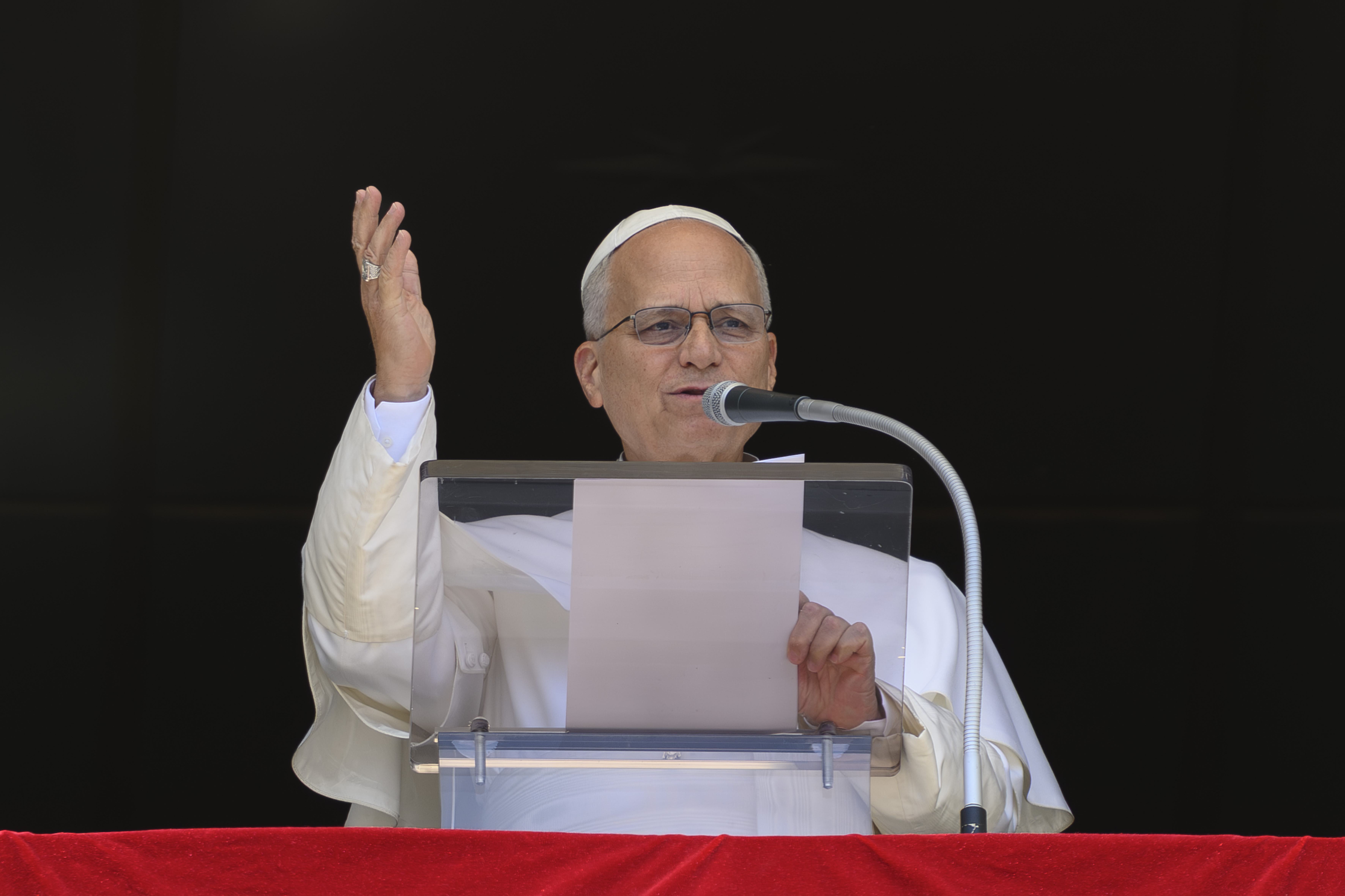
“It is through the Eucharist that even our hands become ‘hands of the Risen One’,” the pope said.

Read More
Chaldean Church chooses Archbishop Amel Nona as patriarch, succeeding Cardinal Sako #Catholic The Chaldean Synod has elected Archbishop Amel Shamon Nona as the new Patriarch of the Chaldean Catholic Church, succeeding Cardinal Louis Raphael Sako, who submitted his resignation to Pope Leo XIV on March 9 amid a financial and legal scandal concerning a former Chaldean bishop in San Diego.The election took place during the synod’s meetings held in Rome since April 9.This election comes at a critical time for both the Chaldean Church and the wider region, amid ongoing political challenges in Iraq and the Middle East, as well as internal ecclesial issues related to unity and the organization of Church life both locally and in the diaspora.Following the election, the Chaldean bishops issued a statement saying:“After deep spiritual and fraternal deliberations, conducted in a spirit of prayer and ecclesial discernment, and mindful of the apostolic responsibility entrusted to them, the Fathers of the Synod elected the Patriarch of the Chaldean Church according to the established canonical procedures. After completing the required ballots, and in accordance with the will expressed by the Synod, His Excellency Archbishop Amel Shamon Nona was elected Patriarch of the Chaldean Church and chose for himself the name His Beatitude Patriarch Mar Paul III Nona.”The statement continued: “His Beatitude accepted the election in accordance with canonical norms, expressing his reliance on God’s grace and his commitment to exercise his patriarchal ministry with fidelity and responsibility, in full communion with the Fathers of the Synod, in service of the unity of the Chaldean Church and its mission in the homeland and the diaspora.”“The Fathers of the Synod raise their prayers to the Lord Jesus Christ, the Good Shepherd, asking that He grant the elected Patriarch wisdom and strength,“ the statement continued. ”They affirm their confidence that this ministry will contribute to strengthening the faithful in their faith, enhancing their unity, and revitalizing the Church’s mission in bearing witness to the Gospel.”The Synod also called on all members of the Chaldean Church — clergy and faithful alike — to unite around the new Patriarch and support him through prayer and shared responsibility for the good of the Church and the growth of its mission.Archbishop Nona was born in Alqosh in northern Iraq in 1967. He was ordained a priest in 1991 after completing his studies at the Patriarchal Seminary in Baghdad. He later pursued higher studies in Rome, earning a doctorate in theological anthropology from the Pontifical Lateran University.He served in the parishes of Alqosh before being appointed Archbishop of Mosul in 2009, during a period marked by escalating violence against Christians in Iraq.During the events of 2014, he left Mosul along with his faithful following the takeover of the city by the terrorist group ISIS, marking a pivotal moment in the modern history of the Chaldean Church.In 2015, the Holy See appointed him head of the Chaldean Eparchy of St. Thomas the Apostle in Australia and New Zealand, where he continued his pastoral ministry among the Chaldean diaspora.His appointment comes following the resignation of Cardinal Raphael Sako, who announced that he submitted his resignation to Pope Leo XIV of his own free will on the morning of March 9 so he could “dedicate himself quietly to prayer, writing, and simple service.”The timing sparked controversy within the Chaldean community. Pope Leo XIV on March 10 accepted the resignation of Bishop Emanuel Shaleta, a Chaldean Catholic bishop arrested in San Diego in March on charges of embezzling Church funds.Sako had allegedly attempted to support or transfer the embattled bishop to a higher position, leading many to question whether the financial scandal played a role in the patriarch’s decision.This story was first published by ACI MENA, the Arabic-language sister service of EWTN News. It has been translated and adapted by EWTN News English.

Chaldean Church chooses Archbishop Amel Nona as patriarch, succeeding Cardinal Sako #Catholic The Chaldean Synod has elected Archbishop Amel Shamon Nona as the new Patriarch of the Chaldean Catholic Church, succeeding Cardinal Louis Raphael Sako, who submitted his resignation to Pope Leo XIV on March 9 amid a financial and legal scandal concerning a former Chaldean bishop in San Diego.The election took place during the synod’s meetings held in Rome since April 9.This election comes at a critical time for both the Chaldean Church and the wider region, amid ongoing political challenges in Iraq and the Middle East, as well as internal ecclesial issues related to unity and the organization of Church life both locally and in the diaspora.Following the election, the Chaldean bishops issued a statement saying:“After deep spiritual and fraternal deliberations, conducted in a spirit of prayer and ecclesial discernment, and mindful of the apostolic responsibility entrusted to them, the Fathers of the Synod elected the Patriarch of the Chaldean Church according to the established canonical procedures. After completing the required ballots, and in accordance with the will expressed by the Synod, His Excellency Archbishop Amel Shamon Nona was elected Patriarch of the Chaldean Church and chose for himself the name His Beatitude Patriarch Mar Paul III Nona.”The statement continued: “His Beatitude accepted the election in accordance with canonical norms, expressing his reliance on God’s grace and his commitment to exercise his patriarchal ministry with fidelity and responsibility, in full communion with the Fathers of the Synod, in service of the unity of the Chaldean Church and its mission in the homeland and the diaspora.”“The Fathers of the Synod raise their prayers to the Lord Jesus Christ, the Good Shepherd, asking that He grant the elected Patriarch wisdom and strength,“ the statement continued. ”They affirm their confidence that this ministry will contribute to strengthening the faithful in their faith, enhancing their unity, and revitalizing the Church’s mission in bearing witness to the Gospel.”The Synod also called on all members of the Chaldean Church — clergy and faithful alike — to unite around the new Patriarch and support him through prayer and shared responsibility for the good of the Church and the growth of its mission.Archbishop Nona was born in Alqosh in northern Iraq in 1967. He was ordained a priest in 1991 after completing his studies at the Patriarchal Seminary in Baghdad. He later pursued higher studies in Rome, earning a doctorate in theological anthropology from the Pontifical Lateran University.He served in the parishes of Alqosh before being appointed Archbishop of Mosul in 2009, during a period marked by escalating violence against Christians in Iraq.During the events of 2014, he left Mosul along with his faithful following the takeover of the city by the terrorist group ISIS, marking a pivotal moment in the modern history of the Chaldean Church.In 2015, the Holy See appointed him head of the Chaldean Eparchy of St. Thomas the Apostle in Australia and New Zealand, where he continued his pastoral ministry among the Chaldean diaspora.His appointment comes following the resignation of Cardinal Raphael Sako, who announced that he submitted his resignation to Pope Leo XIV of his own free will on the morning of March 9 so he could “dedicate himself quietly to prayer, writing, and simple service.”The timing sparked controversy within the Chaldean community. Pope Leo XIV on March 10 accepted the resignation of Bishop Emanuel Shaleta, a Chaldean Catholic bishop arrested in San Diego in March on charges of embezzling Church funds.Sako had allegedly attempted to support or transfer the embattled bishop to a higher position, leading many to question whether the financial scandal played a role in the patriarch’s decision.This story was first published by ACI MENA, the Arabic-language sister service of EWTN News. It has been translated and adapted by EWTN News English.

His appointment comes following the resignation of Cardinal Raphael Sako, who submitted his resignation to Pope Leo XIV on March 9 amid a legal and financial scandal surrounding a former bishop.

Read More
8,645 candles light Finland’s Parliament in pro-life vigil for unborn #Catholic HELSINKI — Thousands of candles illuminated the steps of Finlandʼs Parliament in Helsinki on March 21 as pro-life advocates held a public vigil commemorating children lost to abortion.Organized by the Finnish pro-life group Oikeus elämään ry, the “Muistamme” (“In remembrance”) event featured 8,645 candles, one for each abortion performed in Finland in 2024. Johannes Laitinen, one of the eventʼs organizers, said approximately 100 preselected participants were invited to light the candles, chosen because of their personal connection to the loss of children through abortion. Members of the public were also given the opportunity to take part in the candle lighting during the vigil.
 
 Johannes Laitinen, one of the organizers of the “Muistamme” pro-life vigil held outside Finland’s Parliament in Helsinki on March 21, 2026. | Credit: Miika Soininen
 
 After the candles were lit, participants observed a minute of silence, while volunteers remained through the night as the display continued glowing in central Helsinki.A public witness in the heart of HelsinkiSpeaking to EWTN News, Kirsi Morgan-MacKay, chairman of Finlandʼs Right to Life Association, said the vigil sought both to honor the unborn and to confront the public with the scale of abortion in the country. “The event created a visual that touched peopleʼs hearts and perhaps made them stop and think about how many children are actually lost every year through abortion,” she said.Morgan-MacKay added that the vigil also aimed to acknowledge the often-unspoken grief experienced by women and families affected by abortion.
 
 The full display of 8,645 candles glows on the steps of Finland’s Parliament in Helsinki on the night of March 21, 2026. | Credit: Jaakko Haapanen
 
 She noted that leaders from multiple Christian denominations attended the event, which organizers viewed as an encouraging sign of broader ecclesial engagement. “We have always hoped that churches would come together to defend the lives of unborn children,” she said, explaining that abortion is not merely political but “a spiritual, ethical, and moral issue.”A prayer gathering was also held in connection with the vigil at Luther Church in Helsinki, where clergy from Lutheran, Presbyterian, and Catholic communities offered prayers. Representing the Catholic Church, Jean Claude Kabeza, vicar general of the Diocese of Helsinki, conveyed greetings from Bishop Raimo Goyarrola.Finlandʼs welfare state and the limits of social supportWhile happy about Finlandʼs reputation for its strong social welfare system, Morgan-MacKay noted that many women facing crisis pregnancies still experience profound isolation. “Many women and families are still left alone in the midst of a crisis,” she said, adding that loneliness and lack of support often persist even within families.She also observed that in Finland, the lives of unborn children often go unvalued when a pregnancy is unwanted. She pointed out that women confronted with an unplanned pregnancy, sometimes in shock, may see abortion as an “easy” way out, particularly since medical abortion is frequently presented as a simple “procedure.”
 
 Pro-life advocates carry the “Muistamme” banner through central Helsinki during the candlelit vigil on March 21, 2026. | Credit: Miika Soininen
 
 Morgan-MacKay also drew attention to Finlandʼs liberalized abortion framework, particularly the increased accessibility of medical abortion, arguing that women may be pressured into rushed decisions without adequate counseling.“Sometimes the health care system offers abortion as the only option,” she said. “Many times, these women need space to pause, think everything through, and receive real support.”She added that while Finlandʼs pro-life movement remains relatively small, it is gradually growing, with increased awareness of abortionʼs broader social and personal consequences. She expressed particular encouragement at the involvement of younger supporters, especially young men, saying she believes “God is raising up a new generation of pro-lifers” as more Finns begin speaking openly about the issue.A bishopʼs medical perspective on abortionEWTN News also spoke with Goyarrola, who said he remains hopeful that Finland can become more receptive to pro-life values, despite abortion remaining a sensitive and often taboo topic in public life.Goyarrolaʼs comments carry added weight in Finlandʼs abortion debates because of his medical background. Before entering the priesthood, he trained as a physician, graduating with a degree in medicine and surgery from the University of Navarra in Spain in 1992, and has pursued doctoral research in palliative care at the University of Eastern Finland since 2022.
 
 Spanish Opus Dei priest announced as new Helsinki bishop
 
 Drawing on his medical knowledge, he has also written extensively on social issues for general audiences, authoring “Ihmiselämää äidin kohdussa” (“Human Life in the Womb”), on abortion, and “Arvokas kuolema” (“A Dignified Death”), on euthanasia. Both books were widely praised for making complex bioethical questions accessible to ordinary readers.Reflecting on his experience, Goyarrola said that with regard to discussing abortion, conversations require clarity and compassion rather than confrontation.“I believe that positive language is what truly reaches people and opens hearts to reflection,” he said. “The Church speaks in defense of life by offering real solutions to real problems and proposing ways to prevent abortion.”“No one celebrates abortion as a joyful experience,” he added.Signs of change among younger FinnsAssessing the broader cultural climate, Goyarrola said abortion has historically remained difficult to discuss openly in Finnish society. “Abortion has long been a taboo subject in Finland, and to a large extent it still is,” he said, noting that public discourse is often narrowly framed around “the womanʼs right to her own body.”Yet the bishop said younger generations appear increasingly willing to engage the issue more thoughtfully. “Among young people, the topic is beginning to be discussed more openly, and with many serious questions,” he noted.
 
 Participants light some of the 8,645 candles on the steps of Finlandʼs Parliament in Helsinki on March 21, 2026, one for each abortion performed in Finland in 2024. | Credit: Jaakko Haapanen
 
 Goyarrola explained that because over 90% of abortions in Finland are carried out for social rather than medical reasons, the underlying causes must be addressed socially as well. He called for “better education, access to information, healthier lifestyles, and more personal responsibility and support for marriage and family life.”He added that the Church must continue promoting a concrete vision of family and human dignity, saying: “We aim to promote a culture that values life, family, and hope.” He also noted that the Catholic Church in Finland tries to speak about the “need for more children in society,” not for economic or labor-related reasons but rather for the future of Finnish society itself.“I hope that we can speak about abortion and about life in the motherʼs womb without prejudice, in a rational and thoughtful way,” Goyarrola added. “Only through open and respectful conversation can we better understand the complexity of the issue and seek humane and responsible solutions.”

8,645 candles light Finland’s Parliament in pro-life vigil for unborn #Catholic HELSINKI — Thousands of candles illuminated the steps of Finlandʼs Parliament in Helsinki on March 21 as pro-life advocates held a public vigil commemorating children lost to abortion.Organized by the Finnish pro-life group Oikeus elämään ry, the “Muistamme” (“In remembrance”) event featured 8,645 candles, one for each abortion performed in Finland in 2024. Johannes Laitinen, one of the eventʼs organizers, said approximately 100 preselected participants were invited to light the candles, chosen because of their personal connection to the loss of children through abortion. Members of the public were also given the opportunity to take part in the candle lighting during the vigil. Johannes Laitinen, one of the organizers of the “Muistamme” pro-life vigil held outside Finland’s Parliament in Helsinki on March 21, 2026. | Credit: Miika Soininen After the candles were lit, participants observed a minute of silence, while volunteers remained through the night as the display continued glowing in central Helsinki.A public witness in the heart of HelsinkiSpeaking to EWTN News, Kirsi Morgan-MacKay, chairman of Finlandʼs Right to Life Association, said the vigil sought both to honor the unborn and to confront the public with the scale of abortion in the country. “The event created a visual that touched peopleʼs hearts and perhaps made them stop and think about how many children are actually lost every year through abortion,” she said.Morgan-MacKay added that the vigil also aimed to acknowledge the often-unspoken grief experienced by women and families affected by abortion. The full display of 8,645 candles glows on the steps of Finland’s Parliament in Helsinki on the night of March 21, 2026. | Credit: Jaakko Haapanen She noted that leaders from multiple Christian denominations attended the event, which organizers viewed as an encouraging sign of broader ecclesial engagement. “We have always hoped that churches would come together to defend the lives of unborn children,” she said, explaining that abortion is not merely political but “a spiritual, ethical, and moral issue.”A prayer gathering was also held in connection with the vigil at Luther Church in Helsinki, where clergy from Lutheran, Presbyterian, and Catholic communities offered prayers. Representing the Catholic Church, Jean Claude Kabeza, vicar general of the Diocese of Helsinki, conveyed greetings from Bishop Raimo Goyarrola.Finlandʼs welfare state and the limits of social supportWhile happy about Finlandʼs reputation for its strong social welfare system, Morgan-MacKay noted that many women facing crisis pregnancies still experience profound isolation. “Many women and families are still left alone in the midst of a crisis,” she said, adding that loneliness and lack of support often persist even within families.She also observed that in Finland, the lives of unborn children often go unvalued when a pregnancy is unwanted. She pointed out that women confronted with an unplanned pregnancy, sometimes in shock, may see abortion as an “easy” way out, particularly since medical abortion is frequently presented as a simple “procedure.” Pro-life advocates carry the “Muistamme” banner through central Helsinki during the candlelit vigil on March 21, 2026. | Credit: Miika Soininen Morgan-MacKay also drew attention to Finlandʼs liberalized abortion framework, particularly the increased accessibility of medical abortion, arguing that women may be pressured into rushed decisions without adequate counseling.“Sometimes the health care system offers abortion as the only option,” she said. “Many times, these women need space to pause, think everything through, and receive real support.”She added that while Finlandʼs pro-life movement remains relatively small, it is gradually growing, with increased awareness of abortionʼs broader social and personal consequences. She expressed particular encouragement at the involvement of younger supporters, especially young men, saying she believes “God is raising up a new generation of pro-lifers” as more Finns begin speaking openly about the issue.A bishopʼs medical perspective on abortionEWTN News also spoke with Goyarrola, who said he remains hopeful that Finland can become more receptive to pro-life values, despite abortion remaining a sensitive and often taboo topic in public life.Goyarrolaʼs comments carry added weight in Finlandʼs abortion debates because of his medical background. Before entering the priesthood, he trained as a physician, graduating with a degree in medicine and surgery from the University of Navarra in Spain in 1992, and has pursued doctoral research in palliative care at the University of Eastern Finland since 2022. Spanish Opus Dei priest announced as new Helsinki bishop Drawing on his medical knowledge, he has also written extensively on social issues for general audiences, authoring “Ihmiselämää äidin kohdussa” (“Human Life in the Womb”), on abortion, and “Arvokas kuolema” (“A Dignified Death”), on euthanasia. Both books were widely praised for making complex bioethical questions accessible to ordinary readers.Reflecting on his experience, Goyarrola said that with regard to discussing abortion, conversations require clarity and compassion rather than confrontation.“I believe that positive language is what truly reaches people and opens hearts to reflection,” he said. “The Church speaks in defense of life by offering real solutions to real problems and proposing ways to prevent abortion.”“No one celebrates abortion as a joyful experience,” he added.Signs of change among younger FinnsAssessing the broader cultural climate, Goyarrola said abortion has historically remained difficult to discuss openly in Finnish society. “Abortion has long been a taboo subject in Finland, and to a large extent it still is,” he said, noting that public discourse is often narrowly framed around “the womanʼs right to her own body.”Yet the bishop said younger generations appear increasingly willing to engage the issue more thoughtfully. “Among young people, the topic is beginning to be discussed more openly, and with many serious questions,” he noted. Participants light some of the 8,645 candles on the steps of Finlandʼs Parliament in Helsinki on March 21, 2026, one for each abortion performed in Finland in 2024. | Credit: Jaakko Haapanen Goyarrola explained that because over 90% of abortions in Finland are carried out for social rather than medical reasons, the underlying causes must be addressed socially as well. He called for “better education, access to information, healthier lifestyles, and more personal responsibility and support for marriage and family life.”He added that the Church must continue promoting a concrete vision of family and human dignity, saying: “We aim to promote a culture that values life, family, and hope.” He also noted that the Catholic Church in Finland tries to speak about the “need for more children in society,” not for economic or labor-related reasons but rather for the future of Finnish society itself.“I hope that we can speak about abortion and about life in the motherʼs womb without prejudice, in a rational and thoughtful way,” Goyarrola added. “Only through open and respectful conversation can we better understand the complexity of the issue and seek humane and responsible solutions.”

Organizers of the “Muistamme” vigil lit one candle for each of the 8,645 abortions performed in Finland in 2024, drawing Catholic, Lutheran, and Presbyterian clergy together in central Helsinki.

Read More
Vatican urges Catholics not to leave Pope Leo XIV alone in opposing war #Catholic VATICAN CITY — Vatican Secretary of State Cardinal Pietro Parolin warned that the “logic of the strongest” risks prevailing on the international stage and called on Christians to become “voices of peace” who do not leave Pope Leo XIV standing alone in his opposition to war.In an interview with Dialoghi, a cultural magazine linked to Italian Catholic Action, Parolin said the voice of the pope is “prophetic” but risks becoming “a voice crying in the wilderness if it is not supported and helped concretely.”His remarks also offer a key to understanding the peace prayer vigil Leo XIV has called for April 11 in St. Peter’s Basilica.Parolin recalled the 2003 Iraq war, when St. John Paul II pleaded for the conflict to be avoided but “was left alone.” He therefore stressed the need to support the current pontiff’s appeal for a peace that is “unarmed and disarming” and to reject “the false propaganda of rearmament.”“There is a need for more voices of peace, more voices against the madness of the rush toward rearmament, more voices raised in favor of our poorest brothers and sisters, more voices and more proposals — I am thinking, for example, of the world of Catholic universities — for new economic models inspired by justice and care for the weakest instead of the idolatry of money,” Parolin said.The cardinal described an alarming international climate in which military action appears to impose itself too easily.“I am struck by how much determination — I was about to say ease — with which the military option is presented as decisive, almost inevitable,” he said.According to the Vatican secretary of state, this trend has left diplomacy practically “mute,” unable to activate alternative tools, while awareness of the tragedy of war and the value of shared rules is being lost.Parolin said the root of the problem is a “multi-polarism inspired by the primacy of power,” in which states place greater trust in force than in international law. That, he said, has produced “double standards,” visible in the differing reactions to attacks on civilians in Ukraine and the destruction in Gaza.“Many governments,” Parolin said, “have expressed indignation over attacks against Ukrainian civilians by Russian missiles and drones, imposing sanctions on the aggressors.”“I do not think the same has happened with the tragedy of the destruction of Gaza,” he added.For the cardinal, this is a case of “double standards” tied to the “primacy of power” — the dominance of one’s own country over others — with international law invoked “only when convenient” and ignored in many other cases.“It seems there has been a lack of awareness of the value of peace, awareness of the tragic reality of war, awareness of the importance of shared rules and of respecting them,” he said.Parolin also lamented the weakening of the global diplomatic architecture and said it is “utopian” to think peace can be guaranteed “by weapons and by balances imposed by the strongest rather than by international agreements.”“We cannot surrender to the logic of the strongest,” the cardinal insisted, because that logic “bends international law to its own interests” and weakens multilateral institutions.In that context, he also expressed regret that Europe has been unable to speak with one voice. He said it is necessary “to rekindle in peoples the sense of European belonging and, in leadership, the awareness of the need for common actions without ever failing the principles that are at the foundation of the European Union itself.”Regarding the United Nations, Parolin said the Holy See “continues to believe in its importance,” considering international organizations essential for restraining the logic of the strongest. At the same time, he acknowledged that the use of the veto has limited the U.N.’s ability to act.“We cannot move from the force of law to the law of force,” he warned.Parolin also highlighted the role believers can play, including defending life and human dignity, protecting religious freedom, promoting reforms to the economic and financial system in line with the Church’s social doctrine, and caring for creation.Finally, the cardinal addressed the cultural impact of new technologies, saying hyper-connectivity and the spread of fake news help fuel fear and build new walls.“As Christians, we must oppose this drift with our daily lives,” he concluded.This story was first published by ACI Prensa, the Spanish-language sister service of EWTN News. It has been translated and adapted by EWTN News English.

Vatican urges Catholics not to leave Pope Leo XIV alone in opposing war #Catholic VATICAN CITY — Vatican Secretary of State Cardinal Pietro Parolin warned that the “logic of the strongest” risks prevailing on the international stage and called on Christians to become “voices of peace” who do not leave Pope Leo XIV standing alone in his opposition to war.In an interview with Dialoghi, a cultural magazine linked to Italian Catholic Action, Parolin said the voice of the pope is “prophetic” but risks becoming “a voice crying in the wilderness if it is not supported and helped concretely.”His remarks also offer a key to understanding the peace prayer vigil Leo XIV has called for April 11 in St. Peter’s Basilica.Parolin recalled the 2003 Iraq war, when St. John Paul II pleaded for the conflict to be avoided but “was left alone.” He therefore stressed the need to support the current pontiff’s appeal for a peace that is “unarmed and disarming” and to reject “the false propaganda of rearmament.”“There is a need for more voices of peace, more voices against the madness of the rush toward rearmament, more voices raised in favor of our poorest brothers and sisters, more voices and more proposals — I am thinking, for example, of the world of Catholic universities — for new economic models inspired by justice and care for the weakest instead of the idolatry of money,” Parolin said.The cardinal described an alarming international climate in which military action appears to impose itself too easily.“I am struck by how much determination — I was about to say ease — with which the military option is presented as decisive, almost inevitable,” he said.According to the Vatican secretary of state, this trend has left diplomacy practically “mute,” unable to activate alternative tools, while awareness of the tragedy of war and the value of shared rules is being lost.Parolin said the root of the problem is a “multi-polarism inspired by the primacy of power,” in which states place greater trust in force than in international law. That, he said, has produced “double standards,” visible in the differing reactions to attacks on civilians in Ukraine and the destruction in Gaza.“Many governments,” Parolin said, “have expressed indignation over attacks against Ukrainian civilians by Russian missiles and drones, imposing sanctions on the aggressors.”“I do not think the same has happened with the tragedy of the destruction of Gaza,” he added.For the cardinal, this is a case of “double standards” tied to the “primacy of power” — the dominance of one’s own country over others — with international law invoked “only when convenient” and ignored in many other cases.“It seems there has been a lack of awareness of the value of peace, awareness of the tragic reality of war, awareness of the importance of shared rules and of respecting them,” he said.Parolin also lamented the weakening of the global diplomatic architecture and said it is “utopian” to think peace can be guaranteed “by weapons and by balances imposed by the strongest rather than by international agreements.”“We cannot surrender to the logic of the strongest,” the cardinal insisted, because that logic “bends international law to its own interests” and weakens multilateral institutions.In that context, he also expressed regret that Europe has been unable to speak with one voice. He said it is necessary “to rekindle in peoples the sense of European belonging and, in leadership, the awareness of the need for common actions without ever failing the principles that are at the foundation of the European Union itself.”Regarding the United Nations, Parolin said the Holy See “continues to believe in its importance,” considering international organizations essential for restraining the logic of the strongest. At the same time, he acknowledged that the use of the veto has limited the U.N.’s ability to act.“We cannot move from the force of law to the law of force,” he warned.Parolin also highlighted the role believers can play, including defending life and human dignity, protecting religious freedom, promoting reforms to the economic and financial system in line with the Church’s social doctrine, and caring for creation.Finally, the cardinal addressed the cultural impact of new technologies, saying hyper-connectivity and the spread of fake news help fuel fear and build new walls.“As Christians, we must oppose this drift with our daily lives,” he concluded.This story was first published by ACI Prensa, the Spanish-language sister service of EWTN News. It has been translated and adapted by EWTN News English.

The Vatican Secretary of State said the pope’s appeals for peace need concrete support.

Read More
French priest Henri Caffarel, founder of Teams of Our Lady, declared venerable by Pope Leo XIV #Catholic Father Henri Caffarel, a French priest whose apostolate centered on accompanying and guiding married couples on the path to holiness, is one step closer to being canonized.On March 23, Pope Leo XIV recognized the heroic virtues of the newly declared venerable, who maintained that couples are made for happiness and that marriage is a path toward it.With this deep conviction, and conscious of the challenges faced by couples, Caffarel, who was born in Lyon, France, in 1903, founded the movement for marital spirituality known as “Teams of Our Lady” in Paris in 1939.The beginning of a living legacySpaniards Alberto Pérez Bueno and Mercedes Gómez-Ferrer Lozano, the couple in charge of the Teams of Our Lady internationally, have been married for 35 years and have three children. In an interview with ACI Prensa, the Spanish-language sister service of EWTN News, they said the ministry started “with four couples who approached Father Caffarel to ask him how they could live out their faith as a couple.”“He didn’t have an answer at that moment, so he proposed that they embark on a journey of discovery together rooted in the sacrament of holy orders and the sacrament of matrimony. And that‘s how it all began,” Alberto explained.Following World War II, the movement, which is primarily lay-led, grew rapidly; today, it is present in 92 countries and is comprised of more than 15,000 teams.
 
 Father Henri Caffarel. | Credit: Photo courtesy of Alberto Pérez Bueno
 
 Marital communication and prayerMercedes emphasized that from the very beginning, Caffarel saw the need to foster the essentials of marital communication and prayer, convinced that by sharing their problems with one another, many couples could avoid estrangement that sometimes occurs in marriage.The priest, Alberto recalled, said that “the sacrament of matrimony is an image of God” and “probably the most perfect one there is.” The priest said married couples are called to holiness through a life of “work, personal growth, love, patience, and building a life together.”“It‘s not an overnight process but rather a journey undertaken over the course of a lifetime. Father Caffarel invited couples to embark on this path and to attain holiness through their work and their life together,” Alberto emphasized.Mercedes said the priest thought of marriage as a sign “that reflects the love of God” because the relationship of communion that exists between spouses is analogous to the relationship existing among the three Divine Persons: Christ, the Father, and the Holy Spirit.In the priest’s view, the image of marriage allowed for a clearer expression of the idea of ​​a God who is love “and who communicates and expands within his own nature.” From this perspective, “holiness ceases to be understood as a matter of individual effort or moral perfection and is situated instead within the dynamic of love that transforms and animates life,” Mercedes explained.A continuous path of spiritual growthThe organization of the Teams of Our Lady is based on a specific methodology “that goes beyond monthly meetings,” encompassing prayer, dialogue, and personal commitment. Each team consists of five or six married couples, fostering “listening to the word, personal prayer, prayer as a couple and family prayer, and a profound dialogue in the presence of the Lord that we also have every month,” Mercedes explained.Ultimately, it is a matter of “having a rule of life, a set of elements through which you strive to improve your Christian life,” she said. There is also a yearly retreat and a specific study theme each month.Alberto emphasized that the Teams of Our Lady are, in a sense, “precursors of the synodality” promoted by Pope Francis. “It’s a movement that is very nonclerical — though, it must be said, the accompaniment of married couples by priests is essential.”He also noted that “married couples place their time, their skills, their charisms, and their gifts at the service of others in order to build community.” Mercedes, who had the opportunity to meet the now-venerable, recalled that in 1973 he stepped aside after founding the teams, convinced that “if it was a work of the Holy Spirit and possessed a charism for the Church, there was no need for him to stay on.”Leaving the ministry in the laity’s hands, he retired to a house of prayer on the outskirts of Paris, where he began his other “great work”: teaching people how to pray. Mercedes noted that “one of the things he desired most was to teach people how to draw closer to Christ and to serve as an intermediary so that every person could have a personal encounter with God.”
 
 Alberto Pérez Bueno and Mercedes Gómez-Ferrer Lozano, international organizers of Teams of Our Lady. | Credit: Photo courtesy of Alberto Pérez Bueno
 
 The challenges facing married couples todayAlberto and Mercedes explained how married couples today confront new challenges stemming from the pace of life, particularly the “massive entry of women into the workforce,” which has brought different challenges, such as “finding time to be together and talk.”They highlighted Caffarel’s enduring counsel: “Seek out these moments; don’t let them slip away,” for life “sweeps us along like a fast-moving river.They also highlighted the movement’s impact in countries such as Lithuania, with a past marked by communist repression, or in African nations where the teams foster equality, participation, and changes such as abandoning polygamy. This is also true in Europe, where the Teams of Our Lady help strengthen families within increasingly secularized societies.Both highlight the universal impact of the movement: Couples from diverse cultures agree on the benefits received, particularly the “opportunity to pray together” and the realization of “how difficult it would have been without the presence of Christ in their married life.” Ultimately, this is a way of life that responds to a profound desire: Even as sacramental marriages decline, “there is no diminishing of people’s desire to live as a couple.”Mercedes also warned of a growing way of dealing with problems: “At the slightest setback, people are right off tempted to give up,” and the couple is not taught how to “persevere and forgive.” Added to this is “a great fear of commitment” and a tendency to avoid lasting bonds or communities despite the fact that, deep down, people “want to be happy and want to stay together.”For this reason, she emphasized the importance of mutual support and community life: “It‘s fundamental to allow oneself to be helped,” since in her view navigating married life in isolation “is extremely complex.”The teams offer precisely the necessary tools and support: a setting where married couples share their problems and solutions. Drawing upon their own experiences, they particularly encourage young couples to embark on this path of holiness.Both expressed their joy that Caffarel has been declared venerable, a long-awaited recognition following nearly 20 years of going through the beatification process, which continues, awaiting a miracle wrought through his intercession.This story was first published by ACI Prensa, the Spanish-language sister service of EWTN News. It has been translated and adapted by EWTN News English.

French priest Henri Caffarel, founder of Teams of Our Lady, declared venerable by Pope Leo XIV #Catholic Father Henri Caffarel, a French priest whose apostolate centered on accompanying and guiding married couples on the path to holiness, is one step closer to being canonized.On March 23, Pope Leo XIV recognized the heroic virtues of the newly declared venerable, who maintained that couples are made for happiness and that marriage is a path toward it.With this deep conviction, and conscious of the challenges faced by couples, Caffarel, who was born in Lyon, France, in 1903, founded the movement for marital spirituality known as “Teams of Our Lady” in Paris in 1939.The beginning of a living legacySpaniards Alberto Pérez Bueno and Mercedes Gómez-Ferrer Lozano, the couple in charge of the Teams of Our Lady internationally, have been married for 35 years and have three children. In an interview with ACI Prensa, the Spanish-language sister service of EWTN News, they said the ministry started “with four couples who approached Father Caffarel to ask him how they could live out their faith as a couple.”“He didn’t have an answer at that moment, so he proposed that they embark on a journey of discovery together rooted in the sacrament of holy orders and the sacrament of matrimony. And that‘s how it all began,” Alberto explained.Following World War II, the movement, which is primarily lay-led, grew rapidly; today, it is present in 92 countries and is comprised of more than 15,000 teams. Father Henri Caffarel. | Credit: Photo courtesy of Alberto Pérez Bueno Marital communication and prayerMercedes emphasized that from the very beginning, Caffarel saw the need to foster the essentials of marital communication and prayer, convinced that by sharing their problems with one another, many couples could avoid estrangement that sometimes occurs in marriage.The priest, Alberto recalled, said that “the sacrament of matrimony is an image of God” and “probably the most perfect one there is.” The priest said married couples are called to holiness through a life of “work, personal growth, love, patience, and building a life together.”“It‘s not an overnight process but rather a journey undertaken over the course of a lifetime. Father Caffarel invited couples to embark on this path and to attain holiness through their work and their life together,” Alberto emphasized.Mercedes said the priest thought of marriage as a sign “that reflects the love of God” because the relationship of communion that exists between spouses is analogous to the relationship existing among the three Divine Persons: Christ, the Father, and the Holy Spirit.In the priest’s view, the image of marriage allowed for a clearer expression of the idea of ​​a God who is love “and who communicates and expands within his own nature.” From this perspective, “holiness ceases to be understood as a matter of individual effort or moral perfection and is situated instead within the dynamic of love that transforms and animates life,” Mercedes explained.A continuous path of spiritual growthThe organization of the Teams of Our Lady is based on a specific methodology “that goes beyond monthly meetings,” encompassing prayer, dialogue, and personal commitment. Each team consists of five or six married couples, fostering “listening to the word, personal prayer, prayer as a couple and family prayer, and a profound dialogue in the presence of the Lord that we also have every month,” Mercedes explained.Ultimately, it is a matter of “having a rule of life, a set of elements through which you strive to improve your Christian life,” she said. There is also a yearly retreat and a specific study theme each month.Alberto emphasized that the Teams of Our Lady are, in a sense, “precursors of the synodality” promoted by Pope Francis. “It’s a movement that is very nonclerical — though, it must be said, the accompaniment of married couples by priests is essential.”He also noted that “married couples place their time, their skills, their charisms, and their gifts at the service of others in order to build community.” Mercedes, who had the opportunity to meet the now-venerable, recalled that in 1973 he stepped aside after founding the teams, convinced that “if it was a work of the Holy Spirit and possessed a charism for the Church, there was no need for him to stay on.”Leaving the ministry in the laity’s hands, he retired to a house of prayer on the outskirts of Paris, where he began his other “great work”: teaching people how to pray. Mercedes noted that “one of the things he desired most was to teach people how to draw closer to Christ and to serve as an intermediary so that every person could have a personal encounter with God.” Alberto Pérez Bueno and Mercedes Gómez-Ferrer Lozano, international organizers of Teams of Our Lady. | Credit: Photo courtesy of Alberto Pérez Bueno The challenges facing married couples todayAlberto and Mercedes explained how married couples today confront new challenges stemming from the pace of life, particularly the “massive entry of women into the workforce,” which has brought different challenges, such as “finding time to be together and talk.”They highlighted Caffarel’s enduring counsel: “Seek out these moments; don’t let them slip away,” for life “sweeps us along like a fast-moving river.They also highlighted the movement’s impact in countries such as Lithuania, with a past marked by communist repression, or in African nations where the teams foster equality, participation, and changes such as abandoning polygamy. This is also true in Europe, where the Teams of Our Lady help strengthen families within increasingly secularized societies.Both highlight the universal impact of the movement: Couples from diverse cultures agree on the benefits received, particularly the “opportunity to pray together” and the realization of “how difficult it would have been without the presence of Christ in their married life.” Ultimately, this is a way of life that responds to a profound desire: Even as sacramental marriages decline, “there is no diminishing of people’s desire to live as a couple.”Mercedes also warned of a growing way of dealing with problems: “At the slightest setback, people are right off tempted to give up,” and the couple is not taught how to “persevere and forgive.” Added to this is “a great fear of commitment” and a tendency to avoid lasting bonds or communities despite the fact that, deep down, people “want to be happy and want to stay together.”For this reason, she emphasized the importance of mutual support and community life: “It‘s fundamental to allow oneself to be helped,” since in her view navigating married life in isolation “is extremely complex.”The teams offer precisely the necessary tools and support: a setting where married couples share their problems and solutions. Drawing upon their own experiences, they particularly encourage young couples to embark on this path of holiness.Both expressed their joy that Caffarel has been declared venerable, a long-awaited recognition following nearly 20 years of going through the beatification process, which continues, awaiting a miracle wrought through his intercession.This story was first published by ACI Prensa, the Spanish-language sister service of EWTN News. It has been translated and adapted by EWTN News English.

A married couple that leads the Teams of Our Lady, founded by newly-declared Venerable Father Henri Caffarel, explains how this lay apostolate helps couples grow together in holiness.

Read More
On Easter Monday, Pope Leo XIV remembers those ‘tormented’ by war: ‘The truth does not remain hidden’ #Catholic On his first Easter Monday as pope, Leo XIV appeared at the window of the Apostolic Palace under bright sunshine and clear skies to lead the Regina Caeli with thousands of pilgrims gathered in St. Peter’s Square.“Dear brothers and sisters, Christ is risen! Happy Easter!“ he exclaimed. “This greeting, full of wonder and joy, will accompany us throughout the week. As we celebrate this new day that the Lord has made for us, the liturgy celebrates the entrance of all creation into the time of salvation: The despair of death has been banished forever, in the name of Jesus.”He continued: “Today’s Gospel asks us to choose between two accounts: that of the women, who encountered the Risen One, or that of the guards, who were bribed by the leaders of the Sanhedrin.” The women proclaim “the victory of Christ over death,” while the guards “proclaim that death always wins, no matter what,” the pope said, illustrating two opposing versions of the same event. In the guards’ version, Christ did not rise, “but his body was stolen,” the pope recalled. From this comes the fact that “from the same event — the empty tomb — two interpretations spring forth: One is a source of new and eternal life, the other of certain and definitive death,” he explained.This contrast “makes us reflect on the value of Christian witness and the honesty of human communication. Often, in fact, the telling of the truth is obscured by what we today call fake news — that is, lies, insinuations, and baseless accusations. Yet in the face of such obstacles, the truth does not remain hidden; on the contrary, it comes to meet us, alive and radiant, illuminating even the densest darkness,” he continued.Christ is the good news to be proclaimed to the world, he said: “The Lord’s passover is our passover, the passover of humanity, because this man, who died for us, is the Son of God, who gave his life for us.”Leo then turned his thoughts to “peoples tormented by war, to Christians persecuted for their faith, and to children deprived of education. To announce the passover of Christ in words and deeds means giving new voice to hope, otherwise stifled by the hands of the violent.”Finally, he remembered Pope Francis, “who exactly one year ago, on Easter Monday, entrusted his life to the Lord. As we recall his great witness of faith and love, let us pray together to the Virgin Mary, Seat of Wisdom, so that we may become ever brighter heralds of the truth.”After reciting the Marian prayer, Pope Leo XIV added a few more words: “I thank the initiatives promoted for the International Day of Sport for Development and Peace, and I renew the appeal that sport, with its universal language of fraternity, may be a place of inclusion and peace. I thank all those who in these days have sent me Easter greetings. I am especially grateful for the prayers. Through the intercession of the Virgin Mary, may God reward each one with his gifts.” He concluded: “I wish you a joyful and faithful celebration of this Easter Monday and these days of the Octave of Easter, during which the celebration of Christ’s resurrection continues. Let us persevere in invoking the gift of peace for the whole world.”This story was first published by ACI Stampa, the Italian-language sister service of EWTN News. It has been translated and adapted by EWTN News English.

On Easter Monday, Pope Leo XIV remembers those ‘tormented’ by war: ‘The truth does not remain hidden’ #Catholic On his first Easter Monday as pope, Leo XIV appeared at the window of the Apostolic Palace under bright sunshine and clear skies to lead the Regina Caeli with thousands of pilgrims gathered in St. Peter’s Square.“Dear brothers and sisters, Christ is risen! Happy Easter!“ he exclaimed. “This greeting, full of wonder and joy, will accompany us throughout the week. As we celebrate this new day that the Lord has made for us, the liturgy celebrates the entrance of all creation into the time of salvation: The despair of death has been banished forever, in the name of Jesus.”He continued: “Today’s Gospel asks us to choose between two accounts: that of the women, who encountered the Risen One, or that of the guards, who were bribed by the leaders of the Sanhedrin.” The women proclaim “the victory of Christ over death,” while the guards “proclaim that death always wins, no matter what,” the pope said, illustrating two opposing versions of the same event. In the guards’ version, Christ did not rise, “but his body was stolen,” the pope recalled. From this comes the fact that “from the same event — the empty tomb — two interpretations spring forth: One is a source of new and eternal life, the other of certain and definitive death,” he explained.This contrast “makes us reflect on the value of Christian witness and the honesty of human communication. Often, in fact, the telling of the truth is obscured by what we today call fake news — that is, lies, insinuations, and baseless accusations. Yet in the face of such obstacles, the truth does not remain hidden; on the contrary, it comes to meet us, alive and radiant, illuminating even the densest darkness,” he continued.Christ is the good news to be proclaimed to the world, he said: “The Lord’s passover is our passover, the passover of humanity, because this man, who died for us, is the Son of God, who gave his life for us.”Leo then turned his thoughts to “peoples tormented by war, to Christians persecuted for their faith, and to children deprived of education. To announce the passover of Christ in words and deeds means giving new voice to hope, otherwise stifled by the hands of the violent.”Finally, he remembered Pope Francis, “who exactly one year ago, on Easter Monday, entrusted his life to the Lord. As we recall his great witness of faith and love, let us pray together to the Virgin Mary, Seat of Wisdom, so that we may become ever brighter heralds of the truth.”After reciting the Marian prayer, Pope Leo XIV added a few more words: “I thank the initiatives promoted for the International Day of Sport for Development and Peace, and I renew the appeal that sport, with its universal language of fraternity, may be a place of inclusion and peace. I thank all those who in these days have sent me Easter greetings. I am especially grateful for the prayers. Through the intercession of the Virgin Mary, may God reward each one with his gifts.” He concluded: “I wish you a joyful and faithful celebration of this Easter Monday and these days of the Octave of Easter, during which the celebration of Christ’s resurrection continues. Let us persevere in invoking the gift of peace for the whole world.”This story was first published by ACI Stampa, the Italian-language sister service of EWTN News. It has been translated and adapted by EWTN News English.

Upon the recitation of the Regina Caeli, the pope also remembered Pope Francis, who died a year ago on Easter Monday.

Read More
Government of Cuba announces release of more than 2,000 prisoners for Easter #Catholic The Cuban government announced the release of 2,010 prisoners for Easter on April 2 — the highest number in recent years — amid pressure from the administration of U.S. President Donald Trump.This measure was granted after a “pardon approved by the Government of Cuba” and after the analysis of a series of circumstances of the prisoners, such as “good behavior maintained in prison, having extinguished an important part of their sanction and state of health,” according to a note from the Cuban Ministry of Foreign Affairs.Among the released prisoners are young people, women, and people over 60 years old. Excluded from the release were those who have committed crimes such as sexual assault, pedophilia with violence, murder, robbery with violence or force with weapons, and “crimes against authority.”Specifying that it was the “second release” of 2026, the ministry said that the pardons were announced “in the context of the religious celebrations of Holy Week.”The statement pointed out that this is the governmentʼs “fifth pardon” since 2011, by which a total of “more than 11,000 people have been released.”In March of this year, the Cuban government announced that it would release 51 prisoners “in the spirit of good will, of close and fluid relations between the Cuban State and the Vatican.”The release comes as the United States has been cutting off the oil supply in Cuba as a way to pressure the regime to make various political and economic reforms. Much of the Cuban population has also been experiencing a serious humanitarian emergency due to a lack of food, medicine and health, among other shortcomings.Palm Beach, Florida Bishop Manuel de Jesús Rodríguez, himself a native of the Dominican Republican, recently wrote in a March 27 column that he found in Cuba "a deep and increasing humanitarian crisis: raw, visible and deeply human."The prelate said that “prayer must lead to action.” To that end, the Diocese of Palm Beach is collaborating with the Cuban bishops to find “all possible ways to provide concrete assistance, especially in urgent areas of food and medical care.” “This job is not optional. It is a moral imperative,” he said.This report was originally published by ACI Prensa, the Spanish-language sister service of EWTN News. It has been translated and adapted by EWTN News English.

Government of Cuba announces release of more than 2,000 prisoners for Easter #Catholic The Cuban government announced the release of 2,010 prisoners for Easter on April 2 — the highest number in recent years — amid pressure from the administration of U.S. President Donald Trump.This measure was granted after a “pardon approved by the Government of Cuba” and after the analysis of a series of circumstances of the prisoners, such as “good behavior maintained in prison, having extinguished an important part of their sanction and state of health,” according to a note from the Cuban Ministry of Foreign Affairs.Among the released prisoners are young people, women, and people over 60 years old. Excluded from the release were those who have committed crimes such as sexual assault, pedophilia with violence, murder, robbery with violence or force with weapons, and “crimes against authority.”Specifying that it was the “second release” of 2026, the ministry said that the pardons were announced “in the context of the religious celebrations of Holy Week.”The statement pointed out that this is the governmentʼs “fifth pardon” since 2011, by which a total of “more than 11,000 people have been released.”In March of this year, the Cuban government announced that it would release 51 prisoners “in the spirit of good will, of close and fluid relations between the Cuban State and the Vatican.”The release comes as the United States has been cutting off the oil supply in Cuba as a way to pressure the regime to make various political and economic reforms. Much of the Cuban population has also been experiencing a serious humanitarian emergency due to a lack of food, medicine and health, among other shortcomings.Palm Beach, Florida Bishop Manuel de Jesús Rodríguez, himself a native of the Dominican Republican, recently wrote in a March 27 column that he found in Cuba "a deep and increasing humanitarian crisis: raw, visible and deeply human."The prelate said that “prayer must lead to action.” To that end, the Diocese of Palm Beach is collaborating with the Cuban bishops to find “all possible ways to provide concrete assistance, especially in urgent areas of food and medical care.” “This job is not optional. It is a moral imperative,” he said.This report was originally published by ACI Prensa, the Spanish-language sister service of EWTN News. It has been translated and adapted by EWTN News English.

The government said it was making the release “in the context of the religious celebrations of Holy Week.”

Read More
Adult conversions soar in dioceses across U.S. #Catholic Many U.S. dioceses are expecting heavy increases in people joining the Catholic Church at Easter 2026, including some with record highs, a survey by the National Catholic Register, the sister partner of EWTN News, found.“Something’s happening,” said John Helsey, director of communications for the Archdiocese of Oklahoma City, which is expecting a 57% increase in unbaptized people becoming Catholics at Easter — from 635 in 2025 to nearly 1,000 in 2026.In most places, this year’s increases aren’t a one-off but follow significant increases in recent years.One example is the Archdiocese of Newark, New Jersey, which had record highs attending liturgies several weeks ago that were meant to welcome would-be converts who have been preparing to enter the Church in recent months and to formalize their status.Newark is expecting a 30% jump in converts in 2026 (at 1,701) over 2025 (at 1,305). The 2026 figure is 60% higher than the 1,064 converts in 2019, the year before the COVID-19 pandemic.In the Archdiocese of Mobile, Alabama, the number of converts in 2025 (447) was the highest since at least 2014, and the number in 2026 (603) is 35% higher than in 2025.The Register recently contacted all 175 Latin-rite territorial dioceses in the United States, seeking numbers of people planning to join the Catholic Church at Easter 2026.Seventy-one, or 40% of U.S. dioceses, responded. In some cases, the Register used published sources to supplement the data it used in its analysis. In all cases, the Register attempted to make apples-to-apples comparisons, with the caveat that 2026 numbers aren’t set yet.Just five of the 71 dioceses expected a drop in converts this year, most of them slight. The remaining 66 are expecting increases — in many cases, significant ones.This year’s expected increases in converts in the United States include regions where the Church has been growing rapidly in recent decades, such as Florida, where the Diocese of St. Petersburg is expecting an 84% jump, and Texas, where the Diocese of Austin is expecting a 53% jump.But it also includes highly secularized New England, where the Archdiocese of Boston has 55% more catechumens (unbaptized) this year than last year. The Diocese of Manchester, New Hampshire, reported a 54% increase (including already-baptized and unbaptized); the Diocese of Providence has 76% more converts; and the Diocese of Norwich, Connecticut, is recording a 112% spike.In Pennsylvania, the dioceses of Harrisburg (77%) and Altoona-Johnstown (84%) are seeing big increases. Across the country, the Diocese of Pueblo, Colorado, is expecting a 105% increase.In the Archdiocese of Philadelphia, which is expecting a 60% increase in converts in 2026 over last year, a priest who oversees conversion programs said people seeking to join the Catholic Church tend to come to Mass and have an active prayer life before they ever attend formal sessions with catechists and that they tend to accept Church teachings earlier in the process than their predecessors did.“I have noticed over the last several years that there is a greater commitment to conversion, a greater commitment to the Church, when they arrive,” said Father Dennis Gill, director of the Office for Divine Worship for the Archdiocese of Philadelphia and rector of the Cathedral Basilica of Sts. Peter and Paul.Other factorsAs for why it’s happening, diocesan officials offered various theories.Immigration, particularly from the surge during the Biden administration, is a factor in some places. Some suggest the election in May 2025 of Pope Leo XIV, the first American pope, who describes Church teachings with a native accent unfiltered by translation, might also be a draw for some non-Catholics. Some diocesan officials shared a new emphasis on outreach to non-Catholics.Bishop Frank Dewane, who leads the Diocese of Venice, Florida, which is expecting a 94% increase in converts, noted that some places outside the United States are also seeing big increases this year, including England and France.He told the Register the Church is enjoying what he called “a golden age of Catholic resources,” including podcasts and other online sources that get information about the Church to people who would ordinarily never set foot in it and yet come to find Catholicism unexpectedly attractive.“Our modern culture has not borne good fruits, and I think people see that. They recognize that. They know that,” Dewane said.But ultimately, he and other Church officials the Register spoke with attributed the bountiful harvest to God.“It’s the Holy Spirit,” Dewane emphasized. “Yes, we follow promptings, also. But I think it’s the work of the Holy Spirit right now in society and in the Church.”This story was first published by the National Catholic Register, the sister partner of EWTN News, and has been adapted by EWTN News.

Adult conversions soar in dioceses across U.S. #Catholic Many U.S. dioceses are expecting heavy increases in people joining the Catholic Church at Easter 2026, including some with record highs, a survey by the National Catholic Register, the sister partner of EWTN News, found.“Something’s happening,” said John Helsey, director of communications for the Archdiocese of Oklahoma City, which is expecting a 57% increase in unbaptized people becoming Catholics at Easter — from 635 in 2025 to nearly 1,000 in 2026.In most places, this year’s increases aren’t a one-off but follow significant increases in recent years.One example is the Archdiocese of Newark, New Jersey, which had record highs attending liturgies several weeks ago that were meant to welcome would-be converts who have been preparing to enter the Church in recent months and to formalize their status.Newark is expecting a 30% jump in converts in 2026 (at 1,701) over 2025 (at 1,305). The 2026 figure is 60% higher than the 1,064 converts in 2019, the year before the COVID-19 pandemic.In the Archdiocese of Mobile, Alabama, the number of converts in 2025 (447) was the highest since at least 2014, and the number in 2026 (603) is 35% higher than in 2025.The Register recently contacted all 175 Latin-rite territorial dioceses in the United States, seeking numbers of people planning to join the Catholic Church at Easter 2026.Seventy-one, or 40% of U.S. dioceses, responded. In some cases, the Register used published sources to supplement the data it used in its analysis. In all cases, the Register attempted to make apples-to-apples comparisons, with the caveat that 2026 numbers aren’t set yet.Just five of the 71 dioceses expected a drop in converts this year, most of them slight. The remaining 66 are expecting increases — in many cases, significant ones.This year’s expected increases in converts in the United States include regions where the Church has been growing rapidly in recent decades, such as Florida, where the Diocese of St. Petersburg is expecting an 84% jump, and Texas, where the Diocese of Austin is expecting a 53% jump.But it also includes highly secularized New England, where the Archdiocese of Boston has 55% more catechumens (unbaptized) this year than last year. The Diocese of Manchester, New Hampshire, reported a 54% increase (including already-baptized and unbaptized); the Diocese of Providence has 76% more converts; and the Diocese of Norwich, Connecticut, is recording a 112% spike.In Pennsylvania, the dioceses of Harrisburg (77%) and Altoona-Johnstown (84%) are seeing big increases. Across the country, the Diocese of Pueblo, Colorado, is expecting a 105% increase.In the Archdiocese of Philadelphia, which is expecting a 60% increase in converts in 2026 over last year, a priest who oversees conversion programs said people seeking to join the Catholic Church tend to come to Mass and have an active prayer life before they ever attend formal sessions with catechists and that they tend to accept Church teachings earlier in the process than their predecessors did.“I have noticed over the last several years that there is a greater commitment to conversion, a greater commitment to the Church, when they arrive,” said Father Dennis Gill, director of the Office for Divine Worship for the Archdiocese of Philadelphia and rector of the Cathedral Basilica of Sts. Peter and Paul.Other factorsAs for why it’s happening, diocesan officials offered various theories.Immigration, particularly from the surge during the Biden administration, is a factor in some places. Some suggest the election in May 2025 of Pope Leo XIV, the first American pope, who describes Church teachings with a native accent unfiltered by translation, might also be a draw for some non-Catholics. Some diocesan officials shared a new emphasis on outreach to non-Catholics.Bishop Frank Dewane, who leads the Diocese of Venice, Florida, which is expecting a 94% increase in converts, noted that some places outside the United States are also seeing big increases this year, including England and France.He told the Register the Church is enjoying what he called “a golden age of Catholic resources,” including podcasts and other online sources that get information about the Church to people who would ordinarily never set foot in it and yet come to find Catholicism unexpectedly attractive.“Our modern culture has not borne good fruits, and I think people see that. They recognize that. They know that,” Dewane said.But ultimately, he and other Church officials the Register spoke with attributed the bountiful harvest to God.“It’s the Holy Spirit,” Dewane emphasized. “Yes, we follow promptings, also. But I think it’s the work of the Holy Spirit right now in society and in the Church.”This story was first published by the National Catholic Register, the sister partner of EWTN News, and has been adapted by EWTN News.

The National Catholic Register contacted all 175 Latin-rite territorial dioceses in the United States, seeking numbers of people planning to join the Catholic Church at Easter 2026.

Read More
Israeli police block cardinal, custos from entering Church of the Holy Sepulchre #Catholic In an incident described as unprecedented, Israeli police prevented Cardinal Pierbattista Pizzaballa, Latin Patriarch of Jerusalem, along with Father Francesco Patton, Custos of the Holy Land and the official responsible for the Church of the Holy Sepulchre, from entering the church as they made their way to celebrate Palm Sunday Mass.According to a joint statement issued March 29 by the Latin Patriarchate of Jerusalem and the Custody of the Holy Land, police stopped the two church leaders on their way as they were proceeding privately “without any ceremonial or liturgical manifestations,” and forced them to turn back.The statement noted that, for the first time in centuries, this action prevented church leaders from celebrating Palm Sunday Mass at the Church of the Holy Sepulchre. It described the incident as a “serious and dangerous precedent,” adding that it “disregards the sentiments of millions of believers around the world whose eyes turn to Jerusalem during this week."Isaac Herzog, president of Israel, said in a statement on social media that he called Pizzaballa the Patton to express sorrow over the incident. “I clarified that the incident stemmed from security concerns due to the continuous threat of missile attacks from the Iranian terror regime against the civilian population in Israel, following previous incidents in which Iranian missiles fell in the area of the Old City of Jerusalem in recent days,” Herzog wrote. “I reaffirmed the State of Israelʼs unwavering commitment to freedom of religion for all faiths and to upholding the status quo at the holy sites of Jerusalem.”Mike Huckabee, U.S. ambassador to Israel, expressed gratitude for Herzogʼs “conciliatory” and “gracious” statement in a post on social media.TweetThe March 29 statement by the Latin Patriarchate of Jerusalem and the Custody of the Holy Land emphasized that church leaders had acted with full responsibility, noting that since the beginning of the war they had complied with all imposed restrictions, including canceling public gatherings and limiting attendance, while relying instead on broadcast celebrations reaching hundreds of millions of faithful worldwide during the Easter season. It further stressed that preventing the patriarch and the custos of the Holy Land—who represent the highest ecclesiastical authorities responsible for the Catholic Church and the holy sites—from entering the church constitutes a measure that is “clearly unreasonable and disproportionate.”The decision, the statement added, was “hasty and based on flawed grounds,” “tainted by inappropriate considerations,” and represents “a serious departure from the fundamental principles of reasonableness, freedom of worship, and respect for the status quo.” In conclusion, the two church leaders expressed their “deep regret” to Christians in the Holy Land and around the world after “prayer on one of the holiest days of the Christian calendar was prevented in this manner.” Celebrations under restrictionsOn the security front, Jerusalem and the wider Holy Land continue to experience heightened tensions amid the ongoing regional conflict, which has directly affected daily life and the practice of religious rites. According to media reports, preparations for religious celebrations such as Easter and Holy Saturday have been accompanied by strict security measures, with some traditional events canceled due to security threats and reports of rockets landing near religious sites in the Holy City. Authorities have imposed limits on gatherings and restricted access to certain holy places.Pizzaballa has repeatedly highlighted the deep suffering of Christians in the region amid the ongoing conflict, calling for prayer and support for Christian communities facing increasing challenges due to war and insecurity. In previous statements, he emphasized the importance of providing spiritual and moral support to Christians in the Holy Land, underscoring the need for them to remain in their homeland and affirming that the Church continues its mission and services despite ongoing risks.Reports from religious and community sources have also pointed to a rise in attacks against Christians and Christian properties in the West Bank and Jerusalem, including acts of violence by settlers. These developments, according to various reports, reflect the deteriorating security conditions for Palestinian Christian communities amid ongoing settlement expansion, increasing the risk of displacement and further diminishing their historic presence in the Holy Land.This story was updated at 1 p.m. ET on March 29, 2026, to include comments from Isaac Herzog, president of Israel, and Mike Huckabee, U.S. ambassador to Israel.

Israeli police block cardinal, custos from entering Church of the Holy Sepulchre #Catholic In an incident described as unprecedented, Israeli police prevented Cardinal Pierbattista Pizzaballa, Latin Patriarch of Jerusalem, along with Father Francesco Patton, Custos of the Holy Land and the official responsible for the Church of the Holy Sepulchre, from entering the church as they made their way to celebrate Palm Sunday Mass.According to a joint statement issued March 29 by the Latin Patriarchate of Jerusalem and the Custody of the Holy Land, police stopped the two church leaders on their way as they were proceeding privately “without any ceremonial or liturgical manifestations,” and forced them to turn back.The statement noted that, for the first time in centuries, this action prevented church leaders from celebrating Palm Sunday Mass at the Church of the Holy Sepulchre. It described the incident as a “serious and dangerous precedent,” adding that it “disregards the sentiments of millions of believers around the world whose eyes turn to Jerusalem during this week."Isaac Herzog, president of Israel, said in a statement on social media that he called Pizzaballa the Patton to express sorrow over the incident. “I clarified that the incident stemmed from security concerns due to the continuous threat of missile attacks from the Iranian terror regime against the civilian population in Israel, following previous incidents in which Iranian missiles fell in the area of the Old City of Jerusalem in recent days,” Herzog wrote. “I reaffirmed the State of Israelʼs unwavering commitment to freedom of religion for all faiths and to upholding the status quo at the holy sites of Jerusalem.”Mike Huckabee, U.S. ambassador to Israel, expressed gratitude for Herzogʼs “conciliatory” and “gracious” statement in a post on social media.TweetThe March 29 statement by the Latin Patriarchate of Jerusalem and the Custody of the Holy Land emphasized that church leaders had acted with full responsibility, noting that since the beginning of the war they had complied with all imposed restrictions, including canceling public gatherings and limiting attendance, while relying instead on broadcast celebrations reaching hundreds of millions of faithful worldwide during the Easter season. It further stressed that preventing the patriarch and the custos of the Holy Land—who represent the highest ecclesiastical authorities responsible for the Catholic Church and the holy sites—from entering the church constitutes a measure that is “clearly unreasonable and disproportionate.”The decision, the statement added, was “hasty and based on flawed grounds,” “tainted by inappropriate considerations,” and represents “a serious departure from the fundamental principles of reasonableness, freedom of worship, and respect for the status quo.” In conclusion, the two church leaders expressed their “deep regret” to Christians in the Holy Land and around the world after “prayer on one of the holiest days of the Christian calendar was prevented in this manner.” Celebrations under restrictionsOn the security front, Jerusalem and the wider Holy Land continue to experience heightened tensions amid the ongoing regional conflict, which has directly affected daily life and the practice of religious rites. According to media reports, preparations for religious celebrations such as Easter and Holy Saturday have been accompanied by strict security measures, with some traditional events canceled due to security threats and reports of rockets landing near religious sites in the Holy City. Authorities have imposed limits on gatherings and restricted access to certain holy places.Pizzaballa has repeatedly highlighted the deep suffering of Christians in the region amid the ongoing conflict, calling for prayer and support for Christian communities facing increasing challenges due to war and insecurity. In previous statements, he emphasized the importance of providing spiritual and moral support to Christians in the Holy Land, underscoring the need for them to remain in their homeland and affirming that the Church continues its mission and services despite ongoing risks.Reports from religious and community sources have also pointed to a rise in attacks against Christians and Christian properties in the West Bank and Jerusalem, including acts of violence by settlers. These developments, according to various reports, reflect the deteriorating security conditions for Palestinian Christian communities amid ongoing settlement expansion, increasing the risk of displacement and further diminishing their historic presence in the Holy Land.This story was updated at 1 p.m. ET on March 29, 2026, to include comments from Isaac Herzog, president of Israel, and Mike Huckabee, U.S. ambassador to Israel.

Police stopped the two church leaders on their way as they were proceeding privately “without any ceremonial or liturgical manifestations,” and forced them to turn back.

Read More
Pope Leo XIV says God ‘does not listen’ to prayers of those who wage war #Catholic Pope Leo XIV on Palm Sunday sharply condemned war and the use of religion to justify violence, saying during Mass in St. Peter’s Square that God “does not listen to the prayers of those who wage war.”At the start of Holy Week, the pope tied the Church’s contemplation of Christ’s Passion to the suffering of people caught in today’s conflicts, especially Christians in the Middle East.In his Palm Sunday homily, Leo repeatedly presented Christ as the “King of Peace,” contrasting Jesus’ meekness with the violence surrounding him as he entered into his Passion.“We turn our gaze to Jesus, who reveals himself as King of Peace, even as war looms abounds him,” the pope said. “He remains steadfast in meekness, while others are stirring up violence.”Leo said Christ “did not arm himself, or defend himself, or fight any war” but instead “revealed the gentle face of God, who always rejects violence.”“Rather than saving himself, he allowed himself to be nailed to the cross, embracing every cross borne in every time and place throughout human history,” the pope said.The pope then issued one of the strongest lines of his homily, rejecting any attempt to invoke God in support of armed conflict.“Brothers and sisters, this is our God: Jesus, King of Peace, who rejects war, whom no one can use to justify war,” Leo said. “He does not listen to the prayers of those who wage war, but rejects them, saying: ‘Even though you make many prayers, I will not listen: your hands are full of blood.’”The Palm Sunday liturgy, which opened Holy Week, began with the traditional procession in St. Peter’s Square with cardinals, bishops, priests, religious, and thousands of faithful carrying palms and olive branches.In his homily, Leo reflected on Jesus’ entry into Jerusalem on a donkey rather than a war horse, saying the moment fulfilled the prophecy of a king who would “command peace to the nations.”Recalling the Gospel account of Peter drawing a sword to defend Jesus, Leo cited Christ’s rebuke: “Put your sword back into its place, for all who take the sword will perish by the sword.”The pope said that in the crucified Christ “we can see a crucified humanity.”“In his wounds, we see the hurts of so many women and men today,” he said. “Above all, we hear the painful groans of all those who are oppressed by violence and are victims of war.”“Christ, King of Peace, cries out again from his cross: God is love! Have mercy! Lay down your weapons! Remember that you are brothers and sisters!”Following the Mass, Leo returned to the theme of war during the Angelus, praying in particular for Christians in the Middle East who have been prevented in some places from fully taking part in Holy Week rites.“At the beginning of Holy Week, our prayers are more than ever with the Christians of the Middle East, who are suffering the consequences of a brutal conflict and, in many cases, are unable to observe fully the liturgies of these holy days,” he said.“Just as the Church contemplates the mystery of the Lord’s Passion, we cannot forget those who today are truly sharing in his suffering. Their ordeal challenges all our consciences.”The pope added: “Let us raise our prayer to the Prince of Peace that he may sustain the peoples wounded by war and open concrete paths to reconciliation and peace.”Leo also remembered “the maritime workers who have fallen victim to the conflict,” adding: “I pray for the deceased, the wounded and their families. Land, sky and sea were all created for life and peace!”He further called attention to migrants who died in the Mediterranean, saying: “Let us also pray for all the migrants who have died at sea, especially those who lost their lives in recent days off the coast of Crete.”Near the end of his homily, the pope entrusted his plea for peace to the intercession of Mary, quoting the Servant of God Bishop Tonino Bello and praying that “the tears of all the victims of violence and pain will soon be dried up.”He concluded the Angelus by asking the Virgin Mary to accompany the faithful through the days ahead.“May she guide us during these holy days, so that we may follow Jesus, our Savior, with faith and love,” he said.This story was first published in two parts by ACI Prensa, EWTN News’ Spanish-language news partner. It has been translated and adapted by EWTN News English.

Pope Leo XIV says God ‘does not listen’ to prayers of those who wage war #Catholic Pope Leo XIV on Palm Sunday sharply condemned war and the use of religion to justify violence, saying during Mass in St. Peter’s Square that God “does not listen to the prayers of those who wage war.”At the start of Holy Week, the pope tied the Church’s contemplation of Christ’s Passion to the suffering of people caught in today’s conflicts, especially Christians in the Middle East.In his Palm Sunday homily, Leo repeatedly presented Christ as the “King of Peace,” contrasting Jesus’ meekness with the violence surrounding him as he entered into his Passion.“We turn our gaze to Jesus, who reveals himself as King of Peace, even as war looms abounds him,” the pope said. “He remains steadfast in meekness, while others are stirring up violence.”Leo said Christ “did not arm himself, or defend himself, or fight any war” but instead “revealed the gentle face of God, who always rejects violence.”“Rather than saving himself, he allowed himself to be nailed to the cross, embracing every cross borne in every time and place throughout human history,” the pope said.The pope then issued one of the strongest lines of his homily, rejecting any attempt to invoke God in support of armed conflict.“Brothers and sisters, this is our God: Jesus, King of Peace, who rejects war, whom no one can use to justify war,” Leo said. “He does not listen to the prayers of those who wage war, but rejects them, saying: ‘Even though you make many prayers, I will not listen: your hands are full of blood.’”The Palm Sunday liturgy, which opened Holy Week, began with the traditional procession in St. Peter’s Square with cardinals, bishops, priests, religious, and thousands of faithful carrying palms and olive branches.In his homily, Leo reflected on Jesus’ entry into Jerusalem on a donkey rather than a war horse, saying the moment fulfilled the prophecy of a king who would “command peace to the nations.”Recalling the Gospel account of Peter drawing a sword to defend Jesus, Leo cited Christ’s rebuke: “Put your sword back into its place, for all who take the sword will perish by the sword.”The pope said that in the crucified Christ “we can see a crucified humanity.”“In his wounds, we see the hurts of so many women and men today,” he said. “Above all, we hear the painful groans of all those who are oppressed by violence and are victims of war.”“Christ, King of Peace, cries out again from his cross: God is love! Have mercy! Lay down your weapons! Remember that you are brothers and sisters!”Following the Mass, Leo returned to the theme of war during the Angelus, praying in particular for Christians in the Middle East who have been prevented in some places from fully taking part in Holy Week rites.“At the beginning of Holy Week, our prayers are more than ever with the Christians of the Middle East, who are suffering the consequences of a brutal conflict and, in many cases, are unable to observe fully the liturgies of these holy days,” he said.“Just as the Church contemplates the mystery of the Lord’s Passion, we cannot forget those who today are truly sharing in his suffering. Their ordeal challenges all our consciences.”The pope added: “Let us raise our prayer to the Prince of Peace that he may sustain the peoples wounded by war and open concrete paths to reconciliation and peace.”Leo also remembered “the maritime workers who have fallen victim to the conflict,” adding: “I pray for the deceased, the wounded and their families. Land, sky and sea were all created for life and peace!”He further called attention to migrants who died in the Mediterranean, saying: “Let us also pray for all the migrants who have died at sea, especially those who lost their lives in recent days off the coast of Crete.”Near the end of his homily, the pope entrusted his plea for peace to the intercession of Mary, quoting the Servant of God Bishop Tonino Bello and praying that “the tears of all the victims of violence and pain will soon be dried up.”He concluded the Angelus by asking the Virgin Mary to accompany the faithful through the days ahead.“May she guide us during these holy days, so that we may follow Jesus, our Savior, with faith and love,” he said.This story was first published in two parts by ACI Prensa, EWTN News’ Spanish-language news partner. It has been translated and adapted by EWTN News English.

At Palm Sunday Mass and the Angelus following it, the pope prayed for Middle East Christians, victims of war, and migrants who died at sea off Crete.

Read More
War forces Latin Patriarchate of Jerusalem to cancel Palm Sunday procession #Catholic Amid the continuing war and restrictions on access to the holy sites, the Latin Patriarchate of Jerusalem has canceled the traditional Palm Sunday procession from the Mount of Olives to Jerusalem, announcing “exceptional measures” regarding this year’s Holy Week and Easter celebrations.The Palm Sunday procession will instead be replaced by a time of prayer for the city in a location yet to be announced.The patriarchate also announced the postponement of the chrism Mass until circumstances allow — most likely during the Easter season after necessary ecclesiastical approvals are obtained.At the same time, it affirmed that the churches of the diocese will remain open and that priests and pastors will work, within the limits of what is possible, to ensure the participation of the faithful in prayers and liturgical celebrations.The patriarchate explained that this year it has not been possible to hold the traditional Lenten pilgrimage in Jerusalem, with its celebrations at the Church of the Holy Sepulchre and the sites associated with Christ’s passion. It noted that, although the faithful have been able to prepare individually, they have felt the absence of the communal journey toward Easter, which is an essential element of the Church’s spiritual life.Continuing restrictionsThe patriarchate said the security conditions linked to the conflict do not suggest any improvement in the near future. It stressed that, in coordination with the other Churches and the relevant authorities, it is continuing to assess possible ways to hold the celebrations within the available framework.Decisions, it said, will be made on a day-by-day basis according to developments on the ground. According to the statement, it has become clear that it will not be possible to organize normal celebrations open to all the faithful, prompting the patriarchate to adopt a set of organizational measures.The patriarchate said this reality constitutes “another wound added to the many wounds caused by the conflict.” The pain, it said, is not limited to the consequences of war but also includes the inability to celebrate Easter together “in a fitting way.” Yet it stressed the need not to surrender to despair and called for perseverance in prayer.In this context, the patriarchate called on the faithful to unite in prayer on Saturday, March 28, by reciting the rosary for peace and reassurance, especially for those suffering because of the conflict. It concluded by affirming that Easter remains, despite every circumstance, a sign of hope, recalling that “no darkness, not even the darkness of war, can have the last word” and that the empty tomb remains a witness to the victory of life over hatred and mercy over sin.This story was first published by ACI MENA, the Arabic-language sister service of EWTN News. It has been translated and adapted by EWTN News English.

War forces Latin Patriarchate of Jerusalem to cancel Palm Sunday procession #Catholic Amid the continuing war and restrictions on access to the holy sites, the Latin Patriarchate of Jerusalem has canceled the traditional Palm Sunday procession from the Mount of Olives to Jerusalem, announcing “exceptional measures” regarding this year’s Holy Week and Easter celebrations.The Palm Sunday procession will instead be replaced by a time of prayer for the city in a location yet to be announced.The patriarchate also announced the postponement of the chrism Mass until circumstances allow — most likely during the Easter season after necessary ecclesiastical approvals are obtained.At the same time, it affirmed that the churches of the diocese will remain open and that priests and pastors will work, within the limits of what is possible, to ensure the participation of the faithful in prayers and liturgical celebrations.The patriarchate explained that this year it has not been possible to hold the traditional Lenten pilgrimage in Jerusalem, with its celebrations at the Church of the Holy Sepulchre and the sites associated with Christ’s passion. It noted that, although the faithful have been able to prepare individually, they have felt the absence of the communal journey toward Easter, which is an essential element of the Church’s spiritual life.Continuing restrictionsThe patriarchate said the security conditions linked to the conflict do not suggest any improvement in the near future. It stressed that, in coordination with the other Churches and the relevant authorities, it is continuing to assess possible ways to hold the celebrations within the available framework.Decisions, it said, will be made on a day-by-day basis according to developments on the ground. According to the statement, it has become clear that it will not be possible to organize normal celebrations open to all the faithful, prompting the patriarchate to adopt a set of organizational measures.The patriarchate said this reality constitutes “another wound added to the many wounds caused by the conflict.” The pain, it said, is not limited to the consequences of war but also includes the inability to celebrate Easter together “in a fitting way.” Yet it stressed the need not to surrender to despair and called for perseverance in prayer.In this context, the patriarchate called on the faithful to unite in prayer on Saturday, March 28, by reciting the rosary for peace and reassurance, especially for those suffering because of the conflict. It concluded by affirming that Easter remains, despite every circumstance, a sign of hope, recalling that “no darkness, not even the darkness of war, can have the last word” and that the empty tomb remains a witness to the victory of life over hatred and mercy over sin.This story was first published by ACI MENA, the Arabic-language sister service of EWTN News. It has been translated and adapted by EWTN News English.

Holy Week observances and events in the Holy Land have been canceled or significantly revised in the face of closures in Jerusalem due to the war with Iran.

Read More
Pope decries war’s toll #Catholic Pope Leo XIV on Sunday voiced dismay over ongoing conflicts around the world, saying the suffering of innocent victims “hurts all of humanity” and urging an end to hostilities grounded in dialogue and respect for human dignity.“We cannot remain silent in the face of the suffering of so many defenseless people who are victims of these conflicts. What hurts them hurts all of humanity,” the pope said after praying the Angelus on March 22.“The death and pain caused by these wars is a scandal for the entire human family and a cry that rises to God,” he continued. “I strongly renew my appeal to persevere in prayer, so that hostilities may cease and paths to peace may finally open up, based on sincere dialogue and respect for the dignity of every human person.”Earlier, in his reflection before the Angelus, the pope focused on the Gospel account of the raising of Lazarus, describing it as a sign of Christ’s victory over death and the promise of eternal life received through baptism.“The account of the resurrection of Lazarus, then, invites us to listen to this profound need and, with the power of the Holy Spirit, to free our hearts from habits, conditioning, and ways of thinking which, like boulders, shut us away in the tomb of selfishness, materialism, violence, and superficiality,” he said.“In these places there is no life but only confusion, dissatisfaction, and loneliness.”Quoting Jesus’ command in the Gospel — “Come out!” — the pope said Christ calls believers to emerge from such “cramped spaces,” renewed by his grace, and to “walk in the light of love, as new women and men, capable of hoping and loving, without calculation and without measure, according to the model of his infinite charity.”He also warned that the world seems “to constantly search for novelty and change, even at the cost of sacrificing important things — time, energy, values, affections,” as though “fame, material goods, entertainment, and fleeting relationships could fill our hearts or make us immortal.”“It is a symptom of a longing for the infinite that each of us carries within us, a need that cannot be satisfied by passing things,” he said. “Nothing finite can quench our inner thirst, for we are made for God, and we find no peace until we rest in him.”The pope concluded by entrusting the faithful to the Virgin Mary, praying that the experience of encountering the risen Christ may be renewed in them each day.This story was first published by ACI Stampa, the Italian-language sister service of EWTN News. It has been translated and adapted by EWTN News English.

Pope decries war’s toll #Catholic Pope Leo XIV on Sunday voiced dismay over ongoing conflicts around the world, saying the suffering of innocent victims “hurts all of humanity” and urging an end to hostilities grounded in dialogue and respect for human dignity.“We cannot remain silent in the face of the suffering of so many defenseless people who are victims of these conflicts. What hurts them hurts all of humanity,” the pope said after praying the Angelus on March 22.“The death and pain caused by these wars is a scandal for the entire human family and a cry that rises to God,” he continued. “I strongly renew my appeal to persevere in prayer, so that hostilities may cease and paths to peace may finally open up, based on sincere dialogue and respect for the dignity of every human person.”Earlier, in his reflection before the Angelus, the pope focused on the Gospel account of the raising of Lazarus, describing it as a sign of Christ’s victory over death and the promise of eternal life received through baptism.“The account of the resurrection of Lazarus, then, invites us to listen to this profound need and, with the power of the Holy Spirit, to free our hearts from habits, conditioning, and ways of thinking which, like boulders, shut us away in the tomb of selfishness, materialism, violence, and superficiality,” he said.“In these places there is no life but only confusion, dissatisfaction, and loneliness.”Quoting Jesus’ command in the Gospel — “Come out!” — the pope said Christ calls believers to emerge from such “cramped spaces,” renewed by his grace, and to “walk in the light of love, as new women and men, capable of hoping and loving, without calculation and without measure, according to the model of his infinite charity.”He also warned that the world seems “to constantly search for novelty and change, even at the cost of sacrificing important things — time, energy, values, affections,” as though “fame, material goods, entertainment, and fleeting relationships could fill our hearts or make us immortal.”“It is a symptom of a longing for the infinite that each of us carries within us, a need that cannot be satisfied by passing things,” he said. “Nothing finite can quench our inner thirst, for we are made for God, and we find no peace until we rest in him.”The pope concluded by entrusting the faithful to the Virgin Mary, praying that the experience of encountering the risen Christ may be renewed in them each day.This story was first published by ACI Stampa, the Italian-language sister service of EWTN News. It has been translated and adapted by EWTN News English.

Pope Leo XIV says suffering of innocent victims “hurts all of humanity” as he calls for end to hostilities and renewed paths to peace.

Read More
Ireland sees modest revival in faith, especially among youth and young adults #Catholic An increase in spirituality and religious practice among young adults in Ireland aged 18 to 30 and confirmation that Ireland is in the “middle range” of religious countries in Europe are among the trends identified in a new report published by the Irish Catholic bishops titled “Turning the Tide.”Archbishop Eamon Martin of Armagh, primate of all Ireland, told EWTN News: “There has been a lot of talk recently about the so-called quiet revival in religious practice in recent years. The [report] looks at some of the research studies that have been carried out north and south of the island of Ireland into religious practice, religious awareness and spirituality, and interest in religion, and asks a question by comparing this with European social studies: Is there actually any uptake [in] religious practice and awareness and interest in Ireland?”Drawing on research from the European Social Survey, the Iona Institute’s two recent surveys conducted by Amárach Research, and a variety of relevant academic studies, the report seeks to provide an integrated, relevant, and current look at religious practice in Ireland.“The report very interestingly points to some type of uptick, as they call it, particularly among young people around the ages of 16 to 30 and the fact that they are taking a new interest in religion and in spirituality.”Encouraged by the positive trends emerging across different studies, Martin sounded a note of caution, highlighting the challenges that these findings pose for the Catholic Church in Ireland.“I don’t think we should get ourselves too enthusiastic thinking this is a complete reversal of the very obvious decline and religious practice over the last 10 or 20 years,” he said. “However, it is saying something on the turning tide.”The archbishop pointed to the implications for the Irish Church: “It’s asking us to reflect on this phenomenon in the light of research, and for instance what does this mean for us as Church, as parishes, as dioceses? How are we responding to this growing body of young people who want to know more more about God, about church, and about religion?”The report, co-authored by Stephen Bullivant, professor of theology and the sociology of religion at St. Mary’s University, Twickenham, and Emily Nelson, a doctoral student of sociology at Queen’s University Belfast, examined the overall religious profile of the island of Ireland, including areas of convergence and divergence between Northern Ireland and the Republic of Ireland.The authors drew together research studies on patterns in belief, practice, and religious identification between generations, with particular attention to differences within young adult cohorts. The work also provided insight on  dimensions of religiosity, religious transmission, and attitudes toward Church teaching and institutions among both men and women.Ireland remains among the more religious countries in Europe, on measures of religious affiliation, religious service attendance, and frequency of prayer. Among western European countries, it is one of few outliers with a relatively high level of overall religiosity. It also ranks toward the higher end of (especially western) European countries on measures of weekly Mass attendance and daily prayer.While key measures of Irish religiosity have declined significantly since the European Social Survey began in 2002-2003, the most recent round in 2023-2024 shows a strong uptick in religious affiliation and religious practice.This effect is most strongly evident among those aged 16–29 years, across both Catholics and Protestants.Northern Ireland is both the most religious region of the United Kingdom, by a large margin, and the most religious part of the island of Ireland, in terms of both affiliation and religious practice.Although women in the Republic of Ireland are equally as likely as men to be religious, they continue to play an influential role in transmitting faith, even as they express higher levels of moral dissent and institutional dissatisfaction. The report revealed that 74% of Irish Catholic women were found to believe that the Church did not treat them with “a lot of respect.”According to the report, 51% of Irish adults — and 27% of Irish young adults —pray at least once a week, and 31% say they attend Mass at least once a week, placing them fourth overall, alongside Italy (32%) but well behind Poland (49%) and Slovakia (46%).There is a significant drop-off among young adults, whose reported religious practice is roughly half that of older adults. Irish 16- to 29-year-olds rank sixth overall compared with other countries, at 17%, though that is at least double the rates of the same age group in Switzerland, Germany, and Belgium, at 5%, and in Austria with less than 1%.The Irish report also pointed to a 2023 Barna study that found in certain respects, Irish teens are more religious than their global peers. Just over 3 in 5 (62%) Irish teens identify as Christian with nearly a third identify as atheist, agnostic, or of no faith.On average, 18- to 24-year-olds in the Republic of Ireland aren’t particularly positive about both Christianity and the Catholic Church in Ireland, but they are more positive than those in the 25–34 age range, and fewer have a negative attitude toward priests and nuns.In 2023, EWTN News’ Colm Flynn traveled to Ireland with the question “Is Ireland still Catholic?” He explored the various reasons for the decline of the faith in Ireland and the challenges the Church faces there today. In the three years since, and after many emails and messages pointing to signs of a “quiet revival” of faith in Ireland, Flynn recently returned to the country to explore those signs of renewal. In his report, he refers to the “Turning the Tide” report:

Ireland sees modest revival in faith, especially among youth and young adults #Catholic An increase in spirituality and religious practice among young adults in Ireland aged 18 to 30 and confirmation that Ireland is in the “middle range” of religious countries in Europe are among the trends identified in a new report published by the Irish Catholic bishops titled “Turning the Tide.”Archbishop Eamon Martin of Armagh, primate of all Ireland, told EWTN News: “There has been a lot of talk recently about the so-called quiet revival in religious practice in recent years. The [report] looks at some of the research studies that have been carried out north and south of the island of Ireland into religious practice, religious awareness and spirituality, and interest in religion, and asks a question by comparing this with European social studies: Is there actually any uptake [in] religious practice and awareness and interest in Ireland?”Drawing on research from the European Social Survey, the Iona Institute’s two recent surveys conducted by Amárach Research, and a variety of relevant academic studies, the report seeks to provide an integrated, relevant, and current look at religious practice in Ireland.“The report very interestingly points to some type of uptick, as they call it, particularly among young people around the ages of 16 to 30 and the fact that they are taking a new interest in religion and in spirituality.”Encouraged by the positive trends emerging across different studies, Martin sounded a note of caution, highlighting the challenges that these findings pose for the Catholic Church in Ireland.“I don’t think we should get ourselves too enthusiastic thinking this is a complete reversal of the very obvious decline and religious practice over the last 10 or 20 years,” he said. “However, it is saying something on the turning tide.”The archbishop pointed to the implications for the Irish Church: “It’s asking us to reflect on this phenomenon in the light of research, and for instance what does this mean for us as Church, as parishes, as dioceses? How are we responding to this growing body of young people who want to know more more about God, about church, and about religion?”The report, co-authored by Stephen Bullivant, professor of theology and the sociology of religion at St. Mary’s University, Twickenham, and Emily Nelson, a doctoral student of sociology at Queen’s University Belfast, examined the overall religious profile of the island of Ireland, including areas of convergence and divergence between Northern Ireland and the Republic of Ireland.The authors drew together research studies on patterns in belief, practice, and religious identification between generations, with particular attention to differences within young adult cohorts. The work also provided insight on  dimensions of religiosity, religious transmission, and attitudes toward Church teaching and institutions among both men and women.Ireland remains among the more religious countries in Europe, on measures of religious affiliation, religious service attendance, and frequency of prayer. Among western European countries, it is one of few outliers with a relatively high level of overall religiosity. It also ranks toward the higher end of (especially western) European countries on measures of weekly Mass attendance and daily prayer.While key measures of Irish religiosity have declined significantly since the European Social Survey began in 2002-2003, the most recent round in 2023-2024 shows a strong uptick in religious affiliation and religious practice.This effect is most strongly evident among those aged 16–29 years, across both Catholics and Protestants.Northern Ireland is both the most religious region of the United Kingdom, by a large margin, and the most religious part of the island of Ireland, in terms of both affiliation and religious practice.Although women in the Republic of Ireland are equally as likely as men to be religious, they continue to play an influential role in transmitting faith, even as they express higher levels of moral dissent and institutional dissatisfaction. The report revealed that 74% of Irish Catholic women were found to believe that the Church did not treat them with “a lot of respect.”According to the report, 51% of Irish adults — and 27% of Irish young adults —pray at least once a week, and 31% say they attend Mass at least once a week, placing them fourth overall, alongside Italy (32%) but well behind Poland (49%) and Slovakia (46%).There is a significant drop-off among young adults, whose reported religious practice is roughly half that of older adults. Irish 16- to 29-year-olds rank sixth overall compared with other countries, at 17%, though that is at least double the rates of the same age group in Switzerland, Germany, and Belgium, at 5%, and in Austria with less than 1%.The Irish report also pointed to a 2023 Barna study that found in certain respects, Irish teens are more religious than their global peers. Just over 3 in 5 (62%) Irish teens identify as Christian with nearly a third identify as atheist, agnostic, or of no faith.On average, 18- to 24-year-olds in the Republic of Ireland aren’t particularly positive about both Christianity and the Catholic Church in Ireland, but they are more positive than those in the 25–34 age range, and fewer have a negative attitude toward priests and nuns.In 2023, EWTN News’ Colm Flynn traveled to Ireland with the question “Is Ireland still Catholic?” He explored the various reasons for the decline of the faith in Ireland and the challenges the Church faces there today. In the three years since, and after many emails and messages pointing to signs of a “quiet revival” of faith in Ireland, Flynn recently returned to the country to explore those signs of renewal. In his report, he refers to the “Turning the Tide” report:

A new report examining surveys and research on the practice of the Catholic faith in Ireland shows an uptick in religious practice and spirituality among younger people.

Read More
Angola parish prepares to host historic meeting of pope and Church leaders #Catholic LUANDA, Angola — Our Lady of Fátima Parish in the Archdiocese of Luanda is at the center of preparations for a historic moment in Angola as it prepares to host Pope Leo XIV’s meeting with bishops, priests, women and men religious, and catechists during his planned April 18–21 apostolic visit.The encounter, scheduled for April 20, places the parish — run by members of the Order of Friars Minor Capuchin (OFM Cap) — in the spotlight, drawing attention from across the country and around the world.For Father Diogo Messias, pastor of the parish, the choice of Our Lady of Fátima as host is both an honor and a profound spiritual moment for the local Church.“The visit of the Holy Father to our community is a moment of great significance, joy, and pride for all the faithful,” he said in an interview with ACI Africa, the sister service of EWTN News in Africa, on March 18.“The pope’s presence is a blessing for our parish and for all of Angola,” he said. “The visit marks a historic moment, and seeing our parish chosen for this meeting is a cause of joy and renewal for our community.”
 
 Father Diogo Messias is pastor of Our Lady of Fátima Parish in the Archdiocese of Luanda in Angola. | Credit: Photo courtesy of ACI Africa
 
 As the largest Capuchin fraternity in Angola, the parish has become a hive of activity, with preparations focused on ensuring that the venue is ready to welcome hundreds of Church leaders and participants expected for the encounter.“The preparations are focused both inside and outside the church,” Messias explained, adding: “Visible work includes improving the courtyard, pavement, and chairs. The essential part, however, is the interior, where the meeting with the Holy Father will take place.”The parish’s infrastructure is old, but efforts are underway to enhance the space and ensure it reflects the dignity of the occasion.“It is not a case of serious deterioration, but we want to give dignity to the Capuchin house and the place of prayer for the faithful. Every touch and detail matters,” the priest said.
 
 Preparations are being made both inside and outside of Our Lady of Fátima Parish in the Archdiocese of Luanda, Angola, to prepare for Pope Leo XIV’s historic apostolic visit April 18–21, 2026. | Credit: Photo courtesy of ACI Africa
 
 Renovation works include painting, structural repairs, and adapting the church to accommodate the expected influx of participants. At the same time, improvements are ongoing in surrounding areas, particularly at Largo Rainha Ginga, where access routes and walkways are being upgraded.“These works aim to improve access and movement for everyone and enhance the appearance of the church that will receive the pope on April 20,” Messias said.Beyond logistics, Messias underscored the significance of the gathering, describing it as a moment that brings together the entire Church in Angola and beyond.“The meeting with the Holy Father involves the entire Church in Angola, including religious sisters, catechists, and members from other dioceses and neighboring countries, such as São Tomé,” he said. “The event will have national and international impact, showing the unity of the Church and the richness of Angolan culture.”While the parish prepares physically, the emphasis remains on spiritual renewal for those who will take part in the encounter.“Despite the great mobilization, the most important thing is the experience of renewal for all those present. Those who participate will leave strengthened in spirit, committed to the community, and motivated to live values of fraternity and respect,” Messias said.The April 20 meeting is expected to be one of the defining moments of the pope’s visit to Angola, offering a unique opportunity for direct engagement with Church leaders and pastoral agents.“Bishops, women and men religious, and catechists in Angola expect Pope Leo XIV to bring a message centered above all on unity, hope, and community commitment,” Messias said.He said the visit is widely seen as an opportunity for deeper reflection and renewal within the Church.
 
 Our Lady of Fátima Parish in Angola’s Archdiocese of Luanda will host Pope Leo XIV’s meeting with Church leaders during the pope’s planned apostolic visit April 18–21, 2026. | Credit: Photo courtesy of ACI Africa
 
 “The visit of the Holy Father is seen as a moment that goes beyond a simple meeting, being understood as an opportunity for inner renewal,” he said, adding: “It is expected that the Holy Father’s message will help consecrated persons renew their vocation, strengthen their dedication to service, and assume with greater responsibility the role they play in the life of the Church and the country.”Meanwhile, members of the local community are playing an active role in the preparations. Among them is David Afonso, a young carpenter overseeing the restoration of church benches.“Working to receive the Holy Father is a great responsibility, and we are doing our best to ensure everything is in good condition,” he said.Although not a Catholic, Afonso expressed pride in contributing to the preparations.“It is a pleasure to take part in an event of this magnitude. Every detail matters, and we want the space to be worthy and memorable for all the faithful and visitors,” he said.This story was first published by ACI Africa, the sister service of EWTN News in Africa, and has been adapted by EWTN News.

Angola parish prepares to host historic meeting of pope and Church leaders #Catholic LUANDA, Angola — Our Lady of Fátima Parish in the Archdiocese of Luanda is at the center of preparations for a historic moment in Angola as it prepares to host Pope Leo XIV’s meeting with bishops, priests, women and men religious, and catechists during his planned April 18–21 apostolic visit.The encounter, scheduled for April 20, places the parish — run by members of the Order of Friars Minor Capuchin (OFM Cap) — in the spotlight, drawing attention from across the country and around the world.For Father Diogo Messias, pastor of the parish, the choice of Our Lady of Fátima as host is both an honor and a profound spiritual moment for the local Church.“The visit of the Holy Father to our community is a moment of great significance, joy, and pride for all the faithful,” he said in an interview with ACI Africa, the sister service of EWTN News in Africa, on March 18.“The pope’s presence is a blessing for our parish and for all of Angola,” he said. “The visit marks a historic moment, and seeing our parish chosen for this meeting is a cause of joy and renewal for our community.” Father Diogo Messias is pastor of Our Lady of Fátima Parish in the Archdiocese of Luanda in Angola. | Credit: Photo courtesy of ACI Africa As the largest Capuchin fraternity in Angola, the parish has become a hive of activity, with preparations focused on ensuring that the venue is ready to welcome hundreds of Church leaders and participants expected for the encounter.“The preparations are focused both inside and outside the church,” Messias explained, adding: “Visible work includes improving the courtyard, pavement, and chairs. The essential part, however, is the interior, where the meeting with the Holy Father will take place.”The parish’s infrastructure is old, but efforts are underway to enhance the space and ensure it reflects the dignity of the occasion.“It is not a case of serious deterioration, but we want to give dignity to the Capuchin house and the place of prayer for the faithful. Every touch and detail matters,” the priest said. Preparations are being made both inside and outside of Our Lady of Fátima Parish in the Archdiocese of Luanda, Angola, to prepare for Pope Leo XIV’s historic apostolic visit April 18–21, 2026. | Credit: Photo courtesy of ACI Africa Renovation works include painting, structural repairs, and adapting the church to accommodate the expected influx of participants. At the same time, improvements are ongoing in surrounding areas, particularly at Largo Rainha Ginga, where access routes and walkways are being upgraded.“These works aim to improve access and movement for everyone and enhance the appearance of the church that will receive the pope on April 20,” Messias said.Beyond logistics, Messias underscored the significance of the gathering, describing it as a moment that brings together the entire Church in Angola and beyond.“The meeting with the Holy Father involves the entire Church in Angola, including religious sisters, catechists, and members from other dioceses and neighboring countries, such as São Tomé,” he said. “The event will have national and international impact, showing the unity of the Church and the richness of Angolan culture.”While the parish prepares physically, the emphasis remains on spiritual renewal for those who will take part in the encounter.“Despite the great mobilization, the most important thing is the experience of renewal for all those present. Those who participate will leave strengthened in spirit, committed to the community, and motivated to live values of fraternity and respect,” Messias said.The April 20 meeting is expected to be one of the defining moments of the pope’s visit to Angola, offering a unique opportunity for direct engagement with Church leaders and pastoral agents.“Bishops, women and men religious, and catechists in Angola expect Pope Leo XIV to bring a message centered above all on unity, hope, and community commitment,” Messias said.He said the visit is widely seen as an opportunity for deeper reflection and renewal within the Church. Our Lady of Fátima Parish in Angola’s Archdiocese of Luanda will host Pope Leo XIV’s meeting with Church leaders during the pope’s planned apostolic visit April 18–21, 2026. | Credit: Photo courtesy of ACI Africa “The visit of the Holy Father is seen as a moment that goes beyond a simple meeting, being understood as an opportunity for inner renewal,” he said, adding: “It is expected that the Holy Father’s message will help consecrated persons renew their vocation, strengthen their dedication to service, and assume with greater responsibility the role they play in the life of the Church and the country.”Meanwhile, members of the local community are playing an active role in the preparations. Among them is David Afonso, a young carpenter overseeing the restoration of church benches.“Working to receive the Holy Father is a great responsibility, and we are doing our best to ensure everything is in good condition,” he said.Although not a Catholic, Afonso expressed pride in contributing to the preparations.“It is a pleasure to take part in an event of this magnitude. Every detail matters, and we want the space to be worthy and memorable for all the faithful and visitors,” he said.This story was first published by ACI Africa, the sister service of EWTN News in Africa, and has been adapted by EWTN News.

Our Lady of Fatima Parish in the Archdiocese of Luanda is preparing to host Pope Leo XIV’s meeting with bishops, priests, women and men religious, and catechists during his April 18–21 visit.

Read More
106-year-old nun continues serving in the cloister and sharing the Gospel on YouTube #Catholic Sister Anna Maria of the Sacred Heart, an Italian nun, turned 106 on March 14 at her monastery near Milan, where she continues to serve her sick sisters and share reflections on the Gospel on YouTube.Still lucid “in thought and word,” and with 36 years of life in cloister, the nun belongs to the Adorers of the Blessed Sacrament, the Italian newspaper Il Giorno reported. Despite her advanced age, she continues to participate daily in Eucharistic adoration even during the night and assists in the monastery’s infirmary, caring for elderly or ailing nuns.Her birthday celebration took place with a Mass of Thanksgiving and a gathering with family members, experienced through the grilles of the cloister where Sister Anna Maria remains dedicated to prayer.“I do this like so many other things, out of love for Jesus who continually asks me to love my neighbor,” the religious, whose name before entering the convent was Anna Perfumo, said in a video shared by her community.“The years are many, but … with patience, God’s will shall be fulfilled. Pray for me, and I will always remember you on earth and in heaven,” she added.According to Il Giorno, the nun’s life was marked by hardships from the very beginning. At 4 months old, she contracted bronchopneumonia — a condition that was practically fatal in 1920 — and at age 4 she came down with scurvy, a disease that was incurable at that time. “The doctor told my mother: ‘I won’t be coming back tomorrow, because the child will be dead.’ Yet I was miraculously healed,” she said.Before entering the monastery, she worked for years as a governess and schoolteacher in addition to caring for elderly and infirm priests. Nevertheless, she always harbored in her heart the desire to consecrate herself to God in the contemplative life.That longing was finally realized at the age of 70, following the death of her mother. After several attempts, she was admitted to the Adorers’ monastery in Genoa, from where she would be transferred years later to Seregno, where she currently lives.In a video, Sister Anna Maria expressed her gratitude for the expressions of affection she had received and spoke about her late vocation: “It’s true; I had to wait quite a long time before fulfilling God’s will. But when it is God who desires something, it will always come to pass. That’s why one must have great confidence, great faith, great hope, and great patience.”In her message, she also shared a reflection on the passage of time and on faithfulness: “My grandfather used to tell us that it’s faithfulness that keeps us young and that it’s necessary to keep our eyes and souls open to what is beautiful, good, and true; in this way, one will experience a serene old age. Love keeps the heart young.”Finally, she extended a greeting for the Easter season: “Life is Christ — the Way, the Truth, and the Life. May the Lord grant you peace and joy… and also peace among peoples, for the sake of fraternity among nations.”The Perpetual Adorers of the Blessed Sacrament are a contemplative, cloistered order of women whose life is centered on the continuous adoration of Jesus Christ in the Eucharist. Their mission is to intercede for the Church and the world from the silence of the monastery, offering their lives as a constant prayer.The congregation was founded in 1807 in Rome by Blessed Maria Magdalena of the Incarnation (Caterina Sordini) with the charism of Eucharistic adoration.This story was first published by ACI Prensa, the Spanish-language sister service of EWTN News. It has been translated and adapted by EWTN News English.

106-year-old nun continues serving in the cloister and sharing the Gospel on YouTube #Catholic Sister Anna Maria of the Sacred Heart, an Italian nun, turned 106 on March 14 at her monastery near Milan, where she continues to serve her sick sisters and share reflections on the Gospel on YouTube.Still lucid “in thought and word,” and with 36 years of life in cloister, the nun belongs to the Adorers of the Blessed Sacrament, the Italian newspaper Il Giorno reported. Despite her advanced age, she continues to participate daily in Eucharistic adoration even during the night and assists in the monastery’s infirmary, caring for elderly or ailing nuns.Her birthday celebration took place with a Mass of Thanksgiving and a gathering with family members, experienced through the grilles of the cloister where Sister Anna Maria remains dedicated to prayer.“I do this like so many other things, out of love for Jesus who continually asks me to love my neighbor,” the religious, whose name before entering the convent was Anna Perfumo, said in a video shared by her community.“The years are many, but … with patience, God’s will shall be fulfilled. Pray for me, and I will always remember you on earth and in heaven,” she added.According to Il Giorno, the nun’s life was marked by hardships from the very beginning. At 4 months old, she contracted bronchopneumonia — a condition that was practically fatal in 1920 — and at age 4 she came down with scurvy, a disease that was incurable at that time. “The doctor told my mother: ‘I won’t be coming back tomorrow, because the child will be dead.’ Yet I was miraculously healed,” she said.Before entering the monastery, she worked for years as a governess and schoolteacher in addition to caring for elderly and infirm priests. Nevertheless, she always harbored in her heart the desire to consecrate herself to God in the contemplative life.That longing was finally realized at the age of 70, following the death of her mother. After several attempts, she was admitted to the Adorers’ monastery in Genoa, from where she would be transferred years later to Seregno, where she currently lives.In a video, Sister Anna Maria expressed her gratitude for the expressions of affection she had received and spoke about her late vocation: “It’s true; I had to wait quite a long time before fulfilling God’s will. But when it is God who desires something, it will always come to pass. That’s why one must have great confidence, great faith, great hope, and great patience.”In her message, she also shared a reflection on the passage of time and on faithfulness: “My grandfather used to tell us that it’s faithfulness that keeps us young and that it’s necessary to keep our eyes and souls open to what is beautiful, good, and true; in this way, one will experience a serene old age. Love keeps the heart young.”Finally, she extended a greeting for the Easter season: “Life is Christ — the Way, the Truth, and the Life. May the Lord grant you peace and joy… and also peace among peoples, for the sake of fraternity among nations.”The Perpetual Adorers of the Blessed Sacrament are a contemplative, cloistered order of women whose life is centered on the continuous adoration of Jesus Christ in the Eucharist. Their mission is to intercede for the Church and the world from the silence of the monastery, offering their lives as a constant prayer.The congregation was founded in 1807 in Rome by Blessed Maria Magdalena of the Incarnation (Caterina Sordini) with the charism of Eucharistic adoration.This story was first published by ACI Prensa, the Spanish-language sister service of EWTN News. It has been translated and adapted by EWTN News English.

Sister Anna Maria shares about her late-in-life vocation, some wisdom on living a long life, and how her advanced age has not stopped the elderly nun from keeping active.

Read More
King Felipe VI of Spain installed as protocanon of the Basilica of St. Mary Major #Catholic VATICAN CITY — King Felipe VI of Spain on Friday was installed as protocanon of the Basilica of St. Mary Major in a solemn ceremony that underscores the historic link of the Spanish monarchy with the oldest Marian church in the West.“Protocanon” is an honorary title reserved exclusively for the Spanish head of state, recognizing the monarch as a collaborator of the pope without bestowing executive functions or decision-making power. The investiture March 20 renewed a relationship that dates back centuries and that last took place with Juan Carlos I of Spain in 1977.The king arrived at the Marian basilica, one of four papal basilicas in Rome, after a 50-minute audience with Pope Leo XIV at the Apostolic Palace in the Vatican. The meeting served as a prelude to the pontiff’s upcoming apostolic journey to Spain, scheduled for June 6–12.Upon their arrival at the basilica, the king and his wife, Queen Letizia, were received at the Bronze Gate by the Spanish canon of the chapter, Monsignor José Jaime Brosel, and the archpriest of the basilica, Cardinal Rolandas Makrickas.The king and queen viewed a statue of Philip IV of Spain, ancestor of the current monarch, a work designed by Gian Lorenzo Bernini and one of the pieces of evidence that show the centuries-old historical and spiritual relationship between Spain and the oldest Marian temple in the West.During the ceremony, Makrickas stressed that “authentic tradition is not stagnation but the living transmission of a gift that transcends time” and recalled that the basilica is entrusted with prayer for Spain and its head of state.Parts of the bull Hispaniarum Fidelitas were also read at the ceremony. Pope Pius XII signed the important document, which renewed and confirmed the historic ties of devotion and protection between the Spanish nation and the Basilica of St. Mary Major, in Rome on Aug. 5, 1953.In a short speech, King Felipe VI reaffirmed his commitment to the historic Roman basilica and appealed for “clarity of deed and word, of heart and conscience” in the current context. He also invited people to overcome selfishness and indifference in order to become “a small beacon of concord, generosity, and dedication to the common good.”Spain’s connection to the Basilica of St. Mary MajorFew know that the Basilica of St. Mary Major has close ties to the Spanish crown. Proof of this lies in the statue of Philip IV — an ancestor of the current king — which stands in the atrium.The work was inaugurated in 1692 during the tenure of the Spanish ambassador, the Duke of Medinaceli.The duke “was one of the main benefactors of St. Mary Major,” Brosel, a canon of the basilica and rector of the Spanish National Church of Santiago and Monserrat in Rome, told EWTN News ahead of the March 20 event.“In fact, it was in 1647 that Pope Innocent X formally established the Spanish Charitable Foundation in this basilica. Furthermore, the pope established an annual income in exchange for certain privileges for the Spanish monarchy,” Brosel explained.From that moment onward, the kings of Spain have held the title of “honorary protocanon.” This was a gesture of support for the pope during the Counter-Reformation but also a guarantee to safeguard the influence of the Spanish monarchy within the Holy See.The last time a Spanish head of state took possession as protocanon of the basilica was the father of the current king, Juan Carlos I, on Feb. 10, 1977.Brosel emphasized that Spain’s bond with the basilica “is born from the heart of Spain and its deep Marian devotion, where Spaniards feel St. Mary Major is their home.”
 
 King Felipe VI and Queen Letizia of Spain meet Pope Leo XIV at the Vatican on March 20, 2026. | Credit: Vatican Media
 
 Papal audienceThe investiture ceremony for the king took place following a visit to the Vatican and private audience with Pope Leo XIV.Leo’s upcoming trip to Spain — which is expected to include stops in Madrid, Barcelona, and the Canary Islands — will be the first papal journey to Spain in 15 years.Benedict XVI was the last pope to visit the country, traveling to Madrid for World Youth Day in 2011. At that time, Felipe VI was still a prince and the king was his father, Juan Carlos I.Queen Letizia at Friday’s papal audience wore white, a privilege reserved for Catholic queens, although without a mantilla or hair comb.The private conversation and exchange of gifts with Pope Leo was followed by talks with Cardinal Pietro Parolin and Archbishop Paul Gallagher in the Secretariat of State.This story was first published as three articles by ACI Prensa, the Spanish-language sister agency of EWTN News. It was translated and adapted by EWTN News English.

King Felipe VI of Spain installed as protocanon of the Basilica of St. Mary Major #Catholic VATICAN CITY — King Felipe VI of Spain on Friday was installed as protocanon of the Basilica of St. Mary Major in a solemn ceremony that underscores the historic link of the Spanish monarchy with the oldest Marian church in the West.“Protocanon” is an honorary title reserved exclusively for the Spanish head of state, recognizing the monarch as a collaborator of the pope without bestowing executive functions or decision-making power. The investiture March 20 renewed a relationship that dates back centuries and that last took place with Juan Carlos I of Spain in 1977.The king arrived at the Marian basilica, one of four papal basilicas in Rome, after a 50-minute audience with Pope Leo XIV at the Apostolic Palace in the Vatican. The meeting served as a prelude to the pontiff’s upcoming apostolic journey to Spain, scheduled for June 6–12.Upon their arrival at the basilica, the king and his wife, Queen Letizia, were received at the Bronze Gate by the Spanish canon of the chapter, Monsignor José Jaime Brosel, and the archpriest of the basilica, Cardinal Rolandas Makrickas.The king and queen viewed a statue of Philip IV of Spain, ancestor of the current monarch, a work designed by Gian Lorenzo Bernini and one of the pieces of evidence that show the centuries-old historical and spiritual relationship between Spain and the oldest Marian temple in the West.During the ceremony, Makrickas stressed that “authentic tradition is not stagnation but the living transmission of a gift that transcends time” and recalled that the basilica is entrusted with prayer for Spain and its head of state.Parts of the bull Hispaniarum Fidelitas were also read at the ceremony. Pope Pius XII signed the important document, which renewed and confirmed the historic ties of devotion and protection between the Spanish nation and the Basilica of St. Mary Major, in Rome on Aug. 5, 1953.In a short speech, King Felipe VI reaffirmed his commitment to the historic Roman basilica and appealed for “clarity of deed and word, of heart and conscience” in the current context. He also invited people to overcome selfishness and indifference in order to become “a small beacon of concord, generosity, and dedication to the common good.”Spain’s connection to the Basilica of St. Mary MajorFew know that the Basilica of St. Mary Major has close ties to the Spanish crown. Proof of this lies in the statue of Philip IV — an ancestor of the current king — which stands in the atrium.The work was inaugurated in 1692 during the tenure of the Spanish ambassador, the Duke of Medinaceli.The duke “was one of the main benefactors of St. Mary Major,” Brosel, a canon of the basilica and rector of the Spanish National Church of Santiago and Monserrat in Rome, told EWTN News ahead of the March 20 event.“In fact, it was in 1647 that Pope Innocent X formally established the Spanish Charitable Foundation in this basilica. Furthermore, the pope established an annual income in exchange for certain privileges for the Spanish monarchy,” Brosel explained.From that moment onward, the kings of Spain have held the title of “honorary protocanon.” This was a gesture of support for the pope during the Counter-Reformation but also a guarantee to safeguard the influence of the Spanish monarchy within the Holy See.The last time a Spanish head of state took possession as protocanon of the basilica was the father of the current king, Juan Carlos I, on Feb. 10, 1977.Brosel emphasized that Spain’s bond with the basilica “is born from the heart of Spain and its deep Marian devotion, where Spaniards feel St. Mary Major is their home.” King Felipe VI and Queen Letizia of Spain meet Pope Leo XIV at the Vatican on March 20, 2026. | Credit: Vatican Media Papal audienceThe investiture ceremony for the king took place following a visit to the Vatican and private audience with Pope Leo XIV.Leo’s upcoming trip to Spain — which is expected to include stops in Madrid, Barcelona, and the Canary Islands — will be the first papal journey to Spain in 15 years.Benedict XVI was the last pope to visit the country, traveling to Madrid for World Youth Day in 2011. At that time, Felipe VI was still a prince and the king was his father, Juan Carlos I.Queen Letizia at Friday’s papal audience wore white, a privilege reserved for Catholic queens, although without a mantilla or hair comb.The private conversation and exchange of gifts with Pope Leo was followed by talks with Cardinal Pietro Parolin and Archbishop Paul Gallagher in the Secretariat of State.This story was first published as three articles by ACI Prensa, the Spanish-language sister agency of EWTN News. It was translated and adapted by EWTN News English.

“Protocanon” is an honorary title reserved exclusively for the Spanish head of state, recognizing the monarch as a collaborator of the pope.

Read More
Scottish bishops say ‘prayer moved hearts’ after Scottish Parliament rejects assisted suicide #Catholic In a final vote, members of Scottish Parliament (MSPs) have rejected a bill that would have made assisted suicide legal — a dramatic turn of events that Scotland’s Catholic bishops are attributing to the power of prayer.Reacting to the result immediately after its announcement on March 17, Scotland’s bishops told EWTN News: “Prayer is what moved hearts on this important issue. We are over the moon. Glory be to God that life has triumphed tonight!”Bill sponsor Liam McArthur and his supporters were confident of the Assisted Dying for Terminally Ill Adults (Scotland) Bill becoming law. In the first vote in May 2025, Parliament voted 70 to 56 in favor of the bill progressing to Stage 2. The bill was then amended at Stage 2 before moving to Stage 3 for a decisive vote. in the end, however, MSPs rejected it, voting 69 to 57 against the bill.
 
 Bishop John Keenan, president of the Bishops’ Conference of Scotland, said the vote against the assisted suicide bill would “protect some of Scotland’s most vulnerable individuals from the risk of being pressured into a premature death.” | Credit: Photo courtesy of the Bishops’ Conference of Scotland
 
 After an emotional debate, 12 MSPs changed sides, moving from supporting the Bill at Stage 1 to opposing it. Notable MSPs who swapped sides included Jamie Hepburn (Scottish National Party), Daniel Johnson (Labour), and Brian Whittle (Conservative), who publicly announced their decisions during the debate. This followed other notable announcements in the buildup to the vote by Scottish Conservative leader Russell Findlay and Scottish National Party MSPs Audrey Nicoll and Collette Stevenson, who had initially supported the bill and then shared their decisions to vote against it.Commending MSPs for voting against the legislation, Bishop John Keenan, president of the Bishops’ Conference of Scotland, said after the vote: “I would like to express my gratitude to all MSPs for their serious engagement with this issue and for the thoughtful and considered attention they have given to the bill. I am especially grateful to those who upheld the principle of human dignity and advocated on behalf of the vulnerable.”The Catholic Church teaches that assisted suicide is inherently immoral. In advance of the final vote, Keenan commented that a vote against the bill would “protect some of Scotland’s most vulnerable individuals from the risk of being pressured into a premature death.”“Every human life possesses inherent value,” he said. “Genuine compassion is not expressed through ending a life but through accompanying those who suffer and ensuring they receive the medical, emotional, and spiritual support that recognizes their dignity.”
 
 Alisdair Hungerford-Morgan, chief executive of pro-life charity Right To Life UK, called the result “a great and deeply significant victory for the most vulnerable people in Scotland.” | Credit: Photo courtesy of Right To Life UK
 
 Pro-life groups opposing the bill also highlighted the importance of the vote for the vulnerable. In a message to EWTN News, Alisdair Hungerford-Morgan, chief executive of pro-life charity Right To Life UK, called the result “a great and deeply significant victory for the most vulnerable people in Scotland.”Hungerford-Morgan told EWTN News: “People nearing the end of their lives, no matter what their condition, need love and support, not a pathway to suicide, which is exactly what the Scottish assisted suicide bill would have done."The vote followed an intense and long debate over five sessions, culminating in the final debate and vote on March 17.Hungerford-Morgan said: “If this bill had passed in the Scottish Parliament and gone on to become law, it would have ushered in an irrevocable change that would have put the vulnerable at risk and seen the ending of thousands of lives through assisted suicide in Scotland.”He added: “After two years of debate, and the most intense scrutiny that the question of assisted suicide has ever received in Scotland, Holyrood, which is widely regarded as one of the world’s most socially and politically progressive legislatures, has come to the conclusion that introducing assisted suicide is unsafe and dangerous.”Paul Atkin, pro-life officer at the Archdiocese of St. Andrews and Edinburgh, highlighted “the strength of engagement across our archdiocese” due to the fact that, from the 12 MSPs who changed their votes to opposing the bill, eight represent constituencies within the Archdiocese of St. Andrews and Edinburgh.Atkin told EWTN News: “The defeat of this bill is a welcome result, reflecting the strength of engagement across our archdiocese. From the archbishop’s leadership to parishes who organized hundreds of letters, this was a united effort which made the difference.”Praising the “remarkable contribution” of the archdiocese, Atkin paid tribute to the “polite, persistent engagement from the Catholic community,” which helped “shape outcomes and protect the most vulnerable.”Opponents of the bill called for attention to now move away from assisted suicide toward investment in palliative care. “Our next priority must be to strengthen palliative care by ensuring that it is properly funded and accessible to all who require it,” Keenan said. Echoing this viewpoint, Hungerford-Morgan urged MSPs to “unite to focus on renewed efforts to promote and improve palliative care.”Following the defeat of the bill, Hungerford-Morgan turned his attention to a separate bill currently being debated in the House of Lords in London that would legalize assisted suicide in England and Wales, initiated by Labour MP Kim Leadbeater.Calling on the Leadbeater Bill’s sponsors to “reject assisted suicide,” he said: “This victory will have an impact far beyond Holyrood as the Leadbeater Bill is being debated in the House of Lords. Instead of pushing ahead with this dangerous bill, its sponsors should follow Scotland’s example and reject assisted suicide.”

Scottish bishops say ‘prayer moved hearts’ after Scottish Parliament rejects assisted suicide #Catholic In a final vote, members of Scottish Parliament (MSPs) have rejected a bill that would have made assisted suicide legal — a dramatic turn of events that Scotland’s Catholic bishops are attributing to the power of prayer.Reacting to the result immediately after its announcement on March 17, Scotland’s bishops told EWTN News: “Prayer is what moved hearts on this important issue. We are over the moon. Glory be to God that life has triumphed tonight!”Bill sponsor Liam McArthur and his supporters were confident of the Assisted Dying for Terminally Ill Adults (Scotland) Bill becoming law. In the first vote in May 2025, Parliament voted 70 to 56 in favor of the bill progressing to Stage 2. The bill was then amended at Stage 2 before moving to Stage 3 for a decisive vote. in the end, however, MSPs rejected it, voting 69 to 57 against the bill. Bishop John Keenan, president of the Bishops’ Conference of Scotland, said the vote against the assisted suicide bill would “protect some of Scotland’s most vulnerable individuals from the risk of being pressured into a premature death.” | Credit: Photo courtesy of the Bishops’ Conference of Scotland After an emotional debate, 12 MSPs changed sides, moving from supporting the Bill at Stage 1 to opposing it. Notable MSPs who swapped sides included Jamie Hepburn (Scottish National Party), Daniel Johnson (Labour), and Brian Whittle (Conservative), who publicly announced their decisions during the debate. This followed other notable announcements in the buildup to the vote by Scottish Conservative leader Russell Findlay and Scottish National Party MSPs Audrey Nicoll and Collette Stevenson, who had initially supported the bill and then shared their decisions to vote against it.Commending MSPs for voting against the legislation, Bishop John Keenan, president of the Bishops’ Conference of Scotland, said after the vote: “I would like to express my gratitude to all MSPs for their serious engagement with this issue and for the thoughtful and considered attention they have given to the bill. I am especially grateful to those who upheld the principle of human dignity and advocated on behalf of the vulnerable.”The Catholic Church teaches that assisted suicide is inherently immoral. In advance of the final vote, Keenan commented that a vote against the bill would “protect some of Scotland’s most vulnerable individuals from the risk of being pressured into a premature death.”“Every human life possesses inherent value,” he said. “Genuine compassion is not expressed through ending a life but through accompanying those who suffer and ensuring they receive the medical, emotional, and spiritual support that recognizes their dignity.” Alisdair Hungerford-Morgan, chief executive of pro-life charity Right To Life UK, called the result “a great and deeply significant victory for the most vulnerable people in Scotland.” | Credit: Photo courtesy of Right To Life UK Pro-life groups opposing the bill also highlighted the importance of the vote for the vulnerable. In a message to EWTN News, Alisdair Hungerford-Morgan, chief executive of pro-life charity Right To Life UK, called the result “a great and deeply significant victory for the most vulnerable people in Scotland.”Hungerford-Morgan told EWTN News: “People nearing the end of their lives, no matter what their condition, need love and support, not a pathway to suicide, which is exactly what the Scottish assisted suicide bill would have done."The vote followed an intense and long debate over five sessions, culminating in the final debate and vote on March 17.Hungerford-Morgan said: “If this bill had passed in the Scottish Parliament and gone on to become law, it would have ushered in an irrevocable change that would have put the vulnerable at risk and seen the ending of thousands of lives through assisted suicide in Scotland.”He added: “After two years of debate, and the most intense scrutiny that the question of assisted suicide has ever received in Scotland, Holyrood, which is widely regarded as one of the world’s most socially and politically progressive legislatures, has come to the conclusion that introducing assisted suicide is unsafe and dangerous.”Paul Atkin, pro-life officer at the Archdiocese of St. Andrews and Edinburgh, highlighted “the strength of engagement across our archdiocese” due to the fact that, from the 12 MSPs who changed their votes to opposing the bill, eight represent constituencies within the Archdiocese of St. Andrews and Edinburgh.Atkin told EWTN News: “The defeat of this bill is a welcome result, reflecting the strength of engagement across our archdiocese. From the archbishop’s leadership to parishes who organized hundreds of letters, this was a united effort which made the difference.”Praising the “remarkable contribution” of the archdiocese, Atkin paid tribute to the “polite, persistent engagement from the Catholic community,” which helped “shape outcomes and protect the most vulnerable.”Opponents of the bill called for attention to now move away from assisted suicide toward investment in palliative care. “Our next priority must be to strengthen palliative care by ensuring that it is properly funded and accessible to all who require it,” Keenan said. Echoing this viewpoint, Hungerford-Morgan urged MSPs to “unite to focus on renewed efforts to promote and improve palliative care.”Following the defeat of the bill, Hungerford-Morgan turned his attention to a separate bill currently being debated in the House of Lords in London that would legalize assisted suicide in England and Wales, initiated by Labour MP Kim Leadbeater.Calling on the Leadbeater Bill’s sponsors to “reject assisted suicide,” he said: “This victory will have an impact far beyond Holyrood as the Leadbeater Bill is being debated in the House of Lords. Instead of pushing ahead with this dangerous bill, its sponsors should follow Scotland’s example and reject assisted suicide.”

In a decisive vote, Scottish members of Parliament have rejected the Assisted Dying for Terminally Ill Adults (Scotland) Bill, a victory the bishops in Scotland are praising.

Read More
Attack on one faith wounds all, Detroit archbishop says after synagogue attack #Catholic Archbishop Edward J. Weisenburger of Detroit offered prayers and “profound sorrow” for the Jewish community after an attack on Temple Israel Synagogue in West Bloomfield, Michigan.“We stand in solidarity with our Jewish brothers and sisters, holding in prayer all those affected by this act of violence, especially those who are wounded, grieving, or shaken, including the congregation, first responders, and the greater community,” Weisenburger said in a statement.On March 12, an attacker drove a vehicle into Temple Israel in West Bloomfield, near Detroit, and opened fire.“An attack on one faith community wounds us all,” Weisenburger said. “As details continue to emerge, we remain united with our partners in faith, particularly our Jewish friends and neighbors.”“Together, we pray for an end to violence and for deeper peace in our world. May God’s abundant love and mercy guide us toward compassion, justice, and peace,” he said.Synagogue attackJennifer Runyan, special agent in charge of the FBI’s Detroit field office, said in a statement the FBI “forensically confirmed the assailant responsible” was 41-year-old Ayman Mohamad Ghazali of Dearborn Heights, Michigan. He “has no previous criminal history and registered weapons. He also has never been the subject of an FBI investigation.”In a timeline released by Runyan, the FBI reported Ghazali drove his vehicle into the synagogue building, injuring a security officer in the process. Ghazali then began firing a gun, starting a gunfight between him and security guards, the FBI said.Ghazali’s vehicle’s engine compartment caught fire and at some point during the gunfire, Ghazali suffered “a self-inflicted gunshot wound,” Runyan said.In the bed of his truck, law enforcement found “a large quantity of commercial grade fireworks and several jugs filled with a flammable liquid we believe to be gasoline, some of which was consumed in the fire,” she said.The FBI confirmed the suspect is deceased, but “thankfully, the brave officers and security personnel who protected the Temple … are recovering, and we continue to pray for their speedy healing,” Runyan said.

Attack on one faith wounds all, Detroit archbishop says after synagogue attack #Catholic Archbishop Edward J. Weisenburger of Detroit offered prayers and “profound sorrow” for the Jewish community after an attack on Temple Israel Synagogue in West Bloomfield, Michigan.“We stand in solidarity with our Jewish brothers and sisters, holding in prayer all those affected by this act of violence, especially those who are wounded, grieving, or shaken, including the congregation, first responders, and the greater community,” Weisenburger said in a statement.On March 12, an attacker drove a vehicle into Temple Israel in West Bloomfield, near Detroit, and opened fire.“An attack on one faith community wounds us all,” Weisenburger said. “As details continue to emerge, we remain united with our partners in faith, particularly our Jewish friends and neighbors.”“Together, we pray for an end to violence and for deeper peace in our world. May God’s abundant love and mercy guide us toward compassion, justice, and peace,” he said.Synagogue attackJennifer Runyan, special agent in charge of the FBI’s Detroit field office, said in a statement the FBI “forensically confirmed the assailant responsible” was 41-year-old Ayman Mohamad Ghazali of Dearborn Heights, Michigan. He “has no previous criminal history and registered weapons. He also has never been the subject of an FBI investigation.”In a timeline released by Runyan, the FBI reported Ghazali drove his vehicle into the synagogue building, injuring a security officer in the process. Ghazali then began firing a gun, starting a gunfight between him and security guards, the FBI said.Ghazali’s vehicle’s engine compartment caught fire and at some point during the gunfire, Ghazali suffered “a self-inflicted gunshot wound,” Runyan said.In the bed of his truck, law enforcement found “a large quantity of commercial grade fireworks and several jugs filled with a flammable liquid we believe to be gasoline, some of which was consumed in the fire,” she said.The FBI confirmed the suspect is deceased, but “thankfully, the brave officers and security personnel who protected the Temple … are recovering, and we continue to pray for their speedy healing,” Runyan said.

Michigan Catholics “stand in solidarity” with Jewish community after attack on a synagogue.

Read More
Rohingya refugees learn about Lent as Caritas Bangladesh bridges faiths in camps #Catholic COX’S BAZAR, Bangladesh — As more than 1 million Rohingya Muslim refugees in Bangladesh observe the final days of Ramadan, the Catholic charity Caritas Bangladesh is building bridges between the two faiths by sharing the meaning of Lent with refugees and host communities in the sprawling camps of Cox’s Bazar.“We at Caritas Bangladesh are building a bridge between the two religions by highlighting the significance of Lent for our Christians with the Rohingya refugees and the host community so that they can understand the meaning of Lent,” said Liton Luis Gomes, project director of Caritas Bangladesh’s Emergency Response Program.“We have been sharing with the Rohingya refugees the significance of our fasting, which is to eat less and distribute it to the poor, to listen to people, or to serve those who really deserve it,” Gomes told EWTN News.Caritas is sharing the theme of its 2026 Lenten campaign — “Prayer, Listening, and Fasting: A Holy Call of Inner Transformation” — with the Rohingya and host communities, Gomes said.The pope and the RohingyaPope Francis met a group of Rohingya refugees during his apostolic visit to Bangladesh on Dec. 1, 2017. The refugees traveled to Dhaka from Cox’s Bazar to meet the pope during an interreligious gathering at the archbishop’s residence.“The presence of God today is also called Rohingya,” Francis told the gathering in remarks that marked the first time during his visit to Myanmar and Bangladesh that he publicly used the word “Rohingya” to describe the persecuted Muslim minority.
 
 Pope urges ‘full rights’ be given to persecuted Rohingya minority
 
 Most of the Rohingya in the Cox’s Bazar camps arrived from Myanmar since August 2017, when the military began conducting clearance operations after a series of rebel attacks in Myanmar’s Rakhine state. The Rohingya are Muslims who have long faced discrimination in Buddhist-majority Myanmar, including being denied citizenship since 1982. The military coup in Myanmar, formerly Burma, in February 2021 further heightened their vulnerability.The population density of the camps is staggering — roughly 103,600 people per square mile, more than 40 times the average population density of Bangladesh as a whole. Refugees live in side-by-side plastic and bamboo shelters, each just a little larger than 100 square feet, some holding a dozen residents.‘We are not in a festive mood’Eid al-Fitr, one of Islam’s most important religious celebrations, is expected to begin later this week, but refugees say they are not able to celebrate.Abdur Rahim, 55, a Rohingya father of five, told EWTN News that food in the camps is not sufficient but that refugees are “still surviving, thanks to the Bangladesh government and the Almighty.”“We have no money to buy new clothes for my child and grandchild for this festival. Eid is joyful to Muslims, but we are not in a festive mood, because if we can go to our motherland Myanmar, we will be happy,” Rahim said.Rahim said the Caritas initiative had given him a new understanding of the season of fasting.“I didn’t know that Ramadan is not just about not eating. Now, through Caritas, I’ve learned that Ramadan is about helping people and reducing your expenses,” Rahim said.Between 2017 and 2023, Caritas provided  million in emergency efforts for Rohingya and host community members in Cox’s Bazar, according to Caritas Internationalis. During that period the charity assisted nearly 1.7 million individuals with shelter support, protection, disaster risk reduction, education, and water, sanitation, and hygiene services.Caritas Bangladesh is the social action arm of the Catholic Bishops’ Conference of Bangladesh.

Rohingya refugees learn about Lent as Caritas Bangladesh bridges faiths in camps #Catholic COX’S BAZAR, Bangladesh — As more than 1 million Rohingya Muslim refugees in Bangladesh observe the final days of Ramadan, the Catholic charity Caritas Bangladesh is building bridges between the two faiths by sharing the meaning of Lent with refugees and host communities in the sprawling camps of Cox’s Bazar.“We at Caritas Bangladesh are building a bridge between the two religions by highlighting the significance of Lent for our Christians with the Rohingya refugees and the host community so that they can understand the meaning of Lent,” said Liton Luis Gomes, project director of Caritas Bangladesh’s Emergency Response Program.“We have been sharing with the Rohingya refugees the significance of our fasting, which is to eat less and distribute it to the poor, to listen to people, or to serve those who really deserve it,” Gomes told EWTN News.Caritas is sharing the theme of its 2026 Lenten campaign — “Prayer, Listening, and Fasting: A Holy Call of Inner Transformation” — with the Rohingya and host communities, Gomes said.The pope and the RohingyaPope Francis met a group of Rohingya refugees during his apostolic visit to Bangladesh on Dec. 1, 2017. The refugees traveled to Dhaka from Cox’s Bazar to meet the pope during an interreligious gathering at the archbishop’s residence.“The presence of God today is also called Rohingya,” Francis told the gathering in remarks that marked the first time during his visit to Myanmar and Bangladesh that he publicly used the word “Rohingya” to describe the persecuted Muslim minority. Pope urges ‘full rights’ be given to persecuted Rohingya minority Most of the Rohingya in the Cox’s Bazar camps arrived from Myanmar since August 2017, when the military began conducting clearance operations after a series of rebel attacks in Myanmar’s Rakhine state. The Rohingya are Muslims who have long faced discrimination in Buddhist-majority Myanmar, including being denied citizenship since 1982. The military coup in Myanmar, formerly Burma, in February 2021 further heightened their vulnerability.The population density of the camps is staggering — roughly 103,600 people per square mile, more than 40 times the average population density of Bangladesh as a whole. Refugees live in side-by-side plastic and bamboo shelters, each just a little larger than 100 square feet, some holding a dozen residents.‘We are not in a festive mood’Eid al-Fitr, one of Islam’s most important religious celebrations, is expected to begin later this week, but refugees say they are not able to celebrate.Abdur Rahim, 55, a Rohingya father of five, told EWTN News that food in the camps is not sufficient but that refugees are “still surviving, thanks to the Bangladesh government and the Almighty.”“We have no money to buy new clothes for my child and grandchild for this festival. Eid is joyful to Muslims, but we are not in a festive mood, because if we can go to our motherland Myanmar, we will be happy,” Rahim said.Rahim said the Caritas initiative had given him a new understanding of the season of fasting.“I didn’t know that Ramadan is not just about not eating. Now, through Caritas, I’ve learned that Ramadan is about helping people and reducing your expenses,” Rahim said.Between 2017 and 2023, Caritas provided $45 million in emergency efforts for Rohingya and host community members in Cox’s Bazar, according to Caritas Internationalis. During that period the charity assisted nearly 1.7 million individuals with shelter support, protection, disaster risk reduction, education, and water, sanitation, and hygiene services.Caritas Bangladesh is the social action arm of the Catholic Bishops’ Conference of Bangladesh.

As Ramadan draws to a close in the camps of Cox’s Bazar, Caritas Bangladesh is sharing the meaning of Lent with more than 1 million Rohingya Muslim refugees.

Read More
‘God wants to cover us in robes of grace,’ Catholic fashion writer says #Catholic According to Catholic author Mary Harper, the way we dress can be a way to express faith, human dignity, and personal identity.Harper, author of “The Liturgical Style Guide,” in which she explores how faith should influence how we dress, noted that the Bible shows the symbolic importance of clothing: “It’s actually pretty amazing how, throughout both the Old Testament and the New … clothing is mentioned over 100 times... The majority of times, it’s meant to be a sign of God’s mercy and providence.”This symbolism appears from the very beginning of the Bible, she said in a recent interview posted by the Archdiocese of Miami.
 
 Mary Harper, author of “The Liturgical Style Guide,” explores how faith can influence even everyday dress. | Credit: Archdiocese of Miami
 
 After original sin, Adam and Eve tried to cover themselves by sewing together fig leaves, which Harper called “flimsy.”“What does God do? He literally slaughters an animal, the first sacrifice in Scripture. He covers them in leather garments because he wants them to have something that’s worthy, something that’s good, something that’s actually going to protect them and be lasting,” she explained.According to Harper, this biblical image helps us understand human dignity. “God wants to cover us in robes of grace,” she said, also recalling the parable of the prodigal son, when the father “puts a robe on him and a ring on him, as a reminder of his goodness and his dignity and his identity.”That’s why even something as ordinary as getting dressed every day can have a spiritual dimension. “Even through something that we do every day — getting dressed for the day — the Lord is speaking his providence over you. He desires to lavish you in grace. Even getting dressed in the morning is a way to remember putting on Christ, putting on your baptismal garment again, remembering who you are and who you’re called to be in Christ,” she pointed out.Harper grew up Catholic in New Orleans. She earned her master’s and bachelor’s degrees in theology from Ave Maria University and is the founder of LiturgicalStyle.com, a project dedicated to reflecting on the theological significance of clothing based on the Bible, the stories of the saints, and the liturgical calendar.She also writes for litanynyc.com a Catholic made-to-measure clothing company that seeks to apply the Church’s social teaching in its production process.Clothing as a form of Christian witness“Whether I intend it or not, my clothing is going to communicate something. You wear a school uniform, it tells you what school you go to; priests put on vestments that tell you about the liturgical season. Well, there’s great power in that,” she said.From that perspective, she added, clothing can become a form of Christian witness. “I have the capacity to communicate the Gospel through my very garments, through intentionality, creativity, and beauty.”The author also cautioned that the Christian view of modesty avoids two extremes: absolute individualism and fear of the body.“One extreme is, I can wear whatever I want, I don’t care what anyone else thinks about it. At the same time, we don’t want to get to the point of, ‘I don’t know how to dress myself well, and I’m so scared of doing the wrong thing … [and] nothing can show because my body is bad,’” she explained.“The Church has never said that,” Harper added, noting that Christian teaching on the goodness of the human body is developed in depth in St. John Paul II’s theology of the body.More than strict rules, she argued, the key lies in discerning: “What is it that I want to communicate through what I’m wearing?” Harper also explained that modesty involves considering the context and the activity.“It is my responsibility to wear something that makes sense for the activity at hand, for the environment that I’m in, and that allows me to be fully present. That’s a service to everyone around me and to myself,” she stated, citing as an example the impracticality of wearing flip flops to hike in the Rocky Mountains.Drawing inspiration from the saintsHarper also proposed a creative idea for living out one’s faith in everyday life: finding inspiration in the saints when choosing what to wear.This does not mean, she clarified, that we imitate them literally. “I’m not telling you to go around wearing a Carmelite habit,” she joked.Rather, she suggested small symbolic gestures: “If you have Western boots, you can say you’re wearing them in honor of St. Teresa of the Andes,” who loved horseback riding. Or “when you wear jeans, you can think of her, because she just loved to be this great adventurer and going into the mountains” and “I’m going to ask her to pray for me."Creativity and freedom in the Christian lifeFor Harper, the relationship between faith and clothing should not become a source of scrupulosity or pressure.“Sometimes we can get so caught up saying, ‘If I’m a ‘real Catholic,’ then I’m going to dress in this particular way.’ I think it’s really easy to get kind of scrupulous when it comes to clothing,” she reflected.Instead, she recommended bringing the matter to prayer and discernment with trusted individuals. “If you have any concern about, ‘Am I dressing in a way that is good?’, talk to someone who knows your heart,” she advised.Finally, Harper encouraged living out Christian creativity in these everyday details as well: “The Holy Spirit is creative."“When you get dressed for the day, if you just say, ‘Come, Holy Spirit,’ he’s going to show up. It’s going to be awesome and joyful, and it’ll be more fun.”This story was first published by ACI Prensa, the Spanish-language sister service of EWTN News. It has been translated and adapted by EWTN News English.

‘God wants to cover us in robes of grace,’ Catholic fashion writer says #Catholic According to Catholic author Mary Harper, the way we dress can be a way to express faith, human dignity, and personal identity.Harper, author of “The Liturgical Style Guide,” in which she explores how faith should influence how we dress, noted that the Bible shows the symbolic importance of clothing: “It’s actually pretty amazing how, throughout both the Old Testament and the New … clothing is mentioned over 100 times… The majority of times, it’s meant to be a sign of God’s mercy and providence.”This symbolism appears from the very beginning of the Bible, she said in a recent interview posted by the Archdiocese of Miami. Mary Harper, author of “The Liturgical Style Guide,” explores how faith can influence even everyday dress. | Credit: Archdiocese of Miami After original sin, Adam and Eve tried to cover themselves by sewing together fig leaves, which Harper called “flimsy.”“What does God do? He literally slaughters an animal, the first sacrifice in Scripture. He covers them in leather garments because he wants them to have something that’s worthy, something that’s good, something that’s actually going to protect them and be lasting,” she explained.According to Harper, this biblical image helps us understand human dignity. “God wants to cover us in robes of grace,” she said, also recalling the parable of the prodigal son, when the father “puts a robe on him and a ring on him, as a reminder of his goodness and his dignity and his identity.”That’s why even something as ordinary as getting dressed every day can have a spiritual dimension. “Even through something that we do every day — getting dressed for the day — the Lord is speaking his providence over you. He desires to lavish you in grace. Even getting dressed in the morning is a way to remember putting on Christ, putting on your baptismal garment again, remembering who you are and who you’re called to be in Christ,” she pointed out.Harper grew up Catholic in New Orleans. She earned her master’s and bachelor’s degrees in theology from Ave Maria University and is the founder of LiturgicalStyle.com, a project dedicated to reflecting on the theological significance of clothing based on the Bible, the stories of the saints, and the liturgical calendar.She also writes for litanynyc.com a Catholic made-to-measure clothing company that seeks to apply the Church’s social teaching in its production process.Clothing as a form of Christian witness“Whether I intend it or not, my clothing is going to communicate something. You wear a school uniform, it tells you what school you go to; priests put on vestments that tell you about the liturgical season. Well, there’s great power in that,” she said.From that perspective, she added, clothing can become a form of Christian witness. “I have the capacity to communicate the Gospel through my very garments, through intentionality, creativity, and beauty.”The author also cautioned that the Christian view of modesty avoids two extremes: absolute individualism and fear of the body.“One extreme is, I can wear whatever I want, I don’t care what anyone else thinks about it. At the same time, we don’t want to get to the point of, ‘I don’t know how to dress myself well, and I’m so scared of doing the wrong thing … [and] nothing can show because my body is bad,’” she explained.“The Church has never said that,” Harper added, noting that Christian teaching on the goodness of the human body is developed in depth in St. John Paul II’s theology of the body.More than strict rules, she argued, the key lies in discerning: “What is it that I want to communicate through what I’m wearing?” Harper also explained that modesty involves considering the context and the activity.“It is my responsibility to wear something that makes sense for the activity at hand, for the environment that I’m in, and that allows me to be fully present. That’s a service to everyone around me and to myself,” she stated, citing as an example the impracticality of wearing flip flops to hike in the Rocky Mountains.Drawing inspiration from the saintsHarper also proposed a creative idea for living out one’s faith in everyday life: finding inspiration in the saints when choosing what to wear.This does not mean, she clarified, that we imitate them literally. “I’m not telling you to go around wearing a Carmelite habit,” she joked.Rather, she suggested small symbolic gestures: “If you have Western boots, you can say you’re wearing them in honor of St. Teresa of the Andes,” who loved horseback riding. Or “when you wear jeans, you can think of her, because she just loved to be this great adventurer and going into the mountains” and “I’m going to ask her to pray for me."Creativity and freedom in the Christian lifeFor Harper, the relationship between faith and clothing should not become a source of scrupulosity or pressure.“Sometimes we can get so caught up saying, ‘If I’m a ‘real Catholic,’ then I’m going to dress in this particular way.’ I think it’s really easy to get kind of scrupulous when it comes to clothing,” she reflected.Instead, she recommended bringing the matter to prayer and discernment with trusted individuals. “If you have any concern about, ‘Am I dressing in a way that is good?’, talk to someone who knows your heart,” she advised.Finally, Harper encouraged living out Christian creativity in these everyday details as well: “The Holy Spirit is creative."“When you get dressed for the day, if you just say, ‘Come, Holy Spirit,’ he’s going to show up. It’s going to be awesome and joyful, and it’ll be more fun.”This story was first published by ACI Prensa, the Spanish-language sister service of EWTN News. It has been translated and adapted by EWTN News English.

Mary Harper explains the positive dimension of choosing what to wear and what it can express, urging Catholics to invite the Holy Spirit into their fashion choices.

Read More
Mathematicians can become ‘signs of hope for the world,’ Pope Leo XIV says #Catholic In a message conveyed through Vatican Secretary of State Cardinal Pietro Parolin, Pope Leo XIV on Friday said that mathematicians can become “signs of hope for the world,” particularly in a context marked by rapid technological advancements and challenges facing humanity.The pope’s message was addressed to the Turkish mathematician and university professor Betül Tanbay, chair of the International Day of Mathematics, which was observed March 13. Tanbay had informed the pontiff of a webinar dedicated to the theme “Mathematics and Hope.” In response, the pope sent a letter extending his cordial greetings and best wishes to all participants in the initiative.In the text, Leo XIV invited reflection on the role that mathematics can play in the face of “the multiple challenges confronting the human family,” citing rapid technological development, with all its potential “for both good and evil.”The pontiff encouraged participants to consider how mathematicians can offer a positive witness to society. “A particularly fruitful area of ​​research is the use of algorithms, especially in the field of artificial intelligence,” he noted.However, the pope emphasized that work in these fields demands something more than technical competence. As he pointed out, this task requires “not only intellectual effort and ingenuity but also the integral growth of the whole person,” capable of taking into account the moral dimension of emerging technologies.Recalling his own experience as a mathematics and physics teacher, Leo XIV quoted words he addressed to students during the Jubilee of the World of Education, held on Oct. 30, 2025: “Possessing vast knowledge is not enough if we don’t know who we are or what the meaning of life is.”Along these lines, the pontiff expressed his hope that participants would be attentive “to the profound spiritual needs of the human heart” and seek ways to humanize the digital realm so that it may become an opportunity for fraternity and creativity.Likewise, he encouraged mathematicians to be “prophets of hope, truth, and goodness in the world.”The message concluded with a prayer from the pope for all participants in the International Day of Mathematics, upon whom he invoked “abundant divine blessings of wisdom, joy, and peace.”Pope Leo XIV’s mathematical backgroundRobert Francis Prevost, now Pope Leo XIV, graduated in 1977 from Villanova University in Pennsylvania, earning a bachelor of arts degree in mathematics alongside studies in philosophy. This preceded the beginning of his theological studies upon his formal entry into the Augustinian novitiate that same year.During his time at the Catholic Theological Union in Chicago, Prevost combined his religious formation with teaching: He taught mathematics part time at Mendel Catholic High School in Chicago and worked occasionally as a substitute physics teacher at St. Rita of Cascia High School.This story was first published by ACI Prensa, the Spanish-language sister service of EWTN News. It has been translated and adapted by EWTN News English.

Mathematicians can become ‘signs of hope for the world,’ Pope Leo XIV says #Catholic In a message conveyed through Vatican Secretary of State Cardinal Pietro Parolin, Pope Leo XIV on Friday said that mathematicians can become “signs of hope for the world,” particularly in a context marked by rapid technological advancements and challenges facing humanity.The pope’s message was addressed to the Turkish mathematician and university professor Betül Tanbay, chair of the International Day of Mathematics, which was observed March 13. Tanbay had informed the pontiff of a webinar dedicated to the theme “Mathematics and Hope.” In response, the pope sent a letter extending his cordial greetings and best wishes to all participants in the initiative.In the text, Leo XIV invited reflection on the role that mathematics can play in the face of “the multiple challenges confronting the human family,” citing rapid technological development, with all its potential “for both good and evil.”The pontiff encouraged participants to consider how mathematicians can offer a positive witness to society. “A particularly fruitful area of ​​research is the use of algorithms, especially in the field of artificial intelligence,” he noted.However, the pope emphasized that work in these fields demands something more than technical competence. As he pointed out, this task requires “not only intellectual effort and ingenuity but also the integral growth of the whole person,” capable of taking into account the moral dimension of emerging technologies.Recalling his own experience as a mathematics and physics teacher, Leo XIV quoted words he addressed to students during the Jubilee of the World of Education, held on Oct. 30, 2025: “Possessing vast knowledge is not enough if we don’t know who we are or what the meaning of life is.”Along these lines, the pontiff expressed his hope that participants would be attentive “to the profound spiritual needs of the human heart” and seek ways to humanize the digital realm so that it may become an opportunity for fraternity and creativity.Likewise, he encouraged mathematicians to be “prophets of hope, truth, and goodness in the world.”The message concluded with a prayer from the pope for all participants in the International Day of Mathematics, upon whom he invoked “abundant divine blessings of wisdom, joy, and peace.”Pope Leo XIV’s mathematical backgroundRobert Francis Prevost, now Pope Leo XIV, graduated in 1977 from Villanova University in Pennsylvania, earning a bachelor of arts degree in mathematics alongside studies in philosophy. This preceded the beginning of his theological studies upon his formal entry into the Augustinian novitiate that same year.During his time at the Catholic Theological Union in Chicago, Prevost combined his religious formation with teaching: He taught mathematics part time at Mendel Catholic High School in Chicago and worked occasionally as a substitute physics teacher at St. Rita of Cascia High School.This story was first published by ACI Prensa, the Spanish-language sister service of EWTN News. It has been translated and adapted by EWTN News English.

On the International Day of Mathematics, Pope Leo XIV sent a message inviting reflection on the role good mathematics can play in today’s world.

Read More
Lebanon mourns Father Pierre El-Rahi as calls for peace echo at his funeral #Catholic Amid a war weighing heavily on southern Lebanon with fear and destruction, a prayer of farewell rose from the town of Qlayaa for a priest who chose to remain beside his people until the very end. In the courtyard of St. George Church in a scene marked by tears, prayer, and hope, mourners bid farewell to Father Pierre El-Rahi, who was killed after shelling struck his town.The funeral and burial rites were held with the participation of Bishop Elias Nassar, representing Maronite Patriarch Cardinal Bechara Boutros al-Rahi, and Maronite Archbishop of Tyre Charbel Abdallah, along with Lebanese Army Commander Gen. Rodolphe Haykal, members of the clergy, and a large crowd of townspeople and loved ones who came to bid farewell to their pastor.In a message read on his behalf by Nassar, al-Rahi expressed his “deep pain and sorrow” at the news of the priest’s martyrdom. He described him as a “zealous and courageous pastor” and a man marked by “priestly virtues filled with divine grace.” Recalling El-Rahi’s priestly journey and pastoral service, the patriarch noted that the late priest was a son of the town of Debel and had lived his priesthood, since his ordination in 2014, with unconditional love, remaining close to children, youth, and families. As a result, St. George Parish in Qlayaa, which he had served for about five years, became “a model of a vibrant parish of Christ.”Al-Rahi noted that the martyred priest’s role was not limited to pastoral work. He also held ecclesial, canonical, and social responsibilities in the Archdiocese of Tyre, while serving those who were suffering, the poor, and prisoners. 
 
 Mourners gather for the funeral of Father Pierre El-Rahi at St. George Church in the town of Qlayaa in southern Lebanon. | Credit: ACI MENA
 
 The patriarch also stressed El-Rahi’s “courageous” decision to remain with the steadfast people of Qlayaa while the region bears the cost of the ongoing war. He added in his message: “We pray that his martyrdom may be an act of redemption for the people of Qlayaa and for all Lebanon and the Lebanese who reject this war and long for a just, comprehensive, and lasting peace.”Pope Leo XIV mourned the martyred priest at the end of his weekly general audience on Wednesday. He said El-Rahi embodied the meaning of his family name, becoming “a true shepherd,” always close to his flock and filled with the love and sacrifice of Jesus, the Good Shepherd. He added that the priest rushed without hesitation to help members of his parish as soon as he heard they had been wounded in the shelling. The pope concluded with a prayer for peace in the Middle East, saying: “We ask God to make his shed blood a seed of peace for beloved Lebanon.”This story was first published by ACI MENA, the Arabic-language sister service of EWTN News. It has been translated and adapted by EWTN News English.

Lebanon mourns Father Pierre El-Rahi as calls for peace echo at his funeral #Catholic Amid a war weighing heavily on southern Lebanon with fear and destruction, a prayer of farewell rose from the town of Qlayaa for a priest who chose to remain beside his people until the very end. In the courtyard of St. George Church in a scene marked by tears, prayer, and hope, mourners bid farewell to Father Pierre El-Rahi, who was killed after shelling struck his town.The funeral and burial rites were held with the participation of Bishop Elias Nassar, representing Maronite Patriarch Cardinal Bechara Boutros al-Rahi, and Maronite Archbishop of Tyre Charbel Abdallah, along with Lebanese Army Commander Gen. Rodolphe Haykal, members of the clergy, and a large crowd of townspeople and loved ones who came to bid farewell to their pastor.In a message read on his behalf by Nassar, al-Rahi expressed his “deep pain and sorrow” at the news of the priest’s martyrdom. He described him as a “zealous and courageous pastor” and a man marked by “priestly virtues filled with divine grace.” Recalling El-Rahi’s priestly journey and pastoral service, the patriarch noted that the late priest was a son of the town of Debel and had lived his priesthood, since his ordination in 2014, with unconditional love, remaining close to children, youth, and families. As a result, St. George Parish in Qlayaa, which he had served for about five years, became “a model of a vibrant parish of Christ.”Al-Rahi noted that the martyred priest’s role was not limited to pastoral work. He also held ecclesial, canonical, and social responsibilities in the Archdiocese of Tyre, while serving those who were suffering, the poor, and prisoners. Mourners gather for the funeral of Father Pierre El-Rahi at St. George Church in the town of Qlayaa in southern Lebanon. | Credit: ACI MENA The patriarch also stressed El-Rahi’s “courageous” decision to remain with the steadfast people of Qlayaa while the region bears the cost of the ongoing war. He added in his message: “We pray that his martyrdom may be an act of redemption for the people of Qlayaa and for all Lebanon and the Lebanese who reject this war and long for a just, comprehensive, and lasting peace.”Pope Leo XIV mourned the martyred priest at the end of his weekly general audience on Wednesday. He said El-Rahi embodied the meaning of his family name, becoming “a true shepherd,” always close to his flock and filled with the love and sacrifice of Jesus, the Good Shepherd. He added that the priest rushed without hesitation to help members of his parish as soon as he heard they had been wounded in the shelling. The pope concluded with a prayer for peace in the Middle East, saying: “We ask God to make his shed blood a seed of peace for beloved Lebanon.”This story was first published by ACI MENA, the Arabic-language sister service of EWTN News. It has been translated and adapted by EWTN News English.

In the courtyard of St. George Church, in a scene marked by tears, prayer, and hope, mourners bid farewell to a beloved priest who was killed after shelling struck his town.

Read More
Picture of the day


Detail of a stained glass window in St. Barbara’s Church (Kutná Hora, Czech Republic). The window depicts St. Aloysius, St. Monica, St. Francis of Assisi, and St. Joseph in prayer. Today is All Saints’ Day.
 #ImageOfTheDay
Picture of the day
Detail of a stained glass window in St. Barbara’s Church (Kutná Hora, Czech Republic). The window depicts St. Aloysius, St. Monica, St. Francis of Assisi, and St. Joseph in prayer. Today is All Saints’ Day.
Read More