sick

National Eucharistic Pilgrimage brings Christ through rainy streets of historic Baltimore #Catholic BALTIMORE, Maryland — About 300 Catholics gathered at the Basilica of the National Shrine of the Assumption of the Blessed Virgin Mary on Wednesday, June 10, for Mass and a Eucharistic procession through downtown Baltimore as the National Eucharistic Pilgrimage’s St. Frances Xavier Cabrini Route continued through the nation’s first Catholic diocese.
 
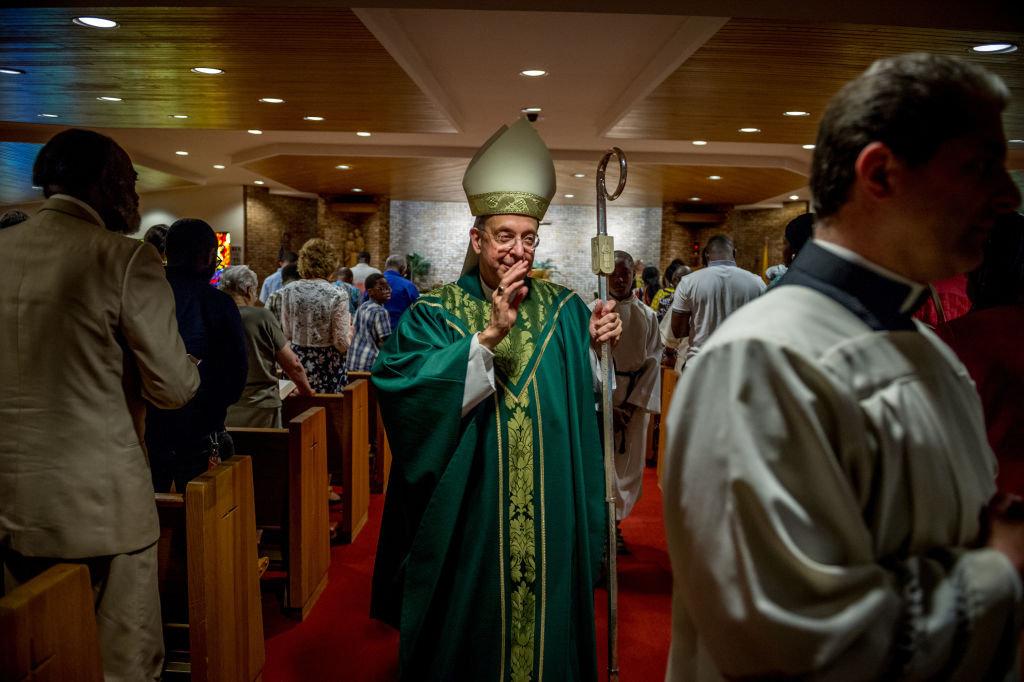
 The congregation participates in Mass at the Basilica of the National Shrine of the Assumption of the Blessed Virgin Mary during the National Eucharistic Pilgrimage in Baltimore, Maryland, June 10, 2026. | Credit: Jeffrey Bruno/EWTN News


 A member of the congregation kneels in prayer during Mass at the Basilica of the National Shrine of the Assumption of the Blessed Virgin Mary during the National Eucharistic Pilgrimage in Baltimore, Maryland, June 10, 2026. | Credit: Jeffrey Bruno/EWTN News
 
 Following the morning Mass, pilgrims processed several blocks in the rain from the basilica to Baltimore’s Washington Monument, one of the city’s most recognizable civic landmarks, praying and singing as they accompanied the Blessed Sacrament through the city’s historic streets.
 
 The Blessed Sacrament is carried beneath a canopy near Baltimore’s Washington Monument during the National Eucharistic Pilgrimage in Baltimore, Maryland, June 10, 2026. |.Credit: Jeffrey Bruno/EWTN News
 
 The Baltimore stop is part of the 2026 National Eucharistic Pilgrimage, which is traveling under the theme “One Nation Under God” as the United States prepares to mark the 250th anniversary of the signing of the Declaration of Independence.
 
 Monsignor Jay OʼConnor delivers the homily during Mass at the Basilica of the National Shrine of the Assumption of the Blessed Virgin Mary during the National Eucharistic Pilgrimage in Baltimore, Maryland, June 10, 2026. | Credit: Jeffrey Bruno/EWTN News
 
 In his homily, Monsignor Jay O’Connor reflected on the meaning of pilgrimage and the public witness of carrying the Eucharist through cities, towns, highways and waterways across the country. “This National Eucharistic Pilgrimage, which is of Jesus through the streets and the highways and the plains and the waterways of our country, brings the blessing of the Real Presence of Jesus into the heart and soul of our fellow citizens and our country,” he said.The basilica, completed in 1821, is the first cathedral constructed in the United States. It was built under the leadership of Bishop John Carroll, the first bishop of the United States, making the Baltimore stop a significant moment for a pilgrimage moving through many of the original 13 colonies during the nation’s semiquincentennial year.
 
 Members of the Knights of Columbus participate in a Eucharistic procession at Washington Monument Place in Baltimore, Maryland, June 10, 2026. | Credit: Jeffrey Bruno/EWTN News
 
 O’Connor said pilgrimage is not meant to be easy, citing St. John Paul II’s teaching that God uses the challenges of the journey to form his people.“Through the challenges of the journey, God forms us into the people he calls us to be — a community of missionary disciples,” he said.The celebrant also recalled a previous Eucharistic procession in Baltimore, when a man came out of his home and asked what was happening as the procession passed through his neighborhood.“One pilgrim responded, ‘Jesus is walking through your neighborhood,’” he said. “The man asked, ‘Can I join you?’ And he was invited to walk the rest of the way with the pilgrims. That’s what a pilgrimage is.”For the perpetual pilgrims accompanying the Eucharist along the Cabrini route, the journey has included long days of travel, prayer, public witness and constant movement.“It’s been very busy,” said John Paul Flynn, one of the perpetual pilgrims. “But it’s through that busyness, I think, that you start to lean more into it and lean more into the graces that are there.”He said the experience of traveling with the Blessed Sacrament has been unlike anything else.“Getting to be with Jesus all the time is a really unique experience,” he said, noting that the pilgrims even have adoration in the van as they travel.The pilgrimage was scheduled to continue through Maryland with stops in Severna Park and Annapolis before crossing the Chesapeake Bay by boat to Kent Island and the Diocese of Wilmington.
 
 Members of the Knights of Columbus depart the Basilica of the National Shrine of the Assumption of the Blessed Virgin Mary before a Eucharistic procession in Baltimore, Maryland, June 10, 2026. | Credit: Jeffrey Bruno/EWTN News
 
 The Cabrini route is named for St. Frances Xavier Cabrini, the Italian-born missionary sister who became the first U.S. citizen to be canonized a saint. Cabrini dedicated her life to serving immigrants, orphans, the sick and the poor, founding schools, hospitals and orphanages across the United States and beyond. The route began over Memorial Day weekend in St. Augustine, Florida, and is traveling north along the Eastern Seaboard before concluding in Philadelphia over Independence Day weekend.

National Eucharistic Pilgrimage brings Christ through rainy streets of historic Baltimore #Catholic BALTIMORE, Maryland — About 300 Catholics gathered at the Basilica of the National Shrine of the Assumption of the Blessed Virgin Mary on Wednesday, June 10, for Mass and a Eucharistic procession through downtown Baltimore as the National Eucharistic Pilgrimage’s St. Frances Xavier Cabrini Route continued through the nation’s first Catholic diocese. The congregation participates in Mass at the Basilica of the National Shrine of the Assumption of the Blessed Virgin Mary during the National Eucharistic Pilgrimage in Baltimore, Maryland, June 10, 2026. | Credit: Jeffrey Bruno/EWTN News A member of the congregation kneels in prayer during Mass at the Basilica of the National Shrine of the Assumption of the Blessed Virgin Mary during the National Eucharistic Pilgrimage in Baltimore, Maryland, June 10, 2026. | Credit: Jeffrey Bruno/EWTN News Following the morning Mass, pilgrims processed several blocks in the rain from the basilica to Baltimore’s Washington Monument, one of the city’s most recognizable civic landmarks, praying and singing as they accompanied the Blessed Sacrament through the city’s historic streets. The Blessed Sacrament is carried beneath a canopy near Baltimore’s Washington Monument during the National Eucharistic Pilgrimage in Baltimore, Maryland, June 10, 2026. |.Credit: Jeffrey Bruno/EWTN News The Baltimore stop is part of the 2026 National Eucharistic Pilgrimage, which is traveling under the theme “One Nation Under God” as the United States prepares to mark the 250th anniversary of the signing of the Declaration of Independence. Monsignor Jay OʼConnor delivers the homily during Mass at the Basilica of the National Shrine of the Assumption of the Blessed Virgin Mary during the National Eucharistic Pilgrimage in Baltimore, Maryland, June 10, 2026. | Credit: Jeffrey Bruno/EWTN News In his homily, Monsignor Jay O’Connor reflected on the meaning of pilgrimage and the public witness of carrying the Eucharist through cities, towns, highways and waterways across the country. “This National Eucharistic Pilgrimage, which is of Jesus through the streets and the highways and the plains and the waterways of our country, brings the blessing of the Real Presence of Jesus into the heart and soul of our fellow citizens and our country,” he said.The basilica, completed in 1821, is the first cathedral constructed in the United States. It was built under the leadership of Bishop John Carroll, the first bishop of the United States, making the Baltimore stop a significant moment for a pilgrimage moving through many of the original 13 colonies during the nation’s semiquincentennial year. Members of the Knights of Columbus participate in a Eucharistic procession at Washington Monument Place in Baltimore, Maryland, June 10, 2026. | Credit: Jeffrey Bruno/EWTN News O’Connor said pilgrimage is not meant to be easy, citing St. John Paul II’s teaching that God uses the challenges of the journey to form his people.“Through the challenges of the journey, God forms us into the people he calls us to be — a community of missionary disciples,” he said.The celebrant also recalled a previous Eucharistic procession in Baltimore, when a man came out of his home and asked what was happening as the procession passed through his neighborhood.“One pilgrim responded, ‘Jesus is walking through your neighborhood,’” he said. “The man asked, ‘Can I join you?’ And he was invited to walk the rest of the way with the pilgrims. That’s what a pilgrimage is.”For the perpetual pilgrims accompanying the Eucharist along the Cabrini route, the journey has included long days of travel, prayer, public witness and constant movement.“It’s been very busy,” said John Paul Flynn, one of the perpetual pilgrims. “But it’s through that busyness, I think, that you start to lean more into it and lean more into the graces that are there.”He said the experience of traveling with the Blessed Sacrament has been unlike anything else.“Getting to be with Jesus all the time is a really unique experience,” he said, noting that the pilgrims even have adoration in the van as they travel.The pilgrimage was scheduled to continue through Maryland with stops in Severna Park and Annapolis before crossing the Chesapeake Bay by boat to Kent Island and the Diocese of Wilmington. Members of the Knights of Columbus depart the Basilica of the National Shrine of the Assumption of the Blessed Virgin Mary before a Eucharistic procession in Baltimore, Maryland, June 10, 2026. | Credit: Jeffrey Bruno/EWTN News The Cabrini route is named for St. Frances Xavier Cabrini, the Italian-born missionary sister who became the first U.S. citizen to be canonized a saint. Cabrini dedicated her life to serving immigrants, orphans, the sick and the poor, founding schools, hospitals and orphanages across the United States and beyond. The route began over Memorial Day weekend in St. Augustine, Florida, and is traveling north along the Eastern Seaboard before concluding in Philadelphia over Independence Day weekend.

Thousands gathered at the Basilica of the National Shrine of the Assumption of the Blessed Virgin Mary on June 10 for Mass and a Eucharistic procession through downtown Baltimore.

Read More
Pope Leo XIV tells Spain’s parliament every human life must be protected #Catholic MADRID — Pope Leo XIV made history Monday by becoming the first pope to address Spain’s Congress of Deputies, delivering a forceful appeal to the country’s political class to defend human dignity and protect life “from conception to its natural end.”The June 8 address, given before about 700 guests amid tight security, drew a standing ovation that lasted nearly seven minutes, with shouts of “Long live the pope!” echoing through the chamber.In his speech, Pope Leo warned lawmakers not to subordinate human dignity to “shifting social consensus or the whims of the majority at any given moment,” insisting that “every truly just society is built upon the recognition of the inviolable dignity of the human person.”“In this sense, if life ceases to be recognized as a fundamental value, what future can our societies have?” the pope asked. “Can a community that casts into the shadows the unborn child, the elderly, the sick, those who suffer in silence, or those who depend entirely on the care of others be called fully just?”“The defense of human life is neither a partisan issue nor a confessional interest: it is a goal of civilization,” he said.The pope’s remarks came as Spain’s socialist-led government has been advancing efforts to enshrine abortion protections in the country’s Constitution. Such a reform would require broad parliamentary consensus, including support from the center-right People’s Party.“Every human life must be recognized and safeguarded from conception to its natural end, in every circumstance of its existence,” Pope Leo said. “When this certainty is obscured, the most vulnerable are the first victims, and the law loses its deepest meaning: to serve and protect every person.”“For this reason,” he added, “the moral greatness of a nation is manifested, above all, in its capacity to accompany, protect and love those lives that are most fragile.”The pope also defended the family as “the primary human reality and the natural foundation of the community,” saying that “where the family is upheld, the spiritual and social stability of nations is also strengthened.”“The family will always be the first school of humanity, where one learns, before anywhere else, the basic grammar of living together: welcoming life, caring for others, forgiving, serving and belonging,” he said.Pope Leo drew on Spain’s intellectual and Catholic heritage, citing Cervantes, St. Teresa of Ávila, Miguel de Unamuno and the School of Salamanca, especially the 16th-century Dominican friar Francisco de Vitoria.From that tradition, he said, Spain helped shape “a legal and moral consciousness capable of remembering that authority always entails responsibility and that every human being must be recognized as a subject of rights and duties.”The pope said that legacy remains alive whenever lawmakers ask “how to ensure that what is possible is just, that what is legal is truly humane, and that the will of the majority safeguards those goods that belong to all and respects that which no majority can legitimately violate.”He also cited his recent encyclical “Magnifica Humanitas,” published May 25, saying that in an age of artificial intelligence, biotechnology and rapid technological change, political discernment must focus on “the place of the human person in our decision making.”The pope devoted part of his address to migrants and refugees, a major theme of his trip to Spain, which will conclude with visits to Tenerife and Las Palmas in the Canary Islands, a key entry point to Europe for migrants.“The situation of migrants and refugees calls for a response that focuses on people, addresses the root causes that force them to leave, and goes beyond the mere management of migration flows,” he said.He called for “safe and legal pathways, a respectful welcome and real opportunities for integration,” while also promoting “the right to remain in one’s own land,” so that no one is forced to leave home because of war, insecurity, poverty or the effects of the climate crisis.Pope Leo also warned that many migrants remain “prey to traffickers and smugglers who take advantage of their desperation,” calling for stronger prevention, rescue and assistance efforts.“No nation can face a challenge of this magnitude on its own,” he said.Turning to global conflict, Pope Leo said the world is undergoing “a profound spiritual and cultural crisis” marked by violence, polarization and mistrust.“Every war constitutes, ultimately, a painful defeat of the capacity to negotiate and also of that common human consciousness that recognizes bonds of justice among nations,” he said.“Weapons may impose a temporary silence; but they can never build a genuine and lasting peace,” the pope said, warning that “in various parts of the world — and in Europe as well — rearmament is once again being presented as an almost inevitable response to the fragility of the international situation.”The pope also warned against the use of artificial intelligence in warfare, saying new technologies in the military sphere require “rigorous ethical oversight, so that decisions regarding life and death are never left to automated systems nor removed from the moral responsibility of the human person.”Addressing Spain’s polarized political climate, the pope urged lawmakers to resist contempt for political opponents.“Political pluralism should not degenerate into the constant disparagement of one’s adversary,” he said. “In a mature society, even conflict can become a path to peace, when differences are softened by listening and directed toward recognizing the needs, aspirations and capabilities of all.”“Firmness does not require contempt; disagreement does not entail humiliation,” he added.Only two left-wing parties, Podemos and the BNG, which together account for six lawmakers out of more than 600 parliamentarians, chose not to attend the pope’s address.Pope Leo also made a strong appeal for religious freedom, calling freedom of thought, conscience and religion “a fundamental right that protects the most intimate sphere of the person.”“The freedom upon which the contemporary state is built, if it is authentic, recognizes the religious dimension of the human person, respects it and protects it legally,” he said. Authentic freedom, the pope added, “ensures that faith is not a reason for which a person has to forfeit his or her contribution to society.”“Faith does not seek to impose itself through privileges or coercion; yet neither can it be silenced as if it were irrelevant to public life,” he said.The pope also defended the sacramental seal of confession, saying it “holds special importance for the Catholic Church” and forms part of the broader sphere of religious freedom.“To protect it legally, as is done in a similar way in some professions, means preserving a sacred space of inner freedom, where the believer can open his or her soul to God without fear of external pressures,” Pope Leo said.The remarks came shortly after French bishops criticized a June 1 proposal in France’s National Assembly that they said could have endangered the seal of confession. The proposal was later withdrawn.Near the end of his address, the pope invited Spanish lawmakers to “lift your gaze to the world around you,” not to escape reality, but to remember that every public decision “affects real people, especially those who have less power to make their voices heard.”“A law does not attain its true greatness merely by having been formally enacted,” he said. “It attains it when, in addition to being valid in form, it can stand before the dignity of the person and pass that test without shame.”The pope concluded with a blessing for Spain, praying that the nation “never lose sight of its roots nor the courage to look to the future.”“May Spain continue to be a land of encounter, of culture, of solidarity and of hope,” he said. “And may its public life always know how to unite the firmness of convictions with the nobility of dialogue and the greatness of service.”This story was first published by ACI Prensa, the Spanish-language sister service of EWTN News. It has been translated and adapted by EWTN News English.

Pope Leo XIV tells Spain’s parliament every human life must be protected #Catholic MADRID — Pope Leo XIV made history Monday by becoming the first pope to address Spain’s Congress of Deputies, delivering a forceful appeal to the country’s political class to defend human dignity and protect life “from conception to its natural end.”The June 8 address, given before about 700 guests amid tight security, drew a standing ovation that lasted nearly seven minutes, with shouts of “Long live the pope!” echoing through the chamber.In his speech, Pope Leo warned lawmakers not to subordinate human dignity to “shifting social consensus or the whims of the majority at any given moment,” insisting that “every truly just society is built upon the recognition of the inviolable dignity of the human person.”“In this sense, if life ceases to be recognized as a fundamental value, what future can our societies have?” the pope asked. “Can a community that casts into the shadows the unborn child, the elderly, the sick, those who suffer in silence, or those who depend entirely on the care of others be called fully just?”“The defense of human life is neither a partisan issue nor a confessional interest: it is a goal of civilization,” he said.The pope’s remarks came as Spain’s socialist-led government has been advancing efforts to enshrine abortion protections in the country’s Constitution. Such a reform would require broad parliamentary consensus, including support from the center-right People’s Party.“Every human life must be recognized and safeguarded from conception to its natural end, in every circumstance of its existence,” Pope Leo said. “When this certainty is obscured, the most vulnerable are the first victims, and the law loses its deepest meaning: to serve and protect every person.”“For this reason,” he added, “the moral greatness of a nation is manifested, above all, in its capacity to accompany, protect and love those lives that are most fragile.”The pope also defended the family as “the primary human reality and the natural foundation of the community,” saying that “where the family is upheld, the spiritual and social stability of nations is also strengthened.”“The family will always be the first school of humanity, where one learns, before anywhere else, the basic grammar of living together: welcoming life, caring for others, forgiving, serving and belonging,” he said.Pope Leo drew on Spain’s intellectual and Catholic heritage, citing Cervantes, St. Teresa of Ávila, Miguel de Unamuno and the School of Salamanca, especially the 16th-century Dominican friar Francisco de Vitoria.From that tradition, he said, Spain helped shape “a legal and moral consciousness capable of remembering that authority always entails responsibility and that every human being must be recognized as a subject of rights and duties.”The pope said that legacy remains alive whenever lawmakers ask “how to ensure that what is possible is just, that what is legal is truly humane, and that the will of the majority safeguards those goods that belong to all and respects that which no majority can legitimately violate.”He also cited his recent encyclical “Magnifica Humanitas,” published May 25, saying that in an age of artificial intelligence, biotechnology and rapid technological change, political discernment must focus on “the place of the human person in our decision making.”The pope devoted part of his address to migrants and refugees, a major theme of his trip to Spain, which will conclude with visits to Tenerife and Las Palmas in the Canary Islands, a key entry point to Europe for migrants.“The situation of migrants and refugees calls for a response that focuses on people, addresses the root causes that force them to leave, and goes beyond the mere management of migration flows,” he said.He called for “safe and legal pathways, a respectful welcome and real opportunities for integration,” while also promoting “the right to remain in one’s own land,” so that no one is forced to leave home because of war, insecurity, poverty or the effects of the climate crisis.Pope Leo also warned that many migrants remain “prey to traffickers and smugglers who take advantage of their desperation,” calling for stronger prevention, rescue and assistance efforts.“No nation can face a challenge of this magnitude on its own,” he said.Turning to global conflict, Pope Leo said the world is undergoing “a profound spiritual and cultural crisis” marked by violence, polarization and mistrust.“Every war constitutes, ultimately, a painful defeat of the capacity to negotiate and also of that common human consciousness that recognizes bonds of justice among nations,” he said.“Weapons may impose a temporary silence; but they can never build a genuine and lasting peace,” the pope said, warning that “in various parts of the world — and in Europe as well — rearmament is once again being presented as an almost inevitable response to the fragility of the international situation.”The pope also warned against the use of artificial intelligence in warfare, saying new technologies in the military sphere require “rigorous ethical oversight, so that decisions regarding life and death are never left to automated systems nor removed from the moral responsibility of the human person.”Addressing Spain’s polarized political climate, the pope urged lawmakers to resist contempt for political opponents.“Political pluralism should not degenerate into the constant disparagement of one’s adversary,” he said. “In a mature society, even conflict can become a path to peace, when differences are softened by listening and directed toward recognizing the needs, aspirations and capabilities of all.”“Firmness does not require contempt; disagreement does not entail humiliation,” he added.Only two left-wing parties, Podemos and the BNG, which together account for six lawmakers out of more than 600 parliamentarians, chose not to attend the pope’s address.Pope Leo also made a strong appeal for religious freedom, calling freedom of thought, conscience and religion “a fundamental right that protects the most intimate sphere of the person.”“The freedom upon which the contemporary state is built, if it is authentic, recognizes the religious dimension of the human person, respects it and protects it legally,” he said. Authentic freedom, the pope added, “ensures that faith is not a reason for which a person has to forfeit his or her contribution to society.”“Faith does not seek to impose itself through privileges or coercion; yet neither can it be silenced as if it were irrelevant to public life,” he said.The pope also defended the sacramental seal of confession, saying it “holds special importance for the Catholic Church” and forms part of the broader sphere of religious freedom.“To protect it legally, as is done in a similar way in some professions, means preserving a sacred space of inner freedom, where the believer can open his or her soul to God without fear of external pressures,” Pope Leo said.The remarks came shortly after French bishops criticized a June 1 proposal in France’s National Assembly that they said could have endangered the seal of confession. The proposal was later withdrawn.Near the end of his address, the pope invited Spanish lawmakers to “lift your gaze to the world around you,” not to escape reality, but to remember that every public decision “affects real people, especially those who have less power to make their voices heard.”“A law does not attain its true greatness merely by having been formally enacted,” he said. “It attains it when, in addition to being valid in form, it can stand before the dignity of the person and pass that test without shame.”The pope concluded with a blessing for Spain, praying that the nation “never lose sight of its roots nor the courage to look to the future.”“May Spain continue to be a land of encounter, of culture, of solidarity and of hope,” he said. “And may its public life always know how to unite the firmness of convictions with the nobility of dialogue and the greatness of service.”This story was first published by ACI Prensa, the Spanish-language sister service of EWTN News. It has been translated and adapted by EWTN News English.

The pontiff warned against subordinating human dignity to shifting majorities and called for stronger protections for life, migrants, families, peace and religious freedom.

Read More
World’s oldest priest dies at 110 #Catholic In late February, Pope Leo XIV thanked Father Bruno Kant of the Diocese of Fulda in Germany for his “many years of faithful and devoted priestly service.” Kant, the oldest priest in the world at 110 years of age, passed away on the night of Friday, May 29. He had been a priest since 1950.In an article published on his dioceseʼs website, Bishop Michael Gerber of Fulda recalled that "just a few months ago" he had "the privilege of conveying Pope Leo XIVʼs blessing to Father Bruno Kant on the occasion of his 110th birthday.""My encounter with him left a deep impression on me. Even at his advanced age, he radiated the humility, kindness, and spiritual depth that characterized his entire priestly life. The Diocese of Fulda remembers his work and service with great gratitude," he added.Father Guido Pasanow of the parish in Eichenzell-Löschenrod, where Kant lived until his death, said that with the priest’s death, the parish “loses a person who was fundamental to it for many years.”“Even after retiring from active ministry, he remained a confidant, pastor, and spiritual guide deeply cherished by many parishioners. We are grateful for all that he contributed to our community,” he added.As reported by the Catholic news outlet katholisch in November 2025, Kant, born near Danzig in what is now Poland, had aspired to become a priest since the age of 9. He was able to begin his theological studies, but the Nazi regime thwarted his plans by conscripting him for forced labor and making him a soldier.Kant spent four years as a prisoner of war in Russia before reuniting with his family, who had fled to the West.He was finally ordained a priest in 1950. After decades of priestly service, he considerably curtailed his activities. He stopped driving at the age of 102, according to a report published on katholisch.de in November.“Over the last few years, he has refrained from celebrating holy Mass with the congregation on Wednesday evenings. However, he continued visiting the sick for as long as he was able. Now, that is no longer possible for him.”On that occasion, Kant said: “I expect to die every day. I am not far from it.” In his final years, he spent his days solving Sudokus, watching television, reading newspapers, and, of course, praying.“Praying keeps me young,” he said.This story was first published by CNA Deutsch, the German-language sister service of EWTN News. It has been translated and adapted by ACI Prensa/EWTN News English.

World’s oldest priest dies at 110 #Catholic In late February, Pope Leo XIV thanked Father Bruno Kant of the Diocese of Fulda in Germany for his “many years of faithful and devoted priestly service.” Kant, the oldest priest in the world at 110 years of age, passed away on the night of Friday, May 29. He had been a priest since 1950.In an article published on his dioceseʼs website, Bishop Michael Gerber of Fulda recalled that "just a few months ago" he had "the privilege of conveying Pope Leo XIVʼs blessing to Father Bruno Kant on the occasion of his 110th birthday.""My encounter with him left a deep impression on me. Even at his advanced age, he radiated the humility, kindness, and spiritual depth that characterized his entire priestly life. The Diocese of Fulda remembers his work and service with great gratitude," he added.Father Guido Pasanow of the parish in Eichenzell-Löschenrod, where Kant lived until his death, said that with the priest’s death, the parish “loses a person who was fundamental to it for many years.”“Even after retiring from active ministry, he remained a confidant, pastor, and spiritual guide deeply cherished by many parishioners. We are grateful for all that he contributed to our community,” he added.As reported by the Catholic news outlet katholisch in November 2025, Kant, born near Danzig in what is now Poland, had aspired to become a priest since the age of 9. He was able to begin his theological studies, but the Nazi regime thwarted his plans by conscripting him for forced labor and making him a soldier.Kant spent four years as a prisoner of war in Russia before reuniting with his family, who had fled to the West.He was finally ordained a priest in 1950. After decades of priestly service, he considerably curtailed his activities. He stopped driving at the age of 102, according to a report published on katholisch.de in November.“Over the last few years, he has refrained from celebrating holy Mass with the congregation on Wednesday evenings. However, he continued visiting the sick for as long as he was able. Now, that is no longer possible for him.”On that occasion, Kant said: “I expect to die every day. I am not far from it.” In his final years, he spent his days solving Sudokus, watching television, reading newspapers, and, of course, praying.“Praying keeps me young,” he said.This story was first published by CNA Deutsch, the German-language sister service of EWTN News. It has been translated and adapted by ACI Prensa/EWTN News English.

Ordained in 1950, Father Bruno Kant served the Diocese of Fulda in Germany for decades. After retiring from active ministry, he remained a confidant, pastor, and spiritual guide for many parishioners.

Read More
Pope Leo XIV: The Trinity teaches that every creature is made for communion #Catholic Pope Leo XIV said Sunday that the mystery of the Holy Trinity teaches Christians to see every creature as made for communion — and warned that division, polarization, and contempt for differences leave the world spiritually barren.Speaking before the Angelus on May 31, the solemnity of the Most Holy Trinity, the pope reflected on Jesus’ encounter with Nicodemus in the Gospel of John, saying the feast reveals that God’s own life is a communion of love into which humanity is invited.“The Trinity helps us to love everyone and everything: we discover that every creature is made for communion, relationship and encounter,” Pope Leo said from the window of the Apostolic Palace overlooking St. Peter’s Square. “On the other hand, we understand why division, polarization and contempt for diversity bring destruction, sadness and barrenness to the world.”The pope said the Church’s Easter journey, which concluded last week with Pentecost, helps believers contemplate the divine life given to humanity in Christ — a communion of love that draws believers in through the Holy Spirit.The Spirit, he said, “unites the Father and the Son” and “has been poured into our hearts.” In this way, he added, “the Church becomes a sacrament of communion, a place of encounter, love and life where heaven and earth already touch.”Turning to Nicodemus, whom the Gospel describes as an important figure in Israel who came to Jesus at night, Leo said Christ “welcomed him and took his search for answers seriously.”Jesus, the pope said, “surprised Nicodemus by suggesting that it was even possible for an adult to be reborn and led him to realize that the life of God could transform his own life.”Leo noted that Nicodemus later defended Jesus before the Sanhedrin, urging others to listen before condemning him.“He had received the Spirit of communion from God through Christ himself, which opens the heart to new truths and to true renewal,” the pope said. “Whoever does not welcome this Spirit grows old quickly, in sorrow, feeling all alone and without joy in their hearts.”By contrast, Leo said, the solemnity of the Trinity is “a day of celebration.”“God’s feast is also ours,” he said, citing St. Paul’s exhortation to the Corinthians: “Rejoice, strive for perfection, encourage one another, live in peace; and the God of love and peace will be with you.”After leading the Angelus, the pope recalled the prayers for peace raised throughout the Church during May, a month traditionally dedicated to the Virgin Mary.“In this month of May, a united chorus of prayers for peace has resounded throughout the Church,” he said. “Above all, through the prayer of the Holy Rosary — like an unbroken chain — the peoples ravaged by war have been entrusted to the intercession of the Virgin Mary.”“May Divine Wisdom enlighten the consciences of those in authority and guide their decisions toward a sincere search for a just and lasting peace,” he said.Leo also marked Italy’s 25th National Day of Relief, expressing closeness to the sick and those who care for them.“I offer my spiritual closeness to the sick and those who care for them; and I thank and encourage all who promote a culture of solidarity and care,” he said.This story was first published by ACI Stampa, the Italian-language sister service of EWTN News. It has been translated and adapted by EWTN News English.

Pope Leo XIV: The Trinity teaches that every creature is made for communion #Catholic Pope Leo XIV said Sunday that the mystery of the Holy Trinity teaches Christians to see every creature as made for communion — and warned that division, polarization, and contempt for differences leave the world spiritually barren.Speaking before the Angelus on May 31, the solemnity of the Most Holy Trinity, the pope reflected on Jesus’ encounter with Nicodemus in the Gospel of John, saying the feast reveals that God’s own life is a communion of love into which humanity is invited.“The Trinity helps us to love everyone and everything: we discover that every creature is made for communion, relationship and encounter,” Pope Leo said from the window of the Apostolic Palace overlooking St. Peter’s Square. “On the other hand, we understand why division, polarization and contempt for diversity bring destruction, sadness and barrenness to the world.”The pope said the Church’s Easter journey, which concluded last week with Pentecost, helps believers contemplate the divine life given to humanity in Christ — a communion of love that draws believers in through the Holy Spirit.The Spirit, he said, “unites the Father and the Son” and “has been poured into our hearts.” In this way, he added, “the Church becomes a sacrament of communion, a place of encounter, love and life where heaven and earth already touch.”Turning to Nicodemus, whom the Gospel describes as an important figure in Israel who came to Jesus at night, Leo said Christ “welcomed him and took his search for answers seriously.”Jesus, the pope said, “surprised Nicodemus by suggesting that it was even possible for an adult to be reborn and led him to realize that the life of God could transform his own life.”Leo noted that Nicodemus later defended Jesus before the Sanhedrin, urging others to listen before condemning him.“He had received the Spirit of communion from God through Christ himself, which opens the heart to new truths and to true renewal,” the pope said. “Whoever does not welcome this Spirit grows old quickly, in sorrow, feeling all alone and without joy in their hearts.”By contrast, Leo said, the solemnity of the Trinity is “a day of celebration.”“God’s feast is also ours,” he said, citing St. Paul’s exhortation to the Corinthians: “Rejoice, strive for perfection, encourage one another, live in peace; and the God of love and peace will be with you.”After leading the Angelus, the pope recalled the prayers for peace raised throughout the Church during May, a month traditionally dedicated to the Virgin Mary.“In this month of May, a united chorus of prayers for peace has resounded throughout the Church,” he said. “Above all, through the prayer of the Holy Rosary — like an unbroken chain — the peoples ravaged by war have been entrusted to the intercession of the Virgin Mary.”“May Divine Wisdom enlighten the consciences of those in authority and guide their decisions toward a sincere search for a just and lasting peace,” he said.Leo also marked Italy’s 25th National Day of Relief, expressing closeness to the sick and those who care for them.“I offer my spiritual closeness to the sick and those who care for them; and I thank and encourage all who promote a culture of solidarity and care,” he said.This story was first published by ACI Stampa, the Italian-language sister service of EWTN News. It has been translated and adapted by EWTN News English.

At the Sunday Angelus, the pope prayed for “a just and lasting peace” as the Church closed a monthlong Marian appeal for countries ravaged by war.

Read More
Pope sets up commission to tackle 0 million debt at Padre Pio’s hospital #Catholic Pope Leo XIV on Wednesday created a commission to identify solutions for long-term sustainability at the Casa Sollievo della Sofferenza, a major hospital complex founded by St. Pio of Pietrelcina and directly overseen by the Vatican Secretariat of State.The Catholic hospital — which is located in the southern Italian region of Puglia — is facing a debt crisis from which “we will emerge together,” Secretary of State Cardinal Pietro Parolin said during a May 5 visit to the facility.The hospital in San Giovanni Rotondo, where the saint known as Padre Pio lived for most of his life, has debts estimated to run between 250 million to 300 million euros (about 0 million to 0 million).The hospital is currently in a dispute with officials from the Puglia region over reimbursements — the regional authority claims it is owed 32 million euros ( million) — and is also involved in a conflict over new labor contracts.The new commission now aims to resolve what is a highly complex situation.The papal chirograph (a kind of decree) establishing the commission states that the pope’s decision arises from the Apostolic See’s love for works of charity and from the awareness that large institutions, in order to remain faithful to their mission, must be capable of facing the challenges of change.“The evolution of the times, technology, law, and economics places the mission of the Church before the challenge of continuous renewal,” particularly in sectors such as healthcare that require vision, investment, and prudent management, the chirograph says.Among these institutions is Casa Sollievo della Sofferenza, founded “with the aim of providing hospitality, assistance, and care to the sick, pilgrims, and their families, inspired by the spirituality and the figure of its saintly founder.”The guidance and oversight commission has the task of analyzing the hospital foundation’s “current situation, identifying the best solutions for ever-greater efficiency, effectiveness, and long-term sustainability of its work and mission, and ensuring the concrete implementation of those solutions.”The commission will operate on all fronts — financial, patrimonial, and operational — with full authority to carry out the necessary acts of both ordinary and extraordinary administration. It will report directly to the pope before any decision of particular significance and before adopting measures of special importance or those that would have a decisive and substantial impact on the foundation’s assets or modify its statutes.The commission represents a combined effort by Vatican economic bodies and the Secretariat of State. Maximino Caballero Ledo, prefect of the Secretariat for the Economy, will serve as president. The coordinator is Fabio Gasperini, secretary-general of the Governorate. Archbishop Giordano Piccinotti, president of the Administration of the Patrimony of the Apostolic See, is a member together with Archbishop Paolo Rudelli, undersecretary for general affairs of the Secretariat of State. The technical committee includes Benjamín Estévez de Cominges, Gino Gumirato, and attorney Alessandro Ela Oyana.Casa Sollievo della Sofferenza was born from Padre Pio’s concrete faith, rooted in the conviction that caring for the body is an integral part of the Christian mission.The decision to establish an ad hoc commission is a sign of Leo’s interest in the hospital but also unusual, given that Pope Francis already established a Vatican commission for Catholic healthcare.This story was first published by ACI Stampa, the Italian-language sister service of EWTN News. It has been translated and adapted by EWTN News English.

Pope sets up commission to tackle $290 million debt at Padre Pio’s hospital #Catholic Pope Leo XIV on Wednesday created a commission to identify solutions for long-term sustainability at the Casa Sollievo della Sofferenza, a major hospital complex founded by St. Pio of Pietrelcina and directly overseen by the Vatican Secretariat of State.The Catholic hospital — which is located in the southern Italian region of Puglia — is facing a debt crisis from which “we will emerge together,” Secretary of State Cardinal Pietro Parolin said during a May 5 visit to the facility.The hospital in San Giovanni Rotondo, where the saint known as Padre Pio lived for most of his life, has debts estimated to run between 250 million to 300 million euros (about $290 million to $350 million).The hospital is currently in a dispute with officials from the Puglia region over reimbursements — the regional authority claims it is owed 32 million euros ($37 million) — and is also involved in a conflict over new labor contracts.The new commission now aims to resolve what is a highly complex situation.The papal chirograph (a kind of decree) establishing the commission states that the pope’s decision arises from the Apostolic See’s love for works of charity and from the awareness that large institutions, in order to remain faithful to their mission, must be capable of facing the challenges of change.“The evolution of the times, technology, law, and economics places the mission of the Church before the challenge of continuous renewal,” particularly in sectors such as healthcare that require vision, investment, and prudent management, the chirograph says.Among these institutions is Casa Sollievo della Sofferenza, founded “with the aim of providing hospitality, assistance, and care to the sick, pilgrims, and their families, inspired by the spirituality and the figure of its saintly founder.”The guidance and oversight commission has the task of analyzing the hospital foundation’s “current situation, identifying the best solutions for ever-greater efficiency, effectiveness, and long-term sustainability of its work and mission, and ensuring the concrete implementation of those solutions.”The commission will operate on all fronts — financial, patrimonial, and operational — with full authority to carry out the necessary acts of both ordinary and extraordinary administration. It will report directly to the pope before any decision of particular significance and before adopting measures of special importance or those that would have a decisive and substantial impact on the foundation’s assets or modify its statutes.The commission represents a combined effort by Vatican economic bodies and the Secretariat of State. Maximino Caballero Ledo, prefect of the Secretariat for the Economy, will serve as president. The coordinator is Fabio Gasperini, secretary-general of the Governorate. Archbishop Giordano Piccinotti, president of the Administration of the Patrimony of the Apostolic See, is a member together with Archbishop Paolo Rudelli, undersecretary for general affairs of the Secretariat of State. The technical committee includes Benjamín Estévez de Cominges, Gino Gumirato, and attorney Alessandro Ela Oyana.Casa Sollievo della Sofferenza was born from Padre Pio’s concrete faith, rooted in the conviction that caring for the body is an integral part of the Christian mission.The decision to establish an ad hoc commission is a sign of Leo’s interest in the hospital but also unusual, given that Pope Francis already established a Vatican commission for Catholic healthcare.This story was first published by ACI Stampa, the Italian-language sister service of EWTN News. It has been translated and adapted by EWTN News English.

The hospital in San Giovanni Rotondo, Italy, where the saint known as Padre Pio lived for most of his life, has debts estimated to run between about $290 million to $350 million.

Read More
Start here: 15 quotes from Pope Leo XIV’s first encyclical Magnifica Humanitas #Catholic Pope Leo XIV just released his first encyclical — and it may be the most important Church document of our lifetime. Called Magnifica Humanitas, it covers artificial intelligence, human dignity, childrenʼs phones, autonomous weapons, doomscrolling, the mystery of the human soul, and why no machine will ever have the final word on what it means to be a person made in the image of God.The full document is available to download here — and worth a read. But for a quick taste of whatʼs inside, here are 15 powerful quotes from the encyclical:“Never has humanity had such power over itself.” (par. 4)"In practice, however, technology is never neutral, because it takes on the characteristics of those who devise, finance, regulate and use it. Therefore, the primary choice is not between a ‘yes’ or ‘no’ to technology, but rather between constructing Babel or rebuilding Jerusalem; between a power that claims to dominate the heavens and a people who work together in the presence of God to rebuild the walls of fraternal coexistence.” (par. 9)“In the era of artificial intelligence, when human dignity is threatened by new forms of dehumanization, ours is the pressing duty to remain profoundly human. We must lovingly safeguard the grandeur of humanity bestowed upon us and revealed in its fullness in Christ, the splendor of which no machine can ever replace.” (par. 15)“Thus, the ‘rejected stones’ — the poor, the sick, the migrants and the least among us — will become the cornerstone, and a solid, welcoming common home will emerge on the earth, where love and faithfulness will finally meet, and righteousness and peace will embrace (cf. Ps 85:10).” (par.16)“Human dignity does not depend on a person’s abilities, wealth, or position in life, nor on the right or wrong choices made; instead, it is a gift that precedes and transcends each person, endowed by God as an expression of his unfailing love.” (par. 50)“Among these ideologies, I consider particularly insidious the one that suggests that every person must earn or justify his or her own worth, to the point of attributing greater value to those who are more efficient or effective.” (par. 51)“No sin, failure, humiliation, or exclusion can diminish the profound value of a human life that God has willed and called into being.” (par. 52)“Solidarity demands that decisions regarding data, algorithms, platforms and artificial intelligence take into account not only the immediate benefit for a few, but also the impact on all peoples and on future generations.” (par. 76)“For an algorithm, an error is a flaw to be corrected; for a person, however, an error can be a catalyst for profound change. A person’s future is not calculable, but depends on one’s freedom — elevated by the inexhaustible grace of God — and on the relationships cultivated.” (par. 128)“Having a personal mobile device at too early an age and using it without adult supervision can exacerbate young people’s vulnerabilities, foster addiction, and expose them to isolation, bullying, and cyberbullying, as well as to pressures to share intimate images or sensitive information.” (par. 141)“Even in the darkest nights, the Lord raises up men and women who refuse to give up, who persevere in doing good, who protect the vulnerable and open pathways to reconciliation. The memory of the saints, righteous people, and the oft-forgotten peacemakers, show us that grace does not magically eliminate conflict, but instead it inspires active resistance to evil and an astonishing creativity in doing good.” (par. 211)“The civilization of love will not arise from a single or spectacular gesture, but from the sum total of small and steadfast acts of fidelity that serve as a bulwark against dehumanization.” (par. 213)“‘Let us disarm words and we will help to disarm the world.’ Words have enormous power, something we experience in our daily interactions; for example, spoken words can change our mood for better or for worse." (par. 214)“No computational system, however sophisticated, can create a heart that gives itself, or a conscience that discerns good from evil. Even when machines excel in efficiency, a human face that asks to be gazed upon remains the center of our history. This human face is the fullness toward which history is moving.” (par. 233)“Let us remain faithful to the truth! Living amid incessant flows of information, opinions and images, we know how easy it can be to influence decisions and preferences through increasingly sophisticated algorithms. In this context, it is imperative to cultivate hearts that love the truth, prefer what is right despite the most appealing content and pursue wisdom rather than immediate results.” (par. 237)

Start here: 15 quotes from Pope Leo XIV’s first encyclical Magnifica Humanitas #Catholic Pope Leo XIV just released his first encyclical — and it may be the most important Church document of our lifetime. Called Magnifica Humanitas, it covers artificial intelligence, human dignity, childrenʼs phones, autonomous weapons, doomscrolling, the mystery of the human soul, and why no machine will ever have the final word on what it means to be a person made in the image of God.The full document is available to download here — and worth a read. But for a quick taste of whatʼs inside, here are 15 powerful quotes from the encyclical:“Never has humanity had such power over itself.” (par. 4)"In practice, however, technology is never neutral, because it takes on the characteristics of those who devise, finance, regulate and use it. Therefore, the primary choice is not between a ‘yes’ or ‘no’ to technology, but rather between constructing Babel or rebuilding Jerusalem; between a power that claims to dominate the heavens and a people who work together in the presence of God to rebuild the walls of fraternal coexistence.” (par. 9)“In the era of artificial intelligence, when human dignity is threatened by new forms of dehumanization, ours is the pressing duty to remain profoundly human. We must lovingly safeguard the grandeur of humanity bestowed upon us and revealed in its fullness in Christ, the splendor of which no machine can ever replace.” (par. 15)“Thus, the ‘rejected stones’ — the poor, the sick, the migrants and the least among us — will become the cornerstone, and a solid, welcoming common home will emerge on the earth, where love and faithfulness will finally meet, and righteousness and peace will embrace (cf. Ps 85:10).” (par.16)“Human dignity does not depend on a person’s abilities, wealth, or position in life, nor on the right or wrong choices made; instead, it is a gift that precedes and transcends each person, endowed by God as an expression of his unfailing love.” (par. 50)“Among these ideologies, I consider particularly insidious the one that suggests that every person must earn or justify his or her own worth, to the point of attributing greater value to those who are more efficient or effective.” (par. 51)“No sin, failure, humiliation, or exclusion can diminish the profound value of a human life that God has willed and called into being.” (par. 52)“Solidarity demands that decisions regarding data, algorithms, platforms and artificial intelligence take into account not only the immediate benefit for a few, but also the impact on all peoples and on future generations.” (par. 76)“For an algorithm, an error is a flaw to be corrected; for a person, however, an error can be a catalyst for profound change. A person’s future is not calculable, but depends on one’s freedom — elevated by the inexhaustible grace of God — and on the relationships cultivated.” (par. 128)“Having a personal mobile device at too early an age and using it without adult supervision can exacerbate young people’s vulnerabilities, foster addiction, and expose them to isolation, bullying, and cyberbullying, as well as to pressures to share intimate images or sensitive information.” (par. 141)“Even in the darkest nights, the Lord raises up men and women who refuse to give up, who persevere in doing good, who protect the vulnerable and open pathways to reconciliation. The memory of the saints, righteous people, and the oft-forgotten peacemakers, show us that grace does not magically eliminate conflict, but instead it inspires active resistance to evil and an astonishing creativity in doing good.” (par. 211)“The civilization of love will not arise from a single or spectacular gesture, but from the sum total of small and steadfast acts of fidelity that serve as a bulwark against dehumanization.” (par. 213)“‘Let us disarm words and we will help to disarm the world.’ Words have enormous power, something we experience in our daily interactions; for example, spoken words can change our mood for better or for worse." (par. 214)“No computational system, however sophisticated, can create a heart that gives itself, or a conscience that discerns good from evil. Even when machines excel in efficiency, a human face that asks to be gazed upon remains the center of our history. This human face is the fullness toward which history is moving.” (par. 233)“Let us remain faithful to the truth! Living amid incessant flows of information, opinions and images, we know how easy it can be to influence decisions and preferences through increasingly sophisticated algorithms. In this context, it is imperative to cultivate hearts that love the truth, prefer what is right despite the most appealing content and pursue wisdom rather than immediate results.” (par. 237)

Pope Leo XIV just released his first encyclical — and it may be the most important Church document of our lifetime.

Read More
Pope Leo XIV prays for Sahel victims #Catholic VATICAN CITY — Pope Leo XIV on Sunday prayed for victims of growing violence in the Sahel, thanked the people of the Canary Islands for welcoming a cruise ship carrying people sick with hantavirus, and offered a special blessing for mothers during his Regina Caeli address in St. Peter’s Square.Speaking after the Marian prayer May 10, the pope said he had learned “with deep concern of the reports regarding the growing violence in the Sahel region, particularly in Chad and Mali,” which have recently suffered terrorist attacks.“I offer the assurance of my heartfelt prayers for the victims and my spiritual closeness to all those who are suffering as a result of the tragic events,” he said. “I fervently hope that every form of violence may cease, and I encourage all efforts aimed at fostering peace and development in that beloved land.”The pope also marked the annual “Day of Coptic-Catholic Friendship,” extending “fraternal greetings” to Pope Tawadros II and assuring “the entire beloved Coptic Church” of his “remembrance in prayer.”“It is my hope that our journey of friendship will lead us to perfect unity in Christ, who has called us ‘friends,’” he said.In Spanish, Pope Leo XIV thanked the people of the Canary Islands who, “with the hospitality characteristic of them,” welcomed the Hondius cruise ship and the passengers infected with hantavirus.“I look forward to seeing all of you next month during my visit to the Islands,” he said.The pope also offered a Mother’s Day greeting, asking Mary, “the Mother of Jesus and our own Mother,” to intercede for all mothers.“Let us pray with love and gratitude for every mother, particularly those living in very difficult circumstances,” he said. “Thank you! May God bless you!”Before the Regina Caeli, Pope Leo reflected on the Gospel for the Sixth Sunday of Easter, in which Jesus tells his disciples: “If you love me, you will keep my commandments.”The pope said the words of Jesus free Christians from the misconception “that we are loved because we keep the commandments, as if our righteousness were a prerequisite for God’s love.”“On the contrary, God’s love is the basis for our righteousness,” he said.Jesus’ words, he said, are “an invitation to enter into a relationship, not a blackmail or a suspicious ultimatum.”The Lord commands his followers to love one another as he has loved them, Pope Leo said, because “it is Jesus’ love that begets love within us.”Christ, he said, is “the standard, the measure of true love: the love that is faithful forever, pure and unconditional,” the love that knows no “buts” or “maybes.”“Because God loved us first, we too can love, and when we truly love God, we truly love one another,” he said.The pope said the Lord’s commandments are “a way of life that heal us from false loves” and “a spiritual lifestyle that is a path towards salvation.”Because God loves his people, the pope continued, he “does not leave us alone in life’s trials” but promises the Paraclete, the Advocate, the “Spirit of truth.”The Holy Spirit, he said, is a gift that “the world cannot receive” as long as it persists in evil, “oppressing the poor, excluding the weak and killing the innocent.” But those who respond to Jesus’ love for all “will find in the Holy Spirit an ally who will never fail.”Pope Leo said Christians can always bear witness to “God, who is love,” adding that love is “not an idea of the human mind, but the reality of divine life, through which all things were created out of nothing and redeemed from death.”Jesus, he said, shares with believers his identity as the beloved Son: “I am in my Father, and you in me, and I in you.”This “all-encompassing communion of life,” the pope said, refutes the Accuser, the adversary of the Paraclete, who seeks to set humanity against God and people against one another. Jesus does the opposite, he said, “saving us from evil and uniting us as a people of brothers and sisters in the Church.”This story was first published by ACI Stampa, the Italian-language sister service of EWTN News. It has been translated and adapted by EWTN News English.

Pope Leo XIV prays for Sahel victims #Catholic VATICAN CITY — Pope Leo XIV on Sunday prayed for victims of growing violence in the Sahel, thanked the people of the Canary Islands for welcoming a cruise ship carrying people sick with hantavirus, and offered a special blessing for mothers during his Regina Caeli address in St. Peter’s Square.Speaking after the Marian prayer May 10, the pope said he had learned “with deep concern of the reports regarding the growing violence in the Sahel region, particularly in Chad and Mali,” which have recently suffered terrorist attacks.“I offer the assurance of my heartfelt prayers for the victims and my spiritual closeness to all those who are suffering as a result of the tragic events,” he said. “I fervently hope that every form of violence may cease, and I encourage all efforts aimed at fostering peace and development in that beloved land.”The pope also marked the annual “Day of Coptic-Catholic Friendship,” extending “fraternal greetings” to Pope Tawadros II and assuring “the entire beloved Coptic Church” of his “remembrance in prayer.”“It is my hope that our journey of friendship will lead us to perfect unity in Christ, who has called us ‘friends,’” he said.In Spanish, Pope Leo XIV thanked the people of the Canary Islands who, “with the hospitality characteristic of them,” welcomed the Hondius cruise ship and the passengers infected with hantavirus.“I look forward to seeing all of you next month during my visit to the Islands,” he said.The pope also offered a Mother’s Day greeting, asking Mary, “the Mother of Jesus and our own Mother,” to intercede for all mothers.“Let us pray with love and gratitude for every mother, particularly those living in very difficult circumstances,” he said. “Thank you! May God bless you!”Before the Regina Caeli, Pope Leo reflected on the Gospel for the Sixth Sunday of Easter, in which Jesus tells his disciples: “If you love me, you will keep my commandments.”The pope said the words of Jesus free Christians from the misconception “that we are loved because we keep the commandments, as if our righteousness were a prerequisite for God’s love.”“On the contrary, God’s love is the basis for our righteousness,” he said.Jesus’ words, he said, are “an invitation to enter into a relationship, not a blackmail or a suspicious ultimatum.”The Lord commands his followers to love one another as he has loved them, Pope Leo said, because “it is Jesus’ love that begets love within us.”Christ, he said, is “the standard, the measure of true love: the love that is faithful forever, pure and unconditional,” the love that knows no “buts” or “maybes.”“Because God loved us first, we too can love, and when we truly love God, we truly love one another,” he said.The pope said the Lord’s commandments are “a way of life that heal us from false loves” and “a spiritual lifestyle that is a path towards salvation.”Because God loves his people, the pope continued, he “does not leave us alone in life’s trials” but promises the Paraclete, the Advocate, the “Spirit of truth.”The Holy Spirit, he said, is a gift that “the world cannot receive” as long as it persists in evil, “oppressing the poor, excluding the weak and killing the innocent.” But those who respond to Jesus’ love for all “will find in the Holy Spirit an ally who will never fail.”Pope Leo said Christians can always bear witness to “God, who is love,” adding that love is “not an idea of the human mind, but the reality of divine life, through which all things were created out of nothing and redeemed from death.”Jesus, he said, shares with believers his identity as the beloved Son: “I am in my Father, and you in me, and I in you.”This “all-encompassing communion of life,” the pope said, refutes the Accuser, the adversary of the Paraclete, who seeks to set humanity against God and people against one another. Jesus does the opposite, he said, “saving us from evil and uniting us as a people of brothers and sisters in the Church.”This story was first published by ACI Stampa, the Italian-language sister service of EWTN News. It has been translated and adapted by EWTN News English.

At the Regina Caeli, the pope also thanked the Canary Islands for welcoming a cruise ship with passengers sick with hantavirus.

Read More
U.S. lawmakers urge Trump to press China’s president on Jimmy Lai case #Catholic More than 100 U.S. lawmakers sent President Donald Trump a letter asking him to address Jimmy Lai’s case when he meets with Chinese President Xi Jinping in Beijing on May 14–15.Lai, founder and publisher of the pro-democracy tabloid Apple Daily, was sentenced to 20 years in prison on Feb. 9 over what Chinese officials claim were national security violations. The sentencing followed Lai’s conviction, which ended what Lai’s defenders described as a politically motivated show trial.In October 2025, Trump spoke with Xi Jinping about Lai. In the letter sent to the White House on May 8, lawmakers urged Trump to advocate for Lai again by asking for his humanitarian release.Catholic Rep. Chris Smith, R-New Jersey, co-chair of the Congressional-Executive Commission on China, and Sen. Rick Scott, R-Florida, both longtime advocates of Laiʼs, circulated the bipartisan letter that was signed by 105 other members of Congress.“We know the president wants to do this,” Smith said in a May 8 interview with “EWTN News Nightly." “We want him to know — President Trump — that weʼre solidly behind him about what he might be able to accomplish.”“And he could use that, frankly, more effectively, with Xi Jinping, and say, ‘Look, donʼt just do it for the executive branch. The legislative branch is asking you, as well, from a humanitarian point of view,’” Smith said.The president has “an ability to persuade” like “no other president Iʼve ever known,” Smith said. “And I hope he can persuade Xi Jinping to let this great man go.”The letter notes that Trump’s “direct engagement is critical to securing Mr. Laiʼs immediate release on humanitarian parole” and the case for his freedom “is urgent and undeniable.”“He is a devout Catholic and successful entrepreneur who has already spent five years in detention, much of it in solitary confinement,” lawmakers wrote.“His family, his friends, and supporters have indicated that if he is released, he will leave Hong Kong and withdraw from public life,” they wrote. “It is a clear, practical path forward that reunites a family and prevents this case from becoming an irreversible tragedy — and an enduring symbol of repression that will echo far beyond Hong Kong.”Lai’s ‘deteriorating health’The group is calling for a humanitarian release due to Lai’s “deteriorating health condition.” They wrote: “His health has declined in custody, and prolonged isolation and inadequate prison conditions only increase the risk of permanent harm.”“From a humanitarian point of view, weʼre hoping the president will look Xi Jinping in the eyes and say, ‘Let this guy go. Do it now. Itʼs a good gesture. It means a lot to us as Americans,’” Smith said.“Jimmy Lai spoke truth to power. He did it with grace, eloquence,” Smith said. “His newspaper … was just a beacon of hope and [truth], and for that, heʼs got a life sentence — 20 years. Heʼs 78. Itʼs probably a life sentence, and heʼs very sick.”“Iʼm very concerned,” Smith said. “Weʼve known for decades that when somebody is a political prisoner, and thatʼs what Jimmy Lai is, or religious prisoner, and you get sick, they let you die. They do not attend to your needs.”Lai “has a number of very serious ailments,” Smith said. “Type 2 diabetes is just one of them. Heʼs got a lot of other problems, and they all are compounding, cascading. He needs good medical attention, and he needs it now.”“Otherwise itʼll be a blight on the Chinese Communist Party added to the other blights that theyʼve accumulated over the years. But break that mold of letting people just die in prison through neglect,” Smith said.“No one can do it better than Trump, and I think he will,” Smith said. “And if it does fail, it wonʼt be on Trumpʼs back. Itʼll be, sadly, that Xi Jinping again has decided to stay with being cruel.”

U.S. lawmakers urge Trump to press China’s president on Jimmy Lai case #Catholic More than 100 U.S. lawmakers sent President Donald Trump a letter asking him to address Jimmy Lai’s case when he meets with Chinese President Xi Jinping in Beijing on May 14–15.Lai, founder and publisher of the pro-democracy tabloid Apple Daily, was sentenced to 20 years in prison on Feb. 9 over what Chinese officials claim were national security violations. The sentencing followed Lai’s conviction, which ended what Lai’s defenders described as a politically motivated show trial.In October 2025, Trump spoke with Xi Jinping about Lai. In the letter sent to the White House on May 8, lawmakers urged Trump to advocate for Lai again by asking for his humanitarian release.Catholic Rep. Chris Smith, R-New Jersey, co-chair of the Congressional-Executive Commission on China, and Sen. Rick Scott, R-Florida, both longtime advocates of Laiʼs, circulated the bipartisan letter that was signed by 105 other members of Congress.“We know the president wants to do this,” Smith said in a May 8 interview with “EWTN News Nightly." “We want him to know — President Trump — that weʼre solidly behind him about what he might be able to accomplish.”“And he could use that, frankly, more effectively, with Xi Jinping, and say, ‘Look, donʼt just do it for the executive branch. The legislative branch is asking you, as well, from a humanitarian point of view,’” Smith said.The president has “an ability to persuade” like “no other president Iʼve ever known,” Smith said. “And I hope he can persuade Xi Jinping to let this great man go.”The letter notes that Trump’s “direct engagement is critical to securing Mr. Laiʼs immediate release on humanitarian parole” and the case for his freedom “is urgent and undeniable.”“He is a devout Catholic and successful entrepreneur who has already spent five years in detention, much of it in solitary confinement,” lawmakers wrote.“His family, his friends, and supporters have indicated that if he is released, he will leave Hong Kong and withdraw from public life,” they wrote. “It is a clear, practical path forward that reunites a family and prevents this case from becoming an irreversible tragedy — and an enduring symbol of repression that will echo far beyond Hong Kong.”Lai’s ‘deteriorating health’The group is calling for a humanitarian release due to Lai’s “deteriorating health condition.” They wrote: “His health has declined in custody, and prolonged isolation and inadequate prison conditions only increase the risk of permanent harm.”“From a humanitarian point of view, weʼre hoping the president will look Xi Jinping in the eyes and say, ‘Let this guy go. Do it now. Itʼs a good gesture. It means a lot to us as Americans,’” Smith said.“Jimmy Lai spoke truth to power. He did it with grace, eloquence,” Smith said. “His newspaper … was just a beacon of hope and [truth], and for that, heʼs got a life sentence — 20 years. Heʼs 78. Itʼs probably a life sentence, and heʼs very sick.”“Iʼm very concerned,” Smith said. “Weʼve known for decades that when somebody is a political prisoner, and thatʼs what Jimmy Lai is, or religious prisoner, and you get sick, they let you die. They do not attend to your needs.”Lai “has a number of very serious ailments,” Smith said. “Type 2 diabetes is just one of them. Heʼs got a lot of other problems, and they all are compounding, cascading. He needs good medical attention, and he needs it now.”“Otherwise itʼll be a blight on the Chinese Communist Party added to the other blights that theyʼve accumulated over the years. But break that mold of letting people just die in prison through neglect,” Smith said.“No one can do it better than Trump, and I think he will,” Smith said. “And if it does fail, it wonʼt be on Trumpʼs back. Itʼll be, sadly, that Xi Jinping again has decided to stay with being cruel.”

Chinese officials sentenced Lai, founder and publisher of the pro-democracy tabloid Apple Daily, to 20 years in prison on Feb. 9.

Read More
Leo XIV makes Marian pilgrimage on 1-year anniversary as pope #Catholic POMPEI, Italy — Pope Leo XIV placed his pontificate under the protection of Mary during a visit to two cities in southern Italy on Friday — the first anniversary of his election to the papacy on May 8, 2025.Leo celebrated Mass for an estimated 20,000 people outside the Shrine of Our Lady of the Rosary of Pompei, whose feast day is May 8, during the day trip to Pompei and Naples.“Exactly one year ago,” the pope said in his homily, amid thunderous applause from the assembled faithful, “when the ministry of successor of Peter was entrusted to me, it was precisely the day of the Supplication to the Virgin, this beautiful day of the Supplication to the Virgin of the Holy Rosary of Pompei! I therefore had to come here, to place my service under the protection of the Holy Virgin.”“Having then chosen the name Leo places me in the footsteps of Leo XIII, who, among his many merits, also developed a rich magisterium on the holy rosary. Added to all of this is the recent canonization of St. Bartolo Longo, apostle of the rosary,” Leo added.Before Mass, the pope — who flew about 150 miles from Rome to Pompei by helicopter early on May 8 — visited the Shrine of Our Lady of Pompei. Despite forecasts of rain, thousands of people filled Bartolo Longo Square from the first light of dawn.At the shrine, the Holy Father met the “Temple of Charity,” an organization that welcomes and assists people coming from situations of hardship.
 
 Pope Leo XIV meets the “Temple of Charity,” an organization that welcomes and assists people coming from situations of hardship, during a pastoral visit to Pompei, Italy, on May 8, 2026. | Credit: Vatican Media
 
 “Good morning, Pompei! Our Mother Mary — our mom — is always with us,” the pope said, informally greeting the faithful who were waiting for Mass. Before the Eucharistic celebration, Leo also greeted the sick and people with disabilities inside the shrine.The pope’s homily at the outdoor Mass focused on the power of the rosary.“The Hail Mary repeated in the holy rosary is an act of love,” he said. “Generations of believers have been shaped and safeguarded by this prayer — simple and popular, yet at the same time capable of mystical heights and a treasure chest of the most essential Christian theology.”He also called the Hail Mary prayer “an invitation to joy.”“It tells Mary, and in her all of us, that upon the ruins of our humanity, tried by sin and therefore always inclined to abuses, oppression, and war, the caress of God has come — the caress of mercy, which in Jesus takes on a human face. Mary thus becomes the mother of mercy.”“When St. John Paul II proclaimed the Year of the Rosary [2002–2003], he wished to place it in a special way under the gaze of the Virgin of Pompei,” Leo XIV continued. “Times have not improved since then. The wars still being fought in so many regions of the world call for renewed commitment, not only economic and political, but also spiritual and religious.”“Peace is born within the heart,” he added. “We cannot resign ourselves to the images of death that the news presents to us every day. St. Bartolo Longo, reflecting on Mary’s faith, called her ‘omnipotent by grace.’ Through her intercession, may an abundant outpouring of mercy come from the God of peace — touching hearts, calming resentments and fratricidal hatred, and enlightening those who bear special responsibilities of governance. No earthly power will save the world, but only the divine power of love.”At the conclusion of Mass, Pope Leo prayed together with the faithful the traditional Supplication to Our Lady of Pompei.The Supplication to the Queen of the Holy Rosary of Pompei was written in 1883 by St. Bartolo Longo. It is solemnly recited twice a year, at noon on May 8 and on the first Sunday of October. The supplication was composed in response to the invitation that Pope Leo XIII addressed to Catholics in his first encyclical on the rosary, Supremi Apostolatus Officio, calling for a spiritual commitment to confront the evils of society.
 
 Pope Leo XIV prays at the Cathedral of the Assumption of Mary in Naples, Italy, on Friday, May 8, 2026. | Credit: Vatican Media
 
 Visit to NaplesAfter lunch in private, Pope Leo took a helicopter about 16 miles northwest to Naples, the capital city of the Campania region of Italy, where he met with priests and religious brothers and sisters in the Naples cathedral.During his visit to the cathedral, Leo stopped in the Chapel of the Treasure of St. Januarius, where the miracle of the liquefaction of the blood of St. Januarius had taken place on May 3. The pope kissed the relic and with it blessed those in the packed cathedral.After some time in adoration of the Blessed Sacrament, the pope addressed the Catholic community: “What I therefore ask of you is this: Listen to one another, walk together, create a symphony of charisms and ministries, and in this way find ways to move from a pastoral ministry of maintenance to a missionary pastoral ministry, capable of engaging with the concrete lives of people.”“In a city marked by inequality, youth unemployment, school dropout rates, and fragile family situations, the proclamation of the Gospel cannot be separated from a concrete and supportive presence that involves everyone — priests, religious, and laypeople alike,” he added.Pope Leo XIV then arrived in the popemobile to Piazza del Plebiscito, the main square of Naples, where authorities estimate about 50,000 people were present.The pope’s address focused on peace and justice: a peace that “begins in the human heart, passes through relationships, takes root in neighborhoods and on the outskirts, and expands to embrace the entire city and the world.” A peace that needs justice “to be authentic” and that “can never be separated from charity.”Leo also spoke about the “Neapolitan paradox:” on the one hand, the significant increase in tourism, which however struggles to correspond to “economic dynamism capable of truly involving the entire social community.” He described a city “marked by a social divide that no longer separates the center from the outskirts but is even evident within every area, with existential peripheries nested even in the heart of the historic center.” Faced with these disparities, Pope Leo XIV recalled the presence of the state as “more necessary than ever, to provide security and confidence to citizens and to take space away from organized crime.”He then encouraged moving forward with the projects of hope taking shape in the city: “Gather your strength, work together, walk united — institutions, Church, and civil society — to connect the city, protect your children from the snares of hardship and evil, and restore to Naples its vocation to be a capital of humanity and hope.”This story was first published in multiple parts by ACI Stampa, the Italian-language sister service of EWTN News. It has been translated and adapted by EWTN News English.

Leo XIV makes Marian pilgrimage on 1-year anniversary as pope #Catholic POMPEI, Italy — Pope Leo XIV placed his pontificate under the protection of Mary during a visit to two cities in southern Italy on Friday — the first anniversary of his election to the papacy on May 8, 2025.Leo celebrated Mass for an estimated 20,000 people outside the Shrine of Our Lady of the Rosary of Pompei, whose feast day is May 8, during the day trip to Pompei and Naples.“Exactly one year ago,” the pope said in his homily, amid thunderous applause from the assembled faithful, “when the ministry of successor of Peter was entrusted to me, it was precisely the day of the Supplication to the Virgin, this beautiful day of the Supplication to the Virgin of the Holy Rosary of Pompei! I therefore had to come here, to place my service under the protection of the Holy Virgin.”“Having then chosen the name Leo places me in the footsteps of Leo XIII, who, among his many merits, also developed a rich magisterium on the holy rosary. Added to all of this is the recent canonization of St. Bartolo Longo, apostle of the rosary,” Leo added.Before Mass, the pope — who flew about 150 miles from Rome to Pompei by helicopter early on May 8 — visited the Shrine of Our Lady of Pompei. Despite forecasts of rain, thousands of people filled Bartolo Longo Square from the first light of dawn.At the shrine, the Holy Father met the “Temple of Charity,” an organization that welcomes and assists people coming from situations of hardship. Pope Leo XIV meets the “Temple of Charity,” an organization that welcomes and assists people coming from situations of hardship, during a pastoral visit to Pompei, Italy, on May 8, 2026. | Credit: Vatican Media “Good morning, Pompei! Our Mother Mary — our mom — is always with us,” the pope said, informally greeting the faithful who were waiting for Mass. Before the Eucharistic celebration, Leo also greeted the sick and people with disabilities inside the shrine.The pope’s homily at the outdoor Mass focused on the power of the rosary.“The Hail Mary repeated in the holy rosary is an act of love,” he said. “Generations of believers have been shaped and safeguarded by this prayer — simple and popular, yet at the same time capable of mystical heights and a treasure chest of the most essential Christian theology.”He also called the Hail Mary prayer “an invitation to joy.”“It tells Mary, and in her all of us, that upon the ruins of our humanity, tried by sin and therefore always inclined to abuses, oppression, and war, the caress of God has come — the caress of mercy, which in Jesus takes on a human face. Mary thus becomes the mother of mercy.”“When St. John Paul II proclaimed the Year of the Rosary [2002–2003], he wished to place it in a special way under the gaze of the Virgin of Pompei,” Leo XIV continued. “Times have not improved since then. The wars still being fought in so many regions of the world call for renewed commitment, not only economic and political, but also spiritual and religious.”“Peace is born within the heart,” he added. “We cannot resign ourselves to the images of death that the news presents to us every day. St. Bartolo Longo, reflecting on Mary’s faith, called her ‘omnipotent by grace.’ Through her intercession, may an abundant outpouring of mercy come from the God of peace — touching hearts, calming resentments and fratricidal hatred, and enlightening those who bear special responsibilities of governance. No earthly power will save the world, but only the divine power of love.”At the conclusion of Mass, Pope Leo prayed together with the faithful the traditional Supplication to Our Lady of Pompei.The Supplication to the Queen of the Holy Rosary of Pompei was written in 1883 by St. Bartolo Longo. It is solemnly recited twice a year, at noon on May 8 and on the first Sunday of October. The supplication was composed in response to the invitation that Pope Leo XIII addressed to Catholics in his first encyclical on the rosary, Supremi Apostolatus Officio, calling for a spiritual commitment to confront the evils of society. Pope Leo XIV prays at the Cathedral of the Assumption of Mary in Naples, Italy, on Friday, May 8, 2026. | Credit: Vatican Media Visit to NaplesAfter lunch in private, Pope Leo took a helicopter about 16 miles northwest to Naples, the capital city of the Campania region of Italy, where he met with priests and religious brothers and sisters in the Naples cathedral.During his visit to the cathedral, Leo stopped in the Chapel of the Treasure of St. Januarius, where the miracle of the liquefaction of the blood of St. Januarius had taken place on May 3. The pope kissed the relic and with it blessed those in the packed cathedral.After some time in adoration of the Blessed Sacrament, the pope addressed the Catholic community: “What I therefore ask of you is this: Listen to one another, walk together, create a symphony of charisms and ministries, and in this way find ways to move from a pastoral ministry of maintenance to a missionary pastoral ministry, capable of engaging with the concrete lives of people.”“In a city marked by inequality, youth unemployment, school dropout rates, and fragile family situations, the proclamation of the Gospel cannot be separated from a concrete and supportive presence that involves everyone — priests, religious, and laypeople alike,” he added.Pope Leo XIV then arrived in the popemobile to Piazza del Plebiscito, the main square of Naples, where authorities estimate about 50,000 people were present.The pope’s address focused on peace and justice: a peace that “begins in the human heart, passes through relationships, takes root in neighborhoods and on the outskirts, and expands to embrace the entire city and the world.” A peace that needs justice “to be authentic” and that “can never be separated from charity.”Leo also spoke about the “Neapolitan paradox:” on the one hand, the significant increase in tourism, which however struggles to correspond to “economic dynamism capable of truly involving the entire social community.” He described a city “marked by a social divide that no longer separates the center from the outskirts but is even evident within every area, with existential peripheries nested even in the heart of the historic center.” Faced with these disparities, Pope Leo XIV recalled the presence of the state as “more necessary than ever, to provide security and confidence to citizens and to take space away from organized crime.”He then encouraged moving forward with the projects of hope taking shape in the city: “Gather your strength, work together, walk united — institutions, Church, and civil society — to connect the city, protect your children from the snares of hardship and evil, and restore to Naples its vocation to be a capital of humanity and hope.”This story was first published in multiple parts by ACI Stampa, the Italian-language sister service of EWTN News. It has been translated and adapted by EWTN News English.

Pope Leo XIV traveled around 150 miles south of Rome to the Italian cities of Pompei and Naples on the first anniversary of his election.

Read More
New York City street renamed for religious sister’s decades of service #Catholic A New York City street acquired a new name this past weekend honoring a Catholic sister’s decades of dedication to the East Harlem community.On Saturday, April 25, more than 100 people gathered to celebrate the newly named street — Sister Susanne Lachapelle Way — named for the life and legacy of Lachapelle and her contributions as a registered nurse, advocate, and Little Sister of the Assumption (LSA).“With a heart rooted in justice, she dedicated herself to serving the vulnerable through home visits, healthcare, and tireless advocacy, both locally and globally,” Rosario Jimenez, director for LSA Family in Mission, told EWTN News.The event and street naming flowed from Lachapelleʼs work with Little Sisters of the Assumption Family Health Service, a community-based nonprofit based in East Harlem. Founded by the Little Sisters, the organization offers numerous programs to help vulnerable families and children meet their basic needs.
 
 Crowd celebrates the unveiling of the Sister Susanne Lachapelle Way street sign in East Harlem, New York, on April 25, 2026. | Credit: Photo courtesy of Alysa Jette and Grace Ayres-Doyle
 
 The group has been in the city for almost 70 years and Lachapelle “really helped to set the trajectory for the organization,” Ray Lopez, chief program officer of LSA Family Health Service, told EWTN News.She was “a foundational visionary staff person and a leader who really, to this day, has a very profound impact on many of us who are on the staff and worked shoulder to shoulder with her, learning from her,” he said.“Since her passing, weʼve all … redoubled our efforts to find a way to keep LSAʼs original mission and vision going in this current environment,” Lopez said. “We really wanted to find ways to keep her name out there and the legacy going.”The street is on the southeast corner of East 115th Street and First Avenue. "Itʼs almost the exact midpoint of where Sister Susanne Lachapelle lived in the Little Sisters of the Assumption brownstone and where the LSA Family Health Service … center is located,” Lopez said.“She walked there every day for at least two decades,” he said. “We thought it was the appropriate place.”Sister Susanne and the Little Sisters: ‘Unsung heroes’Lachapelle entered the LSA order in 1962 and took the religious name Sister Susanne Mary of the Sacred Heart. She made her final vows in 1971.
 
 Sister Susanne Lachapelle. | Credit: Photo courtesy of LSA Family in Mission
 
 In her 60 years of religious life, she served in numerous areas and worked with many ministries. But for 45 years she made the community of East Harlem her home, helping to spearhead the LSA Family Health Service’s programs.As a nurse, Lachapelle conducted home visits, which “was a foundational program of LSA Family Health Service,” Lopez said. “All of the programs grew out of those interactions, those early interactions of nurses going into the homes to treat the sick and poor and really seeing conditions firsthand, sitting with families at their kitchen table, hearing their stories.”“Sister Susanne and the rest of the leadership created other programs to really provide wraparound services for families,” he said. "The Little Sisters set up a food pantry and a thrift store just to make sure that people had the very basics.”“From there, the services were about connecting people with public benefits, providing support around education, education enrichment, education navigation. A lot of … programs focused on maternal child health and early childhood development.”Along with her support for health and families, Lachapelle also had a passion for protecting the environment through her commitment to Pope Francis' Laudato Si', a call to protect our common home.
 
 Sister Susanne Lachapelle. | Credit: Photo courtesy of LSA Family in Mission
 
 Lachapelle decided to initiate “an environmental health component to the work that the Little Sisters were doing,” Lynn Tiede, a volunteer for LSA Health Service who worked with Lachapelle, told EWTN News.“She worked with the families and saw problems like asthma and other debilitating health things, she realized that … itʼs mold, itʼs the air quality, itʼs these other things that are really at the root of these health problems.”“Everybody was just so inspired … to see her traipsing into rough, rough buildings and just without any hesitation,” Tiede said. “If you went into a home and people were dealing with asthma, you … send in the environmental health team and then they try to work to get the building management to actually address those things.”With the success of her work, she even collaborated with the human rights group and nongovernmental organization Vivat International, where she helped bring voices and environmental issues to the United Nations, but she always remained “very, very humble,” Tiede said.Due to her humility “there were a few people who were against [the street-naming] when we proposed it, because they thought she would hate it — because she was so humble,” Tiede said.
 
 Sister Susanne Lachapelle Way in East Harlem, New York. | Credit: Photo courtesy of LSA Family in Mission
 
 Ultimately they chose to honor Lachapelle and the Little Sisters because they are “unsung heroes — these quiet heroes,” Tiede said.The process to get the street renamed began in 2024 and it was found to be an easier process than expected, as the city council was eager to acknowledge Lachapelle and the Little Sisters.Sister Susanne’s lasting impactAt the street naming celebration organizers “were expecting around 80 participants, but I think it was maybe 150 or a little bit more,” Jimenez said. “There were community members, families that she served, youth that she served, … volunteers, and of course, our board members and benefactors.”It honored her “simplicity and the way that she used to be a leader,” which was “was grounded in integrity, purpose, love,” Jimenez said. “Having a street named after her will honor all of that.”Reflecting on the event, Lopez said: “[It] feels like a dream because so many people came that worked with her in the past.”Despite having to move the event inside to avoid the cold and rain, the crowd of people stayed to celebrate. It “was crowded with people, and our center lobby was filled completely,” Lopez said. “It was just a very festive atmosphere.”He added: “It was really moving to have so many people there from so long ago that still feel it in their hearts, [how] the work here in East Harlem impacted their careers, impacted their lives, and that itʼs still a very significant thing for them,” he said.

New York City street renamed for religious sister’s decades of service #Catholic A New York City street acquired a new name this past weekend honoring a Catholic sister’s decades of dedication to the East Harlem community.On Saturday, April 25, more than 100 people gathered to celebrate the newly named street — Sister Susanne Lachapelle Way — named for the life and legacy of Lachapelle and her contributions as a registered nurse, advocate, and Little Sister of the Assumption (LSA).“With a heart rooted in justice, she dedicated herself to serving the vulnerable through home visits, healthcare, and tireless advocacy, both locally and globally,” Rosario Jimenez, director for LSA Family in Mission, told EWTN News.The event and street naming flowed from Lachapelleʼs work with Little Sisters of the Assumption Family Health Service, a community-based nonprofit based in East Harlem. Founded by the Little Sisters, the organization offers numerous programs to help vulnerable families and children meet their basic needs. Crowd celebrates the unveiling of the Sister Susanne Lachapelle Way street sign in East Harlem, New York, on April 25, 2026. | Credit: Photo courtesy of Alysa Jette and Grace Ayres-Doyle The group has been in the city for almost 70 years and Lachapelle “really helped to set the trajectory for the organization,” Ray Lopez, chief program officer of LSA Family Health Service, told EWTN News.She was “a foundational visionary staff person and a leader who really, to this day, has a very profound impact on many of us who are on the staff and worked shoulder to shoulder with her, learning from her,” he said.“Since her passing, weʼve all … redoubled our efforts to find a way to keep LSAʼs original mission and vision going in this current environment,” Lopez said. “We really wanted to find ways to keep her name out there and the legacy going.”The street is on the southeast corner of East 115th Street and First Avenue. "Itʼs almost the exact midpoint of where Sister Susanne Lachapelle lived in the Little Sisters of the Assumption brownstone and where the LSA Family Health Service … center is located,” Lopez said.“She walked there every day for at least two decades,” he said. “We thought it was the appropriate place.”Sister Susanne and the Little Sisters: ‘Unsung heroes’Lachapelle entered the LSA order in 1962 and took the religious name Sister Susanne Mary of the Sacred Heart. She made her final vows in 1971. Sister Susanne Lachapelle. | Credit: Photo courtesy of LSA Family in Mission In her 60 years of religious life, she served in numerous areas and worked with many ministries. But for 45 years she made the community of East Harlem her home, helping to spearhead the LSA Family Health Service’s programs.As a nurse, Lachapelle conducted home visits, which “was a foundational program of LSA Family Health Service,” Lopez said. “All of the programs grew out of those interactions, those early interactions of nurses going into the homes to treat the sick and poor and really seeing conditions firsthand, sitting with families at their kitchen table, hearing their stories.”“Sister Susanne and the rest of the leadership created other programs to really provide wraparound services for families,” he said. "The Little Sisters set up a food pantry and a thrift store just to make sure that people had the very basics.”“From there, the services were about connecting people with public benefits, providing support around education, education enrichment, education navigation. A lot of … programs focused on maternal child health and early childhood development.”Along with her support for health and families, Lachapelle also had a passion for protecting the environment through her commitment to Pope Francis' Laudato Si', a call to protect our common home. Sister Susanne Lachapelle. | Credit: Photo courtesy of LSA Family in Mission Lachapelle decided to initiate “an environmental health component to the work that the Little Sisters were doing,” Lynn Tiede, a volunteer for LSA Health Service who worked with Lachapelle, told EWTN News.“She worked with the families and saw problems like asthma and other debilitating health things, she realized that … itʼs mold, itʼs the air quality, itʼs these other things that are really at the root of these health problems.”“Everybody was just so inspired … to see her traipsing into rough, rough buildings and just without any hesitation,” Tiede said. “If you went into a home and people were dealing with asthma, you … send in the environmental health team and then they try to work to get the building management to actually address those things.”With the success of her work, she even collaborated with the human rights group and nongovernmental organization Vivat International, where she helped bring voices and environmental issues to the United Nations, but she always remained “very, very humble,” Tiede said.Due to her humility “there were a few people who were against [the street-naming] when we proposed it, because they thought she would hate it — because she was so humble,” Tiede said. Sister Susanne Lachapelle Way in East Harlem, New York. | Credit: Photo courtesy of LSA Family in Mission Ultimately they chose to honor Lachapelle and the Little Sisters because they are “unsung heroes — these quiet heroes,” Tiede said.The process to get the street renamed began in 2024 and it was found to be an easier process than expected, as the city council was eager to acknowledge Lachapelle and the Little Sisters.Sister Susanne’s lasting impactAt the street naming celebration organizers “were expecting around 80 participants, but I think it was maybe 150 or a little bit more,” Jimenez said. “There were community members, families that she served, youth that she served, … volunteers, and of course, our board members and benefactors.”It honored her “simplicity and the way that she used to be a leader,” which was “was grounded in integrity, purpose, love,” Jimenez said. “Having a street named after her will honor all of that.”Reflecting on the event, Lopez said: “[It] feels like a dream because so many people came that worked with her in the past.”Despite having to move the event inside to avoid the cold and rain, the crowd of people stayed to celebrate. It “was crowded with people, and our center lobby was filled completely,” Lopez said. “It was just a very festive atmosphere.”He added: “It was really moving to have so many people there from so long ago that still feel it in their hearts, [how] the work here in East Harlem impacted their careers, impacted their lives, and that itʼs still a very significant thing for them,” he said.

For 45 years, Sister Susanne Lachapelle made the community of East Harlem her home, helping to spearhead the LSA Family Health Service’s programs to help the most vulnerable.

Read More