


Jan 10, 2026 / 10:12 am (CNA).
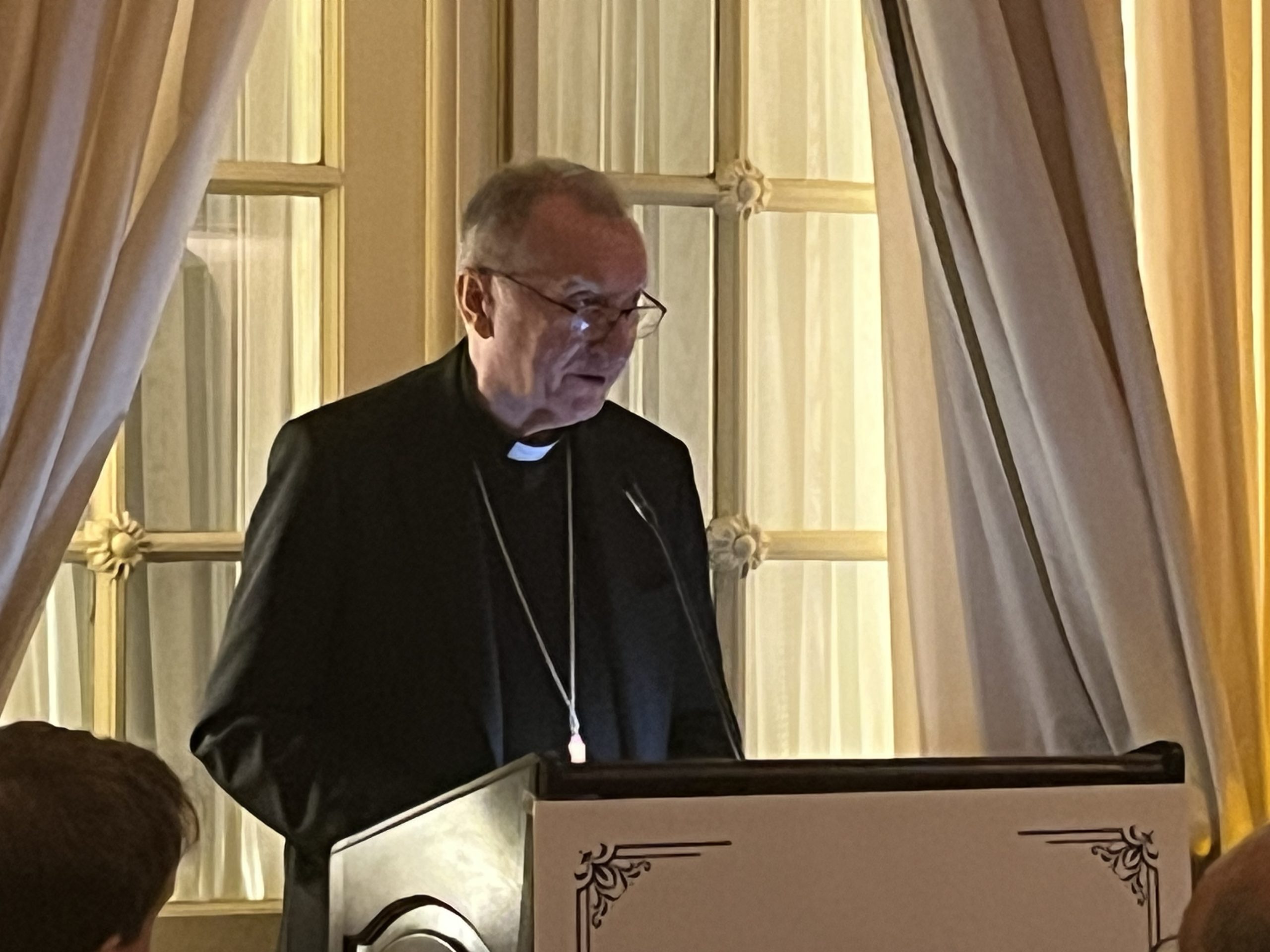
Assessing the impact of the Catholic Church's first American pope was front and center at the 106th annual meeting of the American Catholic Historical Association (ACHA), which met in Pope Leo XIV's hometown of Chicago from Jan. 8-11.
During a panel on the subject, Catholic scholars noted some of the historic caricatures of what an American papacy would be like and compared that to the first eight months of Leo's actual papacy.

At the outset of the panel, University of Notre Dame history professor Kathleen Sprows Cummings referenced the 1894 Puck magazine cartoon titled “ The American Pope,” which depicts the first apostolic delegate to the United States, Cardinal Francesco Satolli, sitting atop a church labeled the “American headquarters” and casting a shadow of then Pope Leo XIII over the entire country.
Sprows Cummings noted the cartoon illustrates “fears about papal intervention in the United States” at a time when the country was receiving waves of Catholic immigrants from countries such as Ireland and Italy.
As Catholics became more settled in American society in the subsequent decades, she said some of those prejudices began to lessen and pointed to the 1918 election of Catholic Democrat Al Smith as New York’s governor. By this point, Catholics had become “much more confident about their place in American culture.”
During the same early 20th century period, the United States also began to rise as a superpower. Sprows Cummings noted that predominant concerns about an American pope shifted to Vatican concerns over the “Americanization of the Catholic Church.”
America magazine's Vatican correspondent, Colleen Dulle, said some of those concerns were evidently mitigated in the person of then Cardinal Robert Prevost, whose service to the Church included many years as a missionary and bishop in Peru as well as in Rome as the head of a global religious order, the Augustinians.
Sprows Cummings said the College of Cardinals clearly saw in Cardinal Prevost the "pastoral presence, administrative savvy and global vision" that the Church needed at this time and that he was “not elected in some flex of American power.”
Miguel Diaz, the John Courtney Murray, S.J. Chair in Public Service at Loyola University Chicago, noted that some of Leo’s actions have actually amounted to the opposite of flexing American power, such as his focus on the dignity of migrants, which he contrasted to the policies of the Trump administration.

Diaz, who served as U.S. ambassador to the Holy See under former President Barack Obama, said Leo is “a different symbol, from America first to America cares.”
He emphasized that having an American pope is significant amid the country’s political debates because “he can say things and he will be listened to.”
The panelists also discussed what Leo’s papacy may look like moving forward, with Dulle noting that only this year are there clear signs of him charting his own programmatic course, as the events and itinerary of the 2025 Jubilee were primarily developed for Pope Francis.
Up until now, she said, he has been mostly “continuing the Francis initiatives in a different style.”
She noted Pope Leo's management of this week's consistory — a meeting between the pope and the College of Cardinals — where the pontiff gave them four topics to choose from, which were all in line with Francis’s priorities: synodality, evangelization, reform of the curia, and the liturgy. The cardinals chose synodality and evangelization.
Dulle said Leo is seen as "a consensus builder” who aims to build consensus around the Church's priorities. She noted Pope Leo's announcement this week of a regular schedule of consistories, with the next one set for this June. This approach is emerging as a "hallmark of how he governs the Church" Dulle said.
Brian Flanagan, the John Cardinal Cody Chair of Catholic Theology at Loyola University Chicago, also emphasized Leo’s strong appeal to the cardinals and bishops in efforts to reach consensus, in keeping with the Pope's role as a preserver of unity.
Flanagan said he sees Leo exercising the papacy as not so much "at the top of the pyramid, but as at the center of conversation.” He said this is likely influenced by Leo's past as leader of a religious order — the Order of Saint Augustine — rather than a diocese because the orders are “global, diverse, and somewhat fractious.”
“You can’t govern a global religious community without getting people on board,” he said.
Read More

Jan 10, 2026 / 06:00 am (CNA).
Catholics in the U.S. were witness to a rare Church decision in 2023 when Pope Francis elevated the Diocese of Las Vegas to a metropolitan archdiocese. Las Vegas had previously been a suffragan diocese of San Francisco, having been created by Pope John Paul II in 1995.
A suffragan diocese operates within an ecclesiastical province subordinate to a larger archdiocese and is led by a suffragan bishop who has the authority to lead his own diocese but works under the metropolitan archbishop.
In September 2025, Pope Leo XIV created a new Catholic diocese in northern China; though it goes by the same name as one established decades ago by Beijing without Vatican approval — a product of ongoing tensions between China and the Holy See — the move demonstrated the Holy See’s authority in creating local Church jurisdictions.
Outside of one’s own parish, a diocese or archdiocese is arguably the average Catholic’s most common point of interaction with the Church. These jurisdictions manage local Church life and administration, with bishops and archbishops offering both spiritual and temporal guidance and authority to Catholics under their care.
But how does the Catholic Church decide what becomes a diocese or an archdiocese? What are the roots of this ancient practice, and how does it function today?
Monsignor William King, JCD, KCHS, an assistant professor at the school of canon law at The Catholic University of America, told CNA that the right to erect (or suppress) a diocese “belongs exclusively to the successor of Peter, the bishop of Rome,” that is, the pope.
“Historically, secular rulers have intruded into the process and the autonomy of the Church in this action has been hard-won,” he said, pointing out that “even today in certain parts of the world, secular or civil rulers wish to have input into matters such as this.”
The pope never makes decisions regarding dioceses and archdioceses “without considerable study and consultation,” King said.
The history of diocesan administration stretches back to the earliest years of the Church, he said. In those days a diocese consisted of “a city larger than the surrounding cities and towns,” often a place of commerce or a center of government.
Throughout the centuries, including after the imperial legalization of the Church by Constantine, Church leaders refined the diocesan structure of “pastoral ministry and governance” in order to facilitate “communication and decision-making” throughout Christendom.
“This became increasingly important as the Church grew and encountered different systems of law, philosophy, and religious practice,” King said. Roman models of government structure proved useful and sufficient for Church governance; King noted that the Church structure even today more closely resembles a government than a corporation.
The process by determining which jurisdictions counted as archdioceses likely arose in earlier centuries organically, King said, with Church leaders identifying major centers of “culture, education, commerce, government, and transportation” as particularly significant jurisdictions.
The procedure for elevating a diocese to an archdiocese, meanwhile — as Pope Francis did to Las Vegas in 2023 — requires “significant study, discussion, and decision-making,” King said.
The Holy See conducts such reviews in part through a diocese’s “quinquennial report,” a detailed rundown of the diocese’s activities and administration. Such a report may indicate to the Holy See that a particular region is growing and could benefit from elevation to an archdiocese.
Local suffragan bishops will participate in discussions to that effect, King said, and the Roman Curia will work with bishops’ conferences as well as the local apostolic nuncio.
“The ultimate decision is that of the Roman pontiff, the bishop of Rome,” King said, “but is always done with his awareness of the conversations and consultations already conducted at every level.”
The priest pointed out that not every local jurisdiction of the Church is a diocese or archdiocese. At times, he said, the pope may establish a less common ecclesiastical administration “for a variety of reasons that relate to culture, legal acceptance or opposition, small numbers, and the like.”
Such jurisdictions include apostolic prefectures, apostolic vicariates, ordinariates, and other designations. Such areas may be governed by a bishop or a priest named by the pope, King said.
Read More
Jan 5, 2026 / 04:00 am (CNA).
Every Jan. 5 the Church celebrates the feast of St. John Neumann, Redemptorist missionary, fourth bishop of the city of Philadelphia, and organizer of the first Catholic education network in the U.S.
John Nepomucene Neumann was born in Bohemia, now the Czech Republic, in 1811. He attended school in Budweis and years later, in 1831, entered the seminary in that same city.
Upon completing his preparation for the priesthood, he presented himself to his diocese but suffered an unexpected setback. The local bishop had fallen ill and priestly ordinations in his diocese were suspended until further notice.
Neumann, eager to serve the Lord, wrote letters to the bishops of the neighboring dioceses, but none of them wanted to accept him. Despite the obstacles, the saint was not discouraged.
To earn his living, he went to work in a factory where he met a few Americans from whom he learned some English. Later, he contacted some bishops in the United States. Neumann had a missionary soul and was ready to move to America.
The archbishop of New York agreed to receive and ordain Neumann, so he left his family and friends to embark on the adventure of proclaiming the Lord in a distant land. After being ordained in the U.S., Neumann joined 36 other priests who were to assist the almost 200,000 Catholics living in the U.S. at the time.
The newly ordained was entrusted with the administration of a parish. The first pastoral difficulty he faced was the vast territory entrusted to him: His parish stretched from Ontario, Canada, to Pennsylvania.
Given the immense need, Neumann spent most of his time visiting villages and towns. He had to cross inhospitable territories, walk long distances in extreme cold and sweltering heat, and trek high mountains and majestic landscapes — all in order to watch over his flock and to assist those in need.
These were long years of providing catechesis, administering the sacraments, and celebrating the Eucharist. It was common to see Neumann preach both in churches and in abandoned huts. He even preached outside taverns, refuges for impenitent souls.
Neumann often had to celebrate Mass in dining rooms and kitchens.
With time and continued difficulties, the missionary priest discovered the need for the support of a religious community. He knew the Redemptorists well so he applied to join the Congregation of the Most Holy Redeemer. When the time came, he took his vows at the congregation’s house in Baltimore in 1842.
Neumann was noted for his piety and kindness as well as his versatility in understanding and accompanying his parishioners, most of whom were European immigrants. Neumann knew up to six languages, so it was not difficult for him to communicate with Catholics who did not speak English well.
In 1847, he was appointed visitator of the Redemptorists in the United States. At the end of his service, the Redemptorists were ready to form an autonomous “province or religious province,” which became a reality in 1850.
Neumann was then ordained bishop of Philadelphia, and from that city he organized the diocesan system of Catholic schools, becoming a great promoter of religious education in the country. He also founded the congregation of the Sisters of the Third Order of St. Francis, dedicated to teaching in schools, and was the promoter of the construction of more than 80 churches throughout the country.
Neumann was a simple man, short in stature and reportedly good-natured. Although he never had robust health, he carried out great pastoral and literary activity. He wrote many articles in magazines and newspapers, and published two catechisms and a history of the Bible for schoolchildren.
Once, in one of his articles, he wrote: “I have never regretted having dedicated myself to the mission in America.”
On Jan. 5, 1860, when he was just 48 years old, he suddenly collapsed in the street and went home to the Lord. He was beatified in 1963 and canonized in 1977 by Pope Paul VI.
This story was first published by ACI Prensa, CNA’s Spanish-language news partner. It has been translated and adapted by CNA.
Read More

Dec 31, 2025 / 08:00 am (CNA).
2025 was filled with impactful moments — from the death of Pope Francis to the election of the first American-born pope, Leo XIV, to hundreds of thousands of young people who gathered in Rome for the Jubilee of Youth to the canonization of the Church’s first millennial saint.
Here are some of the top Catholic moments of 2025:
The new year began with Catholics around the world uniting in prayer for Pope Francis’ health as he entered the hospital on Feb. 14. He was admitted to Gemelli Hospital in Rome due to a respiratory infection that progressed to bilateral pneumonia, requiring a prolonged hospitalization that lasted almost six weeks.
On March 23, Pope Francis was discharged from the hospital and gave a blessing from the hospital window to the faithful who were gathered.
Soon after, on March 29, the late pontiff was readmitted to the hospital with difficulty breathing. On April 21, the day after Easter, Pope Francis passed away at the age of 88 from a stroke, coma, and irreversible cardiovascular collapse, according to the death certificate published just over 12 hours after Francis’ death.
More than 400,000 people filled St. Peter’s Square for the funeral of Pope Francis on April 26 as the world said goodbye to the first Latin American pope, who led the Catholic Church for 12 years.
On May 7, 133 cardinal electors gathered in the Sistine Chapel for the start of the conclave. After four ballots, Cardinal Robert Prevost was elected on May 8 as the 267th pope of the Catholic Church and took the name Pope Leo XIV. A Chicago native, he became the first American pope in Church history.
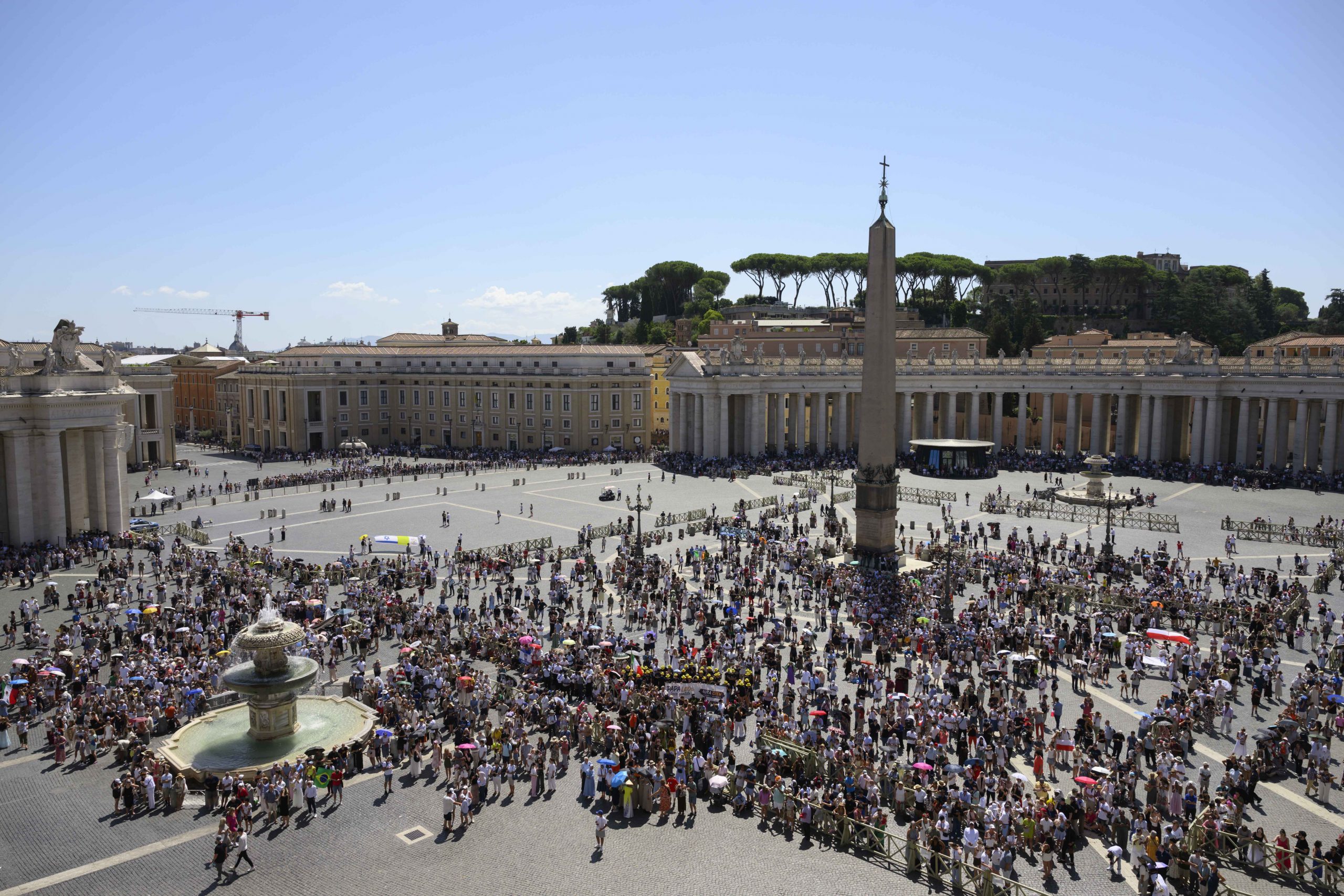
Thousands gathered in St. Peter’s Square erupted in cheers as the bells of the basilica began to toll, confirming the election of a new pontiff. The crowds gathered as word spread throughout Rome that a new pope had been chosen.
One of Pope Leo’s first major events was the Jubilee of Youth, which was held in Rome from July 28 to Aug. 3. Roughly 1 million young adults from around the world filled the streets of Rome as each day was filled with different opportunities and events for the young people to experience the richness of the Catholic faith.
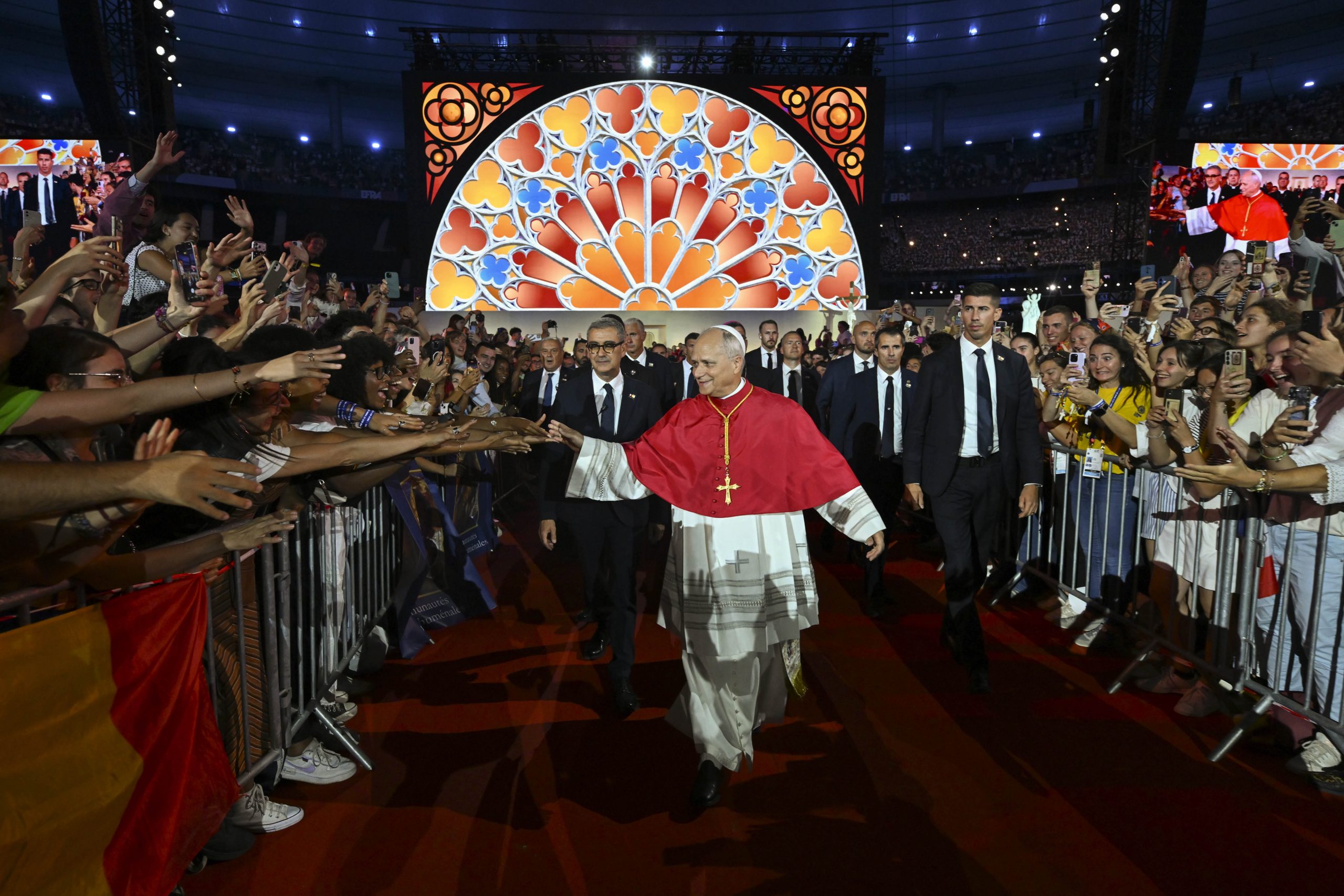
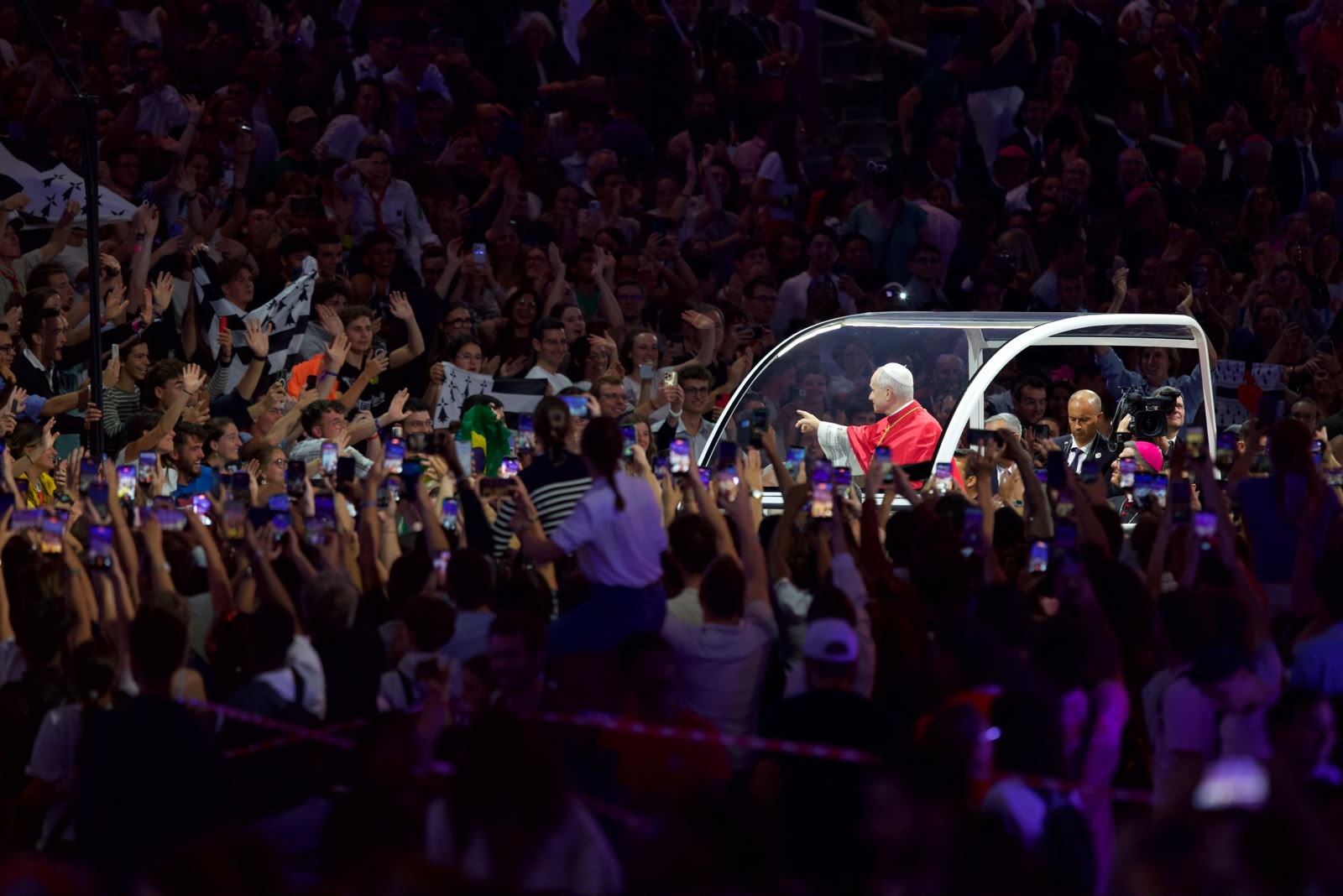
On Aug. 2, Pope Leo XIV was greeted by the largest crowd he had addressed during his pontificate thus far for the evening vigil at Tor Vergata, an outdoor venue 10 miles east of Rome. An estimated 1 million people were in attendance. The Holy Father arrived by helicopter and then drove through the grounds on the popemobile, waving to the cheering young people before the prayer service began.

The Catholic community was shaken when a school shooting took place on Aug. 27 at Annunciation Catholic Church in Minneapolis. Two children were killed and 20 were injured. The shooter was identified as Robin Westman — who was born “Robert” and identified as a transgender woman — who died by suicide shortly after shooting through the windows of the church during a weekday school Mass.
The Holy Father sent his condolences and offered prayers for the victims. He described the event as an “extremely difficult” and “terrible” tragedy.

On Sept. 7, two of the Church’s most beloved blesseds became saints: Carlo Acutis and Pier Giorgio Frassati. The canonizations of the two men, promulgated before an estimated 70,000 people in St. Peter’s Square, were the first of Leo XIV’s pontificate.
During his homily, the pope said: “Today we look to St. Pier Giorgio Frassati and St. Carlo Acutis: a young man from the early 20th century and a teenager from our own day, both in love with Jesus and ready to give everything for him.”
“Dear friends, Sts. Pier Giorgio Frassati and Carlo Acutis are an invitation to all of us, especially young people, not to squander our lives but to direct them upwards and make them masterpieces,” he added.
The Catholic Church gained a new doctor of the Church on Nov. 1 , when Pope Leo XIV declared St. John Henry Newman a doctor of the Church, recognizing the English cardinal and theologian — one of the most influential converts from Anglicanism — as a towering figure of faith and intellect in modern Catholicism.
“Newman’s impressive spiritual and cultural stature will surely serve as an inspiration to new generations whose hearts thirst for the infinite and who, through research and knowledge, are willing to undertake that journey which, as the ancients said, takes us ‘per aspera ad astra,’ through difficulties to the stars,” the pope said in his homily.

On Nov. 21, Pope Leo took part in his first digital encounter with American youth during the National Catholic Youth Conference, which took place Nov. 20–22 in Indianapolis.
The conference featured Catholic speakers, daily Mass and adoration, music and worship, breakout groups and workshops, and interactive exhibits with games, vendors, meetups, and live radio shows.
The main attraction of the conference was the hourlong live, virtual dialogue the pope had with those in attendance. Five young people were chosen to ask the Holy Father questions, which ranged from prayer to technology to friendships and the future of the Church. Pope Leo gave those gathered invaluable advice regarding the several different topics discussed.
Pope Leo visited Turkey and Lebanon during his first papal trip from Nov. 27–Dec. 2. The wide-ranging international visit included historic ecumenical encounters, deeply symbolic gestures of prayer, and pastoral visits to Christian communities under pressure. The Holy Father highlighted the importance of unity, peace, and fraternity, and brought encouragement to a region marked by ancient faith and present suffering.


Dec 31, 2025 / 06:00 am (CNA).
The past year has seen several notable Catholics pass away — from public officials to the vicar of Christ himself.
Here’s a rundown of some prominent Catholics around the world who left us in 2025:
The Holy Father, Pope Francis, passed away at 7:35 a.m. on Easter Monday, April 21, at his residence in the Vatican’s Casa Santa Marta. The 88-year-old pontiff led the Catholic Church for a little more than 12 years.
The first Latin American pope in history as well as the first Jesuit pope, Francis led the Church through significant canonical and catechetical reforms, urging the faithful to reach out and minister to those on the margins of society while preaching the mercy of God.
Upon his death he left the legacy of what Cardinal Kevin Farrell said was a life “dedicated to the service of God and his Church,” one that urged the faithful to “live the values of the Gospel with fidelity, courage, and universal love, especially for the poorest and most marginalized.”
Pope Francis was succeeded in the chair of St. Peter by Pope Leo XIV on May 8.
Mabel Landry Staton, a trailblazing athlete who briefly set an Olympic record at the 1952 Summer Olympics, died on Feb. 20 at age 92.
Representing the United States at the Olympic games in Helsinki in 1952, Staton — known as “Dolly” after a nickname from her father — set a record in the long jump category at 19 feet 3.25 inches. Though the record only lasted for several minutes before New Zealand athlete Yvette Williams bested it, Staton would go on to win medals in the 1955 Pan American Games.
The Philadelphia Inquirer reported that Staton served as a Eucharistic minister at St. Thomas More Church in Cherry Hill, New Jersey, as well as on the board of the Black Catholic Ministry of the Diocese of Camden.
According to the Inquirer, Staton “could still outsprint some of the local high school boys in her 70s.”
Alasdair MacIntyre, a towering figure in moral philosophy and a Catholic convert credited with reviving the discipline of virtue ethics, died on May 21 at age 96.
His seminal 1981 work “After Virtue” reshaped contemporary moral and political philosophy, emphasizing virtue over utilitarian or deontological frameworks.
Known by many as “the most important” modern Catholic philosopher, MacIntyre’s intellectual and spiritual journey spanned atheism, Marxism, Anglicanism, and ultimately Roman Catholicism.
James Hitchcock — a noted historian of the Catholic Church, popular author, and longtime college professor — died on July 14 at age 87.
Hitchcock was remembered by friends and colleagues as a man of prophetic insight who defended Church teaching and helped to make the Catholic intellectual tradition accessible for his students and readers.
Hitchcock taught history at Saint Louis University from the late 1960s until 2013. Some of the most popular of the dozen books he wrote include his one-volume “History of the Catholic Church: From the Apostolic Age to the Third Millennium,” published in 2012 by Ignatius Press.
Frank Caprio, who served as a Providence, Rhode Island, municipal court judge for nearly 40 years and came to be known as “America’s nicest judge,” passed away on Aug. 20 from pancreatic cancer.
Caprio gained worldwide fame for a lenient judicial style that blended justice, extreme empathy, and mercy when his courtroom was televised in a program called “Caught in Providence.”
The program began in 1999 and went viral in 2017, achieving hundreds of millions of views since then. The show was nominated for a Daytime Emmy Award in 2021 and has a YouTube channel with nearly 3 million subscribers.
Caprio told EWTN News in February that he always kept in mind something his father, a hardworking Italian immigrant with a fifth-grade education, had impressed upon him: “What might seem like a small fine to some was something that many couldn’t afford.”
“Your case is dismissed” became Caprio’s signature phrase.
Thomas A. Nelson, the founder of TAN Books — a Catholic publishing house known for its books promoting traditional Catholicism in the post-Vatican II era — died Aug. 16 at age 88.
Nelson, who had previously worked as a teacher, founded TAN Books and Publishers Inc. in Rockford, Illinois, in 1967 and an accompanying printing plant in 1978. In addition to being Nelson’s initials, TAN is an acronym for the Latin phrase “Tuum Adoramus Nomen” (“Let Us Adore Thy Name”).
Under Nelson’s ownership, TAN became known for publishing orthodox Catholic books, including reprints of classic Catholic works on theology, Scripture, traditional devotions, the Traditional Latin Mass, and the lives of the saints as well as new titles on these subjects by contemporary authors.
The Duchess of Kent, who became the first senior British royal to be received into the Catholic Church since the 17th century, died on Sept. 4 at the age of 92.
Renowned for her natural charm, compassion for the sick and downtrodden, and commitment to serving others, the duchess was a much-loved and hardworking British royal whose popularity was enhanced by her own personal suffering and self-effacing nature.
She was received into the Church in January 1994 by Cardinal Basil Hume. Up until then, no senior royal had publicly been received into the Church since 1685.
Katharine spoke favorably of the Church’s moral precepts. “I do love guidelines and the Catholic Church offers you guidelines,” she once told the BBC. “I have always wanted that in my life. I like to know what’s expected of me.”
Sister Jean Dolores Schmidt, the beloved Catholic nun who became known across the country at the age of 98 as the chaplain of the Loyola University Chicago men’s basketball team, died Oct. 9 at the age of 106.
Sister Jean was born Dolores Bertha Schmidt on Aug. 21, 1919, to Joseph and Bertha Schmidt. She was raised in a devout Catholic home in San Francisco’s Castro District.
In 1937, she joined the Sisters of Charity of the Blessed Virgin Mary and took the name Sister Jean Dolores. In 1991, she joined the staff at Loyola Chicago and three years later became part of the basketball team, first as an academic adviser before transitioning to chaplain.
Sister Jean led the team in prayer before each game — praying for her players to be safe, for the referees to be fair, and for God’s assistance during the game.
She also admitted to praying for the opposing team, though “not as hard.”
Sister Mary Michael of the Eucharistic Heart of Jesus, PCPA, died on Nov. 10 at age 94 after roughly three-quarters of a century of religious life.
Sister Mary Michael was the last of the original five nuns who, along with EWTN foundress Mother Angelica, began the Our Lady of the Angels Monastery in Irondale, Alabama.
Born Evelyn Shinosky on Feb. 25, 1931, to Joseph and Helen Shinosky, she entered Sancta Clara Monastery in Canton, Ohio, on Aug. 15, 1951, and received the habit and her new name the following May.
Her passing marked the end of an era at EWTN and at the monastery — one that saw both the launch of the global Catholic network and the expansion of the religious community to include the Shrine of the Most Blessed Sacrament of Our Lady of the Angels Monastery.
Paul Badde, author of many well-known books such as “Benedict Up Close,” “The Face of God,” and “The True Icon,” died on Nov. 10 at the age of 77 after a long illness. Badde was also a veteran contributor to EWTN and CNA Deutsch, CNA’s German-language news partner.
Born in Schaag, Germany — a small village on the Lower Rhine — he studied philosophy and sociology in Freiburg as well as art history, history, and political science in Frankfurt. Before embarking on a journalistic career, Badde worked as a teacher for several years.
A founding editor of Vatican Magazine, Paul and his wife, Ellen, had five children.
Longtime immigrant rights advocate Sister JoAnn Persch died on Nov. 14 at age 91.
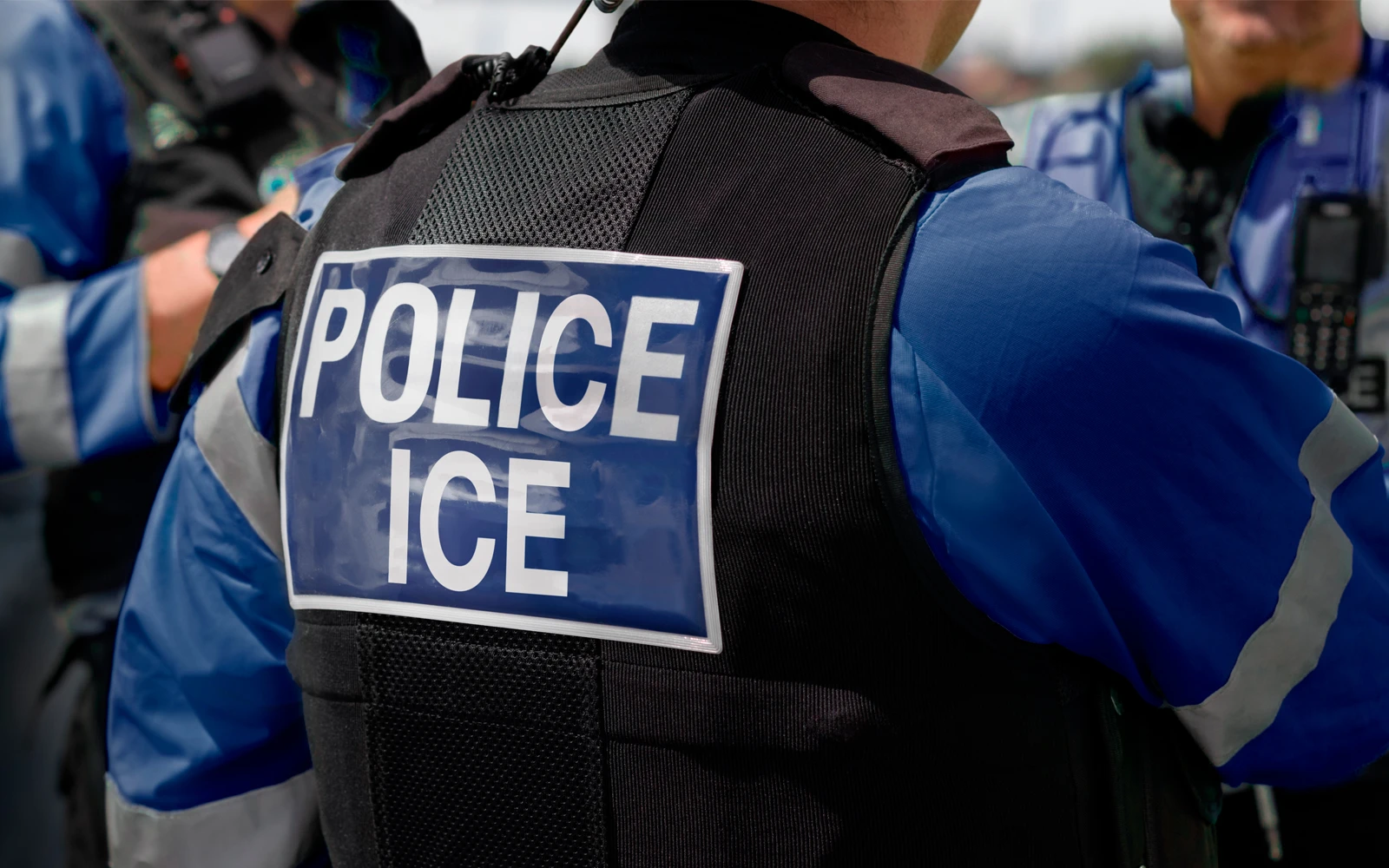
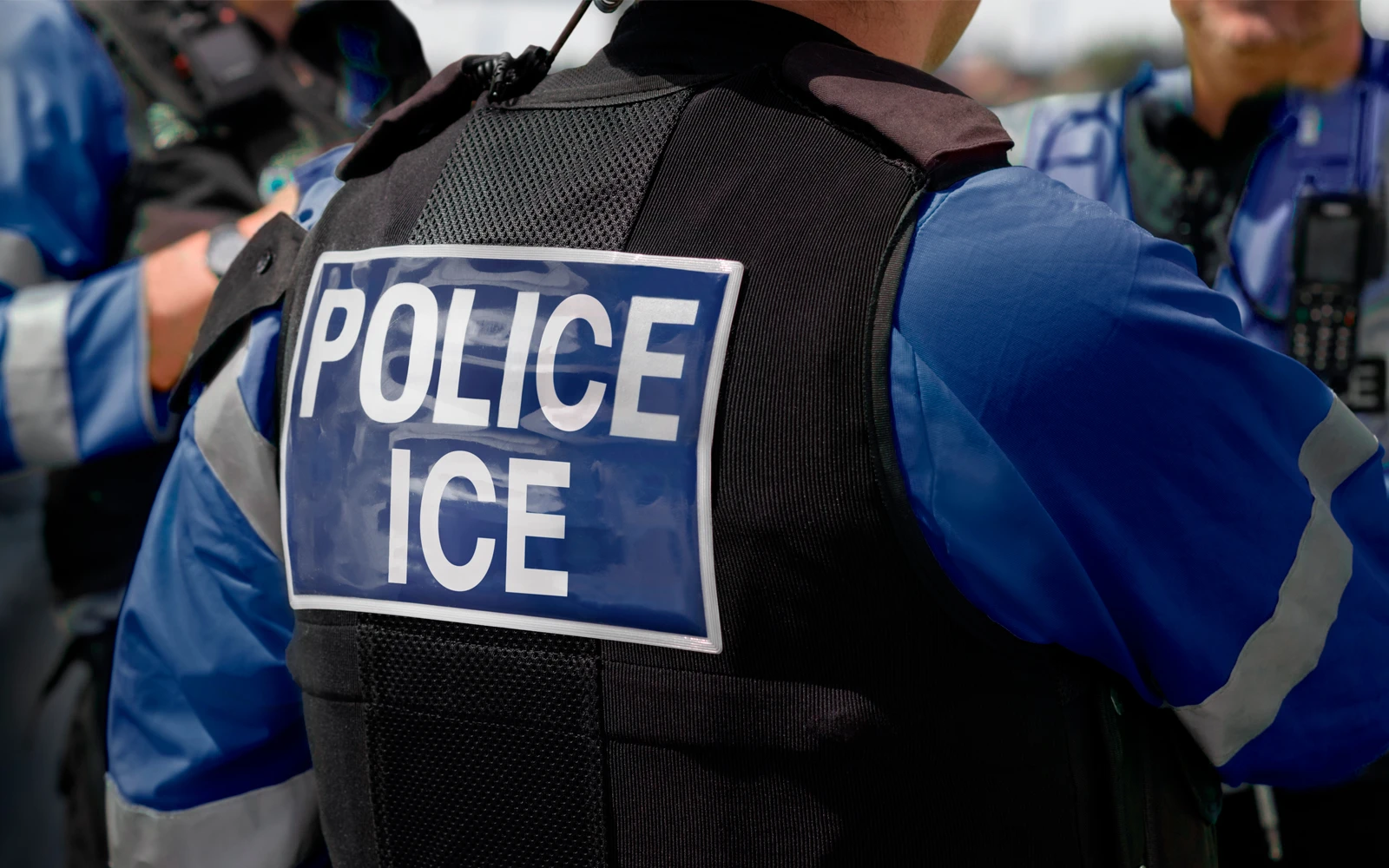
Two weeks before her death, Persch attempted to bring Communion to detainees at the Broadview, Illinois, Immigration and Customs Enforcement (ICE) facility where for decades the Sisters of Mercy ministered to migrants and refugees. Officials denied her entry.
Persch and Sister Pat Murphy were founding members of the Su Casa Catholic Worker House in Chicago, serving refugees from Central America who were survivors of war, torture, and political persecution.
May the souls of the faithful departed, through the mercy of God, rest in peace.
Read More![Should Catholics use AI to re-create deceased loved ones? Experts weigh in #Catholic
A child holds a phone with the Replika app open and an image of an AI companion. Apps that promise to help recreate digital versions of deceased family members using AI pose a “spiritual danger” to Catholics and others who may use the technology in place of healthy grief, experts say. / Credit: Generated by an Artificial Intelligence (AI) system on Shutterstock
CNA Staff, Dec 27, 2025 / 07:00 am (CNA).
Apps that promise to help re-create digital versions of deceased family members using AI pose a “spiritual danger” to Catholics and others who may use the technology in place of healthy grief, experts say.The AI company 2wai ignited a controversy on social media in November after it revealed its eponymous app, which will allow users to fabricate digital versions of their loved ones using video and audio footage.App co-founder Calum Worthy said in a viral X post that the tech could permit “loved ones we’ve lost [to] be part of our future.” The accompanying video shows a family continuously interacting with the digital projection of a deceased mother and grandmother even years after she died.What if the loved ones we've lost could be part of our future? pic.twitter.com/oFBGekVo1R— Calum Worthy (@CalumWorthy) November 11, 2025 The reveal of the app brought praise from some tech commentators, though there was also considerable negative reaction. Many critics denounced it as “vile,” “demonic,” and “terrifying,” with others predicting that the app would be used to ghoulish ends such as using dead relatives to promote internet advertisements. Tech ‘could disrupt the grieving process’2wai did not respond to requests for comment on the controversy, though company CEO Mason Geyser told the Independent that the ad was deliberately meant to be “controversial” in order to “spark this kind of online debate.” Geyser himself said he views the app as a tool to be used with his children to help preserve the memories of earlier generations rather than as a means to having a relationship with an AI avatar. “I see it … as a way to just kind of pass on some of those really good memories that I had with my grandparents,” he said. Whether or not such an app is compatible with the Catholic understanding of death — and of more diffuse, esoteric topics like grief — is unclear. Father Michael Baggot, LC, an associate professor of bioethics at the Pontifical Athenaeum Regina Apostolorum, acknowledged that AI avatars “could potentially remind us of certain aspects of our loved ones and help us learn from their examples.”But such digital replicas “cannot capture the full richness of the embodied human being,” he said, and they risk “distorting the dead’s legacy” by fabricating conversations and interactions beyond the dead’s control. Catholic leaders have regularly remarked on both the heavy burden of grief and its redemptive power. Pope Francis in 2020 acknowledged that grief is ”a bitter path,” but it can “serve to open our eyes to life and the sacred and irreplaceable value of each person,” while helping one realize “how short time is.”In October, meanwhile, Pope Leo XIV told a grieving father that those mourning the death of a loved one must “remain connected to the Lord, going through the greatest pain with the help of his grace.” The Resurrection, he said, “knows no discouragement or pain that imprisons us in the extreme difficulty of not finding meaning in our existence.”Brett Robinson, the associate director of the McGrath Institute for Church Life at the University of Notre Dame, warned that there is “spiritual danger” in technology that outwardly appears to bring loved ones back from the dead. Technology is not a neutral product, he said, but one that “has a profound ability to shape our perception of reality, regardless of the content being displayed.”“In the case of re-presenting dead loved ones we meet one such case where prior conceptions about identity, vitality, and presence are being reshaped along technological lines,” he said. “If someone who no longer exists in human form, body and soul, can be ‘resurrected’ from an archive of the digital traces of their life, who or what are we actually engaging with?” he said. Robinson argued that present modes of technology have echoes of earlier centuries “when the cosmos was filled with presence — the presence of God, of angels, of demons, and of magic.” The problem at hand, he said, is that the “new magic” of modern technology “is divorced from the hierarchical, ordered cosmos of creation and the spiritual realm.”Donna MacLeod has worked in grief ministry for decades. She first became involved in Catholic grief counseling after the death of her youngest daughter in 1988. The funeral ministry evolved into Seasons of Hope, a grief support program for Catholics that “focuses on the spiritual side of grieving the death of a loved one.”MacLeod said the program is one of “hospitality and spirituality” that arises in an intensive community of individuals suffering from grief. “It builds parish communities,” she said. “People discover they’re not alone. That’s a big deal to grieving people — a lot of people feel very alone in their loss.” “And society expects everybody to move on,” she continued. “But grief has its own timetable. Those who are grieving start to understand that the Lord is with them and that he really cares about them. There’s hope and healing at the end of it.” “It’s doing what Christ asks us to do — walking with each other in hard times,” she said. Regarding the AI avatar technology, MacLeod acknowledged that those who have lost a loved one make it a “very high priority” to “seek connection” with the deceased. “People will say, ‘I’m not taking my loved one’s voice off of my answering machine,’” she said. “Or we have people taking out videos of family gatherings so they can see their loved ones again.”“Everyone seeks to still be connected with their loved ones,” she said. “It’s related to our Catholic faith and the communion of saints — people feel this spiritual connection with their loved ones.”MacLeod described herself as “on the fence” about how people could be affected by AI avatar apps. There could be “emotional and psychological risks interacting with AI versions of loved ones,” she admitted, though she said that many users “might look at it, but not get hung up on it,” unless they have underlying mental health issues. But “where the difficulty arises is that some people get stuck in the denial stage,” she said. Those suffering from grief can get desperate in such circumstances, she said, and sometimes resort to means such as mediums or psychics, which MacLeod pointed out the Church explicitly forbids. Whether or not AI avatars fall under that forbidden category is unclear. The Catechism of the Catholic Church expressly outlaws any efforts at “conjuring up the dead.” The use of mediums or clairvoyants “all conceal[s] a desire for power over time, history, and, in the last analysis, other human beings,” the Church says. Baggot said apps like 2wai’s “assemble data about the deceased without preserving the person.” He further argued that AI avatars “could also disrupt the grieving process by sending ambiguous signals about the survival of the departed person.”Robinson, meanwhile, acknowledged that it is “good to want to connect to deceased loved ones,” which he pointed out we do “liturgically through prayer and memorials that honor those souls that are dear to us.” He warned, however, against “technocratic creators of complex computational machines that are becoming indistinguishable from magic.”Such technology, he said, alters “the spiritual order” in ways “that are disordered and disembodied from the ritual forms that sustain religion and our belief that our eternal destiny rests with God in heaven and not in a database.”](https://unitedyam.com/wp-content/uploads/2025/12/should-catholics-use-ai-to-re-create-deceased-loved-ones-experts-weigh-in-catholic-a-child-holds-a-phone-with-the-replika-app-open-and-an-image-of-an-ai-companion-apps-that-promise-to-help-recr.webp)

CNA Staff, Dec 27, 2025 / 07:00 am (CNA).
Apps that promise to help re-create digital versions of deceased family members using AI pose a “spiritual danger” to Catholics and others who may use the technology in place of healthy grief, experts say.
The AI company 2wai ignited a controversy on social media in November after it revealed its eponymous app, which will allow users to fabricate digital versions of their loved ones using video and audio footage.
App co-founder Calum Worthy said in a viral X post that the tech could permit “loved ones we’ve lost [to] be part of our future.” The accompanying video shows a family continuously interacting with the digital projection of a deceased mother and grandmother even years after she died.
What if the loved ones we’ve lost could be part of our future? pic.twitter.com/oFBGekVo1R
— Calum Worthy (@CalumWorthy) November 11, 2025
The reveal of the app brought praise from some tech commentators, though there was also considerable negative reaction. Many critics denounced it as “vile,” “demonic,” and “terrifying,” with others predicting that the app would be used to ghoulish ends such as using dead relatives to promote internet advertisements.
2wai did not respond to requests for comment on the controversy, though company CEO Mason Geyser told the Independent that the ad was deliberately meant to be “controversial” in order to “spark this kind of online debate.”
Geyser himself said he views the app as a tool to be used with his children to help preserve the memories of earlier generations rather than as a means to having a relationship with an AI avatar. “I see it … as a way to just kind of pass on some of those really good memories that I had with my grandparents,” he said.
Whether or not such an app is compatible with the Catholic understanding of death — and of more diffuse, esoteric topics like grief — is unclear. Father Michael Baggot, LC, an associate professor of bioethics at the Pontifical Athenaeum Regina Apostolorum, acknowledged that AI avatars “could potentially remind us of certain aspects of our loved ones and help us learn from their examples.”
But such digital replicas “cannot capture the full richness of the embodied human being,” he said, and they risk “distorting the dead’s legacy” by fabricating conversations and interactions beyond the dead’s control.
Catholic leaders have regularly remarked on both the heavy burden of grief and its redemptive power. Pope Francis in 2020 acknowledged that grief is ”a bitter path,” but it can “serve to open our eyes to life and the sacred and irreplaceable value of each person,” while helping one realize “how short time is.”
In October, meanwhile, Pope Leo XIV told a grieving father that those mourning the death of a loved one must “remain connected to the Lord, going through the greatest pain with the help of his grace.”
The Resurrection, he said, “knows no discouragement or pain that imprisons us in the extreme difficulty of not finding meaning in our existence.”
Brett Robinson, the associate director of the McGrath Institute for Church Life at the University of Notre Dame, warned that there is “spiritual danger” in technology that outwardly appears to bring loved ones back from the dead.
Technology is not a neutral product, he said, but one that “has a profound ability to shape our perception of reality, regardless of the content being displayed.”
“In the case of re-presenting dead loved ones we meet one such case where prior conceptions about identity, vitality, and presence are being reshaped along technological lines,” he said.
“If someone who no longer exists in human form, body and soul, can be ‘resurrected’ from an archive of the digital traces of their life, who or what are we actually engaging with?” he said.
Robinson argued that present modes of technology have echoes of earlier centuries “when the cosmos was filled with presence — the presence of God, of angels, of demons, and of magic.”
The problem at hand, he said, is that the “new magic” of modern technology “is divorced from the hierarchical, ordered cosmos of creation and the spiritual realm.”
Donna MacLeod has worked in grief ministry for decades. She first became involved in Catholic grief counseling after the death of her youngest daughter in 1988. The funeral ministry evolved into Seasons of Hope, a grief support program for Catholics that “focuses on the spiritual side of grieving the death of a loved one.”
MacLeod said the program is one of “hospitality and spirituality” that arises in an intensive community of individuals suffering from grief.
“It builds parish communities,” she said. “People discover they’re not alone. That’s a big deal to grieving people — a lot of people feel very alone in their loss.”
“And society expects everybody to move on,” she continued. “But grief has its own timetable. Those who are grieving start to understand that the Lord is with them and that he really cares about them. There’s hope and healing at the end of it.”
“It’s doing what Christ asks us to do — walking with each other in hard times,” she said.
Regarding the AI avatar technology, MacLeod acknowledged that those who have lost a loved one make it a “very high priority” to “seek connection” with the deceased.
“People will say, ‘I’m not taking my loved one’s voice off of my answering machine,’” she said. “Or we have people taking out videos of family gatherings so they can see their loved ones again.”
“Everyone seeks to still be connected with their loved ones,” she said. “It’s related to our Catholic faith and the communion of saints — people feel this spiritual connection with their loved ones.”
MacLeod described herself as “on the fence” about how people could be affected by AI avatar apps. There could be “emotional and psychological risks interacting with AI versions of loved ones,” she admitted, though she said that many users “might look at it, but not get hung up on it,” unless they have underlying mental health issues.
But “where the difficulty arises is that some people get stuck in the denial stage,” she said. Those suffering from grief can get desperate in such circumstances, she said, and sometimes resort to means such as mediums or psychics, which MacLeod pointed out the Church explicitly forbids.
Whether or not AI avatars fall under that forbidden category is unclear. The Catechism of the Catholic Church expressly outlaws any efforts at “conjuring up the dead.” The use of mediums or clairvoyants “all conceal[s] a desire for power over time, history, and, in the last analysis, other human beings,” the Church says.
Baggot said apps like 2wai’s “assemble data about the deceased without preserving the person.”
He further argued that AI avatars “could also disrupt the grieving process by sending ambiguous signals about the survival of the departed person.”
Robinson, meanwhile, acknowledged that it is “good to want to connect to deceased loved ones,” which he pointed out we do “liturgically through prayer and memorials that honor those souls that are dear to us.”
He warned, however, against “technocratic creators of complex computational machines that are becoming indistinguishable from magic.”
Such technology, he said, alters “the spiritual order” in ways “that are disordered and disembodied from the ritual forms that sustain religion and our belief that our eternal destiny rests with God in heaven and not in a database.”
Read More![Vice President Vance presents a Christian vision of politics #Catholic
U.S. Vice President JD Vance. / Credit: Gage Skidmore, CC BY-SA 4.0, via Wikimedia Commons
CNA Staff, Dec 23, 2025 / 14:27 pm (CNA).
U.S. Vice President JD Vance, America’s second Catholic vice president, laid out a distinctly Christian vision for American politics in a speech this week, declaring that “the only thing that has truly served as an anchor of the United States of America is that we have been and, by the grace of God, we always will be a Christian nation.”Speaking to more than 30,000 young conservatives at Turning Point USA’s AmFest 2025 some three months after the death of its founder Charlie Kirk, Vance called for a politics rooted in a Christian faith that honors the family, protects the weak, and rejects what he described as a decades-long “war” on Christianity in public life.The Christian faith has provided a “shared moral language” since the nation’s founding, the Yale-trained lawyer argued, which led to “our understanding of natural law and rights, our sense of duty to one’s neighbor, the conviction that the strong must protect the weak, and the belief in individual conscience.”“Christianity is America’s creed,” the vice president said to loud cheers, while acknowledging that not everyone needs to be a Christian and “we must respect each individual’s pathway” to God. Even so, he said, “even our famously American idea of religious liberty is a Christian concept.” Vance described how, over the past several decades, “freedom of religion transformed into freedom from religion” as a result of the cultural assault on Christian faith from those on “the left” who have “labored to push Christianity out of national life. They’ve kicked it out of the schools, out of the workplace, out of the fundamental parts of the public square.”He continued: “And in a public square devoid of God, we got a vacuum. And the ideas that filled that void preyed on the very worst of human nature rather than uplifting it.”Vance said cultural voices opposed to Christian faith “told us not that we were children of God, but children of this or that identity group. They replaced God’s beautiful design for the family that men and women could rely on … with the idea that men could turn into women so long as they bought the right bunch of pills from Big Pharma.” The former U.S. senator and Catholic convert credited President Donald Trump for ending the cultural “war that has been waged on Christians and Christianity in the United States of America,” touting the administration’s policy priorities as the fruit of Christian motivation.“We help older Americans in retirement, including by ending taxes on Social Security, because we believe in honoring your father and mother rather than shipping all of their money off to Ukraine,” he said. “We believe in taking care of the poor, which is why we have Medicaid, so that the least among us can afford their prescriptions or to take their kids to see a doctor.”Speaking of the despair he felt after the assassination of his friend Kirk, he said: “What saved me was realizing that the story of the Christian faith … is one of immense loss followed by even bigger victory. It’s a story of very dark nights followed by very bright dawns. What saved me was remembering the inherent goodness of God and that his grace overflows when we least expect it.”Of masculinity, Vance said: “The fruits of true Christianity are good husbands, patient fathers, builders of great things, and slayers of dragons. And yes, men who are willing to die for a principle if that’s what God asked them to do.”He described how he saw the fruits of Christian men living out their faith during a recent visit to a men’s ministry that aids those who struggle with addiction and homelessness: “They feed them. They clothe them. They give them shelter and financial advice. They live out the very best part of Christ’s commission.”After eating lunch with some of the men who were “all back on their feet” after receiving help, Vance said he saw that the answer to “What saved them?” was not “racial commonality or grievance … a DEI prep course” or “a welfare check.”“It was the fact that a carpenter died 2,000 years ago and changed the world in the process.” “A true Christian politics,” he said, “cannot just be about the protection of the unborn or the promotion of the family. As important as those things absolutely are, it must be at the heart of our full understanding of government.” On immigration policy, Vance has challenged U.S. bishops, popesThe vice president has publicly disagreed with the U.S. bishops on their reaction to the Trump administration’s immigration policies, as well as with Pope Leo XIV and the late Pope Francis, who seemed to criticize Vance in a letter the pontiff penned to the U.S. bishops last winter. In defense of the administration’s approach to immigration, Vance had in a late January interview invoked an “old school … Christian concept” he later identified as the “ordo amoris,” or “rightly ordered love.” He said that according to the concept, one’s “compassion belongs first” to one’s family and fellow citizens, “and then after that” to the rest of the world.After Pope Leo on Nov. 18 asked Americans to listen to U.S. bishops’ message opposing “the indiscriminate mass deportation of people” and urging the humane treatment of migrants, Vance countered: “Border security is not just good for American citizens. It is the humanitarian thing to do for the entire world.”Vance continued: “Open borders” do not promote “[human] dignity, even of the illegal migrants themselves,” citing drug and sex trafficking.“When you empower the cartels and when you empower the human traffickers, whether in the United States or anywhere else, you’re empowering the very worst people in the world,” Vance said.In this week’s AmFest speech, he touted the administration’s successes regarding immigration: “December marks seven months straight of zero releases at the southern border. More than 2.5 million illegal immigrants have left the United States. The first time in over 50 years that we have had negative net migration.”At the end of the speech, Vance told the thousands of young people that while “only God can promise you salvation in heaven” if they have faith in God, “I promise you closed borders and safe communities. I promise you good jobs and a dignified life … together, we can fulfill the promise of the greatest nation in the history of the earth.”](https://unitedyam.com/wp-content/uploads/2025/12/vice-president-vance-presents-a-christian-vision-of-politics-catholic-u-s-vice-president-jd-vance-credit-gage-skidmore-cc-by-sa-4-0-via-wikimedia-commonscna-staff-dec-23-2025-1427-p.webp)

CNA Staff, Dec 23, 2025 / 14:27 pm (CNA).
U.S. Vice President JD Vance, America’s second Catholic vice president, laid out a distinctly Christian vision for American politics in a speech this week, declaring that “the only thing that has truly served as an anchor of the United States of America is that we have been and, by the grace of God, we always will be a Christian nation.”
Speaking to more than 30,000 young conservatives at Turning Point USA’s AmFest 2025 some three months after the death of its founder Charlie Kirk, Vance called for a politics rooted in a Christian faith that honors the family, protects the weak, and rejects what he described as a decades-long “war” on Christianity in public life.
The Christian faith has provided a “shared moral language” since the nation’s founding, the Yale-trained lawyer argued, which led to “our understanding of natural law and rights, our sense of duty to one’s neighbor, the conviction that the strong must protect the weak, and the belief in individual conscience.”
“Christianity is America’s creed,” the vice president said to loud cheers, while acknowledging that not everyone needs to be a Christian and “we must respect each individual’s pathway” to God. Even so, he said, “even our famously American idea of religious liberty is a Christian concept.”
Vance described how, over the past several decades, “freedom of religion transformed into freedom from religion” as a result of the cultural assault on Christian faith from those on “the left” who have “labored to push Christianity out of national life. They’ve kicked it out of the schools, out of the workplace, out of the fundamental parts of the public square.”
He continued: “And in a public square devoid of God, we got a vacuum. And the ideas that filled that void preyed on the very worst of human nature rather than uplifting it.”
Vance said cultural voices opposed to Christian faith “told us not that we were children of God, but children of this or that identity group. They replaced God’s beautiful design for the family that men and women could rely on … with the idea that men could turn into women so long as they bought the right bunch of pills from Big Pharma.”
The former U.S. senator and Catholic convert credited President Donald Trump for ending the cultural “war that has been waged on Christians and Christianity in the United States of America,” touting the administration’s policy priorities as the fruit of Christian motivation.
“We help older Americans in retirement, including by ending taxes on Social Security, because we believe in honoring your father and mother rather than shipping all of their money off to Ukraine,” he said. “We believe in taking care of the poor, which is why we have Medicaid, so that the least among us can afford their prescriptions or to take their kids to see a doctor.”
Speaking of the despair he felt after the assassination of his friend Kirk, he said: “What saved me was realizing that the story of the Christian faith … is one of immense loss followed by even bigger victory. It’s a story of very dark nights followed by very bright dawns. What saved me was remembering the inherent goodness of God and that his grace overflows when we least expect it.”
Of masculinity, Vance said: “The fruits of true Christianity are good husbands, patient fathers, builders of great things, and slayers of dragons. And yes, men who are willing to die for a principle if that’s what God asked them to do.”
He described how he saw the fruits of Christian men living out their faith during a recent visit to a men’s ministry that aids those who struggle with addiction and homelessness: “They feed them. They clothe them. They give them shelter and financial advice. They live out the very best part of Christ’s commission.”
After eating lunch with some of the men who were “all back on their feet” after receiving help, Vance said he saw that the answer to “What saved them?” was not “racial commonality or grievance … a DEI prep course” or “a welfare check.”
“It was the fact that a carpenter died 2,000 years ago and changed the world in the process.”
“A true Christian politics,” he said, “cannot just be about the protection of the unborn or the promotion of the family. As important as those things absolutely are, it must be at the heart of our full understanding of government.”
The vice president has publicly disagreed with the U.S. bishops on their reaction to the Trump administration’s immigration policies, as well as with Pope Leo XIV and the late Pope Francis, who seemed to criticize Vance in a letter the pontiff penned to the U.S. bishops last winter.
In defense of the administration’s approach to immigration, Vance had in a late January interview invoked an “old school … Christian concept” he later identified as the “ordo amoris,” or “rightly ordered love.”
He said that according to the concept, one’s “compassion belongs first” to one’s family and fellow citizens, “and then after that” to the rest of the world.
After Pope Leo on Nov. 18 asked Americans to listen to U.S. bishops’ message opposing “the indiscriminate mass deportation of people” and urging the humane treatment of migrants, Vance countered: “Border security is not just good for American citizens. It is the humanitarian thing to do for the entire world.”
Vance continued: “Open borders” do not promote “[human] dignity, even of the illegal migrants themselves,” citing drug and sex trafficking.
“When you empower the cartels and when you empower the human traffickers, whether in the United States or anywhere else, you’re empowering the very worst people in the world,” Vance said.
In this week’s AmFest speech, he touted the administration’s successes regarding immigration: “December marks seven months straight of zero releases at the southern border. More than 2.5 million illegal immigrants have left the United States. The first time in over 50 years that we have had negative net migration.”
At the end of the speech, Vance told the thousands of young people that while “only God can promise you salvation in heaven” if they have faith in God, “I promise you closed borders and safe communities. I promise you good jobs and a dignified life … together, we can fulfill the promise of the greatest nation in the history of the earth.”
Read More![Albany’s retired bishop files for personal bankruptcy #Catholic
Bishop Edward Scarfenberger. / Credit: Photo courtesy of the Diocese of Albany
National Catholic Register, Dec 19, 2025 / 12:24 pm (CNA).
A retired New York bishop has filed for personal bankruptcy protection in federal court after a state jury verdict found him, along with other officials, personally liable for the collapse of a Catholic hospital pension fund that left about 1,100 retirees without the lifetime monthly payments they were expecting.It’s not clear whether a Catholic bishop in the United States has ever previously filed for personal bankruptcy protection.Bishop Edward Scharfenberger, 77, who served as bishop of Albany from April 2014 until his retirement in October, is seeking protection from creditors for his assets valued at between $100,001 and $500,000, according to a filing Tuesday in the U.S. Bankruptcy Court for the Northern District of New York.The seven-page filing does not list the bishop’s assets but states that he has between 100 and 199 creditors and debts totaling between $1,000,001 and $10 million.Last week, a jury found Scharfenberger 10% liable in a $54.2 million judgment in a civil lawsuit over the failed pension plan once provided by St. Clare’s Hospital in Schenectady, a Catholic hospital that operated from 1949 until 2008, according to The Evangelist, the diocese’s newspaper.The verdict and judgment, issued Dec. 12, cover compensatory damages — the amount a court finds is owed to plaintiffs for harm they have suffered — but not punitive damages, which may be added in cases of recklessness, malice, or fraud. The bankruptcy filings by the bishop and another defendant in the state lawsuit over the pension plan failure forced a pause in a punitive damages hearing earlier this week, according to WNYT Channel 13 in Albany.The National Catholic Register, CNA’s sister news partner, was unable to reach Scharfenberger before the publication of this story. A lawyer representing the bishop acknowledged a request for comment Dec. 17 but did not immediately provide one.A rare personal bankruptcyIn recent decades, bankruptcies have occurred regularly in the Catholic Church in the United States. Between 2004 and November 2025, 39 of the country’s dioceses have filed for bankruptcy, almost all to protect assets from clergy sex-abuse lawsuits, as the Register reported last month. One of those is the Diocese of Albany, which filed for bankruptcy in March 2023. But those diocesan cases were filed under Chapter 11 of the U.S. Bankruptcy Code, which allows a corporation, partnership, or sole proprietorship to reorganize and continue operating while developing a court-approved plan to repay creditors.Scharfenberger filed under Chapter 13, which allows an individual with regular income who cannot pay debts to keep certain assets while working out a repayment plan. “The rules in Chapter 13 permit a debtor to keep property and confirm a plan with payments to creditors based on the debtor’s ‘disposable income,’” said Marie Reilly, a bankruptcy expert and law professor at Penn State Dickinson Law, in an email. “If the debtor commits his disposable income to paying creditors for the term of a three- to five-year plan, he gets a discharge (forgiveness) of the unpaid balance.”Reilly, who has researched several dozen diocesan bankruptcies for The Catholic Project, a lay initiative of The Catholic University of America in Washington, D.C., told the Register that the bankruptcy filing does not necessarily solve all of the bishop’s money problems.“There are exceptions — some debts don’t get discharged. Creditors can object to the plan if it does not meet the statutory requirements,” Reilly said. “And, it is possible that the pension fund creditor may move to dismiss the bishop’s Chapter 13 case as having been filed ‘in bad faith.’”$50 million shortfall St. Clare’s Hospital was originally run by the Franciscan Sisters of the Poor. The Diocese of Albany maintains that it never owned the hospital and that the bishop of Albany merely provided “canonical oversight” to make sure the hospital met “its mission to serve all in accord with Catholic moral standards,” according to an August 2025 statement from the diocese.Last week, the jury found that the Diocese of Albany has no liability for the pension failure, instead holding the hospital corporation and certain officers and board members accountable. In addition to Scharfenberger, the jury found two deceased employees of the diocese liable, according to The Evangelist: Former Albany Bishop Howard Hubbard (1938–2023), who led the diocese from 1977 to 2014, was found 20% liable; and Father David LeFort, a former vicar general of the diocese who died in August 2023, was found 5% liable. Also found liable were St. Clare’s Corporation (20%), St. Clare’s president Joseph Pofit (25%), and former St. Clare’s president Robert Perry (20%), according to The Evangelist.The judgments stem from a pension plan that operated for about 60 years. In 1959, the hospital began offering employees a defined-benefit plan that provided a lifetime monthly pension after retirement.Church plan exempt from ERISALike most plans operated by Catholic institutions, the pension plan had a religious exemption from the federal Employee Retirement Income Security Act of 1974 (known as ERISA), which sets minimum funding requirements for most nonreligious pension plans and also enables the federal government to step in and make payments to retirees of failed plans, using a fund financed by covered pension plans.When the hospital closed in 2008, the officers of St. Clare’s “determined that the corporation would continue to exist for purposes of administering the pension plan,” according to a complaint filed in state court in Schenectady County by the New York attorney general’s office in May 2022. “They also chose to continue treating the pension plan as a ‘Church plan’ — which it could do only if the corporation’s former employees and pensioners were designated as employees of the Church. This was all in order to avoid the contribution and insurance requirements of ERISA, and the duties imposed by ERISA upon corporation directors and trustees as fiduciaries,” the complaint states.The bishop of Albany was automatically a member of the hospital’s board and served as its honorary chairman, and had authority to appoint most of the directors on the board, according to the state attorney general’s complaint.The attorney general’s office alleged that St. Clare’s Corporation failed to make contributions to the pension fund “for all but three years from 2001 to 2019” and concealed from retirees “the insolvency of the pension plan.”In 2018, the St. Clare’s board terminated the pension plan effective Feb. 1, 2019, because of an approximately $50 million shortfall. More than 1,100 employees lost retirement benefits, including about 650 who lost all pension payments and about 450 who received a lump-sum payment “equal to 70% of the value of their vested pension,” the complaint states. The retired employees include “nurses, lab technicians, social workers, EMTs, orderlies, housekeepers, and other essential workers” who worked at the hospital “between 10 and 50 years,” the complaint states.Testimony and reactionOn Dec. 9 during the civil trial, Scharfenberger testified that during his tenure no boards he sat on ever discussed the hospital’s pension plan, according to The Times-Union of Albany. In a written statement issued in August, when Scharfenberger still led the Diocese of Albany, the diocese said the bishop “has actively sought ways to help the pensioners” while denying that the diocese ever “exercised any control over St. Clare’s Hospital operations or its pension.” “He hosted a listening session with pensioners at Siena College to identify issues and consider ways to help those in need. He also reached out to the Mother Cabrini Foundation to try to secure funding for the pensioners, but that effort was unable to move forward once the pensioners filed the lawsuit,” the statement said. “The diocese is eager to see the case move forward and promptly resolved,” the August statement continued. “Our prayers continue for all who are struggling in any way, and as we stated previously, our offer to connect those in need with services that can help, stands. No one should walk alone.”His successor, Bishop Mark O’Connell, who was installed as bishop of Albany on Dec. 5, told reporters shortly before the verdict was announced last week: “I care deeply about their hurt [and] not having their pensions,” according to The Evangelist.During the Dec. 12 press conference, when a reporter asked O’Connell what the diocese would do if the jury found the diocese liable for the pension fund collapse, the bishop noted that the diocese is already in the midst of a bankruptcy process.“If we are liable, then we’ll do what we can to make amends, given that they are one creditor as a group among many people accusing the Diocese of Albany,” O’Connell said, according to WAMC Northeast Public Radio. “And that’s what bankruptcy process is. We obviously cannot pay a billion dollars. Right? So that’s what Chapter 11 is all about, to figure out what’s fair. And since you have a bankruptcy judge and mediators, it’s not up to us.”Later that day, the jury found the diocese not liable in the pension fund collapse lawsuit. The diocese issued a written statement, according to The Evangelist, that said: “As grateful as we are for the jury’s informed decision, we are still very much aware of the hurt felt by the St. Clare’s pensioners who cared for the sick and the poor throughout the long history of St. Clare’s Hospital. This does not mean that we will turn our backs to the pensioners, for as Bishop O’Connell has noted, they are a part of our flock; they are still in need of healing.”That same day, lead plaintiff Mary Hartshorne, who worked in the hospital’s radiology department for about 28 years, told WNYT Channel 13 in Albany that she and other hospital retirees were pleased with the jury’s verdict but did not feel they would be made whole.“We’ve been playing this game for seven and a half years, and I think my question I ask everybody is: How do you get that back? You don’t,” she said.This story was first published by the National Catholic Register, CNA’s sister news partner, and has been adapted by CNA.](https://unitedyam.com/wp-content/uploads/2025/12/albanys-retired-bishop-files-for-personal-bankruptcy-catholic-bishop-edward-scarfenberger-credit-photo-courtesy-of-the-diocese-of-albanynational-catholic-register-dec-19-2025-1.webp)

National Catholic Register, Dec 19, 2025 / 12:24 pm (CNA).
A retired New York bishop has filed for personal bankruptcy protection in federal court after a state jury verdict found him, along with other officials, personally liable for the collapse of a Catholic hospital pension fund that left about 1,100 retirees without the lifetime monthly payments they were expecting.
It’s not clear whether a Catholic bishop in the United States has ever previously filed for personal bankruptcy protection.
Bishop Edward Scharfenberger, 77, who served as bishop of Albany from April 2014 until his retirement in October, is seeking protection from creditors for his assets valued at between $100,001 and $500,000, according to a filing Tuesday in the U.S. Bankruptcy Court for the Northern District of New York.
The seven-page filing does not list the bishop’s assets but states that he has between 100 and 199 creditors and debts totaling between $1,000,001 and $10 million.
Last week, a jury found Scharfenberger 10% liable in a $54.2 million judgment in a civil lawsuit over the failed pension plan once provided by St. Clare’s Hospital in Schenectady, a Catholic hospital that operated from 1949 until 2008, according to The Evangelist, the diocese’s newspaper.
The verdict and judgment, issued Dec. 12, cover compensatory damages — the amount a court finds is owed to plaintiffs for harm they have suffered — but not punitive damages, which may be added in cases of recklessness, malice, or fraud. The bankruptcy filings by the bishop and another defendant in the state lawsuit over the pension plan failure forced a pause in a punitive damages hearing earlier this week, according to WNYT Channel 13 in Albany.
The National Catholic Register, CNA’s sister news partner, was unable to reach Scharfenberger before the publication of this story. A lawyer representing the bishop acknowledged a request for comment Dec. 17 but did not immediately provide one.
In recent decades, bankruptcies have occurred regularly in the Catholic Church in the United States. Between 2004 and November 2025, 39 of the country’s dioceses have filed for bankruptcy, almost all to protect assets from clergy sex-abuse lawsuits, as the Register reported last month. One of those is the Diocese of Albany, which filed for bankruptcy in March 2023.
But those diocesan cases were filed under Chapter 11 of the U.S. Bankruptcy Code, which allows a corporation, partnership, or sole proprietorship to reorganize and continue operating while developing a court-approved plan to repay creditors.
Scharfenberger filed under Chapter 13, which allows an individual with regular income who cannot pay debts to keep certain assets while working out a repayment plan.
“The rules in Chapter 13 permit a debtor to keep property and confirm a plan with payments to creditors based on the debtor’s ‘disposable income,’” said Marie Reilly, a bankruptcy expert and law professor at Penn State Dickinson Law, in an email. “If the debtor commits his disposable income to paying creditors for the term of a three- to five-year plan, he gets a discharge (forgiveness) of the unpaid balance.”
Reilly, who has researched several dozen diocesan bankruptcies for The Catholic Project, a lay initiative of The Catholic University of America in Washington, D.C., told the Register that the bankruptcy filing does not necessarily solve all of the bishop’s money problems.
“There are exceptions — some debts don’t get discharged. Creditors can object to the plan if it does not meet the statutory requirements,” Reilly said. “And, it is possible that the pension fund creditor may move to dismiss the bishop’s Chapter 13 case as having been filed ‘in bad faith.’”
St. Clare’s Hospital was originally run by the Franciscan Sisters of the Poor. The Diocese of Albany maintains that it never owned the hospital and that the bishop of Albany merely provided “canonical oversight” to make sure the hospital met “its mission to serve all in accord with Catholic moral standards,” according to an August 2025 statement from the diocese.
Last week, the jury found that the Diocese of Albany has no liability for the pension failure, instead holding the hospital corporation and certain officers and board members accountable.
In addition to Scharfenberger, the jury found two deceased employees of the diocese liable, according to The Evangelist: Former Albany Bishop Howard Hubbard (1938–2023), who led the diocese from 1977 to 2014, was found 20% liable; and Father David LeFort, a former vicar general of the diocese who died in August 2023, was found 5% liable.
Also found liable were St. Clare’s Corporation (20%), St. Clare’s president Joseph Pofit (25%), and former St. Clare’s president Robert Perry (20%), according to The Evangelist.
The judgments stem from a pension plan that operated for about 60 years.
In 1959, the hospital began offering employees a defined-benefit plan that provided a lifetime monthly pension after retirement.
Like most plans operated by Catholic institutions, the pension plan had a religious exemption from the federal Employee Retirement Income Security Act of 1974 (known as ERISA), which sets minimum funding requirements for most nonreligious pension plans and also enables the federal government to step in and make payments to retirees of failed plans, using a fund financed by covered pension plans.
When the hospital closed in 2008, the officers of St. Clare’s “determined that the corporation would continue to exist for purposes of administering the pension plan,” according to a complaint filed in state court in Schenectady County by the New York attorney general’s office in May 2022.
“They also chose to continue treating the pension plan as a ‘Church plan’ — which it could do only if the corporation’s former employees and pensioners were designated as employees of the Church. This was all in order to avoid the contribution and insurance requirements of ERISA, and the duties imposed by ERISA upon corporation directors and trustees as fiduciaries,” the complaint states.
The bishop of Albany was automatically a member of the hospital’s board and served as its honorary chairman, and had authority to appoint most of the directors on the board, according to the state attorney general’s complaint.
The attorney general’s office alleged that St. Clare’s Corporation failed to make contributions to the pension fund “for all but three years from 2001 to 2019” and concealed from retirees “the insolvency of the pension plan.”
In 2018, the St. Clare’s board terminated the pension plan effective Feb. 1, 2019, because of an approximately $50 million shortfall. More than 1,100 employees lost retirement benefits, including about 650 who lost all pension payments and about 450 who received a lump-sum payment “equal to 70% of the value of their vested pension,” the complaint states. The retired employees include “nurses, lab technicians, social workers, EMTs, orderlies, housekeepers, and other essential workers” who worked at the hospital “between 10 and 50 years,” the complaint states.
On Dec. 9 during the civil trial, Scharfenberger testified that during his tenure no boards he sat on ever discussed the hospital’s pension plan, according to The Times-Union of Albany.
In a written statement issued in August, when Scharfenberger still led the Diocese of Albany, the diocese said the bishop “has actively sought ways to help the pensioners” while denying that the diocese ever “exercised any control over St. Clare’s Hospital operations or its pension.”
“He hosted a listening session with pensioners at Siena College to identify issues and consider ways to help those in need. He also reached out to the Mother Cabrini Foundation to try to secure funding for the pensioners, but that effort was unable to move forward once the pensioners filed the lawsuit,” the statement said.
“The diocese is eager to see the case move forward and promptly resolved,” the August statement continued. “Our prayers continue for all who are struggling in any way, and as we stated previously, our offer to connect those in need with services that can help, stands. No one should walk alone.”
His successor, Bishop Mark O’Connell, who was installed as bishop of Albany on Dec. 5, told reporters shortly before the verdict was announced last week: “I care deeply about their hurt [and] not having their pensions,” according to The Evangelist.
During the Dec. 12 press conference, when a reporter asked O’Connell what the diocese would do if the jury found the diocese liable for the pension fund collapse, the bishop noted that the diocese is already in the midst of a bankruptcy process.
“If we are liable, then we’ll do what we can to make amends, given that they are one creditor as a group among many people accusing the Diocese of Albany,” O’Connell said, according to WAMC Northeast Public Radio. “And that’s what bankruptcy process is. We obviously cannot pay a billion dollars. Right? So that’s what Chapter 11 is all about, to figure out what’s fair. And since you have a bankruptcy judge and mediators, it’s not up to us.”
Later that day, the jury found the diocese not liable in the pension fund collapse lawsuit. The diocese issued a written statement, according to The Evangelist, that said: “As grateful as we are for the jury’s informed decision, we are still very much aware of the hurt felt by the St. Clare’s pensioners who cared for the sick and the poor throughout the long history of St. Clare’s Hospital. This does not mean that we will turn our backs to the pensioners, for as Bishop O’Connell has noted, they are a part of our flock; they are still in need of healing.”
That same day, lead plaintiff Mary Hartshorne, who worked in the hospital’s radiology department for about 28 years, told WNYT Channel 13 in Albany that she and other hospital retirees were pleased with the jury’s verdict but did not feel they would be made whole.
“We’ve been playing this game for seven and a half years, and I think my question I ask everybody is: How do you get that back? You don’t,” she said.
This story was first published by the National Catholic Register, CNA’s sister news partner, and has been adapted by CNA.
Read More![Ancient Advent Mass gains new interest among younger Catholics #Catholic
The Rorate Caeli Advent Mass celebrated at The National Shrine of Our Lady of Champion. / Credit: The National Shrine of Our Lady of Champion
CNA Staff, Dec 14, 2025 / 06:00 am (CNA).
Advent is a season filled with rich Catholic traditions, but a slightly lesser-known one is growing in popularity among younger Catholics. The ancient liturgy of the Rorate Caeli Advent Mass honors the Blessed Virgin Mary through a Mass celebrated at dawn, in complete darkness, and lit only by candles, which symbolizes Christ, the Light of the World, entering into the world with Mary as the vessel. Emerging in the Middle Ages, the Rorate Caeli Mass gets its name from the prophecy of Isaiah. Rorate Caeli is Latin for “drop down, ye heavens.” These are the opening words of this liturgy’s Introit, which is used as an opening psalm or entrance antiphon and comes from Isaiah 45:8.Father Tony Stephens, rector at the National Shrine of Our Lady of Champion in Champion, Wisconsin, calls this Mass “a teachable moment.”“As all of us are gathered in the church, only lit with the candles, slowly the light begins coming in through the windows and it’s like the light of Christ,” he told CNA. The process symbolizes “the light of Christ coming into our lives, slowly but surely and progressively as we go through life.”“And just like that light begins to come in through the windows, as the physical sun rises, so in our journey as Catholics, the closer we get to Christ, the more his light shines in our life,” he said. Fr. Nathaneal Mudd, CPM, celebrates the Rorate Caeli Advent Mass at the National Shrine of Our Lady of Champion in 2024. Credit: The National Shrine of Our Lady of ChampionStephens has been rector of the National Shrine of Our Lady of Champion for two years but was scheduled to celebrate the Rorate Caeli Mass there for the first time on Dec. 13. The shrine is the first and only approved Marian apparition site in the United States. It was here that the Blessed Mother is believed to have appeared to Adele Brise in 1859. When speaking about the Blessed Mother’s role in Advent, Stephens described it as “a season of anticipating Our Lord, but when you look at the subtext of Advent, things about Mary are everywhere — in the readings and her role in salvation history is so important. And so that’s, again, part of the reason you have these special Marian Masses honoring her during this Advent season.”He also highlighted the fact that this ancient Mass is seeing a resurgence in popularity and credited Pope Benedict XVI, in part, for reintroducing Catholics to older, traditional practices and his “desire of the hermeneutic of continuity.” “He in his pontificate really emphasized a desire to have that continuity between the earlier traditions of the Church, even prior to the [Vatican II] council … looking at all of the rich liturgical heritage that we have as Catholics,” he added. The priest pointed out that young people are also searching for more traditional practices.“There is a great love, especially amongst young people, for things that are traditional,” he said, adding that the Mass also “appeals to the senses in a way that technology and phones don’t.” “The real light of a candle is way different than the electronic light put off by a cellphone screen,” he said. “A burning, living candle, the way it flickers, and you can’t recharge a candle — it gives everything it has like Jesus did on the cross. A candle burns with all its might to put off that light. And so there is a selflessness about that light of that candle that’s different than technology, and young people desire that kind of self-gift and authenticity.”Stephens said he hopes those who attend a Rorate Caeli Mass will leave with “an eager anticipation of Jesus coming at Christmastime.”“A Rorate Caeli Mass is one of those times that we can have a little consolation and we’re reminded of the author of all consolation and his mother,” he said.](https://unitedyam.com/wp-content/uploads/2025/12/ancient-advent-mass-gains-new-interest-among-younger-catholics-catholic-the-rorate-caeli-advent-mass-celebrated-at-the-national-shrine-of-our-lady-of-champion-credit-the-national-shrine-of-ou.webp)

CNA Staff, Dec 14, 2025 / 06:00 am (CNA).
Advent is a season filled with rich Catholic traditions, but a slightly lesser-known one is growing in popularity among younger Catholics.
The ancient liturgy of the Rorate Caeli Advent Mass honors the Blessed Virgin Mary through a Mass celebrated at dawn, in complete darkness, and lit only by candles, which symbolizes Christ, the Light of the World, entering into the world with Mary as the vessel.
Emerging in the Middle Ages, the Rorate Caeli Mass gets its name from the prophecy of Isaiah. Rorate Caeli is Latin for “drop down, ye heavens.” These are the opening words of this liturgy’s Introit, which is used as an opening psalm or entrance antiphon and comes from Isaiah 45:8.
Father Tony Stephens, rector at the National Shrine of Our Lady of Champion in Champion, Wisconsin, calls this Mass “a teachable moment.”
“As all of us are gathered in the church, only lit with the candles, slowly the light begins coming in through the windows and it’s like the light of Christ,” he told CNA. The process symbolizes “the light of Christ coming into our lives, slowly but surely and progressively as we go through life.”
“And just like that light begins to come in through the windows, as the physical sun rises, so in our journey as Catholics, the closer we get to Christ, the more his light shines in our life,” he said.

Stephens has been rector of the National Shrine of Our Lady of Champion for two years but was scheduled to celebrate the Rorate Caeli Mass there for the first time on Dec. 13. The shrine is the first and only approved Marian apparition site in the United States. It was here that the Blessed Mother is believed to have appeared to Adele Brise in 1859.
When speaking about the Blessed Mother’s role in Advent, Stephens described it as “a season of anticipating Our Lord, but when you look at the subtext of Advent, things about Mary are everywhere — in the readings and her role in salvation history is so important. And so that’s, again, part of the reason you have these special Marian Masses honoring her during this Advent season.”
He also highlighted the fact that this ancient Mass is seeing a resurgence in popularity and credited Pope Benedict XVI, in part, for reintroducing Catholics to older, traditional practices and his “desire of the hermeneutic of continuity.”
“He in his pontificate really emphasized a desire to have that continuity between the earlier traditions of the Church, even prior to the [Vatican II] council … looking at all of the rich liturgical heritage that we have as Catholics,” he added.
The priest pointed out that young people are also searching for more traditional practices.
“There is a great love, especially amongst young people, for things that are traditional,” he said, adding that the Mass also “appeals to the senses in a way that technology and phones don’t.”
“The real light of a candle is way different than the electronic light put off by a cellphone screen,” he said. “A burning, living candle, the way it flickers, and you can’t recharge a candle — it gives everything it has like Jesus did on the cross. A candle burns with all its might to put off that light. And so there is a selflessness about that light of that candle that’s different than technology, and young people desire that kind of self-gift and authenticity.”
Stephens said he hopes those who attend a Rorate Caeli Mass will leave with “an eager anticipation of Jesus coming at Christmastime.”
“A Rorate Caeli Mass is one of those times that we can have a little consolation and we’re reminded of the author of all consolation and his mother,” he said.
Read More

Washington, D.C. Newsroom, Dec 12, 2025 / 07:00 am (CNA).
U.S. border czar Tom Homan said “the Catholic Church should support keeping the community safe” through a secure border and immigration enforcement.
In an interview on “The World Over with Raymond Arroyo” on Thursday, Homan discussed President Donald Trump’s mass deportation policy and immigration enforcement.
“As President Trump promised on day one, we’re going to enforce immigration law,” Homan said. “That’s what he was voted into office to do, and that’s what we’re doing. We’re going to keep this promise to the American people.”
“We’re going to prioritize public safety threats and national security threats,” Homan said. “The majority of people we arrest … have a criminal history. But also, like I’ve said from day one, if you’re in the country illegally, you’re not off the table.”
Data on detainees’ criminal history is disputed. A Cato Institute report in November said 5% of people detained by ICE have violent convictions, and 73% had no convictions. Other analyses of deportation data also have shown a lower incidence of people arrested with prior criminal convictions.
“Many people who’ve lived for years and years and years, never causing problems, have been deeply affected by what’s going on right now,” Pope Leo XIV said Nov. 4.
Since President Trump began his second term, there have been about 600,000 deportations, Homan said. He added: The “results have been outstanding.”
During the Biden administration, “just about a half a million children were smuggled into the country, separated from their families, put in the hands of criminal cartels,” Homan said. Homan said the administration has located tens of thousands of children during deportation operations.
During the first two years of Trump’s first administration, U.S. authorities separated over 5,000 children from their parents at the U.S.-Mexico border, before ending the practice. In 2021, the Biden administration created a family reunification task force, and a federal judge ruled that border officials cannot use family separation as a deterrence tactic through 2031.
Under the second Trump administration, enforcement actions have caused family separations through detentions.
Homan told Arroyo: “President Trump promised from day one that we’re going to find these children because the last administration, even though half a million came across, they lost track of 300,000. They couldn’t find them. They weren’t responding to inquiries and their check-ins.”
As of Dec. 5 there were 62,456 children “the Trump administration already found,” Homan reported.
“Some of these children were safe and with family. They’re just hiding out because they don’t want to be deported. But many of these children, and one is too many, we found were either in forced labor or forced sexual slavery. Some of these children are in really, really bad conditions,” Homan said.
“About half that, 300,000, according to records, have already aged out, which means they’re over 18 already. But … we’re still going to try to locate them … We’re going to do everything we can till the last day of this administration to find these kids. Personally, I’ll do everything I can until I take my last breath on this Earth to find these kids,” Homan said.
The United States Conference of Catholic Bishops (USCCB) expressed concern “about the conditions in detention centers and the lack of access to pastoral care.” They wrote: “Human dignity and national security are not in conflict.”
When asked how he reconciles bishops’ comments on immigration enforcement with his faith and duties, Homan said he is “willing to sit down with anybody in the Catholic Church and talk about it.”
When Catholic leaders “talk about why these laws shouldn’t be enforced … they need to understand, if we don’t enforce laws, what message does that send to the world?” Homan said. He says it sends the message: “Cross the border. It’s illegal, but don’t worry about it.”
People need to understand “a border wall saves lives,” Homan said. “I would ask the Catholic leadership, go talk to the hundreds of… moms and dads that have buried their children because their children were killed by someone that wasn’t supposed to be here.”
During Biden’s presidency, Homan said “a record number of Americans died from fentanyl because that border was wide open … Hundreds of thousands of Americans died from a drug that came across an open border.”
He said a “record number of people from terrorist-related countries” entered the country and said there was “historic increase in sex trafficking of women and children because enforcement was removed from the border.”
“Over 4,000 aliens died making that journey, because we sent a message that there’s no consequences here,” Homan said.
The USCCB through remarks and messages has called for humane treatment of migrants. In response, Homan said: “We treat everybody with dignity.”
Bishops also stated their opposition to “the indiscriminate mass deportation of people.”
Homan said: “When you come across the border illegally, not only is it a crime, but you’re cheating the system.”
“There are millions of people, millions that are standing in line, taking their test, doing the background investigation, paying their fees to be part of the greatest nation on Earth,” Homan said.
“The most humane thing you can do is enforce the law, secure the border, because it saves lives. The Catholic Church should support keeping the community safe again. But I’m saying this, if you’re in the country legally, it’s not OK. Illegal migration is not a victimless crime. I wish Catholic leadership would go with me. Take a border trip with me,” Homan said.
“Look at some of the investigations I do. Wear my shoes … You may not agree with me 100% in the end, but you will certainly understand the importance of border security,” Homan said.
Read More

Washington, D.C. Newsroom, Dec 9, 2025 / 06:00 am (CNA).
Daughter of imprisoned Catholic activist Jimmy Lai spoke out for the first time ahead of her father’s 78th birthday.
“As a daughter, every day I wake up and I hope that today is the day we get my dad home … the day we get to go to Mass together, or to eat dinner around the table, things that years ago I almost took for granted,” Claire Lai said in an interview with EWTN News.
Jimmy Lai, the pro-democracy entrepreneur and human rights activist, was arrested in 2020 in Hong Kong. He underwent a trial that lasted nearly two years for allegations of colluding with foreign forces under a national security law put in effect by the communist-controlled Chinese government.
The trial ended in August, and Lai continues to wait for the verdict in prison where he faces inhumane living conditions, deteriorating health, and is denied the Eucharist, his daughter said.
In an interview with Montse Alvarado, president and COO of EWTN News, Lai’s daughter Claire said: “We’re still waiting for a verdict, five years after he was charged. He is turning 78. We have waited a very, very long time for his cases to be resolved. We do not believe that they will be through the domestic system. Our only hope is outside, and that’s why I’m here now.”
Dec. 8 was Jimmy Lai’s 78th birthday, which falls on the feast of the Immaculate Conception. His daughter highlighted Lai’s deep devotion to the Blessed Mother.
She said her family has tried to send him a rosary in prison, but “each attempt failed.” She said he fell down once in the shower, and “because of his waist pain he wasn’t able to get up.”
“Even some of the guards came over and tried to help him … but he couldn’t get up. So he pretended as though he had a rosary in his hand and prayed to the Blessed Mother. Then he was able to get up without pain,” Claire Lai said.
“When you’re a daughter … and you hear stories like that, you wish you could yourself physically pull him up when he is in pain like that. But you find such great comfort in the fact that Our Lady is protecting him,” she said.
Lai said her father’s conversion to Catholicism has been a stable presence during his time in prison.
“My father had quite an unconventional childhood. He came to Hong Kong when he was 12. He had nothing to his name, nothing in his pockets. But he was full of optimism and he had a yearning for freedom,” she said.
“It was only later on that he understood that there was something, a higher force, guiding him all along, which was why he was able to go from child laborer to a successful entrepreneur and do so almost without fear. It was later on that he understood that to be God,” she said.
Jimmy Lai converted the year of the handover of Hong Kong from the United Kingdom to China when “people were filled with doubt and with a certain amount of fear,” his daughter said. “As Our Lady has taught us, there is nothing that conquers doubt and fear except for the love of God. And that was a time when he was ready to receive it.”
“My father converted one year after I was born. Really, the only memories I have are of growing up in a very loving Catholic family,” she said.
Claire Lai studied law and has been involved with her father’s case and lengthy trial. “There’s an equal amount of outrage, but also it’s a privilege to be able to be there and witness it as closely as I have,” she said.
“As someone who grew up admiring the Hong Kong legal system … it has been heartbreaking to see the rule of law break down, but even more so to see my father and his case is at the helm of it.”
The bench was “not neutral in any sense of the word,” she said. “They just grilled him repeatedly. There were gag orders that were imposed when the evidence just did not suit the narrative … it was just so deeply unfair.”
The trial had unexplained delays that were “clearly meant so that people would forget about my father and so that it would crush his spirit,” she said. But “with the good Lord as his guide, his spirit remained just as strong.”
Lai has been in prison for five years, but “his incarceration has just deepened his faith,” his daughter said.
“I think there isn’t anything quite as much as suffering that opens your heart to God’s love. We are so grateful that Our Lord has accompanied my father. He wakes up around midnight every night to pray,” she said.
“Before the crack of dawn, he would read the Gospel,” Lai said. “At first, he would ask the guards if they could turn on the light so that he could read … For about the first six months, they said ‘yes.’ Afterwards, they always said ‘no.’”
“The conditions he’s kept in have just gotten worse over time. They aren’t a natural byproduct of prison. In the prison cell, there is a window that leads outside that should give access to sunlight. His is deliberately blocked so that he doesn’t have access,” she said.
“He’s been denied holy Communion for over two years and got it only very, very intermittently this year,” she said. “It’s something that costs them nothing … for him to get. It costs them nothing for him to get the rosary, and it costs them nothing to turn on the light so that he can read the Gospel.”
Kept in solitary confinement, he faces extreme heat conditions in his small cell. “In summer, the heat can get up to … 111 degrees Fahrenheit,” she said. “To say that it’s sweltering is a massive understatement.”
“He gets heat rushes all over his body, and they last until the middle of autumn. It is outrageous, and it is torturous,” she said.
“We have typhoon seasons in Hong Kong … and the cells get wet. Almost everything in there gets wet. Once that happened, the first thing he checked was his Bible, and it was the one thing that remained dry. We’re very grateful that Our Lord and Our Lady continue to watch over him,” she said.
Lai’s health has declined rapidly while behind bars.
“In less than a year, he lost 10 kilos … after already having lost a significant amount of weight the last few years. His nails are rotting … He has infections that last for months in spite of antibiotics. And his limbs get swollen, very red, and they’re agonizingly painful,” she said.
“My dad is not someone who complains. He doesn’t even make faces. You know that when he does, it’s very painful,” she said. “There are times when even from a distance, you can tell that he’s pale and he’s shivering.”
“Then there’s the less visible signs,” she said. “He’s diabetic, and he’s had heart issues. He had a perfectly healthy heart before he went to prison.” He has said “that every few days he would have heart palpitations and they would be disabling,” his daughter said.
Jimmy Lai is a British citizen and his daughter said that any communication between Britain and the Chinese government should include discussion of her father.
“He is in prison for basically standing in defense for the freedoms he first came to know as a child in Hong Kong when it was still a British embassy and for hoping that they would keep the promise made during the sign of the British Joint Declaration,” she said.
U.S. President Donald Trump has vowed to do “everything” possible to “save” Lai. A White House official told EWTN News in October that Trump spoke with Chinese President Xi Jinping about his imprisonment.
“We are so extremely grateful to President Trump and his administration,” Claire Lai said. “They have a long, proven record of freeing the unjustly detained, and we hope that my father will follow soon.”
“We are also very, very grateful for members of the public. My father is sustained by your prayers,” she said.
She shared that Pope Leo XIV is also praying for her father during this time. In October, Lai’s wife, Teresa Lai, and his daughter met Pope Leo after a general audience. “It was such a privilege and a blessing to have an audience with our Holy Father,” Claire Lai said.
“The government has no case,” she said. “All they’ve proven is that my father is a good man, a man who loves God, a man who loves freedom, who loves truth, and loves his family.”
If she could speak with the Chinese government, Lai said she would say to “do the only just and … only honorable thing, which is to release a 78-year-old man, my father, Jimmy Lai, against whom no case has been made.”
“Don’t let him die a martyr in these conditions, in this health. It is a stain on your history that you will never be able to wipe off,” she said.
She said she does “worry” that her father could die in prison, but she is “hopeful.”
When her father “reflected on his earlier years, he said that even before he converted and before he opened his heart to the love of God, he was always guided by him — even before he knew it,” she said. “I think that’s how he wants to be remembered, as a faithful servant of Our Lord.”
Read More

Washington, D.C. Newsroom, Dec 8, 2025 / 18:09 pm (CNA).
President Donald Trump honored the feast of the Immaculate Conception on Dec. 8, which appears to be the first time an American president formally recognized the Catholic holy day.
The presidential statement recognized the role Mary played in the salvation of humanity and the importance she has in American history. The statement does, however, contain one theological error about the Incarnation. It says God became man when Christ was born, although Catholic doctrine recognizes God becoming man at the Incarnation: when Mary conceived him.
“Today, I recognize every American celebrating Dec. 8 as a holy day honoring the faith, humility, and love of Mary, mother of Jesus and one of the greatest figures in the Bible,” the statement said. Trump, who is not Catholic and describes himself as a “non-denominational Christian,” has cultivated strong bonds with a broad range of Christians and frequently referenced religious holidays and symbols in ways that resonate with supporters.
CNA could not find similar proclamations on the Immaculate Conception from other presidents, including none from the only two Catholic presidents: John F. Kennedy and Joe Biden. Other presidents have spoken about Mary and the Immaculate Conception, sometimes in messages relating to Christmas or other topics, but not in a formal recognition of this feast.
“On the feast of the Immaculate Conception, Catholics celebrate what they believe to be Mary’s freedom from original sin as the mother of God,” the statement read.
The feast day celebrates the miracle in which Mary was conceived without the stain of original sin. Every person — with the exception of Mary and Jesus Christ — receives the hereditary stain of original sin, which was brought onto humanity through the first sin of Adam and Eve when they disobeyed God by eating fruit from the tree of knowledge of good and evil.
The presidential statement said Mary’s agreement at the Annunciation to conceive and bear the child Christ was “one of the most profound and consequential acts of history,” and Mary “heroically accepted God’s will with trust and humility.”
It cites Luke 1:38: “Behold, I am the handmaid of the Lord. May it be done to me according to your word.”
“Mary’s decision forever altered the course of humanity,” the statement read, adding that Christ “would go on to offer his life on the Cross for the redemption of sins and the salvation of the world.”
President Trump’s statement also describes the annunciation by the archangel Gabriel, who calls the Blessed Mother “favored one” and tells her “you will conceive in your womb and bear a son, and you shall name him Jesus.”
Later in the document, the presidential message says “we remember the sacred words that have brought aid, comfort, and support to generations of American believers in times of need,” and includes the text of the Hail Mary.
Trump’s statement also acknowledges the “distinct role” Mary has played “in our great American story.”
The president’s statement also specifically references Bishop John Carroll’s consecration of the United States to the Blessed Mother. Carroll was the only Catholic to sign the Declaration of Independence. In addition, the statement references the annual Mass of Thanksgiving in New Orleans on Jan. 8, in which Catholics celebrate Mary’s perceived assistance to U.S. troops under the command of General Andrew Jackson in winning the Battle of New Orleans.
The message notes that “American legends” including St. Elizabeth Ann Seton, St. Frances Xavier Cabrini, and Venerable Fulton Sheen “held a deep devotion to Mary” and that many American churches, hospitals, universities, and schools bear her name. It adds that many Americans will also celebrate Our Lady of Guadalupe on Dec. 12.
“As we approach 250 years of glorious American independence, we acknowledge and give thanks, with total gratitude, for Mary’s role in advancing peace, hope, and love in America and beyond our shores,” the presidential message reads.
The presidential message also recognizes Pope Benedict XV dedicating a statue of Mary, Queen of Peace, to encourage Christians “to look to her example of peace by praying for a stop to the horrific slaughter” occurring in World War I, which then ended just a few months later.
“Today, we look to Mary once again for inspiration and encouragement as we pray for an end to war and for a new and lasting era of peace, prosperity, and harmony in Europe and throughout the world,” Trump’s statement added.
Chad Pecknold, a political science professor at The Catholic University of America, said he welcomed the president’s recognition of the feast day.
“The more America publicly honors Christian feast days such as Christmas, Good Friday, and Easter, and the more we remember our greatest saints, as well as our national heroes, the better oriented our nation will be to God,” he said. “This is the spiritual key to raising up the Res Americana for the next 250 years.”
Susan Hanssen, a history professor at the University of Dallas (a Catholic institution), called the presidential message “a jaw-droppingly historic event.” For a president to celebrate Mary as “full of grace” and celebrate “the centrality of the Incarnation,” she said “goes beyond anything that Americans have ever heard in presidential public speeches.”
“This pronouncement, along with the first American pope in world history, marks a watershed moment in American cultural history,” Hanssen said.
Caleb Henry, a political science professor at Franciscan University, told CNA Trump’s message appears to be an extension of the president’s America Prays campaign, which asks Americans to pray for the country ahead of the 250th anniversary of the Declaration of Independence next year.
Henry said the initiative seeks to “reconnect America’s people of faith with … the signing of the Declaration of Independence.” He said the Immaculate Conception statement appears to be “a message to America’s Catholic faithful,” that the country’s history “while complicated, is rooted in these truths of natural law, laws of nature, and of nature’s God.”
“We have a Marian tradition here in our country as well,” he said.
The statement comes as the nation’s Catholic bishops have welcomed some of Trump’s policies, such as regarding gender ideology. Bishops also have expressed dismay about indiscriminate immigration enforcement and a plan to expand in vitro fertilization (IVF).
The United States Conference of Catholic Bishops issued a unified special pastoral message against “indiscriminate mass deportations” on Nov. 12.
Henry said a message like the one issued on the Immaculate Conception is “a typical Trump move” by “ignoring all existing hierarchies and going straight to the people.”
The statement contains a theological error. After discussing the Annunciation, the message states “nine months later, God became man when Mary gave birth to a son, Jesus.”
Christ became man at the moment of the Incarnation, when Mary conceived him, not when he was born.
Father Aquinas Guilbeau, OP, told CNA that although early councils clarified this teaching, the misunderstanding “endures today.” He said: “Even among Christians, sadly. It remains a favorite of poets.”
He noted that even in “Silent Night,” the verse that says “Jesus, Lord, at thy birth” falls into this error because: “Jesus is Lord before his birth. He is Lord at his conception.”
“Wherever it appears, the error may be pious and well-intentioned but it remains theologically inaccurate,” Guilbeau said.
Read More![What is ‘papal infallibility?’ CNA explains an often-misunderstood Church teaching #Catholic
When Pope Pius IX declared the doctrine of the Immaculate Conception of the Virgin Mary on Dec. 8, 1854, he had a golden crown added to the mosaic of Mary, Virgin Immaculate, in the Chapel of the Choir in St. Peter’s Basilica. / Credit: Daniel Ibañez/CNA
CNA Staff, Dec 8, 2025 / 06:00 am (CNA).
On Dec. 8 the Catholic Church celebrates the solemnity of the Immaculate Conception — a paramount feast in the Church’s liturgical calendar and one that indirectly touches on a regularly misunderstood but important piece of Church dogma.The solemnity is the patronal feast of the United States and marks the recognition of the Blessed Mother’s freedom from original sin, which the Church teaches she was granted from the moment of conception.The Catechism of the Catholic Church states that Mary was “redeemed from the moment of her conception” (No. 491) in order “to be able to give the free assent of her faith to the announcement of her vocation” (No. 490). The dogma was disputed and challenged by Protestants over the centuries, leading Pope Pius IX to affirm it in his 1854 encyclical Ineffabilis Deus, stating unequivocally that Mary “was endowed with the grace of the Holy Spirit and preserved from original sin” upon her conception. Ineffabilis Deus is among the papal pronouncements that theologians have long considered to be “infallible.” But what does papal infallibility mean in the context and history of the Church?Defined by First Vatican Council in 1870Though Church historians argue that numerous papal statements down through the centuries can potentially be regarded as infallible under this teaching, the concept itself was not fully defined by the Church until the mid-19th century.In its first dogmatic constitution on the Church of Christ, Pastor Aeternus, the First Vatican Council held that the pope, when speaking “in the exercise of his office as shepherd and teacher of all Christians, in virtue of his supreme apostolic authority,” and while defining “a doctrine concerning faith or morals to be held by the whole Church,” possesses the infallibility that Jesus “willed his Church to enjoy in defining doctrine concerning faith or morals.”Father Patrick Flanagan, an associate professor of theology at St. John’s University, told CNA that the doctrine of papal infallibility “does not concern the pope’s character.”“The pope is human,” Flanagan said. “In other words, he is fallible. He can sin and err in what he says about everyday matters.”Yet in “rare historical, narrowly defined moments” when the pope “exercises his authority as the supreme teacher of the Church of the Petrine office” and speaks “ex cathedra,” he is guided by the Holy Spirit to speak “indisputable truth” about faith and morals, Flanagan said. Flanagan underscored the four specific criteria that a papal statement must make to be considered infallible. For one, the pope must speak “in his official capacity as supreme pontiff,” not off-the-cuff or informally. The doctrine, meanwhile, must concern a matter of faith or morals. “No pope would speak ex cathedra on scientific, economic, or other nonreligious subjects,” Flanagan said. The statement must also be “explicitly straightforward and definitive,” he said, and it “must be intended to bind the whole Church as a matter of divine and Roman Catholic faith.” John P. Joy, a professor of theology and the dean of faculty at St. Ambrose Academy in Madison, Wisconsin, told CNA that the doctrine can be identified in part by the reading of Matthew 16:19.In that passage, Christ tells Peter, the first pope: “I will give you the keys to the kingdom of heaven. Whatever you bind on earth shall be bound in heaven, and whatever you loose on earth shall be loosed in heaven.”“Part of what Jesus is promising here is that he will endorse and ratify in heaven all of the judgments that Peter makes on earth,” Joy said. “So when Peter (or one of his successors) turns the key, so to speak, that is, when he explicitly declares that all Catholics are bound to believe something on earth, then we have the words of Jesus assuring us that God himself will hold us bound to believe the same thing in heaven,” he said. Though the concept of papal infallibility is well known and has become something of a pop culture reference, the number of times a pope has declared something infallibly appears to be relatively small. Theologians and historians do not always agree on what papal statements through the centuries can be deemed infallible. Joy pointed to the Immaculate Conception, as well as Pope Pius XII’s declaration on the Assumption of the Blessed Virgin in 1950, as two of the most well known.He pointed to numerous other statements, such as Pope Benedict XII’s Benedictus Deus from 1336 and Pope Leo X’s Exsurge Domine in 1520, as infallible statements. Flanagan pointed out that there is “no official list” of papally infallible statements. Such declarations are “rare,” he said. “A pope invokes his extraordinary magisterial powers sparingly.” When Catholics trust a papally infallible statement, Joy stressed, they “are not putting [their] faith in the pope as if he were an oracle of truth or a source of divine revelation.” “We are rather putting our faith in God, whom we firmly believe will intervene in order to stop any pope who might be tempted to proclaim a false doctrine in a definitive way,” he said.](https://unitedyam.com/wp-content/uploads/2025/12/what-is-papal-infallibility-cna-explains-an-often-misunderstood-church-teaching-catholic-when-pope-pius-ix-declared-the-doctrine-of-the-immaculate-conception-of-the-virgin-mary.webp)

CNA Staff, Dec 8, 2025 / 06:00 am (CNA).
On Dec. 8 the Catholic Church celebrates the solemnity of the Immaculate Conception — a paramount feast in the Church’s liturgical calendar and one that indirectly touches on a regularly misunderstood but important piece of Church dogma.
The solemnity is the patronal feast of the United States and marks the recognition of the Blessed Mother’s freedom from original sin, which the Church teaches she was granted from the moment of conception.
The Catechism of the Catholic Church states that Mary was “redeemed from the moment of her conception” (No. 491) in order “to be able to give the free assent of her faith to the announcement of her vocation” (No. 490).
The dogma was disputed and challenged by Protestants over the centuries, leading Pope Pius IX to affirm it in his 1854 encyclical Ineffabilis Deus, stating unequivocally that Mary “was endowed with the grace of the Holy Spirit and preserved from original sin” upon her conception.
Ineffabilis Deus is among the papal pronouncements that theologians have long considered to be “infallible.” But what does papal infallibility mean in the context and history of the Church?
Though Church historians argue that numerous papal statements down through the centuries can potentially be regarded as infallible under this teaching, the concept itself was not fully defined by the Church until the mid-19th century.
In its first dogmatic constitution on the Church of Christ, Pastor Aeternus, the First Vatican Council held that the pope, when speaking “in the exercise of his office as shepherd and teacher of all Christians, in virtue of his supreme apostolic authority,” and while defining “a doctrine concerning faith or morals to be held by the whole Church,” possesses the infallibility that Jesus “willed his Church to enjoy in defining doctrine concerning faith or morals.”
Father Patrick Flanagan, an associate professor of theology at St. John’s University, told CNA that the doctrine of papal infallibility “does not concern the pope’s character.”
“The pope is human,” Flanagan said. “In other words, he is fallible. He can sin and err in what he says about everyday matters.”
Yet in “rare historical, narrowly defined moments” when the pope “exercises his authority as the supreme teacher of the Church of the Petrine office” and speaks “ex cathedra,” he is guided by the Holy Spirit to speak “indisputable truth” about faith and morals, Flanagan said.
Flanagan underscored the four specific criteria that a papal statement must make to be considered infallible. For one, the pope must speak “in his official capacity as supreme pontiff,” not off-the-cuff or informally.
The doctrine, meanwhile, must concern a matter of faith or morals. “No pope would speak ex cathedra on scientific, economic, or other nonreligious subjects,” Flanagan said.
The statement must also be “explicitly straightforward and definitive,” he said, and it “must be intended to bind the whole Church as a matter of divine and Roman Catholic faith.”
John P. Joy, a professor of theology and the dean of faculty at St. Ambrose Academy in Madison, Wisconsin, told CNA that the doctrine can be identified in part by the reading of Matthew 16:19.
In that passage, Christ tells Peter, the first pope: “I will give you the keys to the kingdom of heaven. Whatever you bind on earth shall be bound in heaven, and whatever you loose on earth shall be loosed in heaven.”
“Part of what Jesus is promising here is that he will endorse and ratify in heaven all of the judgments that Peter makes on earth,” Joy said.
“So when Peter (or one of his successors) turns the key, so to speak, that is, when he explicitly declares that all Catholics are bound to believe something on earth, then we have the words of Jesus assuring us that God himself will hold us bound to believe the same thing in heaven,” he said.
Though the concept of papal infallibility is well known and has become something of a pop culture reference, the number of times a pope has declared something infallibly appears to be relatively small.
Theologians and historians do not always agree on what papal statements through the centuries can be deemed infallible. Joy pointed to the Immaculate Conception, as well as Pope Pius XII’s declaration on the Assumption of the Blessed Virgin in 1950, as two of the most well known.
He pointed to numerous other statements, such as Pope Benedict XII’s Benedictus Deus from 1336 and Pope Leo X’s Exsurge Domine in 1520, as infallible statements.
Flanagan pointed out that there is “no official list” of papally infallible statements. Such declarations are “rare,” he said. “A pope invokes his extraordinary magisterial powers sparingly.”
When Catholics trust a papally infallible statement, Joy stressed, they “are not putting [their] faith in the pope as if he were an oracle of truth or a source of divine revelation.”
“We are rather putting our faith in God, whom we firmly believe will intervene in order to stop any pope who might be tempted to proclaim a false doctrine in a definitive way,” he said.
Read More

CNA Newsroom, Dec 8, 2025 / 04:00 am (CNA).
Mary, under her title of the Immaculate Conception, has been patroness of the United States since the mid-19th century. But her protection of the nation dates back to its earliest history.
One of the first Catholic churches in what is now the United States was dedicated to the Immaculate Conception in 1584: the now-Basilica of the Immaculate Conception in Jacksonville, Florida.
John Carroll, the first bishop in the United States, had a great devotion to the Blessed Virgin Mary. In 1792, he placed the Diocese of Baltimore — which encompassed the 13 colonies of the young republic — under her protection.
Over the next 50 years, seven more dioceses were created, including New Orleans, Boston, Chicago, and Oregon City.
“The colonies were now the U.S.A., and Baltimore was not the only diocese — so, the American hierarchy felt a need for a national protectress for this new republic,” said Geraldine M. Rohling, archivist-curator emerita for the Basilica of the National Shrine of the Immaculate Conception in Washington, D.C.
U.S. bishops unanimously named Mary, under her title of the Immaculate Conception, patroness of the nation in 1846 during the Sixth Provincial Council of Baltimore.
“We take this occasion, brethren, to communicate to you the determination, unanimously adopted by us, to place ourselves, and all entrusted to our charge throughout the United States, under the special patronage of the holy Mother of God, whose immaculate conception is venerated by the piety of the faithful throughout the Catholic Church. … To her, then, we commend you, in the confidence that … she will obtain for us grace and salvation,” the bishops wrote in a letter at the time.
Blessed Pius IX approved the declaration in 1847.
The Immaculate Conception refers to Mary being conceived without original sin. Today, it is a dogma of the Catholic Church. But back in 1846, it was not. Pius IX would promulgate the dogma of the Immaculate Conception in 1854, and many believe the U.S. bishops’ declaration may have influenced the pope’s decision.
The largest Marian shrine in the United States is dedicated to the Immaculate Conception — the Basilica of the National Shrine of the Immaculate Conception in Washington, D.C. The first public Mass for the National Shrine was celebrated on the feast of the Immaculate Conception in 1917, though the shrine was not yet constructed.
The Immaculate Conception is also patroness of several other countries, including Spain, South Korea, Brazil, and the Philippines.
The solemnity of the Immaculate Conception is celebrated Dec. 8, nine months before the feast of the Nativity of Mary. It is a holy day of obligation in some countries, including the United States, Ireland, and the Philippines.
This story was first published on Dec. 8, 2021, and has been updated.
Read More

Washington, D.C. Newsroom, Dec 5, 2025 / 08:00 am (CNA).
Here is a roundup of Catholic world news from the past week that you might have missed:
Pope Leo XIV sent a surprise video message to thousands of young Catholics at the Australian Catholic Youth Festival on Nov. 30, urging them to turn to God, “especially through prayer and the sacraments. That’s where you’ll hear your Heavenly Father’s voice most clearly.”
The papal message — played during the opening plenary at the Melbourne Convention and Exhibition Centre — drew cheers from young Catholics who gathered from around the country under the 2025 Jubilee theme “Pilgrims of Hope.” The three-day event, held Nov. 30–Dec. 2, opened with a five-kilometer (three-mile) pilgrimage walk from St. Patrick’s Cathedral. Participants accompanied the World Youth Day Cross and Icon through the city streets to the convention center.
“Our lives find their ultimate purpose in becoming who God made us to be, by living out his will,” Leo said. He reminded pilgrims of the words of Pope Benedict XVI: “You are not the result of a random process. Each of you is willed, each of you is loved, each of you is necessary.”
The Holy See’s Permanent Observer Mission to the U.N. called for the end of Russia’s military offensive in Ukraine immediately during a Dec. 3 emergency session.
Monsignor Robert Murphy, chargé d’affaires, said the war in Ukraine must halt “not at some undefined moment in the future, but right now.” Murphy emphasized the need for both sides of the conflict to bring about the return of children to their families and urged all nations represented in the assembly interested in ending the war “to reject passivity and provide tangible support for any initiative that could lead to genuine negotiations and lasting peace.”
The western province of Balochistan in Pakistan has passed a law criminalizing child marriages, eliciting praise from Catholic bishops in the region.
The 2025 Law on the Restriction of Child Marriage in Balochistan penalizes adults who facilitate arranged marriages for minors under the age of 18, repealing a previous law that set the minimum age for girls to be married at 14 years old. Bishop Samson Shukardin, OFM, of Hyderabad and president of the Pakistan Bishops’ Conference, called the new law “a historic decision to protect children and an important step toward strengthening the rights of minors,” according to a Fides report on Monday.
The bishop further expressed gratitude to lawmakers for passing the law, noting that “the Church promotes the fundamental rights of every human being, especially those of girls,” adding: “Early marriage deprives them of their education, their health, and their self-confidence.”
Cardinal Malcolm Ranjith is urging Catholics to join emergency response efforts across Sri Lanka as the country recovers from Cyclone Ditwah, the worst natural disaster in its history.
“We request our priests, religious, brothers, sisters, and lay leaders to work together with all the societies and organizations to provide relief to the people who are helpless at this moment,” Ranjith said in a statement, according to UCA News.
Bishop Jude N. Silva of the Diocese of Badulla, one of the “worst affected,” according to UCA, instructed all priests to cancel Masses and programs “until the situation improved.” Caritas Sri Lanka has led the emergency response, according to AsiaNews.
The Council of the Bishops’ Conferences of Europe discussed Catholic-Muslim dialogue at a three-day conference titled “Nostra Aetate, 60 Years On: Perspectives on Catholic-Muslim Dialogue.”
The meeting took place in Augsburg, Germany, and included “over 30 participants, representatives of European Bishops’ Conferences, theologians, and witnesses from 20 European countries,” according to a press release from the council.
In his keynote address, Cardinal Michael Louis Fitzgerald reflected on ways Nostra Aetate may frame encounters where interreligious dialogue takes place, the release said, noting that “the three days of the meeting were characterized by a wide-ranging exchange in the plenary conversations as well as beautiful liturgies celebrated in the churches of St. Moritz, St. Peter in Perlach, and the Basilica of Sts. Ulrich and Afra.”
Capuchin Friars in the Sibolga province of Indonesia welcomed those displaced by flooding in the country due to Cyclone Senyar, according to Fides.
“The worst is over, but the emergency continues. Floods and landslides have swept away entire villages. Many people are homeless. Rescue teams are now trying to reach the displaced: for some it is possible, for others it is not, because the areas remain isolated,” said Provincial Superior of the Capuchin Friars in Sibolga Friar Yoseph Norbert Sinaga. The cyclone has affected 1.5 million people and displaced more than 570,000, according to the report.
The Archdiocese of Raipur in India has concluded a historic Eucharistic yatra, or pilgrimage, covering 1,655 miles across 72 parishes.
The Eucharistic yatra lasted 14 days, with pilgrims traveling through 19 civil districts of the Central Indian state of Chhattisgarh, stopping in each parish for an hour of Eucharistic adoration, according to a Catholic Connect report. Participants in the yatra used a vehicle that was converted into a mobile chapel donated by the Mid India Province of the SCSC Sisters.
Read More

Washington, D.C. Newsroom, Nov 25, 2025 / 09:00 am (CNA).
The custos of the Holy Land said in an interview with EWTN News that the “greatest challenge” is to be a source of hope amid perpetual devastation due to conflict.
“The greatest challenge is to always be able to give people hope. One can have food, one can have a home, one can have medicine, one can have the best schools, but to live, we all need hope. And this hope always arises when you see, when you feel the presence of God through the presence of the Church beside you,” Father Franceso Ielpo told EWTN News’ Matthew Bunson in a two-part interview that began airing Nov. 24 on “EWTN News Nightly.”
Ielpo has served as custos of the Holy Land since his appointment by Pope Leo XIV in June, when he succeeded Father Francesdo Patton. It is Ielpo’s first visit to the United States as custos, a Latin term for “guardian” associated with the Franciscan order’s special responsibility to oversee and care for holy sites in the Holy Land.
Ielpo explained this challenge confronts the Christian community not only in Israel and Palestine but also in Lebanon and Syria. Custodians in these countries, he said, are faced with having “to grow and continue to live in a context of tension, in a context of perpetual conflict.” The Custody of the Holy Land is made up of 325 friars from over 40 countries.
Ielpo said the latest conflict in Israel “has had very serious consequences” for “all communities in the Holy Land,” particularly in the employment sphere due to a lack of pilgrims to the region, which depends on religious tourism to generate income. He further emphasized the “tension of uncertainty about the future, especially for one’s children.”
“The custody continues first and foremost to support and sustain the salaries of all our employees, of all our Christians, and also seeks to continue the educational work that is the schools,” Ielpo said. “We currently have 18 schools with about 10,000 students, both Christian and Muslim. Even for families who can no longer pay for school, we continue to guarantee education because we are convinced that the future is built in the classroom.”
The work of the custody is not limited to the Christian community alone, he said, noting that 90% of the student population attending the Franciscan school in Jericho are Muslim. “They understand and appreciate that the service we offer is for everyone and is of high quality,” he said. At Magnificat, a music school that just celebrated its 30th anniversary, students and teachers are Christian, Muslim, and Jewish, he added.
“The thing that gives me the most hope is that God’s timing is not our timing, that history is carried forward despite all its contradictions by someone else,” he said. Even amid conflict, he continued, “hope always arises from the fact that God is the true protagonist of history, even in storms, even when it seems that he is on the boat and sleeping.”
Concretely, the custos emphasized the need for pilgrims to return, not only for economic reasons, but to demonstrate to residents of the Holy Land that they are “seen, recognized, wanted, loved.”
“The invitation is to return to the Holy Land,” he said. “The shrines are safe — come back, visit, and don’t just visit the shrines. Always ask to meet the communities, even if only for a prayer together … even if only for a greeting, because it is good for everyone.”
Read More


NASA’s SPHEREx observatory is oriented in a horizontal position, revealing all three layers of photon shields as well as the telescope. This photo was taken at BAE Systems in Boulder, Colorado, in April 2024.
Short for Spectro-Photometer for the History of the Universe, Epoch of Reionization and Ices Explorer, SPHEREx will create a map of the cosmos like no other. Using a technique called spectroscopy to image the entire sky in 102 wavelengths of infrared light, SPHEREx will gather information about the composition of and distance to millions of galaxies and stars. With this map, scientists will study what happened in the first fraction of a second after the big bang, how galaxies formed and evolved, and the origins of water in planetary systems in our galaxy.
Read More


In the Style of Johannes Vermeer create an image of Thomas Jefferson – The third President of the United States- Thomas Jefferson was of average height- with red hair and a fair complexion. — using vibrant Color
Read More
Historic Map, Art meets cartography, 1621 Map of South America and North America, Ameria nova Tabula; Nieuwe kaart van Amerika – Willem Blaeu
Read MoreA reading from the Acts of the Apostles
Acts 6:8-15
Stephen, filled with grace and power,
was working great wonders and signs among the people.
Certain members of the so-called Synagogue of Freedmen,
Cyreneans, and Alexandrians,
and people from Cilicia and Asia,
came forward and debated with Stephen,
but they could not withstand the wisdom and the Spirit with which he spoke.
Then they instigated some men to say,
“We have heard him speaking blasphemous words
against Moses and God.”
They stirred up the people, the elders, and the scribes,
accosted him, seized him,
and brought him before the Sanhedrin.
They presented false witnesses who testified,
“This man never stops saying things against this holy place and the law.
For we have heard him claim
that this Jesus the Nazorean will destroy this place
and change the customs that Moses handed down to us.”
All those who sat in the Sanhedrin looked intently at him
and saw that his face was like the face of an angel.
From the Gospel according to John
Jn 6:22-29
[After Jesus had fed the five thousand men, his disciples saw him walking on the sea.]
The next day, the crowd that remained across the sea
saw that there had been only one boat there,
and that Jesus had not gone along with his disciples in the boat,
but only his disciples had left.
Other boats came from Tiberias
near the place where they had eaten the bread
when the Lord gave thanks.
When the crowd saw that neither Jesus nor his disciples were there,
they themselves got into boats
and came to Capernaum looking for Jesus.
And when they found him across the sea they said to him,
“Rabbi, when did you get here?”
Jesus answered them and said,
“Amen, amen, I say to you, you are looking for me
not because you saw signs
but because you ate the loaves and were filled.
Do not work for food that perishes
but for the food that endures for eternal life,
which the Son of Man will give you.
For on him the Father, God, has set his seal.”
So they said to him,
“What can we do to accomplish the works of God?”
Jesus answered and said to them,
“This is the work of God, that you believe in the one he sent.”
This is an example of how Jesus corrects the attitude of the people, of the crowd, because as they were journeying they gradually strayed from that first moment, from the first spiritual consolation, and took a path that was not the right one, a path more worldly than evangelical.
This makes us understand how many times we ourselves have started out on the path of following Jesus, with the values of the Gospel, and then halfway down the road we get another idea, we see some sign or other, and we stray and conform to something more temporal, more material, more worldly – let’s say – and we lose the memory of that first enthusiasm we had when we heard Jesus speak. The Lord always makes us return to that first encounter, the first moment when He looked at us, He spoke to us and He inspired in us the desire to follow Him. This is a grace to ask of the Lord, because in life we will always have this temptation to stray because we see something else: “But that will go really well, but that’s a good idea”, and we distance ourselves. The grace to return to the first call, the first moment: to not forget, to not forget my history, when Jesus looked at me with love and said to me, “This is your path”; when Jesus, through many people, made me understand what the path of the Gospel is, and not other paths that are more worldly, with other values. To return to the first encounter. (Santa Marta, 27 April 2020)
Read More