
<div class="mw-content-ltr mw-parser-output" lang="en" dir="ltr"><table class="toccolours floatright" style="width:300px;text-align:center">
<tbody><tr>
<th lang="en">Picture of the day
</th></tr>
<tr>
<td class="toccolours" style="padding:0"><span><a href="Pez_%C3%A1ngel_de_barra_amarilla_(Pomacanthus_maculosus),_parque_nacional_Ras_Muhammad,_Egipto,_2022-03-26,_DD_138.jpg" class="mw-file-description"><img src="http://unitedyam.com/wp-content/uploads/2026/01/picture-of-the-dayyellowbar-angelfish-pomacanthus-maculosus-ras-muhammad-national-park-red-sea-egypt-this-marine-angelfish-is-distributed-throughout-the-persian-gulf-the-northwestern-indi.jpg" width="300" height="200" class="mw-file-element" data-file-width="3164" data-file-height="2109"></a></span>
</td></tr>
<tr>
<td><div lang="en" dir="ltr" class="description en">Yellowbar angelfish (<i>Pomacanthus maculosus</i>), Ras Muhammad National Park, Red Sea, Egypt. This marine angelfish is distributed throughout the Persian Gulf, the northwestern Indian Ocean, and the Red Sea south to 19°S. In 2009 it was recorded off the coast of Lebanon in the eastern Mediterranean, probably as a result of Lessepsian migration from the Red Sea through the Suez Canal. <i>Pomacanthus maculosus</i> is found at depths of between 4 and 50 metres (13 and 164 ft). It is a solitary species that lives in sheltered areas, often where there is a mixture of coral and silt. Their diet is dominated by sea sponges and tunicates, although other invertebrates will be eaten opportunistically. The females attain sexual maturity when the reach around 5.5 years of age and a total length of 21.6 centimetres (8.5 in). The maximum longevity is thought to be 36 years old. They are protogynous hermaphrodites and the older females can change sex to become males when there is a shortage of males. The larvae are planktonic. The yellowbar angelfish is occasionally collected for the aquarium trade and in some parts of the Persian Gulf it has been recorded in fish markets.</div>
</td></tr></tbody></table></div>
#Image, #Art
| Picture of the day |
|---|
,_parque_nacional_Ras_Muhammad,_Egipto,_2022-03-26,_DD_138.jpg)
|
|
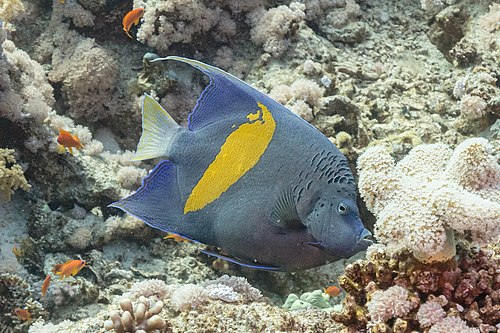
Yellowbar angelfish (Pomacanthus maculosus), Ras Muhammad National Park, Red Sea, Egypt. This marine angelfish is distributed throughout the Persian Gulf, the northwestern Indian Ocean, and the Red Sea south to 19°S. In 2009 it was recorded off the coast of Lebanon in the eastern Mediterranean, probably as a result of Lessepsian migration from the Red Sea through the Suez Canal. Pomacanthus maculosus is found at depths of between 4 and 50 metres (13 and 164 ft). It is a solitary species that lives in sheltered areas, often where there is a mixture of coral and silt. Their diet is dominated by sea sponges and tunicates, although other invertebrates will be eaten opportunistically. The females attain sexual maturity when the reach around 5.5 years of age and a total length of 21.6 centimetres (8.5 in). The maximum longevity is thought to be 36 years old. They are protogynous hermaphrodites and the older females can change sex to become males when there is a shortage of males. The larvae are planktonic. The yellowbar angelfish is occasionally collected for the aquarium trade and in some parts of the Persian Gulf it has been recorded in fish markets.
|
Source: https://commons.wikimedia.org/wiki/Special:FeedItem/potd/20260115000000/en

| Picture of the day |
|---|
|
|
|
Yellowbar angelfish (Pomacanthus maculosus), Ras Muhammad National Park, Red Sea, Egypt. This marine angelfish is distributed throughout the Persian Gulf, the northwestern Indian Ocean, and the Red Sea south to 19°S. In 2009 it was recorded off the coast of Lebanon in the eastern Mediterranean, probably as a result of Lessepsian migration from the Red Sea through the Suez Canal. Pomacanthus maculosus is found at depths of between 4 and 50 metres (13 and 164 ft). It is a solitary species that lives in sheltered areas, often where there is a mixture of coral and silt. Their diet is dominated by sea sponges and tunicates, although other invertebrates will be eaten opportunistically. The females attain sexual maturity when the reach around 5.5 years of age and a total length of 21.6 centimetres (8.5 in). The maximum longevity is thought to be 36 years old. They are protogynous hermaphrodites and the older females can change sex to become males when there is a shortage of males. The larvae are planktonic. The yellowbar angelfish is occasionally collected for the aquarium trade and in some parts of the Persian Gulf it has been recorded in fish markets.
|