Life

Pope calls on Catholic universities to be authentic, instill ‘passion for the truth’ #Catholic Catholic universities should reflect “authenticity as true disciples of Christ” as they guide students’ desire for knowledge into a passion for the truth, Pope Leo XIV told university presidents from the United States on Wednesday.“As young men and women come to your colleges and universities looking to study a specific degree, oftentimes motivated by future job perspectives, yours is the noble task of guiding that desire for knowledge so that they may also ‘learn to seek and love the truth, to reflect on the meaning of life, and to recognize the dignity of every person,’” the pope said June 3, quoting from his encyclical Magnifica Humanitas, published in May.Instilling a love for the truth “is not an easy feat,” he continued. “As you are well aware, seeking the truth requires not only learning and mentorship but also great effort. Unless Catholic education instills in students a true passion for the truth — and not only intellectual truth, but the truth that is Christ himself (cf. John 14:6) — we can hardly expect people to be willing to put forth the effort required to recognize truth and adapt one’s life accordingly.”Leo addressed presidents, senior administrators, and faculty leaders from Catholic institutions of higher education belonging to the Association of Catholic Colleges and Universities. During the Rome Seminar, June 1–5, university leaders are meeting with senior Vatican officials and others to reflect on the opportunities and challenges faced by higher education today.In his speech, the pope acknowledged the challenge of “the increasing fragmentation of knowledge.”“While it is easy to find people who are experts in a particular field of study, many of these individuals ‘struggle to find direction in their lives, partly due to an inability to connect information with deeper knowledge or maintain a sense of purpose,’” he said, quoting from Magnifica Humanitas.Specialized experts “often lack a global vision of reality that is capable of uniting not only the various fields of knowledge but also the multiple aspects of life and the inner longings of the human heart,” he said.He invited Catholic educational institutions to be a “living environment in which the Christian vision permeates every discipline and every interaction,” as Leo wrote in his 2025 apostolic letter Drawing New Maps of Hope.“Your authenticity as true disciples of Christ,” he said, “will certainly assist you in transmitting the living Gospel in such a way that those entrusted to you can truly encounter the Lord and discover in the Catholic faith the unifying vision that truth alone can provide.”On the challenges of technological advances, the pope reflected on the prolific use of artificial intelligence, making it “increasingly difficult to evaluate the work of students, requiring educators to adapt their methods creatively to ensure the integral human formation of those in their care.”“We must be willing to invest generously in the education of future generations,” he said. “It is crucial that young men and women learn to engage positively with new technologies, while at the same time truly developing their God-given skills and capacities to reason, to think critically and commit knowledge to memory, thus preparing them to shape responsibly the world to come.”

Pope calls on Catholic universities to be authentic, instill ‘passion for the truth’ #Catholic Catholic universities should reflect “authenticity as true disciples of Christ” as they guide students’ desire for knowledge into a passion for the truth, Pope Leo XIV told university presidents from the United States on Wednesday.“As young men and women come to your colleges and universities looking to study a specific degree, oftentimes motivated by future job perspectives, yours is the noble task of guiding that desire for knowledge so that they may also ‘learn to seek and love the truth, to reflect on the meaning of life, and to recognize the dignity of every person,’” the pope said June 3, quoting from his encyclical Magnifica Humanitas, published in May.Instilling a love for the truth “is not an easy feat,” he continued. “As you are well aware, seeking the truth requires not only learning and mentorship but also great effort. Unless Catholic education instills in students a true passion for the truth — and not only intellectual truth, but the truth that is Christ himself (cf. John 14:6) — we can hardly expect people to be willing to put forth the effort required to recognize truth and adapt one’s life accordingly.”Leo addressed presidents, senior administrators, and faculty leaders from Catholic institutions of higher education belonging to the Association of Catholic Colleges and Universities. During the Rome Seminar, June 1–5, university leaders are meeting with senior Vatican officials and others to reflect on the opportunities and challenges faced by higher education today.In his speech, the pope acknowledged the challenge of “the increasing fragmentation of knowledge.”“While it is easy to find people who are experts in a particular field of study, many of these individuals ‘struggle to find direction in their lives, partly due to an inability to connect information with deeper knowledge or maintain a sense of purpose,’” he said, quoting from Magnifica Humanitas.Specialized experts “often lack a global vision of reality that is capable of uniting not only the various fields of knowledge but also the multiple aspects of life and the inner longings of the human heart,” he said.He invited Catholic educational institutions to be a “living environment in which the Christian vision permeates every discipline and every interaction,” as Leo wrote in his 2025 apostolic letter Drawing New Maps of Hope.“Your authenticity as true disciples of Christ,” he said, “will certainly assist you in transmitting the living Gospel in such a way that those entrusted to you can truly encounter the Lord and discover in the Catholic faith the unifying vision that truth alone can provide.”On the challenges of technological advances, the pope reflected on the prolific use of artificial intelligence, making it “increasingly difficult to evaluate the work of students, requiring educators to adapt their methods creatively to ensure the integral human formation of those in their care.”“We must be willing to invest generously in the education of future generations,” he said. “It is crucial that young men and women learn to engage positively with new technologies, while at the same time truly developing their God-given skills and capacities to reason, to think critically and commit knowledge to memory, thus preparing them to shape responsibly the world to come.”

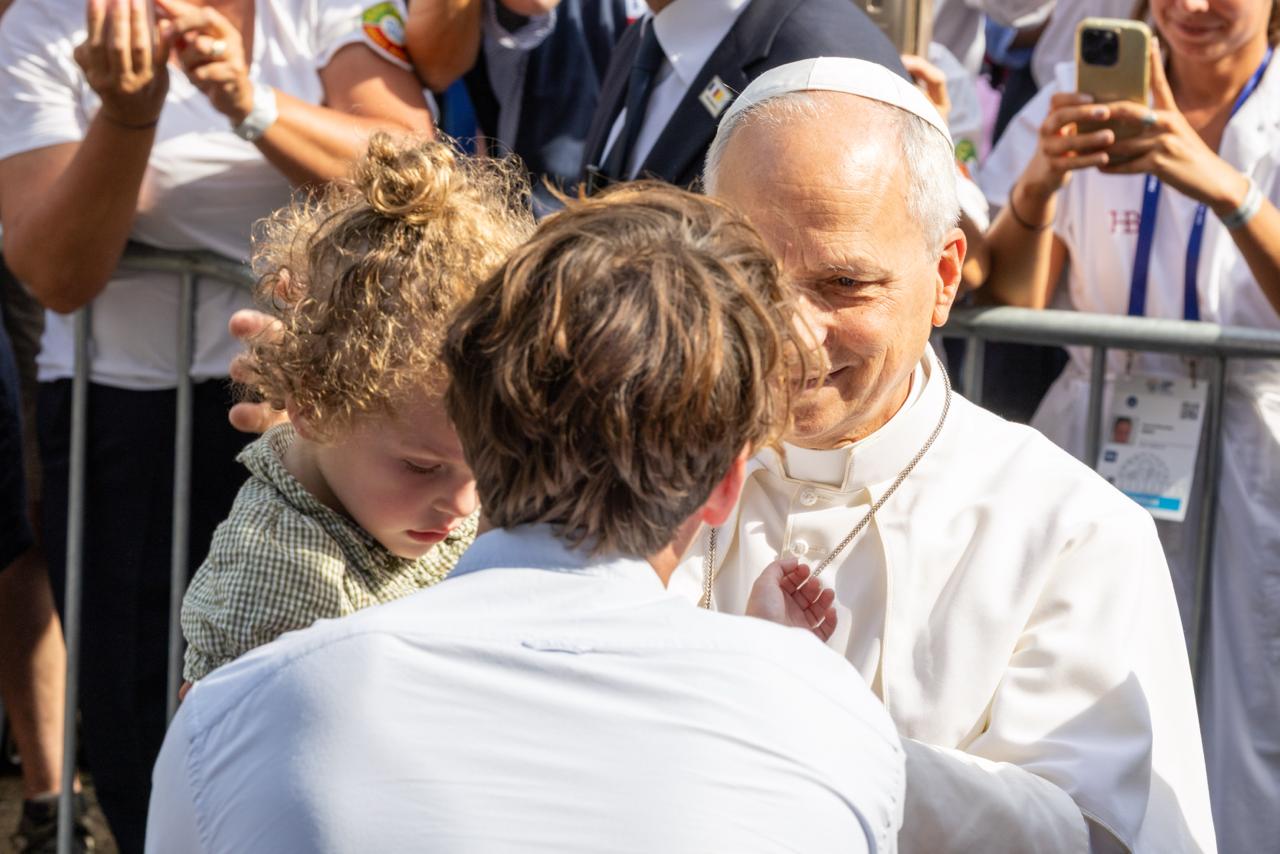
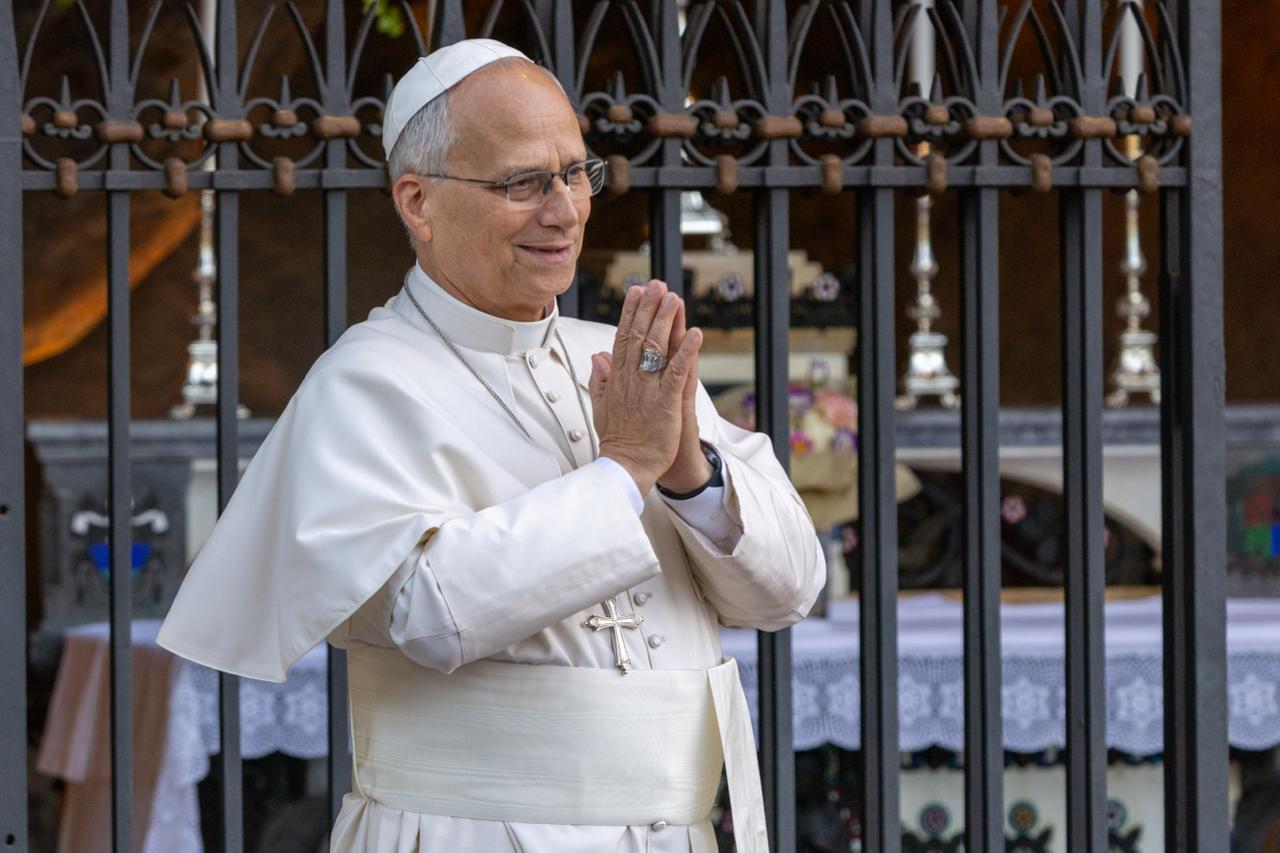
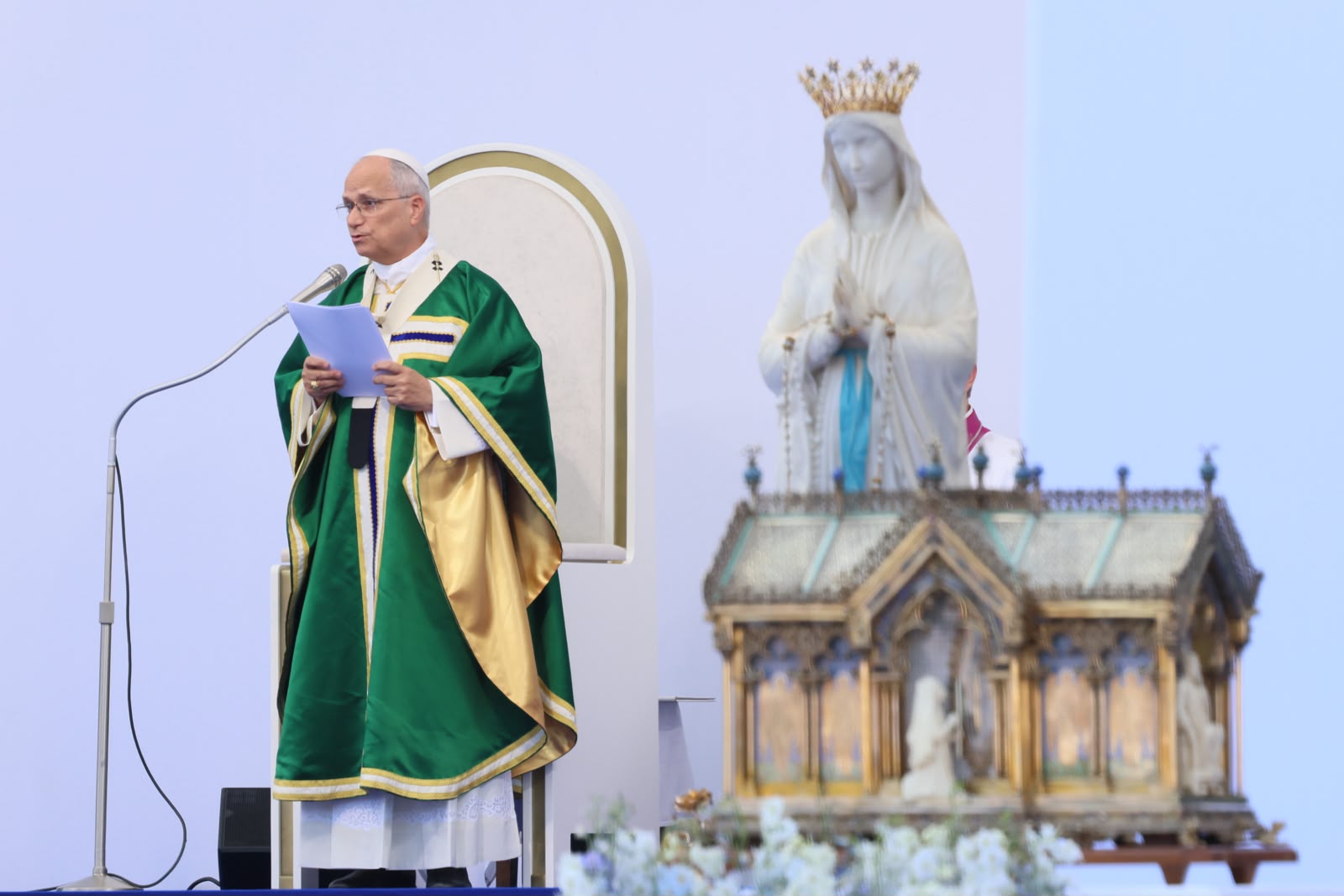
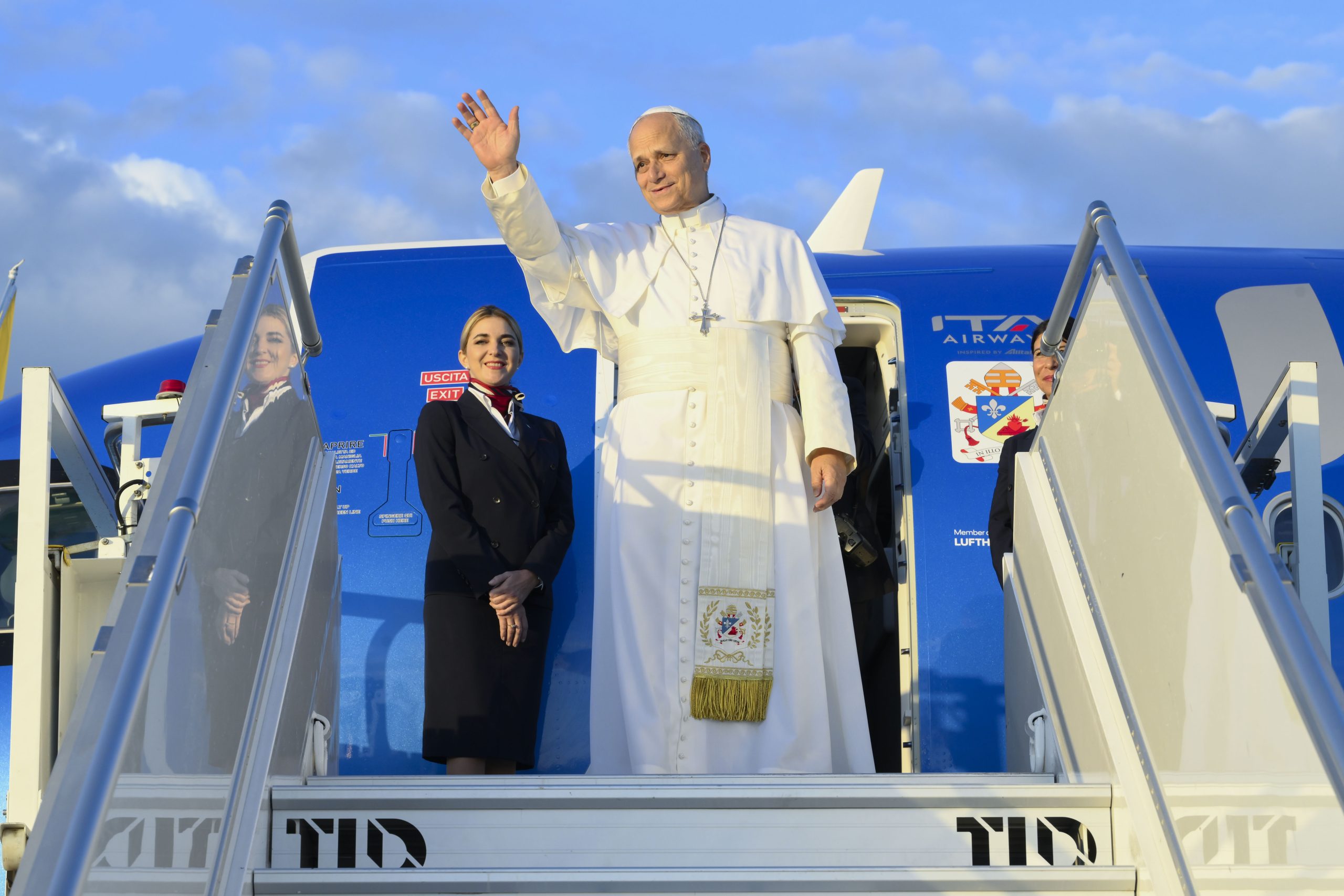
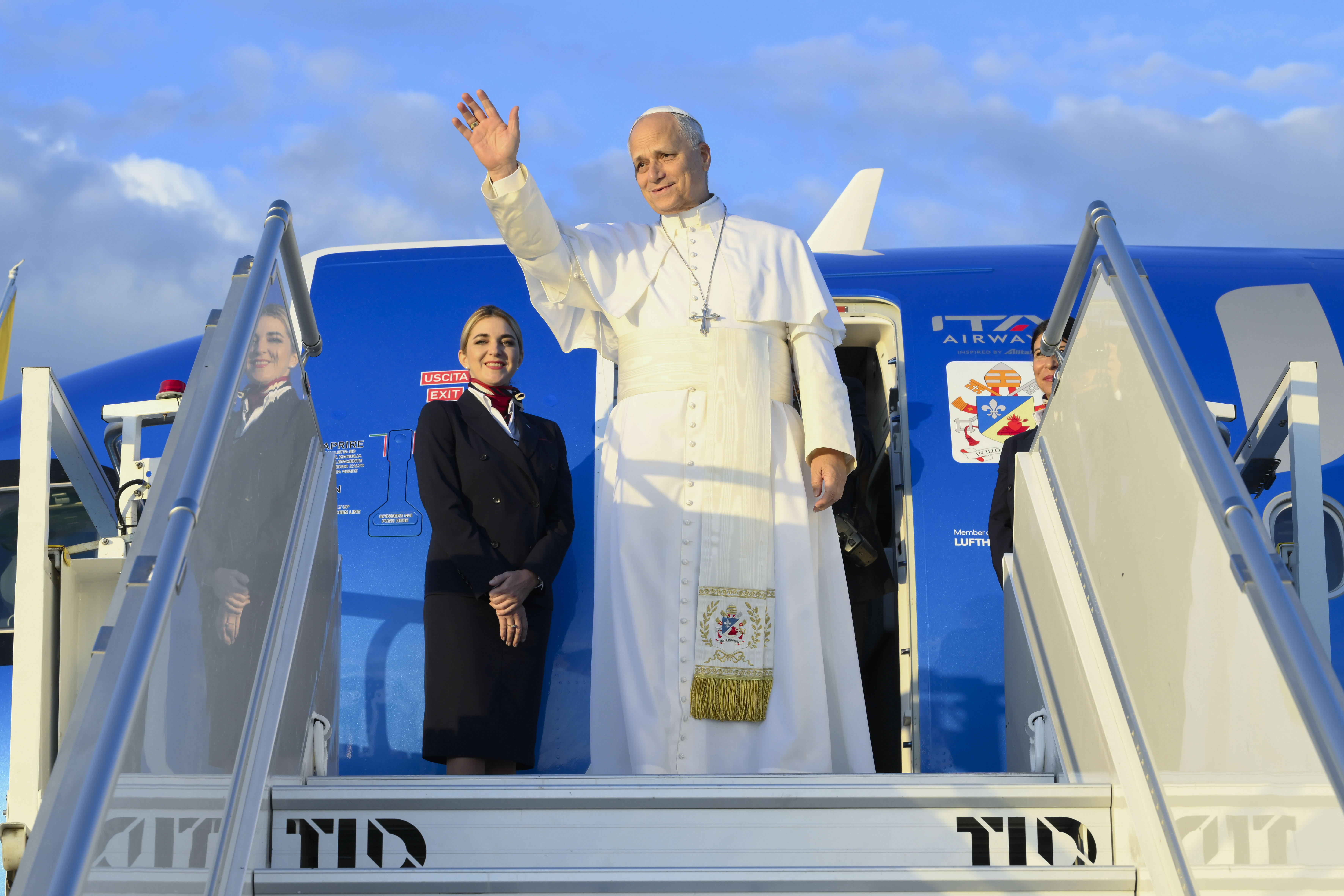
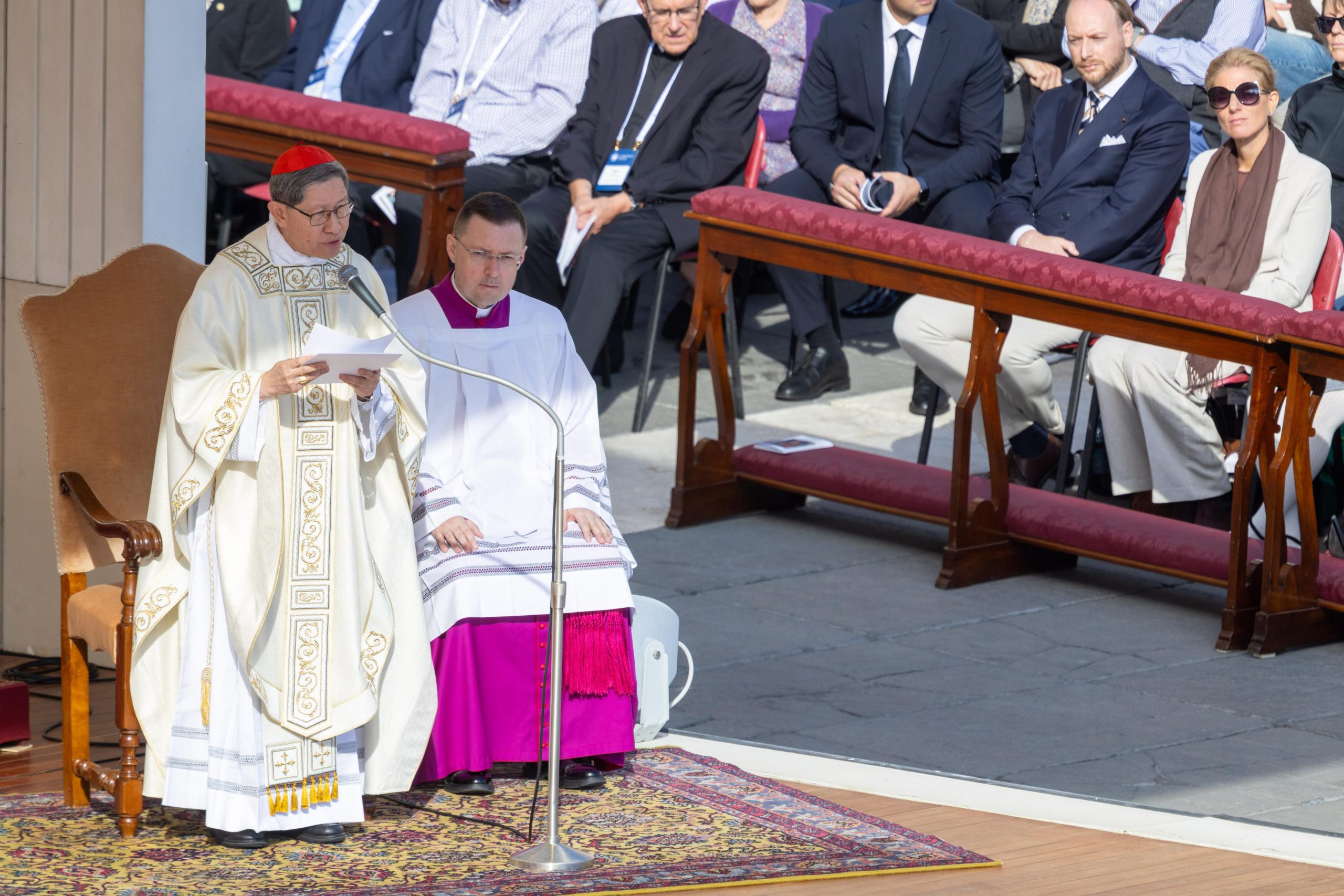
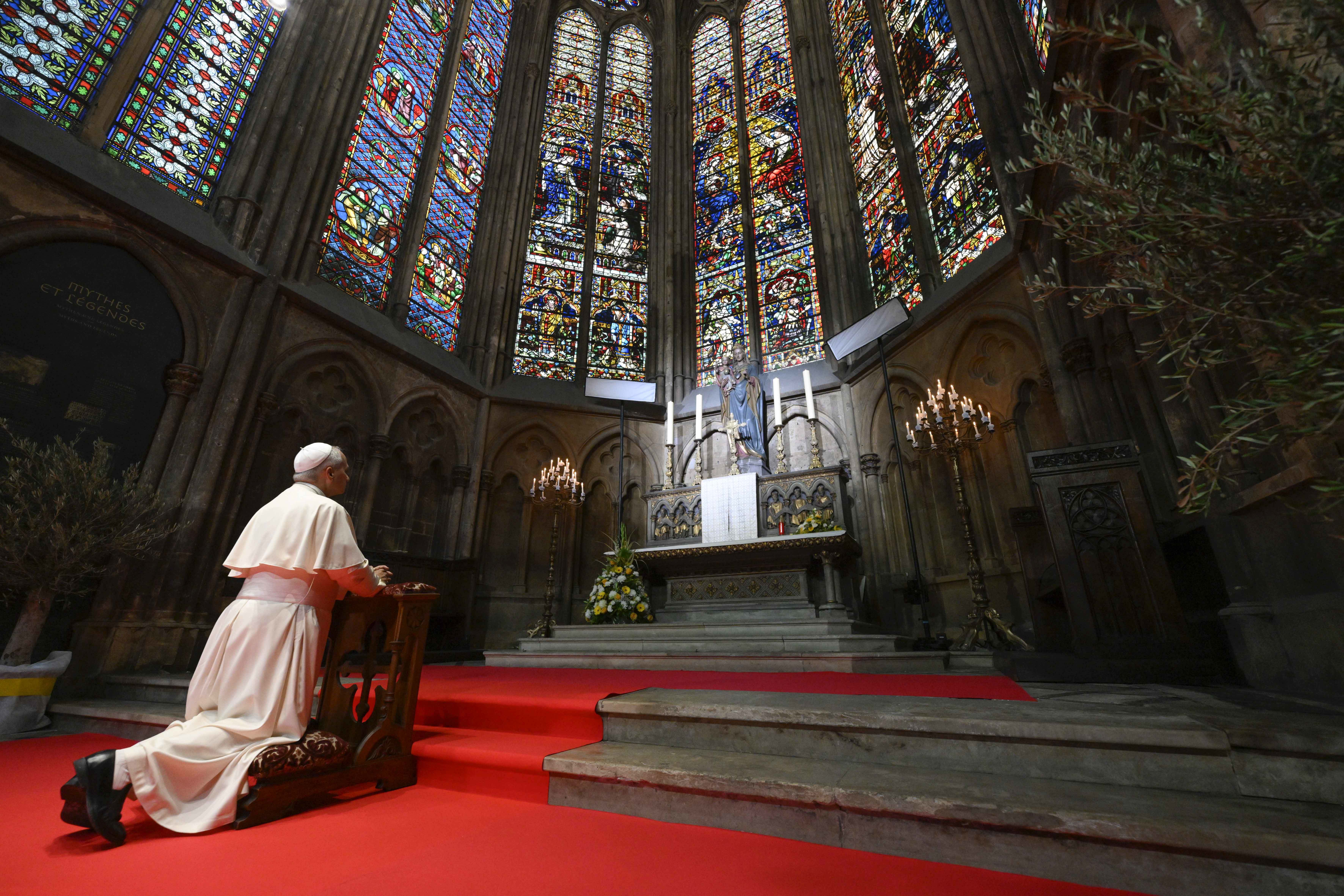
Pope Leo XIV on Wednesday addressed presidents and senior administrators from Catholic institutions belonging to the Association of Catholic Colleges and Universities.

Read More
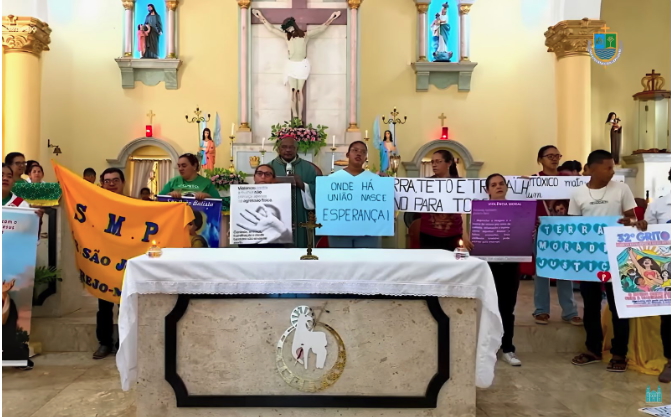
More than 50 children celebrate first Communion amid ongoing missile attacks in southern Lebanon #Catholic Amid a rocket attack launched by Hezbollah on residential homes in the village of Rmeish in southern Lebanon, more than 50 children celebrated their first Communion in a testament to faith, resilience, and hope in the midst of war.In comments to local media, Rmeish Municipality Head Hanna Al-Amil said a missile fell between inhabited homes on Sunday morning and “narrowly avoided causing a major disaster.”Al-Amil stressed that the village contains no military forces, armed groups, or weapons, emphasizing that residents “simply want to live safely on their land, away from confrontation and escalation.”The people of Rmeish remain attached to their land and continue their lives “despite difficult circumstances,” he said, calling for the protection of civilians and for the village and its residents not to be placed at risk. The incident is not an isolated one. It comes amid a series of missile launches affecting Christian villages in the south, increasing fears among local residents. On Friday, several Hezbollah rockets fired toward Israeli forces operating in the town of Dibbin landed in residential and civilian areas of Marjayoun, causing significant property damage. According to local reports, one rocket struck the Greek Orthodox Church of St. George, damaging parts of the church, while another landed within the grounds of the Sacred Hearts Secondary School, leaving extensive destruction to the building and its surroundings.Speaking to ACI MENA, the Arabic-language sister service of EWTN News, Rizkallah Alam, a resident of Rmeish whose daughter received her first Communion, said villagers have effectively been living in a state of war since Oct. 8, 2023. “We have been living the reality of war since then,” he said, adding that the village has not experienced a genuine ceasefire at any point. “The children and their parents live in constant anxiety. We asked to postpone the first Communion to another time, but our parish priest refused and insisted that it take place.”Alam described the daily reality facing children in the village, saying they live without a sense of security or psychological stability. “My children pray and sing hymns all the time, and they live according to the news cycle. Some days schools are open, and other days they are not. Today the situation has become even worse because of the siege.”He said the restrictions affecting the village have impacted even the most basic aspects of daily life. “Everything has become unavailable. We wait for the aid convoy and hope it will be allowed to reach the village.”In previous years, families would hold large celebrations for first Communion. This year, however, circumstances forced them to scale back their plans. “This year the celebration was limited to family homes, with no large festivities,” he said. “The number of children was also lower than in previous years because families are scattered. Some are in Beirut, while others have left the country.”Alam described the immense uncertainty facing both parents and children. “The situation is extremely difficult. We cannot even plan for tomorrow,” he said. “As we speak, rockets have fallen in Rmeish again, one person has been injured, and a car has caught fire.”Between missiles and first Communion, Rmeish embodies one of southern Lebanonʼs most painful paradoxes: a village that wants to live, families determined to remain, and children learning faith in a time of fear. This story was first published by ACI MENA, the Arabic-language sister service of EWTN News, and has been translated for and adapted by EWTN News English.

More than 50 children celebrate first Communion amid ongoing missile attacks in southern Lebanon #Catholic Amid a rocket attack launched by Hezbollah on residential homes in the village of Rmeish in southern Lebanon, more than 50 children celebrated their first Communion in a testament to faith, resilience, and hope in the midst of war.In comments to local media, Rmeish Municipality Head Hanna Al-Amil said a missile fell between inhabited homes on Sunday morning and “narrowly avoided causing a major disaster.”Al-Amil stressed that the village contains no military forces, armed groups, or weapons, emphasizing that residents “simply want to live safely on their land, away from confrontation and escalation.”The people of Rmeish remain attached to their land and continue their lives “despite difficult circumstances,” he said, calling for the protection of civilians and for the village and its residents not to be placed at risk. The incident is not an isolated one. It comes amid a series of missile launches affecting Christian villages in the south, increasing fears among local residents. On Friday, several Hezbollah rockets fired toward Israeli forces operating in the town of Dibbin landed in residential and civilian areas of Marjayoun, causing significant property damage. According to local reports, one rocket struck the Greek Orthodox Church of St. George, damaging parts of the church, while another landed within the grounds of the Sacred Hearts Secondary School, leaving extensive destruction to the building and its surroundings.Speaking to ACI MENA, the Arabic-language sister service of EWTN News, Rizkallah Alam, a resident of Rmeish whose daughter received her first Communion, said villagers have effectively been living in a state of war since Oct. 8, 2023. “We have been living the reality of war since then,” he said, adding that the village has not experienced a genuine ceasefire at any point. “The children and their parents live in constant anxiety. We asked to postpone the first Communion to another time, but our parish priest refused and insisted that it take place.”Alam described the daily reality facing children in the village, saying they live without a sense of security or psychological stability. “My children pray and sing hymns all the time, and they live according to the news cycle. Some days schools are open, and other days they are not. Today the situation has become even worse because of the siege.”He said the restrictions affecting the village have impacted even the most basic aspects of daily life. “Everything has become unavailable. We wait for the aid convoy and hope it will be allowed to reach the village.”In previous years, families would hold large celebrations for first Communion. This year, however, circumstances forced them to scale back their plans. “This year the celebration was limited to family homes, with no large festivities,” he said. “The number of children was also lower than in previous years because families are scattered. Some are in Beirut, while others have left the country.”Alam described the immense uncertainty facing both parents and children. “The situation is extremely difficult. We cannot even plan for tomorrow,” he said. “As we speak, rockets have fallen in Rmeish again, one person has been injured, and a car has caught fire.”Between missiles and first Communion, Rmeish embodies one of southern Lebanonʼs most painful paradoxes: a village that wants to live, families determined to remain, and children learning faith in a time of fear. This story was first published by ACI MENA, the Arabic-language sister service of EWTN News, and has been translated for and adapted by EWTN News English.

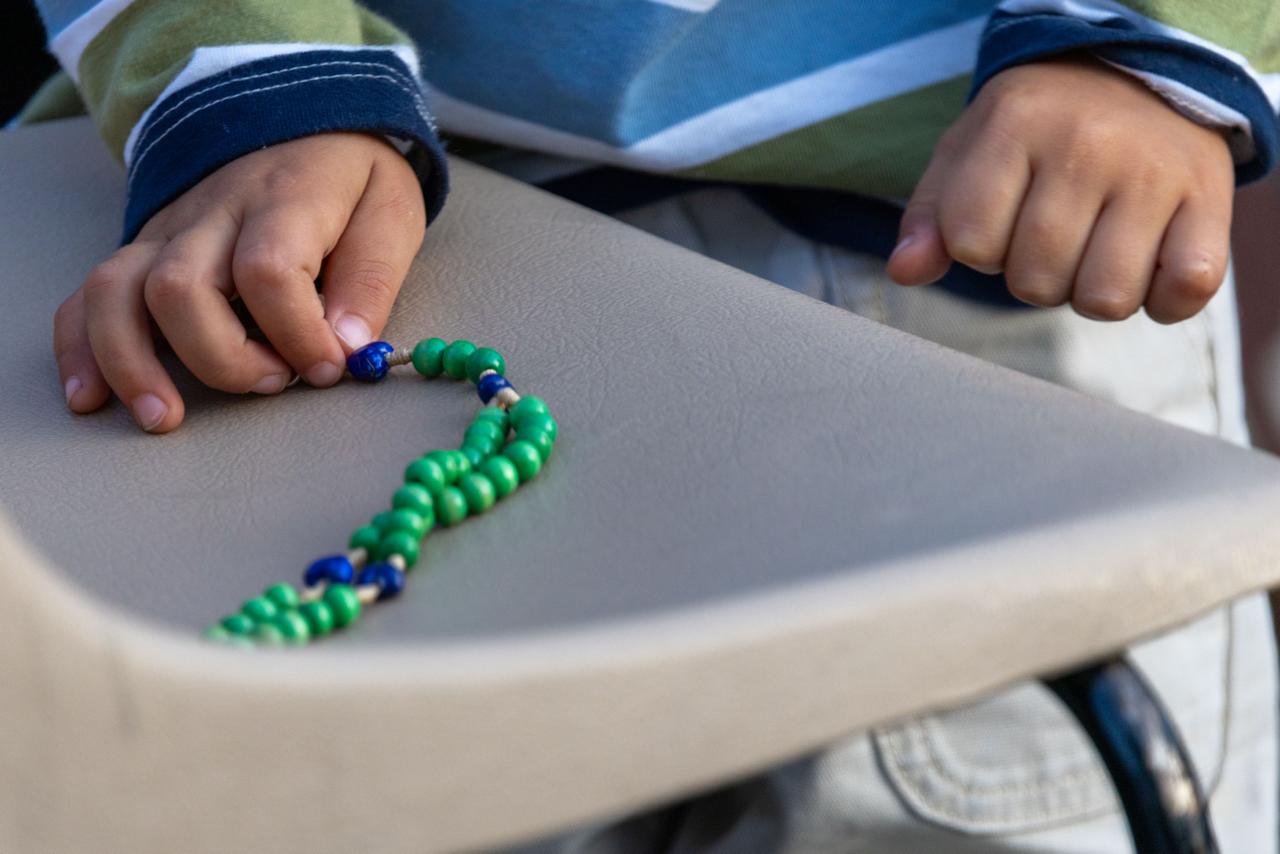
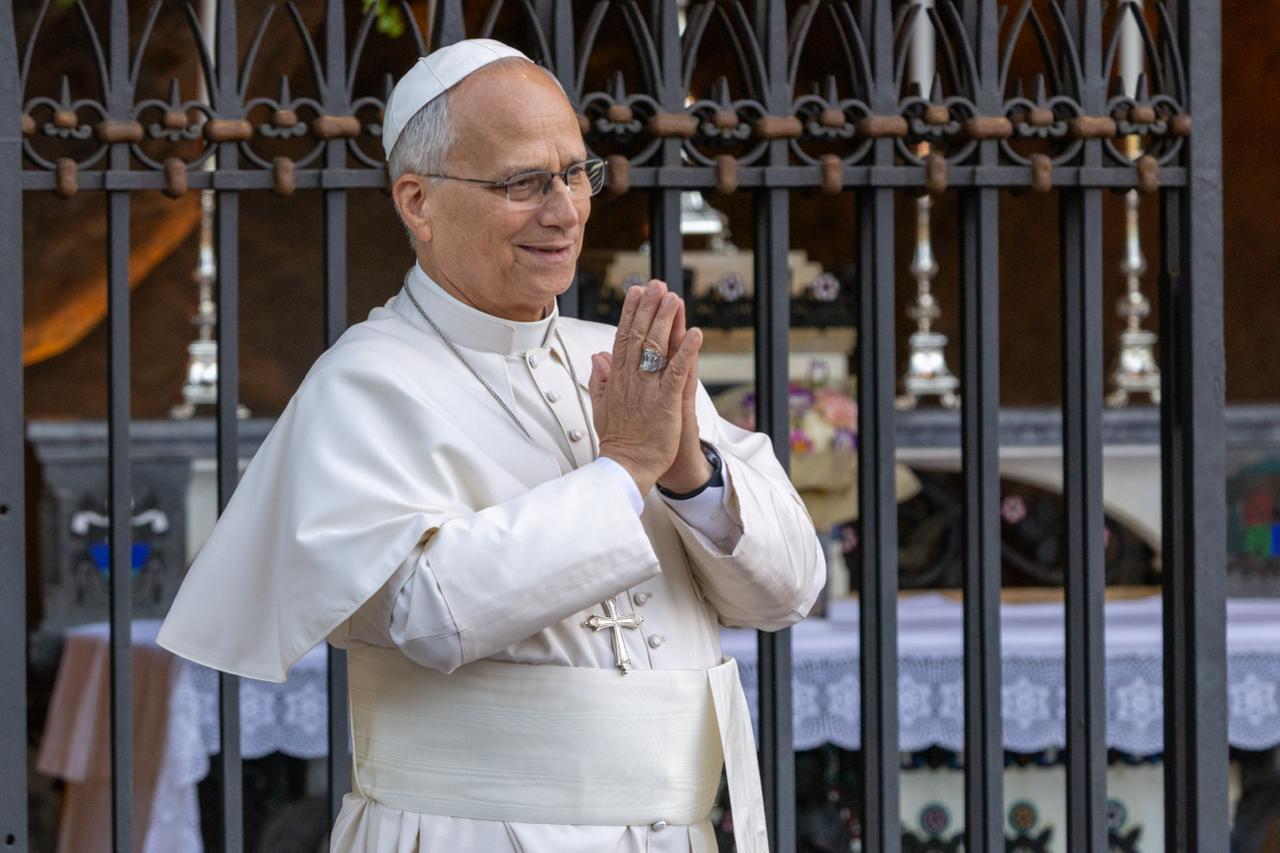
A resident of Rmeish whose daughter received her first Communion said villagers there have effectively been living in a state of war since Oct. 8, 2023.

Read More
This is Pope Leo XIV’s prayer intention for the month of June #Catholic Pope Leo XIV’s prayer intention for the month of June is for the value of sports.“In times of war and extreme polarization, sport is one of the few things that bring us closer together,” the pope said in a video released on X on June 2.He added: “Let us pray this June that sport may be an instrument of peace, encounter, and dialogue among cultures and nations, and that it may promote values such as respect, solidarity, and personal growth.”In the full video shared on the Pope’s Worldwide Prayer Network website, Pope Leo recites an original prayer written specifically for this month’s prayer intention:In the name of the Father, and of the Son, and of the Holy Spirit. Amen.Lord of life,we thank you for the gift of sport,for those who glorify God through the exercise of their bodies,for the friendships born on the fieldand the joy of playing as a team.You teach us that in life, as in the game,no one is saved alone.We need others to grow,to learn respect, to overcome our limits,and to celebrate together the victories we achieve.We ask that sport may always bea school of fraternity, not of empty rivalry,a space of encounter, not exclusion,a path of peace, not violence.May those who play, train, or cheerdiscover in sport a universal languagethat brings cultures together, unites peoples,and sows respect, solidarity, and personal growth.Lord Jesus,may every sport become a parable of life lived with you,working with joy and effort,living with humility in defeatand with gratitude in the victory you offer in your resurrection.May your Spirit never be lacking in us,making us one team, united with youto build communion and fraternity in history.Amen.“Pray with the Pope” is accessible on the Pope’s Worldwide Prayer Network website and its digital platforms.

This is Pope Leo XIV’s prayer intention for the month of June #Catholic Pope Leo XIV’s prayer intention for the month of June is for the value of sports.“In times of war and extreme polarization, sport is one of the few things that bring us closer together,” the pope said in a video released on X on June 2.He added: “Let us pray this June that sport may be an instrument of peace, encounter, and dialogue among cultures and nations, and that it may promote values such as respect, solidarity, and personal growth.”In the full video shared on the Pope’s Worldwide Prayer Network website, Pope Leo recites an original prayer written specifically for this month’s prayer intention:In the name of the Father, and of the Son, and of the Holy Spirit. Amen.Lord of life,we thank you for the gift of sport,for those who glorify God through the exercise of their bodies,for the friendships born on the fieldand the joy of playing as a team.You teach us that in life, as in the game,no one is saved alone.We need others to grow,to learn respect, to overcome our limits,and to celebrate together the victories we achieve.We ask that sport may always bea school of fraternity, not of empty rivalry,a space of encounter, not exclusion,a path of peace, not violence.May those who play, train, or cheerdiscover in sport a universal languagethat brings cultures together, unites peoples,and sows respect, solidarity, and personal growth.Lord Jesus,may every sport become a parable of life lived with you,working with joy and effort,living with humility in defeatand with gratitude in the victory you offer in your resurrection.May your Spirit never be lacking in us,making us one team, united with youto build communion and fraternity in history.Amen.“Pray with the Pope” is accessible on the Pope’s Worldwide Prayer Network website and its digital platforms.

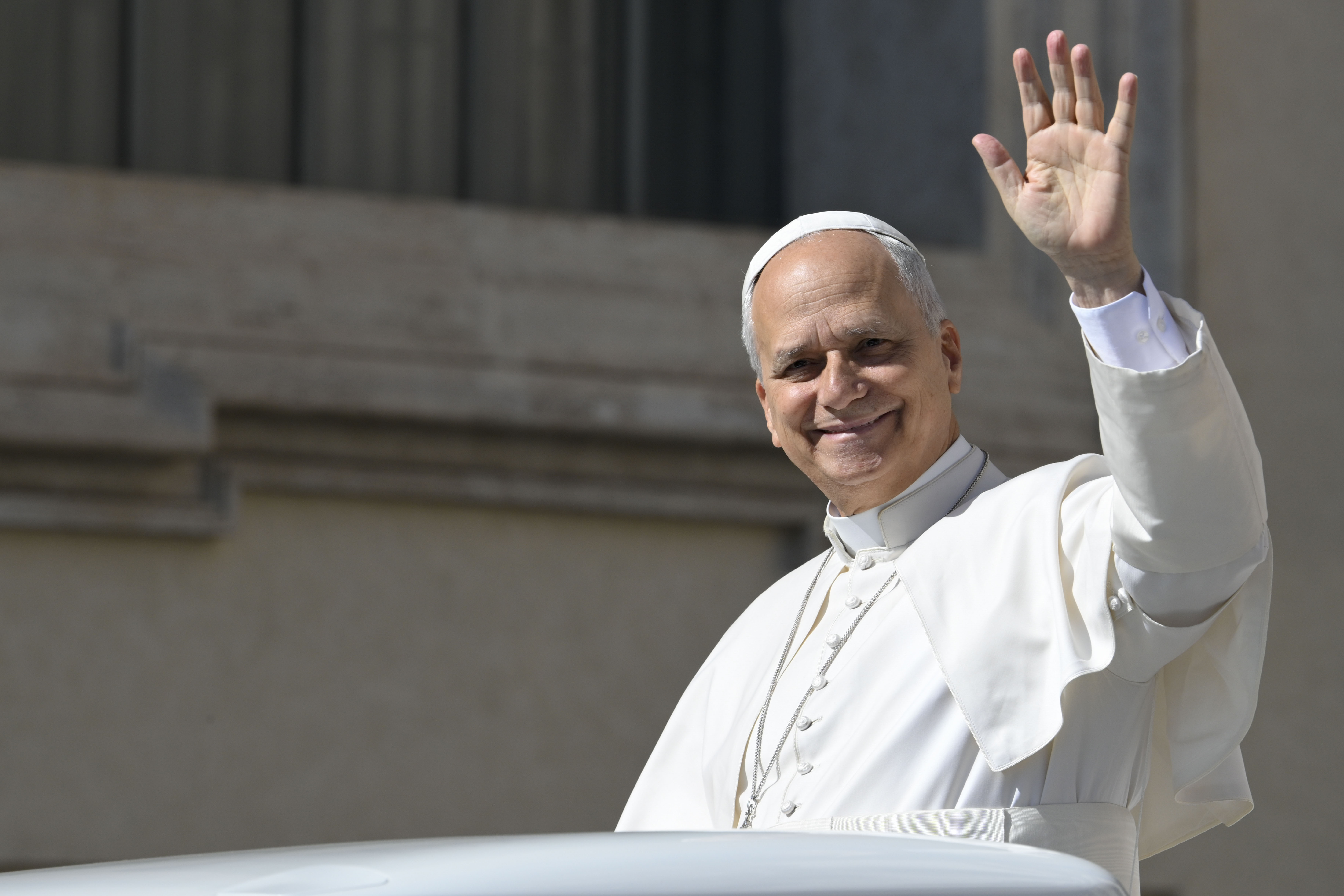
“In times of war and extreme polarization, sport is one of the few things that bring us closer together,” the pope said in a video released on X on June 2.

Read More
U.S. bishops unveil prayer service for America’s 250th anniversary centered on migrants #Catholic The U.S. Conference of Catholic Bishops (USCCB) has released a national prayer service for the country’s upcoming 250th anniversary that places immigration, justice, and the dignity of migrants at the center of America’s semiquincentennial observance.Titled “A National Prayer Service Honoring the Many Journeys that Shaped America,” the resource was developed by the Committee on Migration and the Subcommittee for the Promotion of Racial Justice and Reconciliation.Designed as a template for dioceses and parishes across the country, the prayer service invites Catholics to reflect on the nation’s history through the lens of migration, displacement, slavery, and faith while encouraging advocacy for vulnerable migrant populations.“In observance of the United States’ 250th anniversary in 2026, and rooted in the Church’s pastoral mission of welcome, accompaniment, and solidarity,” the instructions state, the service seeks “to acknowledge and honor the many diverse communities that have journeyed to the United States in search of hope, safety, and opportunity.”The document also highlights “the voices, sufferings, and enduring contributions of those who were forcibly brought to this land.”A prayer service rooted in hospitalityThe proposed service combines hymns, Scripture readings, intercessory prayers, testimonies, and guided reflections focused heavily on migrants, refugees, victims of trafficking, and immigrant communities.Organizers are encouraged to adapt the service to local needs and cultures by incorporating music and devotional practices that reflect “the lived experiences of migration, displacement, resilience, and faith.”The service opens with the hymn “All Are Welcome” by Marty Haugen and includes prayers asking Catholics to “walk in deeper solidarity with immigrant communities” and to advocate for “greater protection, justice, and accompaniment for vulnerable and at-risk migrant populations.”A prayer to St. Frances Xavier Cabrini — patroness of immigrants and herself an immigrant to the United States — asks for protection for migrant families separated from one another and for the grace to “welcome every stranger as Christ in our midst.”The document also includes a “call to action” encouraging Catholics to reflect on “concrete and compassionate ways to welcome, protect, promote, and integrate migrants, immigrants, and refugees” while advocating for “just and humane immigration reform that upholds the dignity of every human person created in the image of God.”The service concludes with a “Prayer for Migrants” asking God to help the Church “welcome, protect, promote, and integrate those who knock at our doors.”Scripture and civil rights themes woven throughoutThe Scripture passages selected for the service strongly emphasize hospitality toward foreigners and care for society’s most vulnerable.A reading from Deuteronomy 10:12-22 exhorts believers: “So you too must befriend the alien, for you were once aliens yourselves in the land of Egypt.”  The Gospel reading from Matthew 25:31-46 centers on Christ’s words, “I was thirsty and you gave me drink, a stranger and you welcomed me.”The template also incorporates themes of racial justice and historical memory. Intercessions address slavery and modern human trafficking, praying both for victims of exploitation and for “perpetrators of slavery” to repent.The service further recommends “Lift Every Voice and Sing,” often referred to as the Black national anthem and rooted in Black church worship and civic life in the U.S., as an intermediate hymn. It also includes optional excerpts from Dr. Martin Luther King Jr.’s “I Have a Dream" speech for use in a homily or guided reflection, alongside passages from the bishops’ 2025 special pastoral message on immigration.Dignity of migrantsIn recent years, U.S. bishops have consistently advocated for immigration reform while emphasizing the dignity of migrants, opposition to family separation, and support for refugees and trafficking victims.The prayer service places those concerns within the broader context of the nation’s identity ahead of America’s 250th anniversary observances.“This prayer service seeks to provide a sacred space for reflection, remembrance, lament, and hope,” the document states, inviting participants to encounter one another “as members of the one human family and the one body of Christ.”EWTN News reached out to the USCCB for comment but did not receive a response by publication time.

U.S. bishops unveil prayer service for America’s 250th anniversary centered on migrants #Catholic The U.S. Conference of Catholic Bishops (USCCB) has released a national prayer service for the country’s upcoming 250th anniversary that places immigration, justice, and the dignity of migrants at the center of America’s semiquincentennial observance.Titled “A National Prayer Service Honoring the Many Journeys that Shaped America,” the resource was developed by the Committee on Migration and the Subcommittee for the Promotion of Racial Justice and Reconciliation.Designed as a template for dioceses and parishes across the country, the prayer service invites Catholics to reflect on the nation’s history through the lens of migration, displacement, slavery, and faith while encouraging advocacy for vulnerable migrant populations.“In observance of the United States’ 250th anniversary in 2026, and rooted in the Church’s pastoral mission of welcome, accompaniment, and solidarity,” the instructions state, the service seeks “to acknowledge and honor the many diverse communities that have journeyed to the United States in search of hope, safety, and opportunity.”The document also highlights “the voices, sufferings, and enduring contributions of those who were forcibly brought to this land.”A prayer service rooted in hospitalityThe proposed service combines hymns, Scripture readings, intercessory prayers, testimonies, and guided reflections focused heavily on migrants, refugees, victims of trafficking, and immigrant communities.Organizers are encouraged to adapt the service to local needs and cultures by incorporating music and devotional practices that reflect “the lived experiences of migration, displacement, resilience, and faith.”The service opens with the hymn “All Are Welcome” by Marty Haugen and includes prayers asking Catholics to “walk in deeper solidarity with immigrant communities” and to advocate for “greater protection, justice, and accompaniment for vulnerable and at-risk migrant populations.”A prayer to St. Frances Xavier Cabrini — patroness of immigrants and herself an immigrant to the United States — asks for protection for migrant families separated from one another and for the grace to “welcome every stranger as Christ in our midst.”The document also includes a “call to action” encouraging Catholics to reflect on “concrete and compassionate ways to welcome, protect, promote, and integrate migrants, immigrants, and refugees” while advocating for “just and humane immigration reform that upholds the dignity of every human person created in the image of God.”The service concludes with a “Prayer for Migrants” asking God to help the Church “welcome, protect, promote, and integrate those who knock at our doors.”Scripture and civil rights themes woven throughoutThe Scripture passages selected for the service strongly emphasize hospitality toward foreigners and care for society’s most vulnerable.A reading from Deuteronomy 10:12-22 exhorts believers: “So you too must befriend the alien, for you were once aliens yourselves in the land of Egypt.”  The Gospel reading from Matthew 25:31-46 centers on Christ’s words, “I was thirsty and you gave me drink, a stranger and you welcomed me.”The template also incorporates themes of racial justice and historical memory. Intercessions address slavery and modern human trafficking, praying both for victims of exploitation and for “perpetrators of slavery” to repent.The service further recommends “Lift Every Voice and Sing,” often referred to as the Black national anthem and rooted in Black church worship and civic life in the U.S., as an intermediate hymn. It also includes optional excerpts from Dr. Martin Luther King Jr.’s “I Have a Dream" speech for use in a homily or guided reflection, alongside passages from the bishops’ 2025 special pastoral message on immigration.Dignity of migrantsIn recent years, U.S. bishops have consistently advocated for immigration reform while emphasizing the dignity of migrants, opposition to family separation, and support for refugees and trafficking victims.The prayer service places those concerns within the broader context of the nation’s identity ahead of America’s 250th anniversary observances.“This prayer service seeks to provide a sacred space for reflection, remembrance, lament, and hope,” the document states, inviting participants to encounter one another “as members of the one human family and the one body of Christ.”EWTN News reached out to the USCCB for comment but did not receive a response by publication time.

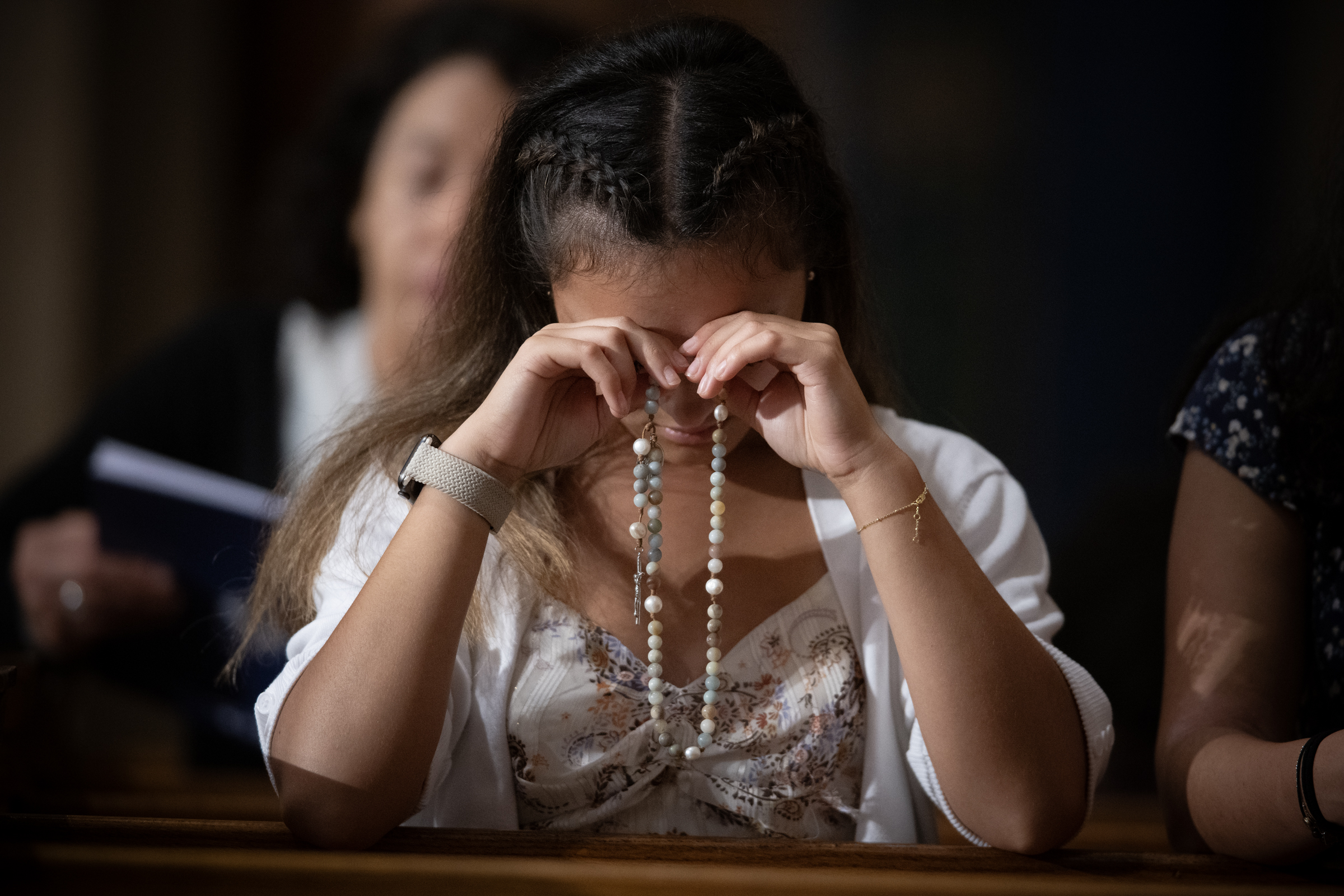
The prayer service invites Catholics to reflect on the nation’s history through the lens of migration, displacement, slavery, and faith while encouraging advocacy for vulnerable migrant populations.

Read More
Pope Leo XIV: The Trinity teaches that every creature is made for communion #Catholic Pope Leo XIV said Sunday that the mystery of the Holy Trinity teaches Christians to see every creature as made for communion — and warned that division, polarization, and contempt for differences leave the world spiritually barren.Speaking before the Angelus on May 31, the solemnity of the Most Holy Trinity, the pope reflected on Jesus’ encounter with Nicodemus in the Gospel of John, saying the feast reveals that God’s own life is a communion of love into which humanity is invited.“The Trinity helps us to love everyone and everything: we discover that every creature is made for communion, relationship and encounter,” Pope Leo said from the window of the Apostolic Palace overlooking St. Peter’s Square. “On the other hand, we understand why division, polarization and contempt for diversity bring destruction, sadness and barrenness to the world.”The pope said the Church’s Easter journey, which concluded last week with Pentecost, helps believers contemplate the divine life given to humanity in Christ — a communion of love that draws believers in through the Holy Spirit.The Spirit, he said, “unites the Father and the Son” and “has been poured into our hearts.” In this way, he added, “the Church becomes a sacrament of communion, a place of encounter, love and life where heaven and earth already touch.”Turning to Nicodemus, whom the Gospel describes as an important figure in Israel who came to Jesus at night, Leo said Christ “welcomed him and took his search for answers seriously.”Jesus, the pope said, “surprised Nicodemus by suggesting that it was even possible for an adult to be reborn and led him to realize that the life of God could transform his own life.”Leo noted that Nicodemus later defended Jesus before the Sanhedrin, urging others to listen before condemning him.“He had received the Spirit of communion from God through Christ himself, which opens the heart to new truths and to true renewal,” the pope said. “Whoever does not welcome this Spirit grows old quickly, in sorrow, feeling all alone and without joy in their hearts.”By contrast, Leo said, the solemnity of the Trinity is “a day of celebration.”“God’s feast is also ours,” he said, citing St. Paul’s exhortation to the Corinthians: “Rejoice, strive for perfection, encourage one another, live in peace; and the God of love and peace will be with you.”After leading the Angelus, the pope recalled the prayers for peace raised throughout the Church during May, a month traditionally dedicated to the Virgin Mary.“In this month of May, a united chorus of prayers for peace has resounded throughout the Church,” he said. “Above all, through the prayer of the Holy Rosary — like an unbroken chain — the peoples ravaged by war have been entrusted to the intercession of the Virgin Mary.”“May Divine Wisdom enlighten the consciences of those in authority and guide their decisions toward a sincere search for a just and lasting peace,” he said.Leo also marked Italy’s 25th National Day of Relief, expressing closeness to the sick and those who care for them.“I offer my spiritual closeness to the sick and those who care for them; and I thank and encourage all who promote a culture of solidarity and care,” he said.This story was first published by ACI Stampa, the Italian-language sister service of EWTN News. It has been translated and adapted by EWTN News English.

Pope Leo XIV: The Trinity teaches that every creature is made for communion #Catholic Pope Leo XIV said Sunday that the mystery of the Holy Trinity teaches Christians to see every creature as made for communion — and warned that division, polarization, and contempt for differences leave the world spiritually barren.Speaking before the Angelus on May 31, the solemnity of the Most Holy Trinity, the pope reflected on Jesus’ encounter with Nicodemus in the Gospel of John, saying the feast reveals that God’s own life is a communion of love into which humanity is invited.“The Trinity helps us to love everyone and everything: we discover that every creature is made for communion, relationship and encounter,” Pope Leo said from the window of the Apostolic Palace overlooking St. Peter’s Square. “On the other hand, we understand why division, polarization and contempt for diversity bring destruction, sadness and barrenness to the world.”The pope said the Church’s Easter journey, which concluded last week with Pentecost, helps believers contemplate the divine life given to humanity in Christ — a communion of love that draws believers in through the Holy Spirit.The Spirit, he said, “unites the Father and the Son” and “has been poured into our hearts.” In this way, he added, “the Church becomes a sacrament of communion, a place of encounter, love and life where heaven and earth already touch.”Turning to Nicodemus, whom the Gospel describes as an important figure in Israel who came to Jesus at night, Leo said Christ “welcomed him and took his search for answers seriously.”Jesus, the pope said, “surprised Nicodemus by suggesting that it was even possible for an adult to be reborn and led him to realize that the life of God could transform his own life.”Leo noted that Nicodemus later defended Jesus before the Sanhedrin, urging others to listen before condemning him.“He had received the Spirit of communion from God through Christ himself, which opens the heart to new truths and to true renewal,” the pope said. “Whoever does not welcome this Spirit grows old quickly, in sorrow, feeling all alone and without joy in their hearts.”By contrast, Leo said, the solemnity of the Trinity is “a day of celebration.”“God’s feast is also ours,” he said, citing St. Paul’s exhortation to the Corinthians: “Rejoice, strive for perfection, encourage one another, live in peace; and the God of love and peace will be with you.”After leading the Angelus, the pope recalled the prayers for peace raised throughout the Church during May, a month traditionally dedicated to the Virgin Mary.“In this month of May, a united chorus of prayers for peace has resounded throughout the Church,” he said. “Above all, through the prayer of the Holy Rosary — like an unbroken chain — the peoples ravaged by war have been entrusted to the intercession of the Virgin Mary.”“May Divine Wisdom enlighten the consciences of those in authority and guide their decisions toward a sincere search for a just and lasting peace,” he said.Leo also marked Italy’s 25th National Day of Relief, expressing closeness to the sick and those who care for them.“I offer my spiritual closeness to the sick and those who care for them; and I thank and encourage all who promote a culture of solidarity and care,” he said.This story was first published by ACI Stampa, the Italian-language sister service of EWTN News. It has been translated and adapted by EWTN News English.

At the Sunday Angelus, the pope prayed for “a just and lasting peace” as the Church closed a monthlong Marian appeal for countries ravaged by war.

Read More
Pope Leo XIV: Our world is more divided, but shared humanity unites us #Catholic Pope Leo XIV on May 30 emphasized to Catholic lay leaders that, in a world increasingly divided by war and polarization, shared humanity can help unify it.During a private audience at the Vatican with the members of the Centesimus Annus Pro Pontifice Foundation, Leo in his remarks referenced his recent encyclical Magnifica Humanitas, explaining that current challenges prompt fundamental questions about life."Indeed, it is precisely when faced with adverse circumstances that the human person is called to reconsider the fundamental questions that have gently prodded the heart of countless generations to more serious reflection: 'Where are we going? Toward what goal do we wish to orient ourselves? What direction should we choose as a people and as a human community?'" Leo said.These questions, the pope said, clearly indicate humanityʼs common pursuit of truth.“Such questions are a clear manifestation of humanity’s search for truth, and give rise to a desire for something more, a thirst for God and lasting meaning,” Leo said in his remarks. “They also bear witness to the essential aspects of our humanity: the God-given gifts of reason and freedom by which we may come to know the truth and adhere to what is good.”Also referencing his predecessor, St. John Paul II, who founded the Centesimus Annus Pro Pontifice Foundation in 1993 to promote Catholic social teaching, Leo explained that while the modern concept of freedom “is often understood as the capacity to do what one wants,” true freedom is lived “as a “gift of self and openness to others.”He also referred to Saint Augustine in his address, using Augustineʼs concept of the two cities. “The City of Man, built on pride and love of oneself, is marked by selfish individualism,” Leo said. “The City of God, built on love of God unto selflessness, and the cultivation of relationships, is what makes it truly possible to build a civilization of love.”He also reminded those present not to despair at the current state of the world, but engage in “small and steadfast acts of fidelity that serve as a bulwark against dehumanization”.

Pope Leo XIV: Our world is more divided, but shared humanity unites us #Catholic Pope Leo XIV on May 30 emphasized to Catholic lay leaders that, in a world increasingly divided by war and polarization, shared humanity can help unify it.During a private audience at the Vatican with the members of the Centesimus Annus Pro Pontifice Foundation, Leo in his remarks referenced his recent encyclical Magnifica Humanitas, explaining that current challenges prompt fundamental questions about life."Indeed, it is precisely when faced with adverse circumstances that the human person is called to reconsider the fundamental questions that have gently prodded the heart of countless generations to more serious reflection: 'Where are we going? Toward what goal do we wish to orient ourselves? What direction should we choose as a people and as a human community?'" Leo said.These questions, the pope said, clearly indicate humanityʼs common pursuit of truth.“Such questions are a clear manifestation of humanity’s search for truth, and give rise to a desire for something more, a thirst for God and lasting meaning,” Leo said in his remarks. “They also bear witness to the essential aspects of our humanity: the God-given gifts of reason and freedom by which we may come to know the truth and adhere to what is good.”Also referencing his predecessor, St. John Paul II, who founded the Centesimus Annus Pro Pontifice Foundation in 1993 to promote Catholic social teaching, Leo explained that while the modern concept of freedom “is often understood as the capacity to do what one wants,” true freedom is lived “as a “gift of self and openness to others.”He also referred to Saint Augustine in his address, using Augustineʼs concept of the two cities. “The City of Man, built on pride and love of oneself, is marked by selfish individualism,” Leo said. “The City of God, built on love of God unto selflessness, and the cultivation of relationships, is what makes it truly possible to build a civilization of love.”He also reminded those present not to despair at the current state of the world, but engage in “small and steadfast acts of fidelity that serve as a bulwark against dehumanization”.

The pontiff addressed members of the Centesimus Annus Pro Pontifice Foundation on May 30.

Read More
Former Russian Orthodox ‘foreign minister’ freed after Czech drug probe #Catholic Czech police arrested Metropolitan Hilarion, a prominent clergyman of the Russian Orthodox Church, on suspicion of drug possession during a vehicle stop on May 24. Officers acted “on anonymous information” about the alleged “transportation of narcotics and psychotropic substances.”A few grams of an unidentified substance were found in the vehicle, though the discovery “does not answer the central question: how the items ended up in the vehicle,” Hilarion said, denying “any involvement in the illegal possession or transportation of prohibited substances.”He was released May 26 after protests from the Russian Ministry of Foreign Affairs, which called the detention a “deliberate, orchestrated provocation” and summoned a Czech diplomat in Moscow. The Russian Orthodox Church likewise defended him, saying the incident “looks like a classic farce” since drug smuggling is often used by “unscrupulous police officers around the world.”No charges have been brought, and Hilarion is free without restrictions while the investigation continues, according to a statement on his Telegram account. His team also called the arrest “a provocation,” claiming he had received anonymous death threats demanding he leave the country.Who is Hilarion?Metropolitan Hilarion, whose secular name is Grigory Alfeyev, headed the Moscow Patriarchateʼs Department for External Church Relations from 2009 to 2022, a role often described as the Russian Orthodox Churchʼs “foreign minister.” He was widely regarded as a close ally of Patriarch Kirill and a possible successor.In June 2022, he was removed from the post and appointed to the Budapest diocese, a move widely interpreted as a demotion. During Pope Francis' apostolic trip to Budapest in April 2023, the two held a private meeting at the apostolic nunciature.In July 2024, Hilarion was accused of sexual harassment by George Suzuki, a former personal attendant. Hilarion denied the allegations. The Holy Synod of the Russian Orthodox Church subsequently declared “the inconsistency of the nature of his relations with his immediate environment and his life with the image of a monk and clergyman” and removed him from the Budapest diocese on Dec. 27, 2024. He has since been serving at the Church of Sts. Peter and Paul in Karlovy Vary, a spa town in western Czech Republic.Rising tensions over the Russian Orthodox Church in Czech RepublicSergei Chapnin, a Russian church affairs scholar at Fordham University and former employee of the Moscow Patriarchate, offered two possible explanations for the incident. First, Hilarion may serve “as a high-level courier” who “moves sensitive documents and other items around Western Europe” since “Russian diplomats are closely monitored and constrained in their movements.” Second, Hilarion was operating “inside a very rough political and ecclesiastical game … over assets and influence” involving local Orthodox communities.The Church of Sts. Peter and Paul was recently registered under the Russian Orthodox Church in Hungary to prevent Czech authorities from freezing Russian assets. Patriarch Kirill, the churchʼs head, is personally listed on the Czech national sanctions list for his support of Russiaʼs invasion of Ukraine.Concerns about the churchʼs role in Czech Republic have been escalating. The Czech security agencyʼs annual report said the Russian Orthodox Churchʼs local representatives are loyal to the Moscow leadership and their “support for the Russian official line is evident.”A study titled “Security Risks of the Orthodox Church,” published by the Czech Academy of Sciences in 2025, called for systematic monitoring of the Russian Orthodox Church in the country. The authors recommended investigating “activities with regard to the danger of money laundering, purposeful export of funds and property, smuggling of goods and people, passing information to the enemy, for example the Russian side, [and] influencing the opinions of Czech society through social networks.”The study also noted that the Church of Sts. Peter and Paul in Karlovy Vary allegedly hosted meetings involving Russian military intelligence (GRU) officials.In a related case, a Prague court recently convicted former Orthodox abbess Taťána Hanhur for the unauthorized transfer of a monastery and property worth 73 million Czech crowns (approximately $3.2 million). The property had belonged to the autocephalous Orthodox Church of the Czech Lands and Slovakia.

Former Russian Orthodox ‘foreign minister’ freed after Czech drug probe #Catholic Czech police arrested Metropolitan Hilarion, a prominent clergyman of the Russian Orthodox Church, on suspicion of drug possession during a vehicle stop on May 24. Officers acted “on anonymous information” about the alleged “transportation of narcotics and psychotropic substances.”A few grams of an unidentified substance were found in the vehicle, though the discovery “does not answer the central question: how the items ended up in the vehicle,” Hilarion said, denying “any involvement in the illegal possession or transportation of prohibited substances.”He was released May 26 after protests from the Russian Ministry of Foreign Affairs, which called the detention a “deliberate, orchestrated provocation” and summoned a Czech diplomat in Moscow. The Russian Orthodox Church likewise defended him, saying the incident “looks like a classic farce” since drug smuggling is often used by “unscrupulous police officers around the world.”No charges have been brought, and Hilarion is free without restrictions while the investigation continues, according to a statement on his Telegram account. His team also called the arrest “a provocation,” claiming he had received anonymous death threats demanding he leave the country.Who is Hilarion?Metropolitan Hilarion, whose secular name is Grigory Alfeyev, headed the Moscow Patriarchateʼs Department for External Church Relations from 2009 to 2022, a role often described as the Russian Orthodox Churchʼs “foreign minister.” He was widely regarded as a close ally of Patriarch Kirill and a possible successor.In June 2022, he was removed from the post and appointed to the Budapest diocese, a move widely interpreted as a demotion. During Pope Francis' apostolic trip to Budapest in April 2023, the two held a private meeting at the apostolic nunciature.In July 2024, Hilarion was accused of sexual harassment by George Suzuki, a former personal attendant. Hilarion denied the allegations. The Holy Synod of the Russian Orthodox Church subsequently declared “the inconsistency of the nature of his relations with his immediate environment and his life with the image of a monk and clergyman” and removed him from the Budapest diocese on Dec. 27, 2024. He has since been serving at the Church of Sts. Peter and Paul in Karlovy Vary, a spa town in western Czech Republic.Rising tensions over the Russian Orthodox Church in Czech RepublicSergei Chapnin, a Russian church affairs scholar at Fordham University and former employee of the Moscow Patriarchate, offered two possible explanations for the incident. First, Hilarion may serve “as a high-level courier” who “moves sensitive documents and other items around Western Europe” since “Russian diplomats are closely monitored and constrained in their movements.” Second, Hilarion was operating “inside a very rough political and ecclesiastical game … over assets and influence” involving local Orthodox communities.The Church of Sts. Peter and Paul was recently registered under the Russian Orthodox Church in Hungary to prevent Czech authorities from freezing Russian assets. Patriarch Kirill, the churchʼs head, is personally listed on the Czech national sanctions list for his support of Russiaʼs invasion of Ukraine.Concerns about the churchʼs role in Czech Republic have been escalating. The Czech security agencyʼs annual report said the Russian Orthodox Churchʼs local representatives are loyal to the Moscow leadership and their “support for the Russian official line is evident.”A study titled “Security Risks of the Orthodox Church,” published by the Czech Academy of Sciences in 2025, called for systematic monitoring of the Russian Orthodox Church in the country. The authors recommended investigating “activities with regard to the danger of money laundering, purposeful export of funds and property, smuggling of goods and people, passing information to the enemy, for example the Russian side, [and] influencing the opinions of Czech society through social networks.”The study also noted that the Church of Sts. Peter and Paul in Karlovy Vary allegedly hosted meetings involving Russian military intelligence (GRU) officials.In a related case, a Prague court recently convicted former Orthodox abbess Taťána Hanhur for the unauthorized transfer of a monastery and property worth 73 million Czech crowns (approximately $3.2 million). The property had belonged to the autocephalous Orthodox Church of the Czech Lands and Slovakia.

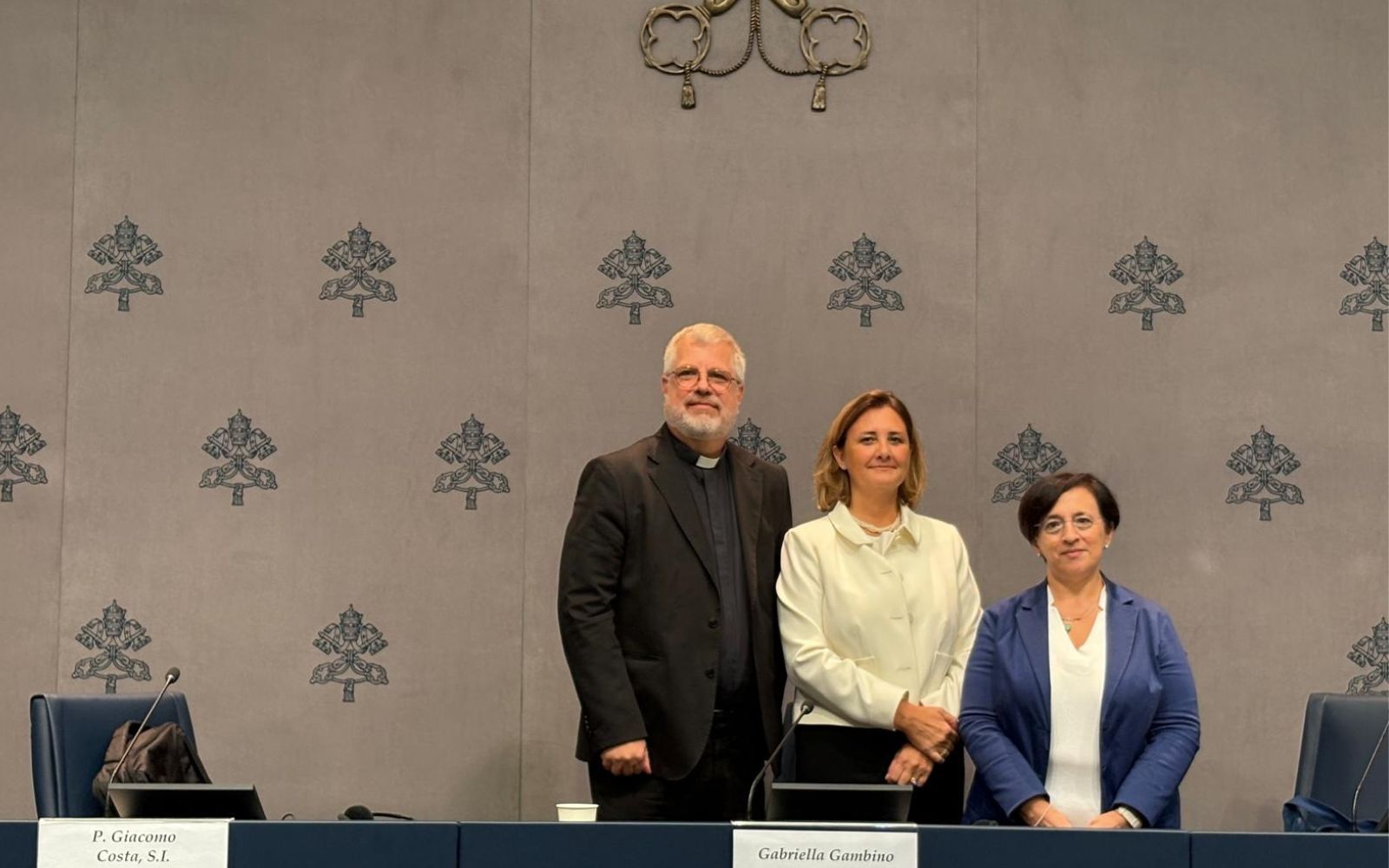
Metropolitan Hilarion, once tipped as successor to Patriarch Kirill, was released without charges after Czech police found an unidentified substance in his vehicle.

Read More
Leo XIV: Don’t water down Christianity #Catholic Pope Leo XIV warned Thursday against the temptation to make Christianity more attractive by diluting its content or softening its demands, telling Vatican evangelization officials that the faith is transmitted above all through credible Christian witness.“It is certainly not by watering down the content or softening the demands that Christianity can be made attractive but by bearing witness with humility and courage to ‘the way, the truth, and the life’ that has converted and sanctified so many people,” the pope said May 28.The pope made the remarks during a meeting in the Consistory Hall with members of the Dicastery for Evangelization’s Section for Fundamental Questions Regarding Evangelization in the World at the conclusion of its plenary assembly.According to the apostolic constitution Praedicate Evangelium, the section is responsible for studying fundamental questions of evangelization and promoting an effective proclamation of the Gospel, identifying appropriate forms, tools, and language.Leo said the crisis of faith, especially in the West, has contributed to “widespread religious indifference.”“To many, faith no longer appears relevant to their lives,” he said. “The underlying danger, the gravity of which is not always perceived, is that the very essence of what is most human — namely, the search for meaning — may be lost. The great existential questions remain unanswered, whilst a technological culture that is supposed to meet every need is spreading.”The pope said that even in such a context, “the encounter with Christ is able to restore full meaning and value to people’s lives,” adding that the Church’s missionary mandate remains urgent.“No one can take her place in this mission, which is as urgent as it is necessary to ensure a reliable foundation for the future of humanity, so that it may be a future of peace, justice, freedom, and fraternity,” he said.Leo also pointed to the continuing relevance of Pope Francis’ apostolic exhortation Evangelii Gaudium, which he said “continues to be a significant point of reference.”He invited the dicastery to revisit the document in its work “to promote a mission that is ‘Christ-centered and kerygmatic … born of an encounter with Christ that is capable of transforming lives.’”The pope said the Church should pay close attention to a growing demand for spirituality, especially among young people, something he said was “clearly evident during the Youth Jubilee.”“The new generation is not closed to the Gospel; on the contrary, many, when they rediscover it, wish to know it better, because they sense that within it lies the secret to being truly happy,” he said.At the same time, Leo said evangelization must confront changed conditions in the transmission of the faith from one generation to the next.“In some parts of the world, this transmission has all but ceased, and this requires the ability to take on new challenges,” he said.The result, he continued, is “a spiritual ‘poverty’ among the younger generations, a lack of motivation and of the means to develop, in full freedom, that commitment to the faith which gives meaning to life.”The pope said the cultural climate of “media-saturated and consumerist societies” weakens the ability to pursue truth with patience, perseverance, and critical judgment.“Every message risks being perceived as just one opinion among many,” he said.In response, he stressed that transmitting the faith “necessarily involves encountering people and communities who express the joy of the Christian faith and the coherence of a Gospel-inspired way of life.”Quoting Benedict XVI, Leo said: “What we need at this moment in history are men who, through an enlightened and lived faith, make God credible in this world.”“We need people who keep their gaze fixed on God, learning true humanity from him,” the pope continued, quoting Benedict. “We need people whose intellect is enlightened by the light of God and whose hearts God opens, so that their intellect may speak to the intellect of others and their hearts may open the hearts of others. Only through men who are touched by God can God return to men.”Leo also thanked the dicastery for its work during last year’s jubilee, which he said brought more than 33 million pilgrims to Rome.“The world thirsts for hope more than ever,” he said. “It longs to live in peace and in the certainty that the commitment to building a city worthy of God’s children is not only possible but real, because it is imbued with a hope that offers true, not illusory, objectives.”The pope said evangelization must remain “the fundamental motivation behind every action of the universal Church and of local communities.”“The proclamation of the Gospel, which instils hope, is not a utopian proposal: It is a witness that draws people in because it reveals the call to love and truth,” he said.Leo concluded by emphasizing the importance of catechesis, which he said “plays a decisive role in the life of the Church through its commitment to formation and the transmission of the faith.”He called for special attention to catechumens, “who are requesting baptism in ever-increasing numbers,” and said Christian communities must accompany them beyond the celebration of the sacrament.“Similar care must be accorded to the boys and girls who receive the sacrament of confirmation,” he said. “I encourage the many initiatives that accompany them as they continue on their journey of faith for their human and Christian growth.”This story was first published by ACI Prensa, the Spanish-language sister service of EWTN News. It has been translated and adapted by EWTN News English.

Leo XIV: Don’t water down Christianity #Catholic Pope Leo XIV warned Thursday against the temptation to make Christianity more attractive by diluting its content or softening its demands, telling Vatican evangelization officials that the faith is transmitted above all through credible Christian witness.“It is certainly not by watering down the content or softening the demands that Christianity can be made attractive but by bearing witness with humility and courage to ‘the way, the truth, and the life’ that has converted and sanctified so many people,” the pope said May 28.The pope made the remarks during a meeting in the Consistory Hall with members of the Dicastery for Evangelization’s Section for Fundamental Questions Regarding Evangelization in the World at the conclusion of its plenary assembly.According to the apostolic constitution Praedicate Evangelium, the section is responsible for studying fundamental questions of evangelization and promoting an effective proclamation of the Gospel, identifying appropriate forms, tools, and language.Leo said the crisis of faith, especially in the West, has contributed to “widespread religious indifference.”“To many, faith no longer appears relevant to their lives,” he said. “The underlying danger, the gravity of which is not always perceived, is that the very essence of what is most human — namely, the search for meaning — may be lost. The great existential questions remain unanswered, whilst a technological culture that is supposed to meet every need is spreading.”The pope said that even in such a context, “the encounter with Christ is able to restore full meaning and value to people’s lives,” adding that the Church’s missionary mandate remains urgent.“No one can take her place in this mission, which is as urgent as it is necessary to ensure a reliable foundation for the future of humanity, so that it may be a future of peace, justice, freedom, and fraternity,” he said.Leo also pointed to the continuing relevance of Pope Francis’ apostolic exhortation Evangelii Gaudium, which he said “continues to be a significant point of reference.”He invited the dicastery to revisit the document in its work “to promote a mission that is ‘Christ-centered and kerygmatic … born of an encounter with Christ that is capable of transforming lives.’”The pope said the Church should pay close attention to a growing demand for spirituality, especially among young people, something he said was “clearly evident during the Youth Jubilee.”“The new generation is not closed to the Gospel; on the contrary, many, when they rediscover it, wish to know it better, because they sense that within it lies the secret to being truly happy,” he said.At the same time, Leo said evangelization must confront changed conditions in the transmission of the faith from one generation to the next.“In some parts of the world, this transmission has all but ceased, and this requires the ability to take on new challenges,” he said.The result, he continued, is “a spiritual ‘poverty’ among the younger generations, a lack of motivation and of the means to develop, in full freedom, that commitment to the faith which gives meaning to life.”The pope said the cultural climate of “media-saturated and consumerist societies” weakens the ability to pursue truth with patience, perseverance, and critical judgment.“Every message risks being perceived as just one opinion among many,” he said.In response, he stressed that transmitting the faith “necessarily involves encountering people and communities who express the joy of the Christian faith and the coherence of a Gospel-inspired way of life.”Quoting Benedict XVI, Leo said: “What we need at this moment in history are men who, through an enlightened and lived faith, make God credible in this world.”“We need people who keep their gaze fixed on God, learning true humanity from him,” the pope continued, quoting Benedict. “We need people whose intellect is enlightened by the light of God and whose hearts God opens, so that their intellect may speak to the intellect of others and their hearts may open the hearts of others. Only through men who are touched by God can God return to men.”Leo also thanked the dicastery for its work during last year’s jubilee, which he said brought more than 33 million pilgrims to Rome.“The world thirsts for hope more than ever,” he said. “It longs to live in peace and in the certainty that the commitment to building a city worthy of God’s children is not only possible but real, because it is imbued with a hope that offers true, not illusory, objectives.”The pope said evangelization must remain “the fundamental motivation behind every action of the universal Church and of local communities.”“The proclamation of the Gospel, which instils hope, is not a utopian proposal: It is a witness that draws people in because it reveals the call to love and truth,” he said.Leo concluded by emphasizing the importance of catechesis, which he said “plays a decisive role in the life of the Church through its commitment to formation and the transmission of the faith.”He called for special attention to catechumens, “who are requesting baptism in ever-increasing numbers,” and said Christian communities must accompany them beyond the celebration of the sacrament.“Similar care must be accorded to the boys and girls who receive the sacrament of confirmation,” he said. “I encourage the many initiatives that accompany them as they continue on their journey of faith for their human and Christian growth.”This story was first published by ACI Prensa, the Spanish-language sister service of EWTN News. It has been translated and adapted by EWTN News English.

The pontiff said the Church must respond to religious indifference not by softening the Gospel’s demands but by offering credible witness to Christ.

Read More
Pope sets up commission to tackle 0 million debt at Padre Pio’s hospital #Catholic Pope Leo XIV on Wednesday created a commission to identify solutions for long-term sustainability at the Casa Sollievo della Sofferenza, a major hospital complex founded by St. Pio of Pietrelcina and directly overseen by the Vatican Secretariat of State.The Catholic hospital — which is located in the southern Italian region of Puglia — is facing a debt crisis from which “we will emerge together,” Secretary of State Cardinal Pietro Parolin said during a May 5 visit to the facility.The hospital in San Giovanni Rotondo, where the saint known as Padre Pio lived for most of his life, has debts estimated to run between 250 million to 300 million euros (about 0 million to 0 million).The hospital is currently in a dispute with officials from the Puglia region over reimbursements — the regional authority claims it is owed 32 million euros ( million) — and is also involved in a conflict over new labor contracts.The new commission now aims to resolve what is a highly complex situation.The papal chirograph (a kind of decree) establishing the commission states that the pope’s decision arises from the Apostolic See’s love for works of charity and from the awareness that large institutions, in order to remain faithful to their mission, must be capable of facing the challenges of change.“The evolution of the times, technology, law, and economics places the mission of the Church before the challenge of continuous renewal,” particularly in sectors such as healthcare that require vision, investment, and prudent management, the chirograph says.Among these institutions is Casa Sollievo della Sofferenza, founded “with the aim of providing hospitality, assistance, and care to the sick, pilgrims, and their families, inspired by the spirituality and the figure of its saintly founder.”The guidance and oversight commission has the task of analyzing the hospital foundation’s “current situation, identifying the best solutions for ever-greater efficiency, effectiveness, and long-term sustainability of its work and mission, and ensuring the concrete implementation of those solutions.”The commission will operate on all fronts — financial, patrimonial, and operational — with full authority to carry out the necessary acts of both ordinary and extraordinary administration. It will report directly to the pope before any decision of particular significance and before adopting measures of special importance or those that would have a decisive and substantial impact on the foundation’s assets or modify its statutes.The commission represents a combined effort by Vatican economic bodies and the Secretariat of State. Maximino Caballero Ledo, prefect of the Secretariat for the Economy, will serve as president. The coordinator is Fabio Gasperini, secretary-general of the Governorate. Archbishop Giordano Piccinotti, president of the Administration of the Patrimony of the Apostolic See, is a member together with Archbishop Paolo Rudelli, undersecretary for general affairs of the Secretariat of State. The technical committee includes Benjamín Estévez de Cominges, Gino Gumirato, and attorney Alessandro Ela Oyana.Casa Sollievo della Sofferenza was born from Padre Pio’s concrete faith, rooted in the conviction that caring for the body is an integral part of the Christian mission.The decision to establish an ad hoc commission is a sign of Leo’s interest in the hospital but also unusual, given that Pope Francis already established a Vatican commission for Catholic healthcare.This story was first published by ACI Stampa, the Italian-language sister service of EWTN News. It has been translated and adapted by EWTN News English.

Pope sets up commission to tackle $290 million debt at Padre Pio’s hospital #Catholic Pope Leo XIV on Wednesday created a commission to identify solutions for long-term sustainability at the Casa Sollievo della Sofferenza, a major hospital complex founded by St. Pio of Pietrelcina and directly overseen by the Vatican Secretariat of State.The Catholic hospital — which is located in the southern Italian region of Puglia — is facing a debt crisis from which “we will emerge together,” Secretary of State Cardinal Pietro Parolin said during a May 5 visit to the facility.The hospital in San Giovanni Rotondo, where the saint known as Padre Pio lived for most of his life, has debts estimated to run between 250 million to 300 million euros (about $290 million to $350 million).The hospital is currently in a dispute with officials from the Puglia region over reimbursements — the regional authority claims it is owed 32 million euros ($37 million) — and is also involved in a conflict over new labor contracts.The new commission now aims to resolve what is a highly complex situation.The papal chirograph (a kind of decree) establishing the commission states that the pope’s decision arises from the Apostolic See’s love for works of charity and from the awareness that large institutions, in order to remain faithful to their mission, must be capable of facing the challenges of change.“The evolution of the times, technology, law, and economics places the mission of the Church before the challenge of continuous renewal,” particularly in sectors such as healthcare that require vision, investment, and prudent management, the chirograph says.Among these institutions is Casa Sollievo della Sofferenza, founded “with the aim of providing hospitality, assistance, and care to the sick, pilgrims, and their families, inspired by the spirituality and the figure of its saintly founder.”The guidance and oversight commission has the task of analyzing the hospital foundation’s “current situation, identifying the best solutions for ever-greater efficiency, effectiveness, and long-term sustainability of its work and mission, and ensuring the concrete implementation of those solutions.”The commission will operate on all fronts — financial, patrimonial, and operational — with full authority to carry out the necessary acts of both ordinary and extraordinary administration. It will report directly to the pope before any decision of particular significance and before adopting measures of special importance or those that would have a decisive and substantial impact on the foundation’s assets or modify its statutes.The commission represents a combined effort by Vatican economic bodies and the Secretariat of State. Maximino Caballero Ledo, prefect of the Secretariat for the Economy, will serve as president. The coordinator is Fabio Gasperini, secretary-general of the Governorate. Archbishop Giordano Piccinotti, president of the Administration of the Patrimony of the Apostolic See, is a member together with Archbishop Paolo Rudelli, undersecretary for general affairs of the Secretariat of State. The technical committee includes Benjamín Estévez de Cominges, Gino Gumirato, and attorney Alessandro Ela Oyana.Casa Sollievo della Sofferenza was born from Padre Pio’s concrete faith, rooted in the conviction that caring for the body is an integral part of the Christian mission.The decision to establish an ad hoc commission is a sign of Leo’s interest in the hospital but also unusual, given that Pope Francis already established a Vatican commission for Catholic healthcare.This story was first published by ACI Stampa, the Italian-language sister service of EWTN News. It has been translated and adapted by EWTN News English.

The hospital in San Giovanni Rotondo, Italy, where the saint known as Padre Pio lived for most of his life, has debts estimated to run between about $290 million to $350 million.

Read More
Start here: 15 quotes from Pope Leo XIV’s first encyclical Magnifica Humanitas #Catholic Pope Leo XIV just released his first encyclical — and it may be the most important Church document of our lifetime. Called Magnifica Humanitas, it covers artificial intelligence, human dignity, childrenʼs phones, autonomous weapons, doomscrolling, the mystery of the human soul, and why no machine will ever have the final word on what it means to be a person made in the image of God.The full document is available to download here — and worth a read. But for a quick taste of whatʼs inside, here are 15 powerful quotes from the encyclical:“Never has humanity had such power over itself.” (par. 4)"In practice, however, technology is never neutral, because it takes on the characteristics of those who devise, finance, regulate and use it. Therefore, the primary choice is not between a ‘yes’ or ‘no’ to technology, but rather between constructing Babel or rebuilding Jerusalem; between a power that claims to dominate the heavens and a people who work together in the presence of God to rebuild the walls of fraternal coexistence.” (par. 9)“In the era of artificial intelligence, when human dignity is threatened by new forms of dehumanization, ours is the pressing duty to remain profoundly human. We must lovingly safeguard the grandeur of humanity bestowed upon us and revealed in its fullness in Christ, the splendor of which no machine can ever replace.” (par. 15)“Thus, the ‘rejected stones’ — the poor, the sick, the migrants and the least among us — will become the cornerstone, and a solid, welcoming common home will emerge on the earth, where love and faithfulness will finally meet, and righteousness and peace will embrace (cf. Ps 85:10).” (par.16)“Human dignity does not depend on a person’s abilities, wealth, or position in life, nor on the right or wrong choices made; instead, it is a gift that precedes and transcends each person, endowed by God as an expression of his unfailing love.” (par. 50)“Among these ideologies, I consider particularly insidious the one that suggests that every person must earn or justify his or her own worth, to the point of attributing greater value to those who are more efficient or effective.” (par. 51)“No sin, failure, humiliation, or exclusion can diminish the profound value of a human life that God has willed and called into being.” (par. 52)“Solidarity demands that decisions regarding data, algorithms, platforms and artificial intelligence take into account not only the immediate benefit for a few, but also the impact on all peoples and on future generations.” (par. 76)“For an algorithm, an error is a flaw to be corrected; for a person, however, an error can be a catalyst for profound change. A person’s future is not calculable, but depends on one’s freedom — elevated by the inexhaustible grace of God — and on the relationships cultivated.” (par. 128)“Having a personal mobile device at too early an age and using it without adult supervision can exacerbate young people’s vulnerabilities, foster addiction, and expose them to isolation, bullying, and cyberbullying, as well as to pressures to share intimate images or sensitive information.” (par. 141)“Even in the darkest nights, the Lord raises up men and women who refuse to give up, who persevere in doing good, who protect the vulnerable and open pathways to reconciliation. The memory of the saints, righteous people, and the oft-forgotten peacemakers, show us that grace does not magically eliminate conflict, but instead it inspires active resistance to evil and an astonishing creativity in doing good.” (par. 211)“The civilization of love will not arise from a single or spectacular gesture, but from the sum total of small and steadfast acts of fidelity that serve as a bulwark against dehumanization.” (par. 213)“‘Let us disarm words and we will help to disarm the world.’ Words have enormous power, something we experience in our daily interactions; for example, spoken words can change our mood for better or for worse." (par. 214)“No computational system, however sophisticated, can create a heart that gives itself, or a conscience that discerns good from evil. Even when machines excel in efficiency, a human face that asks to be gazed upon remains the center of our history. This human face is the fullness toward which history is moving.” (par. 233)“Let us remain faithful to the truth! Living amid incessant flows of information, opinions and images, we know how easy it can be to influence decisions and preferences through increasingly sophisticated algorithms. In this context, it is imperative to cultivate hearts that love the truth, prefer what is right despite the most appealing content and pursue wisdom rather than immediate results.” (par. 237)

Start here: 15 quotes from Pope Leo XIV’s first encyclical Magnifica Humanitas #Catholic Pope Leo XIV just released his first encyclical — and it may be the most important Church document of our lifetime. Called Magnifica Humanitas, it covers artificial intelligence, human dignity, childrenʼs phones, autonomous weapons, doomscrolling, the mystery of the human soul, and why no machine will ever have the final word on what it means to be a person made in the image of God.The full document is available to download here — and worth a read. But for a quick taste of whatʼs inside, here are 15 powerful quotes from the encyclical:“Never has humanity had such power over itself.” (par. 4)"In practice, however, technology is never neutral, because it takes on the characteristics of those who devise, finance, regulate and use it. Therefore, the primary choice is not between a ‘yes’ or ‘no’ to technology, but rather between constructing Babel or rebuilding Jerusalem; between a power that claims to dominate the heavens and a people who work together in the presence of God to rebuild the walls of fraternal coexistence.” (par. 9)“In the era of artificial intelligence, when human dignity is threatened by new forms of dehumanization, ours is the pressing duty to remain profoundly human. We must lovingly safeguard the grandeur of humanity bestowed upon us and revealed in its fullness in Christ, the splendor of which no machine can ever replace.” (par. 15)“Thus, the ‘rejected stones’ — the poor, the sick, the migrants and the least among us — will become the cornerstone, and a solid, welcoming common home will emerge on the earth, where love and faithfulness will finally meet, and righteousness and peace will embrace (cf. Ps 85:10).” (par.16)“Human dignity does not depend on a person’s abilities, wealth, or position in life, nor on the right or wrong choices made; instead, it is a gift that precedes and transcends each person, endowed by God as an expression of his unfailing love.” (par. 50)“Among these ideologies, I consider particularly insidious the one that suggests that every person must earn or justify his or her own worth, to the point of attributing greater value to those who are more efficient or effective.” (par. 51)“No sin, failure, humiliation, or exclusion can diminish the profound value of a human life that God has willed and called into being.” (par. 52)“Solidarity demands that decisions regarding data, algorithms, platforms and artificial intelligence take into account not only the immediate benefit for a few, but also the impact on all peoples and on future generations.” (par. 76)“For an algorithm, an error is a flaw to be corrected; for a person, however, an error can be a catalyst for profound change. A person’s future is not calculable, but depends on one’s freedom — elevated by the inexhaustible grace of God — and on the relationships cultivated.” (par. 128)“Having a personal mobile device at too early an age and using it without adult supervision can exacerbate young people’s vulnerabilities, foster addiction, and expose them to isolation, bullying, and cyberbullying, as well as to pressures to share intimate images or sensitive information.” (par. 141)“Even in the darkest nights, the Lord raises up men and women who refuse to give up, who persevere in doing good, who protect the vulnerable and open pathways to reconciliation. The memory of the saints, righteous people, and the oft-forgotten peacemakers, show us that grace does not magically eliminate conflict, but instead it inspires active resistance to evil and an astonishing creativity in doing good.” (par. 211)“The civilization of love will not arise from a single or spectacular gesture, but from the sum total of small and steadfast acts of fidelity that serve as a bulwark against dehumanization.” (par. 213)“‘Let us disarm words and we will help to disarm the world.’ Words have enormous power, something we experience in our daily interactions; for example, spoken words can change our mood for better or for worse." (par. 214)“No computational system, however sophisticated, can create a heart that gives itself, or a conscience that discerns good from evil. Even when machines excel in efficiency, a human face that asks to be gazed upon remains the center of our history. This human face is the fullness toward which history is moving.” (par. 233)“Let us remain faithful to the truth! Living amid incessant flows of information, opinions and images, we know how easy it can be to influence decisions and preferences through increasingly sophisticated algorithms. In this context, it is imperative to cultivate hearts that love the truth, prefer what is right despite the most appealing content and pursue wisdom rather than immediate results.” (par. 237)

Pope Leo XIV just released his first encyclical — and it may be the most important Church document of our lifetime.

Read More
Leo XIV at Pentecost: The Spirit overcomes war with the omnipotence of love #Catholic VATICAN CITY — Pope Leo XIV marked Pentecost Sunday with a plea for peace, praying that the Holy Spirit would save the world “from the evil of war” and renew the Church in its mission to transform confusion into communion.Celebrating Mass in St. Peter’s Basilica on May 24, the pope centered his homily on the risen Christ’s appearance to the disciples in the upper room, where Jesus showed them “his hands and his side” and breathed the Holy Spirit upon them.“The Lord reveals his glorious body, specifically his wounds, the marks of the crucifixion,” Pope Leo said. “These signs of the Passion, more eloquent than words, are now transfigured; he who was dead lives forever.”The pope said the same upper room that had been marked by fear and betrayal became, through Christ’s gift of the Spirit, “for the entire Church, the womb of the Resurrection.”“Pentecost is therefore a paschal feast and a feast of the body of Christ, which by grace is all of us,” he said.Leo framed his homily around three aspects of the Holy Spirit: peace, mission, and truth.“First of all, the Spirit of the risen One is the Spirit of peace,” he said. “Indeed, through his paschal mystery, Christ restores peace between God and humanity, and the Holy Spirit pours this peace into our hearts and spreads it throughout the world.”That peace, the pope said, “stems from forgiveness and leads us to forgiveness,” beginning with Christ’s forgiveness of humanity.The pope then described the Holy Spirit as “the Spirit of mission,” citing Christ’s words: “As the Father has sent me, so I send you.”“We are truly co-workers of the Gospel: The whole Church is its protagonist, not merely its guardian,” Leo said. “Through the power of the Spirit, our proclamation is filled with joy and hope, for we — yes, we ourselves — are the newness of the world, the light and the salt of the earth.”The pope warned that some changes “do not bring new life to the world, but make it grow old through error and violence.” By contrast, he said, “the Holy Spirit enlightens minds and instils new vitality in our hearts.”“This is how he transfigures history, opening it to salvation, which is the gift that the Lord offers to everyone,” he said. “The Church’s mission bears witness to this offer, thereby transforming the world’s confusion into communion with God and among ourselves.”Finally, Leo said the Spirit is “the Spirit of truth,” who “always promotes unity in truth” and protects the Church from “partisanship, hypocrisy, and fads that obscure the light of the Gospel.”“The truth that God gives us thus stands as a liberating word for all peoples, a message that transforms every culture from within,” he said.Concluding his homily, the pope offered a prayer for a world wounded by war, poverty, and sin.“Dear friends, with fervent hearts, let us pray today that the Spirit of the risen One may save us from the evil of war, which is overcome not by a superpower, but by the omnipotence of love,” he said. “Let us pray that he free humanity from misery, which is redeemed not by immeasurable wealth, but by an inexhaustible gift. Let us pray that he heal us from the scourge of sin through the salvation proclaimed to all peoples in the name of Jesus.”After the Mass, Pope Leo appeared from his study in the Apostolic Palace to pray the Regina Coeli, returning again to the theme of the Holy Spirit as the one who opens what fear and sin have closed.The pope said the Spirit was poured out abundantly on the newborn Church and is given anew to the faithful today as “light and strength” in every circumstance of life.“The Spirit opens doors,” he said, pointing to the image of Christ opening the doors of the upper room and to the Acts of the Apostles, where the Spirit comes “like a violent wind.”Leo asked: “What doors does the Holy Spirit open?”The first, he said, is “the door of God himself,” opening access to the mystery of God as revealed in Jesus Christ. The Holy Spirit, he said, helps believers encounter God personally in Jesus, recognize him within themselves, and discover the signs of his presence in daily life.The second door is that of the upper room, “that is, of the Church.” Without the fire of the Spirit, the pope said, the Church “remains a prisoner of fear,” timid before the challenges of the world, closed in on itself, and unable to enter into dialogue with changing times.The third door, Leo said, is “the door of our hearts.” The Spirit helps believers overcome resistance, selfishness, mistrust, and prejudice, making them capable of living as children of God and brothers and sisters to one another.“Where the Spirit of the Lord is, fraternity is born among persons, groups, and peoples of the earth,” he said, adding that all are called to speak “the one language of love, which unites and harmonizes differences.”The pope also recalled the day of prayer for the Church in China, observed on the liturgical memorial of the Blessed Virgin Mary, Help of Christians, who is venerated at the Shrine of Our Lady of Sheshan in Shanghai.Leo invited the faithful to join in prayer with Chinese Catholics “as a sign of our affection for them and of their communion with the universal Church and with the successor of Peter.” He prayed that Mary’s intercession would obtain for the Church in China the grace of unity and the strength to witness to the Gospel in daily hardship, becoming a seed of hope and peace.The pope also remembered victims of a recent mining accident in northern China and entrusted to Mary the Christian communities of the Holy Land, Lebanon, and the wider Middle East suffering because of war.This story was first published in two parts by ACI Stampa, the Italian-language sister service of EWTN News. It has been translated and adapted by EWTN News English.

Leo XIV at Pentecost: The Spirit overcomes war with the omnipotence of love #Catholic VATICAN CITY — Pope Leo XIV marked Pentecost Sunday with a plea for peace, praying that the Holy Spirit would save the world “from the evil of war” and renew the Church in its mission to transform confusion into communion.Celebrating Mass in St. Peter’s Basilica on May 24, the pope centered his homily on the risen Christ’s appearance to the disciples in the upper room, where Jesus showed them “his hands and his side” and breathed the Holy Spirit upon them.“The Lord reveals his glorious body, specifically his wounds, the marks of the crucifixion,” Pope Leo said. “These signs of the Passion, more eloquent than words, are now transfigured; he who was dead lives forever.”The pope said the same upper room that had been marked by fear and betrayal became, through Christ’s gift of the Spirit, “for the entire Church, the womb of the Resurrection.”“Pentecost is therefore a paschal feast and a feast of the body of Christ, which by grace is all of us,” he said.Leo framed his homily around three aspects of the Holy Spirit: peace, mission, and truth.“First of all, the Spirit of the risen One is the Spirit of peace,” he said. “Indeed, through his paschal mystery, Christ restores peace between God and humanity, and the Holy Spirit pours this peace into our hearts and spreads it throughout the world.”That peace, the pope said, “stems from forgiveness and leads us to forgiveness,” beginning with Christ’s forgiveness of humanity.The pope then described the Holy Spirit as “the Spirit of mission,” citing Christ’s words: “As the Father has sent me, so I send you.”“We are truly co-workers of the Gospel: The whole Church is its protagonist, not merely its guardian,” Leo said. “Through the power of the Spirit, our proclamation is filled with joy and hope, for we — yes, we ourselves — are the newness of the world, the light and the salt of the earth.”The pope warned that some changes “do not bring new life to the world, but make it grow old through error and violence.” By contrast, he said, “the Holy Spirit enlightens minds and instils new vitality in our hearts.”“This is how he transfigures history, opening it to salvation, which is the gift that the Lord offers to everyone,” he said. “The Church’s mission bears witness to this offer, thereby transforming the world’s confusion into communion with God and among ourselves.”Finally, Leo said the Spirit is “the Spirit of truth,” who “always promotes unity in truth” and protects the Church from “partisanship, hypocrisy, and fads that obscure the light of the Gospel.”“The truth that God gives us thus stands as a liberating word for all peoples, a message that transforms every culture from within,” he said.Concluding his homily, the pope offered a prayer for a world wounded by war, poverty, and sin.“Dear friends, with fervent hearts, let us pray today that the Spirit of the risen One may save us from the evil of war, which is overcome not by a superpower, but by the omnipotence of love,” he said. “Let us pray that he free humanity from misery, which is redeemed not by immeasurable wealth, but by an inexhaustible gift. Let us pray that he heal us from the scourge of sin through the salvation proclaimed to all peoples in the name of Jesus.”After the Mass, Pope Leo appeared from his study in the Apostolic Palace to pray the Regina Coeli, returning again to the theme of the Holy Spirit as the one who opens what fear and sin have closed.The pope said the Spirit was poured out abundantly on the newborn Church and is given anew to the faithful today as “light and strength” in every circumstance of life.“The Spirit opens doors,” he said, pointing to the image of Christ opening the doors of the upper room and to the Acts of the Apostles, where the Spirit comes “like a violent wind.”Leo asked: “What doors does the Holy Spirit open?”The first, he said, is “the door of God himself,” opening access to the mystery of God as revealed in Jesus Christ. The Holy Spirit, he said, helps believers encounter God personally in Jesus, recognize him within themselves, and discover the signs of his presence in daily life.The second door is that of the upper room, “that is, of the Church.” Without the fire of the Spirit, the pope said, the Church “remains a prisoner of fear,” timid before the challenges of the world, closed in on itself, and unable to enter into dialogue with changing times.The third door, Leo said, is “the door of our hearts.” The Spirit helps believers overcome resistance, selfishness, mistrust, and prejudice, making them capable of living as children of God and brothers and sisters to one another.“Where the Spirit of the Lord is, fraternity is born among persons, groups, and peoples of the earth,” he said, adding that all are called to speak “the one language of love, which unites and harmonizes differences.”The pope also recalled the day of prayer for the Church in China, observed on the liturgical memorial of the Blessed Virgin Mary, Help of Christians, who is venerated at the Shrine of Our Lady of Sheshan in Shanghai.Leo invited the faithful to join in prayer with Chinese Catholics “as a sign of our affection for them and of their communion with the universal Church and with the successor of Peter.” He prayed that Mary’s intercession would obtain for the Church in China the grace of unity and the strength to witness to the Gospel in daily hardship, becoming a seed of hope and peace.The pope also remembered victims of a recent mining accident in northern China and entrusted to Mary the Christian communities of the Holy Land, Lebanon, and the wider Middle East suffering because of war.This story was first published in two parts by ACI Stampa, the Italian-language sister service of EWTN News. It has been translated and adapted by EWTN News English.

The pontiff prayed that the Holy Spirit would save humanity from war, misery, and sin.

Read More
How Catholics can receive a plenary indulgence on Pentecost #Catholic On the solemnity of Pentecost, which this year is celebrated on May 24, Catholics have the opportunity to gain a plenary indulgence.An indulgence can be received by praying or singing the hymn "Veni Creator Spiritus" during the solemnity of Pentecost. The prayer is below.What is a plenary indulgence?The following “General Remarks on Indulgences” from “Gift of the Indulgence” summarizes the usual conditions given in the Churchʼs law (cf. Apostolic Penitentiary, Prot. N. 39/05/I): “This is how an indulgence is defined in the Code of Canon Law (can. 992) and in the Catechism of the Catholic Church (n. 1471): ‘An indulgence is a remission before God of the temporal punishment due to sins whose guilt has already been forgiven, which the faithful Christian who is duly disposed gains under certain prescribed conditions through the action of the Church which, as the minister of redemption, dispenses and applies with authority the treasury of the satisfactions of Christ and the saints.’”Conditions in all casesIn order to obtain the plenary indulgence, in addition to praying or signing the hymn mentioned above, the following conditions must be fulfilled:1. Detachment from all sin, even venial.2. Sacramental confession, holy Communion, and prayer for the intentions of the pope. These three conditions can be fulfilled a few days before or after performing the works to gain the indulgence, but it is appropriate that Communion and the prayer take place on the same day that the work is completed.A single sacramental confession is sufficient for several plenary indulgences, but frequent sacramental confession is encouraged in order to obtain the grace of deeper conversion and purity of heart.Prayer: Veni Creator SpiritusCome, Holy Spirit, Creator blest, and in our souls take up thy rest; come with thy grace and heavenly aid to fill the hearts which thou hast made.O comforter, to thee we cry, O heavenly gift of God Most High, O fount of life and fire of love, and sweet anointing from above.Thou in thy sevenfold gifts are known; thou, finger of Godʼs hand we own; thou, promise of the Father, thou who dost the tongue with power imbue.Kindle our sense from above, and make our hearts oʼerflow with love; with patience firm and virtue high the weakness of our flesh supply.Far from us drive the foe we dread, and grant us thy peace instead; so shall we not, with thee for guide, turn from the path of life aside.Oh, may thy grace on us bestow the Father and the Son to know; and thee, through endless times confessed, of both the eternal Spirit blest.Now to the Father and the Son, who rose from death, be glory given, with thou, O Holy Comforter, henceforth by all in earth and heaven. Amen.This story was first published by ACI Prensa, the Spanish-language sister service of EWTN News, and has been translated and adapted by EWTN News English.

How Catholics can receive a plenary indulgence on Pentecost #Catholic On the solemnity of Pentecost, which this year is celebrated on May 24, Catholics have the opportunity to gain a plenary indulgence.An indulgence can be received by praying or singing the hymn "Veni Creator Spiritus" during the solemnity of Pentecost. The prayer is below.What is a plenary indulgence?The following “General Remarks on Indulgences” from “Gift of the Indulgence” summarizes the usual conditions given in the Churchʼs law (cf. Apostolic Penitentiary, Prot. N. 39/05/I): “This is how an indulgence is defined in the Code of Canon Law (can. 992) and in the Catechism of the Catholic Church (n. 1471): ‘An indulgence is a remission before God of the temporal punishment due to sins whose guilt has already been forgiven, which the faithful Christian who is duly disposed gains under certain prescribed conditions through the action of the Church which, as the minister of redemption, dispenses and applies with authority the treasury of the satisfactions of Christ and the saints.’”Conditions in all casesIn order to obtain the plenary indulgence, in addition to praying or signing the hymn mentioned above, the following conditions must be fulfilled:1. Detachment from all sin, even venial.2. Sacramental confession, holy Communion, and prayer for the intentions of the pope. These three conditions can be fulfilled a few days before or after performing the works to gain the indulgence, but it is appropriate that Communion and the prayer take place on the same day that the work is completed.A single sacramental confession is sufficient for several plenary indulgences, but frequent sacramental confession is encouraged in order to obtain the grace of deeper conversion and purity of heart.Prayer: Veni Creator SpiritusCome, Holy Spirit, Creator blest, and in our souls take up thy rest; come with thy grace and heavenly aid to fill the hearts which thou hast made.O comforter, to thee we cry, O heavenly gift of God Most High, O fount of life and fire of love, and sweet anointing from above.Thou in thy sevenfold gifts are known; thou, finger of Godʼs hand we own; thou, promise of the Father, thou who dost the tongue with power imbue.Kindle our sense from above, and make our hearts oʼerflow with love; with patience firm and virtue high the weakness of our flesh supply.Far from us drive the foe we dread, and grant us thy peace instead; so shall we not, with thee for guide, turn from the path of life aside.Oh, may thy grace on us bestow the Father and the Son to know; and thee, through endless times confessed, of both the eternal Spirit blest.Now to the Father and the Son, who rose from death, be glory given, with thou, O Holy Comforter, henceforth by all in earth and heaven. Amen.This story was first published by ACI Prensa, the Spanish-language sister service of EWTN News, and has been translated and adapted by EWTN News English.

On the solemnity of Pentecost, which this year is celebrated on May 24, Catholics have the opportunity to gain a plenary indulgence.

Read More
Madrid archbishop says Catholics feel ‘incredible expectation’ at pope’s upcoming trip to Spain #Catholic Madrid Archbishop Cardinal José Cobo Cano said that the imminent visit of Pope Leo XIV to Spain has generated “incredible expectations” and that the main challenge will not only be organizational, but pastoral.“The challenge is that it is not an event. We are used to concerts, which are prepared, closed and thatʼs it," he said in an interview with EWTN News about the preparations for the trip of Pope Leo XIV, who will visit Madrid, Barcelona and the Canary Islands from June 6 to 12. He expressed hope that the visit will be “a moment of experience and … a moment also that will be slow, that it helps us to look up and take a step forward.”Preparations in record timeCardinal Cobo explained that the visit has been organized in “record time,” with just three months of work, and with a much greater social and ecclesial response than expected.“We have had three scarce months to prepare a trip, during which we have also found that there is a great desire and an incredible expectation. I think we thought it was going to be something [for which] we had to motivate [Catholics] a lot, but nothing was needed,” he said.As he highlighted, the popeʼs program in Madrid has been designed as a “pastoral triptych” with three major components: the celebration of the Eucharist on the feast of Corpus Christi, the great meeting with the Church of Madrid at the Santiago Bernabéu stadium, and a space for dialogue with leaders of culture, economy and sport.“The celebration of the Eucharist, [especially on] Corpus Christi — which is a very important holiday for us — and celebrating it with the successor of Peter, is a gift for the whole Church of Madrid and for the whole Church of Spain, because they will come from all places. This is the most celebratory central moment,” said the cardinal.The pope and “politics with capital letters”In Coboʼs opinion, one of the most delicate moments will be the appearance of the Holy Father in the Cortes, or the Spanish parliament, before a joint session of both the Congress of Deputies and the Senate.Cobo warned that he is concerned that a message about “politics with capital letters” may be reduced to a partisan reading.“In a society where we are used to talking about political parties, that moment is important,” he said. “Of course the intention is that the pope will come, that he will support politicians, that he will support politics and that he will thus be able to reinforce democracy from the experience and tradition of the Church,” he said.Asked if the recent accusation of alleged corruption of the former Spanish Prime Minister José Luis Rodríguez Zapatero could have any impact on the visit, Cobo indicated it was unlikely. “We are used to working with many events in political life. Thatʼs already part of life and the headlines are moving,” he said. “I think the good thing about a papal visit is that … it can help us look up and see that despite the political situation that is painful … there is a higher level.”“There is another level, a level that speaks to us of hope, it is a level that speaks to us of responsibility, that speaks to us of ethics,” he said. “I believe that we are not going to contradict one thing with another, but we are going to get used to being also in another space, which is that of non-confrontation and welcoming wounds and difficulties and putting them in front of the space of meaning that life gives and that faith tells us.”The hope of the young, and not so youngThe cardinal also noted that for young people the visit could represent a response to a climate of “disorientation”, “uprooting” and “hopelessness.” He maintained that many are looking for “anchors” and answers about the meaning of life, something that, in his opinion, explains the renewed interest in the figure of the pope among new generations.“I think it is a response to a longing that young people have … and not only young people, I think it is from a very broad generation, I believe that there is an experience of a certain discomfort, a disorientation … a certain de-rooting. People need anchors that they donʼt have.”A meeting between Pope Leo XIV and Bad Bunny?Regarding the coincidence of the popeʼs presence in Madrid occurring at the same time as the rapper Bad Bunnyʼs concerts, Cobo did not close the door to a possible meeting, although he left it in the hands of both parties. “The pope is never closed to talking to anyone who wants to enter into dialogue with him,” he said.“If at some point that can happen, we wouldnʼt rule it out of course, but that depends on the two of them. What is certain is that indeed Madrid is very big and can have different events on the same day,” he said.

Madrid archbishop says Catholics feel ‘incredible expectation’ at pope’s upcoming trip to Spain #Catholic Madrid Archbishop Cardinal José Cobo Cano said that the imminent visit of Pope Leo XIV to Spain has generated “incredible expectations” and that the main challenge will not only be organizational, but pastoral.“The challenge is that it is not an event. We are used to concerts, which are prepared, closed and thatʼs it," he said in an interview with EWTN News about the preparations for the trip of Pope Leo XIV, who will visit Madrid, Barcelona and the Canary Islands from June 6 to 12. He expressed hope that the visit will be “a moment of experience and … a moment also that will be slow, that it helps us to look up and take a step forward.”Preparations in record timeCardinal Cobo explained that the visit has been organized in “record time,” with just three months of work, and with a much greater social and ecclesial response than expected.“We have had three scarce months to prepare a trip, during which we have also found that there is a great desire and an incredible expectation. I think we thought it was going to be something [for which] we had to motivate [Catholics] a lot, but nothing was needed,” he said.As he highlighted, the popeʼs program in Madrid has been designed as a “pastoral triptych” with three major components: the celebration of the Eucharist on the feast of Corpus Christi, the great meeting with the Church of Madrid at the Santiago Bernabéu stadium, and a space for dialogue with leaders of culture, economy and sport.“The celebration of the Eucharist, [especially on] Corpus Christi — which is a very important holiday for us — and celebrating it with the successor of Peter, is a gift for the whole Church of Madrid and for the whole Church of Spain, because they will come from all places. This is the most celebratory central moment,” said the cardinal.The pope and “politics with capital letters”In Coboʼs opinion, one of the most delicate moments will be the appearance of the Holy Father in the Cortes, or the Spanish parliament, before a joint session of both the Congress of Deputies and the Senate.Cobo warned that he is concerned that a message about “politics with capital letters” may be reduced to a partisan reading.“In a society where we are used to talking about political parties, that moment is important,” he said. “Of course the intention is that the pope will come, that he will support politicians, that he will support politics and that he will thus be able to reinforce democracy from the experience and tradition of the Church,” he said.Asked if the recent accusation of alleged corruption of the former Spanish Prime Minister José Luis Rodríguez Zapatero could have any impact on the visit, Cobo indicated it was unlikely. “We are used to working with many events in political life. Thatʼs already part of life and the headlines are moving,” he said. “I think the good thing about a papal visit is that … it can help us look up and see that despite the political situation that is painful … there is a higher level.”“There is another level, a level that speaks to us of hope, it is a level that speaks to us of responsibility, that speaks to us of ethics,” he said. “I believe that we are not going to contradict one thing with another, but we are going to get used to being also in another space, which is that of non-confrontation and welcoming wounds and difficulties and putting them in front of the space of meaning that life gives and that faith tells us.”The hope of the young, and not so youngThe cardinal also noted that for young people the visit could represent a response to a climate of “disorientation”, “uprooting” and “hopelessness.” He maintained that many are looking for “anchors” and answers about the meaning of life, something that, in his opinion, explains the renewed interest in the figure of the pope among new generations.“I think it is a response to a longing that young people have … and not only young people, I think it is from a very broad generation, I believe that there is an experience of a certain discomfort, a disorientation … a certain de-rooting. People need anchors that they donʼt have.”A meeting between Pope Leo XIV and Bad Bunny?Regarding the coincidence of the popeʼs presence in Madrid occurring at the same time as the rapper Bad Bunnyʼs concerts, Cobo did not close the door to a possible meeting, although he left it in the hands of both parties. “The pope is never closed to talking to anyone who wants to enter into dialogue with him,” he said.“If at some point that can happen, we wouldnʼt rule it out of course, but that depends on the two of them. What is certain is that indeed Madrid is very big and can have different events on the same day,” he said.

Archbishop José Cobo Cano hopes Pope Leo XIV’s visit will help Catholics “look up and take a step forward.”

Read More
In Italy’s ‘Land of Fires,’ Pope Leo XIV laments ‘the cry of creation and the poor’ #Catholic Pope Leo XIV arrived in Italyʼs “Terra dei Fuochi,” or “Land of Fires,” for a one-day visit on May 23, the first pope in history to meet with this population amid a yearslong battle against illegal waste disposal.The pope arrived in Acerra around 8:45 a.m., landing at the Arcoleo sports field, where he was immediately welcomed by Acerra Bishop Antonio Di Donna.Numerous dignitaries were also present, including Tito d’Errico, the mayor of Acerra.Pope Leo XIVʼs visit to the region also marks the 11th anniversary of the publication of the late Pope Francis’ landmark environmental encyclical Laudato Si'.Pope Francis himself was originally scheduled to visit the area for the encyclical’s fifth anniversary, though the visit was canceled due to the COVID-19 pandemic. From the sports field, Pope Leo XIV traveled immediately by car to the Cathedral of St. Mary of the Assumption in Acerra, where he met with bishops, clergy, members of religious orders, and the families of victims of environmental pollution. Approximately 12,000 faithful were present for the occasion.
 
 Pope Leo XIV greets the faithful at the Cathedral of Santa Maria Assunta in Acerra, Italy, May 23, 2026. The pope was visiting the so-called “Land of Fires” near Naples where illegal waste dumping has created a yearslong health crisis. | Credit: Daniel Ibáñez/EWTN News
 
 "Today we wish to fulfill Pope Francis’ desire, recognizing the great gift that the encyclical Laudato Si’ has represented for the Church’s mission in this land," the Holy Father said."Indeed, the cry of creation and of the poor among you has been felt most dramatically due to a deadly concentration of shadowy interests and indifference toward the common good — forces that have poisoned both the natural and social environments," he said, adding: "It is a cry that calls for conversion!” Di Donna himself recounted the history of the region at the cathedral, stating that the “environmental tragedy” began in the 1980s, “when certain industrialists in the north needed to dispose of vast quantities of toxic waste.”“Over the span of roughly 30 years, hundreds of thousands of tons of toxic waste arrived from numerous industries across northern Italy, only to be dumped in a specific part of this territory,” the bishop said. The environmental crisis triggered “a collapse of the agricultural industry,” the bishop said, describing the “Terra dei Fuochi” label as “a mark of infamy for our region.” Pope Leo XIV told the assembly he had come to listen to those in the region who have lost loved ones to the environmental devastation. The pope said he also wished to “thank those who have responded to evil with good.” 
 
 Pope Leo XIV greets crowds in Acerra, Italy, May 23, 2026. The pope was visiting the so-called “Land of Fires” near Naples where illegal waste dumping has created a yearslong health crisis. | Credit: Daniel Ibáñez/EWTN News
 
 “We suffer because of the devastation that has compromised a marvelous ecosystem — places, histories, and memories,” the pope said. “Faced with this reality, there are two possible attitudes: indifference or responsibility,” he continued. “You have chosen responsibility, and — with God’s help — you have embarked upon a path of commitment and the pursuit of justice.”“Can these lands come back to life?” the pope continued. “Be the answer yourselves: a united community, in faith and in commitment. Then life will multiply.”The pope was scheduled to return to Rome after his visit to Acerra, located a little over 130 miles southeast of Rome. The Holy Father also met with civic leaders and local residents of Acerra. This story was first published by ACI Stampa, the Italian-language sister service of EWTN News. It has been translated and adapted by EWTN News English.

In Italy’s ‘Land of Fires,’ Pope Leo XIV laments ‘the cry of creation and the poor’ #Catholic Pope Leo XIV arrived in Italyʼs “Terra dei Fuochi,” or “Land of Fires,” for a one-day visit on May 23, the first pope in history to meet with this population amid a yearslong battle against illegal waste disposal.The pope arrived in Acerra around 8:45 a.m., landing at the Arcoleo sports field, where he was immediately welcomed by Acerra Bishop Antonio Di Donna.Numerous dignitaries were also present, including Tito d’Errico, the mayor of Acerra.Pope Leo XIVʼs visit to the region also marks the 11th anniversary of the publication of the late Pope Francis’ landmark environmental encyclical Laudato Si'.Pope Francis himself was originally scheduled to visit the area for the encyclical’s fifth anniversary, though the visit was canceled due to the COVID-19 pandemic. From the sports field, Pope Leo XIV traveled immediately by car to the Cathedral of St. Mary of the Assumption in Acerra, where he met with bishops, clergy, members of religious orders, and the families of victims of environmental pollution. Approximately 12,000 faithful were present for the occasion. Pope Leo XIV greets the faithful at the Cathedral of Santa Maria Assunta in Acerra, Italy, May 23, 2026. The pope was visiting the so-called “Land of Fires” near Naples where illegal waste dumping has created a yearslong health crisis. | Credit: Daniel Ibáñez/EWTN News "Today we wish to fulfill Pope Francis’ desire, recognizing the great gift that the encyclical Laudato Si’ has represented for the Church’s mission in this land," the Holy Father said."Indeed, the cry of creation and of the poor among you has been felt most dramatically due to a deadly concentration of shadowy interests and indifference toward the common good — forces that have poisoned both the natural and social environments," he said, adding: "It is a cry that calls for conversion!” Di Donna himself recounted the history of the region at the cathedral, stating that the “environmental tragedy” began in the 1980s, “when certain industrialists in the north needed to dispose of vast quantities of toxic waste.”“Over the span of roughly 30 years, hundreds of thousands of tons of toxic waste arrived from numerous industries across northern Italy, only to be dumped in a specific part of this territory,” the bishop said. The environmental crisis triggered “a collapse of the agricultural industry,” the bishop said, describing the “Terra dei Fuochi” label as “a mark of infamy for our region.” Pope Leo XIV told the assembly he had come to listen to those in the region who have lost loved ones to the environmental devastation. The pope said he also wished to “thank those who have responded to evil with good.” Pope Leo XIV greets crowds in Acerra, Italy, May 23, 2026. The pope was visiting the so-called “Land of Fires” near Naples where illegal waste dumping has created a yearslong health crisis. | Credit: Daniel Ibáñez/EWTN News “We suffer because of the devastation that has compromised a marvelous ecosystem — places, histories, and memories,” the pope said. “Faced with this reality, there are two possible attitudes: indifference or responsibility,” he continued. “You have chosen responsibility, and — with God’s help — you have embarked upon a path of commitment and the pursuit of justice.”“Can these lands come back to life?” the pope continued. “Be the answer yourselves: a united community, in faith and in commitment. Then life will multiply.”The pope was scheduled to return to Rome after his visit to Acerra, located a little over 130 miles southeast of Rome. The Holy Father also met with civic leaders and local residents of Acerra. This story was first published by ACI Stampa, the Italian-language sister service of EWTN News. It has been translated and adapted by EWTN News English.

The Holy Father said Pope Francis’ encyclical Laudato Si’ is a framework for addressing the social and environmental crises of the region.

Read More
Bishop Barron speaks on U.S. religious roots ahead of nation’s 250th anniversary #Catholic While there has been a tendency in the United Sates "to hyper-stress separation of church and state," Bishop Robert Barron said "the roots of our country are deeply religious" and "the basic principles of the country are inescapably religious.” On May 17, thousands gathered on the National Mall in Washington, D.C., for the White House event celebrating “one nation under God” and "the connection between religion and our American democracy,”  Barron said.In an interview with EWTN News’ Colm Flynn ahead of the event, Barron discussed the “hugely important” phrase "one nation under God.”“In the written versions of the Gettysburg Address that [Abraham Lincoln] prepared before giving it, the phrase ‘under God’ is not there,” Barron explained.“But then when he was delivering it he added ... ‘under God,’“ Barron said. ”I think it represented a deep intuition that Lincoln had that you canʼt really understand our democracy without it.” The phrase “under God” is “meant to hold off tyranny,” he said. It is clear that “all kings and all rulers are under God, meaning under the judgment and authority of God. Our founders understood that.”“And that little phrase is meant to hold off that tendency to deify any political establishment, political party, political ruler. Weʼre a nation, yes indeed, but weʼre under God. Our laws are determined by God,” he said.“I love the First Amendment to our Constitution, which in its opening lines expresses very eloquently … the right balance,“ he said. ”Namely, ‘Congress shall make no law respecting the establishment of religion.’”“But then thereʼs a second part, the second clause of that: ‘Congress shall make no law limiting the free exercise of religion,’” he said.“Thatʼs an eloquent balance. So thereʼs no officially state-sanctioned religion, but that does not mean that religion has no role in public life. On the contrary, because there should be no law restricting the free exercise of religion,” Barron said. Catholics’ role in public life and public officeCatholics in public office should bring “moral sensibility into their public decisions,” Barron said.“Weʼre not here to impose Catholicism on anybody,” he said. “But I think to bring a moral and spiritual sensibility into the decisions that you make at these high levels is altogether valid.”As a member of the White House Religious Liberty Commission, Barron said he met “lots of Catholics in the present administration” and told them to “bring Thomas Aquinas into your public life.”“By which I mean bring these great moral and spiritual principles that indeed undergird our democracy, but make them a lively presence in the work that you do,” he said.Barron further spoke about his time on the White House commission, where he received both criticism and praise.When asked to be a commissioner, “my first reaction was very positive,” Barron said. “I thought … ‘Theyʼre inviting a Catholic bishop to be a voice around the table in the formulation of this policy. Why would I say no?’”To say no would be “taking a Catholic voice away from that process,” he said.“I’m not implementing the policy. Iʼm making suggestions regarding the formulation of policy,” Barron explained. “The president could take or leave what we say … So Iʼm not implementing the presidentʼs policies. Iʼm helping to shape public policy.”“The commission was great. I spoke my mind in every setting. No one censored me,” said Barron, who was present at a White House Holy Week event when Pentecostal pastor Paula Cain White compared the president’s suffering to Jesus Christ’s.Barron said he was able to address issues within the administration, specifically about Immigration and Customs Enforcement (ICE) “detainees in Chicago having access to sacraments and pastoral care.”The bishop took the matter to Homeland Security and “no one questioned” him. It was “a religious liberty issue,” because “people have a right to their sacraments and pastoral care,” he said.Barron also spoke out in regard to the president’s “critical remarks about the pope.”“I said in an X post that I have deep admiration for the president in regard to religion. Heʼs done wonderful things. But I said I think that was a disrespectful way to talk to the pope,” Barron said.“In regards to prudential judgment,” a president can “disagree with the pope,” Barron said. “But the pope is not ... just an ordinary hack politician that you can sort of talk in that flippant way to.”
 
 Bishop Robert Barron speaks with EWTN News’ Colm Flynn ahead of the May 17, 2026, White House event on “one nation under God” in Washington, D.C. | Credit: EWTN News
 
 “Heʼs the vicar of Christ, successor of Peter. Heʼs our Holy Father. And I just felt that was disrespectful, and I thought it was not a constructive contribution to the conversation,” he said.“Heʼs the Holy Father, so we have a filial relationship to him. Heʼs a father, weʼre like children … we have a family relationship to the pope. So itʼs different than just our relationship to a political leader.”“At the level of principle and the moral values that ought to be informing our life … we abide by what the pope is saying, but I think there can be disagreement at the prudential level,” Barron said.Dividing issues in the nation todayAmid numerous wars right now, Barron said “we should study” the just war tradition.It offers “very useful criteria, and I think the Churchʼs job is to bring these to consciousness and urge political leaders to apply them,” he said.“The Catechism of the Catholic Church says that when it comes to the evaluation and application of the criteria, that belongs to the civil authorities. And I think thereʼs great wisdom there too.”Barron also spoke to the ongoing matters with U.S. immigration enforcement.“A completely open border invites a lot of moral chaos, and a lot of catastrophe happens because of an open border. So the Church recognizes the legitimacy of that,” Barron said. “At the same time, the Church wants us to welcome the stranger and to be open to those who are in great need and those who are seeking refuge.”ICE “is a very legitimate expression of the governmentʼs authority, but … I think ICE is way too blunt a tool to use to solve the general issue of people in the country illegally,” Barron said.“I think a political solution has to be found. I donʼt think ICE is the right instrument to do that,” he said. “Iʼd invite people who are intimately involved in these things to have a good, morally informed conversation about it and come to good prudential judgments.”“Iʼm not an expert in immigration policy, and Iʼm not an expert in the economics that are prevailing on the ground in various situations,” he said. “I think we have to inform all those who are making those decisions, make sure they have a keen moral sensibility, [and] know what the principles are.”“But I think people of goodwill can, and obviously do, disagree about how they are applied … concretely,” he said.

Bishop Barron speaks on U.S. religious roots ahead of nation’s 250th anniversary #Catholic While there has been a tendency in the United Sates "to hyper-stress separation of church and state," Bishop Robert Barron said "the roots of our country are deeply religious" and "the basic principles of the country are inescapably religious.” On May 17, thousands gathered on the National Mall in Washington, D.C., for the White House event celebrating “one nation under God” and "the connection between religion and our American democracy,”  Barron said.In an interview with EWTN News’ Colm Flynn ahead of the event, Barron discussed the “hugely important” phrase "one nation under God.”“In the written versions of the Gettysburg Address that [Abraham Lincoln] prepared before giving it, the phrase ‘under God’ is not there,” Barron explained.“But then when he was delivering it he added … ‘under God,’“ Barron said. ”I think it represented a deep intuition that Lincoln had that you canʼt really understand our democracy without it.” The phrase “under God” is “meant to hold off tyranny,” he said. It is clear that “all kings and all rulers are under God, meaning under the judgment and authority of God. Our founders understood that.”“And that little phrase is meant to hold off that tendency to deify any political establishment, political party, political ruler. Weʼre a nation, yes indeed, but weʼre under God. Our laws are determined by God,” he said.“I love the First Amendment to our Constitution, which in its opening lines expresses very eloquently … the right balance,“ he said. ”Namely, ‘Congress shall make no law respecting the establishment of religion.’”“But then thereʼs a second part, the second clause of that: ‘Congress shall make no law limiting the free exercise of religion,’” he said.“Thatʼs an eloquent balance. So thereʼs no officially state-sanctioned religion, but that does not mean that religion has no role in public life. On the contrary, because there should be no law restricting the free exercise of religion,” Barron said. Catholics’ role in public life and public officeCatholics in public office should bring “moral sensibility into their public decisions,” Barron said.“Weʼre not here to impose Catholicism on anybody,” he said. “But I think to bring a moral and spiritual sensibility into the decisions that you make at these high levels is altogether valid.”As a member of the White House Religious Liberty Commission, Barron said he met “lots of Catholics in the present administration” and told them to “bring Thomas Aquinas into your public life.”“By which I mean bring these great moral and spiritual principles that indeed undergird our democracy, but make them a lively presence in the work that you do,” he said.Barron further spoke about his time on the White House commission, where he received both criticism and praise.When asked to be a commissioner, “my first reaction was very positive,” Barron said. “I thought … ‘Theyʼre inviting a Catholic bishop to be a voice around the table in the formulation of this policy. Why would I say no?’”To say no would be “taking a Catholic voice away from that process,” he said.“I’m not implementing the policy. Iʼm making suggestions regarding the formulation of policy,” Barron explained. “The president could take or leave what we say … So Iʼm not implementing the presidentʼs policies. Iʼm helping to shape public policy.”“The commission was great. I spoke my mind in every setting. No one censored me,” said Barron, who was present at a White House Holy Week event when Pentecostal pastor Paula Cain White compared the president’s suffering to Jesus Christ’s.Barron said he was able to address issues within the administration, specifically about Immigration and Customs Enforcement (ICE) “detainees in Chicago having access to sacraments and pastoral care.”The bishop took the matter to Homeland Security and “no one questioned” him. It was “a religious liberty issue,” because “people have a right to their sacraments and pastoral care,” he said.Barron also spoke out in regard to the president’s “critical remarks about the pope.”“I said in an X post that I have deep admiration for the president in regard to religion. Heʼs done wonderful things. But I said I think that was a disrespectful way to talk to the pope,” Barron said.“In regards to prudential judgment,” a president can “disagree with the pope,” Barron said. “But the pope is not … just an ordinary hack politician that you can sort of talk in that flippant way to.” Bishop Robert Barron speaks with EWTN News’ Colm Flynn ahead of the May 17, 2026, White House event on “one nation under God” in Washington, D.C. | Credit: EWTN News “Heʼs the vicar of Christ, successor of Peter. Heʼs our Holy Father. And I just felt that was disrespectful, and I thought it was not a constructive contribution to the conversation,” he said.“Heʼs the Holy Father, so we have a filial relationship to him. Heʼs a father, weʼre like children … we have a family relationship to the pope. So itʼs different than just our relationship to a political leader.”“At the level of principle and the moral values that ought to be informing our life … we abide by what the pope is saying, but I think there can be disagreement at the prudential level,” Barron said.Dividing issues in the nation todayAmid numerous wars right now, Barron said “we should study” the just war tradition.It offers “very useful criteria, and I think the Churchʼs job is to bring these to consciousness and urge political leaders to apply them,” he said.“The Catechism of the Catholic Church says that when it comes to the evaluation and application of the criteria, that belongs to the civil authorities. And I think thereʼs great wisdom there too.”Barron also spoke to the ongoing matters with U.S. immigration enforcement.“A completely open border invites a lot of moral chaos, and a lot of catastrophe happens because of an open border. So the Church recognizes the legitimacy of that,” Barron said. “At the same time, the Church wants us to welcome the stranger and to be open to those who are in great need and those who are seeking refuge.”ICE “is a very legitimate expression of the governmentʼs authority, but … I think ICE is way too blunt a tool to use to solve the general issue of people in the country illegally,” Barron said.“I think a political solution has to be found. I donʼt think ICE is the right instrument to do that,” he said. “Iʼd invite people who are intimately involved in these things to have a good, morally informed conversation about it and come to good prudential judgments.”“Iʼm not an expert in immigration policy, and Iʼm not an expert in the economics that are prevailing on the ground in various situations,” he said. “I think we have to inform all those who are making those decisions, make sure they have a keen moral sensibility, [and] know what the principles are.”“But I think people of goodwill can, and obviously do, disagree about how they are applied … concretely,” he said.

“There’s no officially state-sanctioned religion, but that does not mean that religion has no role in public life,” Bishop Robert Barron said.

Read More
Malta pro-life campaign challenges 6 parties on abortion, euthanasia #Catholic Maltese Prime Minister Robert Abela called a surprise general election for May 30, announcing the vote nine months before his Labour Partyʼs five-year term was scheduled to end. Citing geopolitical turmoil, particularly the war in Iran and volatile oil prices affecting Maltaʼs energy costs, Abela framed the early election as necessary to provide “stability” at a critical moment.The timing is politically advantageous. Abelaʼs Labour government holds a comfortable parliamentary majority, and opinion polls hint the party is on track to win a record fourth consecutive term.Yet the election has forced an uncomfortable conversation about abortion, a topic observers note that Maltese politicians often keep deliberately vague.A country deeply divided on abortionSince Maltaʼs constitution explicitly names Catholicism as the state religion, the nationʼs legal framework reflects that foundation by having a near-total prohibition on abortion. In line with Church teaching, treatment for ectopic pregnancies is permitted.Critics have often labeled the nation as having the most restrictive abortion laws in Europe and regularly called for more abortion rights. As external pressure for liberalization continues to mount, there is also deep internal division between younger, more urban voters who support some abortion access and a significant portion of the electorate that opposes it on moral or religious grounds.Some note that this tension has made abortion a political minefield. Rather than clearly stating whether they are “pro-life” or “pro-choice,” Maltese politicians allegedly employ careful ambiguity. They frame positions using broader language centered on “womenʼs health,” “medical emergencies,” “human rights,” or “legal clarity.” The use of such technical language allows them to address sensitive cases without explicitly endorsing wider abortion access.Pro-life advocates demand clarityAhead of the May 30 election, one of Maltaʼs largest and most prolific pro-life groups, the Life Network Foundation, issued a direct question to all political parties.It demanded that each of Maltaʼs six major political parties participating in the elections clearly state whether they will support changes to Maltese law that would introduce abortion and voluntary assisted euthanasia in the next legislature. The foundation asked for a simple yes-or-no answer.Notably, the Labour government has already broken ranks on one issue. On May 15, it pledged to hold a referendum on voluntary assisted euthanasia if reelected but remained silent on abortion.As of May 22, four of the six parties had responded to the Life Network Foundationʼs questionnaire. The foundation has pledged to publish all responses or publicly note which parties refused to answer.By asking for a direct answer on pro-life issues, it gives Maltaʼs political factions no room to avoid stating their values directly to voters on these key issues. It also allows for more accountability and transparency in the political arena ahead of elections.Pro-abortion encroachmentGiven Maltaʼs strong anti-abortion history and stance, there has been increased activity by pro-abortion organizations to slowly increase abortion rights in the country. Most notably, Women on Waves, a Dutch pro-abortion organization, announced in mid-April that it had installed approximately 15 abortion lock safes around Malta.Each safe contains one mifepristone pill and four misoprostol pills, collectively making up the chemical abortion pill regimen. Women interested in accessing abortion would email the organization, which would provide the location of the abortion safes and the code to unlock the safe.In response to this, the National Council of Women Malta called for legal action into the placement of these abortion pill safes. “Any initiative which appears to facilitate access to abortion pills in Malta raises serious concerns about respect for the law, public safety, the protection of vulnerable women, and the protection of unborn life,” the council stated, requesting authorities investigate the placement of these safes.Questions were also raised about the verification aspects of obtaining these abortion pills and what medical safeguards were in place to ensure they did not fall into the wrong hands. In response, Rebecca Gomperts, the founder of Women on Waves, noted that her organization was simply fulfilling an “unmet demand.”Women on Waves has operated in Malta since 2007. It gained notoriety and visibility in recent years through high-profile campaigns, including at the Malta Maritime Museum, featuring pro-abortion art. The organization has faced backlash in Spain and Poland from citizens and municipalities alike, but its Malta operation is particularly provocative given the countryʼs near-total prohibition on abortion.

Malta pro-life campaign challenges 6 parties on abortion, euthanasia #Catholic Maltese Prime Minister Robert Abela called a surprise general election for May 30, announcing the vote nine months before his Labour Partyʼs five-year term was scheduled to end. Citing geopolitical turmoil, particularly the war in Iran and volatile oil prices affecting Maltaʼs energy costs, Abela framed the early election as necessary to provide “stability” at a critical moment.The timing is politically advantageous. Abelaʼs Labour government holds a comfortable parliamentary majority, and opinion polls hint the party is on track to win a record fourth consecutive term.Yet the election has forced an uncomfortable conversation about abortion, a topic observers note that Maltese politicians often keep deliberately vague.A country deeply divided on abortionSince Maltaʼs constitution explicitly names Catholicism as the state religion, the nationʼs legal framework reflects that foundation by having a near-total prohibition on abortion. In line with Church teaching, treatment for ectopic pregnancies is permitted.Critics have often labeled the nation as having the most restrictive abortion laws in Europe and regularly called for more abortion rights. As external pressure for liberalization continues to mount, there is also deep internal division between younger, more urban voters who support some abortion access and a significant portion of the electorate that opposes it on moral or religious grounds.Some note that this tension has made abortion a political minefield. Rather than clearly stating whether they are “pro-life” or “pro-choice,” Maltese politicians allegedly employ careful ambiguity. They frame positions using broader language centered on “womenʼs health,” “medical emergencies,” “human rights,” or “legal clarity.” The use of such technical language allows them to address sensitive cases without explicitly endorsing wider abortion access.Pro-life advocates demand clarityAhead of the May 30 election, one of Maltaʼs largest and most prolific pro-life groups, the Life Network Foundation, issued a direct question to all political parties.It demanded that each of Maltaʼs six major political parties participating in the elections clearly state whether they will support changes to Maltese law that would introduce abortion and voluntary assisted euthanasia in the next legislature. The foundation asked for a simple yes-or-no answer.Notably, the Labour government has already broken ranks on one issue. On May 15, it pledged to hold a referendum on voluntary assisted euthanasia if reelected but remained silent on abortion.As of May 22, four of the six parties had responded to the Life Network Foundationʼs questionnaire. The foundation has pledged to publish all responses or publicly note which parties refused to answer.By asking for a direct answer on pro-life issues, it gives Maltaʼs political factions no room to avoid stating their values directly to voters on these key issues. It also allows for more accountability and transparency in the political arena ahead of elections.Pro-abortion encroachmentGiven Maltaʼs strong anti-abortion history and stance, there has been increased activity by pro-abortion organizations to slowly increase abortion rights in the country. Most notably, Women on Waves, a Dutch pro-abortion organization, announced in mid-April that it had installed approximately 15 abortion lock safes around Malta.Each safe contains one mifepristone pill and four misoprostol pills, collectively making up the chemical abortion pill regimen. Women interested in accessing abortion would email the organization, which would provide the location of the abortion safes and the code to unlock the safe.In response to this, the National Council of Women Malta called for legal action into the placement of these abortion pill safes. “Any initiative which appears to facilitate access to abortion pills in Malta raises serious concerns about respect for the law, public safety, the protection of vulnerable women, and the protection of unborn life,” the council stated, requesting authorities investigate the placement of these safes.Questions were also raised about the verification aspects of obtaining these abortion pills and what medical safeguards were in place to ensure they did not fall into the wrong hands. In response, Rebecca Gomperts, the founder of Women on Waves, noted that her organization was simply fulfilling an “unmet demand.”Women on Waves has operated in Malta since 2007. It gained notoriety and visibility in recent years through high-profile campaigns, including at the Malta Maritime Museum, featuring pro-abortion art. The organization has faced backlash in Spain and Poland from citizens and municipalities alike, but its Malta operation is particularly provocative given the countryʼs near-total prohibition on abortion.

A leading pro-life nongovernmental organization is asking Malta’s six political parties to declare publicly — yes or no — whether they would back abortion or euthanasia laws ahead of the May 30 vote.

Read More
Alabama cannot execute convicted murderer with low IQ after Supreme Court ruling #Catholic The Supreme Court on May 21 rejected an attempt by the state of Alabama to execute a convicted murderer whose low IQ may render him intellectually disabled and thus protected from capital punishment by the U.S. Constitution. The court in an unsigned order dismissed an appeal from Alabama after the 11th Circuit Court of Appeals ruled in favor of Joseph Clifton Smith, with the appeals court holding that Smithʼs low-70s IQ put him close enough to the threshold of an intellectually disability to render his death sentence unconstitutional. The court heard oral arguments in the case in December 2025. The case had followed a twisting path through the federal court system; the 11th Circuit first ruled in Smithʼs favor in 2023, after which the Supreme Court in 2024 vacated that decision and ordered the appeals court to consider it again. A second review by the lower court, with another favorable ruling for Smith, again brought the case before the Supreme Court last year; the high courtʼs May 21 ruling brought the case to an end.The latest ruling represents a potential precedent in how the Supreme Court considers certain cases of capital punishment. The court ruled in the 2002 case Atkins v. Virginia that executing people with intellectual disabilities violated the Constitution’s Eighth Amendment, which prohibits “cruel and unusual punishment." The justices did not define “intellectual disability” in that case, though it cited expert opinion that “an IQ between 70 and 75 or lower” is “typically considered the cutoff” in some definitions. Theresa Farnan, philosopher on the Ethics and Public Policy Committee of the National Catholic Partnership on Disability, told EWTN News in April that Smithʼs death sentence was “clearly a borderline case.” Smith was convicted in the brutal 1997 slaying of Durk Van Dam. “It’s obvious to me he could not grasp the gravity of his crimes,“ Farnan said of Smith. ”In cases like these, the burden on us as a society is even more pronounced to be radically pro-life.”The Catholic Church in recent decades has come out increasingly against the death penalty, with multiple popes arguing that modern penal systems have rendered capital punishment inadmissible in many if not most cases.Pope Leo XIV in particular has spoken out several times against the death penalty in just the first year of his pontificate, arguing that “human life is to be respected” and that support for capital punishment is incompatible with a pro-life philosophy.

Alabama cannot execute convicted murderer with low IQ after Supreme Court ruling #Catholic The Supreme Court on May 21 rejected an attempt by the state of Alabama to execute a convicted murderer whose low IQ may render him intellectually disabled and thus protected from capital punishment by the U.S. Constitution. The court in an unsigned order dismissed an appeal from Alabama after the 11th Circuit Court of Appeals ruled in favor of Joseph Clifton Smith, with the appeals court holding that Smithʼs low-70s IQ put him close enough to the threshold of an intellectually disability to render his death sentence unconstitutional. The court heard oral arguments in the case in December 2025. The case had followed a twisting path through the federal court system; the 11th Circuit first ruled in Smithʼs favor in 2023, after which the Supreme Court in 2024 vacated that decision and ordered the appeals court to consider it again. A second review by the lower court, with another favorable ruling for Smith, again brought the case before the Supreme Court last year; the high courtʼs May 21 ruling brought the case to an end.The latest ruling represents a potential precedent in how the Supreme Court considers certain cases of capital punishment. The court ruled in the 2002 case Atkins v. Virginia that executing people with intellectual disabilities violated the Constitution’s Eighth Amendment, which prohibits “cruel and unusual punishment." The justices did not define “intellectual disability” in that case, though it cited expert opinion that “an IQ between 70 and 75 or lower” is “typically considered the cutoff” in some definitions. Theresa Farnan, philosopher on the Ethics and Public Policy Committee of the National Catholic Partnership on Disability, told EWTN News in April that Smithʼs death sentence was “clearly a borderline case.” Smith was convicted in the brutal 1997 slaying of Durk Van Dam. “It’s obvious to me he could not grasp the gravity of his crimes,“ Farnan said of Smith. ”In cases like these, the burden on us as a society is even more pronounced to be radically pro-life.”The Catholic Church in recent decades has come out increasingly against the death penalty, with multiple popes arguing that modern penal systems have rendered capital punishment inadmissible in many if not most cases.Pope Leo XIV in particular has spoken out several times against the death penalty in just the first year of his pontificate, arguing that “human life is to be respected” and that support for capital punishment is incompatible with a pro-life philosophy.

The court has previously held that people with intellectual disabilities may not be executed under the U.S. Constitution.

Read More
Leo XIV laments that after receiving confirmation, many young people ‘disappear from the parish’ #Catholic Pope Leo XIV lamented that after being confirmed, many young people no longer attend church. He asked those awaiting confirmation to “pay special attention” to one of the gifts of the Holy Spirit, perseverance.The pope met on Saturday, May 16, with those awaiting confirmation from the Archdiocese of Genoa, Italy. In an impromptu message, the Holy Father said that “one of the greatest joys of a bishop is celebrating confirmations, because it is truly a gift of the Holy Spirit.”“It is truly beautiful to receive this sacrament, for the fullness of the Holy Spirit gives us this enthusiasm, this strength, this ability to follow Jesus Christ, to always say ‘yes’ to the Lord, to have no fear of following him with courage, and to live out our faith in a world that so often seeks to draw us away from Jesus,” he told them.After recalling the significance of the solemnity of Pentecost — to be celebrated on Sunday, May 24 — the pope lamented a sad reality: “At times, when the bishop administers confirmation, the gift of the Holy Spirit, the children are never seen again! They disappear from the parish.”“Don’t forget what you have experienced during this time, including the joy of coming to Rome to celebrate together, to pray together. And may this joy live on in your hearts as you continue to be faithful disciples of Jesus Christ,” Pope Leo urged.He also invited young people to “persevere in the faith, to return to the parish — there are so many activities, so many opportunities — but above all in the life of faith, because Jesus Christ wants to walk with you, with each one of you, and with all of you in community, which is so important.”“We do not live out our faith alone; we live it together. And forming these relationships of friendship and community is a way of living with perseverance as disciples of Jesus,” he added.Finally, he called upon those to be confirmed to make a promise to the Lord: “that you truly desire to continue being his friends, his disciples, and his missionaries, and that you desire to persevere in the faith. So, I leave you with these words,” he concluded.This story was first published by ACI Prensa, the Spanish-language sister service of EWTN News. It has been translated and adapted by EWTN News English.

Leo XIV laments that after receiving confirmation, many young people ‘disappear from the parish’ #Catholic Pope Leo XIV lamented that after being confirmed, many young people no longer attend church. He asked those awaiting confirmation to “pay special attention” to one of the gifts of the Holy Spirit, perseverance.The pope met on Saturday, May 16, with those awaiting confirmation from the Archdiocese of Genoa, Italy. In an impromptu message, the Holy Father said that “one of the greatest joys of a bishop is celebrating confirmations, because it is truly a gift of the Holy Spirit.”“It is truly beautiful to receive this sacrament, for the fullness of the Holy Spirit gives us this enthusiasm, this strength, this ability to follow Jesus Christ, to always say ‘yes’ to the Lord, to have no fear of following him with courage, and to live out our faith in a world that so often seeks to draw us away from Jesus,” he told them.After recalling the significance of the solemnity of Pentecost — to be celebrated on Sunday, May 24 — the pope lamented a sad reality: “At times, when the bishop administers confirmation, the gift of the Holy Spirit, the children are never seen again! They disappear from the parish.”“Don’t forget what you have experienced during this time, including the joy of coming to Rome to celebrate together, to pray together. And may this joy live on in your hearts as you continue to be faithful disciples of Jesus Christ,” Pope Leo urged.He also invited young people to “persevere in the faith, to return to the parish — there are so many activities, so many opportunities — but above all in the life of faith, because Jesus Christ wants to walk with you, with each one of you, and with all of you in community, which is so important.”“We do not live out our faith alone; we live it together. And forming these relationships of friendship and community is a way of living with perseverance as disciples of Jesus,” he added.Finally, he called upon those to be confirmed to make a promise to the Lord: “that you truly desire to continue being his friends, his disciples, and his missionaries, and that you desire to persevere in the faith. So, I leave you with these words,” he concluded.This story was first published by ACI Prensa, the Spanish-language sister service of EWTN News. It has been translated and adapted by EWTN News English.

Speaking to a group of young people soon to be confirmed, Pope Leo XIV encouraged perseverance in the faith and emphasized that faith is lived in community, not in isolation.

Read More
From Budapest to Princeton, Catholic scholars mobilize to reconnect faith and political life #Catholic Catholic political and social thought, one of the foundational intellectual traditions of Western civilization, is poised for renewal as a new international initiative seeks to bring it back into conversation with new generations and decision-makers of tomorrow.CatholicPOST, the Association for the Renewal of Catholic Political and Social Thought, was born from the conviction — shared by a group of European scholars during the COVID-19 lockdowns — that the health crisis had exposed not only the fragility of modern Western societies but also a deeper anthropological confusion threatening their social foundations.That vision took concrete form at the inaugural conference of the association, titled “The Renaissance of Catholic Social Teaching,” held March 9–10 at the Ludovika University of Public Service in Budapest and attended by international academics and Vatican and Hungarian Catholic Church officials.“COVID was a tragic moment in contemporary history, and it required thinking back again on the basics of social life,” Professor Ferenc Hörcher — a Hungarian professor of political philosophy, historian of ideas, and the association’s president — told EWTN News. “And that is something you can do best on the grounds of the Catholic tradition, pointing back to Aristotle and forward to the social teaching of the Church.”For Hörcher — also director of the Research Institute for Politics and Government at Ludovika — the timing has only gained relevance with the election of Pope Leo XIV, whose choice of name evokes Pope Leo XIII, author of the landmark 1891 encyclical Rerum Novarum, widely regarded as the founding text of modern Catholic social teaching.Neglected intellectual inheritanceOne of CatholicPOST’s most urgent tasks is to restore Catholic social doctrine to its rightful place in intellectual life and academic discussion — a place it has progressively lost over the past century.Secularization, according to the association’s founders, has pushed Catholic intellectual traditions to the margins of public discourse. Even conservative academic circles, in their view, have often drawn more from Anglo-Saxon traditions with Protestant roots than from Catholic social thought.“Catholicism finds itself in the second row,” Hörcher said, “despite the fact that our modern and postmodern civilization is essentially built on it.”The association presents itself as a scholarly, nonpartisan platform, open not only to Catholics but also to thinkers willing to engage seriously with the tradition.“The Church cannot enter directly into political debate — that is not its mission,” Hörcher said. “But we, as Catholic intellectuals and practitioners in our own professions, can take that on.”Deeper stakesThe initiative of the group, consisting of, among others, American, Swedish, Maltese, and Hungarian scholars, emerges at a moment of mounting polarization across Western societies, as clashes over gender identity, family, bioethics, and the very understanding of the human person grow increasingly confrontational — and, at times, violent.For Hörcher, this is precisely why a recovery of serious Catholic political and social thought matters. CatholicPOST, he said, aims to reconnect contemporary debates with an intellectual tradition capable of addressing questions of philosophical anthropology that go far beyond basic politics.That ambition also helps explain the caliber of thinkers already orbiting the initiative, from French political philosopher Pierre Manent, a leading contemporary thinker on natural law and the moral foundations of political life, to scholars at the University of Notre Dame, home to the natural law tradition developed by John Finnis, and Princeton’s James Madison Program, led by natural law theorist Robert George — a circle Hörcher is set to join for a year as a visiting scholar to Princeton’s Department of Politics.The initiative has also attracted attention in Rome. In his keynote speech at the Budapest conference, Father Avelino Chico, head of office at the Dicastery for Promoting Integral Human Development, presented Catholic social teaching as a living intellectual tradition still evolving in response to the “new things” of each age — from industrial modernity in the time of Rerum Novarum to contemporary social challenges such as artificial intelligence, migration, ecological crisis, and widening inequality.Chico portrayed Pope Leo XIV as continuing that trajectory, seeking to integrate the legacy of Leo XIII and Pope Francis through the lens of integral human development — an approach that takes seriously not only economic realities but also the spiritual, cultural, and political dimensions of human life.Supporting new generationsThe association is already planning a second conference in Kraków, a deliberate choice honoring Poland’s enduring Catholic intellectual tradition and the legacy of St. John Paul II.Registration in the U.S. is also underway, as CatholicPOST has roots in American educational institutions like Christendom College, as a result of its aim to strengthen its international footprint and deepen transatlantic academic ties.For Hörcher, however, the deeper hope is not merely institutional growth but helping provide intellectual substance to what he sees as a broader spiritual movement among younger Westerners rediscovering Christianity. “We hope to give munition,” he said, “intellectual support for those young people.”He sees CatholicPOST as part of a recurring pattern in Catholic history. “Each century brought a revival of Catholic political thought,” he said, citing the neo-scholastic revival of 16th- to 17th-century Spain, the Holy Alliance of the post-Napoleonic Age, the social teaching inaugurated by Leo XIII, and the contribution of Catholic thinkers such as Jacques Maritain to the postwar rise of the human rights framework.“These historical precedents help us envision what a new renaissance might look like — and why it is needed now."

From Budapest to Princeton, Catholic scholars mobilize to reconnect faith and political life #Catholic Catholic political and social thought, one of the foundational intellectual traditions of Western civilization, is poised for renewal as a new international initiative seeks to bring it back into conversation with new generations and decision-makers of tomorrow.CatholicPOST, the Association for the Renewal of Catholic Political and Social Thought, was born from the conviction — shared by a group of European scholars during the COVID-19 lockdowns — that the health crisis had exposed not only the fragility of modern Western societies but also a deeper anthropological confusion threatening their social foundations.That vision took concrete form at the inaugural conference of the association, titled “The Renaissance of Catholic Social Teaching,” held March 9–10 at the Ludovika University of Public Service in Budapest and attended by international academics and Vatican and Hungarian Catholic Church officials.“COVID was a tragic moment in contemporary history, and it required thinking back again on the basics of social life,” Professor Ferenc Hörcher — a Hungarian professor of political philosophy, historian of ideas, and the association’s president — told EWTN News. “And that is something you can do best on the grounds of the Catholic tradition, pointing back to Aristotle and forward to the social teaching of the Church.”For Hörcher — also director of the Research Institute for Politics and Government at Ludovika — the timing has only gained relevance with the election of Pope Leo XIV, whose choice of name evokes Pope Leo XIII, author of the landmark 1891 encyclical Rerum Novarum, widely regarded as the founding text of modern Catholic social teaching.Neglected intellectual inheritanceOne of CatholicPOST’s most urgent tasks is to restore Catholic social doctrine to its rightful place in intellectual life and academic discussion — a place it has progressively lost over the past century.Secularization, according to the association’s founders, has pushed Catholic intellectual traditions to the margins of public discourse. Even conservative academic circles, in their view, have often drawn more from Anglo-Saxon traditions with Protestant roots than from Catholic social thought.“Catholicism finds itself in the second row,” Hörcher said, “despite the fact that our modern and postmodern civilization is essentially built on it.”The association presents itself as a scholarly, nonpartisan platform, open not only to Catholics but also to thinkers willing to engage seriously with the tradition.“The Church cannot enter directly into political debate — that is not its mission,” Hörcher said. “But we, as Catholic intellectuals and practitioners in our own professions, can take that on.”Deeper stakesThe initiative of the group, consisting of, among others, American, Swedish, Maltese, and Hungarian scholars, emerges at a moment of mounting polarization across Western societies, as clashes over gender identity, family, bioethics, and the very understanding of the human person grow increasingly confrontational — and, at times, violent.For Hörcher, this is precisely why a recovery of serious Catholic political and social thought matters. CatholicPOST, he said, aims to reconnect contemporary debates with an intellectual tradition capable of addressing questions of philosophical anthropology that go far beyond basic politics.That ambition also helps explain the caliber of thinkers already orbiting the initiative, from French political philosopher Pierre Manent, a leading contemporary thinker on natural law and the moral foundations of political life, to scholars at the University of Notre Dame, home to the natural law tradition developed by John Finnis, and Princeton’s James Madison Program, led by natural law theorist Robert George — a circle Hörcher is set to join for a year as a visiting scholar to Princeton’s Department of Politics.The initiative has also attracted attention in Rome. In his keynote speech at the Budapest conference, Father Avelino Chico, head of office at the Dicastery for Promoting Integral Human Development, presented Catholic social teaching as a living intellectual tradition still evolving in response to the “new things” of each age — from industrial modernity in the time of Rerum Novarum to contemporary social challenges such as artificial intelligence, migration, ecological crisis, and widening inequality.Chico portrayed Pope Leo XIV as continuing that trajectory, seeking to integrate the legacy of Leo XIII and Pope Francis through the lens of integral human development — an approach that takes seriously not only economic realities but also the spiritual, cultural, and political dimensions of human life.Supporting new generationsThe association is already planning a second conference in Kraków, a deliberate choice honoring Poland’s enduring Catholic intellectual tradition and the legacy of St. John Paul II.Registration in the U.S. is also underway, as CatholicPOST has roots in American educational institutions like Christendom College, as a result of its aim to strengthen its international footprint and deepen transatlantic academic ties.For Hörcher, however, the deeper hope is not merely institutional growth but helping provide intellectual substance to what he sees as a broader spiritual movement among younger Westerners rediscovering Christianity. “We hope to give munition,” he said, “intellectual support for those young people.”He sees CatholicPOST as part of a recurring pattern in Catholic history. “Each century brought a revival of Catholic political thought,” he said, citing the neo-scholastic revival of 16th- to 17th-century Spain, the Holy Alliance of the post-Napoleonic Age, the social teaching inaugurated by Leo XIII, and the contribution of Catholic thinkers such as Jacques Maritain to the postwar rise of the human rights framework.“These historical precedents help us envision what a new renaissance might look like — and why it is needed now."

CatholicPOST seeks to restore Catholic social doctrine to its rightful place in intellectual life and academic discussion.

Read More
Pope Leo XIV: AI communication must preserve ‘human voices and faces’ #Catholic VATICAN CITY — Pope Leo XIV on Sunday urged Catholics and communicators to promote forms of communication that respect the truth of the human person in the age of artificial intelligence, while also calling for renewed care for creation and peace as Laudato Si’ Week begins.Speaking after praying the Regina Caeli May 17 from the window of the Apostolic Palace, the pope noted that many countries were marking World Communications Day, whose theme this year, he said, is “Preserving Human Voices and Faces.”“In this era of artificial intelligence, I encourage everyone to commit themselves to promoting forms of communication that always respect the truth of the human person, on which every technological innovation should be focused,” Pope Leo XIV said.The appeal comes as the Vatican is preparing for the pope’s first encyclical, expected to treat extensively the ethical and social questions raised by artificial intelligence through the lens of Catholic social teaching.The pope also marked the start of Laudato Si’ Week, which runs through next Sunday and is dedicated to the care of creation, inspired by Pope Francis’ 2015 encyclical.“In this jubilee year of Saint Francis of Assisi, we recall his message of peace with God, with our brothers and sisters, and with all creatures,” he said. “Sadly, in recent years, due to wars, progress in this direction has been greatly impeded.”Pope Leo encouraged the members of the Laudato Si’ Movement and all those who promote an “integral ecology” to renew their commitment, adding: “Indeed, caring for peace is caring for life!”In his catechesis before the Marian prayer, the pope reflected on the Solemnity of the Ascension of the Lord, celebrated Sunday in many countries.The image of Jesus “lifted up from the earth and ascending toward heaven,” he said, may make the mystery seem like “a distant event from long ago.”“Yet this is not so, for we are united to Jesus as the members of one body united to the head,” Pope Leo said. “By ascending into heaven, then, he draws us with him toward full communion with the Father.”Quoting St. Augustine, the pope said that “the head’s advance is the hope of the members.”Christ’s whole life, he continued, is “a movement of ascent,” through which he embraces the world, redeems humanity from sin, and brings “light, forgiveness and hope where previously there was darkness, injustice and desperation.”“The Ascension, therefore, does not speak to us of a distant promise, but of a living bond, which draws us also toward heavenly glory, already elevating and expanding our horizon in this life and directing our way of thinking, feeling and acting more closely to the measure of God’s heart,” he said.The pope said this path of ascent is found in Christ’s life, example, and teaching, and is also marked out by the Blessed Virgin Mary and the saints.He also recalled Pope Francis’ teaching on the saints “next door” — ordinary fathers, mothers, grandparents, and people of every age and condition who “with joy and commitment, make the effort to live sincerely according to the Gospel.”“With them, with their support and thanks to their prayer, we too can learn to ascend day by day toward heaven,” Pope Leo said.The pope urged Christians, with God’s help, to put into practice all that they have “heard and seen,” so that the divine life received in baptism may grow and “spread the precious fruits of communion and peace in the world.”“May Mary, the Queen of Heaven, who illuminates and guides us in every moment, support us on our path,” he said.At the end of the Regina Caeli, the pope greeted pilgrims from Rome and abroad, including marching bands from Germany, the “Sant’Antonu di u Monti” Confraternity from Ajaccio, students from the University of Montana, young people from Oppido Mamertina, youth leaders from Lorenzaga in the Diocese of Concordia-Pordenone, and confirmation candidates from the Archdiocese of Genoa.This story was first published in two parts by ACI Prensa, the Spanish-language sister service of EWTN News. It has been translated and adapted by EWTN News English.

Pope Leo XIV: AI communication must preserve ‘human voices and faces’ #Catholic VATICAN CITY — Pope Leo XIV on Sunday urged Catholics and communicators to promote forms of communication that respect the truth of the human person in the age of artificial intelligence, while also calling for renewed care for creation and peace as Laudato Si’ Week begins.Speaking after praying the Regina Caeli May 17 from the window of the Apostolic Palace, the pope noted that many countries were marking World Communications Day, whose theme this year, he said, is “Preserving Human Voices and Faces.”“In this era of artificial intelligence, I encourage everyone to commit themselves to promoting forms of communication that always respect the truth of the human person, on which every technological innovation should be focused,” Pope Leo XIV said.The appeal comes as the Vatican is preparing for the pope’s first encyclical, expected to treat extensively the ethical and social questions raised by artificial intelligence through the lens of Catholic social teaching.The pope also marked the start of Laudato Si’ Week, which runs through next Sunday and is dedicated to the care of creation, inspired by Pope Francis’ 2015 encyclical.“In this jubilee year of Saint Francis of Assisi, we recall his message of peace with God, with our brothers and sisters, and with all creatures,” he said. “Sadly, in recent years, due to wars, progress in this direction has been greatly impeded.”Pope Leo encouraged the members of the Laudato Si’ Movement and all those who promote an “integral ecology” to renew their commitment, adding: “Indeed, caring for peace is caring for life!”In his catechesis before the Marian prayer, the pope reflected on the Solemnity of the Ascension of the Lord, celebrated Sunday in many countries.The image of Jesus “lifted up from the earth and ascending toward heaven,” he said, may make the mystery seem like “a distant event from long ago.”“Yet this is not so, for we are united to Jesus as the members of one body united to the head,” Pope Leo said. “By ascending into heaven, then, he draws us with him toward full communion with the Father.”Quoting St. Augustine, the pope said that “the head’s advance is the hope of the members.”Christ’s whole life, he continued, is “a movement of ascent,” through which he embraces the world, redeems humanity from sin, and brings “light, forgiveness and hope where previously there was darkness, injustice and desperation.”“The Ascension, therefore, does not speak to us of a distant promise, but of a living bond, which draws us also toward heavenly glory, already elevating and expanding our horizon in this life and directing our way of thinking, feeling and acting more closely to the measure of God’s heart,” he said.The pope said this path of ascent is found in Christ’s life, example, and teaching, and is also marked out by the Blessed Virgin Mary and the saints.He also recalled Pope Francis’ teaching on the saints “next door” — ordinary fathers, mothers, grandparents, and people of every age and condition who “with joy and commitment, make the effort to live sincerely according to the Gospel.”“With them, with their support and thanks to their prayer, we too can learn to ascend day by day toward heaven,” Pope Leo said.The pope urged Christians, with God’s help, to put into practice all that they have “heard and seen,” so that the divine life received in baptism may grow and “spread the precious fruits of communion and peace in the world.”“May Mary, the Queen of Heaven, who illuminates and guides us in every moment, support us on our path,” he said.At the end of the Regina Caeli, the pope greeted pilgrims from Rome and abroad, including marching bands from Germany, the “Sant’Antonu di u Monti” Confraternity from Ajaccio, students from the University of Montana, young people from Oppido Mamertina, youth leaders from Lorenzaga in the Diocese of Concordia-Pordenone, and confirmation candidates from the Archdiocese of Genoa.This story was first published in two parts by ACI Prensa, the Spanish-language sister service of EWTN News. It has been translated and adapted by EWTN News English.

The pontiff marked World Communications Day by urging technology to remain centered on human dignity.

Read More
Centennial honors historic Michigan church built amid KKK threats and strikes #Catholic A richly diverse Catholic community in southern Michigan is preparing to mark a milestone: the centennial of St. Mary Star of the Sea in Jackson, where the beauty of sacred space, reverent liturgy, and a vibrant musical tradition continue to shape the lives of the faithful. The church has thrived through historic events and turbulent times, even as it was being rebuilt. In 1924, one of the largest Ku Klux Klan (KKK) rallies ever recorded saw 100,000 participants tramp through Jacksonʼs streets, and parish tradition holds that the Knights of Columbus kept vigil at the construction site to protect it from KKK vandalism. 
 
 St. Mary Star of the Sea Parish in Jackson, Michigan. | Credit: Photo courtesy of Father Timothy Nelson
 
 As he prepares to wrap up his 15-year tenure as pastor of the parish, Father Timothy Nelson reflected on the churchʼs enduring vitality: “Our church is not a relic but a dynamic part of the present, enriched by a legacy of faith.”Located west of Detroit, Jackson has long been a railroad hub with ties to the automobile industry. St. Mary’s is one of three current parishes, following a consolidation of several others. Following decades of a strong Polish-American presence, demographic changes have included the growing influx of Hispanic families. Children of the latter now make up about a quarter of the enrollment at St. Mary School.St. Mary’s three spires dominate the skyline, reaching up 180 feet in an imposing Romanesque style. Long regarded as one of the most beautiful churches in Michigan, it features magnificent stained-glass windows fashioned in Innsbruck, Austria, an apse mosaic of Our Lady Star of the Sea, murals of the apostles, and Carrara marble altars and Communion rail. The latter embellishments were donated by George Washington Hill, president of the American Tobacco Co., as a memorial to his young wife, Aquinas Heiler Hill, who died in 1925. The green and red colors in the mosaics around the high altar repeat the original colors used on packs of Lucky Strike cigarettes.
 
 A mosaic of the Crucifixion at St. Mary Star of the Sea Parish in Jackson, Michigan. | Credit: Photo courtesy of Father Timothy Nelson
 
 The present structure replaced an earlier church, with its cornerstone laid on Sept. 23, 1923. Construction faced delays because of a prolonged labor strike at limestone quarries. The era was also marred with social unrest, including the Ku Klux Klan and its virulent anti-Catholicism and racism. Construction was not completed until May 31, 1926, at a cost of 5,000. Then-Auxiliary Bishop Joseph C. Plagens came from Detroit to officiate the dedicatory Mass.Among its treasures is a unique stained-glass rose window memorializing the fallen of the first world war, including nuns who tended the wounded. “The window shows not only the American soldiers and sailors of the war, but even their enemies who reach out to Jesus rising above them,” Nelson said as he gave a tour of the magnificent church. Restoration of the windows cost  million and was made possible through the generosity of parishioners and benefactors, including the Eisele Family Foundation. St. Mary’s is depicted in “Buildings of Michigan” by Kathryn Bishop Eckert as one of the most notable in the Mitten State.
 
 Stained-glass window at St. Mary Star of the Sea Parish in Jackson, Michigan. | Credit: Kathryn Mietelka
 
 Now 74, Nelson will step down as pastor this summer. A former cardiologist, he will continue his ministry as chaplain of the St. Pio Medical Center in nearby Howell, which is part of a Vatican-authorized healthcare network inspired by St. Pio of Pietrelcina (Padre Pio). He will be succeeded by Father John Vinton, who will continue offering Traditional Latin Masses and Spanish-language Masses.St. Mary’s serves about 1,086 families, including the active Sacred Heart of Jesus Hispanic Community.Nelson said: “The school is necessary for parish life” and is the most diverse parochial school in the area.The parish’s liturgical life shows both continuity and renewal. The Traditional Latin Mass, celebrated every Sunday, is accompanied by Gregorian chant and organ led by Aine Schroeder, a student at nearby Hillsdale College. Schroeder said the Gregorian schola will chant the “Ave Maria” and “Salve Regina” at the centennial concert. Dispelling concerns that the Latin liturgy is stuck in the past, Nelson said: “I agree with Pope Benedict XVI that the past continues to be lived in the present. We are bringing it into the future.”
 
 Inside St. Mary Star of the Sea Parish in Jackson, Michigan. | Credit: Photo courtesy of Father Timothy Nelson
 
 For longtime parishioner Mary Belknap, a fourth-generation member who serves on the parish guild, St. Mary’s is a spiritual home and a place of encounter. “It’s one of the hallmark parishes in the state. People come from all over to see us and our beautiful church,” she said. Bridging the gaps between communities came easily to educator Belknap, who said that, having been raised in poverty as a child, she has experienced life on the margins, and “I personally reach out to embrace the goodness of other people.”The parishʼs centennial observance will commence with a concert on May 29 and culminate in a solemn Mass on May 31 — exactly 100 years after its first Mass — to be celebrated by Bishop Earl Boyea. Mary Malewitz, parish music director since 1981, is organizing the opening concert, which will feature adult and school choirs, a Hispanic choir, and a Gregorian schola. Between each performance, parishioners will sing their favorite hymns. “St. Mary’s has brought glory to Michigan for generations,” she told EWTN News.

Centennial honors historic Michigan church built amid KKK threats and strikes #Catholic A richly diverse Catholic community in southern Michigan is preparing to mark a milestone: the centennial of St. Mary Star of the Sea in Jackson, where the beauty of sacred space, reverent liturgy, and a vibrant musical tradition continue to shape the lives of the faithful. The church has thrived through historic events and turbulent times, even as it was being rebuilt. In 1924, one of the largest Ku Klux Klan (KKK) rallies ever recorded saw 100,000 participants tramp through Jacksonʼs streets, and parish tradition holds that the Knights of Columbus kept vigil at the construction site to protect it from KKK vandalism. St. Mary Star of the Sea Parish in Jackson, Michigan. | Credit: Photo courtesy of Father Timothy Nelson As he prepares to wrap up his 15-year tenure as pastor of the parish, Father Timothy Nelson reflected on the churchʼs enduring vitality: “Our church is not a relic but a dynamic part of the present, enriched by a legacy of faith.”Located west of Detroit, Jackson has long been a railroad hub with ties to the automobile industry. St. Mary’s is one of three current parishes, following a consolidation of several others. Following decades of a strong Polish-American presence, demographic changes have included the growing influx of Hispanic families. Children of the latter now make up about a quarter of the enrollment at St. Mary School.St. Mary’s three spires dominate the skyline, reaching up 180 feet in an imposing Romanesque style. Long regarded as one of the most beautiful churches in Michigan, it features magnificent stained-glass windows fashioned in Innsbruck, Austria, an apse mosaic of Our Lady Star of the Sea, murals of the apostles, and Carrara marble altars and Communion rail. The latter embellishments were donated by George Washington Hill, president of the American Tobacco Co., as a memorial to his young wife, Aquinas Heiler Hill, who died in 1925. The green and red colors in the mosaics around the high altar repeat the original colors used on packs of Lucky Strike cigarettes. A mosaic of the Crucifixion at St. Mary Star of the Sea Parish in Jackson, Michigan. | Credit: Photo courtesy of Father Timothy Nelson The present structure replaced an earlier church, with its cornerstone laid on Sept. 23, 1923. Construction faced delays because of a prolonged labor strike at limestone quarries. The era was also marred with social unrest, including the Ku Klux Klan and its virulent anti-Catholicism and racism. Construction was not completed until May 31, 1926, at a cost of $375,000. Then-Auxiliary Bishop Joseph C. Plagens came from Detroit to officiate the dedicatory Mass.Among its treasures is a unique stained-glass rose window memorializing the fallen of the first world war, including nuns who tended the wounded. “The window shows not only the American soldiers and sailors of the war, but even their enemies who reach out to Jesus rising above them,” Nelson said as he gave a tour of the magnificent church. Restoration of the windows cost $1 million and was made possible through the generosity of parishioners and benefactors, including the Eisele Family Foundation. St. Mary’s is depicted in “Buildings of Michigan” by Kathryn Bishop Eckert as one of the most notable in the Mitten State. Stained-glass window at St. Mary Star of the Sea Parish in Jackson, Michigan. | Credit: Kathryn Mietelka Now 74, Nelson will step down as pastor this summer. A former cardiologist, he will continue his ministry as chaplain of the St. Pio Medical Center in nearby Howell, which is part of a Vatican-authorized healthcare network inspired by St. Pio of Pietrelcina (Padre Pio). He will be succeeded by Father John Vinton, who will continue offering Traditional Latin Masses and Spanish-language Masses.St. Mary’s serves about 1,086 families, including the active Sacred Heart of Jesus Hispanic Community.Nelson said: “The school is necessary for parish life” and is the most diverse parochial school in the area.The parish’s liturgical life shows both continuity and renewal. The Traditional Latin Mass, celebrated every Sunday, is accompanied by Gregorian chant and organ led by Aine Schroeder, a student at nearby Hillsdale College. Schroeder said the Gregorian schola will chant the “Ave Maria” and “Salve Regina” at the centennial concert. Dispelling concerns that the Latin liturgy is stuck in the past, Nelson said: “I agree with Pope Benedict XVI that the past continues to be lived in the present. We are bringing it into the future.” Inside St. Mary Star of the Sea Parish in Jackson, Michigan. | Credit: Photo courtesy of Father Timothy Nelson For longtime parishioner Mary Belknap, a fourth-generation member who serves on the parish guild, St. Mary’s is a spiritual home and a place of encounter. “It’s one of the hallmark parishes in the state. People come from all over to see us and our beautiful church,” she said. Bridging the gaps between communities came easily to educator Belknap, who said that, having been raised in poverty as a child, she has experienced life on the margins, and “I personally reach out to embrace the goodness of other people.”The parishʼs centennial observance will commence with a concert on May 29 and culminate in a solemn Mass on May 31 — exactly 100 years after its first Mass — to be celebrated by Bishop Earl Boyea. Mary Malewitz, parish music director since 1981, is organizing the opening concert, which will feature adult and school choirs, a Hispanic choir, and a Gregorian schola. Between each performance, parishioners will sing their favorite hymns. “St. Mary’s has brought glory to Michigan for generations,” she told EWTN News.

Founded amid hardship and change, the centennial of St. Mary Star of the Sea in Jackson, Michigan, brings together generations to honor a diverse parish that continues to thrive.

Read More
Seminarians medal at Cincinnati’s Flying Pig Marathon #Catholic On Sunday, May 5, 21 men in formation for the priesthood at Mount St. Mary’s Seminary and School of Theology in Cincinnati participated in the 28th annual Flying Pig Marathon. The men of the Mount held their own among the approximately 45,000 other racers. Emerson Wells, studying for the Archdiocese of Louisville, placed second overall with a personal best marathon time of 2:23:52, averaging 5 minutes, 30 seconds per mile for the entire 26.2 mile race. It’s a time that would have won him first place nine out of the last 10 years of the race. The seminarian-led Verso l’Alto Track Club team won first place in the 4-person relay, clocking a finish time of 2:30:39 and outstripping the second place relay team by nearly 20 minutes. Seminarian Chatham Anderson, studying for the Diocese of Columbus, started the team off, followed by Nick Merk, then Kevin Bonfield, and finally Cincinnati seminarian David Adamitis brought the team over the finish line. These five men each donned the Verso l’Alto Track Club jersey, signalling to all who passed by that they ran for a reason. St. Pier Giorgio Frassati, canonized by Pope Leo XIV on Sept. 7, 2025, made the Italian phrase Verso l’Alto known around the world. It translates to “To the heights.” The Verso l’Alto Track Club, open to all local Catholic men (with a qualifying 5k time of 18 minutes) combines the pursuit of excellence in running and virtuous brotherhood — all ordered toward the glorification of GodWells, a lifelong runner, said this was the most systematic training he’s used to prepare for a marathon thus far.“I had a few weeks where I got up to 80 miles a week, which was workable, but it was definitely tough with the schedule and I had to use my breaks to take advantage of that,” he said.
 
 The seminarian-led Verso l’Alto Track Club team won 1st place in the Marathon 4-man Relay with a time of 2:30:39 on May 5, 2026 in Cincinnati. | Photo courtesy of Chatham Anderson, Nick Merk, Kevin Bonfield and David Adamitis
 
 The seminarians stick to a strict schedule of prayer, worship, instruction, and study each day. Wells trained with a goal of running the race in 2 hours, 25 minutes or less. “I knew I had to really focus on the hills if I was going to be successful.”In conjunction with his rigorous training, Wells had a few other tools to keep him going toward his goal.“There was a group of sisters from the Children of Mary that came down to my home parish in Louisville. One of them — Sister Imelda Joy — told me that she and two of her other sisters were going to be making perpetual vows soon.”On May 3, to be exact, the same day as the Flying Pig Marathon.“When she told me that, I was like, full stop. Thatʼs what Iʼm going to be offering this race for.”At moments when the race became tough, Wells remembered those sisters and asked for our Lady’s intercession for them.Wells’ devotion to Mary is made visible by the brown scapular he wore during the race. “I wear the scapular every day; itʼs part of my devotional life.” The scapular didn’t stay in place as he ran through the streets of Cincinnati and Northern Kentucky. “I actually like having it on during runs because you can kind of see itʼll fly around quite a bit, and I’m reminded that Mary is the way and sheʼs the perfect exemplar of what it means to be truly devoted to God and contemplation,” Wells said.The men of the Verso l’Alto Track Club share a common goal: physical excellence ordered toward spiritual growth.“You can be excellent in a given activity and excellent in your faith. Theyʼre not exclusive to each other, but actually mutually affirming,” Adamitis said. “I think that thereʼs a real good among Christians to have ambitious goals according to their talents and to ask the Lord for enlightenment about what their abilities are and how they can use those abilities to glorify His name to bring others into His kingdom.”The message as these men ran “to the heights” was clear: the pursuit of excellence is the pursuit of God.“When we strive to have perfection in those areas of physical health and strength, it should really encourage us to have greater care for what matters the most, and thatʼs our soul and our union with God,” said Adamitis.Both Wells and Adamitis plan to continue running. Through the Verso l’Alto Track Club, they aim to amplify their mission throughout Cincinnati, Northern Kentucky, and the Archdiocese at large.Catholic high school students and adults are invited to compete in the club’s summer cross country challenge on Aug. 7, 2026. Adamitis explained the main motivation is to bring Catholic high school students together so that they can have a sense of a greater community. “So that these high school students can see, ‘As I get older and I eventually graduate high school, I can still pursue running at a high level and stay Catholic.’ Thereʼs an element of excellence to both of those things that continue beyond high school.” “Our athletic pursuits are ultimately ordered for the glorification of God,” Adamitis said. “Cincinnati is a wonderful running city, and we can shift the idea to where itʼs not just running, but itʼs running for the glorification of God.”This article was originally published by The Catholic Telegraph, of the Archdiocese of Cincinnati, and is reprinted here, with adaptations, with permission.

Seminarians medal at Cincinnati’s Flying Pig Marathon #Catholic On Sunday, May 5, 21 men in formation for the priesthood at Mount St. Mary’s Seminary and School of Theology in Cincinnati participated in the 28th annual Flying Pig Marathon. The men of the Mount held their own among the approximately 45,000 other racers. Emerson Wells, studying for the Archdiocese of Louisville, placed second overall with a personal best marathon time of 2:23:52, averaging 5 minutes, 30 seconds per mile for the entire 26.2 mile race. It’s a time that would have won him first place nine out of the last 10 years of the race. The seminarian-led Verso l’Alto Track Club team won first place in the 4-person relay, clocking a finish time of 2:30:39 and outstripping the second place relay team by nearly 20 minutes. Seminarian Chatham Anderson, studying for the Diocese of Columbus, started the team off, followed by Nick Merk, then Kevin Bonfield, and finally Cincinnati seminarian David Adamitis brought the team over the finish line. These five men each donned the Verso l’Alto Track Club jersey, signalling to all who passed by that they ran for a reason. St. Pier Giorgio Frassati, canonized by Pope Leo XIV on Sept. 7, 2025, made the Italian phrase Verso l’Alto known around the world. It translates to “To the heights.” The Verso l’Alto Track Club, open to all local Catholic men (with a qualifying 5k time of 18 minutes) combines the pursuit of excellence in running and virtuous brotherhood — all ordered toward the glorification of GodWells, a lifelong runner, said this was the most systematic training he’s used to prepare for a marathon thus far.“I had a few weeks where I got up to 80 miles a week, which was workable, but it was definitely tough with the schedule and I had to use my breaks to take advantage of that,” he said. The seminarian-led Verso l’Alto Track Club team won 1st place in the Marathon 4-man Relay with a time of 2:30:39 on May 5, 2026 in Cincinnati. | Photo courtesy of Chatham Anderson, Nick Merk, Kevin Bonfield and David Adamitis The seminarians stick to a strict schedule of prayer, worship, instruction, and study each day. Wells trained with a goal of running the race in 2 hours, 25 minutes or less. “I knew I had to really focus on the hills if I was going to be successful.”In conjunction with his rigorous training, Wells had a few other tools to keep him going toward his goal.“There was a group of sisters from the Children of Mary that came down to my home parish in Louisville. One of them — Sister Imelda Joy — told me that she and two of her other sisters were going to be making perpetual vows soon.”On May 3, to be exact, the same day as the Flying Pig Marathon.“When she told me that, I was like, full stop. Thatʼs what Iʼm going to be offering this race for.”At moments when the race became tough, Wells remembered those sisters and asked for our Lady’s intercession for them.Wells’ devotion to Mary is made visible by the brown scapular he wore during the race. “I wear the scapular every day; itʼs part of my devotional life.” The scapular didn’t stay in place as he ran through the streets of Cincinnati and Northern Kentucky. “I actually like having it on during runs because you can kind of see itʼll fly around quite a bit, and I’m reminded that Mary is the way and sheʼs the perfect exemplar of what it means to be truly devoted to God and contemplation,” Wells said.The men of the Verso l’Alto Track Club share a common goal: physical excellence ordered toward spiritual growth.“You can be excellent in a given activity and excellent in your faith. Theyʼre not exclusive to each other, but actually mutually affirming,” Adamitis said. “I think that thereʼs a real good among Christians to have ambitious goals according to their talents and to ask the Lord for enlightenment about what their abilities are and how they can use those abilities to glorify His name to bring others into His kingdom.”The message as these men ran “to the heights” was clear: the pursuit of excellence is the pursuit of God.“When we strive to have perfection in those areas of physical health and strength, it should really encourage us to have greater care for what matters the most, and thatʼs our soul and our union with God,” said Adamitis.Both Wells and Adamitis plan to continue running. Through the Verso l’Alto Track Club, they aim to amplify their mission throughout Cincinnati, Northern Kentucky, and the Archdiocese at large.Catholic high school students and adults are invited to compete in the club’s summer cross country challenge on Aug. 7, 2026. Adamitis explained the main motivation is to bring Catholic high school students together so that they can have a sense of a greater community. “So that these high school students can see, ‘As I get older and I eventually graduate high school, I can still pursue running at a high level and stay Catholic.’ Thereʼs an element of excellence to both of those things that continue beyond high school.” “Our athletic pursuits are ultimately ordered for the glorification of God,” Adamitis said. “Cincinnati is a wonderful running city, and we can shift the idea to where itʼs not just running, but itʼs running for the glorification of God.”This article was originally published by The Catholic Telegraph, of the Archdiocese of Cincinnati, and is reprinted here, with adaptations, with permission.

On May 5, 21 men in formation for the priesthood at Mount St. Mary’s Seminary and School of Theology in Cincinnati participated in the 28th annual Flying Pig Marathon.

Read More
Newman Guide schools honor Catholic leaders at 2026 commencements #Catholic Here are some of the distinguished individuals receiving honorary degrees at many of the Catholic institutions the Cardinal Newman Society recommends for their commitment to a faithful Catholic education. The Catholic University of AmericaThe Catholic University of America (CUA) will confer honorary degrees on three “notable individuals” at its May 16 commencement ceremony, including Lisa Brenninkmeyer, Dr. John Bruchalski, and Iqbal Z. Quadir.Brenninkmeyer is the founder and CEO of Walking with Purpose, a Catholic Bible study group for women and girls, while Bruchalski is the founder of Tepeyac OB-GYN and Quadir is a distinguished fellow at the CUA’s Busch School of Business “who has pioneered technology-based and for-profit entrepreneurship for the economic empowerment of low-income people,” according to a press release from the university.Monsignor James Patrick Shea, president of the University of Mary, will serve as commencement speaker.Thomas More College of Liberal ArtsThomas More College of Liberal Arts in New Hampshire will award former Wyoming Catholic College President Glenn Arbery, PhD, and his wife, Virginia, with honorary doctorates at its commencement ceremony May 16.“Thomas More College is glad to have old friends and teachers — Glenn and Virginia Arbery — returning,” Thomas More College President William Fahey said. “A community is healthy when it remembers and honors important moments and people of its history. The Arberys are well known and influential teachers and scholars at several institutions of higher learning, but our college was profoundly shaped and ennobled by their learning and generous hearts. We are glad to have them return for this most solemn and joyful of occasions.”University of MaryCatholic businessman and lawyer Timothy Busch received an honorary degree from the University of Mary in Bismarck, North Dakota, in addition to delivering the commencement address during the university’s April 25 commencement.The university also honored Dan Butler, chairman of the board of trustees at the University of Mary, as well as his wife, Heather Butler, who co-chaired the university’s 2030 Capital Campaign with U.S. Sen. Kevin Cramer, R-North Dakota, raising over 0 million for the university’s advancement, according to the university.Franciscan University of SteubenvilleBusch also served as commencement speaker for graduates of science and professional programs at Franciscan University in Steubenville, Ohio, and received an honorary doctorate in humane letters during its May 9 commencement.Busch’s NAPA Institute co-founder, Father Robert Spitzer, SJ, also delivered a commencement address for graduates from the arts, humanities, and social scientists at the university. Spitzer received an honorary doctorate in catechetics and evangelization.University of DallasIn addition to delivering the school’s commencement address, Cardinal Timothy Dolan, archbishop emeritus of New York, will receive an honorary degree of doctor of humane letters from the University of Dallas.“Cardinal Dolan is one of the Church’s most joyful and widely respected shepherds, and we are honored to welcome him to the University of Dallas,” said President Jonathan J. Sanford said in a press release. The university’s commencement ceremony will take place May 16.Benedictine CollegePeter Cancro, the founder and chairman of the popular sandwich chain Jersey Mike’s, will receive an honorary doctor of humane letters at Benedictine College’s May 16 commencement.Cancro, who is renowned for his charitable contributions to faith-based organizations, including a  million gift to Ave Maria School of Law, will also deliver the commencement address.Ave Maria UniversityFlorida Gov. Ron DeSantis received an honorary degree from Ave Maria University during its May 9 commencement ceremony. “The faith does not depend on what is fashionable or who holds power. It is, in fact, the truth that ultimately will set you free,” DeSantis said during his speech, urging Ave Maria’s class of 2026 to put on “the full armor of God” as they go out into the world.Walsh UniversityEWTN “Real Life Catholic” host Chris Stefanick received an honorary doctorate of applied theology at Walsh University’s May 2 commencement ceremonies.“Your formation as men and women of character is the primary end of Catholic education,” Stefanik told graduates during his speech at the Ohio Catholic school. “The secondary end is the formation of useful citizens. Your greatest achievement will forever be marked not by what you do, but by what you do for others.” Walsh University also conferred an honorary doctorate of applied engineering upon Michael White, former principal director for hypersonics in the Office of the Under Secretary of Defense for Research and Engineering.

Newman Guide schools honor Catholic leaders at 2026 commencements #Catholic Here are some of the distinguished individuals receiving honorary degrees at many of the Catholic institutions the Cardinal Newman Society recommends for their commitment to a faithful Catholic education. The Catholic University of AmericaThe Catholic University of America (CUA) will confer honorary degrees on three “notable individuals” at its May 16 commencement ceremony, including Lisa Brenninkmeyer, Dr. John Bruchalski, and Iqbal Z. Quadir.Brenninkmeyer is the founder and CEO of Walking with Purpose, a Catholic Bible study group for women and girls, while Bruchalski is the founder of Tepeyac OB-GYN and Quadir is a distinguished fellow at the CUA’s Busch School of Business “who has pioneered technology-based and for-profit entrepreneurship for the economic empowerment of low-income people,” according to a press release from the university.Monsignor James Patrick Shea, president of the University of Mary, will serve as commencement speaker.Thomas More College of Liberal ArtsThomas More College of Liberal Arts in New Hampshire will award former Wyoming Catholic College President Glenn Arbery, PhD, and his wife, Virginia, with honorary doctorates at its commencement ceremony May 16.“Thomas More College is glad to have old friends and teachers — Glenn and Virginia Arbery — returning,” Thomas More College President William Fahey said. “A community is healthy when it remembers and honors important moments and people of its history. The Arberys are well known and influential teachers and scholars at several institutions of higher learning, but our college was profoundly shaped and ennobled by their learning and generous hearts. We are glad to have them return for this most solemn and joyful of occasions.”University of MaryCatholic businessman and lawyer Timothy Busch received an honorary degree from the University of Mary in Bismarck, North Dakota, in addition to delivering the commencement address during the university’s April 25 commencement.The university also honored Dan Butler, chairman of the board of trustees at the University of Mary, as well as his wife, Heather Butler, who co-chaired the university’s 2030 Capital Campaign with U.S. Sen. Kevin Cramer, R-North Dakota, raising over $100 million for the university’s advancement, according to the university.Franciscan University of SteubenvilleBusch also served as commencement speaker for graduates of science and professional programs at Franciscan University in Steubenville, Ohio, and received an honorary doctorate in humane letters during its May 9 commencement.Busch’s NAPA Institute co-founder, Father Robert Spitzer, SJ, also delivered a commencement address for graduates from the arts, humanities, and social scientists at the university. Spitzer received an honorary doctorate in catechetics and evangelization.University of DallasIn addition to delivering the school’s commencement address, Cardinal Timothy Dolan, archbishop emeritus of New York, will receive an honorary degree of doctor of humane letters from the University of Dallas.“Cardinal Dolan is one of the Church’s most joyful and widely respected shepherds, and we are honored to welcome him to the University of Dallas,” said President Jonathan J. Sanford said in a press release. The university’s commencement ceremony will take place May 16.Benedictine CollegePeter Cancro, the founder and chairman of the popular sandwich chain Jersey Mike’s, will receive an honorary doctor of humane letters at Benedictine College’s May 16 commencement.Cancro, who is renowned for his charitable contributions to faith-based organizations, including a $5 million gift to Ave Maria School of Law, will also deliver the commencement address.Ave Maria UniversityFlorida Gov. Ron DeSantis received an honorary degree from Ave Maria University during its May 9 commencement ceremony. “The faith does not depend on what is fashionable or who holds power. It is, in fact, the truth that ultimately will set you free,” DeSantis said during his speech, urging Ave Maria’s class of 2026 to put on “the full armor of God” as they go out into the world.Walsh UniversityEWTN “Real Life Catholic” host Chris Stefanick received an honorary doctorate of applied theology at Walsh University’s May 2 commencement ceremonies.“Your formation as men and women of character is the primary end of Catholic education,” Stefanik told graduates during his speech at the Ohio Catholic school. “The secondary end is the formation of useful citizens. Your greatest achievement will forever be marked not by what you do, but by what you do for others.” Walsh University also conferred an honorary doctorate of applied engineering upon Michael White, former principal director for hypersonics in the Office of the Under Secretary of Defense for Research and Engineering.

With graduation season underway, here is a roundup of individuals who will receive honorary degrees from Catholic colleges at commencement ceremonies across the country.

Read More
German Catholic congress approves bondage group’s booth #Catholic An ecumenical working group promoting “consensual BDSM culture” will again exhibit at Germanyʼs Catholic Congress in Würzburg this week after organizers said its guidelines pose “no contradiction with the Catechism.”BDSM is an acronym that stands for “bondage and discipline, dominance and submission, sadism and masochism.”“The Ecumenical Working Group BDSM and Christianity has been represented on the Kirchenmeile at several Catholic Congresses now,” Cosima Jagow-Duda, head of press and marketing at the Catholic Congress, told CNA Deutsch, the German-language sister service of EWTN News, in response to an inquiry.“All organizations with an explicitly Christian reference have this right in principle, provided they are not unconstitutional or hostile to specific groups.” The groupʼs guidelines, she added, contain “no contradiction with the Catechism.”The working group was founded in 1999, according to its own website. It also exhibited at the previous Catholic Congress in Erfurt in 2024.Organized by the Central Committee of German Catholics (ZdK), the German Catholic Congress (Katholikentag) is a biennial gathering led by laypeople and representing the countryʼs main umbrella organization for lay Catholic associations. The 104th edition is taking place from May 13 to 17 in Würzburg under the motto “Have Courage, Stand Up!” Around 20,000 people are expected to attend the event, which features approximately 900 events across 50 venues.The approved booth is listed in the official program as stand number MW-R-07 on the Kirchenmeile — a German term meaning “Church Mile” — an exhibitor area where approximately 300 organizations present themselves to attendees.‘Out of the taboo corner’On its website, the working group describes itself as “Christians from various denominations who deal with eroticism and sexuality, particularly in the area of sadomasochistic sexual preferences.”Its published guidelines open with a “preamble on the relationship with God,” affirm belief in “the love and salvation through Jesus Christ,” and state that the group “accepts and lives the diverse and consensual BDSM culture.” The group has also said it wants to take the topic “out of the taboo corner.”Jagow-Duda told CNA Deutsch that applications for the Kirchenmeile “follow clear rules and guidelines” and that the organizers do not admit, for example, “right-wing extremist or anti-democratic groups.”The printed program book states, on page 58, that “a diversity of opinions that encourages and enriches discourse on the cohesion of society is expressly desired,” with limits “where discriminatory, racist, or antisemitic convictions are represented, expressions of group-related misanthropy, or an ideological distance from the free democratic constitutional order are to be expected.”“This concerns a booth where Christians are entering into conversation about their faith,” Jagow-Duda said.Other groups presenting on the Kirchenmeile whose positions stand in tension with Catholic teaching on sexuality include the Network of Catholic Lesbians, the LGBT initiative #OutInChurch, and the Ecumenical Working Group Homosexuals and Church.The official program also lists a “Queer worship service” on May 16 under the title “Life is colorful — diversity in the Church?!” and a Bible workshop titled “Reading the Bible queerly. Why G*D is a fan of diversity.”Pro-life panels rejected, association still presentThe eventʼs panel program, meanwhile, turned down three proposals on surrogacy, abortion, and end-of-life care from the countryʼs largest lay pro-life association, citing limited slots, even as the association maintains its own booth at the congress.The proposals were submitted by the Action for the Right to Life for All (ALfA) in cooperation with the Association of Catholic German Teachers (VkdL).The proposals' titles, according to the Catholic weekly Die Tagespost, were “Life Without a Child? Is Surrogacy the Solution on the Way to a Wished-For Child?”, “Taboo Topic Abortion — ‘I didnʼt want to abort, I had to,’” and “My Death and My Dignity — Autonomy and Human Dignity at the End of Life.”Britta Baas, a spokeswoman for the ZdK, told Die Tagespost that the rejections were made on “capacity grounds.” Two-thirds of all applications had to be turned down because only 40 panel slots were available, she said.The Catholic Congress leadership had set up a so-called “topic convention” before the nationwide call for proposals opened, which pre-selected the 40 panel themes. About three times as many applications were submitted as there were slots, Baas said, and “the panel working group commissioned by the Catholic Congress leadership then had to make a selection.”According to Die Tagespost, ALfA and VkdL had already secured several speakers for the proposed panels, including psychiatrist Christian Spaemann, surgeon and medical ethicist Kai Witzel, and the jurist Felix Böllmann of Alliance Defending Freedom International.The Catholic Congress will, however, host one panel on assisted suicide, titled “Quo Vadis Assisted Suicide? General Regulations and Individual Wishes,” with Social Democratic Party (SPD) parliamentarian Lars Castellucci and the president of the German Caritas Association, Eva Maria Welskop-Deffaa, among the discussants.ALfA itself will be present at the Catholic Congress with a booth on the Kirchenmeile, located in the “Social Cohesion” theme area. In parallel to the official program, the association is holding its own events in cooperation with the VkdL and Die Tagespost, including a lecture on end-of-life autonomy by Witzel, a presentation on international surrogacy by ALfA national chair Cornelia Kaminski, and a panel discussion with Bishop Rudolf Voderholzer of Regensburg on the relationship between the Catholic Church and the German pro-life movement.“The commitment to the protection of human life belongs at the heart of the Church,” Kaminski said in a May 8 statement. “The Catholic Congress is therefore an important place to enter into conversation with people, to present our work, and to make clear how many areas there are in which the right to life and human dignity are under threat — and how needed Church members are who commit themselves to this cause.”Catholic teaching on sexualityThe Catechism of the Catholic Church teaches that sexual pleasure “is morally disordered when sought for itself, isolated from its procreative and unitive purposes” (No. 2351).Chastity, the Catechism teaches, “involves the integrity of the person and the integrality of the gift” and is realized in “the complete and lifelong mutual gift of a man and a woman” (No. 2337). It requires what the Catechism calls “an apprenticeship in self-mastery which is a training in human freedom” (No. 2339).Consent does not, in Catholic moral theology, automatically change the moral character of an act.

German Catholic congress approves bondage group’s booth #Catholic An ecumenical working group promoting “consensual BDSM culture” will again exhibit at Germanyʼs Catholic Congress in Würzburg this week after organizers said its guidelines pose “no contradiction with the Catechism.”BDSM is an acronym that stands for “bondage and discipline, dominance and submission, sadism and masochism.”“The Ecumenical Working Group BDSM and Christianity has been represented on the Kirchenmeile at several Catholic Congresses now,” Cosima Jagow-Duda, head of press and marketing at the Catholic Congress, told CNA Deutsch, the German-language sister service of EWTN News, in response to an inquiry.“All organizations with an explicitly Christian reference have this right in principle, provided they are not unconstitutional or hostile to specific groups.” The groupʼs guidelines, she added, contain “no contradiction with the Catechism.”The working group was founded in 1999, according to its own website. It also exhibited at the previous Catholic Congress in Erfurt in 2024.Organized by the Central Committee of German Catholics (ZdK), the German Catholic Congress (Katholikentag) is a biennial gathering led by laypeople and representing the countryʼs main umbrella organization for lay Catholic associations. The 104th edition is taking place from May 13 to 17 in Würzburg under the motto “Have Courage, Stand Up!” Around 20,000 people are expected to attend the event, which features approximately 900 events across 50 venues.The approved booth is listed in the official program as stand number MW-R-07 on the Kirchenmeile — a German term meaning “Church Mile” — an exhibitor area where approximately 300 organizations present themselves to attendees.‘Out of the taboo corner’On its website, the working group describes itself as “Christians from various denominations who deal with eroticism and sexuality, particularly in the area of sadomasochistic sexual preferences.”Its published guidelines open with a “preamble on the relationship with God,” affirm belief in “the love and salvation through Jesus Christ,” and state that the group “accepts and lives the diverse and consensual BDSM culture.” The group has also said it wants to take the topic “out of the taboo corner.”Jagow-Duda told CNA Deutsch that applications for the Kirchenmeile “follow clear rules and guidelines” and that the organizers do not admit, for example, “right-wing extremist or anti-democratic groups.”The printed program book states, on page 58, that “a diversity of opinions that encourages and enriches discourse on the cohesion of society is expressly desired,” with limits “where discriminatory, racist, or antisemitic convictions are represented, expressions of group-related misanthropy, or an ideological distance from the free democratic constitutional order are to be expected.”“This concerns a booth where Christians are entering into conversation about their faith,” Jagow-Duda said.Other groups presenting on the Kirchenmeile whose positions stand in tension with Catholic teaching on sexuality include the Network of Catholic Lesbians, the LGBT initiative #OutInChurch, and the Ecumenical Working Group Homosexuals and Church.The official program also lists a “Queer worship service” on May 16 under the title “Life is colorful — diversity in the Church?!” and a Bible workshop titled “Reading the Bible queerly. Why G*D is a fan of diversity.”Pro-life panels rejected, association still presentThe eventʼs panel program, meanwhile, turned down three proposals on surrogacy, abortion, and end-of-life care from the countryʼs largest lay pro-life association, citing limited slots, even as the association maintains its own booth at the congress.The proposals were submitted by the Action for the Right to Life for All (ALfA) in cooperation with the Association of Catholic German Teachers (VkdL).The proposals' titles, according to the Catholic weekly Die Tagespost, were “Life Without a Child? Is Surrogacy the Solution on the Way to a Wished-For Child?”, “Taboo Topic Abortion — ‘I didnʼt want to abort, I had to,’” and “My Death and My Dignity — Autonomy and Human Dignity at the End of Life.”Britta Baas, a spokeswoman for the ZdK, told Die Tagespost that the rejections were made on “capacity grounds.” Two-thirds of all applications had to be turned down because only 40 panel slots were available, she said.The Catholic Congress leadership had set up a so-called “topic convention” before the nationwide call for proposals opened, which pre-selected the 40 panel themes. About three times as many applications were submitted as there were slots, Baas said, and “the panel working group commissioned by the Catholic Congress leadership then had to make a selection.”According to Die Tagespost, ALfA and VkdL had already secured several speakers for the proposed panels, including psychiatrist Christian Spaemann, surgeon and medical ethicist Kai Witzel, and the jurist Felix Böllmann of Alliance Defending Freedom International.The Catholic Congress will, however, host one panel on assisted suicide, titled “Quo Vadis Assisted Suicide? General Regulations and Individual Wishes,” with Social Democratic Party (SPD) parliamentarian Lars Castellucci and the president of the German Caritas Association, Eva Maria Welskop-Deffaa, among the discussants.ALfA itself will be present at the Catholic Congress with a booth on the Kirchenmeile, located in the “Social Cohesion” theme area. In parallel to the official program, the association is holding its own events in cooperation with the VkdL and Die Tagespost, including a lecture on end-of-life autonomy by Witzel, a presentation on international surrogacy by ALfA national chair Cornelia Kaminski, and a panel discussion with Bishop Rudolf Voderholzer of Regensburg on the relationship between the Catholic Church and the German pro-life movement.“The commitment to the protection of human life belongs at the heart of the Church,” Kaminski said in a May 8 statement. “The Catholic Congress is therefore an important place to enter into conversation with people, to present our work, and to make clear how many areas there are in which the right to life and human dignity are under threat — and how needed Church members are who commit themselves to this cause.”Catholic teaching on sexualityThe Catechism of the Catholic Church teaches that sexual pleasure “is morally disordered when sought for itself, isolated from its procreative and unitive purposes” (No. 2351).Chastity, the Catechism teaches, “involves the integrity of the person and the integrality of the gift” and is realized in “the complete and lifelong mutual gift of a man and a woman” (No. 2337). It requires what the Catechism calls “an apprenticeship in self-mastery which is a training in human freedom” (No. 2339).Consent does not, in Catholic moral theology, automatically change the moral character of an act.

Organizers of the Würzburg congress told EWTN News the group’s guidelines contain ‘no contradiction with the Catechism.’

Read More
After stillbirth loss, mother of 7 returns to school to help others heal #Catholic After experiencing an unimaginable loss, Kelly Helsel felt called to begin a new chapter. Following 17 years as a stay-at-home mother, she returned to school to pursue her dream of becoming a counselor — hoping to offer others the same compassionate support and Catholic guidance that helped bring healing to her own life.In 2023 Helsel’s daughter, Mary Catherine, was stillborn. The experience and grief was ultimately “a huge catalyst to me going back to school,” Helsel told EWTN News.“I think death has an interesting way of snapping your priorities in line,” she said. “And through the death of our daughter, I understood that tomorrow was not promised. And I had been holding this dream very closely for 17 years, just trusting,” she said.“Much of my healing process after the stillbirth of our daughter was helped along by solid Catholic counseling,” she said. “So I just felt a whisper at first, and then I felt like, ‘I can turn around and be this for someone else in need.’ And so I did.”Path back to schoolA native of Arizona, Helsel met her now-husband, Doug, in high school. She then attended Northern Arizona University to receive a bachelorʼs degree in psychology with the hopes of becoming a counselor, but motherhood ultimately became her first priority.“My firstborn … was born during finals week of my bachelorʼs degree,” Helsel said. “I actually had a positive pregnancy test the day before I was scheduled to take the GRE [Graduate Record Examination].”“I just knew that motherhood was the priority and that Godʼs timing would take care of things. So I stayed at home,” she said.Helsel decided to put her plans of working as a counselor on the side and focus on her growing family. She and her husband had seven children over the next 17 years, but after the loss of their sixth child she felt called to switch her plans and return to school. “We just started taking one step in front of the other,” she said. Helsel started by applying to the University of Mary’s master’s program for counseling about six months after her daughter’s passing but was thrown an unexpected “curveball” during the process.“On the feast of the Annunciation, I got in. But then I also had a positive pregnancy test with my daughter, Isabel, on the very same day.”“I remember standing in the bathroom with my husband with my phone in one hand with an acceptance letter, and on the counter was a positive pregnancy test with our seventh baby.”Motherhood provided ‘the skills to be a fantastic student’Despite navigating grief, welcoming a new baby, and continuing to care for the rest of her family, Helsel not only decided to return to school but also opted for a five-semester accelerated program.She graduated on April 25 with a 4.0 GPA and her whole family by her side. It was all possible not in spite of her 17 years as a stay-at-home mom but because of the experience.
 
 Kelly Helsel, her husband Doug Helsel, and their children at her graduation a the University of Mary on April 25, 2026. | Credit: Photo courtesy of Kelly Helsel
 
 “I actually think that motherhood, 17 years of motherhood, gave me the skills to be a fantastic student,” she said. “I learned time management. I learned prioritization. I learned how to ask for help. I learned all kinds of things in the trenches of motherhood that gave me the opportunity to really thrive at UMary.” “I guess the loss of my daughter really showed me that like all things are ‘figure-out-able,’” she said. “When youʼve gone through something like that, it makes you unafraid to do really big things.”“I knew that I could just cannonball into the deep end and we could do this. And my husband was an amazing support throughout the program. But, Isabel was the curveball of all curveballs,” she said.“She was born during Christmas break and I just jumped back in in January. I didnʼt take any time off,” she said. "I would be in a rocking chair breastfeeding her, and my laptop is sitting next to me and Iʼm listening to a lecture.”“I became a pro at using the dictation tool on Microsoft Word” so “I could hold my baby and dictate a paper,” she said. “It was just a really wild time. I learned to be extremely flexible and gentle with myself ... But I just knew God was like, ‘go, go right now.’”“It was super bumpy at some points,“ she said. ”But I chose the University of Mary because I feel like [University of Mary president] Monsignor [James] Shea and the university really put their money where their mouth is in terms of supporting nontraditional students — especially mothers.”“All of my professors were extremely accommodating with extensions if I needed one. A few professors gave me early finals because Isabel was born right at the end of that first semester,” she said. “So the University of Mary was really crucial to my success because everyone was behind me.” Helsel noted that her professors, especially counseling professor Olivia Wedel, and other facility members and students were champions in cheering her “all the way to the finish line.”Waddell “would always remind me that ‘Iʼm surrounded by support,’” Helsel said. “When youʼre super tired and youʼre on your fourth Crock-Pot meal of the week and you donʼt have anymore bandwidth left, I just thought, ‘I am surrounded by support.’”“Jesus is real and his promises are too,” Helsel said. “I just remember really having to trust the Lord in a new way and also having to be very open to my dream not looking exactly like I wanted.”“So yes, I went back to school and I got a masterʼs degree, but it looked absolutely nothing like I thought it was going to, but it was also better, just like he had promised me.”“Your dreams matter to him,“ she said. ”Trust him, and especially Our Lady, with your dreams. Because he wants both. He wants your motherhood and your dreams.”Catholic counseling offers ‘the keys to real human flourishing’Officially a licensed counselor, Helsel is ready to jump in headfirst to help others in need by utilizing the guidance offered by the Catholic Church.“I believe very deeply that the Catholic Church has the keys to real human flourishing,” she said. “So I knew I wanted to become a mental health professional with those guardrails in place, because I benefited so much from Catholic counseling.”“I want to turn back around and help the next woman or couple or … anyone in line that needs to hear the good news, coupled with solid mental health formation. Like St. Thomas Aquinas says, ‘faith and reason.’ We need both.”With her “perinatal mental health training,” Helsel hopes to primarily work in the womenʼs health category “to support other women, pregnant women, postpartum women,” she said. “And obviously I have a love for people who may have lost a child in a particular way.”Helsel is interested in helping those discerning vocations, as her oldest son plans to apply to the priesthood. She is also hoping to support the vocation of marriage as it is “under a particular attack at this time.”To accomplish all of this, Helsel has already started her own private practice called Concordia Counseling.“I chose Concordia because Mary Catherine had a congenital heart condition,” she said. “Concordia means heart to heart or to bring two hearts into harmony. I wanted to honor my baby in heaven and Our Lord with my work. And so I started Concordia Counseling.”“Iʼm just getting it started. I have a caseload of about 10 clients, but Iʼm hoping to accept more,“ Helsel said. ”I know that the work I want to do most of all involves not just mental health but the teachings of the Catholic Church.”“I just think the framework needs to be formed properly, and that is the Catholic understanding of the whole person. And from there we can jump off anywhere,” she said.

After stillbirth loss, mother of 7 returns to school to help others heal #Catholic After experiencing an unimaginable loss, Kelly Helsel felt called to begin a new chapter. Following 17 years as a stay-at-home mother, she returned to school to pursue her dream of becoming a counselor — hoping to offer others the same compassionate support and Catholic guidance that helped bring healing to her own life.In 2023 Helsel’s daughter, Mary Catherine, was stillborn. The experience and grief was ultimately “a huge catalyst to me going back to school,” Helsel told EWTN News.“I think death has an interesting way of snapping your priorities in line,” she said. “And through the death of our daughter, I understood that tomorrow was not promised. And I had been holding this dream very closely for 17 years, just trusting,” she said.“Much of my healing process after the stillbirth of our daughter was helped along by solid Catholic counseling,” she said. “So I just felt a whisper at first, and then I felt like, ‘I can turn around and be this for someone else in need.’ And so I did.”Path back to schoolA native of Arizona, Helsel met her now-husband, Doug, in high school. She then attended Northern Arizona University to receive a bachelorʼs degree in psychology with the hopes of becoming a counselor, but motherhood ultimately became her first priority.“My firstborn … was born during finals week of my bachelorʼs degree,” Helsel said. “I actually had a positive pregnancy test the day before I was scheduled to take the GRE [Graduate Record Examination].”“I just knew that motherhood was the priority and that Godʼs timing would take care of things. So I stayed at home,” she said.Helsel decided to put her plans of working as a counselor on the side and focus on her growing family. She and her husband had seven children over the next 17 years, but after the loss of their sixth child she felt called to switch her plans and return to school. “We just started taking one step in front of the other,” she said. Helsel started by applying to the University of Mary’s master’s program for counseling about six months after her daughter’s passing but was thrown an unexpected “curveball” during the process.“On the feast of the Annunciation, I got in. But then I also had a positive pregnancy test with my daughter, Isabel, on the very same day.”“I remember standing in the bathroom with my husband with my phone in one hand with an acceptance letter, and on the counter was a positive pregnancy test with our seventh baby.”Motherhood provided ‘the skills to be a fantastic student’Despite navigating grief, welcoming a new baby, and continuing to care for the rest of her family, Helsel not only decided to return to school but also opted for a five-semester accelerated program.She graduated on April 25 with a 4.0 GPA and her whole family by her side. It was all possible not in spite of her 17 years as a stay-at-home mom but because of the experience. Kelly Helsel, her husband Doug Helsel, and their children at her graduation a the University of Mary on April 25, 2026. | Credit: Photo courtesy of Kelly Helsel “I actually think that motherhood, 17 years of motherhood, gave me the skills to be a fantastic student,” she said. “I learned time management. I learned prioritization. I learned how to ask for help. I learned all kinds of things in the trenches of motherhood that gave me the opportunity to really thrive at UMary.” “I guess the loss of my daughter really showed me that like all things are ‘figure-out-able,’” she said. “When youʼve gone through something like that, it makes you unafraid to do really big things.”“I knew that I could just cannonball into the deep end and we could do this. And my husband was an amazing support throughout the program. But, Isabel was the curveball of all curveballs,” she said.“She was born during Christmas break and I just jumped back in in January. I didnʼt take any time off,” she said. "I would be in a rocking chair breastfeeding her, and my laptop is sitting next to me and Iʼm listening to a lecture.”“I became a pro at using the dictation tool on Microsoft Word” so “I could hold my baby and dictate a paper,” she said. “It was just a really wild time. I learned to be extremely flexible and gentle with myself … But I just knew God was like, ‘go, go right now.’”“It was super bumpy at some points,“ she said. ”But I chose the University of Mary because I feel like [University of Mary president] Monsignor [James] Shea and the university really put their money where their mouth is in terms of supporting nontraditional students — especially mothers.”“All of my professors were extremely accommodating with extensions if I needed one. A few professors gave me early finals because Isabel was born right at the end of that first semester,” she said. “So the University of Mary was really crucial to my success because everyone was behind me.” Helsel noted that her professors, especially counseling professor Olivia Wedel, and other facility members and students were champions in cheering her “all the way to the finish line.”Waddell “would always remind me that ‘Iʼm surrounded by support,’” Helsel said. “When youʼre super tired and youʼre on your fourth Crock-Pot meal of the week and you donʼt have anymore bandwidth left, I just thought, ‘I am surrounded by support.’”“Jesus is real and his promises are too,” Helsel said. “I just remember really having to trust the Lord in a new way and also having to be very open to my dream not looking exactly like I wanted.”“So yes, I went back to school and I got a masterʼs degree, but it looked absolutely nothing like I thought it was going to, but it was also better, just like he had promised me.”“Your dreams matter to him,“ she said. ”Trust him, and especially Our Lady, with your dreams. Because he wants both. He wants your motherhood and your dreams.”Catholic counseling offers ‘the keys to real human flourishing’Officially a licensed counselor, Helsel is ready to jump in headfirst to help others in need by utilizing the guidance offered by the Catholic Church.“I believe very deeply that the Catholic Church has the keys to real human flourishing,” she said. “So I knew I wanted to become a mental health professional with those guardrails in place, because I benefited so much from Catholic counseling.”“I want to turn back around and help the next woman or couple or … anyone in line that needs to hear the good news, coupled with solid mental health formation. Like St. Thomas Aquinas says, ‘faith and reason.’ We need both.”With her “perinatal mental health training,” Helsel hopes to primarily work in the womenʼs health category “to support other women, pregnant women, postpartum women,” she said. “And obviously I have a love for people who may have lost a child in a particular way.”Helsel is interested in helping those discerning vocations, as her oldest son plans to apply to the priesthood. She is also hoping to support the vocation of marriage as it is “under a particular attack at this time.”To accomplish all of this, Helsel has already started her own private practice called Concordia Counseling.“I chose Concordia because Mary Catherine had a congenital heart condition,” she said. “Concordia means heart to heart or to bring two hearts into harmony. I wanted to honor my baby in heaven and Our Lord with my work. And so I started Concordia Counseling.”“Iʼm just getting it started. I have a caseload of about 10 clients, but Iʼm hoping to accept more,“ Helsel said. ”I know that the work I want to do most of all involves not just mental health but the teachings of the Catholic Church.”“I just think the framework needs to be formed properly, and that is the Catholic understanding of the whole person. And from there we can jump off anywhere,” she said.

After navigating loss and grief, Kelly Helsel is officially now a licensed counselor thanks to the guidance given to her by the Catholic Church and her desire to use her experience to help others.

Read More
Pope Leo XIV prays for Sahel victims #Catholic VATICAN CITY — Pope Leo XIV on Sunday prayed for victims of growing violence in the Sahel, thanked the people of the Canary Islands for welcoming a cruise ship carrying people sick with hantavirus, and offered a special blessing for mothers during his Regina Caeli address in St. Peter’s Square.Speaking after the Marian prayer May 10, the pope said he had learned “with deep concern of the reports regarding the growing violence in the Sahel region, particularly in Chad and Mali,” which have recently suffered terrorist attacks.“I offer the assurance of my heartfelt prayers for the victims and my spiritual closeness to all those who are suffering as a result of the tragic events,” he said. “I fervently hope that every form of violence may cease, and I encourage all efforts aimed at fostering peace and development in that beloved land.”The pope also marked the annual “Day of Coptic-Catholic Friendship,” extending “fraternal greetings” to Pope Tawadros II and assuring “the entire beloved Coptic Church” of his “remembrance in prayer.”“It is my hope that our journey of friendship will lead us to perfect unity in Christ, who has called us ‘friends,’” he said.In Spanish, Pope Leo XIV thanked the people of the Canary Islands who, “with the hospitality characteristic of them,” welcomed the Hondius cruise ship and the passengers infected with hantavirus.“I look forward to seeing all of you next month during my visit to the Islands,” he said.The pope also offered a Mother’s Day greeting, asking Mary, “the Mother of Jesus and our own Mother,” to intercede for all mothers.“Let us pray with love and gratitude for every mother, particularly those living in very difficult circumstances,” he said. “Thank you! May God bless you!”Before the Regina Caeli, Pope Leo reflected on the Gospel for the Sixth Sunday of Easter, in which Jesus tells his disciples: “If you love me, you will keep my commandments.”The pope said the words of Jesus free Christians from the misconception “that we are loved because we keep the commandments, as if our righteousness were a prerequisite for God’s love.”“On the contrary, God’s love is the basis for our righteousness,” he said.Jesus’ words, he said, are “an invitation to enter into a relationship, not a blackmail or a suspicious ultimatum.”The Lord commands his followers to love one another as he has loved them, Pope Leo said, because “it is Jesus’ love that begets love within us.”Christ, he said, is “the standard, the measure of true love: the love that is faithful forever, pure and unconditional,” the love that knows no “buts” or “maybes.”“Because God loved us first, we too can love, and when we truly love God, we truly love one another,” he said.The pope said the Lord’s commandments are “a way of life that heal us from false loves” and “a spiritual lifestyle that is a path towards salvation.”Because God loves his people, the pope continued, he “does not leave us alone in life’s trials” but promises the Paraclete, the Advocate, the “Spirit of truth.”The Holy Spirit, he said, is a gift that “the world cannot receive” as long as it persists in evil, “oppressing the poor, excluding the weak and killing the innocent.” But those who respond to Jesus’ love for all “will find in the Holy Spirit an ally who will never fail.”Pope Leo said Christians can always bear witness to “God, who is love,” adding that love is “not an idea of the human mind, but the reality of divine life, through which all things were created out of nothing and redeemed from death.”Jesus, he said, shares with believers his identity as the beloved Son: “I am in my Father, and you in me, and I in you.”This “all-encompassing communion of life,” the pope said, refutes the Accuser, the adversary of the Paraclete, who seeks to set humanity against God and people against one another. Jesus does the opposite, he said, “saving us from evil and uniting us as a people of brothers and sisters in the Church.”This story was first published by ACI Stampa, the Italian-language sister service of EWTN News. It has been translated and adapted by EWTN News English.

Pope Leo XIV prays for Sahel victims #Catholic VATICAN CITY — Pope Leo XIV on Sunday prayed for victims of growing violence in the Sahel, thanked the people of the Canary Islands for welcoming a cruise ship carrying people sick with hantavirus, and offered a special blessing for mothers during his Regina Caeli address in St. Peter’s Square.Speaking after the Marian prayer May 10, the pope said he had learned “with deep concern of the reports regarding the growing violence in the Sahel region, particularly in Chad and Mali,” which have recently suffered terrorist attacks.“I offer the assurance of my heartfelt prayers for the victims and my spiritual closeness to all those who are suffering as a result of the tragic events,” he said. “I fervently hope that every form of violence may cease, and I encourage all efforts aimed at fostering peace and development in that beloved land.”The pope also marked the annual “Day of Coptic-Catholic Friendship,” extending “fraternal greetings” to Pope Tawadros II and assuring “the entire beloved Coptic Church” of his “remembrance in prayer.”“It is my hope that our journey of friendship will lead us to perfect unity in Christ, who has called us ‘friends,’” he said.In Spanish, Pope Leo XIV thanked the people of the Canary Islands who, “with the hospitality characteristic of them,” welcomed the Hondius cruise ship and the passengers infected with hantavirus.“I look forward to seeing all of you next month during my visit to the Islands,” he said.The pope also offered a Mother’s Day greeting, asking Mary, “the Mother of Jesus and our own Mother,” to intercede for all mothers.“Let us pray with love and gratitude for every mother, particularly those living in very difficult circumstances,” he said. “Thank you! May God bless you!”Before the Regina Caeli, Pope Leo reflected on the Gospel for the Sixth Sunday of Easter, in which Jesus tells his disciples: “If you love me, you will keep my commandments.”The pope said the words of Jesus free Christians from the misconception “that we are loved because we keep the commandments, as if our righteousness were a prerequisite for God’s love.”“On the contrary, God’s love is the basis for our righteousness,” he said.Jesus’ words, he said, are “an invitation to enter into a relationship, not a blackmail or a suspicious ultimatum.”The Lord commands his followers to love one another as he has loved them, Pope Leo said, because “it is Jesus’ love that begets love within us.”Christ, he said, is “the standard, the measure of true love: the love that is faithful forever, pure and unconditional,” the love that knows no “buts” or “maybes.”“Because God loved us first, we too can love, and when we truly love God, we truly love one another,” he said.The pope said the Lord’s commandments are “a way of life that heal us from false loves” and “a spiritual lifestyle that is a path towards salvation.”Because God loves his people, the pope continued, he “does not leave us alone in life’s trials” but promises the Paraclete, the Advocate, the “Spirit of truth.”The Holy Spirit, he said, is a gift that “the world cannot receive” as long as it persists in evil, “oppressing the poor, excluding the weak and killing the innocent.” But those who respond to Jesus’ love for all “will find in the Holy Spirit an ally who will never fail.”Pope Leo said Christians can always bear witness to “God, who is love,” adding that love is “not an idea of the human mind, but the reality of divine life, through which all things were created out of nothing and redeemed from death.”Jesus, he said, shares with believers his identity as the beloved Son: “I am in my Father, and you in me, and I in you.”This “all-encompassing communion of life,” the pope said, refutes the Accuser, the adversary of the Paraclete, who seeks to set humanity against God and people against one another. Jesus does the opposite, he said, “saving us from evil and uniting us as a people of brothers and sisters in the Church.”This story was first published by ACI Stampa, the Italian-language sister service of EWTN News. It has been translated and adapted by EWTN News English.

At the Regina Caeli, the pope also thanked the Canary Islands for welcoming a cruise ship with passengers sick with hantavirus.

Read More
Catholics weigh in as Supreme Court faces deadline on telemedicine abortion ruling #Catholic The U.S. Supreme Court’s stay on the 5th Circuit’s ruling restricting access to telemedicine abortions is set to expire May 11, a deadline that could bring an extension, allow the restrictions to take effect, or prompt the justices to take up the case in full.Michael New, assistant professor of social research at The Catholic University of America’s Busch School of Business, told “EWTN News Nightly” on May 8: “The Supreme Court may extend the stay if they need more time to deliberate; they may simply uphold the 5th Circuit Courtʼs decision that bans tele-abortion, and the ban will go into effect; or they may want to do a full hearing [and] conduct oral arguments.”The Supreme Court on May 4 temporarily blocked a lower court order requiring in‑person dispensing of mifepristone after two manufacturers asked the justices to intervene, prompting Justice Samuel Alito to issue an administrative stay that restores mail‑order access until May 11 at 5 p.m. ET while the court weighs the request.Although Alito instructed the Food and Drug Administration (FDA) and the state of Louisiana to respond by 5 p.m. ET on May 7, the Justice Department failed to do so.New described the development as “odd,” saying the failure by the Justice Department, which represents the FDA, to meet the filing deadline could be that “they don’t want to defend the FDA’s position any longer” or that it may signal a policy change.“Sometimes when people think theyʼre going to lose a case, they change public policy because theyʼd rather change policy than, you know, lose a court case,” New said. “Itʼs really hard to say at this point.”Ultimately, New said the Supreme Court should “absolutely” reinstate in-person requirements to obtain abortion pills, saying: “Thereʼs some real serious public health issues at play here.”Judicial Crisis Network President Carrie Severino gave context for the latest developments in a May 7 interview on EWTN’s “The World Over with Raymond Arroyo,” noting that the FDAʼs ongoing approval of nationwide mail-order abortion effectively circumvents Louisiana law protecting unborn human life. “The court should decide hopefully by the 11th, because thatʼs when the stay expires,” she said. “If they donʼt make any decision, then the 5th Circuit ruling goes back into effect and the FDA will have to disallow mailing of these pills, at least during the pendency of litigation,” said Severino, who is also a former Supreme Court clerk.U.S. Secretary of Health and Human Services Robert F. Kennedy Jr. ordered the FDA to carry out a review of the abortion drug in May 2025, which is still ongoing.Ultimately, Severino said, the Supreme Court will not be ruling on “what the FDA needs to do at the end of the day” but on whether abortion drugs will be allowed to be mailed into Louisiana or not.“Eventually, you know, then itʼs going to go back and the district court and the 5th Circuit are going to have to reconsider it,” she said. “It could well return to the Supreme Court ultimately, but thatʼs going to be a ways down the litigation.”The U.S. Conference of Catholic Bishops (USCCB) has spoken out against the dangers of mail-order abortion drugs for women and urged the FDA to restore in-person visits to screen for life-threatening conditions such as ectopic pregnancies as well as abuse and human trafficking.

Catholics weigh in as Supreme Court faces deadline on telemedicine abortion ruling #Catholic The U.S. Supreme Court’s stay on the 5th Circuit’s ruling restricting access to telemedicine abortions is set to expire May 11, a deadline that could bring an extension, allow the restrictions to take effect, or prompt the justices to take up the case in full.Michael New, assistant professor of social research at The Catholic University of America’s Busch School of Business, told “EWTN News Nightly” on May 8: “The Supreme Court may extend the stay if they need more time to deliberate; they may simply uphold the 5th Circuit Courtʼs decision that bans tele-abortion, and the ban will go into effect; or they may want to do a full hearing [and] conduct oral arguments.”The Supreme Court on May 4 temporarily blocked a lower court order requiring in‑person dispensing of mifepristone after two manufacturers asked the justices to intervene, prompting Justice Samuel Alito to issue an administrative stay that restores mail‑order access until May 11 at 5 p.m. ET while the court weighs the request.Although Alito instructed the Food and Drug Administration (FDA) and the state of Louisiana to respond by 5 p.m. ET on May 7, the Justice Department failed to do so.New described the development as “odd,” saying the failure by the Justice Department, which represents the FDA, to meet the filing deadline could be that “they don’t want to defend the FDA’s position any longer” or that it may signal a policy change.“Sometimes when people think theyʼre going to lose a case, they change public policy because theyʼd rather change policy than, you know, lose a court case,” New said. “Itʼs really hard to say at this point.”Ultimately, New said the Supreme Court should “absolutely” reinstate in-person requirements to obtain abortion pills, saying: “Thereʼs some real serious public health issues at play here.”Judicial Crisis Network President Carrie Severino gave context for the latest developments in a May 7 interview on EWTN’s “The World Over with Raymond Arroyo,” noting that the FDAʼs ongoing approval of nationwide mail-order abortion effectively circumvents Louisiana law protecting unborn human life. “The court should decide hopefully by the 11th, because thatʼs when the stay expires,” she said. “If they donʼt make any decision, then the 5th Circuit ruling goes back into effect and the FDA will have to disallow mailing of these pills, at least during the pendency of litigation,” said Severino, who is also a former Supreme Court clerk.U.S. Secretary of Health and Human Services Robert F. Kennedy Jr. ordered the FDA to carry out a review of the abortion drug in May 2025, which is still ongoing.Ultimately, Severino said, the Supreme Court will not be ruling on “what the FDA needs to do at the end of the day” but on whether abortion drugs will be allowed to be mailed into Louisiana or not.“Eventually, you know, then itʼs going to go back and the district court and the 5th Circuit are going to have to reconsider it,” she said. “It could well return to the Supreme Court ultimately, but thatʼs going to be a ways down the litigation.”The U.S. Conference of Catholic Bishops (USCCB) has spoken out against the dangers of mail-order abortion drugs for women and urged the FDA to restore in-person visits to screen for life-threatening conditions such as ectopic pregnancies as well as abuse and human trafficking.

U.S. Secretary of Health and Human Services Robert F. Kennedy Jr. ordered a review of the abortion drug mifipristone in May 2025, which is ongoing.

Read More
U.S. lawmakers urge Trump to press China’s president on Jimmy Lai case #Catholic More than 100 U.S. lawmakers sent President Donald Trump a letter asking him to address Jimmy Lai’s case when he meets with Chinese President Xi Jinping in Beijing on May 14–15.Lai, founder and publisher of the pro-democracy tabloid Apple Daily, was sentenced to 20 years in prison on Feb. 9 over what Chinese officials claim were national security violations. The sentencing followed Lai’s conviction, which ended what Lai’s defenders described as a politically motivated show trial.In October 2025, Trump spoke with Xi Jinping about Lai. In the letter sent to the White House on May 8, lawmakers urged Trump to advocate for Lai again by asking for his humanitarian release.Catholic Rep. Chris Smith, R-New Jersey, co-chair of the Congressional-Executive Commission on China, and Sen. Rick Scott, R-Florida, both longtime advocates of Laiʼs, circulated the bipartisan letter that was signed by 105 other members of Congress.“We know the president wants to do this,” Smith said in a May 8 interview with “EWTN News Nightly." “We want him to know — President Trump — that weʼre solidly behind him about what he might be able to accomplish.”“And he could use that, frankly, more effectively, with Xi Jinping, and say, ‘Look, donʼt just do it for the executive branch. The legislative branch is asking you, as well, from a humanitarian point of view,’” Smith said.The president has “an ability to persuade” like “no other president Iʼve ever known,” Smith said. “And I hope he can persuade Xi Jinping to let this great man go.”The letter notes that Trump’s “direct engagement is critical to securing Mr. Laiʼs immediate release on humanitarian parole” and the case for his freedom “is urgent and undeniable.”“He is a devout Catholic and successful entrepreneur who has already spent five years in detention, much of it in solitary confinement,” lawmakers wrote.“His family, his friends, and supporters have indicated that if he is released, he will leave Hong Kong and withdraw from public life,” they wrote. “It is a clear, practical path forward that reunites a family and prevents this case from becoming an irreversible tragedy — and an enduring symbol of repression that will echo far beyond Hong Kong.”Lai’s ‘deteriorating health’The group is calling for a humanitarian release due to Lai’s “deteriorating health condition.” They wrote: “His health has declined in custody, and prolonged isolation and inadequate prison conditions only increase the risk of permanent harm.”“From a humanitarian point of view, weʼre hoping the president will look Xi Jinping in the eyes and say, ‘Let this guy go. Do it now. Itʼs a good gesture. It means a lot to us as Americans,’” Smith said.“Jimmy Lai spoke truth to power. He did it with grace, eloquence,” Smith said. “His newspaper … was just a beacon of hope and [truth], and for that, heʼs got a life sentence — 20 years. Heʼs 78. Itʼs probably a life sentence, and heʼs very sick.”“Iʼm very concerned,” Smith said. “Weʼve known for decades that when somebody is a political prisoner, and thatʼs what Jimmy Lai is, or religious prisoner, and you get sick, they let you die. They do not attend to your needs.”Lai “has a number of very serious ailments,” Smith said. “Type 2 diabetes is just one of them. Heʼs got a lot of other problems, and they all are compounding, cascading. He needs good medical attention, and he needs it now.”“Otherwise itʼll be a blight on the Chinese Communist Party added to the other blights that theyʼve accumulated over the years. But break that mold of letting people just die in prison through neglect,” Smith said.“No one can do it better than Trump, and I think he will,” Smith said. “And if it does fail, it wonʼt be on Trumpʼs back. Itʼll be, sadly, that Xi Jinping again has decided to stay with being cruel.”

U.S. lawmakers urge Trump to press China’s president on Jimmy Lai case #Catholic More than 100 U.S. lawmakers sent President Donald Trump a letter asking him to address Jimmy Lai’s case when he meets with Chinese President Xi Jinping in Beijing on May 14–15.Lai, founder and publisher of the pro-democracy tabloid Apple Daily, was sentenced to 20 years in prison on Feb. 9 over what Chinese officials claim were national security violations. The sentencing followed Lai’s conviction, which ended what Lai’s defenders described as a politically motivated show trial.In October 2025, Trump spoke with Xi Jinping about Lai. In the letter sent to the White House on May 8, lawmakers urged Trump to advocate for Lai again by asking for his humanitarian release.Catholic Rep. Chris Smith, R-New Jersey, co-chair of the Congressional-Executive Commission on China, and Sen. Rick Scott, R-Florida, both longtime advocates of Laiʼs, circulated the bipartisan letter that was signed by 105 other members of Congress.“We know the president wants to do this,” Smith said in a May 8 interview with “EWTN News Nightly." “We want him to know — President Trump — that weʼre solidly behind him about what he might be able to accomplish.”“And he could use that, frankly, more effectively, with Xi Jinping, and say, ‘Look, donʼt just do it for the executive branch. The legislative branch is asking you, as well, from a humanitarian point of view,’” Smith said.The president has “an ability to persuade” like “no other president Iʼve ever known,” Smith said. “And I hope he can persuade Xi Jinping to let this great man go.”The letter notes that Trump’s “direct engagement is critical to securing Mr. Laiʼs immediate release on humanitarian parole” and the case for his freedom “is urgent and undeniable.”“He is a devout Catholic and successful entrepreneur who has already spent five years in detention, much of it in solitary confinement,” lawmakers wrote.“His family, his friends, and supporters have indicated that if he is released, he will leave Hong Kong and withdraw from public life,” they wrote. “It is a clear, practical path forward that reunites a family and prevents this case from becoming an irreversible tragedy — and an enduring symbol of repression that will echo far beyond Hong Kong.”Lai’s ‘deteriorating health’The group is calling for a humanitarian release due to Lai’s “deteriorating health condition.” They wrote: “His health has declined in custody, and prolonged isolation and inadequate prison conditions only increase the risk of permanent harm.”“From a humanitarian point of view, weʼre hoping the president will look Xi Jinping in the eyes and say, ‘Let this guy go. Do it now. Itʼs a good gesture. It means a lot to us as Americans,’” Smith said.“Jimmy Lai spoke truth to power. He did it with grace, eloquence,” Smith said. “His newspaper … was just a beacon of hope and [truth], and for that, heʼs got a life sentence — 20 years. Heʼs 78. Itʼs probably a life sentence, and heʼs very sick.”“Iʼm very concerned,” Smith said. “Weʼve known for decades that when somebody is a political prisoner, and thatʼs what Jimmy Lai is, or religious prisoner, and you get sick, they let you die. They do not attend to your needs.”Lai “has a number of very serious ailments,” Smith said. “Type 2 diabetes is just one of them. Heʼs got a lot of other problems, and they all are compounding, cascading. He needs good medical attention, and he needs it now.”“Otherwise itʼll be a blight on the Chinese Communist Party added to the other blights that theyʼve accumulated over the years. But break that mold of letting people just die in prison through neglect,” Smith said.“No one can do it better than Trump, and I think he will,” Smith said. “And if it does fail, it wonʼt be on Trumpʼs back. Itʼll be, sadly, that Xi Jinping again has decided to stay with being cruel.”

Chinese officials sentenced Lai, founder and publisher of the pro-democracy tabloid Apple Daily, to 20 years in prison on Feb. 9.

Read More
Fidelity, enthusiasm, and faith: Pope Leo XIV welcomes Swiss Guard recruits #Catholic Recruits of the Pontifical Swiss Guard took their oath of allegiance to Pope Leo XIV, solemnly pledging to serve and protect him.The ceremony took place May 6 in the Paul VI Audience Hall at the Vatican in the presence of the pontiff, members of the Holy See Diplomatic Corps, and the family and friends of the 28 recruits.At the high point of the ceremony, in a gesture laden with tradition, each recruit held the banner of the Pontifical Swiss Guard with his left hand, raised three fingers with his right, and recited the oath swearing to protect the pope, even at the cost of his life. 
 
 Each recruit holds the banner of the Pontifical Swiss Guard with his left hand, raises three fingers with his right, and recites the oath swearing to protect the pope, even at the cost of his life, on May 6, 2026. | Credit: Vatican Media
 
 This gesture, more than just an oath of allegiance, also commemorates the 147 Swiss Guards who died defending Pope Clement VII during the Sack of Rome on May 6, 1527.In his address after the ceremony, Leo thanked the recruits, describing their future service as a “commitment of fidelity, inspired by youthful enthusiasm and grounded in faith in God and love for the Church.”On Thursday, the pope held a private audience with the new Swiss Guards and their families. Leo took this occasion to remind them of the beauty of their calling and described them as servants of Christ, called not only to serve the Holy See but also those most in need.
 
 Pope Leo XIV welcomes the Swiss Guard in a ceremony for recruits on May 6, 2026. | Credit: Vatican Media
 
 “More than soldiers, you are servants who, in the image of Christ, go out to meet those who need your help: not only members of the Curia or officials visiting the Vatican but also pilgrims and tourists,” the pope said. “Always remember these words of Jesus: ‘Whatever you did for one of the least of these, my brothers, you did for me’ (Mt 25:40).”
 
 Pope Leo XIV welcomes the Swiss Guard in a ceremony for recruits on May 6, 2026. | Credit: Vatican Media

Fidelity, enthusiasm, and faith: Pope Leo XIV welcomes Swiss Guard recruits #Catholic Recruits of the Pontifical Swiss Guard took their oath of allegiance to Pope Leo XIV, solemnly pledging to serve and protect him.The ceremony took place May 6 in the Paul VI Audience Hall at the Vatican in the presence of the pontiff, members of the Holy See Diplomatic Corps, and the family and friends of the 28 recruits.At the high point of the ceremony, in a gesture laden with tradition, each recruit held the banner of the Pontifical Swiss Guard with his left hand, raised three fingers with his right, and recited the oath swearing to protect the pope, even at the cost of his life. Each recruit holds the banner of the Pontifical Swiss Guard with his left hand, raises three fingers with his right, and recites the oath swearing to protect the pope, even at the cost of his life, on May 6, 2026. | Credit: Vatican Media This gesture, more than just an oath of allegiance, also commemorates the 147 Swiss Guards who died defending Pope Clement VII during the Sack of Rome on May 6, 1527.In his address after the ceremony, Leo thanked the recruits, describing their future service as a “commitment of fidelity, inspired by youthful enthusiasm and grounded in faith in God and love for the Church.”On Thursday, the pope held a private audience with the new Swiss Guards and their families. Leo took this occasion to remind them of the beauty of their calling and described them as servants of Christ, called not only to serve the Holy See but also those most in need. Pope Leo XIV welcomes the Swiss Guard in a ceremony for recruits on May 6, 2026. | Credit: Vatican Media “More than soldiers, you are servants who, in the image of Christ, go out to meet those who need your help: not only members of the Curia or officials visiting the Vatican but also pilgrims and tourists,” the pope said. “Always remember these words of Jesus: ‘Whatever you did for one of the least of these, my brothers, you did for me’ (Mt 25:40).” Pope Leo XIV welcomes the Swiss Guard in a ceremony for recruits on May 6, 2026. | Credit: Vatican Media

Twenty-eight Swiss Guards were sworn in Wednesday at the Vatican.

Read More
Canadian priest offered euthanasia twice while recovering from hip fracture #Catholic A priest from Vancouver, British Columbia, Canada, recovering from a hip fracture at Vancouver General Hospital (VGH) said he was twice offered assisted death by healthcare staff who knew he was a priest and opposed to euthanasia — a practice critics say is growing as medical professionals are increasingly encouraged to initiate such conversations.“There are some things you just don’t talk about to some people,” said Father Larry Holland, who has completed studies in healthcare chaplaincy in addition to serving at numerous parishes in the Archdiocese of Vancouver.He described his reaction when a doctor brought up the option of medical aid in dying (MAID) should his condition deteriorate. “I think I was very shocked,” he said. “It is such a sensitive subject.”Holland, 79, is currently convalescing at VGH after suffering a hip fracture from a fall in his bathroom on Christmas Day. He spoke to The B.C. Catholic about the offers of MAID from two healthcare professionals, despite their knowing he was a Catholic priest.Holland said he wasn’t dying then or now and that the doctor’s mention of MAID left him “kind of silent” for a moment. The doctor then raised the subject again, saying it’s “something they have to discuss with someone who’s been given a terminal diagnosis.”Holland recalled telling the doctor he was morally opposed to euthanasia. The doctor explained that “he just wanted to make sure that, if a [terminal] diagnosis came up or not … I knew of the different services I had access to.”Weeks later, a second offer of MAID came from a nurse who the priest said seemed uncomfortable raising the topic and was likely doing so out of compassion because of the pain he was enduring.“It’s a false compassion, really,” he said.A spokesman for Vancouver Coastal Health, which operates VGH, told The B.C. Catholic in an email that “staff may consider bringing up MAID based on their clinical judgment, provided they possess the necessary knowledge and skills to do so.”Staff are also “responsible for answering questions when patients bring up the topic of MAID,” the spokesman said.The two incidents arise as Canada approaches 100,000 assisted dying deaths.Father Larry Lynn, the archdiocese’s pro-life chaplain, said he was shocked to hear about Holland’s case.“This must surely be among the most appalling examples of Canada’s coercive and insensitive euthanasia regime,” Lynn said in an interview.He said it’s disturbing that a healthcare provider suggests euthanasia with any patient, and particularly when the patient is a consecrated religious known to be morally opposed. “It places the medical practitioner into the role of the devil, tempting a vulnerable person into mortal sin.”He’s equally troubled that Canadian euthanasia providers aren’t ruling out initiating discussions with Roman Catholics about MAID. In a document titled “Bringing up Medical Assistance in Dying (MAID) as a Clinical Care Option,” the Canadian Association of MAID Assessors and Providers recommends against assuming patients oppose MAID because of their faith.The document says: “Healthcare professionals may draw incorrect assumptions about a person’s views on MAID; e.g., they may assume that a patient objects to MAID because she is a Roman Catholic nun, and yet Roman Catholic nuns and others dedicated to a faith-based way of life have requested MAID.” The booklet does not provide a source for the information.An updated version published in March removes the Catholic reference but gives the same advice regarding people of a “faith community” and even those of “strong faith.”Lynn called it “diabolical” to use a nun as an example for overcoming a patient’s moral objections.The booklet reflects a recent trend of encouraging healthcare personnel to initiate MAID discussions with patients. In November 2025, The B.C. Catholic reported on a little-known 2023 Health Canada document urging health authorities and professional bodies to adopt “practice standards” requiring doctors and nurse practitioners to raise MAID with certain patients.The MAID assessors and providers document similarly says physicians and nurse practitioners involved in care planning and consent processes “have a professional obligation to initiate a discussion about MAID if a patient might be eligible for MAID.” However, Health Canada does not have the authority to require provinces or health authorities to adopt such guidelines and The B.C. Catholic found no evidence of any public agency or professional body in British Columbia doing so.Amanda Achtman, creator of the anti-euthanasia project Dying to Meet You and ethics director of Canadian Physicians for Life, said initiating MAID discussions in a medical setting is a form of coercion that attacks patients’ deepest convictions when they’re vulnerable. To “torment” someone who has deeply held beliefs with an offer of MAID is “an attack on their identity,” Achtman said.Holland admitted he was in so much pain that he could “feel the temptation” to accept MAID. “It’s a human reaction. We always look for the easy way out.”Conservative member of Parliament Garnett Genuis has introduced Bill C-260, An Act to Prevent Coercion of Persons Not Seeking Medical Assistance in Dying, which would prohibit federal employees from proactively offering or recommending MAID. The bill resulted from incidents of bureaucrats such as veterans counselors trying to steer vulnerable people toward assisted dying.The Alberta government introduced legislation in March that would restrict regulated health professionals from providing information about MAID to their patients unless the patient brings it up. The Safeguards for Last Resort Termination of Life Act would also restrict the public display of MAID information, such as posters, within healthcare facilities.The bill is worth supporting, said Achtman, who lives in Calgary. “Simply being offered euthanasia already kills the person, because it defeats and deflates their sense of self-worth and value.”The unwanted initiation of MAID discussions in Canada made international headlines in March after Achtman shared the story of an 84-year-old woman, Miriam Lancaster, who went to VGH last year for severe back pain. She said the first doctor she spoke with in the emergency room raised MAID before any diagnostic work had been done. Lancaster’s daughter was present and confirmed the incident, adding her mother eventually responded to rehabilitation and rest.The Catholic chaplain at VGH, Father Ronald Sequeira, said it’s a constant struggle to help suffering patients not lose hope. He said he tries to offer them “some kind of encouragement and comfort,” but many give up.“The moment you lose hope, the devil comes in, in different personalities, and says, ‘Do you want MAID? I don’t want people to suffer.’”Patients often don’t realize that suffering is redemptive, he said. “God makes us more pure, more strong, through the suffering when we offer it up,” Sequeira said. “So we give hope — help them not to lose hope.”Holland said turning down an offer of death opens one to new experiences. Even enduring pain “can encourage growth,” he said. “It can motivate you, it can open up new worlds, new vistas, new opportunities,” including enriched relationships.He said he is sharing his story in the hope it will help others. “I went through it; you can go through it, too.”This story was first published in The B.C. Catholic and is reprinted here with permission and adaptations.

Canadian priest offered euthanasia twice while recovering from hip fracture #Catholic A priest from Vancouver, British Columbia, Canada, recovering from a hip fracture at Vancouver General Hospital (VGH) said he was twice offered assisted death by healthcare staff who knew he was a priest and opposed to euthanasia — a practice critics say is growing as medical professionals are increasingly encouraged to initiate such conversations.“There are some things you just don’t talk about to some people,” said Father Larry Holland, who has completed studies in healthcare chaplaincy in addition to serving at numerous parishes in the Archdiocese of Vancouver.He described his reaction when a doctor brought up the option of medical aid in dying (MAID) should his condition deteriorate. “I think I was very shocked,” he said. “It is such a sensitive subject.”Holland, 79, is currently convalescing at VGH after suffering a hip fracture from a fall in his bathroom on Christmas Day. He spoke to The B.C. Catholic about the offers of MAID from two healthcare professionals, despite their knowing he was a Catholic priest.Holland said he wasn’t dying then or now and that the doctor’s mention of MAID left him “kind of silent” for a moment. The doctor then raised the subject again, saying it’s “something they have to discuss with someone who’s been given a terminal diagnosis.”Holland recalled telling the doctor he was morally opposed to euthanasia. The doctor explained that “he just wanted to make sure that, if a [terminal] diagnosis came up or not … I knew of the different services I had access to.”Weeks later, a second offer of MAID came from a nurse who the priest said seemed uncomfortable raising the topic and was likely doing so out of compassion because of the pain he was enduring.“It’s a false compassion, really,” he said.A spokesman for Vancouver Coastal Health, which operates VGH, told The B.C. Catholic in an email that “staff may consider bringing up MAID based on their clinical judgment, provided they possess the necessary knowledge and skills to do so.”Staff are also “responsible for answering questions when patients bring up the topic of MAID,” the spokesman said.The two incidents arise as Canada approaches 100,000 assisted dying deaths.Father Larry Lynn, the archdiocese’s pro-life chaplain, said he was shocked to hear about Holland’s case.“This must surely be among the most appalling examples of Canada’s coercive and insensitive euthanasia regime,” Lynn said in an interview.He said it’s disturbing that a healthcare provider suggests euthanasia with any patient, and particularly when the patient is a consecrated religious known to be morally opposed. “It places the medical practitioner into the role of the devil, tempting a vulnerable person into mortal sin.”He’s equally troubled that Canadian euthanasia providers aren’t ruling out initiating discussions with Roman Catholics about MAID. In a document titled “Bringing up Medical Assistance in Dying (MAID) as a Clinical Care Option,” the Canadian Association of MAID Assessors and Providers recommends against assuming patients oppose MAID because of their faith.The document says: “Healthcare professionals may draw incorrect assumptions about a person’s views on MAID; e.g., they may assume that a patient objects to MAID because she is a Roman Catholic nun, and yet Roman Catholic nuns and others dedicated to a faith-based way of life have requested MAID.” The booklet does not provide a source for the information.An updated version published in March removes the Catholic reference but gives the same advice regarding people of a “faith community” and even those of “strong faith.”Lynn called it “diabolical” to use a nun as an example for overcoming a patient’s moral objections.The booklet reflects a recent trend of encouraging healthcare personnel to initiate MAID discussions with patients. In November 2025, The B.C. Catholic reported on a little-known 2023 Health Canada document urging health authorities and professional bodies to adopt “practice standards” requiring doctors and nurse practitioners to raise MAID with certain patients.The MAID assessors and providers document similarly says physicians and nurse practitioners involved in care planning and consent processes “have a professional obligation to initiate a discussion about MAID if a patient might be eligible for MAID.” However, Health Canada does not have the authority to require provinces or health authorities to adopt such guidelines and The B.C. Catholic found no evidence of any public agency or professional body in British Columbia doing so.Amanda Achtman, creator of the anti-euthanasia project Dying to Meet You and ethics director of Canadian Physicians for Life, said initiating MAID discussions in a medical setting is a form of coercion that attacks patients’ deepest convictions when they’re vulnerable. To “torment” someone who has deeply held beliefs with an offer of MAID is “an attack on their identity,” Achtman said.Holland admitted he was in so much pain that he could “feel the temptation” to accept MAID. “It’s a human reaction. We always look for the easy way out.”Conservative member of Parliament Garnett Genuis has introduced Bill C-260, An Act to Prevent Coercion of Persons Not Seeking Medical Assistance in Dying, which would prohibit federal employees from proactively offering or recommending MAID. The bill resulted from incidents of bureaucrats such as veterans counselors trying to steer vulnerable people toward assisted dying.The Alberta government introduced legislation in March that would restrict regulated health professionals from providing information about MAID to their patients unless the patient brings it up. The Safeguards for Last Resort Termination of Life Act would also restrict the public display of MAID information, such as posters, within healthcare facilities.The bill is worth supporting, said Achtman, who lives in Calgary. “Simply being offered euthanasia already kills the person, because it defeats and deflates their sense of self-worth and value.”The unwanted initiation of MAID discussions in Canada made international headlines in March after Achtman shared the story of an 84-year-old woman, Miriam Lancaster, who went to VGH last year for severe back pain. She said the first doctor she spoke with in the emergency room raised MAID before any diagnostic work had been done. Lancaster’s daughter was present and confirmed the incident, adding her mother eventually responded to rehabilitation and rest.The Catholic chaplain at VGH, Father Ronald Sequeira, said it’s a constant struggle to help suffering patients not lose hope. He said he tries to offer them “some kind of encouragement and comfort,” but many give up.“The moment you lose hope, the devil comes in, in different personalities, and says, ‘Do you want MAID? I don’t want people to suffer.’”Patients often don’t realize that suffering is redemptive, he said. “God makes us more pure, more strong, through the suffering when we offer it up,” Sequeira said. “So we give hope — help them not to lose hope.”Holland said turning down an offer of death opens one to new experiences. Even enduring pain “can encourage growth,” he said. “It can motivate you, it can open up new worlds, new vistas, new opportunities,” including enriched relationships.He said he is sharing his story in the hope it will help others. “I went through it; you can go through it, too.”This story was first published in The B.C. Catholic and is reprinted here with permission and adaptations.

A Vancouver priest says he was twice offered assisted death by hospital medical staff who knew he was a priest and opposed to euthanasia — a practice critics say is growing.

Read More
Answering call to serve the poor: Papal Foundation announces more than  million in grants #Catholic The Papal Foundation this week announced a record-setting  million in grants for its annual distribution of humanitarian aid to support more than 144 projects across 75 countries.Since its founding, the Papal Foundation has served the Catholic Church with collaboration of laity, clergy, and hierarchy. The United States-based organization is dedicated to fulfilling the requests of the Holy Father for the needs of the Church in developing countries.The foundation has distributed more than 0 million in grants, scholarships, and humanitarian aid to more than 2,700 projects selected by Pope Leo XIV, Pope Francis, Pope Benedict XVI, and St. John Paul II.During his recent papal trip to Africa April 13–23, Pope Leo prayed at the Basilica of St. Augustine in Annaba, Algeria, and he visited the restored Church of Notre Dame dʼAfrique. Both sites were restored through the generosity of The Papal Foundation, with investments of ,000 each from the foundation in 2008.This year, The Papal Foundation’s board of trustees approved  million, including ,502,765 in current grants and an additional  million to be distributed in 2026 to further new projects. The grants will fund initiatives across the globe including the construction and renovation of Catholic schools, classrooms, monasteries, orphanages, and medical clinics in numerous countries including Tanzania, the Central African Republic, and the Philippines.“This year’s grants are a powerful testament to what can be accomplished through faithful stewardship and shared mission,” said Ward Fitzgerald, president of The Papal Foundation board of trustees, in a press release announcing the grants.“Each project represents hope, meeting urgent needs and strengthening the resolve of the Catholic Church community in developing nations,” he said.In Tanzania, the grant will aid the creation of a dormitory to rescue girls from early marriage, trafficking, and sexual abuse, and boys from school dropout. In India, a safe school for marginalized tribal children will be built.The grants will fund the creation of a library and technology center in the Central African Republic and professional IT training for vulnerable women in the Philippines. Also, in the Republic of Guinea, a well and water tower will be built for the community.“Supporting these life-changing grants is the core of the mission of The Papal Foundation,” Fitzgerald said. “The impact we have on the poor and most vulnerable is the organization’s gift to the Church and the Catholic Church’s gift to its people around the world.”Requests for the grants come in from developing nations after local bishops identify the most urgent needs. They are then advanced by apostolic nuncios to the foundation’s grants committee. The requests are then reviewed through the assessor’s office at the Vatican, led by its current assessor for general affairs of the secretariat Monsignor Anthony Onyemuche Ekpo. Members of the foundation’s grants committee met with Ekpo this week to review proposals and begin building a working relationship.“It was encouraging to meet Monsignor Ekpo at the start of his tenure and to hear his focus on expanding impact while strengthening efficiency and accountability,” Fitzgerald told EWTN News.“Those are principles we take seriously. Our goal is to be the most highly disciplined and transparent steward of funds, and the most effective means to get resources to the most in need.”Fitzgerald noted Ekpo’s work in Nigeria and in Australia, which he said has proven to be strength allowing him to bring "a clear understanding of the realities facing developing countries, along with firsthand experience in more advanced economies.” “That perspective allows us to evaluate requests more effectively and align our resources with the priorities identified by the Holy Father,” Fitzgerald said.Growing engagementThe Holy Father met with members of the Papal Foundation in an audience at the Vatican on May 2, where he said he was “deeply grateful” for the work of the foundation “to assist the Successor of Peter in his mission to care for the needs of the universal Church.”
 
 Pope Leo XIV poses with members of the Papal Foundation in the Sala Clementina at the Vatican Apostolic Palace, Saturday, May 2, 2026. | Credit: Vatican Media
 
 “Your generosity has allowed countless people to experience in a concrete fashion the goodness and kindness of God in their own communities,” the pope said. He pointed out that the charity workers “will probably never meet everyone who has benefitted from your kindness, so in their name I express heartfelt appreciation.”The 2026 grants are the result of an evaluation process led by the foundation’s grants committee, chaired by Dr. Tammy Tenaglia of the Archdiocese of Philadelphia, with assistance from the foundation’s mission fund committee.The work of The Papal Foundation has been accomplished with the help of the foundation’s Stewards of Saint Peter, which is made up of North American Catholic philanthropists committed to bringing the love of Christ to those most in need.Since Pope Leo’s election, the community of Stewards of Saint Peter has welcomed 25 new families committed to supporting the Holy Father’s mission to serve the poor. “The growth we’re seeing is incredibly encouraging, as it reflects a shared commitment to serve, to give, and to bring the Church’s mission to life in meaningful ways across the globe,” said David Savage, executive director of The Papal Foundation.The foundation’s annual pilgrimage to Rome the week of April 27 brought together 56 of the Steward families. Led by The Papal Foundation’s chairman, Cardinal Timothy Dolan, the trip included a visit to St. Peter’s Basilica and an audience with Pope Leo XIV on Saturday, May 2.

Answering call to serve the poor: Papal Foundation announces more than $15 million in grants #Catholic The Papal Foundation this week announced a record-setting $15 million in grants for its annual distribution of humanitarian aid to support more than 144 projects across 75 countries.Since its founding, the Papal Foundation has served the Catholic Church with collaboration of laity, clergy, and hierarchy. The United States-based organization is dedicated to fulfilling the requests of the Holy Father for the needs of the Church in developing countries.The foundation has distributed more than $270 million in grants, scholarships, and humanitarian aid to more than 2,700 projects selected by Pope Leo XIV, Pope Francis, Pope Benedict XVI, and St. John Paul II.During his recent papal trip to Africa April 13–23, Pope Leo prayed at the Basilica of St. Augustine in Annaba, Algeria, and he visited the restored Church of Notre Dame dʼAfrique. Both sites were restored through the generosity of The Papal Foundation, with investments of $90,000 each from the foundation in 2008.This year, The Papal Foundation’s board of trustees approved $15 million, including $12,502,765 in current grants and an additional $3 million to be distributed in 2026 to further new projects. The grants will fund initiatives across the globe including the construction and renovation of Catholic schools, classrooms, monasteries, orphanages, and medical clinics in numerous countries including Tanzania, the Central African Republic, and the Philippines.“This year’s grants are a powerful testament to what can be accomplished through faithful stewardship and shared mission,” said Ward Fitzgerald, president of The Papal Foundation board of trustees, in a press release announcing the grants.“Each project represents hope, meeting urgent needs and strengthening the resolve of the Catholic Church community in developing nations,” he said.In Tanzania, the grant will aid the creation of a dormitory to rescue girls from early marriage, trafficking, and sexual abuse, and boys from school dropout. In India, a safe school for marginalized tribal children will be built.The grants will fund the creation of a library and technology center in the Central African Republic and professional IT training for vulnerable women in the Philippines. Also, in the Republic of Guinea, a well and water tower will be built for the community.“Supporting these life-changing grants is the core of the mission of The Papal Foundation,” Fitzgerald said. “The impact we have on the poor and most vulnerable is the organization’s gift to the Church and the Catholic Church’s gift to its people around the world.”Requests for the grants come in from developing nations after local bishops identify the most urgent needs. They are then advanced by apostolic nuncios to the foundation’s grants committee. The requests are then reviewed through the assessor’s office at the Vatican, led by its current assessor for general affairs of the secretariat Monsignor Anthony Onyemuche Ekpo. Members of the foundation’s grants committee met with Ekpo this week to review proposals and begin building a working relationship.“It was encouraging to meet Monsignor Ekpo at the start of his tenure and to hear his focus on expanding impact while strengthening efficiency and accountability,” Fitzgerald told EWTN News.“Those are principles we take seriously. Our goal is to be the most highly disciplined and transparent steward of funds, and the most effective means to get resources to the most in need.”Fitzgerald noted Ekpo’s work in Nigeria and in Australia, which he said has proven to be strength allowing him to bring "a clear understanding of the realities facing developing countries, along with firsthand experience in more advanced economies.” “That perspective allows us to evaluate requests more effectively and align our resources with the priorities identified by the Holy Father,” Fitzgerald said.Growing engagementThe Holy Father met with members of the Papal Foundation in an audience at the Vatican on May 2, where he said he was “deeply grateful” for the work of the foundation “to assist the Successor of Peter in his mission to care for the needs of the universal Church.” Pope Leo XIV poses with members of the Papal Foundation in the Sala Clementina at the Vatican Apostolic Palace, Saturday, May 2, 2026. | Credit: Vatican Media “Your generosity has allowed countless people to experience in a concrete fashion the goodness and kindness of God in their own communities,” the pope said. He pointed out that the charity workers “will probably never meet everyone who has benefitted from your kindness, so in their name I express heartfelt appreciation.”The 2026 grants are the result of an evaluation process led by the foundation’s grants committee, chaired by Dr. Tammy Tenaglia of the Archdiocese of Philadelphia, with assistance from the foundation’s mission fund committee.The work of The Papal Foundation has been accomplished with the help of the foundation’s Stewards of Saint Peter, which is made up of North American Catholic philanthropists committed to bringing the love of Christ to those most in need.Since Pope Leo’s election, the community of Stewards of Saint Peter has welcomed 25 new families committed to supporting the Holy Father’s mission to serve the poor. “The growth we’re seeing is incredibly encouraging, as it reflects a shared commitment to serve, to give, and to bring the Church’s mission to life in meaningful ways across the globe,” said David Savage, executive director of The Papal Foundation.The foundation’s annual pilgrimage to Rome the week of April 27 brought together 56 of the Steward families. Led by The Papal Foundation’s chairman, Cardinal Timothy Dolan, the trip included a visit to St. Peter’s Basilica and an audience with Pope Leo XIV on Saturday, May 2.

The grants will fund initiatives across the globe including the construction and renovation of Catholic schools, monasteries, orphanages, and medical clinics in numerous countries.

Read More
The life and legacy of St. Athanasius, champion of the Nicene Creed #Catholic The Catholic Church on May 2 honors St. Athanasius of Alexandria, a fourth-century bishop known as “the father of orthodoxy” for his dedication to the doctrine of Christ’s divinity. Athanasius played a key role at the First Council of Nicaea in A.D. 325 and defended the Nicene Creed throughout his life.Last year marked the 1,700th anniversary of the Council of Nicaea, which was convened during the pontificate of Pope Sylvester I in 325.St. Athanasius was born to Christian parents living in the Egyptian city of Alexandria in 296. His parents took great care to have their son educated, and his talents came to the attention of a local priest who was later canonized — St. Alexander of Alexandria. The priest and future saint tutored Athanasius in theology and eventually appointed him as an assistant.Around the age of 19, Athanasius spent a formative period in the Egyptian desert as a disciple of St. Anthony in his monastic community. Returning to Alexandria, he was ordained a deacon in 319 and resumed his assistance to Alexander, who had become a bishop. The Catholic Church, newly recognized by the Roman Empire, was already encountering a new series of dangers from within.The most serious threat to the fourth-century Church came from a priest named Arius, who taught that Jesus could not have existed eternally as God prior to his historical incarnation as a man. According to Arius, Jesus was the highest of created beings and could be considered “divine” only by analogy. Arians professed a belief in Jesus’ “divinity” but meant only that he was Godʼs greatest creature.Opponents of Arianism brought forth numerous Scriptures that taught Christ’s eternal preexistence and his identity as God. Nonetheless, many Greek-speaking Christians found it intellectually easier to believe in Jesus as a created demigod than to accept the mystery of a Father-Son relationship within the Godhead. By 325, the controversy was dividing the Church and unsettling the Roman Empire.NicaeaIn that year, Athanasius attended the First Ecumenical Council, held at Nicaea to examine and judge Arius’ doctrine in light of apostolic tradition. It reaffirmed the Church’s perennial teaching on Christ’s full deity and established the Nicene Creed as an authoritative statement of faith. The remainder of Athanasius’ life was a constant struggle to uphold the council’s teaching about Christ.Near the end of St. Alexander’s life, he insisted that Athanasius succeed him as the bishop of Alexandria. Athanasius took on the position just as Emperor Constantine, despite having convoked the Council of Nicaea, decided to relax its condemnation of Arius and his supporters. Athanasius continually refused to admit Arius to Communion, however, despite the urgings of the emperor.A number of Arians spent the next several decades attempting to manipulate bishops, emperors, and popes to move against Athanasius — particularly through the use of false accusations. Athanasius was accused of theft, murder, assault, and even of causing a famine by interfering with food shipments.Arius became ill and died in 336, but his heresy continued to live. Under the rule of the three emperors that followed Constantine, and particularly under the rule of the strongly Arian Constantius, Athanasius was driven into exile at least five times for insisting on the Nicene Creed as the Church’s authoritative rule of faith.Athanasius received the support of several popes and spent a portion of his exile in Rome. However, the Emperor Constantius did succeed in coercing one pope, Liberius, into condemning Athanasius by having him kidnapped, threatened with death, and sent away from Rome for two years. The pope eventually managed to return to Rome, where he again proclaimed Athanasius’ orthodoxy.Constantius went so far as to send troops to attack his clergy and congregations. Neither these measures nor direct attempts to assassinate the bishop succeeded in silencing him. However, they frequently made it difficult for him to remain in his diocese. He enjoyed some respite after Constantius’ death in 361 but was later persecuted by Emperor Julian the Apostate, who sought to revive paganism.In 369, Athanasius managed to convene an assembly of 90 bishops in Alexandria for the sake of warning the Church in Africa against the continuing threat of Arianism. He died in 373 and was vindicated by a more comprehensive rejection of Arianism at the Second Ecumenical Council, held in 381 at Constantinople.St. Gregory Nazianzen, who presided over part of that council, described St. Athanasius as “the true pillar of the Church” whose “life and conduct were the rule of bishops and his doctrine the rule of the orthodox faith.”This story was last published on May 2, 2025, and has been updated.

The life and legacy of St. Athanasius, champion of the Nicene Creed #Catholic The Catholic Church on May 2 honors St. Athanasius of Alexandria, a fourth-century bishop known as “the father of orthodoxy” for his dedication to the doctrine of Christ’s divinity. Athanasius played a key role at the First Council of Nicaea in A.D. 325 and defended the Nicene Creed throughout his life.Last year marked the 1,700th anniversary of the Council of Nicaea, which was convened during the pontificate of Pope Sylvester I in 325.St. Athanasius was born to Christian parents living in the Egyptian city of Alexandria in 296. His parents took great care to have their son educated, and his talents came to the attention of a local priest who was later canonized — St. Alexander of Alexandria. The priest and future saint tutored Athanasius in theology and eventually appointed him as an assistant.Around the age of 19, Athanasius spent a formative period in the Egyptian desert as a disciple of St. Anthony in his monastic community. Returning to Alexandria, he was ordained a deacon in 319 and resumed his assistance to Alexander, who had become a bishop. The Catholic Church, newly recognized by the Roman Empire, was already encountering a new series of dangers from within.The most serious threat to the fourth-century Church came from a priest named Arius, who taught that Jesus could not have existed eternally as God prior to his historical incarnation as a man. According to Arius, Jesus was the highest of created beings and could be considered “divine” only by analogy. Arians professed a belief in Jesus’ “divinity” but meant only that he was Godʼs greatest creature.Opponents of Arianism brought forth numerous Scriptures that taught Christ’s eternal preexistence and his identity as God. Nonetheless, many Greek-speaking Christians found it intellectually easier to believe in Jesus as a created demigod than to accept the mystery of a Father-Son relationship within the Godhead. By 325, the controversy was dividing the Church and unsettling the Roman Empire.NicaeaIn that year, Athanasius attended the First Ecumenical Council, held at Nicaea to examine and judge Arius’ doctrine in light of apostolic tradition. It reaffirmed the Church’s perennial teaching on Christ’s full deity and established the Nicene Creed as an authoritative statement of faith. The remainder of Athanasius’ life was a constant struggle to uphold the council’s teaching about Christ.Near the end of St. Alexander’s life, he insisted that Athanasius succeed him as the bishop of Alexandria. Athanasius took on the position just as Emperor Constantine, despite having convoked the Council of Nicaea, decided to relax its condemnation of Arius and his supporters. Athanasius continually refused to admit Arius to Communion, however, despite the urgings of the emperor.A number of Arians spent the next several decades attempting to manipulate bishops, emperors, and popes to move against Athanasius — particularly through the use of false accusations. Athanasius was accused of theft, murder, assault, and even of causing a famine by interfering with food shipments.Arius became ill and died in 336, but his heresy continued to live. Under the rule of the three emperors that followed Constantine, and particularly under the rule of the strongly Arian Constantius, Athanasius was driven into exile at least five times for insisting on the Nicene Creed as the Church’s authoritative rule of faith.Athanasius received the support of several popes and spent a portion of his exile in Rome. However, the Emperor Constantius did succeed in coercing one pope, Liberius, into condemning Athanasius by having him kidnapped, threatened with death, and sent away from Rome for two years. The pope eventually managed to return to Rome, where he again proclaimed Athanasius’ orthodoxy.Constantius went so far as to send troops to attack his clergy and congregations. Neither these measures nor direct attempts to assassinate the bishop succeeded in silencing him. However, they frequently made it difficult for him to remain in his diocese. He enjoyed some respite after Constantius’ death in 361 but was later persecuted by Emperor Julian the Apostate, who sought to revive paganism.In 369, Athanasius managed to convene an assembly of 90 bishops in Alexandria for the sake of warning the Church in Africa against the continuing threat of Arianism. He died in 373 and was vindicated by a more comprehensive rejection of Arianism at the Second Ecumenical Council, held in 381 at Constantinople.St. Gregory Nazianzen, who presided over part of that council, described St. Athanasius as “the true pillar of the Church” whose “life and conduct were the rule of bishops and his doctrine the rule of the orthodox faith.”This story was last published on May 2, 2025, and has been updated.

St. Athanasius, celebrated on May 2, was a fourth-century bishop who is known as “the father of orthodoxy” for his dedication to the doctrine of Christ’s divinity.

Read More
This is Pope Leo’s prayer intention for the month of May #Catholic Pope Leo XIV’s prayer intention for the month of May is that everyone might have food.In a video released on X, the Holy Father asked the faithful: “What do you feel about 318 million people experiencing acute hunger every day?”“We need to act, but without prayer we will remain powerless,” he said. “This May, I invite you to join me in prayer that we may seriously commit to avoiding food waste and to ensuring that everyone has access to quality food every day.”In the full video shared on the Pope’s Worldwide Prayer Network website, Pope Leo recites an original prayer written specifically for this month’s prayer intention.Here is the pope’s full prayer:In the name of the Father, and of the Son, and of the Holy Spirit. Amen.Lord of creation,You gave us the fertile earth and, with it, our daily bread,as a sign of your love and providence.Today we recognize with sorrowthat millions of brothers and sisters continue to suffer from hunger,while so many goods are wasted at our tables.Awaken in us a new awareness:that we learn to thank for every food, to consume simply,to share with joy,and to care for the fruits of the earth as a gift from you,destined for all, not just a few.Good Father,make us capable of transforming the logic of selfish consumptioninto a culture of solidarity.May our communities promote concrete gestures:awareness campaigns, food banks,and a sober and responsible lifestyle.You who sent us your beloved Son Jesus,broken bread for the life of the world,give us a new heart, hungry for justice and thirsty for fraternity.May no one be excluded from the common table,and may your Spirit teach us to see breadnot as an object of consumption,but as a sign of communion and care.Amen.“Pray with the Pope” is accessible on the Pope’s Worldwide Prayer Network website and its digital platforms.

This is Pope Leo’s prayer intention for the month of May #Catholic Pope Leo XIV’s prayer intention for the month of May is that everyone might have food.In a video released on X, the Holy Father asked the faithful: “What do you feel about 318 million people experiencing acute hunger every day?”“We need to act, but without prayer we will remain powerless,” he said. “This May, I invite you to join me in prayer that we may seriously commit to avoiding food waste and to ensuring that everyone has access to quality food every day.”In the full video shared on the Pope’s Worldwide Prayer Network website, Pope Leo recites an original prayer written specifically for this month’s prayer intention.Here is the pope’s full prayer:In the name of the Father, and of the Son, and of the Holy Spirit. Amen.Lord of creation,You gave us the fertile earth and, with it, our daily bread,as a sign of your love and providence.Today we recognize with sorrowthat millions of brothers and sisters continue to suffer from hunger,while so many goods are wasted at our tables.Awaken in us a new awareness:that we learn to thank for every food, to consume simply,to share with joy,and to care for the fruits of the earth as a gift from you,destined for all, not just a few.Good Father,make us capable of transforming the logic of selfish consumptioninto a culture of solidarity.May our communities promote concrete gestures:awareness campaigns, food banks,and a sober and responsible lifestyle.You who sent us your beloved Son Jesus,broken bread for the life of the world,give us a new heart, hungry for justice and thirsty for fraternity.May no one be excluded from the common table,and may your Spirit teach us to see breadnot as an object of consumption,but as a sign of communion and care.Amen.“Pray with the Pope” is accessible on the Pope’s Worldwide Prayer Network website and its digital platforms.

Pope Leo XIV’s prayer intention for the month of May is that everyone might have food.

Read More
‘Truthful, respectful’: Czech bishop backs Sudeten German gathering in Brno #Catholic For the first time, the Sudeten German Association, uniting descendants of those expelled from Czechoslovakia after World War II, will gather in Brno, the second-largest city in modern-day Czech Republic. They were invited by the cultural festival Meeting Brno for part of its multiday program in late May. Both entities will discuss reconciliation and commemorate the victims of the Shoah.German Interior Minister Alexander Dobrindt is expected to come, too. The gathering is titled “All Life Is Meeting.”A reconciliation Mass will be celebrated at the Brno Exhibition Centre as part of the gathering.Ulrike Scharf, Bavarian state minister for family, labor, and social affairs, told EWTN News that the event “shows that we are reconciled, that we have become friends.”Scharf, whose agenda includes Sudeten Germans in Bavaria, stressed that reconciliation is “the essence of Europe.” In this “wonderful” European community, “it is crucial that we meet in friendship,” the politician explained.
 
 Pope Leo names reconciliation champion as new archbishop of Prague
 
 Yet the decision created a polemic in Czechia, with public figures weighing in and a series of protests, one of which was attended by the speaker of the Chamber of Deputies, Tomio Okamura. Rather than reconciliation, they see the gathering as a provocation and relativization of history.The critique came also from Miloš Zeman and Václav Klaus, who served as presidents as well as prime ministers of Czechia. “We have nothing to reconcile with the Germans,” Klaus said, clarifying that he does “not feel not reconciled” with them.“We did not trigger two world wars” and “are not the cause of tens of millions of victims” of World War II, Klaus explained, arguing that as prime minister in 1997, he signed, together with German Chancellor Helmut Kohl, the Czech-German Declaration on Mutual Relations and Their Future Development.Wounds that remainHowever, the bishop of Brno, Pavel Konzbul, welcomed “every initiative that leads to the meeting of people, to dialogue, and to overcoming historical injustices,” he underscored for EWTN News."Reconciliation between nations and individuals," the prelate continued, "does not happen by denying or simplifying the past but by "talking about it truthfully and with respect."Thus, he sees “the presence of the descendants of the Sudeten Germans” in his diocese “primarily as an opportunity for such a meeting,” provided “it takes place in a spirit of respect, without mutual accusations or spreading false slander, and with openness to the other.”The local bishop appealed to participants, residents, and critics to act with “calm, respect, and to a willingness to look for what can unite us.”Only “such attitudes are the basis of true and lasting peace,” the bishop underlined.When the new archbishop of Prague, Stanislav Přibyl, was the bishop of Litoměřice a few months ago, he proclaimed 2026 a Year of Reconciliation to address wounds that remain from World War II and its aftermath.Nazi Germany annexed the Sudetenland, the majority-German region in Czechoslovakia, in 1938 and later established the Protectorate of Bohemia and Moravia in the country. Following Germanyʼs defeat, Czechoslovakia expelled approximately 3 million ethnic Germans.

‘Truthful, respectful’: Czech bishop backs Sudeten German gathering in Brno #Catholic For the first time, the Sudeten German Association, uniting descendants of those expelled from Czechoslovakia after World War II, will gather in Brno, the second-largest city in modern-day Czech Republic. They were invited by the cultural festival Meeting Brno for part of its multiday program in late May. Both entities will discuss reconciliation and commemorate the victims of the Shoah.German Interior Minister Alexander Dobrindt is expected to come, too. The gathering is titled “All Life Is Meeting.”A reconciliation Mass will be celebrated at the Brno Exhibition Centre as part of the gathering.Ulrike Scharf, Bavarian state minister for family, labor, and social affairs, told EWTN News that the event “shows that we are reconciled, that we have become friends.”Scharf, whose agenda includes Sudeten Germans in Bavaria, stressed that reconciliation is “the essence of Europe.” In this “wonderful” European community, “it is crucial that we meet in friendship,” the politician explained. Pope Leo names reconciliation champion as new archbishop of Prague Yet the decision created a polemic in Czechia, with public figures weighing in and a series of protests, one of which was attended by the speaker of the Chamber of Deputies, Tomio Okamura. Rather than reconciliation, they see the gathering as a provocation and relativization of history.The critique came also from Miloš Zeman and Václav Klaus, who served as presidents as well as prime ministers of Czechia. “We have nothing to reconcile with the Germans,” Klaus said, clarifying that he does “not feel not reconciled” with them.“We did not trigger two world wars” and “are not the cause of tens of millions of victims” of World War II, Klaus explained, arguing that as prime minister in 1997, he signed, together with German Chancellor Helmut Kohl, the Czech-German Declaration on Mutual Relations and Their Future Development.Wounds that remainHowever, the bishop of Brno, Pavel Konzbul, welcomed “every initiative that leads to the meeting of people, to dialogue, and to overcoming historical injustices,” he underscored for EWTN News."Reconciliation between nations and individuals," the prelate continued, "does not happen by denying or simplifying the past but by "talking about it truthfully and with respect."Thus, he sees “the presence of the descendants of the Sudeten Germans” in his diocese “primarily as an opportunity for such a meeting,” provided “it takes place in a spirit of respect, without mutual accusations or spreading false slander, and with openness to the other.”The local bishop appealed to participants, residents, and critics to act with “calm, respect, and to a willingness to look for what can unite us.”Only “such attitudes are the basis of true and lasting peace,” the bishop underlined.When the new archbishop of Prague, Stanislav Přibyl, was the bishop of Litoměřice a few months ago, he proclaimed 2026 a Year of Reconciliation to address wounds that remain from World War II and its aftermath.Nazi Germany annexed the Sudetenland, the majority-German region in Czechoslovakia, in 1938 and later established the Protectorate of Bohemia and Moravia in the country. Following Germanyʼs defeat, Czechoslovakia expelled approximately 3 million ethnic Germans.

Bishop Pavel Konzbul of Brno, Czech Republic, is backing the late-May gathering despite a public backlash led by former Czech presidents Václav Klaus and Miloš Zeman.

Read More
Vatican prepares Pope Leo XIV summit on marriage crisis #Catholic Pope Leo XIV is aware that among the vocations to which men and women are called by God, marriage is one of the “noblest and highest.”He said as much last October, on the 10th anniversary of the canonization of Sts. Louis and Zélie Martin, the parents of St. Thérèse of the Child Jesus. Now, the pope has set in motion a process to address both marital crises and the growing fear among young people of getting married and forming a family.Leo XIV has called the presidents of the world’s bishops’ conferences to Rome this October to seek a response to an issue he considers crucial not only for the Church but also for society.In preparation for the high-level meeting, the Vatican organized a study day Tuesday titled “The Sacrament of Marriage, Faith, and Munus Docendi” at the Casina Pio IV.The initiative, hosted by the Dicastery for the Laity, the Family, and Life, brought together about 75 participants by invitation, including representatives of various dicasteries of the Roman Curia as well as rectors, lecturers, and others involved in the formation of future pastors.According to the dicastery, the study day was devoted to the formation of priests in accompanying “young people, engaged couples, and married couples in faith.”How can the Church form pastors capable of accompanying young people, engaged couples, and spouses so that they live Christian marriage as an authentic experience of faith in a cultural context marked by secularization? Several speakers addressed that question, including Father Andrea Bozzolo, rector of the Pontifical Salesian University.Speaking with ACI Prensa, the Spanish-language sister service of EWTN News, the Italian priest — who has taught theology of marriage at the Pontifical John Paul II Institute for Studies on Marriage and Family — emphasized the urgent need to form priests who are prepared to accompany young people and help them live Christian marriage as a true event of faith rather than as a mere “formality or social rite.”According to Bozzolo, in large sectors of contemporary society, marriage is no longer perceived as a decisive moment in the formation of a family.“For many couples, marriage today seems to be a less decisive step in the emergence of the family covenant,” he said.In that context, he added, cohabitation before marriage has become widespread as a kind of trial stage. For many young people, the strength of that relationship, tested in daily life, “has become the condition for eventually considering access to marriage,” he said.Bozzolo explained that this mentality fuels the now widespread phenomenon of couples living together before going to the altar.Unlike in past decades, when de facto unions were presented as an ideological alternative to marriage, today “they are often understood as a preparatory path,” he said.In what he described as a “liquid society,” cohabitation frequently functions as a first family experience, open to being consolidated over time into a more stable relationship.“Cohabitation in most cases does not seek to exclude the marriage covenant but rather to verify its viability,” he said, noting that the increase in separations also reflects this way of understanding the bond.Not blaming, but not trivializingIn response to this reality, Bozzolo said the Church should “not blame” young people who ask to marry after living together, but it also should not “trivialize” premarital cohabitation, because “it is not the correct way” to arrive at the altar.He also called on the Church to break with stereotypes that present love as if it were “a simple feeling.”“Love has ontological value — and not merely psychological value — and that is why marriage is a privileged vehicle for the biblical revelation of the face of God,” he said.Bozzolo insisted on the need for priestly formation that helps future priests rediscover the decisive value of marriage as a public and sacramental act.“The public and religious expression of consent,” he said, is no longer usually perceived today as something that substantially affects the stability of the bond — a reality he described as “a pastoral challenge of the first order.”Marriage is not a simple social procedureFor that reason, he said, it is essential for the Church to prepare priests who can accompany young people along a journey of faith that presents Christian marriage not as a “simple social procedure.”The goal, Bozzolo explained, is to help priests accompany married couples so that they learn to “recognize the presence and action of God in the concrete history of their bond.”Such accompaniment, he said, requires a “formative approach” capable of bringing together biblical wisdom, theological understanding, an awareness of contemporary cultural trends, and attentive listening to the real experiences of families.One current problem among couples, he said, is the tendency to absolutize the relationship and place expectations on the spousal bond that the other person cannot sustain alone.“We cannot place the entire responsibility for our happiness on our spouse, because he or she will disappoint us. For that, we have Jesus, the true messiah,” Bozzolo said.Only from a well-grounded faith, he emphasized, is it possible to live marriage in a healthy, realistic way that is open to gratuitousness, without making the other person the ultimate source of meaning.For that reason, and in direct relation to the formation of future priests, Bozzolo highlighted the need to create formation paths in seminaries that integrate these dimensions and prepare pastors for authentic marriage ministry, rooted in life and not reduced to theoretical frameworks.The last time a pope called together all the presidents of the world’s bishops’ conferences was in February 2019, when Pope Francis gathered them to address the wound of sexual abuse in the Church. That meeting marked a shift in the global perception of the problem and made it possible to outline a long-term strategy.This story was first published by ACI Prensa, the Spanish-language sister service of EWTN News. It has been translated and adapted by EWTN News English.

Vatican prepares Pope Leo XIV summit on marriage crisis #Catholic Pope Leo XIV is aware that among the vocations to which men and women are called by God, marriage is one of the “noblest and highest.”He said as much last October, on the 10th anniversary of the canonization of Sts. Louis and Zélie Martin, the parents of St. Thérèse of the Child Jesus. Now, the pope has set in motion a process to address both marital crises and the growing fear among young people of getting married and forming a family.Leo XIV has called the presidents of the world’s bishops’ conferences to Rome this October to seek a response to an issue he considers crucial not only for the Church but also for society.In preparation for the high-level meeting, the Vatican organized a study day Tuesday titled “The Sacrament of Marriage, Faith, and Munus Docendi” at the Casina Pio IV.The initiative, hosted by the Dicastery for the Laity, the Family, and Life, brought together about 75 participants by invitation, including representatives of various dicasteries of the Roman Curia as well as rectors, lecturers, and others involved in the formation of future pastors.According to the dicastery, the study day was devoted to the formation of priests in accompanying “young people, engaged couples, and married couples in faith.”How can the Church form pastors capable of accompanying young people, engaged couples, and spouses so that they live Christian marriage as an authentic experience of faith in a cultural context marked by secularization? Several speakers addressed that question, including Father Andrea Bozzolo, rector of the Pontifical Salesian University.Speaking with ACI Prensa, the Spanish-language sister service of EWTN News, the Italian priest — who has taught theology of marriage at the Pontifical John Paul II Institute for Studies on Marriage and Family — emphasized the urgent need to form priests who are prepared to accompany young people and help them live Christian marriage as a true event of faith rather than as a mere “formality or social rite.”According to Bozzolo, in large sectors of contemporary society, marriage is no longer perceived as a decisive moment in the formation of a family.“For many couples, marriage today seems to be a less decisive step in the emergence of the family covenant,” he said.In that context, he added, cohabitation before marriage has become widespread as a kind of trial stage. For many young people, the strength of that relationship, tested in daily life, “has become the condition for eventually considering access to marriage,” he said.Bozzolo explained that this mentality fuels the now widespread phenomenon of couples living together before going to the altar.Unlike in past decades, when de facto unions were presented as an ideological alternative to marriage, today “they are often understood as a preparatory path,” he said.In what he described as a “liquid society,” cohabitation frequently functions as a first family experience, open to being consolidated over time into a more stable relationship.“Cohabitation in most cases does not seek to exclude the marriage covenant but rather to verify its viability,” he said, noting that the increase in separations also reflects this way of understanding the bond.Not blaming, but not trivializingIn response to this reality, Bozzolo said the Church should “not blame” young people who ask to marry after living together, but it also should not “trivialize” premarital cohabitation, because “it is not the correct way” to arrive at the altar.He also called on the Church to break with stereotypes that present love as if it were “a simple feeling.”“Love has ontological value — and not merely psychological value — and that is why marriage is a privileged vehicle for the biblical revelation of the face of God,” he said.Bozzolo insisted on the need for priestly formation that helps future priests rediscover the decisive value of marriage as a public and sacramental act.“The public and religious expression of consent,” he said, is no longer usually perceived today as something that substantially affects the stability of the bond — a reality he described as “a pastoral challenge of the first order.”Marriage is not a simple social procedureFor that reason, he said, it is essential for the Church to prepare priests who can accompany young people along a journey of faith that presents Christian marriage not as a “simple social procedure.”The goal, Bozzolo explained, is to help priests accompany married couples so that they learn to “recognize the presence and action of God in the concrete history of their bond.”Such accompaniment, he said, requires a “formative approach” capable of bringing together biblical wisdom, theological understanding, an awareness of contemporary cultural trends, and attentive listening to the real experiences of families.One current problem among couples, he said, is the tendency to absolutize the relationship and place expectations on the spousal bond that the other person cannot sustain alone.“We cannot place the entire responsibility for our happiness on our spouse, because he or she will disappoint us. For that, we have Jesus, the true messiah,” Bozzolo said.Only from a well-grounded faith, he emphasized, is it possible to live marriage in a healthy, realistic way that is open to gratuitousness, without making the other person the ultimate source of meaning.For that reason, and in direct relation to the formation of future priests, Bozzolo highlighted the need to create formation paths in seminaries that integrate these dimensions and prepare pastors for authentic marriage ministry, rooted in life and not reduced to theoretical frameworks.The last time a pope called together all the presidents of the world’s bishops’ conferences was in February 2019, when Pope Francis gathered them to address the wound of sexual abuse in the Church. That meeting marked a shift in the global perception of the problem and made it possible to outline a long-term strategy.This story was first published by ACI Prensa, the Spanish-language sister service of EWTN News. It has been translated and adapted by EWTN News English.

The October meeting in Rome will bring together presidents of bishops’ conferences from around the world to seek a response to what the pope considers a crucial issue for the Church and society.

Read More
New York City street renamed for religious sister’s decades of service #Catholic A New York City street acquired a new name this past weekend honoring a Catholic sister’s decades of dedication to the East Harlem community.On Saturday, April 25, more than 100 people gathered to celebrate the newly named street — Sister Susanne Lachapelle Way — named for the life and legacy of Lachapelle and her contributions as a registered nurse, advocate, and Little Sister of the Assumption (LSA).“With a heart rooted in justice, she dedicated herself to serving the vulnerable through home visits, healthcare, and tireless advocacy, both locally and globally,” Rosario Jimenez, director for LSA Family in Mission, told EWTN News.The event and street naming flowed from Lachapelleʼs work with Little Sisters of the Assumption Family Health Service, a community-based nonprofit based in East Harlem. Founded by the Little Sisters, the organization offers numerous programs to help vulnerable families and children meet their basic needs.
 
 Crowd celebrates the unveiling of the Sister Susanne Lachapelle Way street sign in East Harlem, New York, on April 25, 2026. | Credit: Photo courtesy of Alysa Jette and Grace Ayres-Doyle
 
 The group has been in the city for almost 70 years and Lachapelle “really helped to set the trajectory for the organization,” Ray Lopez, chief program officer of LSA Family Health Service, told EWTN News.She was “a foundational visionary staff person and a leader who really, to this day, has a very profound impact on many of us who are on the staff and worked shoulder to shoulder with her, learning from her,” he said.“Since her passing, weʼve all … redoubled our efforts to find a way to keep LSAʼs original mission and vision going in this current environment,” Lopez said. “We really wanted to find ways to keep her name out there and the legacy going.”The street is on the southeast corner of East 115th Street and First Avenue. "Itʼs almost the exact midpoint of where Sister Susanne Lachapelle lived in the Little Sisters of the Assumption brownstone and where the LSA Family Health Service … center is located,” Lopez said.“She walked there every day for at least two decades,” he said. “We thought it was the appropriate place.”Sister Susanne and the Little Sisters: ‘Unsung heroes’Lachapelle entered the LSA order in 1962 and took the religious name Sister Susanne Mary of the Sacred Heart. She made her final vows in 1971.
 
 Sister Susanne Lachapelle. | Credit: Photo courtesy of LSA Family in Mission
 
 In her 60 years of religious life, she served in numerous areas and worked with many ministries. But for 45 years she made the community of East Harlem her home, helping to spearhead the LSA Family Health Service’s programs.As a nurse, Lachapelle conducted home visits, which “was a foundational program of LSA Family Health Service,” Lopez said. “All of the programs grew out of those interactions, those early interactions of nurses going into the homes to treat the sick and poor and really seeing conditions firsthand, sitting with families at their kitchen table, hearing their stories.”“Sister Susanne and the rest of the leadership created other programs to really provide wraparound services for families,” he said. "The Little Sisters set up a food pantry and a thrift store just to make sure that people had the very basics.”“From there, the services were about connecting people with public benefits, providing support around education, education enrichment, education navigation. A lot of … programs focused on maternal child health and early childhood development.”Along with her support for health and families, Lachapelle also had a passion for protecting the environment through her commitment to Pope Francis' Laudato Si', a call to protect our common home.
 
 Sister Susanne Lachapelle. | Credit: Photo courtesy of LSA Family in Mission
 
 Lachapelle decided to initiate “an environmental health component to the work that the Little Sisters were doing,” Lynn Tiede, a volunteer for LSA Health Service who worked with Lachapelle, told EWTN News.“She worked with the families and saw problems like asthma and other debilitating health things, she realized that … itʼs mold, itʼs the air quality, itʼs these other things that are really at the root of these health problems.”“Everybody was just so inspired … to see her traipsing into rough, rough buildings and just without any hesitation,” Tiede said. “If you went into a home and people were dealing with asthma, you … send in the environmental health team and then they try to work to get the building management to actually address those things.”With the success of her work, she even collaborated with the human rights group and nongovernmental organization Vivat International, where she helped bring voices and environmental issues to the United Nations, but she always remained “very, very humble,” Tiede said.Due to her humility “there were a few people who were against [the street-naming] when we proposed it, because they thought she would hate it — because she was so humble,” Tiede said.
 
 Sister Susanne Lachapelle Way in East Harlem, New York. | Credit: Photo courtesy of LSA Family in Mission
 
 Ultimately they chose to honor Lachapelle and the Little Sisters because they are “unsung heroes — these quiet heroes,” Tiede said.The process to get the street renamed began in 2024 and it was found to be an easier process than expected, as the city council was eager to acknowledge Lachapelle and the Little Sisters.Sister Susanne’s lasting impactAt the street naming celebration organizers “were expecting around 80 participants, but I think it was maybe 150 or a little bit more,” Jimenez said. “There were community members, families that she served, youth that she served, … volunteers, and of course, our board members and benefactors.”It honored her “simplicity and the way that she used to be a leader,” which was “was grounded in integrity, purpose, love,” Jimenez said. “Having a street named after her will honor all of that.”Reflecting on the event, Lopez said: “[It] feels like a dream because so many people came that worked with her in the past.”Despite having to move the event inside to avoid the cold and rain, the crowd of people stayed to celebrate. It “was crowded with people, and our center lobby was filled completely,” Lopez said. “It was just a very festive atmosphere.”He added: “It was really moving to have so many people there from so long ago that still feel it in their hearts, [how] the work here in East Harlem impacted their careers, impacted their lives, and that itʼs still a very significant thing for them,” he said.

New York City street renamed for religious sister’s decades of service #Catholic A New York City street acquired a new name this past weekend honoring a Catholic sister’s decades of dedication to the East Harlem community.On Saturday, April 25, more than 100 people gathered to celebrate the newly named street — Sister Susanne Lachapelle Way — named for the life and legacy of Lachapelle and her contributions as a registered nurse, advocate, and Little Sister of the Assumption (LSA).“With a heart rooted in justice, she dedicated herself to serving the vulnerable through home visits, healthcare, and tireless advocacy, both locally and globally,” Rosario Jimenez, director for LSA Family in Mission, told EWTN News.The event and street naming flowed from Lachapelleʼs work with Little Sisters of the Assumption Family Health Service, a community-based nonprofit based in East Harlem. Founded by the Little Sisters, the organization offers numerous programs to help vulnerable families and children meet their basic needs. Crowd celebrates the unveiling of the Sister Susanne Lachapelle Way street sign in East Harlem, New York, on April 25, 2026. | Credit: Photo courtesy of Alysa Jette and Grace Ayres-Doyle The group has been in the city for almost 70 years and Lachapelle “really helped to set the trajectory for the organization,” Ray Lopez, chief program officer of LSA Family Health Service, told EWTN News.She was “a foundational visionary staff person and a leader who really, to this day, has a very profound impact on many of us who are on the staff and worked shoulder to shoulder with her, learning from her,” he said.“Since her passing, weʼve all … redoubled our efforts to find a way to keep LSAʼs original mission and vision going in this current environment,” Lopez said. “We really wanted to find ways to keep her name out there and the legacy going.”The street is on the southeast corner of East 115th Street and First Avenue. "Itʼs almost the exact midpoint of where Sister Susanne Lachapelle lived in the Little Sisters of the Assumption brownstone and where the LSA Family Health Service … center is located,” Lopez said.“She walked there every day for at least two decades,” he said. “We thought it was the appropriate place.”Sister Susanne and the Little Sisters: ‘Unsung heroes’Lachapelle entered the LSA order in 1962 and took the religious name Sister Susanne Mary of the Sacred Heart. She made her final vows in 1971. Sister Susanne Lachapelle. | Credit: Photo courtesy of LSA Family in Mission In her 60 years of religious life, she served in numerous areas and worked with many ministries. But for 45 years she made the community of East Harlem her home, helping to spearhead the LSA Family Health Service’s programs.As a nurse, Lachapelle conducted home visits, which “was a foundational program of LSA Family Health Service,” Lopez said. “All of the programs grew out of those interactions, those early interactions of nurses going into the homes to treat the sick and poor and really seeing conditions firsthand, sitting with families at their kitchen table, hearing their stories.”“Sister Susanne and the rest of the leadership created other programs to really provide wraparound services for families,” he said. "The Little Sisters set up a food pantry and a thrift store just to make sure that people had the very basics.”“From there, the services were about connecting people with public benefits, providing support around education, education enrichment, education navigation. A lot of … programs focused on maternal child health and early childhood development.”Along with her support for health and families, Lachapelle also had a passion for protecting the environment through her commitment to Pope Francis' Laudato Si', a call to protect our common home. Sister Susanne Lachapelle. | Credit: Photo courtesy of LSA Family in Mission Lachapelle decided to initiate “an environmental health component to the work that the Little Sisters were doing,” Lynn Tiede, a volunteer for LSA Health Service who worked with Lachapelle, told EWTN News.“She worked with the families and saw problems like asthma and other debilitating health things, she realized that … itʼs mold, itʼs the air quality, itʼs these other things that are really at the root of these health problems.”“Everybody was just so inspired … to see her traipsing into rough, rough buildings and just without any hesitation,” Tiede said. “If you went into a home and people were dealing with asthma, you … send in the environmental health team and then they try to work to get the building management to actually address those things.”With the success of her work, she even collaborated with the human rights group and nongovernmental organization Vivat International, where she helped bring voices and environmental issues to the United Nations, but she always remained “very, very humble,” Tiede said.Due to her humility “there were a few people who were against [the street-naming] when we proposed it, because they thought she would hate it — because she was so humble,” Tiede said. Sister Susanne Lachapelle Way in East Harlem, New York. | Credit: Photo courtesy of LSA Family in Mission Ultimately they chose to honor Lachapelle and the Little Sisters because they are “unsung heroes — these quiet heroes,” Tiede said.The process to get the street renamed began in 2024 and it was found to be an easier process than expected, as the city council was eager to acknowledge Lachapelle and the Little Sisters.Sister Susanne’s lasting impactAt the street naming celebration organizers “were expecting around 80 participants, but I think it was maybe 150 or a little bit more,” Jimenez said. “There were community members, families that she served, youth that she served, … volunteers, and of course, our board members and benefactors.”It honored her “simplicity and the way that she used to be a leader,” which was “was grounded in integrity, purpose, love,” Jimenez said. “Having a street named after her will honor all of that.”Reflecting on the event, Lopez said: “[It] feels like a dream because so many people came that worked with her in the past.”Despite having to move the event inside to avoid the cold and rain, the crowd of people stayed to celebrate. It “was crowded with people, and our center lobby was filled completely,” Lopez said. “It was just a very festive atmosphere.”He added: “It was really moving to have so many people there from so long ago that still feel it in their hearts, [how] the work here in East Harlem impacted their careers, impacted their lives, and that itʼs still a very significant thing for them,” he said.

For 45 years, Sister Susanne Lachapelle made the community of East Harlem her home, helping to spearhead the LSA Family Health Service’s programs to help the most vulnerable.

Read More
Pope Leo XIV: Vatican diplomats must be bridges and channels of peace #Catholic Pope Leo XIV on Monday outlined the qualities needed in priests who serve as Vatican diplomats, describing their work as a unique ministry that serves not only Catholics but also the entire human family in individual nations and international organizations.The pope made the remarks April 27 during a visit to the Pontifical Ecclesiastical Academy, the Holy See’s school for training diplomats, on the occasion of the 325th anniversary of its founding.Leo recalled that a few years earlier, while serving as prefect of the Dicastery for Bishops, he had visited the academy and reflected on “the essential mission carried out by the alma mater of the pontifical diplomats.”“Today, almost a year after the start of my Petrine ministry, accompanied by the diligent commitment of the Secretariat of State and the pontifical representations,” he said, “I therefore look with deep gratitude upon the history of dedication and service that this joyful anniversary celebrates.”That history, the pope said, rooted in the very Catholicity of the Church, has included an unbroken chain of priests from various parts of the world who have contributed “with their humble efforts to the building of that unity in Christ which, amid the diversity of origins, makes communion a fundamental characteristic of the diplomatic service of the Holy See.”Referring to reforms made to the academy by Pope Francis in March 2025, Leo said the most important reform required of those entering the community is “a constant exercise in conversion, aimed at cultivating ‘closeness, attentive listening, witness, a fraternal approach, and dialogue … combined with humility and meekness.’”The pope said the gathering was an opportunity to outline some characteristics of the pontifical diplomatic priest, who participates in the ministry of the successor of Peter and serves peace, truth, and justice.The Vatican diplomat, he said, “must be, first of all, a messenger of the paschal proclamation ‘Peace be with you!’”“Even when the hopes for dialogue and reconciliation seem to vanish and peace ‘as the world gives it’ is trampled upon and put to the test,” Leo said, “you are called to continue to bring the word of the risen Christ to all. ‘Peace I leave with you; my peace I give to you.’”Before trying to build peace “with our own meager strength,” the pope said, the mission of pontifical diplomats calls them to be bridges and channels for it, “so that the grace that comes from heaven may find its way through the vicissitudes of history.”Leo also said the papal diplomat, working in different cultural settings and international organizations, “is specifically assigned to bear witness to the truth that is Christ.”Such a diplomat, he said, must bring Christ’s message to the forum of nations and become “a sign of his love for that portion of humanity entrusted to his mission as a shepherd, even before that of a diplomat.”The pope also stressed the importance of clear language in diplomacy, citing his January address to the diplomatic corps accredited to the Holy See in which he said it is urgently necessary that “words once again … express distinct and clear realities unequivocally,” because “only in this way can authentic dialogue resume without misunderstandings.”“For this reason, too,” he told the students, “it is important that you bring to the world the Word of Life, who revealed himself not through the affirmation of abstract principles and ideas but by becoming flesh.”Leo reminded the academy’s students that they are preparing for a ministry “which is not limited to safeguarding the good of the Catholic community but extends to the entire human family living in a particular nation or participating in the work of various international organizations.”This, he said, requires them “to be promoters of all forms of justice that help to recognize, rebuild, and protect the image of God imprinted in every person.”“In the defense of human rights — among which the rights to religious freedom and to life are prominent — I therefore urge you to continue to show the way, not toward confrontation and demands but toward the protection of human dignity, the development of peoples and communities, and the promotion of international cooperation,” he said. “These are the only means that allow us to embark on authentic paths of peace.”The pope acknowledged that in a world marked by tensions, where conflict can appear to be the only way to address needs and demands, efforts at dialogue, listening, and reconciliation may seem insufficient, at times even futile.“This must not discourage us!” he said. “Let us continue to invoke with confidence the gift of Christ’s peace, without fear.”He assured the superiors and students that their ministry, at any time and in any place, will be “an instrument for promoting and safeguarding the dignity of every man and woman, created in the image and likeness of God, and for advancing the common good.”This story was first published by ACI Prensa, the Spanish-language sister service of EWTN News. It has been translated and adapted by EWTN News English.

Pope Leo XIV: Vatican diplomats must be bridges and channels of peace #Catholic Pope Leo XIV on Monday outlined the qualities needed in priests who serve as Vatican diplomats, describing their work as a unique ministry that serves not only Catholics but also the entire human family in individual nations and international organizations.The pope made the remarks April 27 during a visit to the Pontifical Ecclesiastical Academy, the Holy See’s school for training diplomats, on the occasion of the 325th anniversary of its founding.Leo recalled that a few years earlier, while serving as prefect of the Dicastery for Bishops, he had visited the academy and reflected on “the essential mission carried out by the alma mater of the pontifical diplomats.”“Today, almost a year after the start of my Petrine ministry, accompanied by the diligent commitment of the Secretariat of State and the pontifical representations,” he said, “I therefore look with deep gratitude upon the history of dedication and service that this joyful anniversary celebrates.”That history, the pope said, rooted in the very Catholicity of the Church, has included an unbroken chain of priests from various parts of the world who have contributed “with their humble efforts to the building of that unity in Christ which, amid the diversity of origins, makes communion a fundamental characteristic of the diplomatic service of the Holy See.”Referring to reforms made to the academy by Pope Francis in March 2025, Leo said the most important reform required of those entering the community is “a constant exercise in conversion, aimed at cultivating ‘closeness, attentive listening, witness, a fraternal approach, and dialogue … combined with humility and meekness.’”The pope said the gathering was an opportunity to outline some characteristics of the pontifical diplomatic priest, who participates in the ministry of the successor of Peter and serves peace, truth, and justice.The Vatican diplomat, he said, “must be, first of all, a messenger of the paschal proclamation ‘Peace be with you!’”“Even when the hopes for dialogue and reconciliation seem to vanish and peace ‘as the world gives it’ is trampled upon and put to the test,” Leo said, “you are called to continue to bring the word of the risen Christ to all. ‘Peace I leave with you; my peace I give to you.’”Before trying to build peace “with our own meager strength,” the pope said, the mission of pontifical diplomats calls them to be bridges and channels for it, “so that the grace that comes from heaven may find its way through the vicissitudes of history.”Leo also said the papal diplomat, working in different cultural settings and international organizations, “is specifically assigned to bear witness to the truth that is Christ.”Such a diplomat, he said, must bring Christ’s message to the forum of nations and become “a sign of his love for that portion of humanity entrusted to his mission as a shepherd, even before that of a diplomat.”The pope also stressed the importance of clear language in diplomacy, citing his January address to the diplomatic corps accredited to the Holy See in which he said it is urgently necessary that “words once again … express distinct and clear realities unequivocally,” because “only in this way can authentic dialogue resume without misunderstandings.”“For this reason, too,” he told the students, “it is important that you bring to the world the Word of Life, who revealed himself not through the affirmation of abstract principles and ideas but by becoming flesh.”Leo reminded the academy’s students that they are preparing for a ministry “which is not limited to safeguarding the good of the Catholic community but extends to the entire human family living in a particular nation or participating in the work of various international organizations.”This, he said, requires them “to be promoters of all forms of justice that help to recognize, rebuild, and protect the image of God imprinted in every person.”“In the defense of human rights — among which the rights to religious freedom and to life are prominent — I therefore urge you to continue to show the way, not toward confrontation and demands but toward the protection of human dignity, the development of peoples and communities, and the promotion of international cooperation,” he said. “These are the only means that allow us to embark on authentic paths of peace.”The pope acknowledged that in a world marked by tensions, where conflict can appear to be the only way to address needs and demands, efforts at dialogue, listening, and reconciliation may seem insufficient, at times even futile.“This must not discourage us!” he said. “Let us continue to invoke with confidence the gift of Christ’s peace, without fear.”He assured the superiors and students that their ministry, at any time and in any place, will be “an instrument for promoting and safeguarding the dignity of every man and woman, created in the image and likeness of God, and for advancing the common good.”This story was first published by ACI Prensa, the Spanish-language sister service of EWTN News. It has been translated and adapted by EWTN News English.

The pontiff said the Holy See’s diplomatic service is a unique ministry rooted in peace, truth, and justice and directed not only to Catholics but also to the entire human family.

Read More
Here are the patron saints of World Youth Day Seoul 2027 #Catholic The Local Organizing Committee for World Youth Day Seoul 2027 has officially announced the patron saints who will spiritually accompany the next major international gathering of young Catholics, which will take place in the South Korean capital Aug. 3–8, 2027.According to a statement from organizers, the five patron saints of WYD Seoul 2027 are St. John Paul II, founder of World Youth Day; St. Andrew Kim Taegon and his companion martyrs; St. Frances Xavier Cabrini; St. Josephine Bakhita; and St. Carlo Acutis.St. John Paul II (1920–2005) is remembered for centering much of his pastoral teaching on young people, the family, and the defense of the dignity of human life. St. Andrew Kim Taegon (1821–1846), the first Korean Catholic priest, together with his companion martyrs, represents a powerful witness of faith and courage, sealed by martyrdom at a young age.St. Frances Xavier Cabrini (1850–1917) was a tireless missionary, known especially for her work on behalf of migrants and the poor. St. Josephine Bakhita (1869–1947), a former slave who became a religious sister, is a witness of hope, freedom, and faith transformed through suffering. St. Carlo Acutis (1991–2006), meanwhile, embodies the witness of holiness in the digital age and remains a model of evangelization for young people today.As is customary for each World Youth Day, the patron saints are presented as models and guides of faith for young people through the witness of their lives and spirituality. For WYD Seoul 2027, the choices were made in light of the event’s major spiritual themes: truth, love, and peace.The selection process began at the end of 2024 and included a nationwide survey of young people, youth ministry leaders, and formators. Following that consultation, the Local Organizing Committee reviewed the candidates and made the final selection.After the announcement, a group of young volunteers spent two months studying the lives and spirituality of the five patron saints. Through prayer, dialogue, and shared reflection, they prepared a special prayer and a representative symbol for each saint to express the particular witness they offer to new generations.Cardinal Kevin Farrell, prefect of the Dicastery for the Laity, the Family, and Life, emphasized the importance of the selection, saying the patron saints “play a fundamental role in the preparation of each World Youth Day.” He said these models of holiness invite young people to reflect on God’s call and encourage them to respond with generosity and courage in following Christ.“May the witness of these patron saints inspire young people throughout the world, especially in contexts marked by difficulty and persecution,” Farrell said.Archbishop Peter Soon-taick Chung of Seoul, president of the Local Organizing Committee, noted that the chosen saints represent different continents and generations.“Each one of them offers a concrete path for living the faith amid the realities that young people face today,” Chung said, expressing his hope that participants will form a deep spiritual bond with the saints during the journey of preparation for WYD.The Local Organizing Committee will continue presenting the lives and spirituality of the patron saints through the official WYD Seoul 2027 website and social media channels, while also developing new content and formation programs.Along with the announcement, the committee also launched an interactive section titled “Meet Your Patron Saint!” Inspired by personality tests and digital quizzes, the feature asks young people a series of questions to help them discover which of the five saints most closely resembles their own personality. The goal is to help young people encounter the saints not only as historical figures but also as companions who can illuminate the questions and hopes of today.This story was first published by ACI Prensa, the Spanish-language sister service of EWTN News. It has been translated and adapted by EWTN News English.

Here are the patron saints of World Youth Day Seoul 2027 #Catholic The Local Organizing Committee for World Youth Day Seoul 2027 has officially announced the patron saints who will spiritually accompany the next major international gathering of young Catholics, which will take place in the South Korean capital Aug. 3–8, 2027.According to a statement from organizers, the five patron saints of WYD Seoul 2027 are St. John Paul II, founder of World Youth Day; St. Andrew Kim Taegon and his companion martyrs; St. Frances Xavier Cabrini; St. Josephine Bakhita; and St. Carlo Acutis.St. John Paul II (1920–2005) is remembered for centering much of his pastoral teaching on young people, the family, and the defense of the dignity of human life. St. Andrew Kim Taegon (1821–1846), the first Korean Catholic priest, together with his companion martyrs, represents a powerful witness of faith and courage, sealed by martyrdom at a young age.St. Frances Xavier Cabrini (1850–1917) was a tireless missionary, known especially for her work on behalf of migrants and the poor. St. Josephine Bakhita (1869–1947), a former slave who became a religious sister, is a witness of hope, freedom, and faith transformed through suffering. St. Carlo Acutis (1991–2006), meanwhile, embodies the witness of holiness in the digital age and remains a model of evangelization for young people today.As is customary for each World Youth Day, the patron saints are presented as models and guides of faith for young people through the witness of their lives and spirituality. For WYD Seoul 2027, the choices were made in light of the event’s major spiritual themes: truth, love, and peace.The selection process began at the end of 2024 and included a nationwide survey of young people, youth ministry leaders, and formators. Following that consultation, the Local Organizing Committee reviewed the candidates and made the final selection.After the announcement, a group of young volunteers spent two months studying the lives and spirituality of the five patron saints. Through prayer, dialogue, and shared reflection, they prepared a special prayer and a representative symbol for each saint to express the particular witness they offer to new generations.Cardinal Kevin Farrell, prefect of the Dicastery for the Laity, the Family, and Life, emphasized the importance of the selection, saying the patron saints “play a fundamental role in the preparation of each World Youth Day.” He said these models of holiness invite young people to reflect on God’s call and encourage them to respond with generosity and courage in following Christ.“May the witness of these patron saints inspire young people throughout the world, especially in contexts marked by difficulty and persecution,” Farrell said.Archbishop Peter Soon-taick Chung of Seoul, president of the Local Organizing Committee, noted that the chosen saints represent different continents and generations.“Each one of them offers a concrete path for living the faith amid the realities that young people face today,” Chung said, expressing his hope that participants will form a deep spiritual bond with the saints during the journey of preparation for WYD.The Local Organizing Committee will continue presenting the lives and spirituality of the patron saints through the official WYD Seoul 2027 website and social media channels, while also developing new content and formation programs.Along with the announcement, the committee also launched an interactive section titled “Meet Your Patron Saint!” Inspired by personality tests and digital quizzes, the feature asks young people a series of questions to help them discover which of the five saints most closely resembles their own personality. The goal is to help young people encounter the saints not only as historical figures but also as companions who can illuminate the questions and hopes of today.This story was first published by ACI Prensa, the Spanish-language sister service of EWTN News. It has been translated and adapted by EWTN News English.

The five saints chosen for the international youth gathering reflect the event’s spiritual themes of truth, love, and peace.

Read More
U.S. bishops say violence ‘never the answer’ after shooting at White House press dinner #Catholic U.S. bishops said violence is never the answer after a shooter breached the hotel hosting the White House Correspondents’ Association dinner in Washington, D.C. and injured a Secret Service agent on April 25.Archbishop Paul Coakley, president of the U.S. Conference of Catholic Bishops, said in a statement, “We are grateful the lives of the President, those who protect him, and everyone in attendance last night were spared from serious harm. Let us all pray for our elected leaders and public officials that they may receive God’s blessings. Because human life is a precious gift, there is no room for violence of any kind in our society.”Attendees heard gunshots shortly after the White House Correspondents' Dinner began at the Washington Hilton hotel. President Donald Trump, first lady Melania Trump, Vice President JD Vance and several cabinet members were evacuated by federal agents.  Trump said in a press conference at the White House following the shooting that a lone suspect was taken into police custody and one federal agent was hospitalized after being hit in his bulletproof vest.Bishop David Bonnar of Youngstown, Ohio said the issue of gun violence requires attention.Bonnar said in a statement, “The United States is built on freedom and respect for all. There is no room for violence that endangers the life of any human being. Moreover, the issue of gun violence must be addressed. Violence is never the answer. We all must look deeper into the human heart to build each other up rather than tear each other down. We pray for peace in moments of disagreement and discord. As we celebrate our 250th birthday may we live as a nation under God with liberty and justice for all.”Bonnar also offered a prayer of protection.
 
 We all must look deeper into the human heart to build each other up rather than tear each other down.
 
 Bishop David BonnarDiocese of Youngstown, Ohio
 
 
 Since 2025, the United States has seen a marked escalation in political violence, including assassination attempts and lethal attacks linked to ideological extremism, threats against elected officials, and armed incidents surrounding political events. High‑profile political actor Charlie Kirk, a conservative commentator, was assassinated in Utah in September 2025. In Minnesota, Rep. Melissa Hortman, the top Democratic leader of the state House of Representatives, was assassinated in her home in June 2025, and her husband was killed in the same attack. Hortman, who had served as Minnesota House speaker, was a Roman Catholic catechist.Bishop Robert Barron of Winona-Rochester, Minnesota, posted on X on April 26, “Iʼm grateful that the President and his entourage are unhurt after this latest attack. May I raise my voice against the viciousness and tribalism that are so prevalent on the internet and that contribute mightily to the violence we see in our political culture. Can we please remember that it is possible to disagree with a politicianʼs ideas without demonizing and de-humanizing him? Jesus commanded us to love our enemies, and that includes our ideological opponents.”

U.S. bishops say violence ‘never the answer’ after shooting at White House press dinner #Catholic U.S. bishops said violence is never the answer after a shooter breached the hotel hosting the White House Correspondents’ Association dinner in Washington, D.C. and injured a Secret Service agent on April 25.Archbishop Paul Coakley, president of the U.S. Conference of Catholic Bishops, said in a statement, “We are grateful the lives of the President, those who protect him, and everyone in attendance last night were spared from serious harm. Let us all pray for our elected leaders and public officials that they may receive God’s blessings. Because human life is a precious gift, there is no room for violence of any kind in our society.”Attendees heard gunshots shortly after the White House Correspondents' Dinner began at the Washington Hilton hotel. President Donald Trump, first lady Melania Trump, Vice President JD Vance and several cabinet members were evacuated by federal agents.  Trump said in a press conference at the White House following the shooting that a lone suspect was taken into police custody and one federal agent was hospitalized after being hit in his bulletproof vest.Bishop David Bonnar of Youngstown, Ohio said the issue of gun violence requires attention.Bonnar said in a statement, “The United States is built on freedom and respect for all. There is no room for violence that endangers the life of any human being. Moreover, the issue of gun violence must be addressed. Violence is never the answer. We all must look deeper into the human heart to build each other up rather than tear each other down. We pray for peace in moments of disagreement and discord. As we celebrate our 250th birthday may we live as a nation under God with liberty and justice for all.”Bonnar also offered a prayer of protection. We all must look deeper into the human heart to build each other up rather than tear each other down. Bishop David BonnarDiocese of Youngstown, Ohio Since 2025, the United States has seen a marked escalation in political violence, including assassination attempts and lethal attacks linked to ideological extremism, threats against elected officials, and armed incidents surrounding political events. High‑profile political actor Charlie Kirk, a conservative commentator, was assassinated in Utah in September 2025. In Minnesota, Rep. Melissa Hortman, the top Democratic leader of the state House of Representatives, was assassinated in her home in June 2025, and her husband was killed in the same attack. Hortman, who had served as Minnesota House speaker, was a Roman Catholic catechist.Bishop Robert Barron of Winona-Rochester, Minnesota, posted on X on April 26, “Iʼm grateful that the President and his entourage are unhurt after this latest attack. May I raise my voice against the viciousness and tribalism that are so prevalent on the internet and that contribute mightily to the violence we see in our political culture. Can we please remember that it is possible to disagree with a politicianʼs ideas without demonizing and de-humanizing him? Jesus commanded us to love our enemies, and that includes our ideological opponents.”

Archbishop Paul Coakley, president of the U.S. Conference of Catholic Bishops, condemned violence, and Bishop David Bonnar of Youngstown, Ohio said the issue of gun violence must be addressed.

Read More
Pope Leo XIV tells new priests: ‘You are a channel, not a filter’ #Catholic VATICAN CITY, April 26, 2026 — Pope Leo XIV ordained 10 new priests in St. Peter’s Basilica on Sunday, urging them to keep the doors of the Church open and to remember that their mission is to welcome, not to exclude.“Today more than ever, especially when statistics seem to indicate a divide between people and the Church, keep the door open! Let people in, and be prepared to go out,” the pope said in his homily for the Mass on the Fourth Sunday of Easter, also known as Good Shepherd Sunday.“This is another secret for your life: you are a channel, not a filter,” he told the ordinands.Eight of the new priests were ordained for the Diocese of Rome, of which the pope is bishop: Guglielmo Lapenna, Giorgio Larosa, Jos Emanuele Nleme Sabate, Giovanni Emanuele Nunziante Salazar, Antonino Ordine, Yordan Camilo Ramos Medina, Daniele Riscica, and Cristian Sguazzino.The pope also ordained Armando Roa Núñez, born in Mexico and incardinated in the Diocese of Miao in India, and Selwyn Pinto Loyce, born in Saudi Arabia and incardinated in the Institute of Christ the Redeemer, Idente Missionaries.Reflecting on the Gospel in which Jesus says, “I am the gate,” Leo told the new priests to see themselves as servants of a suffering humanity that awaits abundant life.“Never hide this holy door. Do not block it; do not be an obstacle to those who wish to enter,” he said. Quoting Jesus’ rebuke in Luke’s Gospel, he added: “You did not enter yourselves, and you hindered those who were entering.”The pope said priestly ministry should be marked by communion and openness. “You belong to everyone and are for everyone!” he said. “Let this be the fundamental purpose of your mission: to keep the threshold open and direct others to it, without using too many words.”Leo also urged the ordinands not to reduce Christian life to parish structures or ecclesial groups.“The Church’s doors are open, but not to cut us off from life: life does not end in a parish, in an association, in a movement, in a group,” he said. “Whoever is saved can ‘go out and find pasture.’”“Dear brothers, go out and discover culture, people and life!” the pope continued. “Marvel at the things that God makes grow without our having sown them.”The pope also spoke about celibacy, comparing it to the love of spouses.“Certainly, like the love of spouses, the love that inspires celibacy for the Kingdom of God must also be guarded and constantly renewed, for every true affection matures and becomes fruitful over time,” he said.He told the new priests that the deeper their bond with Christ, “the more radical” their belonging to humanity becomes, adding that they are called to be “not only good priests but also honest, helpful citizens, builders of peace and social friendship.”The pope warned against fear and the search for scapegoats, saying that the need for security today can make people aggressive and cause communities to close in on themselves.“May your security not lie in the role you hold, but in the life, death and resurrection of Jesus as well as in your participation, along with your people, in the story of salvation,” he said.The communities to which the priests will be sent, he said, are already places where the risen Christ is present.“These communities will also help you to become saints!” Leo said. “For your part, help them to walk together, following Jesus, the Good Shepherd, so that they may become places — gardens — of life that rise anew and share themselves with others.”He added: “Facilitating encounters, helping to bring together those who would otherwise never meet, and conciliating division is one and the same as celebrating the Eucharist and Reconciliation. Coming together always means planting the Church anew.”Later on Sunday, before leading the Regina Caeli from the window of the Apostolic Palace, Pope Leo returned to the image of Jesus as the Good Shepherd and the gate of the sheepfold.“Jesus does not come as a thief to take away our life and our freedom, but to lead us along the paths of righteousness,” he said. “He does not come to ensnare or deceive our conscience, but to illuminate it with the light of his wisdom. He does not come to taint our earthly joys, but to open them to a fuller and more lasting happiness.”“Those who entrust themselves to him have nothing to fear,” the pope said, “for he does not deprive us of life, but comes to give it to us in abundance.”Leo urged the faithful to be vigilant about who or what enters “the gate” of their hearts.“‘Thieves’ can take many forms,” he said, citing those who “suppress our freedom or fail to respect our dignity,” as well as “beliefs and biases,” “mistaken ideas,” and “superficial and consumeristic lifestyles” that leave people empty inside.He also pointed to those who harm humanity by “pillaging the earth’s resources, waging blood-thirsty wars, or fueling evil in any form,” saying they “do nothing but rob each of us of the possibility of a future marked by peace and serenity.”The pope invited the faithful to examine their consciences: “Who do we want to guide us in life? Which ‘thieves’ have tried to break into our fold? Have they succeeded, or have we managed to ward them off?”After the Regina Caeli, Leo recalled the 40th anniversary of the Chernobyl nuclear disaster, calling it a warning about the risks of powerful technologies.“Let us entrust those who died and all who still suffer from the aftermath of the disaster to God’s mercy,” he said. “I hope that discernment and responsibility will always prevail at every level of decision-making so that all use of atomic energy may be placed at the service of life and peace.”The pope also offered a special greeting to the relatives and friends of the new priests of the Diocese of Rome.“Please continue to accompany these young ministers of the Gospel with your prayers,” he said.This story was first published in two parts by ACI Prensa, EWTN News’ Spanish-language news partner. It has been translated and adapted by EWTN News English.

Pope Leo XIV tells new priests: ‘You are a channel, not a filter’ #Catholic VATICAN CITY, April 26, 2026 — Pope Leo XIV ordained 10 new priests in St. Peter’s Basilica on Sunday, urging them to keep the doors of the Church open and to remember that their mission is to welcome, not to exclude.“Today more than ever, especially when statistics seem to indicate a divide between people and the Church, keep the door open! Let people in, and be prepared to go out,” the pope said in his homily for the Mass on the Fourth Sunday of Easter, also known as Good Shepherd Sunday.“This is another secret for your life: you are a channel, not a filter,” he told the ordinands.Eight of the new priests were ordained for the Diocese of Rome, of which the pope is bishop: Guglielmo Lapenna, Giorgio Larosa, Jos Emanuele Nleme Sabate, Giovanni Emanuele Nunziante Salazar, Antonino Ordine, Yordan Camilo Ramos Medina, Daniele Riscica, and Cristian Sguazzino.The pope also ordained Armando Roa Núñez, born in Mexico and incardinated in the Diocese of Miao in India, and Selwyn Pinto Loyce, born in Saudi Arabia and incardinated in the Institute of Christ the Redeemer, Idente Missionaries.Reflecting on the Gospel in which Jesus says, “I am the gate,” Leo told the new priests to see themselves as servants of a suffering humanity that awaits abundant life.“Never hide this holy door. Do not block it; do not be an obstacle to those who wish to enter,” he said. Quoting Jesus’ rebuke in Luke’s Gospel, he added: “You did not enter yourselves, and you hindered those who were entering.”The pope said priestly ministry should be marked by communion and openness. “You belong to everyone and are for everyone!” he said. “Let this be the fundamental purpose of your mission: to keep the threshold open and direct others to it, without using too many words.”Leo also urged the ordinands not to reduce Christian life to parish structures or ecclesial groups.“The Church’s doors are open, but not to cut us off from life: life does not end in a parish, in an association, in a movement, in a group,” he said. “Whoever is saved can ‘go out and find pasture.’”“Dear brothers, go out and discover culture, people and life!” the pope continued. “Marvel at the things that God makes grow without our having sown them.”The pope also spoke about celibacy, comparing it to the love of spouses.“Certainly, like the love of spouses, the love that inspires celibacy for the Kingdom of God must also be guarded and constantly renewed, for every true affection matures and becomes fruitful over time,” he said.He told the new priests that the deeper their bond with Christ, “the more radical” their belonging to humanity becomes, adding that they are called to be “not only good priests but also honest, helpful citizens, builders of peace and social friendship.”The pope warned against fear and the search for scapegoats, saying that the need for security today can make people aggressive and cause communities to close in on themselves.“May your security not lie in the role you hold, but in the life, death and resurrection of Jesus as well as in your participation, along with your people, in the story of salvation,” he said.The communities to which the priests will be sent, he said, are already places where the risen Christ is present.“These communities will also help you to become saints!” Leo said. “For your part, help them to walk together, following Jesus, the Good Shepherd, so that they may become places — gardens — of life that rise anew and share themselves with others.”He added: “Facilitating encounters, helping to bring together those who would otherwise never meet, and conciliating division is one and the same as celebrating the Eucharist and Reconciliation. Coming together always means planting the Church anew.”Later on Sunday, before leading the Regina Caeli from the window of the Apostolic Palace, Pope Leo returned to the image of Jesus as the Good Shepherd and the gate of the sheepfold.“Jesus does not come as a thief to take away our life and our freedom, but to lead us along the paths of righteousness,” he said. “He does not come to ensnare or deceive our conscience, but to illuminate it with the light of his wisdom. He does not come to taint our earthly joys, but to open them to a fuller and more lasting happiness.”“Those who entrust themselves to him have nothing to fear,” the pope said, “for he does not deprive us of life, but comes to give it to us in abundance.”Leo urged the faithful to be vigilant about who or what enters “the gate” of their hearts.“‘Thieves’ can take many forms,” he said, citing those who “suppress our freedom or fail to respect our dignity,” as well as “beliefs and biases,” “mistaken ideas,” and “superficial and consumeristic lifestyles” that leave people empty inside.He also pointed to those who harm humanity by “pillaging the earth’s resources, waging blood-thirsty wars, or fueling evil in any form,” saying they “do nothing but rob each of us of the possibility of a future marked by peace and serenity.”The pope invited the faithful to examine their consciences: “Who do we want to guide us in life? Which ‘thieves’ have tried to break into our fold? Have they succeeded, or have we managed to ward them off?”After the Regina Caeli, Leo recalled the 40th anniversary of the Chernobyl nuclear disaster, calling it a warning about the risks of powerful technologies.“Let us entrust those who died and all who still suffer from the aftermath of the disaster to God’s mercy,” he said. “I hope that discernment and responsibility will always prevail at every level of decision-making so that all use of atomic energy may be placed at the service of life and peace.”The pope also offered a special greeting to the relatives and friends of the new priests of the Diocese of Rome.“Please continue to accompany these young ministers of the Gospel with your prayers,” he said.This story was first published in two parts by ACI Prensa, EWTN News’ Spanish-language news partner. It has been translated and adapted by EWTN News English.

The pope ordained 10 men to the priesthood on Good Shepherd Sunday and later warned at the Regina Caeli against the “thieves” that rob people of freedom, dignity, and peace.

Read More
Kicked out of Mass as a mischievous child, Pope Leo will ordain him Sunday #Catholic The Diocese of Rome shared the testimonies of eight seminarians who, on April 26, Good Shepherd Sunday, will be ordained priests by Pope Leo XIV. Among them is Christian Sguazzino, who as a child was once kicked out of Mass by a priest because he was causing "chaos.”Sguazzino, together with Deacon Danilo Defant and Sister Ester Maddalena Iapenna, will share their testimonies on Friday, April 24, at St. John Lateran Basilica, the cathedral church of Rome, during the prayer vigil for vocations.Sguazzino discovered his vocation at St. John of the Cross Parish. “When I was a child — after having made my first Communion — I would go play soccer and then attend Mass every day, always bringing a friend along,” the future priest recounted.“At that time, there wasn’t even a proper church building; instead, services were held in tents. My friends and I, naturally, caused a bit of chaos. So, one day the assistant pastor kicked us out and told us we would be excommunicated!” he shared with a smile.Recalling that time of mischief, Sguazzino said that “even then — despite everything — I felt the joy of being in church; I loved looking at the altar and the tabernacle.” Along his journey, he emphasized, it was crucial to meet “so many priests who were happy to be priests. Their witness was fundamental.”An uncle who was a priest always supported himYordan Camilo Medina is Colombian and has an uncle who is a priest. As a child, he recounted, “I used to accompany him to take Communion to the mountain communities, and the joy of the faithful upon receiving the body of Christ was incredible.”“Now he, too, is in Rome, and I have followed him here on my path of priestly formation. He has always supported me,” he added.He dreamed of becoming a friarGiovanni Emanuele Nunziante is 32 years old. He was born in Rome but spent part of his childhood in England. “If I had to tell you how my vocation began, my earliest memory dates back to when I was a child,“ he said. ”I didn’t yet fully understand what it meant to be a priest, but I dreamed of being close to the Lord and toyed with the idea of ​​becoming a friar. Then, it all faded into oblivion!”The call returned with force in 2016, during the Fourth Sunday of Easter. “Upon hearing the Gospel of the Good Shepherd, that desire to be close to the Lord in a special way returned … I realized that my deepest desire was to offer my life just as Jesus did — the Good Shepherd,” he said.The influence of the Neocatechumenal WayAntonino Ordine, 27, related that his vocation was born within the faith formation program known as the Neocatechumenal Way: “I was born and raised in a very practicing family, and this led me to appreciate the beauty of the work the Church carries out on a daily basis. I was fortunate enough to meet priests and missionary families especially during a mission in Sweden who were fundamental to my discernment.”He had wanted to become a doctor and after having served on missions in Latin America, the Middle East, and India, he realized that God was calling him to give himself completely out of love for him.He was born in Africa into a non-Catholic familyJos Emanuel Nleme Sabate was born in Cameroon. “My father was Protestant and we often prayed at home,” he said. “When I was 11 years old, I entered the minor seminary of my home diocese because it had a reputation as an excellent school. It was there that I learned about Catholicism.”“I was baptized at the age of 12 and I believe it was during that rite, which was unfamiliar to me at the time, that I decided to become a priest,” he shared. He is now studying sign language and helping people with disabilities.He was a pianist of international stature“I come from a Catholic family,” Daniele Riscica related, “and I have always participated in parish activities; however, I studied at the Frosinone Conservatory and completed my piano studies in classical music. From there, I continued my career as a concert pianist.”Regarded as a rising star of the international piano scene by the age of 24, he said, “I had already achieved many goals in life, yet I was not satisfied. I felt that God was calling me to something more. So I tried entering the seminary — almost as a test … and there I felt happy.”He is grateful for his parents' faithGiorgio Larosa is 30 years old and said that his “vocation was born out of attending the parish, thanks to the faith my parents instilled in me.” His parents' example, as well as “the example of other Christians, laypeople and priests, was also very powerful. In their stories, I saw the power of the Gospel,” he recounted.He left his job and entered the seminaryGuglielmo Lapenna is 35 years old and worked in a liquor factory before beginning his formation for the priesthood.“During World Youth Day 2016 in Kraków, I decided to leave my job and enter the seminary,” he shared, adding: “And the Lord has reaffirmed my vocation every day.”This story was first published by ACI Prensa, the Spanish-language sister service of EWTN News. It has been translated and adapted by EWTN News English.

Kicked out of Mass as a mischievous child, Pope Leo will ordain him Sunday #Catholic The Diocese of Rome shared the testimonies of eight seminarians who, on April 26, Good Shepherd Sunday, will be ordained priests by Pope Leo XIV. Among them is Christian Sguazzino, who as a child was once kicked out of Mass by a priest because he was causing "chaos.”Sguazzino, together with Deacon Danilo Defant and Sister Ester Maddalena Iapenna, will share their testimonies on Friday, April 24, at St. John Lateran Basilica, the cathedral church of Rome, during the prayer vigil for vocations.Sguazzino discovered his vocation at St. John of the Cross Parish. “When I was a child — after having made my first Communion — I would go play soccer and then attend Mass every day, always bringing a friend along,” the future priest recounted.“At that time, there wasn’t even a proper church building; instead, services were held in tents. My friends and I, naturally, caused a bit of chaos. So, one day the assistant pastor kicked us out and told us we would be excommunicated!” he shared with a smile.Recalling that time of mischief, Sguazzino said that “even then — despite everything — I felt the joy of being in church; I loved looking at the altar and the tabernacle.” Along his journey, he emphasized, it was crucial to meet “so many priests who were happy to be priests. Their witness was fundamental.”An uncle who was a priest always supported himYordan Camilo Medina is Colombian and has an uncle who is a priest. As a child, he recounted, “I used to accompany him to take Communion to the mountain communities, and the joy of the faithful upon receiving the body of Christ was incredible.”“Now he, too, is in Rome, and I have followed him here on my path of priestly formation. He has always supported me,” he added.He dreamed of becoming a friarGiovanni Emanuele Nunziante is 32 years old. He was born in Rome but spent part of his childhood in England. “If I had to tell you how my vocation began, my earliest memory dates back to when I was a child,“ he said. ”I didn’t yet fully understand what it meant to be a priest, but I dreamed of being close to the Lord and toyed with the idea of ​​becoming a friar. Then, it all faded into oblivion!”The call returned with force in 2016, during the Fourth Sunday of Easter. “Upon hearing the Gospel of the Good Shepherd, that desire to be close to the Lord in a special way returned … I realized that my deepest desire was to offer my life just as Jesus did — the Good Shepherd,” he said.The influence of the Neocatechumenal WayAntonino Ordine, 27, related that his vocation was born within the faith formation program known as the Neocatechumenal Way: “I was born and raised in a very practicing family, and this led me to appreciate the beauty of the work the Church carries out on a daily basis. I was fortunate enough to meet priests and missionary families especially during a mission in Sweden who were fundamental to my discernment.”He had wanted to become a doctor and after having served on missions in Latin America, the Middle East, and India, he realized that God was calling him to give himself completely out of love for him.He was born in Africa into a non-Catholic familyJos Emanuel Nleme Sabate was born in Cameroon. “My father was Protestant and we often prayed at home,” he said. “When I was 11 years old, I entered the minor seminary of my home diocese because it had a reputation as an excellent school. It was there that I learned about Catholicism.”“I was baptized at the age of 12 and I believe it was during that rite, which was unfamiliar to me at the time, that I decided to become a priest,” he shared. He is now studying sign language and helping people with disabilities.He was a pianist of international stature“I come from a Catholic family,” Daniele Riscica related, “and I have always participated in parish activities; however, I studied at the Frosinone Conservatory and completed my piano studies in classical music. From there, I continued my career as a concert pianist.”Regarded as a rising star of the international piano scene by the age of 24, he said, “I had already achieved many goals in life, yet I was not satisfied. I felt that God was calling me to something more. So I tried entering the seminary — almost as a test … and there I felt happy.”He is grateful for his parents' faithGiorgio Larosa is 30 years old and said that his “vocation was born out of attending the parish, thanks to the faith my parents instilled in me.” His parents' example, as well as “the example of other Christians, laypeople and priests, was also very powerful. In their stories, I saw the power of the Gospel,” he recounted.He left his job and entered the seminaryGuglielmo Lapenna is 35 years old and worked in a liquor factory before beginning his formation for the priesthood.“During World Youth Day 2016 in Kraków, I decided to leave my job and enter the seminary,” he shared, adding: “And the Lord has reaffirmed my vocation every day.”This story was first published by ACI Prensa, the Spanish-language sister service of EWTN News. It has been translated and adapted by EWTN News English.

Seminarians shared their personal stories of hearing and responding to God’s call to the priesthood.

Read More
1 in 6 face infertility; Catholic author urges faith-filled support #Catholic During this yearʼs National Infertility Awareness Week (NIAW), Leigh Fitzpatrick Snead, who personally carries the cross of infertility, spoke about the difficult topic with the hope of making others experiencing it feel less alone.NIAW runs from April 19–25, bringing attention to the high numbers of people — now 1 in 6 globally — who experience infertility at some point in their lives, according to the World Health Organization.Snead, a fellow at The Catholic Association, tackles the topic in her book “Infertile But Fruitful: Finding Fulfillment When You Canʼt Conceive.” Through her story and the stories of other women, she wrote the book to be “the voice of a friend who has been where you are now and made it through in one piece.”Snead said the book was “a chance for me to add to the growing conversation and awareness about infertility, especially among Catholics for whom in vitro fertilization (IVF) (the standard ‘cure’ for infertility) is not an option.” In an interview with EWTN News, Snead shared her perspective and offered encouragement and advice for couples navigating the grief of infertility.EWTN News: What might people not know about infertility?Leigh Snead: For sure, how many people are suffering from it. For good reasons, this is a particularly private cross — it involves the most intimate parts of your marriage, for one. But marriage is public, and people can easily see if you do or donʼt have children, or, in most cases, whether or not youʼre expecting.There is a lot of hard stuff experienced in silence and even shame. It might be hard to understand if you havenʼt been through it, but it can feel almost humiliating when you canʼt conceive and so you tend to slap on a smile and pretend nothing is wrong.Itʼs too bad when we give in to this temptation to isolate ourselves from others who really only want to help. Yes, their concern can feel like even more pressure on top of what you may already be feeling internally, but you should open yourself up to their prayers. In the same way, pray for married couples and couples you think might be carrying the cross of infertility, even before they ask you.What do you wish you knew when you began navigating infertility, and what would you tell couples who are going through it now?I wish I hadnʼt overlooked and underestimated the relief and comfort I could have received by being more open about my physical and emotional struggles when facing infertility. The more I kept it a secret, the more shameful it all felt, which led to isolation and even more secrecy and shame.Privacy is one thing, but purposefully forgoing the love and prayers of those who only care for you out of shame over something you have little to no control over — nothing good can come of that.What steps can couples who are going through infertility take?Seek good medical care that aligns with your values. Learn and develop a good understanding of what the Church teaches, especially about the prohibition of IVF. Understand the “why” — not just the fact that itʼs “not allowed.” Communicate with each other and make time to enjoy your marriage even though youʼre struggling.Bear this burden together. Find parish support groups or a group online. Pray together and choose a saint to accompany you. Youʼre probably going to feel and think some dark things, so frequent confession, spiritual direction, and counseling is a good idea.What does the Catholic Church offer couples who struggle with this? What do you think the Church can do to further help them?The teachings on marriage, sexuality, and procreation the Church gives us are such a gift, but we need to be reminded of them regularly. Iʼd like to see more priests and seminarians become fluent in the language of Catholic infertility. I think making a discussion about the possibility of infertility should be included in marriage prep courses.The Catholic infertility ministry Springs in the Desert is a great resource not only for those carrying the cross of infertility but for those, like priests, hoping to support them.What advice do you have for couples who are being pushed to try IVF and other methods that do not align with Church teaching?Seek medical care from a doctor who respects or, even better, shares your views on marriage, sexuality, procreation, and human dignity. This is true for whatever type of medical care you may be seeking and is not limited to fertility care. If you feel mistreated by your physician, just walk out. There is another doctor out there who will provide you with the care you deserve.You and your husband eventually became parents though adoption. What would you want people to know about adoption?I think itʼs important to keep in mind that infertility and adoption are not to be lumped together, and I try to not conflate the two in my work. Thatʼs not always easy for me because I have four beautiful sons through the great gift of adoption.Not everyone with a diagnosis of infertility will be called to adopt a child. There are so many ways to be fruitful! We shouldnʼt limit our idea of a fruitful marriage to the raising of children, and no one should feel obliged to adopt because theyʼre unable to conceive. And if they donʼt hear that call to adopt it does not mean that they didnʼt “really” want a child, or that they arenʼt suffering.In a similar fashion, adoption fulfilled my call to motherhood but the arrival of my sons did not “cure” my infertility, nor did it take away the scars infertility can leave behind. Itʼs one of those messy parts of life where you feel all the feelings at once.

1 in 6 face infertility; Catholic author urges faith-filled support #Catholic During this yearʼs National Infertility Awareness Week (NIAW), Leigh Fitzpatrick Snead, who personally carries the cross of infertility, spoke about the difficult topic with the hope of making others experiencing it feel less alone.NIAW runs from April 19–25, bringing attention to the high numbers of people — now 1 in 6 globally — who experience infertility at some point in their lives, according to the World Health Organization.Snead, a fellow at The Catholic Association, tackles the topic in her book “Infertile But Fruitful: Finding Fulfillment When You Canʼt Conceive.” Through her story and the stories of other women, she wrote the book to be “the voice of a friend who has been where you are now and made it through in one piece.”Snead said the book was “a chance for me to add to the growing conversation and awareness about infertility, especially among Catholics for whom in vitro fertilization (IVF) (the standard ‘cure’ for infertility) is not an option.” In an interview with EWTN News, Snead shared her perspective and offered encouragement and advice for couples navigating the grief of infertility.EWTN News: What might people not know about infertility?Leigh Snead: For sure, how many people are suffering from it. For good reasons, this is a particularly private cross — it involves the most intimate parts of your marriage, for one. But marriage is public, and people can easily see if you do or donʼt have children, or, in most cases, whether or not youʼre expecting.There is a lot of hard stuff experienced in silence and even shame. It might be hard to understand if you havenʼt been through it, but it can feel almost humiliating when you canʼt conceive and so you tend to slap on a smile and pretend nothing is wrong.Itʼs too bad when we give in to this temptation to isolate ourselves from others who really only want to help. Yes, their concern can feel like even more pressure on top of what you may already be feeling internally, but you should open yourself up to their prayers. In the same way, pray for married couples and couples you think might be carrying the cross of infertility, even before they ask you.What do you wish you knew when you began navigating infertility, and what would you tell couples who are going through it now?I wish I hadnʼt overlooked and underestimated the relief and comfort I could have received by being more open about my physical and emotional struggles when facing infertility. The more I kept it a secret, the more shameful it all felt, which led to isolation and even more secrecy and shame.Privacy is one thing, but purposefully forgoing the love and prayers of those who only care for you out of shame over something you have little to no control over — nothing good can come of that.What steps can couples who are going through infertility take?Seek good medical care that aligns with your values. Learn and develop a good understanding of what the Church teaches, especially about the prohibition of IVF. Understand the “why” — not just the fact that itʼs “not allowed.” Communicate with each other and make time to enjoy your marriage even though youʼre struggling.Bear this burden together. Find parish support groups or a group online. Pray together and choose a saint to accompany you. Youʼre probably going to feel and think some dark things, so frequent confession, spiritual direction, and counseling is a good idea.What does the Catholic Church offer couples who struggle with this? What do you think the Church can do to further help them?The teachings on marriage, sexuality, and procreation the Church gives us are such a gift, but we need to be reminded of them regularly. Iʼd like to see more priests and seminarians become fluent in the language of Catholic infertility. I think making a discussion about the possibility of infertility should be included in marriage prep courses.The Catholic infertility ministry Springs in the Desert is a great resource not only for those carrying the cross of infertility but for those, like priests, hoping to support them.What advice do you have for couples who are being pushed to try IVF and other methods that do not align with Church teaching?Seek medical care from a doctor who respects or, even better, shares your views on marriage, sexuality, procreation, and human dignity. This is true for whatever type of medical care you may be seeking and is not limited to fertility care. If you feel mistreated by your physician, just walk out. There is another doctor out there who will provide you with the care you deserve.You and your husband eventually became parents though adoption. What would you want people to know about adoption?I think itʼs important to keep in mind that infertility and adoption are not to be lumped together, and I try to not conflate the two in my work. Thatʼs not always easy for me because I have four beautiful sons through the great gift of adoption.Not everyone with a diagnosis of infertility will be called to adopt a child. There are so many ways to be fruitful! We shouldnʼt limit our idea of a fruitful marriage to the raising of children, and no one should feel obliged to adopt because theyʼre unable to conceive. And if they donʼt hear that call to adopt it does not mean that they didnʼt “really” want a child, or that they arenʼt suffering.In a similar fashion, adoption fulfilled my call to motherhood but the arrival of my sons did not “cure” my infertility, nor did it take away the scars infertility can leave behind. Itʼs one of those messy parts of life where you feel all the feelings at once.

During National Infertility Awareness Week, author Leigh Fitzpatrick Snead shared encouragement and advice for Catholic couples navigating infertility.

Read More
Pope Leo XIV appoints new bishop of London, Ontario #Catholic Pope Leo XIV has appointed Daniel J. Miehm as the new bishop of the Diocese of London, Ontario, Canada. Until now, the prelate served as the bishop of Peterborough, Ontario.The prelate succeeds Bishop Peter Fabbro in leading the Diocese of London. Fabbro’s resignation was accepted upon reaching the age of 75, the mandatory retirement age for bishops.After expressing his gratitude for the trust placed in him by the Holy Father for the new role, Miehm stated: “In this Easter season, as the Church celebrates the resurrection of Christ, we are invited to deep faith, trust in God, and hope in the promise of new life. It is in such a spirit that I embrace this new chapter in my continued service to the Church.”“I ask your prayers for me, for all those I have served in Peterborough and for those whom I will meet and serve in my episcopal ministry in the Diocese of London,” the prelate added in a statement from the Diocese of London.Fabbro, who served at the helm of the London Diocese for 24 years, said that Miehm “is a strong, compassionate leader with outstanding pastoral instincts and the wisdom to guide our diocese into the future. Under his episcopal leadership, the Diocese of London will be in very capable hands.”Miehm will be installed as the new bishop of London on June 29, the solemnity of Sts. Peter and Paul, at St. Peter’s Cathedral Basilica in London.Who is the new bishop of London?Miehm was born on Aug. 27, 1960, in Kitchener, Ontario. He studied philosophy at St. Jeromeʼs University in Waterloo, Ontario, and theology at St. Augustineʼs Seminary in Toronto. He earned a licentiate in canon law from the Pontifical University of St. Thomas in Rome, according to the Vatican Press Office.He was ordained a priest on May 6, 1989, for the Diocese of Hamilton, Ontario.He has held the following positions, among others: vicar of the Cathedral of Christ the King; defender of the bond at the ecclesiastical tribunal of Hamilton; pastor of Our Lady of Lourdes in Hamilton (1998–2004) and of St. Ann in Ancaster (2004–2012); and pastor of St. Benedict in Milton, as well as spiritual assistant to the St. Thomas More Lawyers' Guild (2012).He was appointed auxiliary bishop of Hamilton on Feb. 20, 2013, receiving episcopal consecration on May 7 of that year. On March 10, 2017, he was appointed bishop of Peterborough, where he served until now.This story was first published by ACI Prensa, the Spanish-language sister service of EWTN News. It has been translated and adapted by EWTN News English.

Pope Leo XIV appoints new bishop of London, Ontario #Catholic Pope Leo XIV has appointed Daniel J. Miehm as the new bishop of the Diocese of London, Ontario, Canada. Until now, the prelate served as the bishop of Peterborough, Ontario.The prelate succeeds Bishop Peter Fabbro in leading the Diocese of London. Fabbro’s resignation was accepted upon reaching the age of 75, the mandatory retirement age for bishops.After expressing his gratitude for the trust placed in him by the Holy Father for the new role, Miehm stated: “In this Easter season, as the Church celebrates the resurrection of Christ, we are invited to deep faith, trust in God, and hope in the promise of new life. It is in such a spirit that I embrace this new chapter in my continued service to the Church.”“I ask your prayers for me, for all those I have served in Peterborough and for those whom I will meet and serve in my episcopal ministry in the Diocese of London,” the prelate added in a statement from the Diocese of London.Fabbro, who served at the helm of the London Diocese for 24 years, said that Miehm “is a strong, compassionate leader with outstanding pastoral instincts and the wisdom to guide our diocese into the future. Under his episcopal leadership, the Diocese of London will be in very capable hands.”Miehm will be installed as the new bishop of London on June 29, the solemnity of Sts. Peter and Paul, at St. Peter’s Cathedral Basilica in London.Who is the new bishop of London?Miehm was born on Aug. 27, 1960, in Kitchener, Ontario. He studied philosophy at St. Jeromeʼs University in Waterloo, Ontario, and theology at St. Augustineʼs Seminary in Toronto. He earned a licentiate in canon law from the Pontifical University of St. Thomas in Rome, according to the Vatican Press Office.He was ordained a priest on May 6, 1989, for the Diocese of Hamilton, Ontario.He has held the following positions, among others: vicar of the Cathedral of Christ the King; defender of the bond at the ecclesiastical tribunal of Hamilton; pastor of Our Lady of Lourdes in Hamilton (1998–2004) and of St. Ann in Ancaster (2004–2012); and pastor of St. Benedict in Milton, as well as spiritual assistant to the St. Thomas More Lawyers' Guild (2012).He was appointed auxiliary bishop of Hamilton on Feb. 20, 2013, receiving episcopal consecration on May 7 of that year. On March 10, 2017, he was appointed bishop of Peterborough, where he served until now.This story was first published by ACI Prensa, the Spanish-language sister service of EWTN News. It has been translated and adapted by EWTN News English.

With the retirement of Bishop Peter Fabbro, Bishop Daniel J. Miehm of the Diocese of Peterborough has been appointed the new bishop of London, Ontario, Canada. He will be installed on June 29.

Read More
Cardinals in Rome remember Pope Francis as missionary to all 1 year after death #Catholic Rome remembered Pope Francis' legacy one year after his death with a Mass on Tuesday at the Basilica of St. Mary Major, where the late pontiff is buried.The same day, while en route to Equatorial Guinea to wrap up his trip to Africa, Pope Leo XIV remembered Pope Francis on the first anniversary of his death, highlighting his predecessorʼs “solidarity with the poorest, the most vulnerable, the sick, children, and the elderly.”
 
 Cardinal Rolandas Makrickas, archpriest of the Basilica of St. Mary Major, sprinkles holy water on the tomb of Pope Francis at the aforementioned basilica in Rome on April 21, 2026. | Credit: Daniel Ibanez/EWTN News
 
 Cardinal Giovanni Battista Re, dean of the College of Cardinals, celebrated the Mass with other cardinals and clergy resident in Rome. He read Leoʼs message at the Mass, in which the pope recalled Francis' missionary zeal.“He was also a missionary, proclaiming the Gospel of mercy ‘to everyone, everyone, everyone,’” Leo wrote. “In harmony with his predecessors, he took up the legacy of the Second Vatican Council and urged the Church to be open to mission, a guardian of the world’s hope, passionate about proclaiming that Gospel which is capable of giving every life fulfillment and happiness.”
 
 Cardinal Giovanni Battista Re, dean of the College of Cardinals, preaches at Mass for the first anniversary of the death of Pope Francis at the Basilica of St. Mary Major in Rome on April 21, 2026. | Credit: Daniel Ibanez/EWTN News
 
 Re described Leoʼs message as an invitation to preserve the legacy of Pope Francis, rooted in his “exhortation to build bridges and not walls.”“The heart of this message seems to me a vibrant invitation to preserve the spiritual legacy of the late Pope Francis. A legacy summarized, as we have heard, through several of his key phrases: ‘the joy of the Gospel,’ ‘the mercy of God,’ ‘the smell of the sheep,’” Re said.
 
 A special plaque commemorating the visits of Pope Francis to the Marian icon “Salus Populi Romani” is displayed at the Basilica of St. Mary Major in Rome on April 21, 2026. | Credit: Daniel Ibanez/EWTN News
 
 Before the Mass, a special plaque was blessed and unveiled to commemorate Francis' many visits to the Basilica of St. Mary Major. During his life, Francis frequently visited the basilica to venerate the Marian icon “Salus Populi Romani” and expressed his wish to be buried in the church near the icon.The Mass was also attended by several ambassadors accredited to the Holy See, including Irish Ambassador Frances Collins and U.S. Ambassador Brian Burch.After the Mass, all the cardinals processed to Francis' tomb for the final prayer, delivered by Cardinal Rolandas Makrickas, archpriest of the basilica. Commending the late pontiff to the mercy of God, Makrickas recalled that “hope does not disappoint,” a tribute to the papal bull with which Francis inaugurated the Jubilee Year 2025, which drew over 20 million people to St. Mary Major and his tomb.

Cardinals in Rome remember Pope Francis as missionary to all 1 year after death #Catholic Rome remembered Pope Francis' legacy one year after his death with a Mass on Tuesday at the Basilica of St. Mary Major, where the late pontiff is buried.The same day, while en route to Equatorial Guinea to wrap up his trip to Africa, Pope Leo XIV remembered Pope Francis on the first anniversary of his death, highlighting his predecessorʼs “solidarity with the poorest, the most vulnerable, the sick, children, and the elderly.” Cardinal Rolandas Makrickas, archpriest of the Basilica of St. Mary Major, sprinkles holy water on the tomb of Pope Francis at the aforementioned basilica in Rome on April 21, 2026. | Credit: Daniel Ibanez/EWTN News Cardinal Giovanni Battista Re, dean of the College of Cardinals, celebrated the Mass with other cardinals and clergy resident in Rome. He read Leoʼs message at the Mass, in which the pope recalled Francis' missionary zeal.“He was also a missionary, proclaiming the Gospel of mercy ‘to everyone, everyone, everyone,’” Leo wrote. “In harmony with his predecessors, he took up the legacy of the Second Vatican Council and urged the Church to be open to mission, a guardian of the world’s hope, passionate about proclaiming that Gospel which is capable of giving every life fulfillment and happiness.” Cardinal Giovanni Battista Re, dean of the College of Cardinals, preaches at Mass for the first anniversary of the death of Pope Francis at the Basilica of St. Mary Major in Rome on April 21, 2026. | Credit: Daniel Ibanez/EWTN News Re described Leoʼs message as an invitation to preserve the legacy of Pope Francis, rooted in his “exhortation to build bridges and not walls.”“The heart of this message seems to me a vibrant invitation to preserve the spiritual legacy of the late Pope Francis. A legacy summarized, as we have heard, through several of his key phrases: ‘the joy of the Gospel,’ ‘the mercy of God,’ ‘the smell of the sheep,’” Re said. A special plaque commemorating the visits of Pope Francis to the Marian icon “Salus Populi Romani” is displayed at the Basilica of St. Mary Major in Rome on April 21, 2026. | Credit: Daniel Ibanez/EWTN News Before the Mass, a special plaque was blessed and unveiled to commemorate Francis' many visits to the Basilica of St. Mary Major. During his life, Francis frequently visited the basilica to venerate the Marian icon “Salus Populi Romani” and expressed his wish to be buried in the church near the icon.The Mass was also attended by several ambassadors accredited to the Holy See, including Irish Ambassador Frances Collins and U.S. Ambassador Brian Burch.After the Mass, all the cardinals processed to Francis' tomb for the final prayer, delivered by Cardinal Rolandas Makrickas, archpriest of the basilica. Commending the late pontiff to the mercy of God, Makrickas recalled that “hope does not disappoint,” a tribute to the papal bull with which Francis inaugurated the Jubilee Year 2025, which drew over 20 million people to St. Mary Major and his tomb.

Pope Leo XIV, who is traveling in Africa, sent a message to be read at the Mass commemorating the first anniversary of Pope Francis’ death.

Read More
March for Life in Warsaw commemorates 1,060 years of Christianity in Poland #Catholic Thousands of people gathered in Poland’s capital on April 19 for the National March for Life, a large public demonstration organized under the slogan “Faith and Fidelity 1966–2026,” commemorating the 1,060th anniversary of the Christianization of Poland. The event combined religious observance, civic participation, and pro-life advocacy, drawing families, clergy, activists, and public figures to central Warsaw. The day began with Mass celebrated in two of the cityʼs major churches. 
 
 Mass is celebrated at the Archcathedral Basilica of the Martyrdom of St. John the Baptist in Warsaw, Poland, on April 19, 2026. | Credit: Tomasz Daniluk/Ordo Iuris
 
 In the Archcathedral Basilica of St. John the Baptist, Bishop Piotr Jarecki presided over the liturgy, while Bishop Tomasz Sztajerwald celebrated Mass at the Cathedral of St. Michael the Archangel and St. Florian in Warsaw-Praga.Participants later gathered at Castle Square, where the march officially began. Organizers described the event as a public expression of support for life and family, rooted in Poland’s Christian tradition. Metropolitan Archbishop Adrian Galbas of Warsaw encouraged participation ahead of the event, framing it as a testimony to human dignity. “We want to testify that we are lovers of life. Bring your family along! Life triumphs over every death,” he declared.
 
 Church leaders join Poland’s President Karol Nawrocki and other dignitaries at the March for Life in Warsaw on April 19, 2026. | Credit: Tomasz Daniluk/Ordo lures
 
 March through Warsaw highlights pro-life messageThe procession moved through central Warsaw streets under the historic slogan marking Poland’s Christian heritage. As participants approached the Presidential Palace, Polish President Karol Nawrocki spoke, linking the march to broader social concerns.“I support initiatives that serve Poland, and this initiative certainly serves Poland,” he said. “It is also a response to the deep demographic crisis. Today, the answer to many Polish problems lies precisely in Polish families, in our identity, in remembering where we come from and where we are going.”Organizers said the march was intended not only as a demonstration of pro-life conviction but also as a broader reflection on national identity and social cohesion.A prominent symbol carried during the march was a copy of the icon of Our Lady of Częstochowa, which has been traveling internationally for 14 years as part of the From Ocean to Ocean pilgrimage in defense of life. The icon has traveled more than 220,000 kilometers (almost 137,000 miles) and visited 32 countries across five continents.
 
 Participants carry an icon of Our Lady of Częstochowa. | Credit: Tomasz Daniluk/Ordo Iuris
 
 Shifting abortion attitudes among younger PolesThe National March for Life is organized by the St. Benedict Foundation alongside dozens of pro-life groups from across Poland and takes place under the honorary patronage of the Polish Episcopal Conference.Patrycja Michońska-Dynek, director of the Press Center of the Archdiocese of Warsaw, told EWTN News that there are shifting public attitudes toward abortion in Poland, including growing societal acceptance and increased calls for liberalization, attributing these changes to secularization, cultural pressures, and differing interpretations of freedom.Michońska-Dynek also observed that while pro-life values remain important in Polish society, younger generations often approach the issue with more nuanced perspectives, particularly in complex or exceptional situations. Fostering a “culture of life” must include practical support for families, such as assistance for single mothers and couples in crisis, Michońska-Dynek said.
 
 Lidia, a participant at the National March for Life. | Credit: Tomasz Daniluk/Ordo Iuris
 
 Not a single-issue agendaLidia Sankowska-Grabczuk, one of the organizers of the National March for Life, told EWTN News that the pro-life movement in Poland extends beyond a single-issue focus on abortion.“In a nutshell, the pro-life movement is [often] the anti-abortion movement. In our view… it’s a bit different. We don’t reduce it to a single-issue agenda,” she said, warning that such a narrow framing “strips it of its true meaning.” While protecting unborn life remains central, she described it as part of a broader vision rooted in what she called “the public voice of Polish Christianity.”She outlined three core pillars underpinning the movement. The first is “respect for life,” encompassing not only the unborn but also solidarity with the elderly, families, and those in need. The second is the family as society’s foundation, grounded in the traditional understanding of marriage and its role in Poland’s social stability. The third pillar is “a state serving the common good,” reflecting a view of politics as service and a call for greater social solidarity.
 
 March for Life in Warsaw commemorates 1,060 years of Christianity in Poland. | Credit: Tomasz Daniluk/Ordo Iuris
 
 Sankowska-Grabczuk also discussed the importance of Poland’s historical and Christian identity in shaping the movement. She noted that recent marches have intentionally marked major national milestones, including the 1,000th anniversary of Poland’s first royal coronation in 2025.These commemorations, she said, highlight how the movement sees its mission as inseparable from Poland’s historical development, where Christianity has long informed both national identity and social values.Pro-life voices and public participationAmong international participants was Tonio Borg, president of the European Federation One of Us. He urged participants to remain steadfast in their convictions despite criticism or public pressure. “Do not be afraid of being slandered and ridiculed because you seek to protect life from the moment of conception,” he said, encouraging continued public engagement and advocacy. He also called on supporters to make their voices heard in the public sphere, stressing the importance of influencing lawmakers and demonstrating that “the unborn child is one of us.”
 
 Paula, a participant at the National March for Life in Poland. | Credit: Tomasz Daniluk/Ordo Iuris
 
 Marcin Perłowski, director of the Centre for Life and Family, said participants gathered at the march out of a shared conviction that “human life begins at conception” and must be defended. He stated that the National March for Life serves as a public demonstration of that belief, describing it as a stand “against all those who raise a hand against unborn children.”Pro-life activist Emilia Mędrzecka told EWTN News that her position is grounded in a belief in universal human dignity. “Children in the womb are as human as we are… they are more dependent and need time to grow,” she said while adding that the march reflected a strong presence of families, young people, and older generations united in support of life.
 
 Polish president Karol Nawrocki walks among participants at the National March for Life in Poland. | Credit: Tomasz Daniluk/Ordo Iuris
 
 While official attendance figures have not been released, estimates provided to EWTN News suggested more than 10,000 people participated, with organizers placing peak attendance between 25,000 and 30,000.

March for Life in Warsaw commemorates 1,060 years of Christianity in Poland #Catholic Thousands of people gathered in Poland’s capital on April 19 for the National March for Life, a large public demonstration organized under the slogan “Faith and Fidelity 1966–2026,” commemorating the 1,060th anniversary of the Christianization of Poland. The event combined religious observance, civic participation, and pro-life advocacy, drawing families, clergy, activists, and public figures to central Warsaw. The day began with Mass celebrated in two of the cityʼs major churches. Mass is celebrated at the Archcathedral Basilica of the Martyrdom of St. John the Baptist in Warsaw, Poland, on April 19, 2026. | Credit: Tomasz Daniluk/Ordo Iuris In the Archcathedral Basilica of St. John the Baptist, Bishop Piotr Jarecki presided over the liturgy, while Bishop Tomasz Sztajerwald celebrated Mass at the Cathedral of St. Michael the Archangel and St. Florian in Warsaw-Praga.Participants later gathered at Castle Square, where the march officially began. Organizers described the event as a public expression of support for life and family, rooted in Poland’s Christian tradition. Metropolitan Archbishop Adrian Galbas of Warsaw encouraged participation ahead of the event, framing it as a testimony to human dignity. “We want to testify that we are lovers of life. Bring your family along! Life triumphs over every death,” he declared. Church leaders join Poland’s President Karol Nawrocki and other dignitaries at the March for Life in Warsaw on April 19, 2026. | Credit: Tomasz Daniluk/Ordo lures March through Warsaw highlights pro-life messageThe procession moved through central Warsaw streets under the historic slogan marking Poland’s Christian heritage. As participants approached the Presidential Palace, Polish President Karol Nawrocki spoke, linking the march to broader social concerns.“I support initiatives that serve Poland, and this initiative certainly serves Poland,” he said. “It is also a response to the deep demographic crisis. Today, the answer to many Polish problems lies precisely in Polish families, in our identity, in remembering where we come from and where we are going.”Organizers said the march was intended not only as a demonstration of pro-life conviction but also as a broader reflection on national identity and social cohesion.A prominent symbol carried during the march was a copy of the icon of Our Lady of Częstochowa, which has been traveling internationally for 14 years as part of the From Ocean to Ocean pilgrimage in defense of life. The icon has traveled more than 220,000 kilometers (almost 137,000 miles) and visited 32 countries across five continents. Participants carry an icon of Our Lady of Częstochowa. | Credit: Tomasz Daniluk/Ordo Iuris Shifting abortion attitudes among younger PolesThe National March for Life is organized by the St. Benedict Foundation alongside dozens of pro-life groups from across Poland and takes place under the honorary patronage of the Polish Episcopal Conference.Patrycja Michońska-Dynek, director of the Press Center of the Archdiocese of Warsaw, told EWTN News that there are shifting public attitudes toward abortion in Poland, including growing societal acceptance and increased calls for liberalization, attributing these changes to secularization, cultural pressures, and differing interpretations of freedom.Michońska-Dynek also observed that while pro-life values remain important in Polish society, younger generations often approach the issue with more nuanced perspectives, particularly in complex or exceptional situations. Fostering a “culture of life” must include practical support for families, such as assistance for single mothers and couples in crisis, Michońska-Dynek said. Lidia, a participant at the National March for Life. | Credit: Tomasz Daniluk/Ordo Iuris Not a single-issue agendaLidia Sankowska-Grabczuk, one of the organizers of the National March for Life, told EWTN News that the pro-life movement in Poland extends beyond a single-issue focus on abortion.“In a nutshell, the pro-life movement is [often] the anti-abortion movement. In our view… it’s a bit different. We don’t reduce it to a single-issue agenda,” she said, warning that such a narrow framing “strips it of its true meaning.” While protecting unborn life remains central, she described it as part of a broader vision rooted in what she called “the public voice of Polish Christianity.”She outlined three core pillars underpinning the movement. The first is “respect for life,” encompassing not only the unborn but also solidarity with the elderly, families, and those in need. The second is the family as society’s foundation, grounded in the traditional understanding of marriage and its role in Poland’s social stability. The third pillar is “a state serving the common good,” reflecting a view of politics as service and a call for greater social solidarity. March for Life in Warsaw commemorates 1,060 years of Christianity in Poland. | Credit: Tomasz Daniluk/Ordo Iuris Sankowska-Grabczuk also discussed the importance of Poland’s historical and Christian identity in shaping the movement. She noted that recent marches have intentionally marked major national milestones, including the 1,000th anniversary of Poland’s first royal coronation in 2025.These commemorations, she said, highlight how the movement sees its mission as inseparable from Poland’s historical development, where Christianity has long informed both national identity and social values.Pro-life voices and public participationAmong international participants was Tonio Borg, president of the European Federation One of Us. He urged participants to remain steadfast in their convictions despite criticism or public pressure. “Do not be afraid of being slandered and ridiculed because you seek to protect life from the moment of conception,” he said, encouraging continued public engagement and advocacy. He also called on supporters to make their voices heard in the public sphere, stressing the importance of influencing lawmakers and demonstrating that “the unborn child is one of us.” Paula, a participant at the National March for Life in Poland. | Credit: Tomasz Daniluk/Ordo Iuris Marcin Perłowski, director of the Centre for Life and Family, said participants gathered at the march out of a shared conviction that “human life begins at conception” and must be defended. He stated that the National March for Life serves as a public demonstration of that belief, describing it as a stand “against all those who raise a hand against unborn children.”Pro-life activist Emilia Mędrzecka told EWTN News that her position is grounded in a belief in universal human dignity. “Children in the womb are as human as we are… they are more dependent and need time to grow,” she said while adding that the march reflected a strong presence of families, young people, and older generations united in support of life. Polish president Karol Nawrocki walks among participants at the National March for Life in Poland. | Credit: Tomasz Daniluk/Ordo Iuris While official attendance figures have not been released, estimates provided to EWTN News suggested more than 10,000 people participated, with organizers placing peak attendance between 25,000 and 30,000.

Recent marches in Poland have intentionally marked major national milestones, including the 1,000th anniversary of Poland’s first royal coronation in 2025.

Read More
Christ is not ‘a guru or a good luck charm,’ pope says at Mass in Angola #Catholic SAURIMO, Angola — Pope Leo XIV warned at Mass in Saurimo, Angola, on Monday of making God into an idol that is sought only when advantageous — “when genuine faith is replaced with superstitious practices.”“There are erroneous motives for seeking Christ, particularly when he is considered to be a guru or a good luck charm,” the pope said on April 20, referring to how the crowds in the Gospel reading reacted after Jesus performed the miracle of the loaves and the fishes.“They were not seeking a teacher whom they love but a leader to applaud for their own advantage,” he said.Joyful faith in Saurimo
 
 Pope Leo XIV celebrates Mass in Saurimo, Angola, on April 20, 2026. | Credit: Vatican Media
 
 From the start of his arrival in Sub-Saharan Africa — first in Cameroon and then in Angola — Pope Leo has been welcomed by the warmth of the faithful. In Saurimo, a city in northeastern Angola, the atmosphere greeting the pope on Monday was marked by joyful faith. Everyone welcomed the successor of Peter with songs, dances, and applause.Despite the intense heat, upon reaching the esplanade before Mass, Leo XIV greeted the roughly 60,000 faithful of all ages — who had come from across the region and neighboring dioceses — by making a circuit in the popemobile.“This is the first time a pope has gone beyond Angola’s coastal belt and come — using Pope Francis’ language — to the peripheries,“ the director of the communications office of the Archdiocese of Saurimo said. ”This is a region rich in diamonds, but there is also great poverty, and he comes here to show our reality. For us, having the Holy Father in our region is a great joy.”“This is a unique and unforgettable moment in my life and in the lives of the many pilgrims here today,” Filomena Vunda, who works in the pastoral secretariat of the Archdiocese of Malanje, told ACI Africa, the sister service of EWTN News in Africa, at the Mass.Vunda encouraged non-Catholics in Angola to “keep in mind our African word ‘Ubuntu’: The happiness of others depends on me; my happiness depends solely on the happiness of others.”Ubuntu is an African philosophy about human interconnectedness. It can be translated as “I am because we are.”‘Disciples of Christ’In his homily at Mass, concelebrated by Angolan bishops, Pope Leo said: “In every part of the world, the Church lives as a people who walk as disciples of Christ, our brother and redeemer.”"He, the Risen One, illumines for us the path to the Father and with the strength of the Spirit he sanctifies us so that we may transform our way of life in conformity with his love," the pope said. "This is the good news, the Gospel that courses through our veins like blood, sustaining us on the journey. A journey that has brought me here with you today!”
 
 Pope Leo XIV celebrates Mass in Saurimo, Angola, on April 20, 2026. | Credit: Vatican Media
 
 Commenting on the Gospel of the day, Leo reflected: “Indeed, when the Son of God became man, he performed striking miracles in order to manifest the will of the Father: He made light shine in the darkness by giving sight to the blind, he gave a voice to the oppressed by loosening the tongues of the mute, he slaked our thirst for justice by multiplying bread for the poor and weak. Anyone who heard about these works set out in search of Jesus. At the same time, the Lord looks into our heart and asks us whether we seek him out of gratitude or for our own self-interest, with calculation or with love.”“The Lord himself says,” the pope continued, “‘you are looking for me, not because you saw signs, but because you ate your fill of the loaves’ (Jn 6:26). His words reveal the designs of those who do not want to encounter a person but want to consume things. The crowd sees Jesus as means to an end, a provider of services. If he had not given them something to eat, his actions and teachings would not have interested them.”“This happens,” Leo XIV explained, “when genuine faith is replaced with superstitious practices, in which God becomes an idol that is sought only when it is advantageous to us and only for as long as it is. Even the most beautiful gifts of the Lord, which are always for the care of his people, become a pretext, a prize or a bargaining chip, and are misinterpreted by those who receive them.”“How different is Jesus’ attitude toward us,” the pontiff continued. “Yet, he does not reject this insincere search, but encourages its conversion ... Christ calls us to freedom: He does not want servants or clients, rather he seeks brothers and sisters to whom he can totally dedicate himself.”“Therefore,” Leo XIV said, “the admonition that the Lord directs to the crowd is transformed into an invitation: ‘Do not work for the food that perishes, but for the food that endures for eternal life’ (Jn 6:27)."“His gift sheds light on our current situation,” the pope went on. “We can see today how the hope of many people is frustrated by violence, exploited by the powerful, and defrauded by the rich. Consequently, when injustice corrupts hearts, the bread of all becomes the possession of a few."“In the face of these evils, Christ hears the cry of the people and renews our history by lifting us up from every fall, comforting us in every suffering, and encouraging us in our mission," he said. 
 
 Crowds of people brave the heat and sun to attend Mass with Pope Leo XIV in Saurimo, Angola, on April 20, 2026. | Credit: Raúl Kangombe Sapiti/ACI Africa
 
 “All this,” the pope exhorted, “means that, in light of our discipleship, the ecclesial journey is a ‘synod of resurrection and hope,’ as St. John Paul II affirmed in his apostolic exhortation Ecclesia in Africa. Let us proceed in this wise direction! Christ himself guides and strengthens our journey, a journey that we want to learn to live more and more as it should be, that is, in a synodal manner.”The pope concluded by recalling the importance of the martyrs and saints, whose witness “encourages us and pushes us onto a path of hope, reconciliation, and peace, along which the gift of God becomes the responsibility of the head of the household, in the Christian community, in civil society.”"The vitality of the vocations that you experience [in Angola]," he said, "is a sign that you are responding to the Lord’s gift, which is always abundant for those who welcome it with pure hearts.”ACI Africa reporter Raúl Kangombe Sapiti contributed to this report.This story was first published by ACI Stampa, the Italian-language sister service of EWTN News. It has been translated and adapted by EWTN News English.

Christ is not ‘a guru or a good luck charm,’ pope says at Mass in Angola #Catholic SAURIMO, Angola — Pope Leo XIV warned at Mass in Saurimo, Angola, on Monday of making God into an idol that is sought only when advantageous — “when genuine faith is replaced with superstitious practices.”“There are erroneous motives for seeking Christ, particularly when he is considered to be a guru or a good luck charm,” the pope said on April 20, referring to how the crowds in the Gospel reading reacted after Jesus performed the miracle of the loaves and the fishes.“They were not seeking a teacher whom they love but a leader to applaud for their own advantage,” he said.Joyful faith in Saurimo Pope Leo XIV celebrates Mass in Saurimo, Angola, on April 20, 2026. | Credit: Vatican Media From the start of his arrival in Sub-Saharan Africa — first in Cameroon and then in Angola — Pope Leo has been welcomed by the warmth of the faithful. In Saurimo, a city in northeastern Angola, the atmosphere greeting the pope on Monday was marked by joyful faith. Everyone welcomed the successor of Peter with songs, dances, and applause.Despite the intense heat, upon reaching the esplanade before Mass, Leo XIV greeted the roughly 60,000 faithful of all ages — who had come from across the region and neighboring dioceses — by making a circuit in the popemobile.“This is the first time a pope has gone beyond Angola’s coastal belt and come — using Pope Francis’ language — to the peripheries,“ the director of the communications office of the Archdiocese of Saurimo said. ”This is a region rich in diamonds, but there is also great poverty, and he comes here to show our reality. For us, having the Holy Father in our region is a great joy.”“This is a unique and unforgettable moment in my life and in the lives of the many pilgrims here today,” Filomena Vunda, who works in the pastoral secretariat of the Archdiocese of Malanje, told ACI Africa, the sister service of EWTN News in Africa, at the Mass.Vunda encouraged non-Catholics in Angola to “keep in mind our African word ‘Ubuntu’: The happiness of others depends on me; my happiness depends solely on the happiness of others.”Ubuntu is an African philosophy about human interconnectedness. It can be translated as “I am because we are.”‘Disciples of Christ’In his homily at Mass, concelebrated by Angolan bishops, Pope Leo said: “In every part of the world, the Church lives as a people who walk as disciples of Christ, our brother and redeemer.”"He, the Risen One, illumines for us the path to the Father and with the strength of the Spirit he sanctifies us so that we may transform our way of life in conformity with his love," the pope said. "This is the good news, the Gospel that courses through our veins like blood, sustaining us on the journey. A journey that has brought me here with you today!” Pope Leo XIV celebrates Mass in Saurimo, Angola, on April 20, 2026. | Credit: Vatican Media Commenting on the Gospel of the day, Leo reflected: “Indeed, when the Son of God became man, he performed striking miracles in order to manifest the will of the Father: He made light shine in the darkness by giving sight to the blind, he gave a voice to the oppressed by loosening the tongues of the mute, he slaked our thirst for justice by multiplying bread for the poor and weak. Anyone who heard about these works set out in search of Jesus. At the same time, the Lord looks into our heart and asks us whether we seek him out of gratitude or for our own self-interest, with calculation or with love.”“The Lord himself says,” the pope continued, “‘you are looking for me, not because you saw signs, but because you ate your fill of the loaves’ (Jn 6:26). His words reveal the designs of those who do not want to encounter a person but want to consume things. The crowd sees Jesus as means to an end, a provider of services. If he had not given them something to eat, his actions and teachings would not have interested them.”“This happens,” Leo XIV explained, “when genuine faith is replaced with superstitious practices, in which God becomes an idol that is sought only when it is advantageous to us and only for as long as it is. Even the most beautiful gifts of the Lord, which are always for the care of his people, become a pretext, a prize or a bargaining chip, and are misinterpreted by those who receive them.”“How different is Jesus’ attitude toward us,” the pontiff continued. “Yet, he does not reject this insincere search, but encourages its conversion … Christ calls us to freedom: He does not want servants or clients, rather he seeks brothers and sisters to whom he can totally dedicate himself.”“Therefore,” Leo XIV said, “the admonition that the Lord directs to the crowd is transformed into an invitation: ‘Do not work for the food that perishes, but for the food that endures for eternal life’ (Jn 6:27)."“His gift sheds light on our current situation,” the pope went on. “We can see today how the hope of many people is frustrated by violence, exploited by the powerful, and defrauded by the rich. Consequently, when injustice corrupts hearts, the bread of all becomes the possession of a few."“In the face of these evils, Christ hears the cry of the people and renews our history by lifting us up from every fall, comforting us in every suffering, and encouraging us in our mission," he said. Crowds of people brave the heat and sun to attend Mass with Pope Leo XIV in Saurimo, Angola, on April 20, 2026. | Credit: Raúl Kangombe Sapiti/ACI Africa “All this,” the pope exhorted, “means that, in light of our discipleship, the ecclesial journey is a ‘synod of resurrection and hope,’ as St. John Paul II affirmed in his apostolic exhortation Ecclesia in Africa. Let us proceed in this wise direction! Christ himself guides and strengthens our journey, a journey that we want to learn to live more and more as it should be, that is, in a synodal manner.”The pope concluded by recalling the importance of the martyrs and saints, whose witness “encourages us and pushes us onto a path of hope, reconciliation, and peace, along which the gift of God becomes the responsibility of the head of the household, in the Christian community, in civil society.”"The vitality of the vocations that you experience [in Angola]," he said, "is a sign that you are responding to the Lord’s gift, which is always abundant for those who welcome it with pure hearts.”ACI Africa reporter Raúl Kangombe Sapiti contributed to this report.This story was first published by ACI Stampa, the Italian-language sister service of EWTN News. It has been translated and adapted by EWTN News English.

After praying at the Cathedral of Our Lady of the Assumption in Saurimo, Pope Leo XIV proceeded to the site of the Mass, attended by an estimated 60,000 people.

Read More
10 powerful quotes from Mother Angelica about faith and the love of Jesus #Catholic Mother Angelica was a Poor Clare nun and the dynamic foundress of EWTN, whose bold faith and candid teaching style brought millions closer to Christ through her television ministry. Born on April 20, 1923, she would have turned 103 years old this year.In honor of her birthday, here are 10 quotes from Mother Angelica about the love of Jesus and the beauty and challenge of living a life of faith:“Faith is often most alive when everything feels dark. That is when you choose to believe that God is there, even when you cannot see him or feel him. That kind of faith pleases God the most — because it is pure trust.”“Holiness is not for wimps and the cross is not negotiable, sweetheart — it’s a requirement.”“Jesus asks me to go to him when I am overburdened. He did not promise to take away those burdens, for I must carry mine as he carried his.”“Every Christian who strives for holiness of life experiences dryness of soul. It is to most people a heartrending experience. It is a paradox, for the soul becomes confused when it realizes the harder it strives the further away Jesus seems to be.”“The heart of Jesus is compassionate and understanding. It has felt the sting of ingratitude, and when my heart suffers from that same offense, I can turn to him, and he understands my feelings.”“Jesus feels my sorrow greater than I, for his love is infinite, and he suffers in an infinite way.”“Sometimes my worst day — one filled with pain and suffering — in the eyes of God, is my best day if Iʼve born it cheerfully and Iʼve born it with love.”“Faith is what gets you started. Hope is what keeps you going. Love is what brings you to the end.”“Faith is one foot on the ground, one foot in the air, and a queasy feeling in the stomach.”“You see, God expects his people to do the ridiculous so he can do the miraculous.”

10 powerful quotes from Mother Angelica about faith and the love of Jesus #Catholic Mother Angelica was a Poor Clare nun and the dynamic foundress of EWTN, whose bold faith and candid teaching style brought millions closer to Christ through her television ministry. Born on April 20, 1923, she would have turned 103 years old this year.In honor of her birthday, here are 10 quotes from Mother Angelica about the love of Jesus and the beauty and challenge of living a life of faith:“Faith is often most alive when everything feels dark. That is when you choose to believe that God is there, even when you cannot see him or feel him. That kind of faith pleases God the most — because it is pure trust.”“Holiness is not for wimps and the cross is not negotiable, sweetheart — it’s a requirement.”“Jesus asks me to go to him when I am overburdened. He did not promise to take away those burdens, for I must carry mine as he carried his.”“Every Christian who strives for holiness of life experiences dryness of soul. It is to most people a heartrending experience. It is a paradox, for the soul becomes confused when it realizes the harder it strives the further away Jesus seems to be.”“The heart of Jesus is compassionate and understanding. It has felt the sting of ingratitude, and when my heart suffers from that same offense, I can turn to him, and he understands my feelings.”“Jesus feels my sorrow greater than I, for his love is infinite, and he suffers in an infinite way.”“Sometimes my worst day — one filled with pain and suffering — in the eyes of God, is my best day if Iʼve born it cheerfully and Iʼve born it with love.”“Faith is what gets you started. Hope is what keeps you going. Love is what brings you to the end.”“Faith is one foot on the ground, one foot in the air, and a queasy feeling in the stomach.”“You see, God expects his people to do the ridiculous so he can do the miraculous.”

Born on April 20, 1923, Mother Angelica would be turning 103 years old this year. There is nothing she liked better than to share about faith in Jesus Christ.

Read More
Telescopes Team Up for New View of Cat’s Eye Nebula – In Euclid’s wide, near-infrared, and visible light view, the arcs and filaments of the nebula’s bright central region are situated within a halo of colorful fragments of gas zooming away from the star. This ring was ejected from the star at an earlier stage, before the main nebula at the center formed. Hubble captures the very core of the billowing gas with high-resolution visible-light images, adding extra detail in the center of this image. The whole nebula stands out against a backdrop teeming with distant galaxies, demonstrating how local astrophysical beauty and the farthest reaches of the cosmos can be seen together in modern astronomical surveys. Together, these missions provide a rich and complementary view of NGC 6543 — revealing the delicate interplay between stellar end-of-life processes and the vast cosmic tapestry beyond.

In Euclid’s wide, near-infrared, and visible light view, the arcs and filaments of the nebula’s bright central region are situated within a halo of colorful fragments of gas zooming away from the star. This ring was ejected from the star at an earlier stage, before the main nebula at the center formed. Hubble captures the very core of the billowing gas with high-resolution visible-light images, adding extra detail in the center of this image. The whole nebula stands out against a backdrop teeming with distant galaxies, demonstrating how local astrophysical beauty and the farthest reaches of the cosmos can be seen together in modern astronomical surveys. Together, these missions provide a rich and complementary view of NGC 6543 — revealing the delicate interplay between stellar end-of-life processes and the vast cosmic tapestry beyond.

Read More
Picture of the day


The main altar of Santa Maria della Pace church in Brescia features the altarpiece Presentation at Temple by Pompeo Batoni. The tympanum sculptures are by Antonio Calegari. Celebrated as Candlemas in some places, this event in the life of Jesus is observed today in much of Eastern and Western Christianity.
 #ImageOfTheDay
Picture of the day
The main altar of Santa Maria della Pace church in Brescia features the altarpiece Presentation at Temple by Pompeo Batoni. The tympanum sculptures are by Antonio Calegari. Celebrated as Candlemas in some places, this event in the life of Jesus is observed today in much of Eastern and Western Christianity.
Read More