People

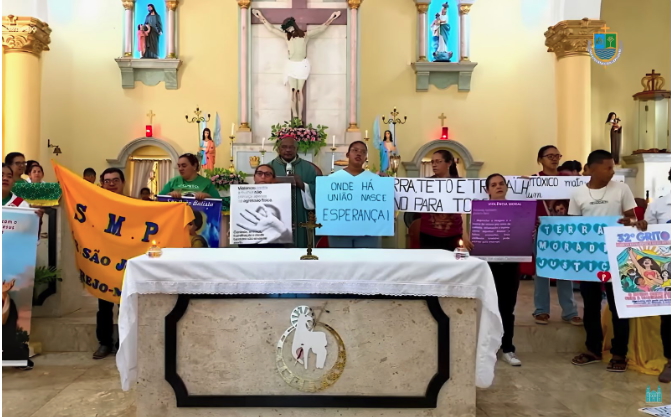
Indian Catholics denied bail after confronting mob that disrupted Mass #Catholic UDAIPUR, India — Nine Catholics have been behind bars for more than two weeks after parishioners chased out more than a dozen people who barged into a village church during Mass, shouting accusations of conversion, in a remote village in Indiaʼs desert state of Rajasthan.“We feel frustrated that our people were denied bail a second time today on the false allegation of conversion,” Bishop Devprasad John Ganawa of Udaipur, a Divine Word missionary, told EWTN News on May 12.“When the hooligans disrupted the Mass on May 1 shouting ‘conversion,’ our people forced them out. Instead of registering a criminal case against the intruders, the police have charged our people with ‘conversion and attempt to murder’ and arrested nine Catholics of Bandaria Parish,” Ganawa explained.‘They took out a knife’“I was saying the evening Mass at the substation of my parish at Kalinjara village when the incident happened,” Father Arvind Amliyar recounted to EWTN News.“During the Communion time over a dozen people stormed into the church, shouted ‘conversion,’ and started filming with cameras. When one of them took out a knife, our people snatched it and chased them out,” Amliyar said.“Soon police came and what happened then shocked me. Instead of finding out what had happened, they arrested four Catholics the same night,” the priest said.A Hindu mob then staged a protest outside the police station and demanded action against the parishioners, according to Amliyar. Police turned away Catholics who went to them twice, including at midnight the same day and the next day, refusing to register their complaint.Police came knocking on May 4 at 2:30 a.m. and arrested five more parishioners, including Anil Rawat, 70, a retired headmaster of a government school who now runs a private school in the village.Bail denied twiceThe local magistrate court rejected the parishioners' bail application the next day, as they were charged with “serious crimes”: conversion and attempted murder. Church lawyers then moved the case to the Banswara district court, which denied bail again on May 12.“Now, we have to go to the High Court with senior lawyers,” Amliyar said of the challenging situation facing the village church, which serves about 70 Catholic families. About 70 people were attending Mass when the intruders stormed in.“I cannot understand what is going on. The police bluntly refused to register the complaint of our people and have filed a serious charge of conversion against our people and imprisoned them,” Ganawa said of the first case of alleged conversion in Udaipur Diocese, where he has served as bishop for 13 years.Anti-conversion laws ‘reduced to a tool to harass minorities’“This is another typical case of the widespread abuse of anti-conversion laws against Christians in several states, most of them ruled by the BJP [Bharatiya Janata Party],” A.C. Michael, a Catholic and national coordinator of the United Christian Forum, which monitors atrocities against Christians, told EWTN News from New Delhi.Under the Indian criminal system, the burden of proof lies with the prosecution. However, under recently enacted or amended anti-conversion laws, Michael said, the burden of disproving the charge of conversion is shifted to the accused, making it difficult for defendants to secure bail from trial courts quickly, even in fraudulent cases.Under the Rajasthan Prohibition of Unlawful Conversion of Religion Act, enacted in 2025, the burden of disproving the allegation of conversion falls on the accused.As a result, Michael said, hundreds of Christians are languishing in jails in BJP-ruled states while protracted legal challenges drag on in higher courts.“The shocking reality is that there has been hardly any conviction in so-called conversion cases. That is why the churches and Christian groups have moved the Supreme Court for abolishing the anti-conversion laws that have been reduced to a tool to harass minorities,” Michael said.He noted that the Supreme Court in May 2024 observed that certain provisions in anti-conversion laws may be in violation of Article 25 of the Indian Constitution, which guarantees the right to freely profess, practice, and propagate oneʼs religion.The Feb. 4–10 biennial assembly of more than 200 bishops in India in Bangalore also reiterated this concern in its final statement: “As many innocent individuals are incarcerated based on unfounded allegations of forceful religious conversions, we strongly demand the repealing of legislations which are inconsistent with religious freedom and right to privacy.”

Indian Catholics denied bail after confronting mob that disrupted Mass #Catholic UDAIPUR, India — Nine Catholics have been behind bars for more than two weeks after parishioners chased out more than a dozen people who barged into a village church during Mass, shouting accusations of conversion, in a remote village in Indiaʼs desert state of Rajasthan.“We feel frustrated that our people were denied bail a second time today on the false allegation of conversion,” Bishop Devprasad John Ganawa of Udaipur, a Divine Word missionary, told EWTN News on May 12.“When the hooligans disrupted the Mass on May 1 shouting ‘conversion,’ our people forced them out. Instead of registering a criminal case against the intruders, the police have charged our people with ‘conversion and attempt to murder’ and arrested nine Catholics of Bandaria Parish,” Ganawa explained.‘They took out a knife’“I was saying the evening Mass at the substation of my parish at Kalinjara village when the incident happened,” Father Arvind Amliyar recounted to EWTN News.“During the Communion time over a dozen people stormed into the church, shouted ‘conversion,’ and started filming with cameras. When one of them took out a knife, our people snatched it and chased them out,” Amliyar said.“Soon police came and what happened then shocked me. Instead of finding out what had happened, they arrested four Catholics the same night,” the priest said.A Hindu mob then staged a protest outside the police station and demanded action against the parishioners, according to Amliyar. Police turned away Catholics who went to them twice, including at midnight the same day and the next day, refusing to register their complaint.Police came knocking on May 4 at 2:30 a.m. and arrested five more parishioners, including Anil Rawat, 70, a retired headmaster of a government school who now runs a private school in the village.Bail denied twiceThe local magistrate court rejected the parishioners' bail application the next day, as they were charged with “serious crimes”: conversion and attempted murder. Church lawyers then moved the case to the Banswara district court, which denied bail again on May 12.“Now, we have to go to the High Court with senior lawyers,” Amliyar said of the challenging situation facing the village church, which serves about 70 Catholic families. About 70 people were attending Mass when the intruders stormed in.“I cannot understand what is going on. The police bluntly refused to register the complaint of our people and have filed a serious charge of conversion against our people and imprisoned them,” Ganawa said of the first case of alleged conversion in Udaipur Diocese, where he has served as bishop for 13 years.Anti-conversion laws ‘reduced to a tool to harass minorities’“This is another typical case of the widespread abuse of anti-conversion laws against Christians in several states, most of them ruled by the BJP [Bharatiya Janata Party],” A.C. Michael, a Catholic and national coordinator of the United Christian Forum, which monitors atrocities against Christians, told EWTN News from New Delhi.Under the Indian criminal system, the burden of proof lies with the prosecution. However, under recently enacted or amended anti-conversion laws, Michael said, the burden of disproving the charge of conversion is shifted to the accused, making it difficult for defendants to secure bail from trial courts quickly, even in fraudulent cases.Under the Rajasthan Prohibition of Unlawful Conversion of Religion Act, enacted in 2025, the burden of disproving the allegation of conversion falls on the accused.As a result, Michael said, hundreds of Christians are languishing in jails in BJP-ruled states while protracted legal challenges drag on in higher courts.“The shocking reality is that there has been hardly any conviction in so-called conversion cases. That is why the churches and Christian groups have moved the Supreme Court for abolishing the anti-conversion laws that have been reduced to a tool to harass minorities,” Michael said.He noted that the Supreme Court in May 2024 observed that certain provisions in anti-conversion laws may be in violation of Article 25 of the Indian Constitution, which guarantees the right to freely profess, practice, and propagate oneʼs religion.The Feb. 4–10 biennial assembly of more than 200 bishops in India in Bangalore also reiterated this concern in its final statement: “As many innocent individuals are incarcerated based on unfounded allegations of forceful religious conversions, we strongly demand the repealing of legislations which are inconsistent with religious freedom and right to privacy.”

Nine parishioners face conversion and attempted murder charges after forcing out intruders who stormed a village church during Mass in Rajasthan.

Read More
From Budapest to Princeton, Catholic scholars mobilize to reconnect faith and political life #Catholic Catholic political and social thought, one of the foundational intellectual traditions of Western civilization, is poised for renewal as a new international initiative seeks to bring it back into conversation with new generations and decision-makers of tomorrow.CatholicPOST, the Association for the Renewal of Catholic Political and Social Thought, was born from the conviction — shared by a group of European scholars during the COVID-19 lockdowns — that the health crisis had exposed not only the fragility of modern Western societies but also a deeper anthropological confusion threatening their social foundations.That vision took concrete form at the inaugural conference of the association, titled “The Renaissance of Catholic Social Teaching,” held March 9–10 at the Ludovika University of Public Service in Budapest and attended by international academics and Vatican and Hungarian Catholic Church officials.“COVID was a tragic moment in contemporary history, and it required thinking back again on the basics of social life,” Professor Ferenc Hörcher — a Hungarian professor of political philosophy, historian of ideas, and the association’s president — told EWTN News. “And that is something you can do best on the grounds of the Catholic tradition, pointing back to Aristotle and forward to the social teaching of the Church.”For Hörcher — also director of the Research Institute for Politics and Government at Ludovika — the timing has only gained relevance with the election of Pope Leo XIV, whose choice of name evokes Pope Leo XIII, author of the landmark 1891 encyclical Rerum Novarum, widely regarded as the founding text of modern Catholic social teaching.Neglected intellectual inheritanceOne of CatholicPOST’s most urgent tasks is to restore Catholic social doctrine to its rightful place in intellectual life and academic discussion — a place it has progressively lost over the past century.Secularization, according to the association’s founders, has pushed Catholic intellectual traditions to the margins of public discourse. Even conservative academic circles, in their view, have often drawn more from Anglo-Saxon traditions with Protestant roots than from Catholic social thought.“Catholicism finds itself in the second row,” Hörcher said, “despite the fact that our modern and postmodern civilization is essentially built on it.”The association presents itself as a scholarly, nonpartisan platform, open not only to Catholics but also to thinkers willing to engage seriously with the tradition.“The Church cannot enter directly into political debate — that is not its mission,” Hörcher said. “But we, as Catholic intellectuals and practitioners in our own professions, can take that on.”Deeper stakesThe initiative of the group, consisting of, among others, American, Swedish, Maltese, and Hungarian scholars, emerges at a moment of mounting polarization across Western societies, as clashes over gender identity, family, bioethics, and the very understanding of the human person grow increasingly confrontational — and, at times, violent.For Hörcher, this is precisely why a recovery of serious Catholic political and social thought matters. CatholicPOST, he said, aims to reconnect contemporary debates with an intellectual tradition capable of addressing questions of philosophical anthropology that go far beyond basic politics.That ambition also helps explain the caliber of thinkers already orbiting the initiative, from French political philosopher Pierre Manent, a leading contemporary thinker on natural law and the moral foundations of political life, to scholars at the University of Notre Dame, home to the natural law tradition developed by John Finnis, and Princeton’s James Madison Program, led by natural law theorist Robert George — a circle Hörcher is set to join for a year as a visiting scholar to Princeton’s Department of Politics.The initiative has also attracted attention in Rome. In his keynote speech at the Budapest conference, Father Avelino Chico, head of office at the Dicastery for Promoting Integral Human Development, presented Catholic social teaching as a living intellectual tradition still evolving in response to the “new things” of each age — from industrial modernity in the time of Rerum Novarum to contemporary social challenges such as artificial intelligence, migration, ecological crisis, and widening inequality.Chico portrayed Pope Leo XIV as continuing that trajectory, seeking to integrate the legacy of Leo XIII and Pope Francis through the lens of integral human development — an approach that takes seriously not only economic realities but also the spiritual, cultural, and political dimensions of human life.Supporting new generationsThe association is already planning a second conference in Kraków, a deliberate choice honoring Poland’s enduring Catholic intellectual tradition and the legacy of St. John Paul II.Registration in the U.S. is also underway, as CatholicPOST has roots in American educational institutions like Christendom College, as a result of its aim to strengthen its international footprint and deepen transatlantic academic ties.For Hörcher, however, the deeper hope is not merely institutional growth but helping provide intellectual substance to what he sees as a broader spiritual movement among younger Westerners rediscovering Christianity. “We hope to give munition,” he said, “intellectual support for those young people.”He sees CatholicPOST as part of a recurring pattern in Catholic history. “Each century brought a revival of Catholic political thought,” he said, citing the neo-scholastic revival of 16th- to 17th-century Spain, the Holy Alliance of the post-Napoleonic Age, the social teaching inaugurated by Leo XIII, and the contribution of Catholic thinkers such as Jacques Maritain to the postwar rise of the human rights framework.“These historical precedents help us envision what a new renaissance might look like — and why it is needed now."

From Budapest to Princeton, Catholic scholars mobilize to reconnect faith and political life #Catholic Catholic political and social thought, one of the foundational intellectual traditions of Western civilization, is poised for renewal as a new international initiative seeks to bring it back into conversation with new generations and decision-makers of tomorrow.CatholicPOST, the Association for the Renewal of Catholic Political and Social Thought, was born from the conviction — shared by a group of European scholars during the COVID-19 lockdowns — that the health crisis had exposed not only the fragility of modern Western societies but also a deeper anthropological confusion threatening their social foundations.That vision took concrete form at the inaugural conference of the association, titled “The Renaissance of Catholic Social Teaching,” held March 9–10 at the Ludovika University of Public Service in Budapest and attended by international academics and Vatican and Hungarian Catholic Church officials.“COVID was a tragic moment in contemporary history, and it required thinking back again on the basics of social life,” Professor Ferenc Hörcher — a Hungarian professor of political philosophy, historian of ideas, and the association’s president — told EWTN News. “And that is something you can do best on the grounds of the Catholic tradition, pointing back to Aristotle and forward to the social teaching of the Church.”For Hörcher — also director of the Research Institute for Politics and Government at Ludovika — the timing has only gained relevance with the election of Pope Leo XIV, whose choice of name evokes Pope Leo XIII, author of the landmark 1891 encyclical Rerum Novarum, widely regarded as the founding text of modern Catholic social teaching.Neglected intellectual inheritanceOne of CatholicPOST’s most urgent tasks is to restore Catholic social doctrine to its rightful place in intellectual life and academic discussion — a place it has progressively lost over the past century.Secularization, according to the association’s founders, has pushed Catholic intellectual traditions to the margins of public discourse. Even conservative academic circles, in their view, have often drawn more from Anglo-Saxon traditions with Protestant roots than from Catholic social thought.“Catholicism finds itself in the second row,” Hörcher said, “despite the fact that our modern and postmodern civilization is essentially built on it.”The association presents itself as a scholarly, nonpartisan platform, open not only to Catholics but also to thinkers willing to engage seriously with the tradition.“The Church cannot enter directly into political debate — that is not its mission,” Hörcher said. “But we, as Catholic intellectuals and practitioners in our own professions, can take that on.”Deeper stakesThe initiative of the group, consisting of, among others, American, Swedish, Maltese, and Hungarian scholars, emerges at a moment of mounting polarization across Western societies, as clashes over gender identity, family, bioethics, and the very understanding of the human person grow increasingly confrontational — and, at times, violent.For Hörcher, this is precisely why a recovery of serious Catholic political and social thought matters. CatholicPOST, he said, aims to reconnect contemporary debates with an intellectual tradition capable of addressing questions of philosophical anthropology that go far beyond basic politics.That ambition also helps explain the caliber of thinkers already orbiting the initiative, from French political philosopher Pierre Manent, a leading contemporary thinker on natural law and the moral foundations of political life, to scholars at the University of Notre Dame, home to the natural law tradition developed by John Finnis, and Princeton’s James Madison Program, led by natural law theorist Robert George — a circle Hörcher is set to join for a year as a visiting scholar to Princeton’s Department of Politics.The initiative has also attracted attention in Rome. In his keynote speech at the Budapest conference, Father Avelino Chico, head of office at the Dicastery for Promoting Integral Human Development, presented Catholic social teaching as a living intellectual tradition still evolving in response to the “new things” of each age — from industrial modernity in the time of Rerum Novarum to contemporary social challenges such as artificial intelligence, migration, ecological crisis, and widening inequality.Chico portrayed Pope Leo XIV as continuing that trajectory, seeking to integrate the legacy of Leo XIII and Pope Francis through the lens of integral human development — an approach that takes seriously not only economic realities but also the spiritual, cultural, and political dimensions of human life.Supporting new generationsThe association is already planning a second conference in Kraków, a deliberate choice honoring Poland’s enduring Catholic intellectual tradition and the legacy of St. John Paul II.Registration in the U.S. is also underway, as CatholicPOST has roots in American educational institutions like Christendom College, as a result of its aim to strengthen its international footprint and deepen transatlantic academic ties.For Hörcher, however, the deeper hope is not merely institutional growth but helping provide intellectual substance to what he sees as a broader spiritual movement among younger Westerners rediscovering Christianity. “We hope to give munition,” he said, “intellectual support for those young people.”He sees CatholicPOST as part of a recurring pattern in Catholic history. “Each century brought a revival of Catholic political thought,” he said, citing the neo-scholastic revival of 16th- to 17th-century Spain, the Holy Alliance of the post-Napoleonic Age, the social teaching inaugurated by Leo XIII, and the contribution of Catholic thinkers such as Jacques Maritain to the postwar rise of the human rights framework.“These historical precedents help us envision what a new renaissance might look like — and why it is needed now."

CatholicPOST seeks to restore Catholic social doctrine to its rightful place in intellectual life and academic discussion.

Read More
Pope Leo XIV: AI communication must preserve ‘human voices and faces’ #Catholic VATICAN CITY — Pope Leo XIV on Sunday urged Catholics and communicators to promote forms of communication that respect the truth of the human person in the age of artificial intelligence, while also calling for renewed care for creation and peace as Laudato Si’ Week begins.Speaking after praying the Regina Caeli May 17 from the window of the Apostolic Palace, the pope noted that many countries were marking World Communications Day, whose theme this year, he said, is “Preserving Human Voices and Faces.”“In this era of artificial intelligence, I encourage everyone to commit themselves to promoting forms of communication that always respect the truth of the human person, on which every technological innovation should be focused,” Pope Leo XIV said.The appeal comes as the Vatican is preparing for the pope’s first encyclical, expected to treat extensively the ethical and social questions raised by artificial intelligence through the lens of Catholic social teaching.The pope also marked the start of Laudato Si’ Week, which runs through next Sunday and is dedicated to the care of creation, inspired by Pope Francis’ 2015 encyclical.“In this jubilee year of Saint Francis of Assisi, we recall his message of peace with God, with our brothers and sisters, and with all creatures,” he said. “Sadly, in recent years, due to wars, progress in this direction has been greatly impeded.”Pope Leo encouraged the members of the Laudato Si’ Movement and all those who promote an “integral ecology” to renew their commitment, adding: “Indeed, caring for peace is caring for life!”In his catechesis before the Marian prayer, the pope reflected on the Solemnity of the Ascension of the Lord, celebrated Sunday in many countries.The image of Jesus “lifted up from the earth and ascending toward heaven,” he said, may make the mystery seem like “a distant event from long ago.”“Yet this is not so, for we are united to Jesus as the members of one body united to the head,” Pope Leo said. “By ascending into heaven, then, he draws us with him toward full communion with the Father.”Quoting St. Augustine, the pope said that “the head’s advance is the hope of the members.”Christ’s whole life, he continued, is “a movement of ascent,” through which he embraces the world, redeems humanity from sin, and brings “light, forgiveness and hope where previously there was darkness, injustice and desperation.”“The Ascension, therefore, does not speak to us of a distant promise, but of a living bond, which draws us also toward heavenly glory, already elevating and expanding our horizon in this life and directing our way of thinking, feeling and acting more closely to the measure of God’s heart,” he said.The pope said this path of ascent is found in Christ’s life, example, and teaching, and is also marked out by the Blessed Virgin Mary and the saints.He also recalled Pope Francis’ teaching on the saints “next door” — ordinary fathers, mothers, grandparents, and people of every age and condition who “with joy and commitment, make the effort to live sincerely according to the Gospel.”“With them, with their support and thanks to their prayer, we too can learn to ascend day by day toward heaven,” Pope Leo said.The pope urged Christians, with God’s help, to put into practice all that they have “heard and seen,” so that the divine life received in baptism may grow and “spread the precious fruits of communion and peace in the world.”“May Mary, the Queen of Heaven, who illuminates and guides us in every moment, support us on our path,” he said.At the end of the Regina Caeli, the pope greeted pilgrims from Rome and abroad, including marching bands from Germany, the “Sant’Antonu di u Monti” Confraternity from Ajaccio, students from the University of Montana, young people from Oppido Mamertina, youth leaders from Lorenzaga in the Diocese of Concordia-Pordenone, and confirmation candidates from the Archdiocese of Genoa.This story was first published in two parts by ACI Prensa, the Spanish-language sister service of EWTN News. It has been translated and adapted by EWTN News English.

Pope Leo XIV: AI communication must preserve ‘human voices and faces’ #Catholic VATICAN CITY — Pope Leo XIV on Sunday urged Catholics and communicators to promote forms of communication that respect the truth of the human person in the age of artificial intelligence, while also calling for renewed care for creation and peace as Laudato Si’ Week begins.Speaking after praying the Regina Caeli May 17 from the window of the Apostolic Palace, the pope noted that many countries were marking World Communications Day, whose theme this year, he said, is “Preserving Human Voices and Faces.”“In this era of artificial intelligence, I encourage everyone to commit themselves to promoting forms of communication that always respect the truth of the human person, on which every technological innovation should be focused,” Pope Leo XIV said.The appeal comes as the Vatican is preparing for the pope’s first encyclical, expected to treat extensively the ethical and social questions raised by artificial intelligence through the lens of Catholic social teaching.The pope also marked the start of Laudato Si’ Week, which runs through next Sunday and is dedicated to the care of creation, inspired by Pope Francis’ 2015 encyclical.“In this jubilee year of Saint Francis of Assisi, we recall his message of peace with God, with our brothers and sisters, and with all creatures,” he said. “Sadly, in recent years, due to wars, progress in this direction has been greatly impeded.”Pope Leo encouraged the members of the Laudato Si’ Movement and all those who promote an “integral ecology” to renew their commitment, adding: “Indeed, caring for peace is caring for life!”In his catechesis before the Marian prayer, the pope reflected on the Solemnity of the Ascension of the Lord, celebrated Sunday in many countries.The image of Jesus “lifted up from the earth and ascending toward heaven,” he said, may make the mystery seem like “a distant event from long ago.”“Yet this is not so, for we are united to Jesus as the members of one body united to the head,” Pope Leo said. “By ascending into heaven, then, he draws us with him toward full communion with the Father.”Quoting St. Augustine, the pope said that “the head’s advance is the hope of the members.”Christ’s whole life, he continued, is “a movement of ascent,” through which he embraces the world, redeems humanity from sin, and brings “light, forgiveness and hope where previously there was darkness, injustice and desperation.”“The Ascension, therefore, does not speak to us of a distant promise, but of a living bond, which draws us also toward heavenly glory, already elevating and expanding our horizon in this life and directing our way of thinking, feeling and acting more closely to the measure of God’s heart,” he said.The pope said this path of ascent is found in Christ’s life, example, and teaching, and is also marked out by the Blessed Virgin Mary and the saints.He also recalled Pope Francis’ teaching on the saints “next door” — ordinary fathers, mothers, grandparents, and people of every age and condition who “with joy and commitment, make the effort to live sincerely according to the Gospel.”“With them, with their support and thanks to their prayer, we too can learn to ascend day by day toward heaven,” Pope Leo said.The pope urged Christians, with God’s help, to put into practice all that they have “heard and seen,” so that the divine life received in baptism may grow and “spread the precious fruits of communion and peace in the world.”“May Mary, the Queen of Heaven, who illuminates and guides us in every moment, support us on our path,” he said.At the end of the Regina Caeli, the pope greeted pilgrims from Rome and abroad, including marching bands from Germany, the “Sant’Antonu di u Monti” Confraternity from Ajaccio, students from the University of Montana, young people from Oppido Mamertina, youth leaders from Lorenzaga in the Diocese of Concordia-Pordenone, and confirmation candidates from the Archdiocese of Genoa.This story was first published in two parts by ACI Prensa, the Spanish-language sister service of EWTN News. It has been translated and adapted by EWTN News English.

The pontiff marked World Communications Day by urging technology to remain centered on human dignity.

Read More
Centennial honors historic Michigan church built amid KKK threats and strikes #Catholic A richly diverse Catholic community in southern Michigan is preparing to mark a milestone: the centennial of St. Mary Star of the Sea in Jackson, where the beauty of sacred space, reverent liturgy, and a vibrant musical tradition continue to shape the lives of the faithful. The church has thrived through historic events and turbulent times, even as it was being rebuilt. In 1924, one of the largest Ku Klux Klan (KKK) rallies ever recorded saw 100,000 participants tramp through Jacksonʼs streets, and parish tradition holds that the Knights of Columbus kept vigil at the construction site to protect it from KKK vandalism. 
 
 St. Mary Star of the Sea Parish in Jackson, Michigan. | Credit: Photo courtesy of Father Timothy Nelson
 
 As he prepares to wrap up his 15-year tenure as pastor of the parish, Father Timothy Nelson reflected on the churchʼs enduring vitality: “Our church is not a relic but a dynamic part of the present, enriched by a legacy of faith.”Located west of Detroit, Jackson has long been a railroad hub with ties to the automobile industry. St. Mary’s is one of three current parishes, following a consolidation of several others. Following decades of a strong Polish-American presence, demographic changes have included the growing influx of Hispanic families. Children of the latter now make up about a quarter of the enrollment at St. Mary School.St. Mary’s three spires dominate the skyline, reaching up 180 feet in an imposing Romanesque style. Long regarded as one of the most beautiful churches in Michigan, it features magnificent stained-glass windows fashioned in Innsbruck, Austria, an apse mosaic of Our Lady Star of the Sea, murals of the apostles, and Carrara marble altars and Communion rail. The latter embellishments were donated by George Washington Hill, president of the American Tobacco Co., as a memorial to his young wife, Aquinas Heiler Hill, who died in 1925. The green and red colors in the mosaics around the high altar repeat the original colors used on packs of Lucky Strike cigarettes.
 
 A mosaic of the Crucifixion at St. Mary Star of the Sea Parish in Jackson, Michigan. | Credit: Photo courtesy of Father Timothy Nelson
 
 The present structure replaced an earlier church, with its cornerstone laid on Sept. 23, 1923. Construction faced delays because of a prolonged labor strike at limestone quarries. The era was also marred with social unrest, including the Ku Klux Klan and its virulent anti-Catholicism and racism. Construction was not completed until May 31, 1926, at a cost of 5,000. Then-Auxiliary Bishop Joseph C. Plagens came from Detroit to officiate the dedicatory Mass.Among its treasures is a unique stained-glass rose window memorializing the fallen of the first world war, including nuns who tended the wounded. “The window shows not only the American soldiers and sailors of the war, but even their enemies who reach out to Jesus rising above them,” Nelson said as he gave a tour of the magnificent church. Restoration of the windows cost  million and was made possible through the generosity of parishioners and benefactors, including the Eisele Family Foundation. St. Mary’s is depicted in “Buildings of Michigan” by Kathryn Bishop Eckert as one of the most notable in the Mitten State.
 
 Stained-glass window at St. Mary Star of the Sea Parish in Jackson, Michigan. | Credit: Kathryn Mietelka
 
 Now 74, Nelson will step down as pastor this summer. A former cardiologist, he will continue his ministry as chaplain of the St. Pio Medical Center in nearby Howell, which is part of a Vatican-authorized healthcare network inspired by St. Pio of Pietrelcina (Padre Pio). He will be succeeded by Father John Vinton, who will continue offering Traditional Latin Masses and Spanish-language Masses.St. Mary’s serves about 1,086 families, including the active Sacred Heart of Jesus Hispanic Community.Nelson said: “The school is necessary for parish life” and is the most diverse parochial school in the area.The parish’s liturgical life shows both continuity and renewal. The Traditional Latin Mass, celebrated every Sunday, is accompanied by Gregorian chant and organ led by Aine Schroeder, a student at nearby Hillsdale College. Schroeder said the Gregorian schola will chant the “Ave Maria” and “Salve Regina” at the centennial concert. Dispelling concerns that the Latin liturgy is stuck in the past, Nelson said: “I agree with Pope Benedict XVI that the past continues to be lived in the present. We are bringing it into the future.”
 
 Inside St. Mary Star of the Sea Parish in Jackson, Michigan. | Credit: Photo courtesy of Father Timothy Nelson
 
 For longtime parishioner Mary Belknap, a fourth-generation member who serves on the parish guild, St. Mary’s is a spiritual home and a place of encounter. “It’s one of the hallmark parishes in the state. People come from all over to see us and our beautiful church,” she said. Bridging the gaps between communities came easily to educator Belknap, who said that, having been raised in poverty as a child, she has experienced life on the margins, and “I personally reach out to embrace the goodness of other people.”The parishʼs centennial observance will commence with a concert on May 29 and culminate in a solemn Mass on May 31 — exactly 100 years after its first Mass — to be celebrated by Bishop Earl Boyea. Mary Malewitz, parish music director since 1981, is organizing the opening concert, which will feature adult and school choirs, a Hispanic choir, and a Gregorian schola. Between each performance, parishioners will sing their favorite hymns. “St. Mary’s has brought glory to Michigan for generations,” she told EWTN News.

Centennial honors historic Michigan church built amid KKK threats and strikes #Catholic A richly diverse Catholic community in southern Michigan is preparing to mark a milestone: the centennial of St. Mary Star of the Sea in Jackson, where the beauty of sacred space, reverent liturgy, and a vibrant musical tradition continue to shape the lives of the faithful. The church has thrived through historic events and turbulent times, even as it was being rebuilt. In 1924, one of the largest Ku Klux Klan (KKK) rallies ever recorded saw 100,000 participants tramp through Jacksonʼs streets, and parish tradition holds that the Knights of Columbus kept vigil at the construction site to protect it from KKK vandalism. St. Mary Star of the Sea Parish in Jackson, Michigan. | Credit: Photo courtesy of Father Timothy Nelson As he prepares to wrap up his 15-year tenure as pastor of the parish, Father Timothy Nelson reflected on the churchʼs enduring vitality: “Our church is not a relic but a dynamic part of the present, enriched by a legacy of faith.”Located west of Detroit, Jackson has long been a railroad hub with ties to the automobile industry. St. Mary’s is one of three current parishes, following a consolidation of several others. Following decades of a strong Polish-American presence, demographic changes have included the growing influx of Hispanic families. Children of the latter now make up about a quarter of the enrollment at St. Mary School.St. Mary’s three spires dominate the skyline, reaching up 180 feet in an imposing Romanesque style. Long regarded as one of the most beautiful churches in Michigan, it features magnificent stained-glass windows fashioned in Innsbruck, Austria, an apse mosaic of Our Lady Star of the Sea, murals of the apostles, and Carrara marble altars and Communion rail. The latter embellishments were donated by George Washington Hill, president of the American Tobacco Co., as a memorial to his young wife, Aquinas Heiler Hill, who died in 1925. The green and red colors in the mosaics around the high altar repeat the original colors used on packs of Lucky Strike cigarettes. A mosaic of the Crucifixion at St. Mary Star of the Sea Parish in Jackson, Michigan. | Credit: Photo courtesy of Father Timothy Nelson The present structure replaced an earlier church, with its cornerstone laid on Sept. 23, 1923. Construction faced delays because of a prolonged labor strike at limestone quarries. The era was also marred with social unrest, including the Ku Klux Klan and its virulent anti-Catholicism and racism. Construction was not completed until May 31, 1926, at a cost of $375,000. Then-Auxiliary Bishop Joseph C. Plagens came from Detroit to officiate the dedicatory Mass.Among its treasures is a unique stained-glass rose window memorializing the fallen of the first world war, including nuns who tended the wounded. “The window shows not only the American soldiers and sailors of the war, but even their enemies who reach out to Jesus rising above them,” Nelson said as he gave a tour of the magnificent church. Restoration of the windows cost $1 million and was made possible through the generosity of parishioners and benefactors, including the Eisele Family Foundation. St. Mary’s is depicted in “Buildings of Michigan” by Kathryn Bishop Eckert as one of the most notable in the Mitten State. Stained-glass window at St. Mary Star of the Sea Parish in Jackson, Michigan. | Credit: Kathryn Mietelka Now 74, Nelson will step down as pastor this summer. A former cardiologist, he will continue his ministry as chaplain of the St. Pio Medical Center in nearby Howell, which is part of a Vatican-authorized healthcare network inspired by St. Pio of Pietrelcina (Padre Pio). He will be succeeded by Father John Vinton, who will continue offering Traditional Latin Masses and Spanish-language Masses.St. Mary’s serves about 1,086 families, including the active Sacred Heart of Jesus Hispanic Community.Nelson said: “The school is necessary for parish life” and is the most diverse parochial school in the area.The parish’s liturgical life shows both continuity and renewal. The Traditional Latin Mass, celebrated every Sunday, is accompanied by Gregorian chant and organ led by Aine Schroeder, a student at nearby Hillsdale College. Schroeder said the Gregorian schola will chant the “Ave Maria” and “Salve Regina” at the centennial concert. Dispelling concerns that the Latin liturgy is stuck in the past, Nelson said: “I agree with Pope Benedict XVI that the past continues to be lived in the present. We are bringing it into the future.” Inside St. Mary Star of the Sea Parish in Jackson, Michigan. | Credit: Photo courtesy of Father Timothy Nelson For longtime parishioner Mary Belknap, a fourth-generation member who serves on the parish guild, St. Mary’s is a spiritual home and a place of encounter. “It’s one of the hallmark parishes in the state. People come from all over to see us and our beautiful church,” she said. Bridging the gaps between communities came easily to educator Belknap, who said that, having been raised in poverty as a child, she has experienced life on the margins, and “I personally reach out to embrace the goodness of other people.”The parishʼs centennial observance will commence with a concert on May 29 and culminate in a solemn Mass on May 31 — exactly 100 years after its first Mass — to be celebrated by Bishop Earl Boyea. Mary Malewitz, parish music director since 1981, is organizing the opening concert, which will feature adult and school choirs, a Hispanic choir, and a Gregorian schola. Between each performance, parishioners will sing their favorite hymns. “St. Mary’s has brought glory to Michigan for generations,” she told EWTN News.

Founded amid hardship and change, the centennial of St. Mary Star of the Sea in Jackson, Michigan, brings together generations to honor a diverse parish that continues to thrive.

Read More
Newman Guide schools honor Catholic leaders at 2026 commencements #Catholic Here are some of the distinguished individuals receiving honorary degrees at many of the Catholic institutions the Cardinal Newman Society recommends for their commitment to a faithful Catholic education. The Catholic University of AmericaThe Catholic University of America (CUA) will confer honorary degrees on three “notable individuals” at its May 16 commencement ceremony, including Lisa Brenninkmeyer, Dr. John Bruchalski, and Iqbal Z. Quadir.Brenninkmeyer is the founder and CEO of Walking with Purpose, a Catholic Bible study group for women and girls, while Bruchalski is the founder of Tepeyac OB-GYN and Quadir is a distinguished fellow at the CUA’s Busch School of Business “who has pioneered technology-based and for-profit entrepreneurship for the economic empowerment of low-income people,” according to a press release from the university.Monsignor James Patrick Shea, president of the University of Mary, will serve as commencement speaker.Thomas More College of Liberal ArtsThomas More College of Liberal Arts in New Hampshire will award former Wyoming Catholic College President Glenn Arbery, PhD, and his wife, Virginia, with honorary doctorates at its commencement ceremony May 16.“Thomas More College is glad to have old friends and teachers — Glenn and Virginia Arbery — returning,” Thomas More College President William Fahey said. “A community is healthy when it remembers and honors important moments and people of its history. The Arberys are well known and influential teachers and scholars at several institutions of higher learning, but our college was profoundly shaped and ennobled by their learning and generous hearts. We are glad to have them return for this most solemn and joyful of occasions.”University of MaryCatholic businessman and lawyer Timothy Busch received an honorary degree from the University of Mary in Bismarck, North Dakota, in addition to delivering the commencement address during the university’s April 25 commencement.The university also honored Dan Butler, chairman of the board of trustees at the University of Mary, as well as his wife, Heather Butler, who co-chaired the university’s 2030 Capital Campaign with U.S. Sen. Kevin Cramer, R-North Dakota, raising over 0 million for the university’s advancement, according to the university.Franciscan University of SteubenvilleBusch also served as commencement speaker for graduates of science and professional programs at Franciscan University in Steubenville, Ohio, and received an honorary doctorate in humane letters during its May 9 commencement.Busch’s NAPA Institute co-founder, Father Robert Spitzer, SJ, also delivered a commencement address for graduates from the arts, humanities, and social scientists at the university. Spitzer received an honorary doctorate in catechetics and evangelization.University of DallasIn addition to delivering the school’s commencement address, Cardinal Timothy Dolan, archbishop emeritus of New York, will receive an honorary degree of doctor of humane letters from the University of Dallas.“Cardinal Dolan is one of the Church’s most joyful and widely respected shepherds, and we are honored to welcome him to the University of Dallas,” said President Jonathan J. Sanford said in a press release. The university’s commencement ceremony will take place May 16.Benedictine CollegePeter Cancro, the founder and chairman of the popular sandwich chain Jersey Mike’s, will receive an honorary doctor of humane letters at Benedictine College’s May 16 commencement.Cancro, who is renowned for his charitable contributions to faith-based organizations, including a  million gift to Ave Maria School of Law, will also deliver the commencement address.Ave Maria UniversityFlorida Gov. Ron DeSantis received an honorary degree from Ave Maria University during its May 9 commencement ceremony. “The faith does not depend on what is fashionable or who holds power. It is, in fact, the truth that ultimately will set you free,” DeSantis said during his speech, urging Ave Maria’s class of 2026 to put on “the full armor of God” as they go out into the world.Walsh UniversityEWTN “Real Life Catholic” host Chris Stefanick received an honorary doctorate of applied theology at Walsh University’s May 2 commencement ceremonies.“Your formation as men and women of character is the primary end of Catholic education,” Stefanik told graduates during his speech at the Ohio Catholic school. “The secondary end is the formation of useful citizens. Your greatest achievement will forever be marked not by what you do, but by what you do for others.” Walsh University also conferred an honorary doctorate of applied engineering upon Michael White, former principal director for hypersonics in the Office of the Under Secretary of Defense for Research and Engineering.

Newman Guide schools honor Catholic leaders at 2026 commencements #Catholic Here are some of the distinguished individuals receiving honorary degrees at many of the Catholic institutions the Cardinal Newman Society recommends for their commitment to a faithful Catholic education. The Catholic University of AmericaThe Catholic University of America (CUA) will confer honorary degrees on three “notable individuals” at its May 16 commencement ceremony, including Lisa Brenninkmeyer, Dr. John Bruchalski, and Iqbal Z. Quadir.Brenninkmeyer is the founder and CEO of Walking with Purpose, a Catholic Bible study group for women and girls, while Bruchalski is the founder of Tepeyac OB-GYN and Quadir is a distinguished fellow at the CUA’s Busch School of Business “who has pioneered technology-based and for-profit entrepreneurship for the economic empowerment of low-income people,” according to a press release from the university.Monsignor James Patrick Shea, president of the University of Mary, will serve as commencement speaker.Thomas More College of Liberal ArtsThomas More College of Liberal Arts in New Hampshire will award former Wyoming Catholic College President Glenn Arbery, PhD, and his wife, Virginia, with honorary doctorates at its commencement ceremony May 16.“Thomas More College is glad to have old friends and teachers — Glenn and Virginia Arbery — returning,” Thomas More College President William Fahey said. “A community is healthy when it remembers and honors important moments and people of its history. The Arberys are well known and influential teachers and scholars at several institutions of higher learning, but our college was profoundly shaped and ennobled by their learning and generous hearts. We are glad to have them return for this most solemn and joyful of occasions.”University of MaryCatholic businessman and lawyer Timothy Busch received an honorary degree from the University of Mary in Bismarck, North Dakota, in addition to delivering the commencement address during the university’s April 25 commencement.The university also honored Dan Butler, chairman of the board of trustees at the University of Mary, as well as his wife, Heather Butler, who co-chaired the university’s 2030 Capital Campaign with U.S. Sen. Kevin Cramer, R-North Dakota, raising over $100 million for the university’s advancement, according to the university.Franciscan University of SteubenvilleBusch also served as commencement speaker for graduates of science and professional programs at Franciscan University in Steubenville, Ohio, and received an honorary doctorate in humane letters during its May 9 commencement.Busch’s NAPA Institute co-founder, Father Robert Spitzer, SJ, also delivered a commencement address for graduates from the arts, humanities, and social scientists at the university. Spitzer received an honorary doctorate in catechetics and evangelization.University of DallasIn addition to delivering the school’s commencement address, Cardinal Timothy Dolan, archbishop emeritus of New York, will receive an honorary degree of doctor of humane letters from the University of Dallas.“Cardinal Dolan is one of the Church’s most joyful and widely respected shepherds, and we are honored to welcome him to the University of Dallas,” said President Jonathan J. Sanford said in a press release. The university’s commencement ceremony will take place May 16.Benedictine CollegePeter Cancro, the founder and chairman of the popular sandwich chain Jersey Mike’s, will receive an honorary doctor of humane letters at Benedictine College’s May 16 commencement.Cancro, who is renowned for his charitable contributions to faith-based organizations, including a $5 million gift to Ave Maria School of Law, will also deliver the commencement address.Ave Maria UniversityFlorida Gov. Ron DeSantis received an honorary degree from Ave Maria University during its May 9 commencement ceremony. “The faith does not depend on what is fashionable or who holds power. It is, in fact, the truth that ultimately will set you free,” DeSantis said during his speech, urging Ave Maria’s class of 2026 to put on “the full armor of God” as they go out into the world.Walsh UniversityEWTN “Real Life Catholic” host Chris Stefanick received an honorary doctorate of applied theology at Walsh University’s May 2 commencement ceremonies.“Your formation as men and women of character is the primary end of Catholic education,” Stefanik told graduates during his speech at the Ohio Catholic school. “The secondary end is the formation of useful citizens. Your greatest achievement will forever be marked not by what you do, but by what you do for others.” Walsh University also conferred an honorary doctorate of applied engineering upon Michael White, former principal director for hypersonics in the Office of the Under Secretary of Defense for Research and Engineering.

With graduation season underway, here is a roundup of individuals who will receive honorary degrees from Catholic colleges at commencement ceremonies across the country.

Read More
Catholic film star becomes first Christian chief minister of major Indian state #Catholic CHENNAI, India — The Catholic Church in the Indian state of Tamil Nadu is celebrating after Joseph Vijay, an actor-turned-politician raised in the Catholic faith, was sworn in as the stateʼs chief minister on May 10.“This is a historic development. We hope it will lead to positive changes as the chief minister has already promised,” Archbishop George Antonysamy of Madras and Mylapore told EWTN News on May 13.Vijayʼs new political party, Tamilaga Vettri Kazhagam (TVK), which translates to Victory Party of Tamil Nadu, was founded in 2024. In its electoral debut, the party stunned the Dravidian parties that had held power for nearly six decades between them, winning 107 seats in the 234-member state assembly.Acknowledging the mandate, five smaller parties withdrew their support from the ousted DMK and opposition AIADMK coalitions to back TVK, pushing it past the 118-seat majority mark and prompting the state governor to invite Vijay to form the government on May 9.The Vijay government won a crucial vote of confidence on May 13 with 144 votes, with a section of the AIADMK also voting in his favor.‘I wonʼt touch public money’“I wonʼt touch public money,” Vijay declared soon after his swearing-in on May 10, promising a “corruption-free” administration. Within hours, the new chief minister signed three orders subsidizing electricity for the poor, establishing a task force for womenʼs safety, and setting up anti-narcotics units to curb the drug menace.Welcoming “the steps the CM has promised,” Antonysamy said, “We cannot judge a person in a few days. Everything will depend on the performance. Vijay himself is new to government administration, and his legislators too, as most of them hail from his fan base.”Catholic identity in the spotlight“We are really rejoicing that we have a Catholic chief minister,” Father Vincent Chinnadurai, spokesperson of the Tamil Nadu Catholic Bishops' Council, told EWTN News.“Vijay is known as a popular actor. But his Catholic background came into public attention after the Hindu nationalists tried to polarize the voters, saying that Vijay is a Christian with the first name Joseph,” explained Chinnadurai, who is also the rector of the Santhome Basilica in Chennai, adjacent to the archbishopʼs residence.The Santhome Basilica is built over the traditional site of the tomb of St. Thomas the Apostle, who according to tradition was martyred at Mylapore in present-day Chennai in A.D. 72. It is one of three basilicas in the world built over tombs traditionally associated with apostles, along with St. Peterʼs Basilica at the Vatican and the Cathedral of Santiago de Compostela in Spain.“The people here are very happy, as we are privileged to be the first big state in India to have a Catholic chief minister, and at a time when Christians are facing troubles in different parts of the country,” Chinnadurai added. He is a former chairman of the Minorities Commission of Tamil Nadu.With approximately 77 million people, Tamil Nadu is the seventh most populous of Indiaʼs 28 states.The archbishop also acknowledged that “Vijay is not known much as a Catholic. But during the election time, it came out in a big way.”Hindu nationalists and the ‘Joseph’ factorThe name “Joseph” stood out prominently on the large stage at the Nehru Indoor Stadium during the swearing-in ceremony, which was broadcast live by major national television channels.When Hindu nationalists tried to brand Vijay as a Christian in the run-up to the election held on April 19, Chinnadurai pointed out that “he did not back off.”Instead, Vijay publicized a Christmas program in which he made a speech linking himself to the Old Testament figure of Joseph, who looked after his brothers even after they had thrown him into a well, while he was the ruler of Egypt. In the speech, Vijay also asserted that “Tamil Nadu is a mother; all children are equal,” promising to care for all, including those who opposed him.In the state, where popular film actors have massive fan followings with organized clubs, The Hindu, a national daily based in Chennai, noted in its May 10 edition that although Vijay set up TVK only two years ago, the party was built on more than 80,000 fan clubs established from 2009 across the state, carrying out social work and social campaigns.Faithful throng Marian shrineThousands of Vijayʼs fans thronged the Marian shrine of Vailankanni, known as the Lourdes of the East, about 200 miles south of Chennai, from the night of May 1, expecting him to visit the shrine on the morning of May 2 in thanksgiving after voting.The fans waited through the night and loudly chanted “TVK, TVK” inside the church premises before church authorities asked them to calm down. Vijay canceled the visit after hearing about the commotion at the shrine.“Vijay is an alumnus of our college, and his mother used to come to our college for Mass regularly,” Professor Gladstone Xavier of Chennaiʼs Loyola College told EWTN News.With Vijayʼs Catholic identity now public, Xavier hopes that “Vijayʼs performance as the chief minister should make the community proud.”

Catholic film star becomes first Christian chief minister of major Indian state #Catholic CHENNAI, India — The Catholic Church in the Indian state of Tamil Nadu is celebrating after Joseph Vijay, an actor-turned-politician raised in the Catholic faith, was sworn in as the stateʼs chief minister on May 10.“This is a historic development. We hope it will lead to positive changes as the chief minister has already promised,” Archbishop George Antonysamy of Madras and Mylapore told EWTN News on May 13.Vijayʼs new political party, Tamilaga Vettri Kazhagam (TVK), which translates to Victory Party of Tamil Nadu, was founded in 2024. In its electoral debut, the party stunned the Dravidian parties that had held power for nearly six decades between them, winning 107 seats in the 234-member state assembly.Acknowledging the mandate, five smaller parties withdrew their support from the ousted DMK and opposition AIADMK coalitions to back TVK, pushing it past the 118-seat majority mark and prompting the state governor to invite Vijay to form the government on May 9.The Vijay government won a crucial vote of confidence on May 13 with 144 votes, with a section of the AIADMK also voting in his favor.‘I wonʼt touch public money’“I wonʼt touch public money,” Vijay declared soon after his swearing-in on May 10, promising a “corruption-free” administration. Within hours, the new chief minister signed three orders subsidizing electricity for the poor, establishing a task force for womenʼs safety, and setting up anti-narcotics units to curb the drug menace.Welcoming “the steps the CM has promised,” Antonysamy said, “We cannot judge a person in a few days. Everything will depend on the performance. Vijay himself is new to government administration, and his legislators too, as most of them hail from his fan base.”Catholic identity in the spotlight“We are really rejoicing that we have a Catholic chief minister,” Father Vincent Chinnadurai, spokesperson of the Tamil Nadu Catholic Bishops' Council, told EWTN News.“Vijay is known as a popular actor. But his Catholic background came into public attention after the Hindu nationalists tried to polarize the voters, saying that Vijay is a Christian with the first name Joseph,” explained Chinnadurai, who is also the rector of the Santhome Basilica in Chennai, adjacent to the archbishopʼs residence.The Santhome Basilica is built over the traditional site of the tomb of St. Thomas the Apostle, who according to tradition was martyred at Mylapore in present-day Chennai in A.D. 72. It is one of three basilicas in the world built over tombs traditionally associated with apostles, along with St. Peterʼs Basilica at the Vatican and the Cathedral of Santiago de Compostela in Spain.“The people here are very happy, as we are privileged to be the first big state in India to have a Catholic chief minister, and at a time when Christians are facing troubles in different parts of the country,” Chinnadurai added. He is a former chairman of the Minorities Commission of Tamil Nadu.With approximately 77 million people, Tamil Nadu is the seventh most populous of Indiaʼs 28 states.The archbishop also acknowledged that “Vijay is not known much as a Catholic. But during the election time, it came out in a big way.”Hindu nationalists and the ‘Joseph’ factorThe name “Joseph” stood out prominently on the large stage at the Nehru Indoor Stadium during the swearing-in ceremony, which was broadcast live by major national television channels.When Hindu nationalists tried to brand Vijay as a Christian in the run-up to the election held on April 19, Chinnadurai pointed out that “he did not back off.”Instead, Vijay publicized a Christmas program in which he made a speech linking himself to the Old Testament figure of Joseph, who looked after his brothers even after they had thrown him into a well, while he was the ruler of Egypt. In the speech, Vijay also asserted that “Tamil Nadu is a mother; all children are equal,” promising to care for all, including those who opposed him.In the state, where popular film actors have massive fan followings with organized clubs, The Hindu, a national daily based in Chennai, noted in its May 10 edition that although Vijay set up TVK only two years ago, the party was built on more than 80,000 fan clubs established from 2009 across the state, carrying out social work and social campaigns.Faithful throng Marian shrineThousands of Vijayʼs fans thronged the Marian shrine of Vailankanni, known as the Lourdes of the East, about 200 miles south of Chennai, from the night of May 1, expecting him to visit the shrine on the morning of May 2 in thanksgiving after voting.The fans waited through the night and loudly chanted “TVK, TVK” inside the church premises before church authorities asked them to calm down. Vijay canceled the visit after hearing about the commotion at the shrine.“Vijay is an alumnus of our college, and his mother used to come to our college for Mass regularly,” Professor Gladstone Xavier of Chennaiʼs Loyola College told EWTN News.With Vijayʼs Catholic identity now public, Xavier hopes that “Vijayʼs performance as the chief minister should make the community proud.”

Church leaders in the southern Indian state of Tamil Nadu call the election of actor-turned-politician Joseph Vijay a source of pride in a country where Christians face growing persecution.

Read More
German Catholic congress approves bondage group’s booth #Catholic An ecumenical working group promoting “consensual BDSM culture” will again exhibit at Germanyʼs Catholic Congress in Würzburg this week after organizers said its guidelines pose “no contradiction with the Catechism.”BDSM is an acronym that stands for “bondage and discipline, dominance and submission, sadism and masochism.”“The Ecumenical Working Group BDSM and Christianity has been represented on the Kirchenmeile at several Catholic Congresses now,” Cosima Jagow-Duda, head of press and marketing at the Catholic Congress, told CNA Deutsch, the German-language sister service of EWTN News, in response to an inquiry.“All organizations with an explicitly Christian reference have this right in principle, provided they are not unconstitutional or hostile to specific groups.” The groupʼs guidelines, she added, contain “no contradiction with the Catechism.”The working group was founded in 1999, according to its own website. It also exhibited at the previous Catholic Congress in Erfurt in 2024.Organized by the Central Committee of German Catholics (ZdK), the German Catholic Congress (Katholikentag) is a biennial gathering led by laypeople and representing the countryʼs main umbrella organization for lay Catholic associations. The 104th edition is taking place from May 13 to 17 in Würzburg under the motto “Have Courage, Stand Up!” Around 20,000 people are expected to attend the event, which features approximately 900 events across 50 venues.The approved booth is listed in the official program as stand number MW-R-07 on the Kirchenmeile — a German term meaning “Church Mile” — an exhibitor area where approximately 300 organizations present themselves to attendees.‘Out of the taboo corner’On its website, the working group describes itself as “Christians from various denominations who deal with eroticism and sexuality, particularly in the area of sadomasochistic sexual preferences.”Its published guidelines open with a “preamble on the relationship with God,” affirm belief in “the love and salvation through Jesus Christ,” and state that the group “accepts and lives the diverse and consensual BDSM culture.” The group has also said it wants to take the topic “out of the taboo corner.”Jagow-Duda told CNA Deutsch that applications for the Kirchenmeile “follow clear rules and guidelines” and that the organizers do not admit, for example, “right-wing extremist or anti-democratic groups.”The printed program book states, on page 58, that “a diversity of opinions that encourages and enriches discourse on the cohesion of society is expressly desired,” with limits “where discriminatory, racist, or antisemitic convictions are represented, expressions of group-related misanthropy, or an ideological distance from the free democratic constitutional order are to be expected.”“This concerns a booth where Christians are entering into conversation about their faith,” Jagow-Duda said.Other groups presenting on the Kirchenmeile whose positions stand in tension with Catholic teaching on sexuality include the Network of Catholic Lesbians, the LGBT initiative #OutInChurch, and the Ecumenical Working Group Homosexuals and Church.The official program also lists a “Queer worship service” on May 16 under the title “Life is colorful — diversity in the Church?!” and a Bible workshop titled “Reading the Bible queerly. Why G*D is a fan of diversity.”Pro-life panels rejected, association still presentThe eventʼs panel program, meanwhile, turned down three proposals on surrogacy, abortion, and end-of-life care from the countryʼs largest lay pro-life association, citing limited slots, even as the association maintains its own booth at the congress.The proposals were submitted by the Action for the Right to Life for All (ALfA) in cooperation with the Association of Catholic German Teachers (VkdL).The proposals' titles, according to the Catholic weekly Die Tagespost, were “Life Without a Child? Is Surrogacy the Solution on the Way to a Wished-For Child?”, “Taboo Topic Abortion — ‘I didnʼt want to abort, I had to,’” and “My Death and My Dignity — Autonomy and Human Dignity at the End of Life.”Britta Baas, a spokeswoman for the ZdK, told Die Tagespost that the rejections were made on “capacity grounds.” Two-thirds of all applications had to be turned down because only 40 panel slots were available, she said.The Catholic Congress leadership had set up a so-called “topic convention” before the nationwide call for proposals opened, which pre-selected the 40 panel themes. About three times as many applications were submitted as there were slots, Baas said, and “the panel working group commissioned by the Catholic Congress leadership then had to make a selection.”According to Die Tagespost, ALfA and VkdL had already secured several speakers for the proposed panels, including psychiatrist Christian Spaemann, surgeon and medical ethicist Kai Witzel, and the jurist Felix Böllmann of Alliance Defending Freedom International.The Catholic Congress will, however, host one panel on assisted suicide, titled “Quo Vadis Assisted Suicide? General Regulations and Individual Wishes,” with Social Democratic Party (SPD) parliamentarian Lars Castellucci and the president of the German Caritas Association, Eva Maria Welskop-Deffaa, among the discussants.ALfA itself will be present at the Catholic Congress with a booth on the Kirchenmeile, located in the “Social Cohesion” theme area. In parallel to the official program, the association is holding its own events in cooperation with the VkdL and Die Tagespost, including a lecture on end-of-life autonomy by Witzel, a presentation on international surrogacy by ALfA national chair Cornelia Kaminski, and a panel discussion with Bishop Rudolf Voderholzer of Regensburg on the relationship between the Catholic Church and the German pro-life movement.“The commitment to the protection of human life belongs at the heart of the Church,” Kaminski said in a May 8 statement. “The Catholic Congress is therefore an important place to enter into conversation with people, to present our work, and to make clear how many areas there are in which the right to life and human dignity are under threat — and how needed Church members are who commit themselves to this cause.”Catholic teaching on sexualityThe Catechism of the Catholic Church teaches that sexual pleasure “is morally disordered when sought for itself, isolated from its procreative and unitive purposes” (No. 2351).Chastity, the Catechism teaches, “involves the integrity of the person and the integrality of the gift” and is realized in “the complete and lifelong mutual gift of a man and a woman” (No. 2337). It requires what the Catechism calls “an apprenticeship in self-mastery which is a training in human freedom” (No. 2339).Consent does not, in Catholic moral theology, automatically change the moral character of an act.

German Catholic congress approves bondage group’s booth #Catholic An ecumenical working group promoting “consensual BDSM culture” will again exhibit at Germanyʼs Catholic Congress in Würzburg this week after organizers said its guidelines pose “no contradiction with the Catechism.”BDSM is an acronym that stands for “bondage and discipline, dominance and submission, sadism and masochism.”“The Ecumenical Working Group BDSM and Christianity has been represented on the Kirchenmeile at several Catholic Congresses now,” Cosima Jagow-Duda, head of press and marketing at the Catholic Congress, told CNA Deutsch, the German-language sister service of EWTN News, in response to an inquiry.“All organizations with an explicitly Christian reference have this right in principle, provided they are not unconstitutional or hostile to specific groups.” The groupʼs guidelines, she added, contain “no contradiction with the Catechism.”The working group was founded in 1999, according to its own website. It also exhibited at the previous Catholic Congress in Erfurt in 2024.Organized by the Central Committee of German Catholics (ZdK), the German Catholic Congress (Katholikentag) is a biennial gathering led by laypeople and representing the countryʼs main umbrella organization for lay Catholic associations. The 104th edition is taking place from May 13 to 17 in Würzburg under the motto “Have Courage, Stand Up!” Around 20,000 people are expected to attend the event, which features approximately 900 events across 50 venues.The approved booth is listed in the official program as stand number MW-R-07 on the Kirchenmeile — a German term meaning “Church Mile” — an exhibitor area where approximately 300 organizations present themselves to attendees.‘Out of the taboo corner’On its website, the working group describes itself as “Christians from various denominations who deal with eroticism and sexuality, particularly in the area of sadomasochistic sexual preferences.”Its published guidelines open with a “preamble on the relationship with God,” affirm belief in “the love and salvation through Jesus Christ,” and state that the group “accepts and lives the diverse and consensual BDSM culture.” The group has also said it wants to take the topic “out of the taboo corner.”Jagow-Duda told CNA Deutsch that applications for the Kirchenmeile “follow clear rules and guidelines” and that the organizers do not admit, for example, “right-wing extremist or anti-democratic groups.”The printed program book states, on page 58, that “a diversity of opinions that encourages and enriches discourse on the cohesion of society is expressly desired,” with limits “where discriminatory, racist, or antisemitic convictions are represented, expressions of group-related misanthropy, or an ideological distance from the free democratic constitutional order are to be expected.”“This concerns a booth where Christians are entering into conversation about their faith,” Jagow-Duda said.Other groups presenting on the Kirchenmeile whose positions stand in tension with Catholic teaching on sexuality include the Network of Catholic Lesbians, the LGBT initiative #OutInChurch, and the Ecumenical Working Group Homosexuals and Church.The official program also lists a “Queer worship service” on May 16 under the title “Life is colorful — diversity in the Church?!” and a Bible workshop titled “Reading the Bible queerly. Why G*D is a fan of diversity.”Pro-life panels rejected, association still presentThe eventʼs panel program, meanwhile, turned down three proposals on surrogacy, abortion, and end-of-life care from the countryʼs largest lay pro-life association, citing limited slots, even as the association maintains its own booth at the congress.The proposals were submitted by the Action for the Right to Life for All (ALfA) in cooperation with the Association of Catholic German Teachers (VkdL).The proposals' titles, according to the Catholic weekly Die Tagespost, were “Life Without a Child? Is Surrogacy the Solution on the Way to a Wished-For Child?”, “Taboo Topic Abortion — ‘I didnʼt want to abort, I had to,’” and “My Death and My Dignity — Autonomy and Human Dignity at the End of Life.”Britta Baas, a spokeswoman for the ZdK, told Die Tagespost that the rejections were made on “capacity grounds.” Two-thirds of all applications had to be turned down because only 40 panel slots were available, she said.The Catholic Congress leadership had set up a so-called “topic convention” before the nationwide call for proposals opened, which pre-selected the 40 panel themes. About three times as many applications were submitted as there were slots, Baas said, and “the panel working group commissioned by the Catholic Congress leadership then had to make a selection.”According to Die Tagespost, ALfA and VkdL had already secured several speakers for the proposed panels, including psychiatrist Christian Spaemann, surgeon and medical ethicist Kai Witzel, and the jurist Felix Böllmann of Alliance Defending Freedom International.The Catholic Congress will, however, host one panel on assisted suicide, titled “Quo Vadis Assisted Suicide? General Regulations and Individual Wishes,” with Social Democratic Party (SPD) parliamentarian Lars Castellucci and the president of the German Caritas Association, Eva Maria Welskop-Deffaa, among the discussants.ALfA itself will be present at the Catholic Congress with a booth on the Kirchenmeile, located in the “Social Cohesion” theme area. In parallel to the official program, the association is holding its own events in cooperation with the VkdL and Die Tagespost, including a lecture on end-of-life autonomy by Witzel, a presentation on international surrogacy by ALfA national chair Cornelia Kaminski, and a panel discussion with Bishop Rudolf Voderholzer of Regensburg on the relationship between the Catholic Church and the German pro-life movement.“The commitment to the protection of human life belongs at the heart of the Church,” Kaminski said in a May 8 statement. “The Catholic Congress is therefore an important place to enter into conversation with people, to present our work, and to make clear how many areas there are in which the right to life and human dignity are under threat — and how needed Church members are who commit themselves to this cause.”Catholic teaching on sexualityThe Catechism of the Catholic Church teaches that sexual pleasure “is morally disordered when sought for itself, isolated from its procreative and unitive purposes” (No. 2351).Chastity, the Catechism teaches, “involves the integrity of the person and the integrality of the gift” and is realized in “the complete and lifelong mutual gift of a man and a woman” (No. 2337). It requires what the Catechism calls “an apprenticeship in self-mastery which is a training in human freedom” (No. 2339).Consent does not, in Catholic moral theology, automatically change the moral character of an act.

Organizers of the Würzburg congress told EWTN News the group’s guidelines contain ‘no contradiction with the Catechism.’

Read More
From seminarian in Nicaragua to priest in Miami: ‘I carry my people and my homeland in my heart’ #Catholic As a seminarian, Cristhian David Mendieta Hernández had to flee Nicaragua, persecuted by the very dictatorship that had recently exiled his bishop. The regime of President Daniel Ortega and his wife and vice president, Rosario Murillo, ramped up its persecution of the Catholic Church in 2018.After the dictatorship exiled Silvio Báez, the auxiliary bishop of Managua, from Nicaragua in April 2019, Mendieta, who as a seminarian often accompanied the bishop, was forced to flee the country as well, traveling first to Guatemala and then to Costa Rica. His journey concluded in Miami in January 2022, where, with the assistance of Báez and Father Marco Somarriba, pastor of St. Agatha Parish in Miami, he was able to continue his priestly formation.On May 9 at St. Mary’s Cathedral, he knelt before Archbishop Thomas Wenski and received the priestly ordination that the Nicaraguan dictatorship had attempted to deny him.“I carry my people and my homeland in my heart, and I will offer my first Mass for them,” the newly ordained Nicaraguan priest, who will serve as parochial vicar at St. Thomas the Apostle in Miami, told ACI Prensa, the Spanish-language sister service of EWTN News, on May 10.“This priesthood is a blessing for me, for my family, for the Church, and for the people of Nicaragua,” added Mendieta, who was born in La Concepción township in the Masaya district of Nicaragua. He celebrated his first Mass on May 10 at St. Agatha, accompanied by Báez and other Nicaraguan priests who attended the ordination.“I am grateful to the Archdiocese of Miami for welcoming me and giving me the opportunity to serve the people of God. Here we have a broader perspective that our ministry is for all of God’s people and that our people, especially those from Latin America, share the same aspirations for freedom, peace, and stability,” he emphasized. Father Edwing Román, parochial vicar at St. Agatha, told ACI Prensa that “it’s a source of great joy to have Father Cristhian as another brother in the priesthood. He is a young man of many virtues and a dedicated scholar.”“I admire his piety and humility as well as his ease in forming friendships with the faithful. May God bless him abundantly, and may he be a shepherd modeled after Jesus Christ, the eternal high priest,” Román said.In a video posted by the Archdiocese of Miami on May 6, Mendieta recalled that when he was 6 years old and attending a concert, he announced that he was thinking of becoming a priest, which surprised his family.Years later, while involved in his parishʼs youth ministry, the example of his hardworking parish priest, Father José Antonio, who strove to reach every community, no matter how remote, encouraged him to pursue his vocation and change his plans to become a doctor.The young priest also shared that he enjoys classical music and Frank Sinatra, and that when he is driving, he entertains himself by listening to the British band Queen.Along with Mendieta, the following men were ordained: Adam Cahill, Henry Cárdenas Afanador, Tomasz Kaziel, Arístides Lima, Carlos Luzardo, Saint-Clos Papouloute, Pietro Pironato, and Michele Sega.In his homily, Wenski highlighted the diverse origins of the new priests — Nicaragua, Italy, Poland, Haiti, Venezuela, Colombia, etc. — and noted that “in an increasingly secularized world, where many have lost the sense of the transcendent, the priest is an enigma, a symbol of great contradiction.”"Nowadays, many view religious faith with hostility or at best, with indifference. In such a world, the Church will always appear out of step and irrelevant. Often, such a Church will be viewed if not with contempt and mockery, with total incomprehension. As Jesus said: ‘If the world hates you, know that it hated me first,’” the archbishop said.“Face the challenges of your ministry without anxiety or mediocrity, and do not allow yourselves to be intimidated or influenced by those who make power, wealth, or pleasure the primary criteria of their lives,” he exhorted.After encouraging the new priests to lay down their lives for their faithful, Wenski urged them to be “generous with their time and available to hear the confessions of the faithful.”This story was first published by ACI Prensa, the Spanish-language sister service of EWTN News. It has been translated and adapted by EWTN News English.

From seminarian in Nicaragua to priest in Miami: ‘I carry my people and my homeland in my heart’ #Catholic As a seminarian, Cristhian David Mendieta Hernández had to flee Nicaragua, persecuted by the very dictatorship that had recently exiled his bishop. The regime of President Daniel Ortega and his wife and vice president, Rosario Murillo, ramped up its persecution of the Catholic Church in 2018.After the dictatorship exiled Silvio Báez, the auxiliary bishop of Managua, from Nicaragua in April 2019, Mendieta, who as a seminarian often accompanied the bishop, was forced to flee the country as well, traveling first to Guatemala and then to Costa Rica. His journey concluded in Miami in January 2022, where, with the assistance of Báez and Father Marco Somarriba, pastor of St. Agatha Parish in Miami, he was able to continue his priestly formation.On May 9 at St. Mary’s Cathedral, he knelt before Archbishop Thomas Wenski and received the priestly ordination that the Nicaraguan dictatorship had attempted to deny him.“I carry my people and my homeland in my heart, and I will offer my first Mass for them,” the newly ordained Nicaraguan priest, who will serve as parochial vicar at St. Thomas the Apostle in Miami, told ACI Prensa, the Spanish-language sister service of EWTN News, on May 10.“This priesthood is a blessing for me, for my family, for the Church, and for the people of Nicaragua,” added Mendieta, who was born in La Concepción township in the Masaya district of Nicaragua. He celebrated his first Mass on May 10 at St. Agatha, accompanied by Báez and other Nicaraguan priests who attended the ordination.“I am grateful to the Archdiocese of Miami for welcoming me and giving me the opportunity to serve the people of God. Here we have a broader perspective that our ministry is for all of God’s people and that our people, especially those from Latin America, share the same aspirations for freedom, peace, and stability,” he emphasized. Father Edwing Román, parochial vicar at St. Agatha, told ACI Prensa that “it’s a source of great joy to have Father Cristhian as another brother in the priesthood. He is a young man of many virtues and a dedicated scholar.”“I admire his piety and humility as well as his ease in forming friendships with the faithful. May God bless him abundantly, and may he be a shepherd modeled after Jesus Christ, the eternal high priest,” Román said.In a video posted by the Archdiocese of Miami on May 6, Mendieta recalled that when he was 6 years old and attending a concert, he announced that he was thinking of becoming a priest, which surprised his family.Years later, while involved in his parishʼs youth ministry, the example of his hardworking parish priest, Father José Antonio, who strove to reach every community, no matter how remote, encouraged him to pursue his vocation and change his plans to become a doctor.The young priest also shared that he enjoys classical music and Frank Sinatra, and that when he is driving, he entertains himself by listening to the British band Queen.Along with Mendieta, the following men were ordained: Adam Cahill, Henry Cárdenas Afanador, Tomasz Kaziel, Arístides Lima, Carlos Luzardo, Saint-Clos Papouloute, Pietro Pironato, and Michele Sega.In his homily, Wenski highlighted the diverse origins of the new priests — Nicaragua, Italy, Poland, Haiti, Venezuela, Colombia, etc. — and noted that “in an increasingly secularized world, where many have lost the sense of the transcendent, the priest is an enigma, a symbol of great contradiction.”"Nowadays, many view religious faith with hostility or at best, with indifference. In such a world, the Church will always appear out of step and irrelevant. Often, such a Church will be viewed if not with contempt and mockery, with total incomprehension. As Jesus said: ‘If the world hates you, know that it hated me first,’” the archbishop said.“Face the challenges of your ministry without anxiety or mediocrity, and do not allow yourselves to be intimidated or influenced by those who make power, wealth, or pleasure the primary criteria of their lives,” he exhorted.After encouraging the new priests to lay down their lives for their faithful, Wenski urged them to be “generous with their time and available to hear the confessions of the faithful.”This story was first published by ACI Prensa, the Spanish-language sister service of EWTN News. It has been translated and adapted by EWTN News English.

The Ortega regime’s repression of the Catholic Church could not silence God’s call to Cristhian Mendieta. Having fled Nicaragua as a seminarian, the young man was ordained to the priesthood in Miami.

Read More
Historic parish in Toronto Archdiocese to finally break ground on new church #Catholic After well over a decade of prayer, planning, and perseverance, a historic parish in the Archdiocese of Toronto, St. Patrick’s Parish in Brampton, Ontario,  Canada, will officially break ground on its new church May 24.For many, the project’s next — and most important — step marks a joyous continuation of a dream long held by generations of parishioners and clergy alike.Celebrations will take place on Pentecost Sunday with Mass at the current St. Patrick’s Church, followed by a procession to the new site located at 150 Martin Byrne Dr. for the formal blessing and groundbreaking ceremony. There, Toronto Auxiliary Bishop Ivan Camilleri will preside, joined by parishioners, major donors, local mayors, and councillors. The day will conclude with a festive barbecue, live music, games, and family activities back at St. Patrick’s.Monsignor Owen Keenan, pastor of St. Patrick’s, the archdiocese’s second-oldest parish, said the long-awaited moment is deeply meaningful for all. He spoke to Canadaʼs The Catholic Register about the parish communityʼs vision for a larger church, dating back to the 1980s, with planning truly intensifying in 2015 under the late Father Vito Marziliano. Unfortunately, misfortune befell the project even in its earliest stages.“ First, our architect Renzo Pianon died at 47, and then COVID hit us hard with the drop in attendance and various fundraising challenges before Father Vito left us far too young,” Keenan said. “There were moments of asking what is next? How much more can the community endure?”Still, the community persisted through Marziliano’s Loaves and Fishes Campaign — a project solely dedicated to St. Patrick’s mission of building a new, larger church property to serve a growing local population.
 
 A rendering of the front of the new St. Patrick’s Parish in Brampton, Ontario, Canada. Construction on the new church is scheduled to begin May 24, 2026. | Credit: Screenshot from St. Patrick promo video
 
 Speaking to The Catholic Register in October 2025, Keenan revealed that the City of Brampton, Region of Peel, and the City of Caledon anticipated an increase of between 50,000 to 60,000 people within the confines of the parish in the next 15 to 20 years. He also shared the growing interest from parishioners — and pledges of  million to be paid upon the start of construction and an additional  million in bequests from an anonymous parishioner and an area business, respectively.While the community has continued to rally behind the cause — including a promising showing and fundraising efforts at last year’s gala in October —Keenan concedes that a sense of restlessness has been creeping in.“ Weʼve managed to maintain and reestablish a good level of fundraising after COVID, but weʼve run out of runway — people are only going to throw money at a question mark for so long. Thus far, we have around 0,000 worth of new donations already, with more expected as we go and as we break ground,” he said.In total, the project has amassed several million dollars for the project.Despite the impressive figures, Keenan reiterated that rising prices have played a role in the project’s delay. Even as the market shows itʼs a good time to build, a 32,000-square-foot project in 2018 was estimated to cost .9 million, but by 2024, a reduced 28,000-square-foot building was estimated to cost as much as .5 million, leading the parish to scale its operation back from wants to needs.Still, the new church itself is set to be Marziliano’s swan song and become something truly unique as his original vision promised.“He was quite an artist, and so the design for the new church will be based on a 19th-century reconstruction of a sixth-century church in the Holy Land, specifically the Church of the Multiplication of the Loaves and Fish in Tabgha, Israel,” Keenan said.The extensive project involves building a bigger version that remains faithful to the original design, complete with a traditional Romanesque style, rounded apse, cruciform shape, and pillars up the aisles.Now, the project that required a true test of the communityʼs resiliency, patience, and faith will reach its most defining moment with May 24’s first dig.Looking back on the multigenerational effort, Keenan is grateful for the patience and steadfast support of parishioners who have sacrificed for this new church over a decade.“ We are all very excited, and I canʼt say enough about the good people of this parish who have been wanting this for so long. There are lots of good people for whom weʼre enormously grateful,” he said.“We want a place for families who are stressed to be able to come together to appeal to the Lord. Letʼs find our identity in Christ, as St. Paul says, and letʼs truly rejoice together.”This story was first published in Canadaʼs The Catholic Register and has been adapted by EWTN News. It is reprinted here with permission.

Historic parish in Toronto Archdiocese to finally break ground on new church #Catholic After well over a decade of prayer, planning, and perseverance, a historic parish in the Archdiocese of Toronto, St. Patrick’s Parish in Brampton, Ontario,  Canada, will officially break ground on its new church May 24.For many, the project’s next — and most important — step marks a joyous continuation of a dream long held by generations of parishioners and clergy alike.Celebrations will take place on Pentecost Sunday with Mass at the current St. Patrick’s Church, followed by a procession to the new site located at 150 Martin Byrne Dr. for the formal blessing and groundbreaking ceremony. There, Toronto Auxiliary Bishop Ivan Camilleri will preside, joined by parishioners, major donors, local mayors, and councillors. The day will conclude with a festive barbecue, live music, games, and family activities back at St. Patrick’s.Monsignor Owen Keenan, pastor of St. Patrick’s, the archdiocese’s second-oldest parish, said the long-awaited moment is deeply meaningful for all. He spoke to Canadaʼs The Catholic Register about the parish communityʼs vision for a larger church, dating back to the 1980s, with planning truly intensifying in 2015 under the late Father Vito Marziliano. Unfortunately, misfortune befell the project even in its earliest stages.“ First, our architect Renzo Pianon died at 47, and then COVID hit us hard with the drop in attendance and various fundraising challenges before Father Vito left us far too young,” Keenan said. “There were moments of asking what is next? How much more can the community endure?”Still, the community persisted through Marziliano’s Loaves and Fishes Campaign — a project solely dedicated to St. Patrick’s mission of building a new, larger church property to serve a growing local population. A rendering of the front of the new St. Patrick’s Parish in Brampton, Ontario, Canada. Construction on the new church is scheduled to begin May 24, 2026. | Credit: Screenshot from St. Patrick promo video Speaking to The Catholic Register in October 2025, Keenan revealed that the City of Brampton, Region of Peel, and the City of Caledon anticipated an increase of between 50,000 to 60,000 people within the confines of the parish in the next 15 to 20 years. He also shared the growing interest from parishioners — and pledges of $1 million to be paid upon the start of construction and an additional $1 million in bequests from an anonymous parishioner and an area business, respectively.While the community has continued to rally behind the cause — including a promising showing and fundraising efforts at last year’s gala in October —Keenan concedes that a sense of restlessness has been creeping in.“ Weʼve managed to maintain and reestablish a good level of fundraising after COVID, but weʼve run out of runway — people are only going to throw money at a question mark for so long. Thus far, we have around $350,000 worth of new donations already, with more expected as we go and as we break ground,” he said.In total, the project has amassed several million dollars for the project.Despite the impressive figures, Keenan reiterated that rising prices have played a role in the project’s delay. Even as the market shows itʼs a good time to build, a 32,000-square-foot project in 2018 was estimated to cost $12.9 million, but by 2024, a reduced 28,000-square-foot building was estimated to cost as much as $26.5 million, leading the parish to scale its operation back from wants to needs.Still, the new church itself is set to be Marziliano’s swan song and become something truly unique as his original vision promised.“He was quite an artist, and so the design for the new church will be based on a 19th-century reconstruction of a sixth-century church in the Holy Land, specifically the Church of the Multiplication of the Loaves and Fish in Tabgha, Israel,” Keenan said.The extensive project involves building a bigger version that remains faithful to the original design, complete with a traditional Romanesque style, rounded apse, cruciform shape, and pillars up the aisles.Now, the project that required a true test of the communityʼs resiliency, patience, and faith will reach its most defining moment with May 24’s first dig.Looking back on the multigenerational effort, Keenan is grateful for the patience and steadfast support of parishioners who have sacrificed for this new church over a decade.“ We are all very excited, and I canʼt say enough about the good people of this parish who have been wanting this for so long. There are lots of good people for whom weʼre enormously grateful,” he said.“We want a place for families who are stressed to be able to come together to appeal to the Lord. Letʼs find our identity in Christ, as St. Paul says, and letʼs truly rejoice together.”This story was first published in Canadaʼs The Catholic Register and has been adapted by EWTN News. It is reprinted here with permission.

St. Patrick’s Parish in Brampton, Ontario, is bursting at the seams. Now, on May 24, it will break ground on its long-awaited new church.

Read More
After stillbirth loss, mother of 7 returns to school to help others heal #Catholic After experiencing an unimaginable loss, Kelly Helsel felt called to begin a new chapter. Following 17 years as a stay-at-home mother, she returned to school to pursue her dream of becoming a counselor — hoping to offer others the same compassionate support and Catholic guidance that helped bring healing to her own life.In 2023 Helsel’s daughter, Mary Catherine, was stillborn. The experience and grief was ultimately “a huge catalyst to me going back to school,” Helsel told EWTN News.“I think death has an interesting way of snapping your priorities in line,” she said. “And through the death of our daughter, I understood that tomorrow was not promised. And I had been holding this dream very closely for 17 years, just trusting,” she said.“Much of my healing process after the stillbirth of our daughter was helped along by solid Catholic counseling,” she said. “So I just felt a whisper at first, and then I felt like, ‘I can turn around and be this for someone else in need.’ And so I did.”Path back to schoolA native of Arizona, Helsel met her now-husband, Doug, in high school. She then attended Northern Arizona University to receive a bachelorʼs degree in psychology with the hopes of becoming a counselor, but motherhood ultimately became her first priority.“My firstborn … was born during finals week of my bachelorʼs degree,” Helsel said. “I actually had a positive pregnancy test the day before I was scheduled to take the GRE [Graduate Record Examination].”“I just knew that motherhood was the priority and that Godʼs timing would take care of things. So I stayed at home,” she said.Helsel decided to put her plans of working as a counselor on the side and focus on her growing family. She and her husband had seven children over the next 17 years, but after the loss of their sixth child she felt called to switch her plans and return to school. “We just started taking one step in front of the other,” she said. Helsel started by applying to the University of Mary’s master’s program for counseling about six months after her daughter’s passing but was thrown an unexpected “curveball” during the process.“On the feast of the Annunciation, I got in. But then I also had a positive pregnancy test with my daughter, Isabel, on the very same day.”“I remember standing in the bathroom with my husband with my phone in one hand with an acceptance letter, and on the counter was a positive pregnancy test with our seventh baby.”Motherhood provided ‘the skills to be a fantastic student’Despite navigating grief, welcoming a new baby, and continuing to care for the rest of her family, Helsel not only decided to return to school but also opted for a five-semester accelerated program.She graduated on April 25 with a 4.0 GPA and her whole family by her side. It was all possible not in spite of her 17 years as a stay-at-home mom but because of the experience.
 
 Kelly Helsel, her husband Doug Helsel, and their children at her graduation a the University of Mary on April 25, 2026. | Credit: Photo courtesy of Kelly Helsel
 
 “I actually think that motherhood, 17 years of motherhood, gave me the skills to be a fantastic student,” she said. “I learned time management. I learned prioritization. I learned how to ask for help. I learned all kinds of things in the trenches of motherhood that gave me the opportunity to really thrive at UMary.” “I guess the loss of my daughter really showed me that like all things are ‘figure-out-able,’” she said. “When youʼve gone through something like that, it makes you unafraid to do really big things.”“I knew that I could just cannonball into the deep end and we could do this. And my husband was an amazing support throughout the program. But, Isabel was the curveball of all curveballs,” she said.“She was born during Christmas break and I just jumped back in in January. I didnʼt take any time off,” she said. "I would be in a rocking chair breastfeeding her, and my laptop is sitting next to me and Iʼm listening to a lecture.”“I became a pro at using the dictation tool on Microsoft Word” so “I could hold my baby and dictate a paper,” she said. “It was just a really wild time. I learned to be extremely flexible and gentle with myself ... But I just knew God was like, ‘go, go right now.’”“It was super bumpy at some points,“ she said. ”But I chose the University of Mary because I feel like [University of Mary president] Monsignor [James] Shea and the university really put their money where their mouth is in terms of supporting nontraditional students — especially mothers.”“All of my professors were extremely accommodating with extensions if I needed one. A few professors gave me early finals because Isabel was born right at the end of that first semester,” she said. “So the University of Mary was really crucial to my success because everyone was behind me.” Helsel noted that her professors, especially counseling professor Olivia Wedel, and other facility members and students were champions in cheering her “all the way to the finish line.”Waddell “would always remind me that ‘Iʼm surrounded by support,’” Helsel said. “When youʼre super tired and youʼre on your fourth Crock-Pot meal of the week and you donʼt have anymore bandwidth left, I just thought, ‘I am surrounded by support.’”“Jesus is real and his promises are too,” Helsel said. “I just remember really having to trust the Lord in a new way and also having to be very open to my dream not looking exactly like I wanted.”“So yes, I went back to school and I got a masterʼs degree, but it looked absolutely nothing like I thought it was going to, but it was also better, just like he had promised me.”“Your dreams matter to him,“ she said. ”Trust him, and especially Our Lady, with your dreams. Because he wants both. He wants your motherhood and your dreams.”Catholic counseling offers ‘the keys to real human flourishing’Officially a licensed counselor, Helsel is ready to jump in headfirst to help others in need by utilizing the guidance offered by the Catholic Church.“I believe very deeply that the Catholic Church has the keys to real human flourishing,” she said. “So I knew I wanted to become a mental health professional with those guardrails in place, because I benefited so much from Catholic counseling.”“I want to turn back around and help the next woman or couple or … anyone in line that needs to hear the good news, coupled with solid mental health formation. Like St. Thomas Aquinas says, ‘faith and reason.’ We need both.”With her “perinatal mental health training,” Helsel hopes to primarily work in the womenʼs health category “to support other women, pregnant women, postpartum women,” she said. “And obviously I have a love for people who may have lost a child in a particular way.”Helsel is interested in helping those discerning vocations, as her oldest son plans to apply to the priesthood. She is also hoping to support the vocation of marriage as it is “under a particular attack at this time.”To accomplish all of this, Helsel has already started her own private practice called Concordia Counseling.“I chose Concordia because Mary Catherine had a congenital heart condition,” she said. “Concordia means heart to heart or to bring two hearts into harmony. I wanted to honor my baby in heaven and Our Lord with my work. And so I started Concordia Counseling.”“Iʼm just getting it started. I have a caseload of about 10 clients, but Iʼm hoping to accept more,“ Helsel said. ”I know that the work I want to do most of all involves not just mental health but the teachings of the Catholic Church.”“I just think the framework needs to be formed properly, and that is the Catholic understanding of the whole person. And from there we can jump off anywhere,” she said.

After stillbirth loss, mother of 7 returns to school to help others heal #Catholic After experiencing an unimaginable loss, Kelly Helsel felt called to begin a new chapter. Following 17 years as a stay-at-home mother, she returned to school to pursue her dream of becoming a counselor — hoping to offer others the same compassionate support and Catholic guidance that helped bring healing to her own life.In 2023 Helsel’s daughter, Mary Catherine, was stillborn. The experience and grief was ultimately “a huge catalyst to me going back to school,” Helsel told EWTN News.“I think death has an interesting way of snapping your priorities in line,” she said. “And through the death of our daughter, I understood that tomorrow was not promised. And I had been holding this dream very closely for 17 years, just trusting,” she said.“Much of my healing process after the stillbirth of our daughter was helped along by solid Catholic counseling,” she said. “So I just felt a whisper at first, and then I felt like, ‘I can turn around and be this for someone else in need.’ And so I did.”Path back to schoolA native of Arizona, Helsel met her now-husband, Doug, in high school. She then attended Northern Arizona University to receive a bachelorʼs degree in psychology with the hopes of becoming a counselor, but motherhood ultimately became her first priority.“My firstborn … was born during finals week of my bachelorʼs degree,” Helsel said. “I actually had a positive pregnancy test the day before I was scheduled to take the GRE [Graduate Record Examination].”“I just knew that motherhood was the priority and that Godʼs timing would take care of things. So I stayed at home,” she said.Helsel decided to put her plans of working as a counselor on the side and focus on her growing family. She and her husband had seven children over the next 17 years, but after the loss of their sixth child she felt called to switch her plans and return to school. “We just started taking one step in front of the other,” she said. Helsel started by applying to the University of Mary’s master’s program for counseling about six months after her daughter’s passing but was thrown an unexpected “curveball” during the process.“On the feast of the Annunciation, I got in. But then I also had a positive pregnancy test with my daughter, Isabel, on the very same day.”“I remember standing in the bathroom with my husband with my phone in one hand with an acceptance letter, and on the counter was a positive pregnancy test with our seventh baby.”Motherhood provided ‘the skills to be a fantastic student’Despite navigating grief, welcoming a new baby, and continuing to care for the rest of her family, Helsel not only decided to return to school but also opted for a five-semester accelerated program.She graduated on April 25 with a 4.0 GPA and her whole family by her side. It was all possible not in spite of her 17 years as a stay-at-home mom but because of the experience. Kelly Helsel, her husband Doug Helsel, and their children at her graduation a the University of Mary on April 25, 2026. | Credit: Photo courtesy of Kelly Helsel “I actually think that motherhood, 17 years of motherhood, gave me the skills to be a fantastic student,” she said. “I learned time management. I learned prioritization. I learned how to ask for help. I learned all kinds of things in the trenches of motherhood that gave me the opportunity to really thrive at UMary.” “I guess the loss of my daughter really showed me that like all things are ‘figure-out-able,’” she said. “When youʼve gone through something like that, it makes you unafraid to do really big things.”“I knew that I could just cannonball into the deep end and we could do this. And my husband was an amazing support throughout the program. But, Isabel was the curveball of all curveballs,” she said.“She was born during Christmas break and I just jumped back in in January. I didnʼt take any time off,” she said. "I would be in a rocking chair breastfeeding her, and my laptop is sitting next to me and Iʼm listening to a lecture.”“I became a pro at using the dictation tool on Microsoft Word” so “I could hold my baby and dictate a paper,” she said. “It was just a really wild time. I learned to be extremely flexible and gentle with myself … But I just knew God was like, ‘go, go right now.’”“It was super bumpy at some points,“ she said. ”But I chose the University of Mary because I feel like [University of Mary president] Monsignor [James] Shea and the university really put their money where their mouth is in terms of supporting nontraditional students — especially mothers.”“All of my professors were extremely accommodating with extensions if I needed one. A few professors gave me early finals because Isabel was born right at the end of that first semester,” she said. “So the University of Mary was really crucial to my success because everyone was behind me.” Helsel noted that her professors, especially counseling professor Olivia Wedel, and other facility members and students were champions in cheering her “all the way to the finish line.”Waddell “would always remind me that ‘Iʼm surrounded by support,’” Helsel said. “When youʼre super tired and youʼre on your fourth Crock-Pot meal of the week and you donʼt have anymore bandwidth left, I just thought, ‘I am surrounded by support.’”“Jesus is real and his promises are too,” Helsel said. “I just remember really having to trust the Lord in a new way and also having to be very open to my dream not looking exactly like I wanted.”“So yes, I went back to school and I got a masterʼs degree, but it looked absolutely nothing like I thought it was going to, but it was also better, just like he had promised me.”“Your dreams matter to him,“ she said. ”Trust him, and especially Our Lady, with your dreams. Because he wants both. He wants your motherhood and your dreams.”Catholic counseling offers ‘the keys to real human flourishing’Officially a licensed counselor, Helsel is ready to jump in headfirst to help others in need by utilizing the guidance offered by the Catholic Church.“I believe very deeply that the Catholic Church has the keys to real human flourishing,” she said. “So I knew I wanted to become a mental health professional with those guardrails in place, because I benefited so much from Catholic counseling.”“I want to turn back around and help the next woman or couple or … anyone in line that needs to hear the good news, coupled with solid mental health formation. Like St. Thomas Aquinas says, ‘faith and reason.’ We need both.”With her “perinatal mental health training,” Helsel hopes to primarily work in the womenʼs health category “to support other women, pregnant women, postpartum women,” she said. “And obviously I have a love for people who may have lost a child in a particular way.”Helsel is interested in helping those discerning vocations, as her oldest son plans to apply to the priesthood. She is also hoping to support the vocation of marriage as it is “under a particular attack at this time.”To accomplish all of this, Helsel has already started her own private practice called Concordia Counseling.“I chose Concordia because Mary Catherine had a congenital heart condition,” she said. “Concordia means heart to heart or to bring two hearts into harmony. I wanted to honor my baby in heaven and Our Lord with my work. And so I started Concordia Counseling.”“Iʼm just getting it started. I have a caseload of about 10 clients, but Iʼm hoping to accept more,“ Helsel said. ”I know that the work I want to do most of all involves not just mental health but the teachings of the Catholic Church.”“I just think the framework needs to be formed properly, and that is the Catholic understanding of the whole person. And from there we can jump off anywhere,” she said.

After navigating loss and grief, Kelly Helsel is officially now a licensed counselor thanks to the guidance given to her by the Catholic Church and her desire to use her experience to help others.

Read More
Pope Leo XIV prays for Sahel victims #Catholic VATICAN CITY — Pope Leo XIV on Sunday prayed for victims of growing violence in the Sahel, thanked the people of the Canary Islands for welcoming a cruise ship carrying people sick with hantavirus, and offered a special blessing for mothers during his Regina Caeli address in St. Peter’s Square.Speaking after the Marian prayer May 10, the pope said he had learned “with deep concern of the reports regarding the growing violence in the Sahel region, particularly in Chad and Mali,” which have recently suffered terrorist attacks.“I offer the assurance of my heartfelt prayers for the victims and my spiritual closeness to all those who are suffering as a result of the tragic events,” he said. “I fervently hope that every form of violence may cease, and I encourage all efforts aimed at fostering peace and development in that beloved land.”The pope also marked the annual “Day of Coptic-Catholic Friendship,” extending “fraternal greetings” to Pope Tawadros II and assuring “the entire beloved Coptic Church” of his “remembrance in prayer.”“It is my hope that our journey of friendship will lead us to perfect unity in Christ, who has called us ‘friends,’” he said.In Spanish, Pope Leo XIV thanked the people of the Canary Islands who, “with the hospitality characteristic of them,” welcomed the Hondius cruise ship and the passengers infected with hantavirus.“I look forward to seeing all of you next month during my visit to the Islands,” he said.The pope also offered a Mother’s Day greeting, asking Mary, “the Mother of Jesus and our own Mother,” to intercede for all mothers.“Let us pray with love and gratitude for every mother, particularly those living in very difficult circumstances,” he said. “Thank you! May God bless you!”Before the Regina Caeli, Pope Leo reflected on the Gospel for the Sixth Sunday of Easter, in which Jesus tells his disciples: “If you love me, you will keep my commandments.”The pope said the words of Jesus free Christians from the misconception “that we are loved because we keep the commandments, as if our righteousness were a prerequisite for God’s love.”“On the contrary, God’s love is the basis for our righteousness,” he said.Jesus’ words, he said, are “an invitation to enter into a relationship, not a blackmail or a suspicious ultimatum.”The Lord commands his followers to love one another as he has loved them, Pope Leo said, because “it is Jesus’ love that begets love within us.”Christ, he said, is “the standard, the measure of true love: the love that is faithful forever, pure and unconditional,” the love that knows no “buts” or “maybes.”“Because God loved us first, we too can love, and when we truly love God, we truly love one another,” he said.The pope said the Lord’s commandments are “a way of life that heal us from false loves” and “a spiritual lifestyle that is a path towards salvation.”Because God loves his people, the pope continued, he “does not leave us alone in life’s trials” but promises the Paraclete, the Advocate, the “Spirit of truth.”The Holy Spirit, he said, is a gift that “the world cannot receive” as long as it persists in evil, “oppressing the poor, excluding the weak and killing the innocent.” But those who respond to Jesus’ love for all “will find in the Holy Spirit an ally who will never fail.”Pope Leo said Christians can always bear witness to “God, who is love,” adding that love is “not an idea of the human mind, but the reality of divine life, through which all things were created out of nothing and redeemed from death.”Jesus, he said, shares with believers his identity as the beloved Son: “I am in my Father, and you in me, and I in you.”This “all-encompassing communion of life,” the pope said, refutes the Accuser, the adversary of the Paraclete, who seeks to set humanity against God and people against one another. Jesus does the opposite, he said, “saving us from evil and uniting us as a people of brothers and sisters in the Church.”This story was first published by ACI Stampa, the Italian-language sister service of EWTN News. It has been translated and adapted by EWTN News English.

Pope Leo XIV prays for Sahel victims #Catholic VATICAN CITY — Pope Leo XIV on Sunday prayed for victims of growing violence in the Sahel, thanked the people of the Canary Islands for welcoming a cruise ship carrying people sick with hantavirus, and offered a special blessing for mothers during his Regina Caeli address in St. Peter’s Square.Speaking after the Marian prayer May 10, the pope said he had learned “with deep concern of the reports regarding the growing violence in the Sahel region, particularly in Chad and Mali,” which have recently suffered terrorist attacks.“I offer the assurance of my heartfelt prayers for the victims and my spiritual closeness to all those who are suffering as a result of the tragic events,” he said. “I fervently hope that every form of violence may cease, and I encourage all efforts aimed at fostering peace and development in that beloved land.”The pope also marked the annual “Day of Coptic-Catholic Friendship,” extending “fraternal greetings” to Pope Tawadros II and assuring “the entire beloved Coptic Church” of his “remembrance in prayer.”“It is my hope that our journey of friendship will lead us to perfect unity in Christ, who has called us ‘friends,’” he said.In Spanish, Pope Leo XIV thanked the people of the Canary Islands who, “with the hospitality characteristic of them,” welcomed the Hondius cruise ship and the passengers infected with hantavirus.“I look forward to seeing all of you next month during my visit to the Islands,” he said.The pope also offered a Mother’s Day greeting, asking Mary, “the Mother of Jesus and our own Mother,” to intercede for all mothers.“Let us pray with love and gratitude for every mother, particularly those living in very difficult circumstances,” he said. “Thank you! May God bless you!”Before the Regina Caeli, Pope Leo reflected on the Gospel for the Sixth Sunday of Easter, in which Jesus tells his disciples: “If you love me, you will keep my commandments.”The pope said the words of Jesus free Christians from the misconception “that we are loved because we keep the commandments, as if our righteousness were a prerequisite for God’s love.”“On the contrary, God’s love is the basis for our righteousness,” he said.Jesus’ words, he said, are “an invitation to enter into a relationship, not a blackmail or a suspicious ultimatum.”The Lord commands his followers to love one another as he has loved them, Pope Leo said, because “it is Jesus’ love that begets love within us.”Christ, he said, is “the standard, the measure of true love: the love that is faithful forever, pure and unconditional,” the love that knows no “buts” or “maybes.”“Because God loved us first, we too can love, and when we truly love God, we truly love one another,” he said.The pope said the Lord’s commandments are “a way of life that heal us from false loves” and “a spiritual lifestyle that is a path towards salvation.”Because God loves his people, the pope continued, he “does not leave us alone in life’s trials” but promises the Paraclete, the Advocate, the “Spirit of truth.”The Holy Spirit, he said, is a gift that “the world cannot receive” as long as it persists in evil, “oppressing the poor, excluding the weak and killing the innocent.” But those who respond to Jesus’ love for all “will find in the Holy Spirit an ally who will never fail.”Pope Leo said Christians can always bear witness to “God, who is love,” adding that love is “not an idea of the human mind, but the reality of divine life, through which all things were created out of nothing and redeemed from death.”Jesus, he said, shares with believers his identity as the beloved Son: “I am in my Father, and you in me, and I in you.”This “all-encompassing communion of life,” the pope said, refutes the Accuser, the adversary of the Paraclete, who seeks to set humanity against God and people against one another. Jesus does the opposite, he said, “saving us from evil and uniting us as a people of brothers and sisters in the Church.”This story was first published by ACI Stampa, the Italian-language sister service of EWTN News. It has been translated and adapted by EWTN News English.

At the Regina Caeli, the pope also thanked the Canary Islands for welcoming a cruise ship with passengers sick with hantavirus.

Read More
Catholics weigh in as Supreme Court faces deadline on telemedicine abortion ruling #Catholic The U.S. Supreme Court’s stay on the 5th Circuit’s ruling restricting access to telemedicine abortions is set to expire May 11, a deadline that could bring an extension, allow the restrictions to take effect, or prompt the justices to take up the case in full.Michael New, assistant professor of social research at The Catholic University of America’s Busch School of Business, told “EWTN News Nightly” on May 8: “The Supreme Court may extend the stay if they need more time to deliberate; they may simply uphold the 5th Circuit Courtʼs decision that bans tele-abortion, and the ban will go into effect; or they may want to do a full hearing [and] conduct oral arguments.”The Supreme Court on May 4 temporarily blocked a lower court order requiring in‑person dispensing of mifepristone after two manufacturers asked the justices to intervene, prompting Justice Samuel Alito to issue an administrative stay that restores mail‑order access until May 11 at 5 p.m. ET while the court weighs the request.Although Alito instructed the Food and Drug Administration (FDA) and the state of Louisiana to respond by 5 p.m. ET on May 7, the Justice Department failed to do so.New described the development as “odd,” saying the failure by the Justice Department, which represents the FDA, to meet the filing deadline could be that “they don’t want to defend the FDA’s position any longer” or that it may signal a policy change.“Sometimes when people think theyʼre going to lose a case, they change public policy because theyʼd rather change policy than, you know, lose a court case,” New said. “Itʼs really hard to say at this point.”Ultimately, New said the Supreme Court should “absolutely” reinstate in-person requirements to obtain abortion pills, saying: “Thereʼs some real serious public health issues at play here.”Judicial Crisis Network President Carrie Severino gave context for the latest developments in a May 7 interview on EWTN’s “The World Over with Raymond Arroyo,” noting that the FDAʼs ongoing approval of nationwide mail-order abortion effectively circumvents Louisiana law protecting unborn human life. “The court should decide hopefully by the 11th, because thatʼs when the stay expires,” she said. “If they donʼt make any decision, then the 5th Circuit ruling goes back into effect and the FDA will have to disallow mailing of these pills, at least during the pendency of litigation,” said Severino, who is also a former Supreme Court clerk.U.S. Secretary of Health and Human Services Robert F. Kennedy Jr. ordered the FDA to carry out a review of the abortion drug in May 2025, which is still ongoing.Ultimately, Severino said, the Supreme Court will not be ruling on “what the FDA needs to do at the end of the day” but on whether abortion drugs will be allowed to be mailed into Louisiana or not.“Eventually, you know, then itʼs going to go back and the district court and the 5th Circuit are going to have to reconsider it,” she said. “It could well return to the Supreme Court ultimately, but thatʼs going to be a ways down the litigation.”The U.S. Conference of Catholic Bishops (USCCB) has spoken out against the dangers of mail-order abortion drugs for women and urged the FDA to restore in-person visits to screen for life-threatening conditions such as ectopic pregnancies as well as abuse and human trafficking.

Catholics weigh in as Supreme Court faces deadline on telemedicine abortion ruling #Catholic The U.S. Supreme Court’s stay on the 5th Circuit’s ruling restricting access to telemedicine abortions is set to expire May 11, a deadline that could bring an extension, allow the restrictions to take effect, or prompt the justices to take up the case in full.Michael New, assistant professor of social research at The Catholic University of America’s Busch School of Business, told “EWTN News Nightly” on May 8: “The Supreme Court may extend the stay if they need more time to deliberate; they may simply uphold the 5th Circuit Courtʼs decision that bans tele-abortion, and the ban will go into effect; or they may want to do a full hearing [and] conduct oral arguments.”The Supreme Court on May 4 temporarily blocked a lower court order requiring in‑person dispensing of mifepristone after two manufacturers asked the justices to intervene, prompting Justice Samuel Alito to issue an administrative stay that restores mail‑order access until May 11 at 5 p.m. ET while the court weighs the request.Although Alito instructed the Food and Drug Administration (FDA) and the state of Louisiana to respond by 5 p.m. ET on May 7, the Justice Department failed to do so.New described the development as “odd,” saying the failure by the Justice Department, which represents the FDA, to meet the filing deadline could be that “they don’t want to defend the FDA’s position any longer” or that it may signal a policy change.“Sometimes when people think theyʼre going to lose a case, they change public policy because theyʼd rather change policy than, you know, lose a court case,” New said. “Itʼs really hard to say at this point.”Ultimately, New said the Supreme Court should “absolutely” reinstate in-person requirements to obtain abortion pills, saying: “Thereʼs some real serious public health issues at play here.”Judicial Crisis Network President Carrie Severino gave context for the latest developments in a May 7 interview on EWTN’s “The World Over with Raymond Arroyo,” noting that the FDAʼs ongoing approval of nationwide mail-order abortion effectively circumvents Louisiana law protecting unborn human life. “The court should decide hopefully by the 11th, because thatʼs when the stay expires,” she said. “If they donʼt make any decision, then the 5th Circuit ruling goes back into effect and the FDA will have to disallow mailing of these pills, at least during the pendency of litigation,” said Severino, who is also a former Supreme Court clerk.U.S. Secretary of Health and Human Services Robert F. Kennedy Jr. ordered the FDA to carry out a review of the abortion drug in May 2025, which is still ongoing.Ultimately, Severino said, the Supreme Court will not be ruling on “what the FDA needs to do at the end of the day” but on whether abortion drugs will be allowed to be mailed into Louisiana or not.“Eventually, you know, then itʼs going to go back and the district court and the 5th Circuit are going to have to reconsider it,” she said. “It could well return to the Supreme Court ultimately, but thatʼs going to be a ways down the litigation.”The U.S. Conference of Catholic Bishops (USCCB) has spoken out against the dangers of mail-order abortion drugs for women and urged the FDA to restore in-person visits to screen for life-threatening conditions such as ectopic pregnancies as well as abuse and human trafficking.

U.S. Secretary of Health and Human Services Robert F. Kennedy Jr. ordered a review of the abortion drug mifipristone in May 2025, which is ongoing.

Read More
U.S. lawmakers urge Trump to press China’s president on Jimmy Lai case #Catholic More than 100 U.S. lawmakers sent President Donald Trump a letter asking him to address Jimmy Lai’s case when he meets with Chinese President Xi Jinping in Beijing on May 14–15.Lai, founder and publisher of the pro-democracy tabloid Apple Daily, was sentenced to 20 years in prison on Feb. 9 over what Chinese officials claim were national security violations. The sentencing followed Lai’s conviction, which ended what Lai’s defenders described as a politically motivated show trial.In October 2025, Trump spoke with Xi Jinping about Lai. In the letter sent to the White House on May 8, lawmakers urged Trump to advocate for Lai again by asking for his humanitarian release.Catholic Rep. Chris Smith, R-New Jersey, co-chair of the Congressional-Executive Commission on China, and Sen. Rick Scott, R-Florida, both longtime advocates of Laiʼs, circulated the bipartisan letter that was signed by 105 other members of Congress.“We know the president wants to do this,” Smith said in a May 8 interview with “EWTN News Nightly." “We want him to know — President Trump — that weʼre solidly behind him about what he might be able to accomplish.”“And he could use that, frankly, more effectively, with Xi Jinping, and say, ‘Look, donʼt just do it for the executive branch. The legislative branch is asking you, as well, from a humanitarian point of view,’” Smith said.The president has “an ability to persuade” like “no other president Iʼve ever known,” Smith said. “And I hope he can persuade Xi Jinping to let this great man go.”The letter notes that Trump’s “direct engagement is critical to securing Mr. Laiʼs immediate release on humanitarian parole” and the case for his freedom “is urgent and undeniable.”“He is a devout Catholic and successful entrepreneur who has already spent five years in detention, much of it in solitary confinement,” lawmakers wrote.“His family, his friends, and supporters have indicated that if he is released, he will leave Hong Kong and withdraw from public life,” they wrote. “It is a clear, practical path forward that reunites a family and prevents this case from becoming an irreversible tragedy — and an enduring symbol of repression that will echo far beyond Hong Kong.”Lai’s ‘deteriorating health’The group is calling for a humanitarian release due to Lai’s “deteriorating health condition.” They wrote: “His health has declined in custody, and prolonged isolation and inadequate prison conditions only increase the risk of permanent harm.”“From a humanitarian point of view, weʼre hoping the president will look Xi Jinping in the eyes and say, ‘Let this guy go. Do it now. Itʼs a good gesture. It means a lot to us as Americans,’” Smith said.“Jimmy Lai spoke truth to power. He did it with grace, eloquence,” Smith said. “His newspaper … was just a beacon of hope and [truth], and for that, heʼs got a life sentence — 20 years. Heʼs 78. Itʼs probably a life sentence, and heʼs very sick.”“Iʼm very concerned,” Smith said. “Weʼve known for decades that when somebody is a political prisoner, and thatʼs what Jimmy Lai is, or religious prisoner, and you get sick, they let you die. They do not attend to your needs.”Lai “has a number of very serious ailments,” Smith said. “Type 2 diabetes is just one of them. Heʼs got a lot of other problems, and they all are compounding, cascading. He needs good medical attention, and he needs it now.”“Otherwise itʼll be a blight on the Chinese Communist Party added to the other blights that theyʼve accumulated over the years. But break that mold of letting people just die in prison through neglect,” Smith said.“No one can do it better than Trump, and I think he will,” Smith said. “And if it does fail, it wonʼt be on Trumpʼs back. Itʼll be, sadly, that Xi Jinping again has decided to stay with being cruel.”

U.S. lawmakers urge Trump to press China’s president on Jimmy Lai case #Catholic More than 100 U.S. lawmakers sent President Donald Trump a letter asking him to address Jimmy Lai’s case when he meets with Chinese President Xi Jinping in Beijing on May 14–15.Lai, founder and publisher of the pro-democracy tabloid Apple Daily, was sentenced to 20 years in prison on Feb. 9 over what Chinese officials claim were national security violations. The sentencing followed Lai’s conviction, which ended what Lai’s defenders described as a politically motivated show trial.In October 2025, Trump spoke with Xi Jinping about Lai. In the letter sent to the White House on May 8, lawmakers urged Trump to advocate for Lai again by asking for his humanitarian release.Catholic Rep. Chris Smith, R-New Jersey, co-chair of the Congressional-Executive Commission on China, and Sen. Rick Scott, R-Florida, both longtime advocates of Laiʼs, circulated the bipartisan letter that was signed by 105 other members of Congress.“We know the president wants to do this,” Smith said in a May 8 interview with “EWTN News Nightly." “We want him to know — President Trump — that weʼre solidly behind him about what he might be able to accomplish.”“And he could use that, frankly, more effectively, with Xi Jinping, and say, ‘Look, donʼt just do it for the executive branch. The legislative branch is asking you, as well, from a humanitarian point of view,’” Smith said.The president has “an ability to persuade” like “no other president Iʼve ever known,” Smith said. “And I hope he can persuade Xi Jinping to let this great man go.”The letter notes that Trump’s “direct engagement is critical to securing Mr. Laiʼs immediate release on humanitarian parole” and the case for his freedom “is urgent and undeniable.”“He is a devout Catholic and successful entrepreneur who has already spent five years in detention, much of it in solitary confinement,” lawmakers wrote.“His family, his friends, and supporters have indicated that if he is released, he will leave Hong Kong and withdraw from public life,” they wrote. “It is a clear, practical path forward that reunites a family and prevents this case from becoming an irreversible tragedy — and an enduring symbol of repression that will echo far beyond Hong Kong.”Lai’s ‘deteriorating health’The group is calling for a humanitarian release due to Lai’s “deteriorating health condition.” They wrote: “His health has declined in custody, and prolonged isolation and inadequate prison conditions only increase the risk of permanent harm.”“From a humanitarian point of view, weʼre hoping the president will look Xi Jinping in the eyes and say, ‘Let this guy go. Do it now. Itʼs a good gesture. It means a lot to us as Americans,’” Smith said.“Jimmy Lai spoke truth to power. He did it with grace, eloquence,” Smith said. “His newspaper … was just a beacon of hope and [truth], and for that, heʼs got a life sentence — 20 years. Heʼs 78. Itʼs probably a life sentence, and heʼs very sick.”“Iʼm very concerned,” Smith said. “Weʼve known for decades that when somebody is a political prisoner, and thatʼs what Jimmy Lai is, or religious prisoner, and you get sick, they let you die. They do not attend to your needs.”Lai “has a number of very serious ailments,” Smith said. “Type 2 diabetes is just one of them. Heʼs got a lot of other problems, and they all are compounding, cascading. He needs good medical attention, and he needs it now.”“Otherwise itʼll be a blight on the Chinese Communist Party added to the other blights that theyʼve accumulated over the years. But break that mold of letting people just die in prison through neglect,” Smith said.“No one can do it better than Trump, and I think he will,” Smith said. “And if it does fail, it wonʼt be on Trumpʼs back. Itʼll be, sadly, that Xi Jinping again has decided to stay with being cruel.”

Chinese officials sentenced Lai, founder and publisher of the pro-democracy tabloid Apple Daily, to 20 years in prison on Feb. 9.

Read More
Leo XIV makes Marian pilgrimage on 1-year anniversary as pope #Catholic POMPEI, Italy — Pope Leo XIV placed his pontificate under the protection of Mary during a visit to two cities in southern Italy on Friday — the first anniversary of his election to the papacy on May 8, 2025.Leo celebrated Mass for an estimated 20,000 people outside the Shrine of Our Lady of the Rosary of Pompei, whose feast day is May 8, during the day trip to Pompei and Naples.“Exactly one year ago,” the pope said in his homily, amid thunderous applause from the assembled faithful, “when the ministry of successor of Peter was entrusted to me, it was precisely the day of the Supplication to the Virgin, this beautiful day of the Supplication to the Virgin of the Holy Rosary of Pompei! I therefore had to come here, to place my service under the protection of the Holy Virgin.”“Having then chosen the name Leo places me in the footsteps of Leo XIII, who, among his many merits, also developed a rich magisterium on the holy rosary. Added to all of this is the recent canonization of St. Bartolo Longo, apostle of the rosary,” Leo added.Before Mass, the pope — who flew about 150 miles from Rome to Pompei by helicopter early on May 8 — visited the Shrine of Our Lady of Pompei. Despite forecasts of rain, thousands of people filled Bartolo Longo Square from the first light of dawn.At the shrine, the Holy Father met the “Temple of Charity,” an organization that welcomes and assists people coming from situations of hardship.
 
 Pope Leo XIV meets the “Temple of Charity,” an organization that welcomes and assists people coming from situations of hardship, during a pastoral visit to Pompei, Italy, on May 8, 2026. | Credit: Vatican Media
 
 “Good morning, Pompei! Our Mother Mary — our mom — is always with us,” the pope said, informally greeting the faithful who were waiting for Mass. Before the Eucharistic celebration, Leo also greeted the sick and people with disabilities inside the shrine.The pope’s homily at the outdoor Mass focused on the power of the rosary.“The Hail Mary repeated in the holy rosary is an act of love,” he said. “Generations of believers have been shaped and safeguarded by this prayer — simple and popular, yet at the same time capable of mystical heights and a treasure chest of the most essential Christian theology.”He also called the Hail Mary prayer “an invitation to joy.”“It tells Mary, and in her all of us, that upon the ruins of our humanity, tried by sin and therefore always inclined to abuses, oppression, and war, the caress of God has come — the caress of mercy, which in Jesus takes on a human face. Mary thus becomes the mother of mercy.”“When St. John Paul II proclaimed the Year of the Rosary [2002–2003], he wished to place it in a special way under the gaze of the Virgin of Pompei,” Leo XIV continued. “Times have not improved since then. The wars still being fought in so many regions of the world call for renewed commitment, not only economic and political, but also spiritual and religious.”“Peace is born within the heart,” he added. “We cannot resign ourselves to the images of death that the news presents to us every day. St. Bartolo Longo, reflecting on Mary’s faith, called her ‘omnipotent by grace.’ Through her intercession, may an abundant outpouring of mercy come from the God of peace — touching hearts, calming resentments and fratricidal hatred, and enlightening those who bear special responsibilities of governance. No earthly power will save the world, but only the divine power of love.”At the conclusion of Mass, Pope Leo prayed together with the faithful the traditional Supplication to Our Lady of Pompei.The Supplication to the Queen of the Holy Rosary of Pompei was written in 1883 by St. Bartolo Longo. It is solemnly recited twice a year, at noon on May 8 and on the first Sunday of October. The supplication was composed in response to the invitation that Pope Leo XIII addressed to Catholics in his first encyclical on the rosary, Supremi Apostolatus Officio, calling for a spiritual commitment to confront the evils of society.
 
 Pope Leo XIV prays at the Cathedral of the Assumption of Mary in Naples, Italy, on Friday, May 8, 2026. | Credit: Vatican Media
 
 Visit to NaplesAfter lunch in private, Pope Leo took a helicopter about 16 miles northwest to Naples, the capital city of the Campania region of Italy, where he met with priests and religious brothers and sisters in the Naples cathedral.During his visit to the cathedral, Leo stopped in the Chapel of the Treasure of St. Januarius, where the miracle of the liquefaction of the blood of St. Januarius had taken place on May 3. The pope kissed the relic and with it blessed those in the packed cathedral.After some time in adoration of the Blessed Sacrament, the pope addressed the Catholic community: “What I therefore ask of you is this: Listen to one another, walk together, create a symphony of charisms and ministries, and in this way find ways to move from a pastoral ministry of maintenance to a missionary pastoral ministry, capable of engaging with the concrete lives of people.”“In a city marked by inequality, youth unemployment, school dropout rates, and fragile family situations, the proclamation of the Gospel cannot be separated from a concrete and supportive presence that involves everyone — priests, religious, and laypeople alike,” he added.Pope Leo XIV then arrived in the popemobile to Piazza del Plebiscito, the main square of Naples, where authorities estimate about 50,000 people were present.The pope’s address focused on peace and justice: a peace that “begins in the human heart, passes through relationships, takes root in neighborhoods and on the outskirts, and expands to embrace the entire city and the world.” A peace that needs justice “to be authentic” and that “can never be separated from charity.”Leo also spoke about the “Neapolitan paradox:” on the one hand, the significant increase in tourism, which however struggles to correspond to “economic dynamism capable of truly involving the entire social community.” He described a city “marked by a social divide that no longer separates the center from the outskirts but is even evident within every area, with existential peripheries nested even in the heart of the historic center.” Faced with these disparities, Pope Leo XIV recalled the presence of the state as “more necessary than ever, to provide security and confidence to citizens and to take space away from organized crime.”He then encouraged moving forward with the projects of hope taking shape in the city: “Gather your strength, work together, walk united — institutions, Church, and civil society — to connect the city, protect your children from the snares of hardship and evil, and restore to Naples its vocation to be a capital of humanity and hope.”This story was first published in multiple parts by ACI Stampa, the Italian-language sister service of EWTN News. It has been translated and adapted by EWTN News English.

Leo XIV makes Marian pilgrimage on 1-year anniversary as pope #Catholic POMPEI, Italy — Pope Leo XIV placed his pontificate under the protection of Mary during a visit to two cities in southern Italy on Friday — the first anniversary of his election to the papacy on May 8, 2025.Leo celebrated Mass for an estimated 20,000 people outside the Shrine of Our Lady of the Rosary of Pompei, whose feast day is May 8, during the day trip to Pompei and Naples.“Exactly one year ago,” the pope said in his homily, amid thunderous applause from the assembled faithful, “when the ministry of successor of Peter was entrusted to me, it was precisely the day of the Supplication to the Virgin, this beautiful day of the Supplication to the Virgin of the Holy Rosary of Pompei! I therefore had to come here, to place my service under the protection of the Holy Virgin.”“Having then chosen the name Leo places me in the footsteps of Leo XIII, who, among his many merits, also developed a rich magisterium on the holy rosary. Added to all of this is the recent canonization of St. Bartolo Longo, apostle of the rosary,” Leo added.Before Mass, the pope — who flew about 150 miles from Rome to Pompei by helicopter early on May 8 — visited the Shrine of Our Lady of Pompei. Despite forecasts of rain, thousands of people filled Bartolo Longo Square from the first light of dawn.At the shrine, the Holy Father met the “Temple of Charity,” an organization that welcomes and assists people coming from situations of hardship. Pope Leo XIV meets the “Temple of Charity,” an organization that welcomes and assists people coming from situations of hardship, during a pastoral visit to Pompei, Italy, on May 8, 2026. | Credit: Vatican Media “Good morning, Pompei! Our Mother Mary — our mom — is always with us,” the pope said, informally greeting the faithful who were waiting for Mass. Before the Eucharistic celebration, Leo also greeted the sick and people with disabilities inside the shrine.The pope’s homily at the outdoor Mass focused on the power of the rosary.“The Hail Mary repeated in the holy rosary is an act of love,” he said. “Generations of believers have been shaped and safeguarded by this prayer — simple and popular, yet at the same time capable of mystical heights and a treasure chest of the most essential Christian theology.”He also called the Hail Mary prayer “an invitation to joy.”“It tells Mary, and in her all of us, that upon the ruins of our humanity, tried by sin and therefore always inclined to abuses, oppression, and war, the caress of God has come — the caress of mercy, which in Jesus takes on a human face. Mary thus becomes the mother of mercy.”“When St. John Paul II proclaimed the Year of the Rosary [2002–2003], he wished to place it in a special way under the gaze of the Virgin of Pompei,” Leo XIV continued. “Times have not improved since then. The wars still being fought in so many regions of the world call for renewed commitment, not only economic and political, but also spiritual and religious.”“Peace is born within the heart,” he added. “We cannot resign ourselves to the images of death that the news presents to us every day. St. Bartolo Longo, reflecting on Mary’s faith, called her ‘omnipotent by grace.’ Through her intercession, may an abundant outpouring of mercy come from the God of peace — touching hearts, calming resentments and fratricidal hatred, and enlightening those who bear special responsibilities of governance. No earthly power will save the world, but only the divine power of love.”At the conclusion of Mass, Pope Leo prayed together with the faithful the traditional Supplication to Our Lady of Pompei.The Supplication to the Queen of the Holy Rosary of Pompei was written in 1883 by St. Bartolo Longo. It is solemnly recited twice a year, at noon on May 8 and on the first Sunday of October. The supplication was composed in response to the invitation that Pope Leo XIII addressed to Catholics in his first encyclical on the rosary, Supremi Apostolatus Officio, calling for a spiritual commitment to confront the evils of society. Pope Leo XIV prays at the Cathedral of the Assumption of Mary in Naples, Italy, on Friday, May 8, 2026. | Credit: Vatican Media Visit to NaplesAfter lunch in private, Pope Leo took a helicopter about 16 miles northwest to Naples, the capital city of the Campania region of Italy, where he met with priests and religious brothers and sisters in the Naples cathedral.During his visit to the cathedral, Leo stopped in the Chapel of the Treasure of St. Januarius, where the miracle of the liquefaction of the blood of St. Januarius had taken place on May 3. The pope kissed the relic and with it blessed those in the packed cathedral.After some time in adoration of the Blessed Sacrament, the pope addressed the Catholic community: “What I therefore ask of you is this: Listen to one another, walk together, create a symphony of charisms and ministries, and in this way find ways to move from a pastoral ministry of maintenance to a missionary pastoral ministry, capable of engaging with the concrete lives of people.”“In a city marked by inequality, youth unemployment, school dropout rates, and fragile family situations, the proclamation of the Gospel cannot be separated from a concrete and supportive presence that involves everyone — priests, religious, and laypeople alike,” he added.Pope Leo XIV then arrived in the popemobile to Piazza del Plebiscito, the main square of Naples, where authorities estimate about 50,000 people were present.The pope’s address focused on peace and justice: a peace that “begins in the human heart, passes through relationships, takes root in neighborhoods and on the outskirts, and expands to embrace the entire city and the world.” A peace that needs justice “to be authentic” and that “can never be separated from charity.”Leo also spoke about the “Neapolitan paradox:” on the one hand, the significant increase in tourism, which however struggles to correspond to “economic dynamism capable of truly involving the entire social community.” He described a city “marked by a social divide that no longer separates the center from the outskirts but is even evident within every area, with existential peripheries nested even in the heart of the historic center.” Faced with these disparities, Pope Leo XIV recalled the presence of the state as “more necessary than ever, to provide security and confidence to citizens and to take space away from organized crime.”He then encouraged moving forward with the projects of hope taking shape in the city: “Gather your strength, work together, walk united — institutions, Church, and civil society — to connect the city, protect your children from the snares of hardship and evil, and restore to Naples its vocation to be a capital of humanity and hope.”This story was first published in multiple parts by ACI Stampa, the Italian-language sister service of EWTN News. It has been translated and adapted by EWTN News English.

Pope Leo XIV traveled around 150 miles south of Rome to the Italian cities of Pompei and Naples on the first anniversary of his election.

Read More
India’s state elections deliver split verdict for Christian community #Catholic The results of staggered elections in four key Indian states held in April have drawn diverse reactions from the Christian community following the May 4 counting of the votes.While the poll outcomes from the two southern states of Kerala and Tamil Nadu have been soothing for Christians, the results from West Bengal and Assam in eastern and northeastern India have come as frustrating for Christian communities.Kerala: A ‘clear verdict’ against propagandaIn the southern Christian heartland of Kerala, the ruling communist alliance was decimated to 35 seats while the opposition Congress-led alliance won 102 seats in the 140-member assembly of Kerala, a state of 35 million people, 18% of whom are Christian.“The result has shown that the people cannot be misled by propaganda and they have given a clear verdict against it,” Father Thomas Tharayil, deputy secretary of the Kerala Catholic Bishops' Council, told EWTN News on May 6.The remark came against the backdrop of anti-Christian propaganda by the Hindu nationalist Bharatiya Janata Party (BJP), with prominent Christians in the BJP even attacking Church leaders for the Churchʼs protest against the draconian amendment to the Foreign Contribution Regulation Act.Christians in Kerala were relieved after four prominent Christians who had allied with the BJP lost the polls despite making much noise against church leadership: P.C. George, a seven-time Kerala legislator; his son Shone George; federal Minister of State for Minority Affairs George Kurian; and Anoop Antony, son of veteran Congress party leader and former Kerala chief minister A.K. Antony.Half a dozen other Christian candidates the BJP fielded in Christian pockets under its lotus symbol also lost, while the party won just three seats with its Hindu candidates.Tamil Nadu: A ‘genuinely historic’ TVK upsetIn neighboring Tamil Nadu, with a population of 77 million, the new political party TVK (Tamilaga Vettri Kazhagam — Victory Party of Tamil Nadu), founded by Catholic actor Joseph Vijay, stunned the Dravidian parties that had held power for nearly six decades between them.Under Vijayʼs leadership, the TVK he founded in 2024 won 108 of the 234 seats in the state legislature, with the ruling DMK reduced to 73 and the opposition AIADMK left with 53 seats.Describing the TVK victory that stunned even poll forecasts as “genuinely historic,” Father Charles Antony, editor of the Catholic fortnightly New Leader based in Chennai, told EWTN News: “Vijayʼs victory is real, consequential, and disruptive [of the] bipolar politics” in the state, which has more than 5 million Christians.“He visited churches, temples, and mosques alike during the campaign, successfully projecting himself as a leader for all communities. This secular messaging helped his party distance itself from identity-based polarization,” he added.While Vijay is “Catholic,” Antony emphasized that “his Christian identity is incidental to his politics. Attacks from the BJP [on his Christian identity] with ‘minority’ tag against him, paradoxically, may have helped consolidate minority votes.”West Bengal: ‘A terrible result many had feared’The likely outcome in West Bengal — the state bordering Bangladesh — had been the subject of much conjecture even before voting, due to the controversial, hurried action of the Election Commission of India that disenfranchised more than 9 million, or 12%, of its 76 million voters under a Special Intensive Revision of the voter list.The Trinamool Congress, which had ruled the state since 2011 across three consecutive terms, lost the election badly — as many had feared — winning a mere 80 seats while the BJP captured power in the state for the first time, with 205 seats in the 294-seat state assembly.“This is a terrible result many had feared,” Sunil Lucas, former president of Signis India, told EWTN News, while prominent Church leaders declined to comment on the results that bring the Hindu nationalist BJP to power in West Bengal — with Kolkata as its capital — for the first time.“Decoding BJPʼs Bengal sweep: 77 seats won in 2021 retained, 129 wrested from TMC,” Indian Express summed up the results, which were flayed by the ruling party and the opposition parties other than the BJP.On May 5, the national news channel NDTV carried a similar report with graphic details on how the ruling Trinamool Congress party “performed in seats with high voter deletions.” In constituencies where more than 25,000 voters had been disenfranchised, the BJP had won 95 of 147 seats, the report pointed out.Assam: ‘Democracy becomes a failure’In Assam state in the northeast, the BJP improved its tally with allies to 102 of the stateʼs 126 seats, securing a third consecutive term.“When the ruling party with over two-thirds majority has no member of the minorities in the legislature, democracy becomes a failure,” Allen Brooks, a Catholic and spokesperson for the ecumenical Assam Christian Forum, told EWTN News.While none of the 82 BJP winners are from the Muslim community, which accounts for 34% of Assamʼs population, Brooks also lamented that “there is not a single Christian in the Assam Assembly now, though Christians account for 3.7%” of the stateʼs 31 million people.Commenting on the election results, Cardinal Anthony Poola, president of the Catholic Bishops' conference of India, in a May 6 statement said: “The true measure of a vibrant democracy lies not just in the successful conduct of elections but in the steadfast commitment of elected leaders to serve the most vulnerable. We urge the new governments to work hand-in-hand with all institutions to build a more just, inclusive, and equitable India.”This story was updated at 12:29 p.m. ET on May 6, 2026, to include Cardinal Anthony Poolaʼs statement.

India’s state elections deliver split verdict for Christian community #Catholic The results of staggered elections in four key Indian states held in April have drawn diverse reactions from the Christian community following the May 4 counting of the votes.While the poll outcomes from the two southern states of Kerala and Tamil Nadu have been soothing for Christians, the results from West Bengal and Assam in eastern and northeastern India have come as frustrating for Christian communities.Kerala: A ‘clear verdict’ against propagandaIn the southern Christian heartland of Kerala, the ruling communist alliance was decimated to 35 seats while the opposition Congress-led alliance won 102 seats in the 140-member assembly of Kerala, a state of 35 million people, 18% of whom are Christian.“The result has shown that the people cannot be misled by propaganda and they have given a clear verdict against it,” Father Thomas Tharayil, deputy secretary of the Kerala Catholic Bishops' Council, told EWTN News on May 6.The remark came against the backdrop of anti-Christian propaganda by the Hindu nationalist Bharatiya Janata Party (BJP), with prominent Christians in the BJP even attacking Church leaders for the Churchʼs protest against the draconian amendment to the Foreign Contribution Regulation Act.Christians in Kerala were relieved after four prominent Christians who had allied with the BJP lost the polls despite making much noise against church leadership: P.C. George, a seven-time Kerala legislator; his son Shone George; federal Minister of State for Minority Affairs George Kurian; and Anoop Antony, son of veteran Congress party leader and former Kerala chief minister A.K. Antony.Half a dozen other Christian candidates the BJP fielded in Christian pockets under its lotus symbol also lost, while the party won just three seats with its Hindu candidates.Tamil Nadu: A ‘genuinely historic’ TVK upsetIn neighboring Tamil Nadu, with a population of 77 million, the new political party TVK (Tamilaga Vettri Kazhagam — Victory Party of Tamil Nadu), founded by Catholic actor Joseph Vijay, stunned the Dravidian parties that had held power for nearly six decades between them.Under Vijayʼs leadership, the TVK he founded in 2024 won 108 of the 234 seats in the state legislature, with the ruling DMK reduced to 73 and the opposition AIADMK left with 53 seats.Describing the TVK victory that stunned even poll forecasts as “genuinely historic,” Father Charles Antony, editor of the Catholic fortnightly New Leader based in Chennai, told EWTN News: “Vijayʼs victory is real, consequential, and disruptive [of the] bipolar politics” in the state, which has more than 5 million Christians.“He visited churches, temples, and mosques alike during the campaign, successfully projecting himself as a leader for all communities. This secular messaging helped his party distance itself from identity-based polarization,” he added.While Vijay is “Catholic,” Antony emphasized that “his Christian identity is incidental to his politics. Attacks from the BJP [on his Christian identity] with ‘minority’ tag against him, paradoxically, may have helped consolidate minority votes.”West Bengal: ‘A terrible result many had feared’The likely outcome in West Bengal — the state bordering Bangladesh — had been the subject of much conjecture even before voting, due to the controversial, hurried action of the Election Commission of India that disenfranchised more than 9 million, or 12%, of its 76 million voters under a Special Intensive Revision of the voter list.The Trinamool Congress, which had ruled the state since 2011 across three consecutive terms, lost the election badly — as many had feared — winning a mere 80 seats while the BJP captured power in the state for the first time, with 205 seats in the 294-seat state assembly.“This is a terrible result many had feared,” Sunil Lucas, former president of Signis India, told EWTN News, while prominent Church leaders declined to comment on the results that bring the Hindu nationalist BJP to power in West Bengal — with Kolkata as its capital — for the first time.“Decoding BJPʼs Bengal sweep: 77 seats won in 2021 retained, 129 wrested from TMC,” Indian Express summed up the results, which were flayed by the ruling party and the opposition parties other than the BJP.On May 5, the national news channel NDTV carried a similar report with graphic details on how the ruling Trinamool Congress party “performed in seats with high voter deletions.” In constituencies where more than 25,000 voters had been disenfranchised, the BJP had won 95 of 147 seats, the report pointed out.Assam: ‘Democracy becomes a failure’In Assam state in the northeast, the BJP improved its tally with allies to 102 of the stateʼs 126 seats, securing a third consecutive term.“When the ruling party with over two-thirds majority has no member of the minorities in the legislature, democracy becomes a failure,” Allen Brooks, a Catholic and spokesperson for the ecumenical Assam Christian Forum, told EWTN News.While none of the 82 BJP winners are from the Muslim community, which accounts for 34% of Assamʼs population, Brooks also lamented that “there is not a single Christian in the Assam Assembly now, though Christians account for 3.7%” of the stateʼs 31 million people.Commenting on the election results, Cardinal Anthony Poola, president of the Catholic Bishops' conference of India, in a May 6 statement said: “The true measure of a vibrant democracy lies not just in the successful conduct of elections but in the steadfast commitment of elected leaders to serve the most vulnerable. We urge the new governments to work hand-in-hand with all institutions to build a more just, inclusive, and equitable India.”This story was updated at 12:29 p.m. ET on May 6, 2026, to include Cardinal Anthony Poolaʼs statement.

Christian leaders welcomed the Kerala and Tamil Nadu outcomes but voiced alarm at the BJP’s historic sweep of West Bengal and a third-term win in Assam.

Read More
Outrage grows over alleged bulldozing of Catholic monastery and school in Lebanon #Catholic In southern Lebanon, the village of Yaroun has drawn widespread attention after images and video circulated showing the demolition, allegedly by Israeli forces, of a monastery and Catholic school belonging to the Salvatorian Sisters.Yarounʼs mayor, Adib Ajaka, rejected claims by the Israeli army that it did not know the buildings were religious places, and the Council of Melkite Greek Catholic Bishops in Lebanon urged the Lebanese government and the United Nations “to protect the property of civilians and religious institutions, citing in particular the village of Yaroun,” according to the Associated Press.Speaking to ACI MENA, the Arabic-language sister service of EWTN News, Ajaka clarified that some media outlets have been recirculating images of a destroyed church as if they were from the latest incident, but the church itself had already been targeted multiple times since 2024. He stressed that the most recent incident concerns the demolition of the monastery and the school.Responding to the Israeli army’s claim that “there were no indications that it was a religious building,” Ajaqa rejected the statement as unconvincing, noting that the site was clearly identifiable, bearing a cross and a statue of the Virgin Mary. He also pointed out that the church had been targeted previously and that footage from 2024 showed the deliberate destruction of a statue of St. George.
 
 Adib Ajaka, mayor of the village of Yaroun, is pictured with the apostolic nuncio to Lebanon, Archbishop Paolo Borgia. | Credit: Photo courtesy of Adib Ajaka
 
 Ajaka said images published by Israel showing the diocese and a nearby clinic were used to suggest that the monastery had not been destroyed, but in reality they referred to a separate building housing a clinic run by the Order of Malta. He suggested that the presence of the organization’s flag may have contributed to it being spared so far. According to Ajaka, the bulldozing operations took place after the ceasefire came into effect. At first, residents did not grasp the scale of what was happening, as they remained in contact with nearby towns such as Rmeish and Ain Ebel, where no strikes or shelling had been reported from Yaroun. This created the impression that the village had not been directly targeted. It later became clear, however, that what had taken place was not bombardment but the widespread bulldozing of homes.Yaroun is home to about 60 Melkite Catholic families — all of whom fled at the outbreak of the war in 2024. Seventeen families returned during the initial ceasefire period, but many others were unable to do so due to the destruction of their homes. Today, residents remain unable to return, scattered between rented accommodations, monasteries, and relatives’ homes, while some have relocated to nearby Christian villages in the south.Ajaka noted that assistance to residents has so far been limited, emphasizing that the most urgent need is direct financial support to help cover rent. At the same time, he expressed gratitude for the support provided by the Vatican and for the continued efforts of the apostolic nuncio through regular visits and follow-up on the situation of displaced families.
 
 The historic stone presented to Pope Leo XIV during his visit to Lebanon in December 2025. | Credit: Rumi Al-Haber/ACI MENA
 
 He also recalled that during the pope’s visit to Lebanon in December 2025, a historic stone from the village church dating back to 1872, engraved with an image of St. George, was presented to him in the hope of drawing attention to Yaroun and its people.Today, the fate of this stone remains unknown, as the church has been destroyed and residents are unable to return to see what remains. Ajaka stressed that the destroyed homes of the Catholic families there are over a century old and are purely civilian properties.Church vandalism across LebanonThe alleged demolitions in Yaroun come amid recent and varied incidents of church vandalism in Lebanon, with multiple places of worship targeted and their contents deliberately damaged. Among them, the Church of Mar Shalita in Qobeiyat was stormed and vandalized. And in Ajaltoun, the Church of Our Lady was targeted, with intruders stealing items, destroying furniture, and leaving bullets scattered on the floor.Taken together, these incidents reflect a broader climate in which Lebanese Christians increasingly feel under pressure, facing different forms of intimidation and attack from multiple actors.This story was first published by ACI MENA, the Arabic-language sister service of EWTN News, and has been adapted by EWTN News English.

Outrage grows over alleged bulldozing of Catholic monastery and school in Lebanon #Catholic In southern Lebanon, the village of Yaroun has drawn widespread attention after images and video circulated showing the demolition, allegedly by Israeli forces, of a monastery and Catholic school belonging to the Salvatorian Sisters.Yarounʼs mayor, Adib Ajaka, rejected claims by the Israeli army that it did not know the buildings were religious places, and the Council of Melkite Greek Catholic Bishops in Lebanon urged the Lebanese government and the United Nations “to protect the property of civilians and religious institutions, citing in particular the village of Yaroun,” according to the Associated Press.Speaking to ACI MENA, the Arabic-language sister service of EWTN News, Ajaka clarified that some media outlets have been recirculating images of a destroyed church as if they were from the latest incident, but the church itself had already been targeted multiple times since 2024. He stressed that the most recent incident concerns the demolition of the monastery and the school.Responding to the Israeli army’s claim that “there were no indications that it was a religious building,” Ajaqa rejected the statement as unconvincing, noting that the site was clearly identifiable, bearing a cross and a statue of the Virgin Mary. He also pointed out that the church had been targeted previously and that footage from 2024 showed the deliberate destruction of a statue of St. George. Adib Ajaka, mayor of the village of Yaroun, is pictured with the apostolic nuncio to Lebanon, Archbishop Paolo Borgia. | Credit: Photo courtesy of Adib Ajaka Ajaka said images published by Israel showing the diocese and a nearby clinic were used to suggest that the monastery had not been destroyed, but in reality they referred to a separate building housing a clinic run by the Order of Malta. He suggested that the presence of the organization’s flag may have contributed to it being spared so far. According to Ajaka, the bulldozing operations took place after the ceasefire came into effect. At first, residents did not grasp the scale of what was happening, as they remained in contact with nearby towns such as Rmeish and Ain Ebel, where no strikes or shelling had been reported from Yaroun. This created the impression that the village had not been directly targeted. It later became clear, however, that what had taken place was not bombardment but the widespread bulldozing of homes.Yaroun is home to about 60 Melkite Catholic families — all of whom fled at the outbreak of the war in 2024. Seventeen families returned during the initial ceasefire period, but many others were unable to do so due to the destruction of their homes. Today, residents remain unable to return, scattered between rented accommodations, monasteries, and relatives’ homes, while some have relocated to nearby Christian villages in the south.Ajaka noted that assistance to residents has so far been limited, emphasizing that the most urgent need is direct financial support to help cover rent. At the same time, he expressed gratitude for the support provided by the Vatican and for the continued efforts of the apostolic nuncio through regular visits and follow-up on the situation of displaced families. The historic stone presented to Pope Leo XIV during his visit to Lebanon in December 2025. | Credit: Rumi Al-Haber/ACI MENA He also recalled that during the pope’s visit to Lebanon in December 2025, a historic stone from the village church dating back to 1872, engraved with an image of St. George, was presented to him in the hope of drawing attention to Yaroun and its people.Today, the fate of this stone remains unknown, as the church has been destroyed and residents are unable to return to see what remains. Ajaka stressed that the destroyed homes of the Catholic families there are over a century old and are purely civilian properties.Church vandalism across LebanonThe alleged demolitions in Yaroun come amid recent and varied incidents of church vandalism in Lebanon, with multiple places of worship targeted and their contents deliberately damaged. Among them, the Church of Mar Shalita in Qobeiyat was stormed and vandalized. And in Ajaltoun, the Church of Our Lady was targeted, with intruders stealing items, destroying furniture, and leaving bullets scattered on the floor.Taken together, these incidents reflect a broader climate in which Lebanese Christians increasingly feel under pressure, facing different forms of intimidation and attack from multiple actors.This story was first published by ACI MENA, the Arabic-language sister service of EWTN News, and has been adapted by EWTN News English.

The mayor of Yaroun, a village in southern Lebanon, and the Melkite Greek Catholic bishops have reacted to the alleged demolition of a monastery and school by Israeli forces.

Read More
Catholic community in shock after terrorists torch historic church in Mozambique #Catholic MAPUTO, Mozambique — The bishop of Mozambique’s Catholic Diocese of Pemba has expressed sorrow following a terrorist attack that destroyed the historic St. Louis de Montfort Parish in Cabo Delgado province, saying the local community “remains in shock” after the assault.In a message sent to Aid to the Church in Need (ACN) International, a Catholic charity foundation that supports the suffering Church all over the world, on May 1, Bishop António Juliasse Ferreira Sandramo said the parish in Meza, northern Mozambique, was completely burned down during an attack carried out by insurgents on April 30.“The terrorists arrived around 4 p.m. and entered the parish of St. Louis of Montfort, a symbol, since 1946, of the Catholic presence in the region,” the bishop said.He added: “The parish was attacked and completely burned down by the insurgents. The scene was one of terror: Houses and infrastructure destroyed, the historic parish reduced to rubble.”According to Sandramo, civilians were captured during the attack and forced to listen to hate speeches delivered by the assailants.The Cameroonian missionaries serving the parish were not present at the time of the attack and are safe.“The missionaries are safe, but the community remains in shock,” the bishop said.The Catholic Church leader appealed for international solidarity with the victims of violence in Cabo Delgado, where Islamist insurgency has persisted for nearly nine years.“We ask for attention and solidarity with the victims of Meza. For almost nine years now, chapels and churches have been burned in the Diocese of Pemba,” the bishop said.Despite the destruction, he expressed hope and resilience among the Christian faithful.“But the faith of this people of God will never be burned; it is rebuilt daily!” he emphasized.According to ACN, the church building, which dates back to colonial times, was vandalized and reduced to ashes. The attack is the latest in a series of assaults attributed to militants linked to the Islamic State in Mozambique.During a December 2025 visit to Mozambique by Vatican Secretary of State Cardinal Pietro Parolin, Sandramo shared the extent of the devastation caused by the insurgency in Cabo Delgado.“More than 300 Catholics were killed, most by decapitation,” the bishop said at the time, referring to catechists, parish animators, and ordinary faithful.He also reported that since the insurgency began in October 2017, at least 117 churches and chapels had been destroyed in the Pemba Diocese, including 23 in 2025 alone. The destruction of St. Louis de Montfort Parish adds to that toll.Parolin visited Cabo Delgado during his Dec. 5–10 trip to Mozambique, where he met victims and heard testimonies from communities affected by the violence.This story was first published by ACI Africa, the sister service of EWTN News in Africa, and has been adapted by EWTN News.

Catholic community in shock after terrorists torch historic church in Mozambique #Catholic MAPUTO, Mozambique — The bishop of Mozambique’s Catholic Diocese of Pemba has expressed sorrow following a terrorist attack that destroyed the historic St. Louis de Montfort Parish in Cabo Delgado province, saying the local community “remains in shock” after the assault.In a message sent to Aid to the Church in Need (ACN) International, a Catholic charity foundation that supports the suffering Church all over the world, on May 1, Bishop António Juliasse Ferreira Sandramo said the parish in Meza, northern Mozambique, was completely burned down during an attack carried out by insurgents on April 30.“The terrorists arrived around 4 p.m. and entered the parish of St. Louis of Montfort, a symbol, since 1946, of the Catholic presence in the region,” the bishop said.He added: “The parish was attacked and completely burned down by the insurgents. The scene was one of terror: Houses and infrastructure destroyed, the historic parish reduced to rubble.”According to Sandramo, civilians were captured during the attack and forced to listen to hate speeches delivered by the assailants.The Cameroonian missionaries serving the parish were not present at the time of the attack and are safe.“The missionaries are safe, but the community remains in shock,” the bishop said.The Catholic Church leader appealed for international solidarity with the victims of violence in Cabo Delgado, where Islamist insurgency has persisted for nearly nine years.“We ask for attention and solidarity with the victims of Meza. For almost nine years now, chapels and churches have been burned in the Diocese of Pemba,” the bishop said.Despite the destruction, he expressed hope and resilience among the Christian faithful.“But the faith of this people of God will never be burned; it is rebuilt daily!” he emphasized.According to ACN, the church building, which dates back to colonial times, was vandalized and reduced to ashes. The attack is the latest in a series of assaults attributed to militants linked to the Islamic State in Mozambique.During a December 2025 visit to Mozambique by Vatican Secretary of State Cardinal Pietro Parolin, Sandramo shared the extent of the devastation caused by the insurgency in Cabo Delgado.“More than 300 Catholics were killed, most by decapitation,” the bishop said at the time, referring to catechists, parish animators, and ordinary faithful.He also reported that since the insurgency began in October 2017, at least 117 churches and chapels had been destroyed in the Pemba Diocese, including 23 in 2025 alone. The destruction of St. Louis de Montfort Parish adds to that toll.Parolin visited Cabo Delgado during his Dec. 5–10 trip to Mozambique, where he met victims and heard testimonies from communities affected by the violence.This story was first published by ACI Africa, the sister service of EWTN News in Africa, and has been adapted by EWTN News.

The bishop of the Pemba Diocese in northern Mozambique has expressed sadness and solidarity with victims of violence in a region where Islamist insurgency has persisted for nearly nine years.

Read More
Canadian priest offered euthanasia twice while recovering from hip fracture #Catholic A priest from Vancouver, British Columbia, Canada, recovering from a hip fracture at Vancouver General Hospital (VGH) said he was twice offered assisted death by healthcare staff who knew he was a priest and opposed to euthanasia — a practice critics say is growing as medical professionals are increasingly encouraged to initiate such conversations.“There are some things you just don’t talk about to some people,” said Father Larry Holland, who has completed studies in healthcare chaplaincy in addition to serving at numerous parishes in the Archdiocese of Vancouver.He described his reaction when a doctor brought up the option of medical aid in dying (MAID) should his condition deteriorate. “I think I was very shocked,” he said. “It is such a sensitive subject.”Holland, 79, is currently convalescing at VGH after suffering a hip fracture from a fall in his bathroom on Christmas Day. He spoke to The B.C. Catholic about the offers of MAID from two healthcare professionals, despite their knowing he was a Catholic priest.Holland said he wasn’t dying then or now and that the doctor’s mention of MAID left him “kind of silent” for a moment. The doctor then raised the subject again, saying it’s “something they have to discuss with someone who’s been given a terminal diagnosis.”Holland recalled telling the doctor he was morally opposed to euthanasia. The doctor explained that “he just wanted to make sure that, if a [terminal] diagnosis came up or not … I knew of the different services I had access to.”Weeks later, a second offer of MAID came from a nurse who the priest said seemed uncomfortable raising the topic and was likely doing so out of compassion because of the pain he was enduring.“It’s a false compassion, really,” he said.A spokesman for Vancouver Coastal Health, which operates VGH, told The B.C. Catholic in an email that “staff may consider bringing up MAID based on their clinical judgment, provided they possess the necessary knowledge and skills to do so.”Staff are also “responsible for answering questions when patients bring up the topic of MAID,” the spokesman said.The two incidents arise as Canada approaches 100,000 assisted dying deaths.Father Larry Lynn, the archdiocese’s pro-life chaplain, said he was shocked to hear about Holland’s case.“This must surely be among the most appalling examples of Canada’s coercive and insensitive euthanasia regime,” Lynn said in an interview.He said it’s disturbing that a healthcare provider suggests euthanasia with any patient, and particularly when the patient is a consecrated religious known to be morally opposed. “It places the medical practitioner into the role of the devil, tempting a vulnerable person into mortal sin.”He’s equally troubled that Canadian euthanasia providers aren’t ruling out initiating discussions with Roman Catholics about MAID. In a document titled “Bringing up Medical Assistance in Dying (MAID) as a Clinical Care Option,” the Canadian Association of MAID Assessors and Providers recommends against assuming patients oppose MAID because of their faith.The document says: “Healthcare professionals may draw incorrect assumptions about a person’s views on MAID; e.g., they may assume that a patient objects to MAID because she is a Roman Catholic nun, and yet Roman Catholic nuns and others dedicated to a faith-based way of life have requested MAID.” The booklet does not provide a source for the information.An updated version published in March removes the Catholic reference but gives the same advice regarding people of a “faith community” and even those of “strong faith.”Lynn called it “diabolical” to use a nun as an example for overcoming a patient’s moral objections.The booklet reflects a recent trend of encouraging healthcare personnel to initiate MAID discussions with patients. In November 2025, The B.C. Catholic reported on a little-known 2023 Health Canada document urging health authorities and professional bodies to adopt “practice standards” requiring doctors and nurse practitioners to raise MAID with certain patients.The MAID assessors and providers document similarly says physicians and nurse practitioners involved in care planning and consent processes “have a professional obligation to initiate a discussion about MAID if a patient might be eligible for MAID.” However, Health Canada does not have the authority to require provinces or health authorities to adopt such guidelines and The B.C. Catholic found no evidence of any public agency or professional body in British Columbia doing so.Amanda Achtman, creator of the anti-euthanasia project Dying to Meet You and ethics director of Canadian Physicians for Life, said initiating MAID discussions in a medical setting is a form of coercion that attacks patients’ deepest convictions when they’re vulnerable. To “torment” someone who has deeply held beliefs with an offer of MAID is “an attack on their identity,” Achtman said.Holland admitted he was in so much pain that he could “feel the temptation” to accept MAID. “It’s a human reaction. We always look for the easy way out.”Conservative member of Parliament Garnett Genuis has introduced Bill C-260, An Act to Prevent Coercion of Persons Not Seeking Medical Assistance in Dying, which would prohibit federal employees from proactively offering or recommending MAID. The bill resulted from incidents of bureaucrats such as veterans counselors trying to steer vulnerable people toward assisted dying.The Alberta government introduced legislation in March that would restrict regulated health professionals from providing information about MAID to their patients unless the patient brings it up. The Safeguards for Last Resort Termination of Life Act would also restrict the public display of MAID information, such as posters, within healthcare facilities.The bill is worth supporting, said Achtman, who lives in Calgary. “Simply being offered euthanasia already kills the person, because it defeats and deflates their sense of self-worth and value.”The unwanted initiation of MAID discussions in Canada made international headlines in March after Achtman shared the story of an 84-year-old woman, Miriam Lancaster, who went to VGH last year for severe back pain. She said the first doctor she spoke with in the emergency room raised MAID before any diagnostic work had been done. Lancaster’s daughter was present and confirmed the incident, adding her mother eventually responded to rehabilitation and rest.The Catholic chaplain at VGH, Father Ronald Sequeira, said it’s a constant struggle to help suffering patients not lose hope. He said he tries to offer them “some kind of encouragement and comfort,” but many give up.“The moment you lose hope, the devil comes in, in different personalities, and says, ‘Do you want MAID? I don’t want people to suffer.’”Patients often don’t realize that suffering is redemptive, he said. “God makes us more pure, more strong, through the suffering when we offer it up,” Sequeira said. “So we give hope — help them not to lose hope.”Holland said turning down an offer of death opens one to new experiences. Even enduring pain “can encourage growth,” he said. “It can motivate you, it can open up new worlds, new vistas, new opportunities,” including enriched relationships.He said he is sharing his story in the hope it will help others. “I went through it; you can go through it, too.”This story was first published in The B.C. Catholic and is reprinted here with permission and adaptations.

Canadian priest offered euthanasia twice while recovering from hip fracture #Catholic A priest from Vancouver, British Columbia, Canada, recovering from a hip fracture at Vancouver General Hospital (VGH) said he was twice offered assisted death by healthcare staff who knew he was a priest and opposed to euthanasia — a practice critics say is growing as medical professionals are increasingly encouraged to initiate such conversations.“There are some things you just don’t talk about to some people,” said Father Larry Holland, who has completed studies in healthcare chaplaincy in addition to serving at numerous parishes in the Archdiocese of Vancouver.He described his reaction when a doctor brought up the option of medical aid in dying (MAID) should his condition deteriorate. “I think I was very shocked,” he said. “It is such a sensitive subject.”Holland, 79, is currently convalescing at VGH after suffering a hip fracture from a fall in his bathroom on Christmas Day. He spoke to The B.C. Catholic about the offers of MAID from two healthcare professionals, despite their knowing he was a Catholic priest.Holland said he wasn’t dying then or now and that the doctor’s mention of MAID left him “kind of silent” for a moment. The doctor then raised the subject again, saying it’s “something they have to discuss with someone who’s been given a terminal diagnosis.”Holland recalled telling the doctor he was morally opposed to euthanasia. The doctor explained that “he just wanted to make sure that, if a [terminal] diagnosis came up or not … I knew of the different services I had access to.”Weeks later, a second offer of MAID came from a nurse who the priest said seemed uncomfortable raising the topic and was likely doing so out of compassion because of the pain he was enduring.“It’s a false compassion, really,” he said.A spokesman for Vancouver Coastal Health, which operates VGH, told The B.C. Catholic in an email that “staff may consider bringing up MAID based on their clinical judgment, provided they possess the necessary knowledge and skills to do so.”Staff are also “responsible for answering questions when patients bring up the topic of MAID,” the spokesman said.The two incidents arise as Canada approaches 100,000 assisted dying deaths.Father Larry Lynn, the archdiocese’s pro-life chaplain, said he was shocked to hear about Holland’s case.“This must surely be among the most appalling examples of Canada’s coercive and insensitive euthanasia regime,” Lynn said in an interview.He said it’s disturbing that a healthcare provider suggests euthanasia with any patient, and particularly when the patient is a consecrated religious known to be morally opposed. “It places the medical practitioner into the role of the devil, tempting a vulnerable person into mortal sin.”He’s equally troubled that Canadian euthanasia providers aren’t ruling out initiating discussions with Roman Catholics about MAID. In a document titled “Bringing up Medical Assistance in Dying (MAID) as a Clinical Care Option,” the Canadian Association of MAID Assessors and Providers recommends against assuming patients oppose MAID because of their faith.The document says: “Healthcare professionals may draw incorrect assumptions about a person’s views on MAID; e.g., they may assume that a patient objects to MAID because she is a Roman Catholic nun, and yet Roman Catholic nuns and others dedicated to a faith-based way of life have requested MAID.” The booklet does not provide a source for the information.An updated version published in March removes the Catholic reference but gives the same advice regarding people of a “faith community” and even those of “strong faith.”Lynn called it “diabolical” to use a nun as an example for overcoming a patient’s moral objections.The booklet reflects a recent trend of encouraging healthcare personnel to initiate MAID discussions with patients. In November 2025, The B.C. Catholic reported on a little-known 2023 Health Canada document urging health authorities and professional bodies to adopt “practice standards” requiring doctors and nurse practitioners to raise MAID with certain patients.The MAID assessors and providers document similarly says physicians and nurse practitioners involved in care planning and consent processes “have a professional obligation to initiate a discussion about MAID if a patient might be eligible for MAID.” However, Health Canada does not have the authority to require provinces or health authorities to adopt such guidelines and The B.C. Catholic found no evidence of any public agency or professional body in British Columbia doing so.Amanda Achtman, creator of the anti-euthanasia project Dying to Meet You and ethics director of Canadian Physicians for Life, said initiating MAID discussions in a medical setting is a form of coercion that attacks patients’ deepest convictions when they’re vulnerable. To “torment” someone who has deeply held beliefs with an offer of MAID is “an attack on their identity,” Achtman said.Holland admitted he was in so much pain that he could “feel the temptation” to accept MAID. “It’s a human reaction. We always look for the easy way out.”Conservative member of Parliament Garnett Genuis has introduced Bill C-260, An Act to Prevent Coercion of Persons Not Seeking Medical Assistance in Dying, which would prohibit federal employees from proactively offering or recommending MAID. The bill resulted from incidents of bureaucrats such as veterans counselors trying to steer vulnerable people toward assisted dying.The Alberta government introduced legislation in March that would restrict regulated health professionals from providing information about MAID to their patients unless the patient brings it up. The Safeguards for Last Resort Termination of Life Act would also restrict the public display of MAID information, such as posters, within healthcare facilities.The bill is worth supporting, said Achtman, who lives in Calgary. “Simply being offered euthanasia already kills the person, because it defeats and deflates their sense of self-worth and value.”The unwanted initiation of MAID discussions in Canada made international headlines in March after Achtman shared the story of an 84-year-old woman, Miriam Lancaster, who went to VGH last year for severe back pain. She said the first doctor she spoke with in the emergency room raised MAID before any diagnostic work had been done. Lancaster’s daughter was present and confirmed the incident, adding her mother eventually responded to rehabilitation and rest.The Catholic chaplain at VGH, Father Ronald Sequeira, said it’s a constant struggle to help suffering patients not lose hope. He said he tries to offer them “some kind of encouragement and comfort,” but many give up.“The moment you lose hope, the devil comes in, in different personalities, and says, ‘Do you want MAID? I don’t want people to suffer.’”Patients often don’t realize that suffering is redemptive, he said. “God makes us more pure, more strong, through the suffering when we offer it up,” Sequeira said. “So we give hope — help them not to lose hope.”Holland said turning down an offer of death opens one to new experiences. Even enduring pain “can encourage growth,” he said. “It can motivate you, it can open up new worlds, new vistas, new opportunities,” including enriched relationships.He said he is sharing his story in the hope it will help others. “I went through it; you can go through it, too.”This story was first published in The B.C. Catholic and is reprinted here with permission and adaptations.

A Vancouver priest says he was twice offered assisted death by hospital medical staff who knew he was a priest and opposed to euthanasia — a practice critics say is growing.

Read More
Answering call to serve the poor: Papal Foundation announces more than  million in grants #Catholic The Papal Foundation this week announced a record-setting  million in grants for its annual distribution of humanitarian aid to support more than 144 projects across 75 countries.Since its founding, the Papal Foundation has served the Catholic Church with collaboration of laity, clergy, and hierarchy. The United States-based organization is dedicated to fulfilling the requests of the Holy Father for the needs of the Church in developing countries.The foundation has distributed more than 0 million in grants, scholarships, and humanitarian aid to more than 2,700 projects selected by Pope Leo XIV, Pope Francis, Pope Benedict XVI, and St. John Paul II.During his recent papal trip to Africa April 13–23, Pope Leo prayed at the Basilica of St. Augustine in Annaba, Algeria, and he visited the restored Church of Notre Dame dʼAfrique. Both sites were restored through the generosity of The Papal Foundation, with investments of ,000 each from the foundation in 2008.This year, The Papal Foundation’s board of trustees approved  million, including ,502,765 in current grants and an additional  million to be distributed in 2026 to further new projects. The grants will fund initiatives across the globe including the construction and renovation of Catholic schools, classrooms, monasteries, orphanages, and medical clinics in numerous countries including Tanzania, the Central African Republic, and the Philippines.“This year’s grants are a powerful testament to what can be accomplished through faithful stewardship and shared mission,” said Ward Fitzgerald, president of The Papal Foundation board of trustees, in a press release announcing the grants.“Each project represents hope, meeting urgent needs and strengthening the resolve of the Catholic Church community in developing nations,” he said.In Tanzania, the grant will aid the creation of a dormitory to rescue girls from early marriage, trafficking, and sexual abuse, and boys from school dropout. In India, a safe school for marginalized tribal children will be built.The grants will fund the creation of a library and technology center in the Central African Republic and professional IT training for vulnerable women in the Philippines. Also, in the Republic of Guinea, a well and water tower will be built for the community.“Supporting these life-changing grants is the core of the mission of The Papal Foundation,” Fitzgerald said. “The impact we have on the poor and most vulnerable is the organization’s gift to the Church and the Catholic Church’s gift to its people around the world.”Requests for the grants come in from developing nations after local bishops identify the most urgent needs. They are then advanced by apostolic nuncios to the foundation’s grants committee. The requests are then reviewed through the assessor’s office at the Vatican, led by its current assessor for general affairs of the secretariat Monsignor Anthony Onyemuche Ekpo. Members of the foundation’s grants committee met with Ekpo this week to review proposals and begin building a working relationship.“It was encouraging to meet Monsignor Ekpo at the start of his tenure and to hear his focus on expanding impact while strengthening efficiency and accountability,” Fitzgerald told EWTN News.“Those are principles we take seriously. Our goal is to be the most highly disciplined and transparent steward of funds, and the most effective means to get resources to the most in need.”Fitzgerald noted Ekpo’s work in Nigeria and in Australia, which he said has proven to be strength allowing him to bring "a clear understanding of the realities facing developing countries, along with firsthand experience in more advanced economies.” “That perspective allows us to evaluate requests more effectively and align our resources with the priorities identified by the Holy Father,” Fitzgerald said.Growing engagementThe Holy Father met with members of the Papal Foundation in an audience at the Vatican on May 2, where he said he was “deeply grateful” for the work of the foundation “to assist the Successor of Peter in his mission to care for the needs of the universal Church.”
 
 Pope Leo XIV poses with members of the Papal Foundation in the Sala Clementina at the Vatican Apostolic Palace, Saturday, May 2, 2026. | Credit: Vatican Media
 
 “Your generosity has allowed countless people to experience in a concrete fashion the goodness and kindness of God in their own communities,” the pope said. He pointed out that the charity workers “will probably never meet everyone who has benefitted from your kindness, so in their name I express heartfelt appreciation.”The 2026 grants are the result of an evaluation process led by the foundation’s grants committee, chaired by Dr. Tammy Tenaglia of the Archdiocese of Philadelphia, with assistance from the foundation’s mission fund committee.The work of The Papal Foundation has been accomplished with the help of the foundation’s Stewards of Saint Peter, which is made up of North American Catholic philanthropists committed to bringing the love of Christ to those most in need.Since Pope Leo’s election, the community of Stewards of Saint Peter has welcomed 25 new families committed to supporting the Holy Father’s mission to serve the poor. “The growth we’re seeing is incredibly encouraging, as it reflects a shared commitment to serve, to give, and to bring the Church’s mission to life in meaningful ways across the globe,” said David Savage, executive director of The Papal Foundation.The foundation’s annual pilgrimage to Rome the week of April 27 brought together 56 of the Steward families. Led by The Papal Foundation’s chairman, Cardinal Timothy Dolan, the trip included a visit to St. Peter’s Basilica and an audience with Pope Leo XIV on Saturday, May 2.

Answering call to serve the poor: Papal Foundation announces more than $15 million in grants #Catholic The Papal Foundation this week announced a record-setting $15 million in grants for its annual distribution of humanitarian aid to support more than 144 projects across 75 countries.Since its founding, the Papal Foundation has served the Catholic Church with collaboration of laity, clergy, and hierarchy. The United States-based organization is dedicated to fulfilling the requests of the Holy Father for the needs of the Church in developing countries.The foundation has distributed more than $270 million in grants, scholarships, and humanitarian aid to more than 2,700 projects selected by Pope Leo XIV, Pope Francis, Pope Benedict XVI, and St. John Paul II.During his recent papal trip to Africa April 13–23, Pope Leo prayed at the Basilica of St. Augustine in Annaba, Algeria, and he visited the restored Church of Notre Dame dʼAfrique. Both sites were restored through the generosity of The Papal Foundation, with investments of $90,000 each from the foundation in 2008.This year, The Papal Foundation’s board of trustees approved $15 million, including $12,502,765 in current grants and an additional $3 million to be distributed in 2026 to further new projects. The grants will fund initiatives across the globe including the construction and renovation of Catholic schools, classrooms, monasteries, orphanages, and medical clinics in numerous countries including Tanzania, the Central African Republic, and the Philippines.“This year’s grants are a powerful testament to what can be accomplished through faithful stewardship and shared mission,” said Ward Fitzgerald, president of The Papal Foundation board of trustees, in a press release announcing the grants.“Each project represents hope, meeting urgent needs and strengthening the resolve of the Catholic Church community in developing nations,” he said.In Tanzania, the grant will aid the creation of a dormitory to rescue girls from early marriage, trafficking, and sexual abuse, and boys from school dropout. In India, a safe school for marginalized tribal children will be built.The grants will fund the creation of a library and technology center in the Central African Republic and professional IT training for vulnerable women in the Philippines. Also, in the Republic of Guinea, a well and water tower will be built for the community.“Supporting these life-changing grants is the core of the mission of The Papal Foundation,” Fitzgerald said. “The impact we have on the poor and most vulnerable is the organization’s gift to the Church and the Catholic Church’s gift to its people around the world.”Requests for the grants come in from developing nations after local bishops identify the most urgent needs. They are then advanced by apostolic nuncios to the foundation’s grants committee. The requests are then reviewed through the assessor’s office at the Vatican, led by its current assessor for general affairs of the secretariat Monsignor Anthony Onyemuche Ekpo. Members of the foundation’s grants committee met with Ekpo this week to review proposals and begin building a working relationship.“It was encouraging to meet Monsignor Ekpo at the start of his tenure and to hear his focus on expanding impact while strengthening efficiency and accountability,” Fitzgerald told EWTN News.“Those are principles we take seriously. Our goal is to be the most highly disciplined and transparent steward of funds, and the most effective means to get resources to the most in need.”Fitzgerald noted Ekpo’s work in Nigeria and in Australia, which he said has proven to be strength allowing him to bring "a clear understanding of the realities facing developing countries, along with firsthand experience in more advanced economies.” “That perspective allows us to evaluate requests more effectively and align our resources with the priorities identified by the Holy Father,” Fitzgerald said.Growing engagementThe Holy Father met with members of the Papal Foundation in an audience at the Vatican on May 2, where he said he was “deeply grateful” for the work of the foundation “to assist the Successor of Peter in his mission to care for the needs of the universal Church.” Pope Leo XIV poses with members of the Papal Foundation in the Sala Clementina at the Vatican Apostolic Palace, Saturday, May 2, 2026. | Credit: Vatican Media “Your generosity has allowed countless people to experience in a concrete fashion the goodness and kindness of God in their own communities,” the pope said. He pointed out that the charity workers “will probably never meet everyone who has benefitted from your kindness, so in their name I express heartfelt appreciation.”The 2026 grants are the result of an evaluation process led by the foundation’s grants committee, chaired by Dr. Tammy Tenaglia of the Archdiocese of Philadelphia, with assistance from the foundation’s mission fund committee.The work of The Papal Foundation has been accomplished with the help of the foundation’s Stewards of Saint Peter, which is made up of North American Catholic philanthropists committed to bringing the love of Christ to those most in need.Since Pope Leo’s election, the community of Stewards of Saint Peter has welcomed 25 new families committed to supporting the Holy Father’s mission to serve the poor. “The growth we’re seeing is incredibly encouraging, as it reflects a shared commitment to serve, to give, and to bring the Church’s mission to life in meaningful ways across the globe,” said David Savage, executive director of The Papal Foundation.The foundation’s annual pilgrimage to Rome the week of April 27 brought together 56 of the Steward families. Led by The Papal Foundation’s chairman, Cardinal Timothy Dolan, the trip included a visit to St. Peter’s Basilica and an audience with Pope Leo XIV on Saturday, May 2.

The grants will fund initiatives across the globe including the construction and renovation of Catholic schools, monasteries, orphanages, and medical clinics in numerous countries.

Read More
Pope Leo XIV responds to letter from victims of Minab girls’ school strike in Iran #Catholic Pope Leo XIV echoed his calls for dialogue and peace between the United States and Iran while expressing grief over the deaths of innocent children killed in a military attack that struck a girls’ elementary school in Minab, Iran.The Holy Father offered these comments April 23 after he received a letter from parents of girls who died in the strike. More than 150 people were killed in the Feb. 28 strike, which the Defense Department says it is investigating.“I have just seen a letter from families of children who were killed on the first day of the attack,” Leo said while speaking to journalists on a flight back to Rome after visiting four countries in Africa, according to the Vatican-run Vatican News.“They speak about how they have lost their children, who died in that event,” he said. “The issue is not whether there is regime change or not; the issue is how to promote the values we believe in without the death of so many innocent people.”Leo called the situation in Iran “complex” amid the ongoing ceasefire, stating that “one day Iran says yes and the United States says no, and vice versa.” The pope warned: “We do not know where things are heading.”“This chaotic, critical situation for the global economy has been created, but there is also an entire population in Iran of innocent people suffering because of this war,” he said. “So, on regime change, yes or no: It is not even clear what regime currently exists after the first days of attacks by Israel and the United States on Iran.”“Rather, I would encourage the continuation of dialogue for peace, that all sides make every effort to promote peace, remove the threat of war, and respect international law,” he said. “It is very important that innocent people are protected, as has not happened in several places.”The letter from the parents of the victims was published in full by a reporter for Press TV, which is operated by the Iranian government. The letter is written in Farsi.According to a partial English translation on Press TV, the parents said the pontiff’s consistent advocacy for peace “offered a healing touch to our broken hearts.”“Today, instead of feeling the warmth of our children’s embrace, we are left to hold onto their charred bags and bloody journals,” the letter said, according to the translation.“Our children will never return home to build a brighter future, but it is the prayer of us grieving parents that your message to ‘lay down the weapons’ be heard, at a time when the United States and the Israeli regime fuel the flames of these atrocities with their excessive demands,” it added.When asked for comment, the Defense Department pointed EWTN News to comments made by Secretary of Defense Pete Hegseth on April 24 when asked about the pope’s comment on Iran.“We know what our mission is,” he said. “We know what authority we have. Weʼre very clear about that. We follow the orders of the president.”“Weʼve got lawyers all over the place, looking at what weʼre doing and why weʼre doing it, and giving us every authority necessary under the Constitution and under our laws to execute it,” he added. “So we feel very confident across the spectrum about what weʼre doing and why weʼre doing it, and the legal justification that weʼre following in order to do it.”A Defense Department official told EWTN News that the strike on the school in Minab “is currently under investigation” and “more details will be provided [when] they become available.” The Pentagon has not claimed responsibility for the strike.

Pope Leo XIV responds to letter from victims of Minab girls’ school strike in Iran #Catholic Pope Leo XIV echoed his calls for dialogue and peace between the United States and Iran while expressing grief over the deaths of innocent children killed in a military attack that struck a girls’ elementary school in Minab, Iran.The Holy Father offered these comments April 23 after he received a letter from parents of girls who died in the strike. More than 150 people were killed in the Feb. 28 strike, which the Defense Department says it is investigating.“I have just seen a letter from families of children who were killed on the first day of the attack,” Leo said while speaking to journalists on a flight back to Rome after visiting four countries in Africa, according to the Vatican-run Vatican News.“They speak about how they have lost their children, who died in that event,” he said. “The issue is not whether there is regime change or not; the issue is how to promote the values we believe in without the death of so many innocent people.”Leo called the situation in Iran “complex” amid the ongoing ceasefire, stating that “one day Iran says yes and the United States says no, and vice versa.” The pope warned: “We do not know where things are heading.”“This chaotic, critical situation for the global economy has been created, but there is also an entire population in Iran of innocent people suffering because of this war,” he said. “So, on regime change, yes or no: It is not even clear what regime currently exists after the first days of attacks by Israel and the United States on Iran.”“Rather, I would encourage the continuation of dialogue for peace, that all sides make every effort to promote peace, remove the threat of war, and respect international law,” he said. “It is very important that innocent people are protected, as has not happened in several places.”The letter from the parents of the victims was published in full by a reporter for Press TV, which is operated by the Iranian government. The letter is written in Farsi.According to a partial English translation on Press TV, the parents said the pontiff’s consistent advocacy for peace “offered a healing touch to our broken hearts.”“Today, instead of feeling the warmth of our children’s embrace, we are left to hold onto their charred bags and bloody journals,” the letter said, according to the translation.“Our children will never return home to build a brighter future, but it is the prayer of us grieving parents that your message to ‘lay down the weapons’ be heard, at a time when the United States and the Israeli regime fuel the flames of these atrocities with their excessive demands,” it added.When asked for comment, the Defense Department pointed EWTN News to comments made by Secretary of Defense Pete Hegseth on April 24 when asked about the pope’s comment on Iran.“We know what our mission is,” he said. “We know what authority we have. Weʼre very clear about that. We follow the orders of the president.”“Weʼve got lawyers all over the place, looking at what weʼre doing and why weʼre doing it, and giving us every authority necessary under the Constitution and under our laws to execute it,” he added. “So we feel very confident across the spectrum about what weʼre doing and why weʼre doing it, and the legal justification that weʼre following in order to do it.”A Defense Department official told EWTN News that the strike on the school in Minab “is currently under investigation” and “more details will be provided [when] they become available.” The Pentagon has not claimed responsibility for the strike.

“The issue is not whether there is regime change or not; the issue is how to promote the values we believe in without the death of so many innocent people,” Pope Leo XIV said.

Read More
This is Pope Leo’s prayer intention for the month of May #Catholic Pope Leo XIV’s prayer intention for the month of May is that everyone might have food.In a video released on X, the Holy Father asked the faithful: “What do you feel about 318 million people experiencing acute hunger every day?”“We need to act, but without prayer we will remain powerless,” he said. “This May, I invite you to join me in prayer that we may seriously commit to avoiding food waste and to ensuring that everyone has access to quality food every day.”In the full video shared on the Pope’s Worldwide Prayer Network website, Pope Leo recites an original prayer written specifically for this month’s prayer intention.Here is the pope’s full prayer:In the name of the Father, and of the Son, and of the Holy Spirit. Amen.Lord of creation,You gave us the fertile earth and, with it, our daily bread,as a sign of your love and providence.Today we recognize with sorrowthat millions of brothers and sisters continue to suffer from hunger,while so many goods are wasted at our tables.Awaken in us a new awareness:that we learn to thank for every food, to consume simply,to share with joy,and to care for the fruits of the earth as a gift from you,destined for all, not just a few.Good Father,make us capable of transforming the logic of selfish consumptioninto a culture of solidarity.May our communities promote concrete gestures:awareness campaigns, food banks,and a sober and responsible lifestyle.You who sent us your beloved Son Jesus,broken bread for the life of the world,give us a new heart, hungry for justice and thirsty for fraternity.May no one be excluded from the common table,and may your Spirit teach us to see breadnot as an object of consumption,but as a sign of communion and care.Amen.“Pray with the Pope” is accessible on the Pope’s Worldwide Prayer Network website and its digital platforms.

This is Pope Leo’s prayer intention for the month of May #Catholic Pope Leo XIV’s prayer intention for the month of May is that everyone might have food.In a video released on X, the Holy Father asked the faithful: “What do you feel about 318 million people experiencing acute hunger every day?”“We need to act, but without prayer we will remain powerless,” he said. “This May, I invite you to join me in prayer that we may seriously commit to avoiding food waste and to ensuring that everyone has access to quality food every day.”In the full video shared on the Pope’s Worldwide Prayer Network website, Pope Leo recites an original prayer written specifically for this month’s prayer intention.Here is the pope’s full prayer:In the name of the Father, and of the Son, and of the Holy Spirit. Amen.Lord of creation,You gave us the fertile earth and, with it, our daily bread,as a sign of your love and providence.Today we recognize with sorrowthat millions of brothers and sisters continue to suffer from hunger,while so many goods are wasted at our tables.Awaken in us a new awareness:that we learn to thank for every food, to consume simply,to share with joy,and to care for the fruits of the earth as a gift from you,destined for all, not just a few.Good Father,make us capable of transforming the logic of selfish consumptioninto a culture of solidarity.May our communities promote concrete gestures:awareness campaigns, food banks,and a sober and responsible lifestyle.You who sent us your beloved Son Jesus,broken bread for the life of the world,give us a new heart, hungry for justice and thirsty for fraternity.May no one be excluded from the common table,and may your Spirit teach us to see breadnot as an object of consumption,but as a sign of communion and care.Amen.“Pray with the Pope” is accessible on the Pope’s Worldwide Prayer Network website and its digital platforms.

Pope Leo XIV’s prayer intention for the month of May is that everyone might have food.

Read More
‘Truthful, respectful’: Czech bishop backs Sudeten German gathering in Brno #Catholic For the first time, the Sudeten German Association, uniting descendants of those expelled from Czechoslovakia after World War II, will gather in Brno, the second-largest city in modern-day Czech Republic. They were invited by the cultural festival Meeting Brno for part of its multiday program in late May. Both entities will discuss reconciliation and commemorate the victims of the Shoah.German Interior Minister Alexander Dobrindt is expected to come, too. The gathering is titled “All Life Is Meeting.”A reconciliation Mass will be celebrated at the Brno Exhibition Centre as part of the gathering.Ulrike Scharf, Bavarian state minister for family, labor, and social affairs, told EWTN News that the event “shows that we are reconciled, that we have become friends.”Scharf, whose agenda includes Sudeten Germans in Bavaria, stressed that reconciliation is “the essence of Europe.” In this “wonderful” European community, “it is crucial that we meet in friendship,” the politician explained.
 
 Pope Leo names reconciliation champion as new archbishop of Prague
 
 Yet the decision created a polemic in Czechia, with public figures weighing in and a series of protests, one of which was attended by the speaker of the Chamber of Deputies, Tomio Okamura. Rather than reconciliation, they see the gathering as a provocation and relativization of history.The critique came also from Miloš Zeman and Václav Klaus, who served as presidents as well as prime ministers of Czechia. “We have nothing to reconcile with the Germans,” Klaus said, clarifying that he does “not feel not reconciled” with them.“We did not trigger two world wars” and “are not the cause of tens of millions of victims” of World War II, Klaus explained, arguing that as prime minister in 1997, he signed, together with German Chancellor Helmut Kohl, the Czech-German Declaration on Mutual Relations and Their Future Development.Wounds that remainHowever, the bishop of Brno, Pavel Konzbul, welcomed “every initiative that leads to the meeting of people, to dialogue, and to overcoming historical injustices,” he underscored for EWTN News."Reconciliation between nations and individuals," the prelate continued, "does not happen by denying or simplifying the past but by "talking about it truthfully and with respect."Thus, he sees “the presence of the descendants of the Sudeten Germans” in his diocese “primarily as an opportunity for such a meeting,” provided “it takes place in a spirit of respect, without mutual accusations or spreading false slander, and with openness to the other.”The local bishop appealed to participants, residents, and critics to act with “calm, respect, and to a willingness to look for what can unite us.”Only “such attitudes are the basis of true and lasting peace,” the bishop underlined.When the new archbishop of Prague, Stanislav Přibyl, was the bishop of Litoměřice a few months ago, he proclaimed 2026 a Year of Reconciliation to address wounds that remain from World War II and its aftermath.Nazi Germany annexed the Sudetenland, the majority-German region in Czechoslovakia, in 1938 and later established the Protectorate of Bohemia and Moravia in the country. Following Germanyʼs defeat, Czechoslovakia expelled approximately 3 million ethnic Germans.

‘Truthful, respectful’: Czech bishop backs Sudeten German gathering in Brno #Catholic For the first time, the Sudeten German Association, uniting descendants of those expelled from Czechoslovakia after World War II, will gather in Brno, the second-largest city in modern-day Czech Republic. They were invited by the cultural festival Meeting Brno for part of its multiday program in late May. Both entities will discuss reconciliation and commemorate the victims of the Shoah.German Interior Minister Alexander Dobrindt is expected to come, too. The gathering is titled “All Life Is Meeting.”A reconciliation Mass will be celebrated at the Brno Exhibition Centre as part of the gathering.Ulrike Scharf, Bavarian state minister for family, labor, and social affairs, told EWTN News that the event “shows that we are reconciled, that we have become friends.”Scharf, whose agenda includes Sudeten Germans in Bavaria, stressed that reconciliation is “the essence of Europe.” In this “wonderful” European community, “it is crucial that we meet in friendship,” the politician explained. Pope Leo names reconciliation champion as new archbishop of Prague Yet the decision created a polemic in Czechia, with public figures weighing in and a series of protests, one of which was attended by the speaker of the Chamber of Deputies, Tomio Okamura. Rather than reconciliation, they see the gathering as a provocation and relativization of history.The critique came also from Miloš Zeman and Václav Klaus, who served as presidents as well as prime ministers of Czechia. “We have nothing to reconcile with the Germans,” Klaus said, clarifying that he does “not feel not reconciled” with them.“We did not trigger two world wars” and “are not the cause of tens of millions of victims” of World War II, Klaus explained, arguing that as prime minister in 1997, he signed, together with German Chancellor Helmut Kohl, the Czech-German Declaration on Mutual Relations and Their Future Development.Wounds that remainHowever, the bishop of Brno, Pavel Konzbul, welcomed “every initiative that leads to the meeting of people, to dialogue, and to overcoming historical injustices,” he underscored for EWTN News."Reconciliation between nations and individuals," the prelate continued, "does not happen by denying or simplifying the past but by "talking about it truthfully and with respect."Thus, he sees “the presence of the descendants of the Sudeten Germans” in his diocese “primarily as an opportunity for such a meeting,” provided “it takes place in a spirit of respect, without mutual accusations or spreading false slander, and with openness to the other.”The local bishop appealed to participants, residents, and critics to act with “calm, respect, and to a willingness to look for what can unite us.”Only “such attitudes are the basis of true and lasting peace,” the bishop underlined.When the new archbishop of Prague, Stanislav Přibyl, was the bishop of Litoměřice a few months ago, he proclaimed 2026 a Year of Reconciliation to address wounds that remain from World War II and its aftermath.Nazi Germany annexed the Sudetenland, the majority-German region in Czechoslovakia, in 1938 and later established the Protectorate of Bohemia and Moravia in the country. Following Germanyʼs defeat, Czechoslovakia expelled approximately 3 million ethnic Germans.

Bishop Pavel Konzbul of Brno, Czech Republic, is backing the late-May gathering despite a public backlash led by former Czech presidents Václav Klaus and Miloš Zeman.

Read More
Vatican prepares Pope Leo XIV summit on marriage crisis #Catholic Pope Leo XIV is aware that among the vocations to which men and women are called by God, marriage is one of the “noblest and highest.”He said as much last October, on the 10th anniversary of the canonization of Sts. Louis and Zélie Martin, the parents of St. Thérèse of the Child Jesus. Now, the pope has set in motion a process to address both marital crises and the growing fear among young people of getting married and forming a family.Leo XIV has called the presidents of the world’s bishops’ conferences to Rome this October to seek a response to an issue he considers crucial not only for the Church but also for society.In preparation for the high-level meeting, the Vatican organized a study day Tuesday titled “The Sacrament of Marriage, Faith, and Munus Docendi” at the Casina Pio IV.The initiative, hosted by the Dicastery for the Laity, the Family, and Life, brought together about 75 participants by invitation, including representatives of various dicasteries of the Roman Curia as well as rectors, lecturers, and others involved in the formation of future pastors.According to the dicastery, the study day was devoted to the formation of priests in accompanying “young people, engaged couples, and married couples in faith.”How can the Church form pastors capable of accompanying young people, engaged couples, and spouses so that they live Christian marriage as an authentic experience of faith in a cultural context marked by secularization? Several speakers addressed that question, including Father Andrea Bozzolo, rector of the Pontifical Salesian University.Speaking with ACI Prensa, the Spanish-language sister service of EWTN News, the Italian priest — who has taught theology of marriage at the Pontifical John Paul II Institute for Studies on Marriage and Family — emphasized the urgent need to form priests who are prepared to accompany young people and help them live Christian marriage as a true event of faith rather than as a mere “formality or social rite.”According to Bozzolo, in large sectors of contemporary society, marriage is no longer perceived as a decisive moment in the formation of a family.“For many couples, marriage today seems to be a less decisive step in the emergence of the family covenant,” he said.In that context, he added, cohabitation before marriage has become widespread as a kind of trial stage. For many young people, the strength of that relationship, tested in daily life, “has become the condition for eventually considering access to marriage,” he said.Bozzolo explained that this mentality fuels the now widespread phenomenon of couples living together before going to the altar.Unlike in past decades, when de facto unions were presented as an ideological alternative to marriage, today “they are often understood as a preparatory path,” he said.In what he described as a “liquid society,” cohabitation frequently functions as a first family experience, open to being consolidated over time into a more stable relationship.“Cohabitation in most cases does not seek to exclude the marriage covenant but rather to verify its viability,” he said, noting that the increase in separations also reflects this way of understanding the bond.Not blaming, but not trivializingIn response to this reality, Bozzolo said the Church should “not blame” young people who ask to marry after living together, but it also should not “trivialize” premarital cohabitation, because “it is not the correct way” to arrive at the altar.He also called on the Church to break with stereotypes that present love as if it were “a simple feeling.”“Love has ontological value — and not merely psychological value — and that is why marriage is a privileged vehicle for the biblical revelation of the face of God,” he said.Bozzolo insisted on the need for priestly formation that helps future priests rediscover the decisive value of marriage as a public and sacramental act.“The public and religious expression of consent,” he said, is no longer usually perceived today as something that substantially affects the stability of the bond — a reality he described as “a pastoral challenge of the first order.”Marriage is not a simple social procedureFor that reason, he said, it is essential for the Church to prepare priests who can accompany young people along a journey of faith that presents Christian marriage not as a “simple social procedure.”The goal, Bozzolo explained, is to help priests accompany married couples so that they learn to “recognize the presence and action of God in the concrete history of their bond.”Such accompaniment, he said, requires a “formative approach” capable of bringing together biblical wisdom, theological understanding, an awareness of contemporary cultural trends, and attentive listening to the real experiences of families.One current problem among couples, he said, is the tendency to absolutize the relationship and place expectations on the spousal bond that the other person cannot sustain alone.“We cannot place the entire responsibility for our happiness on our spouse, because he or she will disappoint us. For that, we have Jesus, the true messiah,” Bozzolo said.Only from a well-grounded faith, he emphasized, is it possible to live marriage in a healthy, realistic way that is open to gratuitousness, without making the other person the ultimate source of meaning.For that reason, and in direct relation to the formation of future priests, Bozzolo highlighted the need to create formation paths in seminaries that integrate these dimensions and prepare pastors for authentic marriage ministry, rooted in life and not reduced to theoretical frameworks.The last time a pope called together all the presidents of the world’s bishops’ conferences was in February 2019, when Pope Francis gathered them to address the wound of sexual abuse in the Church. That meeting marked a shift in the global perception of the problem and made it possible to outline a long-term strategy.This story was first published by ACI Prensa, the Spanish-language sister service of EWTN News. It has been translated and adapted by EWTN News English.

Vatican prepares Pope Leo XIV summit on marriage crisis #Catholic Pope Leo XIV is aware that among the vocations to which men and women are called by God, marriage is one of the “noblest and highest.”He said as much last October, on the 10th anniversary of the canonization of Sts. Louis and Zélie Martin, the parents of St. Thérèse of the Child Jesus. Now, the pope has set in motion a process to address both marital crises and the growing fear among young people of getting married and forming a family.Leo XIV has called the presidents of the world’s bishops’ conferences to Rome this October to seek a response to an issue he considers crucial not only for the Church but also for society.In preparation for the high-level meeting, the Vatican organized a study day Tuesday titled “The Sacrament of Marriage, Faith, and Munus Docendi” at the Casina Pio IV.The initiative, hosted by the Dicastery for the Laity, the Family, and Life, brought together about 75 participants by invitation, including representatives of various dicasteries of the Roman Curia as well as rectors, lecturers, and others involved in the formation of future pastors.According to the dicastery, the study day was devoted to the formation of priests in accompanying “young people, engaged couples, and married couples in faith.”How can the Church form pastors capable of accompanying young people, engaged couples, and spouses so that they live Christian marriage as an authentic experience of faith in a cultural context marked by secularization? Several speakers addressed that question, including Father Andrea Bozzolo, rector of the Pontifical Salesian University.Speaking with ACI Prensa, the Spanish-language sister service of EWTN News, the Italian priest — who has taught theology of marriage at the Pontifical John Paul II Institute for Studies on Marriage and Family — emphasized the urgent need to form priests who are prepared to accompany young people and help them live Christian marriage as a true event of faith rather than as a mere “formality or social rite.”According to Bozzolo, in large sectors of contemporary society, marriage is no longer perceived as a decisive moment in the formation of a family.“For many couples, marriage today seems to be a less decisive step in the emergence of the family covenant,” he said.In that context, he added, cohabitation before marriage has become widespread as a kind of trial stage. For many young people, the strength of that relationship, tested in daily life, “has become the condition for eventually considering access to marriage,” he said.Bozzolo explained that this mentality fuels the now widespread phenomenon of couples living together before going to the altar.Unlike in past decades, when de facto unions were presented as an ideological alternative to marriage, today “they are often understood as a preparatory path,” he said.In what he described as a “liquid society,” cohabitation frequently functions as a first family experience, open to being consolidated over time into a more stable relationship.“Cohabitation in most cases does not seek to exclude the marriage covenant but rather to verify its viability,” he said, noting that the increase in separations also reflects this way of understanding the bond.Not blaming, but not trivializingIn response to this reality, Bozzolo said the Church should “not blame” young people who ask to marry after living together, but it also should not “trivialize” premarital cohabitation, because “it is not the correct way” to arrive at the altar.He also called on the Church to break with stereotypes that present love as if it were “a simple feeling.”“Love has ontological value — and not merely psychological value — and that is why marriage is a privileged vehicle for the biblical revelation of the face of God,” he said.Bozzolo insisted on the need for priestly formation that helps future priests rediscover the decisive value of marriage as a public and sacramental act.“The public and religious expression of consent,” he said, is no longer usually perceived today as something that substantially affects the stability of the bond — a reality he described as “a pastoral challenge of the first order.”Marriage is not a simple social procedureFor that reason, he said, it is essential for the Church to prepare priests who can accompany young people along a journey of faith that presents Christian marriage not as a “simple social procedure.”The goal, Bozzolo explained, is to help priests accompany married couples so that they learn to “recognize the presence and action of God in the concrete history of their bond.”Such accompaniment, he said, requires a “formative approach” capable of bringing together biblical wisdom, theological understanding, an awareness of contemporary cultural trends, and attentive listening to the real experiences of families.One current problem among couples, he said, is the tendency to absolutize the relationship and place expectations on the spousal bond that the other person cannot sustain alone.“We cannot place the entire responsibility for our happiness on our spouse, because he or she will disappoint us. For that, we have Jesus, the true messiah,” Bozzolo said.Only from a well-grounded faith, he emphasized, is it possible to live marriage in a healthy, realistic way that is open to gratuitousness, without making the other person the ultimate source of meaning.For that reason, and in direct relation to the formation of future priests, Bozzolo highlighted the need to create formation paths in seminaries that integrate these dimensions and prepare pastors for authentic marriage ministry, rooted in life and not reduced to theoretical frameworks.The last time a pope called together all the presidents of the world’s bishops’ conferences was in February 2019, when Pope Francis gathered them to address the wound of sexual abuse in the Church. That meeting marked a shift in the global perception of the problem and made it possible to outline a long-term strategy.This story was first published by ACI Prensa, the Spanish-language sister service of EWTN News. It has been translated and adapted by EWTN News English.

The October meeting in Rome will bring together presidents of bishops’ conferences from around the world to seek a response to what the pope considers a crucial issue for the Church and society.

Read More
New York City street renamed for religious sister’s decades of service #Catholic A New York City street acquired a new name this past weekend honoring a Catholic sister’s decades of dedication to the East Harlem community.On Saturday, April 25, more than 100 people gathered to celebrate the newly named street — Sister Susanne Lachapelle Way — named for the life and legacy of Lachapelle and her contributions as a registered nurse, advocate, and Little Sister of the Assumption (LSA).“With a heart rooted in justice, she dedicated herself to serving the vulnerable through home visits, healthcare, and tireless advocacy, both locally and globally,” Rosario Jimenez, director for LSA Family in Mission, told EWTN News.The event and street naming flowed from Lachapelleʼs work with Little Sisters of the Assumption Family Health Service, a community-based nonprofit based in East Harlem. Founded by the Little Sisters, the organization offers numerous programs to help vulnerable families and children meet their basic needs.
 
 Crowd celebrates the unveiling of the Sister Susanne Lachapelle Way street sign in East Harlem, New York, on April 25, 2026. | Credit: Photo courtesy of Alysa Jette and Grace Ayres-Doyle
 
 The group has been in the city for almost 70 years and Lachapelle “really helped to set the trajectory for the organization,” Ray Lopez, chief program officer of LSA Family Health Service, told EWTN News.She was “a foundational visionary staff person and a leader who really, to this day, has a very profound impact on many of us who are on the staff and worked shoulder to shoulder with her, learning from her,” he said.“Since her passing, weʼve all … redoubled our efforts to find a way to keep LSAʼs original mission and vision going in this current environment,” Lopez said. “We really wanted to find ways to keep her name out there and the legacy going.”The street is on the southeast corner of East 115th Street and First Avenue. "Itʼs almost the exact midpoint of where Sister Susanne Lachapelle lived in the Little Sisters of the Assumption brownstone and where the LSA Family Health Service … center is located,” Lopez said.“She walked there every day for at least two decades,” he said. “We thought it was the appropriate place.”Sister Susanne and the Little Sisters: ‘Unsung heroes’Lachapelle entered the LSA order in 1962 and took the religious name Sister Susanne Mary of the Sacred Heart. She made her final vows in 1971.
 
 Sister Susanne Lachapelle. | Credit: Photo courtesy of LSA Family in Mission
 
 In her 60 years of religious life, she served in numerous areas and worked with many ministries. But for 45 years she made the community of East Harlem her home, helping to spearhead the LSA Family Health Service’s programs.As a nurse, Lachapelle conducted home visits, which “was a foundational program of LSA Family Health Service,” Lopez said. “All of the programs grew out of those interactions, those early interactions of nurses going into the homes to treat the sick and poor and really seeing conditions firsthand, sitting with families at their kitchen table, hearing their stories.”“Sister Susanne and the rest of the leadership created other programs to really provide wraparound services for families,” he said. "The Little Sisters set up a food pantry and a thrift store just to make sure that people had the very basics.”“From there, the services were about connecting people with public benefits, providing support around education, education enrichment, education navigation. A lot of … programs focused on maternal child health and early childhood development.”Along with her support for health and families, Lachapelle also had a passion for protecting the environment through her commitment to Pope Francis' Laudato Si', a call to protect our common home.
 
 Sister Susanne Lachapelle. | Credit: Photo courtesy of LSA Family in Mission
 
 Lachapelle decided to initiate “an environmental health component to the work that the Little Sisters were doing,” Lynn Tiede, a volunteer for LSA Health Service who worked with Lachapelle, told EWTN News.“She worked with the families and saw problems like asthma and other debilitating health things, she realized that … itʼs mold, itʼs the air quality, itʼs these other things that are really at the root of these health problems.”“Everybody was just so inspired … to see her traipsing into rough, rough buildings and just without any hesitation,” Tiede said. “If you went into a home and people were dealing with asthma, you … send in the environmental health team and then they try to work to get the building management to actually address those things.”With the success of her work, she even collaborated with the human rights group and nongovernmental organization Vivat International, where she helped bring voices and environmental issues to the United Nations, but she always remained “very, very humble,” Tiede said.Due to her humility “there were a few people who were against [the street-naming] when we proposed it, because they thought she would hate it — because she was so humble,” Tiede said.
 
 Sister Susanne Lachapelle Way in East Harlem, New York. | Credit: Photo courtesy of LSA Family in Mission
 
 Ultimately they chose to honor Lachapelle and the Little Sisters because they are “unsung heroes — these quiet heroes,” Tiede said.The process to get the street renamed began in 2024 and it was found to be an easier process than expected, as the city council was eager to acknowledge Lachapelle and the Little Sisters.Sister Susanne’s lasting impactAt the street naming celebration organizers “were expecting around 80 participants, but I think it was maybe 150 or a little bit more,” Jimenez said. “There were community members, families that she served, youth that she served, … volunteers, and of course, our board members and benefactors.”It honored her “simplicity and the way that she used to be a leader,” which was “was grounded in integrity, purpose, love,” Jimenez said. “Having a street named after her will honor all of that.”Reflecting on the event, Lopez said: “[It] feels like a dream because so many people came that worked with her in the past.”Despite having to move the event inside to avoid the cold and rain, the crowd of people stayed to celebrate. It “was crowded with people, and our center lobby was filled completely,” Lopez said. “It was just a very festive atmosphere.”He added: “It was really moving to have so many people there from so long ago that still feel it in their hearts, [how] the work here in East Harlem impacted their careers, impacted their lives, and that itʼs still a very significant thing for them,” he said.

New York City street renamed for religious sister’s decades of service #Catholic A New York City street acquired a new name this past weekend honoring a Catholic sister’s decades of dedication to the East Harlem community.On Saturday, April 25, more than 100 people gathered to celebrate the newly named street — Sister Susanne Lachapelle Way — named for the life and legacy of Lachapelle and her contributions as a registered nurse, advocate, and Little Sister of the Assumption (LSA).“With a heart rooted in justice, she dedicated herself to serving the vulnerable through home visits, healthcare, and tireless advocacy, both locally and globally,” Rosario Jimenez, director for LSA Family in Mission, told EWTN News.The event and street naming flowed from Lachapelleʼs work with Little Sisters of the Assumption Family Health Service, a community-based nonprofit based in East Harlem. Founded by the Little Sisters, the organization offers numerous programs to help vulnerable families and children meet their basic needs. Crowd celebrates the unveiling of the Sister Susanne Lachapelle Way street sign in East Harlem, New York, on April 25, 2026. | Credit: Photo courtesy of Alysa Jette and Grace Ayres-Doyle The group has been in the city for almost 70 years and Lachapelle “really helped to set the trajectory for the organization,” Ray Lopez, chief program officer of LSA Family Health Service, told EWTN News.She was “a foundational visionary staff person and a leader who really, to this day, has a very profound impact on many of us who are on the staff and worked shoulder to shoulder with her, learning from her,” he said.“Since her passing, weʼve all … redoubled our efforts to find a way to keep LSAʼs original mission and vision going in this current environment,” Lopez said. “We really wanted to find ways to keep her name out there and the legacy going.”The street is on the southeast corner of East 115th Street and First Avenue. "Itʼs almost the exact midpoint of where Sister Susanne Lachapelle lived in the Little Sisters of the Assumption brownstone and where the LSA Family Health Service … center is located,” Lopez said.“She walked there every day for at least two decades,” he said. “We thought it was the appropriate place.”Sister Susanne and the Little Sisters: ‘Unsung heroes’Lachapelle entered the LSA order in 1962 and took the religious name Sister Susanne Mary of the Sacred Heart. She made her final vows in 1971. Sister Susanne Lachapelle. | Credit: Photo courtesy of LSA Family in Mission In her 60 years of religious life, she served in numerous areas and worked with many ministries. But for 45 years she made the community of East Harlem her home, helping to spearhead the LSA Family Health Service’s programs.As a nurse, Lachapelle conducted home visits, which “was a foundational program of LSA Family Health Service,” Lopez said. “All of the programs grew out of those interactions, those early interactions of nurses going into the homes to treat the sick and poor and really seeing conditions firsthand, sitting with families at their kitchen table, hearing their stories.”“Sister Susanne and the rest of the leadership created other programs to really provide wraparound services for families,” he said. "The Little Sisters set up a food pantry and a thrift store just to make sure that people had the very basics.”“From there, the services were about connecting people with public benefits, providing support around education, education enrichment, education navigation. A lot of … programs focused on maternal child health and early childhood development.”Along with her support for health and families, Lachapelle also had a passion for protecting the environment through her commitment to Pope Francis' Laudato Si', a call to protect our common home. Sister Susanne Lachapelle. | Credit: Photo courtesy of LSA Family in Mission Lachapelle decided to initiate “an environmental health component to the work that the Little Sisters were doing,” Lynn Tiede, a volunteer for LSA Health Service who worked with Lachapelle, told EWTN News.“She worked with the families and saw problems like asthma and other debilitating health things, she realized that … itʼs mold, itʼs the air quality, itʼs these other things that are really at the root of these health problems.”“Everybody was just so inspired … to see her traipsing into rough, rough buildings and just without any hesitation,” Tiede said. “If you went into a home and people were dealing with asthma, you … send in the environmental health team and then they try to work to get the building management to actually address those things.”With the success of her work, she even collaborated with the human rights group and nongovernmental organization Vivat International, where she helped bring voices and environmental issues to the United Nations, but she always remained “very, very humble,” Tiede said.Due to her humility “there were a few people who were against [the street-naming] when we proposed it, because they thought she would hate it — because she was so humble,” Tiede said. Sister Susanne Lachapelle Way in East Harlem, New York. | Credit: Photo courtesy of LSA Family in Mission Ultimately they chose to honor Lachapelle and the Little Sisters because they are “unsung heroes — these quiet heroes,” Tiede said.The process to get the street renamed began in 2024 and it was found to be an easier process than expected, as the city council was eager to acknowledge Lachapelle and the Little Sisters.Sister Susanne’s lasting impactAt the street naming celebration organizers “were expecting around 80 participants, but I think it was maybe 150 or a little bit more,” Jimenez said. “There were community members, families that she served, youth that she served, … volunteers, and of course, our board members and benefactors.”It honored her “simplicity and the way that she used to be a leader,” which was “was grounded in integrity, purpose, love,” Jimenez said. “Having a street named after her will honor all of that.”Reflecting on the event, Lopez said: “[It] feels like a dream because so many people came that worked with her in the past.”Despite having to move the event inside to avoid the cold and rain, the crowd of people stayed to celebrate. It “was crowded with people, and our center lobby was filled completely,” Lopez said. “It was just a very festive atmosphere.”He added: “It was really moving to have so many people there from so long ago that still feel it in their hearts, [how] the work here in East Harlem impacted their careers, impacted their lives, and that itʼs still a very significant thing for them,” he said.

For 45 years, Sister Susanne Lachapelle made the community of East Harlem her home, helping to spearhead the LSA Family Health Service’s programs to help the most vulnerable.

Read More
Here are the patron saints of World Youth Day Seoul 2027 #Catholic The Local Organizing Committee for World Youth Day Seoul 2027 has officially announced the patron saints who will spiritually accompany the next major international gathering of young Catholics, which will take place in the South Korean capital Aug. 3–8, 2027.According to a statement from organizers, the five patron saints of WYD Seoul 2027 are St. John Paul II, founder of World Youth Day; St. Andrew Kim Taegon and his companion martyrs; St. Frances Xavier Cabrini; St. Josephine Bakhita; and St. Carlo Acutis.St. John Paul II (1920–2005) is remembered for centering much of his pastoral teaching on young people, the family, and the defense of the dignity of human life. St. Andrew Kim Taegon (1821–1846), the first Korean Catholic priest, together with his companion martyrs, represents a powerful witness of faith and courage, sealed by martyrdom at a young age.St. Frances Xavier Cabrini (1850–1917) was a tireless missionary, known especially for her work on behalf of migrants and the poor. St. Josephine Bakhita (1869–1947), a former slave who became a religious sister, is a witness of hope, freedom, and faith transformed through suffering. St. Carlo Acutis (1991–2006), meanwhile, embodies the witness of holiness in the digital age and remains a model of evangelization for young people today.As is customary for each World Youth Day, the patron saints are presented as models and guides of faith for young people through the witness of their lives and spirituality. For WYD Seoul 2027, the choices were made in light of the event’s major spiritual themes: truth, love, and peace.The selection process began at the end of 2024 and included a nationwide survey of young people, youth ministry leaders, and formators. Following that consultation, the Local Organizing Committee reviewed the candidates and made the final selection.After the announcement, a group of young volunteers spent two months studying the lives and spirituality of the five patron saints. Through prayer, dialogue, and shared reflection, they prepared a special prayer and a representative symbol for each saint to express the particular witness they offer to new generations.Cardinal Kevin Farrell, prefect of the Dicastery for the Laity, the Family, and Life, emphasized the importance of the selection, saying the patron saints “play a fundamental role in the preparation of each World Youth Day.” He said these models of holiness invite young people to reflect on God’s call and encourage them to respond with generosity and courage in following Christ.“May the witness of these patron saints inspire young people throughout the world, especially in contexts marked by difficulty and persecution,” Farrell said.Archbishop Peter Soon-taick Chung of Seoul, president of the Local Organizing Committee, noted that the chosen saints represent different continents and generations.“Each one of them offers a concrete path for living the faith amid the realities that young people face today,” Chung said, expressing his hope that participants will form a deep spiritual bond with the saints during the journey of preparation for WYD.The Local Organizing Committee will continue presenting the lives and spirituality of the patron saints through the official WYD Seoul 2027 website and social media channels, while also developing new content and formation programs.Along with the announcement, the committee also launched an interactive section titled “Meet Your Patron Saint!” Inspired by personality tests and digital quizzes, the feature asks young people a series of questions to help them discover which of the five saints most closely resembles their own personality. The goal is to help young people encounter the saints not only as historical figures but also as companions who can illuminate the questions and hopes of today.This story was first published by ACI Prensa, the Spanish-language sister service of EWTN News. It has been translated and adapted by EWTN News English.

Here are the patron saints of World Youth Day Seoul 2027 #Catholic The Local Organizing Committee for World Youth Day Seoul 2027 has officially announced the patron saints who will spiritually accompany the next major international gathering of young Catholics, which will take place in the South Korean capital Aug. 3–8, 2027.According to a statement from organizers, the five patron saints of WYD Seoul 2027 are St. John Paul II, founder of World Youth Day; St. Andrew Kim Taegon and his companion martyrs; St. Frances Xavier Cabrini; St. Josephine Bakhita; and St. Carlo Acutis.St. John Paul II (1920–2005) is remembered for centering much of his pastoral teaching on young people, the family, and the defense of the dignity of human life. St. Andrew Kim Taegon (1821–1846), the first Korean Catholic priest, together with his companion martyrs, represents a powerful witness of faith and courage, sealed by martyrdom at a young age.St. Frances Xavier Cabrini (1850–1917) was a tireless missionary, known especially for her work on behalf of migrants and the poor. St. Josephine Bakhita (1869–1947), a former slave who became a religious sister, is a witness of hope, freedom, and faith transformed through suffering. St. Carlo Acutis (1991–2006), meanwhile, embodies the witness of holiness in the digital age and remains a model of evangelization for young people today.As is customary for each World Youth Day, the patron saints are presented as models and guides of faith for young people through the witness of their lives and spirituality. For WYD Seoul 2027, the choices were made in light of the event’s major spiritual themes: truth, love, and peace.The selection process began at the end of 2024 and included a nationwide survey of young people, youth ministry leaders, and formators. Following that consultation, the Local Organizing Committee reviewed the candidates and made the final selection.After the announcement, a group of young volunteers spent two months studying the lives and spirituality of the five patron saints. Through prayer, dialogue, and shared reflection, they prepared a special prayer and a representative symbol for each saint to express the particular witness they offer to new generations.Cardinal Kevin Farrell, prefect of the Dicastery for the Laity, the Family, and Life, emphasized the importance of the selection, saying the patron saints “play a fundamental role in the preparation of each World Youth Day.” He said these models of holiness invite young people to reflect on God’s call and encourage them to respond with generosity and courage in following Christ.“May the witness of these patron saints inspire young people throughout the world, especially in contexts marked by difficulty and persecution,” Farrell said.Archbishop Peter Soon-taick Chung of Seoul, president of the Local Organizing Committee, noted that the chosen saints represent different continents and generations.“Each one of them offers a concrete path for living the faith amid the realities that young people face today,” Chung said, expressing his hope that participants will form a deep spiritual bond with the saints during the journey of preparation for WYD.The Local Organizing Committee will continue presenting the lives and spirituality of the patron saints through the official WYD Seoul 2027 website and social media channels, while also developing new content and formation programs.Along with the announcement, the committee also launched an interactive section titled “Meet Your Patron Saint!” Inspired by personality tests and digital quizzes, the feature asks young people a series of questions to help them discover which of the five saints most closely resembles their own personality. The goal is to help young people encounter the saints not only as historical figures but also as companions who can illuminate the questions and hopes of today.This story was first published by ACI Prensa, the Spanish-language sister service of EWTN News. It has been translated and adapted by EWTN News English.

The five saints chosen for the international youth gathering reflect the event’s spiritual themes of truth, love, and peace.

Read More
Hotline operator named Catholic Charities USA 2026 volunteer of the year #Catholic Catholic Charities USA (CCUSA) has named Julie Abbott its 2026 volunteer of the year for her work as “a good and faithful servant.”Abbott has spent more than 15 years and nearly 5,000 hours answering the Relief & Hope emergency services hotline and accompanying callers, many of whom are at their lowest and most vulnerable points.The Catholic Charities Maine hotline provides immediate support for individuals and families experiencing crises. Abbott helps with a number of challenges related to finances, mental health, job loss, car repairs, housing, hunger, or any other situation callers may find themselves in.“When my years of home schooling my children ended, I searched for places where I could feel useful and talk freely about Jesus,” Abbot said in a press release. “I often came home feeling depressed about the need around me and how little I was able to help.”“Callers thank me for just being willing to listen and empathize. I really feel good after those calls. And I appreciate working with people who put their faith into action every day at work," she said."Catholic Charities is such a nice, friendly, godly place to work. I don’t feel I do enough to have earned this award. I am flabbergasted to have received it,” she said.The award also acknowledges Abbott’s work in developing a large database of resources covering Maine’s 16 counties. Due to its success, the state’s 2-1-1 operators, who provide residents with local health and human services information, have even been known to call her for guidance on how to refer their own callers to the appropriate services.“Julie Abbott’s service to Catholic Charities Maine shows that sometimes, the quietest contributions can make the greatest impact,” said Kerry Alys Robinson, CCUSA president and CEO.“Julie’s gift of presence and attention allow struggling neighbors to retain their dignity even in their most distressing and vulnerable moments. She is truly a good and faithful servant to those in need,” Robinson said.The award has been given annually since 1998 and is bestowed on an individual “who embodies the mission of CCUSA to provide critical services to those in need, advocate for justice in social structures, and call the entire Church and other people of goodwill to do the same,” according to CCUSA.More than 200,000 people volunteer at Catholic Charities agencies around the country each year, and agencies nominate their most deserving volunteers for the honor. Abbott was also a 2021 Volunteer of the Year finalist for her work.Abbott will receive the award at CCUSA’s 2026 annual gathering in Richmond, Virginia, later this year.

Hotline operator named Catholic Charities USA 2026 volunteer of the year #Catholic Catholic Charities USA (CCUSA) has named Julie Abbott its 2026 volunteer of the year for her work as “a good and faithful servant.”Abbott has spent more than 15 years and nearly 5,000 hours answering the Relief & Hope emergency services hotline and accompanying callers, many of whom are at their lowest and most vulnerable points.The Catholic Charities Maine hotline provides immediate support for individuals and families experiencing crises. Abbott helps with a number of challenges related to finances, mental health, job loss, car repairs, housing, hunger, or any other situation callers may find themselves in.“When my years of home schooling my children ended, I searched for places where I could feel useful and talk freely about Jesus,” Abbot said in a press release. “I often came home feeling depressed about the need around me and how little I was able to help.”“Callers thank me for just being willing to listen and empathize. I really feel good after those calls. And I appreciate working with people who put their faith into action every day at work," she said."Catholic Charities is such a nice, friendly, godly place to work. I don’t feel I do enough to have earned this award. I am flabbergasted to have received it,” she said.The award also acknowledges Abbott’s work in developing a large database of resources covering Maine’s 16 counties. Due to its success, the state’s 2-1-1 operators, who provide residents with local health and human services information, have even been known to call her for guidance on how to refer their own callers to the appropriate services.“Julie Abbott’s service to Catholic Charities Maine shows that sometimes, the quietest contributions can make the greatest impact,” said Kerry Alys Robinson, CCUSA president and CEO.“Julie’s gift of presence and attention allow struggling neighbors to retain their dignity even in their most distressing and vulnerable moments. She is truly a good and faithful servant to those in need,” Robinson said.The award has been given annually since 1998 and is bestowed on an individual “who embodies the mission of CCUSA to provide critical services to those in need, advocate for justice in social structures, and call the entire Church and other people of goodwill to do the same,” according to CCUSA.More than 200,000 people volunteer at Catholic Charities agencies around the country each year, and agencies nominate their most deserving volunteers for the honor. Abbott was also a 2021 Volunteer of the Year finalist for her work.Abbott will receive the award at CCUSA’s 2026 annual gathering in Richmond, Virginia, later this year.

“Callers thank me for just being willing to listen and empathize. I really feel good after those calls,” Julie Abbott said.

Read More
Pope Leo XIV tells new priests: ‘You are a channel, not a filter’ #Catholic VATICAN CITY, April 26, 2026 — Pope Leo XIV ordained 10 new priests in St. Peter’s Basilica on Sunday, urging them to keep the doors of the Church open and to remember that their mission is to welcome, not to exclude.“Today more than ever, especially when statistics seem to indicate a divide between people and the Church, keep the door open! Let people in, and be prepared to go out,” the pope said in his homily for the Mass on the Fourth Sunday of Easter, also known as Good Shepherd Sunday.“This is another secret for your life: you are a channel, not a filter,” he told the ordinands.Eight of the new priests were ordained for the Diocese of Rome, of which the pope is bishop: Guglielmo Lapenna, Giorgio Larosa, Jos Emanuele Nleme Sabate, Giovanni Emanuele Nunziante Salazar, Antonino Ordine, Yordan Camilo Ramos Medina, Daniele Riscica, and Cristian Sguazzino.The pope also ordained Armando Roa Núñez, born in Mexico and incardinated in the Diocese of Miao in India, and Selwyn Pinto Loyce, born in Saudi Arabia and incardinated in the Institute of Christ the Redeemer, Idente Missionaries.Reflecting on the Gospel in which Jesus says, “I am the gate,” Leo told the new priests to see themselves as servants of a suffering humanity that awaits abundant life.“Never hide this holy door. Do not block it; do not be an obstacle to those who wish to enter,” he said. Quoting Jesus’ rebuke in Luke’s Gospel, he added: “You did not enter yourselves, and you hindered those who were entering.”The pope said priestly ministry should be marked by communion and openness. “You belong to everyone and are for everyone!” he said. “Let this be the fundamental purpose of your mission: to keep the threshold open and direct others to it, without using too many words.”Leo also urged the ordinands not to reduce Christian life to parish structures or ecclesial groups.“The Church’s doors are open, but not to cut us off from life: life does not end in a parish, in an association, in a movement, in a group,” he said. “Whoever is saved can ‘go out and find pasture.’”“Dear brothers, go out and discover culture, people and life!” the pope continued. “Marvel at the things that God makes grow without our having sown them.”The pope also spoke about celibacy, comparing it to the love of spouses.“Certainly, like the love of spouses, the love that inspires celibacy for the Kingdom of God must also be guarded and constantly renewed, for every true affection matures and becomes fruitful over time,” he said.He told the new priests that the deeper their bond with Christ, “the more radical” their belonging to humanity becomes, adding that they are called to be “not only good priests but also honest, helpful citizens, builders of peace and social friendship.”The pope warned against fear and the search for scapegoats, saying that the need for security today can make people aggressive and cause communities to close in on themselves.“May your security not lie in the role you hold, but in the life, death and resurrection of Jesus as well as in your participation, along with your people, in the story of salvation,” he said.The communities to which the priests will be sent, he said, are already places where the risen Christ is present.“These communities will also help you to become saints!” Leo said. “For your part, help them to walk together, following Jesus, the Good Shepherd, so that they may become places — gardens — of life that rise anew and share themselves with others.”He added: “Facilitating encounters, helping to bring together those who would otherwise never meet, and conciliating division is one and the same as celebrating the Eucharist and Reconciliation. Coming together always means planting the Church anew.”Later on Sunday, before leading the Regina Caeli from the window of the Apostolic Palace, Pope Leo returned to the image of Jesus as the Good Shepherd and the gate of the sheepfold.“Jesus does not come as a thief to take away our life and our freedom, but to lead us along the paths of righteousness,” he said. “He does not come to ensnare or deceive our conscience, but to illuminate it with the light of his wisdom. He does not come to taint our earthly joys, but to open them to a fuller and more lasting happiness.”“Those who entrust themselves to him have nothing to fear,” the pope said, “for he does not deprive us of life, but comes to give it to us in abundance.”Leo urged the faithful to be vigilant about who or what enters “the gate” of their hearts.“‘Thieves’ can take many forms,” he said, citing those who “suppress our freedom or fail to respect our dignity,” as well as “beliefs and biases,” “mistaken ideas,” and “superficial and consumeristic lifestyles” that leave people empty inside.He also pointed to those who harm humanity by “pillaging the earth’s resources, waging blood-thirsty wars, or fueling evil in any form,” saying they “do nothing but rob each of us of the possibility of a future marked by peace and serenity.”The pope invited the faithful to examine their consciences: “Who do we want to guide us in life? Which ‘thieves’ have tried to break into our fold? Have they succeeded, or have we managed to ward them off?”After the Regina Caeli, Leo recalled the 40th anniversary of the Chernobyl nuclear disaster, calling it a warning about the risks of powerful technologies.“Let us entrust those who died and all who still suffer from the aftermath of the disaster to God’s mercy,” he said. “I hope that discernment and responsibility will always prevail at every level of decision-making so that all use of atomic energy may be placed at the service of life and peace.”The pope also offered a special greeting to the relatives and friends of the new priests of the Diocese of Rome.“Please continue to accompany these young ministers of the Gospel with your prayers,” he said.This story was first published in two parts by ACI Prensa, EWTN News’ Spanish-language news partner. It has been translated and adapted by EWTN News English.

Pope Leo XIV tells new priests: ‘You are a channel, not a filter’ #Catholic VATICAN CITY, April 26, 2026 — Pope Leo XIV ordained 10 new priests in St. Peter’s Basilica on Sunday, urging them to keep the doors of the Church open and to remember that their mission is to welcome, not to exclude.“Today more than ever, especially when statistics seem to indicate a divide between people and the Church, keep the door open! Let people in, and be prepared to go out,” the pope said in his homily for the Mass on the Fourth Sunday of Easter, also known as Good Shepherd Sunday.“This is another secret for your life: you are a channel, not a filter,” he told the ordinands.Eight of the new priests were ordained for the Diocese of Rome, of which the pope is bishop: Guglielmo Lapenna, Giorgio Larosa, Jos Emanuele Nleme Sabate, Giovanni Emanuele Nunziante Salazar, Antonino Ordine, Yordan Camilo Ramos Medina, Daniele Riscica, and Cristian Sguazzino.The pope also ordained Armando Roa Núñez, born in Mexico and incardinated in the Diocese of Miao in India, and Selwyn Pinto Loyce, born in Saudi Arabia and incardinated in the Institute of Christ the Redeemer, Idente Missionaries.Reflecting on the Gospel in which Jesus says, “I am the gate,” Leo told the new priests to see themselves as servants of a suffering humanity that awaits abundant life.“Never hide this holy door. Do not block it; do not be an obstacle to those who wish to enter,” he said. Quoting Jesus’ rebuke in Luke’s Gospel, he added: “You did not enter yourselves, and you hindered those who were entering.”The pope said priestly ministry should be marked by communion and openness. “You belong to everyone and are for everyone!” he said. “Let this be the fundamental purpose of your mission: to keep the threshold open and direct others to it, without using too many words.”Leo also urged the ordinands not to reduce Christian life to parish structures or ecclesial groups.“The Church’s doors are open, but not to cut us off from life: life does not end in a parish, in an association, in a movement, in a group,” he said. “Whoever is saved can ‘go out and find pasture.’”“Dear brothers, go out and discover culture, people and life!” the pope continued. “Marvel at the things that God makes grow without our having sown them.”The pope also spoke about celibacy, comparing it to the love of spouses.“Certainly, like the love of spouses, the love that inspires celibacy for the Kingdom of God must also be guarded and constantly renewed, for every true affection matures and becomes fruitful over time,” he said.He told the new priests that the deeper their bond with Christ, “the more radical” their belonging to humanity becomes, adding that they are called to be “not only good priests but also honest, helpful citizens, builders of peace and social friendship.”The pope warned against fear and the search for scapegoats, saying that the need for security today can make people aggressive and cause communities to close in on themselves.“May your security not lie in the role you hold, but in the life, death and resurrection of Jesus as well as in your participation, along with your people, in the story of salvation,” he said.The communities to which the priests will be sent, he said, are already places where the risen Christ is present.“These communities will also help you to become saints!” Leo said. “For your part, help them to walk together, following Jesus, the Good Shepherd, so that they may become places — gardens — of life that rise anew and share themselves with others.”He added: “Facilitating encounters, helping to bring together those who would otherwise never meet, and conciliating division is one and the same as celebrating the Eucharist and Reconciliation. Coming together always means planting the Church anew.”Later on Sunday, before leading the Regina Caeli from the window of the Apostolic Palace, Pope Leo returned to the image of Jesus as the Good Shepherd and the gate of the sheepfold.“Jesus does not come as a thief to take away our life and our freedom, but to lead us along the paths of righteousness,” he said. “He does not come to ensnare or deceive our conscience, but to illuminate it with the light of his wisdom. He does not come to taint our earthly joys, but to open them to a fuller and more lasting happiness.”“Those who entrust themselves to him have nothing to fear,” the pope said, “for he does not deprive us of life, but comes to give it to us in abundance.”Leo urged the faithful to be vigilant about who or what enters “the gate” of their hearts.“‘Thieves’ can take many forms,” he said, citing those who “suppress our freedom or fail to respect our dignity,” as well as “beliefs and biases,” “mistaken ideas,” and “superficial and consumeristic lifestyles” that leave people empty inside.He also pointed to those who harm humanity by “pillaging the earth’s resources, waging blood-thirsty wars, or fueling evil in any form,” saying they “do nothing but rob each of us of the possibility of a future marked by peace and serenity.”The pope invited the faithful to examine their consciences: “Who do we want to guide us in life? Which ‘thieves’ have tried to break into our fold? Have they succeeded, or have we managed to ward them off?”After the Regina Caeli, Leo recalled the 40th anniversary of the Chernobyl nuclear disaster, calling it a warning about the risks of powerful technologies.“Let us entrust those who died and all who still suffer from the aftermath of the disaster to God’s mercy,” he said. “I hope that discernment and responsibility will always prevail at every level of decision-making so that all use of atomic energy may be placed at the service of life and peace.”The pope also offered a special greeting to the relatives and friends of the new priests of the Diocese of Rome.“Please continue to accompany these young ministers of the Gospel with your prayers,” he said.This story was first published in two parts by ACI Prensa, EWTN News’ Spanish-language news partner. It has been translated and adapted by EWTN News English.

The pope ordained 10 men to the priesthood on Good Shepherd Sunday and later warned at the Regina Caeli against the “thieves” that rob people of freedom, dignity, and peace.

Read More
Melkite priest finds consecrated host intact after 47 days in damaged church #Catholic Amid widespread destruction and amid the rubble in the southern Lebanese village of Tbenine, what some call a “miracle” in St. George Church offered renewed hope and reminded parishioners that Christ’s presence does not fade, even in war.Melkite Greek Catholic priest Father Marios Khairallah told ACI MENA, the Arabic-language sister service of EWTN News, that he returned to the Lebanese town of Tbenine on April 17 following the ceasefire that had come into effect. Entering the church, surrounded by shattered glass, he found the consecrated bread exactly where he had left it weeks earlier — unchanged despite the absence of people for 47 days. He described the discovery as a confirmation of God’s enduring presence amid suffering.“After 47 days, there is no scientific explanation for why the bread did not spoil,” Khairallah said. “But for us, this is not strange, because we believe this is the body of Christ. This is our faith, it is neither new nor unfamiliar. We believe in God’s presence in the Eucharist.”
 
 A Melkite priest returned to his church damaged in an attack in southern Lebanon to find the Eucharistic bread unchanged after 47 days. | Credit: Photo courtesy of Father Marios Khairallah
 
 He said the story was a “message of hope for the parish,” adding: “It is true that there is destruction in Tbenine. But there is also an encounter with Jesus… Jesus waited for us for 47 days, without human presence.”Khairallah also noted that a statue of the Virgin Mary remained standing amid the devastation, describing her as “the mother who awaits her children.”Khairallah also spoke about the situation of residents, noting that the town is home to around 55 Melkite Catholic families who were forced to leave due to the war. After the ceasefire, some returned temporarily to retrieve clothes and belongings, while most are now staying with relatives, in rented apartments, schools, monasteries, or with friends.The priest pointed out that aid remains almost nonexistent so far, except for assistance that arrived through a papal mission, while some individuals have helped provide medication.
 
 Melkite Greek Catholic priest Father Marios Khairallah told ACI MENA that he found the Eucharistic bread intact after 47 days in the damaged parish. | Credit: Photo courtesy of Father Marios Khairallah
 
 He also praised the role of the apostolic nuncio to Lebanon, Archbishop Paolo Borgia, describing him as “a true shepherd and father who cares for everyone” and noting that “he does what no one else does, visiting us even under shelling.”As for the town itself, he said it suffers from an almost complete lack of basic necessities: no water, no electricity, and no internet, along with harsh cold that worsens the already difficult conditions. He explained that most of Tbenine’s residents are of limited means: retirees, teachers, soldiers, and farmers with no affluent class able to absorb the impact of the crisis. This story was first published by ACI MENA, the Arabic-language sister service of EWTN News, and has been translated and adapted by EWTN News English.

Melkite priest finds consecrated host intact after 47 days in damaged church #Catholic Amid widespread destruction and amid the rubble in the southern Lebanese village of Tbenine, what some call a “miracle” in St. George Church offered renewed hope and reminded parishioners that Christ’s presence does not fade, even in war.Melkite Greek Catholic priest Father Marios Khairallah told ACI MENA, the Arabic-language sister service of EWTN News, that he returned to the Lebanese town of Tbenine on April 17 following the ceasefire that had come into effect. Entering the church, surrounded by shattered glass, he found the consecrated bread exactly where he had left it weeks earlier — unchanged despite the absence of people for 47 days. He described the discovery as a confirmation of God’s enduring presence amid suffering.“After 47 days, there is no scientific explanation for why the bread did not spoil,” Khairallah said. “But for us, this is not strange, because we believe this is the body of Christ. This is our faith, it is neither new nor unfamiliar. We believe in God’s presence in the Eucharist.” A Melkite priest returned to his church damaged in an attack in southern Lebanon to find the Eucharistic bread unchanged after 47 days. | Credit: Photo courtesy of Father Marios Khairallah He said the story was a “message of hope for the parish,” adding: “It is true that there is destruction in Tbenine. But there is also an encounter with Jesus… Jesus waited for us for 47 days, without human presence.”Khairallah also noted that a statue of the Virgin Mary remained standing amid the devastation, describing her as “the mother who awaits her children.”Khairallah also spoke about the situation of residents, noting that the town is home to around 55 Melkite Catholic families who were forced to leave due to the war. After the ceasefire, some returned temporarily to retrieve clothes and belongings, while most are now staying with relatives, in rented apartments, schools, monasteries, or with friends.The priest pointed out that aid remains almost nonexistent so far, except for assistance that arrived through a papal mission, while some individuals have helped provide medication. Melkite Greek Catholic priest Father Marios Khairallah told ACI MENA that he found the Eucharistic bread intact after 47 days in the damaged parish. | Credit: Photo courtesy of Father Marios Khairallah He also praised the role of the apostolic nuncio to Lebanon, Archbishop Paolo Borgia, describing him as “a true shepherd and father who cares for everyone” and noting that “he does what no one else does, visiting us even under shelling.”As for the town itself, he said it suffers from an almost complete lack of basic necessities: no water, no electricity, and no internet, along with harsh cold that worsens the already difficult conditions. He explained that most of Tbenine’s residents are of limited means: retirees, teachers, soldiers, and farmers with no affluent class able to absorb the impact of the crisis. This story was first published by ACI MENA, the Arabic-language sister service of EWTN News, and has been translated and adapted by EWTN News English.

“Jesus was waiting for us,” a priest in southern Lebanon said after returning to his damaged church in the town of Tbenine following the ceasefire on April 17.

Read More
Israeli, Polish foreign ministers spar on X about destroyed Jesus statue #Catholic Israeli Foreign Minister Gideon Sa’ar and his Polish counterpart, Radosław Sikorski, sparred on X over an incident involving an Israel Defense Forces (IDF) soldier who was caught on video destroying a statue of Jesus in southern Lebanon.The online confrontation began after Sikorski responded to Sa’ar’s post apologizing for the destruction of the statue, which he called “grave and disgraceful.” Sikorski wrote that the IDF soldier “should be punished” and that “IDF soldiers themselves admit to war crimes. They killed not only civilian Palestinians but even their own hostages.” Sa’ar condemned the response, describing the IDF as “a professional and ethical army” adding: “One should be cautious about making irresponsible statements that can ultimately lead to dangerous consequences.”Catholic Church in South Korea surpasses major population milestoneSouth Korea’s Catholic population has surpassed 6 million people for the first time, according to statistics released by the Catholic Bishops’ Conference of Korea.The numbers released on Tuesday indicated that while the total population of Catholics in the country did not change from the previous year at 11.4%, the total number of Catholics rose by 9,178 from the year prior to 6,006,832, according to a Seoul Economic Daily Report Thursday.Jesus mosaic created by refugee fleeing Nazis to be preserved A mosaic of Jesus created by a refugee of Nazi persecution will be preserved, along with the historic Catholic church it is housed in, according to The Tablet.The mural depicting Jesus on the cross created by Jewish Hungarian emigre artist George Mayer-Marton in 1955 will remain at Holy Rosary Church in Manchester, England, after the Oldham Mural & Cultural Heritage Trust launched a plan to turn the church into an arts and culture center.Report alleges violations during Syria cost-of-living protestA report on the April 17 protest in Damascus, Syria, says a peaceful civic demonstration calling for better living conditions, anti-corruption measures, justice, and accountability was met by intimidation, incitement, and multiple violations, ACI MENA, the Arabic-language sister service of EWTN News, reported Sunday.The “Justice for All” report said five people were injured, journalists were targeted in attacks, and a car attempted to drive into the protest, where between 900 and 1,200 Syrians staged a sit-in in Yusuf al-Azma Square. The report also noted verbal threats against the protesters, who remained peaceful and carried only the Syrian flag, while some opponents used inflammatory slogans, filmed demonstrators, and challenged them over their political history. It urged independent investigations, prosecution of those responsible for incitement and abuse, stronger protections for journalists, and better safeguards for the right to peaceful assembly.Beloved Italian missionary in Indonesia dies after five decades of ministryFather Natalino Belingheri, the last surviving member of the first group of Italian missionaries assigned to Indonesia’s North Kalimantan province, has died.“Thousands” of Indigenous Dayak in North Kalimantan attended Belingheri’s funeral, according to a Licas News report on Monday. Belingheri, who was known locally by his Dayak name, “Wan Abung,” died April 10. He had been serving in remote areas across the northern province of Indonesia since 1977 and played a significant part in the establishment of the Diocese of Tanjung Selor in 2001, according to the report.Catholic Nobel laureate urges Church not to ignore political prisoners in BelarusAles Bialiatski, a Catholic and Nobel laureate, is calling on Church leaders to intervene on behalf of political prisoners in Belarus in the wake of recent crackdowns on religious freedom.“Western Church leaders and Vatican diplomats should be helping more against current restrictions,” Bialiatski told OSV News Thursday. Bialiatski’s remarks come after the March 16 arrest of Father Anatoly Parakhnevich, a Catholic priest in the Archdiocese of Minsk-Mohilev, by KGB agents and the closure of his church. Bialiatski has been detained multiple times, including in 2021 amid government crackdowns on nationwide protests following President Alexander Lukashenko’s contested election. “I know from my own experience how good it is to be free, with time to recover and rebuild oneself — and if I get to meet the pope, Iʼll inform him of our Churchʼs needs,” Bialiatski said.Thailand Catholics mourn seminarians killed in car accidentA funeral for four teenaged boys, including two seminarians, in Thailand drew hundreds of attendees, according to a report from Licas News on Monday.“With their character and faith, they were the hope of their families and of the Thabom community, who longed to see them become priests,” said Father Nicholas Sarawut Sahaikaen, rector of the Prince of Peace Seminary in Udon Thani, in his eulogy for the two seminarians. He noted that one of the boys had also applied to seminary but was unable to attend due to family circumstances.

Israeli, Polish foreign ministers spar on X about destroyed Jesus statue #Catholic Israeli Foreign Minister Gideon Sa’ar and his Polish counterpart, Radosław Sikorski, sparred on X over an incident involving an Israel Defense Forces (IDF) soldier who was caught on video destroying a statue of Jesus in southern Lebanon.The online confrontation began after Sikorski responded to Sa’ar’s post apologizing for the destruction of the statue, which he called “grave and disgraceful.” Sikorski wrote that the IDF soldier “should be punished” and that “IDF soldiers themselves admit to war crimes. They killed not only civilian Palestinians but even their own hostages.” Sa’ar condemned the response, describing the IDF as “a professional and ethical army” adding: “One should be cautious about making irresponsible statements that can ultimately lead to dangerous consequences.”Catholic Church in South Korea surpasses major population milestoneSouth Korea’s Catholic population has surpassed 6 million people for the first time, according to statistics released by the Catholic Bishops’ Conference of Korea.The numbers released on Tuesday indicated that while the total population of Catholics in the country did not change from the previous year at 11.4%, the total number of Catholics rose by 9,178 from the year prior to 6,006,832, according to a Seoul Economic Daily Report Thursday.Jesus mosaic created by refugee fleeing Nazis to be preserved A mosaic of Jesus created by a refugee of Nazi persecution will be preserved, along with the historic Catholic church it is housed in, according to The Tablet.The mural depicting Jesus on the cross created by Jewish Hungarian emigre artist George Mayer-Marton in 1955 will remain at Holy Rosary Church in Manchester, England, after the Oldham Mural & Cultural Heritage Trust launched a plan to turn the church into an arts and culture center.Report alleges violations during Syria cost-of-living protestA report on the April 17 protest in Damascus, Syria, says a peaceful civic demonstration calling for better living conditions, anti-corruption measures, justice, and accountability was met by intimidation, incitement, and multiple violations, ACI MENA, the Arabic-language sister service of EWTN News, reported Sunday.The “Justice for All” report said five people were injured, journalists were targeted in attacks, and a car attempted to drive into the protest, where between 900 and 1,200 Syrians staged a sit-in in Yusuf al-Azma Square. The report also noted verbal threats against the protesters, who remained peaceful and carried only the Syrian flag, while some opponents used inflammatory slogans, filmed demonstrators, and challenged them over their political history. It urged independent investigations, prosecution of those responsible for incitement and abuse, stronger protections for journalists, and better safeguards for the right to peaceful assembly.Beloved Italian missionary in Indonesia dies after five decades of ministryFather Natalino Belingheri, the last surviving member of the first group of Italian missionaries assigned to Indonesia’s North Kalimantan province, has died.“Thousands” of Indigenous Dayak in North Kalimantan attended Belingheri’s funeral, according to a Licas News report on Monday. Belingheri, who was known locally by his Dayak name, “Wan Abung,” died April 10. He had been serving in remote areas across the northern province of Indonesia since 1977 and played a significant part in the establishment of the Diocese of Tanjung Selor in 2001, according to the report.Catholic Nobel laureate urges Church not to ignore political prisoners in BelarusAles Bialiatski, a Catholic and Nobel laureate, is calling on Church leaders to intervene on behalf of political prisoners in Belarus in the wake of recent crackdowns on religious freedom.“Western Church leaders and Vatican diplomats should be helping more against current restrictions,” Bialiatski told OSV News Thursday. Bialiatski’s remarks come after the March 16 arrest of Father Anatoly Parakhnevich, a Catholic priest in the Archdiocese of Minsk-Mohilev, by KGB agents and the closure of his church. Bialiatski has been detained multiple times, including in 2021 amid government crackdowns on nationwide protests following President Alexander Lukashenko’s contested election. “I know from my own experience how good it is to be free, with time to recover and rebuild oneself — and if I get to meet the pope, Iʼll inform him of our Churchʼs needs,” Bialiatski said.Thailand Catholics mourn seminarians killed in car accidentA funeral for four teenaged boys, including two seminarians, in Thailand drew hundreds of attendees, according to a report from Licas News on Monday.“With their character and faith, they were the hope of their families and of the Thabom community, who longed to see them become priests,” said Father Nicholas Sarawut Sahaikaen, rector of the Prince of Peace Seminary in Udon Thani, in his eulogy for the two seminarians. He noted that one of the boys had also applied to seminary but was unable to attend due to family circumstances.

Israel and Poland’s foreign ministers argue on X, a mosaic of Jesus by a survivor of Nazism will be saved, South Korea’s Catholic population grows, and more in this week’s world news roundup.

Read More
Kicked out of Mass as a mischievous child, Pope Leo will ordain him Sunday #Catholic The Diocese of Rome shared the testimonies of eight seminarians who, on April 26, Good Shepherd Sunday, will be ordained priests by Pope Leo XIV. Among them is Christian Sguazzino, who as a child was once kicked out of Mass by a priest because he was causing "chaos.”Sguazzino, together with Deacon Danilo Defant and Sister Ester Maddalena Iapenna, will share their testimonies on Friday, April 24, at St. John Lateran Basilica, the cathedral church of Rome, during the prayer vigil for vocations.Sguazzino discovered his vocation at St. John of the Cross Parish. “When I was a child — after having made my first Communion — I would go play soccer and then attend Mass every day, always bringing a friend along,” the future priest recounted.“At that time, there wasn’t even a proper church building; instead, services were held in tents. My friends and I, naturally, caused a bit of chaos. So, one day the assistant pastor kicked us out and told us we would be excommunicated!” he shared with a smile.Recalling that time of mischief, Sguazzino said that “even then — despite everything — I felt the joy of being in church; I loved looking at the altar and the tabernacle.” Along his journey, he emphasized, it was crucial to meet “so many priests who were happy to be priests. Their witness was fundamental.”An uncle who was a priest always supported himYordan Camilo Medina is Colombian and has an uncle who is a priest. As a child, he recounted, “I used to accompany him to take Communion to the mountain communities, and the joy of the faithful upon receiving the body of Christ was incredible.”“Now he, too, is in Rome, and I have followed him here on my path of priestly formation. He has always supported me,” he added.He dreamed of becoming a friarGiovanni Emanuele Nunziante is 32 years old. He was born in Rome but spent part of his childhood in England. “If I had to tell you how my vocation began, my earliest memory dates back to when I was a child,“ he said. ”I didn’t yet fully understand what it meant to be a priest, but I dreamed of being close to the Lord and toyed with the idea of ​​becoming a friar. Then, it all faded into oblivion!”The call returned with force in 2016, during the Fourth Sunday of Easter. “Upon hearing the Gospel of the Good Shepherd, that desire to be close to the Lord in a special way returned … I realized that my deepest desire was to offer my life just as Jesus did — the Good Shepherd,” he said.The influence of the Neocatechumenal WayAntonino Ordine, 27, related that his vocation was born within the faith formation program known as the Neocatechumenal Way: “I was born and raised in a very practicing family, and this led me to appreciate the beauty of the work the Church carries out on a daily basis. I was fortunate enough to meet priests and missionary families especially during a mission in Sweden who were fundamental to my discernment.”He had wanted to become a doctor and after having served on missions in Latin America, the Middle East, and India, he realized that God was calling him to give himself completely out of love for him.He was born in Africa into a non-Catholic familyJos Emanuel Nleme Sabate was born in Cameroon. “My father was Protestant and we often prayed at home,” he said. “When I was 11 years old, I entered the minor seminary of my home diocese because it had a reputation as an excellent school. It was there that I learned about Catholicism.”“I was baptized at the age of 12 and I believe it was during that rite, which was unfamiliar to me at the time, that I decided to become a priest,” he shared. He is now studying sign language and helping people with disabilities.He was a pianist of international stature“I come from a Catholic family,” Daniele Riscica related, “and I have always participated in parish activities; however, I studied at the Frosinone Conservatory and completed my piano studies in classical music. From there, I continued my career as a concert pianist.”Regarded as a rising star of the international piano scene by the age of 24, he said, “I had already achieved many goals in life, yet I was not satisfied. I felt that God was calling me to something more. So I tried entering the seminary — almost as a test … and there I felt happy.”He is grateful for his parents' faithGiorgio Larosa is 30 years old and said that his “vocation was born out of attending the parish, thanks to the faith my parents instilled in me.” His parents' example, as well as “the example of other Christians, laypeople and priests, was also very powerful. In their stories, I saw the power of the Gospel,” he recounted.He left his job and entered the seminaryGuglielmo Lapenna is 35 years old and worked in a liquor factory before beginning his formation for the priesthood.“During World Youth Day 2016 in Kraków, I decided to leave my job and enter the seminary,” he shared, adding: “And the Lord has reaffirmed my vocation every day.”This story was first published by ACI Prensa, the Spanish-language sister service of EWTN News. It has been translated and adapted by EWTN News English.

Kicked out of Mass as a mischievous child, Pope Leo will ordain him Sunday #Catholic The Diocese of Rome shared the testimonies of eight seminarians who, on April 26, Good Shepherd Sunday, will be ordained priests by Pope Leo XIV. Among them is Christian Sguazzino, who as a child was once kicked out of Mass by a priest because he was causing "chaos.”Sguazzino, together with Deacon Danilo Defant and Sister Ester Maddalena Iapenna, will share their testimonies on Friday, April 24, at St. John Lateran Basilica, the cathedral church of Rome, during the prayer vigil for vocations.Sguazzino discovered his vocation at St. John of the Cross Parish. “When I was a child — after having made my first Communion — I would go play soccer and then attend Mass every day, always bringing a friend along,” the future priest recounted.“At that time, there wasn’t even a proper church building; instead, services were held in tents. My friends and I, naturally, caused a bit of chaos. So, one day the assistant pastor kicked us out and told us we would be excommunicated!” he shared with a smile.Recalling that time of mischief, Sguazzino said that “even then — despite everything — I felt the joy of being in church; I loved looking at the altar and the tabernacle.” Along his journey, he emphasized, it was crucial to meet “so many priests who were happy to be priests. Their witness was fundamental.”An uncle who was a priest always supported himYordan Camilo Medina is Colombian and has an uncle who is a priest. As a child, he recounted, “I used to accompany him to take Communion to the mountain communities, and the joy of the faithful upon receiving the body of Christ was incredible.”“Now he, too, is in Rome, and I have followed him here on my path of priestly formation. He has always supported me,” he added.He dreamed of becoming a friarGiovanni Emanuele Nunziante is 32 years old. He was born in Rome but spent part of his childhood in England. “If I had to tell you how my vocation began, my earliest memory dates back to when I was a child,“ he said. ”I didn’t yet fully understand what it meant to be a priest, but I dreamed of being close to the Lord and toyed with the idea of ​​becoming a friar. Then, it all faded into oblivion!”The call returned with force in 2016, during the Fourth Sunday of Easter. “Upon hearing the Gospel of the Good Shepherd, that desire to be close to the Lord in a special way returned … I realized that my deepest desire was to offer my life just as Jesus did — the Good Shepherd,” he said.The influence of the Neocatechumenal WayAntonino Ordine, 27, related that his vocation was born within the faith formation program known as the Neocatechumenal Way: “I was born and raised in a very practicing family, and this led me to appreciate the beauty of the work the Church carries out on a daily basis. I was fortunate enough to meet priests and missionary families especially during a mission in Sweden who were fundamental to my discernment.”He had wanted to become a doctor and after having served on missions in Latin America, the Middle East, and India, he realized that God was calling him to give himself completely out of love for him.He was born in Africa into a non-Catholic familyJos Emanuel Nleme Sabate was born in Cameroon. “My father was Protestant and we often prayed at home,” he said. “When I was 11 years old, I entered the minor seminary of my home diocese because it had a reputation as an excellent school. It was there that I learned about Catholicism.”“I was baptized at the age of 12 and I believe it was during that rite, which was unfamiliar to me at the time, that I decided to become a priest,” he shared. He is now studying sign language and helping people with disabilities.He was a pianist of international stature“I come from a Catholic family,” Daniele Riscica related, “and I have always participated in parish activities; however, I studied at the Frosinone Conservatory and completed my piano studies in classical music. From there, I continued my career as a concert pianist.”Regarded as a rising star of the international piano scene by the age of 24, he said, “I had already achieved many goals in life, yet I was not satisfied. I felt that God was calling me to something more. So I tried entering the seminary — almost as a test … and there I felt happy.”He is grateful for his parents' faithGiorgio Larosa is 30 years old and said that his “vocation was born out of attending the parish, thanks to the faith my parents instilled in me.” His parents' example, as well as “the example of other Christians, laypeople and priests, was also very powerful. In their stories, I saw the power of the Gospel,” he recounted.He left his job and entered the seminaryGuglielmo Lapenna is 35 years old and worked in a liquor factory before beginning his formation for the priesthood.“During World Youth Day 2016 in Kraków, I decided to leave my job and enter the seminary,” he shared, adding: “And the Lord has reaffirmed my vocation every day.”This story was first published by ACI Prensa, the Spanish-language sister service of EWTN News. It has been translated and adapted by EWTN News English.

Seminarians shared their personal stories of hearing and responding to God’s call to the priesthood.

Read More
1 in 6 face infertility; Catholic author urges faith-filled support #Catholic During this yearʼs National Infertility Awareness Week (NIAW), Leigh Fitzpatrick Snead, who personally carries the cross of infertility, spoke about the difficult topic with the hope of making others experiencing it feel less alone.NIAW runs from April 19–25, bringing attention to the high numbers of people — now 1 in 6 globally — who experience infertility at some point in their lives, according to the World Health Organization.Snead, a fellow at The Catholic Association, tackles the topic in her book “Infertile But Fruitful: Finding Fulfillment When You Canʼt Conceive.” Through her story and the stories of other women, she wrote the book to be “the voice of a friend who has been where you are now and made it through in one piece.”Snead said the book was “a chance for me to add to the growing conversation and awareness about infertility, especially among Catholics for whom in vitro fertilization (IVF) (the standard ‘cure’ for infertility) is not an option.” In an interview with EWTN News, Snead shared her perspective and offered encouragement and advice for couples navigating the grief of infertility.EWTN News: What might people not know about infertility?Leigh Snead: For sure, how many people are suffering from it. For good reasons, this is a particularly private cross — it involves the most intimate parts of your marriage, for one. But marriage is public, and people can easily see if you do or donʼt have children, or, in most cases, whether or not youʼre expecting.There is a lot of hard stuff experienced in silence and even shame. It might be hard to understand if you havenʼt been through it, but it can feel almost humiliating when you canʼt conceive and so you tend to slap on a smile and pretend nothing is wrong.Itʼs too bad when we give in to this temptation to isolate ourselves from others who really only want to help. Yes, their concern can feel like even more pressure on top of what you may already be feeling internally, but you should open yourself up to their prayers. In the same way, pray for married couples and couples you think might be carrying the cross of infertility, even before they ask you.What do you wish you knew when you began navigating infertility, and what would you tell couples who are going through it now?I wish I hadnʼt overlooked and underestimated the relief and comfort I could have received by being more open about my physical and emotional struggles when facing infertility. The more I kept it a secret, the more shameful it all felt, which led to isolation and even more secrecy and shame.Privacy is one thing, but purposefully forgoing the love and prayers of those who only care for you out of shame over something you have little to no control over — nothing good can come of that.What steps can couples who are going through infertility take?Seek good medical care that aligns with your values. Learn and develop a good understanding of what the Church teaches, especially about the prohibition of IVF. Understand the “why” — not just the fact that itʼs “not allowed.” Communicate with each other and make time to enjoy your marriage even though youʼre struggling.Bear this burden together. Find parish support groups or a group online. Pray together and choose a saint to accompany you. Youʼre probably going to feel and think some dark things, so frequent confession, spiritual direction, and counseling is a good idea.What does the Catholic Church offer couples who struggle with this? What do you think the Church can do to further help them?The teachings on marriage, sexuality, and procreation the Church gives us are such a gift, but we need to be reminded of them regularly. Iʼd like to see more priests and seminarians become fluent in the language of Catholic infertility. I think making a discussion about the possibility of infertility should be included in marriage prep courses.The Catholic infertility ministry Springs in the Desert is a great resource not only for those carrying the cross of infertility but for those, like priests, hoping to support them.What advice do you have for couples who are being pushed to try IVF and other methods that do not align with Church teaching?Seek medical care from a doctor who respects or, even better, shares your views on marriage, sexuality, procreation, and human dignity. This is true for whatever type of medical care you may be seeking and is not limited to fertility care. If you feel mistreated by your physician, just walk out. There is another doctor out there who will provide you with the care you deserve.You and your husband eventually became parents though adoption. What would you want people to know about adoption?I think itʼs important to keep in mind that infertility and adoption are not to be lumped together, and I try to not conflate the two in my work. Thatʼs not always easy for me because I have four beautiful sons through the great gift of adoption.Not everyone with a diagnosis of infertility will be called to adopt a child. There are so many ways to be fruitful! We shouldnʼt limit our idea of a fruitful marriage to the raising of children, and no one should feel obliged to adopt because theyʼre unable to conceive. And if they donʼt hear that call to adopt it does not mean that they didnʼt “really” want a child, or that they arenʼt suffering.In a similar fashion, adoption fulfilled my call to motherhood but the arrival of my sons did not “cure” my infertility, nor did it take away the scars infertility can leave behind. Itʼs one of those messy parts of life where you feel all the feelings at once.

1 in 6 face infertility; Catholic author urges faith-filled support #Catholic During this yearʼs National Infertility Awareness Week (NIAW), Leigh Fitzpatrick Snead, who personally carries the cross of infertility, spoke about the difficult topic with the hope of making others experiencing it feel less alone.NIAW runs from April 19–25, bringing attention to the high numbers of people — now 1 in 6 globally — who experience infertility at some point in their lives, according to the World Health Organization.Snead, a fellow at The Catholic Association, tackles the topic in her book “Infertile But Fruitful: Finding Fulfillment When You Canʼt Conceive.” Through her story and the stories of other women, she wrote the book to be “the voice of a friend who has been where you are now and made it through in one piece.”Snead said the book was “a chance for me to add to the growing conversation and awareness about infertility, especially among Catholics for whom in vitro fertilization (IVF) (the standard ‘cure’ for infertility) is not an option.” In an interview with EWTN News, Snead shared her perspective and offered encouragement and advice for couples navigating the grief of infertility.EWTN News: What might people not know about infertility?Leigh Snead: For sure, how many people are suffering from it. For good reasons, this is a particularly private cross — it involves the most intimate parts of your marriage, for one. But marriage is public, and people can easily see if you do or donʼt have children, or, in most cases, whether or not youʼre expecting.There is a lot of hard stuff experienced in silence and even shame. It might be hard to understand if you havenʼt been through it, but it can feel almost humiliating when you canʼt conceive and so you tend to slap on a smile and pretend nothing is wrong.Itʼs too bad when we give in to this temptation to isolate ourselves from others who really only want to help. Yes, their concern can feel like even more pressure on top of what you may already be feeling internally, but you should open yourself up to their prayers. In the same way, pray for married couples and couples you think might be carrying the cross of infertility, even before they ask you.What do you wish you knew when you began navigating infertility, and what would you tell couples who are going through it now?I wish I hadnʼt overlooked and underestimated the relief and comfort I could have received by being more open about my physical and emotional struggles when facing infertility. The more I kept it a secret, the more shameful it all felt, which led to isolation and even more secrecy and shame.Privacy is one thing, but purposefully forgoing the love and prayers of those who only care for you out of shame over something you have little to no control over — nothing good can come of that.What steps can couples who are going through infertility take?Seek good medical care that aligns with your values. Learn and develop a good understanding of what the Church teaches, especially about the prohibition of IVF. Understand the “why” — not just the fact that itʼs “not allowed.” Communicate with each other and make time to enjoy your marriage even though youʼre struggling.Bear this burden together. Find parish support groups or a group online. Pray together and choose a saint to accompany you. Youʼre probably going to feel and think some dark things, so frequent confession, spiritual direction, and counseling is a good idea.What does the Catholic Church offer couples who struggle with this? What do you think the Church can do to further help them?The teachings on marriage, sexuality, and procreation the Church gives us are such a gift, but we need to be reminded of them regularly. Iʼd like to see more priests and seminarians become fluent in the language of Catholic infertility. I think making a discussion about the possibility of infertility should be included in marriage prep courses.The Catholic infertility ministry Springs in the Desert is a great resource not only for those carrying the cross of infertility but for those, like priests, hoping to support them.What advice do you have for couples who are being pushed to try IVF and other methods that do not align with Church teaching?Seek medical care from a doctor who respects or, even better, shares your views on marriage, sexuality, procreation, and human dignity. This is true for whatever type of medical care you may be seeking and is not limited to fertility care. If you feel mistreated by your physician, just walk out. There is another doctor out there who will provide you with the care you deserve.You and your husband eventually became parents though adoption. What would you want people to know about adoption?I think itʼs important to keep in mind that infertility and adoption are not to be lumped together, and I try to not conflate the two in my work. Thatʼs not always easy for me because I have four beautiful sons through the great gift of adoption.Not everyone with a diagnosis of infertility will be called to adopt a child. There are so many ways to be fruitful! We shouldnʼt limit our idea of a fruitful marriage to the raising of children, and no one should feel obliged to adopt because theyʼre unable to conceive. And if they donʼt hear that call to adopt it does not mean that they didnʼt “really” want a child, or that they arenʼt suffering.In a similar fashion, adoption fulfilled my call to motherhood but the arrival of my sons did not “cure” my infertility, nor did it take away the scars infertility can leave behind. Itʼs one of those messy parts of life where you feel all the feelings at once.

During National Infertility Awareness Week, author Leigh Fitzpatrick Snead shared encouragement and advice for Catholic couples navigating infertility.

Read More
More adults quit Catholic Church than enter it in most countries Pew surveyed #Catholic A Pew Research Center study found that more adults leave the Catholic Church than enter it in most countries, but Catholics still make up the majority of the population in a number of countries analyzed.The research released April 23 found that Christianity has experienced some of the largest losses of followers due to religious switching, when people identify with a different religion in adulthood than they were raised in as a child, compared with other faith groups around the world.The U.S. data in the report, “Catholicism Has Lost People to Religious Switching in Many Countries, While Protestantism Has Gained in Some,” comes from the Center’s 2023-24 U.S. Religious Landscape Study (RLS). The international data comes from surveys conducted by Pew in spring 2024.
 
 Percent of adults in each country survey who reported they were raised Catholic. | Credit: Photo courtesy of Pew Research Center
 
 The global data that analyzed 24 countries was from Pew’s international surveys conducted via telephone or face-to-face interviews. Pew has conducted more than 800,000 interviews in over 110 countries. The margin of sampling error is based on individual countries’ research.Religious switching impact on CatholicismReligious switching has affected Catholicism and Protestantism, two of the largest Christian subgroups, in differing ways. Catholicism has lost more people than it has gained in almost all the countries surveyed, whereas Protestantism has seen a net gain from religious switching.Despite losses from religious switching, Catholics still make up the majority of the population in eight of the 24 nations Pew surveyed, including Poland (92%), the Philippines (80%), Italy (69%), Mexico (67%), Peru (67%), Hungary (63%), Colombia (60%), and Argentina (58%).In 12 of the 24 surveyed countries, most of the population was raised Catholic and many adults still identify with the faith today. For example, 96% of Polish adults were raised Catholics. Of the group, 92% still identify with the religion, with 4% reporting they have left Catholicism.Hungary also experienced a slight loss with 57% of the population identifying as lifelong Catholics and only 2% reporting that they left the Church.But overall, more people left Catholicism than joined it in 21 of the countries. People who leave Catholicism tend to join Protestantism or disaffiliate from religion altogether, the report said.Disaffiliation was found to be especially common in parts of Europe and Latin America, including Chile, where 19% of all adults who are former Catholics identify as atheist, agnostic, or “nothing in particular.”In comparison, in Kenya, Brazil, Ghana, Nigeria, and the Philippines, former Catholics are more likely to have joined Protestantism than to have become religious “nones,” the report said.Other adults have left the Church, with former Catholics making up 10% or more of the total population in 15 countries.In Italy, 22% of adults said they were raised Catholic but no longer identify as such, and an additional 1% were not raised Catholic but entered the Church. The nationʼs Catholic population experienced a net loss of 21% due to religious switching.In the United States, 30% of adults surveyed reported they were raised Catholic and only 17% remain Catholic. An additional 2% who were not raised Catholic reported they entered the Church, for a total of 19% of U.S. adults who are Catholic.Impact on other religionsSimilar to Catholics, former Protestants also make up a large share of the population in many countries. In nine of the 24 countries analyzed, the group was found to make up 10% or more of the population.In several countries, more people have joined Protestantism than have left it, with the religion having a net gain from switching in almost as many places as it has seen a net loss. Adults who leave Protestantism tend to become religiously unaffiliated, the report said.Most of the countries where Protestantism has had net gains are in Latin America, including in Brazil where 15% have joined Protestantism and 6% have left. Most Brazilians who reported switching into Protestantism were former Catholics.

More adults quit Catholic Church than enter it in most countries Pew surveyed #Catholic A Pew Research Center study found that more adults leave the Catholic Church than enter it in most countries, but Catholics still make up the majority of the population in a number of countries analyzed.The research released April 23 found that Christianity has experienced some of the largest losses of followers due to religious switching, when people identify with a different religion in adulthood than they were raised in as a child, compared with other faith groups around the world.The U.S. data in the report, “Catholicism Has Lost People to Religious Switching in Many Countries, While Protestantism Has Gained in Some,” comes from the Center’s 2023-24 U.S. Religious Landscape Study (RLS). The international data comes from surveys conducted by Pew in spring 2024. Percent of adults in each country survey who reported they were raised Catholic. | Credit: Photo courtesy of Pew Research Center The global data that analyzed 24 countries was from Pew’s international surveys conducted via telephone or face-to-face interviews. Pew has conducted more than 800,000 interviews in over 110 countries. The margin of sampling error is based on individual countries’ research.Religious switching impact on CatholicismReligious switching has affected Catholicism and Protestantism, two of the largest Christian subgroups, in differing ways. Catholicism has lost more people than it has gained in almost all the countries surveyed, whereas Protestantism has seen a net gain from religious switching.Despite losses from religious switching, Catholics still make up the majority of the population in eight of the 24 nations Pew surveyed, including Poland (92%), the Philippines (80%), Italy (69%), Mexico (67%), Peru (67%), Hungary (63%), Colombia (60%), and Argentina (58%).In 12 of the 24 surveyed countries, most of the population was raised Catholic and many adults still identify with the faith today. For example, 96% of Polish adults were raised Catholics. Of the group, 92% still identify with the religion, with 4% reporting they have left Catholicism.Hungary also experienced a slight loss with 57% of the population identifying as lifelong Catholics and only 2% reporting that they left the Church.But overall, more people left Catholicism than joined it in 21 of the countries. People who leave Catholicism tend to join Protestantism or disaffiliate from religion altogether, the report said.Disaffiliation was found to be especially common in parts of Europe and Latin America, including Chile, where 19% of all adults who are former Catholics identify as atheist, agnostic, or “nothing in particular.”In comparison, in Kenya, Brazil, Ghana, Nigeria, and the Philippines, former Catholics are more likely to have joined Protestantism than to have become religious “nones,” the report said.Other adults have left the Church, with former Catholics making up 10% or more of the total population in 15 countries.In Italy, 22% of adults said they were raised Catholic but no longer identify as such, and an additional 1% were not raised Catholic but entered the Church. The nationʼs Catholic population experienced a net loss of 21% due to religious switching.In the United States, 30% of adults surveyed reported they were raised Catholic and only 17% remain Catholic. An additional 2% who were not raised Catholic reported they entered the Church, for a total of 19% of U.S. adults who are Catholic.Impact on other religionsSimilar to Catholics, former Protestants also make up a large share of the population in many countries. In nine of the 24 countries analyzed, the group was found to make up 10% or more of the population.In several countries, more people have joined Protestantism than have left it, with the religion having a net gain from switching in almost as many places as it has seen a net loss. Adults who leave Protestantism tend to become religiously unaffiliated, the report said.Most of the countries where Protestantism has had net gains are in Latin America, including in Brazil where 15% have joined Protestantism and 6% have left. Most Brazilians who reported switching into Protestantism were former Catholics.

Despite losses from religious switching, Catholics still make up the majority of the population in a number of countries Pew Research Center analyzed across the globe.

Read More
Cardinals in Rome remember Pope Francis as missionary to all 1 year after death #Catholic Rome remembered Pope Francis' legacy one year after his death with a Mass on Tuesday at the Basilica of St. Mary Major, where the late pontiff is buried.The same day, while en route to Equatorial Guinea to wrap up his trip to Africa, Pope Leo XIV remembered Pope Francis on the first anniversary of his death, highlighting his predecessorʼs “solidarity with the poorest, the most vulnerable, the sick, children, and the elderly.”
 
 Cardinal Rolandas Makrickas, archpriest of the Basilica of St. Mary Major, sprinkles holy water on the tomb of Pope Francis at the aforementioned basilica in Rome on April 21, 2026. | Credit: Daniel Ibanez/EWTN News
 
 Cardinal Giovanni Battista Re, dean of the College of Cardinals, celebrated the Mass with other cardinals and clergy resident in Rome. He read Leoʼs message at the Mass, in which the pope recalled Francis' missionary zeal.“He was also a missionary, proclaiming the Gospel of mercy ‘to everyone, everyone, everyone,’” Leo wrote. “In harmony with his predecessors, he took up the legacy of the Second Vatican Council and urged the Church to be open to mission, a guardian of the world’s hope, passionate about proclaiming that Gospel which is capable of giving every life fulfillment and happiness.”
 
 Cardinal Giovanni Battista Re, dean of the College of Cardinals, preaches at Mass for the first anniversary of the death of Pope Francis at the Basilica of St. Mary Major in Rome on April 21, 2026. | Credit: Daniel Ibanez/EWTN News
 
 Re described Leoʼs message as an invitation to preserve the legacy of Pope Francis, rooted in his “exhortation to build bridges and not walls.”“The heart of this message seems to me a vibrant invitation to preserve the spiritual legacy of the late Pope Francis. A legacy summarized, as we have heard, through several of his key phrases: ‘the joy of the Gospel,’ ‘the mercy of God,’ ‘the smell of the sheep,’” Re said.
 
 A special plaque commemorating the visits of Pope Francis to the Marian icon “Salus Populi Romani” is displayed at the Basilica of St. Mary Major in Rome on April 21, 2026. | Credit: Daniel Ibanez/EWTN News
 
 Before the Mass, a special plaque was blessed and unveiled to commemorate Francis' many visits to the Basilica of St. Mary Major. During his life, Francis frequently visited the basilica to venerate the Marian icon “Salus Populi Romani” and expressed his wish to be buried in the church near the icon.The Mass was also attended by several ambassadors accredited to the Holy See, including Irish Ambassador Frances Collins and U.S. Ambassador Brian Burch.After the Mass, all the cardinals processed to Francis' tomb for the final prayer, delivered by Cardinal Rolandas Makrickas, archpriest of the basilica. Commending the late pontiff to the mercy of God, Makrickas recalled that “hope does not disappoint,” a tribute to the papal bull with which Francis inaugurated the Jubilee Year 2025, which drew over 20 million people to St. Mary Major and his tomb.

Cardinals in Rome remember Pope Francis as missionary to all 1 year after death #Catholic Rome remembered Pope Francis' legacy one year after his death with a Mass on Tuesday at the Basilica of St. Mary Major, where the late pontiff is buried.The same day, while en route to Equatorial Guinea to wrap up his trip to Africa, Pope Leo XIV remembered Pope Francis on the first anniversary of his death, highlighting his predecessorʼs “solidarity with the poorest, the most vulnerable, the sick, children, and the elderly.” Cardinal Rolandas Makrickas, archpriest of the Basilica of St. Mary Major, sprinkles holy water on the tomb of Pope Francis at the aforementioned basilica in Rome on April 21, 2026. | Credit: Daniel Ibanez/EWTN News Cardinal Giovanni Battista Re, dean of the College of Cardinals, celebrated the Mass with other cardinals and clergy resident in Rome. He read Leoʼs message at the Mass, in which the pope recalled Francis' missionary zeal.“He was also a missionary, proclaiming the Gospel of mercy ‘to everyone, everyone, everyone,’” Leo wrote. “In harmony with his predecessors, he took up the legacy of the Second Vatican Council and urged the Church to be open to mission, a guardian of the world’s hope, passionate about proclaiming that Gospel which is capable of giving every life fulfillment and happiness.” Cardinal Giovanni Battista Re, dean of the College of Cardinals, preaches at Mass for the first anniversary of the death of Pope Francis at the Basilica of St. Mary Major in Rome on April 21, 2026. | Credit: Daniel Ibanez/EWTN News Re described Leoʼs message as an invitation to preserve the legacy of Pope Francis, rooted in his “exhortation to build bridges and not walls.”“The heart of this message seems to me a vibrant invitation to preserve the spiritual legacy of the late Pope Francis. A legacy summarized, as we have heard, through several of his key phrases: ‘the joy of the Gospel,’ ‘the mercy of God,’ ‘the smell of the sheep,’” Re said. A special plaque commemorating the visits of Pope Francis to the Marian icon “Salus Populi Romani” is displayed at the Basilica of St. Mary Major in Rome on April 21, 2026. | Credit: Daniel Ibanez/EWTN News Before the Mass, a special plaque was blessed and unveiled to commemorate Francis' many visits to the Basilica of St. Mary Major. During his life, Francis frequently visited the basilica to venerate the Marian icon “Salus Populi Romani” and expressed his wish to be buried in the church near the icon.The Mass was also attended by several ambassadors accredited to the Holy See, including Irish Ambassador Frances Collins and U.S. Ambassador Brian Burch.After the Mass, all the cardinals processed to Francis' tomb for the final prayer, delivered by Cardinal Rolandas Makrickas, archpriest of the basilica. Commending the late pontiff to the mercy of God, Makrickas recalled that “hope does not disappoint,” a tribute to the papal bull with which Francis inaugurated the Jubilee Year 2025, which drew over 20 million people to St. Mary Major and his tomb.

Pope Leo XIV, who is traveling in Africa, sent a message to be read at the Mass commemorating the first anniversary of Pope Francis’ death.

Read More
March for Life in Warsaw commemorates 1,060 years of Christianity in Poland #Catholic Thousands of people gathered in Poland’s capital on April 19 for the National March for Life, a large public demonstration organized under the slogan “Faith and Fidelity 1966–2026,” commemorating the 1,060th anniversary of the Christianization of Poland. The event combined religious observance, civic participation, and pro-life advocacy, drawing families, clergy, activists, and public figures to central Warsaw. The day began with Mass celebrated in two of the cityʼs major churches. 
 
 Mass is celebrated at the Archcathedral Basilica of the Martyrdom of St. John the Baptist in Warsaw, Poland, on April 19, 2026. | Credit: Tomasz Daniluk/Ordo Iuris
 
 In the Archcathedral Basilica of St. John the Baptist, Bishop Piotr Jarecki presided over the liturgy, while Bishop Tomasz Sztajerwald celebrated Mass at the Cathedral of St. Michael the Archangel and St. Florian in Warsaw-Praga.Participants later gathered at Castle Square, where the march officially began. Organizers described the event as a public expression of support for life and family, rooted in Poland’s Christian tradition. Metropolitan Archbishop Adrian Galbas of Warsaw encouraged participation ahead of the event, framing it as a testimony to human dignity. “We want to testify that we are lovers of life. Bring your family along! Life triumphs over every death,” he declared.
 
 Church leaders join Poland’s President Karol Nawrocki and other dignitaries at the March for Life in Warsaw on April 19, 2026. | Credit: Tomasz Daniluk/Ordo lures
 
 March through Warsaw highlights pro-life messageThe procession moved through central Warsaw streets under the historic slogan marking Poland’s Christian heritage. As participants approached the Presidential Palace, Polish President Karol Nawrocki spoke, linking the march to broader social concerns.“I support initiatives that serve Poland, and this initiative certainly serves Poland,” he said. “It is also a response to the deep demographic crisis. Today, the answer to many Polish problems lies precisely in Polish families, in our identity, in remembering where we come from and where we are going.”Organizers said the march was intended not only as a demonstration of pro-life conviction but also as a broader reflection on national identity and social cohesion.A prominent symbol carried during the march was a copy of the icon of Our Lady of Częstochowa, which has been traveling internationally for 14 years as part of the From Ocean to Ocean pilgrimage in defense of life. The icon has traveled more than 220,000 kilometers (almost 137,000 miles) and visited 32 countries across five continents.
 
 Participants carry an icon of Our Lady of Częstochowa. | Credit: Tomasz Daniluk/Ordo Iuris
 
 Shifting abortion attitudes among younger PolesThe National March for Life is organized by the St. Benedict Foundation alongside dozens of pro-life groups from across Poland and takes place under the honorary patronage of the Polish Episcopal Conference.Patrycja Michońska-Dynek, director of the Press Center of the Archdiocese of Warsaw, told EWTN News that there are shifting public attitudes toward abortion in Poland, including growing societal acceptance and increased calls for liberalization, attributing these changes to secularization, cultural pressures, and differing interpretations of freedom.Michońska-Dynek also observed that while pro-life values remain important in Polish society, younger generations often approach the issue with more nuanced perspectives, particularly in complex or exceptional situations. Fostering a “culture of life” must include practical support for families, such as assistance for single mothers and couples in crisis, Michońska-Dynek said.
 
 Lidia, a participant at the National March for Life. | Credit: Tomasz Daniluk/Ordo Iuris
 
 Not a single-issue agendaLidia Sankowska-Grabczuk, one of the organizers of the National March for Life, told EWTN News that the pro-life movement in Poland extends beyond a single-issue focus on abortion.“In a nutshell, the pro-life movement is [often] the anti-abortion movement. In our view… it’s a bit different. We don’t reduce it to a single-issue agenda,” she said, warning that such a narrow framing “strips it of its true meaning.” While protecting unborn life remains central, she described it as part of a broader vision rooted in what she called “the public voice of Polish Christianity.”She outlined three core pillars underpinning the movement. The first is “respect for life,” encompassing not only the unborn but also solidarity with the elderly, families, and those in need. The second is the family as society’s foundation, grounded in the traditional understanding of marriage and its role in Poland’s social stability. The third pillar is “a state serving the common good,” reflecting a view of politics as service and a call for greater social solidarity.
 
 March for Life in Warsaw commemorates 1,060 years of Christianity in Poland. | Credit: Tomasz Daniluk/Ordo Iuris
 
 Sankowska-Grabczuk also discussed the importance of Poland’s historical and Christian identity in shaping the movement. She noted that recent marches have intentionally marked major national milestones, including the 1,000th anniversary of Poland’s first royal coronation in 2025.These commemorations, she said, highlight how the movement sees its mission as inseparable from Poland’s historical development, where Christianity has long informed both national identity and social values.Pro-life voices and public participationAmong international participants was Tonio Borg, president of the European Federation One of Us. He urged participants to remain steadfast in their convictions despite criticism or public pressure. “Do not be afraid of being slandered and ridiculed because you seek to protect life from the moment of conception,” he said, encouraging continued public engagement and advocacy. He also called on supporters to make their voices heard in the public sphere, stressing the importance of influencing lawmakers and demonstrating that “the unborn child is one of us.”
 
 Paula, a participant at the National March for Life in Poland. | Credit: Tomasz Daniluk/Ordo Iuris
 
 Marcin Perłowski, director of the Centre for Life and Family, said participants gathered at the march out of a shared conviction that “human life begins at conception” and must be defended. He stated that the National March for Life serves as a public demonstration of that belief, describing it as a stand “against all those who raise a hand against unborn children.”Pro-life activist Emilia Mędrzecka told EWTN News that her position is grounded in a belief in universal human dignity. “Children in the womb are as human as we are… they are more dependent and need time to grow,” she said while adding that the march reflected a strong presence of families, young people, and older generations united in support of life.
 
 Polish president Karol Nawrocki walks among participants at the National March for Life in Poland. | Credit: Tomasz Daniluk/Ordo Iuris
 
 While official attendance figures have not been released, estimates provided to EWTN News suggested more than 10,000 people participated, with organizers placing peak attendance between 25,000 and 30,000.

March for Life in Warsaw commemorates 1,060 years of Christianity in Poland #Catholic Thousands of people gathered in Poland’s capital on April 19 for the National March for Life, a large public demonstration organized under the slogan “Faith and Fidelity 1966–2026,” commemorating the 1,060th anniversary of the Christianization of Poland. The event combined religious observance, civic participation, and pro-life advocacy, drawing families, clergy, activists, and public figures to central Warsaw. The day began with Mass celebrated in two of the cityʼs major churches. Mass is celebrated at the Archcathedral Basilica of the Martyrdom of St. John the Baptist in Warsaw, Poland, on April 19, 2026. | Credit: Tomasz Daniluk/Ordo Iuris In the Archcathedral Basilica of St. John the Baptist, Bishop Piotr Jarecki presided over the liturgy, while Bishop Tomasz Sztajerwald celebrated Mass at the Cathedral of St. Michael the Archangel and St. Florian in Warsaw-Praga.Participants later gathered at Castle Square, where the march officially began. Organizers described the event as a public expression of support for life and family, rooted in Poland’s Christian tradition. Metropolitan Archbishop Adrian Galbas of Warsaw encouraged participation ahead of the event, framing it as a testimony to human dignity. “We want to testify that we are lovers of life. Bring your family along! Life triumphs over every death,” he declared. Church leaders join Poland’s President Karol Nawrocki and other dignitaries at the March for Life in Warsaw on April 19, 2026. | Credit: Tomasz Daniluk/Ordo lures March through Warsaw highlights pro-life messageThe procession moved through central Warsaw streets under the historic slogan marking Poland’s Christian heritage. As participants approached the Presidential Palace, Polish President Karol Nawrocki spoke, linking the march to broader social concerns.“I support initiatives that serve Poland, and this initiative certainly serves Poland,” he said. “It is also a response to the deep demographic crisis. Today, the answer to many Polish problems lies precisely in Polish families, in our identity, in remembering where we come from and where we are going.”Organizers said the march was intended not only as a demonstration of pro-life conviction but also as a broader reflection on national identity and social cohesion.A prominent symbol carried during the march was a copy of the icon of Our Lady of Częstochowa, which has been traveling internationally for 14 years as part of the From Ocean to Ocean pilgrimage in defense of life. The icon has traveled more than 220,000 kilometers (almost 137,000 miles) and visited 32 countries across five continents. Participants carry an icon of Our Lady of Częstochowa. | Credit: Tomasz Daniluk/Ordo Iuris Shifting abortion attitudes among younger PolesThe National March for Life is organized by the St. Benedict Foundation alongside dozens of pro-life groups from across Poland and takes place under the honorary patronage of the Polish Episcopal Conference.Patrycja Michońska-Dynek, director of the Press Center of the Archdiocese of Warsaw, told EWTN News that there are shifting public attitudes toward abortion in Poland, including growing societal acceptance and increased calls for liberalization, attributing these changes to secularization, cultural pressures, and differing interpretations of freedom.Michońska-Dynek also observed that while pro-life values remain important in Polish society, younger generations often approach the issue with more nuanced perspectives, particularly in complex or exceptional situations. Fostering a “culture of life” must include practical support for families, such as assistance for single mothers and couples in crisis, Michońska-Dynek said. Lidia, a participant at the National March for Life. | Credit: Tomasz Daniluk/Ordo Iuris Not a single-issue agendaLidia Sankowska-Grabczuk, one of the organizers of the National March for Life, told EWTN News that the pro-life movement in Poland extends beyond a single-issue focus on abortion.“In a nutshell, the pro-life movement is [often] the anti-abortion movement. In our view… it’s a bit different. We don’t reduce it to a single-issue agenda,” she said, warning that such a narrow framing “strips it of its true meaning.” While protecting unborn life remains central, she described it as part of a broader vision rooted in what she called “the public voice of Polish Christianity.”She outlined three core pillars underpinning the movement. The first is “respect for life,” encompassing not only the unborn but also solidarity with the elderly, families, and those in need. The second is the family as society’s foundation, grounded in the traditional understanding of marriage and its role in Poland’s social stability. The third pillar is “a state serving the common good,” reflecting a view of politics as service and a call for greater social solidarity. March for Life in Warsaw commemorates 1,060 years of Christianity in Poland. | Credit: Tomasz Daniluk/Ordo Iuris Sankowska-Grabczuk also discussed the importance of Poland’s historical and Christian identity in shaping the movement. She noted that recent marches have intentionally marked major national milestones, including the 1,000th anniversary of Poland’s first royal coronation in 2025.These commemorations, she said, highlight how the movement sees its mission as inseparable from Poland’s historical development, where Christianity has long informed both national identity and social values.Pro-life voices and public participationAmong international participants was Tonio Borg, president of the European Federation One of Us. He urged participants to remain steadfast in their convictions despite criticism or public pressure. “Do not be afraid of being slandered and ridiculed because you seek to protect life from the moment of conception,” he said, encouraging continued public engagement and advocacy. He also called on supporters to make their voices heard in the public sphere, stressing the importance of influencing lawmakers and demonstrating that “the unborn child is one of us.” Paula, a participant at the National March for Life in Poland. | Credit: Tomasz Daniluk/Ordo Iuris Marcin Perłowski, director of the Centre for Life and Family, said participants gathered at the march out of a shared conviction that “human life begins at conception” and must be defended. He stated that the National March for Life serves as a public demonstration of that belief, describing it as a stand “against all those who raise a hand against unborn children.”Pro-life activist Emilia Mędrzecka told EWTN News that her position is grounded in a belief in universal human dignity. “Children in the womb are as human as we are… they are more dependent and need time to grow,” she said while adding that the march reflected a strong presence of families, young people, and older generations united in support of life. Polish president Karol Nawrocki walks among participants at the National March for Life in Poland. | Credit: Tomasz Daniluk/Ordo Iuris While official attendance figures have not been released, estimates provided to EWTN News suggested more than 10,000 people participated, with organizers placing peak attendance between 25,000 and 30,000.

Recent marches in Poland have intentionally marked major national milestones, including the 1,000th anniversary of Poland’s first royal coronation in 2025.

Read More
Pope Leo XIV: Universities must seek truth and form the whole person #Catholic MALABO, Equatorial Guinea — Pope Leo XIV on Tuesday said the inauguration of a new university campus in Equatorial Guinea is “an act of trust in human beings,” praising investment in the education of young people during the final stop of his Africa trip.Speaking at the opening of the Pope Leo XIV University Campus in Basupú, part of the National University of Equatorial Guinea (UNGE), the pontiff said the new institution represents more than new buildings.“This inauguration is an act of trust in human beings, an affirmation of the fact that it is worth the effort to continue wagering on the formation of new generations and on the task, so demanding and yet so noble, of seeking the truth and putting knowledge at the service of the common good,” Leo said.The new campus, in the northern part of Bioko Island, is the country’s largest academic facility. The government chose to dedicate it to the pope in conjunction with his visit. Founded in 1995, the National University of Equatorial Guinea was established to help form national leaders and align academic and professional training with the country’s development needs.Leo was welcomed by Rector Filiberto Ntutumu Nguema Nchama and the archbishop of Malabo, Archbishop Juan Nsue Edjang May. A bust of the pope was unveiled before he met with students and professors gathered in the square outside the main entrance.Students appealed to the pope for encouragement in becoming “a generation characterized by discipline, respect, responsibility, and commitment to the common good,” one aimed not only at personal success but also at contributing to the development of Equatorial Guinea.Faculty members, for their part, pledged themselves to academic excellence, innovation, and the integral formation of students. University officials also stressed that science and technology are powerful tools whose value depends on how they are used and that Christian moral tradition offers essential guidance in that task.In his address, Leo turned to an image deeply resonant in Equatorial Guinea: the ceiba, the country’s national tree.“For the people of Equatorial Guinea, the ceiba, the national tree, has a great symbolic meaning,” he said. “A tree puts forth deep roots and ascends slowly with patience and strength to the heights, embodying in itself a fruitfulness that does not exist for itself.”The pope said the tree offers “a parable of that which a university is called to be”: an institution rooted in serious study, living memory, and the persevering search for truth.Leo then drew on biblical imagery to reflect on the relationship between faith, reason, and knowledge. Referring to the tree of the knowledge of good and evil in Genesis, he said the biblical account is not a rejection of human intelligence.“It should be emphasized that this story is not about a condemnation of knowledge as such, as if faith was afraid of intelligence or looked with suspicion upon the desire for knowledge,” he said.Instead, he warned against knowledge detached from truth and goodness and reduced to self-interest or domination.“The problem, therefore, does not rest with knowledge but in its deviation towards an intelligence that no longer seeks to correspond to reality but rather to twist it for its own purposes,” he said.Leo said Christian tradition points to another tree — the cross — as the redemption, not the negation, of human intelligence.“Christian tradition contemplates another tree, that of the cross, not as a denial of human intelligence but as a sign of its redemption,” he said.“At the cross, human beings are invited to allow their desire for knowledge to be healed: to rediscover that truth is not fabricated, not manipulated nor possessed like a trophy but welcomed, sought with humility, and served with responsibility.”For that reason, he said, Christ is not an escape from intellectual effort.“From a Christian perspective, Christ does not appear as a religious escape in the face of intellectual endeavors, as if faith began where reason ended,” Leo said. “On the contrary, in him the profound harmony between truth, reason, and freedom are manifested.”The pope said the Church’s concern in education is that young people be formed integrally, “rather than giving the mere appearance of success.”He added that the university should be judged less by its size or number of graduates than by the quality of the people it forms for society.“Here on this campus, the ceiba of Equatorial Guinea is called to bear fruits of progress rooted in solidarity and of a knowledge that ennobles and develops the human being in an integral way,” he said. “It is called to offer the fruits of intelligence and uprightness, of competence and wisdom, of excellence and service.”“If generations of men and women are profoundly shaped in this place by truth and are capable of transforming their own existence into a gift for others, then the ceiba will remain an eloquent symbol rooted in the best things of this land, elevated by wisdom and abounding in fruits that pay tribute to Equatorial Guinea and enrich the entire human family.”Before the university event, the pope also made a brief visit to St. Elizabeth of Hungary Cathedral in Malabo, built in 1897.This story was first published by ACI Stampa, the Italian-language sister service of EWTN News. It has been translated and adapted by EWTN News English.

Pope Leo XIV: Universities must seek truth and form the whole person #Catholic MALABO, Equatorial Guinea — Pope Leo XIV on Tuesday said the inauguration of a new university campus in Equatorial Guinea is “an act of trust in human beings,” praising investment in the education of young people during the final stop of his Africa trip.Speaking at the opening of the Pope Leo XIV University Campus in Basupú, part of the National University of Equatorial Guinea (UNGE), the pontiff said the new institution represents more than new buildings.“This inauguration is an act of trust in human beings, an affirmation of the fact that it is worth the effort to continue wagering on the formation of new generations and on the task, so demanding and yet so noble, of seeking the truth and putting knowledge at the service of the common good,” Leo said.The new campus, in the northern part of Bioko Island, is the country’s largest academic facility. The government chose to dedicate it to the pope in conjunction with his visit. Founded in 1995, the National University of Equatorial Guinea was established to help form national leaders and align academic and professional training with the country’s development needs.Leo was welcomed by Rector Filiberto Ntutumu Nguema Nchama and the archbishop of Malabo, Archbishop Juan Nsue Edjang May. A bust of the pope was unveiled before he met with students and professors gathered in the square outside the main entrance.Students appealed to the pope for encouragement in becoming “a generation characterized by discipline, respect, responsibility, and commitment to the common good,” one aimed not only at personal success but also at contributing to the development of Equatorial Guinea.Faculty members, for their part, pledged themselves to academic excellence, innovation, and the integral formation of students. University officials also stressed that science and technology are powerful tools whose value depends on how they are used and that Christian moral tradition offers essential guidance in that task.In his address, Leo turned to an image deeply resonant in Equatorial Guinea: the ceiba, the country’s national tree.“For the people of Equatorial Guinea, the ceiba, the national tree, has a great symbolic meaning,” he said. “A tree puts forth deep roots and ascends slowly with patience and strength to the heights, embodying in itself a fruitfulness that does not exist for itself.”The pope said the tree offers “a parable of that which a university is called to be”: an institution rooted in serious study, living memory, and the persevering search for truth.Leo then drew on biblical imagery to reflect on the relationship between faith, reason, and knowledge. Referring to the tree of the knowledge of good and evil in Genesis, he said the biblical account is not a rejection of human intelligence.“It should be emphasized that this story is not about a condemnation of knowledge as such, as if faith was afraid of intelligence or looked with suspicion upon the desire for knowledge,” he said.Instead, he warned against knowledge detached from truth and goodness and reduced to self-interest or domination.“The problem, therefore, does not rest with knowledge but in its deviation towards an intelligence that no longer seeks to correspond to reality but rather to twist it for its own purposes,” he said.Leo said Christian tradition points to another tree — the cross — as the redemption, not the negation, of human intelligence.“Christian tradition contemplates another tree, that of the cross, not as a denial of human intelligence but as a sign of its redemption,” he said.“At the cross, human beings are invited to allow their desire for knowledge to be healed: to rediscover that truth is not fabricated, not manipulated nor possessed like a trophy but welcomed, sought with humility, and served with responsibility.”For that reason, he said, Christ is not an escape from intellectual effort.“From a Christian perspective, Christ does not appear as a religious escape in the face of intellectual endeavors, as if faith began where reason ended,” Leo said. “On the contrary, in him the profound harmony between truth, reason, and freedom are manifested.”The pope said the Church’s concern in education is that young people be formed integrally, “rather than giving the mere appearance of success.”He added that the university should be judged less by its size or number of graduates than by the quality of the people it forms for society.“Here on this campus, the ceiba of Equatorial Guinea is called to bear fruits of progress rooted in solidarity and of a knowledge that ennobles and develops the human being in an integral way,” he said. “It is called to offer the fruits of intelligence and uprightness, of competence and wisdom, of excellence and service.”“If generations of men and women are profoundly shaped in this place by truth and are capable of transforming their own existence into a gift for others, then the ceiba will remain an eloquent symbol rooted in the best things of this land, elevated by wisdom and abounding in fruits that pay tribute to Equatorial Guinea and enrich the entire human family.”Before the university event, the pope also made a brief visit to St. Elizabeth of Hungary Cathedral in Malabo, built in 1897.This story was first published by ACI Stampa, the Italian-language sister service of EWTN News. It has been translated and adapted by EWTN News English.

At the inauguration of a new campus named in his honor in Equatorial Guinea, the pope urged the education of young people in truth, responsibility, and service to the common good.

Read More
Christ is not ‘a guru or a good luck charm,’ pope says at Mass in Angola #Catholic SAURIMO, Angola — Pope Leo XIV warned at Mass in Saurimo, Angola, on Monday of making God into an idol that is sought only when advantageous — “when genuine faith is replaced with superstitious practices.”“There are erroneous motives for seeking Christ, particularly when he is considered to be a guru or a good luck charm,” the pope said on April 20, referring to how the crowds in the Gospel reading reacted after Jesus performed the miracle of the loaves and the fishes.“They were not seeking a teacher whom they love but a leader to applaud for their own advantage,” he said.Joyful faith in Saurimo
 
 Pope Leo XIV celebrates Mass in Saurimo, Angola, on April 20, 2026. | Credit: Vatican Media
 
 From the start of his arrival in Sub-Saharan Africa — first in Cameroon and then in Angola — Pope Leo has been welcomed by the warmth of the faithful. In Saurimo, a city in northeastern Angola, the atmosphere greeting the pope on Monday was marked by joyful faith. Everyone welcomed the successor of Peter with songs, dances, and applause.Despite the intense heat, upon reaching the esplanade before Mass, Leo XIV greeted the roughly 60,000 faithful of all ages — who had come from across the region and neighboring dioceses — by making a circuit in the popemobile.“This is the first time a pope has gone beyond Angola’s coastal belt and come — using Pope Francis’ language — to the peripheries,“ the director of the communications office of the Archdiocese of Saurimo said. ”This is a region rich in diamonds, but there is also great poverty, and he comes here to show our reality. For us, having the Holy Father in our region is a great joy.”“This is a unique and unforgettable moment in my life and in the lives of the many pilgrims here today,” Filomena Vunda, who works in the pastoral secretariat of the Archdiocese of Malanje, told ACI Africa, the sister service of EWTN News in Africa, at the Mass.Vunda encouraged non-Catholics in Angola to “keep in mind our African word ‘Ubuntu’: The happiness of others depends on me; my happiness depends solely on the happiness of others.”Ubuntu is an African philosophy about human interconnectedness. It can be translated as “I am because we are.”‘Disciples of Christ’In his homily at Mass, concelebrated by Angolan bishops, Pope Leo said: “In every part of the world, the Church lives as a people who walk as disciples of Christ, our brother and redeemer.”"He, the Risen One, illumines for us the path to the Father and with the strength of the Spirit he sanctifies us so that we may transform our way of life in conformity with his love," the pope said. "This is the good news, the Gospel that courses through our veins like blood, sustaining us on the journey. A journey that has brought me here with you today!”
 
 Pope Leo XIV celebrates Mass in Saurimo, Angola, on April 20, 2026. | Credit: Vatican Media
 
 Commenting on the Gospel of the day, Leo reflected: “Indeed, when the Son of God became man, he performed striking miracles in order to manifest the will of the Father: He made light shine in the darkness by giving sight to the blind, he gave a voice to the oppressed by loosening the tongues of the mute, he slaked our thirst for justice by multiplying bread for the poor and weak. Anyone who heard about these works set out in search of Jesus. At the same time, the Lord looks into our heart and asks us whether we seek him out of gratitude or for our own self-interest, with calculation or with love.”“The Lord himself says,” the pope continued, “‘you are looking for me, not because you saw signs, but because you ate your fill of the loaves’ (Jn 6:26). His words reveal the designs of those who do not want to encounter a person but want to consume things. The crowd sees Jesus as means to an end, a provider of services. If he had not given them something to eat, his actions and teachings would not have interested them.”“This happens,” Leo XIV explained, “when genuine faith is replaced with superstitious practices, in which God becomes an idol that is sought only when it is advantageous to us and only for as long as it is. Even the most beautiful gifts of the Lord, which are always for the care of his people, become a pretext, a prize or a bargaining chip, and are misinterpreted by those who receive them.”“How different is Jesus’ attitude toward us,” the pontiff continued. “Yet, he does not reject this insincere search, but encourages its conversion ... Christ calls us to freedom: He does not want servants or clients, rather he seeks brothers and sisters to whom he can totally dedicate himself.”“Therefore,” Leo XIV said, “the admonition that the Lord directs to the crowd is transformed into an invitation: ‘Do not work for the food that perishes, but for the food that endures for eternal life’ (Jn 6:27)."“His gift sheds light on our current situation,” the pope went on. “We can see today how the hope of many people is frustrated by violence, exploited by the powerful, and defrauded by the rich. Consequently, when injustice corrupts hearts, the bread of all becomes the possession of a few."“In the face of these evils, Christ hears the cry of the people and renews our history by lifting us up from every fall, comforting us in every suffering, and encouraging us in our mission," he said. 
 
 Crowds of people brave the heat and sun to attend Mass with Pope Leo XIV in Saurimo, Angola, on April 20, 2026. | Credit: Raúl Kangombe Sapiti/ACI Africa
 
 “All this,” the pope exhorted, “means that, in light of our discipleship, the ecclesial journey is a ‘synod of resurrection and hope,’ as St. John Paul II affirmed in his apostolic exhortation Ecclesia in Africa. Let us proceed in this wise direction! Christ himself guides and strengthens our journey, a journey that we want to learn to live more and more as it should be, that is, in a synodal manner.”The pope concluded by recalling the importance of the martyrs and saints, whose witness “encourages us and pushes us onto a path of hope, reconciliation, and peace, along which the gift of God becomes the responsibility of the head of the household, in the Christian community, in civil society.”"The vitality of the vocations that you experience [in Angola]," he said, "is a sign that you are responding to the Lord’s gift, which is always abundant for those who welcome it with pure hearts.”ACI Africa reporter Raúl Kangombe Sapiti contributed to this report.This story was first published by ACI Stampa, the Italian-language sister service of EWTN News. It has been translated and adapted by EWTN News English.

Christ is not ‘a guru or a good luck charm,’ pope says at Mass in Angola #Catholic SAURIMO, Angola — Pope Leo XIV warned at Mass in Saurimo, Angola, on Monday of making God into an idol that is sought only when advantageous — “when genuine faith is replaced with superstitious practices.”“There are erroneous motives for seeking Christ, particularly when he is considered to be a guru or a good luck charm,” the pope said on April 20, referring to how the crowds in the Gospel reading reacted after Jesus performed the miracle of the loaves and the fishes.“They were not seeking a teacher whom they love but a leader to applaud for their own advantage,” he said.Joyful faith in Saurimo Pope Leo XIV celebrates Mass in Saurimo, Angola, on April 20, 2026. | Credit: Vatican Media From the start of his arrival in Sub-Saharan Africa — first in Cameroon and then in Angola — Pope Leo has been welcomed by the warmth of the faithful. In Saurimo, a city in northeastern Angola, the atmosphere greeting the pope on Monday was marked by joyful faith. Everyone welcomed the successor of Peter with songs, dances, and applause.Despite the intense heat, upon reaching the esplanade before Mass, Leo XIV greeted the roughly 60,000 faithful of all ages — who had come from across the region and neighboring dioceses — by making a circuit in the popemobile.“This is the first time a pope has gone beyond Angola’s coastal belt and come — using Pope Francis’ language — to the peripheries,“ the director of the communications office of the Archdiocese of Saurimo said. ”This is a region rich in diamonds, but there is also great poverty, and he comes here to show our reality. For us, having the Holy Father in our region is a great joy.”“This is a unique and unforgettable moment in my life and in the lives of the many pilgrims here today,” Filomena Vunda, who works in the pastoral secretariat of the Archdiocese of Malanje, told ACI Africa, the sister service of EWTN News in Africa, at the Mass.Vunda encouraged non-Catholics in Angola to “keep in mind our African word ‘Ubuntu’: The happiness of others depends on me; my happiness depends solely on the happiness of others.”Ubuntu is an African philosophy about human interconnectedness. It can be translated as “I am because we are.”‘Disciples of Christ’In his homily at Mass, concelebrated by Angolan bishops, Pope Leo said: “In every part of the world, the Church lives as a people who walk as disciples of Christ, our brother and redeemer.”"He, the Risen One, illumines for us the path to the Father and with the strength of the Spirit he sanctifies us so that we may transform our way of life in conformity with his love," the pope said. "This is the good news, the Gospel that courses through our veins like blood, sustaining us on the journey. A journey that has brought me here with you today!” Pope Leo XIV celebrates Mass in Saurimo, Angola, on April 20, 2026. | Credit: Vatican Media Commenting on the Gospel of the day, Leo reflected: “Indeed, when the Son of God became man, he performed striking miracles in order to manifest the will of the Father: He made light shine in the darkness by giving sight to the blind, he gave a voice to the oppressed by loosening the tongues of the mute, he slaked our thirst for justice by multiplying bread for the poor and weak. Anyone who heard about these works set out in search of Jesus. At the same time, the Lord looks into our heart and asks us whether we seek him out of gratitude or for our own self-interest, with calculation or with love.”“The Lord himself says,” the pope continued, “‘you are looking for me, not because you saw signs, but because you ate your fill of the loaves’ (Jn 6:26). His words reveal the designs of those who do not want to encounter a person but want to consume things. The crowd sees Jesus as means to an end, a provider of services. If he had not given them something to eat, his actions and teachings would not have interested them.”“This happens,” Leo XIV explained, “when genuine faith is replaced with superstitious practices, in which God becomes an idol that is sought only when it is advantageous to us and only for as long as it is. Even the most beautiful gifts of the Lord, which are always for the care of his people, become a pretext, a prize or a bargaining chip, and are misinterpreted by those who receive them.”“How different is Jesus’ attitude toward us,” the pontiff continued. “Yet, he does not reject this insincere search, but encourages its conversion … Christ calls us to freedom: He does not want servants or clients, rather he seeks brothers and sisters to whom he can totally dedicate himself.”“Therefore,” Leo XIV said, “the admonition that the Lord directs to the crowd is transformed into an invitation: ‘Do not work for the food that perishes, but for the food that endures for eternal life’ (Jn 6:27)."“His gift sheds light on our current situation,” the pope went on. “We can see today how the hope of many people is frustrated by violence, exploited by the powerful, and defrauded by the rich. Consequently, when injustice corrupts hearts, the bread of all becomes the possession of a few."“In the face of these evils, Christ hears the cry of the people and renews our history by lifting us up from every fall, comforting us in every suffering, and encouraging us in our mission," he said. Crowds of people brave the heat and sun to attend Mass with Pope Leo XIV in Saurimo, Angola, on April 20, 2026. | Credit: Raúl Kangombe Sapiti/ACI Africa “All this,” the pope exhorted, “means that, in light of our discipleship, the ecclesial journey is a ‘synod of resurrection and hope,’ as St. John Paul II affirmed in his apostolic exhortation Ecclesia in Africa. Let us proceed in this wise direction! Christ himself guides and strengthens our journey, a journey that we want to learn to live more and more as it should be, that is, in a synodal manner.”The pope concluded by recalling the importance of the martyrs and saints, whose witness “encourages us and pushes us onto a path of hope, reconciliation, and peace, along which the gift of God becomes the responsibility of the head of the household, in the Christian community, in civil society.”"The vitality of the vocations that you experience [in Angola]," he said, "is a sign that you are responding to the Lord’s gift, which is always abundant for those who welcome it with pure hearts.”ACI Africa reporter Raúl Kangombe Sapiti contributed to this report.This story was first published by ACI Stampa, the Italian-language sister service of EWTN News. It has been translated and adapted by EWTN News English.

After praying at the Cathedral of Our Lady of the Assumption in Saurimo, Pope Leo XIV proceeded to the site of the Mass, attended by an estimated 60,000 people.

Read More
10 powerful quotes from Mother Angelica about faith and the love of Jesus #Catholic Mother Angelica was a Poor Clare nun and the dynamic foundress of EWTN, whose bold faith and candid teaching style brought millions closer to Christ through her television ministry. Born on April 20, 1923, she would have turned 103 years old this year.In honor of her birthday, here are 10 quotes from Mother Angelica about the love of Jesus and the beauty and challenge of living a life of faith:“Faith is often most alive when everything feels dark. That is when you choose to believe that God is there, even when you cannot see him or feel him. That kind of faith pleases God the most — because it is pure trust.”“Holiness is not for wimps and the cross is not negotiable, sweetheart — it’s a requirement.”“Jesus asks me to go to him when I am overburdened. He did not promise to take away those burdens, for I must carry mine as he carried his.”“Every Christian who strives for holiness of life experiences dryness of soul. It is to most people a heartrending experience. It is a paradox, for the soul becomes confused when it realizes the harder it strives the further away Jesus seems to be.”“The heart of Jesus is compassionate and understanding. It has felt the sting of ingratitude, and when my heart suffers from that same offense, I can turn to him, and he understands my feelings.”“Jesus feels my sorrow greater than I, for his love is infinite, and he suffers in an infinite way.”“Sometimes my worst day — one filled with pain and suffering — in the eyes of God, is my best day if Iʼve born it cheerfully and Iʼve born it with love.”“Faith is what gets you started. Hope is what keeps you going. Love is what brings you to the end.”“Faith is one foot on the ground, one foot in the air, and a queasy feeling in the stomach.”“You see, God expects his people to do the ridiculous so he can do the miraculous.”

10 powerful quotes from Mother Angelica about faith and the love of Jesus #Catholic Mother Angelica was a Poor Clare nun and the dynamic foundress of EWTN, whose bold faith and candid teaching style brought millions closer to Christ through her television ministry. Born on April 20, 1923, she would have turned 103 years old this year.In honor of her birthday, here are 10 quotes from Mother Angelica about the love of Jesus and the beauty and challenge of living a life of faith:“Faith is often most alive when everything feels dark. That is when you choose to believe that God is there, even when you cannot see him or feel him. That kind of faith pleases God the most — because it is pure trust.”“Holiness is not for wimps and the cross is not negotiable, sweetheart — it’s a requirement.”“Jesus asks me to go to him when I am overburdened. He did not promise to take away those burdens, for I must carry mine as he carried his.”“Every Christian who strives for holiness of life experiences dryness of soul. It is to most people a heartrending experience. It is a paradox, for the soul becomes confused when it realizes the harder it strives the further away Jesus seems to be.”“The heart of Jesus is compassionate and understanding. It has felt the sting of ingratitude, and when my heart suffers from that same offense, I can turn to him, and he understands my feelings.”“Jesus feels my sorrow greater than I, for his love is infinite, and he suffers in an infinite way.”“Sometimes my worst day — one filled with pain and suffering — in the eyes of God, is my best day if Iʼve born it cheerfully and Iʼve born it with love.”“Faith is what gets you started. Hope is what keeps you going. Love is what brings you to the end.”“Faith is one foot on the ground, one foot in the air, and a queasy feeling in the stomach.”“You see, God expects his people to do the ridiculous so he can do the miraculous.”

Born on April 20, 1923, Mother Angelica would be turning 103 years old this year. There is nothing she liked better than to share about faith in Jesus Christ.

Read More
National Infertility Awareness Week: 4 Catholic ministries walking with couples #Catholic According to the World Health Organization, about 1 in 6 people globally experience infertility in their lifetime. In the United States, 1 in 8 couples deal with infertility.This year, National Infertility Awareness Week (NIAW) runs from April 19–25. Established in 1989 by RESOLVE: The National Infertility Association, NIAW is an annual initiative held each April that raises public awareness, promotes policy change — especially regarding insurance coverage — and fosters open conversations to support those struggling to build their families.RESOLVE: The National Infertility Association was founded in 1974 as a nonprofit dedicated to supporting individuals and couples facing infertility through education, advocacy, and community support.The Catholic Church offers couples struggling with infertility a wide range of resources that aim to address the root of the issue in a holistic manner and in a way that aligns with Church teaching.Here are four Catholic ministries that work with couples carrying the cross of infertility:Springs in the DesertSprings in the Desert is a Catholic infertility ministry founded in 2019 by Kimberly Henkel and Ann Koshute after they recognized how isolating infertility can be and how little pastoral support existed within the Church. The ministry exists to accompany women and couples spiritually and emotionally, helping them encounter God’s love and discover a broader understanding of fruitfulness beyond biological parenthood. Rooted deeply in Catholic teaching on marriage, human dignity, and reproductive ethics, it also works to educate clergy and lay leaders about the unique grief and needs associated with infertility.The ministry offers a wide range of resources, including retreats, small groups, blog reflections, a podcast, and virtual and in-person events designed to foster community and healing.For this year’s National Infertility Awareness Week, Springs in the Desert has partnered with Ascension to launch two free spiritual resources designed specifically for couples experiencing this hardship. They are a 15-part “Scripture and Saints” audio series featuring biblical figures such as Sarah and Abraham, Ruth and Naomi, Hannah and Elkanah, St. Joseph, Elizabeth and Zechariah, the woman with the hemorrhage, and St. Paul who connect the listener to the lived experience of infertility, and a novena inviting couples to pray with titles of Our Lady such as Our Lady of Sorrows and Queen of Families in order to invoke the Blessed Mother during times of grief and loss.Both resources will be available beginning April 19 in the Ascension app.The Fruitful HollowThe Fruitful Hollow is an online Catholic infertility ministry founded in 2021 by Lauren Allen after her own experience of infertility inspired her to create a space rooted in Church teaching and authentic support. The ministry focuses on helping women and couples live out their vocation with purpose during infertility, emphasizing that fruitfulness is not limited to having children but can be lived out in many spiritual and relational ways. It aims to address the lack of conversation and resources within Catholic circles and to guide people toward holiness in the midst of suffering.
 
 Lauren Allen, the founder of the Catholic infertility ministry the Fruitful Hollow, with her husband. | Credit: Photo courtesy of Lauren Allen
 
 The ministry provides weekly blog reflections, a mentorship program titled “Sisters of Hannah,” and a wide range of downloadable resources that address grief, medical decisions, marriage, and spiritual growth. It also offers tools for prayer, education on ethical fertility treatments, and even a memorial space for those who have experienced loss.Lily of the ValleyLily of the Valley is a Catholic lay ministry founded in 2022 to support families facing infertility, pregnancy loss, and difficult prenatal or postnatal diagnoses. Rooted in Catholic teaching and devotion — especially to St. Gianna Molla — the ministry’s mission is to accompany those carrying the cross of early-life suffering with prayer, compassion, and spiritual solidarity.The ministry’s work focuses on providing both spiritual and community-based support, particularly through tangible and relational resources. One of its most distinctive offerings is personalized prayer care packages, which include sacramentals, prayer cards, and handwritten notes designed to bring comfort and encourage prayer during difficult times.In addition, Lily of the Valley offers online support groups, curated spiritual resources, and opportunities for prayer accompaniment, helping women and families feel less alone and more supported within a faith-filled community as they navigate infertility and related struggles.Elizabeth MinistryA parish-based Catholic outreach founded in 1991 in Wisconsin, Elizabeth Ministry is designed to support women and families during critical reproductive and family life experiences, including infertility, miscarriage, pregnancy, and adoption. The ministry is inspired by the Visitation of Mary to Elizabeth, emphasizing accompaniment, presence, and shared faith. Its mission is to affirm the dignity of life and provide emotional, spiritual, and practical care to women navigating difficult or unexpected journeys.The ministry operates primarily through local parish chapters, offering one-on-one mentoring, meal support, prayer networks, and companionship for women experiencing infertility or loss. It also provides training materials, spiritual reflections, and structured programs to help parishes build supportive communities.Elizabeth Ministry’s work is especially valuable for women seeking in-person, relational support within their local Catholic community rather than solely online resources.Several parishes and dioceses have their own programs for couples struggling with infertility. For example, the Archdiocese of Denver and the Diocese of Des Moines, Iowa, have a program called Behold Your Child, which offers spiritual and emotional support for those experiencing infertility and hosts memorial Masses for those who have lost a child due to miscarriage, stillbirth, or infant loss.

National Infertility Awareness Week: 4 Catholic ministries walking with couples #Catholic According to the World Health Organization, about 1 in 6 people globally experience infertility in their lifetime. In the United States, 1 in 8 couples deal with infertility.This year, National Infertility Awareness Week (NIAW) runs from April 19–25. Established in 1989 by RESOLVE: The National Infertility Association, NIAW is an annual initiative held each April that raises public awareness, promotes policy change — especially regarding insurance coverage — and fosters open conversations to support those struggling to build their families.RESOLVE: The National Infertility Association was founded in 1974 as a nonprofit dedicated to supporting individuals and couples facing infertility through education, advocacy, and community support.The Catholic Church offers couples struggling with infertility a wide range of resources that aim to address the root of the issue in a holistic manner and in a way that aligns with Church teaching.Here are four Catholic ministries that work with couples carrying the cross of infertility:Springs in the DesertSprings in the Desert is a Catholic infertility ministry founded in 2019 by Kimberly Henkel and Ann Koshute after they recognized how isolating infertility can be and how little pastoral support existed within the Church. The ministry exists to accompany women and couples spiritually and emotionally, helping them encounter God’s love and discover a broader understanding of fruitfulness beyond biological parenthood. Rooted deeply in Catholic teaching on marriage, human dignity, and reproductive ethics, it also works to educate clergy and lay leaders about the unique grief and needs associated with infertility.The ministry offers a wide range of resources, including retreats, small groups, blog reflections, a podcast, and virtual and in-person events designed to foster community and healing.For this year’s National Infertility Awareness Week, Springs in the Desert has partnered with Ascension to launch two free spiritual resources designed specifically for couples experiencing this hardship. They are a 15-part “Scripture and Saints” audio series featuring biblical figures such as Sarah and Abraham, Ruth and Naomi, Hannah and Elkanah, St. Joseph, Elizabeth and Zechariah, the woman with the hemorrhage, and St. Paul who connect the listener to the lived experience of infertility, and a novena inviting couples to pray with titles of Our Lady such as Our Lady of Sorrows and Queen of Families in order to invoke the Blessed Mother during times of grief and loss.Both resources will be available beginning April 19 in the Ascension app.The Fruitful HollowThe Fruitful Hollow is an online Catholic infertility ministry founded in 2021 by Lauren Allen after her own experience of infertility inspired her to create a space rooted in Church teaching and authentic support. The ministry focuses on helping women and couples live out their vocation with purpose during infertility, emphasizing that fruitfulness is not limited to having children but can be lived out in many spiritual and relational ways. It aims to address the lack of conversation and resources within Catholic circles and to guide people toward holiness in the midst of suffering. Lauren Allen, the founder of the Catholic infertility ministry the Fruitful Hollow, with her husband. | Credit: Photo courtesy of Lauren Allen The ministry provides weekly blog reflections, a mentorship program titled “Sisters of Hannah,” and a wide range of downloadable resources that address grief, medical decisions, marriage, and spiritual growth. It also offers tools for prayer, education on ethical fertility treatments, and even a memorial space for those who have experienced loss.Lily of the ValleyLily of the Valley is a Catholic lay ministry founded in 2022 to support families facing infertility, pregnancy loss, and difficult prenatal or postnatal diagnoses. Rooted in Catholic teaching and devotion — especially to St. Gianna Molla — the ministry’s mission is to accompany those carrying the cross of early-life suffering with prayer, compassion, and spiritual solidarity.The ministry’s work focuses on providing both spiritual and community-based support, particularly through tangible and relational resources. One of its most distinctive offerings is personalized prayer care packages, which include sacramentals, prayer cards, and handwritten notes designed to bring comfort and encourage prayer during difficult times.In addition, Lily of the Valley offers online support groups, curated spiritual resources, and opportunities for prayer accompaniment, helping women and families feel less alone and more supported within a faith-filled community as they navigate infertility and related struggles.Elizabeth MinistryA parish-based Catholic outreach founded in 1991 in Wisconsin, Elizabeth Ministry is designed to support women and families during critical reproductive and family life experiences, including infertility, miscarriage, pregnancy, and adoption. The ministry is inspired by the Visitation of Mary to Elizabeth, emphasizing accompaniment, presence, and shared faith. Its mission is to affirm the dignity of life and provide emotional, spiritual, and practical care to women navigating difficult or unexpected journeys.The ministry operates primarily through local parish chapters, offering one-on-one mentoring, meal support, prayer networks, and companionship for women experiencing infertility or loss. It also provides training materials, spiritual reflections, and structured programs to help parishes build supportive communities.Elizabeth Ministry’s work is especially valuable for women seeking in-person, relational support within their local Catholic community rather than solely online resources.Several parishes and dioceses have their own programs for couples struggling with infertility. For example, the Archdiocese of Denver and the Diocese of Des Moines, Iowa, have a program called Behold Your Child, which offers spiritual and emotional support for those experiencing infertility and hosts memorial Masses for those who have lost a child due to miscarriage, stillbirth, or infant loss.

In honor of National Infertility Awareness Week, here are four Catholic ministries helping couples carry the cross of infertility.

Read More
Beloved Catholic kids book series ‘Chime Travelers’ becomes animated TV show #Catholic The beloved children’s book series “Chime Travelers” has now made an exciting leap from page to screen with its development into an animated TV series, bringing its imaginative world to life in a whole new way. Known for its blend of adventure, time travel, and meaningful life lessons, the Catholic series has captivated young readers with its charming characters and heartfelt storytelling for over 10 years.“Chime Travelers,” written by Catholic author Lisa Hendey, follows twins Patrick and Katie as they travel to different places and time periods — all thanks to some magical church bells — to learn valuable life lessons from the saints.Developed by Family Theater Productions and Herald Entertainment, the new animated series depicts the same stories from the book series and includes episodes on St. Patrick, St. Francis of Assisi, St. Clare of Assisi, St. Kateri Tekakwitha, and the Holy Family.In an interview with EWTN News, Hendey said she’s “absolutely thrilled with the outcome” of the animated series.She shared that she had been in conversations with Family Theater Productions — a Catholic production studio in Hollywood — since 2017 about adapting the books for television.“They really saw at an early point the potential for the books to become a very dynamic [series], something even bigger than what they were as books, and itʼs been a long path enough to get to where we are now,” Hendey said.
 
 Katie meets St. Kateri Tekakwitha in an episode of “Chime Travelers.” | Credit: Family Theater Productions
 
 Father David Guffey, executive producer of “Chime Travelers” and the national director of Family Theater Productions, told EWTN News that he believed this series needed to be made because there aren’t many options in terms of Catholic media for children.“If you look at all the media thatʼs out there, thereʼs not much for Catholic children,” he said. “Thereʼs a lot for Catholic teens. Thereʼs a lot for Catholic adults. Thereʼs not a lot of Catholic childrenʼs programming. And we decided just to take a risk on this animated series so that thereʼd be another option for parents that wanted something solid to show their children.”While the book series only included five stories, the animated series will have more saint stories made into episodes for future seasons. For these additional stories, Hendey is serving as a consultant.“Iʼm so delighted that they continue to involve my voice and to give me the chance to say, ‘Well, I donʼt think my character would say that, or have we tried this, or have we thought about this?’ But the new stories are — theyʼre so exciting because theyʼre brand-new. I didnʼt write books about them,” she said. “And now the question will be, do we adapt books from those or what happens next?”Guffey, who is also a biblical consultant on the hit series “The Chosen," said he believes the rise in popularity in faith-based movies and shows being created has “been a long time in coming.”“For a long time, executives in Hollywood didnʼt believe that Christians were an audience,” he explained. “They didnʼt believe there was a faith-based audience and so they were very reluctant to fund or distribute projects. Weʼve had some big signs that there is an audience. Christians have proved themselves.”He highlighted “The Passion of the Christ” as the faith-based movie that opened the doors for other faith-based films to be created and “The Chosen” for doing the same for faith-based television series.“Christians and Catholics are showing they will seek out the kind of content that suits their families and their faith. And thatʼs going to change Hollywood — the business side of Hollywood especially,” Guffey added.The Catholic priest also emphasized the importance of creating faith-based media specifically for children.“With an adult show, adults will watch it once and theyʼre done. But with childrenʼs shows, if theyʼre of any quality at all, children will watch them over and over and over again. So, these shows and these stories really form young people in a really significant way,” he said.Hendey added that she’s grateful “we have now programming thatʼs not only faithful — because we always wanted to be faithful and we always wanted to really speak to the truth and the beauty and the goodness of our Church — but also thatʼs fun, thatʼs compelling, that kids want to watch over and over again.”As for her hopes for the series, Hendey said: “I hope that the kids who watch this, in particular, understand the agency that they have in their own lives to learn valuable lessons from the community of saints and to be a force for good in our world. We need them. We need their hearts and their purity and the love that they have, and so I hope they feel emboldened to realize that they really can make change in their world and in our world.”Guffey added: “When youʼre a kid, you think the problem youʼre going through, youʼre the only one that ever had it and you think you can be a very lonely place. I hope the series shows that first of all, Katie and Patrick go through some of the things they go through at school or at home, but also that the saints and the people whoʼve gone before us have gone through the same thing. And we can draw on the wisdom and the experience of others to gracefully move through the problems, the troubles that we encounter in our lives today.”“The lives of the saints are the lives of the Gospel in action. And I think itʼs important that children see how faith is put into practice,” Guffey shared. “And when we tell the stories of the saints, we are really telling the story of people who put their faith into practice in the good times and in the more difficult times.”“Chime Travelers” can be watched on Formed and on Hallow.

Beloved Catholic kids book series ‘Chime Travelers’ becomes animated TV show #Catholic The beloved children’s book series “Chime Travelers” has now made an exciting leap from page to screen with its development into an animated TV series, bringing its imaginative world to life in a whole new way. Known for its blend of adventure, time travel, and meaningful life lessons, the Catholic series has captivated young readers with its charming characters and heartfelt storytelling for over 10 years.“Chime Travelers,” written by Catholic author Lisa Hendey, follows twins Patrick and Katie as they travel to different places and time periods — all thanks to some magical church bells — to learn valuable life lessons from the saints.Developed by Family Theater Productions and Herald Entertainment, the new animated series depicts the same stories from the book series and includes episodes on St. Patrick, St. Francis of Assisi, St. Clare of Assisi, St. Kateri Tekakwitha, and the Holy Family.In an interview with EWTN News, Hendey said she’s “absolutely thrilled with the outcome” of the animated series.She shared that she had been in conversations with Family Theater Productions — a Catholic production studio in Hollywood — since 2017 about adapting the books for television.“They really saw at an early point the potential for the books to become a very dynamic [series], something even bigger than what they were as books, and itʼs been a long path enough to get to where we are now,” Hendey said. Katie meets St. Kateri Tekakwitha in an episode of “Chime Travelers.” | Credit: Family Theater Productions Father David Guffey, executive producer of “Chime Travelers” and the national director of Family Theater Productions, told EWTN News that he believed this series needed to be made because there aren’t many options in terms of Catholic media for children.“If you look at all the media thatʼs out there, thereʼs not much for Catholic children,” he said. “Thereʼs a lot for Catholic teens. Thereʼs a lot for Catholic adults. Thereʼs not a lot of Catholic childrenʼs programming. And we decided just to take a risk on this animated series so that thereʼd be another option for parents that wanted something solid to show their children.”While the book series only included five stories, the animated series will have more saint stories made into episodes for future seasons. For these additional stories, Hendey is serving as a consultant.“Iʼm so delighted that they continue to involve my voice and to give me the chance to say, ‘Well, I donʼt think my character would say that, or have we tried this, or have we thought about this?’ But the new stories are — theyʼre so exciting because theyʼre brand-new. I didnʼt write books about them,” she said. “And now the question will be, do we adapt books from those or what happens next?”Guffey, who is also a biblical consultant on the hit series “The Chosen," said he believes the rise in popularity in faith-based movies and shows being created has “been a long time in coming.”“For a long time, executives in Hollywood didnʼt believe that Christians were an audience,” he explained. “They didnʼt believe there was a faith-based audience and so they were very reluctant to fund or distribute projects. Weʼve had some big signs that there is an audience. Christians have proved themselves.”He highlighted “The Passion of the Christ” as the faith-based movie that opened the doors for other faith-based films to be created and “The Chosen” for doing the same for faith-based television series.“Christians and Catholics are showing they will seek out the kind of content that suits their families and their faith. And thatʼs going to change Hollywood — the business side of Hollywood especially,” Guffey added.The Catholic priest also emphasized the importance of creating faith-based media specifically for children.“With an adult show, adults will watch it once and theyʼre done. But with childrenʼs shows, if theyʼre of any quality at all, children will watch them over and over and over again. So, these shows and these stories really form young people in a really significant way,” he said.Hendey added that she’s grateful “we have now programming thatʼs not only faithful — because we always wanted to be faithful and we always wanted to really speak to the truth and the beauty and the goodness of our Church — but also thatʼs fun, thatʼs compelling, that kids want to watch over and over again.”As for her hopes for the series, Hendey said: “I hope that the kids who watch this, in particular, understand the agency that they have in their own lives to learn valuable lessons from the community of saints and to be a force for good in our world. We need them. We need their hearts and their purity and the love that they have, and so I hope they feel emboldened to realize that they really can make change in their world and in our world.”Guffey added: “When youʼre a kid, you think the problem youʼre going through, youʼre the only one that ever had it and you think you can be a very lonely place. I hope the series shows that first of all, Katie and Patrick go through some of the things they go through at school or at home, but also that the saints and the people whoʼve gone before us have gone through the same thing. And we can draw on the wisdom and the experience of others to gracefully move through the problems, the troubles that we encounter in our lives today.”“The lives of the saints are the lives of the Gospel in action. And I think itʼs important that children see how faith is put into practice,” Guffey shared. “And when we tell the stories of the saints, we are really telling the story of people who put their faith into practice in the good times and in the more difficult times.”“Chime Travelers” can be watched on Formed and on Hallow.

The new animated series depicts the same stories from the books, including episodes on St. Patrick, St. Francis of Assisi, St. Clare of Assisi, St. Kateri Tekakwitha, and the Holy Family.

Read More
Pope Leo XIV urges Angola to ‘remove the obstacles to integral human development’ #Catholic LUANDA, Angola — Pope Leo XIV on April 18 called on Angola’s leaders and people to “remove the obstacles to integral human development,” urging them to choose the path of the common good, resist exploitative interests, and preserve the hope and joy that, he said, remain among Africa’s greatest treasures.The pope spoke at the presidential palace in Luanda during his meeting with authorities, civil society, and the diplomatic corps, the first public event of the Angola leg of his broader trip to Africa.Arriving in Luanda earlier in the day, Leo traveled by popemobile through jubilant crowds lining the route to the palace. He also held a private meeting with Angolan President João Lourenço before delivering his address.At the outset of his speech, the pope expressed solidarity with those affected by recent flooding in the country.“Before continuing, I would like to offer the assurance of my prayers for the victims of the heavy rains and floods that have struck the province of Benguela, and to express my closeness to the families who have lost their homes,” he said. “I also know that you, the people of Angola, are united in a great chain of solidarity with those affected.”His remarks came against the backdrop of mounting social strains in Angola, including protests last year over fuel price increases, repeated criticism by the country’s bishops over entrenched corruption, and deadly flooding in early April.Leo framed his address around themes that have marked earlier stops on his Africa trip, including peace, reconciliation, the common good, and criticism of those who exploit the continent for personal gain.Speaking in Portuguese, the pope praised the Angolan people for possessing “treasures that cannot be bought or taken away.”“In particular, there dwells within you a joy that not even the most adverse circumstances have been able to extinguish,” he said. This joy, he added, “is no stranger to sorrow, indignation, disappointment and defeat,” yet continues to be reborn in those who have resisted “the seductions of wealth.”The pope sharply criticized patterns of exploitation directed at Africa.“You know well that all too often people have looked — and continue to look — to your lands in order to give, or, more commonly, in order to take,” he said. “It is necessary to break this cycle of interests, which reduces reality, and even life itself, to mere commodities.”Leo described Africa’s joy and hope as “virtues that I would not hesitate to call ‘political,’” because “her young people and her poor continue to dream and to hope.” He said they “are not content with what already exists; they strive to rise above, to prepare themselves for great responsibilities, and to take an active part in shaping their own future.”He also emphasized that authentic social transformation cannot be imposed ideologically.“Indeed, the wisdom of a people cannot be stifled by any ideology, and the longing for the infinite that dwells in the human heart is a principle of social transformation far deeper than any political or cultural program,” he said.The pope said he had come to “listen to and encourage all those who have already chosen the paths of goodness, justice, peace, tolerance and reconciliation,” while also praying “for the conversion of those who choose contrary paths and hinder its harmonious and fraternal development.”Turning to Angola’s natural wealth, Leo warned against what he called a destructive extractive logic.“How much suffering, how many deaths, how many social and environmental disasters are brought about by this logic of extractivism!” he said. At every level, he added, it supports “a model of development that discriminates and excludes, while still presuming to impose itself as the only viable option.”He said Africa “urgently needs to overcome situations and dynamics of conflict and enmity that tear apart the social and political fabric of many countries, fostering poverty and exclusion.”Only encounter allows life to flourish, the pope said, and dialogue must come first, even when disagreements emerge.“Angola can experience great growth if, first of all, those who hold authority in the country believe in the manifold nature of its riches,” he said. “Do not be afraid of disagreement; do not suppress the ideas of the young or the dreams of the elderly; and know how to manage conflicts by transforming them into paths of renewal. Place the common good before every particular interest, never confusing your own part with the whole. History will then vindicate you, even if in the near term some may oppose you.”Leo then returned to the themes of joy and hope, describing them not as merely private sentiments but as forces with public and political consequences.“Despots and tyrants of both body and spirit seek to render souls passive and passions gloomy; they prefer a populace prone to inertia, docile and subservient to power,” he said.Sadness, he argued, leaves people vulnerable to fear, fanaticism, manipulation, and isolation from public life. By contrast, “true joy frees us from such alienation,” he said, calling joy “a gift of the Holy Spirit.”“Joy intensifies life and leads to the creation of community,” the pope said. “Joy knows how to carve paths even in the darkest zones of stagnation and hardship.”He concluded with an appeal for moral and social renewal.“Let us therefore examine our own hearts, dear friends, because without joy there is no renewal; without interiority there is no liberation; without encounter there is no politics; without the other there is no justice.”Leo said the Catholic Church wants to help Angola become “a project of hope” by fostering a just model of coexistence, especially in poor urban neighborhoods and remote rural areas.“Let us remove the obstacles to integral human development, working and hoping together alongside those whom the world has discarded but whom God has chosen,” he said.This story was first published by ACI Stampa, the Italian-language sister service of EWTN News. It has been translated and adapted by EWTN News English.

Pope Leo XIV urges Angola to ‘remove the obstacles to integral human development’ #Catholic LUANDA, Angola — Pope Leo XIV on April 18 called on Angola’s leaders and people to “remove the obstacles to integral human development,” urging them to choose the path of the common good, resist exploitative interests, and preserve the hope and joy that, he said, remain among Africa’s greatest treasures.The pope spoke at the presidential palace in Luanda during his meeting with authorities, civil society, and the diplomatic corps, the first public event of the Angola leg of his broader trip to Africa.Arriving in Luanda earlier in the day, Leo traveled by popemobile through jubilant crowds lining the route to the palace. He also held a private meeting with Angolan President João Lourenço before delivering his address.At the outset of his speech, the pope expressed solidarity with those affected by recent flooding in the country.“Before continuing, I would like to offer the assurance of my prayers for the victims of the heavy rains and floods that have struck the province of Benguela, and to express my closeness to the families who have lost their homes,” he said. “I also know that you, the people of Angola, are united in a great chain of solidarity with those affected.”His remarks came against the backdrop of mounting social strains in Angola, including protests last year over fuel price increases, repeated criticism by the country’s bishops over entrenched corruption, and deadly flooding in early April.Leo framed his address around themes that have marked earlier stops on his Africa trip, including peace, reconciliation, the common good, and criticism of those who exploit the continent for personal gain.Speaking in Portuguese, the pope praised the Angolan people for possessing “treasures that cannot be bought or taken away.”“In particular, there dwells within you a joy that not even the most adverse circumstances have been able to extinguish,” he said. This joy, he added, “is no stranger to sorrow, indignation, disappointment and defeat,” yet continues to be reborn in those who have resisted “the seductions of wealth.”The pope sharply criticized patterns of exploitation directed at Africa.“You know well that all too often people have looked — and continue to look — to your lands in order to give, or, more commonly, in order to take,” he said. “It is necessary to break this cycle of interests, which reduces reality, and even life itself, to mere commodities.”Leo described Africa’s joy and hope as “virtues that I would not hesitate to call ‘political,’” because “her young people and her poor continue to dream and to hope.” He said they “are not content with what already exists; they strive to rise above, to prepare themselves for great responsibilities, and to take an active part in shaping their own future.”He also emphasized that authentic social transformation cannot be imposed ideologically.“Indeed, the wisdom of a people cannot be stifled by any ideology, and the longing for the infinite that dwells in the human heart is a principle of social transformation far deeper than any political or cultural program,” he said.The pope said he had come to “listen to and encourage all those who have already chosen the paths of goodness, justice, peace, tolerance and reconciliation,” while also praying “for the conversion of those who choose contrary paths and hinder its harmonious and fraternal development.”Turning to Angola’s natural wealth, Leo warned against what he called a destructive extractive logic.“How much suffering, how many deaths, how many social and environmental disasters are brought about by this logic of extractivism!” he said. At every level, he added, it supports “a model of development that discriminates and excludes, while still presuming to impose itself as the only viable option.”He said Africa “urgently needs to overcome situations and dynamics of conflict and enmity that tear apart the social and political fabric of many countries, fostering poverty and exclusion.”Only encounter allows life to flourish, the pope said, and dialogue must come first, even when disagreements emerge.“Angola can experience great growth if, first of all, those who hold authority in the country believe in the manifold nature of its riches,” he said. “Do not be afraid of disagreement; do not suppress the ideas of the young or the dreams of the elderly; and know how to manage conflicts by transforming them into paths of renewal. Place the common good before every particular interest, never confusing your own part with the whole. History will then vindicate you, even if in the near term some may oppose you.”Leo then returned to the themes of joy and hope, describing them not as merely private sentiments but as forces with public and political consequences.“Despots and tyrants of both body and spirit seek to render souls passive and passions gloomy; they prefer a populace prone to inertia, docile and subservient to power,” he said.Sadness, he argued, leaves people vulnerable to fear, fanaticism, manipulation, and isolation from public life. By contrast, “true joy frees us from such alienation,” he said, calling joy “a gift of the Holy Spirit.”“Joy intensifies life and leads to the creation of community,” the pope said. “Joy knows how to carve paths even in the darkest zones of stagnation and hardship.”He concluded with an appeal for moral and social renewal.“Let us therefore examine our own hearts, dear friends, because without joy there is no renewal; without interiority there is no liberation; without encounter there is no politics; without the other there is no justice.”Leo said the Catholic Church wants to help Angola become “a project of hope” by fostering a just model of coexistence, especially in poor urban neighborhoods and remote rural areas.“Let us remove the obstacles to integral human development, working and hoping together alongside those whom the world has discarded but whom God has chosen,” he said.This story was first published by ACI Stampa, the Italian-language sister service of EWTN News. It has been translated and adapted by EWTN News English.

The pontiff urged the country to reject exploitative models of development and place the common good above particular interests.

Read More
Pope Leo XIV says debate with Trump is ‘not in my interest at all’ #Catholic ABOARD THE PAPAL PLANE — Pope Leo XIV arrived in Angola after a two-and-a-half-hour flight from Cameroon on April 18, using the short journey to reject suggestions that his recent remarks about war were aimed at U.S. President Donald Trump while reflecting on the pastoral focus of his African trip.In a brief in-flight press conference with journalists, the pope addressed the interpretation of some of his recent speeches as a response to criticism from Trump, who had accused him of weakness in foreign policy.“[T]hereʼs been a certain narrative that has not been accurate in all of its aspects, but because of the political situation created when on the first day of the trip, the President of the United States made some comments about myself,” the pope said.“Much of what has been written since then has been more commentary on commentary, trying to interpret what has been said.”He pointed in particular to his address at the April 16 prayer meeting for peace in Cameroon.“Just one little example, the talk that I gave at the prayer meeting for peace a couple days ago was prepared two weeks ago, well before the president ever commented on myself and on the message of peace that I am promoting,” he said.“And yet, as it happens, it was looked at as if I was trying to debate again the president, which is not in my interest at all.”Leo XIV said he intends instead to continue proclaiming the Gospel and promoting peace.“So we go on the journey, we continue proclaiming the Gospel message,” he said.He added that the liturgies during the trip have highlighted what it means to follow Christ, promote fraternity, and seek justice and peace.The pope also said the broader African journey has been shaped by themes that emerged at the start of the trip in Algeria, especially the figure of St. Augustine.“I was personally very pleased, as you know, we began the trip in Algeria with the theme of Saint Augustine, and yesterday at the Catholic University, we had the blessing of that beautiful monument that they had prepared with a map of Africa and Saint Augustine at the center,” he said.“And so in one sense, it expresses part of what this trip is about.”Leo XIV emphasized that his primary purpose in Africa is to accompany Catholics.“And I primarily come to Africa as pastor, as the head of the Catholic Church, to be with, to celebrate with, to encourage and accompany all of the Catholics throughout Africa.”He also referred to a meeting with imams in Cameroon, describing it in general terms as part of the Church’s continuing commitment to interreligious dialogue, understanding, and peace-building.He concluded his main remarks by thanking journalists for their work and expressing hope that God would continue to bless the journey.Responding later to a French journalist, Leo XIV expressed gratitude for the reception he received in Cameroon.“I would just like to thank everyone in Cameroon for the wonderful welcome, the great enthusiasm, the joy of the people,” he said.“It was absolutely fantastic, the experience … how wonderful it is to experience what it means to be a follower of Jesus Christ and to celebrate our faith together.”The pope’s flight took him from Yaoundé to Luanda, crossing over Cameroon, Equatorial Guinea, Gabon, the Democratic Republic of Congo, and Angola. Angola is the third and penultimate stop of his African journey.The Catholic Church has longstanding ties with Angola. Formal relations date back centuries, including the 1608 appointment of Antonio Manuel Nyunda as the first ambassador to Rome from the then-Kingdom of Kongo. More recently, in 2019, the Holy See and Angola signed an agreement recognizing the legal personality of the Catholic Church and defining its property rights.This story was first published by ACI Stampa, the Italian-language sister service of EWTN News. It has been translated and adapted by EWTN News English.

Pope Leo XIV says debate with Trump is ‘not in my interest at all’ #Catholic ABOARD THE PAPAL PLANE — Pope Leo XIV arrived in Angola after a two-and-a-half-hour flight from Cameroon on April 18, using the short journey to reject suggestions that his recent remarks about war were aimed at U.S. President Donald Trump while reflecting on the pastoral focus of his African trip.In a brief in-flight press conference with journalists, the pope addressed the interpretation of some of his recent speeches as a response to criticism from Trump, who had accused him of weakness in foreign policy.“[T]hereʼs been a certain narrative that has not been accurate in all of its aspects, but because of the political situation created when on the first day of the trip, the President of the United States made some comments about myself,” the pope said.“Much of what has been written since then has been more commentary on commentary, trying to interpret what has been said.”He pointed in particular to his address at the April 16 prayer meeting for peace in Cameroon.“Just one little example, the talk that I gave at the prayer meeting for peace a couple days ago was prepared two weeks ago, well before the president ever commented on myself and on the message of peace that I am promoting,” he said.“And yet, as it happens, it was looked at as if I was trying to debate again the president, which is not in my interest at all.”Leo XIV said he intends instead to continue proclaiming the Gospel and promoting peace.“So we go on the journey, we continue proclaiming the Gospel message,” he said.He added that the liturgies during the trip have highlighted what it means to follow Christ, promote fraternity, and seek justice and peace.The pope also said the broader African journey has been shaped by themes that emerged at the start of the trip in Algeria, especially the figure of St. Augustine.“I was personally very pleased, as you know, we began the trip in Algeria with the theme of Saint Augustine, and yesterday at the Catholic University, we had the blessing of that beautiful monument that they had prepared with a map of Africa and Saint Augustine at the center,” he said.“And so in one sense, it expresses part of what this trip is about.”Leo XIV emphasized that his primary purpose in Africa is to accompany Catholics.“And I primarily come to Africa as pastor, as the head of the Catholic Church, to be with, to celebrate with, to encourage and accompany all of the Catholics throughout Africa.”He also referred to a meeting with imams in Cameroon, describing it in general terms as part of the Church’s continuing commitment to interreligious dialogue, understanding, and peace-building.He concluded his main remarks by thanking journalists for their work and expressing hope that God would continue to bless the journey.Responding later to a French journalist, Leo XIV expressed gratitude for the reception he received in Cameroon.“I would just like to thank everyone in Cameroon for the wonderful welcome, the great enthusiasm, the joy of the people,” he said.“It was absolutely fantastic, the experience … how wonderful it is to experience what it means to be a follower of Jesus Christ and to celebrate our faith together.”The pope’s flight took him from Yaoundé to Luanda, crossing over Cameroon, Equatorial Guinea, Gabon, the Democratic Republic of Congo, and Angola. Angola is the third and penultimate stop of his African journey.The Catholic Church has longstanding ties with Angola. Formal relations date back centuries, including the 1608 appointment of Antonio Manuel Nyunda as the first ambassador to Rome from the then-Kingdom of Kongo. More recently, in 2019, the Holy See and Angola signed an agreement recognizing the legal personality of the Catholic Church and defining its property rights.This story was first published by ACI Stampa, the Italian-language sister service of EWTN News. It has been translated and adapted by EWTN News English.

En route from Cameroon to Angola, the pope said his mission in Africa is pastoral and rejected suggestions that his recent remarks were aimed at President Donald Trump.

Read More
U.S. Embassy to the Vatican: Nigerian Christians are being targeted #Catholic ROME — It is “intolerable” that Christians are being targeted for persecution in Nigeria, said U.S. Ambassador to the Holy See Brian Burch during an event in Rome on Friday.The group Solidarity with the Persecuted Church (SPC) and the Embassy of the United States to the Holy See organized the April 17 conference at the embassy on threats to religious freedom in Nigeria.Burch spoke to EWTN News on the sidelines about the stance of the U.S. on religious violence in Nigeria. He described the current situation as a “conflict between radical Islamic groups and Christians because of their faith.”“The United States is the greatest friend of religious liberty,” Burch said. “The purpose of this event is to call attention to the plight of Christians who are being targeted and killed in Nigeria. Unfortunately, there are extremist Islamic groups that have been targeting Christians specifically in their churches and their homes, and the scale and size of the persecution of Christians there is intolerable.”Asked about the denial by some Nigerian government officials that Christians specifically are being targeted, Burch insisted that the current violence against Christians is alarming, citing U.S. President Donald Trump, who designated Nigeria as a country of particular concern in 2025.“The president has said that Christians face an existential crisis in Nigeria, and thanks to his leadership, he is now acting to bring an end to this. We have called on the Nigerian government to take necessary steps to protect Christians, and the United States government is now working in partnership with the Nigerian government to assist them in doing just that,” he said.Steven Wagner, president of SPC, underscored the importance of Nigeria for Christianity in Africa and the need for the Holy See to be involved in raising awareness.“As Nigeria goes, so goes Africa. More Christians are martyred for their faith in Nigeria than in any other country on earth. There is a huge crisis of internally displaced persons. We are calling on the Vatican to increase public awareness of the problem and to continue to encourage the government of Nigeria to make progress in protecting its people,” Wagner said.Burch responds to Trump’s comments on the popeIn his opening remarks at the conference, Burch commented for the first time on the recent tensions between Trump and Pope Leo XIV. He emphasized their difference in approach to armed conflicts and their shared goal of eliminating evil.“In recent days, President Trump and Pope Leo have exchanged, shall we say, sharp words. We must not pretend there is no disagreement. But both men are driven by an unshakable belief in protecting the innocent. One leads with the sword and shield of American power, the other with the cross of sacrificial love. But both are saying in their own languages, ‘Evil must not triumph and innocence must not be abandoned,’” Burch said.Papal trip in AfricaThe pontiff is currently on his first apostolic journey to Africa — visiting Algeria, Cameroon, Angola, and Equatorial Guinea.Archbishop Fortunatus Nwachukwu, secretary of the Dicastery for Evangelization and a presenter at the conference, described the trip as a moment of profound unity for all Africans.“This is Africa, and much of the divisions, according to countries in Africa, are artificial divisions that were imposed on the continent,” Nwachukwu told EWTN News. “Africans quite often feel united even beyond the boundaries. So the popeʼs message to these churches and these populations will also be a message to the population in Nigeria and to the Church in Nigeria.”Many of the issues the pope is addressing on his trip “are shared in common in Nigeria,” Burch added. The Holy See and the United States “certainly share this deep, fundamental commitment to religious liberty.”

U.S. Embassy to the Vatican: Nigerian Christians are being targeted #Catholic ROME — It is “intolerable” that Christians are being targeted for persecution in Nigeria, said U.S. Ambassador to the Holy See Brian Burch during an event in Rome on Friday.The group Solidarity with the Persecuted Church (SPC) and the Embassy of the United States to the Holy See organized the April 17 conference at the embassy on threats to religious freedom in Nigeria.Burch spoke to EWTN News on the sidelines about the stance of the U.S. on religious violence in Nigeria. He described the current situation as a “conflict between radical Islamic groups and Christians because of their faith.”“The United States is the greatest friend of religious liberty,” Burch said. “The purpose of this event is to call attention to the plight of Christians who are being targeted and killed in Nigeria. Unfortunately, there are extremist Islamic groups that have been targeting Christians specifically in their churches and their homes, and the scale and size of the persecution of Christians there is intolerable.”Asked about the denial by some Nigerian government officials that Christians specifically are being targeted, Burch insisted that the current violence against Christians is alarming, citing U.S. President Donald Trump, who designated Nigeria as a country of particular concern in 2025.“The president has said that Christians face an existential crisis in Nigeria, and thanks to his leadership, he is now acting to bring an end to this. We have called on the Nigerian government to take necessary steps to protect Christians, and the United States government is now working in partnership with the Nigerian government to assist them in doing just that,” he said.Steven Wagner, president of SPC, underscored the importance of Nigeria for Christianity in Africa and the need for the Holy See to be involved in raising awareness.“As Nigeria goes, so goes Africa. More Christians are martyred for their faith in Nigeria than in any other country on earth. There is a huge crisis of internally displaced persons. We are calling on the Vatican to increase public awareness of the problem and to continue to encourage the government of Nigeria to make progress in protecting its people,” Wagner said.Burch responds to Trump’s comments on the popeIn his opening remarks at the conference, Burch commented for the first time on the recent tensions between Trump and Pope Leo XIV. He emphasized their difference in approach to armed conflicts and their shared goal of eliminating evil.“In recent days, President Trump and Pope Leo have exchanged, shall we say, sharp words. We must not pretend there is no disagreement. But both men are driven by an unshakable belief in protecting the innocent. One leads with the sword and shield of American power, the other with the cross of sacrificial love. But both are saying in their own languages, ‘Evil must not triumph and innocence must not be abandoned,’” Burch said.Papal trip in AfricaThe pontiff is currently on his first apostolic journey to Africa — visiting Algeria, Cameroon, Angola, and Equatorial Guinea.Archbishop Fortunatus Nwachukwu, secretary of the Dicastery for Evangelization and a presenter at the conference, described the trip as a moment of profound unity for all Africans.“This is Africa, and much of the divisions, according to countries in Africa, are artificial divisions that were imposed on the continent,” Nwachukwu told EWTN News. “Africans quite often feel united even beyond the boundaries. So the popeʼs message to these churches and these populations will also be a message to the population in Nigeria and to the Church in Nigeria.”Many of the issues the pope is addressing on his trip “are shared in common in Nigeria,” Burch added. The Holy See and the United States “certainly share this deep, fundamental commitment to religious liberty.”

Ambassador Brian Burch described the situation in Nigeria as a “conflict between radical Islamic groups and Christians because of their faith.”

Read More
EWTN News explains: Why does the pope visit mosques on papal trips? #Catholic For more than a quarter-century, popes have periodically visited Islamic mosques as part of official voyages and papal visits. The tradition began with Pope John Paul II, who in 2001 became the first pope in history known to have entered a mosque when he visited the Great Mosque of Damascus in the capital of Syria. The subsequent Popes Benedict XVI, Francis, and Leo XIV have all paid visits to mosques to hold ecumenical dialogues and host diplomatic meetings. Yet the practice is not without some controversy. Indeed, Leo XIVʼs visit to the Great Mosque of Algiers on April 13 drew some backlash on social media by critics incredulous over the leader of the Catholic Church visiting a major Islamic holy site. (This was Leoʼs second visit to a mosque; he also visited the famed “Blue Mosque” in Istanbul in late 2025.) 
 
 Pope Leo XIV stands with Rector Mohamed Mamoun Al Qasimi at the Great Mosque in Algiers, Monday, April 13, 2026. | Credit: Vatican Media
 
 So why do popes make visits to mosques, courting controversy and criticism for making a point to go to holy sites of another religion? ‘We can live together in peace’Pope Leo XIV himself addressed criticism directed toward him on April 15 on board the papal plane after leaving Algiers bound for Cameroon. “I think the visit to the mosque was significant [and showed] that although we have different beliefs, we have different ways of worshipping, we have different ways of living, we can [still] live together in peace,” the Holy Father said.  “I think that to promote that kind of image is something which the world needs to hear today,” he said, arguing that such visits show that “together we can continue to offer in our witness as we continue on this apostolic voyage.”Gabriel Said Reynolds, a theology professor at the University of Notre Dame who has written multiple works on the Quran and its relationship to Christianity, told EWTN News that interpreting papal visits to mosques should include an understanding of “the Churchʼs vision of God in the world.” “What is God’s relationship to the world? That’s been important to all of the recent popes,” he said.Reynolds pointed out that an Islamic mosque is “fundamentally different from a church.” “A Catholic church is a sort of temple in which God is present in the tabernacle — body, blood, soul, and divinity,” he said. “It’s a sacred space in the deepest sense of the word.”“What Muslims would say of a mosque is fundamentally different,” he said. “A mosque is for communal prayer, but the communal prayer that takes place in a mosque is no different than the ritual prayer that’s more often done at home.” He likened a mosque to a “gathering place” with just a few features that set it apart as a distinct site — such as a pulpit for occasional sermons and an alcove that denotes the direction of Mecca to which Muslims orient themselves during prayer. Reynolds said popes visit mosques in no small part as a “pastoral concern” for Christians living in majority-Muslim countries, such as Algeria. “Algerian society is thoroughly Islamic,” he said. “It’s not generally marked by notions of rights and responsibilities and citizenship in the same way the U.S. is. Cultivating positive relationships with Muslim leaders is absolutely essential for Christians.”Reynolds said the Churchʼs view about human dignity has “fundamental implications with its relationship toward non-Christians.” He pointed out, for instance, that the pope “could show up at an atheist convention and meet the people there and have dialogue with them.”“John 3:16 says God loves the world,” he said. “It’s not that God loves believers and doesn’t love the unbelievers. All people are children of God, according to Catholic teaching.”The declaration Nostra Aetate, meanwhile — issued by the Second Vatican Council in 1965 to address Catholicismʼs relationship with non-Christians — affirmed that the Church “regards [Muslims] with esteem.”The document points out that although Muslims “do not acknowledge Jesus as God,” they still “adore the one God” and “revere [Jesus] as a prophet” while giving honor to the Virgin Mother as well. The Second Vatican Council acknowledged that “in the course of centuries not a few quarrels and hostilities have arisen” between Christians and Muslims, but the document “urge[d] all to forget the past and to work sincerely for mutual understanding.”It further called on religious adherents to “preserve as well as to promote together for the benefit of all mankind social justice and moral welfare, as well as peace and freedom.”

EWTN News explains: Why does the pope visit mosques on papal trips? #Catholic For more than a quarter-century, popes have periodically visited Islamic mosques as part of official voyages and papal visits. The tradition began with Pope John Paul II, who in 2001 became the first pope in history known to have entered a mosque when he visited the Great Mosque of Damascus in the capital of Syria. The subsequent Popes Benedict XVI, Francis, and Leo XIV have all paid visits to mosques to hold ecumenical dialogues and host diplomatic meetings. Yet the practice is not without some controversy. Indeed, Leo XIVʼs visit to the Great Mosque of Algiers on April 13 drew some backlash on social media by critics incredulous over the leader of the Catholic Church visiting a major Islamic holy site. (This was Leoʼs second visit to a mosque; he also visited the famed “Blue Mosque” in Istanbul in late 2025.) Pope Leo XIV stands with Rector Mohamed Mamoun Al Qasimi at the Great Mosque in Algiers, Monday, April 13, 2026. | Credit: Vatican Media So why do popes make visits to mosques, courting controversy and criticism for making a point to go to holy sites of another religion? ‘We can live together in peace’Pope Leo XIV himself addressed criticism directed toward him on April 15 on board the papal plane after leaving Algiers bound for Cameroon. “I think the visit to the mosque was significant [and showed] that although we have different beliefs, we have different ways of worshipping, we have different ways of living, we can [still] live together in peace,” the Holy Father said.  “I think that to promote that kind of image is something which the world needs to hear today,” he said, arguing that such visits show that “together we can continue to offer in our witness as we continue on this apostolic voyage.”Gabriel Said Reynolds, a theology professor at the University of Notre Dame who has written multiple works on the Quran and its relationship to Christianity, told EWTN News that interpreting papal visits to mosques should include an understanding of “the Churchʼs vision of God in the world.” “What is God’s relationship to the world? That’s been important to all of the recent popes,” he said.Reynolds pointed out that an Islamic mosque is “fundamentally different from a church.” “A Catholic church is a sort of temple in which God is present in the tabernacle — body, blood, soul, and divinity,” he said. “It’s a sacred space in the deepest sense of the word.”“What Muslims would say of a mosque is fundamentally different,” he said. “A mosque is for communal prayer, but the communal prayer that takes place in a mosque is no different than the ritual prayer that’s more often done at home.” He likened a mosque to a “gathering place” with just a few features that set it apart as a distinct site — such as a pulpit for occasional sermons and an alcove that denotes the direction of Mecca to which Muslims orient themselves during prayer. Reynolds said popes visit mosques in no small part as a “pastoral concern” for Christians living in majority-Muslim countries, such as Algeria. “Algerian society is thoroughly Islamic,” he said. “It’s not generally marked by notions of rights and responsibilities and citizenship in the same way the U.S. is. Cultivating positive relationships with Muslim leaders is absolutely essential for Christians.”Reynolds said the Churchʼs view about human dignity has “fundamental implications with its relationship toward non-Christians.” He pointed out, for instance, that the pope “could show up at an atheist convention and meet the people there and have dialogue with them.”“John 3:16 says God loves the world,” he said. “It’s not that God loves believers and doesn’t love the unbelievers. All people are children of God, according to Catholic teaching.”The declaration Nostra Aetate, meanwhile — issued by the Second Vatican Council in 1965 to address Catholicismʼs relationship with non-Christians — affirmed that the Church “regards [Muslims] with esteem.”The document points out that although Muslims “do not acknowledge Jesus as God,” they still “adore the one God” and “revere [Jesus] as a prophet” while giving honor to the Virgin Mother as well. The Second Vatican Council acknowledged that “in the course of centuries not a few quarrels and hostilities have arisen” between Christians and Muslims, but the document “urge[d] all to forget the past and to work sincerely for mutual understanding.”It further called on religious adherents to “preserve as well as to promote together for the benefit of all mankind social justice and moral welfare, as well as peace and freedom.”

Why do popes make visits to Islamic mosques, courting controversy and criticism by taking part in events at holy sites of another religion?

Read More
Police reveal bomb threat at Chicago-area home of Pope Leo XIV’s brother #Catholic The brother of Pope Leo XIV was reportedly the victim of a hoax bomb threat in a suburb outside of Chicago, according to police and media reports. The New Lenox, Illinois, Police Department said in a Facebook post on April 15 that it had responded to a “reported bomb threat at a private residence” in the Chicago suburb about 40 miles outside of the city center. The statement did not identify the home as belonging to Leoʼs brother John Prevost, but local media reports said the target of the threat was Prevostʼs home. Public records indicate that Prevost lives on the street to which police responded. Police evacuated nearby homes during their investigation and called in explosive-detection K9 units. “After careful examination, investigators determined that the threat was unsubstantiated and that no explosive devices or hazardous materials were present,” New Lenox police said. The police noted that no injuries were reported but that the false bomb threat was “a serious offense and may result in criminal charges.”New Lenox Police Chief Micah Nuesse told EWTN News via email on April 16 that the matter was an “active and ongoing investigation” and that the police department had “no new updates to share” about the crime or any suspects. The hoax threat came just several days after President Donald Trump praised Pope Leo XIVʼs other brother, Louis, in a rambling Truth Social post in which he derided Pope Leo XIV as “weak on crime” and “terrible for foreign policy” after Leo repeatedly criticized the ongoing U.S.-led war in Iran. “I like [Leoʼs] brother Louis much better than I like him, because Louis is all MAGA. He gets it, and Leo doesn’t!” Trump said. Louis Prevost currently lives in Florida. On April 11 at a Vatican peace vigil, the pope criticized the “madness of war” and urged world leaders: “Stop! Itʼs time for peace!” On March 29, meanwhile, he said that God “does not listen to the prayers of those who wage war.”In Trumpʼs Truth Social post, he suggested that Leo — the first American-born pontiff — was only elected to the papacy as part of a diplomatic strategy to “deal with” Trump himself, due to Leoʼs U.S. background. “If I wasn’t in the White House, Leo wouldn’t be in the Vatican,” Trump claimed in the post. Responding to a question about Trumpʼs post on April 13, Leo told media that “people who read it will be able to draw their own conclusions.” "I am not a politician, and I have no intention of entering into a debate with him,” the pope said, adding that he had "no fear neither of the Trump administration nor of speaking out loudly about the message of the Gospel."

Police reveal bomb threat at Chicago-area home of Pope Leo XIV’s brother #Catholic The brother of Pope Leo XIV was reportedly the victim of a hoax bomb threat in a suburb outside of Chicago, according to police and media reports. The New Lenox, Illinois, Police Department said in a Facebook post on April 15 that it had responded to a “reported bomb threat at a private residence” in the Chicago suburb about 40 miles outside of the city center. The statement did not identify the home as belonging to Leoʼs brother John Prevost, but local media reports said the target of the threat was Prevostʼs home. Public records indicate that Prevost lives on the street to which police responded. Police evacuated nearby homes during their investigation and called in explosive-detection K9 units. “After careful examination, investigators determined that the threat was unsubstantiated and that no explosive devices or hazardous materials were present,” New Lenox police said. The police noted that no injuries were reported but that the false bomb threat was “a serious offense and may result in criminal charges.”New Lenox Police Chief Micah Nuesse told EWTN News via email on April 16 that the matter was an “active and ongoing investigation” and that the police department had “no new updates to share” about the crime or any suspects. The hoax threat came just several days after President Donald Trump praised Pope Leo XIVʼs other brother, Louis, in a rambling Truth Social post in which he derided Pope Leo XIV as “weak on crime” and “terrible for foreign policy” after Leo repeatedly criticized the ongoing U.S.-led war in Iran. “I like [Leoʼs] brother Louis much better than I like him, because Louis is all MAGA. He gets it, and Leo doesn’t!” Trump said. Louis Prevost currently lives in Florida. On April 11 at a Vatican peace vigil, the pope criticized the “madness of war” and urged world leaders: “Stop! Itʼs time for peace!” On March 29, meanwhile, he said that God “does not listen to the prayers of those who wage war.”In Trumpʼs Truth Social post, he suggested that Leo — the first American-born pontiff — was only elected to the papacy as part of a diplomatic strategy to “deal with” Trump himself, due to Leoʼs U.S. background. “If I wasn’t in the White House, Leo wouldn’t be in the Vatican,” Trump claimed in the post. Responding to a question about Trumpʼs post on April 13, Leo told media that “people who read it will be able to draw their own conclusions.” "I am not a politician, and I have no intention of entering into a debate with him,” the pope said, adding that he had "no fear neither of the Trump administration nor of speaking out loudly about the message of the Gospel."

The bomb threat was determined to be “unsubstantiated,” according to law enforcement.

Read More
Knights of Columbus affirms ‘solidarity’ with Pope Leo XIV as Trump escalates criticism #Catholic The Knights of Columbus issued a statement that affirms the Catholic fraternal organization’s solidarity with Pope Leo XIV as President Donald Trump criticized the Holy Father a second time on Truth Social.“The Knights of Columbus has always stood in solidarity with the Holy Father, recognizing in him a spiritual father who calls the world not to division but to unity, not to conflict but to peace,” Supreme Knight Patrick Kelly said in the statement.“In this moment, we reaffirm that commitment with clarity and conviction,” he said.Trump escalated his criticism of the Holy Father late Tuesday evening in a second post on Truth Social, which criticized the pontiff’s staunch opposition to war.Whether one agrees or disagrees with Leo’s policy views, Kelly said, “the Holy Father’s prophetic voice deserves to be heard with respect and engaged seriously.”“Pope Leo XIV has consistently called for peace, dialogue, and restraint in a world marked by war and suffering,” he said. “The Holy Father’s words are not political talking points — they are reflections of the Gospel itself.”Kelly noted that many Catholics and others “have been deeply disappointed by the disparaging comments directed at Pope Leo XIV” by Trump, and that Leo “is not a politician — he is the vicar of Christ, entrusted with proclaiming the Gospel and shepherding souls.”In his statement, Kelly acknowledged that faithful Catholics can hold differing views on foreign policy and that Catholics should engage in the public square. He said nations can safeguard security “in accordance with the demands of justice and the pursuit of peace.”“The Church does not ask Catholics to withdraw from civic life but to engage with and elevate it — bringing to our civic dialogue the light of truth, respect for the dignity of every human person, and a steadfast concern for the common good," he said.Kelly also encouraged prayers for the pope, the president, and other politicians.“As Knights, we are called to be men of unity, as followers of Christ and patriotic citizens,” he said. “I encourage all Knights of Columbus to pray for the Holy Father, to pray for civic leaders, and to pray for peace and those working to achieve it.”“And let us recommit ourselves to charity in our public discourse,” he added. “May we be known not for echoing the divisions of our time, but for healing them. In a moment of tension, the path forward is not louder conflict but deeper fidelity — to truth, to charity, and to the Gospel.”Trump goes after Leo againTrumpʼs social media post said: “Will someone please tell Pope Leo that Iran has killed at least 42,000 innocent, completely unarmed, protesters in the last two months, and that for Iran to have a nuclear bomb is absolutely unacceptable."During the protests, Leo did call for peace, saying in January that “ongoing tensions [in Iran and Syria] continue to claim many lives.”“I hope and pray that dialogue and peace may be patiently nurtured in pursuit of the common good of the whole of society,” he said at the time.Leo has also strongly opposed nuclear weapons, saying in June 2025: “The further proliferation of nuclear weapons in the Middle East, as well as this escalation of violence, imperils the fragile stability remaining in the region.”While Trump cited numbers exceeding 40,000 people, estimates about the number of people killed in anti-regime protests and unrest in Iran varies a lot, ranging from several thousand to more than 30,000. Most protesters were unarmed, but Iran’s government claims some were armed and killed about 500 security personnel. Trump said the United States tried to arm the protesters, but those guns did not get to the right people.Vance, bishops offer more commentsCatholic bishops and leaders have responded to Trump’s attack on Pope Leo, and elected officials also have made statements.Archbishop Alexander Sample of Portland, Oregon, said he is deeply concerned and troubled by Trump’s social media rhetoric, especially during Holy Week and Easter, which he says falls short of the moral standard expected of both the presidency and a professed Christian. The archbishop criticized Trump’s attacks on Pope Leo, saying the pope’s calls for peace and dialogue arise from his pastoral mission, not political ideology.Sample said the Church’s role is to proclaim peace, human dignity, and the Gospel, citing Jesus’ teaching: “Blessed are the peacemakers.”The Ancient Order of Hibernians condemned attacks and mockery directed at Pope Leo XIV and the papacy, affirming that respect for the Holy Father is essential to Catholic faith.Vice President JD Vance, a convert to Catholicism, said at a Turning Point USA event that Pope Leo XIV should “be careful when he talks about matters of theology.”“One of the issues here is that if youʼre going to opine on matters of theology, youʼve got to be careful,” he said. “Youʼve got to make sure itʼs anchored in the truth.”Republican U.S. House Speaker Mike Johnson of Louisiana said: “Any religious leader can say anything they want, but obviously, if you wade into political waters, I think you should expect some political response.”Pope Leo XIV has responded to Trump’s public criticism by saying he has “no fear of the Trump administration” and will continue to speak out boldly with the message of the Gospel.

Knights of Columbus affirms ‘solidarity’ with Pope Leo XIV as Trump escalates criticism #Catholic The Knights of Columbus issued a statement that affirms the Catholic fraternal organization’s solidarity with Pope Leo XIV as President Donald Trump criticized the Holy Father a second time on Truth Social.“The Knights of Columbus has always stood in solidarity with the Holy Father, recognizing in him a spiritual father who calls the world not to division but to unity, not to conflict but to peace,” Supreme Knight Patrick Kelly said in the statement.“In this moment, we reaffirm that commitment with clarity and conviction,” he said.Trump escalated his criticism of the Holy Father late Tuesday evening in a second post on Truth Social, which criticized the pontiff’s staunch opposition to war.Whether one agrees or disagrees with Leo’s policy views, Kelly said, “the Holy Father’s prophetic voice deserves to be heard with respect and engaged seriously.”“Pope Leo XIV has consistently called for peace, dialogue, and restraint in a world marked by war and suffering,” he said. “The Holy Father’s words are not political talking points — they are reflections of the Gospel itself.”Kelly noted that many Catholics and others “have been deeply disappointed by the disparaging comments directed at Pope Leo XIV” by Trump, and that Leo “is not a politician — he is the vicar of Christ, entrusted with proclaiming the Gospel and shepherding souls.”In his statement, Kelly acknowledged that faithful Catholics can hold differing views on foreign policy and that Catholics should engage in the public square. He said nations can safeguard security “in accordance with the demands of justice and the pursuit of peace.”“The Church does not ask Catholics to withdraw from civic life but to engage with and elevate it — bringing to our civic dialogue the light of truth, respect for the dignity of every human person, and a steadfast concern for the common good," he said.Kelly also encouraged prayers for the pope, the president, and other politicians.“As Knights, we are called to be men of unity, as followers of Christ and patriotic citizens,” he said. “I encourage all Knights of Columbus to pray for the Holy Father, to pray for civic leaders, and to pray for peace and those working to achieve it.”“And let us recommit ourselves to charity in our public discourse,” he added. “May we be known not for echoing the divisions of our time, but for healing them. In a moment of tension, the path forward is not louder conflict but deeper fidelity — to truth, to charity, and to the Gospel.”Trump goes after Leo againTrumpʼs social media post said: “Will someone please tell Pope Leo that Iran has killed at least 42,000 innocent, completely unarmed, protesters in the last two months, and that for Iran to have a nuclear bomb is absolutely unacceptable."During the protests, Leo did call for peace, saying in January that “ongoing tensions [in Iran and Syria] continue to claim many lives.”“I hope and pray that dialogue and peace may be patiently nurtured in pursuit of the common good of the whole of society,” he said at the time.Leo has also strongly opposed nuclear weapons, saying in June 2025: “The further proliferation of nuclear weapons in the Middle East, as well as this escalation of violence, imperils the fragile stability remaining in the region.”While Trump cited numbers exceeding 40,000 people, estimates about the number of people killed in anti-regime protests and unrest in Iran varies a lot, ranging from several thousand to more than 30,000. Most protesters were unarmed, but Iran’s government claims some were armed and killed about 500 security personnel. Trump said the United States tried to arm the protesters, but those guns did not get to the right people.Vance, bishops offer more commentsCatholic bishops and leaders have responded to Trump’s attack on Pope Leo, and elected officials also have made statements.Archbishop Alexander Sample of Portland, Oregon, said he is deeply concerned and troubled by Trump’s social media rhetoric, especially during Holy Week and Easter, which he says falls short of the moral standard expected of both the presidency and a professed Christian. The archbishop criticized Trump’s attacks on Pope Leo, saying the pope’s calls for peace and dialogue arise from his pastoral mission, not political ideology.Sample said the Church’s role is to proclaim peace, human dignity, and the Gospel, citing Jesus’ teaching: “Blessed are the peacemakers.”The Ancient Order of Hibernians condemned attacks and mockery directed at Pope Leo XIV and the papacy, affirming that respect for the Holy Father is essential to Catholic faith.Vice President JD Vance, a convert to Catholicism, said at a Turning Point USA event that Pope Leo XIV should “be careful when he talks about matters of theology.”“One of the issues here is that if youʼre going to opine on matters of theology, youʼve got to be careful,” he said. “Youʼve got to make sure itʼs anchored in the truth.”Republican U.S. House Speaker Mike Johnson of Louisiana said: “Any religious leader can say anything they want, but obviously, if you wade into political waters, I think you should expect some political response.”Pope Leo XIV has responded to Trump’s public criticism by saying he has “no fear of the Trump administration” and will continue to speak out boldly with the message of the Gospel.

Supreme Knight Patrick Kelly is asking Catholics to pray for the pope and the president, as President Trump again criticized Leo’s comments about the Iran war.

Read More
Pope Leo XIV arrives in Cameroon for second leg of Africa trip #Catholic YAOUNDE, Cameroon — Pope Leo XIV arrived Wednesday in Yaoundé, the capital of Cameroon, after a five-hour flight. While meeting with journalists aboard the papal plane, he delivered a brief address, thanking the Algerian authorities and reflecting on the first leg of the journey.Leo, speaking in English, expressed his “gratitude to all the authorities in Algeria, who made this visit possible. As youʼve seen, theyʼve even granted us the full honor of an escort as we fly over Algerian airspace.”This, the pope said, is “a sign of the goodness, of the generosity, of the respect that the Algerian people and the Algerian government have wished to show to the Holy See, to myself. And so I want to say a word of thanks to them, as well as a word of thanks to the very small but very significant presence of the Catholic Church in Algeria.”The pontiff then reflected on the journey.“We had, as you know,” he said, “some very special visits both in the Basilica Notre Dame dʼAfrique as well as in Annaba yesterday, in the Basilica of St. Augustine on the hill overlooking both the modern city of Annaba and the ruins of the ancient Roman city of Ippona. And that in itself, I would say, is also symbolically significant, because St. Augustine, who was bishop, as you know, of Hippo for more than 30 years, actually is a figure which is very much from the past and speaks to us of tradition, speaks to us of the life, the Church, as the Church grew in the early centuries.”Continuing to speak about St. Augustine, Leo said that he is “a very important figure today as his writings, his teaching, his spirituality, his invitation to search for God and to search for truth is something that is very much needed today — a message that is very real for all of us today, as believers in Jesus Christ, but for all people. And as youʼve seen, even the people of Algeria, the vast majority of whom are not Christian, they very much honor and respect the memory of St. Augustine as one of the great sons of their land.""So it was a special blessing for me personally to return once again to Annaba yesterday," he said, "but also to offer to the Church and the world a vision that St. Augustine offers us in terms of the search for God and the struggle to build community, to seek for unity among all peoples and respect for all peoples in spite of the differences.”The pope concluded: “In two days in Algeria I think weʼve really had a wonderful opportunity to, if you will, continue to build bridges, to promote dialogue. I think the visit to the mosque was significant and to say that it showed that although we have different beliefs, we have different ways of worshipping, we have different ways of living, we can live together in peace. And so I think that promoting that kind of image is something which the world needs to hear today, and that together we can continue to offer in our witness through as we continue on this apostolic voyage.”Pope Leo XIV is the third pope to visit Cameroon.Leo will first meet with 92-year-old President Biya, elected to an eighth term and in power for 40 years. After his address to the diplomatic corps — a standard stop at the beginning of every trip — the pope will visit the Ngul Zamba orphanage, a historic point of reference for the care and education of orphaned children and minors in situations of serious social vulnerability.In addition to Yaoundé, Leo XIV will also visit the city of Bamenda, around 230 miles from the capital, at the center of the Anglophone crisis — a complex situation in which English-speaking separatists have also called for the formation of their own state.The pope will also visit Douala, Cameroon’s economic capital, thus touching all the major realities of the country before departing for Angola on April 18.

Pope Leo XIV arrives in Cameroon for second leg of Africa trip #Catholic YAOUNDE, Cameroon — Pope Leo XIV arrived Wednesday in Yaoundé, the capital of Cameroon, after a five-hour flight. While meeting with journalists aboard the papal plane, he delivered a brief address, thanking the Algerian authorities and reflecting on the first leg of the journey.Leo, speaking in English, expressed his “gratitude to all the authorities in Algeria, who made this visit possible. As youʼve seen, theyʼve even granted us the full honor of an escort as we fly over Algerian airspace.”This, the pope said, is “a sign of the goodness, of the generosity, of the respect that the Algerian people and the Algerian government have wished to show to the Holy See, to myself. And so I want to say a word of thanks to them, as well as a word of thanks to the very small but very significant presence of the Catholic Church in Algeria.”The pontiff then reflected on the journey.“We had, as you know,” he said, “some very special visits both in the Basilica Notre Dame dʼAfrique as well as in Annaba yesterday, in the Basilica of St. Augustine on the hill overlooking both the modern city of Annaba and the ruins of the ancient Roman city of Ippona. And that in itself, I would say, is also symbolically significant, because St. Augustine, who was bishop, as you know, of Hippo for more than 30 years, actually is a figure which is very much from the past and speaks to us of tradition, speaks to us of the life, the Church, as the Church grew in the early centuries.”Continuing to speak about St. Augustine, Leo said that he is “a very important figure today as his writings, his teaching, his spirituality, his invitation to search for God and to search for truth is something that is very much needed today — a message that is very real for all of us today, as believers in Jesus Christ, but for all people. And as youʼve seen, even the people of Algeria, the vast majority of whom are not Christian, they very much honor and respect the memory of St. Augustine as one of the great sons of their land.""So it was a special blessing for me personally to return once again to Annaba yesterday," he said, "but also to offer to the Church and the world a vision that St. Augustine offers us in terms of the search for God and the struggle to build community, to seek for unity among all peoples and respect for all peoples in spite of the differences.”The pope concluded: “In two days in Algeria I think weʼve really had a wonderful opportunity to, if you will, continue to build bridges, to promote dialogue. I think the visit to the mosque was significant and to say that it showed that although we have different beliefs, we have different ways of worshipping, we have different ways of living, we can live together in peace. And so I think that promoting that kind of image is something which the world needs to hear today, and that together we can continue to offer in our witness through as we continue on this apostolic voyage.”Pope Leo XIV is the third pope to visit Cameroon.Leo will first meet with 92-year-old President Biya, elected to an eighth term and in power for 40 years. After his address to the diplomatic corps — a standard stop at the beginning of every trip — the pope will visit the Ngul Zamba orphanage, a historic point of reference for the care and education of orphaned children and minors in situations of serious social vulnerability.In addition to Yaoundé, Leo XIV will also visit the city of Bamenda, around 230 miles from the capital, at the center of the Anglophone crisis — a complex situation in which English-speaking separatists have also called for the formation of their own state.The pope will also visit Douala, Cameroon’s economic capital, thus touching all the major realities of the country before departing for Angola on April 18.

Reflecting on the visit to Algeria, the pope described it as “a wonderful opportunity to continue building bridges and promoting dialogue.”

Read More
Pope Leo XIV in Algeria: Where there is conflict the Church brings reconciliation #Catholic ANNABA, Algeria — Pope Leo XIV concluded his visit to the land of St. Augustine by celebrating Mass at the Basilica of St. Augustine in Annaba, where he said the Church is continually reborn when it brings hope to the despairing, dignity to the poor, and reconciliation where there is conflict.The basilica, dedicated to the bishop of ancient Hippo, was built between 1881 and 1907 at the initiative of Algiers Archbishop Charles-Martial-Allemand Lavigerie and was elevated to the rank of minor basilica on April 24, 1914, by Pope Pius X. Restoration work was completed in 2013, with support that included a personal donation from Pope Benedict XVI.In his homily, the pope reflected on the Gospel account of Jesus’ nighttime encounter with Nicodemus, presenting it as a summons to renewal for the whole Church and especially for Algeria’s Christian community.“Today we listen to the Gospel, the good news for all time, in this basilica in Annaba dedicated to St. Augustine, bishop of the ancient city of Hippo,” the pope said. “Over the centuries, the names of the places that welcome us have changed, but the saints continue to serve as our patrons and faithful witnesses of a connection to the land that comes from heaven.”Leo said Jesus’ words to Nicodemus — “You must be born from above” — are not a burden but an invitation to freedom and new life in God.“Such is the invitation for every man and woman who seeks salvation!” he said. “Jesus’ invitation gives rise to the mission of the whole Church, and consequently to the Christian community in Algeria: to be born again from above, that is, from God. In this perspective, faith overcomes earthly hardships and the Lord’s grace makes the desert blossom.”The pope acknowledged that Christ’s command can sound impossible at first but said it reveals God’s power to renew human life.“On the contrary, the obligation expressed by Jesus is a gift of freedom for us, because it reveals an unexpected possibility: We can be born anew from above thanks to God,” Leo said. “We should do so, then, according to his loving will, which desires to renew humanity by calling us to a communion of life that begins with faith. While Christ invites us to renew our lives completely, he also gives us the strength to do so.”He then asked whether life can truly begin again and answered with hope rooted in the cross and Resurrection.“Yes! The Lord’s response, so full of love, fills our hearts with hope,” the pope said. “No matter how weighed down we are by pain or sin: The crucified One carries all these burdens with us and for us. No matter how discouraged we are by our own weaknesses: It is precisely then that God manifests his strength, the God who has raised Christ from the dead in order to give life to the world.”“Each one of us can experience the freedom of new life that comes from faith in the Redeemer,” he added. “Once again, St. Augustine offers us an example of this: We revere him for his conversion even more than for his wisdom.”Turning to the Acts of the Apostles, Leo said the life of the early Church remains the model for genuine ecclesial reform.“Even today, we must embrace this apostolic rule and put it into practice, meditating on it as an authentic criterion for ecclesial reform: a reform that must begin in the heart, if it is to be genuine, and must encompass everyone if it is to be effective,” he said.The pope said the first Christian community was not founded on a merely human agreement but on communion in Christ.“The early Church, therefore, was not based on a social contract but rather on the harmony of faith, affections, ideas, and life decisions centered on the love of God who became man to save all the peoples of the earth,” he said.That unity, he said, must bear fruit in charity, especially amid poverty and oppression.“Therefore, in the face of poverty and oppression, the guiding principle above all for Christians is charity: Let us do to those around us, as we would have them do to us,” Leo said. “Inspired by this law, inscribed in our hearts by God, the Church is continually reborn, for where there is despair she kindles hope, where there is misery she brings dignity, and where there is conflict she brings reconciliation.”Addressing bishops and priests, the pope said pastors are called above all to bear witness to God without fear or compromise.“The primary task of pastors as ministers of the Gospel is therefore to bear witness to God before the world with one heart and one soul, not permitting our concerns to lead us astray through fear, nor trends to undermine us through compromise,” he said.“Together with you, brothers in the episcopate and the priesthood, let us constantly renew this mission for the sake of those entrusted to us, so that through her service, the whole Church may be a message of new life for those we encounter,” he added.In his closing appeal, Leo addressed Algeria’s Christians directly, praising their fidelity and urging them to continue witnessing to the Gospel in ordinary life.“Dearest Christians of Algeria, you remain a humble and faithful sign of Christ’s love in this land,” he said. “Bear witness to the Gospel through simple gestures, genuine relationships, and a dialogue lived out day by day: In this way, you bring flavor and light to the places where you live.”He also praised their perseverance through hardship and invoked the example of the martyrs and of St. Augustine.“Your history is one of generous hospitality and resilience in times of trial,” the pope said. “Here the martyrs prayed; here St. Augustine loved his flock, fervently seeking the truth and serving Christ with ardent faith. Be heirs to this tradition, bearing witness through fraternal charity to the freedom of those born from above as a hope of salvation for the world.”Several cardinals concelebrated the Mass with the pope, including Cardinal Jean-Paul Vesco, archbishop of Algiers; Cardinal Cristóbal López Romero, archbishop of Rabat; and curial cardinals Pietro Parolin, George Koovakad, Luis Antonio Tagle, Peter Turkson, and Robert Sarah. Also among the concelebrants were Archbishop Paul Gallagher and Father Joseph Farrell, prior general of the Augustinians.Before the Mass, the pope visited the Augustinian community house and later had lunch with his confreres.At the end of the celebration, Bishop Michel Jean-Paul Guillaud of Constantine offered words of thanks to the pope.“Holy Father, your visit to this place, a source of your Augustinian roots, was brief, but it was an encouragement for us,” Guillaud said. “First of all, it strengthened our Christian community in its faith and in its trust in the goodwill and respect of the Algerian people. We could not have welcomed you without the support and active collaboration of the authorities and the joyful hospitality of our Algerian brothers and sisters.”The exchange of gifts followed: The pope received a ceramic work made by an Algerian artist, and he in turn gave a chalice.Leo then offered brief words of thanks of his own.“This journey has been for me a particular gift of God’s providence, a gift that the Lord has wished to make to the whole Church,” the pope said. “And it seems to me that I can sum it up this way: God is love; he is the Father of all men and women. Let us return to God with humility…”He continued: “We acknowledge that the current situation of the world is caught in a negative spiral that ultimately depends on our pride. We need him, we need his mercy, because only in him is the peace of the human heart found, and with him we will all be able to live together.”This story was first published by ACI Stampa, the Italian-language sister service of EWTN News. It has been translated and adapted by EWTN News English.

Pope Leo XIV in Algeria: Where there is conflict the Church brings reconciliation #Catholic ANNABA, Algeria — Pope Leo XIV concluded his visit to the land of St. Augustine by celebrating Mass at the Basilica of St. Augustine in Annaba, where he said the Church is continually reborn when it brings hope to the despairing, dignity to the poor, and reconciliation where there is conflict.The basilica, dedicated to the bishop of ancient Hippo, was built between 1881 and 1907 at the initiative of Algiers Archbishop Charles-Martial-Allemand Lavigerie and was elevated to the rank of minor basilica on April 24, 1914, by Pope Pius X. Restoration work was completed in 2013, with support that included a personal donation from Pope Benedict XVI.In his homily, the pope reflected on the Gospel account of Jesus’ nighttime encounter with Nicodemus, presenting it as a summons to renewal for the whole Church and especially for Algeria’s Christian community.“Today we listen to the Gospel, the good news for all time, in this basilica in Annaba dedicated to St. Augustine, bishop of the ancient city of Hippo,” the pope said. “Over the centuries, the names of the places that welcome us have changed, but the saints continue to serve as our patrons and faithful witnesses of a connection to the land that comes from heaven.”Leo said Jesus’ words to Nicodemus — “You must be born from above” — are not a burden but an invitation to freedom and new life in God.“Such is the invitation for every man and woman who seeks salvation!” he said. “Jesus’ invitation gives rise to the mission of the whole Church, and consequently to the Christian community in Algeria: to be born again from above, that is, from God. In this perspective, faith overcomes earthly hardships and the Lord’s grace makes the desert blossom.”The pope acknowledged that Christ’s command can sound impossible at first but said it reveals God’s power to renew human life.“On the contrary, the obligation expressed by Jesus is a gift of freedom for us, because it reveals an unexpected possibility: We can be born anew from above thanks to God,” Leo said. “We should do so, then, according to his loving will, which desires to renew humanity by calling us to a communion of life that begins with faith. While Christ invites us to renew our lives completely, he also gives us the strength to do so.”He then asked whether life can truly begin again and answered with hope rooted in the cross and Resurrection.“Yes! The Lord’s response, so full of love, fills our hearts with hope,” the pope said. “No matter how weighed down we are by pain or sin: The crucified One carries all these burdens with us and for us. No matter how discouraged we are by our own weaknesses: It is precisely then that God manifests his strength, the God who has raised Christ from the dead in order to give life to the world.”“Each one of us can experience the freedom of new life that comes from faith in the Redeemer,” he added. “Once again, St. Augustine offers us an example of this: We revere him for his conversion even more than for his wisdom.”Turning to the Acts of the Apostles, Leo said the life of the early Church remains the model for genuine ecclesial reform.“Even today, we must embrace this apostolic rule and put it into practice, meditating on it as an authentic criterion for ecclesial reform: a reform that must begin in the heart, if it is to be genuine, and must encompass everyone if it is to be effective,” he said.The pope said the first Christian community was not founded on a merely human agreement but on communion in Christ.“The early Church, therefore, was not based on a social contract but rather on the harmony of faith, affections, ideas, and life decisions centered on the love of God who became man to save all the peoples of the earth,” he said.That unity, he said, must bear fruit in charity, especially amid poverty and oppression.“Therefore, in the face of poverty and oppression, the guiding principle above all for Christians is charity: Let us do to those around us, as we would have them do to us,” Leo said. “Inspired by this law, inscribed in our hearts by God, the Church is continually reborn, for where there is despair she kindles hope, where there is misery she brings dignity, and where there is conflict she brings reconciliation.”Addressing bishops and priests, the pope said pastors are called above all to bear witness to God without fear or compromise.“The primary task of pastors as ministers of the Gospel is therefore to bear witness to God before the world with one heart and one soul, not permitting our concerns to lead us astray through fear, nor trends to undermine us through compromise,” he said.“Together with you, brothers in the episcopate and the priesthood, let us constantly renew this mission for the sake of those entrusted to us, so that through her service, the whole Church may be a message of new life for those we encounter,” he added.In his closing appeal, Leo addressed Algeria’s Christians directly, praising their fidelity and urging them to continue witnessing to the Gospel in ordinary life.“Dearest Christians of Algeria, you remain a humble and faithful sign of Christ’s love in this land,” he said. “Bear witness to the Gospel through simple gestures, genuine relationships, and a dialogue lived out day by day: In this way, you bring flavor and light to the places where you live.”He also praised their perseverance through hardship and invoked the example of the martyrs and of St. Augustine.“Your history is one of generous hospitality and resilience in times of trial,” the pope said. “Here the martyrs prayed; here St. Augustine loved his flock, fervently seeking the truth and serving Christ with ardent faith. Be heirs to this tradition, bearing witness through fraternal charity to the freedom of those born from above as a hope of salvation for the world.”Several cardinals concelebrated the Mass with the pope, including Cardinal Jean-Paul Vesco, archbishop of Algiers; Cardinal Cristóbal López Romero, archbishop of Rabat; and curial cardinals Pietro Parolin, George Koovakad, Luis Antonio Tagle, Peter Turkson, and Robert Sarah. Also among the concelebrants were Archbishop Paul Gallagher and Father Joseph Farrell, prior general of the Augustinians.Before the Mass, the pope visited the Augustinian community house and later had lunch with his confreres.At the end of the celebration, Bishop Michel Jean-Paul Guillaud of Constantine offered words of thanks to the pope.“Holy Father, your visit to this place, a source of your Augustinian roots, was brief, but it was an encouragement for us,” Guillaud said. “First of all, it strengthened our Christian community in its faith and in its trust in the goodwill and respect of the Algerian people. We could not have welcomed you without the support and active collaboration of the authorities and the joyful hospitality of our Algerian brothers and sisters.”The exchange of gifts followed: The pope received a ceramic work made by an Algerian artist, and he in turn gave a chalice.Leo then offered brief words of thanks of his own.“This journey has been for me a particular gift of God’s providence, a gift that the Lord has wished to make to the whole Church,” the pope said. “And it seems to me that I can sum it up this way: God is love; he is the Father of all men and women. Let us return to God with humility…”He continued: “We acknowledge that the current situation of the world is caught in a negative spiral that ultimately depends on our pride. We need him, we need his mercy, because only in him is the peace of the human heart found, and with him we will all be able to live together.”This story was first published by ACI Stampa, the Italian-language sister service of EWTN News. It has been translated and adapted by EWTN News English.

At the Basilica of St. Augustine, the pontiff urged Christians to bear witness through “simple gestures, genuine relationships and a dialogue lived out day by day.”

Read More
Trump’s comments on Pope Leo called ‘disrespectful’ as Americans react #Catholic Catholic bishops and U.S. elected officials have publicly criticized the president’s statements about Pope Leo XIV.President Donald Trump called Leo “weak on crime and terrible for foreign policy” in a lengthy social media post April 12 that drew response from the United States Conference of Catholic Bishops (USCCB) and elected officials.Bishop Robert Barron of the Diocese of Winona-Rochester, Minnesota, called Trump’s attack on Pope Leo XIV “disrespectful." Barron, who serves on Trump’s Religious Liberty Commission, said in a post on X that Trump’s comments “were entirely inappropriate and disrespectful” and “I think the president owes the pope an apology.”“[Trump’s comments] don’t contribute at all to a constructive conversation,” he said. “It is the pope’s prerogative to articulate Catholic doctrine and the principles that govern the moral life. In regard to the concrete application of those principles, people of goodwill can and do disagree.”Barron encouraged Catholic Trump officials to arrange a meeting with Vatican officials “so that a real dialogue can take place,” saying “this is far preferable to the statements on social media.”Bishop Michael Burbidge of Arlington, Virginia, said in a social media post: “Along with Archbishop [Paul] Coakley, president of the USCCB, and my brother bishops, I was disheartened by recent comments from President Trump concerning Pope Leo XIV and the Church. I pray that civility and respect are fully restored as together, with God’s grace, we work for peace and harmony among all people. May we also be united in our prayer for the end of war and violence so that Christ’s peace reigns throughout the world and in our hearts.”Palm Beach, Florida, Bishop Manuel de Jesús Rodríguez posted on X: “The @DiocesePB stands firm with our Holy Father, @Pontifex, and strongly rejects the disrespectful and violent attacks that Donald J. Trump has directed against the Holy Father.”Buffalo, New York, Bishop Michael Fisher posted on X: “This is not about politics but the very cause of humanity.”The Catholic Association's Ashley McGuire said in a statement: “The Catholic Church does not in any way fit into American political boxes. It will always prioritize the protection of innocent life in all its stages as well as the cause of the poor and marginalized. Insulting the pope, and all Catholics by extension, with the hope of making the Church bend to American political agendas, is discouraging and counterproductive.” McGuire added: “We pray that President Trump apologizes to Pope Leo.”U.S. officials' reaction beginsRepublican Vice President JD Vance, who is Catholic, has not yet commented on the matter, nor has Secretary of State Marco Rubio, also a Catholic.Sen. Mark Kelly, D-Arizona, who is Catholic, posted on X that “I find it abhorrent that the president of the United States would publicly attack the successor of St. Peter.”U.S. House Minority Leader Hakeem Jeffries said on X that Trump “shamefully attacked” the pope. Few Republican elected officials have spoken out.TweetDemocratic California Gov. Gavin Newsom posted on X: “Hey @GOP, you good with your guy directly attacking the pope now?”Rep. Lukas Schubert, a Republican Montana state lawmaker, disputed the presidentʼs statement that the pope is a “liberal person.”“Pope Leo is significantly further to the right than President Trump on abortion, gay marriage, and family values. Also he is more America First on the Iran War,” Schubert said.AI imageTrump also posted an AI-created image on Truth Social that appeared to portray himself as Jesus Christ, healing the sick, which led several Catholics to accuse the president of blasphemy.Edward Feser, a Catholic philosopher and professor at Pasadena City College, posted on X that Trump’s comments illustrate “how utter enslavement to the sin of pride makes a man unsuitable for the presidency.”“For all their faults, previous presidents had the visceral understanding of proper boundaries not to attack the vicar of Christ even when they disagreed with him,” he said.Feser quoted Daniel 11:36-37 in response to Trump’s AI image of himself as Christ, which reads: “And the king shall do according to his will; he shall exalt himself and magnify himself above every god, and shall speak astonishing things against the God of gods … He shall not give heed to any other god, for he shall magnify himself above all.”In reaction to the AI photo, Matt Fradd, the host of “Pints With Aquinas,“ urged Catholics to “offer a rosary today for Donald Trump and all blasphemers. … Seriously. Do it. I will too.”TweetRep. Shontel Brown, D-Ohio, did not directly reference Trumpʼs remarks about the pope but criticized the AI-created image on X: “There aren’t enough words to denounce how wrong this is.”The comments came after Leo criticized the Iran war and Trump’s rhetoric about targeting the entire civilization of Iran. Leo said in response to the post: “I have no fear neither of the Trump administration nor of speaking out loudly about the message of the Gospel.”Marjorie Taylor Greene, a former Republican congresswoman who was a strong ally of Trump before splitting with him on the Iran war and his handling of the Jeffrey Epstein files, posted on X that Trump “attacked the pope because the pope is rightly against Trump’s war in Iran and then he posted this picture of himself as if he is replacing Jesus.”“This comes after last week’s post of his evil tirade on Easter and then threatening to kill an entire civilization,” she said. “I completely denounce this and I’m praying against it!!!”‘Fuels division’Father Robert Sirico, the founder of the Acton Institute, said in a statement that Leo “has both the right and the duty to speak prophetically on matters of war and peace, the dignity of the human person, and the moral limits of force — even when his words discomfort political leaders.”He said Trump’s post does not “strengthen America’s moral standing but “merely fuels division.”Sirico also added that Catholics can disagree with popes on prudential judgments, such as foreign policy or crime, which he said are not infallible: “The Church herself teaches that such applications of principle admit of legitimate debate.”This story was updated at 11:50 a.m. ET on April 13, 2026, with comments from Buffalo, New York, Bishop Michael Fisher and The Catholic Associationʼs Ashley McGuire.

Trump’s comments on Pope Leo called ‘disrespectful’ as Americans react #Catholic Catholic bishops and U.S. elected officials have publicly criticized the president’s statements about Pope Leo XIV.President Donald Trump called Leo “weak on crime and terrible for foreign policy” in a lengthy social media post April 12 that drew response from the United States Conference of Catholic Bishops (USCCB) and elected officials.Bishop Robert Barron of the Diocese of Winona-Rochester, Minnesota, called Trump’s attack on Pope Leo XIV “disrespectful." Barron, who serves on Trump’s Religious Liberty Commission, said in a post on X that Trump’s comments “were entirely inappropriate and disrespectful” and “I think the president owes the pope an apology.”“[Trump’s comments] don’t contribute at all to a constructive conversation,” he said. “It is the pope’s prerogative to articulate Catholic doctrine and the principles that govern the moral life. In regard to the concrete application of those principles, people of goodwill can and do disagree.”Barron encouraged Catholic Trump officials to arrange a meeting with Vatican officials “so that a real dialogue can take place,” saying “this is far preferable to the statements on social media.”Bishop Michael Burbidge of Arlington, Virginia, said in a social media post: “Along with Archbishop [Paul] Coakley, president of the USCCB, and my brother bishops, I was disheartened by recent comments from President Trump concerning Pope Leo XIV and the Church. I pray that civility and respect are fully restored as together, with God’s grace, we work for peace and harmony among all people. May we also be united in our prayer for the end of war and violence so that Christ’s peace reigns throughout the world and in our hearts.”Palm Beach, Florida, Bishop Manuel de Jesús Rodríguez posted on X: “The @DiocesePB stands firm with our Holy Father, @Pontifex, and strongly rejects the disrespectful and violent attacks that Donald J. Trump has directed against the Holy Father.”Buffalo, New York, Bishop Michael Fisher posted on X: “This is not about politics but the very cause of humanity.”The Catholic Association's Ashley McGuire said in a statement: “The Catholic Church does not in any way fit into American political boxes. It will always prioritize the protection of innocent life in all its stages as well as the cause of the poor and marginalized. Insulting the pope, and all Catholics by extension, with the hope of making the Church bend to American political agendas, is discouraging and counterproductive.” McGuire added: “We pray that President Trump apologizes to Pope Leo.”U.S. officials' reaction beginsRepublican Vice President JD Vance, who is Catholic, has not yet commented on the matter, nor has Secretary of State Marco Rubio, also a Catholic.Sen. Mark Kelly, D-Arizona, who is Catholic, posted on X that “I find it abhorrent that the president of the United States would publicly attack the successor of St. Peter.”U.S. House Minority Leader Hakeem Jeffries said on X that Trump “shamefully attacked” the pope. Few Republican elected officials have spoken out.TweetDemocratic California Gov. Gavin Newsom posted on X: “Hey @GOP, you good with your guy directly attacking the pope now?”Rep. Lukas Schubert, a Republican Montana state lawmaker, disputed the presidentʼs statement that the pope is a “liberal person.”“Pope Leo is significantly further to the right than President Trump on abortion, gay marriage, and family values. Also he is more America First on the Iran War,” Schubert said.AI imageTrump also posted an AI-created image on Truth Social that appeared to portray himself as Jesus Christ, healing the sick, which led several Catholics to accuse the president of blasphemy.Edward Feser, a Catholic philosopher and professor at Pasadena City College, posted on X that Trump’s comments illustrate “how utter enslavement to the sin of pride makes a man unsuitable for the presidency.”“For all their faults, previous presidents had the visceral understanding of proper boundaries not to attack the vicar of Christ even when they disagreed with him,” he said.Feser quoted Daniel 11:36-37 in response to Trump’s AI image of himself as Christ, which reads: “And the king shall do according to his will; he shall exalt himself and magnify himself above every god, and shall speak astonishing things against the God of gods … He shall not give heed to any other god, for he shall magnify himself above all.”In reaction to the AI photo, Matt Fradd, the host of “Pints With Aquinas,“ urged Catholics to “offer a rosary today for Donald Trump and all blasphemers. … Seriously. Do it. I will too.”TweetRep. Shontel Brown, D-Ohio, did not directly reference Trumpʼs remarks about the pope but criticized the AI-created image on X: “There aren’t enough words to denounce how wrong this is.”The comments came after Leo criticized the Iran war and Trump’s rhetoric about targeting the entire civilization of Iran. Leo said in response to the post: “I have no fear neither of the Trump administration nor of speaking out loudly about the message of the Gospel.”Marjorie Taylor Greene, a former Republican congresswoman who was a strong ally of Trump before splitting with him on the Iran war and his handling of the Jeffrey Epstein files, posted on X that Trump “attacked the pope because the pope is rightly against Trump’s war in Iran and then he posted this picture of himself as if he is replacing Jesus.”“This comes after last week’s post of his evil tirade on Easter and then threatening to kill an entire civilization,” she said. “I completely denounce this and I’m praying against it!!!”‘Fuels division’Father Robert Sirico, the founder of the Acton Institute, said in a statement that Leo “has both the right and the duty to speak prophetically on matters of war and peace, the dignity of the human person, and the moral limits of force — even when his words discomfort political leaders.”He said Trump’s post does not “strengthen America’s moral standing but “merely fuels division.”Sirico also added that Catholics can disagree with popes on prudential judgments, such as foreign policy or crime, which he said are not infallible: “The Church herself teaches that such applications of principle admit of legitimate debate.”This story was updated at 11:50 a.m. ET on April 13, 2026, with comments from Buffalo, New York, Bishop Michael Fisher and The Catholic Associationʼs Ashley McGuire.

President Donald Trump called Leo “weak on crime and terrible for foreign policy” in a lengthy social media post April 12 that drew response from U.S. bishops and elected officials.

Read More
Pope Leo XIV in Algeria: ‘I am here among you as a pilgrim of peace’ #Catholic ALGIERS, Algeria — Pope Leo XIV on Monday presented himself to Algeria’s diplomatic corps and civil society as “a pilgrim of peace,” urging a more just international order, warning against exclusion and inequality, and praising those who refuse to be “blinded by power or wealth.”Peace remained the central theme of the pope’s first day in Algeria, following his earlier stop at the Martyrs’ Memorial, where he delivered an appeal for peace and reconciliation.Speaking in French at the Djamaa el Djazair Conference Center, Leo recalled his previous visits to Algeria in 2001 and 2013 to Annaba, the ancient see of St. Augustine, whose spiritual legacy has long shaped the Augustinian order to which the pope belongs.“I am here among you as a pilgrim of peace, eager to meet the noble Algerian people,” the pope said. “We are brothers and sisters, for we have the same Father in heaven.”Leo said the “profound religious sense of the Algerian people” fosters “a culture of encounter and reconciliation,” adding that his visit also seeks to be a sign of that spirit.“In a world full of conflicts and misunderstandings, let us meet and strive for mutual understanding, recognizing that we are one family!” he said. “Today, the simplicity of this awareness is the key to opening many doors that are closed.”Addressing an audience of about 1,400 people from civil society and the diplomatic corps, the pope praised the resilience of the Algerian people, saying they had never been defeated by their trials because of their spirit of solidarity, hospitality, and community.“They are the truly strong ones, to whom the future belongs: those who do not allow themselves to be blinded by power or wealth, and those who refuse to sacrifice the dignity of their fellow citizens for the sake of personal or collective gain,” he said.Leo also highlighted the Algerian understanding of hospitality and almsgiving, reflected in the word “sadaka,” which he noted can also mean justice.“The one who accumulates wealth and remains indifferent to others is unjust,” the pope said, calling this vision of justice both “simple and radical” because it recognizes the image of God in others. “Indeed, a religion without mercy and a society without solidarity are a scandal in God’s eyes.”At the same time, he warned that many societies that consider themselves advanced are falling ever deeper into inequality and exclusion, while “people and organizations that dominate others destroy the world.” He said Africa knows this reality well and suggested that Algeria’s historical experience gives it a critical perspective on global power balances.“If you are able to engage in dialogue regarding the concerns of all and show solidarity with the sufferings of so many countries near and far, then you will be able to contribute to both envisioning and bringing about greater justice among peoples,” Leo said.He added that this task is especially urgent “in the face of continuous violations of international law and neocolonial tendencies.”Drawing on the teaching of Benedict XVI and Pope Francis, Leo called on Algeria’s authorities not to fear a broader social participation by those on the margins.“I therefore urge those of you who hold positions of authority in this country not to fear this outlook but to promote a vibrant, dynamic, and free civil society, in which young people in particular are recognized as capable of helping to broaden the horizon of hope for all,” he said.“The true strength of a nation lies in the cooperation of everyone in pursuing the common good,” he continued. “Authorities are called not to dominate but to serve the people and foster their development.”The pope also pointed to Algeria’s unique role as “a bridge between North and South, and between East and West,” describing the Mediterranean and the Sahara as geographical and spiritual crossroads rich with human and cultural meaning.“Woe to us if we turn them into graveyards where hope also dies!” he said. “Let us multiply oases of peace; let us denounce and remove the causes of despair; and let us oppose those who profit from the misfortune of others!”“For illicit are the gains of those who exploit human life, whose dignity is inviolable,” he added.Leo then broadened his reflection to the place of religion in modern society, noting that Algeria, like much of the world, experiences tensions between religious sensibility and modern life. He warned against both fundamentalism and secularization when they distort the true sense of God and human dignity.“Religious symbols and words can become, on the one hand, blasphemous languages of violence and oppression, or on the other, empty signs in the immense marketplace of consumption that does not satisfy us,” he said.Still, the pope insisted that such polarization should not lead to despair.“We must educate people in critical thinking and freedom, in listening and dialogue, and in the trust that leads us to recognize in those who are different fellow travelers and not threats,” he said. “We must work toward the healing of memory and reconciliation among former adversaries.”In his introduction, Algerian President Abdelmadjid Tebboune called Leo’s presence the first visit of a pope to Algeria and said it gave the occasion “a unique resonance.” He invoked both St. Augustine and Emir Abdelkader as enduring models at a time of accelerating change and weakening moral values.Tebboune also praised the pope’s moral authority and his support for social justice while reaffirming Algeria’s commitment to working with the Holy Father to promote dialogue, coexistence, and cooperation over division and conflict.This story was first published by ACI Stampa, the Italian-language sister service of EWTN News. It has been translated and adapted by EWTN News English.

Pope Leo XIV in Algeria: ‘I am here among you as a pilgrim of peace’ #Catholic ALGIERS, Algeria — Pope Leo XIV on Monday presented himself to Algeria’s diplomatic corps and civil society as “a pilgrim of peace,” urging a more just international order, warning against exclusion and inequality, and praising those who refuse to be “blinded by power or wealth.”Peace remained the central theme of the pope’s first day in Algeria, following his earlier stop at the Martyrs’ Memorial, where he delivered an appeal for peace and reconciliation.Speaking in French at the Djamaa el Djazair Conference Center, Leo recalled his previous visits to Algeria in 2001 and 2013 to Annaba, the ancient see of St. Augustine, whose spiritual legacy has long shaped the Augustinian order to which the pope belongs.“I am here among you as a pilgrim of peace, eager to meet the noble Algerian people,” the pope said. “We are brothers and sisters, for we have the same Father in heaven.”Leo said the “profound religious sense of the Algerian people” fosters “a culture of encounter and reconciliation,” adding that his visit also seeks to be a sign of that spirit.“In a world full of conflicts and misunderstandings, let us meet and strive for mutual understanding, recognizing that we are one family!” he said. “Today, the simplicity of this awareness is the key to opening many doors that are closed.”Addressing an audience of about 1,400 people from civil society and the diplomatic corps, the pope praised the resilience of the Algerian people, saying they had never been defeated by their trials because of their spirit of solidarity, hospitality, and community.“They are the truly strong ones, to whom the future belongs: those who do not allow themselves to be blinded by power or wealth, and those who refuse to sacrifice the dignity of their fellow citizens for the sake of personal or collective gain,” he said.Leo also highlighted the Algerian understanding of hospitality and almsgiving, reflected in the word “sadaka,” which he noted can also mean justice.“The one who accumulates wealth and remains indifferent to others is unjust,” the pope said, calling this vision of justice both “simple and radical” because it recognizes the image of God in others. “Indeed, a religion without mercy and a society without solidarity are a scandal in God’s eyes.”At the same time, he warned that many societies that consider themselves advanced are falling ever deeper into inequality and exclusion, while “people and organizations that dominate others destroy the world.” He said Africa knows this reality well and suggested that Algeria’s historical experience gives it a critical perspective on global power balances.“If you are able to engage in dialogue regarding the concerns of all and show solidarity with the sufferings of so many countries near and far, then you will be able to contribute to both envisioning and bringing about greater justice among peoples,” Leo said.He added that this task is especially urgent “in the face of continuous violations of international law and neocolonial tendencies.”Drawing on the teaching of Benedict XVI and Pope Francis, Leo called on Algeria’s authorities not to fear a broader social participation by those on the margins.“I therefore urge those of you who hold positions of authority in this country not to fear this outlook but to promote a vibrant, dynamic, and free civil society, in which young people in particular are recognized as capable of helping to broaden the horizon of hope for all,” he said.“The true strength of a nation lies in the cooperation of everyone in pursuing the common good,” he continued. “Authorities are called not to dominate but to serve the people and foster their development.”The pope also pointed to Algeria’s unique role as “a bridge between North and South, and between East and West,” describing the Mediterranean and the Sahara as geographical and spiritual crossroads rich with human and cultural meaning.“Woe to us if we turn them into graveyards where hope also dies!” he said. “Let us multiply oases of peace; let us denounce and remove the causes of despair; and let us oppose those who profit from the misfortune of others!”“For illicit are the gains of those who exploit human life, whose dignity is inviolable,” he added.Leo then broadened his reflection to the place of religion in modern society, noting that Algeria, like much of the world, experiences tensions between religious sensibility and modern life. He warned against both fundamentalism and secularization when they distort the true sense of God and human dignity.“Religious symbols and words can become, on the one hand, blasphemous languages of violence and oppression, or on the other, empty signs in the immense marketplace of consumption that does not satisfy us,” he said.Still, the pope insisted that such polarization should not lead to despair.“We must educate people in critical thinking and freedom, in listening and dialogue, and in the trust that leads us to recognize in those who are different fellow travelers and not threats,” he said. “We must work toward the healing of memory and reconciliation among former adversaries.”In his introduction, Algerian President Abdelmadjid Tebboune called Leo’s presence the first visit of a pope to Algeria and said it gave the occasion “a unique resonance.” He invoked both St. Augustine and Emir Abdelkader as enduring models at a time of accelerating change and weakening moral values.Tebboune also praised the pope’s moral authority and his support for social justice while reaffirming Algeria’s commitment to working with the Holy Father to promote dialogue, coexistence, and cooperation over division and conflict.This story was first published by ACI Stampa, the Italian-language sister service of EWTN News. It has been translated and adapted by EWTN News English.

The pontiff called for a world order that does not exclude the vulnerable and urged leaders to serve the common good.

Read More
Pope Leo XIV: Eucharist is ‘indispensable for Christian life’ #Catholic “The Sunday Eucharist is indispensable for Christian life,” said Pope Leo XIV before reciting the Marian prayer of the Regina Caeli on April 12 in St. Peterʼs Square. Speaking to crowds gathered in the square, the pope noted his upcoming departure for Africa, where “some martyrs of the early African Church, the Martyrs of Abitene, have left us a beautiful testimony in this regard." "Faced with the offer to save their lives on the condition that they renounce celebrating the Eucharist, they replied that they could not live without celebrating the Lord’s Day. It is there that our faith is nourished and grows,” the Holy Father said. “Because it is through the Eucharist that even our hands become ‘hands of the Risen One,’ witnesses of his presence, of his mercy, and of his peace, in the signs of work, of sacrifices, of illness, and of the passing of the years, which are often engraved upon them — just as in the tenderness of a caress, a handshake, or a gesture of charity," he said. In his commentary on the April 12 Gospel for the second Sunday of Easter — dedicated by Pope John Paul II to Divine Mercy — the pope spoke about the faithfulʼs encounter with Jesus: “Where can we find him? How can we recognize him? How can we believe?”“Certainly, it is not always easy to believe. It was not easy for Thomas, and it is not easy for us either. Faith needs to be nourished and supported. For this reason, on the ‘eighth day,’ that is, every Sunday, the Church invites us to do as the first disciples did: to gather together and celebrate the Eucharist as one," he said.The pope concluded: “In a world that is in such great need of peace, this commits us more than ever to be assiduous and faithful in our Eucharistic encounter with the Risen Lord, so that we may depart from it as witnesses of charity and bearers of reconciliation." “May the Virgin Mary help us to do this — she who is blessed because she was the first to believe without seeing,” he said. After the prayer, Pope Leo XIV returned to the theme of peace. Recalling the Easter celebration of the Orthodox Churches, he said: “I accompany those communities with even more intense prayer for all those who suffer because of the war, in particular for the dear people of Ukraine.”“May the light of Christ bring comfort to afflicted hearts and strengthen the hope of peace. May the attention of the international community toward the drama of this war not diminish. I am also more than ever close to the beloved people of Lebanon in these days of sorrow, fear, and invincible hope in God.”“The principle of humanity, inscribed in the conscience of every person and recognized in international law, entails the moral obligation to protect the civilian population from the atrocious effects of war. I appeal to the conflicting parties to cease fire and to urgently seek a peaceful solution," he said. Next Wednesday marks three years since the beginning of the bloody conflict in Sudan. “How much the Sudanese people are suffering — innocent victims of this inhuman tragedy!“ the pope said. ”I renew my heartfelt appeal to the warring parties to silence the weapons and to begin, without preconditions, a sincere dialogue aimed at ending as soon as possible this fratricidal war.”The pope then greeted everyone: “I extend a warm welcome to all of you, Romans and pilgrims, especially to the faithful who have celebrated Divine Mercy Sunday at the Shrine of Santo Spirito in Sassia.”This story was first published by ACI Stampa, the Italian-language sister service of EWTN News. It has been translated and adapted by EWTN News English.

Pope Leo XIV: Eucharist is ‘indispensable for Christian life’ #Catholic “The Sunday Eucharist is indispensable for Christian life,” said Pope Leo XIV before reciting the Marian prayer of the Regina Caeli on April 12 in St. Peterʼs Square. Speaking to crowds gathered in the square, the pope noted his upcoming departure for Africa, where “some martyrs of the early African Church, the Martyrs of Abitene, have left us a beautiful testimony in this regard." "Faced with the offer to save their lives on the condition that they renounce celebrating the Eucharist, they replied that they could not live without celebrating the Lord’s Day. It is there that our faith is nourished and grows,” the Holy Father said. “Because it is through the Eucharist that even our hands become ‘hands of the Risen One,’ witnesses of his presence, of his mercy, and of his peace, in the signs of work, of sacrifices, of illness, and of the passing of the years, which are often engraved upon them — just as in the tenderness of a caress, a handshake, or a gesture of charity," he said. In his commentary on the April 12 Gospel for the second Sunday of Easter — dedicated by Pope John Paul II to Divine Mercy — the pope spoke about the faithfulʼs encounter with Jesus: “Where can we find him? How can we recognize him? How can we believe?”“Certainly, it is not always easy to believe. It was not easy for Thomas, and it is not easy for us either. Faith needs to be nourished and supported. For this reason, on the ‘eighth day,’ that is, every Sunday, the Church invites us to do as the first disciples did: to gather together and celebrate the Eucharist as one," he said.The pope concluded: “In a world that is in such great need of peace, this commits us more than ever to be assiduous and faithful in our Eucharistic encounter with the Risen Lord, so that we may depart from it as witnesses of charity and bearers of reconciliation." “May the Virgin Mary help us to do this — she who is blessed because she was the first to believe without seeing,” he said. After the prayer, Pope Leo XIV returned to the theme of peace. Recalling the Easter celebration of the Orthodox Churches, he said: “I accompany those communities with even more intense prayer for all those who suffer because of the war, in particular for the dear people of Ukraine.”“May the light of Christ bring comfort to afflicted hearts and strengthen the hope of peace. May the attention of the international community toward the drama of this war not diminish. I am also more than ever close to the beloved people of Lebanon in these days of sorrow, fear, and invincible hope in God.”“The principle of humanity, inscribed in the conscience of every person and recognized in international law, entails the moral obligation to protect the civilian population from the atrocious effects of war. I appeal to the conflicting parties to cease fire and to urgently seek a peaceful solution," he said. Next Wednesday marks three years since the beginning of the bloody conflict in Sudan. “How much the Sudanese people are suffering — innocent victims of this inhuman tragedy!“ the pope said. ”I renew my heartfelt appeal to the warring parties to silence the weapons and to begin, without preconditions, a sincere dialogue aimed at ending as soon as possible this fratricidal war.”The pope then greeted everyone: “I extend a warm welcome to all of you, Romans and pilgrims, especially to the faithful who have celebrated Divine Mercy Sunday at the Shrine of Santo Spirito in Sassia.”This story was first published by ACI Stampa, the Italian-language sister service of EWTN News. It has been translated and adapted by EWTN News English.

“It is through the Eucharist that even our hands become ‘hands of the Risen One’,” the pope said.

Read More