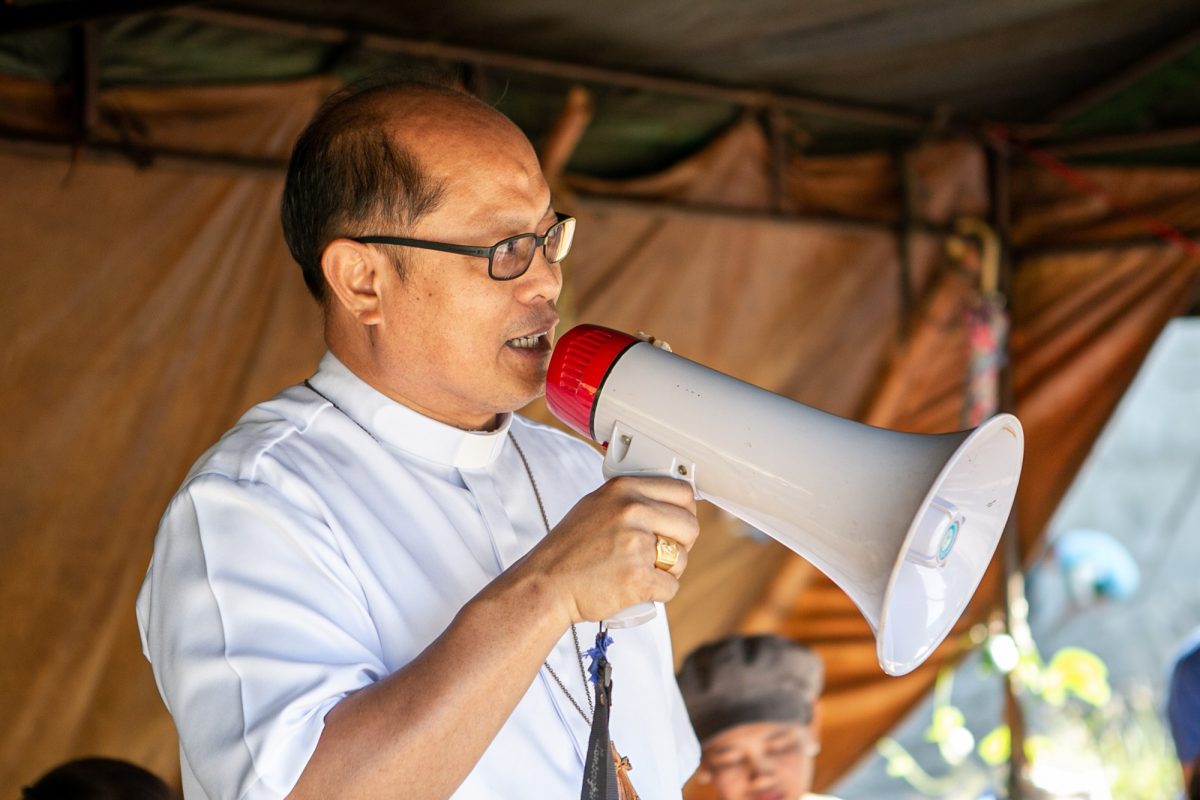
A court in the northern Philippines has dismissed a forcible entry case against a Catholic bishop, a priest, and several community leaders involved in a dispute over a mining exploration project in Nueva Vizcaya province.
Bishop Jose Elmer Mangalinao of Bayombong welcomed the June 24 ruling, which dismissed a complaint linked to barricades established by residents in Kasibu town against exploration activities by North Luzon Mineral Resources Corporation (NLMRC).
“This outcome is not only a legal victory. It is a victory for truth, justice, and the collective efforts of communities who courageously stand to protect our land, water, and future generations,” Mangalinao said in a statement.
The complaint named Mangalinao, Father Christian Dumangeng, and several community leaders allegedly involved in maintaining the barricades. The case drew national attention after a Catholic bishop and priest were included among the defendants.
The dispute stems from opposition to a 4,456-hectare (11,011 acres) mining exploration project being undertaken by NLMRC in several villages in Kasibu, a municipality in Nueva Vizcaya, a mountainous province on the island of Luzon north of Manila.
Residents, church groups, and some Indigenous leaders have raised concerns about the project’s potential effects on watersheds, local livelihoods, and nearby communities.
Residents established barricades in May to block the movement of fuel, equipment, and mineral samples linked to NLMRC’s exploration activities, according to community groups.
The complaint was filed by Rosario Camma, who identified himself as the overall chieftain of the Bugkalot-Ilongot Indigenous Cultural Communities. Some members of the Bugkalot-Ilongot Indigenous communities have joined opposition to the project, citing concerns about its possible effects on their communities and surrounding resources.
In a nine-page decision obtained by EWTN News, the local court said the plaintiff failed to establish a clear legal right warranting injunctive relief and ruled that it lacked jurisdiction over the action. The court found that the relief sought was more consistent with an injunction case than a forcible entry action.
The decision also cited a certification from the Philippine government’s Indigenous affairs agency stating that the exploration permit area falls outside officially recognized ancestral domain lands. Opponents of the project, however, have argued that the controversy extends beyond ancestral domain claims and includes concerns over environmental impacts and consultation requirements.
The court further held that the complaint sought to stop activities related to the barricades rather than recover possession of property, a key element in forcible entry cases.
Mangalinao has defended his involvement in the issue, saying his presence at the barricades was part of his pastoral responsibility. Earlier this week, he said he visited the communities to celebrate Mass and accompany residents concerned about the future of their land and water sources.
“I went as their bishop to offer the Holy Mass, to pray with them, and to remind them that their concern for the land, the water, and their children’s future is one the Church shares and blesses,” he said.
In his homily on June 21, the prelate said the dispute is an issue of environmental stewardship and concern for communities affected by development projects.
“I could have chosen not to speak up, but if I do not speak up, my sin would be great before God,” he said.
The bishop said the ruling would strengthen continuing efforts to defend the environment and communities affected by extractive projects.
“Let this moment remind us that defending our watersheds, our environment, and our people’s livelihood is not a crime: it is a shared moral responsibility,” he said.
“We believe, as the Church has always taught, that the earth is not ours to exhaust but ours to steward,” he added.
Philippine court dismisses case against bishop involved in mining dispute #Catholic
A court in the northern Philippines has dismissed a forcible entry case against a Catholic bishop, a priest, and several community leaders involved in a dispute over a mining exploration project in Nueva Vizcaya province.
Bishop Jose Elmer Mangalinao of Bayombong welcomed the June 24 ruling, which dismissed a complaint linked to barricades established by residents in Kasibu town against exploration activities by North Luzon Mineral Resources Corporation (NLMRC).
“This outcome is not only a legal victory. It is a victory for truth, justice, and the collective efforts of communities who courageously stand to protect our land, water, and future generations,” Mangalinao said in a statement.
The complaint named Mangalinao, Father Christian Dumangeng, and several community leaders allegedly involved in maintaining the barricades. The case drew national attention after a Catholic bishop and priest were included among the defendants.
The dispute stems from opposition to a 4,456-hectare (11,011 acres) mining exploration project being undertaken by NLMRC in several villages in Kasibu, a municipality in Nueva Vizcaya, a mountainous province on the island of Luzon north of Manila.
Residents, church groups, and some Indigenous leaders have raised concerns about the project’s potential effects on watersheds, local livelihoods, and nearby communities.
Residents established barricades in May to block the movement of fuel, equipment, and mineral samples linked to NLMRC’s exploration activities, according to community groups.
The complaint was filed by Rosario Camma, who identified himself as the overall chieftain of the Bugkalot-Ilongot Indigenous Cultural Communities. Some members of the Bugkalot-Ilongot Indigenous communities have joined opposition to the project, citing concerns about its possible effects on their communities and surrounding resources.
In a nine-page decision obtained by EWTN News, the local court said the plaintiff failed to establish a clear legal right warranting injunctive relief and ruled that it lacked jurisdiction over the action. The court found that the relief sought was more consistent with an injunction case than a forcible entry action.
The decision also cited a certification from the Philippine government’s Indigenous affairs agency stating that the exploration permit area falls outside officially recognized ancestral domain lands. Opponents of the project, however, have argued that the controversy extends beyond ancestral domain claims and includes concerns over environmental impacts and consultation requirements.
The court further held that the complaint sought to stop activities related to the barricades rather than recover possession of property, a key element in forcible entry cases.
Mangalinao has defended his involvement in the issue, saying his presence at the barricades was part of his pastoral responsibility. Earlier this week, he said he visited the communities to celebrate Mass and accompany residents concerned about the future of their land and water sources.
“I went as their bishop to offer the Holy Mass, to pray with them, and to remind them that their concern for the land, the water, and their children’s future is one the Church shares and blesses,” he said.
In his homily on June 21, the prelate said the dispute is an issue of environmental stewardship and concern for communities affected by development projects.
“I could have chosen not to speak up, but if I do not speak up, my sin would be great before God,” he said.
The bishop said the ruling would strengthen continuing efforts to defend the environment and communities affected by extractive projects.
“Let this moment remind us that defending our watersheds, our environment, and our people’s livelihood is not a crime: it is a shared moral responsibility,” he said.
“We believe, as the Church has always taught, that the earth is not ours to exhaust but ours to steward,” he added.