![4 Venezuelans form new community of hermits where Christianity began in Spain #Catholic Since last May, the Diocese of Guadix in Spain has been home to a new community of hermits — four Venezuelan men who have settled at the site of the martyrdom of St. Torquatus.St. Torquatus, beheaded in the first century, was one of the seven reputed disciples of the apostle James, known as the apostolic men, who were the first to preach Christianity in Spain.Carlos Andrés, Óscar Eduardo, Osmar Moisés, and Emilio José have taken up residence at Face Retama, a desert area within the Granada Geopark and the location of the hermitage of St. Torquatus, the patron saint of the Diocese of Guadix.The four Venezuelans have formed a community known as the Hermits of Sts. Torquatus, Martha, Mary, and Lazarus, receiving their habits in early May.According to the Diocese of Guadix, this diocesan foundation was established through the efforts of Bishop Francisco Jesús Orozco, who wants to ensure that the diocese “keep[s] the memory of the place alive and pray[s] for the Church proclaimed by St. Torquatus in the first century and that endures to this day.”In recent years, the hermitage of Face Retama has been restored and designated a diocesan shrine, with plans for regular Masses and pilgrimages.The four new hermits have been preparing for their arrival for three years and, prior to establishing the community, underwent a period of acclimatization to the location.“They arrive guided by and inspired by the charism of the Congregation of Martha and Mary, which already has two communities of women religious in the diocese, one in Castril and the other in the city of Guadix,” the diocese explained.The ceremony consecrating the four men as hermits held at the Guadix Cathedral was attended by numerous religious sisters from this community, including its founder, Mother Ángela, and the superior general, Mother Rutilia.Signs of their commitment as hermitsSeveral signs of the new communityʼs eremitic life were present during the celebration: a white tablecloth, recalling the table Martha prepared for Jesus, the purity of Lazarus’s resurrection, and the Eucharist they will celebrate daily; a cross with its nails, a symbol of the self-offering of the family of Martha, Mary, and Lazarus, “seeking nothing other than to unite with the sufferings of Christ in order to share in his glory”; and a staff, a water gourd, and sandals, reminding that “the hermit through his seclusion upholds the mission of the Church through prayer.”During the homily, Orozco reminded the newly consecrated men of their new commitments: “In the perpetual adoration of the Blessed Sacrament, you will be the beating heart of our diocese, interceding ceaselessly for the needs of the Church and, very especially, for the needs of our Holy Father, the pope.”He also reminded them that their new way of life “is not a flight from the world. It is much more; it is personal intimacy with Christ.”“In the desert of Face Retama you will never be alone. Where a Christian or where a hermit lives, he gives himself, suffers, makes sacrifices, and lives in fidelity to prayer and contemplation; there the entire Church is with him. That is the desert, that is your vocation,” he continued.“In you, dear hermits, we place our rich history of 21 centuries of faith; may Face Retama, through your fidelity, be heaven on Earth,” the bishop told them.This story was first published by ACI Prensa, the Spanish-language sister service of EWTN News. It has been translated and adapted by EWTN News English.](https://unitedyam.com/wp-content/uploads/2026/06/4-venezuelans-form-new-community-of-hermits-where-christianity-began-in-spain-catholic-since-last-may-the-diocese-of-guadix-in-spain-has-been-home-to-a-new-community-of-hermits-four-venezu.webp "4 Venezuelans form new community of hermits where Christianity began in Spain #Catholic Since last May, the Diocese of Guadix in Spain has been home to a new community of hermits — four Venezuelan men who have settled at the site of the martyrdom of St. Torquatus.St. Torquatus, beheaded in the first century, was one of the seven reputed disciples of the apostle James, known as the apostolic men, who were the first to preach Christianity in Spain.Carlos Andrés, Óscar Eduardo, Osmar Moisés, and Emilio José have taken up residence at Face Retama, a desert area within the Granada Geopark and the location of the hermitage of St. Torquatus, the patron saint of the Diocese of Guadix.The four Venezuelans have formed a community known as the Hermits of Sts. Torquatus, Martha, Mary, and Lazarus, receiving their habits in early May.According to the Diocese of Guadix, this diocesan foundation was established through the efforts of Bishop Francisco Jesús Orozco, who wants to ensure that the diocese “keep[s] the memory of the place alive and pray[s] for the Church proclaimed by St. Torquatus in the first century and that endures to this day.”In recent years, the hermitage of Face Retama has been restored and designated a diocesan shrine, with plans for regular Masses and pilgrimages.The four new hermits have been preparing for their arrival for three years and, prior to establishing the community, underwent a period of acclimatization to the location.“They arrive guided by and inspired by the charism of the Congregation of Martha and Mary, which already has two communities of women religious in the diocese, one in Castril and the other in the city of Guadix,” the diocese explained.The ceremony consecrating the four men as hermits held at the Guadix Cathedral was attended by numerous religious sisters from this community, including its founder, Mother Ángela, and the superior general, Mother Rutilia.Signs of their commitment as hermitsSeveral signs of the new communityʼs eremitic life were present during the celebration: a white tablecloth, recalling the table Martha prepared for Jesus, the purity of Lazarus’s resurrection, and the Eucharist they will celebrate daily; a cross with its nails, a symbol of the self-offering of the family of Martha, Mary, and Lazarus, “seeking nothing other than to unite with the sufferings of Christ in order to share in his glory”; and a staff, a water gourd, and sandals, reminding that “the hermit through his seclusion upholds the mission of the Church through prayer.”During the homily, Orozco reminded the newly consecrated men of their new commitments: “In the perpetual adoration of the Blessed Sacrament, you will be the beating heart of our diocese, interceding ceaselessly for the needs of the Church and, very especially, for the needs of our Holy Father, the pope.”He also reminded them that their new way of life “is not a flight from the world. It is much more; it is personal intimacy with Christ.”“In the desert of Face Retama you will never be alone. Where a Christian or where a hermit lives, he gives himself, suffers, makes sacrifices, and lives in fidelity to prayer and contemplation; there the entire Church is with him. That is the desert, that is your vocation,” he continued.“In you, dear hermits, we place our rich history of 21 centuries of faith; may Face Retama, through your fidelity, be heaven on Earth,” the bishop told them.This story was first published by ACI Prensa, the Spanish-language sister service of EWTN News. It has been translated and adapted by EWTN News English.")
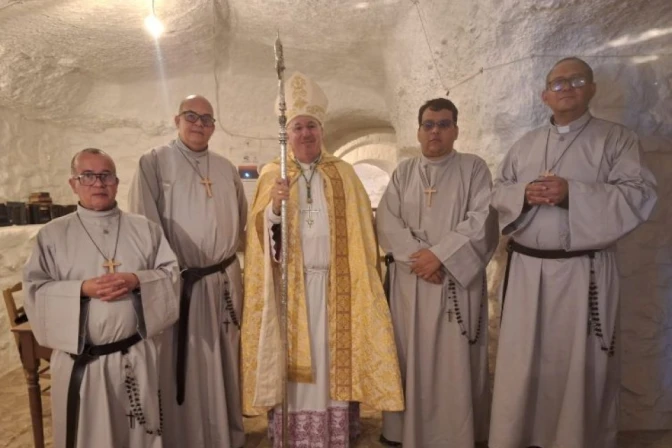
Since last May, the Diocese of Guadix in Spain has been home to a new community of hermits — four Venezuelan men who have settled at the site of the martyrdom of St. Torquatus.
St. Torquatus, beheaded in the first century, was one of the seven reputed disciples of the apostle James, known as the apostolic men, who were the first to preach Christianity in Spain.
Carlos Andrés, Óscar Eduardo, Osmar Moisés, and Emilio José have taken up residence at Face Retama, a desert area within the Granada Geopark and the location of the hermitage of St. Torquatus, the patron saint of the Diocese of Guadix.
The four Venezuelans have formed a community known as the Hermits of Sts. Torquatus, Martha, Mary, and Lazarus, receiving their habits in early May.
According to the Diocese of Guadix, this diocesan foundation was established through the efforts of Bishop Francisco Jesús Orozco, who wants to ensure that the diocese “keep[s] the memory of the place alive and pray[s] for the Church proclaimed by St. Torquatus in the first century and that endures to this day.”
In recent years, the hermitage of Face Retama has been restored and designated a diocesan shrine, with plans for regular Masses and pilgrimages.
The four new hermits have been preparing for their arrival for three years and, prior to establishing the community, underwent a period of acclimatization to the location.
“They arrive guided by and inspired by the charism of the Congregation of Martha and Mary, which already has two communities of women religious in the diocese, one in Castril and the other in the city of Guadix,” the diocese explained.
The ceremony consecrating the four men as hermits held at the Guadix Cathedral was attended by numerous religious sisters from this community, including its founder, Mother Ángela, and the superior general, Mother Rutilia.
Signs of their commitment as hermits
Several signs of the new communityʼs eremitic life were present during the celebration: a white tablecloth, recalling the table Martha prepared for Jesus, the purity of Lazarus’s resurrection, and the Eucharist they will celebrate daily; a cross with its nails, a symbol of the self-offering of the family of Martha, Mary, and Lazarus, “seeking nothing other than to unite with the sufferings of Christ in order to share in his glory”; and a staff, a water gourd, and sandals, reminding that “the hermit through his seclusion upholds the mission of the Church through prayer.”
During the homily, Orozco reminded the newly consecrated men of their new commitments: “In the perpetual adoration of the Blessed Sacrament, you will be the beating heart of our diocese, interceding ceaselessly for the needs of the Church and, very especially, for the needs of our Holy Father, the pope.”
He also reminded them that their new way of life “is not a flight from the world. It is much more; it is personal intimacy with Christ.”
“In the desert of Face Retama you will never be alone. Where a Christian or where a hermit lives, he gives himself, suffers, makes sacrifices, and lives in fidelity to prayer and contemplation; there the entire Church is with him. That is the desert, that is your vocation,” he continued.
“In you, dear hermits, we place our rich history of 21 centuries of faith; may Face Retama, through your fidelity, be heaven on Earth,” the bishop told them.
This story was first published by ACI Prensa, the Spanish-language sister service of EWTN News. It has been translated and adapted by EWTN News English.
4 Venezuelans form new community of hermits where Christianity began in Spain #Catholic
Since last May, the Diocese of Guadix in Spain has been home to a new community of hermits — four Venezuelan men who have settled at the site of the martyrdom of St. Torquatus.
St. Torquatus, beheaded in the first century, was one of the seven reputed disciples of the apostle James, known as the apostolic men, who were the first to preach Christianity in Spain.
Carlos Andrés, Óscar Eduardo, Osmar Moisés, and Emilio José have taken up residence at Face Retama, a desert area within the Granada Geopark and the location of the hermitage of St. Torquatus, the patron saint of the Diocese of Guadix.
The four Venezuelans have formed a community known as the Hermits of Sts. Torquatus, Martha, Mary, and Lazarus, receiving their habits in early May.
According to the Diocese of Guadix, this diocesan foundation was established through the efforts of Bishop Francisco Jesús Orozco, who wants to ensure that the diocese “keep[s] the memory of the place alive and pray[s] for the Church proclaimed by St. Torquatus in the first century and that endures to this day.”
In recent years, the hermitage of Face Retama has been restored and designated a diocesan shrine, with plans for regular Masses and pilgrimages.
The four new hermits have been preparing for their arrival for three years and, prior to establishing the community, underwent a period of acclimatization to the location.
“They arrive guided by and inspired by the charism of the Congregation of Martha and Mary, which already has two communities of women religious in the diocese, one in Castril and the other in the city of Guadix,” the diocese explained.
The ceremony consecrating the four men as hermits held at the Guadix Cathedral was attended by numerous religious sisters from this community, including its founder, Mother Ángela, and the superior general, Mother Rutilia.
Signs of their commitment as hermits
Several signs of the new communityʼs eremitic life were present during the celebration: a white tablecloth, recalling the table Martha prepared for Jesus, the purity of Lazarus’s resurrection, and the Eucharist they will celebrate daily; a cross with its nails, a symbol of the self-offering of the family of Martha, Mary, and Lazarus, “seeking nothing other than to unite with the sufferings of Christ in order to share in his glory”; and a staff, a water gourd, and sandals, reminding that “the hermit through his seclusion upholds the mission of the Church through prayer.”
During the homily, Orozco reminded the newly consecrated men of their new commitments: “In the perpetual adoration of the Blessed Sacrament, you will be the beating heart of our diocese, interceding ceaselessly for the needs of the Church and, very especially, for the needs of our Holy Father, the pope.”
He also reminded them that their new way of life “is not a flight from the world. It is much more; it is personal intimacy with Christ.”
“In the desert of Face Retama you will never be alone. Where a Christian or where a hermit lives, he gives himself, suffers, makes sacrifices, and lives in fidelity to prayer and contemplation; there the entire Church is with him. That is the desert, that is your vocation,” he continued.
“In you, dear hermits, we place our rich history of 21 centuries of faith; may Face Retama, through your fidelity, be heaven on Earth,” the bishop told them.
This story was first published by ACI Prensa, the Spanish-language sister service of EWTN News. It has been translated and adapted by EWTN News English.